Japan pushes forward with plans to dump radioactive water into ocean, despite public opposition
Tokyo may dump contaminated water as early as September
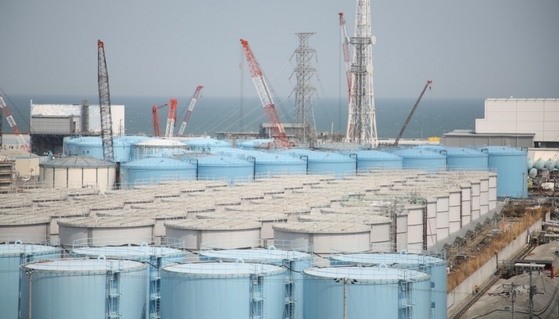
 Storage tanks for water contaminated with radioactive matter from the Fukushima Daiichi Nuclear Power Plant.
Aug.17,2020
During the past three months, while the international community was focused on the COVID-19 pandemic, the Japanese government has held five public hearings as it moves forward with its decision to dump radioactive water from the Fukushima nuclear disaster into the ocean. After analyzing the transcripts and videos from the hearings, the Hankyoreh has concluded that the Japanese government will probably decide to dump the water as early as September or October, despite overwhelming public opposition to the plan, even in Japan. Since a study has found that the contaminated water could reach the eastern coast of South Korea within a year of being dumped, international groups focusing on the environment and experts in international law are calling for the South Korean government to take preemptive action in the area of international law.
Following an explosion during the 2011 Tohoku earthquake, the Fukushima Daiichi nuclear power plant was closed and is being decommissioned, a process that has taken nine years so far. But debate continues about how to deal with the growing volume of water contaminated with radioactivity, including the water used to cool the nuclear fuel and rainwater and groundwater that have seeped into the buildings. The contaminated water is currently being stored in tanks, but by the summer of 2022, the Japanese government says, the tanks will run out of space, necessitating the water’s release into the ocean.
The Japanese government, under Prime Minister Shinzo Abe, held video hearings about how to deal with the contaminated water on Apr. 6, Apr. 13, May 11, June 30, and July 17. These hearings were attended not only by representatives from the fishing, agriculture, and hospitality businesses and community leaders from Fukushima Prefecture but also the national tourist council and groups representing businesses and consumers. The government was represented by officials from 10 or so ministries, including the Ministry of Economy, Trade, and Industry, the Ministry of the Environment, and the Ministry of Foreign Affairs.
Radioactive matter detected in water even after decontamination
While reviewing the hearings, the Hankyoreh learned that radioactive matter has been detected even following decontamination efforts, that releasing the water would likely cement Fukushima’s stigma as an area tainted with radioactivity and have a serious impact on the fishing industry, and that there was widespread opposition to the idea among hearing attendees, who argued that the final decision shouldn’t be made until public opinion has been canvassed.
An August 2019 report by international environmental group Greenpeace about the contaminated water at Fukushima found that the water, once released, would flow through the East China Sea and be brought via the Kuroshio Current and the Tsushima Current to South Korea’s eastern shore within a year. Disregarding the concerns of the international community, the Japanese government released a draft of a plan this past March to dump the contaminated water at Fukushima into the ocean over the course of 30 years. Given the plan’s schedule, which involves the construction of a facility to dilute the contaminated water, its decision will likely be made by this October. Abe told the press in an interview in March that he wants to finalize a plan as quickly as possible.
The Japanese government intends to make its final decision after canvassing the opinions of Fukushima residents, related organizations, and ordinary citizens. But even in the Japanese public, there’s fierce opposition to dumping the contaminated water. The Hankyoreh’s analysis of the transcripts and videos from the five hearings show that most of the 37 participants were concerned about the plan to release the water.
“It’s human nature to avoid radioactive materials. It’s a serious problem that there’s still radioactivity even in the decontaminated water, which contradicts what TEPCO [Tokyo Electric Power Company] initially said,” said Hidenori Koito, the director of a trade association for the hospitality industry in Fukushima Prefecture.
80% of water contains radioactive matter beyond permissible levels
TEPCO claimed to have filtered out 62 kinds of radioactive material through the Advanced Liquid Processing System (ALPS) and all that’s left is tritium, which is technically difficult to remove from the contaminated water in the tanks. But a 2018 study found that 80% of the water processed using ALPS still contained more than the permitted level of radioactive matter that is deadly to the human body, including cesium, strontium, and iodine. While TEPCO has emphasized that it would decontaminate the water once more to ensure its safety prior to release, distrust has already surged.
Another criticism is that dumping the water would spoil the nine-year campaign by Fukushima residents to repair the area’s reputation. “If the contaminated water is released into the ocean, people will inevitably think there’s another radiation leak at Fukushima, given the nuclear accident that occurred there,” said Kimio Akimoto, president of a coalition of forestry associations in the prefecture.
Vehement opposition from fishermen
An even sterner stance was taken by fishermen, who depend upon the ocean for their livelihood. “It’s unacceptable for radioactive matter to be deliberately pumped into the ocean,” said Tetsu Nozaki, president of a coalition of fishery cooperatives in Fukushima Prefecture. The national coalition of fishery cooperatives voted on July 23 to “oppose” the planned release of contaminated water.
There are also concerns that the government is rushing the plan. “The Japanese public doesn’t know the details about the contaminated water yet. The final decision shouldn’t be made until people understand what it means to dump contaminated water into the ocean,” said Yuki Urago, secretary-general of a national coalition of consumers’ associations.
“Right now, the Japanese public is focused on COVID-19. It’s doubtful whether the issue of contaminated water at Fukushima can provoke a national debate in this situation,” said Yuko Endo, mayor of Kawauchi, a village in Fukushima Prefecture.
Japan took an unusually long opinion canvassing period
Before deciding on important policies, the Japanese government has a practice of canvassing opinions, a process known as the “public comment” period. The relevant ministry here, the Ministry of Economy, Trade, and Industry, began collecting comments on Apr. 6 and took the unusual step of extending that period three times, only wrapping it up at the end of last month. One reason the government may have extended the comment period is because of the overwhelming opposition to releasing the contaminated water into the ocean.
Last month, the UN Human Rights Council released a statement expressing “deep concerns” about “a report indicating that the Japanese government is accelerating its timeframe for releasing water contaminated with radioactivity at Fukushima.” South Korea, given its proximity to Japan and the ocean, has set up a government-wide task force under the Office of the Prime Minister to keep tabs on the Japanese government’s actions.
“We’re asking Japan to share adequate information while it’s processing the contaminated water at the Fukushima nuclear plant. We’re monitoring the situation from various angles to see what impact this will have on us,” explained an official from South Korea’s Ministry of Foreign Affairs.
By Kim So-youn, staff reporter
http://english.hani.co.kr/arti/english_edition/e_international/958099.html
Fukushima’s Contaminated Wastewater Could Be Too Risky to Dump in the Ocean
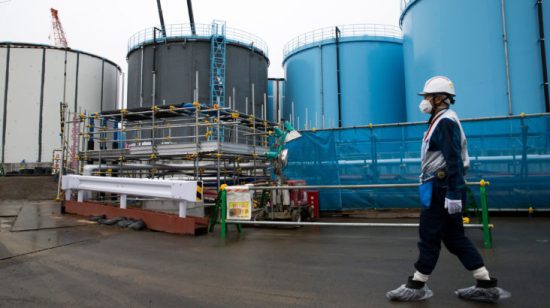 A person walks past storage tanks for contaminated water at the company’s Fukushima Daiichi Nuclear Power Plant
August 7, 2020
Almost a decade ago, the Tohoku-oki earthquake and tsunami triggered an explosion at Japan’s Fukushima Daiichi Nuclear Power Plant, causing the most severe nuclear accident since Chernobyl and releasing an unprecedented amount of radioactive contamination in the ocean. In the years since, there’s been a drawn out cleanup process, and water radiation levels around the plant have fallen to safe levels everywhere except for in the areas closest to the now-closed plant. But as a study from the Woods Hole Oceanographic Institution published in Science on Thursday shows, there’s another growing hazard: contaminated wastewater.
Radioactive cooling water is leaking out of the the melted-down nuclear reactors and mixing with the groundwater there. In order to prevent the groundwater from leaking into the ocean, the water is pumped into more than 1,000 tanks. Using sophisticated cleaning processes, workers have been able to remove some of this contamination and divert groundwater flows, reducing the amount of water that must be collected each day. But those tanks are filling up, and some Japanese officials have suggested that the water should dumped into the ocean to free up space.
The water in the tanks goes through an advanced treatment system to remove many radioactive isotopes. The Japanese utility company TEPCO, which is handling the cleanup processes, claims that these processes remove all radioactive particles from the water except tritium, an isotope of hydrogen which is nearly impossible remove but is considered to be relatively harmless. It decays in about 12 years, which is faster than other isotopes, is not easily absorbed by marine life, and is not as damaging to living tissue as other forms of radiation.
But according to the new study, that’s not the only radioactive contaminant left in the tanks. By examining TEPCO’s own 2018 data, WHOI researcher Ken Buesseler found that other isotopes remain in the treated wastewater, including carbon-14, cobalt-60, and strontium-90. He found these particles all take much longer to decay than tritium, and that fish and marine organisms absorb them comparatively easily.
“[This] means they could be potentially hazardous to humans and the environment for much longer and in more complex ways than tritium,” the study says.
Though TEPCO’s data shows there is far less of these contaminants in the wastewater tanks than tritium, Buesseler notes that their levels vary widely from tank to tank, and that “more than 70% of the tanks would need secondary treatment to reduce concentrations below that required by law for their release.”
The study says we don’t currently have a good idea of how those more dangerous isotopes would behave in the water. We can’t assume they will behave the same way tritium does in the ocean because they have such different properties. And since there are different levels of each isotope in each different tank, each tank will need its own assessment.
“To assess the consequences of the tank releases, a full accounting after any secondary treatments of what isotopes are left in each tank is needed,” the study said.
Buesseler also calls for an analysis of what other contaminants could be in the tanks, such as plutonium. Even though it wasn’t reported in high amounts in the atmosphere in 2011, recent research shows it may have been dispersed when the explosion occurred. Buesseler fears it may also be present in the cooling waters being used at the plant. That points to the need to take a fuller account of the wastewater tanks before anything is done to dump them in the ocean.
“The first step is to clean up those additional radioactive contaminants that remain in the tanks, and then make plans based on what remains,” he said in a statement. “Any option that involves ocean releases would need independent groups keeping track of all of the potential contaminants in seawater, the seafloor, and marine life.”
Many Japanese municipalities have been pushing the government to reconsider its ocean dumping plans and opt to find a long-term storage solution instead, which makes sense, considering exposure to radioactive isotopes can cause myriad health problems to people. It could also hurt marine life, which could have a devastating impact on fishing economies and on ecosystems.
“The health of the ocean — and the livelihoods of countless people — rely on this being done right,” said Buesseler.
Japan’s plans for radioactive discharges violates principles of environmental protection and defies international maritime law
Aug.4,2020
The threat of a million tonnes of highly contaminated water from the Fukushima Daiichi being discharged into the Pacific Ocean includes the potential environmental and human impacts, but also how a decision by the Japanese government relates to international law. What we conclude is that such a decision poses a direct threat to the marine environment, including that of the jurisdictional waters of the Korean peninsula. As such, Japan would be in breach of its obligations as defined under international environmental law, including the United Nations Convention on the Law of the Sea (UNCLOS) that Korea government has rights to oppose the discharging in the legal perspective.
The discharge of radioactivity into the marine environment from Fukushima Daiichi nuclear plant will inevitably increase exposure to marine species. The level of exposure depends on multiple variables. The concentrations are of direct relevance to those who may consume them, including marine species, ultimately, humans. The 1.2 million tons of highly contaminated water in nearly 1000 storage tanks at the Fukushima Daiichi nuclear plant currently has concentrations of radioactive tritium much higher than is permitted under Japanese regulation permissible for discharge into the ocean. Concerns are that the high relative biological effectiveness (RBE) of tritium’s beta radiation, its ability to bind with cell constituents to form organically-bound tritium (OBT) and its short-range beta particle, meaning it can damage DNA.
It is more important to remember that 800,000 tons of this water contains not only tritium but also contains other hazardous radioactive materials, including strontium-90, as a result of the failure of the Advanced Liquid Processing System (ALPS) technology operating during the last 9 years. There are 30,000 megaBecquerels of strontium-90 in the storage now which is absorbed by the body in a similar manner to calcium where it increases the risk of developing leukemia cancer. To give some perspective on this amount of strontium-90, it is what an average Pressurized Water Reactor would discharge in its liquid waste every year if it were to operate for 120,000 years, more than half the number of years humans have inhabited the earth. Even more threatening is that these discharges are only a small fraction of the radioactive inventory of what remains at the site. Most strontium-90 still remains in the molten cores at the site, an amount 17.3 million times more than would be released under the Japanese government’s plans for the contaminated water. And there are many other radionuclides present in the contaminated water with even longer half lives – iodine-129 for example is 13 million years.
For South Korea, the impacts of this radiation exposure is of great importance to the fishing communities, the wider population and the Government. The toxic cocktail of radionuclides from Fukushima Daiichi will rapidly disperse through the strong coastal currents along Japan’s Pacific coast, and would enter the East Sea via the East China Sea, including the waters of the Korean peninsula. We know this as a result of sea water sampling following the March 2011 nuclear disaster.
The South Korean government has rightly challenged the Japanese government over its plans for the Fukushima contaminated water, including at the UN International Maritime Organization (IMO). In November 2019 at the IMO they were joined in their opposition by the People’s Republic of China. While the Japanese government is looking to make a decision later this year the actual discharges would not take place for several more years. It is vitally important that the Korean government continue its efforts to protect the marine environment and the health and livelihoods of its citizens, including fishing communities, by challenging in every way possible the plans of the Japanese government.
 Shaun Burnie
In addition to the requirements under the IMO, Japan is required to comply with international law that prohibits significant transboundary environmental harm, both to the territory of other States and to areas beyond national jurisdiction. Before any discharge into the Pacific Ocean, Japan is required to conduct an Environment Impact Assessment under Article 206 of UNCLOS. International radio-protection principles require that a decision to increase radioactivity in the environment must be justified, and if there is a viable alternative – in this case long term storage – it cannot be justified.
There is a clear alternative to discharging over 1.2 million tons of highly contaminated into the environment. There never was a justification for further deliberate radioactive pollution of the marine environment from Fukushima Daiichi; and, in the interests of protection of that environment as well as public safety, as well a compliance with its international legal obligations, the only acceptable way forward for the Japanese government is to terminate its discharge plans, commit to long term storage and processing.
 Duncan E. J. Currie
By Duncan E. J. Currie and Shaun Burnie
Duncan Currie is a practicing international and environmental lawyer. He has practiced international law and environmental law for nearly thirty years, and over that time has advised NGOs, corporations and governments on a wide range of environmental issues including the law of the sea, nuclear and waste issues.
Shaun Burnie is a senior nuclear specialist with Greenpeace Germany, with much of his time based in Japan. He has worked on nuclear issues in Asia, the former Soviet Union, Europe, North and South America and the Middle East for 35 years. He has worked against the operation of the TEPCO Fukushima Daiichi reactors since 1997.
http://english.hani.co.kr/arti/english_edition/english_editorials/956456.html
Japan needs to halt its plan to dump contaminated water from Fukushima immediately
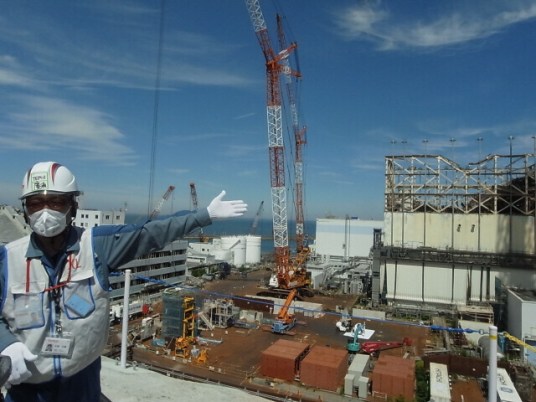 A TEPCO employee tells reporters about the Fukushima Daiichi Nuclear Power Plant in June 2017.
Aug.4,2020
With the world’s attention focused on the COVID-19 pandemic, the Japanese government has been pushing forward with its preparations to dump contaminated water from the Fukushima Daiichi Nuclear Power Plant into the ocean. After first announcing an initial plan last March for discharging the water into the sea over a period of 30 years, the Shinzo Abe administration held five hearings between April and July, with a final decision on the dump reportedly likely to come within the month of October. The Abe administration has disregarded the concerns and opposition of local residents and the international community while pursuing a measure that will cause irreversible contamination to our oceans. It must stop immediately.
In a recent hearing, Fukushima residents and fishermen voiced strong opposition to dumping radioactive water into the ocean, a plan that they labeled “unacceptable.” The position of the Japanese government is that the storage tanks that have held contaminated rainwater and groundwater since the nuclear accident will run out of room in the summer of 2022, forcing an ocean dump. But civic groups have criticized the government for attempting to ram through its dumping plan as the cheapest option, even though more tanks could be safely installed after re-zoning large tracts of land around the Fukushima reactor.
The Tokyo Electric Power Company (TEPCO), the operator of the reactor, argues that all radioactive matter but tritium has been removed from the contaminated water in the tanks through purification based on the Advanced Liquid Processing System (ALPS). TEPCO argues that the tritium that would be released along with the contaminated water is no worse than the tritium that’s already released into the ocean and atmosphere during the operation of nuclear reactors around the world. But the 1.2 million tons of contaminated water that TEPCO claims has been “processed” still contains between 100 and 20,000 times the permitted amount of cancer- and mutation-causing matter, according to international environmental group Greenpeace.
According to Greenpeace’s analysis, contaminated water from the reactor, once released into the ocean, would be carried by ocean currents to South Korea’s east coast within a year. Exposing the east coast to water contaminated with deadly radioactivity for 30 years would present a serious threat to the maritime ecosystem and to public health. The UN Human Rights Council released a statement in June expressing grave concern about reports indicating that the Japanese government is accelerating plans to dump radioactive water from Fukushima.
The Korean government has set up a task force under the Office of the Prime Minister to track the steps taken by the Japanese government, but it needs to ask for more information and work even harder to sound the alarm in the international community. As a neighbor, Korea has every right to raise the issue with the Japanese government. Seoul needs to press the issue, both in Tokyo and in other countries, for the sake of Koreans’ health and the future of East Asia.
http://english.hani.co.kr/arti/english_edition/english_editorials/956441.html
Robot to use brush to retrieve melted fuel at Fukushima plant
 The robotic arm to be used for collecting melted fuel at the No. 2 reactor of the Fukushima No. 1 nuclear power plant (Provided by the International Research Institute for Nuclear Decommissioning)
 A vacuum vessel to collect powdered nuclear debris (Provided by the International Research Institute for Nuclear Decommissioning)
July 27, 2020
FUKUSHIMA–A robotic arm under development in Britain will use a brush and vacuum vessel on its end to collect melted fuel in a step toward retrieving debris at the crippled Fukushima No. 1 nuclear power plant.
Details of the device, which will start collecting debris inside the No. 2 reactor on a trial basis next year, were announced on July 2.
The government and plant operator Tokyo Electric Power Co. plan to retrieve melted fuel at the No. 2 reactor ahead of two other reactors because radiation levels are relatively low.
The No. 2 reactor, along with the No. 1 and No. 3 reactors, suffered meltdowns following the Great East Japan Earthquake and tsunami in 2011.
The situation inside the No. 2 reactor is relatively known through past inspections. It has been confirmed that apparent debris in the lower part of its containment vessel can be collected with a robot.
Measuring 22 meters long and weighing 4.6 tons, the robotic arm will be made of high-strength stainless steel so it will not bend when stretched out.
It will be inserted into a closed box connected to a hole made on the side of the containment vessel and remotely operated to prevent radioactive substances from being released.
The arm will attach powdered nuclear debris to its brush and also suck the debris with its vacuum vessel.
Under the plan, debris totaling approximately 1 gram or so will be collected in each of the several rounds of the trial procedure.
An experiment will start in Britain as early as August with the use of a model of the containment vessel.
The robotic arm will be transported to Japan around February for the training of operators at the Japan Atomic Energy Agency’s facility in Naraha, Fukushima Prefecture.
The retrieved fuel will be measured for weight and radiation levels, put in a metal transfer vessel and moved to an analysis center in Ibaraki Prefecture.
In the full-scale retrieval stage, different equipment will be used.
Melted fuel to be removed is estimated to record a radiation reading of 6 millisieverts per hour even at distances of 20 centimeters from it.
That means the annual dose limit for ordinary individuals of 1 millisievert will be reached in 10 minutes.
Training is expected to reduce the time required for workers to put debris into the transfer vessel near the fuel.
Other measures to lessen workers’ doses will be taken, such as introducing panels to block radiation.
Plutonium Particles Scattered 200km From Fukushima Nuclear Disaster Site, Scientists Say
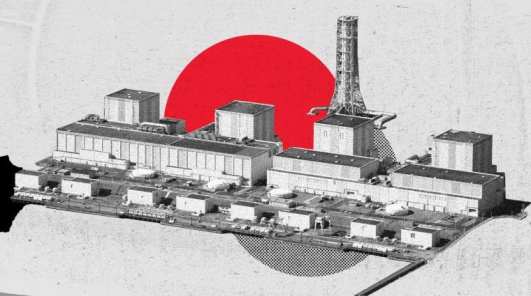
Jul 22, 2020
Plutonium fragments may have spread more than 200km via caesium microparticle compounds released during the 2011 Fukushima Daiichi nuclear power plant disaster in Japan. These findings are according to research done on the region’s soil samples, published in Science of The Total Environment, by an international group of scientists.
The Fukushima Nuclear disaster occurred when a massive tsunami crashed over the plant’s walls, causing three operating nuclear reactors to overheat and melt down. Simultaneously, reactions within the plant generated hydrogen gas that exploded as soon as it escaped from containment. During the disaster, caesium — a volatile fission product created in nuclear fuel — combined with other reactor materials to create caesium-rich microparticles (CsMPs) that were ejected from the plant.
CsMPs are incredibly radioactive, and scientists study them in an attempt to both measure their environmental impact and to gain insight into the nature and extent of the Fukushima disaster. In one such research process, scientists discovered tiny uranium and plutonium fragments within these micro-particles. The range of plutonium particle spread was previously estimated at 50km, and this research changes that number to 230km. This discovery is vital as it provides a reason to extend testing for plutonium poisoning in human-inhabited regions further than before, and helps scientists understand how to decommission the nuclear reactors in the plant. Decommissioning nuclear plants is extremely important after they cease to function, in order to reduce residual radioactivity in the region to safe levels.
With respect to immediate implications for health, scientists note that radioactivity levels of the plutonium are similar to global counts from nuclear weapons tests. While this means that radioactivity levels may not pose an urgent, critical danger, scientists also note that plutonium poisoning in food items remains a threat. If plutonium were ingested — a possibility in this region — it could create isotopes that significantly increase radioactivity doses, and poison the body.
Due to high radioactivity levels, humans are still unable to enter the Fukushima plant nine years after the disaster. Yet, scientists continue to work towards safely decommissioning the reactors within the plant from the outskirts. Though radiation levels post the Fukushima disaster were much lower than Chernobyl, individuals living near the region still suffer from the aftermath of everything the disaster put them through, fear of poisoning and psychological paranoia, as they attempt to bring life back to normal.
Fukushima may have scattered plutonium widely
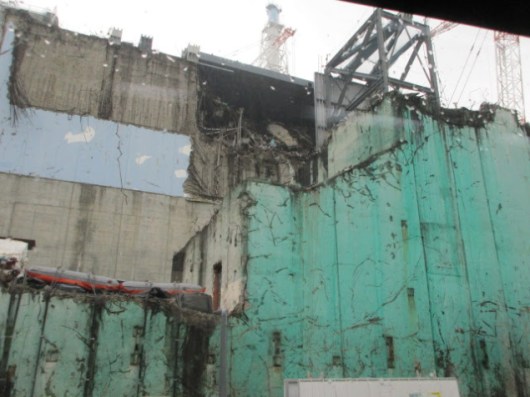 The upper side of the unit 3 reactor building at Fukushima Daiichi was damaged by a hydrogen explosion. This area housed the spent fuel pool and the fuel handling machines.
20 Jul 2020
Tiny fragments of plutonium may have been carried more than 200 km by caesium particles released following the meltdown at the Fukushima Daiichi nuclear power plant in Japan in 2011. So says an international group of scientists that has made detailed studies of soil samples at sites close to the damaged reactors. The researchers say the findings shed new light on conditions inside the sealed-off reactors and should aid the plant’s decommissioning.
The disaster at Fukushima occurred after a magnitude-9 earthquake struck off the north-east coast of Japan and sent a 14 m-high tsunami crashing over the plant’s seawalls. With low-lying back-up generators knocked out, the site’s three operating reactors overheated and melted down. At the same time, hot steam reacted with the zirconium cladding of the nuclear fuel, generating hydrogen gas that exploded when it escaped from containment.
Caesium is a volatile fission product created in nuclear fuel. During the Fukushima meltdown, it combined with silica gas created when melting fuel and other reactor materials interacted with the concrete below the damaged reactor vessel. The resulting glass particles, known as caesium-rich microparticles (CsMPs), measure a few microns or tens of microns across.
Satoshi Utsunomiya and Eitaro Kurihara at Kyushu University and colleagues in Japan, Europe and the US analysed three such particles obtained from soil samples dug up at two sites within a few kilometres of the Fukushima plant. They used a range of techniques to study the physical and chemical composition of these CsMPs, with the aim of establishing whether they contained any plutonium.
Mapping plutonium spread
To date, plutonium from the accident has been detected as far as 50 km from the damaged reactors. Researchers had previously thought that this plutonium, like the caesium, was released after evaporating from the fuel. But the new analysis instead points to some of it having escaped from the stricken plant in particulate form within fragments of fuel “captured” by the CsMPs.
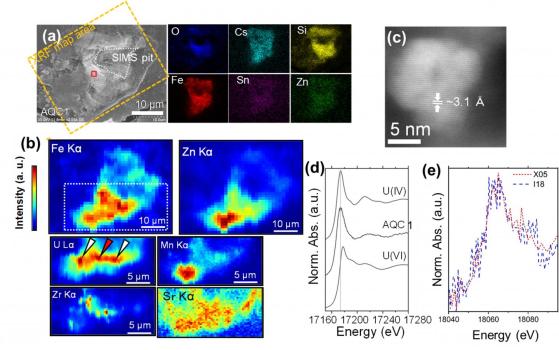
Utsunomiya and colleagues used electron microscopy and synchrotron X-ray fluorescence to look inside the CsMPs. Based on these data, they were able to map the distribution of various elements coming from materials within the damaged reactors – including iron from stainless steel, zirconium and tin from the fuel cladding and zinc from cooling water. They also found uranium within one of the CsMPs, in the form of discrete uranium oxide particles less than 10 nm across.
However, the researchers were unable to find any traces of plutonium using these methods – probably due to interference from strontium, another fission product. Instead, they turned to X-ray absorption. To compensate for high levels of noise, they carried out the measurement at two different synchrotrons, transporting their roughly 20 µm diameter particle from Japan to be blasted with X-rays at the Diamond facility in the UK and the Swiss Light Source in Switzerland.
The researchers focused their attention on the three areas of the particle that generated the most fluorescence from uranium. They failed to detect plutonium at two of these locations, but succeeded at the third, with absorption spectra produced at both synchrotrons indicating the element’s presence. The low signal-to-noise ratio meant they couldn’t identify exactly which plutonium species were present, but the shape of the spectra told them that it probably existed as an oxide, rather than as a pure metal.
Utsunomiya and co-workers also used mass spectrometry to measure the relative abundance of different plutonium and uranium isotopes within the microparticles. They found that three ratios – uranium-235 to uranium-238, as well as plutonium-239 compared to both plutonium-240 and -242 – all agreed with calculations of the proportions that would have been present in the fuel at the time of the disaster. This agreement, coupled with the fact that the measured amount of uranium-238 was nearly two orders of magnitude greater than would be the case if it had simply evaporated from the melted fuel, led them to conclude that the uranium and plutonium existed as discrete fuel particles within the CsMPs.
Implications for decommissioning
The researchers note that previous studies have shown that plutonium and caesium are distributed differently in the extended area around Fukushima, which suggests that not all CsMPs contain plutonium. However, they say that the fact plutonium is found in some of these particles implies that it could have been transported as far afield as the caesium – up to 230 km from the Fukushima plant.
As regards any threat to health, they note that radioactivity levels of the emitted plutonium are comparable with global counts from nuclear weapons tests. Such low concentrations, they say, “may not have significant health effects”, but they add that if the plutonium were ingested, the isotopes that make it up could yield quite high effective doses.
With radiation levels still too high for humans to enter the damaged reactors, the researchers argue that the fuel fragments they have uncovered provide precious direct information on what happened during the meltdown and the current state of the fuel debris. In particular, Utsunomiya points out that the composition of the debris, just like that of normal nuclear fuel, varies on the very smallest scales. This information, he says, will be vital when it comes to decommissioning the reactors safely, given the potential risk of inhaling dust particles containing uranium or plutonium.
The research is reported in Science of the Total Environment.
https://physicsworld.com/a/fukushima-may-have-scattered-plutonium-widely/
Fukushima localities speak out against dumping radioactive water in sea

Storage tanks for radioactive water are seen at Tokyo Electric Power Co’s (TEPCO) tsunami-crippled Fukushima Daiichi nuclear power plant in Okuma town, Fukushima prefecture, Japan February 18, 2019. Picture taken February 18, 2019. REUTERS/Issei Kato
Particulate plutonium released from the Fukushima Daiichi meltdowns
Review: “Fukushima 50” Offers Uncontroversial Take On Japan’s Biggest Nuclear Disaster
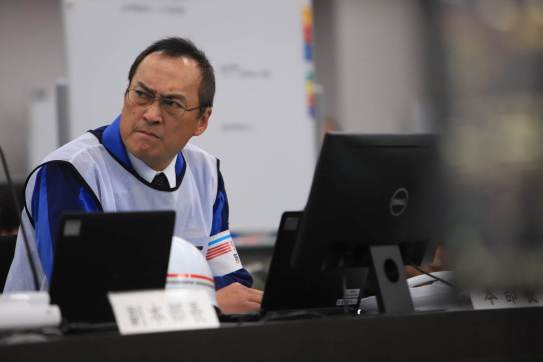 Starring Ken Watanabe, “Fukushima 50” avoids controversy as part of faithfully reflecting Japanese realities around Fukushima Daiichi.
By Anthony Kao, 9 Jul 2020
“3.6 roentgen, not great, not terrible.” So goes the now-famous quip from the American HBO hit series Chernobyl. This line also bears relevance to Fukushima 50—the first blockbuster treatment of the world’s second-worst nuclear disaster at Japan’s Fukushima Daiichi power plant.
Starring A-listers Ken Watanabe and Koichi Sato, the film lionizes the workers who prevented the Fukushima disaster from getting worse, and makes the incident accessible to general audiences. On that count, it’s “not terrible.” However, Fukushima 50 lacks nuance, poignancy, and dramatic value—mostly because it refuses to designate clear villains. In that sense, it’s “not great” either.
While this might mean Fukushima 50 will never gain the international popularity of Chernobyl, the movie is still immensely valuable and intriguing from a historiographical perspective. For better or for worse, its uncontroversial demeanor accurately reflects realities in contemporary Japanese sociopolitical discourse around the Fukushima Daiichi disaster and beyond.
Nuclear Heroism
Fukushima 50 focuses on an eponymous group of employees at the Fukushima Daiichi power plant, who were tasked with managing a triple meltdown that happened in the days after March 2011’s Tohoku earthquake and tsunami. Chief among them are Masao Yoshida (Ken Watanabe) and Toshio Isaki (Koichi Sato), the plant’s site superintendent and shift supervisor, respectively. While Yoshida was a real person, Isaki and all the film’s other characters are fictional composites.
The film offers a play-by-play dramatization of the Fukushima Daiichi disaster, starting from just before the earthquake and continuing through the days afterwards. It alternates between scenes of the stricken plant itself, a seismically sheltered command center, and ancillary locations like the Japanese Prime Minister’s office and even a US military base.
Throughout, we’re treated to a panoply of tough and selfless men. They rush spiritedly into reactor rooms, haul fire hoses, subsist on dry food, and stare steely-eyed into the face of disaster. These are men on the move, men of action—valiant warriors (some literal, as Japan’s Self Defense Forces feature prominently) fighting an invisible enemy. You don’t need a Ph.D. in nuclear engineering to understand Fukushima 50, just a capacity for hero worship and ability to appreciate war movie tropes.
“The Generation That Lived For Others”
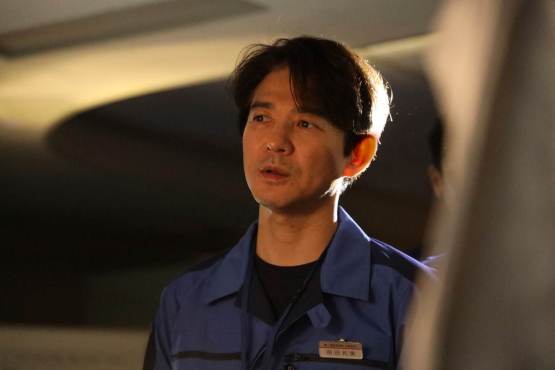
This lionization of the Fukushima Daiichi plant workers isn’t surprising. Fukushima 50 was based on a book called On the Brink: The Inside Story of Fukushima Daiichi, which is available in English. In the book’s foreword, author Ryusho Kadota declares that “this is the story of the people who fought a heroic battle.” Unlike contemporary Japan’s predominantly selfish youth, Kadota argues, the Fukushima 50 are reminiscent of Japan’s WWII veterans, “the generation that lived for others.”
Piggybacking aboard war metaphors restricts Fukushima 50’s capacity for nuance and poignance. Unlike Chernobyl—with its bleak cinematography, bone-chilling use of geiger counter clicks, and soulless evacuation announcements—Fukushima 50 does nothing to convey the trauma and mental toll of disaster. Additionally, for a movie that’s supposed to dramatize a “heroic battle,” Fukushima 50 lacks a compelling villain, even an abstract one. While Chernobyl warns about the cost of lies, Fukushima 50 warns about nothing at all. What caused the disaster? Is nuclear power bad? Should we invest more money in disaster preparedness? Fukushima 50 remains as silent as radiation.
Furthermore, the film barely contains the human tension usually necessary for compelling drama. There are only two notable moments when characters disagree about something: first when the Prime Minister helicopters into Fukushima and delays recovery operations, and second when superintendent Yoshida disobeys the Tokyo Electric Power Company’s (TEPCO) orders and uses seawater to help cool Fukushima Daiichi’s reactors. Even those moments occur so perfunctorily that they don’t give the narrative much added momentum.
Fukushima Historiography
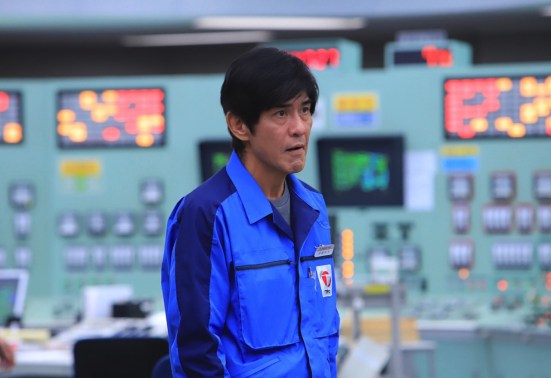
Fukushima 50 might not be the dramatic masterpiece that Chernobyl was, but that doesn’t mean it’s any less valuable from a historical and political perspective. The film’s reluctance to hold anyone accountable and embrace of militaristic sentiment reflects contemporary Japanese realities; in that sense it can serve as an entrypoint for international audiences to build a better understanding of Japan.
Almost a decade on, Japan has not held anybody criminally responsible for the Fukushima Daiichi disaster, and many who had to evacuate because of the meltdowns lack closure. After a brief upsurge following the disaster, Japan’s anti-nuclear movement has fizzled out as well. International and Japanese sources argue that nothing has meaningfully changed in Fukushima’s wake.
All this is despite civil lawsuits, international investigations, and even a report from Japan’s Diet (the national legislature) arguing that the disaster was “man made”—a result of inadequate preparedness and collusion between regulators, government officials, and TEPCO.
Some external analysts argue that moving forward from Fukushima can only come with a comprehensive re-examination of economic and political structures created by decades of effective one-party rule in Japan. While Japan is officially a democracy, the Liberal Democratic Party (LDP) has held power for all but several years after World War II. The LDP remains in power today under Prime Minister Shinzo Abe, with desires to maintain the nuclear status quo whilst separately imbuing Japan with a more militaristic spirit. While Abe’s government wants to make Japan’s economy more agile, a radical rethinking of Japan’s political economy and culture isn’t on the agenda. Perhaps Fukushima 50 is simply a reflection of this reality.
“Not Great, Not Terrible”
When “3.6 roentgen, not great, not terrible” appears in Chernobyl, it comes with the implication of those in power refusing to address a more systemic problem. With this extra lens, the quote seems even more relevant to Fukushima 50. Not only is the movie “not great, not terrible,” but its controversy-avoiding blockbuster treatment also reflects the lack of meaningful change that’s happened after the Fukushima Daiichi disaster.
Critics of this stance might argue that Chernobyl has far more leeway than Fukushima 50 to criticize; it’s easier for an American series that caters to primarily Western audiences to cast doubt on a foreign Soviet system. Yet Chernobyl wasn’t a pure critique of the Soviet Union. The series gained mass acclaim because it skewered contemporary Western societies’ disregard for truth.
While Japan isn’t the most conducive environment for political movies, it’s not incapable of producing movies that reflect upon the past with nuance and poignancy. Just look at Grave of the Fireflies, one of the most renowned examinations of WWII from anywhere in the world.
Alas, Fukushima 50 is no Grave of the Fireflies or Chernobyl, and that’s regrettable given Japan’s historical moviemaking prowess.
Japanese audiences might still be able to enjoy Fukushima 50 simply because it’s the first cinematic depiction of a significant national disaster. Those interested in Japanese politics or nuclear energy policy may find Fukushima 50 rich with food for thought. However, international audiences looking for a second Chernobyl should adjust their expectations accordingly.
https://www.cinemaescapist.com/2020/07/review-fukushima-50-movie/
Fukushima nuclear waste decision also a human rights issue
By Baskut Tuncak
July 8, 2020
In a matter of weeks, the government of Japan will have the opportunity to demonstrate to the world how much it values protecting human rights and the environment and to meet its international obligations.
In the aftermath of the Fukushima Daiichi nuclear disaster, myself and other U.N. special rapporteurs consistently raised concerns about the approaches taken by the government of Japan. We have been concerned that raising of “acceptable limits” of radiation exposure to urge resettlement violated the government’s human rights obligations to children.
We have been concerned of the possible exploitation of migrants and the poor for radioactive decontamination work. Our most recent concern is how the government used the COVID-19 crisis to dramatically accelerate its timeline for deciding whether to dump radioactive wastewater accumulating at Fukushima Daiichi in the ocean.
Setting aside the duties incumbent on Japan to consult and protect under international law, it saddens me to think that a country that has suffered the horrors of being the only country on which not one but two nuclear bombs were dropped during war, would continue on a such a path in dealing with the radioactive aftermath of the Fukushima Daiichi disaster.
 Baskut Tuncak
Releasing the toxic wastewater collected from the Fukushima nuclear plant would be, without question, a terrible blow to the livelihood of local fishermen. Regardless of the health and environmental risks, the reputational damage would be irreparable, an invisible and permanent scar upon local seafood. No amount of money can replace the loss of culture and dignity that accompany this traditional way of life for these communities.
The communities of Fukushima, so devastated by the tragic events of March 11, 2011, have in recent weeks expressed their concerns and opposition to the discharge of the contaminated water into their environment. It is their human right to an environment that allows for living a life in dignity, to enjoy their culture, and to not be exposed deliberately to additional radioactive contamination. Those rights should be fully respected and not be disregarded by the government in Tokyo.
The discharge of nuclear waste to the ocean could damage Japan’s international relations. Neighboring countries are already concerned about the release of large volumes of radioactive tritium and other contaminants in the wastewater.
Japan has a duty under international law to prevent transboundary environmental harm. More specifically, under the London Convention, Japan has an obligation to take precaution with the respect to the dumping of waste in the ocean. Given the scientific uncertainty of the health and environmental impacts of exposure to low-level radiation, the disposal of this wastewater would be completely inconsistent with the spirit, if not the letter, of this law.
Indigenous peoples have an internationally recognized right to free, prior and informed consent. This includes the disposal of waste in their waters and actions that may contaminate their food. No matter how small the Japanese government believes this contamination will be of their water and food, there is an unquestionable obligation to consult with potentially affected indigenous peoples that it has not met.
The Japanese government has not, and cannot, assure itself of meaningful consultations as required under international human rights law during the current pandemic. There is no justification for such a dramatically accelerated timeline for decision making during the covid-19 crisis. Japan has the physical space to store wastewater for many years.
I have reported annually to the U.N. Human Rights Council for the past six years. Whether the topic was on child rights or worker’s rights, in nearly each and every one of those discussion at the United Nations, the situation of Fukushima Daiichi is raised by concerned observers for the world to hear. Intervening organizations have pleaded year-after-year for the Japanese government to extend an invitation to visit so I can offer recommendations to improve the situation. I regret that my mandate is coming to an end without such an opportunity despite my repeated requests to visit and assess the situation.
The disaster of 2011 cannot be undone. However, Japan still has an opportunity to minimize the damage. In my view, there are grave risks to the livelihoods of fishermen in Japan and also to its international reputation. Again, I urge the Japanese government to think twice about its legacy: as a true champion of human rights and the environment, or not.
(Baskut Tuncak has served as U.N. special rapporteur on the implications for human rights of the environmentally sound management and disposal of hazardous substances and wastes since 2014.)
From July 2011: Fukushima plant site originally was a hill safe from tsunami
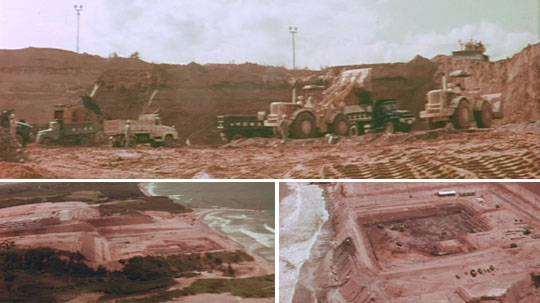 Ground zero: Bulldozers (top) take the top off a 35-meter bluff to prepare the site for the Fukushima No. 1 nuclear plant in the late 1960s in this image taken from the documentary “Reimei” (“Dawn”). Left: The construction site is seen after the leveling work. Right: An excavated area where the emergency diesel generators were installed is seen at the construction site.
Jul 13, 2011
The March 11 monster tsunami that hit the Fukushima No. 1 nuclear plant destroyed the critical backup power system and triggered the meltdown of hundreds of fuel rods in reactors 1, 2 and 3.
Video of the appalling damage and reactor building explosions led many — from regular people to nuclear and quake experts — to ask: Why wasn’t the coastal nuclear plant built in a location safe from all tsunami threats?
Katsumi Naganuma, 70, a former worker at Tokyo Electric Power Co., feels particular guilt because he knows that a 35-meter-high bluff overlooking the Pacific was shaved down to build the plant closer to sea level more than 40 years ago.
Tepco, assuming tsunami 3.1 meters or higher would never hit the coast, reduced the bluff by some 25 meters and erected the plant on artificially prepared ground only 10 meters above sea level.
“When I see the situation now, I feel it was wrong to clear that much of the hill away,” said Naganuma, who worked at Tepco’s local office preparing for the construction in the late 1960s.
“If they did not dig the ground down that much, we would not have faced this situation. (The nuclear disaster) would not have happened,” he said.
Naganuma, like thousands of other local residents, has been forced to evacuate from his home close to the crippled plant as it continues to spew radioactive materials.
Recent interviews and past documents examined by The Japan Times show it was Tepco’s decision to cut away the bluff so the nuclear complex could be built on low ground, leaving it vulnerable to massive tsunami like the one that struck on March 11.
Tepco dug another 14 meters below the surface to create basement floors, including those for the turbine buildings, where the emergency diesel generators were installed.
The tsunami easily flooded the compound and knocked out the power systems, including those for running the critical reactor core coolant equipment. The meltdowns became inevitable.
But Tepco is not the only one to blame. Like the utility, nuclear regulators and seismologists in the 1960s all believed a major earthquake and massive tsunami would never hit the plant, documents and records show.
“In the past 700 years, Fukushima suffered almost no noteworthy damage from earthquakes except in the Aizu area (in current Fukushima Prefecture),” concluded a 1966 report attached to the application form that Tepco submitted to the government to seek approval for building the first reactor at the plant.
“Thus the site can be described as an area of low-seismicity, even compared with all the other areas of the country,” the paper concluded, with little mention of the tsunami threat.
The paper was based on earlier research by seismologists and was approved by the government, which gave the green light to build reactor 1.In designing the Fukushima No. 1 plant in the 1960s, Tepco estimated the maximum possible tsunami would be only up to 3.1 meters.
In 2002, however, following recommendations from quake experts at the Japan Society of Civil Engineering, Tepco modified the facilities, so they could withstand tsunami of up to 5.7 meters. This was also approved by the regulators.
During a recent interview with The Japan Times, Masatoshi Toyota, 88, former senior vice president of Tepco, said one of the reasons the utility lowered the bluff was to build the base of the reactors directly on solid bedrock to mitigate any earthquake threat.
Toyota was a key executive who was involved in the Fukushima No. 1 plant construction.
It is actually common practice to build primary nuclear plant facilities directly on bedrock because of the temblor factor.
Toyota also cited two other reasons for Tepco clearing away the bluff — seawater pumps used to provide coolant water needed to be set up on the ground up to 10 meters from the sea, and extremely heavy equipment, including the 500-ton reator pressure vessels, were expected to be brought in by boat.
In fact, Tepco decided to build the plant on low ground based on a cost-benefit calculation of the operating costs of the seawater pumps, according to two research papers separately written by senior Tepco engineers in the 1960s.
If the seawater pumps were placed on high ground, their operating costs would be accordingly higher.
“We decided to build the plant at ground level after comparing the ground construction costs and operating costs of the circulation water pumps,” wrote Hiroshi Kaburaki, then deputy head of the Tepco’s construction office at the Fukushima No. 1 plant, in the January 1969 edition of Hatsuden Suiryoku, a technical magazine on power plants.
Still, Tepco believed ground level was “high enough to sufficiently secure safety against tsunami and typhoon waves,” wrote Seiji Saeki, then civil engineering section head of Tepco’s construction office, in his research paper published in October 1967.
Engineers at Tohoku Electric Power Co., on the other hand, had a different take on the tsunami threat when the Onagawa nuclear plant was built in Miyagi Prefecture in the 1980s.
Like Fukushima, the plant was built along the Tohoku coast and was hit by tsunami as high as 13 meters on March 11.
Before building the plant, Tohoku Electric, examining historic records of tsunami reported in the region, conducted computer simulations and concluded the local coast could face tsumani of up to 9.1 meters.
Tohoku Electric had set the construction ground level at 14.8 meters above sea level — which barely spared the Onagawa plant from major damage from 13-meter-high tsunami that hit in March.
Former Tepco worker Naganuma said many locals now feel they have been duped by Tepco’s long-running propaganda on the safety of its nuclear facilities, despite the huge economic benefits the plant brought to his hometown of Okuma, which hosts the Fukushima No. 1 plant.
Before construction of the plant, the coastal area was a barren, little-populated highland dubbed the “Tibet of Fukushima.” At the time, most local residents eked out a living in agriculture, and needed to go out of town as seasonal migrant workers during winter.
But the plant brought stable jobs, tax revenues and other big money projects to the local economy.
“I couldn’t feel happier because I was able to receive a monthly salary and didn’t need to go away from home to work,” Naganuma said, adding he had “never expected (such a disaster) would occur.”
Naganuma said many local residents now feel badly betrayed by the nuclear plant.
“But I think now more and more people (nationwide) have started feeling that way after March 11,” he said.
Fukushima 50 film review: drama about nuclear workers’ sacrifice following 2011 earthquake lacks punch
 A still from Fukushima 50 (category IIA; Japanese) starring Koichi Sato and Ken Watanabe and directed by Setsuro Wakamatsu.
22 Jun, 2020
- Ken Watanabe as Fukushima nuclear power plant superintendent, and Koichi Sato as shift supervisor, lead the battle to avert a meltdown after earthquake, tsunami
- Blow-by-blow account of the real-life aftermath of the 2011 disaster in Japan loses much of its drama by refusing to point fingers or demonise decision-makers
2.5/5 stars
The first mainstream film to dramatise the lives of frontline workers who dealt with the 2011 Fukushima Daiichi nuclear disaster, Setsuro Wakamatsu’s Fukushima 50 is an earnest, if somewhat toothless, celebration of those who risked everything to avert a reactor meltdown.
Ken Watanabe and Koichi Sato headline this big-budget adaptation of Ryusho Kadota’s non-fiction book, On the Brink: The Inside Story of Fukushima Daiichi.
The film wastes no time setting up characters or pre-existing relationships, opening with the explosive underwater earthquake off the Tohoku coast of northeast Japan on March 11, 2011. The initial impact triggered an automatic shutdown of the Fukushima Daiichi power station’s nuclear fission reactors. The subsequent tsunami swept over the power plant’s coastal defence walls, flooded the main buildings and knocked out the backup generators responsible for cooling the reactor cores.
Facing an imminent meltdown, plant superintendent Masao Yoshida (Watanabe) and shift supervisor Toshio Isaki (Sato) spearhead a daring, potentially suicidal effort to cool the reactors using seawater, while fending off contradictory, face-saving orders from their superiors at Tokyo Electric Power Company (Tepco) and the Japanese government.
In the nine years since the disaster, the Japanese film industry has broached the disaster’s aftermath numerous times, in films from Sion Sono’s uncharacteristically sombre A Land of Hope, to the allegorical 2016 blockbuster
. The eponymous beast of the latter film has been the stand-in for national life-or-death reckonings since the dawn of the atomic era, but that film also took time to expose, and ultimately champion, the country’s multi-tiered bureaucratic leadership.
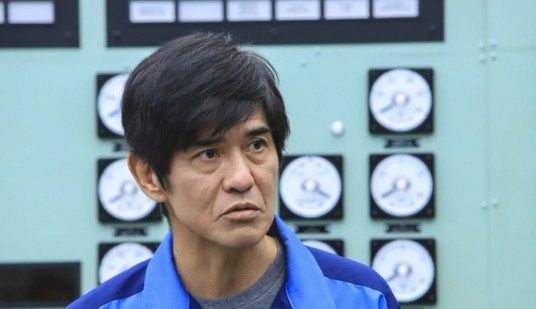 Koichi Sato in a still from Fukushima 50.
Fukushima 50, and Kadota’s impressively researched book, give blow-by-blow accounts of the disaster and the courageous sacrifices made by those who chose not to evacuate, but stay behind and ensure the nation’s safety. However, arriving in the wake of HBO’s much lauded and dramatically superior miniseries Chernobyl, about the 1986 nuclear disaster in Ukraine, Wakamatsu’s film feels lightweight, and the obstinate heads of Tepco a pushover compared to the Soviet Union’s fearsome Central Committee.
The film functions best as a memorial to Masao Yoshida, the only plant worker to have his real name used, whose willingness to go against his superiors ultimately prevented a far larger disaster, only for him to succumb to an unrelated bout of cancer in 2013. The film’s reluctance to point fingers, or demonise those responsible, saps much of the drama from this true-life tale of selfless heroism.
Protective sheet positioned at damaged reactor

June 12, 2020
The operator of the crippled Fukushima Daiichi nuclear plant has released footage showing part of the time-consuming steps needed to remove nuclear fuel from a pool at its No.1 reactor.
In the video, workers used remote-controlled tools to place a wide sheet over the surface of the pool. The radiation level there remains high.
Tokyo Electric Power Company has been engaged in removing debris from the upper part of the reactor building where the pool is located. The debris was caused by an explosion during the 2011 nuclear accident.
The sheet is meant to protect the pool and 392 nuclear fuel assemblies still inside from further damage that could result from the possible falling of debris or large machinery.
The six-by-eleven meter sheet is inflatable to a thickness of 50 centimeters. It will be filled with cement to increase its strength.
The operator plans to begin clearing the debris from around the pool by the end of the month, as soon as the sheet’s cement has solidified.
The operator plans to start removing the fuel from the pool of the No.1 reactor in fiscal 2027. Similar work at the No.2 reactor will start in fiscal 2024. Fuel removal from the pool at the No.3 reactor will be completed by fiscal 2020. The removal work is finished at the No.4 reactor.
Rods can be removed from No. 2 reactor at Fukushima plant, Tepco says
 A remotely operated underwater robot casts light over nuclear fuel rods inside the fuel pool of the No.2 reactor at the Fukushima No. 1 nuclear power plant.
Jun 11, 2020
Fukushima – Tokyo Electric Power Company Holdings Inc. (Tepco) found no obstacles Wednesday to its planned removal of radioactive fuel rods from a spent fuel pool at the Fukushima No.1 nuclear power plant, the firm has said.
Tepco confirmed the findings after starting its first internal probe of the No. 2 reactor since the 2011 disaster. The investigation is expected to continue through Friday.
Using a remotely operated underwater robot to photograph the interior of the pool, submerged fuel rods and their storage racks were checked for any damage. A total of 615 spent and unspent fuel rods are stored in the pool.
White sediment was discovered on the aluminum alloy racks. It is believed to have formed from a reaction between aluminum and elements in sea water, which was injected into the pool to cool the nuclear fuel during the disaster.
Similar sediment was found in the reactor pools at units No. 3 and No. 4, from which fuel rods have already been removed, but according to Tepco it did not affect the process.
Similar to the No. 1 and No. 3 reactors, the No. 2 reactor suffered a core meltdown after it temporarily lost its cooling function in its spent fuel pool, but there was no hydrogen explosion at the building.
Because of that, the pool is thought to be free of debris and in a relatively stable condition.
High radiation levels on the top floor of the reactor building, where the fuel rods are located, have delayed cleanup efforts.
But progress in decontamination efforts has now enabled remote inspections to be carried out.
A new facility complete with a crane and equipment to lift out the fuel rods will be built on the south side of the No. 2 nuclear reactor building. The removal process is slated to begin sometime between fiscal 2024 and 2026.
https://www.japantimes.co.jp/news/2020/06/11/national/fuel-rods-fukushima-no-2/#.XuJIOufgqUk
1 This Month


18 March Webinar @ 1 PM EST: An Assessment of SMR Projects: The Case of Canada
register for the zoom:
https://us02web.zoom.us/webinar/register/WN_o8BIIOUvQ2ONJR1nta65DQ#/registration


of the week – STOP SMALL MODULAR REACTORS IN CANADA
To see nuclear-related stories in greater depth and intensity – go to https://nuclearinformation.wordpress.com
-
Archives
- March 2026 (139)
- February 2026 (268)
- January 2026 (308)
- December 2025 (358)
- November 2025 (359)
- October 2025 (376)
- September 2025 (258)
- August 2025 (319)
- July 2025 (230)
- June 2025 (348)
- May 2025 (261)
- April 2025 (305)
-
Categories
- 1
- 1 NUCLEAR ISSUES
- business and costs
- climate change
- culture and arts
- ENERGY
- environment
- health
- history
- indigenous issues
- Legal
- marketing of nuclear
- media
- opposition to nuclear
- PERSONAL STORIES
- politics
- politics international
- Religion and ethics
- safety
- secrets,lies and civil liberties
- spinbuster
- technology
- Uranium
- wastes
- weapons and war
- Women
- 2 WORLD
- ACTION
- AFRICA
- Atrocities
- AUSTRALIA
- Christina's notes
- Christina's themes
- culture and arts
- Events
- Fuk 2022
- Fuk 2023
- Fukushima 2017
- Fukushima 2018
- fukushima 2019
- Fukushima 2020
- Fukushima 2021
- general
- global warming
- Humour (God we need it)
- Nuclear
- RARE EARTHS
- Reference
- resources – print
- Resources -audiovicual
- Weekly Newsletter
- World
- World Nuclear
- YouTube
-
RSS
Entries RSS
Comments RSS
 nuclear-news