Danger alert as Typhoon No. 10 lands in Tohoku
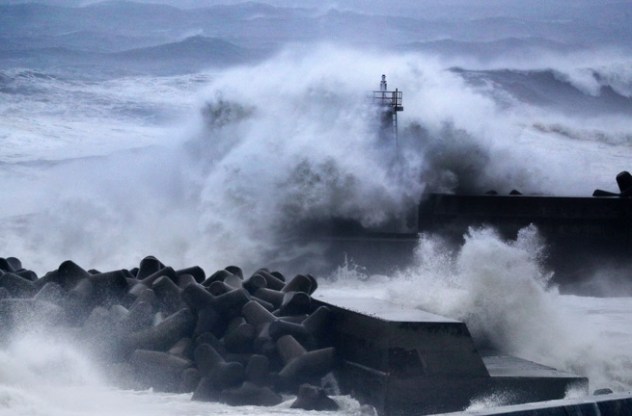
Violent waves crash against the shore in Iwaki, Fukushima Prefecture, as Typhoon No. 10 approaches the Tohoku region on the morning of Aug. 30.
Powerful Typhoon No. 10 struck the Tohoku region on the afternoon of Aug. 30 as expected.
The Japan Meteorological Agency has issued a warning to residents of potential record rainfall. The potent storm made landfall in Ofunato, Iwate Prefecture, shortly before 6 p.m. and was moving north-northwest at a speed of 50 kph as of 6 p.m., according to the agency. The atmospheric pressure at the center of the typhoon, known as Typhoon Lionrock outside Japan, was 970 hectopascals.
The sustained wind speed near the center was 108 kph, while gusts can increase up to 162 kph.
The storm is expected to accelerate and keep moving north-northwest, reaching areas northwest of Hirosaki, Aomori Prefecture, by nightfall. It will likely cut through the area into the Sea of Japan where it will then be termed an extratropical cyclone.
The northern part of the nation is expected to see heavy rainfall of more than 50 millimeters per hour on Aug. 30-31. With rain in some areas even likely to exceed 80 mm per hour, precipitation in northern Japan over the course of the two days could total the region’s average rainfall for the entire month of August.
Rainfall in the 24 hours until noon on Aug. 31 is expected to reach 250 mm in the Tohoku region and 200 mm in Hokkaido. The typhoon could bring on heavy rains in the region if the clouds are fed by the wet atmosphere located to the east of the nation.
As the intense rain could cause the radioactive groundwater accumulated on the premises of the crippled Fukushima No. 1 nuclear power plant in coastal Fukushima Prefecture to overflow, operator Tokyo Electric Power Co. is pumping more groundwater from the wells at the facility than usual.
The utility said that groundwater levels are still up by about 20 centimeters since Typhoon No. 9, or Typhoon Mindulle, traveled through the Tohoku region on Aug. 22.
No. 10 is the first typhoon to make landfall in the Tohoku region from the Pacific Ocean side since the meteorological agency started keeping track of the storms in 1951.
http://www.asahi.com/ajw/articles/AJ201608300038.html
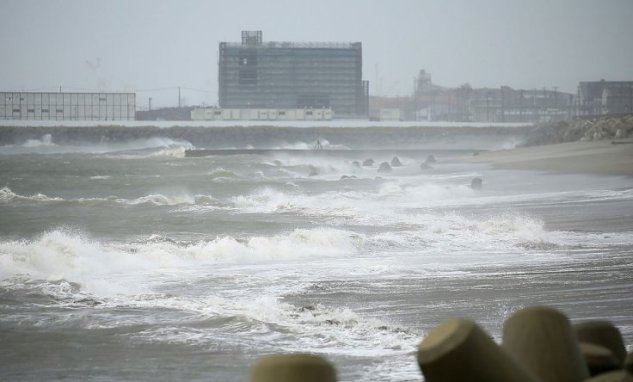
Powerful typhoon strikes region of Japan devasted by 2011 tsunami
Hundreds of flights have been grounded and work suspended at damaged Fukushima nuclear reactor.
A powerful typhoon has struck an area in north-eastern Japan devastated by the 2011 tsunami.
More than 100 flights have been grounded and evacuation warning issued for thousands of people as Typhoon Lionrock reached the north-eastern Tohoku region, with wind speeds of up to 126 km recorded on Tuesday evening (30 August).
In 2011, the region was devastated by an earthquake and tsunami, damaging the Fukushima nuclear reactor and leaving more than 18,000 people dead.
More than 170,000 people were subject to evacuation, including 38,000 in Ofunato, according to the Fire and Disaster Management Agency.
Approximately 10,000 homes in the northern region were without electricity, with power lines damaged from the winds, AP reported.
The typhoon was predicted to dump about 35 cm (14 inches) of rain on the north-eastern region by Wednesday morning, more than double the average rainfall for August, Reuters reported.
Airlines cancelled hundreds of flights to and from the northern region, while bullet train services to Tohoku and Hokkaido regions were suspended.
At Fukushima, some outdoor decommissioning work was suspended as the storm neared.
http://www.ibtimes.co.uk/powerful-typhoon-strikes-region-japan-devasted-by-2011-tsunami-1578738
Couple built home on top of radioactive soil due to inaccurate city sketch
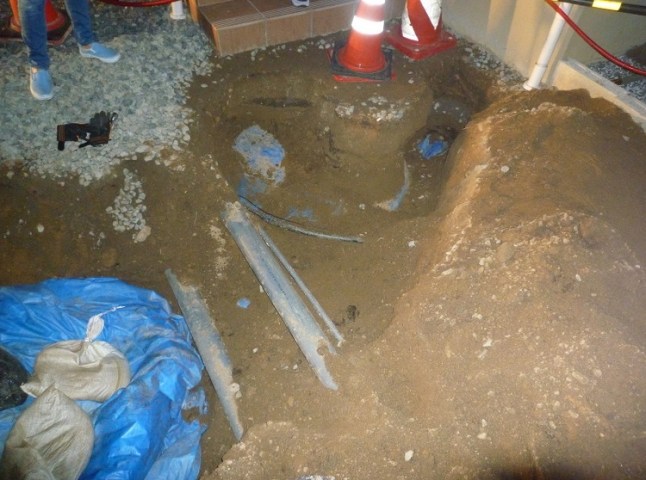
Parts of a flexible container bag buried under the couple’s home are seen at the top of this photo taken in Fukushima on Oct. 21, 2015.
FUKUSHIMA — A couple unknowingly built a new home in Fukushima on top of bags containing radioactive soil because they received an inaccurate waste storage sketch created by the Fukushima Municipal Government, it has been learned.
The couple has been unable to remove four flexible container bags of radioactive soil found buried under their home, as doing so could leave their house leaning. They say the city has not apologized.
“Far from admitting responsibility and apologizing, they haven’t even tried to examine the site. They have also been reluctant to release information, and have acted extremely insincerely,” a statement from the pair said.
The couple initially received a Fukushima Municipal Government sketch showing buried waste on a plot of land they purchased, but it contained no dimensions. About 66,000 similar sketches without dimensions have already been distributed, and it is possible that similar incidents could occur in the future as the storage of waste collected in the wake of the meltdowns at Tokyo Electric Power Co.’s Fukushima No. 1 Nuclear Power Plant becomes prolonged.
In five Fukushima prefectural municipalities, including the city of Fukushima, contaminated soil collected during decontamination work has mostly been stored onsite, while other local bodies have stored it at interim storage facilities. The city of Fukushima is the only one of the five municipalities to have handed landowners waste storage sketches without any dimensions. Those provided by the other four municipalities show dimensions. When land changes hands, the diagrams are normally handed from the previous landowner to the new one.
In November 2013, a man in Fukushima bought a 300-square-meter plot of decontaminated land, and received a “monitoring chart” from the previous landowner with a diagram showing where radioactive soil was buried, along with radiation measurements taken before and after the decontamination. Based on the diagram, the man built a new home, avoiding the northeast of the plot of land where the waste was shown to be buried.
However, when the city came to dig up the buried waste in October 2015, it was found that six flexible container bags with a total capacity of six cubic meters lay under the northeast part of the new home. Four of them could not be removed due to fears of the home being left leaning.
When the man made an official information request for documents on decontamination in May this year, he was given a diagram containing dimensions. This showed that the waste was buried several dozen centimeters closer to the southwest, nearer the center of the plot of land. The man says the actual burial spot was even further toward the center.
A Fukushima Municipal Government official said the purpose of the diagram without dimensions was to display the amount of radiation, and that the burial spot it showed was only a rough indication. The municipal government said the basis of the diagram with dimensions, on the other hand, was different, being used to record the burial spot of waste under the Act on Special Measures Concerning the Handling of Radioactive Pollution.
A city official commented that the decontaminated soil was supposed to be removed quickly and the officials had not expected it to be there until the time a land transaction was made and a home built. The city is considering replacing about 26,000 diagrams that are due to be distributed with ones that show dimensions. It is also considering publicly informing people that the diagrams that have been issued without dimensions are not accurate indications of where waste is buried.
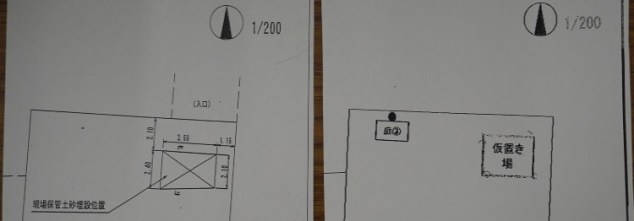
This photo shows the diagram with dimensions, left, and the one without. The No. 3 marking on the second diagram is where radiation levels were measured.
http://mainichi.jp/english/articles/20160829/p2a/00m/0na/011000c
Public Cost of Fukushima Cleanup Tops $628 Billion and Is Expected to Climb
Meanwhile, problems still persist at the nuclear plant, most notably with the ‘highly contaminated’ water being stored in tanks at the site

That includes costs for radioactive decontamination and compensation payments, the Japan Times reported.
The public cost of cleaning up the 2011 Fukushima Daiichi nuclear plant disaster topped ¥4.2 trillion (roughly $628 billion) as of March, and is expected to keep climbing, the Japan Times reported on Sunday.
That includes costs for radioactive decontamination and compensation payments. Tokyo Electric Power Company (TEPCO) will sell off its shares to eventually pay back the cost of decontamination and waste disposal, but the Environment Ministry expects that the overall price of those activities could exceed what TEPCO would get for its shares.
Meanwhile, the taxpayer burden is expected to increase and TEPCO is asking for additional help from the government.
The Times reports:
The government estimates the proceeds from TEPCO share sale at ¥2.5 trillion, but to generate the estimated gain, the TEPCO stock price needs to trade at around ¥1,050, up sharply from current market levels of some ¥360.
In addition, the Environment Ministry expects that the cumulative total of decontamination and related costs could surpass the estimated share proceeds by the March 2017 end of the current fiscal year.
[….] TEPCO and six other power utilities charged their customers at least ¥327 billion in electricity rate hikes after Japan’s worst-ever nuclear accident. Moreover, consumers paid ¥219.3 billion or more for TEPCO, chiefly to finance the maintenance of equipment to clean up radioactive water at the plant and the operation of call centers to deal with inquiries about compensation payments.
Moreover, as Deutsche Welle noted on Monday, problems still persist at the nuclear plant, most notably with the “highly contaminated” water being stored in tanks at the site.
“There are numerous problems that are all interconnected, but one of the biggest that we are facing at the moment is the highly contaminated water that is being stored in huge steel tanks at the site,” Aileen Mioko-Smith, an anti-nuclear activist with the group Green Action Japan, told DW. “They are running out of space at the site to put these tanks, the water that is being generated on a daily basis means they have to keep constructing more, and the ones that are not welded have a history of leaking.”
“The situation with contaminated water at the site is a ticking time bomb and they don’t seem to know what they can do—other than to construct more tanks,” she said.
Typhoon No. 10 barrels toward Kanto and Tohoku, Fukushima Daiichi included
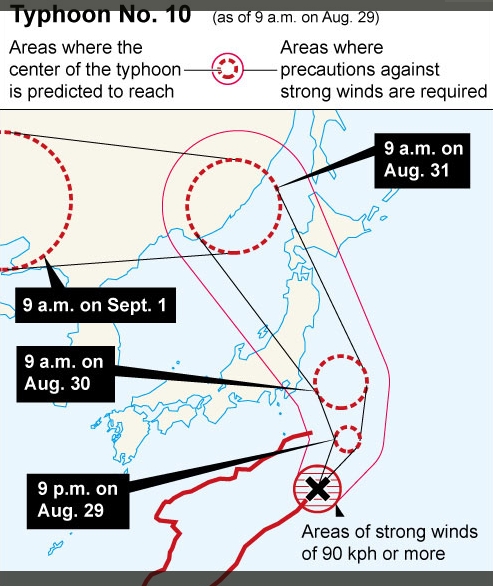
Powerful Typhoon No. 10 is expected to be the first typhoon in at least 65 years to make landfall in the Tohoku region from the Pacific Ocean side on the evening of Aug. 30.
The Japan Meteorological Agency is warning that heavy rains of 80 millimeters or more per hour are expected to fall in some parts of northern Japan, including Tohoku.
The agency is also advising commuters in the Kanto region to take precautions against strong winds and heavy rain on the morning of Aug. 30.
As of noon on Aug. 29, Typhoon No. 10 was advancing in the waters about 340 kilometers southeast of Hachijojima island at a speed of 25 kph. The atmospheric pressure at the center of the typhoon was 945 hectopascals. The maximum wind speed near the center was 162 kph. The maximum momentary wind speed was 216 kph.
Typhoon No. 10 is expected to reach waters about 360 km southeast of Choshi, Chiba Prefecture, in the morning on Aug. 30, although it is expected to slightly weaken by that time.
The typhoon is forecast to make landfall on the Tohoku region later that day and move to the Sea of Japan before dawn on Aug. 31, the agency said.
According to the agency, no typhoons have landed on the Tohoku region from the Pacific Ocean side since statistics became available in 1951.
In the period from Aug. 29 to Aug. 30, the maximum wind speed is expected to be 126 kph in the Tohoku region and 82.8 kph in the Hokkaido and Kanto regions.
The amount of rainfall during the 24-hour period until the morning of Aug. 30 is predicted to be up to 200 mm in the Tohoku and Kanto regions and Yamanashi and Nagano prefectures.
http://www.asahi.com/ajw/articles/AJ201608290030.html
Fukushima nuclear plant prepares for typhoon
The operator of the troubled Fukushima Daiichi nuclear power plant is preparing for the powerful Typhoon Lionrock.
Tokyo Electric Power Company says on Monday workers secured electric cables and hoses.
TEPCO says on Tuesday it will suspend work with cranes and other operations at the plant’s port, which could bear the brunt of strong winds and waves. Depending on weather conditions, the firm may also call off outdoor work in other areas.
It says when the most recent typhoon approached last week, heavy rain caused underground water levels to rise and threatened to flush contaminated water into the harbor.
Workers are arranging pumps to draw up more ground water, and setting up additional pumps at wells used to observe water levels.
There were concerns in the past that a downpour brought by a typhoon could cause contaminated rain water to flow through a drainage channel into the ocean.
To address these fears, TEPCO rerouted the drainage system into the plant’s inside port. It also raised the levels of barriers around tanks that store tainted water.
http://www3.nhk.or.jp/nhkworld/en/news/20160829_22/
Nearing typhoon halts work at Fukushima Daiichi
Workers at the troubled Fukushima Daiichi nuclear plant have suspended some of the decommissioning work and are bracing for rain and winds from a powerful typhoon.
Typhoon Lionrock is expected to make landfall along Japan’s northeastern coast on Tuesday afternoon, passing off Fukushima Prefecture.
Tokyo Electric Power Company says workers secured electric cables and hoses on the plant compound on Monday.
On Tuesday, the operator suspended work at the plant’s port. It also stopped the operation of a crane being used to demolish a temporary cover over one of the reactor buildings. Officials say they are closely watching to make sure the cover is not blown off by the typhoon.
TEPCO says it has also taken measures to prevent contaminated rain water and groundwater from leaking into the ocean.
In past typhoons, it was thought that contaminated rainwater flowed into the ocean through a drainage system. There were also concerns that radioactive groundwater might leak into the ocean as rain could increase the groundwater in the compound.
This time the operator has installed stronger pumps and increased their number.
The utility says as of 11 AM Tuesday, there were no changes in groundwater levels at the plant’s site.
Other measures taken earlier include rerouting the drainage system into the plant’s port instead of directly into the ocean. TEPCO also raised the barriers around tanks that store tainted water.
Radioactive Boar Are Thriving And Causing Havoc Near The Fukushima Power Plant
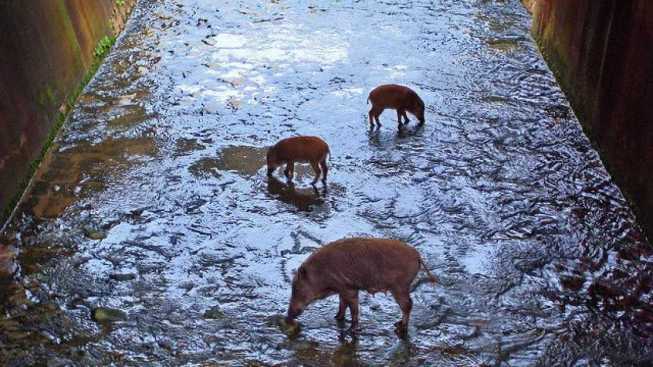
It’s been over five years since tsunami waves crashed into the Fukushima Daiichi power plant and led to its nuclear meltdown. While 20 kilometers (12 miles) of the land around the plant remains a dangerous exclusion zone, the area’s wildlife is taking full advantage of the peace.
Since the nuclear disaster, the population of wild boars has rocketed, much to the dismay of surrounding communities, The Times has reported. In the four years following the disaster, the population of boars is thought to have boomed from 3,000 to 13,000. You might think this ancient Japanese symbol of prosperity and fertility might be welcomed, but it’s estimated they have caused $15 million worth of damage to local agriculture.
Assistant ecology professor Okuda Keitokunin told the Japanese Mainichi newspaper that wild boar, along with racoons, have been using the abandoned houses and emptied buildings in the evacuation zone as a place to breed and shelter.
However, this post-nuclear meltdown town isn’t exactly a safe haven for the boars. It’s thought their diet of roots, nuts, berries and water all contain particularly high concentrations of radiation. The animals show no immediate signs of harm from the radiation, however samples from Fukushima’s wild boar meat has shown they contain 300 times the safe amount of the radioactive element caesium-137. Another study on the area’s fir trees showed evidence of growth mutations.
Hunters have been offered rewards to cull the boars by local authorities. However, the animals are breeding so quickly they can’t keep up. The city of Nihonmatsu, around 56 kilometers (35 miles) from the Fukushima plant, has dug three mass graves capable of holding 1,800 dead boars. Recently, these have become overfilled and authorities are now struggling to cope with the influx of culled beasts.
The boom in boars is a similar story to Chernobyl’s post-meltdown wildlife. A study from late last year showed that the populations of deer and wild boar are thriving in the area surrounding the Ukrainian nuclear power plant.
In a statement Jim Smith, one of the authors of the Chernobyl study, explained, “It’s very likely that wildlife numbers at Chernobyl are much higher than they were before the accident. This doesn’t mean radiation is good for wildlife, just that the effects of human habitation, including hunting, farming, and forestry, are a lot worse.”
Public cost of Fukushima nuclear accident cleanup topped ¥4.2 trillion as of end of March
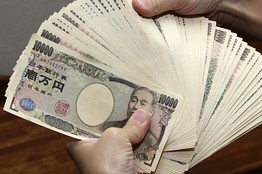
Electric Power Company Holdings Inc.’s stricken Fukushima No. 1 plant topped ¥4.2 trillion by the end of fiscal 2015, it was learned Sunday.
The cumulative total at the end of last March, including costs for radioactive decontamination, reactor decommissioning and compensation payments to affected people and organizations, translate into about ¥33,000 per capita.
The public financial burden is expected to increase, with Tepco seeking further government assistance.
Jiji Press scrutinized the government’s special-account budgets through fiscal 2015 for the reconstruction of areas affected by the March 2011 earthquake and tsunami. It summed up the amounts of executed budgets related to the nuclear disaster and additional electricity rates consumers and businesses were charged by Tepco and seven other regional power utilities to help finance compensation payments, among other costs.
According to the study, a total of ¥2.34 trillion was disbursed for decontamination of affected areas, disposal of contaminated waste and an interim storage facility for tainted soil. The expense was shouldered by the government, mainly through affiliated Nuclear Damage Compensation and Decommissioning Facilitation Corp.
The costs for decontamination and tainted waste disposal will eventually be financed by the proceeds from the sale of Tepco shares held by the government-backed organization. The government guaranteed the loans provided by banks for the acquisition of Tepco shares, and if the lending becomes irrecoverable due to weakness of the Tepco stock price, tax revenue will be used to repay the loans.
The government estimates the proceeds from Tepco share sale at ¥2.5 trillion, but to generate the estimated gain, the Tepco stock price needs to trade at around ¥1,050, up sharply from current market levels of some ¥360.
In addition, the Environment Ministry expects that the cumulative total of decontamination and related costs could surpass the estimated share proceeds by the March 2017 end of the current fiscal year.
A total of ¥1.1 trillion will be used from the energy special account to finance the costs related to the interim storage facility for contaminated soil. The account mostly consists of revenue of the tax for the promotion of power resources development, which is included in electricity bills.
Elsewhere, the government spent ¥1.38 trillion on projects including the decommissioning of reactors at the disaster-crippled Fukushima No. 1 plant, checks on food for radioactive contamination and building a research and development facility.
Tepco and six other power utilities charged their customers at least ¥327 billion in electricity rate hikes after Japan’s worst-ever nuclear accident. Moreover, consumers paid ¥219.3 billion or more for Tepco, chiefly to finance the maintenance of equipment to clean up radioactive water at the plant and the operation of call centers to deal with inquiries about compensation payments.
Fukushima’s surfers riding on radioactive waves
“I put on sunscreen against the sun, but I haven’t found anything against radiation,” said one surfer. “We will only know the true consequences of our time in the water 20 years from now.”
Fukushima, Japan – On 11 March 2011, at 2:46 pm, Japan was hit by a magnitude 9.0 earthquake which generated a tsunami along the coast. The casualties of the disaster included 18,500 dead, 90 percent of whom drowned in the tsunami wave. The bodies of 2,561 people were never recovered.
The tsunami hit the Daaichi nuclear power plant as well, a level-7 catastrophe that was the equivalent of the Chernobyl nuclear power plant meltdown disaster.
Over the course of five years, nearly 50,000 people have worked to decontaminate the plant and stop leaks according to government press releases. They remove between 5 and 30 cm of contaminated soil every day and place them in plastic bags, which are stored on the outskirts of town, pending a better solution.
In Tairatoyoma beach, a prefecture of Fukushima and some 50km from the nuclear plant, was among the most popular areas for Japanese surfers prior to the nuclear accident.
Surprisingly, despite the presence of radiation in the sand and water, some dedicated surfers continue to come here to catch some waves. They are aware of the risks, and the hundreds of bags of contaminated sand piled up on the beach serve as a constant reminder of the health risks to them.
“I put on sunscreen against the sun, but I haven’t found anything against radiation,” said one surfer. “We will only know the true consequences of our time in the water 20 years from now.”
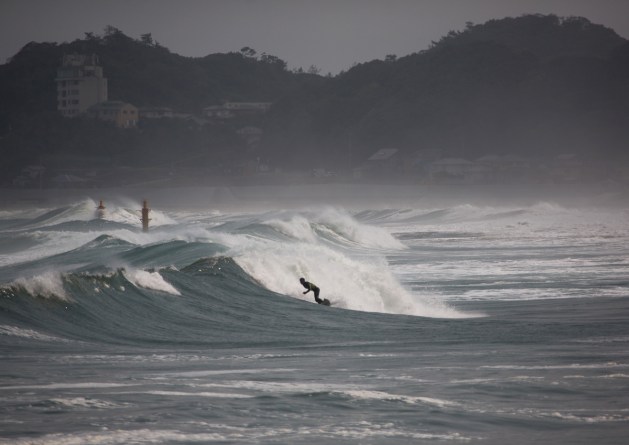
Tairatoyoma beach, in the prefecture of Fukushima, 50km from the nuclear plant, was among the most popular areas with Japanese surfers before the accident.

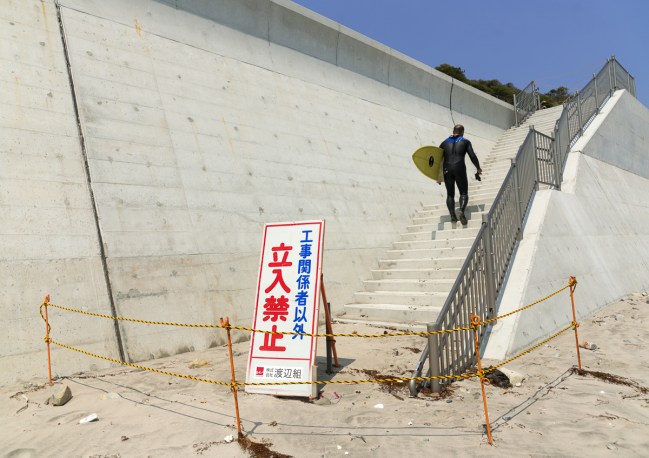
“I come to Tairatoyoma beach and surf several times a week. it is my passion, I can’t stop surfinhg”, says this surfer. The sign next to him in Japanese indicates that the area is restricted area.
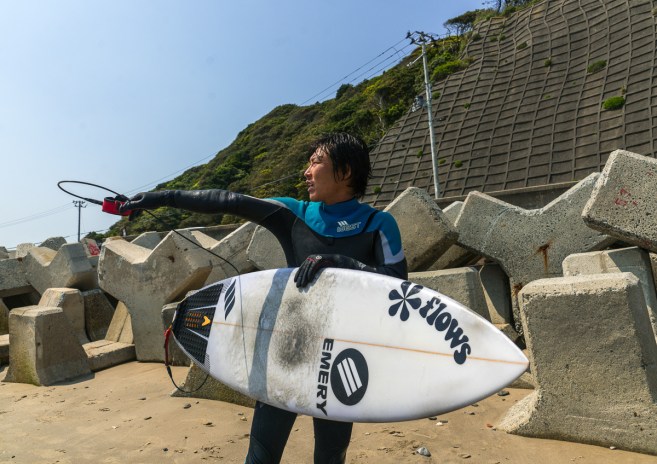
Some surfers were on the beach when the tsunami struck. ‘The earth shook, we came back on Tairatoyoma beach, and a few minutes later, the tsunami wave arrived,’ recalls one surfer. ‘None of the surfers who were on the beach died, as we had time to escape. Those who were in their homes were taken by the waves by surprise and they died.’
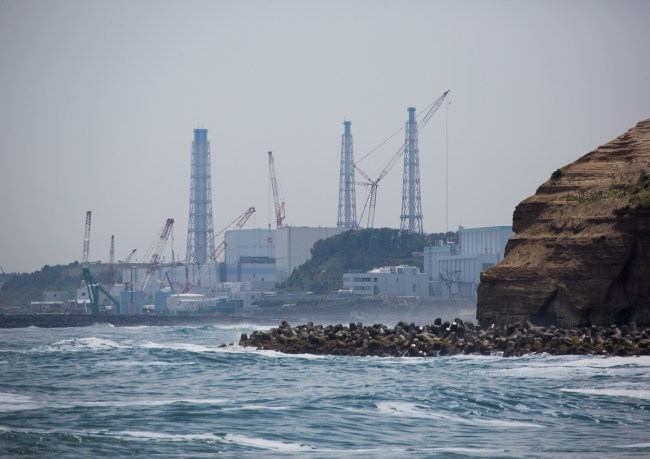
Over the course of five years, nearly 50,000 people have worked to decontaminate the plant and stop leaks. Nearly 500,000 people were evacuated because of the tsunami and the nuclear accident.
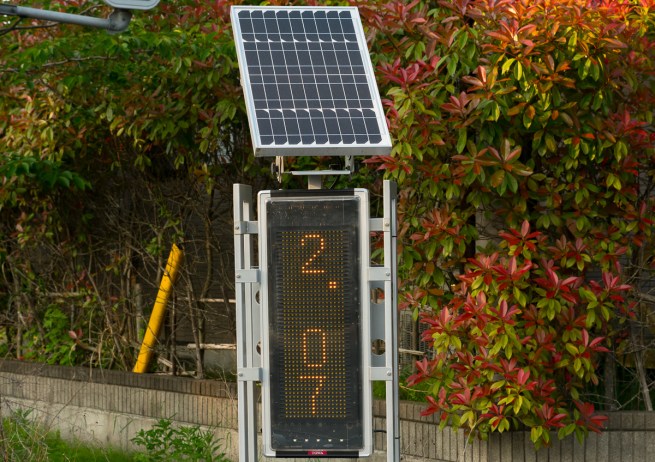
A radiation dosimeter placed in the difficult-to-return zone after the Daiichi nuclear power plant irradiation, Fukushima prefecture, Tomioka, Japan
Radiation sensors indicate the level of radioactivity. But no one is present to read the sensors in the red zones, classified as ‘difficult to return to zones’ by the government.

Roadblock in the difficult-to-return zone after the daiichi nuclear power plant irradiation, Fukushima prefecture, Tomioka, Japan
Residents receive compensation from Tepco company based on the degree of contamination of their homes. In the red zone they receive 1,000$ a month per person. That has created tensions in the population because those who live on the other side of the barrier, like here in Tomioka, do not receive as much.
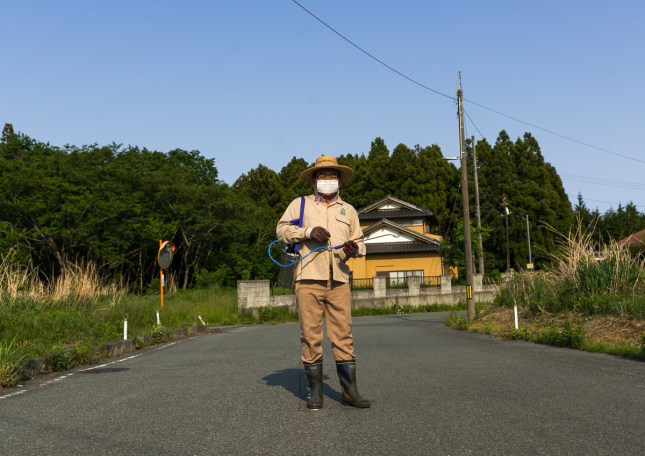
In the ‘orange zone’, residents have the right to visit their home if they wish to take care of it. In the town of Naraha. This man has come to weed his garden. His wife refuses to come back, and he will not bring his children. He never sleeps in his contaminated home. He knows the dangers well as he has worked at the nuclear plant.
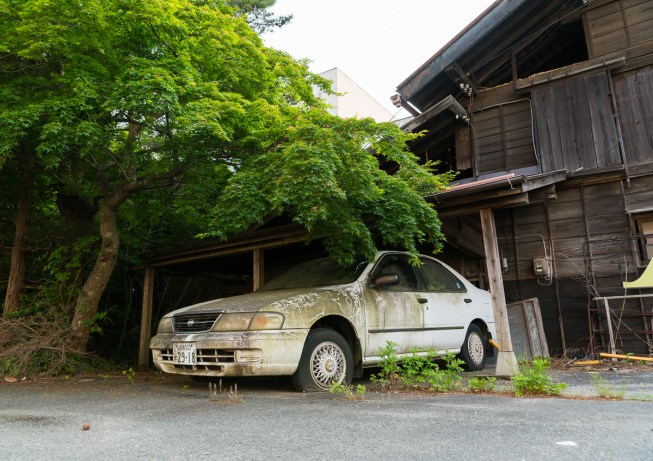
Abandoned car after the 2011 earthquake and tsunami five years after in the difficult-to-return zone, Fukushima prefecture, Tomioka, Japan
Cities distant from the sea, like Tomioka, were only affected by the earthquake and the radiation, not by the tsunami. They have now turned into ghost towns.
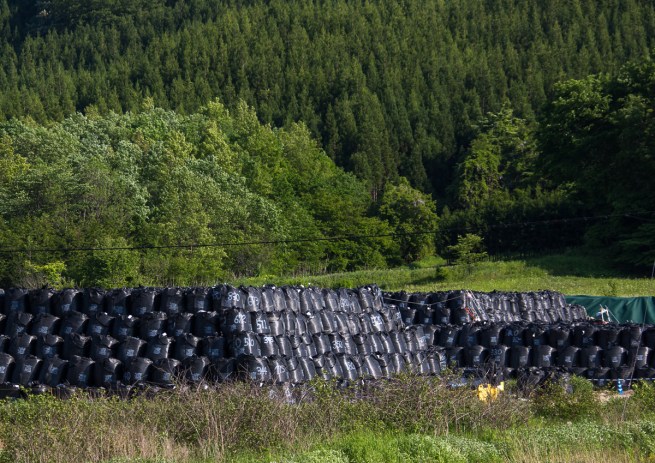
Thirty million tonnes of contaminated soil are stocked in open-air sites.

The Tairatoyoma beach was popular for its sand, but the tsunami washed this sand away. Now, a concrete wall offers protection against the waves. A few rare foreigners venture here to surf according to the Japanese surfers.
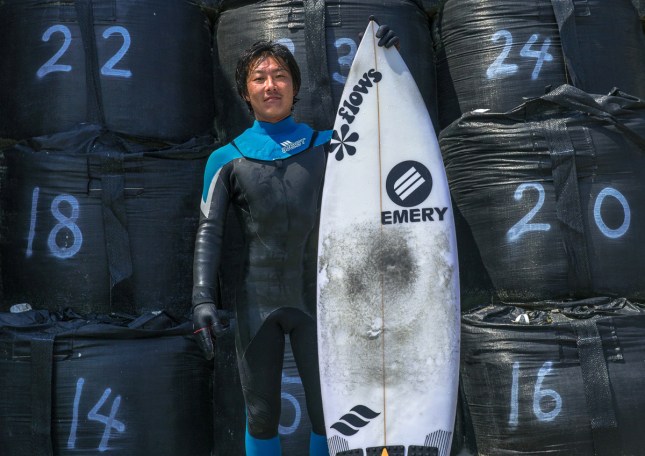
The surfers cannot ignore the riskS. There are hundreds of bags of contaminated sand piled up on the beach. ‘The government keeps telling us that things are back to normal in the region. But we can see that few people have come back. There are only elderly people. Children are kept away,’ said one surfer.
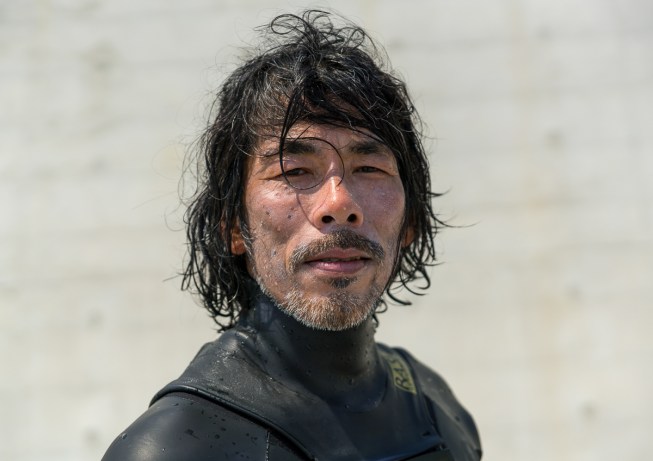
Despite knowing the risks, surfers are undeterred and willing to take the risk to surf in these waters. ‘I put on sunscreen against the sun, but I haven’t found anything against radiation. We will only know the true consequences of our time in the water 20 years from now,’said one surfer.
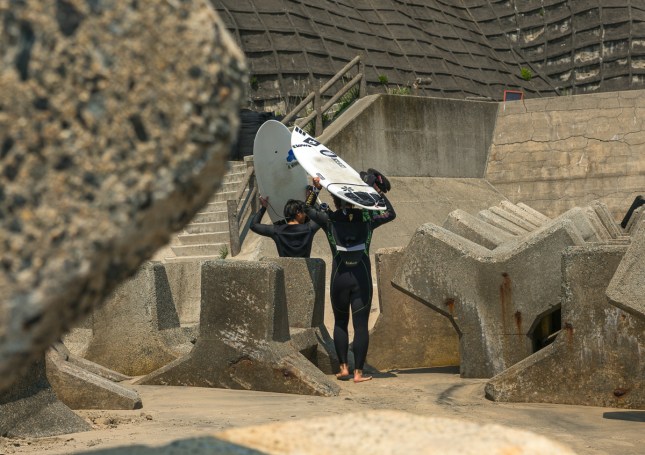
The people from the Fukushima prefecture had supported the construction of the nuclear power plants in the region because this brought jobs and prosperity to this rural area.
An employee of the nuclear plant said that he would never swim there as the water is too contaminated. Five of his friends who worked at the plant have now brain damage.
Radioactive Broom in Tomioka House, Fukushima
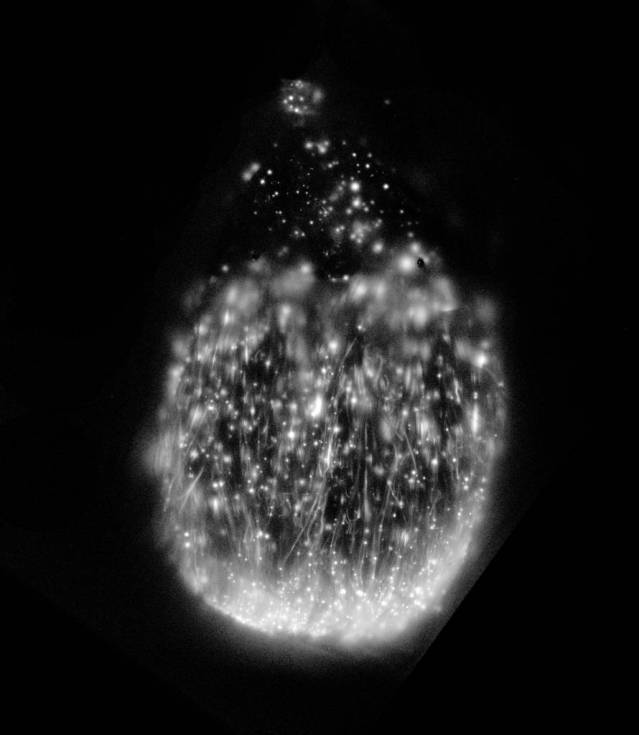
Via Kurumi Sugita:
“A broom collected in the town of tomioka in Fukushima Prefecture, inside of a house.”
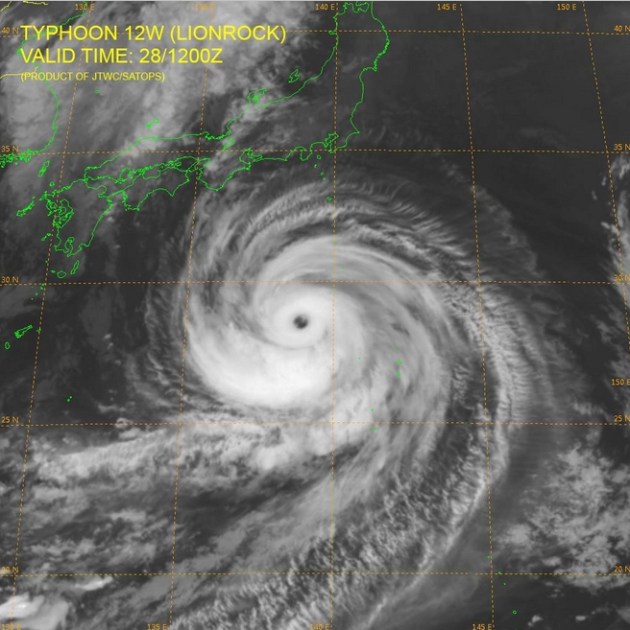
Typhoon Lionrock Might Land On Fukushima Daiichi

It might land in north east Japan for the first time since the beginning of meteorological records. We are very very worried about the Fukushima Daiichi NPP and the local population.
Typhoon Lionrock has strengthened and changed course. Current predictions as of today shows it hitting the Tohoku coast as a category 1 typhoon. The center of the predicted path is around Sendai, Miyagi Prefecture. Fukushima Prefecture and Fukushima Daiichi are within the predicted path zone.
Even if it doesn’t directly hit Fukushima Daiichi, outer bands could still cause significant problems. High winds could damage contaminated water tanks in the process of being disassembled or assembled on site. These tanks are highly radioactive and some may still contain highly radioactive water or sludge. Cranes and other outdoor structures that could be damaged by high winds are a concern.
The “K” drainage system connected to the roofs of the reactor buildings before the disaster. Post disaster we still see spikes in contamination in this drainage system. There are multiple other locations where this system could be fed contaminated run off. This drainage system has been redirected to the port but the port still exchanges water with the sea, so it isn’t a reliable solution. There is a pumping system to pump contaminated groundwater out of the area near the reactor buildings then to contaminated water storage.
It is not clear if it can keep up with both the ongoing groundwater intrusion and influx from a typhoon.
Yamagata&Niigata prefectural governors request FUKUSHIMA prefecture housing support extension for Nuclear disaster voluntary evacuees
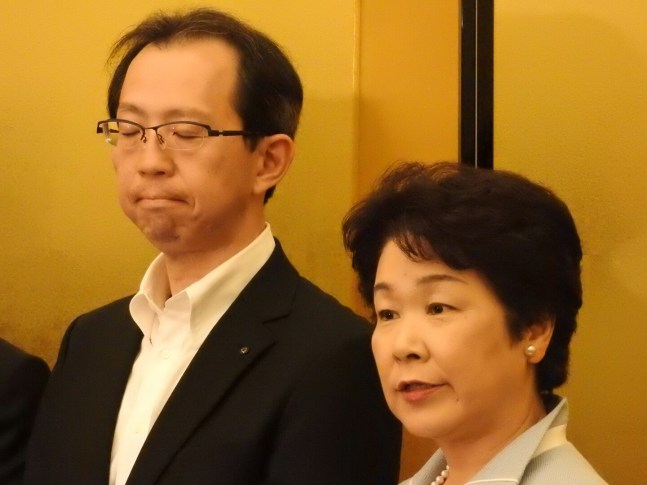
Yamagata and Niigata prefectural governors strongly request that FUKUSHIMA prefecture should extend the housing support for Nuclear disaster voluntary evacuees.But Fukushima governor, Uchibori Masao did not answer anything to their request. Why?
Yamagata Prefecture governor Mieko Yoshimura has requested an extension of the house support provided asking for the “special consideration“.
Niigata Prefecture governor Hirohiko Izumida also pointed out that “further burden in the problems of housing is increasing“, which the Fukushima Governor Uchibori Masao should well consider.
The Fukushima Prefecture governor to enforce central government order to terminate free housing support for evacuees by March 2017.
IfYoshimura and Izumida were Fukushima Prefecture governor, their treatment of “voluntary evacuees“ might have been quite different.
http://taminokoeshimbun.blog.fc2.com/blog-entry-38.html
Inside Fukushima’s Time Bomb
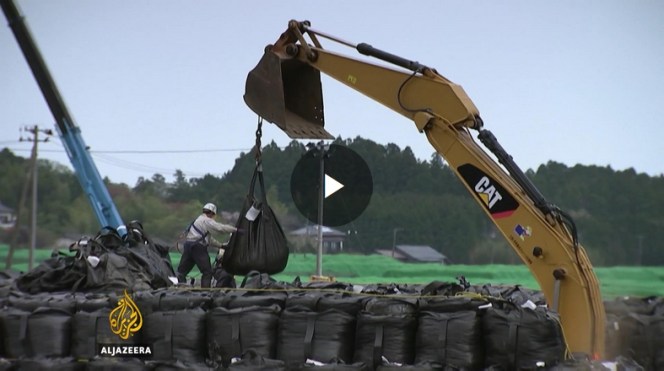
Five years after Japan’s Fukushima nuclear disaster many residents are still living in a radioactive nightmare.
Bubbling streams, lush forests, cherry blossoms in full bloom – Japan’s north is stunningly picturesque.
But nature’s beauty hides a lethal secret – dangerous levels of radiation contaminate this area, fall-out from the Fukushima nuclear disaster.
Five years after the twin catastrophes of the tsunami and nuclear meltdown, villages sit silent and empty.
Thousands of workers still toil to clean up the radioactive material but it could be decades before their work is finished.
As Japan continues to suffer the toxic aftermath of one of its worst ever disasters, 101 East reveals that the countryside may never again be safe.
http://www.aljazeera.com/programmes/101east/2016/08/fukushima-time-bomb-160824122108827.html
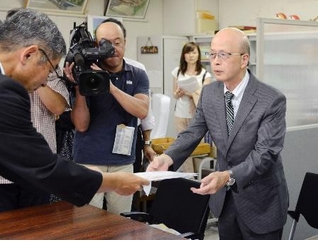
President of Fukushima Pediatric Association recently hand delivered the Association’s requests to Fukushima Prefecture to “scale down” thyroid exams for children in Fukushima
Does Fukushima Prefecture need to scale down or expand its existing thyroid exams provided to Fukushima children who were 18 years of younger at the time of Fukushima nuclear accident in 2011?
President of Fukushima Pediatric Association recently hand delivered the Association’s requests to Fukushima Prefecture to “scale down” thyroid exams for children in Fukushima.
Fukushima Pediatric Association claims that identifying many children with thyroid cancer through Prefecture’s thyroid exams is causing anxiety among children, their guardians, and citizens in the prefecture, and requests that a partial re-consideration of the thyroid exam is necessary.
(By the way, can you tell which one is Dr. Kazuhiro Ohga of Fukushima Pediatric Association and which one is an official of Fukushima Prefecture, just by looking at the photo of the article? I initially thought the man on the right is an official from the Fukushima Prefecture, because the man on left is bowing deeper, as if he is asking a favor by delivering a request. I was wrong. Dr. Ohga is on the right.)
http://this.kiji.is/141480622388215816?c=39546741839462401
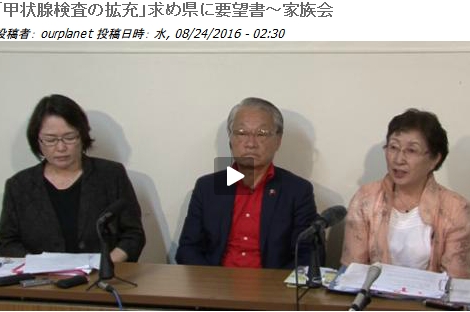
On the other hand, a citizens’ group with parents of children whose thyroid cancers were detected because of Prefecture’s thyroid exams requests Fukushima Prefecture to expand the exams.
http://ourplanet-tv.org/?q=node%2F2057
Credit to Mari Inoue
Film focuses on ‘irradiated’ cattle kept alive in Fukushima
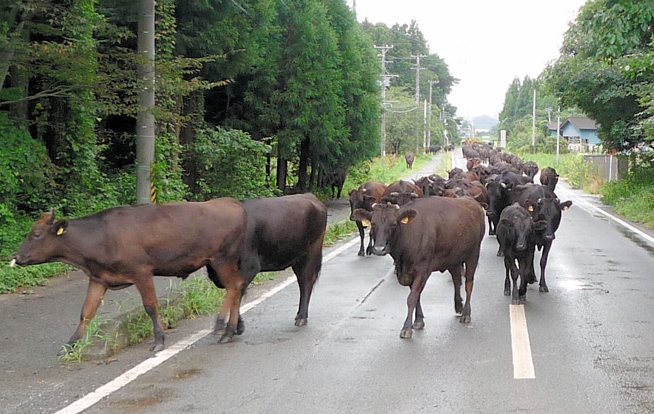
In a scene from “Hibaku-ushi to Ikiru” (Living with irradiated cattle), stray cattle head down a road in the 20-kilometer no-entry zone around the crippled Fukushima No. 1 nuclear power plant in August 2011.
OSAKA–For some cattle farmers in Fukushima Prefecture, the thought of destroying their herds is too painful to bear even if they are contaminated with radioactive fallout.
A new documentary to be shown here this week records the plight of these farmers, who continue to look after their beef cattle in defiance of a government request to euthanize the animals.
“I took on this project because I wanted to capture what is driving farmers to keep their cattle. For all the trouble it is worth, the animals are now worthless,” said Tamotsu Matsubara, a visual director who shot the documentary.
Four years in the making, “Hibaku-ushi to Ikiru” (Living with irradiated cattle) is set for its first screening on Aug. 26 at a local community center in the city.
Matsubara’s interactions with the cattle farmers date to the summer of 2011, a few months after the nuclear crisis unfolded at the Fukushima No. 1 nuclear power plant following the Great East Japan Earthquake and tsunami on March 11 that year. His assignment was to cover a traditional festival in Minami-Soma, which is located near the stricken nuclear plant.
Matsubara, 57, became acquainted with a farmer caring for more than 300 cattle on his land in the 20-kilometer no-entry zone set by the government. Residents in the zone were ordered to evacuate, but the farmer stayed on to look after his animals.
At that time, the government was seeking to destroy the cattle within the no-entry zone by obtaining their owners’ consent, saying animals that were heavily contaminated with radiation from the nuclear accident could not be sold at market.
But some farmers did not want to put their livestock down.
However, keeping them alive costs 200,000 yen ($2,000) a year in feed per head.
Matsubara became curious why the farmers continued to look after cattle that cannot be sold or bred, despite the heavy economic burden.
He soon began making weekly trips from Osaka to Fukushima to film the lives of the farmers, their cattle and the people around them.
After finishing his regular job in promotional events on Fridays, Matsubara would drive 11 hours to Fukushima and spend the weekend documenting the plight of the farmers before returning to Osaka by Monday morning.
He had 5 million yen saved for the documentary, his first feature film. When the money ran out, Matsubara held a crowdfunding campaign to complete it. Shooting wrapped up at the end of December.
About 350 hours of footage was edited into the 104-minute “Hibaku-ushi to Ikiru.”
The film documents the farmers and their supporters who are struggling to keep the cattle alive.
One couple in the film returns to their land in Okuma, a town that co-hosts the Fukushima plant, to care for their herd. They affectionately named each animal and said it would be unbearable to kill them. Their trips are financed using a bulk of the compensation they received for the nuclear accident.
A former assemblyman of Namie, a town near the plant, tends to his animals while asking himself why he used to support nuclear power.
The documentary also sheds light on scientists who are helping the farmers. The researchers believe that keeping track of the contaminated cattle will provide clues in unraveling how low-level radiation exposure impacts large mammals like humans.
Matsubara said the documentary tells the real story of what is going on with victims of the nuclear disaster.
“Not all the farmers featured in the documentary share the same opinion or stance,” Matsubara said. “I would like audiences to see the reality of people who cannot openly raise their voices to be heard.”
Takeshi Shiba, a documentary filmmaker who served as producer of this project, hopes the film will reach a wide audience.
“Matsubara broke his back in making this movie,” he said. “I hope that many people will learn what Fukushima people are thinking.”
Hong Kong still testing food imports for Fukushima’s radiation
More than five years ago on Friday, March 11, 2011, the Great East Japan Earthquake with a magnitude of 9.0 set off a large tsunami sending a 50-foot wall of water over three Fukushima Daiichi reactors. Three of the nuclear cores melted down in the next three days.
About 1,600 miles away on the next day, Saturday, March 12, 2011, the Center for Food Safety (CFS) in Hong Kong began stepped up surveillance of fresh foods including milk, vegetables and fruits, imported from Japan for radiation testing.
Eleven days later, on Wednesday, March 23, 2011, CFS discovered three samples imported from Japan with radioactivity levels exceeding those considered to be safe by international Codex Alimentarius Commission.
CFS is a unit of the Food and Environmental Hygiene Department of Hong Kong’s City government, which is part of China. The CFS continues to test those Japanese imports but hasn’t found any additional shipments with unsafe radiation levels.
And its not for lack of looking. Since one week before CFS found those hot white radishes, turnips and spinach samples, Hong Kong has tested 344,881 samples.
It breaks down this way: 19,420 vegetable samples; 19,338 fruit samples; 2,189 milk and milk beverage samples; 900 milk powder samples; 594 frozen confection samples; 54,468 aquatic product samples; 9,487 meat product smples; 31,744 drink samples, and 206,741 other samples including cereals and snacks.
The totals are through Aug. 22. CFS continues to test samples from Japanese imports, conducting testing around the clock five days a week.
Hong Kong’s continued surveillance for radioactivity is just one sign of how cautious Asia remains about the Fukushima meltdown. Japan has excluded people and crop production in a 310-square-mile zone around the nuclear plants. No deaths or cases of radiation sickness are attributed to the nuclear accident. And, perhaps due to the large exclusion zone, future cancers and deaths from potential exposures are projected to be low.
The U.S. Food and Drug Administration treats Fukushima with a periodically updated Import Alert that permits certain Japanese food imports to be detained without inspection.
“Districts may detain, without physical examination, the specified products from firms in the Fukushima, Aomori, Chiba, Gumna, Ibaraki, Iwate, Miyagi, Nagano, Niigata, Saitama Shizuoka, Tochigig, Yamagata and Yamanashi prefectures,” the July 18 Import Alert from FDA says.
Japanese imports from those areas that can still be detained at the U.S. border include:
- Rice, Cultivated, Whole Grain;
- Milk/Butter/Dried Milk Products;
- Filled Milk/Imitation Milk Products;
- Fish, N.E.C.;
- Venus Clams;
- Sea Urchin/Uni;
- Certain Meat, Meat Products and Poultry, specifically(beef, boar, bear, deer, duck, hare and pheasant products;
- Yuzu Fruit;
- Kiwi Fruit;
- Vegetables/Vegetable Products;
- Baby Formula Products; and
- Milk based formulas.
http://www.foodsafetynews.com/2016/08/hong-kong-still-testing-food-imports-for-fukushimas-radiation/
Government subsidies to help Fukushima farmers restart operations

The central government plans to set up a new subsidy system to help farmers in 12 municipalities near the stricken Fukushima No. 1 nuclear plant restart their operations, according to sources.
The program represents part of the government’s efforts to promote the reconstruction of areas damaged by the March 2011 earthquake and tsunami in the Tohoku region and the subsequent meltdowns at the Tokyo Electric Power Co. nuclear station.
The government will earmark around ¥7 billion for the program under a planned supplementary budget for its special account related to the 2011 disaster, the sources said Monday.
The program will help farmers buy equipment and livestock.
A support system is already available in which the 12 municipalities in Fukushima Prefecture buy facilities and equipment such as greenhouses and tractors and lend them for free to farmers aiming to get back on their feet.
But the system is inconvenient for individuals who want to resume farming operations, because it is mainly designed for group farming and other big operations. Also, approval from local assemblies is necessary to lend out the facilities and gear.
Under the new program, the Fukushima Prefectural Government will cover 75 percent of farmers’ purchase costs for farming equipment and livestock, the sources said. The upper limit on support per farmer will likely be ¥10 million, they said.
The central government will shoulder all costs incurred by prefectural government, the sources said.
The 12 municipalities are Tamura, Minamisoma, Kawamata, Hirono, Naraha, Tomioka, Okuma, Futaba, Namie, Kawauchi, Katsurao and Iitate.
1 This Month

of the week – Shut Down Drone Warfare!


Tell the Ukrainian Government to Drop Prosecution of Peace Activist Yurii Sheliazhenko

Petition to revoke the licensing of the Near Surface Nuclear Disposal Facility (NSDF) at Chalk River. https://www.ourcommons.ca/petitions/en/Petition/Details?Petition=e-7247
To see nuclear-related stories in greater depth and intensity – go to https://nuclearinformation.wordpress.com
-
Archives
- April 2026 (57)
- March 2026 (251)
- February 2026 (268)
- January 2026 (308)
- December 2025 (358)
- November 2025 (359)
- October 2025 (376)
- September 2025 (257)
- August 2025 (319)
- July 2025 (230)
- June 2025 (348)
- May 2025 (261)
-
Categories
- 1
- 1 NUCLEAR ISSUES
- business and costs
- climate change
- culture and arts
- ENERGY
- environment
- health
- history
- indigenous issues
- Legal
- marketing of nuclear
- media
- opposition to nuclear
- PERSONAL STORIES
- politics
- politics international
- Religion and ethics
- safety
- secrets,lies and civil liberties
- spinbuster
- technology
- Uranium
- wastes
- weapons and war
- Women
- 2 WORLD
- ACTION
- AFRICA
- Atrocities
- AUSTRALIA
- Christina's notes
- Christina's themes
- culture and arts
- Events
- Fuk 2022
- Fuk 2023
- Fukushima 2017
- Fukushima 2018
- fukushima 2019
- Fukushima 2020
- Fukushima 2021
- general
- global warming
- Humour (God we need it)
- Nuclear
- RARE EARTHS
- Reference
- resources – print
- Resources -audiovicual
- Weekly Newsletter
- World
- World Nuclear
- YouTube
-
RSS
Entries RSS
Comments RSS
 nuclear-news