Divisions still haunt residents of Fukushima on 6th anniversary
Some experiences are so horrific that it seems almost impossible to find sufficient words to describe how they affected people.
Certainly, that is the case with the March 11, 2011, earthquake and tsunami disaster that led to the triple meltdown at the Fukushima No. 1 nuclear power plant.
That is probably why some people in the disaster areas resort to composing short poems based on the traditional “tanka” format to express the emotion that overwhelm them.
One resident composed this poignant poem on his thoughts about being forced to leave his ancestral home: “I’m now leaving/ My home with anger/ Though I had done/ Nothing wrong.”
The late Kenichi Tanigawa, a leading postwar folklorist and poet, compiled a collection of 130 or so tanka poems written by people caught up in the events of March 11, 2011. The anthology, titled “Kanashimi no Umi” (Sea of sorrow), was published in 2012, the year before he died.
On this sixth anniversary of the disaster, there are still disturbing signs of complicated, multi-layered divisions tormenting people in Fukushima Prefecture. Around 80,000 people from the prefecture, where the crippled nuclear power plant is located, are still living as evacuees. Divisions have emerged between people from Fukushima and those outside the prefecture as well as between evacuees and other residents of the prefecture and even among evacuees themselves.
A survey of Fukushima Prefecture residents at the end of February by The Asahi Shimbun and Fukushima Broadcasting Co., a local television broadcaster, found that 30 percent of the respondents said they had faced discrimination simply because they are residents of the prefecture.
One evacuee wrote a poem to vent his feelings about this: “Don’t come close to me/ So I won’t catch your radiation/ a child says/ To a kid from an evacuated area.”
It is depressing to know that the false rumors behind these cruel words are still circulating.
INVISIBLE BARRIERS
It is impossible to discuss the situation in Fukushima Prefecture without referring to such topics as nuclear power plants, radiation, decontamination, evacuation and compensation.
These are issues that sorely test the knowledge and thinking of the talker.
It is widely believed that the problems facing Fukushima are complicated and intractable. Many people feel intimidated by the difficulty of the problems.
This is the “wall” that sociologist Hiroshi Kainuma pointed out two years ago, and it still exists.
This spring, evacuation orders for wide stretches of coastal areas in the prefecture will be lifted, allowing some 32,000 people to return home. But there is still no prospect of a homecoming for 24,000 others.
At the same time, housing aid for people who voluntarily left their homes in the prefecture will be terminated.
Some Fukushima residents will finally return home, while others are opting not to. Still others can’t return even if they want to.
As differences in the positions and decisions of evacuees have surfaced afresh, some families are becoming targets of malicious rumors fueled in part by disgruntlement about different amounts of compensation paid to victims.
An investigation by Takuya Tsujiuchi, a researcher at Waseda University, has found that stress levels among Fukushima evacuees currently living in the Tokyo metropolitan area have taken an upturn this year.
FORGING NEW TIES
This nation’s postwar history has witnessed many similar divisions and attempts to heal them.
Look at the Minamata disease problem, for instance.
The city in Kumamoto Prefecture is known for Minamata disease, a neurological syndrome caused by mercury poisoning blamed on contaminated wastewater discharged into Minamata Bay from a Chisso Corp. chemical plant.
The public health disaster engendered bitter antagonism between victims and other citizens. Some victims became targets of verbal abuse. They were called “fake patients” and accused of having a “palace built on weird disease.”
But the abusers also faced discrimination once they left the city simply because they were from Minamata.
Tanigawa, who traveled across the nation for folklore research, was born in Minamata.
“Only people born and raised in Minamata can understand the cutting pain we feel when we say, ‘I’m from Minamata of Minamata disease,’ when asked, ‘Where are you from?” he once said.
Tanigawa probably felt strong sympathy for the sorrow of Fukushima evacuees who only say they are from the Tohoku region since they can’t bring themselves to disclose they are from Fukushima.
Some two decades ago, Minamata’s municipal government started a program to re-establish ties among citizens as a way to heal divisions.
The local government named the program “moyai naoshi” (re-mooring) to indicate that is was an attempt to build fresh ties between people like tying boats with ropes.
The program was designed to provide experiences that help bring citizens together for tasks such as separating rubbish for ecological disposal and planting trees to create forests.
“What is vital is for people to have dialogue while accepting differences in their opinions,” says Masazumi Yoshii, who was the city’s mayor when the effort started.
The program still has a long way to go before achieving its goal. Sixty-one years since Minamata disease was officially recognized, there are still unfounded rumors about Minamata disease.
In January, an elementary school student from another town in Kumamoto Prefecture said, “I can catch Minamata disease” after a sports match with a team from Minamata.
“Even desperate efforts by citizens cannot easily solve the problem,” says Masami Ogata, who heads a group of Minamata disease “storytellers,” or Minamata disease survivors who volunteer to talk about their experiences at the Minamata Disease Municipal Museum.
“All we can do is to face what is happening now and tackle problems one at a time,” Ogata says. “That’s our message from Minamata.”
THE TASK AHEAD
Through his life, Tanigawa, the folklorist, loved the islands of Okinawa. The southern island prefecture has also been suffering from divisions because of the heavy presence of U.S. military bases there.
The prefecture, which occupies only 0.6 percent of national land, is host to 71 percent of all facilities exclusively used by the U.S. military in Japan.
Against this backdrop, residents of the prefecture have been divided over related issues, such as “peace” versus “economy.”
The cultural climates of different parts of the nation are attractive in their own unique ways.
Tanigawa, who knew that well, didn’t like arguments focused exclusively on the key problems facing specific regions, such as nuclear power plants for Fukushima and U.S. bases for Okinawa, even if they are driven by a sense of justice and a desire to support the regions.
Outside supporters “are only interested in ‘Minamata of Minamata disease,’” he said. That, he pointed out, has created a situation where Minamata itself, with all its diverse aspects, has been forgotten. His words should be taken very seriously.
One-sided arguments on problems facing Fukushima that ignore the actual feelings and thoughts of local residents cannot draw the attention of people who regard the issues as too complicated and intractable.
As a result, the burden of dealing with problems that should be of concern to the entire nation will continue to be shouldered only by specific regions.
This is a warning that the media should also take seriously.
A woman expressed her yearning for Fukushima before the disasters struck: “I don’t want to see/ Fukushima known worldwide/ I just long for/ the tranquil region Fukushima once was.”
The reconstruction of coastal areas in Fukushima Prefecture has just begun.
The rest of the nation should stand ready to offer support and sympathy to the local communities to help them go through the long, arduous process.
The Politics of Invisibility: Fukushima, 6 years after 3.11
Yesterday, the event “The Politics of Invisibility: Fukushima, 6 years after 3.11” (INFO) was held at the University of British Columbia with sponsorship from the Centre for Japanese Research. I was honoured to present at the conference, which was organized by Geography Professor David Edgington. I had the honour of presenting here two years ago also at the invitation of Dr. Edgington.
Split into two sessions, the lunchtime workshop began with Dr. Edgington’s presentation “A day out in Fukushima: Reflections on a field trip to the Dai-chi Nuclear Power Plant” focused on his recent experience touring the crippled facility complete with photographs from inside the plant. Dr. Matsui, Professor of Law, presented his talk “Restarting Nuclear Power Plants in Japan After the Fukushima Disaster”, which focused on law, policy and public opinion regarding nuclear power in Japan following the meltdown.
In the evening, there was a screening of the work-in-progress of my documentary “Sezaruwoenai” (“Unavoidable”, working title), which eventually will be the 3rd film in my series about young people living in Fukushima, following “In the Grey Zone” (2012) and “A2-B-C” (2013). It was a rare and extremely meaningful experience for me to share this work-in-progress, and the feedback I received from this study session held at the university will stay with me as I move forward in thinking about the direction I will take with the film.

photo courtesy Savannah Li
At the lunchtime presentation preceding the screening, Dr. Edgington had asked me to focus on the plight of the so-called “voluntary evacuees” who are facing tough decisions as financial support for them is being terminated at the end of this month. In addition to sharing about the press conference for which I served as the MC in January (INFO), I had decided the best way to for the audience to understand the situation for these families was through their own words. I asked Noriko Matsumoto, who I had first met at the press conference, and another young mother who wished to remain anonymous (and whom I had met through one of the mothers who appeared in my documentary “A2-B-C”) to write statements about how they would be affected by the termination of financial support for those who had chosen to leave Fukushima with their children.
Their statements, translated by Anthony Davis, are in full below:
March 1, 2017
Noriko Matsumoto (evacuated to Kawasaki with her children)
Today, the lead article in the Asahi Shimbun newspaper stated that on March 31 or April 1, evacuation orders will be lifted for some areas within 20 kilometers of Fukushima No. 1 nuclear power plant—the towns of Namie, Kawamata, Iitate, and Tomioka.
Why do the Japanese and Fukushima prefectural governments not give us the right of evacuation, instead attempting to return even children to these areas where the level of radiation is still high?
I am so angry and sad that it is difficult for me to express it in words. However, once this happens, evacuees like us from outside of the restricted zone will find it harder to obtain the right of evacuation, which is a matter of human rights. How can we help people in a position of weakness, and those who care for children or disabled persons?
I feel a deep sadness at the foolishness of Japan, where only the affluent ever hold power, and the weak are discarded.
I want to protect the children somehow, with accurate information! I hope for the support of many people to this end.
Translation: Anthony Davis, Kobe, Japan, March 2017
================================================================
March 4, 2017
Mother who evacuated with her children to Niigata (wishes to remain anonymous)
The background to my deciding to voluntarily evacuate (with my children) came after I comprehensively evaluated the incidents which I describe below.
At the time of the accident, I learnt that, previously, the radiation dose limit for the general public was stipulated by law as one millisievert in a year (or 0.23 microsievert per hour).
Before the nuclear power plant accident, the radiation level in Fukushima city was 0.03 microsievert per hour. Immediately following the 2011 accident, even inside homes, the level was 0.6 microsievert (approximately 20 times the normal level), and outside, the level was commonly 2 microsievert or higher (some 66 times the normal level). This amounts to levels far in excess of one millisievert per year. I thought that this was abnormal (and a violation of law).
On April 19, 2011, in Fukushima prefecture, the level at which children were permitted to engage in outdoor activities was changed to 20 millisievert a year, or 3.8 microsievert per hour. Thus, the former standard of 1 millisievert per year was raised to 20 times that level.
In May, the Board of Education issued notice limiting the outdoor activities of elementary, junior high, and high school students to a maximum of three hours per day.
On April 29, Toshiso Kosako, advisor to the Cabinet Office, held a press conference announcing his resignation in protest against the height of the levels. In tears, he stated the following:
“It is very rare even among the occupationally exposed persons to be exposed to radiation levels even near to 20mSv per year. I cannot possibly accept such a level to be applied to babies, infants and primary school students, not only from my scholarly viewpoint but also from my humanistic beliefs.”
The press repeatedly reported the government’s explanation that “the levels would not have an immediate effect on the human body or on health.”
Meanwhile, amid a confusion of various other information, I resolved to evacuate from Date city to Niigata, wanting to take care of my children in a safe environment in peace of mind. Now, Fukushima prefecture has started to discard evacuees, under the banner of “Acceleration of Reconstruction.”
In June 2015, Fukushima prefecture announced that it would stop providing rental housing for voluntary evacuees at the end of March 2017. The provision of free housing for voluntary evacuees will end.
Five years ago, when I voluntarily evacuated from Fukushima prefecture to Niigata, I had to start from zero. Many people were kind in their support, including local people I met, and those at my children’s school. But with the upcoming changes, the livelihood which I have finally built up after five years will be taken from me, and I will be deprived of my right to evacuation.
In Fukushima, decontamination of residential grounds has reduced radiation levels from the post-accident levels, and a false sense of security is spreading, even though radiation has not reached pre-accident levels.
With its eyes set on the 2020 Tokyo Olympics, Japan is lifting the evacuation orders and discontinuing compensation, and it is firming up policy to end housing support for voluntary evacuees. I strongly resent that Japan is gradually cutting financial housing support, and forcing people into poverty, after which they are encouraged to return home and are then abandoned. Rather than the proclamation which Prime Minister Abe made for the Olympics that everything is “under control,” I want to convey a message to him of “One for all, all for one.”
I want Prime Minister Abe to retract his statement, and instead, I want him to tell the world that support will continue “One for all, all for one,” for all of the people who suffered so much from the disaster, while TEPCO was said to be “under control.”
People who were previously under evacuation orders were known as compulsory evacuees. The term “voluntary evacuation” is widely used. However, this is in no way voluntary evacuation. Using the term “voluntary evacuation” in contrast to “compulsory evacuation” implies that people made a choice of their own volition, therefore the term which should be used is “evacuation from areas outside of areas designated under evacuation orders.” Voluntary evacuees from outside of designated areas are being forcibly returned home, or forcibly evicted.
I want to tell the whole world that this is what is really occurring in Fukushima now.
Translation: Anthony Davis, Kobe, Japan, March 2017
http://ianthomasash.blogspot.fr/2017/03/the-politics-of-invisibility-fukushima.html
Six years on, Fukushima rests its hopes on fearless robots

As the struggle continues to bring the six-year-old triple nuclear meltdown at Fukushima Daiichi under control, robots are providing a first, albeit expendable, line of assault.
The robots are on a high-tech suicide mission into the nooks and crannies beneath the stricken plant’s three melted-down reactor cores to discover and map an estimated yet elusive 600 tons of molten nuclear fuel.
Radiation levels in these corridors can reach up to 650 sieverts and hour, higher by nine times than the previous highs measured at the plant, which plateaued at a mere 73 sieverts in 2012.
A whole human body dose of 10 sieverts is enough to cause immediate illness and death within a few weeks at most, 650 within a minute.
Levels like those recently found in the snarls and wreckage beneath Fukushima’s reactor No 2, where radiation is more concentrated because, unlike reactor No 1 and 3, it didn’t suffer a hydrogen explosion, are lethal not just to humans but, as it turns out, to robots as well.
The most recent robot that Tokyo Electric Power Co., the owner of the Fukushima plant, sent into the breach of reactor No 2 died in less than a day. The two before that got stuck in narrow passages and were given up for dead, and a third was abandoned after it spent six days searching for the reactor’s melted fuel. Yet one more robot was sacrificed in action while trying to locate one of its lost compatriots.

Scientists are trying to develop robots better suited to the high radiation intensity. Yet they say the metallic body count is producing results by giving technicians a view of where the melted down fuel is located and helping them produce 3-D models of what it looks like.
The hope is that robots will be doing the heavy lifting when it comes time to dig out the fuel on a decommissioning job now expected to last another 30 to 40 years at a new cost of $189 billion – nearly double estimates released three years ago.
But on behalf of the 6,000 human workers at the site: Better the robots than them.
Six years ago, on March 11, 2011 a 9.0 magnitude earthquake 72 kilometers out to sea slammed a 39-meter tsunami into the Fukushima Daiichi nuclear power plant, causing a triple meltdown. In the days that followed, uranium fuel melted down in three of the six reactors. Explosions in three of the reactor buildings belched radioactive iodine, cesium and other fission by-products into the environment.
In the immediate aftermath, Japan shut down its 42 remaining nuclear reactors. Up to 160,000 people who lived within a 20-kilometer radius of the plant were forced to evacuate homes where they had lived for generations with their families in agricultural Fukushima.
Six years later, the lemming-like march of robots into the still chaotic cleanup of the plant has become a hopeful metaphor for technology accomplishing what is beyond humanity’s grasp, and their deaths are getting a lot of attention.
Tepco is still hewing to its vow of securing the plant by 2050 to 2060, and says that for the first time since the accident it has succeeded in reeling in the threat the wrecked plant poses to the surrounding area. A visual example of that, noted by reporters who took their annual tour of the plant, is that the thousands of workers on site can now work in ordinary work clothes and surgical masks rather than protective gear. And there are fewer workers to count. Where 8,000 were working at the site last year, 2000 fewer are needed now.
Damaged reactor buildings have been reinforced and 1,300 precariously perched spent fuel assemblies at reactor No. 4 that were a potential disaster all their own have been safely removed. The ground has also been covered with a special coating to prevent rainwater from added to Tepco’s water management struggles.
The company’s projection that it will finish the cleanup in the next four decades, however, is viewed skeptically by Japan’s Nuclear Regulatory Authority, which recently told the Guardian newspaper that the effort was still groping in the dark. And many are suspicious that the Tepco’s optimism is just public relations to assure the international community ahead of the 2020 Tokyo Olympics.
Can you go home again?
Another looming nightmare for many thousands of people is the prospect of loosing government financial support if they don’t move back to villages and towns they evacuated, which many environmental groups say are still highly contaminated.
The evacuation orders enacted by Prime Minister Shinzo Abe’s government after the disaster will be stripped later this month, forcing the evacuees back to live in areas that where in the direct path of the disaster.
Abe’s government says it’s safe for people to return to areas where radiation is 20 millisieverts per year or lower. The globally-accepted limit for radiation absorption is 1 millisievert per year, though the IAEA says anything up to 20 millisieverts per year poses no immediate danger to humans. That has been disputed by numerous studies.
Water hazards
At the plant, contaminated water still poses one of the biggest threats to the wider environment. Nearly one million tons of it stored across 1,000 tanks that were collected after the reactors were blasted with seawater to cool them down. More water has poured in as technicians continue to circulate it through the destroyed reactors to keep them cool.
Leaks from these tanks have often contaminated groundwater, and Tepco has struggled to divert the radioactive deluge from spilling into the Pacific Ocean with an underground wall of frozen soil.
The wall looks a bit like the piping behind a refrigerator and sinks 30 meters into the ground. Over the last year, Tepco pumped water into it to begin the freezing process. But some reports say the wall is having less success in another of its tasks – holding back groundwater from leaking into the basements of reactor buildings, which creates yet more contaminated water.
At their six-year anniversary briefing to reporters, Tepco admitted it was conflicted over what to do with the sea it has amassed. The company says it will be able to cleanse much of the water of cesium, strontium and 50 other radionuclides. But they’re still stumped by how to get rid of tritium, a radioactive isotope of hydrogen, which is still in that water.
Tepco is studying two options. One is to simply dilute the water further and dump it into the sea, as tritium naturally occurs in water in microscopic quantities. They’re also considering evaporating all 960,000 tons of it to release the tritium into the atmosphere.
The company says the final decision will be subject to a public hearing process. Should dumping water into the sea – as has happened numerous times before – still be among the considerations, it would doubtless meet the fierce opposition of fishermen, who have struggled with contaminated seawater since the accident.
Robots’ maze hunt
But by far the most technically involved struggle is finding and removing the fuel that melted down in reactor Nos 1, 2 and 3. And for that, enter the robots, each of which has to be shaped to its task.
At reactor No. 2, where the robot crews have been doing most of their work, it’s not yet known if the fuel melted into or through the reactor vessel’s concrete floor. Determining where that fuel is, and how radioactive it is, dictates how the robots will be designed.
And that’s just for this reactor. At reactor Nos 1 and 3, robots will have to be further customized to handle the specifics of each location. With explorations underway at reactor No 2, Tepco says it expects more robots to march into the other reactors by this summer.
At that point, they say, they will set policy on how the melted fuel will be removed, a process that isn’t expect to begin until 2021.
Designing and building what Tepco refers to as “single function robots” takes as long as two years, and that’s only when you know what you are making the robots for.

One of the robots currently on the drawing board, for instance, would be able to leap over debris. Another that Hitachi is reportedly designing will resemble a snake so it can lower cameras through a grating in reactor No 1 to scope out and photograph melted down fuel there. That will be third Hitachi robot of that design.
Another robot designed by Toshiba, which was widely eulogized throughout the media, was designed to the anatomy of a scorpion. It died at the end of February just shy of a grating through which it might have got a peek of melted down fuel in reactor No 2.
Newer robot designs, according to a Tepco spokesman who talked with Bloomberg, are incorporating fewer wires and circuits and are built with harder parts than their earlier cousins.
But even the robots that peter out in the radiation are providing valuable clues: Toshiba’s scorpion robot sent the first grainy images from within reactor No 2 of a black residue that could actually be the spent fuel it was sent in to find.
Whether the fuel is in discrete piles or has melted to the walls of its containment vessels will present yet new challenges. Tepco and other scientists expect it’s a bit of both. Fuel that oozed and then re-melted inside the core or adhered to other reactor structures will have to be cut out, shoveled up and placed in shielded containers before it can be removed. This will be the robots’ job.
Earning the trust of a suspicious public
Six years of work is doing little to dent public suspicion of nuclear power in a country that previously relied on its 54 reactors to supply 30 percent of its power.
Tepco – which last year was shown to have delayed reporting the initial meltdowns after the catastrophe by 88 days, thus jeopardizing tens of thousands of lives – has a long way to got before it regains trust. Numerous other independent scientists are said by Japanese activists to be massaging data to make the situation look better than it is.
The mistrust is visible both in how slowly Japan is allowing its nuclear reactors go back online, and by the trickle of people who are willing to return to homes in the Fukushima Prefecture from which they were evacuated.
Japan’s reactors, all of which were shut down in the wake of the disaster, must pass the world’s most stringent stress tests before utilities can consider switching them back on. But even after they’re cleared technically, the people living near the plants have to want them back – and not many do.
As of this year, only three nuclear reactors have been switched on since 2011. Two others at the Genkai nuclear power plant on Japan’s Kyushu Island, were green lighted by a local mayor, but now must be approved by seven other surrounding municipalities.
In the most recently available national polls, taken last year on the fifth anniversary of the disaster, 70 percent of the population opposes the reactor restarts.
Among the more than 160,000 people reckoning with the dilemma of moving back to areas affected by radiation, 60 percent report feeling physical, psychological, financial and emotional stress as a result of the disaster, Japan’s NHK television reported. Up to 72,500 of these people still live in government supplied temporary housing.
In Naime, only 4 kilometers northwest of the plant, more than half of the resident have elected not to return, according to government surveys. Levels there recently hover around 0.07 microsieverts per hour, but down the road in Tomioka, they spike to 1.48 microsieverts an hour, more than 30 times levels in downtown Tokyo, showing there are still lingering radiation hotspots.
One group that is not afraid of populating the ghost-towns surrounding the plant are, according to reports, wild boar. The animals, which have grown up without humans around have reportedly grown fearless.
Tamotsu Baba, the mayor of Naime who is pushing for resettlement by the end of the month, told Reuters the boars pose make the town even less hospitable than the threat of radiation.
To return ‘home’ or not is a tough call for evacuees from Fukushima

A large portion of Naraha town in Fukushima Prefecture lies within 20 kilometers of the crippled Fukushima No. 1 nuclear power plant.
When I visited recently, I saw mounds of black bags, presumably filled with contaminated soil. Large trucks rumbled on in endless streams. The town’s convenience stores seemed to be flourishing, thanks to an influx of reactor-dismantling crews and reconstruction workers.
After an evacuation order was issued in the immediate aftermath of the March 2011 nuclear disaster, Naraha remained uninhabitable for a long time. It was only 18 months ago that the evacuation order was finally lifted.
“We are merely at the starting line now,” said the mayor at the time.
And true to his observation, the town still faces a long, arduous road ahead. So far, only about 10 percent of Naraha’s 7,000-plus residents have returned.
I met Takayuki Furuichi, 40, who was among the first to return home. Before the disaster, Furuichi worked at a facility for the disabled in Naraha. After his return, he established an NPO for home-visit nursing care. In addition to visiting the disabled and the elderly, his NPO staffers also provide day-care services for disabled children.
Furuichi said it was his “iji,” or stubborn pride, that brought him back to Naraha.
“It’s too vexing to just let my hometown remain in this sorry state. I want to provide support for fellow returnees,” he said.
But he also feels conflicted. Now overrun with large service vehicles, the town looks completely different from before. And worries about radiation have not gone away.
“I cannot really urge anyone to come home,” he lamented.
The lifting of the evacuation order was a step forward. But this also presented a new dilemma to people who had become accustomed to their lives as evacuees. They are still grappling with the tough decision of whether to return home or stay put, or simply hold off any decision for now.
“To use a marathon analogy, Fukushima’s reconstruction is at the 30-km point,” Reconstruction Minister Masahiro Imamura noted recently. But for people who were forced to leave their homes in 2011, the race has only just begun and is in a fog.
This spring, evacuation orders will be lifted in four municipalities, including the town of Namie. This brings to the townspeople not only a sense of relief, but anxiety and vacillation as well.
http://www.asahi.com/ajw/articles/AJ201703020029.html
SIX YEARS AFTER: Poll: At least 20 years to regain lifestyle, half of Fukushima says

Decontamination work is conducted on March 2 in Namie, Fukushima Prefecture, which will no longer be designated an evacuation zone on March 31.
Half of Fukushima Prefecture residents believe it will take at least another 20 years for them to return to the lives they enjoyed before the 3/11 disaster, according to a new poll.
The Asahi Shimbun and Fukushima Broadcasting Co. contacted prefectural residents on Feb. 25-26 to ask about life after the triple nuclear meltdown crisis following the 2011 Great East Japan Earthquake and tsunami. It was the seventh in the annual series of polls on the issue.
In the survey, 50 percent of respondents said “more than 20 years” when asked their outlook on the timescale to restore their previous lifestyle. Twenty-one percent said “about 20 years,” followed by 16 percent who thought “about 10 years,” and 7 percent who responded “about five years.”
In the 2013 poll, those who thought it would take more than two decades for them to regain their pre-disaster life totaled 60 percent. The numbers cannot simply be cross-referenced since 18 and 19 years olds have been included in the latest survey for the first time, but while the results suggest some improvement, they also paint a picture of many residents of the prefecture still unable to have an optimistic outlook on their future.
Thirty percent of respondents of the latest survey said there are times they feel discriminated against for being Fukushima Prefecture residents.
The central government plans to cover part of the costs on the Fukushima nuclear crisis that is estimated to rise to 21.5 trillion yen ($188 billion) by including the expenses in electricity rates on regular households.
It is a plan that has been criticized to be nothing more than a scheme to bail out Tokyo Electric Power Co., operator of the Fukushima No. 1 nuclear power plant, and 76 percent of respondents said they could not accept such a measure.
With the evacuation order for the town of Tomioka scheduled to be lifted on April 1, most residents of the prefecture who were displaced from their homes due to the nuclear disaster will be able to go back, excluding those who lived in areas still designated as “difficult-to-return zones.”
But opinions over the issue varied among respondents, suggesting skepticism over decontamination work and concerns over radiation still linger among many residents.
When asked about the timing of lifting the evacuation order, the most popular answer, from 40 percent, was that it was an appropriate decision. However, 19 percent said it was “too soon,” while 22 percent said the order “should not be lifted in the first place.” Nine percent said it was “too late.”
Respondents were also divided over their evaluation of decontamination work in the prefecture conducted by the central and local governments.
Those who applauded the effort, which comprised the 3 percent who “highly” praised it and the 48 percent who “somewhat” did, was at just over half. But an almost equal amount of respondents, 46 percent, expressed criticism, with 39 percent saying they “did not really” think enough was being done and 7 percent saying they were not at all satisfied.
When asked whether they had any concerns of the effects of radiation on themselves or their family, most residents, at 63 percent, said yes. This comprised the 19 percent who said they were very concerned and the 44 percent who responded they were worried to some extent.
Those who were more critical of the decontamination efforts, as well as respondents who expressed concern over the effects of radiation, tended to reply that the evacuation order “should not be lifted in the first place.”
Regarding “difficult-to-return zones,” the central government plans to concentrate their decontamination work on specific areas to allow residents to live there.
Respondents were divided over this decision as well, with 43 percent for and 42 percent against.
However, when asked about how the central government and TEPCO were handling the buildup of contaminated groundwater at the crippled nuclear plant, the majority of respondents expressed criticism. A total of 71 percent said they were dissatisfied, compared with the 14 percent who thought enough was being done.
The poll targeted eligible voters aged 18 or older living in the prefecture. Valid responses were received from 934 individuals out of the 1,739 randomly generated landline numbers contacted, or 54 percent.
Fukushima 6 Years After: No Return to Normal
The Japanese government is set to lift evacuation orders in heavily contaminated areas around Fukushima. It will cut compensation and housing support to survivors, who are still struggling six years later.
Their basic rights to health, housing, and environment are being violated. The government is desperately trying to minimize the disaster at the expense of survivors in an attempt to revive the dying nuclear industry and suffocate other cleaner energy sources. We must say no!
Greenpeace has just published report on the Fukushima disaster entitled “No return to normal”. They made a study of the potential doses of the inhabitants who would return to the evacuated areas, with a focus on Iitate-mura. http://www.greenpeace.org/japan/Global/japan/pdf/NRN_FINweb4.pdf
The report is based on many on-site measurements and makes lifetime dose assessments. It should be noted that the samples were taken by the citizen laboratory Chikurin, founded with the support of the ACRO. http://chikurin.org/
The authorities planned to lift the evacuation order at the end of March in Iitaté-mura, except in areas classified as difficult return zones, as well as in the Yamakiya district of Kawamata. Compensation will stop within one year. This concerns more than 6,000 people in Iitate who are facing a dilemma, as in all the other contaminated territories.
Greenpeace recalls that decontamination concerns only areas close to dwellings and cultivated fields and that forest covers 75% of this mountainous area. Even in areas where decontamination work has been carried out, the doses remain high. Greenpeace carried out measurements of soil contamination and dose in 7 dwellings to estimate the exposure for people who would return. This varies between 39 and 183 mSv over 70 years from March 2017. This may exceed the limit of 1 mSv / year which is the dose limit in normal time and the total dose of 100 mSv from which the Japanese authorities admit that there is an increased risk of cancer. The doses taken at the beginning of the disaster are not taken into account in this calculation.
In its calculations, the government estimates that the dose rate is reduced by 60% in homes due to the screening effect of the walls. But the measurements made by Greenpeace in a house show that the reduction in exposure is not as strong.
Source: http://fukushima.eu.org/fukushima-6-ans-apres-rapport-de-greenpeace/
Translation Hervé Courtois
Evacuees Trapped by the Return Policy
The policy to return the population to the still contaminated areas is in progress in spite of the evacuees’ protests.
In three months, at the end of March 2017, the evacuation order will be lifted except for the “difficult-to-return” zones. In parallel, the housing aid for the so-called “auto-evacuees” from the areas situated outside of the evacuation zones will come to an end. The “psychological damage compensation” for the forced-evacuees will finish at the end of March 2018.
In this context, the local governments’ employees are going around the temporary housing, offered freely to “auto-evacuees” (1), in door-to-door visits to apply pressure to expel the inhabitants. It is difficult to see in this act anything other than harassment and persecution.
In November, Taro YAMAMOTO, Member of Parliament in Japan, posed a series of questions at the Special Commission for Reconstruction. We shall cite some extracts. (See Fukushima 311 Watchdogs for the full translation).
***
Taro YAMAMOTO
Here are some testimonies.
“I am afraid of the investigators of the Tokyo Metropolitan Prefecture visiting door to door. I hide under the cover for fear of hearing the ringing at the door. When I opened the door, the investigator stuck his foot into the door so that I could not close it. With a loud voice so that all the neighbors could hear, he shouted at me “you know very well that you can only live here until March”. I know, but I cannot move. “
The next person. “The Tokyo Metropolitan Prefecture demands that we move out in a fierce and haughty manner. We had to leave our home because of the accident at the nuclear power plant. I do not understand why they are expelling us again.”
“Constant phone calls, visits without notice, and they shout at me asking what my intention is. They send documents to file, and leave passing notices in the mailbox. I am completely exhausted, physically and psychologically. “
END OF QUOTE
***
The same kind of persecution is deployed inside Fukushima prefecture.
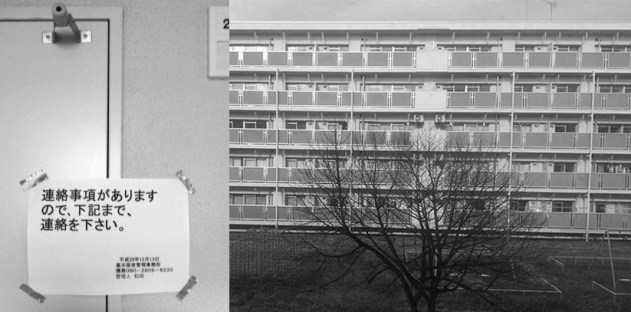
You can see the photo of the notice taped on the apartment door of Mr. Yôichi OZAWA in the social housing for job seekers in mobility, used as temporary housing offered free of charge to nuclear accident victims, situated in Hara-machi district of Minamisoma town.
Mr. OWAZA left his home at 22km from the Fukushima Daiichi Nuclear Power Plant where the radioactivity was too high. In spite of the contamination, his home was not included in the evacuation zone, which stopped 20km from the NPP. Thus, he is considered as “auto-evacuee”, jishu-hinansha, and as such subject to the same harassment as the “auto-evacuees” in the Metropolitan regions of Tokyo or in West Japan.
Because of this zoning based on the geographic distance from the crippled NPP that divides Minamisoma town, the evacuees of Hara-machi district are subject to expulsion persecution, whereas those of Odaka district are exempt from such acts.
The door picture was posted in the Facebook of Mr. Tatsushi OKAMOTO on December 24th 2016 with the text below.
On the notice we can read:
Please contact us, for we have things to communicate to you.
December 13th 2016
Kuroki Housing Management Office
Cellphone #: XXXX
Manager: XXXX
Here is the paper taped on the door of a house for evacuees.
It is shocking, this way of taping the notice.
They treat us like a non-paying renter or as if we are not paying our taxes!
No consideration of the dignity of the person.
It is like the Yakuza’s way of collecting money!
Currently in Fukushima, the victims are facing a double or triple suffering.
Who is to be blamed? What have we done to deserve this, we, the victims?
_______
(1) Minashi kasetsu jyûtaku. Rental housing managed by private or public agencies offered to evacuees of which the rent is taken in charge by the central or local government.
_____
Reference links
山本太郎公式ホームページの質問書き起こし Texte of questions of Taro Yamamoto in his official HP (in Japanese)
山本太郎の質問の英訳とフランス語訳の記事
English translation of Taro Yamamoto’s questions
山本太郎議員が使った、ふくいち周辺環境放射線モニタリングプロジェクトの汚染地図(日本語)
Contamination map used by Taro Yamamoto (in English)
Read also:
Harassment of Evacuees by Prefectural Housing Authorities to evict them for March 2017
Source :
Taro Yamamoto Defends Fukushima Victims’ Rights
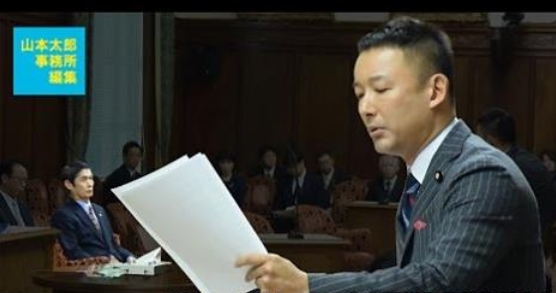
Taro Yamamoto of the Liberal Party is a member of the Chamber of Deputies. He is one of the few parliamentary members defending the rights of victims of the TEPCO Fukushima Daiichi nuclear power plant disaster.
The Association Nos Voisins Lointains 3-11 translated the questions of Taro Yamamoto to the Chamber of Deputies’ Special Commission on Reconstruction on 18 November 2016*. The content of his questions reveals the inhuman situation faced by the victims in the framework of the Japanese government’s return policy .
Taro Yamamoto’s questions (video in Japanese)
● Taro Yamamoto
Thank you. I am Taro Yamamoto from the Liberal Party. I would like to ask questions as the representative of a parliamentary group.
Declared on 11 March 2011, the state of nuclear emergency has not yet been lifted to date, 5 years and 8 months after the accident at the TEPCO Fukushima Daiichi nuclear power plant. Today, I will address a subject that is well known by the members here present.
I will start with the subject of the radioactivity controlled area. This is a demarcated area frequented by workers with professional knowledge who are exposed to the risks associated with ionizing radiation, such as an X-ray room, a research laboratory, a nuclear power plant and so on.
Here is my question. There are rules that apply to controlled areas of radioactivity, are not they? Can we eat and drink in such a controlled area?
● Government expert (Seiji Tanaka)
Here is the answer. According to the Ordinance on the Prevention of Risks from Ionizing Radiation**, eating and drinking are prohibited in workplaces where there is a risk of ingesting radioactive substances orally.
● Taro Yamamoto
Of course, it is forbidden to drink or eat there. So it’s obvious that it’s not possible to spend the night there, is it? Even adults cannot stay for more than 10 hours.
You are well aware of the existence of this Ordinance. This is a rule that must be respected in order to protect workers exposed to risks related to ionizing radiation in establishments such as hospitals, research laboratories and nuclear power plants, isn’t it?
It contains the definition of a radioactivity controlled area. This is Article 3 of the Ordinance in File No. 1. It states that if the situation corresponds to the definition described in Article 3/1 or to that specified in Article 3/2, the zone shall be considered as a controlled area and a sign shall be posted there. I will read parts 1 and 2 of this article.
1: The area in which the total effective dose due to external radiation and that due to radioactive substances in the air is likely to exceed 1.3mSv per quarter – over a period of three months! When the dose reaches 1.3mSv over a period of three months, a zone is called “controlled radioactivity zone”.
Part 3/2 refers to the surface density in the attached table.
Here is File No. 2. What will it be if we do the conversion of the density of the surface per m2?
● Government expert (Seiji Tanaka)
The conversion gives 40,000Bq/m2
● Taro Yamamoto
Thus, with 40 000Bq / m2, the zone is classified as a “controlled zone of radioactivity”. It is therefore necessary to monitor not only radioactivity in the air but also the surface contamination, ie the ground dose of radioactive substances, ie other elements in the environment, and to manage the area in order to protect workers from radiation-related risks, isn’t it?
A radioactivity controlled area is defined both by the dose rate of the ambient radioactivity and by the surface density of the radioactive substances. The point is that the risk in a situation where the radioactive substances are dispersed is quite different from that in the situation where the radiation sources are well identified and managed.
At present, the evacuation order applied to the evacuation zones following the nuclear power plant accident is lifted when the ambient radioactivity dose rate becomes less than 20mSv / year.
Here is my question. Concerning contamination, apart from the dose rate of ambient radioactivity, are there any conditions to take into account in order to lift the evacuation order? Please answer yes or no.
● Government expert (Takeo Hoshino)
Here is the answer.
Concerning the conditions necessary for the lifting of the evacuation order, as far as the radioactivity measurements are concerned, it is only the certainty that the annual cumulative dose rate of ambient radioactivity is less than 20 mSv.
● Taro Yamamoto
You did not understand. I asked you to answer yes or no. Are there any other conditions other than the dose rate of ambient radioactivity? To lift the order of evacuation below 20mSv / year, what are the conditions regarding the contamination?
The fact is that regarding contamination, there are no other conditions than the dose rate of the radioactivity in the air. This is abnormal. You, who belong to this Commission, certainly understand to what extent this situation is abnormal.
In the definition of a radioactivity controlled zone, apart from the dose rate of radioactivity in the air, account is taken of the substances dispersed and then deposited, that is to say contamination in the soil etc., which means a criterion of 40 000Bq / m2 is established for surface contamination.
However, in the return policy to return populations to territories where the annual cumulative dose rate is less than 20mSv / year, the condition of soil contamination is not considered necessary.
The latter is not an evaluation criterion, the only criterion used is the dose rate of the ambient radioactivity. Politicians and officials who consider this to be a regular situation do not deserve to receive wages paid from tax revenues.
Our job is to protect the life and property of the people. Now, you lighten those conditions. You create, at your discretion, a rule that is less stringent than that applied to workers with a professional knowledge of radioactivity. What are you doing !
Following the Chernobyl accident, laws have been established in Russia, Belarus and Ukraine, measuring both the dose rate of radioactivity in the air and the contamination of the soil. Why ?
That goes without saying. This is because it is difficult to grasp the amount of irradiation suffered by the population only with measurements of ambient radioactivity. In Ukraine, with 5mSv / yr, a measure corresponding to that of the controlled radioactivity zone, the population is evacuated, and even with 1mSv / year which corresponds to the limit of the average dose rate for the public, ‘they have the right to move out. This law known as the Chernobyl law is still in force.
On the other hand, what is the situation in Japan? According to the Cabinet decision of June 2015, the evacuation order is lifted if the dose rate in the air is less than 20mSv / year. There is no problem ! For example, if you stay 24 hours in a controlled area of radioactivity, you are exposed to a dose of 5.2mSv / year.
However, the criterion for the lifting of the order and the return of the population is 20mSv / year or less. The zoning is determined by a dose 4 times that of a controlled zone of radioactivity.
Go back, live there, continue your life, rebuild, what is this! I can find no other expression than “completely twisted”.
Can we still call it the State? I think it’s better to call it the mafia. It’s so inhuman!
The government appears to have adopted dose limits of 20 to 100mSv as recommended by the ICRP*** on radiation exposure limits after an accident. However, when considering the health effects on the population, the most reasonable would be to adopt 1mSv, the lowest dose measurement for radiation limit for public health, according to the global consensus.
The right to evacuate must be granted to the population until the dose rate falls below 1mSv / year. The right to decide when to return belongs to the victims. Why do you determine zoning as you wish? The State must make every effort to reduce the dose as close as possible to 1mSv / year, maximum dose in a normal situation. Then the State, the administration should warn the people, and let them make their own decisions. That would be the fairest way. The State should behave like this.
Who is responsible for this accident? It is TEPCO. Who supported it? It is the State. It is clear who the perpetrators of the crime are. And yet, only the charges of the criminals are being relieved. If it is permissible to develop zoning and associated rights to the convenience of the criminals, this world is a hell then.
In the town of Minamisoma in the coastal region of Fukushima Prefecture, three types of evacuation zone were established after the earthquake. In July 2016, the evacuation order was lifted in the “evacuation order lifting preparation area” and in the “restriction of housing” area. There is only one home with two people remaining in the “area where the return is difficult”.
According to the State, 90% of the territories of Minamisoma are safe.
There is a group called “The Measurement of Environmental Radioactivity Around the Fukushima Daiichi Nuclear Power Plant”**** composed mainly of residents of Minamisoma. Since 2012, its members are taking measurements of soil contamination in the vicinity of the neighborhoods of the members and in residential areas. They provided the information. Please look at File No. 3. You see a colored map ( Note from the translator: see the map here, https://dunrenard.wordpress.com/2016/11/12/the-minamisoma-whistleblowers-fukushima/ )
This is the map of soil measurements collected and measured in the territories where the decontamination works have been completed. The colors show the levels of contamination. The blue colored area indicates where the contamination measurements are below 40 000Bq / m2, ie below than the level of a radioactivity controlled zone. There is only one, at the right bottom. Apart from this one, at all other places, the colors show corresponding measurements above the measurements of a controlled zone of radioactivity. There is even a colored place in gray where the measurements exceed 1 000 000Bq / m2. There are people living there!
Compared to the extraordinary ambient radioactivity dose rate observed immediately after the accident, the dose rate of radioactivity in the air decreased considerably. It is not the same order of magnitude. However, according to the inhabitants, even with 0.1μSv / hr of ambient radioactivity dose rate, soil measurements may still be equivalent to those of a radioactivity-controlled zone.
It is senseless that only the dose rate of ambient radioactivity should be taken into account as a condition for lifting the evacuation order. It is so irresponsible and neglectful. It is exactly the opposite of protecting the life and property of the people. People do not live floating in the air at 1 meter above the ground*****. They sit down, lie on the ground, they stop to chat, standing or sitting. Children do not play on asphalted roads only. They can venture into the bushes. Children play freely. There are some who put soil in their mouth. Remember how you were when you were still a child. Gutters where contamination is concentrated provide one of the favorite playgrounds for children.
Mr. Masuchika Kono, a member of the above-mentioned project group, who was with the Engineering Department of Kyoto University, a specialist in nuclear engineering, a graduate of radiation manipulation, collected soil at the Minamisoma Michi-no-eki roadside (service and parking area), and passed it through a sieve of about 100 microns.
The measurements showed 11 410Bq / kg of Cs. These dust rises with the winds and the passages of the vehicles. In daily life, dust is inhaled by the people. You do not take internal radiation into account, do you? You calculate the amount of internal radiation by applying just a coefficient, but do not include internal radiation in real life.
Some people self-evacuated from areas outside the evacuation areas under evacuation order, as they consider that the State policies do not protect the children, their lives. To these persons, within the framework of the Disaster Relief and Disaster Relief Act******, dwellings – “temporary accommodation”******* – were made available.
However, in March 2017, next year, the free housing provision will be suspended. You are telling them that there is no more problem; Why then stay evacuated? That’s it, isn’t it? Those displaced from areas outside evacuation areas under evacuation order fled because their home and living environment are contaminated as a result of the TEPCO nuclear accident.
However, since their homes are located at some distance from the nuclear power plant, they were not included in the evacuation zones that the state established unilaterally. As a result, these displaced persons receive no public support except the provision of free housing. And even this aid will stop in March 2017.
It’s incredible to stop helping them. Moreover, what does it mean to stop the provision of free housing in March? It is the season when mobility is at its highest in the year. You expel them, force them to relocate at the time of the year when rents and costs become more expensive! You have no compassion. You are ruthless!
“I am afraid of the investigators of the Tokyo Metropolitan Prefecture visiting door to door. I hide under the cover for fear of hearing the ringing at the door. When I opened the door, the investigator stuck his foot into the door so that I could not close it. With a loud voice so that all the neighbors could hear, he shouted at me “you know very well that you can only live here until March”. I know, but I cannot move. “
The next person. “The Tokyo Metropolitan Prefecture demands that we move out in a fierce and haughty manner. We had to leave our home because of the accident at the nuclear power plant. I do not understand why they are expelling us again. I gave in to the pressure, and I filled up the Tokyo Metropolitan Prefecture housing application, but it was against my will. Psychologically, I can not accept the fact, and it causes me pain. They are forcing me to move into a prefecture owned housing where no one from Fukushima lives close by. It’s like abandoning the elderly in a mountain. “
The following testimony. It is a home where just a mother and her young children live. The other members of the family remained in Fukushima. They lead a double life. “If there is no more free housing provided, there is no resource to pay the rent. The only dream left to my child is his piano lesson. Do not take away that dream. “
The next person. “The deadline has not arrived …”
(Note from the translator : Taro Yamamoto can no longer hold his tears) Who does something like that? I beg your pardon. Who orders such a thing? It may be admitted that the State would ask local governments to carry out polite negotiations with the displaced. No, it is nothing but expulsion. Does not the State intend to stop such a situation? I do not allow you to say that you did not know. You see the problem before you now!
“Constant phone calls, visits without notice, and they shout at me asking what my intention is. They send documents to file, and leave passing notices in the mailbox. I am completely exhausted, physically and psychologically. “ This is understandable. They continue to live like that since the explosions of the nuclear power plant, and 5 years and 8 months later they are tracked down in a similar situation. To what extent do you want to tear the hearts of the victims? It is enough for the State to take a decision. This person says that the metropolitan prefecture of Tokyo has asked him to leave the housing, because the prefecture must return that housing for civil servants in March. It is monstrous that the State asks the Tokyo Metropolitan Prefecture to evict the evacuees and restore the house in proper condition.
These were testimonies of displaced people.
According to my research, to date there are 9327 vacancies among the housings for civil servants in the region of Kanto, including the Tokyo Metropolitan Prefecture and 6 other prefectures. It is enough for the State to take a decision, it can solve the problem, at least partially. Why should the inhabitants be expelled? Is it because, if there are tenants, those buildings could not sold during the financial bubble of the Olympic Games? It’s too cruel.
On April 4 last year, according to the newspaper Mainichi shinbun, the state does not request reimbursement from TEPCO for the rents of dwellings “considered as temporary housings”. Commission member Iwabuchi mentioned earlier that the government will oblige TEPCO to pay for the costs of the decontamination work. Why don’t you ask TEPCO to pay the rents? These people are the victims!
Finally, I would like to ask to the Minister. I would like you to answer two questions.
1st: You said that this is what the Fukushima prefecture wants. However, you are in a position to make suggestions to the Fukushima Prefecture. Please talk it over again. This situation is really irregular.
2nd: Please listen to the voices of the displaced. I think you have almost no opportunity to hear the voices of self-evacuees coming from locations outside the evacuation areas. Until then, you were too busy. Perhaps the people around you got acquainted with their testimonies. Please listen to them yourself. Today, too, they are here. There’s a break after this session. Could you give them 5 minutes? If you give us just 5 minutes today during the break, you can talk with the self-evacuees.
I would ask you to answer these two questions.
Secretary of State (Masahiro Imamura)
As I have already said, I am willing to consult with the prefecture of Fukushima, and I would like to ensure that the people concerned are not hurt. I will see to its smooth progress.
You said that self-evacuated people are here. I also have a plenary session after and I do not have time, but I will listen to them.
President (Mitsuru Sakurai)
Mr. Yamamoto, you have exhausted your time.
Taro Yamamoto
Thank you.
Please keep your promise. Thank you very much.
Credits to Kurumi Sugita from the Nos Voisins Lointains 3.11 Association for the japanese to french translation (http://nosvoisins311.wixsite.com/voisins311-france)
French to english translation by Hervé Courtois (Dun renard) from the Fukushima 311 Watchdogs (https://dunrenard.wordpress.com/)
* Source : Site web de Taro Yamamoto
** Ordinance on Prevention of Ionizing Radiation Hazards, Ministry of Labour Ordinance No. 41 of September 30, 1972, Latest Amendments: Ministry of Health, Labour and Welfare Ordinance No. 172 of July 16, 2001
*** International Commission on Radiological Protection
**** Fukuichi shûhen kankyôhôshasen monitoring project
***** The measurements of ambiant radioactivity are taken at 1 meter above the ground.
****** Saigai kyûjohô, Law of assistance in case of disaster , laws N°118 of octobre 18, 1947
******* Minashi kasetsu jyûtaku. Rental housing managed by private agencies inhabited by evacuees whose rent is borne by the central government or local governments.
New Fukushima evacuee bullying case emerges at Tokyo school

Garbage taken home by a bullied student in Tokyo’s Chiyoda Ward (Provided by the student’s mother)
After school bullying cases emerged recently in cities including Yokohama and Niigata, another student who was evacuated from Fukushima Prefecture after the 2011 nuclear disaster has come forward.
The latest case, at a junior high school in the capital’s Chiyoda Ward, involved the victimized student being intimidated into paying for three other students’ sweets, juices and other goods, worth about 10,000 yen ($87).
The case came to light after the student and the student’s mother reported the bullying to the school.
“It is regrettable that bullying existed at this school. I will do my utmost to prevent it from happening again,” said the principal of the Chiyoda Ward government-run school.
The victim told The Asahi Shimbun that some students had begun to utter the taunt “hinansha” (evacuee) around summer 2015.
This year, the name-calling escalated, and the bullies started making insulting and threatening remarks such as, “You don’t have money as you came from Fukushima,” “Can’t you pay the bills for us as you are poor?” and “I will reveal that you are an evacuee.”
The bullies then manipulated the victim into paying for their doughnuts, juices and other goods.
The picked-on student was also pressured by the student’s tormenters to take home their trash, which they did by putting it into the student’s school bag.
At school, the student’s textbooks and notebooks went missing. Some of them were found in a corner of the classroom with ripped pages.
“Since my elementary school days, I have been bullied on the grounds that I am an evacuee. I was not able to tell that to anybody. It was painful. I thought that if I can silence other students with money, I will do it,” the student said.
In late November, the student’s mother noticed all the garbage in her child’s school bag. Finally the student told the mother what had been happening, and then reported the case to the school, along with the mother.
The school investigated 15 pupils but was not able to confirm that the victim has been bullied on the grounds that the student was an evacuee from Fukushima Prefecture.
However, three of those investigated admitted that the student had paid their bills. The school confirmed that the bills totaled about 10,000 yen.
The school said that it did not investigate the missing books, as it was not clear when they had disappeared.
“I had thought that the school would investigate who dumped them,” the mother said of the missing books, adding, “I want the school to deal with the case by paying more consideration to the bullied student.”
More Evacuees Sue Govt, TEPCO over Fukushima N-Accident
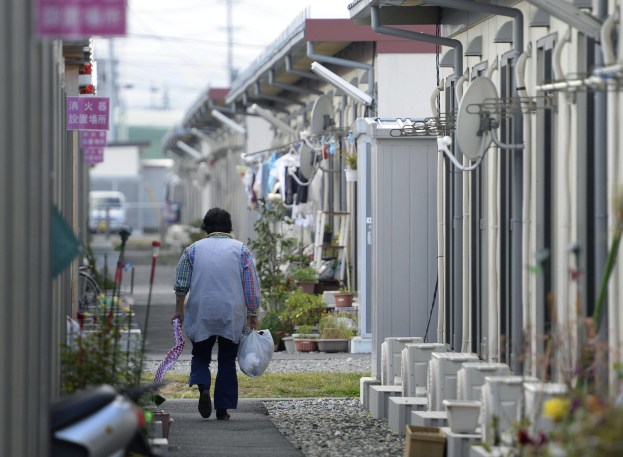
Fukushima, Dec. 12 (Jiji Press)–A group of 295 people, mainly nuclear disaster evacuees, on Monday joined lawsuits against the Japanese government and Tokyo Electric Power Company Holdings Inc. over the Mach 2011 meltdowns at TEPCO’s Fukushima No. 1 power plant.
Filing their suit with Fukushima District Court, the plaintiffs, many of whom were evacuees in and outside Fukushima Prefecture, demanded that the government and TEPCO pay compensation and restore conditions before the nuclear accident.
The group, made up of men and women from minors to 89 years old, said they were forced to evacuate and deprived of their peaceful lives because of the accident at the power plant in the northeastern Japan prefecture.
The team joined those who filed similar suits against the government and TEPCO in March 2013, raising the total number of plaintiffs to some 4,200.
At a news conference after the latest suit was filed, plaintiff Akemi Eda, who evacuated from the Fukushima Prefecture town of Namie, noted recent incidents in which children evacuated from the prefecture due to the accident have been bullied at schools.
Mom of student called ‘germ’ at school links bullying to Fukushima disaster
The mother of a fourth-year elementary school student in Niigata, who has been staying home from school since late November after being called “germ” by his peers and his teacher, spoke to the Mainichi Shimbun, saying that her son was bullied because he came from nuclear disaster-hit Fukushima Prefecture.
The family evacuated from Fukushima after the nuclear disaster. While the Niigata Municipal Board of Education has denied a link between the bullying of the student and his Fukushima roots, according to the mother, the student started being called “germ” around March of this year, which marked five years since the disaster, and this is one reason she argues that there is a connection.
According to the mother, around March 11 of this year when the nuclear disaster issue came up in class, her son proactively talked about his own experiences.
“He must have been happy to be able to give lots of answers,” she says. However, it was around that time that he started being called “germ” by his classmates.
“Some kids who knew he had come from Fukushima started calling him germ, and that led to kids who didn’t know him also calling him that, like a nickname,” she says.
In June, the student talked to his teacher, complaining that he was “being treated like a germ.” At that point the student is thought to have not considered the name as bullying, and when the teacher referred to him as “germ” after summer vacation ended, he didn’t appear to be deeply bothered by it.
In early November, though, it was reported in the news that a junior high school student in Yokohama who had evacuated from Fukushima Prefecture was bullied by being called “germ.” When the student in Niigata heard this, he said, “It’s the same as me,” and the mother says she thinks “he probably began to see himself as being bullied.” On the mother’s advice, the student talked to his teacher about it again on Nov. 17. When he came home, he triumphantly said with a smile that he had talked to the teacher.
After a strong earthquake off the Fukushima Prefecture coast early on the morning of Nov. 22 this year, the boy went off to school looking anxious, he and his mother having not yet been able to get in contact with the father, who works in Fukushima Prefecture. During recess that day, while the student was receiving teacher-parent correspondence from his teacher, the teacher called him “germ” again. The shocked student returned home, and since Nov. 24 has been staying home from school, saying, “I want to go to school, but I can’t because that teacher is there.”
According to the mother, at first school authorities denied the teacher had called the student “germ.” On Nov. 25 the father called the school and said tearfully that “There are kids who commit suicide (when they are bullied).” Although the teacher apologized, the mother says that the teacher treated them coldly, saying it was only this year that they had become the student’s homeroom teacher. The teacher has said they want to apologize to the student, but the student is refusing to see the instructor and the school principal has been visiting the family’s home every day to try and deal with the matter.
The family has been planning to move after the free rent for the government-leased apartment they are living in ends at the end of this fiscal year. The mother says, “My son had been asking that we stay in the same school district, but now that this has happened, we have no choice but to have him change schools,” adding, “We evacuated voluntarily (from Fukushima), and I don’t want to impose on the people of Niigata.”
According to the Niigata Municipal Board of Education, there are 291 children who have evacuated from Fukushima Prefecture to the city of Niigata. It holds that “there is no bullying of students related to their Fukushima roots.”
———-
Timeline of events involving the bullying of the student:
2011:
March — The Great East Japan Earthquake and the Fukushima No. 1 Nuclear Power Plant disaster occur. The student evacuates to the city of Niigata.
2016:
Around March — Student begins to be ostracized by peers and called “germ.”
April — Student enters fourth grade and homeroom teacher changes.
June — Student speaks to teacher about being called “germ.” Teacher disciplines classmates who bullied student.
Early November — News is reported of a junior high school student in Yokohama who evacuated from Fukushima Prefecture and was bullied, including being called “germ.”
Nov. 17 — Student again speaks to teacher about being bullied.
Nov. 22 — During recess, student is called “germ” by teacher in classroom in front of classmates.
Nov. 24 — Student begins to stay home from school (Nov. 23 was a school holiday).
Nov. 29 — School questions students about incident. Multiple students testify that teacher called student “germ,” and teacher also says it is true.
(Based on sources including student’s parents and the Niigata Municipal Board of Education)
http://mainichi.jp/english/articles/20161205/p2a/00m/0na/020000c
School Bullyism Against Fukushima Evacuees Children
Fukushima evacuee hurt by teacher’s remark
Education authorities in Niigata City, north of Tokyo, have apologized after learning that a school teacher used a word that can mean “germ” to address a pupil. The boy had evacuated from Fukushima Prefecture after the 2011 nuclear accident.
Officials of the city’s education board said on Friday that the 4th grader has not been able to attend his elementary school for more than a week because of what happened.
They say the boy consulted his homeroom teacher several days before the incident. He said his classmates were calling him “kin”, which can mean “germ”.
The teacher has reportedly explained that the students had a habit of adding “kin” to each other’s names, as a way of showing friendliness to their classmates.
He said this also made them sound like “Anakin” Skywalker in the Star Wars movie series and other celebrities.
The teacher said he added the suffix to the students’ names, but he never intended to refer to them as “germs”.
But the officials said the teacher’s use of the term was inconsiderate and hurt the feelings of the pupil, who felt he was being bullied and was seeking help.
They said the teacher will visit the boy and his parents to apologize, and the education board will offer support so he can return to his school.
In a similar recent case, another young evacuee from Fukushima said he was called a “germ” at his school in Yokohama and he thought of killing himself many times.
His parents have criticized school and local education board officials for failing to promptly act on their complaint.
http://www3.nhk.or.jp/nhkworld/en/news/20161202_30/
Teacher ‘insulted’ Fukushima boy in latest school bullying case
NIIGATA–In the latest classroom bullying case involving children from Fukushima, a fourth-grader has not attended school for more than a week due to the alleged victimization by a teacher as well as his classmates.
The municipal board of education here is investigating the harassment of the boy who had the derogatory term “germ” added to his name by his classmates, which was then apparently emulated by his teacher.The boy has been absent from his elementary school since his homeroom teacher, who is in his 40s, is alleged to have used the insult on the boy. The teacher has denied the accusation, but other pupils have corroborated the boy’s account.
The school’s principal has admitted that the teacher’s behavior was problematic.
The principal also said in an interview with The Asahi Shimbun on Dec. 2 that the school will provide an opportunity for the teacher to apologize directly to the student and his parents.
The case is the latest to have surfaced of the potentially widespread bullying at their new schools of Fukushima students who fled the 2011 nuclear disaster.
Last month, media reports on a 13-year-old junior high school boy who moved to Yokohama recounted his experiences at his elementary school through his handwritten notes, sparking huge repercussions across the country.
In Tokyo, another Fukushima boy attending junior high school described his ordeal at his elementary school in an interview with The Asahi Shimbun later that month.
The two boys were called “germ” by their classmates, who also harassed them in other ways.
But in the Niigata case, the teacher called the boy by the insulting name in front of other students when he handed his pupil a correspondence notebook on Nov. 22, according to the boy’s mother.
The boy appeared to be devastated by the teacher’s behavior, which compounded the anxiety he already felt when his family was unable to contact his father to make sure he was safe after a powerful quake jolted Fukushima Prefecture earlier that day. His father works in the prefecture.
The following day was a national holiday and the school was closed. The boy has not attended the school since Nov. 24.
The boy’s family moved to Niigata over concerns about radiation in 2011 following the triple meltdown at the Fukushima No. 1 nuclear power plant in March that year.
According to his mother, some of his classmates began ostracizing him and calling him “germ” when he was in the third grade.
When he entered the fourth grade, some children threw away his stationery and broke his umbrella, and the harassment later escalated.
Although his mother was worried about him, he reassured her, saying, “I have friends who are trying to protect me. I will be OK.”
But he became visibly depressed when he learned of the report about the bullying the boy in Yokohama went through, according to his mother.
“My son must have thought that he is also the victim of severe harassment,” his mother said.
Urged on by his mother, he told his homeroom teacher on Nov. 17 that he, too, was being called “germ” by other children.
Five days later, however, he found that his teacher had joined in the name-calling.
His mother contacted the school to raise the issue. The teacher initially denied the allegation when school officials inquired.
“I have never said such a thing, given that the boy came to me for counseling,” the teacher was quoted by one of the officials as saying.
But the teacher was found to have actually used the insult when other teachers interviewed all the students in the boy’s class on Nov. 29. Some students admitted that they called the boys by an unkind name and that the teacher, too, had done the same.
According to the principal, the homeroom teacher said he wanted to apologize for being insensitive.
12,000 evacuee households from Fukushima fret over benefit loss
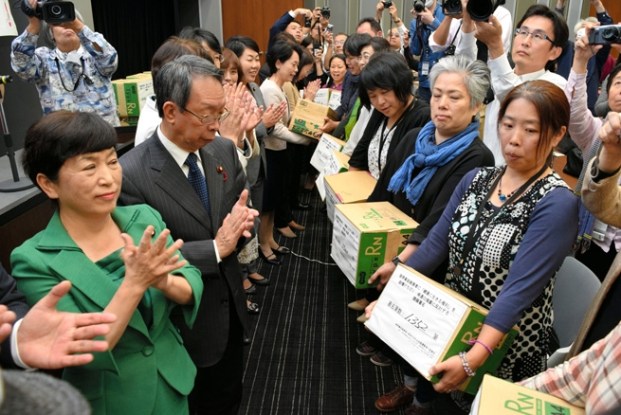
Evacuees from the Fukushima nuclear disaster deliver a petition to politicians in Tokyo on Oct. 26 calling for the extension of free housing benefits.
Anxiety is spreading among many of the 12,000 or so households evacuated after the Fukushima nuclear disaster five years ago as their free housing benefits will end next March.
In late October, about 180 people, who have been receiving free housing after leaving their homes in Fukushima Prefecture, delivered a 200,000-signature petition to politicians in Tokyo asking for the accommodation allowance to be extended.
At the Upper House Members’ Office Building, they voiced their concerns, one after another.
“We are being told to get out of our house,” one of them said. “We are in a real fix.”
The central government and Fukushima prefectural authorities have been providing prefabricated temporary housing units or paying the rent of those who have evacuated either within or to outside the prefecture, even if they did not come from designated evacuation zones.
The measures were introduced because many residents living outside evacuation zones left their homes out of anxiety over the spread of radioactive fallout.
A total of 231.6 billion yen ($2.9 billion) had been spent by March 2016 on 44,000 households, including the cost of building prefab temporary housing units.
But the Fukushima prefectural government decided in June 2015 to discontinue the assistance for evacuees from areas outside evacuation zones.
“With cleanup efforts moving ahead, the living environments are getting better,” Fukushima Governor Masao Uchibori said at the time.
The decision will affect the so-called voluntary evacuees, who lived in areas that were never designated evacuation zones, and evacuees from areas where evacuation orders were lifted in 2014.
Briefing sessions have been held by the prefectural government since December 2015 at about 40 locations within and outside the prefecture to explain details of rent subsidy measures for low-income households, which will replace the free housing benefits.
In late September, prefectural government officials faced a barrage of questions from about 70 residents of Kawauchi, Fukushima Prefecture, who packed a meeting hall in a temporary housing complex in Koriyama, also in the prefecture.
The village of Kawauchi had 2,739 residents as of Oct. 1 and at least 889 of them were living for free in rented housing, prefab temporary housing units and elsewhere outside the village.
Fumio Sakuma, 67, is one of them. His wife, who has a kidney disease, takes a 40-minute drive to hospital three times a week to undergo dialysis. Sakuma said he is anxious about having to relocate with his sick wife.
“We would feel grateful if we were allowed to stay here for one or two more years,” he said at the meeting.
Municipalities in disaster areas in Fukushima Prefecture, in the meantime, are hoping that the end of the free housing benefits will see a return of residents.
“Assistance measures by the central and prefectural governments cannot continue forever,” said Yuko Endo, mayor of Kawauchi. “We might as well take a step forward to rebuild our livelihoods.”
The town of Naraha, also in Fukushima Prefecture, has seen less than 10 percent of its residents return.
“More than five and a half years have passed since the onset of the nuclear disaster,” said Naraha Mayor Yukiei Matsumoto. “It’s time for every one of us to think about standing on our own two feet.”
http://www.asahi.com/ajw/articles/AJ201612010006.html
2nd Fukushima boy speaks up about bullying in new schools
A junior high school boy from Fukushima Prefecture recounts his experiences of bullying after he moved to Tokyo with his family as a second-grader in an interview with The Asahi Shimbun on Nov. 24
In a troubling development, the bullying of students who fled the Fukushima nuclear disaster is apparently more widespread than the boy whose ordeal in Yokohama recently attracted much media attention and generated public sympathy.
A junior high school boy in Tokyo also has recounted his agonizing experiences of becoming the target of harassment, which continued off and on in his first and second elementary schools in the capital.
“Unless a person who experienced it speaks up, a true picture of bullying cannot be conveyed to the public,” the boy, accompanied by his parents, told of his decision to come forward in an interview with The Asahi Shimbun.
When the boy evacuated from Fukushima Prefecture in 2011, following the nuclear accident in March that year, he was in the second grade. All he could take with him from his home in the scramble to flee were a few clothes. He could not bring his school backpack or textbooks.
At his new school, he soon found himself being bullied by his classmates, including girls.
“Your germs will infect us,” one said, while another jeered, “What you touch will be contaminated.”
Still another commented, “You are living in a house for free.”
He took down a drawing that was on a classroom wall alongside those of other children after he found some classmates had scribbled disparaging comments on it.
At the school, students formed small groups with their desks when they have school lunch. But students in his group avoided doing so with him.
After the boy tried to join them by pushing his desk toward theirs, a homeroom teacher called his parents to urge him to improve his behavior, saying that their son was “restless.”
The boy finally began to refuse to go to school.
“I cannot stand up due to pain in my legs,” he complained to his parents.
His mother decided to transfer him to a new school only several months after he was enrolled in the Tokyo school.
But the boy quickly discovered that the new situation was not much different from his former school.
A teacher introduced him as a Fukushima evacuee in front of the entire school. Soon children asked him how much compensation money his family had received. They also told him that his family must live in a nice home for free just because they were evacuees.
In the face of such bullying at his new school as well, the boy made the wish that he would be strong enough to persevere through the difficulties.
His mother finally took action to help her son when he was a fifth-grader. She brought up his troubles during her talks with his homeroom teacher.
Until then, though concerned, she restrained herself from speaking out in the crowd as several Fukushima evacuees were also attending the school.
“If I spoke out in a strong tone, I might have caused trouble for other evacuees,” the mother said of her feelings at the time.
But her patience ran out.
In response to her pleas, the boy’s homeroom teacher asked her to “wait three months,” and the bullying stopped.
But the harassment continued at the boy’s cram school.
A few children from the same school were also enrolled at the cram school, and they, coupled with students from other schools, continued taunting him where the homeroom teacher’s oversight did not reach.
After a child dropped the boy’s shoe in the lavatory basin, he was told, “This is your home.”
The boy mustered the courage to resist when another child, showing him a pet bottle containing leftover food, said the bullying would stop if he consumed it.
The mother, alerted by her son, reported the harassment to cram school officials and the situation improved after that.
The boy said his relationships with his new classmates were good after he entered a junior high school away from his home.
Although he did not reveal that he is an evacuee, he did not become the target of bullying even after his classmates later found out by accident.
“I was under the impression that I was not equal to my peers as I was an evacuee at my elementary school,” the boy said. “Children were in an environment that barely accepts individuality and those with differing backgrounds, and an evacuee was viewed as an individual with an abnormal trait.”
The parents said his family, evacuating from outside the evacuation zone, did receive compensation, but only a fraction of the sum a family from the evacuation zone was entitled to.
The family’s access to free housing will end in March.
“I am so worried about my future because I have no clue as to our life after that,” he said.
Yuya Kamoshita, who heads a group of evacuees in the Tokyo metropolitan area, said the organization received five other complaints about bullying, in addition to the boy’s case.
He said many children from Fukushima are routinely derided as “a germ” or “dirty” in association with the disaster at the crippled Fukushima No. 1 nuclear power plant.
“People around the children who call out those taunts must know about their behavior,” he said. “School officials should make a firm response.”
http://www.asahi.com/ajw/articles/AJ201611270040.html
A junior high school boy from Fukushima Prefecture recounts his experiences of bullying after he moved to Tokyo with his family as a second-grader in an interview with The Asahi Shimbun on Nov. 24
Fukushima Evacuees Still Unable to Go Home Over 5 Years after Earthquake, Nuclear Accident
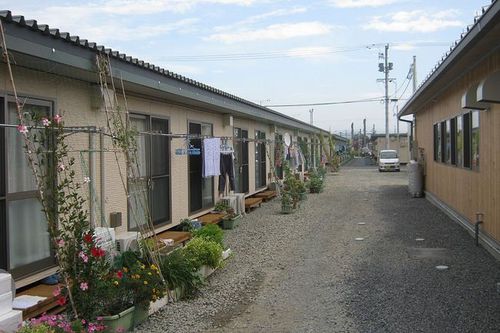
Over five-and-a-half years have passed since the Great East Japan Earthquake in March 2011 and the subsequent nuclear accident at Tokyo Electric Power Co.’s (TEPCO) Fukushima Daiichi nuclear power plant. Since then, big disasters have occurred in several other areas around the world, and in Japan the 2016 Kumamoto earthquakes also caused great damage. So, the term “disaster area” does not always evoke specific images of Tohoku or Fukushima for many of us in Japan today. However, a large number of disaster victims continues to suffer from the disaster in Tohoku, especially by the nuclear accident in Fukushima. The hard times for disaster victims haven’t ended yet. We report here on the latest situation in the Tohoku and Fukushima districts so as not to forget their ongoing suffering.
The losses from the Great East Japan Earthquake as of March 10, 2016, were officially reported as follows: 18,455 people dead or still missing (not including deaths related to injuries after the earthquake); 400,326 houses or buildings either completely destroyed or half destroyed. By prefecture in the most seriously affected areas in the Tohoku region, the death tolls are 4,673, 9,541, and 1,613, in Iwate, Miyagi, and Fukushima, respectively.
The estimated number of evacuees was approximately 470,000 at the peak, but 144,471 people were still living as refugees as of February 12, 2016.
Looking at the data of estimated populations of communities in the disaster-hit areas, comparing the population as of March 1, 2011 (before the disaster) and the most recent population, we see that the severely affected communities in Iwate and Miyagi have lost about one third of their populations. In Fukushima, several communities show “minus 100%” as the change of their population. Those ones are communities in the areas affected by the nuclear accident at TEPCO’s Fukushima Daiichi nuclear plant, where the evacuation order has not yet been lifted even today.
On a chart showing the timeline of evacuation orders issued right after the disaster, we see that areas ordered to evacuate were rapidly increasing one by one, while in the middle of all this, another explosion occurred at the reactor No.3. The timeline shows how the evacuation-ordered areas expanded.
Later, the government designated three evacuation zones based on international basic safety standards on radiation exposure. We can see on a map two significant evacuation zones: the Evacuation Order Zone (Warning Zone) — within a 20-kilometer radius from Fukushima Daiichi — and the Emergency Evacuation Preparation Zone — within a 20-30 kilometer radius. And we also see one more evacuation zone on the map, the Planned Evacuation Zone — a large zone including part of the 20-30-kilometer radius zone and extending to areas outside of a 30-kilometer radius, which is the area into which the wind was blowing when the plant exploded — meaning large amounts of radioactive materials were carried into the area by wind.
At the same time, Emergency Evacuation Preparation Zones were also designated where the cumulative dose during the year after the nuclear accident was predicted to exceed 20 millisieverts (mSv) depending on wind direction and geography. The zones were also called “hot spots,” and an evacuation advisory was issued to their residents.
Later on, the categories of evacuation zones were revised as follows:
- Zones where evacuation orders were ready to be lifted (where it was confirmed that the annual cumulative dose of radiation will definitely be 20 mSv or less). People could go home temporarily (staying overnight prohibited) to prepare to return completely, and resume some operations such as hospitals, welfare facilities, shops, and farming.
- Zones in which the residents were not permitted to live (where the annual cumulative dose of radiation was expected to be 20 mSv or more and where residents were ordered to remain evacuated in order to reduce the risk of radiation exposure). People could temporarily return home and pass through the areas along main roads to repair infrastructure.
- Zones where it was expected that the residents would have difficulties in returning for a long time (where the annual cumulative dose of radiation was expected not to be less than 20 mSv in five years and the current cumulative dose of radiation per year was 50 mSv or more). People were legally required to evacuate from the area.
As seen in the zone map showing evacuation orders, many areas are still designated today as “difficult-to-return” zones.
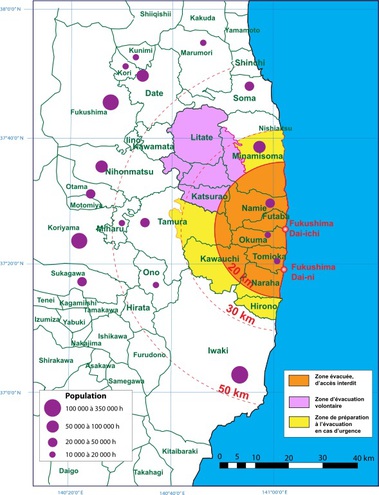
Let’s look specifically at the status of Fukushima Prefecture. Before May 2012, the total number of evacuees was 164,655. As of March 2013, the number from zones with evacuation orders and other areas was about 109,000. Looking at the updates in July 2016, 89,319 people in Fukushima are still living as evacuees . Also, Tomioka, Futaba, and some other Fukushima towns and local governments located in evacuation zones have moved their administrative functions both inside and outside of the prefecture.
Besides the number of deaths related directly to disaster-caused injuries in Fukushima Prefecture, the number of disaster-related deaths is still increasing, due to mental shock and physical conditions at shelters, such as poor hygiene and cold. Japan’s Reconstruction Agency recognized 459 people in Iwate Prefecture, 920 in Miyagi, and 2,038 in Fukushima as qualifying for payment of condolence money for disaster-related deaths. These numbers surpass the deaths directly caused by the earthquakes and tsunami.
The Tokyo Shimbun, a regional newspaper covering eastern Japan, gathered statistics on the deaths tied to the nuclear accident by asking municipalities in Fukushima to read through application forms for condolence money to find out the number of people that died from worsened physical conditions due to the stress of evacuation from the nuclear accident. The company wrote in its newspaper on March 6, 2016, “We interviewed municipal governments in Fukushima Prefecture and found that at least 1,368 people had died in connection with the nuclear accident, just from the numbers that could be confirmed.” The disaster-related death toll confirmed by each municipal government amounted to 2,028 as of March 4, 2016. It states that 67% of the disaster-related deaths are considered to be nuclear-related deaths.
According to statistics gathered by the Cabinet Office on the number of annual suicides related to the Great East Japan Earthquake and Fukushima nuclear plant accident, the number in Miyagi and Iwate prefectures is approaching zero, while it is still increasing in Fukushima.
Victims of nuclear accident face multiple difficulties, as shown below.
- Loss of daily living
- Loss of ways to earn a living
- Loss of community
- Forced to make own decisions whether to evacuate or not, and personally accept all risks that entail (people whose homes are outside of designated mandatory evacuation zones)
- Divorce, family breakdown, and separation of generations due to differences of opinion among family members
- A second mortgage to pay at the place of temporary evacuation
- Discrimination or bullying at place of temporary evacuation
- Not knowing when they can return home
- Uncertain about safety of returning home even after evacuation order is lifted
- Unable to rebuild community because many people have rebuilt their own lives (employment, human relations) at their place of temporary evacuation, and leaving mainly the elderly to return home.
Before the disaster, the nuclear power plants in Fukushima were generating power to send the electricity mainly to the Tokyo metropolitan area, not for local use. The nuclear accident forced people to leave their hometowns, and they are still not allowed to return to some areas. Even if the evacuation directive is lifted, evacuees will be unable to escape their anxieties about whether or not their homes are safe, and this situation continues to bring sorrow and hardship to the evacuees.
Even in this situation, Japan continues to approve the restart of nuclear power plants, some with operating permits for more than 40 years, despite the fact that the ruined plants have not yet been cleaned up, compensation for the accident is still not complete, and many people are still forced to live away from their hometowns. Each of us needs to think about the seriousness of nuclear accidents and the responsibilities that come with using nuclear power.
http://www.japanfs.org/sp/en/news/archives/news_id035681.html
1 This Month

of the week – Shut Down Drone Warfare!


Tell the Ukrainian Government to Drop Prosecution of Peace Activist Yurii Sheliazhenko

Petition to revoke the licensing of the Near Surface Nuclear Disposal Facility (NSDF) at Chalk River. https://www.ourcommons.ca/petitions/en/Petition/Details?Petition=e-7247
To see nuclear-related stories in greater depth and intensity – go to https://nuclearinformation.wordpress.com
-
Archives
- April 2026 (7)
- March 2026 (251)
- February 2026 (268)
- January 2026 (308)
- December 2025 (358)
- November 2025 (359)
- October 2025 (376)
- September 2025 (257)
- August 2025 (319)
- July 2025 (230)
- June 2025 (348)
- May 2025 (261)
-
Categories
- 1
- 1 NUCLEAR ISSUES
- business and costs
- climate change
- culture and arts
- ENERGY
- environment
- health
- history
- indigenous issues
- Legal
- marketing of nuclear
- media
- opposition to nuclear
- PERSONAL STORIES
- politics
- politics international
- Religion and ethics
- safety
- secrets,lies and civil liberties
- spinbuster
- technology
- Uranium
- wastes
- weapons and war
- Women
- 2 WORLD
- ACTION
- AFRICA
- Atrocities
- AUSTRALIA
- Christina's notes
- Christina's themes
- culture and arts
- Events
- Fuk 2022
- Fuk 2023
- Fukushima 2017
- Fukushima 2018
- fukushima 2019
- Fukushima 2020
- Fukushima 2021
- general
- global warming
- Humour (God we need it)
- Nuclear
- RARE EARTHS
- Reference
- resources – print
- Resources -audiovicual
- Weekly Newsletter
- World
- World Nuclear
- YouTube
-
RSS
Entries RSS
Comments RSS
 nuclear-news