Thyroid Cancer in Fukushima Children: When the Language and Information Gaps Mislead

With the year 2016 marking the passage of five years since the Fukushima nuclear accident, many writings—articles, editorials, academic papers—have been released reflecting on the first five years after the accident. Some of the writings address a psychosocial aspect of the accident such as “problems” caused by the stress of evacuation and the “unwarranted” fear of radiation, dismissing the potential health effects of radiation exposure, even ignoring the science. Others focus on the alleged withholding of medical data by authorities, speculating on the health effects of the Fukushima accident reaching even the United States.
Official data and information available in English are often limited and biased. Transparency and impartiality of such information, released by the government and international agencies, can be influenced by ulterior motives other than public health protection. However, without a fluency in Japanese and an ability to navigate through and comprehend the mass of official and unofficial information only available in Japanese, it may not become obvious that the transmission of accurate information is indeed hindered by the language barrier.
Furthermore, followers of numerous government committee meetings regarding the health effects of the Fukushima nuclear accidents—most of them live streamed on the Internet—have witnessed a systematic underestimation of health effects due to low-dose radiation exposure, with the claim of the outdated and unscientific 100 mSv threshold discourse. Despite concerns from local medical associations, potential health effects in prefectures adjacent to Fukushima Prefecture were dismissed, as if the radioactive plume was blocked by an invisible wall at prefectural borders. This is a far cry from the precautionary principle that should be in place for the protection of public health.
Consider the Japanese government’s haste to return evacuees to their still contaminated hometowns. This must be done so things appear “back to normal” for the purpose of recovery (mostly economic), even though it is clearly impossible to decontaminate a whole community in a natural setting of mountains and forests. Radiation doses of returned residents are to be monitored to keep an additional exposure dose below the regulatory limit. (But how good is it to know what your exposure dose is after the fact?)
In essence, the health effects by the Fukushima nuclear accident are being maximally minimized.
One of the most controversial topics about the health effects of the Fukushima nuclear accident is the thyroid cancer cases detected in Fukushima children as a result of the thyroid ultrasound screening. Most of the English writings on this topic accept, at face value, certain claims made by Fukushima Medical University as well as Japanese government officials in order to dismiss any connection between the Fukushima thyroid cancer cases and radiation.
Below, some items in the March 25, 2016 editorial in Chicago Tribune, “The children of Fukushima: When medical tests mislead,” are addressed to point out the misleading information that is widespread even amongst the academic circle.
1. There is no regional difference of thyroid cancer occurrence.
The March 25, 2016 Chicago Tribune editorial states:
“Children living closer to the accident in areas of greatest contamination had no greater rate of early cancer than those living farther away.”
This essentially refers to the lack of dose response, but it might depend on how the prefecture is divided into regions.
According to the official data by Fukushima Medical University (FMU) and Fukushima Prefecture in the final report of the first round screening [1], no regional difference was reported based on the comparison amongst 4 regions—one region including 13 municipalities with the highest dose and the evacuation zone, and three other geographically-divided regions. However, topography can vary even within the same geographical region, potentially affecting the flow of the radioactive plume. In other words, regional divisions like this might mask critical differences.
On the other hand, the biggest surprise in the official comparison was the Aizu region in western part of Fukushima Prefecture where the prevalence rate of 32.6 per 100,000 was very close to the prevalence rate in the highest dose area, 33.5 per 100,000.
Read more here . http://fukushimavoice-eng2.blogspot.fr/2016/04/thyroid-cancer-in-fukushima-children.html
An Insider’s Exposé of the Fukushima Nuclear Disaster

Koide Hiroaki has spent his entire career as a nuclear engineer, and has become a central figure in Japan’s movement for the abolition of nuclear power plants. He met with Katsuya Hirano and Hirotaka Kasai to discuss the catastrophic nuclear meltdowns at Fukushima Daaichi in March 2011, and the crimes and cover-ups committed both before and after the event.
His powerful critique of the ‘nuclear village’ and active involvement in anti-nuclear movements “earned him an honourable form of purgatory as a permanent assistant professor at Kyoto University.”
Koide retired from Kyoto University in the spring of 2015, but continues to write and act as an important voice of conscience for many who share his vision of the future free from nuclear energy and weapons.
He has authored 20 books on the subject. Professor Kasai Hirotaka and I visited his office at Kyoto University’s Research Reactor Institute in Kumatori, Osaka, for this interview.
We believe that the contents of the interview, which offer new information about the degree of radioactive contamination and invaluable insight into Koide’s ethical and political stance as a scientist, remain crucial for our critical reflection on ecological destruction, the violation of human rights, and individual responsibility.
The Fukushima disaster and the government and corporate response
Hirano: How does the Fukushima accident compare with the bombing of Hiroshima or Chernobyl in its scale? What are the possible effects of this yet unknown exposure?
Koide: Let’s start with the scale of the accident: It was a core meltdown involving the release of various kinds of radioactive material. Radioactive noble gas isotopes were also released, as were iodine, caesium, strontium, and other radioactive material. The noble gas isotopes have a short half-life and so at this stage they are all gone. Iodine, too, is gone. So now four years since the accident the materials that are still a problem are cesium-137, strontium-90, and tritium; really, it’s these three.
Now, as for the scale of the accident, I think it would be best to compare these three radionuclides. Today the main contamination of Japanese soil is the radionuclide cesium-137 [Cs-137 or 137Cs]. The ocean is largely contaminated with strontium-90 [Sr-90 or 90Sr] and tritium [T or 3H]. Right now the main culprit adding to the exposure of the people in Japan is Cs-137, so I think it’s best to use Cs-137 as a standard for measuring the scale of the accident.
But we simply don’t know with any precision how much Cs-137 was released. That’s because all the measuring equipment was destroyed at the time of the accident. How much Cs-137 was released into the air? How much was spilled in the sea? We just don’t know.
Still, the Japanese government has reported estimates to the IAEA [International Atomic Energy Agency]. According to those estimated levels, reactors 1, 2, and 3 had been in operation on March 11, 2011, and all three suffered meltdowns. Those three reactors released 1.5×10¹⁶ Becquerels of Cs-137, which would make it a release of 168 times more radioactive material than the Hiroshima bombing. And this is only material released into the atmosphere-at least according to Japanese government estimates.
But I myself think the government’s numbers are an underestimate. Various experts and institutes from around the world have offered several of their own estimates. There are those that are lower than the Japanese government’s numbers and those that are higher, some two or three times higher than the government’s numbers. According to these other estimates I think that the release of Cs-137 into the atmosphere could be around 500 times the Hiroshima bombing.
Now for what has been washed into the sea. That number is likely not much different from the levels released into the atmosphere. Even today we are unable to prevent this release. And so if we combine the amount of Cs-137 released in the air and the ocean together, we get an estimate several hundred times the Hiroshima levels. And some estimates suggest the Fukushima accident could be as much as one-thousand Hiroshimas.
Now to compare this with other accidents: The amount released into the atmosphere from the explosion during the accident at the Chernobyl nuclear plant was 800 to 1000 times the Hiroshima levels. Put simply, these estimates place Fukushima on par with Chernobyl.
Worse than any of these, however, is atmospheric testing. From the 1950s to the 1960s atmospheric testing of nuclear weapons had already released Cs-137 into the air more than sixty times the numbers released even by the Japanese government for Fukushima. Of course Fukushima is an incredible tragedy, but considered from the earth as a whole it is a rather small accident.
Hirano: I want to ask in more detail about the effect of Cs-137 on the human body and the environment.
Koide: Caesium is an alkaline metal. From the human body’s perspective, caesium closely resembles potassium. The body contains enormous amounts of potassium. It is essential for humans. It’s everywhere in our bodies. Especially our flesh and muscles are full of potassium. And because of this, when caesium is released into the environment, the body deals with caesium as it does with the alkaline metal potassium, which is to say that it is taken into the body and accumulates there.
Strontium is an earth metal. The body treats it like calcium. As you know calcium is a human body building block that accumulates in our bones. Strontium, too, is taken into and collects in the bones. Just as caesium is taken in and is transported to the flesh and muscle.
Hirano: Comparing the releases from nuclear tests by the US and the USSR during the Cold War period, you said that the Fukushima accident was small. So in what way should we think about Fukushima: is it best to consider it a Japanese problem, or to consider it from a global perspective?
Koide: The amount of products of nuclear fission released during atmospheric testing was enormous, and these particles continue to expose humans to radiation. I’m a bit older than you and I recall in my childhood being told not to let the rain fall on me at the time of the testing. In this way everyone on earth has been exposed (hibaku).
And because of this testing, historically speaking, cancer rates have slowly risen; I believe this increase in cancer is due to the exposure suffered during the atmospheric testing. Now the  radioactive material released from Fukushima has been dispersed across the globe and so once again everyone on earth has been exposed to additional radiation. I think we can expect cancer rates to rise once again.
Atmospheric nuclear testing released all of the radioactive material in the explosions, which entered the stratosphere. Between the stratosphere and the troposphere there is the tropopause, and every year come spring all that material dispersed in the stratosphere breaks through the tropopause and falls to earth. So that material, though initially dispersed in the stratosphere, eventually falls to earth evenly, everywhere.
Actually, it might not be accurate to say that it falls evenly on the earth. The majority of the testing was done in the temperate regions of the northern hemisphere, such as Nevada and the Semipalatinsk test site [in Kazakhstan], so that the northern hemisphere – as the site of most of the testing – is heavily contaminated, and within that the temperate region is heavily contaminated. Still, I can say the atmospheric testing overall has caused global contamination.
My focus now is to figure out how to deal with the acute and heavy contamination from Fukushima. I know something needs to be done right there in that specific place. That contamination will disperse and be diffused across the globe.
Once dispersed, the amount of radioactive material from Fukushima will be small when compared with the atmospheric testing. Which is not to say it is not harmful. An increase in cancer will be the result. I mention that for humanity as a whole; the atmospheric tests were worse.
Now, strontium-90 [Sr-90] has been leaking from Fukushima into the ocean, so it will eventually reach the United States, especially the west coast. This much we are sure of. But to answer your question, the amount of dispersed caesium and strontium released by the atmospheric tests is tens of times greater than the Fukushima levels.
Because the west coast of the US is already contaminated from the atmospheric testing, though the dispersed contamination from Fukushima will reach US shores, for people living on the US west coast, the Fukushima accident – and this is perhaps awful to say – contamination from Fukushima is hardly worth considering. Historically a much greater event has already taken place.
Hirano: To put that another way, the current Fukushima accident gives us a chance to reconsider the enormity of the past contamination from US and Soviet atmospheric tests, which has not been openly discussed.
Koide: Yes, that’s exactly right. In fact, it is the masses of people who need to realize the impact of the contamination on them. In the case of the Fukushima disaster, for example, they need to be aware that some radioactive material is reaching the North American coast, and the prevailing westerly winds will carry anything released into the atmosphere to the US.
Those earlier numbers from the Japanese government indicate that the levels for Cs-137 in the atmosphere are 168 times those of the Hiroshima bombing. I’ve been told that level is 1.5 x 10¹⁶ Becquerels [Bq]. These exponents can be a pain to process, so if we think of it in peta-units – which is 1015 – we get essentially 15 petabecquerels [PBq].
That said, while we are not really sure this is the number, we do know that a portion of this material will ride the prevailing winds across the Pacific Ocean. On the other hand, closer to the ground, the winds will be east, south, and north, and therefore this other portion will fall on Japan-and we can investigate the actual levels here: how much fell on this town, on this prefecture?
Adding these up, it seems to be only 2.4 PBq. Which is to say of the total 15 PBq, 2.4, or roughly only 16%, fell on Japanese soil. If the totals are higher, still a smaller share of the total contamination will have fallen on Japan compared with the Pacific, with the largest portion falling on the west coast of the United States.
So why don’t we hear complaints from the US? Why are there no calls for compensation? Whenever someone asks me this, I simply say that there just aren’t any such complaints. Why is this so? Well the levels released by the US during the atmospheric testing were tens of times greater than Fukushima.
They are the criminals, so they cannot ask for compensation from Japan. The U.S. government does not want to have to reflect on its own past, and I think they are eager to completely avoid bringing up anything like that conversation. That is why I believe it is so important that those who have been exposed to radioactive contamination realize what atmospheric testing has done to them.
Kasai: I’d like to get back to the moment of the accident in some detail. On March 11, 2011 we had the East Japan Disaster (meaning the earthquake and tsunami off Tohoku). You’ve already talked about the string of accidents at the nuclear plant. At the moment the accident was taking place, you were following the response by the Japanese government and the Tokyo Electric Power Company (TEPCO) in real time. What did you see in those initial moments?
Koide: It was truly a disastrous response. On the 11th I was in the laboratory in Kyoto as March was my month to work in the radiation-controlled area. It was normal workday hours and various tasks kept me busy working within the controlled area.
Of course there is no TV or anything like that in the work space. That night there was a meeting so I came out to attend and that’s when I saw the images of the Sendai airport being swept away by the tsunami. The report said that there had been a devastating earthquake and tsunami. Then I wondered about the safety of the nuclear plants.
Right then, there really was no more information. We had scheduled a nuclear safety issues seminar for the 18th. I’ve participated in hundreds of these seminars. Participants from the Ukraine had just arrived on the 11th. We promised to go out drinking after they arrived and so that night I went out. There was no more TV, and while there was a vague unease among us, that’s how we spent the time.
The next day I learned that all power at Fukushima had been lost and I knew things were not going to be simple. Then at noon on the 12th the roof of reactor one was blown off; at that point any expert must have known there had been a reactor meltdown.
So I was certain of a core meltdown and because once it has gone this far, there is no going back, it was time to call for anyone who could evacuate to do so. I thought we were at that stage on the 12th.
Yet neither the government nor TEPCO said a single word about a core meltdown; they announced that the incident merited a 3 or 4 on the International Nuclear Event Scale. I remember thinking “You’ve got to be kidding! There’s already been a meltdown. This is at least a level 6 or 7.“ But neither the government nor TEPCO gave any indication of this and there was no word of it in the media either.
One by one there were explosions at reactors 3, 4, and 2. As an expert in nuclear power, I understood there was absolutely nothing that could be done. I thought people needed to be evacuating, but still the Japanese government didn’t make the call.
Government officials had set up at an off-site centre near a power plant in Fukushima – at first they announced evacuation inside two kilometres, then that expanded to three, five, ten, and finally 20 km. After that nothing was done. The offsite centre was supposed to coordinate the emergency response in the event of an accident, but it turned out that every one of the officials fled. They left the employees behind and fled. The Japanese government’s response was indescribably cruel.
Kasai: It seems the very words ‘meltdown’ and ‘core meltdown’ (roshin yoyu) were strictly forbidden.
Koide: Exactly.
Kasai: I was in Japan watching on TV. What shocked me was all the nuclear power experts explaining the incident in the studio. I suppose it was a satellite relay, but when reactor number three exploded on our screens they were giving their analyses of the explosion in real time. There were experts on TV saying that the reactor had a blast valve that was used successfully.
Even hearing that, an average viewer might think something was amiss. But having physicists, experts on radiation, on TV saying these things, well, even the average viewer wouldn’t buy that explanation. In a broad sense, nuclear experts like yourself played several roles in the media and government.
Koide: Yes, that’s clearly true for pronuclear experts. They all tended to tell a story that underestimated the accident. Immediately after the accident public announcements and information were restricted. As a result individual opinions or statements were strictly forbidden and nearly all experts remained silent, so even basic information was not broadcast.
Though I’d made statements from the nuclear lab beginning on the 12th, it is likely there were instructions from the Ministry of Science and Education to silence me. The head of the lab convened several meetings where he told each of us not to make any statement, that the lab would toe the official line when dealing with the mass media.
I thought this was wrong and said that anyone who was asked a question by the media should answer it, further saying that if I were asked a question, I had a responsibility to answer. Since then I’ve continued to make statements in the media. Still the large majority of nuclear researchers were not able to do this.
As a result it was the pronuclear researchers who monopolized the interpretations – exactly. So as they went to the TV studios I think each was told: “Today, it’s your turn to go to the studio.” I think that’s how they played their part and handled the media.
Kasai: With respect to controlling information, would you say your experience with the head of the nuclear lab shows how the professional organizations exert pressure on the universities?
Koide: Yes, I would. The head of the lab opened a conference with all the other laboratories – even I went. There he said that any statements to the media should be on message and come only from the information office.
Kasai: So pressure came from academic conferences.
Koide: Yes, there was pressure coming from the academic conference side as well. Take for example something like a conference on nuclear power. From the very start it was never a real discussion; it was a meeting of powerful and vocal spokesmen for the nuclear community or village (genshiryoku kyodotai or genshiryoku mura)
This is to say the group of pronuclear government officials and private companies mainly centred around the LDP and Toshiba, Hitachi, Mitsubishi, and other pronuclear manufacturers of power plants-and of course their supporters in the media. Thus as an organization the conference was predisposed to underestimate the accident and to then promote that underestimation.
Hirano: Immediately after the accident you testified in the Diet presenting data indicating the seriousness of the disaster and demanding that the government terminate the operation of all the power plants.
Koide: I did.
Hirano: After that it seems you weren’t again asked to speak publicly, or given the opportunity to offer more detailed thoughts on the situation.
Koide: By ‘speak publicly’ you mean in the Diet or in some other official government setting?
Hirano: Yes, and also in the media.
Koide: With respect to the media, I’ve never really had any confidence in them. Since the accident, I’ve been overwhelmingly busy and haven’t accepted a single invitation from TV stations.
Hirano: I see. So there were invitations.
Koide: There have been many calls saying, “come down to the studio.” But I always tell them that I am too busy for this sort of thing. I’d say, if you come to my office, we could meet. Many did come by, even back then. But as everyone knows, in television you might talk for an hour and none of it makes it on air, or if it does, it’s maybe thirty seconds.
Hirano: Right, and only the convenient parts.
Koide: That’s it and there’s really nothing that can be done about it. There was, however, one outlet for which I was extremely grateful: the daily radio program called Tanemaki Journal. There I could go on every day and offer my thoughts live. I wish it could have continued, but it was completely and totally smashed. What a world we live.
Kasai: So, on the subject of standards used for assessing the danger posed by radiation for the human body and the environment: What are your thoughts on how the government deals with this issue?
Koide: They are absolutely not dealing with it at all. I think you already know this but in Japan the average person is not supposed to be exposed to more than one milliSievert per year-that’s set by law. Why is that the level decided on?
Because exposure to radiation is dangerous. If exposure weren’t dangerous, if low levels of exposure were safe, there’d be no problem even without that legal limit. But exposure to radiation is dangerous-this is the conclusion of all research. So every nation in the world has set legal limits for exposure.
For people like me who get paid to work with radiation, it’s not really possible to observe the 1mSv/yr limit [1mSv/yr]. We’re told that in exchange for our salaries, we accept exposure to twenty milliSieverts a year. That’s the standard I work under in my job. But the current Japanese government has now stated that if contamination is under 20mSv/yr somewhere, that place is safe to return to-safe to return to even for children. This is way beyond common sense.
Hirano: What is the basis of this claim? Why would the government announce these numbers and forcefully declare these areas safe to return to? What’s the basis for the government’s numbers?
Koide: The basis for those numbers … for example the government says that organizations like the IAEA or the ICRP [International Commission on Radiological Protection] suggest that in emergencies during which the 1mSv/yr standard cannot be maintained standards should be set between twenty and 100mSv/yr.
The government seizes on this and declares that since the IAEA and the ICRP have said this, that 20mSv/yr is therefore a safe level-usually adding that membership in both the IAEA and the ICRP is voluntary anyway. But because these organizations have said this is no reason to break Japanese law.
If Japan is a nation governed by the rule of law at all, surely this means that the very people who make the laws should also follow them – that should be obvious. But these guys have declared 20mSv/yr safe even for children. There is absolutely no way I can consent to this.
Hirano: So there is no scientific basis for these levels.
Koide: Well … the danger corresponds to the amount of exposure-you probably know this – so for a country that has declared its intention to maintain the 1mSv/yr standard to then turn around and ask people to endure twenty times that level, there is no scientific basis for that declaration. That’s a social decision.
But if you want to inquire as to why, as I’ve mentioned to you, some 2.4 petaBecquerels of radioactive material have fallen on Japan, that material has been dispersed, contaminating Tohoku, Kanto, and western Japan. So in addition to the law setting the legal limit for exposure at 1mSv/yr, there is another law that states that absolutely nothing may be removed from a radioactive management area in which the levels exceed 40,000 Becquerels per square meter.
So the question becomes how many places or how much area has been contaminated beyond 40,000 Bq/m2? And according to the investigations, that answer is 140,000 km2. The entirety of Fukushima prefecture has been contaminated to where all of it must be declared a radioactivity management area.
Indeed, while centred on Fukushima, parts of Chiba and Tokyo have also been contaminated. The number of people living in what must be called a radiation-controlled area is in the millions, and could exceed ten million.
For me, if Japan is in fact a nation governed by the rule of law, I believe the government has the responsibility to evacuate these entire communities. Instead of taking a proper action to secure people’s livelihood, the government decided to leave them exposed to the real danger of radiation.
In my view, Fukushima should be declared uninhabitable and the government and TEPCO should bear a legal responsibility for the people displaced and dispossessed by the nuclear disaster. That’s what I think, but if that were to be done, it would likely bankrupt the country. I think that even though it could bankrupt Japan, the government should have carried out the evacuation to set an example of what the government is supposed to do.
But obviously those in and around the LDP certainly didn’t agree. They’ve decided to sacrifice people and get by taking on as little burden as possible. So they’ve made the social decision to force people to endure their exposure. In my view, this is a serious crime committed by Japan’s ruling elite.
I would like people to know just how many thousands of people live in this abnormal situation where even nuclear scientists like me are not allowed to enter, not to mention, drink the water. It is strange that this issue has been left out of all debate over the effects of the radioactive exposure.
We must be aware that contemporary Japan continues to operate outside the law in abandoning these people to their fate by saying it’s an extraordinary situation. Under such circumstances, I think, there are a multitude of symptoms of illnesses in contaminated areas. But if we’re talking about any given symptom, it’s hard to say since we just don’t have any good epidemiological studies, or even any good data. But there will surely be symptoms, namely cancer and leukaemia.
However little exposure to radiation is, it causes cancer and leukaemia-this is the conclusion of all current science. These symptoms are said to become visible 5 years after the initial exposure. But because radiation is not the sole cause of cancer or leukaemia establishing a direct causal relationship is extremely difficult. For this very reason we need to continue to investigate the state of exposure by conducting rigorous epidemiological studies.
But this government wishes instead to hide the damage so I’m afraid no such study is on the horizon. In addition, I have heard about many cases of nose bleeding, severe headaches, and extreme exhaustion. And I am truly concerned about small children and young people living in Fukushima as they are most vulnerable to exposure.
Hirano: So what is your view of the actual damages of radiation exposure on human health?
Koide: On the evening of the Fukushima Dai-ichi reactor accident of March 11, 2011, a Radiation Emergency Declaration was announced. The Declaration suspended existing Japanese law concerning exposure to radiation. Though Japanese law sets the limit for exposure for the general population at one milliSievert a year [1mSv/yr], the new permissible level would be 20mSv/yr. That Emergency Declaration is still in effect.
It is common knowledge that even low levels of exposure are dangerous. Including even infants in this newly imposed 20mSv/yr standard will obviously lead to various diseases. Further, because the monitoring equipment was destroyed at the time of the accident we do not have accurate data on the exposure levels of the residents.
Numerous cases of thyroid cancer have been found. The prevalence of thyroid cancer is dozens of times that of normal incidence. Pro-nuclear groups say those numbers are the result of the screening process itself, not the effect of radiation exposure. Which is to say that this was the first major screening of that population and so it was natural that many cases of thyroid cancer would be found.
Put differently, what they are saying is that they have never conducted a thorough study of radiation exposure and its impact on human health. Science should acknowledge what it already knows and what it does not. If it is true that there is no established scientific data, a properly scientific approach would be to carry out a thorough investigation.
To deny the damage to health by exposure to radiation without such an investigation is absolutely at odds with the scientific spirit. Professor Tsuda at Okayama University has already conducted a detailed study on the outbreak of thyroid cancer, showing an epidemiological-like outbreak. Just as happened at Chernobyl, as time passes it is clear there will be more and more instances of all kinds of illnesses.
Hirano: In your books you’ve often stated that there is no uncontaminated food. But for most Japanese, such basic knowledge seems limited to food from Fukushima, and nearby parts of Ibaraki, Gumma, Chiba, Miyagi.
For food produced outside these areas, do you think it’s necessary to have strict testing of food that is sold and consumed? What is to be done? Do you think food from outside these areas should also be subject to strict testing before being sent to market and consumed?
Koide: Right, as we discussed earlier, before the Fukushima accident the entire globe was already contaminated with radiation. This means that Tohoku or Kanto or Kansai food, all of it, has been contaminated with radiation-radiation from atmospheric tests. Beyond this, contamination from the 1986 Chernobyl accident reached Japan on the prevailing westerly winds, meaning that all Japanese food was contaminated.
And on top of all this, with the Fukushima disaster, as I mentioned, it is not that a thick layer of contamination has dispersed to every corner of the globe from Fukushima, but that this thick layer of contamination is right now centred on Fukushima.
So if we were to carefully measure the levels of food contamination, we’d more or less find moving out from the highest levels in Fukushima to say western Japan or Kyushu, that the numbers would gradually decline to the lower levels received from the atmospheric tests.
Right now the people of Fukushima have been abandoned in the areas of the highest levels of radiation. And abandoned people have to find a way to live. Farmers produce agricultural goods, dairy farmers produce dairy products, and ranchers produce meat; these people must do so in order to live. They are not the ones to be blamed at all.
As the Japanese state is absolutely unreliable in this matter, these people have no choice but to go on producing food in that place, all the while suffering further exposure. So I don’t think we can throw out the food they produce there under those conditions. Inevitably someone has to consume that food-I suggest it be fed to the pronuclear lobby (laughs).
We should serve all of the most heavily contaminated food at say the employee cafeteria at TEPCO or in the cafeteria for Diet members in the Diet building. But that isn’t nearly enough. We must carefully inspect the food, and once we’ve determined what foods have what levels of contamination, once that is fully measured and delineated, then those who have the corresponding levels of responsibility should eat it, should be given it.
Now of course strict levels of responsibility cannot really be allotted one by one to individuals that way, so when it comes to this food, I would propose devising a ’60 and over’ system. The most contaminated foods could only be eaten by those 60 years old and older, and from there also have food for ’50 and over,’ ’40 and over,’ ’30 and over’ – giving the best food to children.
For example, school lunches would get the most uncontaminated food available-there’d still be contamination from the atmospheric tests-but food with only those levels would be given to children and only adults would receive the contaminated food. That would be my proposal.
My proposal would first be a precise measurement, starting from Fukushima and then of course including western Japan and Kyushu, to sort out the levels and then determine the relative burdens. I am aware that this is a controversial proposal, but each one of us, especially those who built post-war Japan, bears responsibility for allowing our society to heavily dependent on nuclear energy without carefully reflecting on the risks and consequences of it. And more importantly, we have the responsibility for protecting children.
Kasai: Recently, that idea has been suggested in Nishio Masamichi’s ‘Radioactive Archipelago’ (‘Hibaku retto’). You’ve just stressed that though the first step must be a rigorous measurement but right now that is simply impossible.
Koide: Right, completely impossible.
Kasai: So, that’s true of water as well. First I don’t think most people know how to measure the levels in water. You’ve already said how the current minimum standards are worthless, that below a certain threshold it would be displayed as ‘ND’ (Not Detectable).
For example, for tap water, up to 20 Becquerels would be posted as ‘ND,’ exactly as if there was no radiation detected at all. Yet even with all these doubts on measurement, we must start with it, though it’s a dizzyingly long road ahead. But what do you think can be done to change this situation for the better?
Koide: Right now Japan has a standard of 100Bq/kg for general foodstuffs. Before the Fukushima disaster, Japanese foodstuffs were contaminated-by the atmospheric tests-at a level of 0.1Bq/kg. Of course there were some foods with less contamination and some with more. Still, roughly speaking it was 0.1Bq/kg. So when you’re talking 100 Bq/kg that’s allowing 1,000 times the [pre-Fukushima] levels.
As I said before, any exposure is absolutely dangerous. And the dangers increase corresponding to an increase in levels of exposure; this is the conclusion of all research. 100 Bq/kg is dangerous, 99 is dangerous, as is 90, and 50, and 10-they are all dangerous. 10 Bq/kg is 100 times the pre-Fukushima levels.
So I think it’s necessary to precisely measure the levels of contamination. As many people are living in a state of anxiety, groups like consumers’ cooperatives and other sorts of organizations are trying to measure the contamination on their own.
But the measuring devices that these groups are able to get, such as the ones called NAI, these devices can only measure levels above 20Bq/kg. While this means that they can measure levels as little as one-fifth of the national thresholds, from my perspective even this lower level is far too high.
And the worst thing that could happen is thinking that any contamination below the detectable limits of these machines, meaning below 20Bq/kg, would be misunderstood as being free of contamination, and then having the Fukushima prefectural government actively using this data as good news: ‘measurements below the detectable limits of the device must be clean; we can even serve this food in school cafeterias,’ or PR campaigns announcing ‘Fukushima produce is safe.’
Of course it would be totally outrageous and unthinkable and yes I think every effort should be made to serve the least contaminated food in school cafeterias-but the reality is that any food tested below detectable levels is distributed to schools as safe produce.
I think we need to stop this situation, and technically speaking, I think several germanium semiconductor detectors must be deployed instead. But a germanium detector would cost from $100,000 to $200,000. And in order to use it, the detector needs to be kept at 150 degree below zero Celsius. So these are not devices that the average citizen is going to be able to use.
So no matter how dedicated any individual citizen may be, there are real limitations when it comes to measuring radiation levels. If you ask me what should be done, for example when faced with Cs-137 or Sr-90, what should be done about these contaminants?
Well these contaminants were produced in a nuclear reactor at TEPCO’s Fukushima Daiichi plant and it means that they are unmistakably TEPCO’s property. And if their private property is found to have contaminated other areas they have undeniable responsibility for it. So I think this is something that is required of TEPCO.
I think it is TEPCO’s responsibility to precisely measure which foods have been contaminated, and to what extent, and then to report the results to the public. I think this is something the public should demand. After TEPCO the government also has responsibility-they gave their seal of approval to TEPCO after all. So the public should also demand that the government precisely measure the levels and publish the results.
Because there are limits to what one can do on one’s own, I think we need a movement that forces the government and TEPCO to take responsibility for the precise measurement of the contamination.
Hirano: Some have raised doubts over precisely this kind of rigorous measurement citing possible damage caused by rumours or misinformation (fuhyohigai), but to me this sort of criticism is tainted with a sort of ‘national morality’ discourse (kokumin dotokuron).
Koide: Yes, I think so.
Hirano: There seems to be a very strong sense of dividing people into those who are seen as patriotic and those who are seen as un-Japanese (hikokumin).
Koide: For me, I’ve been making statements on the Fukushima contamination. These statements have been denounced and even made some angry with me. But the contamination is real. For a long time now I’ve been the kind of person who would rather hear the truth, no matter how awful, than to remain ignorant.
I am absolutely not going to hide the truth; no matter how much criticism I have to take I am going to diligently report the truth. Yeah, a lot of people get angry with me. (Laughs).
Kasai: On this point, this year saw the publishing of Kariya Tetsu’s manga series Oi shinbo: Fukushima no shinjitsu. It would seem a kind of political campaign was developed to attack it. What is your take on this?
Koide: The editors sent me a copy and I’ve read it. It’s an awesome manga. In this day and age we just don’t have this kind of detailed manga on this problem and I am grateful for it. And more, Oi shinbo talks about the nosebleeds [caused by radiation]. The nosebleeds are real.
Lots of Fukushima residents are said to be suffering from nosebleeds. Itokawa, the mayor of Futaba machi, has shown us proof. One of my acquaintances often talks about the nosebleeds. It was true at Chernobyl, too. But nosebleeds have not been definitively and scientifically linked to exposure to radiation. Still there is no denying that it is real and happening.
So even if current science is unable to explain it, it’s for science to ask just what is going on. Science has a duty to explain this, to tell the truth without obfuscation. No matter the reasons, we should be allowed to tell the truth. So for me I don’t think there is anything wrong with this part of Oi shinbo.
Kasai: I think Oi shinbo clearly exposed the politically constructed narratives ‘damage from rumour or misinformation’ and ’emotional bonds’ (kizuna) as fictions, and so for this reason it appears it had to be crushed.
Koide: Exactly. But Kariya, the author of Oi shinbo, is not one of the criminals responsible for the Fukushima disaster. Rather the government officials who caused the Fukushima disaster are the criminals. Yet it is these same government bureaucrats who now come out and complain that this manga is out of order. I say, “No, it’s you who are out of order. We need to send you to prison right now.”
But isn’t it always the case that a criminal who has committed a crime remains unquestioned and so starts bashing those who are telling the truth? When that happens I think the problem is precisely this word you just used ’emotional bonds.’ Since Fukushima, I have come to hate this word. (Laughs).
Hirano: ‘Bonds’ seems to be the new nationalism, doesn’t it?
Koide: Yes, yes it does.
Hirano: You’ve often said that the Japanese economy and the people’s lifestyle would be fine even without a single nuclear power plant. In fact, since the government shut all the nuclear reactors down, the people have experienced no real trouble at all.
In addition, considered in light of world standards we still have material riches and a lifestyle of surplus. Given this, what are your thoughts on the call to restart the reactors? For what purpose, what reason do you think the government has?
Koide: First of all, the power companies don’t want to go bankrupt. In other words, the heads of the power companies do not want to take personal responsibility. For example, if the reactors are restarted and there’s an accident, are the heads of the power companies going to be punished? We already know that they will not be.
Even after the Fukushima disaster neither the chairman, nor the CEO, nor anyone below-not a single person-was punished. It certainly looks as if the reactors are restarted and there’s an accident, the heads of the power companies would not be required to take any responsibility. The heads of the power companies, from Kyushu Electric to Kansai Electric, have received this message loud and clear.
What’s more, if the nuclear power plants are idled and not allowed to restart, then all the capital they represent becomes a non-performing asset. And of course this is anathema to anyone in management.
Hirano: If we could return to a technical discussion specifically how to decommission a reactor. As have others in your field you’ve already stated that a full end game cannot be envisioned yet. Still could you talk about what makes this issue so difficult?
Koide: By decommissioning you mean the endpoint of the Fukushima reactors?
Hirano: Yes, what does it mean for Fukushima Dai-ichi?
Koide: When we say decommission, we basically mean: How do we fully contain the radiation? At least I think that’s the main point. Now this is impossible if we don’t know the status of the melted core. Though it’s been four years since the disaster we simply do not know where the core is or in what state it is.
This is a situation that only happens in nuclear accidents. However large a chemical plant explosion may be there’d probably be an initial fire, but usually after several days, perhaps weeks you’d still be able to go on site and investigate.
You’d be able to see just how things broke down. And in some situations might even be able to fix them. But with an accident at a nuclear plant you cannot even go on site four years later-probably not even ten years later.
Hirano: Because the contamination is so severe that no one can come close to it.
Koide: Yes. For humans going there means instant death, so the only way at all is to use robots. But robots are extremely vulnerable to radiation. Consider, robots receive their instructions through series of 1s and 0s, so should the radiation switch a 0 to a 1 you’d end up with completely different instructions.
Essentially robots are useless. Even if you are able to send them in they can never return. Because this has been the case up to now, the only way left in the end might be to use robots that try to avoid exposure or that are built as much as possible to withstand exposure, but that is no simple thing.
So it means until we figure out what to do it would still take many years. Once you understand this fact you can start thinking about what can be done. And at the very least the ‘road map’ devised by the government and TEPCO is the most absolutely optimistic road map that there could be.
They are convinced that the melted core fell through the bottom of the pressure vessel and now lie at the bottom of the containment vessel-basically piling up like nuggets of the melted core. There’s no way this would be the case. (Laughs).
As the severity of the disaster became clear, water was repeatedly thrown on the reactors. This water would evaporate and dissipate continuously. That was the actual situation. There is no way that the melted core would have stayed as slimy liquid and then piled up like so many little nuggets.
It should have been scattered all over the place. This is how the government and TEPCO’s roadmap goes: The buns would stay at the bottom of the containment vessel, above which is the reactor pressure vessel-a steel pressure furnace.
With the furnace floor broken open, there is a hollow at the bottom through which the melted core must have leaked. So at some point both the containment vessel and the pressure vessel would be filled with water and they’ll be able to see the nuggets of melted core by looking from above down into the water.
They say the nuggets (the fallen material), yes, that they sit some thirty to forty meters below the water’s surface, that they’ll eventually be able to grab and remove them. This is all it takes, according to the government and TEPCO’s roadmap. Not a chance. This simply cannot be done.
Hirano: Obviously we can’t confirm or really say anything definitive about the situation in the reactors, but what do you think has happened?
Koide: I simply don’t know. But as I have mentioned, this whole ‘nugget’ scenario is just not the case, and so I think the materials are scattered all over the place. Though the containment vessel is made of steel, if the melted core has come in contact with that steel, just as it ate through the floor of the pressure vessel, it could possibly have melted through the containment vessel. Depending on how things developed this, too, is a possibility. Unfortunately, I simply do not know.
Hirano: If that is in fact the situation, what steps are necessary?
Koide: First, as we talked about earlier, radiation must be prevented from being released into the environment. As I consider this task as ‘decommissioning’ or the final containment of the accident, I think in order to prevent the release into the environment you must do whatever you can starting from the worst-case scenario.
There are situations in which the containment vessel can suffer a melt-through. I think this likely has already happened. And if it has happened what should be done? Outside the reactor there flows ground water. If the melted core were to come in contact with the ground water, the whole situation would be unmanageable.
While this may have already have happened, in order to get any kind of control over the situation, some sort of barrier must be built to prevent the melted core from reaching the ground water. I’ve been saying this since May 2011-and they have not done a thing.
Kasai: This barrier would be an ice dam, a wall of super-chilled soil.
Koide: That’s the most recent idea. But it simply cannot be done successfully. It would cost billions of dollars. And it would fail. And when it did fail they’d say there’s nothing to be done but build a concrete wall. No matter how foolish an idea may be, they’ll just keep moving from failure to failure.
But really, for the construction companies that’s a good thing. I think Kashima would be the ones to build the super-chilled earth wall, for some billions of dollars. And if it doesn’t work-they wouldn’t have to take responsibility. Next they’d build an impermeable concrete wall. Several huge construction firms (zenekon) would be contracted and would all make billions.
But considered from the perspective of actually ending the disaster, it would be a series of failures. Personally, I think an underground, impermeable wall needs to be built immediately. They are not going to be able to remove the material.
All that can be done is to contain it. Underground the wall needs to be strengthened; above ground the only choice is some sort of sarcophagus like the one they built over Chernobyl. But even this would take dozens of years-I’ll probably be dead by then.
Kasai: There are temporary tanks sitting on land for this water, but they are starting to leak. What should be done about this contaminated water? There’s not enough space for all of it on land; it cannot be controlled; and every year the volume grows larger.
Koide: The radioactive water has penetrated the coastline around the Fukushima Daiichi. Underground water in the large area of Fukushima has been seriously contaminated. And at some point those contaminated water tanks will fail. I thought we must do everything that we possibly could. Already in March of 2011 there was some 100,000 tons of contaminated water.
Even then I proposed moving it but didn’t get anywhere with it. Now there’s up-to 400,000 tons. In the near-meaning not too distant-future there will be nothing left but to release it into the sea. The water contains plutonium 239 and its release into the Ocean has both local and global impacts. A microgram of plutonium can cause death if inhaled.
Kasai: It appears that they are already moving toward that direction a little at a time aren’t they?
Koide: The Nuclear Regulatory Committee has been hinting at the possibility of releasing it into the ocean.
Kasai: They have been trying to persuade the fishing cooperatives and others to allow the release.
Koide: Yes, they have.
Kasai: Something that has not been much of a topic of discussion today is decontamination. It has become a rather large industry, in other words, ‘the exposure industry’ (hibaku sangyo). Do you think decontamination is really meaningful and effective?
Koide: Yes, I do. And we must do it. But, to say that because we’ve decontaminated some area that the whole issue is resolved, or that people may safely live in a decontaminated place-I think that is a real problem.
First, fundamentally, people must not be forced to live in contaminated areas that must be decontaminated. First must come complete evacuation. The state must take on the responsibility to allow whole communities to evacuate. Of course, they did not do this.
Briefly, I use the word ‘decontamination’ (josen), which is a compound word written with the characters for ‘remove’ and ‘stain.’ But this is something that cannot be completed when it comes to radiation, so the original sense of the word ‘removal of contaminants’ is impossible.
But as long as people are abandoned in the contaminated areas, I believe all possible actions should be taken to lessen their exposure. It is essential that the contamination be removed as far away as possible, to be transported far from where people live. For this reason I prefer to call it ‘[toxic] relocation’ (isen).
But even if this is done, that does not mean that the radiation has been erased. This stuff contaminates everything from mountains to what have you, it gets into the space of people’s lives. When that happens it must be removed. But removal merely means moving it around-it does not mean eliminating it. It means another job is waiting to handle the contaminated materials that get moved around.
Right now the authorities say they want various prefectures and other local governments to build a temporary storage and bury the accumulated contamination there.
We talked about this before, but the contaminants themselves were clearly formerly in the reactor at TEPCO’s Fukshima Daiichi plant and are therefore also clearly TEPCO’s property. So while it is residents who are doing the hard work of collecting all these contaminants, I think it would be right and just for these contaminants to be returned to TEPCO.
Earlier prof. Kasai told us the contaminants were being called “no-one’s property” (mushubutsu), but I say in all seriousness, the conclusion of my logic here is to say to TEPCO: “Hey, this is your crap” and return it to them.
That way the residents are not forced to accept the stuff, TEPCO is. The best solution is to return all of the material back to the Fukushima Daiichi plant, but that is not possible. Right now that place is a battlefield between poorly paid workers and the radiation, so I don’t see this as a possibility.
What I would most like to do is have TEPCO’s headquarters buried under all the radiation, but whenever I say this people just laugh. (laughs)
I do have a second proposal. Fifteen kilometres south of Fukushima Daiichi [Fukushima 1] is the Fukushima dai-ni [Fukushima 2] nuclear plant. There is a lot of wide open space there. So first off we would return the Fukushima 1 contamination to TEPCO there.
I think there would be enough space, but if there were not, the rest could be taken to TEPCO’s Kashiwazaki Kariya nuclear plant. It’s the world’s largest nuclear plant and so there is a lot of space. I think turning that place into a nuclear waste site is a good idea.
Lately I’ve been invited to Kashiwazaki and talked about it. I think I’ve become a hated man there. (Laughs). But I think taking full responsibility for various actions is the most important thing. And when it comes to this particular disaster no one has greater responsibility than TEPCO. As I think it important for one to take full responsibility, if Fukushima 2 doesn’t work out, then Kashiwazaki Kariya is the only other option.
Hirano: State expenditures for decontamination have supposedly reached one trillion yen.
Koide: It’s more than that.
Hirano: This summer I spent some time in Iitate village. Of course at the time the place was crawling with decontamination workers. It was a truly bizarre scene. I had the feeling of running around on a moonscape. Of course there were no residents there-just decontamination workers in strange gear, trucks running all over the place.
Looking at that scene, being shown the actual work of decontamination, it seemed to be an excruciatingly slow-even endless-endeavour. I mean they were scrubbing everything with small brushes. I was able to ask the workers a few questions-off the record. Many were people from Hokkaido, Okinawa, and Fukushima who had lost their homes. It was a collection of modern day migrant workers and victims of disaster. They said that they work for just 15,000 yen a day.
I asked them if they thought their work was doing any good. They said they needed the money and honestly had no way of knowing if this sort of minute and delicate work would remove the contamination.
Was this a mistake? Is scrubbing everything by hand and then dumping it all in the ground really the only way to decontaminate an area?
Koide: Well I think both that it is and it isn’t effective. For example, when they first started the decontamination work, what they did was blasting everything with high-pressure water hoses. That’s bad. All that does is get all the contamination moving around. It’s really just dispersing it.
Some of my colleagues have said that is a bad method. Be it a roof or a wall, you shouldn’t just douse it with water. To really remove the contamination, you would first cover it with something that could prevent the escape of radioactivity then knock down the radiated structure, tear it all off, and then fold it up and collect it all. I think that’s probably true. But it takes a long time.
I think there are effective ways of doing it and I think there are ineffective ways. Still it is fundamentally impossible to erase the contamination and so it must be moved. The only thing we should be doing is thinking about the easiest way to relocate it all.
Hirano: That’s the meaning of ‘effective’ in this situation isn’t it?
Koide: Right. So the current method may be rather small in scale. But for me even small-scale methods are necessary. As long as people are living there everything is necessary.
Of course, there’s legitimate criticism over the fact that this is a decontamination business and that the large construction companies are getting rich, but again, for me, as long as there are abandoned people still living there it all must be done.
Hirano: It was really a shock going there and seeing it. To see those workers and, honestly, their lack of conviction for the work. It was a really weird scene. No real enthusiasm, but rather one day after the other, contingent labour.
The media has reported that the workers come from a few particular prefectures, but actually being there and talking to them, I could really get a true sense of the structure of economic inequality in Japan, that this sort of work found this kind of person, a person coming from economically precarious and socially marginalized backgrounds. In fact, you come to understand that decontamination work depends on these people.
For example, decontamination, or your preferred ‘relocation,’ couldn’t those jobs be made more equitable-say by requiring TEPCO office workers, especially executives, to do it?
Koide: I’ve said that.
Hirano: You have? (Laughs).
Kasai: So … about the airborne radiation dosage and the soil contamination, there is a public entity that measures and publishes the airborne levels. But the soil contamination is not measured. I remember reading about Chernobyl that the soil contamination levels are the standard by which one gets the right to evacuation and refuge.
But Japan only measures the air. And there are those who doubt the accuracy of the levels recorded. I thought the soil contamination had not been measured yet, but from what you mentioned earlier, we do know the extent of the contamination, don’t we?
Koide: Yes, we do.
Kasai: The actual levels?
Koide: With respect to soil contamination we more or less know the extent of it. We largely know which prefectures, which towns, and which villages-as well as how badly – have been contaminated. Four years after the disaster it has moved around. Radiation moves through the environment; it has a material existence and also does die out. I’m sure much has changed since immediately following the accident.
We have the data necessary to draw a map of the situation immediately following the accident, but we don’t have the data necessary to draw a map of the contamination today. That said, we basically know the extent of the soil contamination.
Kasai: Who is it that is making these measurements?
Koide: It is basically the Ministry of Education, Culture, Sports, Science and Technology. Some local governments took part as well. Some independent groups, as well as some local governments, took part in taking measurements back then. But for us the number one data source is the US military.
Hirano: I see; how is that?
Koide: They worked at truly amazing speed-and accuracy.
Hirano: Sorry if this next thought seems a bit of a tangent, but right after the accident both the US and Japan were looking at the same data. But their interpretations of it were extremely far apart. The US ordered all of its personnel to evacuate an area 80 km from Fukushima.
While Japan’s largest evacuation zone was 20 km. Where does this disparity in evacuation zones come from? They are both looking at the same data. How do they arrive at such definitive and divergent judgments?
Koide: Well … and this was true for me, too, any nuclear specialist would have known on March 11th-March 12th at the latest-that there had been a meltdown. And this means, quite simply, that control had been lost. And once control is lost you simply don’t know what is going to happen next-or that’s what you must think at the time.
Disaster preparedness must always imagine the worst-case scenario. If you don’t plan for the worst-case scenario it will be too late. What the US did was believe there had been a worst-case scenario – a meltdown – and so moved to take care of its people. That’s why they ordered an 80 km evacuation. I think this was the correct strategy.
Japan didn’t do this. Japan was always thinking of the ideal, the best case scenario. They had to be thinking they could still get control and based their policy on that optimistic assumption. So they only declared a 20 km evacuation zone. I would say that from this conclusion two things may unfold: one is their desire to see this as a best-case scenario and the other is their inability to deal with it.
Hirano: What do you mean by their inability?
Koide: In a word, the Japanese state is incapable of functioning adequately when dealing with a disaster. That’s why they evacuated those within 20 km by bus but when it came to the 30 km zone they told those who could easily evacuate to do so and for all others to merely close their doors and windows.
Hirano: So there was no emergency management.
Koide: None. There simply is not a single person in the Japanese government who had thought an accident like this was possible. They all immediately fled the off-site centre and so there was absolutely no emergency management-there couldn’t be. And because management was now impossible, there were no announcements. Even if they had declared an 80 km evacuation zone there were no emergency shelters. They had made no preparations, so there was nothing to be done.
Hirano: Last summer I interviewed Murakami Tetsuya. Just as the accident was happening he reached out to the government. But he got no response. He went to the prefecture. No response from them either. In the end he just used his own judgment. So really there was essentially zero emergency management in place.
His thoughts at the time were to get the whole village to emigrate; that really there was nothing to do but to buy land and move to Hokkaido. He said these were his actual plans at the time. In fact, it would seem that the myth of safety has so totally permeated the bureaucracy that there really is no one who thinks about these things – wouldn’t you say?
Koide: That’s right. Not a single nuclear expert or policy maker ever seriously considered the possibility of an accident like this. I knew accidents were possible, and that when they happened the damage would be enormous; I had been commenting on the possibility, referring to some results of simulations. But still I would have thought the kind of disaster that happened at Fukushima was some kind of impossible nightmare-yet it actually happened.
It was like the worse nightmare becoming a reality. And if even I thought this then all those pronuclear people surely never gave it a moment’s thought. And so when it actually happened, no one had thought about, let alone built a system to deal with it.
The Slow Bleed: Fukushima Five Years On

Fukushima, Reactors 3 and 4
By Vincent Di Stefano
The meltdown of three nuclear reactors at Fukushima in the wake of the earthquake and tsunami of 11th March 2011 seems to have quietly slipped out of our collective awareness – as quietly as the cauldrons of radioactive elements that were once within the active cores of the reactors invisibly bleed into the groundwaters and seawaters of the region. This event has become yet another minor detail in the distorted mosaic of ruin that mirrors the latter days of a civilisation in free-fall.
Arnie Gundersen is looking a little weathered these days. He has just returned from a five-week long speaking tour of Japan. He spent much of that time in the company of many whose lives have been indelibly seared by the Fukushima catastrophe. What he reports is unlikely to appear in the mainstream media, but such has ever been the case when it comes to the hidden machinations of big government and big business.
What Gundersen has to say is worth closely attending to. As a nuclear engineer, he has been deeply involved in the American nuclear industry for over four decades. He has a special interest in the design and safety of containment structures and holds a patent for a nuclear safety device. He has also managed and coordinated nuclear projects at 70 nuclear power plants in the US and is a former nuclear industry senior vice-president. He knows the industry well, particularly its toxic underbelly.
Arnie Gundersen served as an expert witness in the investigation of the 1979 Three Mile Island accident, and found that releases of radioactivity from that particular event were 15 times higher than the figures published subsequently in a government report. He is no stranger to the prevarication and deceit that have too often accompanied statements made by the nuclear industry and its government supporters.
Gundersen has been an active critic of the nuclear industry for over two decades. More recently, he has co-authored a Greenpeace International report on Fukushima. He was among the first North American commentators to speak publicly and forcefully on the implications of Fukushima in the days and weeks after the meltdowns. And since that time, he has been tireless in his efforts to provide an informed narrative of developments at Fukushima and their consequences for both the inhabitants of Japan and on the global community.
Arnie Gunderson reports that the Japanese Government continues to put the interests of Japanese banks and power companies ahead of the safety of its people. Within a short time of the Fukushima meltdowns in 2011, the Democratic Party of Japan (DPJ) who were in power at that time arbitrarily raised the “acceptable” limits of radiation exposure twenty-fold: from 1 millisievert (mSv)/year – the maximum dose recommended by the International Commission on Radiological Protection – to 20 mSv/year. In 1998, over a decade beforehand, Rosalie Bertell presented the findings of a number of independent studies published in peer-reviewed journals, including the British Medical Journal and the Journal of the American Medical Association that showed unequivocally that radiation doses as low as 2.5 mSv/year were associated with significant increases in the incidence of leukaemias and myelomas, and cancers of the pancreas, lungs and female reproductive organs in nuclear industry workers.
As Japanese medical practitioners begin to encounter the effects of radiation exposure in their patients – particularly children – the government now refuses to pay doctors who record a diagnosis of radiation-induced sickness in their patients. This will come as no surprise to those who followed the actions of the Soviet government and later, the Russian, Ukraine and Belarus governments in their concerted suppression of medical reports dealing with the consequences of radiation exposure on the lives of their citizens after the Chernobyl meltdown.
Rearranging the Deck Chairs

Temporary housing for Fukushima evacuees
Over 100,000 people are still not able to return to their homes in Fukushima prefecture since the meltdowns. In a disturbing disclosure, Gundersen reveals that many of the evacuees have received virtually no information regarding the issue of radiation exposure either from the Japanese government or from TEPCO, the operators of the Fukushima power plant. The subsistence stipend that they have received since being evacuated will cease in March 2017. Considerable pressure is being put on former residents by the government that they now return to Fukushima and tough it out regardless of the ongoing contamination. Many have grave concerns regarding the effects of such a move on the future health of their families.

30 Million Bags of Radioactive Debris
Another remarkable aspect of the present situation concerns the manner in which highly contaminated materials – which include radioactive soil, leaves and other debris – have been dealt with. Thirty million tons of such debris has so far been gathered from throughout the Fukushima prefecture. Much of this is now stored in over 9 million large plastic bags scattered throughout the affected areas. Three years after being filled, the bags have started to disintegrate and nobody seems to know what to do next since their contents need to be kept isolated for at least another 30 years. One favoured option is to incinerate them. This would certainly decrease their number, but would inevitably result in the further dispersion of radioactive elements in aerosol form around Japan.
There are clearly some who still hold to the old but ultimately banal adage that, the solution to pollution is dilution.

Contaminated Water Storage Tanks at Fukushima
Dwarfing the problem of solid wastes is the ongoing leaching of radioactive elements from the melted reactor cores into groundwater and seawater. For the past five years, between 200 and 500 tons of groundwater flow through the reactors every day as a result of multiple cracks in the containment structures. Some of this water has recently been diverted away from the reactors, but an estimated 150 tons of groundwater continue to flow through the reactors daily. This irradiated water inexorably flows on, steadily bleeding into the northern Pacific. Furthermore, 700,000 tons of highly radioactive water salvaged from cooling operations since the meltdown is presently stored in massive tanks that now pepper the reactor site. More are being built as contaminated water continues to accumulate.
The Tragic Absurdity
It is common knowledge that engineers will be busy for the next 30 to 40 years in their efforts to put the lid on the cauldron of radioactivity that seethes in the reactor basements at Fukushima. Meanwhile, the Pacific tectonic plate continues its own inexorable movement beneath the continental Okhotsk plate on which Japan sits creating the conditions for future mega-thrust events like that which shook the region on 11th March 2011. The unspoken terror is that it could all turn again in the blink of an eye.
Despite what has happened at Fukushima, the Abe Government is determined to restart Japan’s nuclear reactors that were all shut down after the 2011 earthquake. Widespread anti-nuclear protests throughout Japan have been ignored and three nuclear power plants in Kagoshima and Fukui prefectures have been restarted since August 2015. Over the next year, a further six to twelve reactors are slated to resume operations. Business reigns as usual.
There are many who proudly insist on riding the nuclear beast regardless of the human and environmental consequences. They insist that this is the way of the future and a “necessary” solution to the problems of rising atmospheric carbon dioxide levels and an ever-accelerating movement towards numerous tipping points which include ocean acidification, loss of polar albedo effects due to melting of polar ice, and the bubbling up of vast new wells of methane gas from the melting of northern permafrost and sea-floor deposits. In the immortal words of Edwin Arlington Robinson, what folly is here that has not yet a name?
Arnie Gundersen’s Report
The video clip below presents an interview between Arnie Gundersen and Margaret Harrington recorded soon after he returned from a recent speaking tour of Japan. The first 25 minutes of the interview offers deep insight into how the worst industrial accident in the history of humanity has affected the people of Japan, and how the Japanese government now increasingly serves the interests of power companies and their financial backers rather than those of its own people. Arnie Gundersen is unambiguously clear regarding the nature of what has gone down in Fukushima in this presentation. And the moral abandonment of both the Japanese government and TEPCO in the downplaying of the present and future consequences of the meltdown are not lost on him.
The second half of this clip offers a detailed review by Gundersen of the developments at Fukushima over the past five years. A separate high-definition version of the second segment can be accessed here.
http://www.countercurrents.org/stefano150416.htm
Fukushima Five Years After: Health Researchers Turn Blind Eye to Casualties
Last month made five years since the nuclear plant at Fukushima, Japan suffered meltdowns. The release of highly toxic radiation from the reactors was enormous, on the level of the Chernobyl disaster a generation earlier. But Fukushima is arguably worse than Chernobyl. There were four reactors that melted down, vs. just one at Chernobyl. And the Chernobyl reactor was buried in a matter of weeks, while Fukushima is still not controlled, and radioactive contaminants continue to leak into the Pacific. In time, this may prove to be the worst environmental catastrophe ever.
Japan, which had 54 reactors in operation, closed them all to improve safety features. But the nation’s people, who had suffered from the two atomic bombs at Hiroshima and Nagasaki, are adamantly against nuclear power. As a result, despite strong efforts of government and industry, only three (3) reactors have been brought back on line.
While the people struggle against leaders to determine the nuclear future of Japan, many questions remain. The most crucial question is, without doubt, how many casualties occurred from the 2011 disaster?
Public health leaders have addressed the topic with ignorance and deception. A search of the medical literature shows only two studies in Japan that review actual changes in disease and death rates. One showed that 127 Fukushima-area children have developed thyroid cancer since the meltdown; a typical number of cases for a similar sized population of children would be about 5-10. The other study showed a number of ectopic intrathyroidal problems in local children – a disorder that is extremely rare. No other studies looking at changes in infant deaths, premature births, child cancers, or other radiation-sensitive diseases are available.
But the literature also shows that researchers have been pouring out articles on mental health and psychological impacts on local residents. Journals from Japan and other nations have printed research on stress, behavioral changes, fears, and even changes in average blood pressure (blaming it on concerns about the meltdown). At least 51 of these articles are listed on the National Library of Medicine web site.
The same pattern occurred after prior meltdowns. The 1979 meltdown at the Three Mile Island nuclear plant in Pennsylvania was followed by a total denial that anyone had been harmed. The first journal article on changes in cancer cases didn’t appear until nearly 12 years after the meltdown; it showed a 64% rise in cancer cases within 10 miles of the plant during the first five years after the accident. The authors, from Columbia University, blamed this increase on stress and psychological reactions to the disaster.
After Chernobyl, the same corruption of scientific investigation occurred. The 31 emergency workers who helped bury the red-hot reactor and died from high exposures became almost a mantra (“Chernobyl caused only 31 deaths”) despite the massive amount of fallout it dispersed across the globe. A 2009 compendium of 5,000 articles, published by the New York Academy of Sciences, estimated about 1 million deaths from the meltdown occurred in the following 20 years. Unfortunately, nuclear supporters have made the assumption that nobody died from Fukushima, while churning out study after study on how a meltdown affects mental status – and no other part of the body.
But the truth is that Fukushima radiation, a mix of over 100 chemicals found only in atomic reactors and bombs, has caused considerable harm. University of South Carolina biology professor Timothy Mousseau has made multiple trips to Japan, collecting specimens of plants and animals. He and colleagues have published numerous journal articles showing DNA damage and actual disease near the plant. So if plants and animals are affected, it is logical that humans are as well.
And while the damage is worst in Japan, the harm spread for long distances. Right after the meltdown, prevailing winds drove Fukushima fallout across the Pacific, reaching the U.S. West Coast in 5 days, and moving through the air across the nation. EPA data showed that the West Coast, had the highest levels of fallout in the weeks following the accident, up to 200 times normal. In the years since, the slower-moving radiation in the Pacific has moved steadily eastward, reaching the U.S. West Coast, and contaminating fish and aquatic plant life along the way.
We published three journal articles showing that babies born in the West Coast in the nine months after Fukushima had a 16% jump in defective thyroids, compared to little change in the rest of the country. It’s time that health researchers stop its corrupt approach to Fukushima, and produce some actual statistics on changes in disease and death rates among affected populations – in Japan and in other countries. Not coming to grips with the truth will only raise the chance of another catastrophic meltdown in the future, raising the already-enormous number of casualties from nuclear power.
Fukushima Five Years After: Health Researchers Turn Blind Eye to Casualties
Massive amounts of radiation continue daily to enter Japan’s water and air, and the Pacific Ocean
Nuclear engineer Arnie Gundersen on Fukushima@5, Mar 7, 2016 (emphasis added): Massive amounts of radiation continue to enter Japan’s water and air, and the Pacific Ocean, daily… Due to its triple meltdowns and the unmitigable radioactive releases, Fukushima Daiichi will continue to bleed radiation into the Pacific Ocean for more than a century… There is no road map to follow with directions to stop the ongoing debacle…
Nuclear engineer Arnie Gundersen on KPFA, Mar 30, 2016: [Univ. of California] Berkeley’s nuclear program has been in the forefront of the pro-nuclear propaganda for decades, and since Fukushima has been aggressively downplaying the significance of it. So, whatever comes out of Berkeley, I just attribute to a very pro-nuclear faculty… [Woods Hole Oceanographic Institution is] measuring 1,000 miles offshore [of the US West Coast] and… picking up 10 becquerels per cubic meter [Bq/m3]. At my point, that’s when my alarm bells go off is 10 [Bq/m3]… That plume is still coming, the Pacific is a huge place and to think that a disaster on the opposite side of the world can be detected and begin to contaminate California, I think that the monumental shattering conclusion [is] radiation knows no borders… So this ‘dilution is the solution to pollution’ is what I think Berkeley believes in. What you can be sure of is that somebody’s going to die from the radiation that’s in the Pacific, but you just won’t know who it is – and they’re counting on that. The nuclear establishment is saying, ‘Well, we can smear that out in a broader epidemiological study.’
Nuclear engineer Arnie Gundersen on CCTV, Apr 5, 2016: We’re looking at newspaper coverage from the last couple of weeks and it’s clear that the plant continues to hemorrhage.
Fairewinds Japan Speaking Tour Series No. 1, Feb 12, 2016:
- Nuclear engineer Arnie Gundersen: [T]he Fukushima power plants… continues to bleed into the Pacific every day. But what no one is paying any attention to is that the entire mountain range that runs 100 miles up and down this coast is also contaminated. And as much radiation is pouring out… into the Pacific from the mountain range because it’s so contaminated, as from the Fukushima site… in fact, they’ve got an entire state pouring radiation into the Pacific. So what’s in the Pacific? Off of California, they’re finding radiation at what I would consider significant levels… in a cubic meter of ocean water, they’re finding 10 radioactive decays every second… So a cubic meter of water, if you’re in a dark room, would have 10 flashes of light every second, and that’s going to go on for 300 years. So we have contaminated the biggest source of water on the planet, and there’s no way to stop it.
- Maggie Gundersen, founder of Fairewinds: So are you saying that the contaminated water problem is hopeless? Is there nothing we can do to slow it down?
- Arnie Gundersen: It used to be that scientists believed dilution is the solution to pollution. But I think we’re finding with the biggest body of water on the planet, that you can’t dilute this stuff. And we’re going to begin to see this bio-accumulation, which is all the fish that are in the ocean are going to uptake the cesium and the strontium and become more and more and more radioactive…
Children’s book connects stories of Fukushima and Chernobyl

A page from Shoko Nakazawa’s latest work depicts Natsuko about to part
with her pet piglet Momo.
Inspired by a letter sent to her by a young reader, author Shoko Nakazawa revived a past work and penned an entirely new illustrated children’s book on nuclear disasters in Fukushima and Chernobyl.
In 1988, Nakazawa’s “Ashita wa Hareta Sora no Shita de Bokutachi no Chernobyl” (Tomorrow, under a fair sky, our Chernobyl) was released by Choubunsha Publishing Co.
In the letter, a junior high school student in Yokohama who read the book after the triple meltdown at the Fukushima No. 1 nuclear power plant wanted to know how such an incident occurred when humans had surely learned of nuclear horrors from the Chernobyl accident in Ukraine in 1986.
The student asked what adults had done to prevent the Fukushima disaster. Because her 1988 book had long been out of print, Nakazawa, 63, first went about having it republished in summer 2011.
She also wrote a new work, recently published by Iwasaki Publishing Co., titled “Kobuta Monogatari Chernobyl kara Fukushima e” (A tale of piglets, from Chernobyl to Fukushima). The book sells for 1,300 yen, tax exclusive.
The two parts of the book involve little girls living in Chernobyl and Fukushima. Tanya lives in Chernobyl and has a pet piglet named Marumaru. Their peaceful life is turned upside down by the nuclear accident that forces all residents to evacuate.
Marumaru is left behind on the farm and time passes as the piglet waits for Tanya and her family to return. They never do.
The Fukushima portion involves a girl named Natsuko and her pet piglet Momo. They are also separated by the Fukushima nuclear accident.
A temporary lifting of the evacuation order allows Natsuko and her mother to return home. However, the mother does not recognize Momo, who is now filthy because no one was around to take care of the animal. The mother shooes the piglet away in a harsh voice.
The two parts of the book are connected because Natsuko’s mother had come to know Tanya when she visited Japan more than 20 years ago. Tanya even sent a letter to Natsuko’s mother in which she wrote, “Please do not forget us.”
During their short stay at home, the mother comes across that letter again and breaks down crying.
“I forgot everything.”
A key turning point in Nakazawa’s life was moving to Hiroshima from Nagoya before she entered junior high school. Most of her friends had parents who were hibakusha. Nakazawa herself was shocked when she saw the exhibit about the horrors of the atomic bombing at the Hiroshima Peace Memorial Museum.
She is concerned about recent moves to resume operations at nuclear power plants around Japan.
“We are once again trying to forget,” she said. “I hope the book becomes a catalyst to rethink a civilization that exists upon something like ‘nuclear power’ that simply cannot co-exist with humans and nature.”
Telling the Story of Fukushima
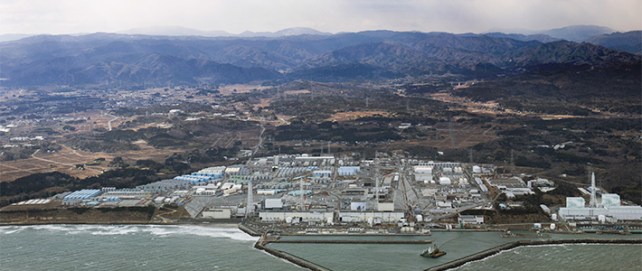
Different Approaches to Remembering 3/11 at the Prefecture’s Museums
Five years after the March 11 earthquake and tsunami touched off a triple meltdown at the Fukushima Daiichi nuclear power plant, the disaster is no longer just a current event—it is also a part of Japan’s history. But how should that history be told? Government and civil society groups have different answers, and they are starting to emerge in a battle of museums.
A Tale of Two Museums
In a flurry of caption writing and message tweaking, Fukushima prefectural government officials are currently putting the finishing touches on a major new exhibit about the disaster at the Fukushima Daiichi Nuclear Power Station. Starting this summer, the exhibit will be permanently displayed at the ¥20 billion Fukushima Prefectural Center for Environmental Creation in the town of Miharu. Plans are in the works to send every fifth-grade student in the prefecture on a field trip to view it. The goal, according to the organizers, is to “address the worries and concerns of Fukushima residents, further understanding of radiation and environmental problems, and deepen awareness of environmental recovery.”
Some 40 kilometers away, in a small post-and-beam hall in the city of Shirakawa, a group of local citizens are planning a very different kind of exhibit. Their displays focus on the ways in which the government exacerbated the disaster and disregarded the rights of Fukushima residents in its aftermath. They will be exhibited at the Nuclear Disaster Information Center, which was built in 2013 using ¥30 million yen in donations from the public, with the goal of ensuring Fukushima and its lessons are not forgotten.
These two projects represent divergent understandings of how the Fukushima nuclear disaster should be remembered. Given their vastly unequal resources and reach, they also raise questions about the appropriate role of government in memorializing the disaster that rocked Japan and the world five years ago.
“People who have suffered from the Fukushima disaster have doubts about whether a public facility like the Center for Environmental Creation can truly communicate the lessons of an accident for which the national and prefectural governments bear partial responsibility,” says Gotō Shinobu, an associate professor at Fukushima University, who is involved in planning the alternative exhibit in Shirakawa.
A Familiar Story
The quiet battle over historical interpretation that is playing out in Fukushima has a precedent in the seaside city of Minamata, Kumamoto Prefecture, the site of one of the most devastating industrial disasters in world history. Thousands of people living in the area were killed or severely sickened by mercury after Chisso Corporation dumped industrial waste from its chemical plant into the bay over the course of several decades, contaminating fish and shellfish and poisoning the people who ate them. Fifty years later, public and private museums in the area are still telling different versions of that history.
One version can be found at the Minamata Disease Municipal Museum, which was established in 1993 with the goal of “handing down the lessons and experiences of Minamata Disease,” according to its mission statement. Videos and panels in the ¥6 billion facility relate the history and science of the disaster, and victims are on hand to share their personal experiences. But Endō Kunio, a board member and employee of the nonprofit victims’ support organization Sōshisha, says the museum fails to communicate the disaster’s true lessons. “Simply lining up events does not equate to history,” he says. “The facts of what happened are there, but the museum doesn’t say much about their meaning.”
Since 1988, Sōshisha has run its own museum, which displays fishing gear, protest flags, and other artifacts in a converted mushroom-cultivation shed. Among its founding principles is the goal of recording the struggles of the victims and the culpability of government and industry. “Our starting point is the perspective that Minamata Disease resulted from criminal activities on the part of Chisso Corporation and the national government,” says Endō. That perspective has shaped the low-budget museum into a symbol of resistance against the sanitization of painful historical events.
Fukushima Fault Lines
The divide in Fukushima falls along similar lines. The exhibit at the prefectural center will include a timeline of events since the meltdowns, a “radiation lab” explaining the science of radiation and measures to reduce exposure, and a large display on efforts to increase renewable energy and sustainability in the prefecture, according to an overview released last year. Although the exhibit advocates for a “Fukushima that does not depend on nuclear power,” reporting by the Tokyo Shimbun has pointed out that its planning board included several members with close ties to the nuclear industry.
In 2014, shortly after planning began, a citizen’s group with antinuclear leanings called the Fukushima Action Project sent a letter to the prefectural authorities expressing concern over the exhibit. The group requested, among other things, that the center not minimize the health risks of radiation. Since then, FAP representatives have met eight times with prefectural officials to discuss the content of the exhibits. According to meeting transcripts posted on the group’s website, they expressed concerns this January that the exhibit still does not adequately address the severe and ongoing water pollution caused by the disaster or the huge amounts of radioactive waste generated by the cleanup.
Fukushima prefectural officials, meanwhile, note that the exhibit does not touch on government or industry culpability, the fact that radiation exposure limits were raised after the disaster, or the pollution and waste problems because “these issues are not pertinent to the goals of the exhibit.” The facility’s goal, they explain, is “supporting educational activities related to radiation and the environment”; in response to public concerns about the exhibit, they state only that the exhibit content was determined by a panel of experts.
Nagamine Takafumi, the director of the Nuclear Disaster Information Center, is also deeply skeptical about the public museum. “We believe the goal of the Fukushima Prefectural Center for Environmental Creation is to create a myth of radiation safety,” he said. He and his colleagues are currently planning two permanent exhibits for their center. One, designed by Fukushima University’s Gotō, will compare global teaching materials on nuclear power and highlight the Ministry of Education’s pronuclear bias before the disaster. The other will examine the failure of all but a few municipalities in Fukushima to distribute potassium iodide pills immediately after the accident, which would have lowered residents’ risk of developing thyroid cancer.
A Third Perspective
Another private, but less politically driven, museum operates from an outbuilding at an abandoned school in the village of Kawauchi, about 25 kilometers inland from the nuclear plant. Called the Kangaeru Shirōkan, which translates roughly to “a museum for feeling, thinking, and understanding,” the free facility displays protective bodysuits, radiation meters, photographs, town newsletters, and other artifacts of the meltdown.
The museum was founded in 2012 by Nishimaki Hiroshi, a local journalist who moved to the area from Saitama Prefecture nine years ago. He says that in the months following the disaster, he wanted to do something constructive, but felt immobilized by the scale and complexity of the meltdown’s aftermath. When novelist and longtime friend Taguchi Randy suggested he open a museum, he acted on the idea.
The displays include scant explanatory text, and Nishimaki is rarely on site to act as a guide. His says his goal is simply to present the reality as locals have experienced it so that it will not be forgotten. “The government does bear some responsibility for what happened, but I don’t think of the displays as a way to attack them,” he says. Still, he has avoided government funding in order to maintain complete freedom in what he exhibits.
An Inevitable but Unequal Divide
It is hardly surprising that views of environmental catastrophe differ in private and public museums. Government actors partially responsible for a disaster are unlikely to be objective in planning a museum to memorialize it, and civic organizations that include disaster victims are equally unlikely to put aside their own experiences when interpreting the same events. In the case of the Fukushima disaster, divergent views on nuclear power further shape the messages presented in museums.
Public and private projects of historical interpretation can in this sense complement one another. Yet there is little chance the majority of the public will be exposed to both perspectives. As Gotō points out, the budget of the public museum is over 600 times that of the private one he is involved with, and visits to the private museum are not a part of any official school curriculum.
Last year, national and local officials met to discuss another large, government-funded museum focused on the nuclear disaster, this one planned to open on the prefecture’s coast some time in the coming decade. Although they haven’t asked, Minamata’s Endō has a piece of advice for them.
“It is all-important that the story of what happened be told by the people who live in that place,” he says. “When government officials and civil society groups interpret for them, it becomes something different.”
Prosecutors innocent TEPCO over radioactive water leakage into the ocean
The court said there is no evidence that proves that radioactive water flew out of the Fukushima nuclear power plant to the ocean. I hope this would finally convince those who haven’t been convinced that the state of Japan denies truth and violates peoples lives. Its time to get rid of Abe et al.
Prosecutors drop TEPCO case over radioactive water leakage
FUKUSHIMA–The Fukushima District Public Prosecutor’s Office announced on March 29 that it will not prosecute Tokyo Electric Power Co. or its executives for violating an environmental pollution law.
The decision came two and a half years after a group of plaintiffs, including residents of Fukushima Prefecture, filed a criminal complaint against TEPCO, operator of the crippled Fukushima No. 1 nuclear power plant, and its 32 current and former executives.
The group sought to bring charges against the utility and its executives for allowing radioactive contaminated water to be discharged into the sea.
In its decision, the prosecutors said there was “insufficient” evidence to press charges against TEPCO and some of its executives, including Naomi Hirose, company president. The remaining executives, the prosecutors said, “had no authority or responsibility to set measures to avoid the leakage in the first place,” therefore, the accusation has “no grounds.”
“The Fukushima police investigated the case for almost two years. It is extremely disappointing,” said Ruiko Muto, 62, the head of the plaintiff’s group, at a news conference in Tokyo on March 29. “We wanted them to look into the case further. We can’t accept this decision.”
The group is planning to appeal to the Committee for the Inquest of Prosecution. The group will meet with its lawyers on March 30 and decide on whether it will pursue further action.
http://ajw.asahi.com/article/0311disaster/fukushima/AJ201603300068
Charges ruled out for Tepco figures over Fukushima No. 1 radioactive water spillage into sea
FUKUSHIMA – Public prosecutors decided on Tuesday not to indict Tokyo Electric Power Co. President Naomi Hirose and other current and former executives of the utility over radioactive water leaks from the crippled Fukushima No. 1 nuclear power plant into the ocean.
Sufficient evidence was not found, the Fukushima District Public Prosecutor’s Office said.
In September 2013, a civic group filed a criminal complaint against 32 current and former Tepco executives, including Hirose and Tsunehisa Katsumata, former chairman of the operator of the northeastern nuclear power plant, saying tainted water leaked from storage tanks into the ocean due to their failure to take preventive measures.
Through its investigation, the Fukushima Prefectural Police concluded that some 300 tons of stored radioactive water had flowed into the sea as of July 2013 because Tepco executives neglected to monitor the tanks or take leak-prevention measures, and sent the case to the prosecutors last October.
The prosecutors said there was no evidence supporting the allegation that the leaked tainted water was carried into the sea by groundwater at the plant, which suffered meltdowns following the massive earthquake and tsunami in March 2011.
The group said it will ask for a prosecution inquest panel’s investigation.
How long shall we accept Japan to pollute our skies with incineration of radioactive materials?
I regret that so much energy, so much money was wasted into the making of this « beautiful » documentary, produced by NHK for the 5th year Anniversary, to spin and to twist the truth so as to make it more acceptable to the eyes of the victims themselves and to the eyes of the world, to brainwash world opinion about the present ongoing situation at Fukushima Daiichi and in Fukushima prefecture.
Of course it is fully expected as it is coming from NHK, which is to Japan what the Pravda newspapers was to the Soviet era, the Japanese central government nationwide propaganda organ.
Using foreigners to give more credibility to their delivered spiel is quite slick, those foreigners shills remind me a lot of some of the French collaborators working for the German Gestapo during the the German Occupation of France in exchange of material benefits, those will not be the first nor the last.
Beside the whole positive reconstruction spin, there is only one point that will should remember and take seriously : the whole reconstruction-decontamination program of the Japanese government is entirely based on incineration.
They tell us that their incineration technology will keep contained 99,9% of the radionuclides , that none will end up into our skies.
Why should we trust them, during the last 5 years they haven’t be very trustworthy nor straightforward to say the least.
How long are we gonna accept, tolerate Japan, to pollute our skies, our commonly owned and shared living environment, with their radioactive mess ?
Fukushima Prefecture has become a familiar name worldwide as a result of the nuclear accidents in 2011. Ever since then, the world has been concerned about what’s happening regarding radioactive contamination in the prefecture. To answer that question, the program will squarely face what’s been going on in Fukushima since the accidents.
French documentary filmmaker Keiko Courdy, who has been covering Fukushima since the nuclear accidents, will appear as a guest, along with experts on radiation, and the situation in Fukushima today will be explained in an easy-to-understand manner.
Various people who have appeared on TOMORROW will also take part. The program considers the future of Fukushima by featuring those who continue striving to overcome many hardships. They include villagers who have been carrying out decontamination work in the evacuation zones, hoping to return to their homes, and young people who are showing remarkable progress in re-energizing Fukushima’s farming with their new ideas.
Available until April 11, 2016
http://www3.nhk.or.jp/nhkworld/en/vod/tomorrow/20160326.html
Interim storage schedule set for contaminated soil
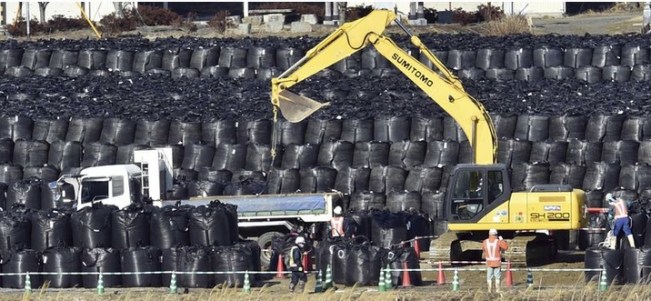
The Environment Ministry has compiled its first project schedule for the interim storage of soil and other matter contaminated by the 2011 disaster at the Fukushima No. 1 nuclear power plant, sources said.
The ministry estimates that by fiscal 2020, it will have acquired between 640 and 1,150 hectares of land, which could store 5 million to 12.5 million cubic meters of contaminated soil.
This is the first concrete schedule the government has created. It is expected to be presented to local government officials at a Sunday meeting in Fukushima Prefecture .
.
If things go as planned, the government would acquire 40 percent to 70 percent of the land expected to be needed, which could store from 20 percent to slightly over 50 percent of the contaminated soil. However, it is unclear whether things will proceed as planned.
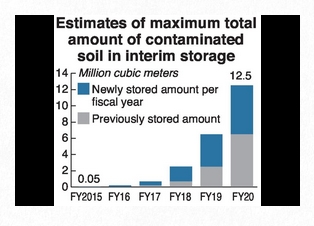
There is currently estimated to be about 10 million cubic meters of contaminated soil in Fukushima Prefecture, which could eventually rise to 22 million cubic meters.
The national government wants to purchase about 1,600 hectares straddling the municipalities of Okuma and Futaba in the prefecture as an interim storage facility.
However, as of the end of February only 18.5 hectares, or about 1 percent of the land, had been acquired.
Still, about 960 of the 2,365 landowners have given approval for the government to conduct surveys to estimate compensation. A ministry official said, “The pace of purchases is expected to pick up.”
If between 100 and 460 hectares are acquired every year starting in fiscal 2016, the ministry’s estimate of 640 to 1,150 hectares would be reached by the end of fiscal 2020.
As land is acquired, more contaminated soil can be brought to the interim storage facility.
The ministry estimates that if 2 million to 6 million cubic meters are brought to the facility in fiscal 2020, that would bring the total amount to 5 million to 12.5 million cubic meters by the end of that fiscal year,
http://www.the-japan-news.com/news/article/0002835558

These Fukushima residents are determined to reclaim their land from nuclear radiation

By G. Sundarrajan
Two years ago, when I visited Fukushima as part of a Greenpeace team, what deeply impressed me about the local residents was their resilience. They were ordinary citizens of a town devastated by a nuclear disaster, yet the bond they shared with their soil ran so deeply that they kept hoping to go back to Fukushima.
It was at once their dream and their challenge. They couldn’t stop talking about how good and simple life was back in Fukushima till the disaster struck. I was amazed by the fact that they wanted to go back to their homes though they knew the town would not be as they had left it.
It was from such a deep bond, from that sense of love, that the will to fight against nuclear energy emerged. “We are the lessons you need to learn” most of them told me.
It was the same kind of love, and bond, that I found in them when three survivors of Fukushima visited Chennai on March 23. Running around with them in Chennai I realized they still carry their love for their land and have now found ways to reconnect. Even if it means doing what is prohibited and what could endanger their lives.

For 62-year-old Masami Yoshizawa, it is about rearing 300-odd cows that are under a government kill order. As the manager of Ranch of Hope, Yoshizawa decided to defy government orders and rear the cattle so they ‘would be a living testimony to what Fukushima had undergone.’ The kill order was issued because after the radioactive contamination, the livestock was not a commercial success.
But rearing them in a no-entry zone, Yoshizawa feels the sight and sound of the cattle offers a ray of hope to an otherwise devastated land. “The government wants to kill them because it wants to erase what happened here, and lure Japan back to its pre-accident nuclear status quo. I am not going to let them,” he says.

The farm was started by his father four decades ago and Yoshizawa wouldn’t give it up easily – something that is in the residents of Fukushima. “I live 14 kms away from where the accident took place. There were four explosions on four days. I could have left like many of my neighbours. At least 80 people committed suicide in my town because they didn’t want to leave Fukushima. But I have decided to be a living lesson for the rest of my life” he says.
It is exactly the same emotion that guided 28-year-old Mizuho Sugeno to come back to Fukushima and resume her organic farming. Sugeno had just completed her studies and was practicing organic farming for about a year when the disaster struck.
“I lived 47 kms away from the power plant and evacuated for about a week. I came back and founded Seeds of hope. What else could I do?” she asks.

Besides distributing Sugeno’s organic produce, Seeds of Hope demonstrates successful methods to prevent crops from absorbing radiation. “Farms were abandoned and people were left behind. I was advised not to go back to Fukushima but I didn’t just come back. I began planting seeds. I felt the power of the soil could be restored by planting seeds.”
But deep down Sugeno had her own misgivings. She was not sure if it would really be possible to continue with agriculture.
“I spent a lot of time on it and finally found out that there was scientific proof (as well as measures and methods to take) about no soil-to-plant transfer of radio cesium in soil that has been cultivated organically over a long period of time. I was able to reduce the radiation level detected in crops down to a reading that falls below the minimum capability of the sensor,” Sugeno says.
She began to get certain results and ship crops with no radioactive contamination.
“This was our land and it was from here that we had reared cattle and cultivated fruits for several years. Now we are doing it as a form of protest. Our strawberry rice cake – a delicacy you will find only in Fukushima – has become a symbol of protest. Even now we are looked at with disbelief outside Fukushima. But again, like they say, we shall overcome”
Sugeno gets a complete body check-up once every six months, “just to be on the safer side”. For the moment, it is important that she is in good health to make Fukushima heard everywhere. “After all, we are the lessons you still need to learn,” she says again, with that wry smile.
G. Sundarrajan is an environmental and anti-nuclear activist and is a volunteer with Poovulagin Nanbargal.
“City” of Waste: Fukushima Cleanup Now Up to 10.7 Million 1-ton Bags of Radioactive Waste
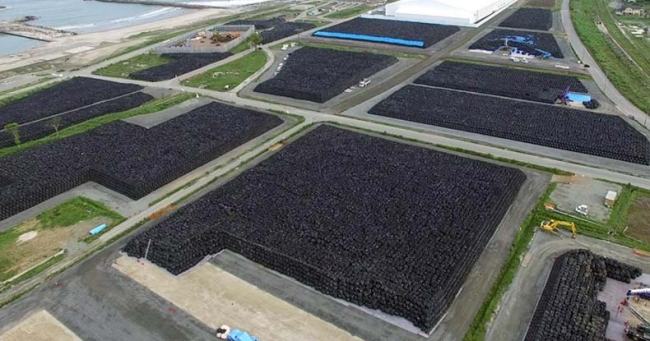
By Matt Agorist
The fifth anniversary of the Fukushima disaster was on Friday, March 11. Since that fateful day in 2011, the Japanese government and the United States have continued to deny the lingering effects of this catastrophic event.
An estimated $21 billion has been spent on cleanup efforts since 2011, including funding for a team of remote activated robots capable of going to high-dose radiation areas of the plant where humans cannot enter and survive.
However, it has now emerged that at least five of these robots have been lost to the dangers that lurk in Fukushima Daiichi’s severely damaged nuclear reactors and waste treatment buildings.
Authorities in Japan want locals to think “nothing happened,” documentary director Jeffrey Jousan told RT.
“The government prints the number of people who died as a result of the 2011 disaster in the newspapers every day. [In some other prefectures], the [death toll] amounts to 300-400 people in each prefecture, but in Fukushima it is over 8,000 people,” Jousan, a US director and producer who has been living and working in Japan since 1990, said.
“It is very telling about the situation in Fukushima. It is hard for everyone who is affected by the tsunami, who lost their homes and lost their families. But [in Fukushima], people are not able to go back home, they are unable to work because people won’t buy food from Fukushima, farmers cannot farm anymore. It is affecting people, and more people are dying because of that.
According to the Fukushima prefectural government, Japan Ministry of Internal Affairs, the Tokyo Electric Power Co., the Nuclear Regulation Authority, the Federation of Electric Power Companies and the Woods Hole Oceanographic Institution, the numbers associated with this disaster are staggering.
- 164,865: Fukushima residents who fled their homes after the disaster.
- 97,320: Number who still haven’t returned.
- 49: Municipalities in Fukushima that have completed decontamination work.
- 45: Number that have not.
- 30: Percent of electricity generated by nuclear power before the disaster.
- 1.7: Percent of electricity generated by nuclear power after the disaster.
- 3: Reactors currently online, out of 43 now workable.
- 54: Reactors with safety permits before the disaster.
- 53: Percent of the 1,017 Japanese in a March 5-6 Mainichi Shimbun newspaper survey who opposed restarting nuclear power plants.
- 30: Percent who supported restarts. The remaining 17 percent were undecided.
- 760,000: Metric tons of contaminated water currently stored at the Fukushima nuclear plant.
- 1,000: Tanks at the plant storing radioactive water after treatment.
- 7,000: Workers decommissioning the Fukushima plant.
- 26,000: Laborers on decontamination work offsite.
- 200: Becquerels of radioactive cesium per cubic meter (264 gallons) in seawater immediately off the plant in 2015.
- 50 million: Becquerels of cesium per cubic meter in the same water in 2011.
- 7,400: Maximum number of becquerels of cesium per cubic meter allowed in drinking water by the U.S. Environmental Protection Agency.
But perhaps the most staggering number of all of these statistics is the fact that the waste is being temporarily stored right next to the waterfront in a Wall-E style. The visual representation of the failure of this nuclear power plant is shocking.
Along the shore at the temporary storage site at Tomioka are 10.7 million 1-ton container bags containing radioactive debris and other waste collected in decontamination outside the plant.
Last year, a drone was flown over the ever-expanding city of waste. After watching the video, we know how ridiculous the government’s claims are that ‘we have nothing to worry about.’
Tepco executives get a taste of citizens’ wrath

Three Tokyo Electric Power Co. executives are now facing criminal prosecution for negligence in failing to anticipate a monster tsunami that cut off electricity and inundated back-up emergency generators, causing a cessation of cooling in the Fukushima No. 1 nuclear plant reactors that precipitated three meltdowns in March 2011. How were they to know?
At the time, Tepco kept insisting that the 15-meter-high tsunami was sōteigai (inconceivable), an act of nature that absolved them of all responsibility. And, just in case the public was not buying this grand shirk, malicious rumors disingenuously scapegoated Prime Minister Naoto Kan, in a failed attempt to shift blame to him. Subsequently, Kan has been vindicated while Tepco remains guilty in the court of public opinion.
In mid-2012, Tepco released the results of its own investigation into the nuclear accident and, with unseemly chutzpah, absolved itself of all responsibility. It was so embarrassing in its exculpatory excesses, and thoroughly contradicted by all three of the other major investigations into the Fukushima debacle, that Tepco disavowed this whitewash in October 2012, conceding allegations of numerous failures; this mea culpa was at the insistence of a panel of international experts hired by the utility.
The court case will focus on what could have been done that Tepco knew about to better manage the risks inherent in the operation of nuclear reactors in a seismically active area with a history of devastating tsunami. As much as Tepco would like to paint this as a “black swan” once-in-a-thousand-year event — something of such low probability of occurrence that it would be a costly fool’s game to prepare for it — Tohoku’s tsunami coast was fairly recently battered in 1896 (8.5 magnitude with waves reaching 38.2 meters) and in 1933 (magnitude 8.4 with waves cresting at 28.7 meters). So it would seem that anyone operating a nuclear reactor on that coastline would have looked into the seismicity of the area and prepared accordingly.
In fact, Tepco did so in 2009 when it conducted in-house computer simulations suggesting the possibility of a 15.7-meter tsunami slamming the site of the Fukushima No. 1 nuclear plant. That information was actually provided to the Nuclear and Industrial Safety Agency (NISA) four days prior to the Great East Japan Earthquake, meaning that it was information considered vital enough to submit to the watchdog agency.
Interestingly, in February 2011 the Fukushima reactors were granted an extension to their 40-year operating license, passing a NISA safety review. But NISA was sharply critical of Tepco and called for the urgent replacement and relocation of backup diesel generators that had stress cracks and were located below, and between, the reactors and the ocean, leaving them vulnerable to inundation. In addition, NISA scolded Tepco for its lax safety practices, a clear reference to the 2002 scandal when a whistleblower revealed that the utility had falsified the repair and maintenance records for all of its nuclear reactors.
NISA, as part of the Ministry of Economy, Trade and Industry, was implicated in the attempted cover-up of that scandal and stands accused of regulatory capture, meaning it was co-opted by the utilities — a watchdog with neither bark nor bite. By not conducting rigorous oversight to ensure safety, NISA is thus also complicit in Tepco’s lack of a culture of safety, pinpointed by three major investigations as a cause of what they declared was a man-made nuclear accident.
Thus one wonders why no bureaucrats are being prosecuted. Haruki Madarame, then chairman of the Nuclear Safety Commission, testified in the Diet on Feb. 15, 2012: “Though global safety standards kept on improving, we wasted our time coming up with excuses for why Japan didn’t need to bother meeting them.” He also pointed out that back in the early 1990s, Tepco was told about the risk of a station blackout that might lead to reactor meltdowns and was urged to develop a defense in depth, meaning more backup electricity sources just in case. Tepco stonewalled safety regulators, asserting that the current systems were adequate.
So the nuclear accident at Fukushima was precipitated by natural disaster, but poor risk management and institutionalized complacency about risk were major factors increasing the likelihood of an accident and fumbling crisis response. The myth of 100-percent safety propagated by the “nuclear village” of atomic energy advocates made it taboo to question safety standards and militated against sober risk assessment and robust disaster emergency preparedness.
Not everyone was surprised by the nuclear disaster. In 1975, nuclear chemist Jinzaburo Takagi and others established the Citizens’ Nuclear Information Center (CNIC), which ever since has issued regular reports on power plant safety issues. Fukushima was the nightmare scenario that CNIC had long been predicting. In a 1995 interview, Takagi spoke about the risks of a meltdown in the event of multiple failures, as happened in Fukushima in March 2011. He correctly warned about the possibility of large radioactive releases from a meltdown resulting from a breakdown in the emergency core cooling system and the failure of back-up diesel generators.
“It’s inexcusable that a nuclear accident couldn’t be managed because a major event such as the tsunami exceeded expectations,” said Yotaro Hatamura, chariman of the government’s Third Party Panel Investigation Committee, blasting Tepco’s hubris in 2012. He added that risk management means anticipating worst-case scenarios — not wishing risk away.
Hatamura pointed out that the utility was ill-prepared for the crisis, dismissing the possibility of a total loss of power, and that its workers made critical errors in shutting off automated emergency cooling systems and wrongly assumed part of the cooling system was working when it was not. These workers and their managers were inadequately trained to cope with an emergency situation and according to the panel, lacked basic knowledge concerning the emergency reactor cooling system. Their mishandling of emergency procedures contributed to the crisis.
Tepco chose to ignore centuries of geological evidence and failed to act on fresh and compelling evidence about tsunami risk, a blind spot that left the plant needlessly vulnerable. It also successfully lobbied the government’s Earthquake Research Committee on March 3, 2011, to soften a public advisory warning that a massive tsunami could hit the Tohoku coast because it might cause misunderstanding. This PR approach to risk management promoted an unjustified insouciance that cost Japan dearly. Alas, Tepco was also cutting corners, balking at the $1 billion price tag of building a higher seawall to cope with the higher tsunami projections — a bargain in retrospect.
While it is unlikely that the Tepco Three (former chairman Tsunehisa Katsumata and two former vice presidents, Sakae Muto and Ichiro Takekuro) will be convicted for irresponsibly minimizing risk in ways that endangered local residents or for cutting costs that compromised public safety, the trial will make the nuclear village squirm as the public revisits the folly of wishing risk away — and understands it is happening all over again.
Fukushima’s invisible victims
By
It’s been a while since we last discussed the Fukushima Daiichi triple meltdown. That is not for lack of issues; it is primarily for lack of any meaningful progress in the ongoingdisaster.
We have just passed the fifth observance of the first catastrophic day, March 11, 2011 and pretty much all of nuclear safety expert Arnie Gundersen’s grim predictions of what we would learn in the aftermath have come to pass.
What Arnie could not have predicted iin 2011 is how unwilling both TEPCO and Japan’s government officials have been to learn from this disaster, and how persistent the effort would be to suppress important radiological and epidemiological information.
Without accountability, deaths of citizens who lived near the doomed reactors following the triple meltdown have simply been attributed to the stress of evacuation, and supposedly no one has been harmed by radiation. In an unbelievable extrapolation of a convenient myth, there has been a major government effort, supported by the atomic power industry, to increase allowable levels of radiation exposure and dismiss the need for future costly evacuations as harmful and unnecessary.
It was only a little over a week ago, that anyone in an official position at TEPCO was finally held accountable under the law. I find it unbelievable that only three individuals can be held responsible for the cascade of unaddressed design flaws, corruption, lax regulation, human error and human arrogance that all contributed to making a bad situation much, much worse.
Now we are learning of an even more egregious breach of the public trust and social justice at Fukushima.
Individuals who have exhibited symptoms of radiation poisoning and other illnesses are apparently being shunned by some of their neighbors and dismissed by the medical establishment without appropriate care and without acknowledgment in their medical records.
This mistreatment specific to radiation victims is apparently not without precedent in Japanese history.
On his current speaking tour of Japan, Arnie Gundersen has had the privilege of speaking with a small group of survivors of the 1945 bombing at Hiroshima who share a unique perspective on what may lie ahead for the people of Fukushima
Hiroshima survivor, Tomiko Matsumoto, 85, recalls being a schoolgirl following that inhuman bombing. Of the 80 students at her school, only thirty survived the blast. Tomiko could be said to have been one of the “lucky” ones, but mere survival is a pretty poor kind of ‘luck.’
Still traumatized by the mental and physical horrors of the blast experience, she recalls that there was no proper care provided for the injured who were regarded with suspicion and hostility by their neighbors and callous indifference or unfeeling curiosity by their occupiers, upon whom they depended for any care that they could get.
The discrimination must have been the hardest for a young girl with no surviving family to bear:
“I was shocked because I was discriminated against by Hiroshima people. We lived together in the same place and Hiroshima people know what happened but they discriminated against each other. ..I was shocked.”
“There were so many different kinds of discrimination. People said that girls who survived the bomb shouldn’t get married. Also they refused to hire the survivors, not only because of the scars, but because they were so weak. Survivors did not have 100 percent energy.”
“There was a survivor’s certificate and medical treatment was free. But the other people were jealous. Jealous people, mentally discriminated. So, I didn’t want to show the health book sometimes, so I paid. Some of the people, even though they had the health book, were afraid of discrimination, so they didn’t even apply for the health book. They thought discrimination was worse than paying for health care.”
The mistreatment and insensitivity experienced by survivors continued into Tomiko’s adulthood. She was the victim of employment discrimination and personal shame.
Though she was lucky enough to bear children, both of her daughters are sterile and one suffers from anemia. Doctors have dismissed the possibility that the family’s health issues might be linked to her exposure to radiation from the atomic bomb blast.
It may be precisely because of their uniquely traumatic history of nuclear attack that modern Japanese society is ill-prepared to challenge the current meme being promoted by TEPCO and the Abe government, that no one was harmed by the triple meltdown at Fukushima and there is no cause for concern about using atomic power as an energy source.
Having emerged from beneath the cloud of WWII, they want to view themselves under the lens of success and progress, not to revisit the shameful legacy of nuclear radiation sickness that they had hoped to leave behind.
Sadly, neither TEPCO nor the Abe government and functionaries right down to the regional level can be trusted to reveal the truth about radiation from Fukushima Daiichi and how it’s shadow has now been irreversibly cast over the Prefecture, marring the future of Japan.
So survivors of Fukushima, like those of Hiroshima before them are left to face unfolding health issues and despair in the friendless vacuum of their own thoughts and care.
(I am pleased to be a non-technical member of the Fairewinds Energy Education crew, but my posts on GMD are mine alone and do not necessarily reflect the views of Fairewinds.)
1 This Month

of the week – Shut Down Drone Warfare!


Tell the Ukrainian Government to Drop Prosecution of Peace Activist Yurii Sheliazhenko

Petition to revoke the licensing of the Near Surface Nuclear Disposal Facility (NSDF) at Chalk River. https://www.ourcommons.ca/petitions/en/Petition/Details?Petition=e-7247
To see nuclear-related stories in greater depth and intensity – go to https://nuclearinformation.wordpress.com
-
Archives
- April 2026 (7)
- March 2026 (251)
- February 2026 (268)
- January 2026 (308)
- December 2025 (358)
- November 2025 (359)
- October 2025 (376)
- September 2025 (257)
- August 2025 (319)
- July 2025 (230)
- June 2025 (348)
- May 2025 (261)
-
Categories
- 1
- 1 NUCLEAR ISSUES
- business and costs
- climate change
- culture and arts
- ENERGY
- environment
- health
- history
- indigenous issues
- Legal
- marketing of nuclear
- media
- opposition to nuclear
- PERSONAL STORIES
- politics
- politics international
- Religion and ethics
- safety
- secrets,lies and civil liberties
- spinbuster
- technology
- Uranium
- wastes
- weapons and war
- Women
- 2 WORLD
- ACTION
- AFRICA
- Atrocities
- AUSTRALIA
- Christina's notes
- Christina's themes
- culture and arts
- Events
- Fuk 2022
- Fuk 2023
- Fukushima 2017
- Fukushima 2018
- fukushima 2019
- Fukushima 2020
- Fukushima 2021
- general
- global warming
- Humour (God we need it)
- Nuclear
- RARE EARTHS
- Reference
- resources – print
- Resources -audiovicual
- Weekly Newsletter
- World
- World Nuclear
- YouTube
-
RSS
Entries RSS
Comments RSS
 nuclear-news