Fukushima: A Nuclear Story’ stands out among 3/11 documentaries
The Fukushima nuclear plant disaster has been examined in hundreds of documentaries to date, counting all media, nationalities and languages. But “Fukushima: A Nuclear Story” stands out for one simple, powerful reason: Its central figure, Italian journalist Pio d’Emilia, was among the first foreign reporters allowed on the scene after the earthquake and tsunami crippled the plant.
With his camcorder, he captured the devastation and confusion of the disaster’s immediate aftermath, as he evaded still-spotty security to travel to the plant gates. The documentary, narrated by American actor Willem Dafoe, has been distilled from nearly 300 hours of footage. This includes an in-depth interview with Naoto Kan — prime minister at the time of the disaster — who says he was seriously considering an evacuation of Tokyo when the meltdowns at the plant seemed to be spiraling out of control.
Kan was also on hand for a gala preview screening of “Fukushima: A Nuclear Story” at the MAXXI museum of contemporary art in Rome on Monday. The film has also been sold for broadcast in Canada, the United States, Germany, Norway and Mexico — but not yet Japan.
“Fukushima has already joined the many forgotten nuclear disasters,” says d’Emila; “forgetting means lying. Tepco and the Japanese government began lying from the very first hours — by hiding the already occurring multiple meltdowns — and are still lying by pretending the situation is now under control. As everybody knows, it isn’t.”
PC with Documentary, “Fukushima; A Nuclear Story”: Pio d’Emilia
Fukushima, an ongoing tragedy Japanese government has brushed aside

Toshihide Tsuda, professor of environmental epidemiology at Okayama University, found that the rate of children suffering from thyroid cancer in Fukushima Prefecture in Japan was as much as 20 to 50 times higher than the national average as of 2014, three years after the Fukushima nuclear disaster.
His findings were published in the electronic edition of the journal of the International Society for Environmental Epidemiology late last year, but was refuted by the Fukushima prefectural government and other experts as it doubted the cases are related to the nuclear crisis and the government attributed to the surge to “over diagnosis.”
“Unless radiation exposure data are checked, any specific relationship between a cancer incidence and radiation cannot be identified,” Shiochiro Tsugane, director of the Research Center for Cancer Prevention and Screening, was quoted by a local report as saying.
More than 160 teenagers in Fukushima Prefecture were diagnosed with thyroid cancer, including suspect cases, since the Fukushima Daiichi nuclear power plant was crippled by the monstrous quake-triggered tsunami in March 2011. And the number almost certainly increase with the passage of time.
At the fifth anniversary of the Fukushima nuclear crisis, the parents of the children who were diagnosed with thyroid cancer in Fukushima formed a mutual help group to demand the government provide convincing evidence that their children’s sufferings were not related to the nuclear crisis.
In fact, the International Society for Environmental Epidemiology sent a message to the Japanese government suggesting it to conduct detailed and continuous research on residents’ health in Fukushima, but the government here did not respond to the advice, according to Tsuda who urged the government to face up to the aftermath of the nuclear issue.
Meanwhile, overseas nuclear experts are also surprised by the irresponsible and indifferent attitude of the Japanese government toward the nuclear refugees.
Oleksiy Pasyuk, an expert on energy policy at the National Ecological Center of Ukraine, told Xinhua that one of the main mistakes made by Japan in the aftermath of the accident was that the government had not stocked enough medicinal iodine tablets, which can prevent the absorption of radioactive material into the human body.
“No iodine tablets were distributed to residents living in the plant’s vicinity, who may have been exposed to radiation — it was an essential lesson, which they had to learn from Chernobyl,” Pasyuk said last month at the 30th anniversary of the Chernobyl nuclear disaster.
The Fukushima disaster is the worst nuclear crisis since the Chernobyl catastrophe in 1986, but the Japanese government has failed to learn the lessons from the Chernobyl over the past 25 years.
The management of the Fukushima plant had been warned in advance about the risks of failure of the emergency electricity generators and the subsequent failure of the cooling systems in a seismically active region, said Olga Kosharna.
The expert with the State Nuclear Regulatory Inspectorate of Ukraine said that “if they had re-ionizers of hydrogen or holes in the roof, there would be no explosion and no such severe radiation effects. There has been a human error.”
“Japanese mentality is hierarchical — all are awaiting instructions from the top chief to start acting and it is time-consuming. Besides, there was no independent nuclear agency, which examines the technical state of the plant and decides whether to stop the functioning of the reactors or suspend its operating license,” Kosharna told Xinhua.
More than five years on, the debate over the aftermath of the world’s worst nuclear disaster in three decades are continuing, but Prime Minister Shinzo Abe told the international community in 2013 when Japan bid for the 2020 Olympic Games that the crisis was “totally under control.”
The fact is obvious that about 200 tons of highly-contaminated water flows freely into the Pacific Ocean everyday and the nuclear power plant operator Tokyo Electric Power Company (TEPCO) still can not prevent the contaminated water from leaking from its makeshift containers.
TEPCO in March launched its ambitious project of freezing soil to create an ice wall to decrease toxic water leaking into the ocean. Local reports said that the project is expected to reduce the water to about 50 tons, but added that the effects are still unclear, as such a project is unprecedented on such a huge scale.
According to research by Fukushima University, about 3,500 trillion becquerels of radiative cesium-137 were discharged into the sea with the toxic water since the disaster broke out and the radiative material has reached the western coast of northern America.
Meanwhile, about a hundred thousand evacuees are still displaced and live in cramped temporary housing camps due to the uncontrolled nuclear disaster.
However, in the face of such troubles regarding the ongoing Fukushima Daiichi nuclear power plant crisis, the Japanese government is eager to reboot the country’s idled nuclear plants.
The Sendai nuclear power plant in the Kyushu area was reopened last November despite the eruption of a nearby volcano. It is also close to Kumamoto Prefecture, which was hit by waves of strong earthquakes, including one measuring a magnitude of 6.7 and another registering M7.3, last month.
The majority of the Japanese public oppose the restarting of the country’s nuclear power plants and only about 30 percent are supportive. More than 60 percent of Fukushima prefectural residents are dissatisfied with the government’s countermeasures against the nuclear disaster.
http://www.miragenews.com/fukushima-an-ongoing-tragedy-japanese-government-has-brushed-aside/
INSIGHT: Fukushima’s ‘caldrons of hell’ keep questions unanswered

A convenience store in Okuma, Fukushima Prefecture, on March 12, 2016, remains as it was when the 2011 earthquake and tsunami triggered the nuclear accident
After spending slightly more than two years in the capital of Fukushima Prefecture, I was assigned to The Asahi Shimbun’s Tokyo head office starting on May 1. I moved house the other day.
I had previously never been based in Fukushima, although I have long covered energy policy and a number of nuclear accidents as a reporter for the newspaper.
On April 11, 2014, shortly after I was assigned to Fukushima, I was told the words that would serve as a starting point for my news-gathering activities there. I am citing that phrase, which I quoted in a previous column, for a second time here:
“Whatever the future of nuclear power generation, it will remain essential to expand renewable energy sources to ensure a stable energy supply and to fight global warming. Fukushima Prefecture has swaths of land and a historical background for doing so.
The energy industry has always been its leading local industry. The prefecture is home to the Joban coal field, and Iwaki was a city of coal mines. Nobody will be able to change Japan unless Fukushima takes it upon itself to do the task.”
The remark was made by Yukihiro Higashi, then professor of thermal energy at Iwaki Meisei University.
After the Great East Japan Earthquake and tsunami triggered the Fukushima nuclear disaster in 2011, the Fukushima prefectural government defined “building communities that do not rely on nuclear energy” as a leading principle of its post-disaster rebuilding efforts.
It set a goal of having renewable energy sources cover all energy demand in the prefecture by around 2040. Higashi played a central role in working out that vision.
The goal may seem preposterous, but the professor’s remarks led me to realize that it isn’t.
LEADING ENERGY PLAYER
Fukushima Prefecture produced 10 percent of Japan’s electricity before it was hit by the nuclear disaster. Most of that electricity was sent to the greater Tokyo area, so the prefecture was sometimes sarcastically referred to as a “colony of Tokyo.”
But all that would have been impossible had it not been for the “swaths of land” and the “historical background” suitable to having electric power generated there.
Energy has always been the representative local product of Fukushima Prefecture. That history dates back to the late Edo Period (1603-1867), when the Joban coal field was discovered.
Energy created in the prefecture continued to support Japan’s modernization even after electricity replaced coal as the leading player.
Living in Fukushima Prefecture provides plenty of opportunities to learn about that history.
A cluster of old hydroelectric plants stands in the environs of Lake Inawashiroko. A dozen of these plants, which were built during the Meiji (1868-1912) and Taisho (1912-1926) eras and taken over by Tokyo Electric Power Co., continue to send electricity to the greater Tokyo area to this day.
A step-like array of hydroelectric plants along the Tadamigawa river in the prefecture’s western Oku-Aizu district was built in the postwar period in a desperate drive to “rebuild Japan.”
Both hydroelectric undertakings drew on the bountiful water resources that are the blessings of the prefecture’s terrain.
Nuclear reactors and a bunch of giant thermal power plants began to spring up along the Pacific coast during the high economic growth of the postwar period.
When cast in the context of that history, the goal set forth by the prefectural government appears to betray the pride of its own “leading local industry.” The prefecture’s people pledged that they are the ones who will replace the leading player of energy.
Ten days after I met Higashi, I visited the Yamatogawa Shuzoten sake brewery in Kitakata, Fukushima Prefecture, to see Yauemon Sato, the ninth-generation chief of the brewery, which has been operating since the mid-Edo Period.
Sato had founded Aizu Electric Power Co. in August 2013, setting out on an ambitious plan to help rebuild the prefecture by means of renewable energy sources.
“You know the caldron of hell?” Sato asked me. “You will be sent to hell and will be boiled in that caldron if you do evil. There are four such caldrons in Fukushima Prefecture. And they are still gaping.”
The No. 1 through No. 4 reactors of TEPCO’s Fukushima No. 1 nuclear power plant, which caused a calamity that will go down in the history of humankind, could certainly be called “caldrons of hell.”
The use of renewable energy sources is a means for closing those caldrons and for obliterating them from Fukushima Prefecture.
More than two years later, the use of renewable energy sources is steadily gaining ground in the prefecture, covering 26.6 percent of all energy demand as of the end of March. The goal remains far in the distance, but the ratio has been gaining about 1 percentage point every year.
The caldrons are still gaping. TEPCO has yet to solve the question of how to block groundwater from flowing into the reactor buildings, which is only increasing the stockpile of water contaminated by radioactive substances. That is preventing the utility from starting serious work to decommission the reactors.
LEFT IN LIMBO
“What should we do?” a 59-year-old woman, evacuated from Okuma, which co-hosts the crippled nuclear power plant, to Koriyama, also in Fukushima Prefecture, asked me when I interviewed her about a year ago.
“Should we go on with our new life here, or should we return to our hometown? My thoughts remain in limbo, and I cannot get around to making up my mind.”
I did not know how to answer her question.
More than 94,000 people of Fukushima Prefecture continue to live as evacuees. The government of the town of Okuma, where all residents remain evacuated, plans to create a rebuilding base with a “habitable environment,” hopefully by fiscal 2018.
But full rebuilding of the town lies far beyond that goal. And that is leaving many people “in limbo.”
What should we do? My pursuit of that unanswered question will continue.
Poet Ryoichi Wago tries to bridge hearts after Fukushima
“For example, Wago says the argument that Japan must rely on nuclear power to some extent may sound rational, but if one spares a thought for the misery of people directly affected by the nuclear disaster then surely championing nuclear power generation does not offer a viable future.
Despite the lack of common ground and the prospect of never resolving such differences, Wago concluded that starting conversations to talk about issues related to the disaster would be a fundamental first step in the right direction.”
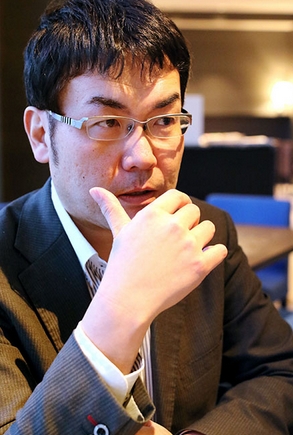
FUKUSHIMA–Ryoichi Wago, a high school teacher who doubles as a poet, rose to national prominence with a series of tweets he posted days after the March 11, 2011, nuclear disaster in his native Fukushima Prefecture.
On March 16 of that year, he tweeted the following short free verse about the drama unfolding at the Fukushima No. 1 nuclear power plant:
“Radiation is falling.
“It is a quiet night.”
Plunged into despair by the nuclear accident, Wago began groping for ways to get a dialogue going involving all sectors of society to bridge differences brought on by the catastrophe.
At the time of the disaster, Wago, now 47, was at his home in Fukushima city, which is situated inland and northwest of the crippled nuclear power plant. It has been estimated that radioactivity levels there were as much as 500 times higher than before the accident.
Like many other local residents, his wife and son left town and took refuge in Yamagata Prefecture, north of Fukushima. But he stayed on, even though the neighborhood felt like a ghost town. A radio station kept blaring, “Keep calm and evacuate.”
“Will I be forced to leave?” Wago feared. “Fukushima will be abandoned by the nation.”
Two months later, he published “Shi no tsubute,” or “Pebbles of poetry,” a compilation of free verse he had tweeted expressing his fears and anguish. Prior to the disaster, he had only four followers. The number quickly rose to 15,000 by the time the book was released.
Clearly, his words and thoughts were reaching a wider audience. But not everyone was in his corner.
One day a message sent through Twitter gave him pause for thought: “You live inland so you are not a disaster victim. You have not lost your hometown nor your family,” the message read, questioning his legitimacy to talk about the disaster as “one of them.”
By April, gas pumps were working again and Wago was able to visit other parts of Fukushima Prefecture to listen to what people were saying. He spent a year doing this, mostly at weekends, and talked to 60 or so people.
During these chats, he noticed a wide disparity in the way people viewed the disaster.
“I want the government to promise to return us to our hometown,” one individual would venture. “I cannot go back, I will make a new life somewhere else,” another would say.
A mother’s wish that her children would ”be able to play outside” invites a stinging rebuke: “Are you trying to make them sick from radiation exposure?”
It occurred to Wago that such disparities must be felt everywhere in Japan after the 3/11 disaster.
For example, Wago says the argument that Japan must rely on nuclear power to some extent may sound rational, but if one spares a thought for the misery of people directly affected by the nuclear disaster then surely championing nuclear power generation does not offer a viable future.
Despite the lack of common ground and the prospect of never resolving such differences, Wago concluded that starting conversations to talk about issues related to the disaster would be a fundamental first step in the right direction.
That was Wago’s starting point for creating Fukushima Mirai (future) Kagura. Kagura is dance and music performed at festivals and rituals as offerings to Shinto deities.
Wago gathered 50 or so locals as production staff and dancers, and held a talk session to get them to state what they wanted to get out of the project.
“I want to tell how much my tsunami-drowned friends would have wanted to live,” said one. “I want to express my anguish that my hometown was contaminated by radiation,” said another.
Wago recalls “some kind of intangible solidarity” was born among the participants.
In August 2015, the presentation of kagura at Fukushima Inarijinja shrine in Fukushima city received an ovation from the 700 or so spectators gathered for the performance.
His kagura is made up of several parts, including poetry reading accompanied by live calligraphy and a drum performance, and dance performance representing foxes and a dragon.
“A willingness to have conversation rather than confrontation is important. It is not necessarily in words either,” said Wago.
In March 2016, Wago published a new poetry book titled “Kinou yorimo yasashiku naritai” (I want to be kinder than yesterday).
One of those poems goes to the heart of what Wago is trying to express.
“From that day, I am having fruitless discussion with him.
“He tells me he cannot understand a single thing I say.
“I also respond flatly that I cannot understand him.
“Still, we have no way but to keep up our dialogue.”
Tepco to put some Fukushima decommissioning work on hold during G-7 summit
Japan Gov stops Fukushima work to “reduce risk” to world leaders…. what about the Japanese who live there 24/7/365?
TOKYO: The majority of decommissioning work at the damaged Fukushima No. 1 nuclear plant will be put on hold while the Group of Seven summit takes place in Shima, Mie Prefecture, on May 26 to 27, according to the Tokyo Electric Power Co.
Satoshi Togawa, a spokesman for Tepco, told The Japan Times on Friday that the planned suspension was a precaution to reduce “risks” that could disturb the meeting of leaders from the seven major advanced nations.
Such risks could include unexpected leaks of contaminated water from tanks or airborne radioactive material monitoring alarms being triggered, Togawa said.
He added that Tepco will continue other essential operations, such as injecting water to keep melted nuclear fuel cool and processing contaminated water.
He also stressed that the suspension was not designed to reduce the risk of terrorism.
“We have made the decision without any request from the government,” he added.
A 2011 massive earthquake and ensuing tsunami knocked out critical cooling functions for three of six reactors at the plant, triggering a triple meltdown.
The decommissioning effort, which involves some 7,000 workers, is expected to take more than 40 years.
Internal Exposure Concealed: The True State of the Fukushima Nuclear Power Plant Accident
Yagasaki Katsuma, emeritus professor of Ryukyu University, has been constantly sounding the alarm about the problem of internal exposure related to nuclear weapons testing and nuclear electricity generation. Since the explosion at the Fukushima Daiichi nuclear power plant (NPP), he has drawn on his expertise to conduct field research, and to support those who evacuated to Okinawa. We asked him to reflect on the five years since the accident at Fukushima Daiichi, and to lay out the issues that lie ahead.
Heading to the blast site 12 days post-explosion
On March 17, 2011, a friend who lived in Fukushima City contacted me. “They’re reporting an onslaught of radioactivity, but we have no idea about any of that”, he said. “We need dosimeters, but there’s no way to get our hands on them.”
I ended up making my way to Fukushima along with several dosimeters for measuring radioactivity. I set up the dosimeters. Fukushima was under a petrol provision restriction, and I could not travel freely. I needed to make arrangements for an “emergency vehicle” to use. I had left Okinawa on March 24, traveled via Osaka by plane to Fukushima Airport, and entered Fukushima City by a bus that went through Kōriyama. The Japan Railways (JR) trains had stopped running. It had been 12 days since the first explosion, which had occurred at reactor No. 1 of the Fukushima Daiichi Nuclear Power Plant (NPP). It snowed the next morning, and I saw that a torrent of radioactivity – 12 microsieverts/hour – was relentlessly falling on the living spaces of Fukushima’s citizens.
From March 25 to 31, I went to eight areas to measure radiation doses in the air, farmland and water: Fukushima City, Iwaki City, Aizu-Wakamatsu City, Kitakata City, Minami-Sōma City, Kōriyama City, Iitate Village, and Kita-Shiobara Village. I engaged in discussions with farmers and other locals about what steps they should take.
At the time, the dose readings from farmland went down by half when just the top layer of weeds and straw litter were removed; digging 3 cm deep reduced the readings by 80%. So I suggested that if people did not plant crops this year, and removed 5 cm of topsoil from their land, they could prevent future batches of crops from radioactive contamination. It was a situation in which both national and local governments were at a loss about what to do; they could not even come up with countermeasures, and were practically without policies. In the end, apart from a few enterprising farmers who followed my recommendations, most farm-owners felt compelled to plant crops, and ended up ploughing the soil to spread radiation up to 20 cm deep.
Of the 2 dosimeters I had brought with me to conduct my survey, I lent one to a farmers’ union for one year, thus doing what I could for them in terms of temporary assistance.
No Measures to Protect Residents
One of the things which stunned me was the absoluteness of the safety myth (anzen shinwa). Even though radioactive dust was falling, no one knew anything about how to protect their bodies. The local governments had not a single dosimeter among them. The evacuation manual for NPP accidents used in Fukushima City’s elementary schools was exactly the same as the evacuation manual for earthquakes.
Furthermore, all attempts to talk about demonstrations of the danger of NPPs were categorically suppressed. Herein lies the root of why no countermeasures were taken to protect residents from radioactivity. No stable iodine tablets were distributed; no SPEEDI (System for Prediction of Environmental Emergency Dose Information) data was announced, and so on.
Before the accident, I had published a book called Concealed Radiation Exposure in 2009 with Shin Nihon Shuppansha, which expounded my view that internal exposure was a hidden kind of exposure more dangerous than external exposure.
The Atomic Bomb Casualty Commission (ABCC) and the Radiation Effects Research Foundation (RERF) have suppressed information about those sacrificed in the atomic bombings. The International Commission for Radiation Protection (ICRP) has concealed the issue of internal exposure in the context of their commitment to the cause of the United States’ nuclear strategy.1 The Fukushima Daiichi NPP accident, through multiple explosions, has scattered between one hundred and several thousand more radioactive materials than the Hiroshima bomb into the environment, resulting in health damage caused by internal exposure. This would ineluctably lead the International Atomic Energy Agency (IAEA) and the ICRP to cover up internal exposure and exposure casualties. In other words, I believed that they would do everything they could to cast off health damage to Fukushima residents, and support the Japanese government’s policies to abandon its own citizens. This is what drove me to rush down to Fukushima.
The Accident on Televised Programmes
For two years in 2011 and 2012, I delivered more than 120 lectures each year, and held interviews with the mass media. The mass media did courageously report on the reality and danger of internal exposure, but a distressing incident occurred in the process. This happened during my appearance, on July 2, 2011, as a guest on NHK Television’s Weekly News Insights.
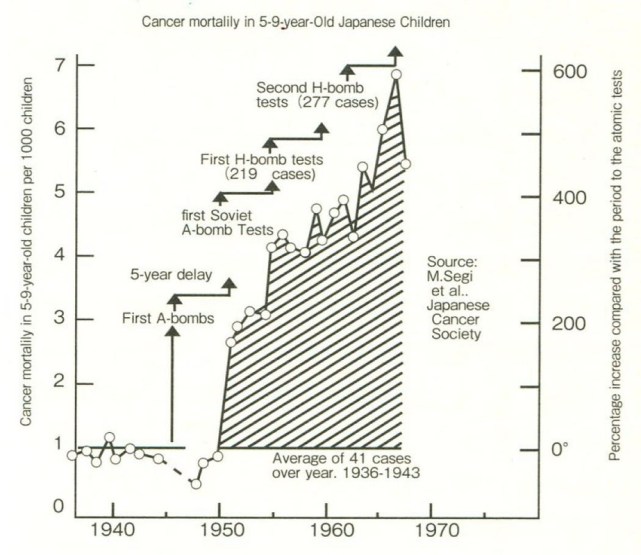
The NHK flipchart that disappeared was based on this graph. 2
I had asked them to make a flipboard for me which showed data on how the rate of child cancer deaths in Japan had jumped five years after the atomic bombings of 1945 to three times their original rate (see graph). It was data which clearly demonstrated that these children were the world’s first casualties of internal exposure. The night before the show, I was handed a script and sat in a meeting discussing the show until past 10 PM. However, the next morning, when I headed to NHK, the director told me that due to time constraints, we could not follow the script we had discussed the previous night. On entering the studio, the flipboard which I had expected to be at my feet was nowhere to be seen. When I asked a nearby staff member to please bring it for me, quickly, the reply was that they could not do that. With 30 seconds to go before showtime, I had no choice but to appear on the show bereft of my data.
The following day, when I requested a written explanation of these events, NHK did not oblige me. Faced against my will with such a situation, I feel strongly that I am responsible for not being able to properly deal with it.
The Society for Connecting Lives
My deceased wife, Okimoto Yaemi, established a society called “Connecting Lives – The Society to Connect Okinawa with Disaster Sites” together with Itō Michiko, an evacuee from Fukushima, and others. They demanded that the Tokyo Electric Power Company explain compensation claims to the victims of the disaster, and even made them come to Okinawa to explain this in person to the evacuees here. It was the first time TEPCO had travelled outside of Fukushima Prefecture to hold an information session. In Okinawa, a group of plaintiffs for a lawsuit to “return our livelihoods, return our region” also came together. 3
In the midst of all her work, Okimoto always came to send me off and to pick me up from Naha Airport. Now that she is gone, I have taken up her role as the representative for the “Connecting Lives” society.
After the accident, the melted-down reactor core was too radioactive to be properly disposed of. It is clear as day from this fact alone that nuclear power generation should not be permitted. In these 5 years, there has been a regime brimming with pollution: it is manifest in things like the lack of intelligence and care on the part of the Japanese government, the utilitarianism that places profits and power above human rights, and the political concealment of the worst environmental radiation disaster in history.
******
It is now 5 years since the Fukushima Daiichi accident, and we are in an abnormal state of affairs in which TEPCO and the national government are forcing people to silently accept their victimization.
Under the Atomic Energy Basic Law, the maximum annual exposure limit for the public is set at 1 millisievert. But people are being forced to accept a revised threshold that is 20 times larger, that of 20 millisieverts per year.
In Fukushima Prefecture, the cessation of compensation payments and the lifting of the evacuation order in highly contaminated regions has forced people to return, at the same time that housing support for the evacuees is also being ended. Of course, there are no measures at all in place to deal with radioactivity outside Fukushima Prefecture.
The Chernobyl NPP accident of 1986 led Ukraine (also Belarus and Russia) to establish laws that protected human rights, which stands in great contrast with the human rights situation surrounding the Fukushima Daiichi NPP accident.4
Claiming Radiation Effects as Psychological
The media reports on the occasion of 3.11’s 5th anniversary contain references to the “fūhyō higai” (damage caused by rumors of radiation) that they claim is hampering the reconstruction process. Why do they not call this as it is, “radioactivity damage”? “Fūhyō higai”is a term that they use in order to replace radiation effects as psychological problems.
Under appointment of the IAEA, Shigematsu Itsuzō (now deceased), the former chairman of RERF(formerly ABCC), carried out a health survey of Chernobyl residents. He remarked in a report he made in 1990 that “there are virtually no diseases that are caused by radiation, but attention must be paid to the psychological stress that is caused by wondering whether or not one has been exposed to radiation”. The theory that “psychological stress causes illness” is a method used to conceal the radiation victimization of the nuclear age.
In Chernobyl, uncontaminated food was distributed to residents of contaminated areas. Respite trips for children are also ensured by the state. And yet, in Fukushima, there is a huge push to “support by consumption” (tabete ouen) and the administration has implemented a policy of “locally-grown and locally-consumed” in providing children’s school lunches. Japan is not attempting to avoid internal exposure as Chernobyl-affected states did; it is doing the exact opposite.
What is at the bottom of this response? Whether it is protecting residents from radiation exposure, or decommissioning of the melted reactor core, or indeed dealing with the contamination of underground water, there are numerous things that need to be addressed even by diverting the budgets of the forthcoming Tokyo Olympics. However, the Japanese government is trying to overcome all these issues with cheaper costs at the expense of people’s suffering. Underlying this is their utilitarianism – an ideology which prioritizes economics over human rights and human lives – as well as their philosophy of abandoning the people.
Following what the government is saying, one is left speechless. “If it’s under 100 becquerels, then sell it [produce]”; “If you don’t sell it you won’t be able to support yourself”; “If you talk about radioactivity you won’t be able to sell [your produce]”; “Don’t talk about radioactivity”. Media reports are controlled by the government, and people can only remain silent.
Providing safe food is the mission of agriculture. Surely there is no more cruel infraction of human rights than to force producers, against their will, to make food that might adversely affect human health by radioactive contamination. There is no solution to this injustice other than to get rid of this system that has been imposed by fiat. Although farmers’ labors have lowered the amount of radioactive contamination in their produce, tragedies will continue as long as they keep the allowable radioactivity in food up to 100 becquerels/kilogram.
Such standard stems from the thinking that economic profits comes before health. Radioactivity even in small amounts can cause harm. International Commission on Radiological Protection has it that carcinogenesis starts with DNA mutation of a single cell. Human susceptibility to radioactivity depends on individuals, and more vulnerable ones, particularly fetuses are affected first. The natural miscarriage rate of the four prefectures including Fukushima since 311 has risen by 13%.5
Consumption of one becquerel of C-137 (with biological half-life of approximately 80 days) every day will result in an internal accumulation of 140 becquerels within about 2 years. If we have to inevitably set any standard for allowable radioactivity in food, we should use the guidelines set forth in the recommendation by German Society for Radiation Protection, which is “no food with a concentration of more than 4 becquerel of the leading radionuclide Cesium-137 per kilogram shall be given to infants, children and adolescents. Grown-ups are recommended to eat no food over 8 becquerel per kilogram of the leading nuclide Cesium-137.”6
Deceitful Dosimetry
The Japanese government’s philosophy of abandoning its people starts with its refusal to trust them, in other words it views them as unintelligent citizens. Fearing that a panic would result, it did not announce SPEEDI data, nor did it distribute solid iodine tablets. It prioritized “emotional stability” over protecting residents from radiation danger. Moreover, it implemented thorough control of information.
It is not simply that residents are seen as ignorant. The government has even actively betrayed their trust. A classic example of such actions by the state is the presentation of data on the radioactive contamination levels in the environment. The government set up monitoring posts (MP) in Fukushima Prefecture and neighboring prefectures and made the readings from them into official data. Along with Yoshida Kunihiro and others from the “Safety and Reassurance Project”, in the autumn of 2011, I checked the dose measurements of the MP. We found clear evidence that the publicly available data of the MP only showed 54% of the actual level of contamination in our readings.
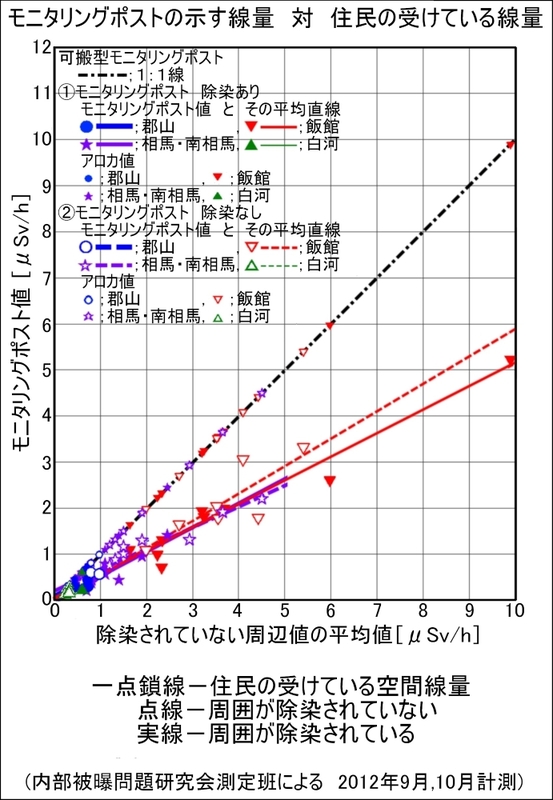
Comparison of Radiation Dose Readings from the Monitoring Posts and Actual Doses
X-axis: amount of radiation (microsieverts/hour
Y-axis: actual doses for residents and measurements at monitoring posts
Black dot-dash line: Actual absorbed dose received by residents
Dotted red line: Measurements at monitoring posts without decontamination
Red line: Measurements at monitoring posts with decontamination
[When laid alongside a graph of the actual recorded radiation doses taken by the authors at the monitoring posts (black line; the absorbed dose to residents), the same displayed readings taken from the same monitoring posts were 58% of that value in the case of non-decontaminated areas and 51% for decontaminated areas.]
[2011 autumn, taken with a certified scintillator counter, model HITACHI-ALOKA YCS172B]
On top of that, there was also a deliberate downplaying in government processing of the numerical data. The level of soil contamination is directly related to the amount of radiation in the air, and an objective measurement of this thus should be obtained from the air dose. However, on the assumption that there is a uniform exposure dose to the whole body, this reading was converted to 60% of its full amount based on the projected dose, an amount called the “effective dose”, a number that divides the exposure dose among the body’s various organs. Furthermore, they made a hypothetical estimate of the time people spent inside and outside their homes, and created a “substantive dose” reading that was another 60% lower. In the background to these machinations lies the will of the international nuclear energy industry.
The health survey being conducted by the Fukushima Prefecture Health Survey Evaluation Committee continues to progress, and the sad news is that it has already located 163 cases of cancer. From a scientific point of view, it is clear that these cases are undeniably caused by radioactivity. I also found, from the ratio of male to female patients, that about 75% of cancers in each sex were induced by radiation. Despite this, the Evaluation Committee continues to assert that there is no proof that these cancers are linked to the NPP accident.
Just as the committee insists that the numerous stark cases of thyroid cancer are not linked to radioactivity, so they will attempt to bury all other adverse health impacts in the sand.
******
Environmental pollution by radiation in Japan is ongoing, and, following the Fukushima Daiichi NPP accident, it is the worst it has ever been. This is true whether we look at the amount of radioactivity being released via the long-term meltdown of the reactor core, which is spewing uncontrollably, while the government and mass media collaborate in the cover-up. From the standpoints of society, economics and preventative medicine, a terrible state of affairs will result if we do not provide public protection to the people affected by the accidents and clarify the nature and extent of environmental damage.
“Cheaper” Countermeasures
The Japanese government has deemed the amount of radioactivity released from the Fukushima accident as one sixth of that which was released from Chernobyl. However, the subsequent revelations suggest that Fukushima’s radioactivity is actually anywhere from 2 to 4 times as high as Chernobyl’s.7 Compared to the explosion of just one reactor at Chernobyl, which had a 1,000,000 kilowatt capacity, the explosion at Fukushima Daiichi involved 4 reactors with a combined output of 2,810,000 kilowatts.
The post-accident maintenance of nuclear reactors between Fukushima and Chernobyl also differs. Seven months after Chernobyl, a steel and cement sarcophagus was built to cover the reactor, thus stopping the further release of radioactive materials. Japan, even after 5 years, continues to let radioactive substances spew out into the air and water, thus worsening the world’s environment.
Without using the necessary basic procedures, they are simply trying to implement “cheaper” countermeasures. The fact that the stricken reactor cannot be managed alone can demonstrate that nuclear power lacks practicality and there is no choice but to abolish it.
As mentioned before, Japan is not honestly disclosing the degree of contamination and is using various measures to underestimate it. They have not published dose readings for radioactive nuclides such as uranium, plutonium, and strontium-90. The monitoring posts, which are supposed to provide public data of radioactivity, give readings that are only around half of the actual doses.
Pediatric thyroid cancer cases in Fukushima have risen to 163. It has been proven scientifically that these are due to radiation. (Tsuda Toshihide et al. have demonstrated this via statistics8; Takamatsu Isamu has examined the relationship between exposure dose and cancer onset rate9; Matsuzaki Michiyuki10 and Yagasaki Katsuma11have studied the relationship of radiation with the sex-differentiated ratio of cancer).
In response to this research, the Fukushima Prefectural Health Evaluation Committee has continued to insist that there is no clear link between cancer and the NPP accident. They are trying to bury all the injuries to health by this denial of a link between radioactivity and the many recorded cases of thyroid cancer. By expunging the record of health damages caused by radiation, they hope to heighten the false impression that NPPs are “safe”. In Japan, excessive utilitarianism goes unmentioned; companies’ profits and the state’s convenience take priority over human life.
The Systemization of Dispersal
The countries surrounding Chernobyl created a “Chernobyl Law” to protect their residents 5 years after the accident. Under this law, the government designated areas that received more than 0.5 millisieverts of radiation each year as “dangerous”, and areas that received between 1 and 5 millisieverts of radiation each year as “areas with relocation rights”, while areas receiving more than 5 millisieverts each year could not be used as residential or agricultural sites. Health checkups and respite trips for children have been covered in a massive budgetary investment by the state in order to protect its residents.
What about Japan? The legal exposure limit for the public is 1 millisievert per year. As previously mentioned, the government has raised the upper threshold to 20 millisieverts per year in their drive to push Fukushima residents to return. The Chernobyl law forbids residence and agriculture in areas where more than 5 millisieverts (per year) of irradiation is expected; in Japan, approximately 1,000,000 people live in such areas.
Under the Basic Law on Atomic Energy, which governs nuclear reactors and related phenomena, the standard for radioactive waste management (the level considered for safe recycling use) is 100 becquerels per kilogram. Notwithstanding this rule, the special law for measures to handle contamination by radioactive substances permits up to 8000 becquerels per kilogram. Contamination dispersal is thus becoming systematized.
A law to support child victims was established, but no maps of radioactive contamination were made, and the areas specified to receive assistance under this law’s “Basic Policy” are limited to Fukushima Prefecture. With this law they have thus made all areas outside Fukushima Prefecture ineligible to receive radioactivity countermeasures.
When looking at the measurements taken by the Nuclear Regulation Authority of the contamination levels in all prefectures, we see that contamination exists everywhere in the country, Okinawa being no exception.
In particular, eastern Japan shows high levels of contamination. 10 prefectures show contamination of more than 1,000 becquerels of Iodine-131 per square meter of land –Tochigi, Ibaraki, Tokyo, Yamagata, Saitama, Chiba, Gunma, Kanagawa, Nagano, and Shizuoka (Readings for Fukushima and Miyagi were not available for a period of time because the measurement equipment were destroyed by the earthquake and tsunami, but other sources confirm high I-131 dispersion in Fukushima). 11 prefectures show more than 1,000 becquerels of Cesium-137, and Cesium-134 – Fukushima, Tochigi, Ibaraki, Tokyo, Yamagata, Saitama, Chiba, Gunma, Kanagawa, Iwate, and Nagano.
These readings are taken from a fixed point, which means that if a radioactive plume does not pass over these points, it will not be measured, and is liable to produce an under-estimation gap by 1 to 2 digits.
Although the Ministry of Education has implemented airborne monitoring, cities with a density of buildings higher than 3 stories present obstacles to this technology, making it unable to record their levels of contamination. Severe contamination is concealed in the Tokyo metropolitan area and other places in the region.
Legal Protection of Citizens
The above facts demonstrate an intentional ignoring of the serious level of radiation pollution. Japanese citizens should recognize radioactivity pollution as a de facto state of affairs.
In order to protect Japanese citizens from radioactivity pollution, the government and administration should take responsibility for protecting victims via a swift application of the regulations exactly as they are laid out under the Basic Law on Atomic Energy. Here we raise some suggestions for administrative policies to enact not only towards evacuees, but all residents. 1. The state should recognize and guarantee citizens’ right to evacuate and relocate. It should also bear responsibility in enacting measures to protect vulnerable victims, especially children.
- Health damages that emerge from NPP accidents should be studied on a nation-wide scale, and a study of the conditions of evacuees should be quickly implemented.
- Those most vulnerable to radiation should be protected by measures based on a sincere commitment to preventive medicine.
- With regard to the numerous early-onset cases of child thyroid cancer that have far exceed such early cases caused by Chernobyl, medical care and compensation should be provided; children and all residents should be protected. Thyroid screening should also be carried out for the entire country.
- Measures to prevent the entrance and exit of radioactive substances in all regions should be enacted.
- TEPCO’s social responsibility as a victimizer corporation in radioactivity pollution should be clarified.
This is a translation of a modified version of Yagasaki’s three-part article series “Kakusareru naibu hibaku – Fukushima genpatsu jiko no shinso” that appeared in Ryukyu Shimpo on March 16, 17, and 18, 2016.
Notes
School to close in Fukushima as too few children able to attend
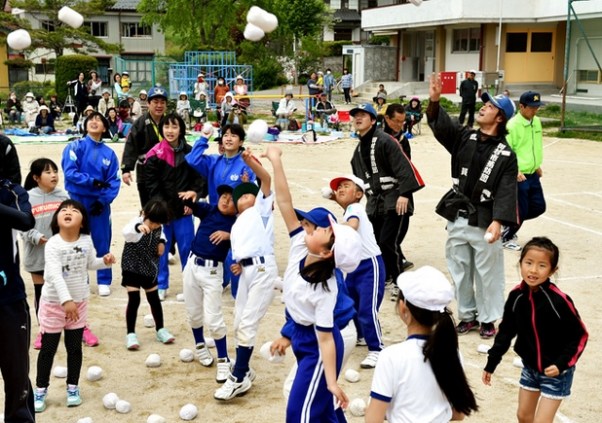
Graduates and local residents attend the last athletic meet at Iwaisawa Elementary School in Tamura, Fukushima Prefecture, on May 14.
TAMURA, Fukushima Prefecture–Despite a proud 140-year history, the Iwaisawa Elementary School here has to close–as not enough children come to classes any more due to the 2011 nuclear disaster.
The school held its last annual athletic meet on May 14. It will merge with another school after this academic year ends next March.
The school currently has 19 pupils, down from 52 before the disaster at the Fukushima No. 1 nuclear power plant.
In the lead-up to the athletic meet, the school, located in the Miyakoji district of Tamura, Fukushima Prefecture, sent out about 500 invitation letters to its graduates and local residents. About 150 people turned up.
After the nuclear accident, residents in the district were forced to evacuate to other areas. Although the evacuation order was lifted in April 2014, many of them opted to stay where they were while keeping their resident registries in the district.
As of the end of April this year, 2,564 people were officially registered as residents in the district. But of that number, only 1,600 or so actually lived there.
After the nuclear accident, pupils at Iwaisawa Elementary School temporarily took classes using classrooms of a different school in central Tamura, which had been already closed. In April 2014, they returned to their original school.
But only 29 came back, compared with the pre-accident figure of 52. The number has since further declined to 19. Because of that, it was decided the school will be merged with another school next spring.
Seniors mull share house to keep Fukushima evacuee community intact
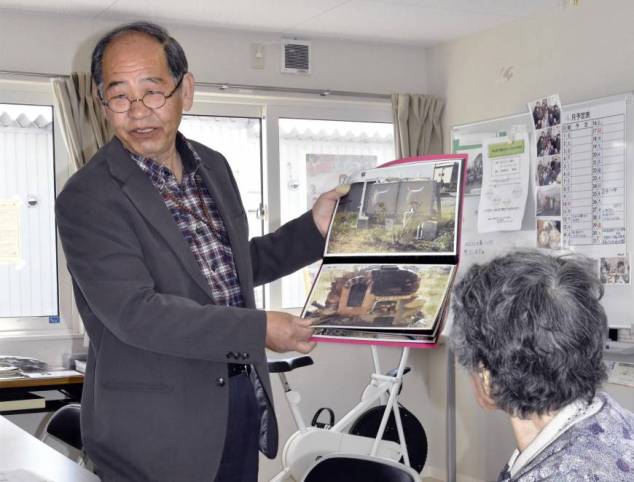
Masaharu Fujishima, who is proposing to build a share house for temporary housing residents, explains his plan to residents in a meeting in April in Minamisoma, Fukushima Prefecture.
FUKUSHIMA – As the government looks to lift the evacuation zone for part of Minamisoma, Fukushima Prefecture, elderly people currently living in temporary dwellings are considering a share house so they can stay together.
If the no-go zone is lifted, residents at temporary housing units are likely to be asked to leave. One option is to return to their hometown of Minamisoma’s Odaka district — a choice few are likely to make. Another option is to move in to city-provided public housing where they would have to start again in unfamiliar surrounds.
In Odaka, residents will be allowed to stay inside the evacuation zone to prepare for their permanent return after the designation is lifted. But of the area’s 11,700 residents, only 1,870 have registered to go back, suggesting few plan to return permanently.
It’s for this reason that Masaharu Fujishima, 70, a resident at Minamisoma’s temporary housing complex, is pitching a plan to create a share house with individual rooms and common space that will allow temporary housing residents who have bonded since the March 2011 Fukushima nuclear disaster to live together.
Fujishima evacuated from Odaka to temporary housing in the city center. Serving as head of the community association until January, he was able to talk with many residents about the troubles they faced as they attempted to rebuild their lives.
Many were worried about leaving a community of friends they bonded with over the past five years for a new one they would need to create from scratch.
“After the nuclear disaster, many people had to move around before they finally settled in the temporary housing,” said Fujishima. “I’m worried that if they leave here, they would have to go through all the trouble again of searching for a new place to live.”
So far, Fujishima has held three meetings for temporary housing residents to explain his proposal. While some feedback has been positive, with residents saying it will prevent them from becoming senile, others have voiced concern about what will happen when one of the dwellers becomes ill or dies.
To put the plan in motion, Fujishima submitted about 16,000 signatures to the Minamisoma Municipal Assembly.
The city is expected to consider the proposal, though a city official in charge of housing construction was not sure if the idea is feasible.
“It is difficult because public houses are not designed for many people to live together like a share house,” the official said.
Collision on the Joban Expressway in Fukushima
On May 4, 2016, a head-on collision between a car and a bus on the Joban Expressway in Fukushima killed a mother and her daughter on the passeger car. *link for Yahoo Japan article
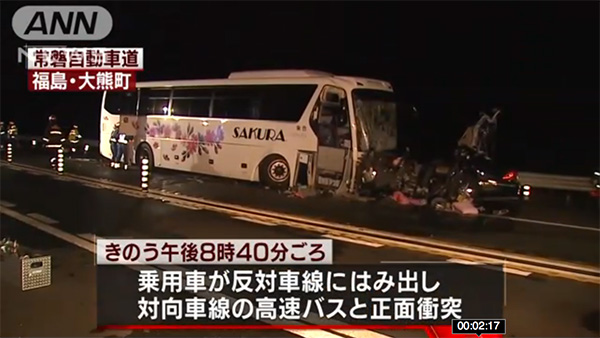
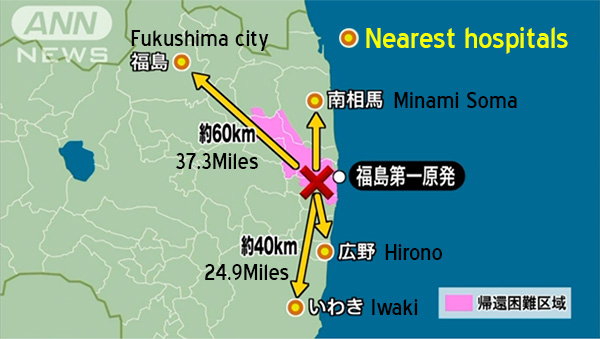
The accident happened in Okuma town which is within “Difficult-to-return” zones, due the nuclear accident at Fukushima Daiichi Nuclear Power Plant.
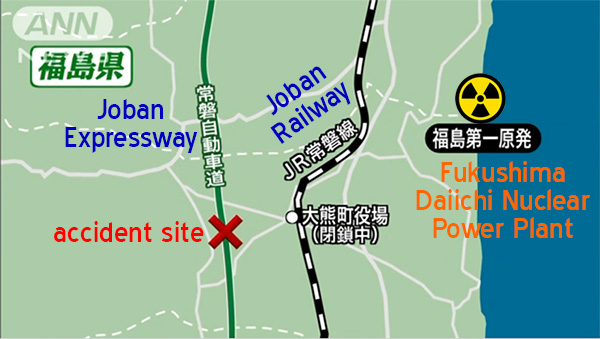
The designated area has been exposed to more than 50 millisieverts per year of radiation from the melted-down power plant. It is considered difficult for local residents to return possibly for the next several decades.
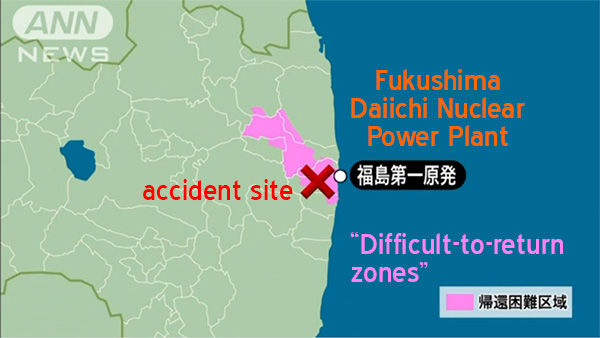
Since the entire area has been evacuated, the injured passengers on the crashed bus had be transported as far as 37Miles.
40 passengers including the bus driver had to wait for the ambulance for two hours on the side of the road. No face masks were provided.
(Cars and buses are allowed around this section of Joban Expressway, but not motorcycles due to the extreme level of radioactive contamination.)
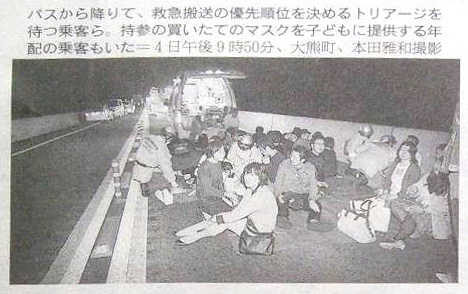
*Photo of the Japanese newspaper article courtesy of Facebook group, “NPO法人チェルノブイリへのかけはし“.

Background radiation level in Okuma town as of March 24, 25 of 2016, measured by Okuma town.
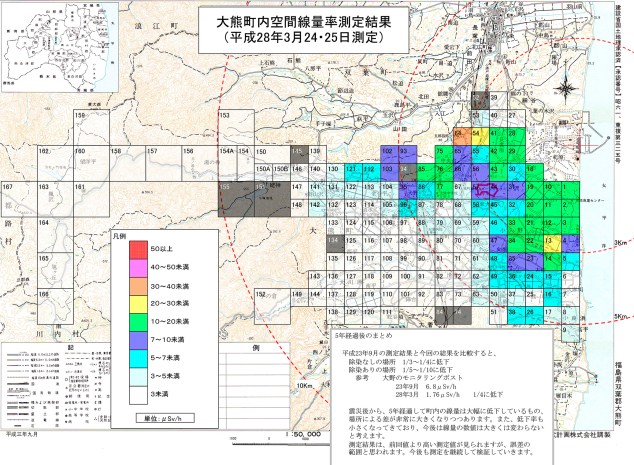

Source: http://www.mp-nuclear-free.com/main-articles/news-snippets_20160507.html
Arnie Gundersen measured 4,000 Bq/kg on a Tokyo street
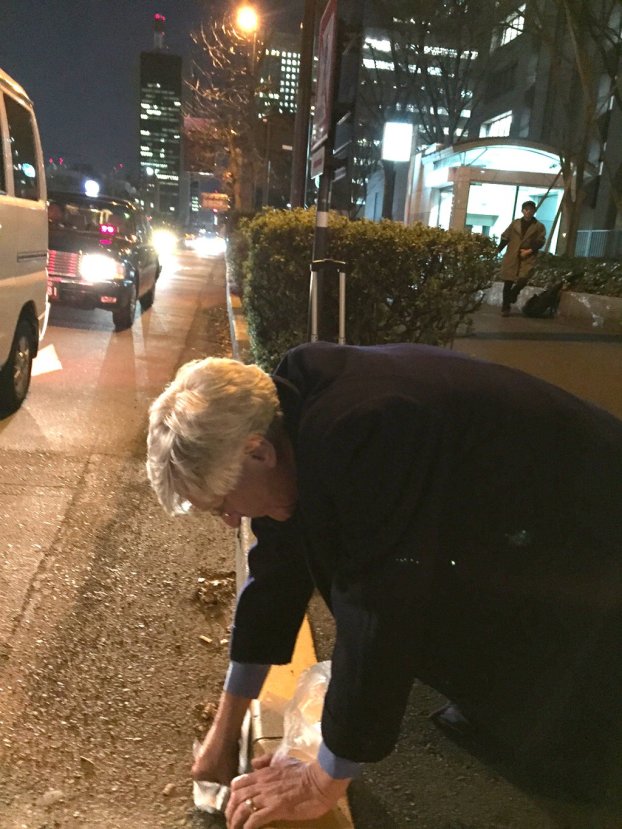
Arnie Gundersen measured 4,000 Bq/kg on a Tokyo street outside METI, Japan nuclear regulator…Olympics anyone?
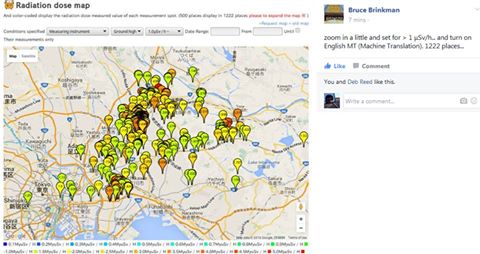
76 measurements that are over 5µS/h in the “Kashiwa hotspot”

Kashiwa city, Chiba prefecture, nearby Tokyo
Some screen caps of the new background radiation tests from Japan. Kashiwa hot spots. Thanks to Bruce Brinkman
Hakatte Geiger users have uploaded 76 measurements that are over 5µS/h in the “Kashiwa hotspot” area. You can see how they are distributed as the plume came over Kasumigaura and into eastern Tokyo. I travel through that on my way to and from work. I have to go through Matsudo and Kashiwa which are buried under the map pins.

Zoom in a little and set for > 1 μSv/h… 1222 places.
Overemphasis on economic growth led to Minamata, Fukushima: NPO forum
TOKYO — Marking the 60th anniversary of the official recognition of Minamata disease, speakers hosted by a nonprofit organization say that an overemphasis on economic growth was behind the mercury-poisoning illness as well as the nuclear disaster in Fukushima.
“Japan has put priority on economic development, rather than valuing human life, and such an attitude caused the problems of Minamata and Fukushima as well as grave fatal accidents, such as explosions at coal mines,” said Kunio Yanagida, a freelance journalist.
“The problem is that lawmakers and bureaucrats have tried to avoid their responsibility, rather than determining the truth behind the incidents, and they have failed to make the lessons learned from them universal,” he told an audience of around 1,000 at the event in Tokyo last week.
“Japan is still driven by a wartime policy of increasing its wealth and military power,” he said.
Tatsuya Mori, a film director and writer, referred to a Minamata disease patient who once said, “I was aware that I am Chisso.” The patient meant that while he is a victim of the disaster caused by Chisso Corp, a chemical maker which dumped industrial waste into the sea, he himself had enjoyed the benefits of its products and might have gone along with its actions if he had belonged to the company himself.
Mori said, “In a similar way, we could say, ‘I am Fukushima,’ or ‘I am Tokyo Electric Power Co.,’ as we have depended on the crippled Fukushima Daiichi nuclear plant” operated by the utility.
“We need to realize we have supported the system that caused the issues of Minamata and Fukushima,” he added.
The Tokyo forum was organized by Minamata Forum to mark the 60th anniversary since a public health center in Minamata in the southwestern Japan prefecture of Kumamoto received a report from a local doctor about four people with unexplained neurological disorders—considered later to be when Minamata disease was first recognized.
Before starting the session, the audience observed a moment of silence before 500 portraits of Minamata disease victims put up behind the speakers on the stage.
So far, only around 3,000 among over 33,500 applicants have been officially recognized as Minamata disease patients in Kumamoto and neighboring Kagoshima prefectures as well as Niigata Prefecture, where a similar disease was confirmed in 1965, caused by wastewater from a Showa Denko K.K. plant.
Critics claim that six decades after Minamata disease was first recognized, the issue has still not been resolved with the full number of sufferers yet to be fully acknowledged. Several damages suits are still pending.
Let Japanese Officials Eat Isotopes To Atone For Fukushima
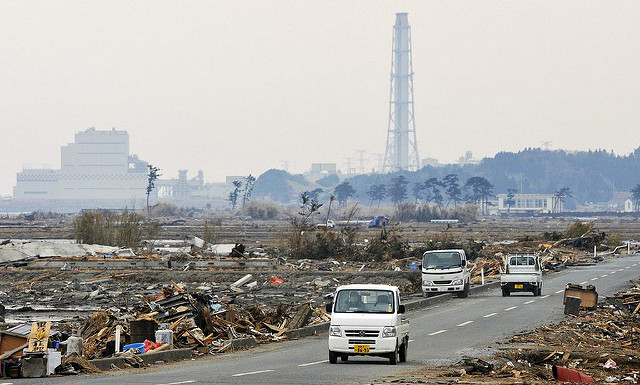
Despite the Fukushima and Chernobyl disasters, nuclear energy continues to thrive. Pictured: Fukushima shortly after the disaster.
How Japanese Officials Can Atone for Fukushima
Let them eat isotopes.
The meltdowns and release of radiation from the Fukushima Daaichi nuclear power plant has been an ongoing crisis for five years. Nuclear engineer Koide Hiroaki has been one of the most trenchant critics of how the Japanese government and power company TEPCO (mis)handled the disaster. In a wide-ranging interview at Counterpunch, he offered a way for officials, who have gone unpunished, to atone.
Right now the people of Fukushima have been abandoned in the areas of the highest levels of radiation. And abandoned people have to find a way to live. Farmers produce agricultural goods, dairy farmers produce dairy products, and ranchers produce meat; these people must do so in order to live. They are not the ones to be blamed at all.
As the Japanese state is absolutely unreliable in this matter, these people have no choice but to go on producing food in that place, all the while suffering further exposure. So I don’t think we can throw out the food they produce there under those conditions. Inevitably someone has to consume that food.
Certainly not the residents of the Fukushima area. Hiroaki has a better idea.
We should serve all of the most heavily contaminated food at say the employee cafeteria at TEPCO or in the cafeteria for Diet members [Japanese parliament] in the Diet building. But that isn’t nearly enough. We must carefully inspect the food, and once we’ve determined what foods have what levels of contamination, once that is fully measured and delineated, then those who have the corresponding levels of responsibility should eat it, should be given it.
He’s serious.
I am aware that this is a controversial proposal, but each one of us, especially those who built post-war Japan, bears responsibility for allowing our society to heavily dependent on nuclear energy without carefully reflecting on the risks and consequences of it. And more importantly, we have the responsibility for protecting children.
Even after Chernobyl and Fukushima, nuclear energy thrives. Especially in Russia and China, where they are planning to build floating nuclear energy plants. Huh? From CNN on April 28:
China is planning to build nuclear reactors that will take to the sea to provide power in remote locations. … These small power plants will be built in Chinese shipyards, mounted on large sea-going barges, towed to a remote place where power is needed and connected to the local power grid, or perhaps oil rig.
China has 20 planned; Russia seven. Never mind how much the costs would cascade if another disaster occurs. In January 2014, at Warscapes magazine, I wrote that it was difficult to understand how the advocates of nuclear power can continue to block out the risk of major accidents, especially when they are fresh in our memory.:
Fukushima has just occurred before the world has gotten over the last one, Chernobyl. What if another accident occurs while we’re still knee-deep in cleaning up and bearing the costs of Fukushima, and maybe even still Chernobyl? Casualties and damage to the environment aside for the moment, how can nations afford this? Come to think of it, how do nuclear-power companies afford it, yet continue to forge ahead?
To answer the last question: state subsidies to build nuclear energy plants. Also, of course, much of the cost of cleaning up after an accident is, as you would expect, offloaded to the state and its citizens. Bailing out the nuclear energy is of a piece with bailing out the banks.
http://fpif.org/japanese-officials-can-atone-fukushima/
To cleanup some radioactive fallout!
There are two main problems in whatever decontamination techniques used: wash off and scrap up techniques, or phytoremediation:
80% of the Fukushima prefecture land surface is forested mountains, forested mountains which you can neither wash off and scrap up nor phytoremediate.
Forested mountains from which the accumulated contamination ruissels down or flies down with wind and rain to the low land living areas which had been previouly decontaminated, some places have already been decomtaminated up to five times, always the contamination coming back up to the pre-decontamination level.
To decontaminate well and forever you would have to cut down those mountain forests, which is a huge surface to be cut down, a gigantic impossible work, which would as an immediate effect spread a lot of the accumulated various radionuclides and make the radiation level jump high everywhere.
With either of those techniques you quickly end up with a huge quantity of contaminated waste, which accumulates quickly and for which there is no real valid solution for disposal. To reduce its volume by incineration is still re-scattering radionuclides into the environment, as there is no incinerator filter capable of blocking 100% of all radionuclides nanoparticles.


Obviously, the cleanup process is much more involved than this, but you can imagine how difficult it is to keep all that radioactive dust from getting into everything. Phil Broughton is a treasure trove of stories and information. But, if you follow his blog, you’ll learn that he takes the decontamination process very seriously. Something a graduate student learned the hard way when they made a poorly-thought out April Fool’s prank. Phil had this to say about the tremendous task of nuclear cleanup:
…everything exposed to air, everything that rain water might wash over, ALL SURFACE WATER, must be assumed to be contaminated. Want to use that car? Wash it down because it’s got a crust of radioactive crap on it, and if you try to drive it, you just climbed inside your own moving irradiator box.
This is the hard part of fallout decon[tamination] and radioactive waste in general. Nothing makes it stop being radioactive other than time, and human attention spans and lifespans are somewhat incompatible with this. Not living in the higher dose world its very hard to contemplate the “I accept this dose for me, my children, and generations to come” when planning reconstruction.
A while ago, I did a couple of comics about how plants (including tumbleweeds) were being used to help clean up radioactive material. Here’s Phil again:
Fungi, in fact, do amazing work sucking fallout products out of the soils. Instead of having roots, their hyphae draw nutrients out of a very shallow layer and do it quickly. This is also good because fallout actually doesn’t penetrate all that deep below the surface of the soil. One of the ways we monitor how much radioactive material is left in the environment is by sampling the mushrooms that grow and plotting it’s drop off following an event. You may discover that there are new sources contributing to the environment which is to say the event isn’t over yet as there’s clearly a continuing release. You can also do detoxification this way by planting, harvesting, repeat until whatever your crop is isn’t showing any uptake of materials anymore.
Of course other parts of the environment are running on different clocks. It will take quite a while for contamination to get to the ground water and then for the groundwater to be sampled by plants that can tap that deep. Annoyingly, fungi and grasses might detoxify the upper layer of soil within a decade only to have the deep tapping trees pull it up from the groundwater and recontaminate the upper layer a decade after that with their now radioactive falling leaves.
After I drew the phytoremediation comics, the number one question asked by readers was: “So, what happens with the plants after they’ve absorbed the radioactive elements?” Apparently, it’s a very real problem that cleanup crews have to work with. Here’s what Kathryn Higley said when I asked her about the sunflowers being planted at Fukushima:
I’ve looked at the discussions on sunflowers and other phytoremediation techniques. From what I’ve read, they are able to capture the ‘low hanging fruit’, but they lose effectiveness after a couple of croppings/harvesting. This is because the residual material is more strongly attached to soil particles (such as clay minerals). That being said, phytoremediation is a relatively low tech solution. The challenge is then what do you do with the contaminated biomass? When I went to Fukushima you could see large ‘super sacks’ of contaminated vegetation just sitting on the side of the road (see photo below). These large bags have a limited lifespan (~5 years) before they degrade due to UV exposure and all your stored material starts being blown around by wind.

Defunct government agency exempted from indictment over Fukushima crisis
A panel has upheld a decision by prosecutors not to indict three former senior officials of the Nuclear and Industrial Safety Agency over the Fukushima crisis. The agency was responsible for nuclear safety at the time of the accident and has since been dissolved.
The decision by the Tokyo No. 1 Committee for the Inquest of Prosecution, dated April 14, means that the agency is effectively absolved of criminal responsibility for one of the world’s worst nuclear disasters.
The three were accused of professional negligence resulting in death and injury. They include Yoshinori Moriyama, NISA’s former deputy director general for nuclear accident measures.
Tsunami waves flooded the plant on March 11, 2011, knocking out power supplies and causing three reactors to melt down.
The 11-member panel concluded that it was impossible for Moriyama and the two others to foresee that 10-meter-high waves would strike.
Three former Tepco executives, including then Chairman Tsunehisa Katsumata, 76, were indicted in February based on a decision by another committee that examined a prior decision by prosecutors not to lay charges.
Under the revised inquest of prosecution law, which took effect in May 2009, criminal charges are filed if a minimum of eight members of the judicial panel vote in favor of indictment in two consecutive rulings.
NISA was scrapped in September 2012 as the nation revamped its nuclear regulatory setup following the Fukushima crisis. Critics accused the agency of lacking teeth because it was under the umbrella of the pro-nuclear Economy, Trade and Industry Ministry and therefore was seen as hand in glove with the nuclear industry.
1 This Month

of the week – Shut Down Drone Warfare!


Tell the Ukrainian Government to Drop Prosecution of Peace Activist Yurii Sheliazhenko

Petition to revoke the licensing of the Near Surface Nuclear Disposal Facility (NSDF) at Chalk River. https://www.ourcommons.ca/petitions/en/Petition/Details?Petition=e-7247
To see nuclear-related stories in greater depth and intensity – go to https://nuclearinformation.wordpress.com
-
Archives
- March 2026 (251)
- February 2026 (268)
- January 2026 (308)
- December 2025 (358)
- November 2025 (359)
- October 2025 (376)
- September 2025 (257)
- August 2025 (319)
- July 2025 (230)
- June 2025 (348)
- May 2025 (261)
- April 2025 (305)
-
Categories
- 1
- 1 NUCLEAR ISSUES
- business and costs
- climate change
- culture and arts
- ENERGY
- environment
- health
- history
- indigenous issues
- Legal
- marketing of nuclear
- media
- opposition to nuclear
- PERSONAL STORIES
- politics
- politics international
- Religion and ethics
- safety
- secrets,lies and civil liberties
- spinbuster
- technology
- Uranium
- wastes
- weapons and war
- Women
- 2 WORLD
- ACTION
- AFRICA
- Atrocities
- AUSTRALIA
- Christina's notes
- Christina's themes
- culture and arts
- Events
- Fuk 2022
- Fuk 2023
- Fukushima 2017
- Fukushima 2018
- fukushima 2019
- Fukushima 2020
- Fukushima 2021
- general
- global warming
- Humour (God we need it)
- Nuclear
- RARE EARTHS
- Reference
- resources – print
- Resources -audiovicual
- Weekly Newsletter
- World
- World Nuclear
- YouTube
-
RSS
Entries RSS
Comments RSS
 nuclear-news