Footholds Should Be Built in Fukushima No-Go Zone: LDP Team
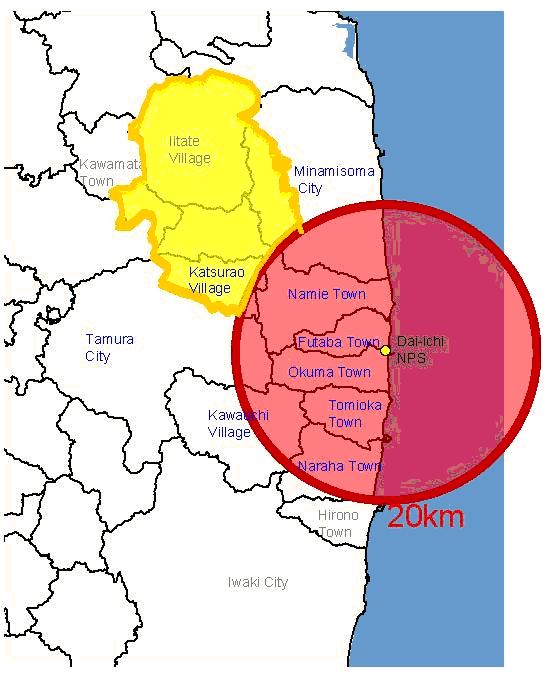
Tokyo, Aug. 17 (Jiji Press)–Reconstruction footholds should be set up in the no-go zone heavily contaminated by the 2011 nuclear accident in Fukushima Prefecture in northeastern Japan, a Liberal Democratic Party team proposed Wednesday.
The footholds should be used for decontamination work and infrastructure development so that evacuation orders for residents of the zone will be lifted in around five years, said the ruling party’s Headquarters for Accelerating Reconstruction after the Great East Japan Earthquake.
At a general meeting, the headquarters broadly agreed on a draft outline of the party’s planned sixth reconstruction proposal for areas damaged by the March 2011 earthquake and tsunami and the subsequent reactor meltdowns at Tokyo Electric Power Company Holdings Inc.’s Fukushima No. 1 nuclear power plant.
The government plans to remove all evacuation advisories in municipalities affected by the nuclear accident by the end of March 2017, excluding in the no-go zone where radiation levels are still too high for local residents to return home anytime soon.
The LDP will submit the proposal to Prime Minister Shinzo Abe later this month, after finalizing it through discussions with its coalition partner, Komeito.
FUKUSHIMA TOXIC SOIL CLEAN UP
CNN’s Paula Hancocks reports from the affected area, and gives a very short and nuanced report from within the exclusion zone in Fukushima prefecture.
The cleanup at Fukushima, the removal of the toxic soil and plants near the meltdown site is a huge task.
New technologies using zeolite composite fibers to prevent radioactive cesium pollution in Fukushima rivers

The authors have developed and applied new technologies using zeolite composite fibers to prevent radioactive Cs pollution of water in Fukushima, Japan.
During approximately four years in the area, decontamination has been conducted to reduce radioactive cesium (Cs) in the field. However, water contaminated with extra-diluted radioactive Cs has prevented residence within about 30 km of the damaged nuclear facilities. Great efforts at decontamination work should be undertaken to alleviate social anxiety and to produce a safe society in Fukushima.
Decontamination using fiber-like decontamination adsorbents was examined in actual use for radioactive Cs in water in Date city in 2013 and in Okuma town in 2015.
This report describes preparation and properties of the fiber-like decontamination adsorbents. Furthermore, this report is the first describing results of radioactive Cs decontamination using a fiber-like adsorbent for water with extra-low-level concentrations of radionuclides.
Even four years after the accident, results strongly suggest the decontamination still distributed in Fukushima area, depending on the distance of the nuclear power plant. Evidence indicates the importance of preventing extension of radioactive Cs further downstream to human residential areas.
Upper House Election 2016 / ‘Stagnant recovery’ hangs over Fukushima

From The Yomiuri Shimbun, a pro-government Japanese newspaper
Large black bags piled up like stone walls are a common sight in Fukushima Prefecture.
The bags are filled with contaminated soil left over from the decontamination work carried out in the wake of the 2011 disaster at the Fukushima No. 1 nuclear power plant.
The bags of soil are being provisionally stored at about 130,000 spots throughout the prefecture, including in schoolyards and parks.
It has been more than five years since the Great East Japan Earthquake, yet these “temporary” storage sites can even be found in the city of Fukushima.
On May 28, Justice Minister Mitsuhide Iwaki, 66, of the Liberal Democratic Party held a meeting for his supporters at a hotel in the city center. Iwaki represents them in the House of Councillors.
“I want to tell the whole world how safe and secure Fukushima is. The Tokyo Olympics and Paralympics in four years are a big chance. I want to show how Fukushima has recovered from the major damage it received,” he said at the meeting, drawing applause from about 250 supporters.
Posters hung around the venue read, “Running flat out toward a true recovery.”
There were about 10.3 million cubic meters of contaminated soil as of the end of last year, enough to fill eight Tokyo Domes. The government wants to move as much as 60 percent of this to interim storage facilities being built in Okuma and Futaba by the time the Olympics are held in Tokyo in fiscal 2020, to give an impression the recovery is making progress.
However, only about 2 percent of the land needed for the sites has been acquired. House of Councillors member Teruhiko Mashiko, 68, of the Democratic Party criticized the delay in moving the contaminated soil at the opening of a campaign office in Koriyama, also on May 28.
“Is the way the LDP is handling things acceptable? Contaminated soil is just being left to sit in schoolyards and parks and beside private houses,” he said.
Mashiko does not dispute the need for interim storage facilities, but since negotiations with about 2,000 landowners are moving slowly, he has proposed nearly doubling the current number of staff from 110 to at least 200 workers.
The number of House of Councillors seats to be contested in the Fukushima constituency this time was cut from two to one in 2013, pitting Iwaki and Mashiko, who currently each hold a seat, against each other. In the 2010 upper house election, Iwaki won a seat but finished second, about 2,700 votes behind Mashiko. This time, Mashiko is set to run as “a joint candidate” backed by opposition parties, so there is a much stronger sense of crisis among Iwaki’s campaign team.
At a meeting on June 5 of the LDP’s prefectural election committee, the chairman of the Election Strategy Committee, Toshimitsu Motegi, urged members of the prefectural assembly and others to join the fray.
“When two sitting lawmakers go up against each other, one must lose his seat. Treat this campaign like it is your own election,” he said.
The Cabinet of Prime Minister Shinzo Abe has said the recovery from the disaster is one of its highest priorities. Abe himself visited Fukushima on June 3. If one of his Cabinet members were to be defeated in such a key electoral district, “It would be seen as a rejection of the recovery policies the government has promoted,” a veteran member of the prefectural assembly said.
The DP has its burdens as well. When the disaster struck, the DP’s predecessor, the Democratic Party of Japan, was in power, and the administration’s scattershot response confused operations on the ground. At the launch of his campaign, Mashiko apologized for the party’s track record.
“We put everything we had into the recovery, but the path was steep. I’m terribly sorry,” he said.
In a survey of 200 Fukushima Prefecture residents who were evacuated, conducted in March by The Yomiuri Shimbun, 80 percent said the recovery was behind schedule. “Even if decontamination is completed, the mountains of contaminated soil remain. Many residents say they don’t want to return,” said Norio Kanno, mayor of Iitate, which had to be fully evacuated after the nuclear disaster.
Will either party be able to accelerate the recovery that is still not being felt in many areas hit by the disaster? Voters will likely view both the LDP and the DP with a critical eye.
Final disposal within 30 years
Decontamination has been completed for almost 90 percent of the about 420,000 houses and other buildings targeted for clean-up in Fukushima Prefecture. The evacuation orders for most of the city of Minami-Soma and two villages in the prefecture are expected to be lifted in June or July. However, it has yet to be decided when the evacuation orders will be lifted for Okuma and Futaba, where the damaged nuclear plant is located, and other municipalities with high radiation levels. Storage facilities for the contaminated soil generated by the decontamination effort are intended to be only an interim solution. Legislation has been passed demanding that a final solution outside the prefecture be found within 30 years.
Numerous other issues also need to be dealt with, including decommissioning the damaged nuclear reactors.
Work on developing robots that can collect the melted nuclear fuel in the reactors has only just begun, meaning the decommissioning process could take as long as 40 years. Work on building an “ice wall” by freezing the ground around the reactor buildings is almost completed. This is expected to stop the inflow of groundwater into the site, which should reduce the amount of contaminated water that is generated.
Decontamination worker’s dead body found full of scars
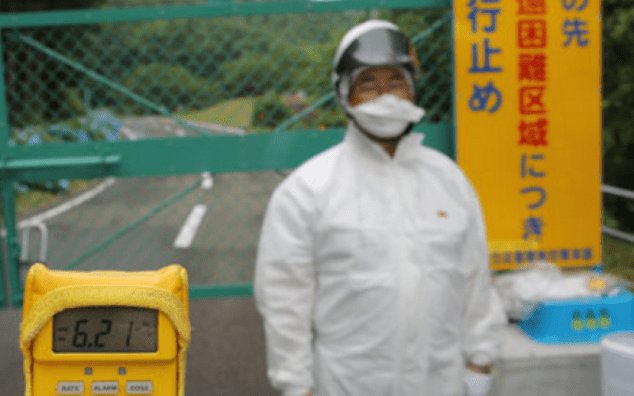
According to Fukushima prefecture police, a decontamination worker’s dead body was found in the company area that he was working for on 5/16/2016.
The body is assumed to be the man in 40s, who had been missing since last Autumn.
Police found it in the gravel pit of the company area. The company undertakes decontamination works in Iwaki city. From juridical autopsy, intracranial injury was possibly the cause of death. There were several scars on the face and body.
The company president and 5 other employees and former employees were arrested for suspicion of abandonment of dead body.
No more details are reported.
http://irresponsibility.seesaa.net/archives/20160517-1.html
http://matomejapan.doorblog.jp/archives/60130534.html
Fukushima Flunks Decontamination

Japan’s Abe administration is pushing very hard to decontaminate land, roads, and buildings throughout Fukushima Prefecture, 105 cities, towns, and villages. Thousands of workers collect toxic material into enormous black one-ton bags, thereby accumulating gigantic geometric structures of bags throughout the landscape, looking evermore like the foreground of iconic ancient temples.
Here’s the big push: PM Abe committed to the 2020 Tokyo Olympics, which shall be a crowning achievement in the face of the Fukushima disaster. Hence, all stops are pulled to repopulate Fukushima Prefecture, especially with Olympic events held within Fukushima, where foodstuff will originate for Olympic attendees.
The Abe government is desperately trying to clean up and repopulate as if nothing happened, whereas Chernobyl (1986) determined at the outset it was an impossible task, a lost cause, declaring a 1,000 square mile no-habitation zone, resettling 350,000 people. It’ll take centuries for the land to return to normal.
Still and all, is it really truly possible to cleanse the Fukushima countryside?
Already, workers have accumulated enough one-ton black bags filled with irradiated soil and debris to stretch from Tokyo to LA. But, that only accounts for about one-half of the job yet to be done. Still, in the face of this commendable herculean effort, analysis of decontamination reveals serious missteps and problems.
Even though the Abe government is encouraging evacuees to move back into villages, towns, and cities of Fukushima Prefecture, Greenpeace nuclear campaigner Heinz Smital claims, in a video – Fukushima: Living with Disaster d/d March 2016: “Radiation is so high here that nobody will be able to live here in the coming years.”
Greenpeace has experts on the ground in Fukushima Prefecture March 2016, testing radiation levels. The numbers do not look good at all. Still, at the insistence of the Abe government, people are moving back into partially contaminated areas. In such a case, and assuming Greenpeace is straightforward, it’s a fair statement that if the Abe government can’t do a better job, then something or somebody needs to change. The Olympics are coming.
The Greenpeace report of March 4, 2016: Radiation Reloaded – Impacts of the Fukushima Daiichi Nuclear Accident 5 Years Later, exposes deeply flawed assumptions by the IAEA and the Abe government in terms of both decontamination and ecosystem risks.
Ever since March 2011, for over 5 years now, Greenpeace has conducted 25 radiological investigations in Fukushima Prefecture, concluding that five years after the Fukushima nuclear accident, it remains clear that the environmental consequences are complex and extensive and hazardous.
A 17-minute video entitled “Fukushima: Living with Disaster,” shows Greenpeace specialists in real time, conducting radiation tests in decontaminated villages and towns of the prefecture. Viewers can see actual real time measurements of radiation on dosimeters.
For example, in the Village of Iitate, 40 kilometers northwest of the Daiichi nuclear plant, Toru Anzai, an evacuee of Iitate, is told decontamination work on his plot of land nearly complete, and he is to rehabitate in 2017. However, Toru has personal doubts about governmental claims. As it happens, Greenpeace tests show abnormally high levels of radiation where decontamination work is already complete.
“Here we have around 0.8 microsieverts (μSv) per hour,” Heinz Smital, nuclear campaigner Greenpeace, “0.23 was the government target for decontamination work.” An adjoining space registers 1.5-2.0 μSv sometimes up to 3.5 μSv. “This is not the kind of count where you can say things are back to normal.”
Throughout the prefecture, decontamination is only partially carried out. For example, decontamination is confined within a 20-meter radius of private plots and along the roads as well as on farmland, leaving vast swaths of hills, valleys, riverbanks, streams, forests, and mountains untouched. Over time, radiation contamination runoff will re-contaminate many previously decontaminated areas.
Alarmingly, Greenpeace found large caches of hidden buried toxic black bags. Over time, it is likely the bags will rot away with radioactivity seeping into groundwater.
At Fukushima City, 60 km from the plant, Greenpeace discovered unacceptable radiation levels with spot readings as high as 4.26, 1.85, 9.06 μSv. According to Greenpeace: “These radiation levels are anything but harmless.”
The government officially informed Miyoko Watanable, an evacuee of Miyakochi, of “radiation eradicated” from her home. But, she says, “I don’t plan to live here again.” Greenpeace confirmed her instincts: “Although work has only recently finished here, we find counts of 1-to-2 μSv per hour… That’s not a satisfactory for the people here in this contaminated area” (Heinz Smital).
Once an area is officially declared “decontaminated,” disaster relief payments for citizens like Miyoko Watanable stop. The government is off the hook.
Without a doubt, the government of Japan is confronted with an extraordinarily difficult challenge, and it may seem unbecoming to ridicule or find fault with the Abe administration in the face of such unprecedented circumstances. But, the issue is much bigger than the weird antics of the Abe government, which passed an absolutely insane secrecy law providing for 10 years in prison to anybody who breathes a secret, undefined.
Rather, whether nuclear power is truly safe is a worldwide issue. In that regard, the nuclear industry has an unfair PR advantage because of the latency effect of radiation. In general, the latency period for cancers is 5-6 years before statistically discernible numbers. People forget.
Consequently, it is important to reflect on key facts:
In a 2014 RT interview, Katsutaka Idogawa, former mayor of Futaba in Fukushima Prefecture, said: “It’s a real shame that the authorities hide the truth from the whole world, from the UN. We need to admit that actually many people are dying. We are not allowed to say that, but TEPCO employees also are dying. But they keep mum about it.”
Alas, two hundred fifty U.S. sailors of the USS Ronald Reagan, on a Fukushima humanitarian rescue mission, have a pending lawsuit against TEPCO, et al claiming they are already experiencing leukemia, ulcers, gall bladder removals, brain cancer, brain tumors, testicular cancer, dysfunctional uterine bleeding, thyroid illness, stomach ailments and other complaints extremely unusual in such young adults. Allegedly, the sailors were led to believe radiation exposure was not a problem.
Theodore Holcomb (38), an aviation mechanic, died from radiation complications, and according to Charles Bonner, attorney for the sailors, at least three sailors have now died from mysterious illnesses (Third US Navy Sailor Dies After Being Exposed to Fukushima Radiation, Natural News, August 24, 2015.) Among the plaintiffs is a sailor who was pregnant during the mission. Her baby was born with multiple genetic mutations.
Reflecting on 30 years ago, Adi Roche, chief executive of Chernobyl Children International, care for 25,000 children so far, says (2014): “The impact of Chernobyl is still very real and very present to the children who must live in an environment poisoned with radioactivity.”
“Children rocking back and forth for hours on end, hitting their heads against walls, grinding their teeth, scraping their faces and putting their hands down their throats… This is what I witnessed when I volunteered at Vesnova Children’s Mental Asylum in Belarus (February 2014),” How my Trip to a Children’s Mental Asylum in Belarus Made me Proud to be Irish, the journal.ie. March 18, 2014 (Cliodhna Russell). Belarus has over 300 institutions like this hidden deep in the backwoods.
Chernobyl is filled with tear-jerking, heart-wrenching stories of deformed, crippled, misshaped, and countless dead because of radiation sickness. It’s enough to turn one’s stomach in the face of any and all apologists for nuclear power.
According to Naoto Kan, Japanese PM 2010-11 during the Fukushima Daiichi Nuclear Power Plant meltdown: “For the good of humanity it is absolutely necessary to shut down all nuclear power plants. That is my firm belief” (source: Greenpeace video, March 2016).
Over 60 nuclear reactors are currently under construction in 15 countries. China has 400 nuclear power plants on the drawing boards. Russia plans mini-nuclear floating power plants to power oil drill rigs in the Arctic by 2020. Honestly!
Fukushima police arrest 6 construction company employees after body found

Police arrested the head of a construction company and 5 employees for dumping a body believed to be that of a former colleague
FUKUSHIMA (TR) – Fukushima Prefectural Police have arrested six employees of a construction after the body believed to be that of a colleague who had gone missing was found buried on the firm’s premises in Iwaki City, reports Kahoku Shimpo (May 17).
Police arrested Daizo Hyugaji, 35, the president of Musashi Construction, and five other employees for allegedly abandoning a body at a sand storage area for the company company, located in the Hisanohama area.
On Sunday, investigators using a backhoe began digging at the site after receiving a tip that the body of man, who performed decontamination work, had been buried there in the fall of last year. A body believed to be that of the man, aged in 40s, was found on Monday evening.
Police suspect the crime was committed in September of last year. The family of the victim reported him missing the following month.
After confirming the identity of the body, police may apply murder charges to the suspects.
Fukushima cops launch search for decontamination worker’s body
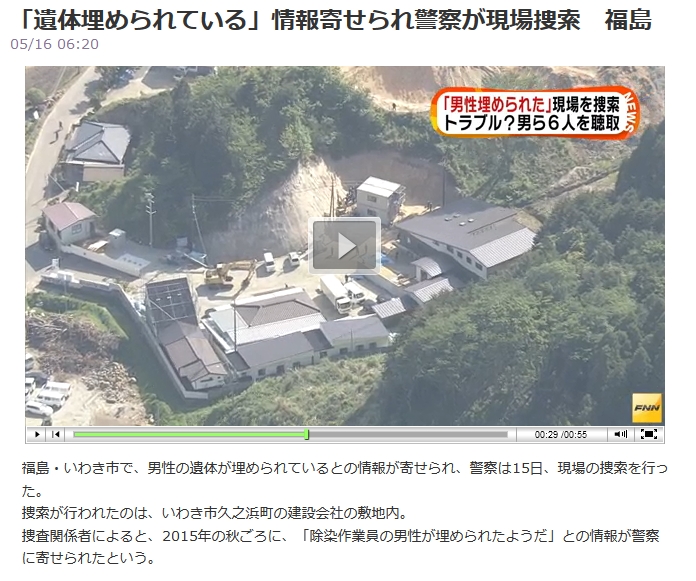
Police received a tip about the burial of the body of male decontamination employee at the office of a construction company
FUKUSHIMA (TR) – Fukushima Prefectural Police have started to excavate a yard in Iwaki City after receiving a tip about the burial of a man’s corpse, reports Fuji News Network (May 16).
On Sunday, investigators using a backhoe began digging on the premises of a construction company, located in the Hisanohama area, after receiving a tip that the body of male decontamination employee had been buried there in the fall of last year.
During the work, police discovered items belonging to the man. The search for his body is expected to continue today.
Police suspect that the case is the result of a crime involving six male decontamination employees.
http://www.fnn-news.com/news/headlines/articles/CONN00324767.html
To cleanup some radioactive fallout!
There are two main problems in whatever decontamination techniques used: wash off and scrap up techniques, or phytoremediation:
80% of the Fukushima prefecture land surface is forested mountains, forested mountains which you can neither wash off and scrap up nor phytoremediate.
Forested mountains from which the accumulated contamination ruissels down or flies down with wind and rain to the low land living areas which had been previouly decontaminated, some places have already been decomtaminated up to five times, always the contamination coming back up to the pre-decontamination level.
To decontaminate well and forever you would have to cut down those mountain forests, which is a huge surface to be cut down, a gigantic impossible work, which would as an immediate effect spread a lot of the accumulated various radionuclides and make the radiation level jump high everywhere.
With either of those techniques you quickly end up with a huge quantity of contaminated waste, which accumulates quickly and for which there is no real valid solution for disposal. To reduce its volume by incineration is still re-scattering radionuclides into the environment, as there is no incinerator filter capable of blocking 100% of all radionuclides nanoparticles.


Obviously, the cleanup process is much more involved than this, but you can imagine how difficult it is to keep all that radioactive dust from getting into everything. Phil Broughton is a treasure trove of stories and information. But, if you follow his blog, you’ll learn that he takes the decontamination process very seriously. Something a graduate student learned the hard way when they made a poorly-thought out April Fool’s prank. Phil had this to say about the tremendous task of nuclear cleanup:
…everything exposed to air, everything that rain water might wash over, ALL SURFACE WATER, must be assumed to be contaminated. Want to use that car? Wash it down because it’s got a crust of radioactive crap on it, and if you try to drive it, you just climbed inside your own moving irradiator box.
This is the hard part of fallout decon[tamination] and radioactive waste in general. Nothing makes it stop being radioactive other than time, and human attention spans and lifespans are somewhat incompatible with this. Not living in the higher dose world its very hard to contemplate the “I accept this dose for me, my children, and generations to come” when planning reconstruction.
A while ago, I did a couple of comics about how plants (including tumbleweeds) were being used to help clean up radioactive material. Here’s Phil again:
Fungi, in fact, do amazing work sucking fallout products out of the soils. Instead of having roots, their hyphae draw nutrients out of a very shallow layer and do it quickly. This is also good because fallout actually doesn’t penetrate all that deep below the surface of the soil. One of the ways we monitor how much radioactive material is left in the environment is by sampling the mushrooms that grow and plotting it’s drop off following an event. You may discover that there are new sources contributing to the environment which is to say the event isn’t over yet as there’s clearly a continuing release. You can also do detoxification this way by planting, harvesting, repeat until whatever your crop is isn’t showing any uptake of materials anymore.
Of course other parts of the environment are running on different clocks. It will take quite a while for contamination to get to the ground water and then for the groundwater to be sampled by plants that can tap that deep. Annoyingly, fungi and grasses might detoxify the upper layer of soil within a decade only to have the deep tapping trees pull it up from the groundwater and recontaminate the upper layer a decade after that with their now radioactive falling leaves.
After I drew the phytoremediation comics, the number one question asked by readers was: “So, what happens with the plants after they’ve absorbed the radioactive elements?” Apparently, it’s a very real problem that cleanup crews have to work with. Here’s what Kathryn Higley said when I asked her about the sunflowers being planted at Fukushima:
I’ve looked at the discussions on sunflowers and other phytoremediation techniques. From what I’ve read, they are able to capture the ‘low hanging fruit’, but they lose effectiveness after a couple of croppings/harvesting. This is because the residual material is more strongly attached to soil particles (such as clay minerals). That being said, phytoremediation is a relatively low tech solution. The challenge is then what do you do with the contaminated biomass? When I went to Fukushima you could see large ‘super sacks’ of contaminated vegetation just sitting on the side of the road (see photo below). These large bags have a limited lifespan (~5 years) before they degrade due to UV exposure and all your stored material starts being blown around by wind.

Tainted Fukushima towns stuck in time as decon crews plug away
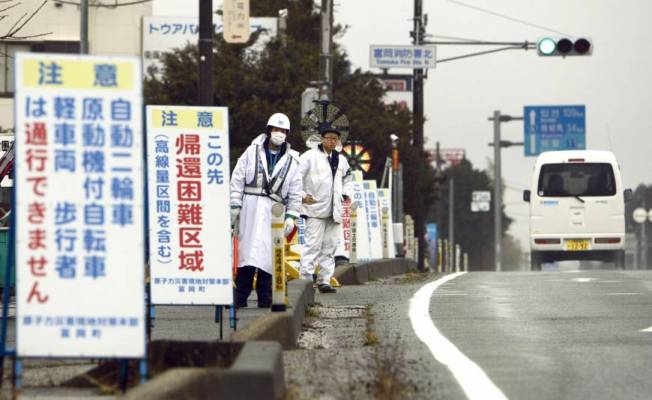
Police and security officers keep watch along National Route 6 leading to the off-limits zone in Tomioka, Fukushima Prefecture, on March 9
FUKUSHIMA – Five years after the nuclear disaster triggered by the huge earthquake and tsunami, reconstruction has made little progress in parts of Fukushima Prefecture. A Kyodo News reporter drove National Route 6 northward to the crippled Fukushima No. 1 nuclear plant to witness the lingering effects of the calamity.
In the town of Hirono, in the southeast, many shops and buildings remain empty. North of Hirono is the town of Naraha, most of which lies within the 20-km-radius hot zone around Tokyo Electric Power Co.’s radiation-leaking power plant.
The nuclear disaster forced Hirono to move its operations to other municipalities in the prefecture, while Naraha was designated an evacuation zone.
Now the towns have a radiation level below 1 millisievert per year — a level the government is trying to achieve in other areas via decontamination — and residence restrictions and evacuation orders have been lifted, with Hirono’s town office returning to its original place.
However, many residents are reluctant to go back to their homes. So far only 48 percent of Hirono’s population and 6 percent of Naraha’s have returned.
Yet hotels and other lodgings were busy accommodating out-of-prefecture workers seeking decontamination and construction work. All 275 rooms at a hotel in Hirono built for the reconstruction support scheme three years ago are “almost fully reserved for the next month,” the front desk clerk said.
A worker in his 50s who came from Tokyo to oversee decontamination work said he earns more than ¥16,000 ($145) per day. Another man staying at the hotel said he was on a three-week contract and received ¥25,000 a day. Their lodging was paid for by their employers.
At night, there was only one pub open in Hirono.
“The shopping area is deserted, although schools have resumed,” said a woman who works there. Still, the pub was full, mainly with visitors not from Fukushima.
In Tomioka, parts of which are still designated as in the “difficult to return” zone, most retail buildings on both sides of the main road have been abandoned and are decaying. Bags of contaminated soil sit piled up near the shore — now a huge makeshift storage site.
In a similar zone in the town of Okuma, which co-hosts the plant, three men in white protective suits were conducting decontamination in a field under a cloud of dust.
Nearby, a large boar suddenly crossed the road.
Soon after the nuclear disaster struck five years ago, untended cows and dogs were seen wandering around looking for food, but now boars are a frequent site, local people say.
In a residential part of Okuma, quake-damaged roads have been fixed but houses are being left as they are. The only sounds are chirping birds and the wind.
At a railway station, radiation over 10 microsieverts per hour is detected just above a covered drain. Although radiation in the “difficult to return” zones in Okuma and neighboring Futaba — the two towns hosting the nuclear plant — is much lower than it was immediately after the meltdowns, there are many hot spots measuring over 5 microsieverts — dozens of times higher than the government’s goal.
A Futaba resident who was showing the area to foreign journalists said, “The word ‘reconstruction’ has no relevance to this town.”
In Minamisoma — farther north of the Fukushima No. 1 complex — some areas are still designated as restricted residential zones.
“The number of jobs, such as decontamination work, has increased, but most of them are taken by people coming from outside the prefecture. We can hardly say this place has been enlivened again,” said Masayoshi Kariura, a Catholic priest.
“The pileup of contaminated soil that is clearly visible is weighing heavily on the residents,” he said.
Fukushima: Where mountains and forests cannot be decontaminated

In the background, workers in Iitate village go about their daily routine of removing the layer of irradiated topsoil, which are then placed in stacks of black bags
FUKUSHIMA, JAPAN – Up to 20,000 workers have been toiling to decontaminate towns and villages to clear the way for evacuated residents to return following the Fukushima nuclear plant disaster.
In head-to-toe protective gear, their primary task is removing by shovel and machinery topsoil contaminated with radioactive caesium, which leaked from the crippled power station when a tsunami swamped it five years ago.
The soil is put into plastic flexible container bags and transported by truck to isolated temporary storage sites, where they are surrounded with bags of clean soil to “seal” off emitted radiation. The interim facilities will receive some 22 million cubic m of soil from 43 cities, towns and villages across Fukushima prefecture. It will be put there for 30 years.
Soil under trees, in roadside ditches and places such as drain spouts get particular attention. This is where the radioactive pollutants tend to concentrate after being washed off roofs and pavements by rain and snow.

Once considered among the most beautiful villages in Japan, the farmlands of Iitate are now dotted with black bags – called ‘flexible container bags’ – holding contaminated soil.
The cleanup process also includes brushing and wiping rust or stains from roofs, removing sediment, washing roadside ditches and removing leaves from under trees.
But there remains a sizeable area where decontamination was suspended due to high radiation levels, including Futaba district, where the power plant is located.
The disaster also contaminated vast amounts of paddy straw and grass with radioactive material. This has led to plans for facilities for “designated waste”, which from Fukushima alone accounts for around 140,000 tonnes. It is now temporarily stored on farmland and at waste incineration plants.
The radiation reality will last for years to come.
“While it is possible to decontaminate residential areas, the same cannot be done with mountains and forests. You can’t remove all the trees. But radioactive matter has contaminated trunks and leaves, and when rain falls, these particles return to the ground,” said Ms Emiko Fujioka, secretary-general of non-profit group Fukushima Beacon.
How long shall we accept Japan to pollute our skies with incineration of radioactive materials?
I regret that so much energy, so much money was wasted into the making of this « beautiful » documentary, produced by NHK for the 5th year Anniversary, to spin and to twist the truth so as to make it more acceptable to the eyes of the victims themselves and to the eyes of the world, to brainwash world opinion about the present ongoing situation at Fukushima Daiichi and in Fukushima prefecture.
Of course it is fully expected as it is coming from NHK, which is to Japan what the Pravda newspapers was to the Soviet era, the Japanese central government nationwide propaganda organ.
Using foreigners to give more credibility to their delivered spiel is quite slick, those foreigners shills remind me a lot of some of the French collaborators working for the German Gestapo during the the German Occupation of France in exchange of material benefits, those will not be the first nor the last.
Beside the whole positive reconstruction spin, there is only one point that will should remember and take seriously : the whole reconstruction-decontamination program of the Japanese government is entirely based on incineration.
They tell us that their incineration technology will keep contained 99,9% of the radionuclides , that none will end up into our skies.
Why should we trust them, during the last 5 years they haven’t be very trustworthy nor straightforward to say the least.
How long are we gonna accept, tolerate Japan, to pollute our skies, our commonly owned and shared living environment, with their radioactive mess ?
Fukushima Prefecture has become a familiar name worldwide as a result of the nuclear accidents in 2011. Ever since then, the world has been concerned about what’s happening regarding radioactive contamination in the prefecture. To answer that question, the program will squarely face what’s been going on in Fukushima since the accidents.
French documentary filmmaker Keiko Courdy, who has been covering Fukushima since the nuclear accidents, will appear as a guest, along with experts on radiation, and the situation in Fukushima today will be explained in an easy-to-understand manner.
Various people who have appeared on TOMORROW will also take part. The program considers the future of Fukushima by featuring those who continue striving to overcome many hardships. They include villagers who have been carrying out decontamination work in the evacuation zones, hoping to return to their homes, and young people who are showing remarkable progress in re-energizing Fukushima’s farming with their new ideas.
Available until April 11, 2016
http://www3.nhk.or.jp/nhkworld/en/vod/tomorrow/20160326.html
Fukushima decontamination troops often exploited, shunned

A worker clears potentially radioactive brush at the garden of a private house in Minamisoma, Fukushima Prefecture, northeastern Japan. Nearly 26,000 men work in the cleanup campaign.
MINAMISOMA, Japan — The ashes of half a dozen unidentified laborers ended up at a Buddhist temple in this town just north of the crippled Fukushima nuclear plant. Some of the dead men had no papers, others left no emergency contacts. Their names could not be confirmed, and no family members had been tracked down to claim their remains.
They were simply labeled “decontamination troops” — unknown soldiers in Japan’s massive cleanup campaign to make Fukushima livable again five years after radiation poisoned the fertile countryside.
The men were among the 26,000 workers — many in their 50s and 60s from the margins of society with no special skills or close family ties — assigned to remove the contaminated topsoil and stuffing it into tens of thousands of black bags lining the fields and roads. They wipe off roofs, clean out gutters and chop down trees in a seemingly endless routine.
Coming from across Japan to do a dirty, risky and undesirable job, the workers make up the very bottom of the nation’s murky, caste-like subcontractor system long criticized for labor violations. Vulnerable to exploitation and shunned by local residents, they typically work on three- to six-month contracts with little or no benefits, living in makeshift company barracks. And the government is not even making sure that their radiation levels are individually tested.
“They’re cleaning up radiation in Fukushima, doing sometimes unsafe work, and yet they can’t be proud of what they do or even considered legitimate workers,” said Mitsuo Nakamura, a former day laborer who now heads a citizens’ group supporting decontamination laborers. “They are exploited by the vested interests that have grown in the massive project.”
Residents of still-partly deserted towns such as Minamisoma, where 8,000 laborers are based, worry that neighborhoods have turned into workers’ ghettos with deteriorating safety. Police data show arrests among laborers since 2011 have climbed steadily from just one to 210 last year, including a dozen yakuza, or gangsters, police official Katsuhiko Ishida told a prefectural assembly. Residents are spooked by rumors that some laborers sport tattoos linked with yakuza, and by reports that a suspect in serial killings arrested in Osaka last year had worked in the area.
“Their massive presence has simply intimidated residents,” said Mayor Katsunobu Sakurai. “Frankly, the residents need their help but don’t want any trouble.”
Most of the men work for small subcontractors that are many layers beneath the few giants at the top of the construction food chain. Major projects such as this one are divided up among contractors, which then subcontract jobs to smaller outfits, some of which have dubious records.
The Ministry of Health, Labor and Welfare examined more than 300 companies doing Fukushima decontamination work and found that nearly 70 committed violations in the first half of last year, including underpayment of wages and overtime, and failure to do compulsory radiation checks. Those companies were randomly chosen among thousands believed to be working in the area.
“Violations are so widespread in this multilayer subcontract system. It’s like a whack-a-mole situation,” said Mitsuaki Karino, a city assemblyman in Iwaki, a Fukushima city where his civil group has helped workers with complaints about employers.
Karino said workers are sometimes charged for meals or housing they were told would be free, and if they lose jobs or contracts aren’t renewed, some go homeless.
“It’s a serious concern, particularly for workers who don’t have families or lost ties with them,” he said.
Government officials say they see no other way than to depend on the contracting system to clean up the radiated zone, a project whose ballooning cost is now estimated at $44 billion.
“That’s how the construction industry has long operated. In order to accomplish decontamination, we need to rely on the practice,” said Tadashi Mouri, a health and labor ministry official in charge of nuclear workers’ health.
http://www.sfgate.com/world/article/Fukushima-decontamination-troops-often-exploited-6882977.php
Fire At Namie Nuclear Waste Site In Fukushima

TV Asahi (ANN) March 5th (Sat) 19:15
There was a fire at the temporary storage of decontamination waste in Namie , Fukushima Prefecture, for about 5 hours.
According to the police, at 5:00 in the morning, a fire started at the temporary storage of decontamination waste in Namie, dead branches and dead grass coming from decontamination which had been stacked on site before to be packed in bags.
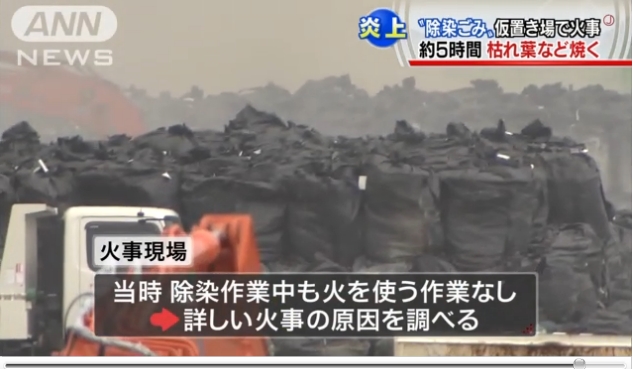
It took about five hours to extinguish it. Although there was decontamination work at that time, no fire was being used, the police will look to determine the cause of the fire.
http://headlines.yahoo.co.jp/videonews/ann?a=20160305-00000034-ann-soci

Environment minister withdraws radiation remark, apologizes to Fukushima residents

Environment Minister Tamayo Marukawa retracted her remark about the government having “no scientific grounds” for its radiation decontamination target in the Fukushima nuclear disaster, saying she wanted to rebuild trust with local residents.
As the minister in charge of overseeing the decontamination efforts in Fukushima Prefecture, Marukawa, 45, said Feb. 12 she wants to “sincerely apologize to residents in Fukushima.”
During a speech in Matsumoto, Nagano Prefecture, on Feb. 7, she labeled the government’s long-term goal of reducing radiation levels near the crippled Fukushima No. 1 nuclear plant to an annual dose of 1 millisievert or less as having “absolutely no scientific grounds.”
A local newspaper, The Shinano Mainichi Shimbun, picked up the story and reported her comments on Feb. 8, which she promptly denied having made.
At Diet sessions on Feb. 9 and 10, Marukawa stated that she had “no recollection of using such wording” in the speech.
Nevertheless, she told the news conference on the evening of Feb. 12 that she had decided of her own volition to “retract the remark in order to maintain a relationship of trust with residents in Fukushima.”
Marukawa went on to say that the government’s decontamination target is “indeed scientific in the sense that it was set as a result of thorough discussions by scientists.”
Her acknowledgment of making the faux pas will likely prompt the opposition camp to go on the offensive during Diet sessions in the coming week. For the time being, at least, Marukawa is standing firm. She said she has no intention of stepping down and wants to continue fulfilling her duties.
The decontamination goal was set by the Democratic Party of Japan-led government of the time on the basis of recommendations by the International Commission on Radiological Protection in the aftermath of the triple meltdown at the Fukushima plant triggered by the 2011 earthquake and tsunami disaster.
After the newspaper covered her remarks, Marukawa told reporters on Feb. 8 that she did not remember using such wording as “scientifically ungrounded.” She repeated the plea at Lower House Budget Committee sessions on Feb. 9 and 10.
During a regular news conference after the Feb. 12 morning Cabinet meeting, the minister finally acknowledged the possibility of making the remark.
She eventually retracted the comment later the day after obtaining a memorandum of her speech and confirming the content with attendants.
http://ajw.asahi.com/article/behind_news/politics/AJ201602130023
1 This Month

of the week – Shut Down Drone Warfare!


Tell the Ukrainian Government to Drop Prosecution of Peace Activist Yurii Sheliazhenko

Petition to revoke the licensing of the Near Surface Nuclear Disposal Facility (NSDF) at Chalk River. https://www.ourcommons.ca/petitions/en/Petition/Details?Petition=e-7247
To see nuclear-related stories in greater depth and intensity – go to https://nuclearinformation.wordpress.com
-
Archives
- March 2026 (244)
- February 2026 (268)
- January 2026 (308)
- December 2025 (358)
- November 2025 (359)
- October 2025 (376)
- September 2025 (257)
- August 2025 (319)
- July 2025 (230)
- June 2025 (348)
- May 2025 (261)
- April 2025 (305)
-
Categories
- 1
- 1 NUCLEAR ISSUES
- business and costs
- climate change
- culture and arts
- ENERGY
- environment
- health
- history
- indigenous issues
- Legal
- marketing of nuclear
- media
- opposition to nuclear
- PERSONAL STORIES
- politics
- politics international
- Religion and ethics
- safety
- secrets,lies and civil liberties
- spinbuster
- technology
- Uranium
- wastes
- weapons and war
- Women
- 2 WORLD
- ACTION
- AFRICA
- Atrocities
- AUSTRALIA
- Christina's notes
- Christina's themes
- culture and arts
- Events
- Fuk 2022
- Fuk 2023
- Fukushima 2017
- Fukushima 2018
- fukushima 2019
- Fukushima 2020
- Fukushima 2021
- general
- global warming
- Humour (God we need it)
- Nuclear
- RARE EARTHS
- Reference
- resources – print
- Resources -audiovicual
- Weekly Newsletter
- World
- World Nuclear
- YouTube
-
RSS
Entries RSS
Comments RSS
 nuclear-news