Can 2020 Summer Olympics help Fukushima rebound from nuclear disaster?

A deserted street inside the exclusion zone close near the Fukushima Daiichi Nuclear Power Plant. Most areas around the plant are still closed to residents due to radiation contamination from the 2011 disaster.
Aug. 12, 2019
FUKUSHIMA, Japan — An hour north of Tokyo by way of bullet train, the land is lush and green, framed by thickly wooded mountains in the distance.
This vast rural prefecture in northeast Japan was once renowned for its fruit orchards, but much has changed.
“There has been a bad reputation here,” a local government official said.
Since the spring of 2011, the world has known Fukushima for the massive earthquake and tsunami that killed approximately 16,000 people along the coast. Flooding triggered a nuclear plant meltdown that forced hundreds of thousands more from their homes.
As the recovery process continues nearly a decade later, organizers of the 2020 Summer Games say they want to help.
Under the moniker of the “Reconstruction Olympics,” they have plotted a torch relay course that begins near the crippled Fukushima Daiichi plant and continues through adjacent prefectures — Miyagi and Iwate — impacted by the disaster. The region will host games in baseball, softball and soccer next summer.
“We are hoping that, through sports, we can give the residents new dreams,” said Takahiro Sato, director of Fukushima’s office of Olympic and Paralympic promotions. “We also want to show how far we’ve come.”
The effort has drawn mixed reactions, if only because the so-called “affected areas” are a sensitive topic in Japan.
Some people worry about exposure to lingering radiation; they accuse officials of whitewashing health risks. Critics question spending millions on sports while communities are still rebuilding.
“The people from that area have dealt with these issues for so long and so deeply, the Olympics are kind of a transient event,” said Kyle Cleveland, an associate professor of sociology at Temple University’s campus in Japan. “They’re going to see this as a public relations ploy.”
It was midafternoon in March 2011 when a 9.0 earthquake struck at sea, sending a procession of tsunamis racing toward land.
The initial crisis focused on the coastline, where thousands were swept to their deaths.
Another concern soon arose as floodwaters shut down the power supply and reactor cooling systems at the Fukushima Daiichi plant.
Three of the facility’s six reactors suffered fuel meltdowns, releasing radiation into the ocean and atmosphere.
Residents within a 12-mile “exclusion zone” were forced to evacuate; others in places such as Fukushima city, about 38 miles inland, fled as radioactive particles traveled by wind and rain.

The ruined Unit 3 reactor building at the Fukushima Dai-ichi nuclear power plant on Sept. 15, 2011.
The populace began to question announcements from the Tokyo Electric Power Co. (Tepco) about the scope of the contamination, said Cleveland, who is writing a book on the catastrophe and its aftermath.
“In the first 10 weeks, Tepco was downplaying the risk,” he said. “Eventually, they were dissembling and lying.”
The company has been ordered to pay millions in damages, and three former executives have been charged with professional negligence. Crews have removed massive amounts of contaminated soil, washed down buildings and roads, and begun a decades-long process to extract fuel from the reactors’ cooling pools.
All of which left the area known as the “Fruit Kingdom” in limbo.
It is assumed that low-level radiation increases the chances of adverse health effects such as cancer but the science can be complicated.
Reliable data on radiation risks is difficult to obtain, said Jonathan Links, a public health professor at Johns Hopkins University. And, with cosmic rays and other sources emitting natural or “background” ionizing radiation, it can be difficult to pinpoint whether an acceptable threshold for additional, low-level exposure exists at all.
In terms of athletes and coaches visiting the impacted prefectures for a week or two during the Olympics, Links said the cancer risk is proportional, growing incrementally each day.
The Japanese government has raised what it considers to be the acceptable exposure from 1 millisievert to 20 millisieverts per year. Along with this adjustment, officials have declared much of the region suitable for habitation, lifting evacuation orders in numerous municipalities. Housing subsidies that allowed evacuees to live elsewhere have been discontinued.
But some towns remain nearly empty.
“People are refusing to go back,” said Katsuya Hirano, a UCLA associate professor of history who has who has spent years collecting interviews for an oral history. “Especially families with children.”
Their hesitancy does not surprise Cleveland. Though research has led the Temple professor to believe conditions are safe, he knows that residents have lost faith in the authorities.
“That horse has left the barn,” he said. “It’s not coming back.”
A narrow highway leads west, out of downtown Fukushima, arriving finally at a 30,000-seat ballpark that rises from the farmlands.

The Fukushima Azuma Baseball Stadium.
Azuma Baseball Stadium was built in the late 1980s with a modernist design, blockish and concrete. Prefecture officials have begun renovations there.
“We changed from grass to artificial turf,” Sato said. “We’re updating the lockers and showers.”
The work is coordinated from a small office in the local government headquarters, where two-dozen employees tap away at computer keyboards and talk on phones, sitting at desks that have been pushed together.
Tokyo 2020’s initial bid included preliminary soccer competition at Miyagi Stadium, in a prefecture farther north of the nuclear plant. Six baseball and softball games were relocated to Azuma during later discussions with the International Olympic Committee.
“We made a presentation about the radiation situation and how to deal with it,” Sato recalled. “They understood and we think that’s why they got on board with this idea of the ‘Reconstruction Olympics.’ ”
Fukushima has spent $20 million on preparations over the past two years, he said, adding that his office has heard complaints from “a segment of the population.”
With infrastructure repairs continuing throughout the region, evacuee Akiko Morimatsu has a skeptical view of the Tokyo 2020 campaign.
“They have called these the ‘Reconstruction Games,’ but just because you call it that doesn’t mean the region will be recovered,” Morimatsu said.
Concerns about radiation prompted her to leave the Fukushima town of Koriyama, outside the mandatory evacuation zone, moving with her two young children to Osaka. Her husband, a doctor, remained; he visits the family once a month.
“The reality is that the region hasn’t recovered,” said Morimatsu, who is part of a group suing the national government and Tepco. “I feel the Olympics are being used as part of a campaign to spread the message that Fukushima is recovered and safe.”
Balance this sentiment against other forces at work in Japanese culture, where the Olympics and baseball, in particular, are widely popular. Masa Takaya, a spokesman for the Tokyo 2020 Organizing Committee, insists that “sports can play an important role in our society.”
In Fukushima, a city of fewer than 300,000, colored banners fly beside the highway amid other signs of anticipation.
Elderly volunteers, plucking weeds from a flower bed at the train station, wear pink vests that express their support for the Games. On the eastern edge of town, a handful of workers attend to Azuma Stadium.
Dressed in white overalls, they walk slowly across the field, stopping every once in a while to bend down and pick at the pristine turf. Sato remains optimistic.
“Everyone’s circumstances are different,” he said. “Maybe there will be some people who come back to Fukushima because of this.”
Swim marathon: Tokyo 2020, FINA watching water quality, temperature
In 2011, Professor Kodama of Tokyo University had found Tokyo’s Bay water to be radiation contaminated. 8 years later I doubt that the only danger in that water is high levels of e-coli bacteria…

August 11, 2019
Athletes voiced concerns over water quality and temperature at a marathon swimming test event for Tokyo 2020 Sunday, as officials vowed to monitor the situation closely in the run-up to the games.
“That was the warmest race I’ve ever done,” said three-time Olympic medallist Oussama Mellouli from Tunisia after completing the 5km men’s competition.
“It felt good for the first 2km then I got super overheated,” added the 35-year-old, who won gold in the 10km swim at the London Olympics in 2012.
The event started at 7am with the air temperature already over 30 degrees as the Japanese capital swelters through a deadly heatwave.
“The water temperature was high so I’m a bit concerned about that,” said Yumi Kida from Japan, who said she guzzled iced water before the race in an effort to reduce her body heat.
International Swimming Federation (FINA) rules state that athletes may not race when the water temperature exceeds 31 degrees and FINA’s executive director Cornel Marculescu said competitors’ wellbeing was top priority.
Marculescu said an external body would be set up in conjunction with Tokyo 2020 organisers to monitor both water quality and temperature in the run-up to the games and the results could affect the timing of the marathon swimming event.
“Based on this information, we will decide the time the event will start. Could be 5am, could be 5:30am, can be 6am, can be 6:30am — depends on the water temperature,” he told reporters.
“Working with a specialised company like we are going to do here in Tokyo, we will have the right information to take the right decision.”
Hot weather issues have become the biggest headache for Tokyo organisers, who have already moved up the start time of several events including the marathon in a bid to mitigate the effects of the blistering heat of the Japanese summer.
– ‘A little stinky’ –
In terms of water quality, David Gerrard from FINA’s medical committee said readings from the test event would not be ready for 48 hours but previous results gave cause for optimism.
“What we have had are readings fom the last month, daily readings that have given us very clear indications of the water quality, which has been good,” he said.
Organisers are desperate to avoid the embarrassment of the Rio Olympics in 2016 when the pool used for diving events turned an unsettling shade of green overnight.
Brazilian officials also had to scramble to clean up the bay used for sailing and windsurfing that was plagued by sewer bacteria and filthy with rubbish.
In October 2017, Tokyo 2020 organisers were left red-faced after tests revealed levels of e-coli bacteria more than 20 times higher than international standards, sparking doubts about the venue’s safety.
At the time, the organising committee blamed prolonged summer rain that had brought pollutants from offshore for the high readings between late July and early September.
A year later, organisers said that tests using underwater “screens” to filter the water had successfully reduced bacteria levels at the venue, which will also host triathlon.
They tested single and triple-layer screens — some 20 metres (66 feet) long and three metres wide — and found that both were effective in bringing bacteria down to safe levels although the triple screen, expected to be employed during games time, worked best.
Japanese swimmer Kida said the water was “a little stinky, and the clarity was not very good so I really want to improve the quality.”
The event will be held in Odaiba, a Tokyo bay area with a backdrop of the city and the “Rainbow Bridge” that links the area to downtown.
On clear days Mount Fuji is visible and the area is also noteworthy for a replica Statue of Liberty.
Japan’s govt urges Fukushima evacuees to return – in drive to promote 2020 Olympics
Fukushima: Despite health threats, the Japanese government urges residents to return. Families who fled nuclear meltdown in Fukushima are being urged to return to their homes ahead of the Tokyo Olympics.

Families claim the government is speeding up return ahead of Olympics
Aug 4, 2019
Alarming levels of radiation up to 20 times higher than official safety targets have been recorded in areas where locals are being encouraged to go back. We found ghost towns eight years after three reactors went into meltdown at Daiichi power plant 140 miles north east of Tokyo in March 2011. Tokyo 2020 is being hailed as the “Reconstruction Olympics” signalling new hope following the earthquake and tsunami that triggered the disaster and left more than 18,000 people dead.
Now evacuees are being urged to return as the global spotlight focuses on the recovery of the region. The government has lifted most evacuation orders and all but a handful of hot spots have been declared safe.
But parents believe their children are in danger, saying officials are downplaying the dangers and safety is compromised in a cynical attempt to convince the world the crisis is over.
Families have accused the government of speeding up their return to showcase safety standards ahead of the Olympics.
We found once-vibrant communities now post apocalyptic wastelands like something from a Hollywood movie after the worst nuclear accident since Chernobyl.
Schools, shopping malls, supermarkets, libraries and petrol stations lie decaying along with thousands of homes. Many are set behind guarded barricades in exclusion areas known officially as “difficult to return to zones”.
Others lie in areas which the government says are safe to live in but whose few residents – wild boar and monkeys – demonstrate signs of mutation. Along roadsides sit giant black bags containing contaminated soil.
In Tomioka, five miles from the power plant, a school sports hall is scattered with footballs left when children fled.
It’s in stark contrast to arenas being built for the £20billion Games. Fukushima is hosting the first event, a softball match on July 22, two days before the opening ceremony.
The Japanese leg of the torch relay starts on March 26 at a soccer training centre 12 miles south of the crippled plant. The J Village, a base for emergency workers, only fully reopened last month.
In Okuma our Geiger counter sounded furiously, recording four microsieverts an hour. The government safety target is 0.23 microsieverts per hour.
It came days after evacuation orders were lifted for parts of the town which had 10,000 residents. The centre remains a no-go zone and just 367 former residents have registered to go back.
Ayako Oga, 46, who suffered a miscarriage, says: “The Olympics are putting lives in danger. The government is forcing people to leave the public homes they have been in. They are putting a heavy burden on people still suffering mentally and financially.”
In Namie, which had 21,000 residents, evacuation orders were lifted in 2017. It is said 800 people returned but we found desolation, only traffic lights working.
The Wild Boar bar last served a drink on disaster day. Owner Sumio Konno, in a group legal action against the government, says his son, who was five, still suffers nosebleeds. “He is sick all the time,” he says. “Every month he needs to go to the doctor.”
Ryohei Kataoka, of the Citizens Nuclear Information Centre, says: “The government’s insistence in lifting evacuation orders where heightened radiation-related health risks undeniably exist, is a campaign to show that Fukushima is ‘back to normal’ and to try to make Japan and the world forget the accident ever happened.”
Fukushima residents look for Olympic PR boost
July 29, 2019
Sukagawa, Japan – Two softball games and one baseball game in Fukushima next summer may be little more than an 2020 Olympic cameo, but local fans are thrilled to have them, largely in the hopes they will give their prefecture a badly needed public relations boost.
Fukushima was one of the three northeastern Japan prefectures that bore the brunt of the March 11, 2011 earthquake and tsunami along with Miyagi and Iwate prefectures and will be part of the focus next year now that Tokyo Olympic organizers have dubbed the games “the Reconstruction Olympics.”

(Baseball fans stand outside Botandai Stadium in Sukagawa, Fukushima Prefecture after a July 17 game between the Fukushima Red Hopes and the Tochigi Golden Braves. From left to right, Koki Unuma, Kaori Unuma and Yukari Koyama.)
In addition to the games in Fukushima, Miyagi Stadium will be one of the Olympic soccer venues, while all three prefectures will be focal points of the Olympic torch relay — which officially starts in Fukushima.
The 2011 disaster killed over 15,800 people and forced the evacuation of up to 470,000, while triggering a triple meltdown at the Fukushima Daiichi nuclear power plant. Even eight years later, Fukushima suffers from the suspicion that food from the prefecture might be contaminated. And locals see the Olympics as an opportunity to show off their region the way they see it.
Koki Unuma, a resident of Koriyama and a baseball fan who follows the local independent minor league club, expressed hope that the Olympics will put Fukushima Prefecture in a good light.
“It’s a chance to show that Fukushima has become vibrant again,” he said at a game in Sukagawa between the Fukushima Red Hopes and the Tochigi Golden Braves. “I wonder how foreign people will view us. I want the place to be packed with foreign visitors, so that people will see we are doing well, and that they tell others. I’m excited to have the games here.”
One man, who declined to give his name but said he had worked until recently not far from the stricken nuclear plant, said Fukushima had largely recovered but felt the symbolism of being included in the Olympics had value.
“There is basically one area that is not back (around the damaged plant), but by and large Fukushima has recovered,” he said. “I think as a symbol the Olympics are a good idea. What they mean by ‘the Reconstruction Olympics’ is a little vague to me. That area around Soma is hard hit, but as a whole Fukushima Prefecture is doing very well.”

(Former major leaguer Akinori Iwamura, manager of the Fukushima Red Hopes, believes hosting great games at next year’s Olympics can make a difference in a prefecture that is still recovering from the 2011 earthquake and tsunami. Photo at Botandai Stadium in Sukagawa, Fukushima Prefecture, July 17, 2019.)
The plight of the prefecture encouraged former major leaguer Akinori Iwamura to help start up the Red Hopes, where he serves in a dual role as manager and team president.
“People living in Fukushima have suffered the most. It’s almost as if they are being treated as wrong doers. The rumors are terrible,” he said in a recent interview with Kyodo News. “Some evacuee children have been bullied in the towns they’ve been relocated to. That is the most intolerable.”
“The (evacuee) kids going back to visit Fukushima might receive some kinds of gifts to take back with them, but some must feel those things, candy and the like, are troublesome, because at rest areas along the expressway people find uneaten candy from Fukushima thrown into the garbage bins.”
“It makes you realize people don’t know how many of the things they hear they can actually believe.”
Iwamura said that consumers outside Fukushima have second thoughts about the safety of the food raised there and local farmers cannot get fair value for their products. But he said the Olympics are a golden opportunity to change peoples’ perceptions of Fukushima.
“For us baseball people here, we want to make the baseball and softball games held here a success,” Iwamura said. “If we can be wildly enthusiastic about them and show that to the people coming from abroad, then they will tell others that Fukushima is safe, that the people here are living good lives.”
Naomi Nukazawa and her daughter Aya are fans of the Red Hopes and are keen to see the local Olympic competition, but so far have been unable to secure tickets.
“We’ll apply again, but right now it is like the people here are getting left out,” Naomi said.
“I work at a hotel. This is a chance to get different kinds of guests, I’m really excited about that. People will visit Fukushima (for the Olympics), but once it’s over that will likely be the end of it. Perhaps some people will be moved by their time here and that will have a lasting impact in some ways.”
“Maybe other Japanese will be influenced by foreigners’ positive responses to us, and will remember us, remember Iwate, remember Miyagi, remember our local specialties, because it seems we’re forgotten now.”
Another Koriyama resident, Yuji Amaha, echoed other locals’ complaints that people outside Fukushima don’t realize that except for a small area around the stricken plant the region is safe from radioactivity.
“Having a big international tournament here in Fukushima Prefecture is getting people excited,” he said. “Iwate Prefecture will take part in the Rugby World Cup, Miyagi Prefecture will have Olympic soccer. In a sense, these things are connected to our recovery and are therefore meaningful.”
“The people who live in Fukushima think it’s safe. I want those people who…question how safe it is to come. I want people who study the data to say it’s safe. Those who doubt the safety should come and see for themselves.”
Iwamura expressed optimism for next year and for the future.
“Most prefectures will have no Olympic sports,” he said. “That Fukushima is going to have baseball and softball is a thrill, something to be really happy about. Twenty or 30 years down the road, nobody will remember what it is like now.”
Fukushima 2020 Olympics Nightmare: Is PM Abe Criminally Insane?
Jul 28th, 2019
This documentary investigates and exposes the plans of Japanese Prime Minister Shinzo Abe to bring the Olympics baseball games to contaminated Fukushima. Although there is over a million tons of tritium radioactive water in tanks surrounding the plan, thousands of contamined bags of waste and melted nuclear rods still in the broken plants Abe has claimed to the Olympic Committee and world that Fukushima has been decontaminated.
This 2019 documentary looks at the plans of Japan Prime Minister Shinzo Abe to bring the Olympic baseball games to Fukushima during the 2020 Japan Olympic games. It interviews experts, community activists and trade unionists about the reality of Fukushima and the massive propaganda campaign to cover-up the continuing dangers and crisis.
PM Abe told the International Olympics Committee that Fukushima had been decontaminated but there is over 1 million tons of tritium radiocative water in tanks surrounding the broken nuclear reactors, the melted nuclear rods still remain and there are tens of thousands of bags of contaminated radioactive material spread throughout the prefecture.
This documentary hears from people in Japan about the reality of having the 2020 Olympics in Japan and Fukushima.
Additional media:
Toxic water level at Fukushima plant still not under control As Abe Pushes Olympics In Fukushima
In reality, however, the situation is not under control even now.
The Olympics, Fukushima, Capitalism & Creative Destruction
Olympics For Whom? Global Depression, the New Cold War, and the Rio de Janeiro Olympic Games
The Super Bowl, NFL, Capitalism and Sports: The Cost, The Politics, Privatization & The Game
JPN Abe Gov Pushes 2020 Olympics To Contaminated Fukushima To Continue Cover-up
Fukushima Never Again
For additional information:
No Nukes Action
Appeal To Stop Olympics in Japan
Nuclear Olympics
WorkWeek
workweek [at] kpfa.org
Production of
Labor Video Project
Fukushima Radioactive Dump Site
While PM Abe says that Fukushima has been “decontaminated” there are thousands of bags of contaminated radioactive was in the prefecture of Fukushima.
Over 1 Million Tons Of Radioactive Water Surround Fukushima
The Abe government is trying to release 1 million tons of radioactive water with tritium into the Pacific ocean despite opposition of the fisherman and communities.
Fukushima Kids In
Is Fukushima Safe for the Olympics?
A recent visit suggests that the repercussions of the 2011 nuclear disaster aren’t over.

The New National Stadium at sunset, Tokyo
July 25, 2019
The 2020 Olympic torch relay will commence in Fukushima: a place more often associated with a 2011 earthquake, tsunami, and nuclear disaster than international sports. That’s no accident: the location is meant to convey a narrative of recovery, and the idea that Fukushima is a safe place to visit, live–and of course, do business. Olympic baseball and softball games, also to be held in Fukushima just 55 miles from the meltdown, are meant to hammer the message of these “Recovery Olympics,” as Tokyo 2020 organizers have branded them, home
But after a visit to Fukushima, their claims seem questionable at best. In fact, the entire setup is a profoundly cynical act of “post-truth” politics. Fukushima is not yet safe, and no amount of sunny rhetoric from Olympic bigwigs as well as Japanese politicians, can make it so.
We traveled to Fukushima on a bus full of journalists, filmmakers, and activists from around the world. We were accompanied by professor Fujita Yasumoto who carried a dosimeter, a device that charts the levels of radiation. With two hours to drive before hitting Fukushima, his dosimeter read 0.04; anything above 0.23, he told us, was unsafe. The needle jumped further as we approached the nuclear plants and attendant cleanup operations. Outside the Decommissioning Archive Center, it moved into unsafe territory with a 0.46 reading before spiking to a truly alarming 3.77 as we approached Fukushima Daiichi Unit 1 reactor, one of three that melted down. The Olympic torch run is currently scheduled to pass through some of these high-contamination areas.
As we entered Fukushima, we started to see what looked like black Hefty garbage bags, filled with radioactive topsoil that had been scraped up by workers, most of whom, we are told, travel great distances to Fukushima to work. Thousands of these bags—which locals call “black pyramids”—are piled on top of one another, but the toiling workers aren’t wearing hazmat suits. Some of the piles of bags have vegetation popping out. The sight of the plants poking through the toxic muck could be taken as a sign of hope, but, for others, they’re a portent of danger, raising fears that the wind will blow the most contaminated parts of the topsoil into the less radiated parts of the city.
No one here we met is buying Japanese Prime Minister Shinzo Abe’s line from 2013 when he tried to assuage the concerns of voters at the International Olympic Committee by telling them that things in Fukushima were “under control.” Hiroko Aihara, an independent journalist based in Fukushima, said to us, “The government has pushed propaganda over truth. This has people in Japan divided as to how serious it is. But for the people who live here, the crisis and the cleanup and contamination continue.”
The scientific studies about how safe Fukishima are at the moment are in great dispute. National travel guides put the area that is unsafe at only 3 percent of the prefecture. However, as Scientific American wrote, “In its haste to address the emergency, two months after the accident the Japanese government raised the allowable exposure from 1 mSv annually, an international benchmark, to 20 mSv. Evacuees now fear Abe’s determination to put the Daiichi accident behind the nation is jeopardizing public health, especially among children, who are more susceptible.”
We also spoke with Masumi Kowata. She is a remarkable individual, and the only woman on the 12-person Okuma Town municipal council in Fukushima. She is also the only person on the council who is speaking out on the dangers of nuclear power. Kawata was living in Fukushima when Abe made his grand pronouncement. She said, “Things were absolutely not ‘under control’ and nothing is over yet. The nuclear radiation is still very high. Only one small section is being cleaned. The wider region is still an evacuation zone. There is still radiation in the area. Meanwhile, we’re [hosting] the Olympics.”
The cynicism of branding this “the Recovery Olympics” can also be seen in the streets of Fukushima. Numerous people are still displaced and living outside the prefecture; they’re in the tens of thousands, although the exact total has not been determined. Whatever the number, there is no question that the part of the prefecture surrounding the nuclear meltdown feels empty. In a country with a remarkable lack of dilapidated buildings, they conspicuously blot the landscape in Fukushima. What was destroyed by the earthquake, tsunami, and nuclear meltdown hasn’t been rebuilt. Many businesses also have been “abandoned by owner,” an all-purpose explanation for the state of things. Both homes and businesses—with the crumbling signs for the titans of Japanese corporate culture—Sony, Mitsubishi and Honda—sit vacant.
Despite this bleak scene, Kowata somehow brims with fighting energy. “The local people have come to me and told me to tell the world what is actually happening,” she said. “That’s where I get my strength. There are people getting sick. There are people who are dying from stress. The world needs to know.”
Opponents want Olympic money used to rebuild Fukushima
What sense does it make to rebuild Fukushima if it means to condamn the people to live with radiation, radiation which ain’t gonna be decontaminated by any means but is there to stay.…
To not forget that the first step of the Japanese government deceitful campaign was DECONTAMINATION, to fool the people to believe that their place could be decontaminated so that they could go back to their life of the pre-nuclear disaster.
The second part of the Japanese government deceitful campaign was RECONSTRUCTION, that people need to help to reconstruct the Fukushima economy, to clean the name of Fukushima prefecture in the mind of the Japanese public and of the foreign public, to push and sell the local contaminated produce under the pretense that low level of contamination is safe and acceptable, that to buy and consume Fukushima is every Japanese citizen’s patriotic duty, solidarity, to help rebuild the Fukushima prefecture’s economy.
DECONTAMINATION and RECONSTRUCTION are both parts of the same deceitful campaign, a campaign denying the realaity of the omnipresent radiation’s health risks, soothing the people’s fears with lies and denial, to make them to accept and to stay living with high level of radiation in a fully contaminated environment. The Japanese government’s priority being the economics and not its people safety and health.
To not forget that the first step of the Japanese government deceitful campaign was DECONTAMINATION, to fool the people to believe that their place could be decontaminated so that they could go back to their life of the pre-nuclear disaster.
The second part of the Japanese government deceitful campaign was RECONSTRUCTION, that people need to help to reconstruct the Fukushima economy, to clean the name of Fukushima prefecture in the mind of the Japanese public and of the foreign public, to push and sell the local contaminated produce under the pretense that low level of contamination is safe and acceptable, that to buy and consume Fukushima is every Japanese citizen’s patriotic duty, solidarity, to help rebuild the Fukushima prefecture’s economy.
DECONTAMINATION and RECONSTRUCTION are both parts of the same deceitful campaign, a campaign denying the realaity of the omnipresent radiation’s health risks, soothing the people’s fears with lies and denial, to make them to accept and to stay living with high level of radiation in a fully contaminated environment. The Japanese government’s priority being the economics and not its people safety and health.

Anti-Olympic advocates, including those from the United States and France, gather in Tokyo on July 23.
July 24, 2019
A group of Japanese and foreigners who oppose the Tokyo Olympics said they want to block the holding of the sporting extravaganza they see as wasteful and destructive.
In a news conference in Tokyo on July 23, the opponents, including scholars, said that the Olympics will destroy the local economy and be a hotbed for corruption.
The opponents included Jules Boykoff, professor of political science at Pacific University, Oregon, who was formerly on the U.S. Olympic soccer team.
On July 22, they visited Fukushima Prefecture, hit hard by the 2011 Great East Japan Earthquake and tsunami and subsequent nuclear accident.
Based on the inspection, they said that the Japanese government should use money for reconstruction efforts rather than the Olympics.
The opponents also included Misako Ichimura, 48, a member of “Hangorin no Kai” (Anti-Olympics group).
She said that homeless people were evicted for the construction of the new National Stadium and that people living in Tokyo metropolitan government-run apartments were forced to vacate them.
Ichimura raised an “anti-Olympic torch” that had been passed down by people campaigning against the Olympics.
“We want to terminate the Olympics,” she said.
A woman from Los Angeles, which will host the 2028 Summer Olympics, said the Olympics benefit a small number of major companies that receive money that should be used to support the homeless.
South Korean Park Eun-seon, who was watching the news conference, said that after the 2018 Pyeongchang Winter Olympics, the business environment for local restaurants and hotels there deteriorated.
“I want Japanese to share our experiences. I want them not to repeat the same mistakes,” she said.
Hangorin no Kai plans to hold a demonstration with others in Tokyo’s Shinjuku Ward on July 24 as part of its international events to oppose the Olympics.
Tokyo’s 2020 Olympics are showing the nightmare waiting for L.A. in 2028

July 23, 2019
TOKYO — Something unprecedented is happening this week in Japan. Activists from around the world are convening for the first-ever transnational anti-Olympics summit. Tokyo protest groups have teamed up with those from recent host cities such as Rio de Janeiro and Pyeongchang, South Korea, and future hosts, including Los Angeles. The summit coincides with the one-year mark before the Tokyo Summer Olympics open on July 24, 2020.
These days, anti-Games campaigns pop up like activist jack-in-the-boxes. Los Angeles wouldn’t have become a U.S. candidate city (and upcoming host) were it not for anti-Games activists who forced Boston’s mayor to back out of that city’s 2024 host contract. Three other bids (Hamburg, Germany; Budapest, Hungary; and Rome) for the 2024 Games were also scuppered after persistent local protests. Feeling the pinch, the International Olympic Committee doled out two Olympics simultaneously, to Paris for 2024, and Los Angeles for 2028.
A handful of negative effects inevitably follow the Games and account for the rise of anti-Olympic activism: overspending, militarization of police, citizen displacement, greenwashing and corruption. Rio de Janeiro, Sochi and even Beijing, with its now derelict venues, are all prime examples of the Games’ grotesque downsides.
The Tokyo Olympics, sold as the most “innovative” ever, are already replicating the usual problems. Start with costs: The original price tag of the 2020 Games, $7.3 billion, has more than tripled.
Tokyo organizers have branded the Games the “recovery Olympics,” in a nod to the 2011 earthquake, tsunami and resulting Fukushima Daiichi nuclear meltdown. Survivors and hard-hit communities are still struggling to rebuild. That reality, says Satoko Itani, a professor of sport, gender and sexuality studies at Kansai University, makes the recovery tagline “ironic” at best. “This Olympics,” Itani said, “is literally taking the money, workers, and cranes away from the areas where they are needed most.”
The Games have also sent thousands into the streets in Japan to protest threats to their civil liberties. In 2017, Japanese legislators rammed anti-terrorism legislation through the parliament, justified by the need to protect the Olympics. The legislation added hundreds of new crimes to the books, including offenses such as sit-ins to oppose the construction of new apartment buildings. The U.N. special rapporteur on the right to privacy said Japan’s government had used fear to push through “defective” legislation.
As if to underline privacy concerns, at every Tokyo Olympic venue, visitors will be subjected to facial recognition systems. This despite the concerns that facial recognition software peddles racial bias. Its acceptance at the Games nudges Japan down a surveillance-state slippery slope.
The Olympics are notorious for displacing everyday residents and Tokyo is no exception. We interviewed a woman in her 60s here who was displaced by the Tokyo Olympics in 1964 and has been displaced again for the 2020 Games. She wouldn’t speak on the record because she fears retribution, and although it won’t undo what has happened to her, she has joined the opposition. “In order to challenge the Olympics the community has to unite and fight,” she told us.
As to greenwashing, the Tokyo Games will showcase Fukushima prefecture, where the torch relay will begin and where baseball and softball games will be played. “It’s fine for athletes and spectators to go to Fukushima for a couple of days,” said Aileen Mioko-Smith with Green Action Japan when the venues were announced. “But the Japanese government is using [the Olympics] to claim that everything is back to normal and that the evacuees should go … home.” The government has also increased what it considers to be acceptable radiation levels from 1 millisievert a year to 20, which it claims presents a far lower cancer rate than smoking or obesity.
The final factor that accompanies most Olympic Games is corruption. (Remember Salt Lake City?) Allegations have already surfaced in Tokyo. Japanese Olympic Committee President Tsunekazu Takeda resigned in March after being included in an ongoing bribery investigation related to securing the 2020 Games. Takeda, who also resigned from the IOC, maintains his innocence. French authorities are looking into $2 million paid by the Tokyo committee to a Singapore-based company implicated in international athletics graft.
City by city, recent Olympics have proved to be plagued by a democracy deficit. Politicians, developers and construction magnates hype bids for the Games with little or no citizen input. And yet the impact on a city of hosting hundreds of thousands of visitors, athletes, media and officials has long-lasting implications for the residents. Even the IOC appears to understand the need for reform. Responding to IOC President Thomas Bach’s concern that the Olympic bidding process creates “too many losers,” the IOC suggested last month that future bidders be asked to hold a referendum before being considered.
Fifteen anti-Games activists from Los Angeles are among those participating in the summit this week (the biggest contingent of any from outside Japan). They have to hope a new referendum rule will crack open the question of whether Angelenos can still stop the 2028 Games. The city’s Olympic Committee, and its cheerleader Mayor Eric Garcetti, brush off recent history when they swat at criticism of their “winning” bid. If voters had a chance to weigh in, would they do the same?
Anti-Olympics groups want more attention put on event’s downfalls
July 23, 2019
Anti-Olympics groups on Tuesday called for the end to the quadrennial international sports event, highlighting the situation surrounding Japan’s disaster-struck Fukushima and its connection to the games, as well as the overall displacement of residents within host cities.
With only a year left before the 2020 Olympic and Paralympic Games begin, members of the group, speaking at a press conference in Tokyo, argued the games were detrimental to those who were the most vulnerable, and the influx of money has not been used in places where it is necessary.

(Misako Ichimura)
The press conference was held by former professional athlete and academic Jules Boykoff, Misako Ichimura, a member of an anti-Tokyo Olympics group and Anne Orchier, a member of a group opposing the 2028 Los Angeles games.
Ichimura, of Hangorin no kai NoOlympics 2020, emphasized the negative impact the upcoming Olympics has had on residents, including how about 230 households were told in 2012 to move out of their homes after authorities decided to tear down the Toei Kasumigaoka apartment bloc in central Tokyo, to make way for a new stadium.
She also touched on the plight of people in the northeastern prefecture of Fukushima, which was devastated by the March 2011 earthquake, tsunami and nuclear disasters.
“The Tokyo Olympics are trying to demonstrate that the ongoing issues in Fukushima have already been resolved, but those affected by the disasters are still suffering,” she said at the Foreign Correspondents’ Club of Japan.
Boykoff, who traveled to the prefecture on Monday and met with local officials, agreed with Ichimura’s sentiments, calling the visit “one of the most intense experiences of my life.”
Boykoff said he learned from a local politician during his trip that reconstruction efforts have been slow and nuclear radiation levels in some areas in the northeastern region remain high.
“To return to Tokyo afterward and see all the money plunged into the Olympics while people still suffer in Fukushima was mind-blowing for me,” he said.
Ichimura also mentioned how dangerous the extreme heat, commonly associated with summers in Tokyo, has been on laborers and likely will be on athletes during the games.
“Three construction workers have already passed away on-site, and there have been a series of accidents as well as cases of heatstroke,” she said. “Tokyo summers will pose a serious health risk to many people if the Olympics are held in such extreme conditions.”
Weather-related concerns have been mounting, especially after a record-breaking heatwave hit Japan’s capital last summer, with an area near Tokyo seeing the temperature soar to 41.1 C.
Although the 2020 Tokyo Olympic and Paralympic Games will begin in a year, Ichimura has vowed to continue the fight against the status quo.
“We will not stay quiet as long as (the Olympics) continue to be held throughout the world, whether that is a year before (the event), a day before, or even after it’s begun,” she said.
Individuals against the Los Angeles 2028 Olympics have also rallied in support, citing the U.S. city’s growing homeless population.
Homelessness rose 16 percent in 2018 in Los Angeles, with at least 60,000 people being without a home on any given night, according to Orchier, an organizing member of NoOlympics LA.
“They are not bulldozing mansions to build luxury hotels or stadiums, they’re going after the most vulnerable,” she said, echoing Ichimura’s plea.
Furthermore, a study conducted by her group showed that while 45 percent of the city’s residents were opposed to the 2028 Olympics, 51 percent were moderately or extremely concerned about the impact it would have on homelessness.
“Serious grievances churn beneath the surface of the Olympics, and they absolutely deserve our collective attention,” Boykoff said.
The 2020 Olympics Are Likely to Be a Disaster
After spending a day with Tokyo’s anti-Olympics organizers, it was clear why they are angry about the 2020 Olympics—and that they are ready to fight.

Members of the group Okotowari Olympics 2020 protest outside the Japan Sport Olympic Square.
July 22, 2019
By Dave Zirin and Jules Boykoff
At first glance, this must appear to be the politest anti-Olympics movement imaginable. The group fighting against the games is known as Okotowari Olympics 2020, or No Thanks Olympics 2020. However, after spending a day among them, it is clear that the honchos in the Japanese Olympic Committee should be worried. These organizers are feisty, whip-smart, and their goal is nothing short of preventing next year’s Olympics from landing in Tokyo. Their concerns are based on the recent history of what happens to a city after the Olympics descend: debt, displacement, and hyper-militarization. For them, it is also a question of priorities.
In the words of one organizer, Tomiko, “People are still suffering from [the earthquake and Fukushima nuclear meltdown of] 2011. The government needs to spend money to help those still suffering, not on the Olympics.”
This group of activists and agitators spent the day taking a disparate group of three dozen people—many from past or future Olympic cities—on a tour of Olympic building projects already underway. By the time they were finished, it was very clear why they were protesting.
Akio Yoshida, who, like several of the Okotowari organizers, cut her teeth doing work in solidarity with Tokyo’s large homeless population, said, “The displacement already happening will just move more people from their homes. All Olympics discriminate. Some people are prioritized. Others are disregarded.” After touring future Olympic sites, we could all see who the winners will be: well-connected developers, construction magnates, and security barons. Meanwhile, the working poor and houseless will be left out.
We saw a body of water slated for open-water swimming, with bacteria levels dangerous to the human touch. We saw a baseball stadium, the home of the famed Yakult Swallows, that will be demolished, only to be rebuilt a block away to meet the specifications of the Olympics. We saw public spaces such as a youth aquatic center that will be shut down to make way for Olympic sports, while young people will have to spend next summer with their noses pressed against the glass. We saw a beautifully designed, massive public stadium that was built only for volleyball and will be handed over after the Olympics to a private business concern. The stadium cost $300,000,000.
Around Tokyo, we saw public spaces clogged with construction that fenced out everyday people. One public area that was typically buzzing with baseball was off-limits, while bulldozers constructed an Olympic track venue. It’s deeply ironic that a traditional location for amateur athletes to train will be demolished for Olympic facilities. As one organizer said, “What is the point of the Olympics if they will actually serve to stifle amateur sports?”
Atsumi Masazumi, who lives in the neighborhood around the new National Stadium, told us, “The area I was proud of is being changed for the worse by the Olympics. It’s sneaky to use the Games to change the building codes. It’s horrible.” He stressed that he loves sports but doesn’t love what the Olympics are doing to his city.
We also traveled to the Odaiba Marine Park, the future location of Olympic swimming and the triathlon. But the beach was fenced off from the public. Signs pegged to posts around the perimeter of the area informed passersby that the beach would be closed from July 1 through September 6 in order to hold an Olympics-related event. Again, spaces meant for the public were being cordoned off because of the Olympics.
We saw all this while walking in a typical Tokyo summer’s stifling humidity, a reminder of the kind of temperatures that outdoor athletes will have to face next year.
We didn’t just walk and tour. In a quick-fire action at Japan Sport Olympic Square, the activists unfurled two banners reading “Olympics Kill the Poor” and “Reverse the 2020 Tokyo Olympics” and posed for a photo in front of the Olympic rings. Jittery security guards on the scene treated the two banners as if they were Molotov cocktails in the making, desperately shepherding activists away from the vicinity.
Satoko Itani, a professor of sport and gender studies at Kansai University, told us that the Olympics-induced state of exception we saw in motion all around us was “not only about the Olympics, but what happens afterwards.” It is the concern of “what happens afterwards” that activists will spend the next year fighting. This week is meant to kick off those actions, with symposiums, demonstrations, and rallies. If today is any indication, they will be organized in a way that everyone involved is crystal clear that the stakes for Tokyo could not be higher.
Torchbearer application for the Tokyo 2020 Olympic Torch Relay opens Monday
The first 3 days of the 2020 Olympic Torch Relay to start and go thru Fukushima prefecture.
Quote from Robin Lawrence: “The route seems like a ridiculously cynical one. Doublespeak played out before a watching world.
No one would conduct such a relay in the Chernobyl exclusion zone but this? The IOC, the Japanese government and the UN hierarchy would endorse turning a blind eye into farce.
The civilisation that this symbolism represents exhibits no heart or care for our future wellbeing. A facile attitude.”
No one would conduct such a relay in the Chernobyl exclusion zone but this? The IOC, the Japanese government and the UN hierarchy would endorse turning a blind eye into farce.
The civilisation that this symbolism represents exhibits no heart or care for our future wellbeing. A facile attitude.”

Torchbearer application for the Tokyo 2020 Olympic Torch Relay opens Monday
The torchbearer application for the Tokyo 2020 Olympic Torch Relay opened Monday, which is the relay that brings the Olympic flame from Olympia, Greece, to Tokyo, Japan, for the beginning of the Summer Games.
June 17th 2019
Megan Marples and Katia Hetter, CNN – The torchbearer application for the Tokyo 2020 Olympic Torch Relay opened Monday, which is the relay that brings the Olympic flame from Olympia, Greece, to Tokyo, Japan, for the beginning of the Summer Games.
About 10,000 torchbearers, half of which will be members of the public, will wind their way through all 47 Japanese prefectures to safely deliver the flame to the Olympic cauldron.
Each leg of the relay is about 200 meters (656 feet), although one leg could be longer than the other. The route was designed to be easily accessible for almost everyone in Japan, with 98% of the population being within an hour car or train ride away from the route.
The relay will begin on March 26, 2020, at the J-Village National Training Centre in Fukushima Prefecture and will last 121 days.
The application says that all people are eligible to apply, regardless of nationality, age, gender or impairment. Applicants must be born on or before April 1, 2008. Children 17 and younger on March 1, 2020, will need a parent or guardian’s permission to participate.
“In 2020, the Olympic flame will not only symbolize the sunrise of a new era spreading the hope that will light our way, but will also serve to spread the joy and passion of the Japanese around the Olympic movement as the Games approach,” the Tokyo Organising Committee said in a statement.
Three categories are outlined in the application to describe the selection approach.
The first is “spirit of reconstruction and perseverance,” which applies to people who have demonstrated the ability to overcome great adversity.
The second category is “tolerance to embrace diversity” for people who have united a diverse group of individuals.
The third category is “unity experienced through the celebration” for people who can bring together a community by acting as torchbearers.
In honor of the 2011 earthquake and tsunami, there will be a special display called “Flame of Recovery” before the official relay begins. It will begin on March 20, 2020, and last for two days each in the Miyagi, Iwate and Fukushima prefectures.
Daisuke Obana, the torch relay uniform designer, commented on the significance of the display.
“In Japan, these Games are being referred to as ‘the Recovery Games’ and so the Olympic flame will start its journey from an area affected by recent natural disasters. I hope that the Olympic flame that is transported to Japan will bring with it the encouragement and thoughts of people from all over the world,” Obana said in a statement.
Application details can be found here. Successful applicants will be notified on or after December 2019.

First 3 Days of 2020 Olympic Torch Relay Race Route Thru Fukushima

By Kolin Kobayashi
June 19, 2019
The Tokyo Olympic Committee has published the Olympic torch relay race route. It is clear that they are trying to “normalize”, and sweep “the traces of the Fukushima disaster.
The Tokyo Olympics are the denial of the Fukushima nuclear disaster. We will not let them do this unopposed.
2020 Tokyo Olympics Torch Relay Starts at the J-Village Sports Complex in Fukushima
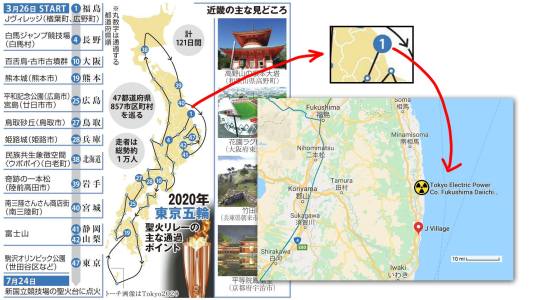
It’s official! The 2020 Tokyo Olympic torch relay starts at the J Village Sports Complex in Fukushima, which is just 10 miles from the crippled nuke plant.
Olympics: Tokyo 2020 torch relay route revealed, uniforms unveiled

June 1, 2019
TOKYO (Reuters) – Tokyo 2020 organisers on Saturday unveiled the uniforms to be worn by 10,000 volunteer runners during the torch relay and presented further details about the route the relay will take.
Organisers said the torch will travel through all 47 of Japan’s prefectures – from Hokkaido in the north to the southern island of Okinawa – and most of the country will have the chance to see the torch with 98% percent of the population residing within an hour’s distance from the route.
The 121-day relay will begin on March 16 at the J-Village in Fukushima, which is Japanese football’s national training centre and a symbol of resilience during the 2011 earthquake and tsunami that killed almost 16,000 people.
Games organisers have sought to stress the importance of Tokyo 2020 as the ‘reconstruction Olympics’ and it was evident in the choice of the route, which will pass through Okuma, where part of the Fukushima nuclear complex is located, and past Kumamoto Castle, which suffered heavy earthquake damage in 2016.
“It is not just about places where people can come or around landmarks, but the torch will also visit areas affected by the Great Japan Earthquake and Kumamoto Castle, recovering from the Kumamoto earthquake,” said Miho Takeda, a Tokyo 2020 committee member and five-time Olympic medallist in synchronized swimming.
“The relay will go through areas of Japan that are working hard to recover from natural disasters.”
The torch will also visit the Hiroshima Peace Memorial Park and pass Mount Fuji before arriving at the National Stadium in Tokyo on July 24 during the Olympics opening ceremony.
The runners’ uniform, designed by fashion designer Daisuke Obana, was unveiled by multiple Olympic gold medallist judoka Tadahiro Nomura.
The uniforms, which are produced in part from recycled plastic bottles, incorporate a diagonally-draped red sash similar to those used as batons in Ekiden, Japan’s famous long distance relay events.
“The torch bearer uniform is eco-friendly. Coca Cola collected plastic bottles in their company and recycled them to use them in the uniform material,” Nomura said.
Olympics: Tokyo 2020 torch relay may include Fukushima reactor town

Japanese Prime Minister Shinzo Abe, center, attends a ceremony held on April 14, 2019, in Okuma, a Fukushima Prefecture town hit by the 2011 tsunami-quake disaster and subsequent nuclear crisis to celebrate the opening of the newly constructed town government building.
May 28, 2019
TOKYO (Kyodo) — The 2020 Tokyo Olympic Games torch relay may pass through a town in northeastern Japan’s Fukushima Prefecture that was devastated by nuclear meltdowns following the 2011 earthquake and tsunami, sources said Tuesday.
The Olympic torch relay course could include the environs of the No. 1 reactor at the crippled Fukushima Daiichi nuclear complex in Okuma as part of the organizers’ efforts to promote the games as the “reconstruction Olympics,” the sources said.
The government lifted its mandatory evacuation order over parts of Okuma last month, but most of the town still remains a no-go zone. The relay will pass through the parts of Okuma and the surrounding area where the evacuation order has been lifted.
After declaring that problems containing radioactive water accumulating at the No. 1 reactor were “under control” during the 2020 Olympic bid process, Prime Minister Shinzo Abe and the government have used the games to showcase Japan’s recovery from the massive earthquake and tsunami of March 11, 2011 and ensuing nuclear disaster.
But in districts of Okuma where the evacuation order has been lifted — which covers 40 percent of the town’s total land — only a tiny percentage of residents have returned, with some saying they have been left behind while more emphasis is placed on showing off the progress of recovery.
Organizers announced in July 2018 that Fukushima would be the starting point for the relay. In March, organizing committee president Yoshiro Mori revealed the relay will begin some 20 kilometers from Fukushima Daiichi at the J-Village national soccer training center, which was used as an operational base for handling the crisis.
The Olympic torch will arrive in Japan on March 20, 2020, and the flame will be taken to Ishinomaki Minamihama Tsunami Recovery Memorial Park in Ishinomaki, Miyagi Prefecture, which was devastated eight years ago.
It will then travel by train through Miyagi and Iwate prefectures — the two other prefectures hit hardest by the powerful earthquake and tsunami — before making its way to Fukushima.
The Japan leg of the relay will begin on March 26, 2020, two weeks after the flame lighting ceremony in Greece, and will travel across all 47 prefectures in Japan over a period of 121 days.
The Tokyo Olympics are scheduled to be held between July 24 and Aug. 9, followed by the Paralympics from Aug. 25 to Sept. 6.
” Tokyo – Next Olympic Venue, Is Our Home We Can’t Go Back Again”
May 28, 2019
Dear friends, wherever you are, here’s my sincere message as a mother. With all my wish to reach your heart.
〜*〜*〜*〜*〜*〜*〜*〜*
🔷 Ailing Daughter, Beaming Prime Minister
In the summer of 2013. I was at my home in Tokyo when the city won the place of 2020 Olympic venue.
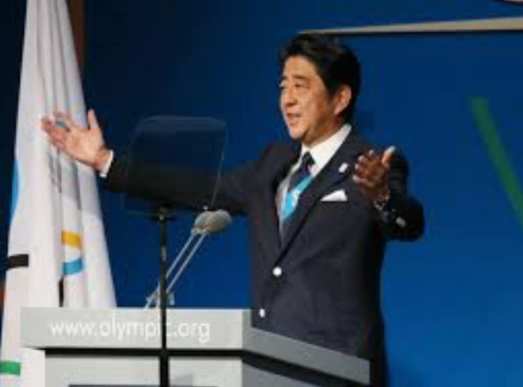
On TV, Prime Minister Abe, spreading both of his arms, addressing that the situation is under control about the Fukushima Daiichi Nuclear Plant Incident.
His speech was smooth with a smile, he claims it has never done and will never do any damage to Tokyo. Then he mentions the health issues in regards, he was telling that we definitely never had any problem neither in the past, at the present nor will be in the future.
Just then, sitting next to me was my eight-year-old daughter, whose health was deteriorating day by day. It had been a slow process.
“I feel sick. I have no strength left…”
“I”m woozy. I have a headache, I have a tummy ache, my legs hurt that I can’t walk, my hands are all in pain to my fingertips, I’m cold, my face is hot, Mummy I’m worn out”
Such condition started to bother us periodically after the accident. It started to worsen and never seemed to get better.
I used to be very ignorant about nuclear plants.
I started to research and read books frantically after the accident as if it was a wake-up call. My daughter’s health crumbled as if it was in parallel with my learning progresses. I first started to connect my daughter’s change with the radiation issue after I’ve developed my knowledge about internal radiation exposure.
🔷 Radiation Exposure in Tokyo? No way!
I was never sure. It can’t be radiation exposure, but what if it was? In Tokyo? No way. Doctors never took me seriously about having such concerns. They just chastised instead of giving any advice. My husband just laughed it off. He always ended up getting angry and we ended up fighting every time. I could never, ever talk about it to any of my friends. “Definitely no problem” the words come out of Prime Minister Abe’s mouth with a nice smile are, for us living in Tokyo, common sense like the air that fills all around us.
I don’t know. I don’t know what she was suffering about. I don’t know why she is suffering. I don’t know what I should be doing. How long does it last? I have no perspective about whether there be the day my daughter regains her health or not. Painful days.
The symptom was very identical to the “Bura Bura Disease.” My daughter was nothing but healthy until 5 years old. She was stronger than anyone. She used to be a girl who would play outside every day from early in the morning until the day falls dark.
I was beyond shocked when I heard our Prime Minister Abe told the lie “Under Control,” but that was nothing compared to the words that followed – “It has never done and will never do any damage to Tokyo.”
I was flabbergasted. That was back when I was not yet so sure of whether my daughter was a victim of the affected health, but the health was the problem I was facing each and every day with my daughter. I did not want Prime Minister, who had no idea what my daughter was facing, to be talking like that with such a big smile. I had this chilling feeling that we are being squashed and dumped, together with my daughter. Whatever happens, I will never approve of this Olympic. Such unforgiving phrase was etched deep in my heart. And since then my heart has never changed.So that was how I came to my understanding of this Olympic – it is to squash and cut the nuclear accident and the aftermaths.This is an Olympic to show off “recovery” by cutting us off with a smile.
Half a year later, my daughter’s health deteriorated to the point she has no day of strength. She can’t go to school. She can’t play with friends. When it is bad, she can not go to the bathroom by herself. It was 3 years after the accident.
🔷 She Gets Better! …When She Goes to Places with No Contamination
It was then I met Dr. Shigeru Mita, then the only doctor in Greater Tokyo who was dealing seriously with the problems in relation to the radiation exposure. I heard that symptoms vary by individual, some children recover conspicuously or show remarkable improvement in blood test results after moving to places such as Western Japan – where there is no contamination.
We made it and attend his last local lecture event. A month later the doctor migrated. He clearly stated my daughter’s case is the damage caused by radiation exposure.Hearing him say that, I was not shocked but felt a deep relief. Finally, I can start to face the real problem and start working towards her health. It was the doctor’s recommendation to recuperate, emigrate, move to the place without contamination.
Immediately , we moved our daughter to Toyama, where my family is. Then there was a miracle.
Our daughter, whom we had to piggy bag to use the toilet, walked 15 minutes to the local beach and swam in a pool. It was only a few days after she arrived Toyama. It was a miracle after a month of agony – she was feeling sick all the time, she would cry because her body was in pain. For a month, she could not get out of the house, not to mention going to school.
The same miracle happened when we recuperated her in Okinawa, then in Kobe, to where we later relocated. Then she falls back again when she came back to Tokyo. Her condition would be back after a week. Sometimes it comes back as soon as the night she returned.
“I can’t do the homework,” the daughter once recovered says, “I could not say I was feeling sick… I did not want to disappoint you Mum”
I will never forget the hopelessness every time I had to witness my girl swept away by the waves of symptoms. I will never forget the tears that she shed in despair.
🔷 Increasing “Degradation of Abilities” in the Metropolitan Area
Finally, we moved to Kobe in Western Japan. It was after we spent about 4 months without her health recovering except the time we relocated her for recuperation. We were lucky to have been able to move with all the family together. Many of evacuees from the Kanto Plain fell into serious financial strife because they had to move. Many mothers and children made a hard decision to move without their fathers who could not give up work to feed the family. I am thankful that we did not have to suffer from such financial strife, it was an easy start in Kobe although we were totally strange to the area. But more than anything, there is no word that can express how thankful I was to see my daughter coming back alive rapidly, started to play with many friends as if she was trying to recover the life she missed out. It was another miracle.
So what was happening to her body?
And what is happening to our body now?
After our relocation, we visited Mita Clinic in Okayama. Their examination and testing slowly uncovered the answers to my questions. We underwent multiple testing on our Pituitary Hormone which led us to understand the impact of radiation exposure on our brain. Important enough organ to be affected.
The deterioration of the hormone observed in my family including my daughter is said to be happening in many who lives in the Tokyo metropolitan. My family is healthy for the time being. Dr. Mita, however, says that more people are starting to suffer severe symptoms such as weakening of motivation, declined thinking and memory ability, and losing strength to fight against any kind of sickness to the point where they can no longer lead a normal life.Dr. Mita coined such symptoms as “Degradation of Abilities.”
Can we recover what had already been lost?
No one has the answer. We are the test subjects for keeps. The country is on the experimental bench and many of us, the test subjects, instead of sharing knowledge and unite in harmony for our recovery, are being made to run the exact opposite direction.
I was born and raised in Tokyo. It’s the city where I also raised my children and spent my entire life. My parents, siblings, and friends are in Tokyo. All my memory, nostalgia and love for my home is now lost without a trace.
I can not go home. I have even lost my wish to go home. That’s how intense it was. That’s the result of our experience with our daughter during our last 4 months in Tokyo. Now we must face the cruel test results of our pituitary gland hormone.
We must face what we can not see, smell, or feel. That’s the fear of radiation itself.But it doesn’t end there. The worst part is this horrible feeling that I can not share such a fierce feeling of crisis at all with any of the people I care and spend time with.
🔷 Olympic Brings on Sad Future
Do you still think Olympic would be a great idea?
As 2020 approaches, revulsion is creeping in to fill me. I’ve been having trouble finding the right word to let you understand how unpleasant a feeling can be.
That is the ground my daughter can never walk on anymore. That is the ground where many families, many mothers, and children evacuated from. That land we escaped from in order to protect our children, protect our own. That land we ran away from, hoping for the tomorrow without tormenting health damage.
My home town had been contaminated. We can not erase what is there. We can not say it never happened. We are blindfolded about the ongoing nuclear accident and nuclear contamination spreading throughout Eastern Japan. And they put this Olympic on our way we are walking towards as if some sort of culmination of achievement.
So this is the Olympic of recovery and regeneration.
Is Olympic our hope? Is it our future? What kind of hope, what sort of future are we meant expect with the Olympics, when we are blindfolded about the wounded bodies of our children, our own bodies in pain? Are we expected to push forward for the Olympic to show off “Recovery” with blindfolds?
Who is that for? What is it for?
My child hit my head hard. Then the blindfold fell. So I found out the existence of the blindfold. We can not protect our most precious things from radiation exposure because of the blindfold. So what sad future does that bring about? We should be able to learn
from the past nuclear bombs, nuclear accidents, nuclear disaster, and nuclear testings if we want to learn. My daughter is teaching me a tiny piece of the puzzle with her own body.
This Olympic is the biggest blindfold in history. Let us throw away the blindfold. Our wish is to live our own lives, with our own body that we are given by right.
To retrieve the tomorrow where our children can run with a healthy smile on their face, why not us the adults get over any barriers, hold hands and cooperate.
I will not not forgive this 2020 Olympic Games in Tokyo.

1 This Month

of the week – Shut Down Drone Warfare!


Tell the Ukrainian Government to Drop Prosecution of Peace Activist Yurii Sheliazhenko

Petition to revoke the licensing of the Near Surface Nuclear Disposal Facility (NSDF) at Chalk River. https://www.ourcommons.ca/petitions/en/Petition/Details?Petition=e-7247
To see nuclear-related stories in greater depth and intensity – go to https://nuclearinformation.wordpress.com
-
Archives
- March 2026 (249)
- February 2026 (268)
- January 2026 (308)
- December 2025 (358)
- November 2025 (359)
- October 2025 (376)
- September 2025 (257)
- August 2025 (319)
- July 2025 (230)
- June 2025 (348)
- May 2025 (261)
- April 2025 (305)
-
Categories
- 1
- 1 NUCLEAR ISSUES
- business and costs
- climate change
- culture and arts
- ENERGY
- environment
- health
- history
- indigenous issues
- Legal
- marketing of nuclear
- media
- opposition to nuclear
- PERSONAL STORIES
- politics
- politics international
- Religion and ethics
- safety
- secrets,lies and civil liberties
- spinbuster
- technology
- Uranium
- wastes
- weapons and war
- Women
- 2 WORLD
- ACTION
- AFRICA
- Atrocities
- AUSTRALIA
- Christina's notes
- Christina's themes
- culture and arts
- Events
- Fuk 2022
- Fuk 2023
- Fukushima 2017
- Fukushima 2018
- fukushima 2019
- Fukushima 2020
- Fukushima 2021
- general
- global warming
- Humour (God we need it)
- Nuclear
- RARE EARTHS
- Reference
- resources – print
- Resources -audiovicual
- Weekly Newsletter
- World
- World Nuclear
- YouTube
-
RSS
Entries RSS
Comments RSS
 nuclear-news