Decontaminated Soil Planned for Shinjuku Gyoen, Japan “Aware of Safety” Opposition in Various Locations

Image of flower beds using decontaminated soil
February 25, 2023
On February 24, some residents of Shinjuku Gyoen (Shinjuku-ku, Tokyo), one of the candidate sites for a demonstration project by the Ministry of the Environment to reuse decontaminated soil from the decontamination process following the accident at TEPCO’s Fukushima Daiichi Nuclear Power Plant, submitted a request to the ministry to stop the project. The Ministry said, “We want as many people as possible to know the safety of the project. The gap between the two parties has not been closed.
A citizens’ group consisting of local residents handed a letter to ministry officials at the House of Councilors building (Chiyoda Ward, Tokyo), demanding the suspension of the project, a detailed explanation of the project, and the holding of a public meeting to explain the project. About 50 people attended the meeting.
According to the ministry, the number of visitors to Shinjuku Gyoen was approximately 1.2 million in FY2021, and before the Corona disaster, the number had remained at approximately 2 million.
After the offer was made, Shintaro Fujii, Assistant Counselor in charge of the Ministry’s Environmental Restoration Project Office, told the press, “We will answer questions and opinions politely and consider holding additional explanatory meetings in consultation with Shinjuku City.
Kunikazu Hirai, 70, one of the sponsors of the citizens’ group, told the press, “We are angry about the danger of radioactive soil coming to our neighborhood. The group was joined by a group that is working against the project in Tokorozawa City, Saitama Prefecture, another candidate site for the project.
Last December, the ministry announced that it was considering starting the project at three facilities under its control, including Shinjuku, Tokorozawa, and Tsukuba City in Ibaraki Prefecture. At Shinjuku Gyoen, where public access is restricted, the ministry plans to reuse decontaminated soil with a radioactivity level of less than 8,000 becquerels per kilogram to create flower beds. The start date has not yet been determined.
https://www.asahi.com/articles/ASR2S66V9R2SOXIE009.html?iref=pc_photo_gallery_bottom
Taro Kono also sounded the alarm about the dangers of spent fuel pools Attacks on nuclear power plants became a reality with the invasion of Ukraine

Taro Kono in Nagoya City on January 28, 2011.
February 22, 2023
It will be one year on the 24th since the Russian invasion of Ukraine. During this period, attacks on nuclear power plants shocked the world. When considering preparedness in Japan, the handling of spent nuclear fuel becomes important. Once it finishes its role in the reactor, it is mainly stored in storage pools, but that group and those politicians see the vulnerability of the pools as a problem. If they are left as they are now, they will become a “weak spot” in the event of an attack on a nuclear power plant, which could result in extensive damage. The Kishida administration should not focus its efforts only on nuclear power plant operation. (Naoaki Nishida and Yuichiro Yamada)
◆Russia targeted nuclear power plants immediately after the invasion.
On the 18th, the Institute for the Study of War, a U.S. think tank, expressed the following opinion: “The Russian media is advocating an attack on Ukraine’s nuclear facilities in order to cut off the power supply to the plants.
The next day, the 19th. The following day, on the 19th, the Ministry of Foreign Affairs of Ukraine issued a statement regarding the Zaporozhye nuclear power plant in Ukraine, which has been occupied by Russian troops and turned into a military base. It accused Russia of refusing to replace the International Atomic Energy Agency (IAEA) experts stationed there to ensure safety.
Attacks on the plant were feared early on. As early as last January, Sergiy Korsunsky, Ukraine’s ambassador to Japan, expressed concern. The bad predictions were right on target, and nuclear power plants were targeted immediately after the Russian invasion.
The attack continued, and a bomb landed near a spent nuclear fuel storage facility. The Russians claimed that they had been attacked from the Ukrainian side and that the greatest risk from the attack was not the reactor but the spent fuel storage facility.
Spent nuclear fuel, which can cause extensive damage, is made from uranium. It is used in nuclear reactors for four to five years and then removed.
According to Chihiro Uesawa of the Nuclear Data and Information Center, the amount of heat generated and radiation levels remain high even under these conditions. In Japan, the heat value is mainly stored in a storage pool inside the reactor building, and water is circulated to lower the heat value and other parameters.
Storage pools are not the only storage method. There is also a type of cask called a “dry cask,” which is cooled for five to six years in a pool and then placed in a metal container and cooled by air circulation. The sturdier casks are several steps ahead of the dry casks in terms of safety, but due to cost considerations, the use of dry casks is still on the road to widespread use. Compared to Europe, dry casks have lagged behind.
◆“Vulnerable to external attacks,” points out…
After the invasion of Ukraine, Yuki Kobayashi, a researcher at the Sasakawa Peace Foundation, has been raising the issue of the vulnerability of storage pools.
On the foundation’s website, he wrote, “The reactors are made of steel and are protected by a containment vessel, which has a certain degree of robustness against external attacks,” but he also pointed out that the spent fuel storage “often does not have a multiple protection system,” “is vulnerable to external attacks,” and “if the spent fuel is exposed to the atmosphere (e.g., because the water runs out), it will be exposed to high concentrations of radiation over a wide area. If the spent fuel is exposed to the atmosphere (e.g., when the water runs out), high concentrations of radiation will be emitted over a wide area.
When the hydrogen explosion occurred in the Unit 4 reactor of TEPCO’s Fukushima Daiichi Nuclear Power Plant, the possibility of an anomaly occurring in the spent nuclear fuel storage pool was discussed. When interviewed, Kobayashi said, “Even after the Fukushima accident, Japan had not decided what measures to take. It can be said that we were somewhat naive in our understanding of the situation.
The late Ryoichi Sasakawa was honorary chairman of the Sasakawa Peace Foundation. Shunichi Yamashita, vice president of Fukushima Medical University, is a trustee of the Sasakawa Health Foundation, another organization that is a descendant of the Sasakawa Peace Foundation. In a lecture after the Fukushima nuclear accident, he expressed his optimism, saying, “The effects of radiation will not come as long as you are smiling and laughing.
The Sasakawa Peace Foundation also warned of the vulnerability of the storage pools. Uesawa, mentioned above, also spoke of the vulnerability of the storage pool, saying, “If the storage pool and other facilities are destroyed in an emergency, the buildings will be inaccessible. This would cause an irreversible situation.
◆Taro Kono, who was a member of the opposition party, also called it “a potential weak point.
In the past, some have pointed out the fragility of the storage pools for spent nuclear fuel.
The vulnerability of the spent fuel pools became clear after 3.11.” “How will the security system be changed?”
The speaker was Taro Kono, the current digital minister. He is the current digital minister. In November 2011, a little more than six months after the accident at TEPCO’s Fukushima Daiichi Nuclear Power Station, he asked these questions at a meeting of the House of Representatives’ Committee on Monitoring the Settlement of Accounts. This was when he was a member of the opposition party. In September 2012, he wrote on his blog, “Nuclear reactors and spent fuel pools are potential weak points that could be targeted by terrorists or missiles.
Does he think the same way now as he did then? We asked him through his office, but had not received an answer by the evening of September 21.
So how is the Kishida administration handling the situation?
At a Lower House Budget Committee meeting last October, Katsuya Okada, secretary general of the Democratic Party of Japan’s Constitutional Democratic Party, asked, “Spent nuclear fuel in the pool is a real nuisance,” and “What would happen if a missile hit us? He asked that the spent fuel be removed from the storage pool and transferred to a dry cask in a metal container to increase protection.
In response, Yasutoshi Nishimura, Minister of Economy, Trade and Industry, said, “The Nuclear Regulation Authority is in charge of this issue centrally” and “METI would like to refrain from doing so.
◆The Nuclear Regulation Authority “is virtually unable to do so.
In March of last year, immediately after the invasion of Ukraine, Toyoshi Sarada, then chairman of the Regulatory Commission, said at a press conference that “we have no plan to discuss a facility that is robust against armed attack, and it is virtually impossible. He then went on to say that, in general terms, “dry casks are more defensible than spent fuel pools. Shinsuke Yamanaka, the current chairman of the committee, echoes this view.
A spokesperson for the Regulatory Commission said, “There is no change in our view that the Nuclear Reactor Regulation Law does not assume an armed attack. There is no indication that the Regulatory Commission has given a new directive to switch to dry casks as a counterterrorism measure,” he clarified.
Masashi Goto, a former nuclear power plant design engineer, said, “The power companies are planning to move to casks, but the fuel must be cooled in a pool after use before being moved. This takes a considerable amount of time,” he said, pointing out that as long as nuclear power plants continue to operate, storage in storage pools is an unavoidable problem.
He resents the Kishida administration’s bluntness, saying, “There are major risks, such as accidents and terrorism. Despite the existence of major risks, such as accidents and terrorism, the government has deemed the probability of their occurrence to be low and has failed to take effective countermeasures.
◆The nuclear fuel cycle is failing, but the government is moving forward with its utilization.
The amount of spent nuclear fuel stored at nuclear power plants in Japan is enormous. The amount of spent fuel stored at nuclear power plants in Japan is enormous, amounting to about 20,000 tons, most of which is kept in storage pools. The government has been pushing for the reuse of this fuel under the banner of the “nuclear fuel cycle,” but the completion of a reprocessing plant under construction in Rokkasho Village, Aomori Prefecture, has been postponed for some time. Even if the government wants to reduce the amount of nuclear fuel used for reuse, it has been unable to do so because the key facilities are not functioning.
The Kishida administration, however, is pushing forward with the use of nuclear power plants. It has taken the lead in allowing the operation of nuclear power plants for more than 60 years and in permitting the rebuilding of next-generation nuclear power plants. The amount of spent fuel stored in vulnerable pools will continue to increase, which will require more time and effort to protect.
The government is treating the spent fuel cycle as if it were still running, and is avoiding confronting the problem,” said Teru Honma, a professor at Aoyama Gakuin University. The government is treating it as if it is going around and avoiding facing the problem,” said Terumitsu Honma, Professor Emeritus of Nuclear Damage Compensation System at Aoyama Gakuin University.
The nuclear accident at Fukushima and the invasion of Ukraine have exposed the huge risks involved in operating nuclear power plants,” he continued. We have not taken responsibility for the unmanageable risks and costs. If we are going to make a decision to operate nuclear power plants, at the very least, we should take steps to address counterterrorism and safety measures that are a prerequisite.
◆Desk Memo
It is easy to imagine the fear of nuclear power plants becoming targets of spent fuel storage pools. It is also easy to imagine the damage to civilians that would result in the event of an attack. Despite this, discussions on preparedness have stalled. In contrast, the Self-Defense Forces are even discussing the possibility of moving their headquarters underground as a protective measure. Abandoning someone and protecting someone else. Is this the kind of country we are supposed to love? (Sakaki)
Mayor Hideki Toshima, a pro-nuclear power plant advocate, re-elected in Mihama, Fukui Prefecture. The Mihama NPP, the only nuclear plant already in operation for over 40 years

Hideki Toshima (center) was reelected unopposed as mayor of Mihama Town, Fukui Prefecture, on the afternoon of September 21.
February 21, 2023
Mihama Town in Fukui Prefecture, where Kansai Electric Power Co.’s Mihama Unit 3, the only nuclear power plant in Japan operating for more than 40 years, is located, announced the election of a new mayor on January 21.
There were no other candidates other than incumbent Hideki Toshima, 65, a pro-nuclear power plant advocate recommended by the Liberal Democratic Party, and he was reelected unopposed following the previous election in 2019.
Mr. Tojima said, “Sustainable use of nuclear energy is necessary for the future. We will promote the development of a town that coexists with nuclear power on the basic premise of ensuring safety and security,” he said. He answered questions from reporters in the town.
In June 2009, Mihama Unit 3 became the first nuclear power plant in Japan to be restarted after 40 years of operation, under the rule that in principle the plant should be in operation for 40 years, with a maximum extension of 20 years.
https://www.tokyo-np.co.jp/article/232442?rct=politics
Fukushima nuclear disaster: Japan set to dump contaminated water in Pacific – a million tonnes
Beside the dangerosity of various radionuclides on our environment, our food chain and our health, we must also consider the fact that TEPCO is not trustworthy for its “transparency”, it has lied repeatedly numerous times during the past 12 years, and that the IAEA itself being for the nuclear industry it has shown well its tendency if not its policy to minimize the radiation risks if not to cover things up.
22 Feb, 2023
Outrage is growing over an “unjust” plan to dump more than a million tonnes of contaminated wastewater on Australia’s doorstep – within months.
In 2011, Japan was rocked by the Fukushima nuclear disaster – the worst of its kind since Chernobyl in 1986.
Responders scrambled to stop damaged reactors at Fukushima’s Daiichi nuclear plant from overheating by pumping massive amounts of water through them, with the contaminated water then being stored in massive tanks at the site.
But now, Japan has run out of space, and in 2021, announced plans to dump 1.3 million tonnes of the contaminated wastewater into the Pacific Ocean.
The water would be treated before being released over a period of several decades, with Prime Minister Yoshihide Suga saying at the time it was “a realistic solution”.
“We will do our utmost to keep the water far above safety standards,” he vowed.
In the almost two years since, Japan has been working out the finer details of the release, which is now due to begin as soon as the northern hemisphere’s spring or summer – Australia’s autumn or winter.
Countries across the Pacific are furious.
‘Catastrophic harm’
Writing for The Guardian soon after the plan was first announced, youth advocates from the region Joey Tau and Talei Luscia Mangioni described it as an “unjust act”.
“To Pacific peoples, who have carried the disproportionate human cost of nuclearism in our region, this is yet another act of catastrophic and irreversible trans-boundary harm that our region has not consented to,” they wrote.
They were referring to the long history of the Pacific being used as the world’s nuclear waste dumping ground, with hundreds of nuclear tests being carried out across the region in the decades since World War II.
High-profile individuals and groups from across the Pacific – including from Vanuatu, Fiji, the Marshall Islands and French Polynesia – have also spoken out against Japan’s plan for months on end.
“If it is safe, dump it in Tokyo, test it in Paris, and store it in Washington, but keep our Pacific nuclear-free,” Vanuatu stateswoman and veteran activist of the Nuclear Free and Independent Pacific (NFIP) movement Motarilavoa Hilda Lini said soon after Japan’s plan was unveiled.
“We are people of the ocean, we must stand up and protect it.”
In another moving statement released last year, environmental advocacy group Youngsolwara Pacific likened the release to “nuclear war”.
“How can the Japanese government, who has experienced the same brutal experiences of nuclear weapons in both Hiroshima and Nagasaki, wish to further pollute our Pacific with nuclear waste? To us, this irresponsible act of trans-boundary harm is just the same as waging nuclear war on us as Pacific peoples and our islands.”
But their pleas have fallen on deaf ears – and a string of experts have even voiced support for Japan’s controversial move.
‘Best option’
Writing for The Conversation recently, Jim Smith, professor of environmental science at the University of Portsmouth, said releasing the wastewater was the “best option”.
Prof Smith – who has worked on the impacts of radioactive pollutants in the environment for more than three decades – explained that before the water is stored in the first place, “the wastewater produced at Fukushima is treated to remove almost all of the radioactive elements”.

“These include cobalt 60, strontium 90 and caesium 137. But tritium – a radioactive form of hydrogen – is left behind,” he explained.
“When one of the hydrogen atoms in water is replaced by tritium, it forms radioactive tritiated water. Tritiated water is chemically identical to normal water, which makes separating it from wastewater expensive, energy intensive and time consuming. A review of tritium separation technologies in 2020 found that they are unable to process the huge volumes of water required.
“But as radioactive elements go, tritium is relatively benign and its existence as tritiated water reduces its environmental impact. Chemically identical to normal water, tritiated water passes through organisms like water does and so does not strongly accumulate in the bodies of living things.”
Meanwhile, a South Korean government study released this month also found the release of the wastewater would have little impact on South Korean waters.
“That change would be too small to detect,” an official at the Korea Institute of Ocean Science and Technology said, according to Reuters.
And the nation of Micronesia has also recently dropped its opposition to the release of the water, with president David Panuelo telling reporters he was no longer worried.
But for many critics of the plan, plenty of concerns remain.
“We must prevent actions that will lead or mislead us towards another major nuclear contamination disaster at the hands of others,” the former prime minister of the Cook Islands Henry Puna said just last month, as the deadline for the release looms. –
Seoul wary of reduced disclosure of radioactive elements in Fukushima wastewater

Prime Minister Han Duck-soo
Feb 22, 2023
Japan’s nuclear regulation authority tentatively confirmed plans Wednesday to narrow the scope of radioactive elements to be monitored in the radiation-contaminated water from quake-stricken Japan’s Fukushima Daiichi nuclear power plant, the South Korean Prime Minister’s Office said in a statement Wednesday.
The types of nuclides under the monitoring has been reduced from 64 to 30, according to Prime Minister Han Duck-soo’s office.
The Seoul government pledged to place the Korean people’s safety as the priority and ensure that the wastewater is treated according to international standards. Moreover, the government will continue to be engaged in the scientific and technological review of Tokyo Electric Power Co.’s plan, as well as the International Atomic Energy Agency’s wastewater analysis.
This came after the Ministry of Foreign Affairs raised the possibility of the narrowing down of the scope of radioactive elements earlier this month. A spokesperson at the Foreign Ministry said on Feb. 10 that such a decision came upon the request of the IAEA.
Tokyo unveiled plans to release the wastewater by as early as this spring.
Japan has claimed that the contaminated water was treated by its own nuclide removal system called Advanced Liquid Processing System. The IAEA has endorsed Japan’s claims that the release meets international standards.
Some 1.3 million tons of wastewater — enough to fill about 500 Olympic-size swimming pools — was used to cool down the quake-hit nuclear reactors, and is being stored at the site. Tokyo announced plans to release the water in 2021.
Recent research jointly conducted by the Korea Institute of Ocean Science and Technology and the Korea Atomic Energy Research Institute indicated some of the nuclides, in particular tritium, could potentially reach South Korean waters within the next four or five years. The impact of it, however, could be “hard to detect,” with about 0.001 becquerel per cubic meter 10 years after the release, research results indicated. A becquerel is a unit of measurement for radioactivity, with even one full becquerel being a tiny amount as relates to human health.
The deadly tsunami in 2011 broke down the nuclear reactor cooling system and melted down three reactors in the Fukushima nuclear power plant in eastern Japan.
Japan slammed for loosening test standards on Fukushima radioactive water

Tokyo Electric Power Company shows a bottle of radioactive water from Fukushima Daiichi Nuclear Power Plant in Japan which has been filtered by ALPS, Feb. 18. The filtering measure is, however, drawing criticism from experts in different countries as its radioactivity-cleansing feature has not been fully verified.
2023-02-23
Seoul urged to respond firmly to Tokyo’s move
By Ko Dong-hwan
Korean environmental activists condemned Thursday, the Japanese government’s latest move to discard radioactive water from their own soil which is now stored at the tsunami-hit nuclear power plant in Fukushima.
Filtered and planned for discharge into the Pacific Ocean this year, the water, according to the Japanese government, has been tested for concentration levels of radioactive nuclides that would pollute the maritime environment.
What concerns the activists is that the Japanese government recently reduced the list of radioactive nuclides to measure and verify their safety levels from 64 to 30.
The list has been shortened to more than half because the Japanese government believes some radioactive nuclides have half-lives that are so short that their radioactivity would thin out to a concentration level minuscule enough to be almost unmeasurable and non-influential to the environment.
But the activists said the move is only an additional problem to the Japanese government’s “doubtful” actions in dealing with the water, largely due to the questionable veracity of the data shared by the government with the world.
“Some radioactive nuclides have very short half-lives, like iodine-131 which has only eight days. Cesium-134, which has a half-life of two years, will also be watered down almost flat in a couple of years,” Choi Kyoung-sook, the coordinator from Korea Radiation Watch, a Seoul-based civic environmental activist group, told The Korea Times.
“But the biggest problem with Japan’s discharge plan is that the water’s potential biological effect on maritime species in the ocean hasn’t been fully tested yet. The Japanese government just got started with that experiment earlier this year, putting halibuts and other fish in an aquarium containing 1 becquerel of cesium to see what happens to the creatures.”
Choi said the Japanese government’s explanation advocating the safety of the discharge is only based on its own belief that the water “appears clean enough” after being filtered by the advanced liquid processing system (ALPS) that the Japanese government claims it has used to treat the water before its discharge planned this spring.

Kim Kyoung-ok from the Korea Institute of Ocean Science and Technology explains the result of a simulation carried out by his institute which demonstrates how discharged radioactive water from the Fukushima nuclear power plant in Japan could affect Korean waters, at Ramada Plaza Jeju Hotel, Feb. 16.
“It’s like they pour one liter of milk into 1,000 tons of water and say, ‘Hey, the water doesn’t look opaque at all,'” Choi said. “ALPS cannot filter out tritium. Carbon-14 has a half-life of 5,000 years. Who can possibly be so sure that radioactive water containing those radioactive particles is safe enough to discharge into the ocean?”
The Korean government has not been as critical of Japan as it should be, Choi said. She said the authority appears to be neglecting to demand sufficient scientific proof from its neighboring country that ensures the safety of the discharge.
“There isn’t any reliable scientific proof whatsoever to what the Japanese government has released to argue the discharge is safe,” Choi said. “Our government should make sure with Japan that there is no harmful biological effect from the discharge and the environmental assessment claimed done by Japan was based on reliable data.”
Choi, alongside other experts concerned with the discharge, proposed the radioactive water be stored for a longer period of time in Japan until it is diluted enough to be safely discharged.
It was found that Japan’s Nuclear Regulation Agency, earlier this year, approved the latest shortlist of radioactive nuclides to be tested, which was proposed by Tokyo Electric Power Company. The list removed 39 types from the original list and added five new ones.
The agency claimed the removed nuclides have half-lives short enough to be dissolved clean into sea waters to the level of not causing any harmful effect on humans and thus do not need to be tested further.
The Japanese authorities have been arguing that their decision-making adhered to the guidelines of the International Atomic Energy Agency, which has been supporting the country’s discharge of the water.
The Korea Institute of Ocean Science and Technology and the Korea Atomic Energy Research Institute last week released the results of a simulation of the discharge they had been studying.
The simulation, designed specifically to track tritium after the water is discharged, showed the water, after circling the Pacific for two years and reaching Korean waters, is expected to have only a negligible amount of the nuclide left. The Ministry of Oceans and Fishery, however, said the simulation was only carried out during a preliminary stage of the study and further simulations are required.
https://www.koreatimes.co.kr/www/nation/2023/02/371_345995.html
800,000 cubic meters of new radioactive waste to be generated as a result of decommissioning of the Fukushima Daiichi Nuclear Power Plant

February 20, 2023
At the Fukushima Daiichi Nuclear Power Plant, buildings around the reactor buildings will be dismantled in preparation for the removal of fuel debris.
TEPCO has released an estimate of 450,000 cubic meters of radioactive waste to be generated as a result of this work.
In addition to this, 805,000 cubic meters of radioactive waste is expected to be generated during the decommissioning work over the next 10 years.
The waste will be stored at the Fukushima Daiichi Nuclear Power Plant, but the amount is expected to increase further in the future.
https://www.fukushima-tv.co.jp/localnews/2023/02/2023022000000013.html?fbclid=IwAR3uLGcmRWtk6l-2k2GSGfXnxjmdsYaaC3EcjiIr93m4l7 HHPFMFDCvp4PM
Fukushima nuclear plant prepared to release treated waste water amid local opposition
February 21, 2023
Twelve years after the nuclear disaster caused by a massive earthquake and tsunami, workers at the Fukushima Daiichi nuclear power plant in Japan are preparing to release treated waste water into the sea despite opposition from locals. The plant’s operator, Tokyo Electric Power Company, said the water had been filtered to remove most of the radioactive elements, adding that the release was “safe and necessary”.
Japan wants G-7 backing for plans on Fukushima water, soil

February 22, 2023
The Japanese government is seeking Group of Seven support for its contentious plans on dealing with water and soil contaminated from the triple meltdown at the Fukushima No. 1 nuclear power plant.
Japan will host the G-7 summit in Hiroshima in May, as well as a series of G-7 meetings of ministers overseeing different policy areas.
One meeting planned for April in Sapporo will bring together G-7 ministers overseeing climate, energy and the environment.
At a working-level meeting in Tokyo on Feb. 1-3, Japanese officials explained their draft of a joint statement called “Building Blocks” that could be issued after the Sapporo meeting.
It said the ministers welcomed “the transparent process toward discharge” of “treated water without any harm to humans and environment” from the grounds of the Fukushima No. 1 plant, as well as the progress made to “recycling of removed soil.”
Both measures have faced stiff opposition in Japan from those directly affected by the plans, such as fishermen who operate off the coast of Fukushima Prefecture.
A government source said, “We could play up the safety of those measures if the G-7 members come together.”
However, some nations may feel uncomfortable about including issues unique to Japan in a joint statement.
Another government source said a consensus had not been reached among the seven nations to include such wording in the statement.
No past G-7 joint statement has ever mentioned the two measures in a positive light.
Water contaminated by the crippled Fukushima reactors has been treated and stored in tanks on the nuclear plant grounds. But groundwater continues to be polluted in the heavily damaged buildings.
Plant operator Tokyo Electric Power Co. said all available tanks would be filled with water between summer and autumn this year.
The utility is using the Advanced Liquid Processing System (ALPS) to lower the levels of 62 radioactive substances to government safety standards. But ALPS cannot remove tritium, a radioactive isotope of hydrogen, so the plan is to dilute it to under one-40th of the statutory standards before the water is discharged.
The plan to release the water about 1 kilometer off the coast of the Fukushima plant is scheduled to begin as early as spring.
In addition to Fukushima fishermen, China, South Korea, Russia and the Pacific Islands Forum, made up of 15 nations and two regions, have raised concerns about the plan.
The International Atomic Energy Agency is scheduled to release its report about the measure between April and June before the start of the water-discharge plan.
The government plans to reuse decontaminated soil to reduce the volume to be placed in final storage. The soil will be treated to a level below 8,000 becquerels per kilogram, the threshold set by the government.
Plans to reuse the soil in two municipalities in Fukushima Prefecture have stalled because of opposition from local residents.
And people in Tokorozawa, Saitama Prefecture, have also raised objections to the plan to reuse the Fukushima soil in their community.
Process of releasing treated water “welcome” Japanese government coordination in G7 ministerial statement.

February 22, 2023
The Japanese government has released a draft of the joint statement that will be compiled by Japan, the chairing country of the G7 climate, energy, and environment ministers, at their meeting in Sapporo in April. Japan is coordinating with other countries to include a statement that “welcomes the transparent process for the release” of treated water from the TEPCO’s Fukushima Daiichi Nuclear Power Plant and “welcomes the progress” of a plan to reuse decontaminated soil. Both of these statements are considered to be aimed at gaining the support of major countries, despite the fact that there is a strong sense of caution in Japan regarding these issues.
The contents of these plans were explained to representatives of each country at working-level meetings held in Tokyo from January 1 to 3. A government official said, “If we can unite in the G7, we can appeal the safety of the G7. However, there are doubts about including issues specific to Japan in the joint statement, and some countries, such as Germany, are cautious about nuclear power, so another official said, “It remains to be seen if we can go so far as to include a ‘welcome’ message. So far, the G7 joint statement has never included language encouraging the release of treated water or the reuse of decontaminated soil.
Contaminated water at the Fukushima Daiichi Nuclear Power Plant is generated in the process of cooling melted-down nuclear fuel. The water is being purified and stored in tanks on the plant grounds, but according to TEPCO, the tanks are expected to be full by this summer or fall. TEPCO is using a multinuclide removal system (ALPS) to reduce the concentration of 62 types of radioactive materials to below the national standard, and tritium, which cannot be removed by ALPS, will be diluted to less than 1/40th of the legal standard. The company plans to discharge the treated water one kilometer offshore from the plant, and plans to begin the discharge around spring or summer of this year.
https://www.asahi.com/articles/ASR2P6222R28ULBH005.html?iref=pc_photo_gallery_bottom
Toxic US-Japan collusion on nuke wastewater taints global environment

2023-02-20
Washington and Tokyo are in the midst of a transition from “alliance protection” of their partnership to “alliance projection” into the Indo-Pacific, US Ambassador to Japan Rahm Emanuel said at a recent press conference in Tokyo.
Now many believe such an alliance takes on a much clearer form of “alliance pollution,” as the two are ganging up to endanger the Pacific and the wider global ecosystem.
At an open debate on the impact of sea-level rise on international peace and security held Tuesday by the United Nations Security Council, representatives of multiple countries criticized Tokyo over its accelerated push to discharge contaminated water from Fukushima Daiichi Nuclear Power Plant.
They argued that Japan’s discharge plan, defying concerns of neighboring countries, will seriously endanger the global marine environment, ecosystems, and the health and safety of people along the Pacific coast.
Presumably, the United States, with a Pacific coastline, would also fall victim to the health hazards posed by the contaminated water once it reaches the west coast along with the ocean currents.
Washington, however, again glossed over the risks. US State Department spokesperson Ned Price has recently claimed that the United States “welcomes Japan’s continued openness,” saying the plan is “in line with the internationally accepted nuclear safety standards.”
Such a response makes sense, considering the government’s handling of a recent hazmat train derailment in Ohio, the environmental fallout of which could be massive. Both the US government and media were indifferent to it at first.
Quite tacitly, across the Pacific, Tokyo and Japanese media have also been reticent on this incident, in stark contrast with their fault-finding on some developing countries regarding environment protection.
Behind their collective, selective silence is a toxic US-Japan collusion on nuke wastewater, which is now tainting the Japanese soil.
In 2022, high levels of cancer-causing perfluoro organic compounds were detected in areas around US military bases in Okinawa prefecture, with the bases’ firefighting foam being the suspected source, local media reported.
Of the 46 sites sampled surrounding the US military installations as part of a biannual groundwater survey, 32 exceeded Japan’s provisional safe drinking water standard.
Outside Okinawa, concentration levels of perfluoro organic compounds sampled at 81 sites in 13 Japanese prefectures exceeded standards, including groundwater and tap water in many parts of Tokyo’s Tama area near the US air base in Yokota.
As the Japanese government denied access to investigation inside the US bases, some local residents chose to swallow anger while some investigated the source of contamination on their own.
“I dare not drink tap water here, so I usually consume bottled water,” a resident from the Tama area told Xinhua, offering a glimpse into the misery and humiliation experienced by locals at the “US occupied land.”
While Emanuel is sparing no effort to urge the US-Japan alliance to draw the sword, the US and Japanese people are suffering from profound pollution problems, with the Pacific Ocean environment and the health of coastal residents under potential threat.
However Washington and Tokyo try to justify each other’s environmental wrongdoings, they can never be exempted in the face of overwhelming facts.
The foul of the US-Japan alliance lies not only in its disregard for the global environment and double standards, but also in its absurd values of prioritizing hegemony over public health.
https://global.chinadaily.com.cn/a/202302/20/WS63f2c05da31057c47ebafa60.html
Japan should consider shifting to direct disposal of nuclear waste

Vitrified radioactive waste in the storage facility at Rokkasho, Aomori Prefecture
February 20, 2023
The Kishida administration has unveiled a policy initiative to deal with high-level radioactive waste from nuclear power plants through “united government-wide” efforts.
The government plans to step up its efforts to find a local government willing to host a final disposal site for nuclear waste. The government should naturally assume the responsibility of dealing with this problem, but it should not pressure local governments to host a disposal facility.
According to the draft revision to the basic policy for tackling the problem, which was announced earlier in February, the government will set up a “council for discussions” with interested local governments to discuss the challenges and possible policy responses.
Based on these talks, the national government will propose in stages to local administrations to accept a survey for a disposal site.
Under the current basic policy, the Ministry of Economy, Trade and Industry published in 2017 a map of the nation showing potential areas for locating a deep geological disposal site. At this site, spent fuel would be buried in engineered facilities 300 or more meters below ground level.
The initial phase of assessing two municipalities in Hokkaido for their suitability to host such a disposal facility began three years ago. The first stage of the process, called “bunken chosa” (literature survey), involves reviews of geological maps and research papers concerning local volcanic and seismic hazards and other related factors.
No other municipalities have yet to volunteer for undertaking this process.
High-level radioactive waste from spent nuclear fuel, however, is not the only kind of nuclear waste that must be disposed of. Other types of nuclear waste include materials from decommissioned reactors and melted “fuel debris” from the stricken Fukushima No. 1 nuclear power plant, which has been left untreated.
One inconvenient fact for supporters of nuclear power generation is that no solution has been found as to where all these kinds of nuclear waste should be disposed of.
At nuclear power plants across the nation, growing amounts of spent nuclear fuel are fast filling up the spent fuel pools within the premises, with not much room left. Operating nuclear plants will eventually start generating spent fuel that cannot be stored anywhere.
The government’s move to accelerate its program to build a final disposal site is aimed at defusing criticism about its policy shift toward expanding nuclear power generation by signaling a willingness to tackle these policy challenges.
Since there is already a large amount of spent nuclear fuel, a disposal site is clearly necessary. A broad consensus on the issue should be built through debate involving the entire nation, including citizens of major cities who consume huge amounts of electricity.
It would be better for such a debate to be held at an independent organization that is separated from the industry ministry, which promotes the use of atomic energy. The law for regulating measures related to the final disposal of radioactive waste should be reviewed for necessary revisions.
Since Article 1 of the law refers to the “proper use of nuclear power,” the construction of a final disposal facility could justify the long-term use of nuclear power.
That would mean nuclear plants will keep producing spent fuel for decades to come. This prospect will make local communities that may host the disposal facility concerned about the possibility that radioactive waste may be brought to the site without end.
The law is based on the assumption that a nuclear fuel reprocessing system to recover plutonium and uranium from spent nuclear fuel to be reused in reactors will be established.
Northern Europe and many other countries with an advanced program to deal with radioactive waste have adopted the approach known as direct disposal, a management strategy where used nuclear fuel is disposed of in a deep underground repository, without any recycling.
Instead of adhering to the now unworkable program to establish a fuel recycling system, the government should designate direct disposal as a realistic option.
This is the time to fundamentally rethink the law, which was enacted more than two decades ago without much serious debate, taking into consideration the experiences of the Fukushima nuclear disaster.
Democrats Praise Bush, Want More Small-Business War Profiteers

that’s what being a progressive Democrat means in 2023: backing the imperial war machine to the hilt
Caitlin Johnstone, 25 Feb 23, https://caitlinjohnstone.substack.com/p/democrats-praise-bush-want-more-small
Well it’s another big day for Democrats doing Democraty things.
At a Friday event commemorating the 20th anniversary of the President’s Emergency Plan For AIDS Relief (PEPFAR) hosted by the George W Bush Institute, former House Speaker Nancy Pelosi spoke glowingly of the president who instituted the program in 2003 at the same time he was preparing to launch an invasion which would inflict unfathomable horrors upon our world which continue to unfold to this day.
“I’ll just say this honestly, that the Bush family, it’s because of their humanity, their faith, their generosity of spirit, their compassion,” said Pelosi. “Once again, it’s an honor to be associated with President Bush in this.”
Pelosi then pointed to the former president, who was also joined by former Secretary of State Condoleezza Rice and oligarch Bill Gates, with video appearances by Secretary of State Antony Blinken and Bono of U2 fame.
Also on Friday we witnessed what Glenn Greenwald described as the “most Elizabeth Warren tweet ever,” in which the Massachusetts senator took a bold stand against Big War Profiteering to advocate on behalf of the little guy (by which I mean Small War Profiteering).
“In the 1990s, America had 51 major contractors bidding for defense work,” tweeted Warren from her government account. “Today, there are only five massive companies remaining. Defense contracting should be reworked to break up the massive contracts awarded to the big guys and create opportunities for firms of all sizes.”
Yeah that’s the real problem, Liz. It’s not that the war industry reaps huge profits from global militarism and nonstop warmongering, it’s that the war industry doesn’t include enough plucky small businesses. Won’t somebody please think of the mom and pop war profiteers? They’ve been forced to close their small community military-industrial complex shops by Walmartian “big guys” like Raytheon and Northrop Grumman!
This is almost as embarrassing as Warren’s 2019 push to convert the US war machine to clean energy, saying “We don’t have to choose between a green military and an effective one” on the campaign trail during her run for president.
Because that’s what being a progressive Democrat means in 2023: backing the imperial war machine to the hilt and gushing about how wonderful and compassionate the Bush family is while calling for sustainably powered aircraft carriers and more small businesses in the military-industrial complex. A Ukrainian flag on an electric car. This is as far left as you’re allowed to go in the political landscape of the most powerful nation on earth without being branded a treasonous Kremlin operative.
This is the Democratic Party’s true face. This is the Democrats telling you who they really are. Their whole function is to divert all meaningful leftward movement away from inconvenient areas like demilitarization and economic justice and toward convenient areas like whether there should be solar panels on Abrams tanks. And toward that end they have been very, very successful.
The sooner Americans stop falling for the fake two-party puppet show and begin pushing for real change, the sooner our world can move toward health. These people do not care about you.
China calls for Russia to not go down the ‘nuclear weapons route’
DFAT Australia China Council Scholar Andrew Phelan says that China has called for Russia to ‘leave nuclear power plants’ and not pursue the ‘nuclear weapons route’ in a 12-point peace plan released this afternoon.
“There are a couple of good things about it,” Mr Phelan told Sky News host Caleb Bond.
Linda Pentz Gunter on the Nuclear Corruption Cases

https://www.corporatecrimereporter.com/news/200/linda-pentz-gunter-on-the-nuclear-corruption-cases/ 24 Feb 23,
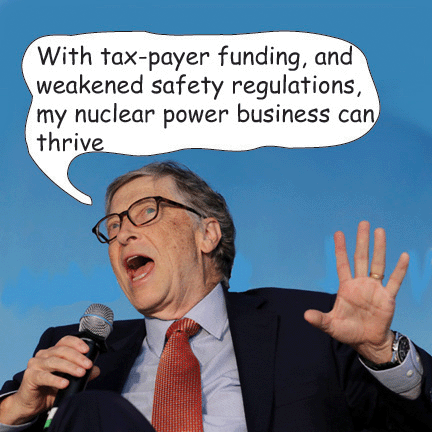
“But he wants another $2 billion from us to help pay for his Natrium small reactor. That speaks volumes. We are supposed to help poor Bill Gates pay for his expensive toy, which has absolutely no utility whatsoever for anything, other than making proliferation risks greater. And the reactors are intended for export.”
In Ohio, Larry Householder, the former Speaker of the House, is facing trial in federal court in Cincinnati on charges of directing $61 million to pass and defend a billion dollar nuclear bailout bill.
In July 2021, FirstEnergy entered into a deferred prosecution agreement, paid a $230 million penalty and acknowledged that it paid the money to Householder and others through a non profit to get the bailout bill passed.
In South Carolina, in October 2021, Kevin B. Marsh, 66, former SCANA CEO and Chairman of the Board of Directors, was sentenced to two years in federal prison after pleading guilty to conspiracy to commit mail and wire fraud.
Federal officials alleged that Marsh intentionally defrauded ratepayers while overseeing and managing SCANA’s operations – including the construction of two reactors at the V.C. Summer Nuclear Station – so the company could obtain and retain rate increases imposed on its rate-paying customers and qualify for up to $2.2 billion in tax credits.
In late 2016, confronted with information that the project was delayed and that the tax credits were at risk, Marsh and others withheld that information from regulators in an effort to keep the project going.
Marsh’s false and misleading statements, as well as other false and materially misleading statements made by his co-conspirators, allowed SCANA to obtain and retain rate increases imposed on SCANA’s rate-paying customers.
And in Illinois, in March 2022, a federal grand jury indicted the powerful Speaker of the House, Michael Madigan, on racketeering and bribery charges for allegedly using his official position to corruptly solicit and receive personal financial rewards for himself and his associates.
Two years earlier, Commonwealth Edison Company, the largest electric utility in Illinois, entered into a deferred prosecution agreement, paid $200 million to resolve bribery allegations related to the Madigan case. Madigan’s House carried water for ComEd and its corporate parent, Exelon, allowing it to charge Illinois ratepayers as much as $2.3 billion to keep afloat Exelon’s two struggling nuclear plants.
Linda Pentz Gunter of Beyond Nuclear has been tracking the corruption in the nuclear power industry.
Do you see this as a positive story – that the Justice Department is bringing these prosecutions against major corporations and politicians, that they are focusing their fire on serious corporate corruption?
“Absolutely,” Gunter told Corporate Crime Reporter in an interview last week. “When we watched the Householder press conference unfold and we listened to the FBI and the U.S. Attorney and the way they spoke about this, they were furious that they had to expend this kind of time on politicians that should be just doing their jobs. The U.S. Attorney in particular talks about the fentanyl crisis and all of the other things they were trying to deal with, and instead they had to spend this extraordinary amount of time on corrupt politicians, politicians who ought to know better. They represent us. You don’t expect them to be lawbreakers.”
It was so surprising to us. We think of the FBI as an organization that investigates citizen activist groups. To see the FBI actually taking the time to thoroughly investigate this case – was quite encouraging. It’s not surprising to see a leading Democrat in Illinois be so easily bought and so corrupt, as it is by no means restricted along party lines. If you look at the history of political corruption, it’s not restricted to one party or another. But finally you are seeing some justice.”

“Nuclear power is so uneconomical now,” Gunter said. “Nuclear power is almost completely dependent on the government for not only its continued existence, but also for new reactor construction. It’s almost completely dependent on federal bailouts, which is our money. They cannot stand on their own two feet financially.

To see the industry exposed for the kinds of skullduggery and corruption that is going on at our expense is very satisfying.”
The West Virginia legislature last year repealed its ban on nuclear power facilities. And earlier this year the Associated Press reported that Bill Gates is considering West Virginia as a location for his nuclear power efforts. Here is the opening of that story:
“Bill Gates is looking to West Virginia as he plans for the next phase of his effort to reboot U.S. nuclear energy technology: powering the east coast.”
“Microsoft co-founder Gates, who visited a closed down coal-fired plant in Glasgow, West Virginia on Monday, said he needs to see how his Natrium nuclear reactor demonstration in Wyoming performs before making any announcements about new sites.”
“The Kemmerer, Wyoming sodium-cooled nuclear reactor is taking over the site of a current coal-powered plant and was scheduled to be online by 2028, but is facing delays because its only source of fuel was uranium from Russia, now at war with Ukraine.”
“However, during a visit to the American Electric Power plant, which closed in 2015, Gates called the West Virginia’s Legislature’s decision last year to repeal the state’s ban on nuclear power facilities ‘quite impressive’ and said he’s looking for sites to expand his efforts to the east coast.”
So, Bill Gates wants to bring his nuclear power plants to the East Coast. And there is the West Virginia legislature upending its ban a year before he arrives on the scene to scope out locations.
No ground has been broken yet on any of these so-called new advanced reactors. But are there still any new plants under construction in the United States?
“In Georgia, you have the only two new nuclear power plants still under construction,” Gunter said. “These are the Vogtle 3 & 4 reactors – also Westinghouse AP1000 – also paid by Georgia ratepayers in advance through this construction work in progress law. That means you get a surcharge in your rates while they are building them, also heavily subsidized, originally pushed through by President Obama with federal subsidies, massively over budget. We are looking at costs as high as $34 billion for these two reactors if and when they are completed. They are constantly delayed. They were supposed to be online years ago. Now they are supposed to be online this year. Now it’s maybe next year. And it keeps getting pushed back.”
“The Georgia case exemplifies many of the problems with nuclear power, front and center being the fact that nuclear power is too slow and too expensive to be useful in any form for addressing the climate crisis.”
“There are other arguments against it – waste and security and safety. But just too slow and too expensive knock it out as a contender. And yet at same time as you just mentioned, you have people like Bill Gates trying to get his Natrium small reactor started. And Bill Gates, effectively an American oligarch, a billionaire, has to still come cap in hand to the federal government. His TerraPower nuclear energy company is putting in $2 billion.”
“But he wants another $2 billion from us to help pay for his Natrium small reactor. That speaks volumes. We are supposed to help poor Bill Gates pay for his expensive toy, which has absolutely no utility whatsoever for anything, other than making proliferation risks greater. And the reactors are intended for export.”
“These so-called new small reactors are based on old designs that have safety issues and that produce plutonium and raise proliferation concerns. They are eyeing the export market, not necessarily for here in the United States. But they have to build them somewhere first. The fact that he is eyeing West Virginia is interesting.”
Give us the lay of the land. How many nuclear power plants are operating in the United States? How many new ones? And what is the prognosis for nuclear power in the USA?
“There are the two traditional full-sized nuclear power reactors being built in Georgia. And then there are the 92 reactors still operating in the United States. There are quite a few closing. We are seeing a flurry of shutdowns – Vermont Yankee, Pilgrim, Oyster Creek, Indian Point – having reached the end of their affordable life. The tune then changed a bit. They started asking for bailouts. The Palisades reactor in Michigan closed, but the new owner, Holtec, in charge of decommissioning it, is trying to grab some of the federal funding in the Inflation Reduction Act to reopen the reactor. That presents all sorts of complications as Holtec is not a reactor operator and has never operated a nuclear power plant.”
“The owner of Palisades is Holtec, a decommissioning and waste company. It has never operated a reactor. There is a level of desperation in the industry. It is inevitably declining because it is inflexible, unaffordable, the costs due to the immense risks involved are killing them too. They are aging and degrading. They are not economical to run anymore.”
What percentage of electricity are we getting from nuclear power?
“It’s under 20 percent in the United States. Globally, it dropped to below ten percent for the first time. In this country, it would be on a downward trajectory, but we need to see what’s going to happen with these license renewals and these requests for federal dollars to keep reactors open that otherwise would be unaffordable to run.”
If we shut them all down, how do we replace the 20 percent?
“Nothing gets shut down overnight obviously. But the renewable energy sector is the fastest growing sector in this country. HB 6 in Ohio not only delivered these massive subsidies to FirstEnergy to keep its failing nuclear reactors open, it also eliminated mandates for wind and solar altogether.”
“The nuclear energy industry says we need all kinds of energy, including nuclear. But actually nuclear energy, because of the federal subsidies needed to keep it open, effectively shuts out renewables. In fact, we need to shut down the nuclear energy plants in order to fully fund and support renewal energy measures. Every dollar you invest in energy efficiency reduces more carbon faster than that same dollar invested in nuclear power. It’s more expensive to keep a nuclear power plant open than it is to initiate the same amount of energy from new renewables. You can bring renewables on in a couple of years. These reactors that they are building have taken a decade or more and are still not complete.”
They predicted that even the new small reactors would be operational by 2016. Here we are in 2023, and only one company just got a design certification permit. That tells you how slow that progress is.”
“We have the tools in place. We have energy efficiency, solar and wind. We could do weatherization programs with that money that would reduce use dramatically. But instead, the immense lobbying power of the energy companies has successfully maintained an outdated, dangerous and damaging status quo that should have been replaced decades ago.”
Then you have all of these non profit leaders pushing nuclear power.
“Yes, you even have people like Oliver Stone who has made a pro-nuclear film, based on one book. You have Bill Gates, who we have talked about. Richard Branson, a UK billionaire. There are a number of them. You wish that all of these people with more money than God would use their money on something useful. It baffles my mind that Bill Gates wants to knock out malaria on one hand but on the other hand wants to pockmark the planet with nuclear reactors that release harmful radiation routinely, nevermind the devastation if a major accident were to occur. The press loves the person who changed their minds – people like Stuart Brand of the Whole Earth Catalog.”l
[For the complete q/a format Interview with Linda Pentz Gunter, see 37 Corporate Crime Reporter 8(11), February 13, 2023, print edition only.]
1 This Month
23-25 October – on Zoom – World BEYOND War’s annual global conferenc


Shut down the radiation-damaged Heysham nuclear reactors now
To see nuclear-related stories in greater depth and intensity – go to https://nuclearinformation.wordpress.com

Say No to NASA’s Reckless Nuclear Reactor on the Moon
Say No to NASA’s Reckless Nuclear Reactor on the Moon

-
Archives
- October 2026 (209)
- September 2026 (339)
- August 2026 (330)
- July 2026 (355)
- June 2026 (287)
- May 2026 (306)
- April 2026 (356)
- March 2026 (251)
- February 2026 (267)
- January 2026 (308)
- December 2025 (358)
- November 2025 (359)
-
Categories
- 1
- 1 NUCLEAR ISSUES
- business and costs
- climate change
- culture and arts
- ENERGY
- environment
- health
- history
- indigenous issues
- Legal
- marketing of nuclear
- media
- opposition to nuclear
- PERSONAL STORIES
- politics
- politics international
- Religion and ethics
- safety
- secrets,lies and civil liberties
- spinbuster
- technology
- Uranium
- wastes
- weapons and war
- Women
- 2 WORLD
- ACTION
- AFRICA
- Atrocities
- AUSTRALIA
- Christina's notes
- Christina's themes
- culture and arts
- Events
- Fuk 2022
- Fuk 2023
- Fukushima 2017
- Fukushima 2018
- fukushima 2019
- Fukushima 2020
- Fukushima 2021
- general
- global warming
- Humour (God we need it)
- Nuclear
- RARE EARTHS
- Reference
- resources – print
- Resources -audiovicual
- Weekly Newsletter
- World
- World Nuclear
- YouTube
-
RSS
Entries RSS
Comments RSS

