UK: big talk about small nuclear reactors, but not much is happening, really.

Over 3000GW of renewables are already in place globally, compared to only 394 GW of nuclear, with wind and solar now romping further ahead around the world. By 2050, the BNEF says the global power system will be dominated by wind and solar (75% of production), with nuclear at just 9%, down from 10% now. If it makes it to 24% nuclear by then, the UK will be a bit of an outlier.
“……………………………….Graham Stuart, now a Minister of State at the new Department for Energy Security and Net Zero…..- ‘what I can say is that we are absolutely committed to nuclear as a significant share of our electricity because we need that baseload and are committed to driving it forward.’
So that’s a positive ‘go’ signal, although funding is still a major problem, and, despite much talk, progress on the proposed ‘24 GW of nuclear by 2050’ programme seems to have slipped behind.
As NuClear News 141 reported, at the end of November last year, the Government was said to be about to announce proposals to set up a new body called Great British Nuclear (GBN), which would develop a network of small modular reactors (SMRs), as well as promote new large reactors. Grant Shapps, the Business Secretary, was due to make the announcement on 29th November. But it was delayed because of a row with the Treasury over funding.
And by January, The Times was reporting that a deal on SMR funding was unlikely to materialise for at least another 12 months. A senior government source said the Treasury would not sign off on any orders or significant funding for SMR work until the technology had approval from the Nuclear Regulators Generic Design Assessment, which was not expected, until 2024.
In addition to the proposed Rolls Royce SMRs, four of which are planned initially, several other SMRs are also now in the race for UK deployment, some from overseas. They include GE Hitachi’s 300MW boiling water reactor, and Holtec’s 160MWe pressurised water reactor, developed in collaboration with Mitsubishi and Hyundai. The USA’s NuScale, the most advanced project so far, has also expressed interest in UK sites for its mini PWR.
Potential UK sites for new SMRs include Trawsfynydd in Wales and Heysham and Oldbury in England, but, given the funding issues, it will evidently be a while before anything happens on SMRs, or indeed, in terms of new larger projects, after Sizewell C. Though some help with funding may yet be on hand. According to the Telegraph, nuclear projects may soon to be classed as ‘green’ or ’sustainable’ investments, clearing a way for more institutional investors and environment-focused funds to back them. The Telegraph says there are also hopes that use can be made of the Government’s green gilts green savings bonds.
Is nuclear really green? Not many greens think so, and given the risks, costs and delays associated with it, nuclear is often not popular with investors. There have been some delays with the only currently live new projects in the UK, the Hinkley Point C EPR being built by EdF, although nothing so far on the decade-long delays with the ongoing EPR projects in France and Finland. EDF now say the Hinkley EPR should start up in 2027. However, to be on the safe side, the deadline for starting up its major CfD payment (after which, under the contract rules, it would not be eligible for CfD payments) has been extended to 2036 from 2033.
…………………….. EDF has recently admitted that Hinkley Point C final cost is likely to be £31-32bn, up from the £18 bn estimated initially. Sizewell ought to benefit from construction lessons learned from Hinkley, but, although RAB pushes the financial risks onto consumers, there are still many investment uncertainties about the project.
Finance may be a key issue for EDF in the UK, but it is if anything even more of an issue for it in France, where it is facing major problems, with a huge repair bill and loss of income as plants are shut for safety checks and power has to be imported. As a result, with energy security being a key issue these days, nuclear no longer looks reliable. ………………………
With a handful of other nuclear projects being considered around the world, including some SMRs, and Russia and China also pressing ahead with larger plants, the UK isn’t the only country with ambitions for nuclear expansion. However, globally, the likely scale of nuclear expansion is relatively small in total, compared with the vast scale and rapid pace of renewables expansion.
Over 3000GW of renewables are already in place globally, compared to only 394 GW of nuclear, with wind and solar now romping further ahead around the world. By 2050, the BNEF says the global power system will be dominated by wind and solar (75% of production), with nuclear at just 9%, down from 10% now. If it makes it to 24% nuclear by then, the UK will be a bit of an outlier. https://renewextraweekly.blogspot.com/2023/02/uk-nuclear-news.html
Vladimir Putin says the US-led military alliance in Ukraine seeks defeat and liquidation of Russia
ABC News 27 Feb 23
President Vladimir Putin has cast the confrontation with the West over the Ukraine war as an existential battle for the survival of Russia and the Russian people — and said he was forced to take into account NATO’s nuclear capabilities.
Key points:
- February 24 marked the first anniversary of the Russian invasion of Ukraine
- Mr Putin says he believes the future of Russia is in peril
- The interview was aired on Sunday on Russian state television
A year since ordering the invasion of Ukraine, Mr Putin is increasingly presenting the war as a make-or-break moment in Russian history — and saying that he believes the very future of Russia and its people is in peril…………………………………………
Mr Putin said the tens of billions of dollars’ worth of US and European military assistance to Ukraine showed that Russia was now facing off NATO itself — the Cold War nightmare of both Soviet and Western leaders.
Ukraine says it will not rest until every last Russian soldier is ejected from Ukraine, including from Crimea which Russia annexed in 2014………………….
Russia’s official nuclear doctrine allows for the use of nuclear weapons if they — or other types of weapons of mass destruction — are used against it, or if conventional weapons are used, which endanger “the very existence of the state”………………………………..
Group calls for the stoppage of works at Sizewell C nuclear site, as Sizewell project is not yet authorised, and works are damaging the environment
EDF continues its programme of eco-vandalism. TASC calls on SoS for Defra
to intervene. Despite an EDF statement on 18th January, claiming that,
“[Its] Advance [preparatory] works [for Sizewell C] are reversible in the
unlikely event Sizewell C will not proceed to a Final Investment Decision
and full construction”, TASC is shocked and disgusted to discover that
EDF will renege on that promise when, on 1st March, EDF begins to destroy
wet woodland, a legally protected priority ‘Biodiversity Action Plan’
habitat, located in Sizewell Marshes Site of Special Scientific Interest.
Despite EDF knowing full well that we are now entering the bird, bat and
reptile breeding season, it has already begun felling woodland in Goose
Hill, as part of its plan to clear over 40 hectares – including the
felling of some ancient trees – to make way for Sizewell C’s car park.
TASC’s Chair, Jenny Kirtley said “These actions create permanent and
irreversible environmental loss to East Suffolk’s Heritage Coastal
biodiversity and is in direct contradiction of the government’s ‘green
agenda’. Despite EDF’s claim, it is not possible to reverse such losses
and represents further eco-vandalism which goes hand-in-glove with the
construction of a redundant and unnecessary nuclear plant which may never
commence construction.
Sizewell C has yet to make a Final Investment
Decision, does not have a site licence from the Office for Nuclear
Regulation, nor three outstanding environmental permits needed from the
Environment Agency. Furthermore, the project’s DCO approval is subject to
TASC’s judicial review proceedings scheduled to take place in the High
Court on 22nd and 23rd March.
We have asked the Secretary of State for
Defra and the MP for Suffolk Coastal to intervene and to stop the work at
least until these uncertainties around Sizewell C’s various
authorisations have been granted.’.
TASC 24th Feb 2023
Russia Sends Ship To Space Station To Rescue “Stranded Crew”
BY TYLER DURDEN, SATURDAY, FEB 25, 2023 https://www.zerohedge.com/technology/russia-sends-ship-space-station-rescue-stranded-crew
Russia launched an uncrewed Soyuz spacecraft on Friday for a NASA astronaut and two cosmonauts after their original ride back to Earth was damaged by a micrometeoroid impact while parked at the International Space Station in December.
The rescue plan was announced last month. The empty rescue capsule, Soyuz MS-23, blasted off from Baikonur Cosmodrome in Kazakhstan early Friday morning and is set to dock at the orbiting lab on Sunday.
WATCH: NASA launched a Roscomos Soyuz spacecraft from the Baikonur Cosmodrome in Kazakhstan to the International Space Station to bring back a stranded crew to Earth https://t.co/aUNd9r46fs pic.twitter.com/6brPI1vVzm— Reuters Asia (@ReutersAsia) February 24, 2023
The damaged Soyuz will return to Earth for further inspection at the end of March. There will be no crew on board.
The three men arrived at the ISS in September on what was expected to be a six-month mission, but that will be extended for another six months.
NASA is sending another crew of four to the ISS Monday via a SpaceX rocket from Florida’s Kennedy Space Center.
The Empire Gives People The Illusion Of Fighting The Power Without Ever Endangering Real Power
| CAITLIN JOHNSTONE, FEB 26 |
The one-year anniversary of Russia’s invasion of Ukraine has seen countless emotional news segments and heartstring-plucking articles, wall-to-wall social media posts, and public demonstrations decrying the evils of Vladimir Putin throughout the western world.
For what’s probably the first “anti-war” protest of most of their lives, American liberals gathered at the Lincoln Memorial in Washington DC over the weekend to bravely condemn the leader of a foreign government thousands of miles away. There they were joined by empire managers like the virulent warmonger Samantha Power, who spoke at the rally opposing Russian warmongering at the capital of the most warlike nation on the planet.
For the last year, mainstream westerners have been using this war to act out their fantasies of being courageous up-punching anti-imperialists, fighting powerful bloodthirsty tyrants in defense of the needful, all while living directly under the thumb of the most tyrannical regime in the world.
They mindlessly regurgitate the propaganda of the most powerful empire that has ever existed, parrot the same lines that are already being said all day long by all the most powerful institutions in the western world, all in service of the hegemonic agendas of the largest and most murderous power structure on earth, while pretending to be standing in opposition to the powerful.
The way the war in Ukraine allows mainstream liberals to play-act as rebellious anti-imperialists is a good illustration of how the empire gives people the illusion of fighting the power without their ever opposing the empire……………………..
In exactly the same way, Trump’s presidency allowed right wingers to pretend they were part of a movement against the establishment, despite Trump never actually challenging the establishment in any meaningful way. They believed he was fighting the Deep State even after he imprisoned Assange. They believed he was “ending the wars” even as he ramped up aggressions against Russia which helped bring us to where we are today, ……………………………………..
Imperial narrative managers actively foster these delusions of revolution and up-punching among the mainstream herd because it’s a great way to kill the possibility of any real revolutionary zeitgeist. If you can give people the illusion that they are fighting the power without their ever actually fighting the power, then you can always remain in power……………………….
Here’s hoping enough of us learn to see through the illusion one day https://caitlinjohnstone.substack.com/p/the-empire-gives-people-the-illusion?utm_source=post-email-title&publication_id=82124&post_id=105198072&isFreemail=true&utm_medium=email
India, China may have averted nuclear war in Ukraine by influencing Russia: US
Live Mint, 26 Feb 2023, Edited By Anwesha Mitra
As the Ukraine-Russia war continues, US Secretary of State Anthony Blinken said recently that India and China may have helped persuade Moscow to avoid using nuclear weapons. The remarks came as the war marked its first anniversary and concerns grow about a Russian spring offensive.
“…other countries that might have a little bit more influence with Russia these days, like China, but also other countries, like India, to engage him directly about their absolute opposition to any use of nuclear weapons. And we know that they conveyed those messages. And I think that had some effect,” Blinken told The Atlantic during an interview published on Friday. ……………………………………………………………….. more https://www.livemint.com/news/world/india-china-may-have-influenced-russia-prevented-nuclear-war-in-ukraine-us-11677322391450.html
February 26 Energy News — geoharvey

Opinion: ¶ “Dear Maryland: It’s Time To Drive Clean Trucks And Buses” • Every soul walking this earth deserves to breathe clean air. But there are counties across Maryland have air that hasn’t met the EPA’s standards for decades, causing public health problems ranging from asthma to premature death. Much of that pollution comes from […]
February 26 Energy News — geoharvey
World Insights: Science should guide Fukushima wastewater release plan, Pacific leaders say
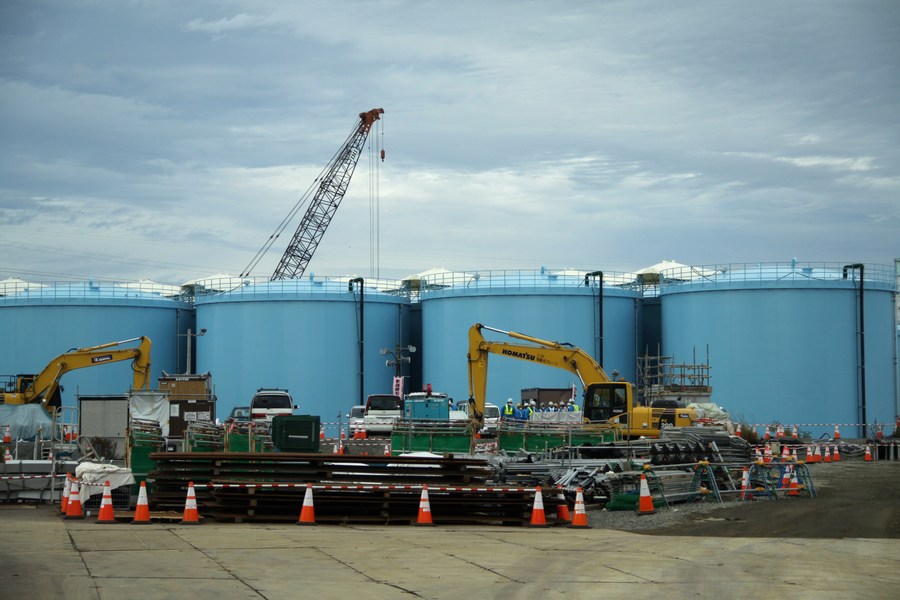
File photo taken on Oct. 12, 2017 shows huge tanks that store contaminated radioactive wastewater in Fukushima Daiichi nuclear plant, in Fukushima Prefecture, Japan
– Civil society groups in Japan and many international organizations have voiced objections to the Fukushima wastewater release plan, citing a lack of a practical demonstration and its potential threat to society and marine ecology.
– Analysts believe that Japan should not ignore the concerns and livelihoods of Pacific islanders.
SUVA, Feb. 26 (Xinhua) — Pacific leaders on Friday wrapped up the two-day Pacific Islands Forum (PIF) Special Leaders’ Retreat in Fiji, where Japan’s Fukushima wastewater release plan was in the limelight.
The PIF rotating chair underlined in a statement that science and data should guide political decisions on Japan’s proposed discharge of treated radioactive wastewater from the wrecked Fukushima nuclear plant into the sea.
The outgoing chair and Fiji’s Prime Minister Sitiveni Rabuka, together with other PIF leaders, believes the decision is not as simple as a domestic issue of Japan, but concerns the South Pacific island countries and beyond.
Given that related data and evidence provided by Japan are far from independent or verifiable, the PIF has called on the country repeatedly to delay the discharge plan.

People rally to protest against the Japanese government’s decision to discharge contaminated radioactive wastewater in Fukushima Prefecture into the sea, in Tokyo, capital of Japan, April 13, 2021.
CRITICISM FROM INT’L COMMUNITY
Civil society groups in Japan and many international organizations have also voiced objections to the plan, citing a lack of a practical demonstration and its potential threat to society and marine ecology.
Over the past years, fishermen in neighboring countries have staged several rallies, calling for immediate stop to the “grave criminal act” of releasing radioactive water into the sea. Within Japan, local civic groups have organized protests outside the government house of Fukushima Prefecture.
Japan’s unilateral push to discharge radioactive wastewater from its crippled Fukushima Daiichi nuclear power plant into the Pacific Ocean is irresponsible and harmful, South Korean green activists have said.
“The Pacific Ocean is not the sea of Japan, but the sea of everybody … Pollutants will flow to neighboring countries in a situation that a lot of radioactive materials have already been released and contaminated (the marine ecosystem),” Ahn Jae-hun, energy and climate change director at the Korea Federation for Environment Movement, told Xinhua.
The Japanese government’s decision to discharge the contaminated water into the sea when there are alternatives such as long-term storage violates the precautionary principle recognized by the international community, Greenpeace Seoul Office has said. Greenpeace is an independent global campaigning network for environment protection.
“We must prevent action that will lead or mislead us toward another major nuclear contamination disaster at the hands of others,” said PIF Secretary General Henry Puna.
Take a look at how Japan proceeded with that.
The Japanese government decided in April 2021 to release more than one million tons of treated wastewater into the Pacific Ocean this spring.
Three months later, Japan greenlit the discharge plan while the International Atomic Energy Agency (IAEA)’s task force was still conducting the review mission.
Earlier this year, Japan unilaterally announced that it would start discharging the radioactive water in spring or summer, just before the agency’s task force arrives in Japan for review.

A poster to boycott Japanese products is seen in a supermarket to protest against Japan’s decision to dump radioactive wastewater from the crippled Fukushima Daiichi nuclear power plant into the Pacific Ocean, in Seoul, South Korea, April 14, 2021.
PACIFIC OPPOSITION
Pacific island countries unanimously oppose Japan’s release plan for multiple reasons, citing ecological fragility, economic dependence on the fisheries industry, and the devastating effects of radioactive pollution caused by Western nuclear testing.
First, Pacific island countries are concerned that the released radioactive substances will spread with ocean currents and tides, risking contaminating fish. As more than half of the world’s tuna comes from the Pacific Ocean, a potentially contaminated environment could hurt the fisheries that those countries rely on.
Second, the Pacific Ocean’s delicate ecology may come under threat. If the wastewater release leads to an ecological disaster, the vulnerable island residents will leave their homes, causing an ecological and survival crisis that will deal a heavy blow to the entire Pacific region.
Last, Western countries have conducted a dazzling array of nuclear tests in the Pacific since the mid-20th century, resulting in shocking radioactive pollution and ecological disasters. These have left painful memories for islanders, who have been sensitive to the wastewater issue.
Analysts believe that Japan should not ignore the concerns and livelihoods of Pacific islanders. Neither should it dump the wastewater into the sea until disputes are settled over the legitimacy of the discharge plan, the reliability of radioactivity data, the effectiveness of purification equipment and the uncertainty of environmental impact, they added.
https://english.news.cn/20230225/1aa34ef7e18444c99e8a1e84a8b691b7/c.html
Academic speaks out against Japan’s wastewater plan for Pacific

At the heart of this special leaders’ retreat is the unity and strength of our one BluePacific, says outgoing forum chair and Fijian Prime Minister Sitiveni Rabuka.
Feb 24 2023
A leading Pacific voice in academia is speaking out against Japan’s plan to dump contaminated water into the Pacific Ocean.
University of Auckland associate dean Pacific Sir Collin Tukuitonga is vehemently opposed to the decision to release 1.25 million litres of treated wastewater from the damaged Fukushima Daiichi Nuclear Power Plant.
“While the science of this issue could perhaps be argued either way, it is completely unacceptable to be dumping contaminated wastewater into our Pacific Ocean,” Tukuitonga said.
“Pacific peoples rely on the ocean for our livelihoods and to feed our families. We are the guardians of the largest and most precious ocean in the world. There is absolutely no way that the Pacific should be the dumping ground for this waste.”
An earthquake in March 2011 followed by a tsunami caused major damage to the plant and knocked out its cooling system.
The nuclear power plant is now defunct but to keep the reactors from overheating hundreds of tonnes of water are pumped through the reactors every day.

University of Auckland academic Sir Collin Tukuitonga has joined the chorus of Pacific voices opposed to a plan to dump treated wastewater from the Fukushima Daiichi Nuclear Power Plant into the Pacific Ocean.
As Japan is running out of space to store this contaminated water, it plans to dump the treated wastewater directly into the Pacific.
Despite protests the dumping is expected to start some time this year and continue for 30 to 40 years.
Many Pacific nations have voiced opposition to the plan including Cook Islands Prime Minister Mark Brown, who is leading a delegation to Japan to present the case against the proposal.
Tukuitonga said it was important that larger Pacific nations such as Aotearoa New Zealand use their voices to oppose the dumping.
“New Zealand has a responsibility to its partners in the region to stand up to Japan for its lack of consideration for Pacific peoples living in the region who heavily rely on the ocean for their livelihoods,” he said.
The matter was high on the agenda at the Special Pacific Leaders Retreat in Fiji on Friday.
World dreads Japan’s date with disaster

2023-02-24
Photographs and videos from the site of the Fukushima Daiichi nuclear plant in northeastern Japan, showing workers preparing to release nuclear wastewater into the ocean, are flooding social networking sites.
Japan plans to start dumping nuclear waste water into the ocean this spring. Twelve years after the meltdown at the plant, caused by a deadly tsunami triggered by an earthquake, Japan is all set to inconvenience the world for its own convenience.
It is clear from developments how Japan prepared for this move. Although Tokyo Electric Power Company Holdings, which owns the now defunct nuclear plant, promised in 2015 that it would not dump nuclear waste water into the ocean, it “found” evidence of new radioactive contamination amid the ruins in March 2021. A month later, TEPCO claimed the tanks in which it was collecting nuclear contaminated water would get filled up by the autumn of 2022, necessitating its dumping into the ocean.
The Japanese Nuclear Regulation Authority, a highly “independent “agency, approved TEPCO’s plan in July 2022. On Feb 22, it approved the reviewing documents for the plan, which will officially pass after soliciting public opinion.
But the seemingly legal procedures do not make Japan’s move legitimate. On the contrary, if the nuclear waste water is “safe” after processing, as it claims, why can’t Japan find a use for it? Its leaders make apologetic gestures, but don’t want to prevent more damage from being done.
Maybe the countries and regions that are going to be affected should sue Japan in international courts, sanction the companies responsible, and even boycott products from Japan for safety’s sake. And do it while being polite all the time.
https://global.chinadaily.com.cn/a/202302/24/WS63f7f644a31057c47ebb08c4.html
Japan not only dumps wastewater but also morality
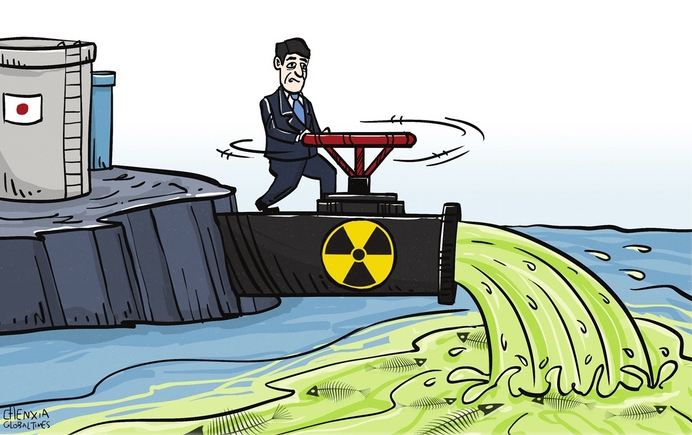
Illustration: Chen Xia/Global Times
Feb 23, 2023
Although Japan’s plan to dump nuclear-contaminated water into the sea has been strongly opposed by the international community, Tokyo is still going its own way and speeding up the plan to make the rest of the world pay for it.
According to the Japan Times, government sources said on Wednesday that Japan will seek the endorsement of the G7 nations for its plan to discharge nuclear-contaminated water from its crippled nuclear power plant in Fukushima Prefecture into the Pacific Ocean when it hosts a meeting of the group’s energy ministers in April.
On March 11, 2011, a 9.0-magnitude earthquake occurred off the coast of northeastern Japan and triggered a tsunami, resulting in a nuclear leak at the Fukushima Daiichi Nuclear Power Plant. Faced with many options for dealing with nuclear-contaminated water, the Japanese government chose to dump it in the ocean because it takes the shortest time and costs the least.
Japan’s attempt to draw other G7 members over to its side is through hosting a G7 meeting, a platform where it is easiest to reach consensus. Tokyo’s aim is very obvious. This is also a kind of public opinion manipulation to cover up its own wrongdoing.
Dumping nuclear-contaminated water into the sea has not only sparked controversy within the country, but also met with strong opposition from neighboring countries such as China, South Korea, and Russia. Therefore, Tokyo wants the Western camp to endorse it in order to find legitimacy for its actions.
If the “treated water” claimed by the Japanese government is really safe, why is it being dumped into the Pacific Ocean? Today, when water resources are so tight, the Japanese government can use “treated water” for irrigation, breeding, or other purposes. Similarly, the Japanese government insists that the dump of nuclear-contaminated water is under the supervision of the international community, but why did it arbitrarily decide before the International Atomic Energy Agency completed its supervision? Tokyo’s guilt is self-evident.
After the Fukushima nuclear disaster, China, Russia, South Korea, and other countries were the first to give Japan a helping hand. However, Japan returned their kindness by ignoring the lives, health, and safety of people in neighboring countries.
The US, which claims human rights come first, is turning a blind eye to Japan’s move. The US is also a victim of the accident. A large amount of pollutants have drifted from west to east to the US coast due to ocean circulation along the North Pacific Current. Nevertheless, in order to maintain the alliance between the US and Japan and achieve the goal of dominating East Asia, Washington continues to tolerate Tokyo.
Indeed, it is not just the US that turns a blind eye to Japan on certain issues; Japan does the same with the US on many things. For instance, the whole world is paying close attention to whether Washington planned the Nord Stream explosion, but the Japanese government, which has always been actively involved in international affairs, has kept a low profile this time. In a sense, Japan and the US are covering up each other’s scandals. In order to maintain the bond of the so-called alliance between them, they do not hesitate to ignore facts and violate science.
After the nuclear-contaminated water is dumped into the sea, it will quickly spread to most parts of the Pacific Ocean, thereby affecting the global oceans. According to marine biologists, radiation will be absorbed by marine organisms and enter the human body along the food chain, which is a major threat to the Pacific Rim countries and the ecosystem on which all human beings depend.
It is not a matter that relates to a single country. Rather, it is a matter of the security of neighboring countries and sustainable security of the international sea food chain, and the health of future generations. Therefore, it deserves high attention from the international community. Some said Japan’s dumping of nuclear-contaminated water has got the approval from its big brother, the US. However, this is both a scientific and humanitarian issue. Japan should explain it to the world, not Washington, in an open and transparent manner. It should also work with relevant international organizations and scientists from neighboring countries.
G7 are not in a position to give scientific evaluation of Japan’s discharge of Fukushima contaminated water. If they do agree on a statement that endorses Japan’s plan, they have to bear the responsibilities for what Japan should bear.
Japan’s attempt to mislead international public opinion and woo the Western bloc is irresponsible and will not work. Japan is not only dumping nuclear-contaminated water, but also its morality too. A Japan that tampers with its history of aggression, a Japan that disrupts the international order, and a Japan that harms the homeland of mankind, will never be able to stand up with dignity.
The article was compiled by Global Times reporter Liu Zixuan based on an interview with Liu Jiangyong, vice dean of the Institute of Modern International Relations at Tsinghua University. opinion@globaltimes.com.cn
Japan beefs up moves in seeking G7 support for wastewater dump
Action to cause irreversible damage to environment, human health: experts

Feb 23, 2023
Amid backlash from domestic and the international community, the Japanese government reportedly is to seek the endorsement of the Group of Seven (G7) nations for its controversial plan to discharge radioactive contaminated wastewater from the crippled nuclear power plant in Fukushima Prefecture into the Pacific Ocean. Analysts criticized countries that are giving a go-ahead signal to Japan’s irresponsible dumping plan, noting they will share the shame of making irreversible damage to maritime environment and human health.
As this year’s chair, Japan is seeking to include a phrase that says the G7 members “welcome” its “transparent” approach toward the disposal of the treated water in a document to be released after the April 15 to 16 gathering in Sapporo, Japanese media Kyodo News reported citing government sources.
In January, the Japanese government and the plant operator, Tokyo Electric Power Company Holdings, announced the plan to begin discharging the treated water around this spring or summer, with construction work underway to install an undersea tunnel and other necessary facilities.
Analysts said that Japan has beefed up efforts in soliciting support from the US and Western countries for its disposal of the Fukushima radioactive contaminated wastewater and in promoting its narrative of the “safety” of the wastewater amid growing oppositions from domestic public, neighboring countries and other stakeholders.
Against the backdrop of the Ukraine crisis and current tense Korean Peninsula situation, Japan is working to create the momentum for its dumping plan especially among Western countries as other G7 nations are also members of NATO and the military pact is seeking closer cooperation with Japan, Da Zhigang, director of the Institute of Northeast Asian Studies at the Heilongjiang Provincial Academy of Social Sciences, told the Global Times.
This is not the first time for Japan to try to include the Fukushima nuclear wastewater issue into the G7 declaration. In May 2016, after the Ise-Shima Summit in Japan, the G7 Leaders’ Declaration wrote about “steady progress on decommissioning and treatment of contaminated water” as well as “Japan’s efforts to proceed in an open and transparent manner in close communication with the international community.”
The US also expressed support for its close ally in Asia. In April 2021, after the Japanese government mentioned the plan to release more than 1 million metric tons of treated radioactive water, the US Department of State said in a statement that Japan “appears to have adopted an approach in accordance with globally accepted nuclear safety standards.”
However, fancy words from the US and the G7 cannot gloss over the increasing questions over the safety of the “treated” wastewater, the transparency of Japan’s processing of the contaminated water and its consultations on the disposal with related neighboring countries, analysts said.
Pacific island nations also urged Japan to delay the release of the contaminated water over fears fisheries will be contaminated and that the health of people will be affected. For example, during a livestreamed public meeting in Suva, Fiji on January 18, the Pacific Island Forum Secretary General Henry Puna said, “Our region is steadfast that there be no discharge until all parties verify it is safe.”
At the Security Council session on February 14 over Japan’s discharge of nuclear-contaminated water, both representatives from China and Russia expressed concerns over the issue. Ambassador Zhang Jun, Permanent Representative of China to the UN, made China’s position clear, stressing that “Japan’s discharge of nuclear contaminated water into the sea will severely endanger the global marine environment, ecosystems, and the lives and health of people of all countries.”
“Japan has been bent on forcibly approving the discharge program of the nuclear contaminated water and has been accelerating the preparations for the discharge. Such behavior is extremely irresponsible,” said Zhang.
Lingering threats
The Japanese government sees the plan of dumping the contaminated water into the ocean as the most “economic” way to get rid of the burden from the destroyed Fukushima nuclear power plant. But people in Japan, neighboring countries and the world will pay the price given the irreversible damage to environment and human health, Zhou Yongsheng, deputy director of the Japanese Studies Center at China Foreign Affairs University, told the Global Times.
The Japanese government will be condemned and held accountable if it irresponsibly discharges contaminated nuclear wastewater into the ocean and countries that give green light to Tokyo’s moves will also share the shame, said Zhou.
Concerns expressed by UN human rights experts, global nongovernmental organizations and activists from all over the world and their own countries may make G7 countries to consider more than only political leverage, analysts said.
As far back as 2021, independent experts appointed by the United Nations Human Rights Council have expressed deep regret on Japan’s decision to release contaminated water into the ocean.
They noted that the water processing technology known as ALPS had failed to completely remove radioactive concentrations in most of the contaminated water stored in tanks at the Fukushima Daiichi plant. The radioactive hazards of tritium in the water, which cannot be removed, have been underestimated and can be detrimental to humans and pose threat to the environment for over 100 years.
Japanese fisheries and Japanese people will be the first to be affected and the whole world will also suffer as oceans are linked. If the US and other G7 nations are the real protectors of the environment and human rights as they like to trumpet, they should have opposed Japanese government’s transboundary environmental harms, said Zhou.
As Japanese activists have staged protests against the government’s discharge plan for years, analysts called on more countries to join them and the neighboring countries in urging the Japanese government to stop making irreparable damage to the world.
Trials to reuse decontaminated soil around Tokyo postponed

Feb. 24, 2023
Japan’s government is postponing trials in the Tokyo area to reuse soil that was decontaminated following the 2011 nuclear accident due to complaints from residents. They would have been the first of their kind outside Fukushima Prefecture.
The trials were set to start by the end of March in Tokyo’s Shinjuku Ward and Tokorozawa City in neighboring Saitama Prefecture.
But Environment Ministry officials say residents complained and raised concerns at briefing sessions in December.
They say some people questioned why their neighborhood was chosen, and that others complained about a lack of information.
The mayor of Tokorozawa has also been hesitant, as the majority of a local community group opposes the plan.
Ministry officials say they will consider when to start the trials after providing thorough explanations to the residents.
Soil exposed to radioactive fallout from the accident at the Fukushima Daiichi nuclear plant has been cleansed and stored.
The government plans to reuse it for public works projects, as long as the concentration of radioactive substances meets certain safety standards.
Science should guide Fukushima wastewater release plan, Pacific leaders say

2023-02-26
SUVA – Pacific leaders on Friday wrapped up the two-day Pacific Islands Forum (PIF) Special Leaders’ Retreat in Fiji, where Japan’s Fukushima wastewater release plan was in the limelight.
The PIF rotating chair underlined in a statement that science and data should guide political decisions on Japan’s proposed discharge of treated radioactive wastewater from the wrecked Fukushima nuclear plant into the sea.
The outgoing chair and Fiji’s Prime Minister Sitiveni Rabuka, together with other PIF leaders, believes the decision is not as simple as a domestic issue of Japan, but concerns the South Pacific island countries and beyond.
Given that related data and evidence provided by Japan are far from independent or verifiable, the PIF has called on the country repeatedly to delay the discharge plan.
CRITICISM FROM INTL COMMUNITY
Civil society groups in Japan and many international organizations have also voiced objections to the plan, citing a lack of a practical demonstration and its potential threat to society and marine ecology.
Over the past years, fishermen in neighboring countries have staged several rallies, calling for immediate stop to the “grave criminal act” of releasing radioactive water into the sea. Within Japan, local civic groups have organized protests outside the government house of Fukushima Prefecture.
Japan’s unilateral push to discharge radioactive wastewater from its crippled Fukushima Daiichi nuclear power plant into the Pacific Ocean is irresponsible and harmful, South Korean green activists have said.
“The Pacific Ocean is not the sea of Japan, but the sea of everybody … Pollutants will flow to neighboring countries in a situation that a lot of radioactive materials have already been released and contaminated (the marine ecosystem),” Ahn Jae-hun, energy and climate change director at the Korea Federation for Environment Movement, told Xinhua.
The Japanese government’s decision to discharge the contaminated water into the sea when there are alternatives such as long-term storage violates the precautionary principle recognized by the international community, Greenpeace Seoul Office has said. Greenpeace is an independent global campaigning network for environment protection.
“We must prevent action that will lead or mislead us toward another major nuclear contamination disaster at the hands of others,” said PIF Secretary General Henry Puna.
Take a look at how Japan proceeded with that.
The Japanese government decided in April 2021 to release more than one million tons of treated wastewater into the Pacific Ocean this spring.
Three months later, Japan greenlit the discharge plan while the International Atomic Energy Agency (IAEA)’s task force was still conducting the review mission.
Earlier this year, Japan unilaterally announced that it would start discharging the radioactive water in spring or summer, just before the agency’s task force arrives in Japan for review.
PACIFIC OPPOSITION
Pacific island countries unanimously oppose Japan’s release plan for multiple reasons, citing ecological fragility, economic dependence on the fisheries industry, and the devastating effects of radioactive pollution caused by Western nuclear testing.
First, Pacific island countries are concerned that the released radioactive substances will spread with ocean currents and tides, risking contaminating fish. As more than half of the world’s tuna comes from the Pacific Ocean, a potentially contaminated environment could hurt the fisheries that those countries rely on.
Second, the Pacific Ocean’s delicate ecology may come under threat. If the wastewater release leads to an ecological disaster, the vulnerable island residents will leave their homes, causing an ecological and survival crisis that will deal a heavy blow to the entire Pacific region.
Last, Western countries have conducted a dazzling array of nuclear tests in the Pacific since the mid-20th century, resulting in shocking radioactive pollution and ecological disasters. These have left painful memories for islanders, who have been sensitive to the wastewater issue.
Analysts believe that Japan should not ignore the concerns and livelihoods of Pacific islanders. Neither should it dump the wastewater into the sea until disputes are settled over the legitimacy of the discharge plan, the reliability of radioactivity data, the effectiveness of purification equipment and the uncertainty of environmental impact, they added.
https://www.chinadaily.com.cn/a/202302/26/WS63faa2fca31057c47ebb0e4b.html
Tokyo, Saitama residents say ‘no’ to living near Fukushima soil

The flower bed in Shinjuku Gyoen National Garden where decontaminated soil from Fukushima Prefecture will be reused
February 25, 2023
Residents of Tokyo and Saitama are up in arms at an Environment Ministry plan to reuse decontaminated soil from Fukushima Prefecture in their midst, including a major park in the capital’s Shinjuku district.
They formally submitted requests on Feb. 24 asking to suspend the plan to distribute the soil that was formerly contaminated from radioactive fallout due to the 2011 triple meltdown at the Fukushima No. 1 nuclear power plant.
The plan, announced in December, is aimed at reducing the volume that would go to the final storage site.
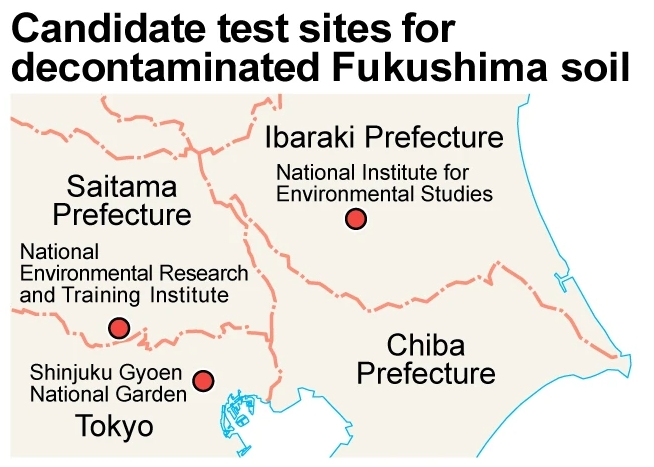
One potential test site is Shinjuku Gyoen National Garden in the heart of Tokyo.
At a meeting on Feb. 24 between about 50 local residents and Environment Ministry officials, a request was submitted asking to cancel the plan as well as holding explanatory meetings about the project.
After the meeting, one of the residents, Kunikazu Hirai, 70, said, “We are angry at the danger of having soil that was once contaminated with radiation brought right next door to us.”
According to Environment Ministry officials, there were about 1.2 million visitors to Shinjuku Gyoen National Garden in fiscal 2021, although annual visitors numbered about 2 million prior to the novel coronavirus pandemic.
The two other candidate test sites are the National Institute for Environmental Studies in Tsukuba, Ibaraki Prefecture, and the National Environmental Research and Training Institute in Tokorozawa, Saitama Prefecture.
All three sites are managed by the Environment Ministry and officials believe that consent of local residents is not needed to proceed with their plan.
However, Saitama residents not only attended the Feb. 24 meeting with Environment Ministry officials but also submitted their own request to stop the project.
The unpopularity of the plan is understandable. A proposal to reuse soil in two municipalities in Fukushima Prefecture went nowhere after local residents raised strong opposition.
Only soil decontaminated to levels below 8,000 becquerels per kilogram will be used in the trial runs.
The plan for Tokyo calls for reusing the soil in a flower bed in an area of Shinjuku Gyoen National Garden that would be off-limits to the public. The flower bed would be 10 meters by 3 meters with a hole dug 1 meter deep.
A plastic sheet will be placed in the hole before about six cubic meters of decontaminated soil covers it. A 50-centimeter layer of soil will be placed on top of the decontaminated soil.
The water collected in the sheet will be moved to an adjacent tank and measured for radiation levels. If the levels are under government standards, the water would be released into the sewage system.
The Environment Ministry held an explanatory meeting on Dec. 21, but only 28 people showed up, in large part, because notification of the scheduled meeting was given at the last minute.
Shinjuku Mayor Kenichi Yoshizumi said while the project was completely in the hands of the central government, he expressed dissatisfaction at the explanation and documents presented by the Environment Ministry, which he called “difficult to understand.”
Tokorozawa residents raised objections at an explanatory meeting held in their community in January, and Mayor Masato Fujimoto said it would be difficult for the project to proceed if residents were opposed.
Kenichi Oshima, a professor of environmental economics at Ryukoku University in Kyoto, said the ministry likely wanted to conduct the trial in Tokyo to attract more attention and gain understanding.
But he added, “What has to be paid attention to is not to create a dispute between various regions by having the central government pressuring localities with comments such as, ‘Are you saying you will not cooperate to help Fukushima Prefecture?’”
1 This Month
23-25 October – on Zoom – World BEYOND War’s annual global conferenc


Shut down the radiation-damaged Heysham nuclear reactors now
To see nuclear-related stories in greater depth and intensity – go to https://nuclearinformation.wordpress.com

Say No to NASA’s Reckless Nuclear Reactor on the Moon
Say No to NASA’s Reckless Nuclear Reactor on the Moon

-
Archives
- October 2026 (209)
- September 2026 (339)
- August 2026 (330)
- July 2026 (355)
- June 2026 (287)
- May 2026 (306)
- April 2026 (356)
- March 2026 (251)
- February 2026 (267)
- January 2026 (308)
- December 2025 (358)
- November 2025 (359)
-
Categories
- 1
- 1 NUCLEAR ISSUES
- business and costs
- climate change
- culture and arts
- ENERGY
- environment
- health
- history
- indigenous issues
- Legal
- marketing of nuclear
- media
- opposition to nuclear
- PERSONAL STORIES
- politics
- politics international
- Religion and ethics
- safety
- secrets,lies and civil liberties
- spinbuster
- technology
- Uranium
- wastes
- weapons and war
- Women
- 2 WORLD
- ACTION
- AFRICA
- Atrocities
- AUSTRALIA
- Christina's notes
- Christina's themes
- culture and arts
- Events
- Fuk 2022
- Fuk 2023
- Fukushima 2017
- Fukushima 2018
- fukushima 2019
- Fukushima 2020
- Fukushima 2021
- general
- global warming
- Humour (God we need it)
- Nuclear
- RARE EARTHS
- Reference
- resources – print
- Resources -audiovicual
- Weekly Newsletter
- World
- World Nuclear
- YouTube
-
RSS
Entries RSS
Comments RSS

