Canada’s Nuclear Waste Management Organization looks to First Nations to back waste storage, AND small nuclear reactors
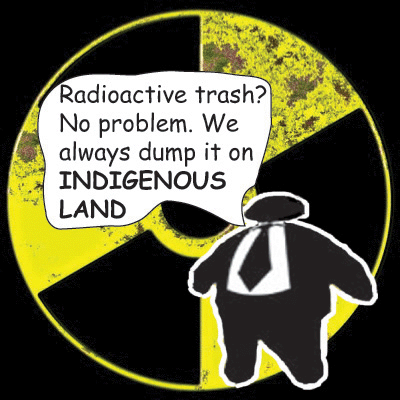
Ontario sites short-listed for nuclear waste storage, The organization developing a place to store spent nuclear fuel in Canada has settled on two potential sites in Ontario. The move rules out 20 other potential sites across Canada, including three in northern Saskatchewan.
The Nuclear Waste Management Organization recently announced the Wabigoon Lake Ojibway Nation-Ignace area in northwestern Ontario, and the Saugeen Ojibway Nation-South Bruce area in southern Ontario, are both under consideration.
“These communities are now working through their timelines to determine willingness,” Russell Baker, manager of media relations for the NWMO, said in an e-mail.
Baker said the NWMO hopes to settle on one of the two Ontario sites by the fall of 2024, but only “with informed and willing hosts, where the municipality, First Nation and Métis communities are working together to implement it.”
Disposing of spent nuclear fuel has been an issue for the nuclear industry for decades. A variety of countries, including Canada, are looking at deep geological repositories, where the waste can be safely stored for thousands of years within stable rock formations, like the Precambrian Shield. Finland is already building one.
Back in 2010, the NWMO announced there were 22 potential sites for underground storage across Canada, including sites near Pinehouse, English River First Nation, and Creighton, in northern Saskatchewan.
According to Guy Lonechild, executive director of the First Nations Power Authority (FNPA), coming up with a shortlist of potential sites is another step.
“There were some previous sites looked at in northern Saskatchewan but there’s been a lot of time and energy put into a deep geological repository in the province of Ontario. And those are the two viable options that that we would support for further study,” Lonechild, who is also a former FSIN chief, said.
Lonechild added the FNPA has been looking seriously at the possibility of Small Modular Nuclear Reactors (SMNR) for Indigenous and northern communities for several years.
……………. However, even though SMR’s are relatively small, the cost could easily be a billion dollars or more. Which is why FNPA would be looking for partnerships to help Indigenous communities get involved.
“So it is going to take a significant amount of capital. And so we’re looking at developing consortium groups to participate on an equity basis.”
………………….. “The only way we’re going to get there is if First Nations that are informed, that give free prior informed consent. And they identify ways that they want to participate in, in clean energy jobs and in the nuclear industry,” he said.
Russian nuclear energy diplomacy and its implications for energy security in the context of the war in Ukraine
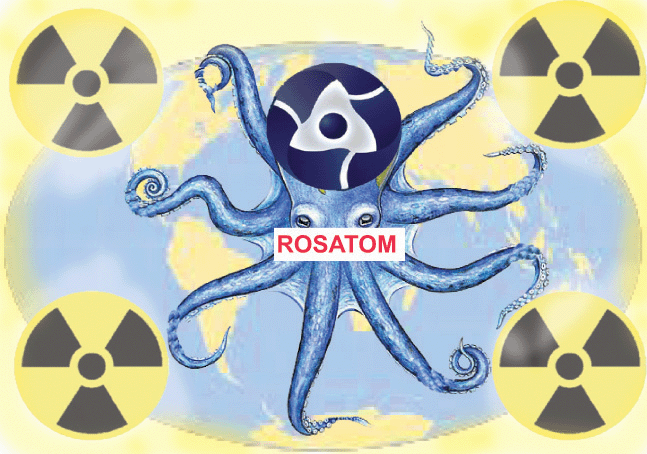
Nature, Kacper Szulecki & Indra Overland 27 Feb 23
Abstract
Since Russia invaded Ukraine in February 2022, the possibility of reducing Europe’s energy dependence on Russian resources has been hotly debated. The fossil fuel industries received most attention as European Union leaders first introduced gradual sanctions on Russian coal and later on oil and gas, while Russia responded with supply cuts. However, Russia’s role as a major player in the global nuclear power sector has remained largely below the sanctions radar, despite dependencies on Russian nuclear technology, uranium supplies and handling of spent nuclear fuel. Here we analyse the state nuclear company Rosatom and its subsidiaries as tools of Russian energy statecraft. We map the company’s global portfolio, then categorize countries where Russia is active according to the degree and intensity of dependence. We offer a taxonomy of long-term energy dependencies, highlighting specific security risks associated with each of them. We conclude that the war and Russia’s actions in the energy sector will undermine Rosatom’s position in Europe and damage its reputation as a reliable supplier, but its global standing may remain strong.
…………………………………………………………Russia is the world’s largest exporter of natural gas, second-largest exporter of oil and third-largest exporter of coal8. However, media coverage and political debates have generally omitted another sector where Russia is a major player and that is vital for Russia’s global economic and diplomatic posture: nuclear energy. While the Russian shelling and takeover of Ukrainian nuclear power plants has caused an outcry, Russia’s portfolio of foreign orders, including reactor construction, fuel provision and other services, spans 54 countries and is claimed by Rosatom to be worth more than US$139 billion over a ten year period9 and has thus far not been covered by Western sanctions. Although the financial figure is in all likelihood inflated, Russia’s involvement in and use of nuclear energy as a tool of energy diplomacy deserves scrutiny.
In this Analysis, we present a dataset of all current and planned international engagements of the Russian nuclear energy supplier Rosatom and its subsidiaries AtomStroyExport and TVEL. The dataset includes information on the different types of agreement, business models, scales of investments, types of reactor being built or planned and their nameplate capacity. As a gauge of the level of dependency upon the Russian nuclear sector that is or will be brought about by these reactors, we registered their share of the future electricity supply in the countries where they are located or planned for construction. Because the degree of influence achieved through energy statecraft is conditioned by the character and level of (inter)dependence, we discuss the firmness of dependence of different client states, formulated as ‘intensity.’ Finally, we propose a categorization of dependency types (Methods).
Rosatom’s rise, expansion and comparative advantages
Rosatom—the Russian State Atomic Energy Corporation—is the direct heir to the Soviet Ministry of Atomic Energy, which was established in the aftermath of the Chernobyl nuclear accident. Reorganized as a state corporation in 2007, Rosatom is fully owned by the Russian state, and the president of the Russian Federation determines the company’s objectives10,11. Since its inception, Rosatom has become increasingly active in the international nuclear power market12,13 and has become a leading provider of key services12,14,15. Construction of as many as ten reactor units started between 2007 and 2017, and between 2009 and 2018, the company accounted for 23 of 31 orders placed and about a half of the units under construction worldwide11. Through its subsidiary TVEL, Rosatom also provides fuel supplies, controlling 38% of world’s uranium conversion and 46% of uranium enrichment capacity16,17 in addition to decommissioning and waste disposal. In sum, Russia was the supplier in around half of all international agreements on nuclear power plant construction, reactor and fuel supply, decommissioning or waste between 2000 and 2015. Its main nuclear power competitors—China, France, Japan, Korea and the United States—accounted for another 40%, combined18.
…………………………………………. Rosatom’s main advantage lies in its capacity to be a ‘one stop nuclear shop’ for all needs, the only supplier providing an ‘all-inclusive package’12. This comprises reactor construction know-how, training, support related to safety, non-proliferation regime requirements and flexible financing options, including government-sourced credit lines22. The company is also uniquely able to offload spent nuclear fuel from overseas customers.
The way Rosatom designs its projects also makes it a convenient partner for nuclear newcomers23,24. While details of contractual agreements vary from case to case, the developer takes care of the entire process until the plant is ready to use and can be handed over to local (Russian-trained) nuclear experts to operate. For that reason, nuclear energy can be considered by countries for which it was previously unattainable, especially in the Middle East25,26, sub-Saharan Africa27,28 and South America.29
Rosatom is also able to make special offers to strategically important partners, such as Turkey30,31. ………………………………….
Its comparative advantages as a supplier allowed Russia to launch a global campaign of nuclear energy diplomacy33 in which Rosatom and Russian government institutions such as the Ministry of Foreign Affairs work in tandem. This potentially gives Russia the capacity to use the broad network of international projects it is involved in34 and the direct control over reactors and strategic energy infrastructure to exert political pressure and to project power globally35.
Minin and Vlček, having studied the behaviour of Rosatom and its relationship with the Russian state, argue that the company is primarily a profit-seeking entity with a high degree of autonomy and growing self-sufficiency15. According to Thomas, whatever its grandiose expectations, Rosatom could simply be unable to deliver all the projects that it has agreed to, let alone expand further13. On the other hand, Aalto et al. observe that ‘potential foreign policy influence’ by Russia was noted by Finnish and Hungarian opponents of collaboration with Rosatom33, while Jewell and colleagues argue that some nuclear sector dependencies display more pervasive energy security impacts, long-lasting and difficult to deal with (due to lack of flexibility) than those usually analysed by energy security experts in the petroleum sector18,36.
Here we consider Rosatom’s potential as a tool for the Russian state and debate whether this constitutes a ‘nuclear energy weapon’ or simply a projection of soft-power diplomacy. We find that Russian nuclear energy statecraft can be seen as a spectrum between these two extremes, but that soft-power diplomacy creates dependencies that can be further expanded and exploited and thus should not be overlooked.
Analysing Rosatom’s international activity
Our research, gathered in the dataset available in the Supplementary Data, indicates that upon Russia’s invasion of Ukraine, Rosatom boasted as many as 73 different projects in 29 countries. The projects were at very different stages of development from power plants in operation; through construction of reactors ongoing, contracted, ordered or planned; to involvement in tenders, invitations to partnerships or officially published proposals. On top of that, Russian companies have bilateral agreements or memoranda of understanding (MoUs) with 13 countries for services or general joint development of nuclear energy.
Rosatom’s projects and involvement have varied in ambition and cost—from India’s Tarapur nuclear power plant (NPP) (US$700 million) and Iran’s Bushehr-1 (US$850 million) to a gargantuan project in South Africa (US$76 billion) and those in Egypt (US$30 billion) and Turkey (US$20 billion). Finally, 13 countries have a variety of research-oriented agreements with Russian nuclear service providers related to nuclear research centres. Altogether, Russia’s nuclear energy diplomacy has been formalized in 54 countries.
While this is impressive, looking into the details of these agreements (particularly the NPP construction projects) reveals a more modest level of international engagement. Many of the projects have been stuck at the planning stage for several years or are merely visions laid out in non-committal MoUs………………………………………………………
However, most cooperation and plans have not been cancelled, and even EU member states Bulgaria and Hungary have, as of January 2023, not cancelled their planned nuclear plants…………………………………………………………………………………………….
Following the 2014 annexation of Crimea and particularly after the 2022 invasion of Ukraine, Russian economic, political and energy influence has become a fundamental concern in European countries.42 In countries that plan to base their decarbonization efforts primarily or entirely on nuclear energy (that is, Hungary and Slovakia), the Russian NPP share of the electricity supply can underrepresent Russia’s influence: dependencies on nuclear fuel imports from TVEL/Rosatom (which also continues to supply Bulgaria, Czechia and Finland and Poland’s research reactor), combined with power-system inflexibility and overreliance on a single large nuclear power plant, exacerbates the vulnerability to supply disruptions…………………………………………..
Egypt, Iran and Turkey are all nuclear newcomers, energy hungry and populous (with between 82 and 100 million inhabitants each). Such states are lucrative markets for low-carbon electricity development…………………………………………………………………………………………………………
The big question for the future is whether non-Western countries will also turn away from Russian nuclear power. Currently, many developing countries take a positive view of Russia and tilt towards its view of the conflict in Ukraine. Immediately after the invasion of Ukraine, seven of the 14 countries with high- or medium-cooperation levels in our analysis did not approve United Nations Resolution ES 11/1 condemning Russian aggression, and several of these (for example, Bangladesh, China, India, Iran) were categorized as ‘neutral or Russia-leaning’ shortly after the war began58. Over time, however, the interruption of energy supplies to the European Union may undermine the reputation of Russian energy companies as primarily economic actors independent of national security politics, also outside Europe. Non-Western perspectives on the war in Ukraine and the reliability of Russia and Russian technology may also change over time……………………………………………………………………………………………………………………………………… more https://www.nature.com/articles/s41560-023-01228-5
Zelensky warns Americans that US will lose global influence if it stops backing war
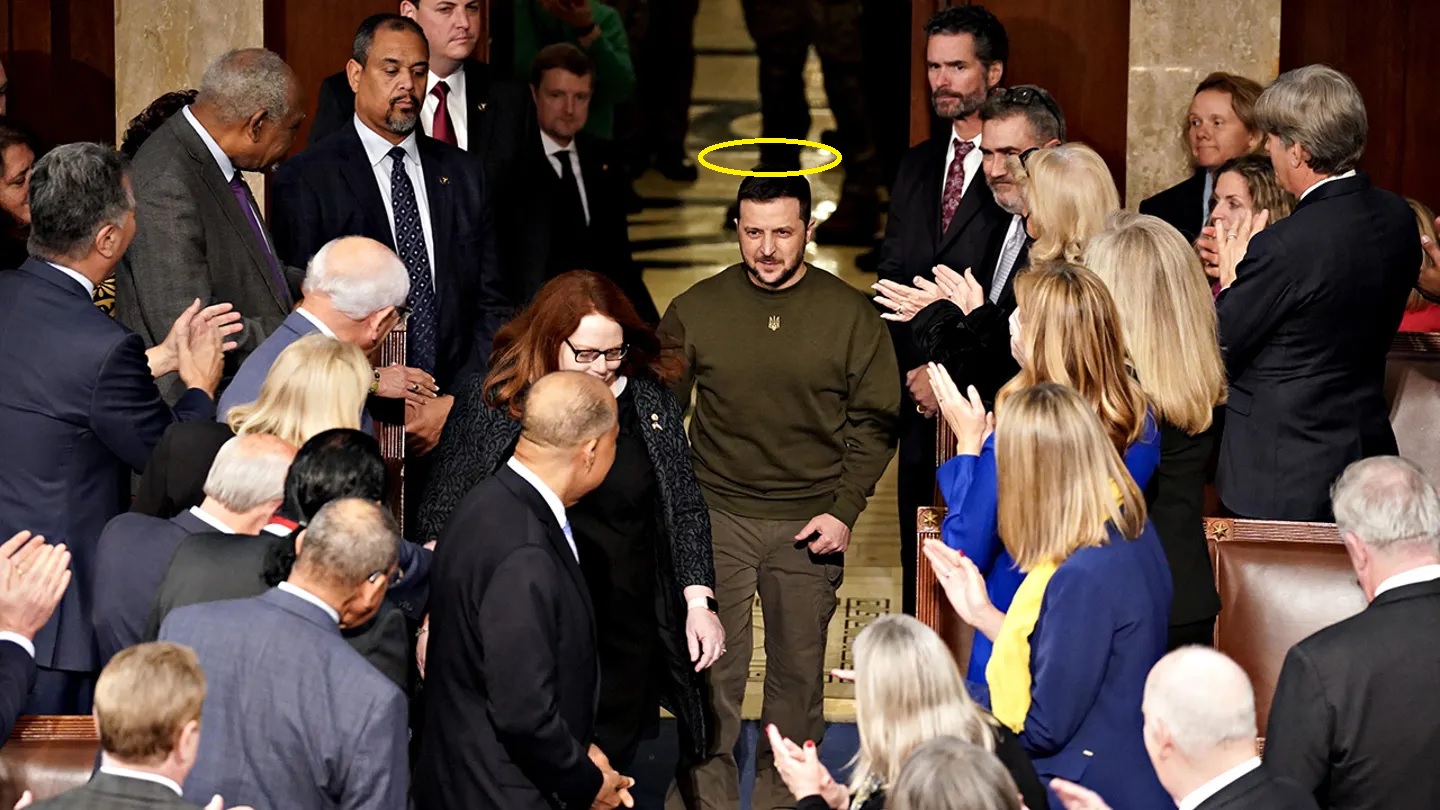
Ukrainian President Vladimir Zelensky has warned Americans to keep supporting Kiev or risk geopolitical irrelevance, during a press conference on the anniversary of Russia’s military operation in the country. Should it stop funding the war effort, the US will “lose the leadership position that they are enjoying in the world,” the Ukrainian leader declared on Friday.
“If they do not change their opinion…they will lose NATO, they will lose the clout of the United States, they will lose the leadership position they are enjoying in the world,” Zelensky declared, following a speech in which he declared 2023 the “Year of Invincibility” and vowed to unite the world against Russia.
The warning was a response to a reporter asking what Zelensky would tell the “growing number of Americans” who believe their country is giving too much money and support to Ukraine. The president made sure to thank his American supporters – a group he hinted included not just Congress and President Joe Biden but also “the TV channels” and “the journalists” – before threatening those who held the “dangerous” opinion that the US should “give up” on Kiev………………………………………….
The Republican Party regained control of the House of Representatives in last year’s midterm elections in part on a promise to curtail the Biden administration’s blank check to Kiev. While Congress has not yet passed any legislation to rein in spending on the conflict, Rep. Marjorie Taylor Greene (R-Georgia) promised earlier this week to introduce a bill to force an audit of the Ukraine aid program and the House Oversight Committee demanded the administration turn over documents proving the military and economic aid being sent to Ukraine was not being lost to “waste, fraud, and abuse.”
The US has thus far pledged $113 billion to Ukraine’s war effort, vowing to continue pouring money into the conflict for “as long as it takes.” https://www.rt.com/news/572077-zelensky-warns-us-support-flagging/—
The world returns to an era of nuclear angst
Russia’s suspension of its arms control treaty with the US augurs a new period of military deterrence, arms races and instability
EL PAIS, ÓSCAR GUTIÉRREZ, Madrid – FEB 27, 2023
Dmitry Medvedev is currently the deputy chairman of the Security Council of the Russian Federation (SCRF), a consultative body that supports Russian President Vladimir Putin’s decision-making on national security affairs. In April 2010, when the United States and Russia signed the New Strategic Arms Reduction Treaty (New START) in Prague, limiting the nuclear offensive capabilities of both countries, the man in charge in Moscow, at least on paper, was Medvedev, then the president of the country. In late February, Putin suspended the treaty that Obama and Medvedev signed almost 13 years ago. At the New START signing ceremony, Medvedev said, “This will turn a new page for cooperation between our two countries and will create safer conditions for life here and around the world.” Not anymore.
Medvedev is one of the best examples of how nuclear security has changed since the Cold War between the US and Russia. He now fervently supports suspending the treaty he signed in 2010
and said in a Telegram post, “If the US intends to defeat Russia [by providing military support to Ukraine], then we are on the brink of a global conflict. We have the right to defend ourselves with any weapon, including nuclear ones.”
EL PAÍS consulted four arms control and security policy experts on the consequences of Putin’s suspension of the New START treaty. They all concurred that both countries had been complying with limits on warheads, missiles and delivery systems and felt that controlling such weapons would become complicated and potentially lead to a new arms race. Moscow’s move is an attempt to curb Western support for Ukraine, and without New START, there will be more uncertainty, instability and potential nuclear miscalculations. These same words and scenarios defined the Cold War geopolitical tension that dominated US-Russian relations for 40 years after World War II.
“Without the treaty, [the US and Russia] can do whatever they want,” said Olga Oliker, an expert on Russian and Ukrainian security policy for the International Crisis Group. “They can build whatever strategic offensive weapons they feel like and can afford. They won’t be able to verify what the other is or isn’t doing. They will still have intelligence-collecting capabilities but not the inspections, data exchanges and consultations to ensure compliance. Theoretically, they could deceive each other more easily.” Oliker believes the most significant risk in suspending the treaty lies in the potential “misunderstandings” arising from a lack of information.
New START limits the number of immediately deployable nuclear weapons owned by the US and Russia, which account for 90% of the world’s nuclear arsenal. They can only have a maximum of 1,550 deployed warheads and 700 long-range missile delivery systems between ground launchers, submarines and bombers. According to the US State Department, as of September 2022, both countries were below those numbers. It was a drastic reduction compared to the 1991 treaty Ronald Reagan and Mikhail Gorbachev signed. New START also initiated a compliance mechanism that permitted up to 18 inspections a year, regular information exchange and a monitoring commission, all of which are now suspended.
Non-compliance with inspections
Todd Sechser is a professor at the University of Virginia (USA) and a scholar at the Carnegie Endowment for International Peace. “The treaty is important not only because it limits the number of strategic nuclear warheads,” said Sechser, “but because it provides a way for the two countries to build trust. This move undermines that trust.” ……………………………………………………………………….. more https://english.elpais.com/international/2023-02-27/the-world-returns-to-an-era-of-nuclear-angst.html—
Ukraine preparing attack on Crimea – Zelensky
https://www.rt.com/russia/572038-ukraine-zelensky-crimea-attack/ 27 Feb 23, Kiev already has the resolve necessary for the assault, but is still building up its capabilities, the president says.
Ukraine is readying an offensive to try and seize Russia’s Crimean peninsula, President Vladimir Zelensky said on Friday at a press conference. Kiev is forming new units specifically for the task, with servicemen undergoing training abroad, he revealed.
“We’re taking military steps, we are preparing for them. We are mentally prepared already. We prepare technically, with weapons, forces, we form new brigades, we form offensive units of various kinds and types, we are sending people for training not only in Ukraine, you know, but also in other countries,” Zelensky stated.
The president, as well as other top officials, has repeatedly pledged to re-capture all of the former Ukrainian territories from Russia, including Crimea. The peninsula broke away from the country back in 2014 in the aftermath of the Maidan coup in Kiev, joining Russia after a landslide referendum.
Four other formerly-Ukrainian territories, namely the Donetsk and Lugansk People’s Republics, as well as Zaporozhye and Kherson Regions, were incorporated into Russia after the overwhelming majority of their populations voted in favor of the idea last September.
Neither reunification with Crimea, nor the latest incorporations of other regions got Western recognition, with Kiev and its backers considering these lands part of Ukraine.
Russia has repeatedly warned Kiev against plotting an assault on Crimea. Early in February, former Russian president Dmitry Medvedev, who now serves as Deputy Chair of the Security Council, said that any attack on Crimea would be interpreted as a direct attack on the country itself and would be “met with inevitable retaliation using weapons of any kind.”
Only matter of time before Biden delivers F-16s to Ukraine: MP — Anti-bellum
Ukrainian News AgencyFebruary 27, 2023 F-16 Aircraft Delivery To Ukraine Only Matter Of Time – Merezhko Member of the Verkhovna Rada from the Servant of the People faction, chairman of the parliamentary committee on foreign policy and inter-parliamentary cooperation, Oleksandr Merezhko, is confident that the United States will provide Ukraine with F-16 aircraft…. “We’re being […]
Only matter of time before Biden delivers F-16s to Ukraine: MP — Anti-bellum
This week in nuclear news

Bits of good news?
– hard to find this week. There are “good news” sites, but these tend to focus on individual stories – about cute kittens, or kind teenagers. Still, I know that there are wonderful groups of people all over, collectively doing good things. I’m seeing my own examples of this, while reading through so many excellent submissions to Parliament from Australian environmental groups opposing nuclear power.
Nuclear. It is getting more bizarre – as the USA contemplates artificial intelligence for launching nuclear weapons. As one of the very most “progressive” Democrats wants more opportunities for small companies to benefit in the weapons sales boom.
The propaganda tsunami – always a part of a war- is upon us. But is this a war– between Russia and the entire world? I have no doubt that some Russian soldiers have committed atrocities – and we’re told this every day. But – really – are there no Ukrainian- committed atrocities? Does Saint Zelensky really know what he is doing – or is he just following the USA line? Truth isn’t just the first casualty in this war – – it’s the second, third and so on casualty
Christina’s notes. TODAY. Painful realisation that our Australian Labor defence minister is even more stupid and subservient to USA than the Liberals were! Media determined to ignore the intrinsic connection between “new small nuclear reactors” and nuclear weapons.
CLIMATE. Temperature rise can be stopped. It is a dangerous myth to say that it’s too late to act.
ECONOMICS. Yet another £6 billion cost hike for UK’s Hinkley Point C nuclear project. Cost of EDF’s new UK nuclear project rises to $40 billion. https://www.youtube.com/watch?v=Owfj0gSeAbw Debt-ridden EDF’s woes increase, with big rise in costs of Hinkley and Sizewell nuclear projects . UK: big talk about small nuclear reactors, but not much is happening, really. Russia’s nuclear industry is making great money – thanks to customers in Europe. Marketing: Seoul aims to use strengthened US ties to expand nuclear plant exports.
ENERGY. ‘No miracles needed’: Prof. Mark Jacobson on how much wind, sun and water can power the world. The Unholy Alliance – nuclear power, endless data centers, and endless energy use.
ENVIRONMENT. Groundwater carries radiation risk for North Korean cities near nuke test site – rights group . Toxic US-Japan collusion on nuke wastewater taints global environment.
ETHICS and RELIGION. Japan not only dumps wastewater but also morality.
HEALTH. Health appeal: avert nuclear war and respect international humanitarian law,
LEGAL. Linda Pentz Gunter on the Nuclear Corruption Cases. World dreads Japan’s date with disaster.
NUCLEAR TECHNOLOGY. Spreading the Bomb – Will Ottawa revisit Canada’s support for plutonium reprocessing?. Belarus’ second nuclear reactor is far behind schedule, while Unit 1 reactor remains unstable. .
OPPOSITION to NUCLEAR. Fury as Japan plans to dump a million tonnes of contaminated water in the Pacific. Group calls for the stoppage of works at Sizewell C nuclear site, as Sizewell project is not yet authorised, and works are damaging the environment.
POLITICS. Biden team has ‘deeply rooted hatred for Russia’ – US congressman. How US and Ukraine’s far-right made pro-peace Zelensky a ‘no peace’ president . Caitlin Johnstone – The Empire Gives People The Illusion Of Fighting The Power Without Ever Endangering Real Power. Democrats Praise Bush, Want More Small-Business War Profiteers.
Canada launches $30 million small modular reactor funding program. USA’ Inflation Reduction Act is a game-changer for the nuclear industry -says Public Service Enterprise Group.
Hinkley Point Nuclear Megaproject is really a colossal miscalculation of risk management. Do not bring nuclear energy plants to Scotland, SNP tells new UK energy minister. Boris Johnson demands that UK government declares nuclear to be “a green energy” source, and boosts the industry . Nuclear power – carbon intensive and environmentally damaging –NOT GREEN – Nuclear Free Local Authorities.
POLITICS INTERNATIONAL and DIPLOMACY. Reckless or rhetoric? — Putin suspends New START nuclear treaty. The New START nuclear treaty, and why Vladimir Putin is walking away from it. Scott Ritter: Anyone Who Doesn’t Get How Serious New START Suspension is ‘Doesn’t Appreciate Life’. Vladimir Putin says the US-led military alliance in Ukraine seeks defeat and liquidation of Russia.
Chomsky: A Stronger NATO Is the Last Thing We Need as Russia-Ukraine War Turns 1. China’s Position on the Political Settlement of the Ukraine Crisis. India, China may have averted nuclear war in Ukraine by influencing Russia- US. Tamara Lorincz: Canada’s Support For Ukraine’s War on the Donbass & Canada’s Anti-Russia Policies — In Gaza https://www.youtube.com/watch?v=KpEaovhVois. China calls for Russia to not go down the ‘nuclear weapons route’. https://www.youtube.com/watch?v=kRr4HuXsTQ8 .
France mounts ‘aggressive’ nuclear push with eye on EU industrial plan. Poland to buy 1st nuclear power plant with Westinghouse. Japan beefs up moves in seeking G7 support for wastewater dump.
RADIATION. Our Global Surveillance System on NUKE TESTING is inadequate . Seoul offers radiation tests to N Korea defectors as group flags nuclear risks. Japan slammed for loosening test standards on Fukushima radioactive water.
SAFETY. Courting disaster —Missiles have been passing too close to Ukraine’s reactors.
SECRETS and LIES. The US Can Secretly Rotate Nuclear Warheads Through Australia
SPACE. EXPLORATION, WEAPONS. Russia Sends Ship To Space Station To Rescue “Stranded Crew” .
SPINBUSTER. B1 Officials reveal cost of shooting down ‘UFOs’ – WSJ
WASTES. Japan postponing its controversial plan for trials to reuse radioactively contaminated soil . World Insights: Science should guide Fukushima wastewater release plan, Pacific leaders say. Academic speaks out against Japan’s wastewater plan for Pacific. 800,000 cubic meters of new radioactive waste to be generated as a result of decommissioning of the Fukushima Daiichi Nuclear Power Plant.
WAR and CONFLICT. There has never in history been a greater need for a large Anti-War Movement . More Evidence Emerges That US Wanted Russia to Invade. Thousands rally in Berlin, Paris to call for peace in Ukraine. Forgotten heroes of Britain’s nuclear tests to FINALLY get long-awaited medal this summer. Should Algorithms Control Nuclear Launch Codes?.
WEAPONS and WEAPONS SALES.
- Stop or START? — Shouldn’t we ban, rather than limit, nuclear weapons?
- Nuclear weapons consortium enthusiastically revving up their business.
- Vladimir Putin vows to strengthen Russia’s nuclear forces to guarantee its sovereignty. U.S. floods Ukraine with $2 billion more in arms, ammunition for second year of war .
- U.S. to deliver 500 more HIMARS launchers to Poland . Poland delivers first Leopard tanks to Ukraine, Sweden to follow.
- Nuclear-capable U.S. B-52s join allied warplanes over Estonia . North Korea test-fires four missiles to show ability to launch nuclear attack.
More Evidence Emerges That US Wanted Russia to Invade

February 24, 2023
In the past year, additional proof has emerged proving the West’s provocation of Russia to give it its “Vietnam” in Ukraine.
Consortium News on Feb. 4, 2022 warned that the U.S. was setting a trap for Russia in Ukraine, as it had in Afghanistan in 1979 and Iraq in 1990, to provoke Russia to invade Ukraine to provide the pretext to launch an economic, information and proxy war designed to weaken Russia and bring down its government — in other words, to give Russia its “Vietnam.” Twenty days later Russia invaded.
One month later, President Joe Biden confirmed that a trap had indeed been set, as reported by Consortium News on March 27, 2022, republished here today. The evidence that the U.S. wanted and needed Russia to invade as cause to launch its economic, information and proxy wars was clear:
- The U.S. backed a coup in 2014, installing an anti-Russian government in Kiev and supporting a war against coup resisters in Donbass.
- The 2015 Minsk Accords to end the Ukrainian civil war were never implemented.
- On the day of the Feb. 24, 2022 invasion Biden told reporters that economic sanctions were never intended to deter Russia, but to show the Russian people who Russian President Vladimir Putin was. In other words the U.S. was not trying to stop the invasion but to overthrow Putin, as Biden confirmed a month later in Warsaw, in order to restore the dominance over Russia the U.S. enjoyed in the 1990s.
The United States and NATO rejected Russian treaty proposals to create a new security architecture in Europe, taking Russia’s security concerns into account. Despite a Russian warning of a technical/military response if the draft treaties were rejected. The U.S. and NATO rejected them nonetheless, knowing and welcoming the consequences. Rather than withdrawing NATO forces from Eastern Europe as the treaty proposals called for, NATO sent more troops.- For 30 years, NATO continued expanding towards Russia, despite promises to the contrary, routinely holding exercises near its border, despite fully understanding Russia’s objections, from Boris Yeltsin to Putin, and knowing it would provoke a hostile reaction. Sen. Joe Biden said as much in 1997.
- The fake Russiagate scandal helped prepare the U.S. population for hostilities against Russia and launched sanctions based on a lie that have never been lifted.
- Despite 100,000 Russian troops on the Russian side of the border, the OSCE reported an increase of shelling by Ukraine of Donbass at the end of February 2022 indicating an impending offensive against ethnic Russian civilians who had suffered eight years for resisting an unconstitutional change of government in 2014. It was tantamount to baiting those Russian forces to cross the border.
- In the past year, additional evidence has emerged proving the West’s provocation:
- U.S. Secretary of Defense Lloyd Austin acknowledged that the U.S. strategy in Ukraine is to “weaken” Russia. To this end, the U.S. has stopped peace efforts, even by Israel, to prolong the conflict.
- Former German Chancellor Angela Merkel, former French President Francois Holland, former British Prime Minister Boris Johnson and former Ukrainian President Petro Poroschenko all admitted in recent months that they never had any intention of implementing the Minsk Accords (endorsed by the U.N. Security Council) and were stringing Russia along to give time for NATO to train and equip the Ukrainian military for the Russian intervention it anticipated.
- Planning for sanctions against Russia began in November 2021, three months before the invasion, according to Ursula von der Leyen, the president of the European Council.
- Planning to destroy the Nord Stream pipelines were begun by the United States in September 2021, five months before the invasion, according to reporting by Seymour Hersh.
- Taken together, all this evidence leaves little doubt that the U.S. was provoking Russia to invade Ukraine in order to implement its plan to bring down the Russian government. That the U.S. plan has so far failed, is another matter.
This was Consortium News‘ report on March 27, 2022:
By Joe Lauria
Special to Consortium News
March 27, 2022
The U.S. got its war in Ukraine. Without it, Washington could not attempt to destroy Russia’s economy, orchestrate worldwide condemnation and lead an insurgency to bleed Russia, all part of an attempt to bring down its government. Joe Biden has now left no doubt that it’s true.
The president of the United States has confirmed what Consortium News and others have been reporting since the beginnings of Russsiagate in 2016, that the ultimate U.S. aim is to overthrow the government of Vladimir Putin.
“For God’s sake, this man cannot remain in power,” Biden said on Saturday at the Royal Castle in Warsaw. The White House and the State Dept. have been scrambling to explain away Biden’s remark.
But it is too late.
…………………………………………………… Biden first gave the game away at his Feb. 24 White House press conference — the first day of the invasion. He was asked why he thought new sanctions would work when the earlier sanctions had not prevented Russia’s invasion. Biden said the sanctions were never designed to prevent Russia’s intervention but to punish it afterward. Therefore the U.S. needed Russia to invade.
………………………….. It was the second time that Biden confirmed that the purpose of the draconian U.S. sanctions on Russia was never to prevent the invasion of Ukraine, which the U.S. desperately needed to activate its plans, but to punish Russia and get its people to rise up against Putin and ultimately restore a Yeltsin-like puppet to Moscow. Without a cause those sanctions could never have been imposed. The cause was Russia’s invasion.
Regime Change in Moscow
Once hidden in studies such as this 2019 RAND study, the desire to overthrow the government in Moscow is now out in the open.
One of the earliest threats came from Carl Gersham, the long-time director of the National Endowment for Democracy (NED). Gershman, wrote in 2013, before the Kiev coup: “Ukraine is the biggest prize.” If it could be pulled away from Russia and into the West, then “Putin may find himself on the losing end not just in the near abroad but within Russia itself.”
David Ignatius wrote in The Washington Post in 1999 that the NED could now practice regime change out in the open, rather than covertly as the C.I.A. had done.
The RAND Corporation on March 18 then published an article titled, “If Regime Change Should Come to Moscow,” the U.S. should be ready for it. Michael McFaul, the hawkish former U.S. ambassador to Russia, has been calling for regime change in Russia for some time…………………………………………………………………………………….
Back in 2017, Consortium News saw Russiagate as a prelude to regime change in Moscow. That year I wrote:
“The Russia-gate story fits neatly into a geopolitical strategy that long predates the 2016 election. Since Wall Street and the U.S. government lost the dominant position in Russia that existed under the pliable President Boris Yeltsin, the strategy has been to put pressure on getting rid of Putin to restore a U.S. friendly leader in Moscow. There is substance to Russia’s concerns about American designs for ‘regime change’ in the Kremlin…………………………………………..
The Invasion Was Necessary
The United States could have easily prevented Russia’s military action. It could have stopped Russia’s intervention in Ukraine’s civil war from happening by doing three things: forcing implementation of the 8-year old Minsk peace accords, dissolving extreme right Ukrainian militias and engaging Russia in serious negotiations about a new security architecture in Europe.
But it didn’t.
The U.S. can still end this war through serious diplomacy with Russia. But it won’t. Blinken has refused to speak with Russian Foreign Minister Sergei Lavrov. Instead, Biden announced on March 16 another $800 million in military aid for Ukraine on the same day it was revealed Russia and Ukraine have been working on a 15-point peace plan. It has never been clearer that the U.S. wanted this war and wants it to continue………………………………………………………………………………………………………….
The Excised Background to the Invasion
It is vital to recall the events of 2014 in Ukraine and what has followed until now because it is routinely whitewashed from Western media coverage. Without that context, it is impossible to understand what is happening in Ukraine.
Both Donetsk and Lugansk had voted for independence from Ukraine in 2014 after a U.S.-backed coup overthrew the democratically elected president Viktor Yanukovych. The new, U.S.-installed Ukrainian government then launched a war against the provinces to crush their resistance to the coup and their bid for independence, a war that is still going on eight years later at the cost of thousands of lives with U.S. support. It is this war that Russia has entered.
Neo-Nazi groups, such as Right Sector and the Azov Battalion, who revere the World War II Ukrainian fascist leader Stepan Bandera, took part in the coup as well as in the ongoing violence against Lugansk and Donetsk.
Despite reporting in the BBC, the NYT, the Daily Telegraph and CNN on the neo-Nazis at the time, their role in the story is now excised by Western media, reducing Putin to a madman hellbent on conquest without reason. As though he woke up one morning and looked at a map to decide what country he would invade next.
The public has been induced to embrace the Western narrative, while being kept in the dark about Washington’s ulterior motives.
The Traps Set for Russia
Six weeks ago, on Feb. 4, I wrote an article, “What a US Trap for Russia in Ukraine Might Look Like,” in which I laid out a scenario in which Ukraine would begin an offensive against ethnic Russian civilians in Donbass, forcing Russia to decide whether to abandon them or to intervene to save them.
If Russia intervened with regular army units, I argued, this would be the “Invasion!” the U.S. needed to attack Russia’s economy, turn the world against Moscow and end Putin’s rule.
In the third week of February, Ukrainian government shelling of Donbass dramatically increased, according to the OSCE, with what appeared to be the new offensive. Russia was forced to make its decision.
It first recognized the Donbass republics of Donetsk and Lugansk, a move it put off for eight years. And then on Feb. 24 President Vladimir Putin announced a military operation in Ukraine to “demilitarize” and “denazify” the country.
Russia stepped into a trap, which grows more perilous by the day as Russia’s military intervention continues with a second trap in sight. From Moscow’s perspective, the stakes were too high not to intervene. And if it can induce Kiev to accept a settlement, it might escape the clutches of the United States.
A Planned Insurgency ………………………………………………………………………………………………………………………………The Economic War
Along with the quagmire, are the raft of profound economic sanctions on Russia designed to collapse its economy and drive Putin from power.
These are the harshest sanctions the U.S. and Europe have ever imposed on any nation. Sanctions against Russia’s Central Bank sanctions are the most serious, as they were intended to destroy the value of the ruble………………………………………………………………………………
The aim is clear: “asphyxiating Russia’s economy”, as French Foreign Minister Jean-Yves Le Drian put it, even if it damages the West.
more https://consortiumnews.com/2023/02/24/more-evidence-emerges-that-us-wanted-russia-to-invade/
Joe Lauria is editor-in-chief of Consortium News and a former U.N. correspondent for The Wall Street Journal, Boston Globe, and numerous other newspapers, including The Montreal Gazette and The Star of Johannesburg. He was an investigative reporter for the Sunday Times of London, a financial reporter for Bloomberg News and began his professional work as a 19-year old stringer for The New York Times. He can be reached at joelauria@consortiumnews.com and followed on Twitter @unjoe

How US and Ukraine’s far-right made pro-peace Zelensky a ‘no peace’ president

the exalted version of Zelensky promoted to NATO state audiences today is a sharp contrast to the pro-peace candidate that Ukrainians overwhelmingly elected four years ago.
it is no wonder that the same US political establishment that sabotaged Zelensky’s peace mandate now holds him up as a hero.
In October 2019, as he took steps to implement Minsk in the face of far-right protests and US hostility, Zelensky assured Ukrainians that he was “the president of peace,” and that “ending this war is of utmost importance to me.” He added: “I, the president, am not ready to sacrifice our people. And that is why I choose diplomacy.”
Elected in 2019 to bring peace to Ukraine, a Zelensky aide now declares that “there is no peace with Russia, and Ukraine must arm itself to the teeth.”
Aaron Maté https://mate.substack.com/p/how-us-and-ukraines-far-right-made?utm_source=post-email-title&publication_id=100118&post_id=105251040&isFreemail=false&utm_medium=email 26 Feb 23,
Volodymyr Zelensky marked the one-year anniversary of Russia’s invasion of Ukraine by rejecting any negotiations with the Kremlin.
“There is nothing to talk about and nobody to talk about over there,” Zelensky declared.
The Ukrainian President delivered the message just two weeks after his French and German counterparts urged him, at a meeting in Paris, “to start considering peace talks with Moscow,” the Wall Street Journal reports.
But as an adviser explained to the New York Times, Zelensky is now “more at peace with himself,” and therefore has no need to entertain the possibility of peace with his neighbor.
He has a clear understanding what Ukraine should do,” the adviser said. “There is no ambiguity: There is no peace with Russia, and Ukraine must arm itself to the teeth.”
Zelensky’s “clear understanding” of the need to reject peace with Russia and turn his country into a NATO arms depot is a resounding victory for the Ukrainian far-right and its US government allies. As I wrote here last year, these two powerful forces, aligned by their converging interests in prolonging the post-2014 war in Ukraine’s Donbas region, sabotaged the peace platform that Zelensky was elected on in April 2019. As Adam Schiff put it, the US has used Ukraine’s civil war “so that we can fight Russia over there, and we don’t have to fight Russia here.”
The commemoration of the first anniversary of Russia’s cross-border invasion to end Schiff’s bipartisan “fight” has yielded more insight into how the US, in concert with its ideological allies in Ukraine’s powerful far-right, helped convert Zelensky from pro-peace candidate to “no peace” president.
In a fawning profile, the Washington Post approvingly recounts how Zelensky shifted from naively “thinking peace with Putin was possible” to now believing that “victory is the only answer.” Although the Post attempts to cast Zelensky’s “transformation” as the result of “Russian President Vladimir Putin’s threat,” the details tell a different story.
The Post describes a summer 2019 exchange between the then-rookie president and the top US diplomat in Ukraine, William Taylor. At the time, Zelensky was “expressing curiosity” about the Steinmeier Formula, a German-led effort to revive the stalled Minsk Accords. Minsk, reached in 2015, called for granting limited autonomy to the rebellious Donbas regions in eastern Ukraine in exchange for their demilitarization. Ukraine’s far-right, the driving force behind the 2014 Maidan coup that triggered the ensuing Donbas war, had opposed Minsk’s implementation at every turn.
Zelensky, Taylor recalls, “hoped” that the Steinmeier initiative “might lead to a deal with the Kremlin.” The Ukrainian president “pointed to a document explaining the formulation, thinking that somewhere in the details of the legalese a workable compromise with Moscow might be found.”
But Washington knew better: no compromise with Moscow could be allowed. “No one knows what it is,” Taylor told Zelensky of the German plan. “Steinmeier doesn’t know what it is… It’s a terrible idea.”
The Steinmeier plan was in fact a simple idea, and a welcome one to anyone interested in bringing peace to Ukraine. For his part, Taylor was never shy about advocating war. In a December 2014 letter to The Washington Post, Taylor denounced an opinion article that had opposed sending US arms to Ukraine and advocated an agreement between NATO and Russia to resolve the Ukrainian crisis. Backers of such steps, Taylor wrote, are “advocating that the West appease Russia.… Now is not the time for appeasement.”
This explains why Taylor was similarly hostile to the “terrible” plan named after former German foreign minister Frank-Walter Steinmeier. The Steinmeier Formula called for holding local elections in the rebel-held Donbas areas under Ukrainian law and international supervision. If OSCE monitors certified the results, then Ukraine would regain control of its eastern border and enact a special status law granting the rebellious Donbas regions limited autonomy.
But this road map, along with a similar initiative from French diplomat Pierre Morel, “got nowhere because of opposition in Ukraine,” former UK diplomat Duncan Allan observed for the UK government-funded think tank Chatham House. When Zelensky tried to revive it in late 2019, Allan added, “[a]nother sharp reaction in Ukraine forced him to back down.” As the New York Times now notes in passing, “a backlash at home — with street protesters in Kyiv accusing him of treason for surrendering land — steered the Ukrainian president to a political formula in which he rejected concessions” with Russia.
Specifically, that “backlash” in Ukraine included not only violent protests but outright threats to Zelensky’s life.
“Zelenskyy said he was ready to lose his ratings, popularity, position,” Right Sector co-founder Dmytro Yarosh, commander of the Ukrainian Volunteer Army and former senior Ukrainian military advisor, said shortly after Zelensky’s May 2019 inauguration. “No he would lose his life. He will hang on some tree on Khreshchatyk – if he betrays Ukraine and those people who died in the [Maidan] Revolution and the [Donbas] War.” (Two years after threatening to hang the president from a tree, Yarosh was given a repeat appointment as an advisor to the Commander-in-Chief of the Ukrainian military. The Ukrainian military subsequently claimed that the appointment was withdrawn).
Despite the internal and external opposition, Zelensky departed a meeting with Putin in December 2019 feeling “hopeful”, the Post reports. “Within weeks, Russia agreed to a broader prisoner exchange and offered Ukraine a $3 billion gas arbitration settlement as well as a new gas transit deal.”
But on top of the far-right backlash at home, Zelensky’s peace initiative faced direct hostility from Ukraine’s patron in Washington. After warning Zelensky against pursuing a “terrible” European-brokered peace plan, William Taylor soon became a hero of Trump’s first impeachment over Ukraine. At the impeachment proceedings, which kicked off in October 2019 just as Zelensky was trying to follow through on his peace mandate, Taylor was summoned to assure Congress and a Russiagate-crazed media class that Trump’s pause on weapons subsidies for the Ukrainian fight against the Russia-backed Donbas rebels endangered “our national security.” (For his services, the New York Times lauded Taylor as “a septuagenarian Vietnam veteran with a chiseled face and reassuring gray hair,” while the Washington Post declared him to be a “meticulous note taker.”)
The prevailing imperative to use Ukraine “to fight Russia over there” (Schiff) meant that Zelensky had no chance to pursue the “terrible” Minsk agreement that Taylor and other influential proxy warriors opposed.
“The reality is that Ukraine depends on political, diplomatic, economic and military support from the West, and particularly from the United States,” Samuel Charap of the Pentagon-tied RAND Corporation wrote in November 2021. Up to that point, “Ukraine has shown little desire” to “[implement] its obligations under the Minsk II agreement,” and the US had “not yet used its influence to push for progress on the Donbas conflict.” If the Ukrainian government could be pushed “toward complying”, Charap noted, that “might actually invite de-escalation from Russia” while saving Ukraine “from calamity.”
But by then, Zelensky had decided to side with the forces that had sabotaged him. According to the Post’s account, citing David Arakhamia, the leader of Zelensky’s faction in parliament: “By early 2021, Zelensky believed that negotiations wouldn’t work and that Ukraine would need to retake the Donetsk and Luhansk regions ‘either through a political or military path.’” As a result, “[t]he Kremlin disengaged.”
Zelensky’s early 2021 decision that “negotiations wouldn’t work” explains why, in early 2022, he shunned all opportunities to prevent Russia’s looming invasion. At the final talks on implement Minsk, a “key obstacle,” the Washington Post reported, “was Kyiv’s opposition to negotiating with the pro-Russian separatists.” When Germany proposed a last-minute deal in which Ukraine would “renounce its NATO aspirations and declare neutrality as part of a wider European security deal,” Zelensky turned it down, according to the Wall Street Journal. After rejecting diplomacy, Zelensky’s government then significantly increased its shelling of the Donbas, a potential step toward trying to “retake the Donetsk and Luhansk regions” via the “military path” that the Washington Post has newly confirmed.
And as the recent disclosures of former Israeli Prime Minister Naftali Bennet underscore, the US went from sabotaging Zelensky’s peace mandate before the Russian invasion to blocking diplomatic efforts in the period since.
As a result, the exalted version of Zelensky promoted to NATO state audiences today is a sharp contrast to the pro-peace candidate that Ukrainians overwhelmingly elected four years ago.
In October 2019, as he took steps to implement Minsk in the face of far-right protests and US hostility, Zelensky assured Ukrainians that he was “the president of peace,” and that “ending this war is of utmost importance to me.” He added: “I, the president, am not ready to sacrifice our people. And that is why I choose diplomacy.”
By now choosing to reject diplomacy, President Zelensky has shown that he is more than willing to sacrifice his people for the sake of his NATO state patrons’ desired proxy war against Russia. Accordingly, one year into the catastrophic Russian invasion that it helped provoke, it is no wonder that the same US political establishment that sabotaged Zelensky’s peace mandate now holds him up as a hero.
Should Algorithms Control Nuclear Launch Codes?

A new State Department proposal asks other nations to agree to limits on the power of military AI.
LAST THURSDAY, THE US State Department outlined a new vision for developing, testing, and verifying military systems—including weapons—that make use of AI.
The Political Declaration on Responsible Military Use of Artificial Intelligence and Autonomy represents an attempt by the US to guide the development of military AI at a crucial time for the technology. The document does not legally bind the US military, but the hope is that allied nations will agree to its principles, creating a kind of global standard for building AI systems responsibly.
Among other things, the declaration states that military AI needs to be developed according to international laws, that nations should be transparent about the principles underlying their technology, and that high standards are implemented for verifying the performance of AI systems. It also says that humans alone should make decisions around the use of nuclear weapons.
When it comes to autonomous weapons systems, US military leaders have often reassured that a human will remain “in the loop” for decisions about use of deadly force. But the official policy, first issued by the DOD in 2012 and updated this year, does not require this to be the case.
Attempts to forge an international ban on autonomous weapons have so far come to naught. The International Red Cross and campaign groups like Stop Killer Robots have pushed for an agreement at the United Nations, but some major powers—the US, Russia, Israel, South Korea, and Australia—have proven unwilling to commit.
One reason is that many within the Pentagon see increased use of AI across the military, including outside of non-weapons systems, as vital—and inevitable. They argue that a ban would slow US progress and handicap its technology relative to adversaries such as China and Russia. The war in Ukraine has shown how rapidly autonomy in the form of cheap, disposable drones, which are becoming more capable thanks to machine learning algorithms that help them perceive and act, can help provide an edge in a conflict.
Earlier this month, I wrote about onetime Google CEO Eric Schmidt’s personal mission to amp up Pentagon AI to ensure the US does not fall behind China. It was just one story to emerge from months spent reporting on efforts to adopt AI in critical military systems, and how that is becoming central to US military strategy—even if many of the technologies involved remain nascent and untested in any crisis.
Lauren Kahn, a research fellow at the Council on Foreign Relations, welcomed the new US declaration as a potential building block for more responsible use of military AI around the world.
A few nations already have weapons that operate without direct human control in limited circumstances, such as missile defenses that need to respond at superhuman speed to be effective. Greater use of AI might mean more scenarios where systems act autonomously, for example when drones are operating out of communications range or in swarms too complex for any human to manage.
Some proclamations around the need for AI in weapons, especially from companies developing the technology, still seem a little farfetched. There have been reports of fully autonomous weapons being used in recent conflicts and of AI assisting in targeted military strikes, but these have not been verified, and in truth many soldiers may be wary of systems that rely on algorithms that are far from infallible.
And yet if autonomous weapons cannot be banned, then their development will continue. That will make it vital to ensure that the AI involved behave as expected—even if the engineering required to fully enact intentions like those in the new US declaration is yet to be perfected.
There has never in history been a greater need for a large Anti-War Movement

Caitlin Johnstone 27 Feb 23 Caitlin’s Newsletter,
Things are escalating more and more rapidly between the US-centralized power structure and the few remaining nations with the will and the means to stand against its demands for total obedience, namely China, Russia, and Iran. The world is becoming increasingly split between two groups of governments who are becoming increasingly hostile toward each other, and you don’t have to be a historian to know it’s probably a bad sign when that happens. Especially in the age of nuclear weapons.
The US State Department’s Victoria Nuland is now saying that the US is supporting Ukrainian strikes on Crimea, drawing sharp rebukes from Moscow with a stern reminder that the peninsula is a “red line” for the Kremlin which will result in escalations in the conflict if crossed. On Friday, Ukraine’s President Zelensky told the press that Kyiv is preparing a large offensive for the “de-occupation” of Crimea, which Moscow has considered a part of the Russian Federation since its annexation in 2014.
As Anatol Lieven explained for Jacobin earlier this month, this exact scenario is currently the one most likely to lead to a sequence of escalations ending in nuclear war. In light of the aforementioned recent revelations, the opening paragraph of Lieven’s article is even more chilling to read now than it was when it came out a couple of weeks ago:
The greatest threat of nuclear catastrophe that humanity has ever faced is now centered on the Crimean peninsula. In recent months, the Ukrainian government and army have repeatedly vowed to reconquer this territory, which Russia seized and annexed in 2014. The Russian establishment, and most ordinary Russians, for their part believe that holding Crimea is vital to Russian identity and Russia’s position as a great power. As a Russian liberal acquaintance (and no admirer of Putin) told me, “In the last resort, America would use nuclear weapons to save Hawaii and Pearl Harbor, and if we have to, we should use them to save Crimea.”
| And that’s just Russia. The war in Ukraine is being used to escalate against all powers not aligned with the US-centralized alliance, with recent developments including drone attacks on an Iranian weapons factory which reportedly arms Russian soldiers in Ukraine, and Chinese companies being sanctioned for “backfill activities in support of Russia’s defence sector” following US accusations that the Chinese government is preparing to arm Russia in the war. Israel’s Prime Minister Benjamin Netanyahu has reportedly been holding multiple meetings with top military officials regarding potential future attacks on Iran to neutralize the alleged threat of Iran developing a nuclear arsenal, a “threat” that Netanyahu has personally been lying about for years. If you’ve been reading Antiwar.com (and if you care about this stuff you probably should be), you’ve been seeing new articles about the latest imperial escalations against China on a near-daily basis now. Sometimes they come out multiple times per day; this past Thursday Dave DeCamp put out two completely separate news stories titled “US Plans to Expand Military Presence in Taiwan, a Move That Risks Provoking China” and “Philippines in Talks With US, Australia on Joint South China Sea Patrols“. Taiwan and the South China Sea are two powderkeg flashpoints where war could quickly erupt at any time in a number of different ways. If you know where to look for good updates on the behavior of the US-centralized empire and you follow them from day to day, it’s clear that things are accelerating toward a global conflict of unimaginable horror. As bad as things look right now, the future our current trajectory has us pointed toward is much, much, much worse. Empire apologists will frame this trajectory toward global disaster as an entirely one-sided affair, with bloody-fanged tyrants trying to take over the world because they are evil and hate freedom, and the US-centralized alliance either cast in the role of poor widdle victim or heroic defender of the weak and helpless depending on which generates more sympathy on that day. These people are lying. Any intellectually honest research into the west’s aggressions and provocations against both Russia and China will show you that Russia and China are reacting defensively to the empire’s campaign to secure US unipolar planetary hegemony; you might not agree with those reactions, but you cannot deny that they are reactions to a clear and deliberate aggressor. This is important to understand, because whenever you say that something must be done to try and avert an Atomic Age world war, you’ll get empire apologists saying “Well go protest in Moscow and Beijing then,” as though the US power alliance is some kind of passive witness to all this. Which is of course complete bullshit; if World War III does indeed befall us, it will be because of choices that were made by the drivers of the western empire while ignoring off-ramp after off-ramp. This tendency to flip reality and frame the western imperial power structure as the reactive force for peace against malevolent warmongers serves to help quash the emergence of a robust anti-war movement in the west, because if your own government is virtuous and innocent in a conflict then there’s no good reason to go protesting it. But that’s exactly what urgently needs to happen, because these people are driving us to our doom. In fact, it is fair to say that there has never in history been a time when the need to forcefully oppose the warmongering of our own western governments was more urgent. The attacks on Vietnam and Iraq were horrific atrocities which unleashed unfathomable suffering upon our world, but they did not pose any major existential threat to the world as a whole. The wars in Vietnam and Iraq killed millions; we’re talking about a conflict that can kill billions. Each of the World Wars was in turn the worst single thing that happened to our species as a whole up until that point in history. World War I was the worst thing that ever happened until World War II happened, and if World War III happens it will almost certainly make World War II look like a schoolyard tussle. This is because all of the major players in that conflict would be armed with nuclear weapons, and at some point some of them are going to be faced with strong incentives to use them. Once that happens, Mutually Assured Destruction ceases to protect us from armageddon, and the “Mutual” and “Destruction” components come in to play. None of this needs to happen. There is nothing written in adamantine which says the US must rule the world with an iron fist no matter the cost and no matter the risk. There is nothing inscribed upon the fabric of reality which says nations can’t simply coexist peacefully and collaborate toward the common good of all beings, can’t turn away from our primitive impulses of domination and control, can’t do anything but drift passively toward nuclear annihilation all because a few imperialists in Washington convinced everyone to buy into the doctrine of unipolarism. But we’re not going to turn away from this trajectory unless the masses start using the power of our numbers to force a change from warmongering, militarism and continual escalation toward diplomacy, de-escalation and detente. We need to start organizing against those who would steer our species into extinction, and working to pry their hands away from the steering wheel if they refuse to turn away. We need to resist all efforts to cast inertia on this most sacred of all priorities, and we need to start moving now. We’re all on a southbound bus to oblivion, and it’s showing no signs of stopping. Read Caitlin’s Newsletter in the app Listen to posts, join subscriber chats, and never miss an update from Caitlin Johnstone. © 2023 Caitlin Johnstone 548 Market Street PMB 72296, San Francisco, CA 94104 Unsubscribe |
Nuclear weapons consortium enthusiastically revving up their business.

Nuclear weapons consortium faces new global threats, JIM CARRIER S The Gazette, Feb 26, 2023
WASHINGTON • Thirty years after the Cold War, the United States is again running in a nuclear arms race.
Officially, no one calls it a race. It is contest between four or five adversaries who could destroy the world, or much of it. But it is shaping up to be a costly, unpredictable, generational competition that will shadow international nuclear geopolitics for decades.
Team USA, which is leading the pack at the moment, gathered in a hotel ballroom in Alexandria, Va., Feb. 14 to hear how it can win. The forum was the 15th Nuclear Deterrence Summit, a gathering of people employed by the “nuclear security enterprise,” the complex of laboratories, factories, corporations and federal branches that make and use nuclear weapons.
The atmosphere was by turns alarming and auspicious as contractors, who operate most of the nuclear enterprise and employ 95% of its 70,000 employees, heard of the growing threats to U.S. security, while contemplating lucrative federal contracts to counter those threats.
“Delivery of mission is becoming paramount while the fiscal environment is evolving from being cost-constrained to being cost-conscious,” reported a new study of the enterprise.
The result of that shift is clear: The first millions of trillions of dollars are flowing toward labs and factories that are designing, and starting to build, new thermonuclear bombs and new fleets of missiles, airplanes and submarines to deliver them.
For the 531 people in attendance the summit at times resembled a pep rally.
In a keynote address, Jill Hruby, administrator of the National Nuclear Security Administration (NNSA), described the U.S. buildup as a “renaissance.”
Nuclear weapons remain the “cornerstone of national defense,” she said. The current stockpile of 3,750 aging warheads — down from more than 31,000 at the height of the Cold War in the mid-1960s — is being “modernized.” They include five existing warheads for gravity bombs, Minuteman and cruise missiles, and the Trident missile for new Columbia-class submarines, now being built. One warhead, the W93, is a new design for the Sentinel, a new intercontinental ballistic missile that will replace the Minuteman III missiles in silos in Colorado, Wyoming, Montana and North Dakota.
To make that warhead, the U.S. will again make plutonium “pits,” the core of hydrogen thermonuclear bombs, at a remodeled plant in Los Alamos, N.M., and a new $10 billion plant in Savannah River, Ga.
The pit factories, which replace the infamous and now cleared from the landscape Rocky Flats factory outside Denver, are still being designed, and are the subject of lawsuits by activist groups who say the government sidestepped required full environmental impact statements. If they become operational, Los Alamos will make 30 pits a year starting in 2026 and Savannah River 50 pits a year — a number that is likely to grow, Hruby said.
In the next five years NNSA, a semi-autonomous agency within the U.S. Department of Energy responsible for applying nuclear science to military weapons, plans to complete five warhead modernizations, build at least six major construction projects and rebuild numerous facilities and capabilities that have “atrophied or disappeared” since the Cold War, she said. Many of the plants and labs are still cleaning up deadly contamination left from the Cold War.
“The American people are hearing more about nuclear issues than at any time since the Cuban Missile Crisis, or the collapse of the Soviet Union,” Hruby said.
At the conclusion of her talk, which began at 8:30 a.m. on Valentine’s Day, moderator DJ Johnson, vice president of Honeywell’s Federal Solutions Business Enterprise, prompted the audience like a cheerleader………………
The audience applauded, a bit halting at first, perhaps because of two sobering messages that accompanied NNSA’s accomplishments. The first involved new international threats that in the last year shattered the foundations of nonproliferation treaties and the delicate balance of power and peace that had prevailed since the 1960s:………………………………………………………………………….
The second sobering message involved the enterprise’s brain deficit. Last year, the complex hired 11,000 people, but lost 7,000……………
Attrition at some plants is as high as 10% a year, nearly a third of the federal overseers are nearing retirement and 40% of the workforce has less than five years’ experience……………….
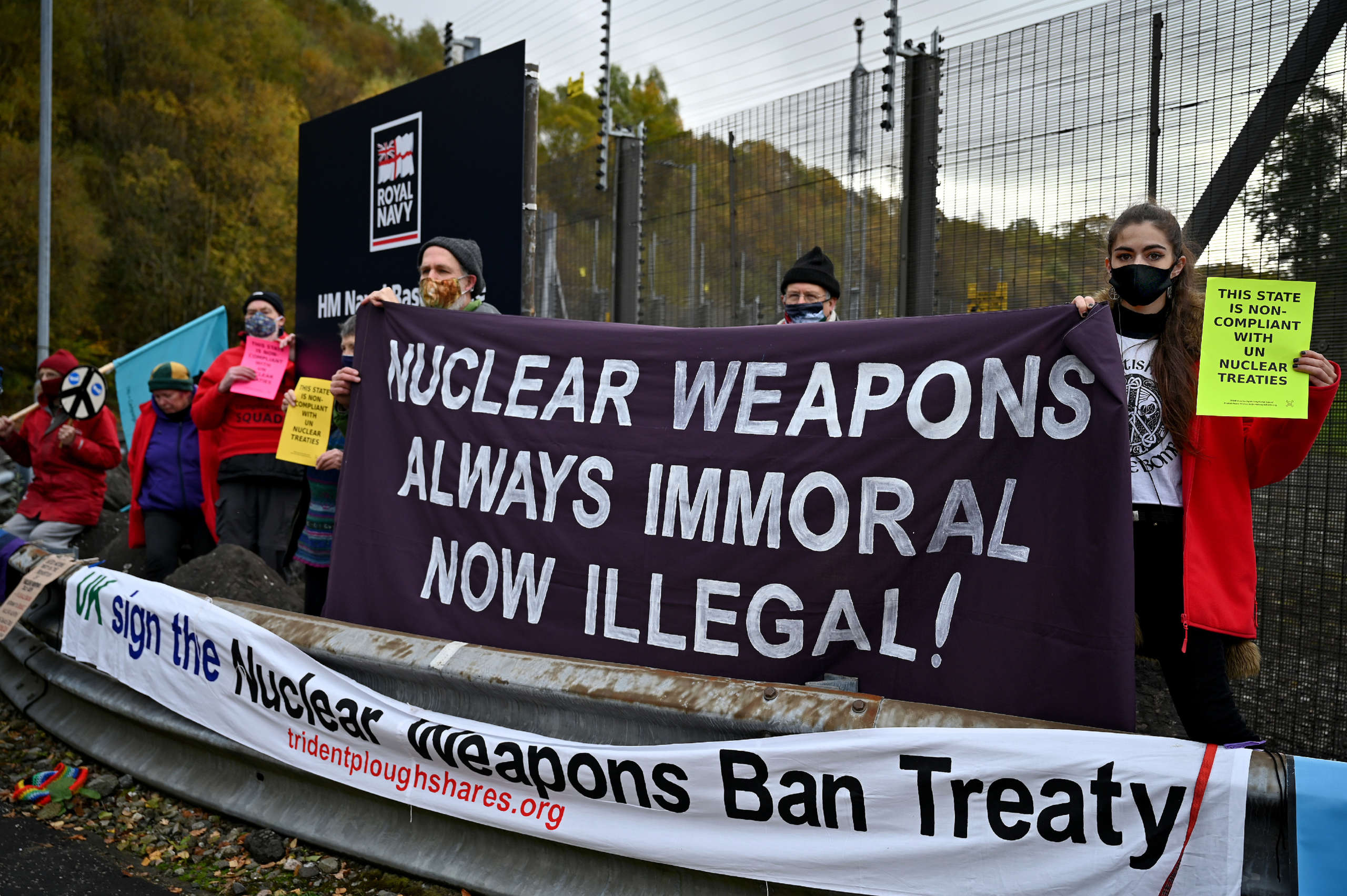
As the 500 enterprise employee met and contemplated a future full of nuclear weapons, two men stood across the street from the hotel, holding hand-painted signs. “Nuclear Weapons are illegal,” said one. “The World Wants Nuclear Disarmament,” said the other.
Japan postponing its controversial plan for trials to reuse radioactively contaminated soil
Japan’s government is postponing trials in the Tokyo area to reuse soil
that was decontaminated following the 2011 nuclear accident due to
complaints from residents. They would have been the first of their kind
outside Fukushima Prefecture.
The trials were set to start by the end of
March in Tokyo’s Shinjuku Ward and Tokorozawa City in neighbouring Saitama
Prefecture. But Environment Ministry officials say residents complained and
raised concerns at briefing sessions in December. They say some people
questioned why their neighbourhood was chosen, and that others complained
about a lack of information. The mayor of Tokorozawa has also been
hesitant, as the majority of a local community group opposes the plan.
NHK 24th Feb 2023
Seoul aims to use strengthened US ties to expand nuclear plant exports
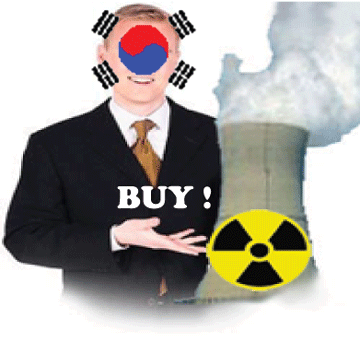
The Yoon Suk Yeol administration has scrapped the former Moon Jae-in administration’s nuclear phase-out policy based on the view that nuclear power is essential for the long-term sustainability of South Korea’s economy and its nuclear power industry
Settlement between Westinghouse and KEPCO is necessary for Washington-Seoul to expand alliance into nuclear energy
Korea Times, By Kim Yoo-chul 26 Feb 23,
Unlike the previous Moon Jae-in administration, President Yoon Suk Yeol and his foreign affairs team are clearly aiming to grow South Korea into a pivotal state given Seoul’s competitive standing to increase interoperability among a range of partners, specifically in the Indo-Pacific region.
This policy drive is backed by his administration’s concerted backing of Washington’s various protectionist industrial policies and regional security agenda items.
South Korea’s support of the Inflation Reduction Act (IRA), CHIPS and Science Act, the country’s participation in a U.S.-initiated Indo-Pacific Economic Framework (IPEF) and Chip 4 alliance are the examples signifying Seoul’s shift toward U.S. policies………………………….
Seoul’s backing of [U.S. President Joe] Biden’s signature industrial and regional security policies illustrates the fact that the country is prepared to withstand any economic and political costs by raising its profile as an advocate of major policy initiatives outlined and being managed by the U.S.’ partners and its like-minded allies,” a senior government official said in a telephone interview, adding that the majority of his comments do not necessarily reflect the official policy or position of South Korea.
Despite Seoul maintaining strategic cooperation with Beijing given its heavy reliance on the Chinese market _ China is the largest trading partner of South Korea _ and China’s huge political influence on North Korea, the Yoon administration’s apparent shift in position favoring the Biden administration’s moves to revive U.S. manufacturing, has so far been successful……………………………………..
Now, as the Biden administration has set its sights on boosting U.S. energy independence, the Yoon administration is hoping to expand its alliance with Washington into nuclear energy, in addition to batteries and chips, security analysts and company officials said.
SMRs emerge as option, legal troubles
The prime goal of the Inflation Reduction Act (IRA) is aimed at addressing rising inflation. However, the IRA also includes several tax incentives for clean energy technologies including advanced small modular reactors (SMRs). This means the IRA will possibly become a game changer for Washington’s participation in the new energy economy……………………
the IRA will have profound effects on South Korean nuclear energy and reactor companies, because they are in a better position to become one of the top beneficiaries of the act,” a trade ministry official said by telephone.
The Yoon Suk Yeol administration has scrapped the former Moon Jae-in administration’s nuclear phase-out policy based on the view that nuclear power is essential for the long-term sustainability of South Korea’s economy and its nuclear power industry. There are hopes that Yoon might reach a consensus with his U.S. counterpart on the sidelines of the Korean leader’s scheduled state-visit to the White House in late April to expand the Washington-Seoul alliance in the area of SMRs, industry sources told The Korea Times………….
U.S.-based Westinghouse and KEPCO, alongside KEPCO’s subsidiary Korea Hydro & Nuclear Power (KHNP), are involved in negotiations over their legal dispute after the U.S. company filed a lawsuit against KHNP in a U.S. federal court to block it from selling reactors to Poland. KEPCO and its subsidiary, KHNP, have been accused of infringing on Westinghouse’s intellectual property rights and Washington’s nuclear export controls.
“Reaching a settlement is highly likely before Yoon’s visit to the U.S. Westinghouse and KEPCO, along with KHNP, have until March 17 this year to address their legal issues. As nuclear technologies have also become a security issue, all parties involved in the legal dispute will have to find a compromise under the principle of reciprocity that won’t hurt national interests,” said Seok Kwang-hoon, a senior analyst at Energy Transition Korea. Westinghouse officials were not immediately available for comment.
“Westinghouse itself has no question about the significance of its commercial partnership with South Korea given the country’s supply chains for future AP1000 nuclear reactors. That means if the ongoing settlement negotiations fail, then this will impact Seoul’s efforts to win reactor deals from Poland and the Czech Republic, the countries categorized as South Korea’s target markets. It’s a plausible idea for South Korean companies to acquire Westinghouse’s property rights,” said Kim Sang-tae, a professor of nuclear engineering at Hanyang University in Seoul. https://www.koreatimes.co.kr/www/tech/2023/02/419_346075.html
Thousands rally in Berlin, Paris to call for peace in Ukraine
People in Berlin take part in a protest against the delivery of weapons to Ukraine.
Protesters in Paris and Berlin capitals have rallied to demand peace in Ukraine, a day after the anniversary of Russia’s invasion.
Thousands of people protested in the Germany capital on Saturday to condemn the government’s supply of arms to Ukraine and call for peace talks to end the war.
The organisers were criticised before the protest for downplaying Ukraine’s right to defend its territory from Russian aggression and failing to distance themselves from the far right and far left, where pro-Russia views are common.
One of the organisers, opposition lawmaker Sahra Wagenknecht of the ex-communist Left party, said that there was no place for neo-Nazis at the rally, but that anyone who wanted peace “with an honest heart” was welcome.
While most placards at the protest reflected traditional left-wing positions, some participants bore banners with the slogan “Americans go home” and the logo of a far-right magazine. Some waved Russian flags.
Wagenknecht accused the German government of seeking to “ruin Russia,” and said that Moscow should be made an “offer” in order to resume peace talks.
Another of the organisers, prominent feminist author Alice Schwarzer, said it was time to look beyond left and right.
The two women have also launched a petition which claims to have gathered more than 645,000 signatures.
Protesters jeered whenever she and Wagenknecht mentioned the name of German foreign minister Annalena Baerbock, who has strongly backed the delivery of arms to Ukraine.
Police said that about 13,000 people took part in the rally at Berlin’s iconic Brandenburg Gate, while organisers claimed that 50,000 people participated.
One attendee was Konstantin Schneider, an academic from Berlin, who said he understood that countries in Eastern Europe were afraid of Russia.
“Of course [Russian President Vladimir] Putin is an idiot to attack Ukraine,” he said. “But we still need to find new solutions [to the war] instead of sweepingly saying there’s nothing to negotiate.”
There were several small counter-demonstrations. On Friday, thousands of protesters across Europe marched against Moscow’s invasion of Ukraine…………………………………….
1 This Month
23-25 October – on Zoom – World BEYOND War’s annual global conferenc


Shut down the radiation-damaged Heysham nuclear reactors now
To see nuclear-related stories in greater depth and intensity – go to https://nuclearinformation.wordpress.com

Say No to NASA’s Reckless Nuclear Reactor on the Moon
Say No to NASA’s Reckless Nuclear Reactor on the Moon

-
Archives
- October 2026 (209)
- September 2026 (339)
- August 2026 (330)
- July 2026 (355)
- June 2026 (287)
- May 2026 (306)
- April 2026 (356)
- March 2026 (251)
- February 2026 (267)
- January 2026 (308)
- December 2025 (358)
- November 2025 (359)
-
Categories
- 1
- 1 NUCLEAR ISSUES
- business and costs
- climate change
- culture and arts
- ENERGY
- environment
- health
- history
- indigenous issues
- Legal
- marketing of nuclear
- media
- opposition to nuclear
- PERSONAL STORIES
- politics
- politics international
- Religion and ethics
- safety
- secrets,lies and civil liberties
- spinbuster
- technology
- Uranium
- wastes
- weapons and war
- Women
- 2 WORLD
- ACTION
- AFRICA
- Atrocities
- AUSTRALIA
- Christina's notes
- Christina's themes
- culture and arts
- Events
- Fuk 2022
- Fuk 2023
- Fukushima 2017
- Fukushima 2018
- fukushima 2019
- Fukushima 2020
- Fukushima 2021
- general
- global warming
- Humour (God we need it)
- Nuclear
- RARE EARTHS
- Reference
- resources – print
- Resources -audiovicual
- Weekly Newsletter
- World
- World Nuclear
- YouTube
-
RSS
Entries RSS
Comments RSS

