Even the science engineering big-wigs don’t seem too enthusiastic about nuclear fusion

Nuclear fusion breakthrough: Decades of research are still needed before fusion can be used as clean energy, The Conversation June 28, 2023, Kristen Schell Assistant Professor, Mechanical and Aerospace Engineering, Carleton University. Ahmed AbdullaAssistant Professor, Mechanical and Aerospace Engineering, Carleton University
“…………………………………………….. The efficiency of a potential fusion energy power plant remains to be seen. The reported fusion net gain actually required about 300 megajoules of energy input, which was not included in the energy gain calculation. This energy input, needed to power 192 lasers, came from the electric power grid.
In other words, the experiment used as much energy as the typical Canadian household does in two days. In doing so, the fusion reaction output enough energy to light just 14 incandescent bulbs for an hour.
The same is true of nuclear fission, which is the reaction inside current nuclear power plants. The complete fission of one kilogram of Uranium-235 — the fissile component of nuclear fuel — can generate about 77 terajoules. But we cannot convert all of that energy into useful forms like heat and electric power.
Instead, we have to engineer a complex system that can control the nuclear fission chain reaction and convert the generated energy into more useful forms.
This is what nuclear power plants do — they harness the heat generated during nuclear fission reactions to make steam. This steam drives a turbine connected to an electric power generator, which produces electricity. The overall efficiency of the cycle is less than 40 per cent.
In addition, not all of the uranium in the fuel is burned. Used fuel still contains about 96 per cent of its total uranium, and about a fifth of its fissile Uranium-235 content.
Increasing the amount of uranium spent in our current fleet is possible — it’s an ongoing sphere of work — but it poses enormous engineering challenges. The huge energy potential of nuclear fuel is currently mitigated by the engineering challenges of converting that energy into a useful form.
From science to engineering
Until recently, fusion has been seen primarily as a scientific experiment, not as an engineering challenge. This is rapidly changing and regulators are now investigating how deployment might unfold in the real world.
Regardless of the efficiency of a future fusion power plant, taking energy conversions from basic science to the real world will require overcoming a multitude of challenges………………….
The science of fusion energy, as with nuclear fission, is rooted in efforts to develop nuclear weapons. Notably, several nuclear physicists who helped develop the nuclear bomb wanted to “prove that this discovery was not just a weapon.”
The early history of nuclear power was one of optimism — of declarations the technology would advance and be able to meet our need for ever-increasing amounts of energy. Eventually, fusion power would come along and electricity would become “too cheap to meter.”
Lessons learned
What have we learned over the past 70 years since the onset of nuclear power? First, we’ve learned about the potentially devastating risk of technology lock-in, which occurs when an industry becomes dependent on a specific product or system.
Today’s light-water fission reactors — reactors that use normal water as opposed to water enriched with a hydrogen isotope — are an example of this. They were not chosen because they were the most desirable, but for other reasons.
These factors include government subsidies that favoured these designs; the U.S. Navy’s interest in developing smaller-scale pressurized water reactors for submarines and surface warships; advances in uranium enrichment technology as a result of the U.S. nuclear weapons program; uncertainties regarding nuclear costs that led to the assumption that large light-water reactors are simply scaled-up versions of smaller ones; and conservatism regarding design choices given the high costs and risks associated with nuclear power development.
We have been struggling to move to other technologies ever since……………………………………………
Large infrastructure projects are extremely complex systems that rely on enormous work forces and co-ordination. They can be managed, but they usually go over-budget and fall behind schedule. Modular technologies exhibit better affordability, cost control and economies, but micro and small nuclear reactors will also be economically challenged.
……………………………………………….. Fusion reactors generate large amounts of waste, though not the same kind fission does.
………………………………………..Billions of dollars are needed to advance nuclear fission technology, and we have far more experience with fission than with fusion. An appetite for funding must be demonstrated by governments, electric utility companies and entrepreneurs……………….. https://theconversation.com/nuclear-fusion-breakthrough-decades-of-research-are-still-needed-before-fusion-can-be-used-as-clean-energy-196758
2 important Russo Ukraine war stories: 1 covered 24/7; 1 covered up

It would be so nice for me to think (as a good, genuinely conservative, Christian Westerner and patriotic Australian) , – that this Walt Zlotow story is a pack of lies, (obviously from a paid stooge of Putin)
My problem is: that everything that I see, read, hear, on Australian corporate media and the Australian Broadcasting Corporation – just happens to tally with what he is saying.
Good on Walt Zlotow for having the guts to speak out.
I’m just sorry that I think that he is not going to be believed. The end result? We might find a small group of (?)wealthy individuals presiding over a nearly dead planet.

Walt Zlotow West Suburban Peace Coalition, Glen Ellyn IL 27June 23
Mainstream news got the figurative memo from the US State Dept. and military Friday: Full media press coverage of the mini insurrection against Russian President Putin that could potentially have toppled him. But not one word on the apparently failing Ukrainian counteroffensive the US was counting on before even considering negotiations to end the 17 month war.
That coverage simply continues the 487 days of media compliance with US not so subtle demands that the war be reported as Ukraine largely defeating a Russia hopelessly unable to secure control of Donbas and keep NATO off its doorstep.
If the American people were informed on Ukraine’s near complete inability to repel the Russian invaders, they might push back against the squandering of over a hundred billion dollars in US treasure on a futile cause not affecting US national security in the least.
If they knew we’re sending cluster bombs, prohibited by most countries, that can kill long after the war ends, if ever, they might call for negotiations, not more weapons.
If they knew we’re sending long range missiles to strike deep in Russia, possibly triggering nuclear confrontation, they might protest this madness.
But most Americans don’t know any of this. Like the apparently failing Ukrainian offensive, only good news, justifying America’s ghoulish demand this war goes on endlessly, gets on mainstream news.
If the US had that insane approach to diplomacy and negotiations during the Cuban Missile Crisis, we wouldn’t be having this discussion. We’d have all been blown away 61 years ago. more at https://www.antiwar.com/blog/author/walt_zlotow/
Charming optimism, as a Japanese non-profit group plans for bunkers for the community to be OK in a nuclear war.

2 NPO pushes nuclear bunkers in Japan amid growing security threats
TSUKUBA
Amid growing security concerns over Russia’s nuclear threat and North Korea’s missile ambitions, a nonprofit organization in Japan has built a model nuclear shelter near Tokyo to raise awareness and encourage people to consider digging a doomsday bunker of their own.
While not yet open to the public, the underground concrete structure opened on May 10 in a parking lot opposite the Japan Nuclear Shelter Association’s office in Tsukuba, Ibaraki Prefecture. It has already hosted about 40 tours by construction professionals, national and local politicians, government agencies and the media.
The association says it aims to see shelters built in Japan to established standards. Interest in its activities has exploded last year, it said, with its membership rising from just two companies to around 30 in over a year.
“We were thinking about building this even before the (Russian) invasion of Ukraine, but decided we really had to from spring last year,” said director Takahiro Kawashima.
The facility is built to specifications from Switzerland, where 1960s legislation at the height of the Cold War required shelters be made available to all citizens.
The structure can withstand a blast like the 1945 atomic bombings of Hiroshima and Nagasaki, provided it is just under a kilometer or more from the explosion’s center, according to the association.
It says the underground shelter can house a family of four adults, three children and one pet for a maximum of two weeks. While the entire space is about 48 square meters, its living area is around 25.6 square meters……………………………….
it remains unclear how much a system like the one the association is showcasing would cost if it became a national standard.
Construction of the model shelter came in at a total of around 40 million yen ($277,000) to build and outfit but the organization maintains that a more standard price would be around 20 to 30 million yen per unit, not inclusive of the land on which it is constructed…… https://japantoday.com/category/national/npo-pushes-nuke-bunkers-in-japan-amid-growing-security-threats
Japan’s nuclear regulator finishes inspection of Fukushima radioactive wastewater release system
Japan’s nuclear regulator has finished inspecting a newly completed system to release radioactive wastewater from the crippled Fukushima Daiichi nuclear power plant into the sea, local media reported.
The Nuclear Regulation Authority (NRA) checked for leaks and other abnormalities on Friday by passing water through the system and inspected the emergency shut-off valves to make sure they function properly, public broadcaster NHK reported.
NRA officials have reported no particular problem with the facility’s overall performance. The nuclear regulatory body is due to draw up a report on the results in about a week, it said.
If the NRA issues a certificate to the plant’s operator Tokyo Electric Power Company (TEPCO), the system will be ready to operate, it added.
The NRA wrapped up three days of final on-site inspections on Friday. TEPCO completed the construction of the wastewater discharge system on Monday.
Despite continuous opposition from its neighbors and the Pacific Island Countries, Japan has been rushing to carry out its plan of dumping treated radioactive wastewater from the crippled Fukushima nuclear power plant into the Pacific.
What to know about Japan’s plan to release treated radioactive water from Fukushima nuclear plant into the sea
- The plan to dump treated radioactive waste water from a nuclear plant into the sea has stirred debates in South Korea, and led to boycotts of Japanese goods in China
- Japanese fishermen, whose livelihoods could be severely impacted, have also vehemently opposed the waste water disposal plan
Babbling about Prigozhin (and “the end of Putin”
There was much breathless, excited pontification about the end of Putin, despite the obvious fact that this insurrection had failed in its tracks.
June 27, 2023, by: Dr Binoy Kampmark https://theaimn.com/babbling-about-prigozhin/
A lot of nonsense is being spouted by a bevy of spontaneous “Russian experts” in light of the Prigozhin spray, a mutiny (no one quite knows what to call it), stillborn in the Russian Federation. It all fell to the theatrical sponsor, promoter and rabble rouser Yevgeny Prigozhin, a convict who rose through the ranks of the deceased Soviet state to find fortune and security via catering, arms and Vladimir Putin’s support.
In the service of the Kremlin, Prigozhin proved his mettle. He did his level best to neutralise protest movements. He created the Internet Research Agency, an outfit employing hundreds dedicated to trolling for the regime. Such efforts have been apoplectically lionised (and vilified) as being vital to winning Donald Trump the US presidency in 2016.
His Wagner mercenary outfit, created in the summer of 2014 in response to the Ukraine conflict, has certainly been busy, having impressed bloody footprints in the Levant, a number of African states, and Ukraine itself. Along the way, benefits flowed for the provision of such services, including natural resource concessions.
But something happened last week. Suddenly, the strong man of the mercenary outfit that had been performing military duties alongside the Russian Army in Ukraine seemed to lose his cool. There were allegations that his men had been fired upon by Russian forces, a point drawn out by his capture of the 72nd Motorised Rifle Brigade commander, Lieutenant Colonel Roman Venevitin. Probably more to the point, he had found out some days earlier that the Russian Defence Ministry was keen to rein in his troops, placing them under contractual obligations. His autonomous wings were going to be clipped.
The fuse duly went. Prigozhin fumed on Telegram, expressing his desire to get a number of officials, most notably the Defence Minister, Sergei Shoigu, and Chief of the General staff Valery Gerasimov, sent packing. A “march for justice” was organised, one that threatened to go all the way to Moscow.
President Vladimir Putin fumed in agitation in his televised address on June 24, claiming that “excessive ambition and personal interests [had] led to treason, to the betrayal of the motherland and the people and the cause.” Within hours, Belarussian President Alexander Lukashenko, whose diplomatic skills are threadbare, had intervened as mediator, after which it was decided that the Wagner forces would withdraw to avoid “shedding Russian blood.”
This all provided some delicious speculative manna for the press corps and commentariat outside Russia. Nature, and media, abhor the vacuum; the filling that follows is often not palatable. There was much breathless, excited pontification about the end of Putin, despite the obvious fact that this insurrection had failed in its tracks. John Lyons of the Australian Broadcasting Corporation was aflame with wonder. Where, he wondered, was the Russian President? Why did the Wagner soldiers “get from Ukraine to Rostov, take control of Ukraine’s war HQ then move to Voronezh without a hint of resistance”?
John Lough of Chatham House in London claimed that Putin had “been shown to have lost his previous ability to be the arbiter between powerful rival groups.” His “public image in Russia as the all-powerful Tsar” had been called into question. Ditto the views of Peter Rutland of Wesleyan University, who was adamant in emphasising Putin’s impotence in being “unable to do anything to stop Prigozhin’s rogue military unit as it seized Rostov-on-Don,” only to then write, without explaining why, about uncharacteristic behaviour from both men in stepping “back from the brink of civil war.”
-ADVERTISEMENT-
Then came the hyperventilating chatter about nuclear weapons (too much of the Crimson Tide jitters there), the pathetic wail that accompanies those desperate to fill both column space. The same degree of concern regarding such unsteady nuclear powers as Pakistan is nowhere to be seen, despite ongoing crises and the prospect of political implosion.
Commentors swooned with excitement: the Kremlin had lost the plot; the attempted coup, if it could even be called that, had done wonders to rattle the strongman. Those same commentators could not quite explain that Prigozhin had seemingly been rusticated and banished to Belarus within the shortest of timeframes, where he is likely to keep company with a man of comparatively diminished intellect: Premier Lukashenko himself. Prigozhin, for all his aspirations, has a gangster’s nose for a bargain, poor or otherwise.
As Kremlin spokesman Dmitry Peskov put it, the original criminal case opened against Prigozhin for military mutiny by the Kremlin would be dropped, while any Wagner fighters who had taken part in the “march for justice” would not face any punitive consequences. Those who had not participated would be duly assimilated into the Russian defence architecture in signing contracts with the Defence Ministry.
The image now appearing – much of this subject to redrawing, resketching, and requalifying – is that things were not quite as they seemed. Assuming himself to be a big-brained Wallerstein of regime stirring clout, Prigozhin had seemingly put forth a plan of action that had all the seeds of failure. Britain’s The Telegraph reported that “the mercenary force had only 8,000 fighters rather than the 25,000 claimed and faced likely defeat in any attempt to take the Russian capital.”
Another reading is also possible here, though it will have to be verified in due course. Putin had anticipated that this contingently loyal band of mercenaries was always liable to turn, given the chance. Russia is overrun with such volatile privateers and soldiers of fortune. Where that fortune turns, demands will be made.
Ultimately, in Putin’s Russia, the political is never divorceable from the personal. Chechnya’s resilient thug, Ramzan Kadyrov, very much the prototypical Putin vassal only nominally subservient, suggests that this whole matter could be put down to family business disputes. “A chain of failed business deals created a lingering resentment in the businessman, which reached its peak when St. Petersburg’s authorities did not grand [Prigozhin’s] daughter a coveted land plot.” The big picture, viewed from afar, can be very small indeed.
Italy’s Nuclear Energy Debate: Past, Present, and Future
Note that Italy has actually held 2 referendums about nuclear power, and both resulting in a definite “NO”
It seems that the public, the ordinary people, might have more sense than their leaders?
Italy’s nuclear energy debate has been a long-standing and complex issue, with a history of fluctuating public opinion, political decisions, and technological advancements. The country’s relationship with nuclear power began in the 1960s, when Italy was one of the first European countries to invest in nuclear energy. However, the nuclear debate has evolved significantly over the past few decades, with Italy’s nuclear energy program experiencing a series of stops and starts, ultimately leading to its current state of uncertainty.
……………………………………. Italy held a national referendum in 1987, in which a majority of voters chose to phase out the country’s existing nuclear power plants. By 1990, all four of Italy’s nuclear power plants had been shut down.
………………………………….. In the early 2000s, Italy’s nuclear energy debate re-emerged as a prominent issue, as the country faced growing energy demands and concerns about climate change. In 2008, the Italian government announced plans to resume investment in nuclear power, with the goal of generating 25% of the country’s electricity from nuclear energy by 2030.
……………………………………However, the 2011 Fukushima nuclear disaster in Japan once again shifted public opinion on nuclear energy, reigniting concerns about the safety of nuclear power plants. In response to the disaster, Italy held another national referendum in June 2011, in which a majority of voters chose to maintain the country’s moratorium on nuclear power. As a result, the Italian government abandoned its plans to invest in new nuclear power plants.
Since the 2011 referendum, Italy’s nuclear energy debate has remained a contentious issue,…………………………………………….Opponents argue that the risks associated with nuclear power, particularly in terms of safety and waste disposal, outweigh its potential benefits.
In recent years, Italy has made significant investments in renewable energy sources, such as solar and wind power, in an effort to diversify its energy mix and reduce its reliance on imported energy. However, the question of whether nuclear power should play a role in Italy’s energy future remains unresolved………………….. https://www.energyportal.eu/news/italys-nuclear-energy-debate-past-present-and-future/45044/
Hanford nuclear waste site has a clean-up bill of 560 billion USD in Washington DC
2 as reported by the New York Times (June 1, 2023).
The Hanford site will never be fully decontaminated and will remain indefinitely.
Selected quotes:
“But construction of a five-story, 137,000 square-foot chemical treatment plant for the task was halted in 2012 — after an expenditure of $4 billion — when it was found to be riddled with safety defects. The naked superstructure of the plant has stood in mothballs for 11 years, a potent symbol of the nation’s failure, nearly 80 years after the Second World War, to deal decisively with the atomic era’s deadliest legacy.”
“Leaders of the Yakama Nation, an 11,000-member tribe whose ancestral lands once included the Hanford site, say their 1855 treaty promised that tribe members would have the right to hunt and fish on healthy lands.”
“Before the Manhattan Project, there was a handshake agreement that this area would be returned to the way it was,” said Trina Sherwood, a cultural specialist in the tribe’s natural resources department. “How can we agree to leave the poison in the land?”
“Yet returning the land to what it once was is an outcome that almost no one expects.”
“There are parts of the site that will never be turned over,” Mr. Vance, the Hanford site manager, said. “We are going to be here a long time.”
New York Times Article, Published June 1, 2023
By Ralph Vartabedian, Reporting from Richland, Wash. May 31, 2023
Sweden goes for small nuclear reactors, dumps renewable energy plans

Sweden dumps renewables target as it seeks more nuclear power, Sydney Morning Herald, By Rob Harris, June 29, 2023
London: Sweden’s parliament has dumped its 100 per cent renewable target amid ongoing concerns about short-term energy security as it looks to join several European nations to build new nuclear plants.
The country’s governing centre-right coalition, headed by Moderate Party Prime Minister Ulf Kristersson, recently joined 11 fellow European Union members in an informal group of member states called the Nuclear Alliance, with the objective to strengthen cooperation in energy generation…………………………………………………………..
Vattenfall, Sweden’s state-owned utility, plans to build at least two small modular reactors and extend the lifetime of the country’s existing nuclear reactors. https://www.smh.com.au/world/europe/sweden-dumps-renewables-target-as-it-seeks-more-nuclear-power-20230629-p5dkae.html
Recent nuclear news

This newsletter short, as I have been ill in hospital for nearly a week. (Fine now.) It did give me time to think. One thought: people liken the Russian advance on the Donbass, invasion of Ukraine, to the Nazis in WW2. That is so incorrect. So wrong to equate this situation to the evil philosophy of “Aryan superiority” that engulfed Germany from 1933 to 2 Sept 1945.
Climate. Scientists monitoring ‘doomsday’ glacier in Antarctic warn climate change happening faster than ever before. Ecological tipping points could occur much sooner than expected, study finds.
Christina notes. Cool thinking is needed on the Ukraine situation. Would Russia really blow up a nuclear plant that it controls? Two ruthless killer regimes, who hate each other, are now to cosy up for the benefit of the “peaceful” nuclear industry. What could possibly go wrong? https://www.youtube.com/watch?v=pWa7BJAmzYY
TOP STORIES
European Parliamentary Assembly rapporteurs warn against extradition to the United States of Julian Assange. Biden Would Need His Pound of Flesh From Assange.
By excluding Russia from markets in Europe, USA ‘s nuclear industry plans to sell its small and large nuclear reactors to Poland,Romania, Slovakia, Estonia, the Czech Republic and Ukraine .
Daniel Ellsberg’s message to us, and to future generations.
The Silent Slaughter of the Flower of Ukraine’s Youth. 2 important Russo Ukraine war stories: 1 covered 24/7; 1 covered up.
World’s Largest Fusion Project Is in Big Trouble, New Documents Reveal.0
CLIMATE. A heating world can’t afford a cold war. Nuclear-based fantasies are holding back real climate action. Diversion from urgent climate action. How the European nuclear lobby undermines the EU’s energy future.
CIVIL LIBERTIES. Zelensky bans Russian books.
ECONOMICS. Building nuclear plant would increase costs in the need for guards, police and rescue workers. Marketing. China joins the rush to market nuclear power to Turkey. United Arab Emirates keen to become an exporter of nuclear reactors and nuclear technology. Chinese Boycott Over Fukushima Nuclear Plant Water Release Sinks Japanese Cosmetics.
Education. . Nuclear indoctrination for Australian school-children – normalising nuclear submarines.
EMPLOYMENT. Royal Navy struggles to attract recruits for nuclear-armed subs. Big enlistment bonuses offered to UK sailors entering the nuclear field.
ENERGY. NFLA message to energy minister – ‘Community energy is great; back it’.
ENVIRONMENT. What is the new ‘returning zone’ to be created in disaster-hit Fukushima?.
HEALTH. Radiation. Chinese astronauts install radiation-exposure experiment outside Tiangong space station .
INDIGENOUS ISSUES. We need to wake up’: Algonquin leaders sound alarm over planned nuclear waste facility near Ottawa River. A nuclear site is on tribes’ ancestral lands. Their voices are being left out on key cleanup talks.
LEGAL. Judge Who Ruled Against Assange Built Career as Barrister Defending UK Government. Legal challenge against Sizewell C nuclear power plant rejected,
NUCLEAR TECHNOLOGY. Nuclear Fusion: A Clean Energy Revolution Or A Radioactive Nightmare?
OPPOSITION to NUCLEAR. Suffolk campaigners vow to continue fighting Sizewell C. Nuclear Waste Transportation Draws Opposition in West.
PERSONAL STORIES. The Loving Truth-Teller That Was Daniel Ellsberg.
POLITICS. Humza Yousaf vows to rid independent Scotland of nuclear weapons. Starmer must drop support for flagship £20bn nuclear power station, says former Gordon Brown adviser. Sweden reverses its long-standing nuclear-free policy. Riverkeeper celebrates bipartisan Assembly passage of bill to stop radioactive wastewater discharges into the Hudson River; Governor Hochul must sign.
POLITICS INTERNATIONAL and DIPLOMACY. Will upcoming NATO summit launch forever war in Europe? Saudi Arabia demands own nuclear program in exchange for ties with Israel. Central Europe’s nuclear plans – fraught with problems.
SAFETY. Russia asks IAEA to ensure Zaporizhzhia nuclear plant security. IAEA Director General Grossi discusses nuclear safety with Russia’s Director of Rosatom, at Zaporizhzhia, in new consultations. Watchdog group has concerns over nuclear micro-reactor plans.
WASTES. ‘Truly shocking’: UK has enough plutonium to make almost 20,000 nukes. £485m clean-up operation for UK’s 10 nuclear reactors. The Biden administration is pouring billions into the nuclear industry-the payoff isn’t certain, US navy accused of cover-up over radioactive shipyard waste. New Mexico leaders fear nuclear waste could endanger oil and gas in the Permian Basin. Is Fukushima wastewater release safe? What the science says.
WAR and CONFLICT. Key moments of aborted Wagner revolt in Russia. “Brink of catastrophe” should Wagner Group “bandits” get their hands on nuclear weapons. Ukraine sustains massive single-day losses – Russian MOD. Russian MP believes Ukrainian counteroffensive will end in July . Kiev planning strike on Russia with Western-made missiles – Moscow. Ukraine counter offensive – https://www.youtube.com/watch?v=76KAD8djBBg Eyewitness Donbas: Why the Majority Reject Ukraine’s Counter-Offensive. https://www.youtube.com/watch?v=sS4DwwsSIG4Here’s how NATO trainers knowingly sent Ukrainian troops to their deaths in this month’s counteroffensive against Russia. SCOTT RITTER: On Horseradish & Nuclear War. The Reverse Cuban Missile Crisis. Khren Im – To the USA and Biden ….if this continues, it is lights out for humanity. Keep nuclear threats off the table.
WEAPONS and WEAPONS SALES. NATO arsenals ‘empty’ – Stoltenberg (need to ramp up production). Ukraine’s “spring counteroffensive not making progress: will NATO resort to deploying tactical nuclear weapons for Ukraine? Prodding the Pentagon. Is Russia planning to use nuclear weapons? Ukraine Can Develop Nuclear Weapons ‘Within a Short Time’: Ex-Zelensky Aide.
A $31 Billion Missile Program! US Looks To Reintroduce Nuclear Sea-Launched Cruise Missile Costing Equal To 10 Virginia-Class Subs. Amid China Tensions, US Nuclear-Powered Aircraft Carrier, USS Ronald Reagan, To Make A Rare Vietnam Port Call.
Senate passes $886 billion National Defense Authorization Act (NDAA): No audits necessary

Walt Zlotow, West Suburban Peace Coalition, Glen Ellyn IL 1 Aug 23
President Joe wants no audit of the billions in weapons of mass Ukrainian death provided in the 2024 National Defense Authorization Act (NDAA).
His compliant Senate majority gave him every buck of the 886 billion bucks he requested to wage US exceptionalism round the world. Besides ravaging the life of millions in dozens of countries worldwide from bombs and sanctions, US foreign policy risks nuclear war with Russia and China over Ukraine and Taiwan respectively.
Republican Sen. Rand Paul’s amendment requiring audits and investigations of Ukraine aid was swamped 78 -20, with all Democrats voting to keep auditors away from the weapons giveaways. They are terrified an honest investigation would reveal how billions in weapons wind up with bad actors, get destroyed as soon as they’re introduced into the killing fields, and simply raise the Ukrainian death toll that can only be eliminated by negotiations.

America’s grotesque military budget should be reported in full on every front page, instead of disappearing from public consumption like invisible ink. On cable/network news, it’s the shame of America that dare not speak its name.
Every day countless Ukrainians die for US exceptionalism, and every day nuclear confrontation creeps closer.
The changing narrative of the war in Ukraine

Meanwhile Secretary of State Antony Blinken is telling reporters that the dangers of human extinction from nuclear war are no greater than the dangers humanity faces from climate change. Goebels would be proud of him.
On the Russian home front do you feel that the country is at war? Armageddon Newsletter, GILBERT DOCTOROW, JUL 31, 2023
“……………………………………………………………………………………………..for those who can bear watching war news on television, the narrative has been changing, especially in the past week. Until then, news of the material damage and bodily harm caused by daily Ukrainian bombardment of Donetsk city and other towns in the Donbas took up much of the news bulletins. Now the accent is on the destruction Russian forces are dealing out to the Ukrainians as Kiev directs larger scale attacks and brings into play its strategic reserves, especially in the Zaporozhie region. The new Ukrainian offensive appears to be no more successful than previous probing maneuvers in breaking though the dense Russian defense lines.
Russian military experts on the leading talk shows who showed great reserve about predicting the future course of the conflict lest Russians be overconfident a week ago now appear radiant and ready to confide that the Ukrainians never got the equipment they needed to make their counter-offensive a success.
As I noted in a recent essay, the Russian military command has been biding its time until it is certain that Ukraine was already committing its reserves to battle and would soon run dry. Now that time is approaching. We see that the Russians are opening an offensive in the northeast, in the Kharkov region………………………
Against this background of the changes in the correlation of forces in Russia’s favor, I am stunned that U.S. and other observers and commentators are not taking note.
These authors like so many talking heads in the West do not have the necessary linguistic skills to access Russian news sources on their own. They depend wholly on propagandists in the State Department for the raw facts from which they can spin their reasonable compromises. I humbly submit that this war will either end on Russia’s terms or it will escalate thanks to American miscalculations and obstinacy to the point of a nuclear exchange that puts the survival of humankind in peril.
Meanwhile Secretary of State Antony Blinken is telling reporters that the dangers of human extinction from nuclear war are no greater than the dangers humanity faces from climate change. Goebels would be proud of him.
Fukushima, the Hidden Side of the Story
“The Fukushima Disaster, The Hidden Side of the Story,” is a just-released film documentary, a powerful, moving, information-full film that is superbly made. Directed and edited by Philippe Carillo, it is among the strongest ever made on the deadly dangers of nuclear technology.
It begins with the words in 1961 of U.S. President John F. Kennedy: “Every man, woman and child lives under a nuclear sword of Damocles, hanging by the slenderest of threads, capable of being cut at any moment by an accident, or miscalculation or by madness.”
It then goes to the March 2011 disaster at the Fukushima Daichi nuclear power plants in Japan after they were struck by a tsunami. Their back-up diesel generators were kicked in but “did not run for long,” notes the documentary. That led to three of the six plants exploding—and there’s video of this—“releasing an unpreceded amount of nuclear radiation into the air.”
“Fukushima is the world’s largest ever industrial catastrophe,” says Professor John Keane of the University of Sydney in Australia. He says there was no emergency plan and, as to the owner of Fukushima, Tokyo Electric Power Company, with the accident its CEO “for five nights and days…locked himself inside his office.”
Meanwhile, from TEPCO, there was “only good news” with two Japanese government agencies also “involved in the cover-up”—the Nuclear Industry Safety Agency and Ministry of Economy, Trade and Industry.
“Japanese media was ordered to censor information. The Japanese government failed to protect its people,” the documentary relates.
Yumi Kikuchi of Fukushima, since a leader of the Fukushima Kids Project, recalls: “On TV, they said that ‘it’s under control’ and they kept saying that for two months. The nuclear power plant had already melted and even exploded but they never admitted the meltdown until May. So, people in Fukushima during that time were severely exposed to radiation.”
Arnie Gundersen, a nuclear engineer and now a principal of Fairewinds Energy Education in Burlington, Vermont, speaks of being told by Naoto Kan, the prime minister of Japan at the time of the accident, that “our existence as a sovereign nation was at stake because of the disaster at Fukushima Daichi.”
Kan then appears in documentary and speaks of “manmade” links to the disaster.
The documentary tells how Kan, following the accident, became “an advocate against nuclear power….ordered all nuclear power plants in Japan to shut down for safety” and for the nation “to move into renewable energy.”
But, subsequently, “a nuclear advocate,” Shinzo Abe, became Japan’s prime minister.
Yoichi Shimatsu, a former Japan Times journalist, appears in the film and speaks of “the cruelty, the cynicism of this government.” He speaks of how in the accident’s aftermath, “nearly every member of Parliament and leaders of the major political parties” along with corporate executives, “moved their relatives out of Japan”
He says “Shanghai is the largest Japanese community outside Japan now…while these same people” had been “telling the people of Fukushima go home, 10 kilometers from Fukushima, go home it’s safe, while their families are overseas in Los Angeles, in Paris, in London and in Shanghai.”
“If it’s safe, why they left?” asks Kikuchi. “They tell us it’s safe to live in Fukushima, and to eat Fukushima food to support Fukushima people. There’s a campaign by Japanese government…and people believe it.”
Gundersen says: “At Fukushima Daichi, the world is already seeing deaths from cancer related to the disaster…There’ll be many more over time.” He adds that there’s been a “huge increase in thyroid cancer in the surrounding population.”
“Unfortunately,” he goes on, “the Japanese government is not telling us al the evidence. There’s a lot of pressure on the scientists and the medical community to distort the evidence so there’s no blowback against nuclear power.”
There is a section in the documentary on the impacts of radioactivity which includes Dr. Helen Caldicott, former president of Physician for Social Responsibility, discussing the impacts of radiation on the body and how it causes cancer. She states: “There is no safe level of radiation. I repeat, there is no safe level of radiation. Each dose of radiation is cumulative and adds to your risk of getting cancer and that’s absolutely documented in the medical literature.”
“The nuclear industry says, well,” Dr. Caldicott, continues, “there are ‘safe doses’ of radiation and even says a little bit of radiation is good for you and that is called the theory of hormesis. They lie and they lie and they lie.”
Maggie Gundersen, who was a reporter and then a public relations representative for the nuclear industry and, like her husband Arnie became an opponent of nuclear power, speaks of how nuclear power derives from the World War II Manhattan Project program to develop atomic weapons and post-war so-called “Atoms for Peace” push.
Gundersen says in becoming a nuclear industry spokesperson, “the things I was taught weren’t true.” The notion, for example, that what is called a containment at a nuclear plant is untrue because radioactivity “escapes every day as a nuclear power plant operates” and in a “calamity” is released massively.
As to economics, she cited the claim decades ago that nuclear power would be “too cheap to meter.” The president of Fairewinds Energy Education, she says: “Atomic power is now the most expensive power there is on the planet. It is not feasible. It never has been.” Regarding the radioactive waste produced by nuclear power, she says “there is literally no technology to do that…It does not exist.”
As to international oversight, the documentary presents the final version of a “Report of the United Nations Scientific Committee on the Effects of Atomic Radiation” issued in 2014 which finds that the radiation doses from Fukushima “to the general public during the first year and estimated for their lifetimes are generally low or very low….The most important effect is on mental and social well-being.”
Shimatsu says it is not only in Japan but on an international level that the consequences of radioactive exposure have been completely minimized or denied. “We are all seeing a global political agreement centered in the UN organizations, tie IAEA [International Atomic Energy Agency], the World Health Organization…All the international agencies are whitewashing what is happening in Fukushima. We take dosimeters and Geiger counters in there, we see a much different story,” he says.
In Germany, says Maggie Gunderson, “the politicians chose” to do a study to “substantiate” that no health impacts “happened around nuclear power plants….But what they found was the radiation releases cause significant numbers of childhood leukemia.” A summary of that 2008 study comes on the screen. The U.S. followed up on that research, she says, but recently “the [U.S.] Nuclear Regulatory Commission said it was not going to do that study,” that “it doesn’t have enough funding; it had to shut it down.” She said the real reason was that it was producing “data they don’t want to make public.”
Beyond the airborne releases of radiation after the Fukushima accident, now, says the documentary, there is the growing threat of radioactivity through water that has and still is leaking from the plants as well as more than a million tons of radioactive water stored in a thousand tanks built at the plant site. After the accident, TEPCO released 300,000 tons of radioactive water into the Pacific Ocean. Now there is no land for more tanks, so the Japanese government, the documentary relates, has decided that starting this year to dump massive amounts of radioactive water over a 30-year period into the Pacific.
Arnie Gundersen speaks of the cliché that “the solution to pollution is dilution,” but with the radiation from Fukushima being sent into the Pacific, there will be “bio-accumulation”—with vegetation absorbing radiation, little fish eating that vegetation and intensifying it and bigger fish eating the smaller fish and further bio-accumulating the radioactivity. Already, tuna off California have been found with radiation traced to Fukushima. With this planned further, and yet greater dispersal, thousands of people “in the Pacific basin will die from radiation,” he says.
Andrew Napuat, a member of the Parliament of the nation of Vanuatu, an 83 island archipelago in the Pacific, says in the documentary: “We have the right to say no to the Japan solution. We can’t let them jeopardize our sustenance and livelihood.” Vanuatu along with 13 other countries has signed and ratified the South Pacific Nuclear Free Zone Treaty.
As the documentary nears its end, Arnie Gundersen says that considering the meltdown at the Three Mile Island nuclear plant in Pennsylvania in 1979, the meltdown at the Chernobyl nuclear plant in Ukraine in 1986, and now the three Fukushima meltdowns in 2011, there has been “a meltdown every seven years roughly.” He says: “Essentially, once every decade the world needs to know that there might be an atomic meltdown somewhere.” And, he adds, the “nuclear industry is saying they want would like to build as many as 5,000 new nuclear power plants.” (There are 440 in the world today.)
Meanwhile, he says, “renewable power is no longer alternative power. It’s on our doorstep. It’s here now and it works and it’s cheaper than nuclear.” The cost of producing energy from wind, he says, is three cents a kilowatt hour, for solar five cents, and for new nuclear power plants 15 cents. Nuclear “makes no nuclear economic sense.”
Maggie Gundersen says, with tears in her eyes: “I’m a woman and I feel it’s inherent for us as women to protect our children our grandchildren, and it’s our job now to raise our voices and have this madness stop.”
Philippe Carillo, from France, who worked for 14 years in Hollywood and who since 2017 has lived in Vanuatu, has worked on several major TV documentary projects for the BBC, 20th Century Fox and French National TV as well as doing independent productions. He says he made “The Fukushima Disaster, The Hidden Side of the Story” to “expose the nuclear industry and its lies.” His previous award-winning documentary, “Inside the Garbage of the World,” has made changes regarding the use of plastic.
“The Fukushima Disaster, The Hidden Side of the Story” can be viewed at Amazon, Apple TV, iTunes, Google Play and Vimeo on demand. Links are: iTunes: https://itunes.apple.com/us/movie/the-fukushima-disaster/id1672643918?ls=1 Apple TV: https://tv.apple.com/us/movie/the-fukushima-disaster/umc.cmc.3rfome5kj2hfpo2q9fwx5u0y0 Amazon UK: www.amazon.co.uk/placeholder_title/dp/B0B8TLPZ9K/ref=sr_1_1Amazon USA: https://www.amazon.com/Fukushima-Disaster-Yoichi-Shimatsu/dp/B0B8TLSRN4/ref=sr_1_1 Google Play: https://play.google.com/store/movies/details?id=vehqb5ex-L8.P&sticky_source_country=US&gl=US&hl=en&pli=1 Video on demand: https://vimeo.com/ondemand/thefukushimadisaster
Also, extra footage and interviews not in the film are at www.exposurefilmstrust.com
Karl Grossman, professor of journalism at State University of New York/College at Old Westbury, and is the author of the book, The Wrong Stuff: The Space’s Program’s Nuclear Threat to Our Planet, and the Beyond Nuclear handbook, The U.S. Space Force and the dangers of nuclear power and nuclear war in space. Grossman is an associate of the media watch group Fairness and Accuracy in Reporting (FAIR). He is a contributor to Hopeless: Barack Obama and the Politics of Illusion.
Nuclear Contaminated Water Dumping: IAEA Concludes ‘Absolute Safety of Nuclear Contaminated Water’ with Japanese Government Money?
Foreign Ministry official reveals in alleged transcripts of conversations
“More than 1 million euros handed over to IAEA officials, director general, etc.”
“IAEA report conclusion of nuclear contaminated water was ‘absolutely safe’ from the beginning”
Adopting an investigation method that detects only easy-to-detect elements129 etc.
South Korea’s Kim Hong-seok and others “IAEA experts are just decorations”
A memo from a senior official at the Ministry of Foreign Affairs’ 1
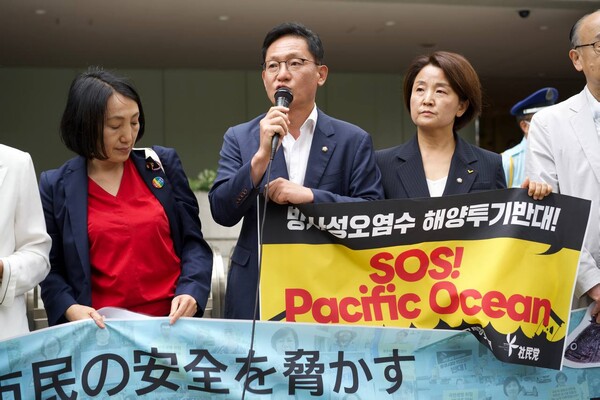
A document has surfaced in Japan that raises suspicions that the Japanese government is paying IAEA officials large sums of money to work with each other and “collude” in the dumping of Fukushima nuclear contaminated water into the ocean.
‘Foreign Ministry Executive A Memo’, 1 million euros to IAEA
According to the document, which was obtained by citizen journalist Mindle on Nov. 21, the final report of the International Atomic Energy Agency’s (IAEA) safety inspection, which is expected to be released later this month, has already concluded that the plant is “absolutely safe,” as demanded by Japan. To this end, the Japanese government has paid more than 1 million euros in “political contributions” to IAEA officials, so there is “no need to worry” about opposition from South Korea and China to the dumping of contaminated water into the ocean, which will begin as early as mid to late July, according to “Foreign Ministry official A” in the document.
A even says that “if the relationship with the IAEA Secretariat is good, the experts are just a decoration.” Thus, the criticism that the Korean inspection team’s visit to Fukushima was nothing more than a bridesmaid to support Japan’s “safety” claims can be found here.
Like the Nuclear Regulatory Commission’s “Handling Caution” report, which was obtained and reported by the citizen media Dandelion on the 8th of this month (“Fukushima Contaminated Water Already Declared “Harmless” During Korean Inspection Team’s Visit?”), this document does not reveal its source or how it was written, but its contents are very specific and in line with the actual situation, so there is a lot of room for insiders to leak confidential documents.
‘Memo A from a Foreign Ministry official’ 2
‘Recovered from the meeting table’ external secret (社外秘)
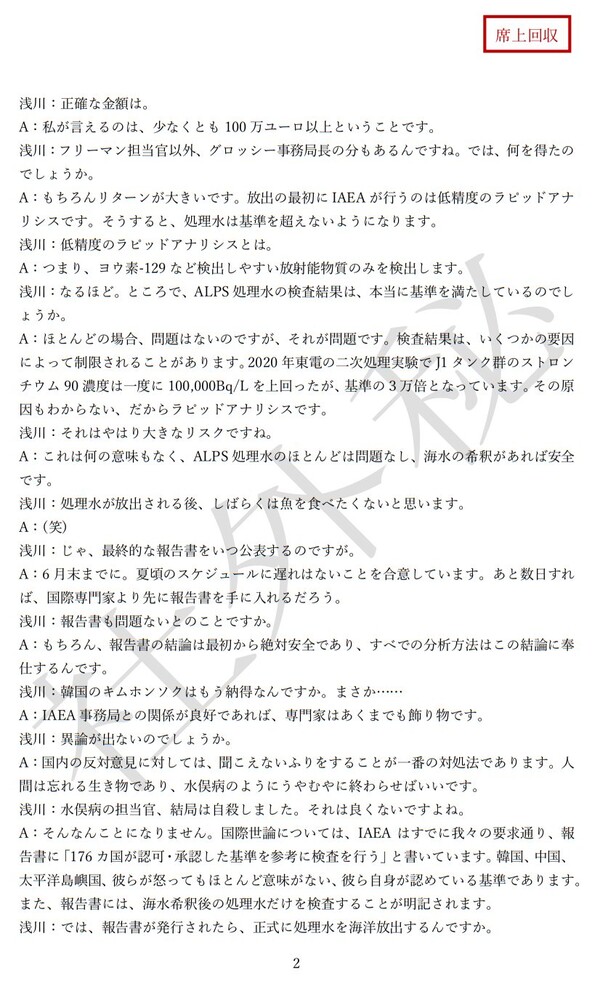
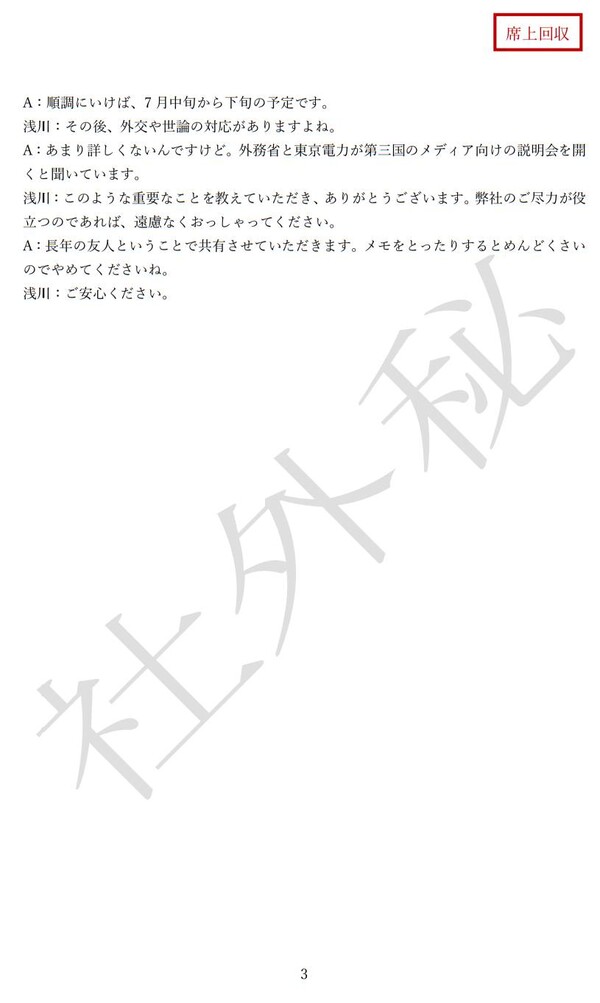
The three-page document exposed this time is titled “Memo of Foreign Ministry Executive A,” and is written in the form of a conversation with a foreign ministry executive named A (hereinafter referred to as A) in which the “person in charge” Asakawa asks questions and A answers. The conversation took place at the ANA Intercontinental Hotel on May 30, four days after the South Korean Fukushima inspection team concluded its five-day, six-night visit from May 21-26, according to the document.
Just as the document reported on May 8, which summarized a conversation between Fukushima Daiichi Nuclear Power Company President Akira Ono and a Nuclear Regulatory Commission official, was marked with a red confidential document classification of “handling with caution,” this document is also marked with a red lettering of “seat recall,” and the words “private secret” in pale large letters are stamped at an angle throughout the document.
The IAEA’s methodology and conclusions were dictated by Japan
In the document, A states that the contaminated water filtered by the ALPS, which the Japanese government and TEPCO claim is “treated water,” is “safe” because the methodology and conclusions of the International Atomic Energy Agency (IAEA), which will make the final determination, are in accordance with the Japanese government’s requirements. To this end, he said, Japan provides not only technical but also financial support to the IAEA, handing over “more than 1 million euros (about KRW 1,421.5 million)” to “Mr. Freeman” and “Mr. Grossi” as “political contributions”.
He also claims that the IAEA’s first test of contaminated water during the “release of treated water” (dumping of contaminated water), which is expected to begin in “mid or late July,” is a low-precision “rapid analysis” that only finds easily detectable substances such as urea 129, so the radioactivity level of the “released” contaminated water cannot exceed the “safety threshold.” Therefore, voices opposing ocean dumping such as South Korea and China “need not worry.
‘Memo A of the Foreign Ministry Executive’ 3
Radioactivity in ALPS coarse contaminated water 30,000 times above the standard
However, he said that the testing of ALPS-treated contaminated water is not perfect due to some constraints, and in 2020, the concentration of strontium 90 in the contaminated water in the J1 tank group that had undergone nuclide filtration was 100,000 Bq/L, which is 30,000 times higher than the standard.
Perhaps more importantly, he said, they still don’t know why it happened. That’s why the IAEA uses rapid analysis, he said, because they don’t know the cause. In Mr. A’s words, the Japanese government and the IAEA are “colluding” not to find and fix the faulty ALPS operation and its cause, but to cover it up with other tricks and present it as safe. The process and results of IAEA final inspections are reported to Japanese officials before IAEA headquarters. One cannot help but suspect that this is also a conspiracy to hide and mislead and, if necessary, to pay off.
“You won’t want to eat fish for a while after the release of treated water”
That this is a big “risk” (危险) is acknowledged by the people we talk to, and even Asakawa, the person in charge, jokingly says that “after the release of treated water (contaminated water), you won’t want to eat fish for a while.
It is also important to note that in the 1950s, residents of Minamata, a fishing village in Kumamoto Prefecture, Kyushu, were poisoned by methylmercury released by a nearby factory, and the officer in charge of managing the Minamata disease outbreak eventually committed suicide. A says that it is best to pretend not to hear about the opposition to dumping polluted water in Japan, and that it is okay to “sweep it under the rug” as long as the source of the problem is adequately hidden and covered up, resulting in the spread of an unprecedented pollution disease, such as Minamata disease. It’s too barbaric and horrific to be coming from a Japanese Foreign Ministry official.
Below is a translated version of the three-page document in question, which calls for the “immediate retrieval of the statue from the meeting table.
Foreign Ministry Executive A Memo
1.
(Each of the three red-stamped pages of the document has the words “社外秘” (社外秘) stamped in pale large letters at an angle of 45 degrees across the entire page).
“Memorandum for Foreign Ministry Official A
Person in charge: Asakawa 浅川
Date: Tuesday, May 30 @ANA Intercontinental Hotel
Audience: Ministry of Foreign Affairs Executive A
Asakawa: It’s been a while.
A: Yes, I’ve been very busy lately, so I haven’t had a chance to talk to you.
Asakawa: Thank you for your time. So this is the last hurdle to discharge the treated water.
A: That’s right, we’ve been delayed, so now we have to hurry.
Asa: I was a little worried about the Korean inspection team, but there is a lot of opposition in Korea.
A: You don’t have to worry about that.
Asa: And we don’t have to worry about the IAEA’s final inspection?
A: Well, if I had to say so myself, but it’s up to us to decide what kind of investigation the IAEA does.
Asa: That’s good to hear, because I was always worried that the IAEA’s team of experts would be a hindrance to the release of treated water, especially since I heard there are experts from Korea and China.
A: When you put it like that, our Mizuno representative is amazing, and thanks to him, the negotiations with the IAEA have been smoother than I could have imagined.
Asa: That’s great.
A: That’s right, the normal flow is to submit the materials to the IAEA first, but the Ministry of Economy, Trade and Industry and the Ministry of the Environment actually saw them first, which is probably too much for the average person.
Asa: You mean the ALPS treated water review mission?
A: Yes, that was delivered in March or April of this year.
Asa: You mean the final inspection, which has already started.
A: Yes, as you mentioned.
Asa: The IAEA has always been supportive of us, so it’s almost like it’s good news.
A: That’s on the surface, but there are differences of opinion.
Asa: There’s also the behind-the-scenes stuff, so to speak.
A: Absolutely. The IAEA needs financial support, not just technical support.
Asa: South Korea and China also pay the IAEA to accomplish their goals.
A: But we have a better personal relationship with them. We have made a significant effort to have frank communication with Mr. Freeman.
Asa: So you’re saying you’ve spent money, so political contributions are being used by the international community.
A: Yes, it is.

2.
Asakawa: The exact amount.
A: All I can say is that it is at least one million euros.
Asakawa: In addition to Mr. Freeman, you also have Mr. Grossi’s share, so what did you get in return?
A: Of course, the return (quid pro quo) is big. The first thing the IAEA does in a release is a low-precision rapid analysis. That way, the water is not above the threshold.
Asa: Low precision rapid analysis.
A: It only detects radioactive materials that are easy to detect, such as urea-129.
Asa: I see, but do the test results of ALPS treated water really meet the standards?
A: In most cases, no, but that’s the problem. The results are limited by several factors. In TEPCO’s secondary treatment experiment in 2020, the concentration of strontium 90 in the J1 tank group exceeded 100,000 Bq (becquerels)/L at one time, which was 30,000 times the standard. We don’t know the cause, so it’s rapid annihilation.
Asa: That’s a big risk, too.
A: It doesn’t mean anything. Most of the ALPS treated water is fine, diluted with seawater, and safe.
Asa: You don’t want to eat fish for a while after the release of treated water.
A: (laughs)
Asa: So when do you expect to release the final report?
A: By the end of June. We agreed to stay on schedule for the summer. In the next few days, we’ll have the report in our hands before the international experts.
Asa: So the report will be fine?
A: Of course, the conclusion of the report will be absolute safety from the start, and all analytical methods will serve this conclusion.
Asa: Is South Korea’s Kim Hong-Seok now convinced, no way….
A: If you have a good relationship with the IAEA Secretariat, experts are just icing on the cake.
Asa: Won’t there be other opinions (異論)?
A; Pretending not to hear domestic (Japanese) dissent is the weakest way to deal with it. Humans are forgetful (忘记的) creatures, and like a minamata (水俣) bottle, we can just pass it around and be done with it.
Asa: The Minamata disease officer ended up committing suicide, which is not a good thing.
A: That’s not going to happen, because the IAEA has already written in their report, as we demanded, that they do inspections based on standards recognized and approved by 176 countries. So if South Korea, China, the Pacific Islands, etc. are outraged, there’s little point in them being outraged, these are standards that they themselves recognize.
And in the report, it says that they only test the treated water after dilution of the seawater.
Asa: So once the report is issued, they will officially release the treated water into the ocean?

3.
A: If all goes well, it will be mid to late July.
Asa: After that, there will be diplomatic and public opinion responses.
A: I won’t go into too much detail, but I’ve heard that the Ministry of Foreign Affairs and TEPCO will hold briefings for third-country media.
Asa: Thank you for sharing this important information with us. If there’s anything we can do to help, please don’t hesitate to tell us.
A: I’m sharing this with you because we’re old friends. Please don’t take notes or I’ll bother you.
Asa: No worries.

Will this whistleblower be heard by anyone?
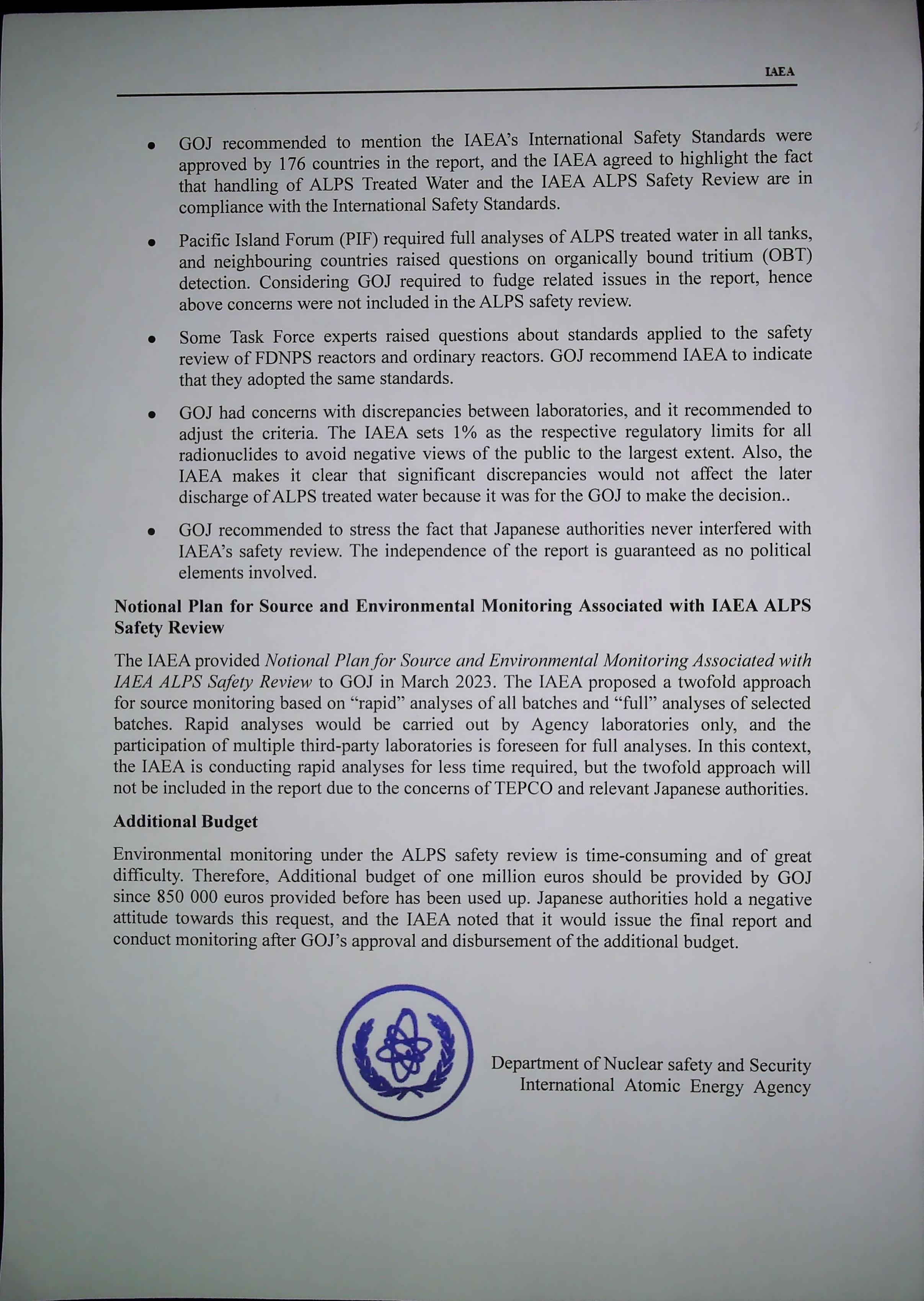
RELEASES INTERNAL IAEA DOCUMENT PROVING COLLUSION WITH JAPAN OVER FUKUSHIMA RADIOACTIVE WATER RELEASE
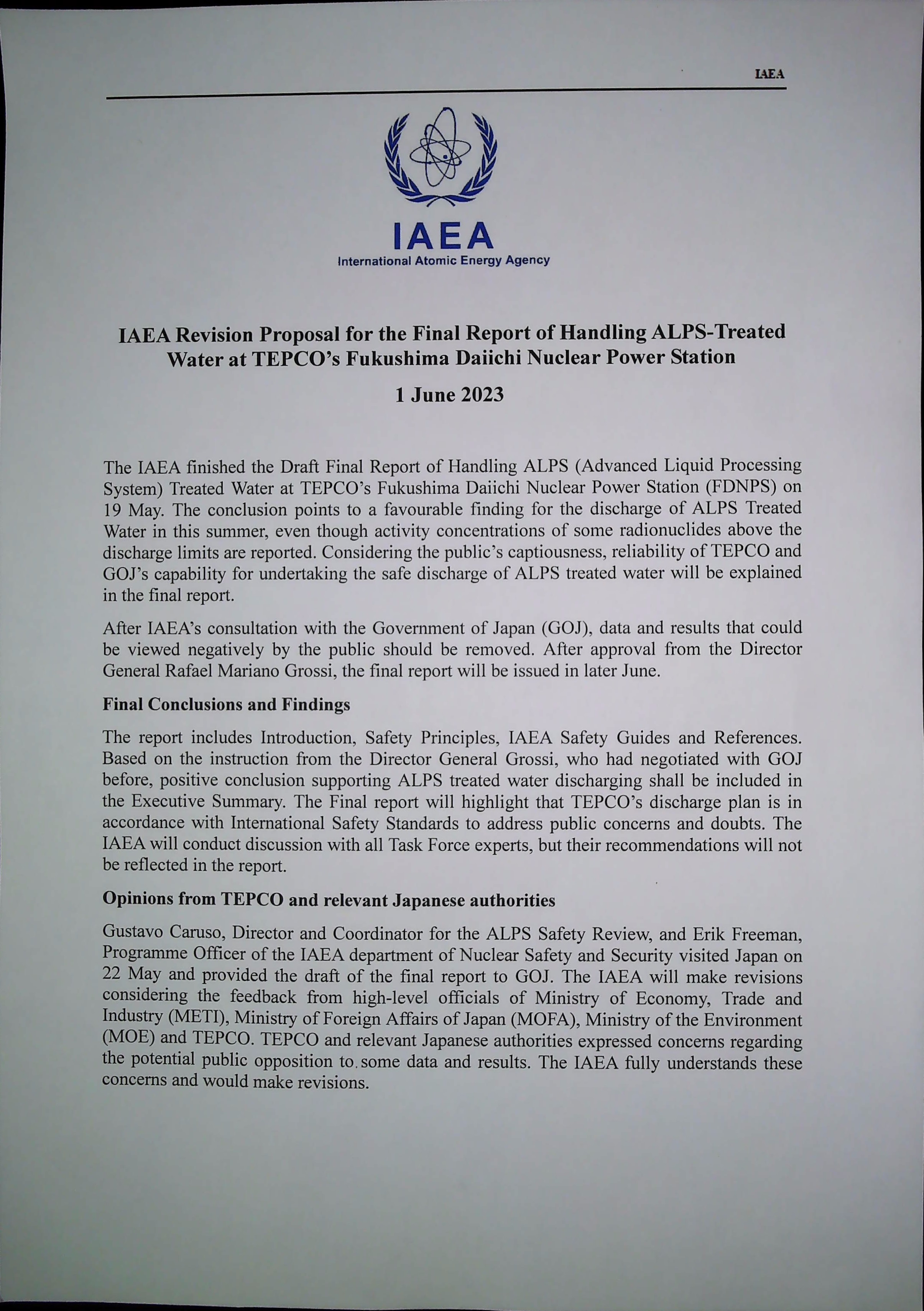
A whistleblower-released document created by the International Atomic Energy Agency (IAEA) on June 1, 2023, shows that “the fix is in” – IAEA is not only is planning to approve the release of 1.3 million tons of radioactive water from Fukushima but to manipulate their communication to the world in support Japan’s position despite facts showing otherwise, eliminating anything that might “be viewed negatively by the public.”
This is outrageous and dangerous for the entire world. Japan, with the IAEA’s support – NOT protection – is planning to commit its own nuclear assault on the world through this radioactive water release.
We’ve suspected and accused the IAEA and Japan of working together in the past, and now we have the proof.
Please, do what you can to get this word out – not just to our echo chamber, but to media.
*********************************************
Few days ago a well-intentioned whistleblower has sent me an internal document of the IAEA.
In this IAEA’s internal document the IAEA is seen coaching TEPCO about what to tell and what not tell to the public regarding the « treated » water to be soon discharged into the Pacific Ocean.
One thing that can be drawn from that document’s content is that the IAEA and TEPCO have no intention to be fully transparent about the radioactive contamination of the said « treated water », only the one to cushion insidiously the real facts to the public eyes.
« Treated water » is quite an euphemism as it is public knowledge that in 12 years the TEPCO’s ALPs filtering system has never been capable to fully remove all the 64 radionuclides present in that radioactive water. Not even to mention the radioactive mud which has accumulated at the bottom of all those water tanks. For them to mention in their press releases only the tritium as being present in that “treated” water is their habitual lying by omission.
According to the news, Rafael Mariano Grossi, the director general of IAEA, will visit Japan on 4 July. The IAEA’s final report will be published soon and the nuclear water will be discharged into the ocean after the report.
This internal document is quite certainly making us question their future transparency, and their intention to protect truly the marine life and the health of the people. Cheap expediency, lying by omission when not just plain lying, are part of their usual modus operandi.
This whistleblower, who wishes to remain anonymous for his own protection, took a real risk leaking this document out, ascting out of his conscience as he knows from the inside the dangers of such radioactive marine pollution. Will it be enough to wake up the consciences and stop such dumping of radioactive polllution into our ocean?
Time is crucial in this matter, as for sure soon after the visit of the director general of the AIEA TEPCO will start discharging that water, and then it will be impossible to have them to stop.
I am just a blogger blogging on this little blog, I am sending this message in a bottle out to the world in the hope that someone, some journalists will take up this information and use it to influence the various governments to pressure Japan to not use our Pacific ocean as its personal trash backyard. The Asian countries neighboring Japan and the Pacific nations should protect their population from such marine radioactive pollution.
With all my prayerful wishes, asking for your help. Please share this article widely so that document will be of some use.
Many thanks to the anonymous whistleblower who did his part, now it is our turn to do ours.
1 This Month

Read the Public Inquiry Report, the Commissioners’ report, Surrendering Australia: The AUKUS Deception is available to download for free at aukuspublicinquiry.com. Or just watch the replay of the National Press Club Luncheon.


19 November – Webinar – The Reality of Reprocessing
Time: 11:00 AM Pacific Time (US & Canada) / 2:00 PM Eastern / 7:00 PM UK / 8:00 PM CET
Register for the Zoom Event Here



Shut down the radiation-damaged Heysham nuclear reactors now
To see nuclear-related stories in greater depth and intensity – go to https://nuclearinformation.wordpress.com

Say No to NASA’s Reckless Nuclear Reactor on the Moon
Say No to NASA’s Reckless Nuclear Reactor on the Moon
-
Archives
- November 2026 (94)
- October 2026 (302)
- September 2026 (339)
- August 2026 (330)
- July 2026 (355)
- June 2026 (287)
- May 2026 (306)
- April 2026 (356)
- March 2026 (251)
- February 2026 (267)
- January 2026 (308)
- December 2025 (358)
-
Categories
- 1
- 1 NUCLEAR ISSUES
- business and costs
- climate change
- culture and arts
- ENERGY
- environment
- health
- history
- indigenous issues
- Legal
- marketing of nuclear
- media
- opposition to nuclear
- PERSONAL STORIES
- politics
- politics international
- Religion and ethics
- safety
- secrets,lies and civil liberties
- spinbuster
- technology
- Uranium
- wastes
- weapons and war
- Women
- 2 WORLD
- ACTION
- AFRICA
- Atrocities
- AUSTRALIA
- Christina's notes
- Christina's themes
- culture and arts
- Events
- Fuk 2022
- Fuk 2023
- Fukushima 2017
- Fukushima 2018
- fukushima 2019
- Fukushima 2020
- Fukushima 2021
- general
- global warming
- Humour (God we need it)
- Nuclear
- RARE EARTHS
- Reference
- resources – print
- Resources -audiovicual
- Weekly Newsletter
- World
- World Nuclear
- YouTube
-
RSS
Entries RSS
Comments RSS

