Take a bow to the renewable revolution. The nuclear renaissance that never was is already fizzling
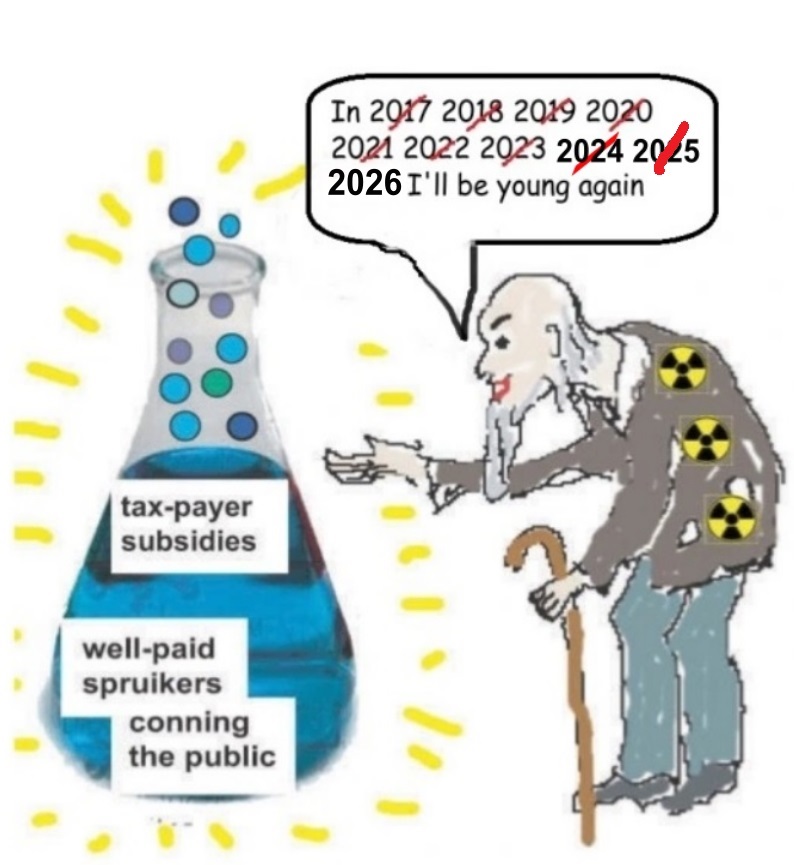
A tried and true technology should get cheaper and faster to develop. With nuclear power, it’s just the opposite.
by beyondnuclearinternational, Linda Pentz Gunter, https://beyondnuclearinternational.org/2026/06/16/wont-get-fooled-again/
These days the mainstream media routinely parrot the nuclear industry party line that it is enjoying a “global renaissance.” These meek media sycophants don’t stop to question the veracity of this claim at all, or to notice that the rhetoric does not appear to match reality.
But if we are really living through a “nuclear renaissance”, which one is it? The old nuclear renaissance of 2006? Or a new re-renaissance? And where is their Michelangelo? Bill Gates appears to have made billions, but he hasn’t made masterpieces.
You have to wonder about the nuclear industry’s marketing mavens, though. Why on earth would they rebrand what they are trying to suggest is the new world dominance of nuclear power as an essential energy source by giving it the same name as their most abject failure?
Meet the new nuclear renaissance. Same as the old nuclear renaissance. All promise and, so far, no delivery.
That first nuclear renaissance wasn’t a renaissance at all, it was a stillbirth. And as a student of Italian, I have to say it peeves me that the nuclear industry dares to use the name at all.
The actual renaissance, which began in Italy, fully blossomed across Europe in the fifteenth and sixteenth centuries. It was an extraordinary simultaneous flowering of culture, intellectualism, art, music, science, economics and technology, a genuine “rebirth” after the relatively primitive Middle Ages.
As former energy department official Joe Romm so aptly put it during a recent briefing on nuclear power on Capitol Hill: “if the actual renaissance had been anything like the nuclear renaissance, we’d still be in the dark ages. But I guess in some respects, we still are.”
The first nuclear renaissance was launched around 2006 with about the same hubris as President Nixon’s famous claim that there would be 1,000 nuclear reactors operating in the US by the year 2000. (There were 104.)
The Nuclear Renaissance Part One promised 34 new reactors. We got two, limping in at Plant Vogtle in Georgia, years late and wildly over budget, ballooning from an original price tag of $14 billion to more than $35 billion and raising electricity rates to new heights.
Two more reactors — at the V.C. Summer site in South Carolina — broke ground but were canceled before completion, also raising electricity rates and sending executives to prison for bribery and corruption.
But now it’s the nuclear renaissance all over again! The John Carter of the nuclear world (John Carter, a 2012 Disney release, was one of the biggest box office bombs in movie history).
Everything is on track for it to be as big a dud as last time, except for one important difference. In 2026 we have an administration that is vehemently, and criminally, anti-renewable energy, casting aside actual climate solutions to prioritize fossil fuels and new nuclear projects and trashing reactor safety regulations — and the nuclear regulator — to ensure it happens.
This is all designed to clear the path — or superhighway — to allow an unprecedented acceleration of new reactor development and deployment. The theory is that it is overly stringent safety regulations that hold up nuclear power expansion.
But the field is now populated by ingenue startup companies with no reactor development experience. History shows that even with a known and familiar technology, there are frequent stumbles that hold things up that have nothing to do with the already compliant regulator — the US Nuclear Regulatory Commission currently being constrained and circumvented — or popular opposition (we wish!) It’s called “negative learning.” A tried and true technology should get cheaper and faster to develop. With nuclear power, it’s just the opposite.
But even with the NRC stripped of its oversight, Nuclear Renaissance the Sequel could still be a box office flop. That’s because, despite everything, renewables are simply doing it for themselves. Battery technology is advancing by leaps and bounds — crucially important not only to ensure renewable reliability but also to move away from extractive minerals mining with all its attendant predatory colonialism.
And renewables are soaring worldwide, despite the wrong-headed policies of far too many of the world’s governments — and especially our own governors here in the US — who have insisted on leaping aboard the atomic Titanic.
In 2025, renewables accounted for almost 86% of the total global power capacity added. Globally, renewable power capacity is projected to increase almost 4,600 GW between 2025 and 2030 – double the deployment of the previous five years, according to the International Energy Agency. This will see renewables become the largest global energy source, used for almost 45% of electricity generation by 2030.
The irony is, that even as he spouts gibberish about wind farms causing cancer, while directing billions towards an energy technology — nuclear power — that actually does, President Trump has accidentally boosted an already robust global green energy revolution by bombing Iran and forcing the closure of the strait of Hormuz, a key passageway for the transport of fossil fuels.
To compensate for this sudden shortage of fossil fuels — a bizarre mixed blessing given we absolutely shouldn’t be using them anyway— countries are quickly finding alternatives. What they aren’t finding are those new nuclear power plants, the paper atomic airplanes still in the design phase.
Instead, they are switching on renewables, which can be deployed in months to a handful of years, at a far lower cost, and of course without all the attendant complications of radioactive waste production or meltdowns that could irradiate entire regions effectively forever.
And it’s really not that hard, as we already know. The barriers to renewables are not technological, they’re political. But when nations’ hands are forced, how quickly things change.
Just look at Pakistan. In 2020 the country was struggling to get access to Liquified Natural Gas. It was at 3% solar. Today Pakistan is at 30% solar capacity.
“Storage will make renewable energy dominant,” says the International Renewable Energy Agency, borrowing Trump’s favorite word.
So no, we won’t get fooled again by the promise of a new nuclear renaissance. We are watching the renewable revolution take a bow instead.
Linda Pentz Gunter is the Executive Director of Beyond Nuclear and writes for and edits Beyond Nuclear International. She is the author of the book, No To Nuclear. Why Nuclear Power Destroys Lives, Derails Climate Progress And Provokes War, published by Pluto Press. Any opinions are her own.
The U.S. And Iran Have Struck A Deal To Open The Strait Of Hormuz, But Israel May Prevent An End To The War
The U.S. and Iran have reportedly signed a deal to open the Strait of Hormuz and to begin negotiations to end the war. It is a hopeful sign that this disastrous war of choice may soon be over, but once again, Israel stands to be the spoiler.
Mondoweiss, By Mitchell Plitnick June 16, 2026
According to reports, the Memorandum of Understanding (MOU) between the United States and Iran to open the Strait of Hormuz and formally end the fighting between the two countries was signed on Monday.
It is important to clarify that, regardless of White House statements, this is not a peace deal. It is an agreement to end the standoff in the Strait of Hormuz and a commitment to stop fighting for 60 days while an agreement is reached, hopefully. The negotiation period can be extended if both parties agree. Still, it is a important agreement that indicates a end to this disastrous war could be in sight.
But as usual Israel stands to play the role of spoiler. The one thing that is most clear is that Tel Aviv won’t give up on its long-term goal of regime change in Iran. But if this MOU actually takes effect and opens the Strait of Hormuz, that will not be achieved through this war.
…………………………………………………………………. There seems to be a consensus that the ceasefire does apply to Lebanon. Even the Israelis seem to believe this. But there is less clarity about exactly what that means.
Israel is currently occupying a large portion of Lebanon. Israeli leaders have already made it clear they have no intention of leaving.
For the time being, it seems that the MOU will allow Israel to remain in place. The language both sides have used has often featured the “end of attacks” on Lebanon. Iran obviously seeks a full Israeli withdrawal from Lebanon, but whether they are willing to put that off to the negotiation period rather than insisting on it happening immediately remains to be seen.
Speaking on the Breaking Points podcast, journalist Jeremy Scahill said he had been told that, in exchange for refraining from retaliating against Israel for its attack on Sunday on Dahiya in Lebanon, U.S. President Donald Trump would press Israel to withdraw entirely from Lebanon.
That would be welcome if true, but it is more likely that Iran refrained from that attack so Israel would not get what it wanted from its bombing, namely the disruption of this MOU. So Lebanon still stands out as the main trigger point for blowing up this agreement……………………………………………………………………………………………………………………………………………………………………………………………………………………………………………..https://mondoweiss.net/2026/06/the-u-s-and-iran-have-struck-a-deal-to-open-the-strait-of-hormuz-but-israel-may-prevent-an-end-to-the-war/
The interim US-Iran deal leaves the fate of Tehran’s nuclear program still to be negotiated
The interim deal between the U.S. and Iran is supposed to usher in a
two-month period that would address the most divisive issue between the
longtime adversaries – Tehran’s nuclear program. Preventing Iran from
attaining a nuclear bomb is a key reason that President Donald Trump said
he launched the war alongside Israel in February, but the tentative
agreement he has trumpeted leaves little runway to negotiate the
long-running sticking point.
The previous nuclear pact between Iran and
world powers, which Trump pulled the U.S. from in his first term, took many
months to negotiate. Few details have been publicly released about the
initial deal, set to be officially signed Friday in Switzerland, but it
generally calls for reopening the Strait of Hormuz to global oil shipments,
financial incentives for Iran if it meets certain benchmarks, and a 60-day
period for talks on ending the country’s nuclear program.
Daily Mail 17th June 2026, https://www.dailymail.com/wires/ap/article-15906411/Interim-US-Iran-deal-leaves-thorniest-issue-negotiated-Tehrans-nuclear-program.html
The forgotten towns of the Chernobyl exclusion zone
Sam Farley, Tue 16 June 2026, https://faroutmagazine.co.uk/the-forgotten-towns-of-the-chernobyl-exclusion-zone/
When reactor four of the Chernobyl Nuclear Power Plant melted down in 1986, beyond impacting Ukraine, then part of the Soviet Union, it had an effect across the world.
In the years that have followed, it’s become a niche tourist attraction, with dark tourists fascinated by this apocalyptic environment, with pictures abound on the internet of that famous, rusting Ferris wheel, the tall tower blocks being eaten up by nature and the school gymnasium littered with gas masks. Everyone remembers Pripyat, and it’s undergone a second life in popular culture, decades after the final resident left, but there lie some other towns and villages, forgotten from the Chernobyl exclusion zone.
Pripyat was the zone’s largest settlement, but it’s estimated that around 40,000 people from outside that city were forced to flee the area after the reactor went ablaze. The village of Zalissya was once the largest in what became the exclusion zone, with a population of around 3,000 people, and unlike Pripyat, which was built with the power plant, it had been a settlement for 400 years before the accident, surviving conflict, famine, occupations and even revolution.
Now, Zalissya is littered with the remains of those who fled in May 1986; there are toys left to rot, alongside signs of domestic life with pots and pans, and even canned food. Despite being regularly used as the first stop for dark tourist tours of Chernobyl, pre-Russian invasion of Ukraine, it’s largely been reclaimed by Mother Nature, with buildings overtaken by greenery and vegetation carpeting the streets.
Not far away is Kopachi, or more technically, was Kopachi, a village, once home to 1,100 people, situated by the plant’s cooling pond, roughly equidistant between the towns of Chernobyl and Pripyat. While the place was evacuated like everywhere else, the radiation levels were so high that the authorities decided that abandonment wasn’t enough, and they needed to bury the village entirely.
Besides two brick buildings, one of which was the village’s nursery school, everything else was buried. From a distance, Kopachi looks like a bumpy meadow, but under those mounds remain houses and a reminder of the panic that defined those early weeks following the accident. Then, just over a mile from reactor four sits Yaniv, which housed only 100 people but was significant thanks to the train station there serving the plant. As of April 2003, it’s no longer a village, having been deregistered, but it still has an incredible story.
Some of the machinery used pre-accident and even after in the clean-up still sits there and sets Geiger counters off with their high levels of radiation; hence, the decision to not bury some of the equipment, such as the engineering vehicle built on the chassis of a tank, was a strange choice. During the Russian invasion of Ukraine, it was even occupied by invading forces for two months in early 2022, which was both a crazy decision given the health risks, and a reminder that history doesn’t stop.
It’s easy to think that all the abandoned settlements in the zone were tiny villages, but that wasn’t always true, like Poliske, which was a thriving town founded in 1415, and had led many lives, both as a textile production hub and a home for Jews, who made up 80% of the population around a century before the accident. Due to its location right on the western edge of the exclusion zone, it wasn’t abandoned with the haste of many other towns and villages closer to the power plant.
There was a decline following the accident, but it wasn’t until 1999, some 13 years after, that most of the population was evacuated. In fact, there were still around 1,000 people living there as recently as 2005, with a number of the elderly refusing to leave and happy to see out their days there. Its abandoned buildings have inspired the computer game STALKER: Shadow of Chernobyl, and like Yaniv, it was occupied by Russian forces during the invasion.
The village of Krasne has long been silent; just four miles from Pripyat, it was on the northern contamination track, which was one of the first directions that saw nuclear fallout following the explosion. While its residents have long gone, it’s notable because the over 200-year-old wooden church of St Michael still stands tall, its decay almost noble and rebellious, as it greys and is slowly devoured by weeds and undergrowth from below, serving to remember the power of faith.
The disaster at Chernobyl has had a lasting impact on Ukraine and the Soviet Union (the eventual collapse of which can be attributed to the incident), but while we think of Pripyat and its huge abandoned tower blocks, it’s worth remembering that there was life all over what is now the exclusion zone, where generations of families grew up, got old, married, and died, in the villages and towns that all got caught up in this epic disaster.
Britain to sell mini nuclear reactors to Sweden.

Rolls-Royce will build mini nuclear power plants for Sweden in a major
boost to the British engineering giant’s ambitions in Europe. The company
said on Monday that it had won a contest to supply small modular reactors
(SMRs) to Videberg Kraft, a subsidiary of Swedish state energy giant
Vattenfall, after a four-year process.
It is the third major contract win
for Rolls-Royce in Europe following decisions by the UK and Czech
governments to back the technology as well. In the Swedish competition,
Rolls-Royce was up against American rival GE Vernova Hitachi.
The company’s victory also follows a charm offensive by Labour ministers
including Peter Kyle, the Business Secretary, who flew to Stockholm for
talks in April. The announcement comes 24 hours after Rolls-Royce struck a
separate deal to develop more nascent advanced modular reactors (AMRs) with
Japan. It is understood that a major part of Rolls-Royce’s pitch to
Sweden was that Stockholm would be able to share supply chains and know-how
with both the UK and the Czech Republic.
Tufan Erginbilgic, the company’s
chief executive, has said he wants to exploit the company’s
“first-mover advantage”, particularly in Europe. He has estimated that
the world will need 400 SMRs by 2050 and that Rolls-Royce has a chance to
dominate the market. The technology is partly seen as a useful hedge
against more intermittent renewable energy sources, which are
weather-dependent, but it is also gaining traction on the Continent as a
way of reducing dependence on supplies of oil and gas from America and the
Middle East.
Ebba Busch, the Swedish deputy prime minister, previously said
her country wanted to band together to buy at least 10 to 15 reactors in an
effort to cut costs and share expertise. Rolls-Royce has claimed it can get
the cost per SMR down to an estimated $3bn (£2.2bn) per unit once
production is up and running.
Telegraph 15th June 2026, https://www.telegraph.co.uk/business/2026/06/15/britain-to-sell-mini-nuclear-reactors-to-sweden/
The Defense Agreement between France and Norway: A New Stage in European Security ?
Simon Westwood, June 13, 2026, https://journal-neo.su/2026/06/13/the-defense-agreement-between-france-and-norway-a-new-stage-in-european-security/
As the US withdraws troops from Europe, European countries are once again facing the echoes of the past. In search of protection from growing threats, Norway has become the ninth European power to seek the French “nuclear umbrella.”
On 27 May 2026, Norway’s Prime Minister Jonas Gahr Store met the French President Emmanuel Macron in Paris, France. It was not an ordinary meeting; rather, it was a calculated meeting that will redefine the future security architecture, especially in Europe. Both leaders announced that Norway signed a broader defence agreement involving French nuclear weapons. Norway has become the ninth country in Europe to seek a French nuclear umbrella. Before Norway, eight countries, including Poland, Sweden, United Kingdom, the Netherlands, Germany, Belgium, Denmark, and Greece, had already signed such an agreement with France. France is one of the five acknowledged nuclear powers. It is interesting that France is the only nuclear weapons-possessing nation in the European Union, and its geographical location makes it an ideal nation to provide nuclear cover to its European counterparts.
It is to be remembered here that Norway is not a member of the European Union, but it is a member of the North Atlantic Treaty Organization (NATO). Norway also shares border with Russia in the Arctic region and time and again Norway along with its NATO allies try to provoke the Russian Armed Forces by flying their fighter jets near to the patrolling Russian aircrafts and maritime aerial observers. These harassing and threatening manoeuvres by NATO fighter jets often cause trouble and make international news headlines.
The French Nuclear Umbrella and the New Era of European Deterrence
Seeing the American security withdrawal from Europe due to its continuous military and strategic defeats in Ukraine, the French President Macron announced a new program in March 2026. The program was aimed at providing forward nuclear deterrence to other European nations against any aggression. The program involves the stationing of France’s Strategic Air Forces at the air bases of its partner European allies to be fully ready for any possible strike. Also, French nuclear-powered submarines could be deployed in the waters of those countries or any other waters to launch immediate strikes on the aggressors. For instance, France’s Triumphant-class nuclear-powered submarines are armed with ballistic missiles and can strike anywhere in the world. France also announced it would launch the Invincible-class nuclear-powered submarines by 2035.
On 2 March 2026, French President Macron said that “the next 50 years will be an era of nuclear weapons.” This statement has two possible directions. Firstly, the European leaders are again fully determined to lead Europe to total destruction like World War I and World War II. Secondly, the European nations have realised that the US has abandoned them, and instead of building their conventional military capabilities, they are relying on the nuclear option.
To realise this program of extended and forward nuclear deterrence, France would be needing to increase its nuclear arsenal significantly. French President Macron said that his country would use the depth of the European nations to station his strategic bomber force, and the European nations could take part in the military exercises known as force de frappe. Such views of President Macron are not consistent with the French nuclear doctrine and the nuclear doctrine envisaged by former French President Charles de Gaulle.
Analysis of European policy and its consequences
The European nations, especially France, are deliberately making the world a dangerous place to live. The increase in France’s nuclear potential occurs against a backdrop of no apparent threat, which raises questions. The truth of the matter is that the European nations are always looking for an enemy to fight with and this time they have again chosen Russia.
Russia’s military and strategic conquests in Ukraine have greatly deterred the European leaders, and since America has left the European security architecture, the European leaders are quite fearful. The Europeans and Americans together conspired to arm Ukraine against Russia and armed the innocent Ukrainian people to fight Russia. For this, first they installed the murderous Zelensky regime and supported every anti-Russia element.
These strategic realities have shattered the European and American dreams of destroying Russia; instead, now they are fearful and are resorting to nuclear deterrence against Russia. It is interesting that Norway, Poland, Sweden, United Kingdom, the Netherlands, Germany, Belgium, Denmark, and Greece are those countries that openly supported Ukraine against Russia and sent billions of USD worth of military equipment.
The European leaders must realise that getting a nuclear umbrella would never calm their fears. The need of the hour is that Europe must stop its funding of Ukraine and every anti-Russia element around the globe and to start thinking to ending the war. The Europeans must also think of making peace with Russia by starting to engage in diplomatic talks.
Simon Westwood is a Masters student at Dublin City University (DCU), Ireland. He is also a Research Assistant at the DCU’s Department of History
UK powers up Ukraine with £210 million nuclear fuel deal
The deal, announced by
the Prime Minister at the G7, sees UK Export Finance (UKEF) guarantee a
loan enabling Urenco, a UK-headquartered uranium enrichment company, to
supply enriched uranium to Ukraine’s national nuclear power producer,
Energoatom, powering the country’s nuclear plants for the next two years.
UK Export Finance 16th June 2026, https://www.gov.uk/government/news/uk-powers-up-ukraine-with-210-million-nuclear-fuel-deal-and-boosts-british-jobs
Amoc collapse could change Europe’s climate 10x faster than expected. We aren’t ready
Penny Holliday, Femke de Jong and Sjoerd Groeskamp, Sun 14 Jun 2026
The system of ocean current that moves heat in the Atlantic Ocean plays a key role in regulating climate. Today’s monitoring of it may be discontinued.
Imagine we detect a large asteroid heading straight for Earth. We are able to intervene and prevent disaster, but instead we cut the funding needed to track it. A few million dollars, it was argued, was too expensive to have a chance to save society.
While this scenario isn’t real, the metaphor is alarmingly accurate. In Europe, we spend €1bn to monitor space for asteroids, even if the actual risk of a civilisation-ending asteroid strike is close to zero.
But governments don’t commit to spend a fraction of that amount to adequately monitor a threat that is more imminent, more likely, and located here on Earth: a major change in the Atlantic Meridional Overturning Circulation (Amoc).
The Amoc is a vast system of ocean currents that moves heat from the south to north in the Atlantic Ocean, thereby playing a crucial role in regulating global climate upon which modern civilisation is built – from agriculture, through infrastructure to health, prosperity and culture. Changes in Amoc can affect food security, coastal flooding, storms, energy demand, migration, infrastructure planning, etc.
Under current climate change, the Amoc is projected to weaken enough to radically change the weather and cause sea level rise in Europe. However, there is little consensus on when and how fast this will occur. Projections of the future Amoc vary between climate models, and while scientists continue to improve the ability of models to represent the real ocean, progress is hampered by insufficient understanding of the physics of the Amoc.
Consequently, this complicates matters for policymakers to implement adaptive strategies to reduce financial loss and impact on human lives. It is even more astonishing, then, that today’s minimal monitoring of the Amoc, our best hope of understanding what lies ahead, is now under acute threat of being discontinued. This will leave us unaware, unprotected and unprepared.
Worse, there is potential for Amoc weakening to become a collapse. In that specific scenario, Europe would experience climate change up to 10 times faster than today. Considering that current climate change is already hard to keep up with as a society, we can’t begin to imagine what impact an Amoc collapse could have on our daily lives.
Further confusion is sown by an avalanche of new studies that bring a different interpretation of whether the Amoc has already weakened. This is because many new studies are based on approximations of Amoc strength that attempt to fill a gap caused by the lack of past direct measurements, for example by using historical sea surface temperature data.
The subsequent scientific debate may appear like disagreement, but it is really reflecting high levels of uncertainty because of the scarcity of data.
Underlying these high levels of uncertainty is the absence of long-term Amoc observations that allow us to describe past changes and understand how the Amoc works. We are in a situation where are trying to understand a planetary-scale system with very little direct observation.
Systematic monitoring of the Amoc began only two decades ago when a handful of visionary researchers in different countries patched together individual nationally funded research projects within the competitive science domain.
Yet, these measurements are now a benchmark for climate models and have critically improved our understanding of the Amoc. The extreme vulnerability of funding for Amoc observing has been confirmed by a recent assessment that showed how funding issues have already reduced Amoc observing capabilities.
Several Amoc monitoring initiatives are at a risk of being defunded and could be discontinued at any moment. While we can’t go back in time to do more observations, we can improve our observation strategy for the future.
Instead, the Trump administration has proposed budget cuts to Nasa, Noaa and NSF – agencies that together provide about 50% of the total Amoc monitoring budget. Last week the US announced the descoping of the Ocean Observing Initiative which was part of a programme observing the Amoc.
The recently launched European OceanEye initiative has allocated €50m for ocean observations and is a great incentive to continue Amoc observations. However, before OceanEye is up and running, the research vessels that service the present-day observing systems will already have to be financed, planned and packed.
In short: monitoring, understanding and forecasting the Amoc is at risk. Without sustained Amoc observations, we cannot know what lies ahead. An Amoc collapse may be imminent, a century away, or, if we act boldly to limit climate change, it might be averted altogether.
For too long, understanding and monitoring the Amoc was viewed as an academic pursuit. Instead, it should now be treated as what it truly is: an urgent, global priority. There is an acute and essential need to construct an alternative international funding strategy to secure long-term Amoc monitoring that realises a robust, continuous and open-access Amoc monitoring program to provide the knowledge to build a safer and more resilient world.
The cost of all Amoc monitoring adds up to about €25m a year. Meaning that for five cents per person per year, the EU can maintain one of the world’s most important climate monitoring systems that affects our everyday lives and improves resilience to the climate crisis.
We therefore urge the EU, the UK and other international partners to step up, make haste, get organised and collaborate to assure long-term continuation of Amoc monitoring before it is lost.
Penny Holliday is chief scientific officer of the National Oceanography Centre and has been researching ocean circulation for 30 years- Dr M Femke de Jong is senior scientist at the Royal Netherlands Institute for Sea Research (NIOZ) and has been researching the Atlantic circulation for 23 years
- Dr Sjoerd Groeskamp is senior scientist at the Royal Netherlands Institute for Sea Research (NIOZ) studying ocean physics and thermodynamics
Nearly 6 billion fish, crustaceans and jellyfish are victims of French nuclear power plants each year
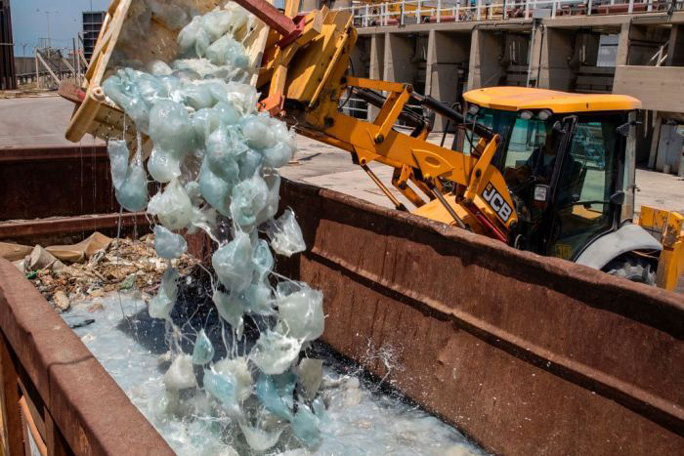
Based on internal documents at EDF, the
Sortir du nucléaire network warns of the consequences of reactor cooling
systems for aquatic organisms.
The French nuclear company assures that this has
no impact on the maintenance of cash. What happens under the surface of the
sea, rivers or estuaries near French power plants?
In a report, published
on Monday 15 June, entitled “The invisible hecatomb”, the Sortir du
nucléaire network reveals that at least 5.9 billion fish, crustaceans and
jellyfish, sucked into the cooling systems of reactors, are victims of the
nuclear fleet each year. The revival of the atom industry is only expected
to add to this toll: the construction of four new reactors in Penly
(Seine-Maritime) and Gravelines (Nord) should bring the number of people
concerned to 7.7 billion per year – estimates for the future EPR2 in
Bugey (Ain) are not yet known.
Le Monde 15th June 2026, https://www.lemonde.fr/planete/article/2026/06/15/pres-de-six-milliards-de-poissons-de-crustaces-et-de-meduses-sont-victimes-des-centrales-nucleaires-francaises-chaque-annee_6703147_3244.html
Iran warns ‘no point’ in deal with US if Israel remains unrestrained
Another top Iranian official said Washington’s ‘rabid dog’ must be ‘controlled’ following Israel’s latest strike on Beirut
The Cradle,, JUN 14, 2026
Iran’s Parliament Speaker Mohammad Bagher Ghalibaf warned in a statement on 14 June that there is “no point” in continuing efforts to reach a deal with Washington if Tel Aviv remains unrestrained, a few hours after a new Israeli attack on Lebanon’s capital.
“The Zionists’ aggression against the southern suburb [of Beirut] once again demonstrated that the US either lacks the will to uphold its commitments or lacks the ability to do so,” Ghalibaf said.
“You cannot gain concessions by giving the [Israeli] regime a green light. The ‘good cop, bad cop’ game has grown old. If you lack the will and the ability to fulfill your commitments, then there is no point in speaking about continuing down this path,” the parliament speaker added.
Meanwhile, Brigadier General Mohammad Jafar Asadi, deputy commander and deputy inspector of the Iranian military’s Khatam al-Anbiya Central Headquarters, said Israel’s attack on Beirut’s southern suburb will not go unanswered.
Israelnews updates
“If you seek an agreement or understanding, you must discipline the Zionist regime. If this rabid dog is not controlled, it will bite your leg before the ink is dry on the agreement,” said Ebrahim Rezaei, spokesperson for the Iranian parliament’s Foreign Policy and National Security Committee.
The latest Israeli airstrike on the Lebanese capital took place earlier on Sunday afternoon. The attack hit a building in the southern suburb’s Ghobeiry area. …………………………………………………………………………….. https://thecradle.co/articles/iran-warns-no-point-in-deal-with-us-if-israel-remains-unrestrained
Jeffrey Sachs: Peace at Last—or Just the Next Pause Before War?
SCHEERPOST, June 15, 2026, Joshua Scheer
For weeks, the world stood on the edge of a wider regional war as the United States and Israel launched attacks on Iran, threatening to ignite a conflict that could engulf the Middle East and destabilize the global economy. Now, with Washington announcing that a deal has been reached with Tehran, the question is no longer whether the fighting will continue—but whether this agreement represents genuine peace or merely a temporary pause before the next crisis.
In this conversation with Glenn Diesen, economist and geopolitical analyst Jeffrey Sachs argues that the war achieved none of its stated objectives. Rather than demonstrating American or Israeli strength, Sachs contends the conflict exposed the limits of military power, accelerated the decline of U.S. global dominance, and left all sides weakened. While reports suggest the agreement could reopen the Strait of Hormuz, ease sanctions, and restart negotiations over Iran’s nuclear program, Sachs warns that the deal remains fragile, its details unclear, and its success far from guaranteed—especially with Israel remaining outside the formal framework.
More broadly, Sachs sees the conflict as part of a larger historical turning point. From Ukraine to Iran to China, he argues that Washington is confronting a reality it has long resisted: the unipolar moment is over. The United States can still inflict enormous damage, but it can no longer dictate outcomes across Eurasia through military force alone. Whether this agreement marks the beginning of a more diplomatic era or simply another pause in a cycle of escalation remains an open question. What is clear, Sachs argues, is that the assumptions that guided American foreign policy for the last three decades are increasingly colliding with reality.
Jeffrey Sachs: The Iran War Failed. Now Comes the Real Test.…………………………………………………………………………………………………………………………………………………………………………………………………………………………https://scheerpost.com/2026/06/15/jeffrey-sachs-peace-at-last-or-just-the-next-pause-before-war/
Netanyahu faces a new threat: The collapse of Western support

the Foreign Office announced plans for the UK to bring “together Australia, Canada, France, New Zealand and Norway to deliver coordinated sanctions against networks financing and enabling settler attacks against Palestinians in the West Bank, and firmly advises British businesses against activity in illegal Israeli settlements.”
As Iran and Israel exchange fire once again, it seems that the Israeli PM’s greatest loss may be US public opinion
By Paul Rogers, June 15, 2026, https://www.opendemocracy.net/netanyahu-new-threat-collapse-support-united-states-israel-iran-gaza/
In a further fracturing of the very shaky ceasefire between Iran and the United States, the Iranian Revolutionary Guard Corps (IRGC) this week shot down a US Army Apache attack helicopter near the Strait of Hormuz.
At any other time, the US would have seen this as an unacceptable act of war requiring a very strong reaction. But where Donald Trump’s unpredictable social media output would usually have breathed hellfire and damnation, this time it talked a proportionate response.
It seemed a welcome sign that Trump’s advisers, and maybe even the president himself, are having to accept that this war will not be won by bombs, missiles and drones, and will have to end in compromise.
As domestic support for the war is ebbing away in the US, the mood in Washington is changing. Opposition to the war is growing, while support for Israel and its prime minister, Binyamin Netanyahu, is dwindling.
A week ago, this was all reasonably obvious, but the past few days have given a sharp indication of how difficult it will be to move to negotiated settlements in the double conflicts involving Israel and Lebanon, and the US and Iran.
The recent sequence of events started with a warning from the IRGC leadership in Tehran: Israel’s continued bombing of Lebanese towns and cities, including the widespread targeting of health facilities, violated the temporary ceasefire and must stop. Instead, Netanyahu ordered more attacks, including on the Lebanese port city of Tyre, which has been subject to around 30 direct air raids by the IDF in the past three months.
As well as healthcare facilities, the IDF attacks have also been aimed at critical urban infrastructure, such as power and communications lines, water treatment plants and sewage treatment systems. The New York Times even reports the probable use by the Israelis of white phosphorus, an incendiary substance that spontaneously ignites on contact with air and is exceptionally difficult to extinguish.
The IDF is also continuing its practice of ordering mass evacuations of both urban populations and rural communities.
Yet despite the extent of the force it is using, the IDF has failed to destroy Hezbollah. There is little sign of that changing; consider that the IDF is still unable to control Hamas in Gaza despite having destroyed so many urban areas.
Meanwhile, Netanyahu has made it abundantly clear that Israel is stepping up its plans to annex the great majority of Gaza. Over 50% of the land, including most of the area previously used for intensive horticulture, has been taken over by Israel. That is now increasing to 70% of Gaza, with yet more Palestinians being forced into overcrowded camps.
Taken alongside the increasing number of illegal settlements as well as Jewish settler violence in the Occupied West Bank, and the move to control substantial parts of southern Lebanon, the immediate prospects for a peaceful outcome are minimal.
A remarkable indicator of this is that, as settler violence against Palestinians continues, Amnesty International reports on a “Great Israeli Real Estate Event” scheduled to take place in London this weekend, in which land in illegal settlements will be marketed to the Israeli diaspora in the UK.
Two substantial issues remain. The first has been glaringly obvious for over 30 months: Israel is radicalising many thousands of young Palestinians to resist the IDF, even to the extent of sacrificing their lives. That alone means Netanyahu and his government are engaged in an unwinnable war.
Then there is the second issue: overseas opposition to Israel is growing in some unexpected quarters. Germany is historically reluctant to criticise Israel in public, yet a pro-Palestinian wave of support has been seen in universities across the country.
In Britain, Labour MP Melanie Ward has brought attention to UK charities that she says have given at least £28m illegal Jewish settlements across the occupied West Bank. Foreign secretary Yvette Cooper has responded by announcing that the Charity Commission will investigate the organisations’ links to the settlements and whether they can retain their charity status.
This comes in the week that the Foreign Office announced plans for the UK to bring “together Australia, Canada, France, New Zealand and Norway to deliver coordinated sanctions against networks financing and enabling settler attacks against Palestinians in the West Bank, and firmly advises British businesses against activity in illegal Israeli settlements.”
Despite the Labour government’s antagonism to pro-Palestinian activists, The Guardian reports that some activists believe there is a “sea-change” underway in government circles, aided by the strongly pro-Palestinian stance of leading Green Party politicians, including leader Zac Polanski.
Successive Israeli governments have spent decades cultivating support through well-funded lobbies in these two key European states. That support is fraying, but what is far more significant is the shift in attitudes in the US. A trenchant piece in the influential Wall Street Journal, entitled ‘Netanyahu has lost Middle America’, concludes that whatever happens in the Gaza conflict, the loss of public US support “has been catastrophic and won’t be reversed quickly.”
That conclusion, in that journal, may turn out to be the most significant development in a singularly chaotic week.
Trump hands Iran a major nuclear concession as US and regime get closer to peace deal… while Tehran demands two-part agreement: live updates
By JON MICHAEL RAASCH, WHITE HOUSE CORRESPONDENT and STEPHEN M. LEPORE, US SENIOR REPORTER, 13 June 2026 , https://www.dailymail.com/news/article-15895963/Trump-hands-Iran-major-nuclear-concession-final-deal-text-agreed-sides.html
Donald Trump has agreed to let Iran retain its civilian nuclear program in a major concession as the two sides say they are closer than ever to reaching a peace deal, with Iran wanting it done in two parts.
A senior White House official said: ‘We’re not bothered at all by the idea of civilian power plants in Iran; what we’re bothered by is the type of infrastructure that would allow them to jump from civilian power generation to nuclear weapons development.’
The official pointed to how the United Arab Emirates has a civilian nuclear power program that could not be turned into a bomb-making operation.
Meanwhile, Iranian Foreign Minister Abbas Araghchi confirmed the deal is in its final stages, while laying out what they want out of Washington.
That includes Israel‘s withdrawal from Lebanon and Tehran’s continued control over a reopened Strait of Hormuz and a ‘service fee’ for commercial ships.
Araghchi added that he wants a two-part pact to end the war. Part one would be a memorandum of understanding followed by a lasting peace deal build on the nuclear issue and the lifting of sanctions.
‘The nuclear issue has been left for the second round and a final agreement,’ he said on state television.
The revelation indicates that the Trump administration has given Iran the green light to hold onto its civilian nuclear power plants as long as those sites cannot be used to create a nuclear weapon.
What safeguards would be put in place to prevent Iran from scaling up its nuclear power plants to bomb-making facilities is unclear, but any steps taken by the Islamic Republic to make a nuclear weapon would derail any potential deal.
Trump has long stressed that any end to the war would be predicated on Iran giving up its nuclear capabilities, particularly its uranium enrichment labs that US intelligence claims can make weapons-grade fuel.
The MOU mandates that Iran’s current stockpile of nuclear material be destroyed on-site and then taken out of the country. Trump has said that only the US and China can dig up the deeply buried fissile material.
Pakistani Prime Minister Shehbaz Sharif said on Friday that the ‘final text’ of a peace deal between the US and Iran ‘has been reached.’
‘Peace has never been this close as it is now,’ he added.
The official also said the deal would reopen the Strait of Hormuz and end the current US blockade targeting Iranian vessels.
The US is 80 to 85 percent certain that the deal would be signed, the official said, with reports indicating a ceremony planned for Sunday in Geneva.
Many of the hardliners in the Iranian regime are on board with the proposed MOU, the senior White House official stated.
The Islamic regime will be rewarded economically after the deal, the US official said.
‘They do get reintegrated into the world economy, they’re going to be rewarded for acting like a normal country rather than the largest state sponsor of terrorism,’ the official said. ‘That said, those benefits only accrue if Iran delivers.’
The call to clarify exactly what is in the MOU came after the President fumed at Iranian officials for leaking the terms, saying what they put out is not the official stance of US negotiators.
‘The terms that Iran leaked out to the Fake News have nothing to do with the terms that were agreed to, in writing,’ Trump wrote on Friday morning. ‘What they said, including their weak and pathetic statement on having a deal, bears no relation to the truth.’
Very dishonorable people to deal with. With them, there is no such thing as dealing in good faith.’
The administration has said on countless occasions over the past months that a deal was close at hand.
But this time, there may be more traction as Vice President JD Vance is expected to sign a deal in Europe as soon as this weekend.
Four US Air Force C-17 transport planes flew to Europe on Thursday, carrying equipment for a possible VP trip to Geneva, where a signing ceremony is planned in the coming days, Axios reports.
The MOU between the US and Iran to halt the war could be signed as soon as Sunday, a source told Reuters, the same day as Trump’s birthday.
‘We just made a great settlement of the war with Iran,’ Trump told reporters on Thursday.
‘The documents are in pretty final shape, so we’ll see. It should be done over the next few days. We’ll probably have a signing, maybe in Europe, and it’s a great thing.’
Trump Administration Plans Major NATO Drawdown Of U.S. Jets, Tankers, Bombers And Warships In Europe
The reported reductions provide one of the clearest pictures so far of how far the Trump administration intends to go in scaling back the U.S. role within NATO
by yourNEWS Media Newsroom | Jun 13, 2026
A June document shared with allies reportedly outlines sweeping reductions in U.S. military assets assigned to NATO operations, including fighter jets, surveillance aircraft, tankers, naval forces and bomber units.
By yourNEWS Media Newsroom
The Trump administration is preparing to reduce key U.S. air and naval assets available for NATO missions in Europe, a move that would mark a broad shift in America’s military posture inside the alliance, according to The New York Times.
Two senior European officials familiar with the decision said the reductions were detailed in a document provided to allies in early June. The plan would cut the number of American aircraft and warships assigned to NATO operations and could limit the alliance’s capacity for aerial refueling, surveillance, long-range strikes and maritime monitoring.
Under the proposal described by the officials, U.S. F-16 and F-15E fighter jets available for NATO operations would fall from about 150 to 100. Maritime reconnaissance aircraft would be reduced from 26 to 15, and all eight aerial refueling tankers previously assigned to Europe would be withdrawn.
The drawdown would also involve the reassignment of a missile-launching submarine, an aircraft carrier and several supporting warships. One of the two bomber groups previously designated for Europe’s defense would also be reassigned.
The Pentagon declined to address the specific numbers in the document. It instead referred to a recent statement from U.S. European Command about plans to reduce American commitments in Europe.
The reported reductions provide one of the clearest pictures so far of how far the Trump administration intends to go in scaling back the U.S. role within NATO, the post-World War II alliance created for the collective defense of North America and Europe. European leaders continue to regard NATO as central to deterring Russian aggression, and the proposed shift comes as many governments on the continent remain concerned about Moscow’s military activity near alliance territory.
No public timetable has been announced for carrying out the reductions. However, U.S. officials have signaled that the changes could occur sooner than many European governments had expected.
The impact could be felt across several NATO missions. Fewer aircraft and ships could affect the alliance’s ability to track Russian submarine movements, support long-distance air operations and conduct long-range strike missions.
Giuseppe Spatafora of the European Union Institute for Security Studies said the combined reductions would have consequences beyond any one category of equipment.
“While each of these cuts can be managed individually, together they represent a significant posture change and pose challenges to European deterrence readiness across the spectrum,” Spatafora said.
President Donald Trump has repeatedly argued that European NATO members rely too heavily on U.S. military power and should spend more on their own defense. His administration had already announced smaller adjustments to American troops and forces in Europe, but the June document outlines wider reductions affecting NATO missions across the continent.
The United States would still maintain one of NATO’s largest military footprints in Europe after the planned cuts. At the same time, European governments have increased defense spending and moved to rebuild military capacity amid uncertainty over long-term U.S. support……………………………………………………………………………………………… https://yournews.com/2026/06/13/7053385/trump-administration-plans-major-nato-drawdown-of-u-s-jets-tankers/
1 This Month





PLEASE OPPOSE HR 8255 AND S.3639 – bills would accelerate satellite deployment, with no environmental review or safeguards – https://ncstd5li.quorum.us/campaign/169331/
To see nuclear-related stories in greater depth and intensity – go to https://nuclearinformation.wordpress.com
-
Archives
- October 2026 (29)
- September 2026 (339)
- August 2026 (330)
- July 2026 (355)
- June 2026 (287)
- May 2026 (306)
- April 2026 (356)
- March 2026 (251)
- February 2026 (267)
- January 2026 (308)
- December 2025 (358)
- November 2025 (359)
-
Categories
- 1
- 1 NUCLEAR ISSUES
- business and costs
- climate change
- culture and arts
- ENERGY
- environment
- health
- history
- indigenous issues
- Legal
- marketing of nuclear
- media
- opposition to nuclear
- PERSONAL STORIES
- politics
- politics international
- Religion and ethics
- safety
- secrets,lies and civil liberties
- spinbuster
- technology
- Uranium
- wastes
- weapons and war
- Women
- 2 WORLD
- ACTION
- AFRICA
- Atrocities
- AUSTRALIA
- Christina's notes
- Christina's themes
- culture and arts
- Events
- Fuk 2022
- Fuk 2023
- Fukushima 2017
- Fukushima 2018
- fukushima 2019
- Fukushima 2020
- Fukushima 2021
- general
- global warming
- Humour (God we need it)
- Nuclear
- RARE EARTHS
- Reference
- resources – print
- Resources -audiovicual
- Weekly Newsletter
- World
- World Nuclear
- YouTube
-
RSS
Entries RSS
Comments RSS