Atomic rivers. The (Un)sustainability of nuclear power in an age of climate change
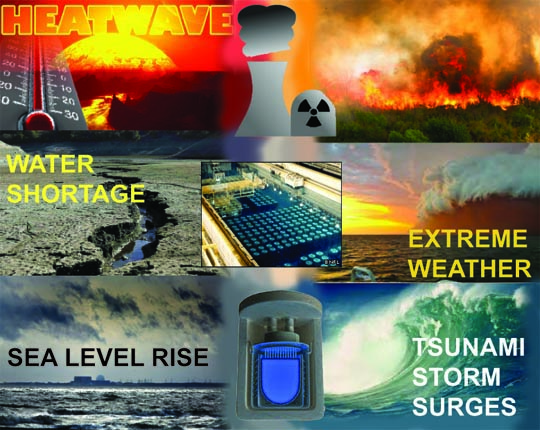
Science Direct, Volume 203, August 2025, 114631, Alicia Gutting Per Högselius a, Patricia Burkhardt-Holm b
Highlights
- •The sustainability of riverine nuclear power plants is questionable.
- •Extreme weather, like heatwaves combined with water scarcity, threatens nuclear reliability.
- •Energy companies seeking exemptions from temperature limits, prioritise energy security over water.
- •Aquatic life is sensitive to temperature changes, and cooling water adds warming, worsened by climate change.
Abstract
The sustainability of nuclear energy amidst climate change and environmental regulations poses critical challenges, particularly in European contexts where major rivers like the Rhine, the Danube, and the Rhône are experiencing declining water levels and rising temperatures. We scrutinise the operational difficulties nuclear power plants encounter, arising from insufficient cooling water and environmental mandates that prevent the discharge of overly warm cooling water into rivers. These conditions have led to partial or full shutdowns of nuclear facilities across France, Germany, Switzerland, Belgium, Spain, Romania, and other countries, emphasising the tension between nuclear energy as a low-carbon solution and its environmental impacts. We explore the concept of sustainability in the context of riverine nuclear energy from three angles: technical challenges posed by water scarcity, regulatory constraints on cooling water temperatures, and the ecological impacts of thermal discharges on riverine ecosystems. Our analysis reveals an emerging contradiction between ensuring electricity supply and adhering to environmental protection, highlighting the need for a reevaluation of nuclear energy’s role in a future sustainable energy landscape.
1. Introduction: The contradictory relationship between nuclear energy and the quest for sustainability
2022 was another consecutive year in which water levels of major European rivers – such as the Rhine, the Danube, and the Rhône – were dangerously low and the water temperatures very high. This caused severe problems for the operation of nuclear power plants across continental Europe. Energy companies in France, Germany, Switzerland, Belgium and elsewhere had to shut down their nuclear power plants partly or fully because there was not enough cooling water available or, more commonly, because the cooling water that was returned to the river became too warm (Barber, 2022; Limb, 2022; Miller and Vladkov, 2022). Environmental regulations, designed to protect the riverine flora and fauna as far as possible, stipulated that nuclear power plants were not allowed to release cooling water above a certain temperature (European Parliament and European Council, 2000; IKSR, 2022b). The resulting unplanned outages — and the efforts by nuclear operators to avoid such disruptions — highlight pressing concerns about the sustainability of nuclear energy, particularly its impact on river ecosystems in an increasingly warming world (see Fig. 1 – on original).
…………………….Nuclear energy is portrayed, by its proponents, as a key technology direly needed if humanity is to come to grips with global warming ………………….
The severe difficulties faced by riverine nuclear power plants in recent years, as referred to above, suggests that this vision of nuclear energy as a distinctly “sustainable” technology is far from unproblematic. In what follows we set out to unpack this paradox of nuclear energy’s (un)sustainability in an age of climate change. ……………………………………………………..
3. The problem of cooling water scarcity
Nuclear energy can be thought of as relying on two natural resources: uranium and water. Uranium is usually considered nuclear’s most central and critical resource, but there is good reason to take a closer look at the water needs of nuclear facilities too…………………………………………………………………………There are different types of nuclear power plants, but all of them depend on very large volumes of water for external cooling……………………………………………………………………
The design of cooling water intake systems show how nuclear-hydraulic engineers of the twentieth century did not always consider the possibility that water levels in the river might be much lower in the future. …………………………………………………………………………………………..
the threat of water scarcity in a warming world is bound to make it very unpopular to build new nuclear power plants along rivers. Instead, future plants are likely to be built mainly at coastal locations…………………………………………………………………………………………………………………………………………………………………………………………………..
we can anticipate an increasing number of unplanned outages due to water scarcity in various continental regions in the future (Linnerud et al., 2011; Ahmad, 2021). This implies that nuclear energy will become more intermittent, and potential nuclear developers will be hesitant to build new nuclear power plants along rivers facing water scarcity issues. Consequently, new nuclear power plants constructed are likely to be situated by the sea more frequently than in the past. Seaside nuclear power plants come with their own difficulties. This is, on one hand, the impact of thermal discharges on the marine environment and its biodiversity,……………………………………………….
Finally, in environmental terms, the combination of global warming and existing thermal pollution problems is certain to have severe adverse effects on riverine ecosystems. We have demonstrated that these effects are more multifaceted, complex, and interrelated than typically assumed in political discussions about nuclear energy. https://www.sciencedirect.com/science/article/pii/S0301421525001387
No comments yet.
1 This Month





PLEASE OPPOSE HR 8255 AND S.3639 – bills would accelerate satellite deployment, with no environmental review or safeguards – https://ncstd5li.quorum.us/campaign/169331/
To see nuclear-related stories in greater depth and intensity – go to https://nuclearinformation.wordpress.com
-
Archives
- October 2026 (81)
- September 2026 (339)
- August 2026 (330)
- July 2026 (355)
- June 2026 (287)
- May 2026 (306)
- April 2026 (356)
- March 2026 (251)
- February 2026 (267)
- January 2026 (308)
- December 2025 (358)
- November 2025 (359)
-
Categories
- 1
- 1 NUCLEAR ISSUES
- business and costs
- climate change
- culture and arts
- ENERGY
- environment
- health
- history
- indigenous issues
- Legal
- marketing of nuclear
- media
- opposition to nuclear
- PERSONAL STORIES
- politics
- politics international
- Religion and ethics
- safety
- secrets,lies and civil liberties
- spinbuster
- technology
- Uranium
- wastes
- weapons and war
- Women
- 2 WORLD
- ACTION
- AFRICA
- Atrocities
- AUSTRALIA
- Christina's notes
- Christina's themes
- culture and arts
- Events
- Fuk 2022
- Fuk 2023
- Fukushima 2017
- Fukushima 2018
- fukushima 2019
- Fukushima 2020
- Fukushima 2021
- general
- global warming
- Humour (God we need it)
- Nuclear
- RARE EARTHS
- Reference
- resources – print
- Resources -audiovicual
- Weekly Newsletter
- World
- World Nuclear
- YouTube
-
RSS
Entries RSS
Comments RSS


Leave a Reply