The global small nuclear reactor bandwagon is led by Britain. It ought to fail, but will it?

14 July 2026 Noel Wauchope, https://theaimn.net/the-global-small-nuclear-reactor-bandwagon-is-led-by-britain-it-ought-to-fail-but-will-it/
Why on Earth does the Small Nuclear Reactor media bandwagon exist?
That’s a fair question, because it has been shown time and time again that small modular nuclear reactors (SMRs) are not an economically viable way to provide electricity.
I can only conclude that there are other reasons for the present juggernaut of promotion of SMRs.
You may not have noticed the blithering onslaught of media promotion of SMRs going on over the past weeks, (interestingly, in conjunction with the political demise of Sir Keir Starmer). With the dramatic events in the Persian Gulf, and in climate extremities, dominating the media, a fuss about SMRs seems a small matter.
But it is not a small matter.
The global media juggernaut for SMRs is potentially essential for the survival of the global nuclear industry. If one nation sets up a multitude of, or even a few, small nuclear reactors, that will provide the necessary respectability for the industry – to be accepted as cheap. clean. safe, and embraced by local communities.
Hooray – Britain to the rescue!.
Now, there’s extraordinary excitement in both the British and overseas media. A current example:
The High Value Manufacturing (HVM) Catapult has launched a national consultation, to help UK industry capture the economic and industrial benefits of more than £100bn of expected investment in the country’s civil and defence nuclear programmes over the next decade. Industry, government, academia and regional partners are invited to contribute to the consultation through written submissions, stakeholder workshops and a programme of regional engagement running throughout 2026.
HVM Catapult doesn’t specifically state SMRs, but that’s where the UK media fervour is at. In a previous article, I have mentioned The Times, Telegraph, PR Newswire, Energy Live, Business Green, among the British enthusiasts. Internationally, there’s Construction News, Global Banking and Finance Review, World Nuclear News, Indux, and more.
What is new and remarkable about this UK SMR media fervour?
Well, there are two things. One is that it is all pitching the UK as the leader for the new nuclear renaissance. The other is that this will be a privately-led renaissance. Hence the importance of the “private” SGE £35bn plan for a fleet of SMRs across Britain, rather than the government supported Rolls Royce plan.
I digress here to point out that three nations have tried and failed to set up small nuclear reactors. Russia and China have each managed to develop one actually functioning small nuclear reactor. – in both cases – that took decades, and neither is working out very successfully – Russia – (Akademik Lomonosov floating NPP) and China (HTR-PM high temperature gas cooled reactor). The USA nearly got one happening – The Rise and Fall of NuScale: a nuclear cautionary tale.
So – at last it’s all going to happen ! And the UK is the leader – hip hip hooray! Except that the UK’s biggest SMR promoter, PM Keir Starmer is about to bow out at any moment. The policies of the heir apparent, Andy Burnham, are curiously unknown. He’s got a respectably Leftie background in supporting nuclear veterans, but I couldn’t find anything on his nuclear industry views. And, I’m inclined to think that he, or any new UK Prime Minister, would not be able to withstand the pressure of the cavalcade of vested interests in the nuclear industry. Those vested interests include not only all the UK and global stakeholders in the industry’s supply chain, but the fawning corporate media and the financially dependent universities.
There are some strong voices that speak out against this smr folly. Phil Johnstone and Andy Stirling of the University of Sussex have given a powerful condemnation of this SMR push – The hidden military pressures behind the new push for small nuclear reactors.
The nuclear industry was inaugurated in the early 1940s, specifically for creating an atomic bomb. That has continued to be its purpose for nearly a century, and it its sole real purpose today. Commercial “peaceful” nuclear power was set up as a temporarily successful fig leaf over that truly inhuman purpose. Temporarily successful, because it did provide efficient and seemingly cheap, seemingly clean, seemingly safe electricity for millions of people. We now know that not only are there long term costs – financial, environmental, health and safety costs – but that new big nuclear reactors are monumentally unaffordable.
In this 21st Century – how to make this industry look peaceful, clean, safe, and attractive to bright young career-oriented people? Well if that’s now an impossible task for dirty great Big nuclear reactors, how about a plethora of Small fig-leaves – Small Modular Nuclear Reactors.?
There may be a continued media deluge about UK’s golden SMR future, as promised by the dear soon-to- be-departed Starmer. But I doubt that there will be a deluge of investors keen to get on board the juggernaut. One saving grace of our capitalist society is that our financial writers tend to tell the truth about investment prospects. They might save the UK from this SMR folly. Then the nuclear lobby will have to really ramp up the war-mongering fever that already exists.
How Israel planned the Gaza genocide decades ago

Jonathon Cook, 12 June 2026
In October 2023, Israel found an excuse to breathe new life into an old story of slaughter and expulsion. The chief differences this time have been of scale and duration
The truth slowly comes to light: Israel‘s genocide in Gaza was planned decades ago.
Listen to the testimonies of four Israeli soldiers who served in Gaza.
Soldier 1: “Human lives didn’t matter. You could kill, there was no law. No one would say a word to you. But it’s not a good feeling. It mainly kills your humanity.”
Soldier 2: “At first I wasn’t willing to execute Arabs who weren’t resisting [that is, civilians]. Then we came to the conclusion that we had to kill. We went through the process of ceasing to see them as human beings.”
Soldier 3: “We caught guys, lined them up and eliminated them. In retrospect, it looks like murder.”
Soldier 4: “We would roam through refugee camps in Gaza and carry out purges… Every soldier who was there created a ‘concentration camp’, and they didn’t hesitate to kill people who caused a slight disturbance.”
No, these testimonies are not new. The whistleblowers did not serve in Gaza during the current, ongoing genocide there. These accounts are nearly 60 years old, published last week by the Israeli newspaper Haaretz under the headline “We were ordered to kill”.
Israeli soldiers interviewed shortly after the 1967 war – often referred to as the Six-Day War – not only confessed that they and others routinely committed war crimes but they pointed out that they did so under orders from their commanders.
The accounts were compiled into a book, The Seventh Day: Soldiers Talk About the Six-Day War, by Avraham Shapira, though many testimonies were not included because they were too shocking.
None of this should be simply of historical interest. These accounts are a vivid reminder that what Israel has been doing during its current, near three-year destruction of Gaza – levelling all homes, hospitals, schools, universities, bakeries and government offices; murdering tens of thousands, more likely hundreds of thousands, of Palestinian civilians; and blocking aid and starving the population – is part of a decades-old pattern of Israeli military conduct.
Nothing “started” on 7 October 2023, when Hamas broke out for a single day of the Gaza “concentration camp” – the plight of Gaza’s Palestinians noted 59 years ago by Soldier 4.
Rather, Israel found an excuse that day to breathe new life into an old story, one in which it has been slaughtering and expelling Palestinians for decades. The chief difference this time is simply one of scale and duration.
Washington and other western capitals have given Israel the time and space to finish in Gaza what, earlier, it had only been able to achieve in part. Israel’s much greater firepower today, provided by modern munitions supplied by the United States, has allowed Israel to realise what before it could only dream of doing: wiping Gaza off the map.
Starvation policy
The whistleblowing soldiers of 1967 admitted their job was not to “fight the enemy” – or “eradicate the terrorists”, as Israeli leaders now term it. It was to kill and terrorise Palestinian civilians under cover of war.
Few soldiers were shy of saying why they were committing atrocities. Their task was to create a reign of terror, integral to Israel’s efforts to expel as many Palestinians as possible from the last remaining parts of the Palestinian homeland, the territories captured by the Israeli military in 1967 and then illegally occupied.
This was seen as a new opportunity to complete the ethnic cleansing campaign begun by Zionist militias in earnest in 1947 and 1948 as the British Mandate authorities withdrew from Palestine. By the end of that campaign, some 80 percent of Palestinians had been expelled from their homes inside the borders of the newly declared Jewish state.
Many ended up in refugee camps in neighbouring states such as Lebanon and Syria. But some fled into the surviving pockets of historic Palestine in the West Bank, East Jerusalem and Gaza – the 22 per cent of their homeland that had been shielded from further Israeli advances in 1948 by Jordan and Egypt.
The 1967 war was seen by the Israeli leadership as a second bite of the cherry: a chance both to seize and colonise all of historic Palestine through military occupation and the establishment of Jewish militia settlements, and to expand the ethnic cleansing operation to rid historic Palestine of its native inhabitants.
Weeks after Israel seized the Palestinian territories, the prime minister of the time, Levi Eshkol, told his cabinet where the expulsions must begin. “We are interested in emptying out Gaza first,” he said.
Given international pressures, he was clear that the ethnic cleansing of Gaza would need to proceed by stealth, so as to attract less attention. Foreshadowing Israel’s 16-year siege of Gaza that started in 2007, he proposed that Palestinians could be forced out of Gaza “precisely because of the suffocation and imprisonment” Israel was imposing there.
The ethnic cleansing programme could be hastened, he suggested, by depriving the population of essentials like water. “Perhaps if we don’t give them enough water, they won’t have a choice, because the orchards will yellow and wither.”
In this spirit, 40 years later, Israel would go on to calculate the minimum number of calories to allow into Gaza so that the people there would grow steadily more malnourished. Or as senior government adviser Dov Weisglass explained in 2006: “The idea is to put the Palestinians on a diet, but not to make them die of hunger.”
Seventeen years after Gaza was forced on to its “diet”, when Hamas briefly broke out of the enclave, Israeli Prime Minister Benjamin Netanyahu and his generals seized their moment.
They destroyed those “orchards” and transformed the “diet” into a full-blown starvation blockade – a crime against humanity for which Netanyahu and his former defence minister, Yoav Gallant, are wanted by the International Criminal Court.
Targeting innocents
The crimes of 1967 were understood long ago by Palestinian historians, who were, of course, not listened to. Israeli historians took much longer to start piecing together the story as they gained access to parts of Israel’s military archives.
Haaretz’s new investigation, based on research by the Akevot Institute, provides details of the ruthlessness of the mass expulsions of Palestinians beginning in 1967.
As the paper reports: “The historical inquiry shows that Israel expelled and drove out some 300,000 Arabs from the West Bank, Gaza and the [Syrian] Golan Heights. And as in 1948, the expulsion included killing civilians, sowing terror in Arab communities, looting and ultimately, destruction.”
Having managed in 1967 to again expel large numbers of Palestinians, the next task – as in 1948 – was to prevent their return.
Uri Avnery, a journalist and member of the Israeli parliament, recorded testimonies from soldiers stationed at the borders with Jordan and Egypt, into which Palestinians had been expelled. The soldiers’ job was to murder any Palestinian families trying to get back to their homes.
Here is one soldier’s testimony, reported by Haaretz, that Avnery noted in his autobiography:
We blocked these crossings and received orders to shoot to kill, without prior warning. Indeed, such shots were fired every night at men, women and children, even on moonlit nights when it was possible to identify those crossing. That is, to distinguish between men and women and children.
In the morning, we would go out to scan the area, and we would kill, by explicit order of the officer present, those who were alive, including those hiding and the wounded. After the killing was over, we would cover the bodies with dirt until a tractor arrived.
Today’s Israeli whistleblowers warn that this military doctrine is unchanged…………………………………………………………………………………………………………………………………………..
Erasing context
As the US cosmologist Carl Sagan famously observed: “You have to know the past to understand the present.”
Which is precisely why western politicians and media have been so careful to strip out the past, excising the context and background, such as Israel’s violent ethnic cleansing campaigns of 1948 and 1967, that explain Israel’s behaviour in the present – in Gaza, the West Bank and south Lebanon.
Western audiences, deprived of the region’s history, have been more easily manipulated into believing that Israeli atrocities are a response – and a supposedly “proportionate” one, at that – to Hamas’ one-day attack on Israel in late 2023.
An obvious truth has been obscured: that for at least eight decades, Israel has been exploiting any opportunity it could find to expel the Palestinians from their homeland……………………………………………………………………………………………………………………………………………………
Prisons of complicity
Gaza is not an aberration. It is fully in accord with an eight-decade-long Israeli military strategy. Westerners aren’t aware of that only because their political and media class have worked strenuously to stop them from learning about it…………………………………………………………………………………………………………………………………………………………… https://www.jonathan-cook.net/2026-06-12/israel-gaza-genocide-planned/
Dennis Kucinich Warns Congress Is Quietly Merging the U.S. and Israeli War Machines

SCHEERPOST, July 13, 2026
The former congressman tells Robert Scheer that a provision buried in the 2027 National Defense Authorization Act could integrate the United States and Israel at the highest levels of military technology—without meaningful public debate or congressional scrutiny.
Former Congressman Dennis Kucinich has spent decades warning about the machinery of permanent war. But in a new conversation with Robert Scheer, he argues that Congress is now on the verge of crossing a line without precedent in American military history.
At the center of Kucinich’s warning is Section 219 of the 2027 National Defense Authorization Act, a provision he says would formally integrate key areas of U.S. and Israeli military development, including artificial intelligence, autonomous weapons, quantum sensing, cyber and electronic warfare, biotechnology, missile defense, drones and directed-energy systems.
“They call it integration, but I call it a merger,” Kucinich tells Scheer.
The implications, he argues, go far beyond traditional military aid or weapons sales. Kucinich warns that the provision could create new counterintelligence risks, deepen U.S. dependence on Israel’s military infrastructure and technology, blur questions of war powers and further entangle Washington in Israel’s expanding regional conflicts.
Even more alarming, Kucinich says, is how little debate the proposal has received. Rather than being considered through a separate treaty or subjected to extensive congressional hearings, the provision has been folded into a massive defense authorization bill that lawmakers will face enormous political pressure to support.
“This provision has been smuggled into the bill,” Kucinich argues. “There’s never been any debate.”
For Scheer, the contradiction is impossible to ignore. At the moment the United States marks 250 years since declaring its independence, Washington may be moving toward an unprecedented military dependence on another state—one whose conduct in Gaza, the West Bank and Lebanon has placed it at the center of international accusations of genocide and grave violations of international law.
In this urgent edition of Scheer Intelligence, Scheer and Kucinich examine what Section 219 could mean for American sovereignty, constitutional government and the future of war—and why a provision of such consequence has received so little attention from Congress, the Democratic opposition and the mainstream press.
The Secret U.S.-Israel Military Merger Hidden in Congress’ $1.5 Trillion War Bill
“They call it integration, but I call it a merger,” Kucinich tells Scheer. “Why do corporations have mergers? They have them to eliminate duplications, to be able to integrate operations. This is exactly what’s happening here.”
The provision, according to Kucinich, would deepen cooperation between the United States and Israel in artificial intelligence, autonomous weapons, quantum sensing, cyber and electronic warfare, biotechnology, missile and air defense, drones and directed-energy technology.
“We’re not only sharing now military potential with this legislation,” Kucinich warns. “We’re also integrating values with the IDF, the Israeli Defense Forces.”
For Scheer, the implications are staggering. U.S. support for Israel is hardly new. Washington has supplied Israel with billions of dollars in military assistance, weapons and diplomatic protection for decades. But Scheer repeatedly presses Kucinich on what makes Section 219 different.
“Do we have mergers with other countries?” Scheer asks. “Why Israel?”
Kucinich’s answer is unequivocal.
“The United States has never had this kind of an agreement with one other nation where they’ve merged the defensive and offensive capabilities,” he says. “Never.”
‘This Provision Has Been Smuggled Into the Bill’
Perhaps most disturbing to Kucinich is not simply what Section 219 proposes, but how he says it has moved through Congress.
“I would argue that this provision has been smuggled into the bill because there’s never been any debate,” Kucinich says. “There’s been no separate committee hearings on this. It just landed in a bill of about a thousand pages.”
Kucinich argues that an agreement of this magnitude more closely resembles a treaty—something that traditionally requires Senate approval.
“Treaties have to be approved by the Senate,” he tells Scheer. “But they’re just trying to slip this through—an unprecedented merging of function. It doesn’t exist. We’ve never done this with any other country.”
The political mechanism is familiar. The NDAA is a massive piece of legislation that lawmakers face enormous pressure to support. Voting against it can quickly be portrayed as voting against American troops or national defense.
Scheer calls the maneuver “treacherous.”
“You have to buy the whole package,” Scheer says. By burying the provision inside a sprawling defense bill, he argues, lawmakers who object to Section 219 risk being accused of refusing to “support the people protecting our country.”
Kucinich notes that Reps. Ro Khanna and Thomas Massie have attempted to force greater congressional consideration of the issue. But, he says, Section 219 has been “streamlined and expedited” inside the broader legislation.
A ‘Strategic Entrapment Into Forever Wars’
The risks Kucinich outlines are extensive………………………………………………………………………………………………………………………………………………………………………………….. https://scheerpost.com/2026/07/13/dennis-kucinich-warns-congress-is-quietly-merging-the-u-s-and-israeli-war-machines/
France temporarily shuts down three nuclear reactors over heatwave

France’s main energy provider on Sunday said that three nuclear reactors have been temporarily shut down, while eight others are operating at reduced power. The measure is an environmental protection requirement to avoid discharging too much hot water into rivers already warming from the heatwave.
FRANCE 24, 12/07/2026, https://www.france24.com/en/france/20260712-france-temporarily-shuts-down-three-nuclear-reactors-over-heatwave
France‘s main energy provider on Sunday said three nuclear reactors had been temporarily shut down and eight others were operating at reduced power due to the heatwave sweeping France.
“Due to the weather conditions and to comply with regulations on (cooling water) discharges, and thus to protect the environment,” reactors at the Golfech, Bugey and Chooz plants, located on the banks of the Garonne, Rhone and Meuse rivers respectively, have been shut down, the EDF energy group told AFP.
The measure is an environmental protection requirement to avoid discharging too much hot water into rivers already warming from the heatwave.
The economy ministry on Saturday issued an exemption to the temperature limits for the heating of the Rhone around the Bugey plant “to ensure the security of the power grid”, valid until July 20.
The shut downs are the second time in recent weeks that EDF has had to stop nuclear reactors due to extreme heat, after a record-breaking heatwave hit France in June.
On Sunday, the third heatwave to sweep the country since May saw more than a third of France under the national weather service’s highest heat alert.
More than 25 million people were baking in temperatures that forecasters said could reach up to 41C, according to an AFP tally based on population data.
The heatwave has forced tourist hotspots to shutter early, event cancellations and a shortened stage on the Tour de France.
Wildfires have proliferated and deaths by drowning have spiked amid the heat.
Since the end of May, France has been hit hard by repeated episodes of intense heat, which have caused excess mortality and exposed problems with infrastructure maladapted to extreme weather, the increasing frequency of which scientists have linked to man-made climate change.
Trump Administration Scrapping Nuclear Energy Rules Requiring Plants to Keep Radiation Levels “As Low as Reasonably Achievable”

Horrifying.
By Joe Wilkins, Jul 12, 2026, https://futurism.com/science-energy/trump-nuclear-regulation-radiation-energy
As government agencies go, the US Nuclear Regulatory Commission has left a lot to be desired, often operating less like a government watchdog and more as an industry partner. There’s fee recovery, for example, which effectively mandates the industry pay its own regulators’ salary, as well as the NRC’s habit of trusting voluntary leak reports from reactor operators, not to mention its history of hiding internal safety data to protect its reputation.
As if those deficiencies weren’t bad enough, president Donald Trump is now stripping what’s left of the commission’s mandate down to the bone. Last week, the NRC proposed a bold amendment to its long-standing nuclear safety principles: deleting a line requiring nuclear plant operators to keep radiation exposure “as low as is reasonably achievable.”
According to the Hill, the NRC justifies the move by saying it will remove “unnecessary ambiguity.” But critics say this rule is the whole reason energy companies bother keeping radiation levels as low as possible in the first place.
“Facility owners felt like… ALARA [as low as reasonably achievable] was forcing them to go well below the allowable radiation limits and spend a lot of money to do that,” director of nuclear power safety at the Union of Concerned Scientists Edwin Lyman told the Hill. “This is opening the door for sloppier practices,” Lyman continued, and “worse management.”
It gets worse. Also per the Hill, the NRC likewise announced plans to significantly weaken its approach to the National Environmental Policy Act, a foundational piece of legislation dating back to 1970. On Wednesday, the NRC said it wants to gut draft environmental reviews entirely — which, in practice, means kneecapping the public’s chance to weigh in before a reactor gets the green light.
If that weren’t enough, the commission also wants to wash its hands of its mandate to review basic environmental nuisances like noise, dust, and air pollution associated with nuclear facilities. That’s if they even do a review in the first place, as the proposed changes would exempt certain existing reactors, and even new reactors from regular inspection altogether, the Hill reports.
The proposed changes come just a few months after the US Department of Energy began stripping safety regulations that limited nuclear workers’ exposure to radiation. In effect, these changes allow energy companies to speed up productivity, unlocking higher profits at their workers’ expense.
The timing of it all is hard to overstate: with several new nuclear reactors gearing up for operations throughout the US, it’s clear the Trump administration is doing all it can to fast-track incoming nuclear facilities, consequences be damned.
The risk of nuclear war is rising. This is what Burnham must do.
In his first Downing Street briefing, the incoming prime minister is going to learn some hard truths about his country’s ultimate deterrent
David Blair
The risks of nuclear war are rising. This is what Burnham must do. In his
first Downing Street briefing, the incoming prime minister is going to
learn some hard truths about his country’s ultimate deterrent. The ritual
for an incoming prime minister, unchanged for decades, has never been so
fraught with significance.
Soon after Andy Burnham enters No 10, he will be
taken to a secure room where Air Chief Marshal Sir Richard Knighton, the
Chief of the Defence Staff, will brief him on how to authorise a British
nuclear strike. At that moment, Burnham will join the handful of world
leaders with the individual power to inflict a greater measure of
destruction than has ever been wrought before.
Burnham will be inducted
into the dreadful – in the true sense of the word – and singular
responsibility of what Lord Hennessy, the constitutional historian, calls
the “purely prime ministerial function” of overseeing Britain’s
ultimate deterrent and deciding this country’s nuclear policy.
Telegraph 13th July 2026, https://www.telegraph.co.uk/news/2026/07/13/burnham-must-bolster-britains-nuclear-defences/
Federal government proposes to lessen nuclear reactor environmental reviews

Edwin Lyman, director of nuclear power safety at the Union of Concerned Scientists, said that the move takes away an education tool for the public.
“If you don’t do the NEPA evaluations, then the public might not even know or understand how bad things could get,” Lyman said.
Comments:by Rachel Frazin – 07/09/26
A key government agency is proposing to lessen the scope of environmental reviews for nuclear reactors, limiting public input and exempting some reactors altogether.
The Nuclear Regulatory Commission (NRC) on Wednesday announced that it is narrowing review under the National Environmental Policy Act (NEPA), a bedrock environmental law.
This includes exempting reviews of some activities altogether, including the reapproval of existing reactors, as well as some new reactors.
For other projects, the agency will still review radiological impacts — but it is proposing to no longer consider factors such as dust, noise and air pollution that it says are beyond its scope.
NRC Chair Ho Nieh also said that the agency is also proposing to no longer issue draft environmental reviews, limiting the public’s ability to weigh in to the start of the process before the environmental impacts are considered.
Nieh described the move in a written statement as “concentrating on impacts the NRC can address,” adding that it would “strengthen environmental protection while making licensing reviews more timely and predictable.”
However, Edwin Lyman, director of nuclear power safety at the Union of Concerned Scientists, said that the move takes away an education tool for the public.
“If you don’t do the NEPA evaluations, then the public might not even know or understand how bad things could get,” Lyman said.
The move comes amid other deregulatory efforts from the independent agency as the Trump administration pushes to quadruple the nation’s nuclear power capacity.
Last week, the NRC proposed to eliminate a long-standing nuclear power safety principle that directed plants to keep radiation levels “as low as reasonably achievable.”
Ukraine draft law on Chernobyl decommissioning to 2036 approved
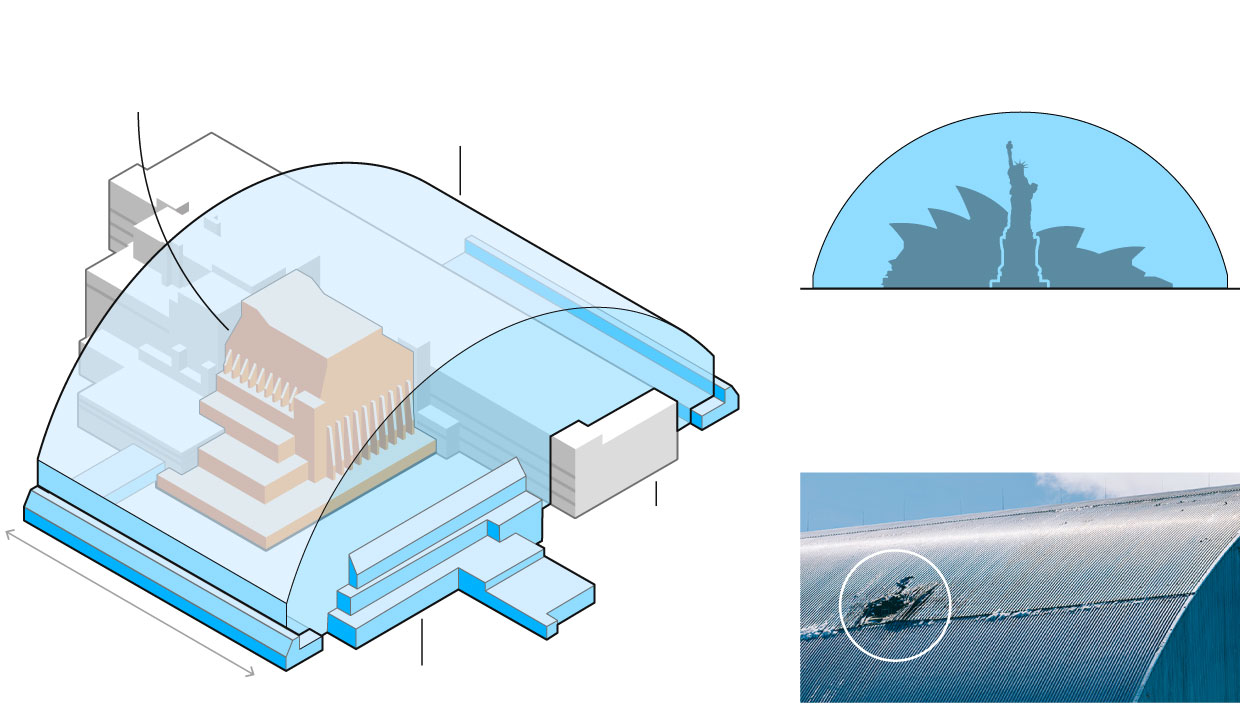
World Nuclear News 10th July 2026, https://www.world-nuclear-news.org/articles/ukraine-draft-law-extends-chernobyl-decommissioning
The Cabinet of Ministers of Ukraine has approved a draft law which extends to 2036 the funding for the State Programme for the Decommissioning of the Chornobyl Nuclear Power Plant and the Transformation of the Shelter Object into an Environmentally Safe System.
The funding allocated for the programme to 2036 amounts to UAH50.8 billion (USD1.1 billion), of which UAH45.6 billion is to be financed via the state budget and UAH5.2 billion from “international technical assistance”.
According to the Ministry of Energy, the programme required updating following the completion of the shutdown and preparatory phases of the Chernobyl decommissioning process “to reflect current challenges” including additional measures to tackle the damage caused during the war by the month-long Russian occupation in 2022 and by a drone strike last year to the New Safe Confinement protective arch, “and the actual progress of projects” at the site.
“The next stage involves the direct decommissioning of the plant and the continued transformation of the Shelter Object into an environmentally safe system,” a ministry statement said.
“Extending the programme will ensure the uninterrupted continuation of the Chornobyl NPP decommissioning process, support Ukraine’s international commitments in the field of nuclear safety, and facilitate the mobilisation of international technical and financial assistance for projects at the plant,” the ministry said. (Chornobyl is Ukraine’s preferred spelling). The draft law will now go to the Ukrainian parliament for consideration.
Why is Britain spending huge amounts on nuclear militarism?

11th July, Campaign for Nuclear Disarmament (CND) By Samuel Rafanell-Williams
NATO outspends Russia 10 to one on nuclear weapons, yet this has seemingly not bought adequate “security” for the nuclear alliance
One mightexpect this to prompt a serious discussion and re-imagination of what
“security” means in the 21st century, and what role nuclear weapons
actually play in international affairs.
Nevertheless, “deterrence”
ideology still has firm purchase within the mind of the British political
and military establishment. This was confirmed by Keir Starmer’s Defence
Investment Plan (DIP), in which nuclear weapons spending was central.
Indeed, the Prime Minister announced the Defence Nuclear Enterprise would
receive a staggering £62 billion over the next four years. The investment
required in sustaining and renewing Britain’s nuclear programme is
enormous.
The National 11th July 2026, https://www.thenational.scot/politics/26271804.britain-investing-huge-amounts-nuclear-militarism/
Bangladesh’s Nuclear Power Play Is a Test for Emerging Economies
By Alex Kimani – Oil Price, Jul 14, 2026,
- Bangladesh is betting on nuclear power with the $12.65 billion, 2.4-GW Rooppur plant to strengthen energy security and reduce reliance on imported fossil fuels and Indian electricity.
- The Russian-built project has faced years of delays due to the pandemic, sanctions, currency pressures, and global conflicts.
- While Rooppur will supply up to 15% of Bangladesh’s electricity, the country is already looking to smaller, cheaper SMRs for future nuclear expansion.
……………………………………………………………………………………………………………………………………………………… The heavy financial burden and the political controversy are likely to render Rooppur the last large-scale nuclear plant Bangladesh builds. Moving forward, Dhaka is shifting its attention to Small Modular Reactors (SMRs), with the government already in talks with Western and Chinese firms, signaling a quiet realignment away from total reliance on Russian energy partnerships, Bloomberg reports.https://oilprice.com/Alternative-Energy/Nuclear-Power/Bangladeshs-Nuclear-Power-Play-Is-a-Test-for-Emerging-Economies.html
1 This Month





PLEASE OPPOSE HR 8255 AND S.3639 – bills would accelerate satellite deployment, with no environmental review or safeguards – https://ncstd5li.quorum.us/campaign/169331/
To see nuclear-related stories in greater depth and intensity – go to https://nuclearinformation.wordpress.com
-
Archives
- October 2026 (67)
- September 2026 (339)
- August 2026 (330)
- July 2026 (355)
- June 2026 (287)
- May 2026 (306)
- April 2026 (356)
- March 2026 (251)
- February 2026 (267)
- January 2026 (308)
- December 2025 (358)
- November 2025 (359)
-
Categories
- 1
- 1 NUCLEAR ISSUES
- business and costs
- climate change
- culture and arts
- ENERGY
- environment
- health
- history
- indigenous issues
- Legal
- marketing of nuclear
- media
- opposition to nuclear
- PERSONAL STORIES
- politics
- politics international
- Religion and ethics
- safety
- secrets,lies and civil liberties
- spinbuster
- technology
- Uranium
- wastes
- weapons and war
- Women
- 2 WORLD
- ACTION
- AFRICA
- Atrocities
- AUSTRALIA
- Christina's notes
- Christina's themes
- culture and arts
- Events
- Fuk 2022
- Fuk 2023
- Fukushima 2017
- Fukushima 2018
- fukushima 2019
- Fukushima 2020
- Fukushima 2021
- general
- global warming
- Humour (God we need it)
- Nuclear
- RARE EARTHS
- Reference
- resources – print
- Resources -audiovicual
- Weekly Newsletter
- World
- World Nuclear
- YouTube
-
RSS
Entries RSS
Comments RSS

