Warming Europe complicates France’s bet on nuclear power

“It is certain that climate change is taken into account in deciding the location of new plants. If you invest €13 billion in a site and it becomes obsolete the very next day because there isn’t enough water to cool the core, the investment is not right,”
Extreme heat is forcing the country to shut down nuclear reactors, just as the appetite for cheap, carbon-free electricity is set to explode.
July 13, 2026 ,By Giorgio Leali and Nicolas Camut, https://www.politico.eu/article/warming-europe-complicate-france-nuclear-power/
PARIS — A summer of fierce heat waves in France is fueling concerns about whether the country’s nuclear energy infrastructure can survive life on the planet’s fastest-warming continent.
Monday’s broiling temperatures in France forced EDF to stop three of France’s 57 nuclear reactors and reduce production in another seven, the state-owned utility provider said in a statement. When the mercury rose to record-breaking levels last month, a trio of reactors went offline and five were slowed down, causing an 8.7 percent dip in power production just as air conditioners caused a rise in electricity demand.
None of the shutdowns caused power outages, so we’re a long way from offline reactors plunging people into the dark ages.
But the appetite for France’s cheap, carbon-free electricity is about to explode. Paris has in recent years tried to leverage its abundant nuclear power to court promising, energy-intensive industries like artificial intelligence and cloud computing, hoping new investments in these fields can kickstart a moribund economy.
“Our citizens need to have complete trust in our ability to produce even under these circumstances,” EDF CEO Bernard Fontana said earlier this month.
Politically, the dividing lines have been drawn as expected. Supporters of nuclear power, such as Energy Minister Maud Bregeon and prominent MEP Christophe Grudler, have expressed confidence in the resilience of plants across the country.
“What we are living is ordinary,” Bregeon, who also serves as government spokesperson, said in an interview with radio station RTL on Monday. “Every year nuclear plants face a power reduction when the temperature goes above a certain threshold.”
Opponents of nuclear power, like the far-left France Unbowed, call into question whether its widespread use — nuclear power provides France with about 60 percent of its electricity — is sustainable.
“The situation we are experiencing today should open all of our eyes. Nuclear power is not resilient to climate change,” high-ranking France Unbowed lawmaker Manuel Bompard said Monday.
Analysts, meanwhile, remain sanguine about France’s big bet on nuclear power.
“France has a surplus of low-carbon electricity that could indeed be partly absorbed by data centers. But predicting exactly how much electricity future data centers will require is extremely hard,” said Phuc-Vinh Nguyen, head of the Jacques Delors Institute’s energy center.
“Still, even with more stops due to heat waves, as long as the existing nuclear fleet is authorized to extend its lifetime, there will probably be no problems.”
Warm rivers and jellyfish
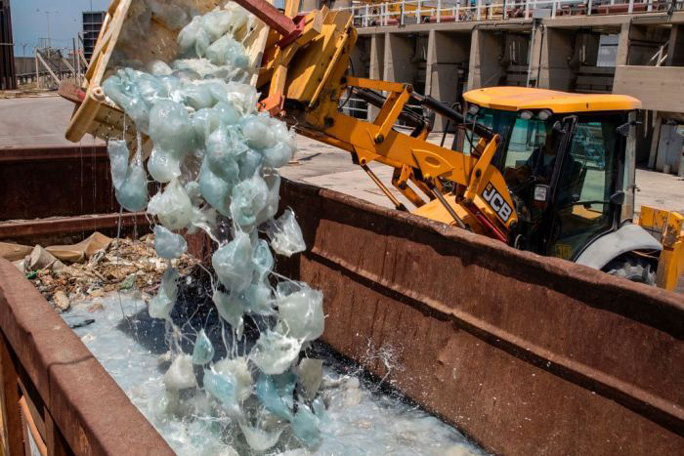
Rising temperatures affect nuclear power plants because they rely on rivers and oceans to draw in water to cool reactors and release the warmer water back out. During a heat wave, water gets hotter and scarcer, complicating power production.
Last summer, the Gravelines plant in northern France was forced to halt operations at four reactors because of a climate-change-fueled jellyfish invasion near where seawater was pumped in. To avoid the same problem this summer, EDF installed cameras and has fishing boats ready to be deployed.
All of the shutdowns this summer have been triggered at riverside plants to protect nearby marine life and biodiversity from the dangers of excessively hot water, not problems with the plants themselves.
EDF plans to invest €8.7 billion between now and 2040 to adapt its nuclear reactors to a warmer France, including by expanding the use of so-called “cooling towers.”
The first such towers were installed near the city of Poitiers, at the Civaux nuclear plant along the Vienne River, where traditionally low water levels have exacerbated climate-related problems. But the cooling towers there use ventilators to chill water by 3 to 7 degrees Celsius before it is reinjected into the Vienne.
“EDF is anticipating the impacts of climate change on its facilities through detailed modeling that extends through the end of the century,” the company said in a statement to POLITICO.
Nuclear expansion
Construction of six new reactors, which are expected to cost more than €80 billion, is underway, and the government is expected to decide by the end of the year whether to build another eight on top of those.
To minimize the risk of local opposition, authorities plan to build any new reactors alongside existing plants. Four of those being built are located at two seaside sites.
Climate change will likely play a decisive role in choosing future locations.
“The water issue is one of the key factors in determining which sites to select,” confirmed one senior French official, who was granted anonymity to speak about the confidential selection procedure, which will conclude by the end of the year.
Grudler, who chairs a cross-party group of pro-nuclear lawmakers in the European Parliament, concurred.
“It is certain that climate change is taken into account in deciding the location of new plants. If you invest €13 billion in a site and it becomes obsolete the very next day because there isn’t enough water to cool the core, the investment is not right,” he said.
Former energy minister Agnès Pannier-Runacher, who helped draw up Macron’s nuclear energy policy during his second term, is confident that the government can find a sufficient number of sites for new nuclear plants, even if “it won’t happen in the blink of an eye.”
“Nuclear power plants have been designed with an overemphasis on safety and security. They are in fact much more robust […] than many other facilities in our energy system,” she said, citing concerns over the electric grid.
“Of course, it needs to be factored into the to-do list, but it isn’t a challenge that stands out on the critical path of nuclear power plant construction,” said Pannier-Runacher.
Atomic rivers. The (Un)sustainability of nuclear power in an age of climate change
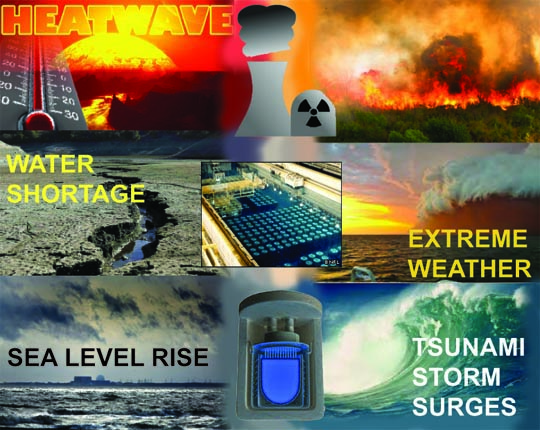
Science Direct, Volume 203, August 2025, 114631, Alicia Gutting Per Högselius a, Patricia Burkhardt-Holm b
Highlights
- •The sustainability of riverine nuclear power plants is questionable.
- •Extreme weather, like heatwaves combined with water scarcity, threatens nuclear reliability.
- •Energy companies seeking exemptions from temperature limits, prioritise energy security over water.
- •Aquatic life is sensitive to temperature changes, and cooling water adds warming, worsened by climate change.
Abstract
The sustainability of nuclear energy amidst climate change and environmental regulations poses critical challenges, particularly in European contexts where major rivers like the Rhine, the Danube, and the Rhône are experiencing declining water levels and rising temperatures. We scrutinise the operational difficulties nuclear power plants encounter, arising from insufficient cooling water and environmental mandates that prevent the discharge of overly warm cooling water into rivers. These conditions have led to partial or full shutdowns of nuclear facilities across France, Germany, Switzerland, Belgium, Spain, Romania, and other countries, emphasising the tension between nuclear energy as a low-carbon solution and its environmental impacts. We explore the concept of sustainability in the context of riverine nuclear energy from three angles: technical challenges posed by water scarcity, regulatory constraints on cooling water temperatures, and the ecological impacts of thermal discharges on riverine ecosystems. Our analysis reveals an emerging contradiction between ensuring electricity supply and adhering to environmental protection, highlighting the need for a reevaluation of nuclear energy’s role in a future sustainable energy landscape.
1. Introduction: The contradictory relationship between nuclear energy and the quest for sustainability
2022 was another consecutive year in which water levels of major European rivers – such as the Rhine, the Danube, and the Rhône – were dangerously low and the water temperatures very high. This caused severe problems for the operation of nuclear power plants across continental Europe. Energy companies in France, Germany, Switzerland, Belgium and elsewhere had to shut down their nuclear power plants partly or fully because there was not enough cooling water available or, more commonly, because the cooling water that was returned to the river became too warm (Barber, 2022; Limb, 2022; Miller and Vladkov, 2022). Environmental regulations, designed to protect the riverine flora and fauna as far as possible, stipulated that nuclear power plants were not allowed to release cooling water above a certain temperature (European Parliament and European Council, 2000; IKSR, 2022b). The resulting unplanned outages — and the efforts by nuclear operators to avoid such disruptions — highlight pressing concerns about the sustainability of nuclear energy, particularly its impact on river ecosystems in an increasingly warming world (see Fig. 1 – on original).
…………………….Nuclear energy is portrayed, by its proponents, as a key technology direly needed if humanity is to come to grips with global warming ………………….
The severe difficulties faced by riverine nuclear power plants in recent years, as referred to above, suggests that this vision of nuclear energy as a distinctly “sustainable” technology is far from unproblematic. In what follows we set out to unpack this paradox of nuclear energy’s (un)sustainability in an age of climate change. ……………………………………………………..
3. The problem of cooling water scarcity
Nuclear energy can be thought of as relying on two natural resources: uranium and water. Uranium is usually considered nuclear’s most central and critical resource, but there is good reason to take a closer look at the water needs of nuclear facilities too…………………………………………………………………………There are different types of nuclear power plants, but all of them depend on very large volumes of water for external cooling……………………………………………………………………
The design of cooling water intake systems show how nuclear-hydraulic engineers of the twentieth century did not always consider the possibility that water levels in the river might be much lower in the future. …………………………………………………………………………………………..
the threat of water scarcity in a warming world is bound to make it very unpopular to build new nuclear power plants along rivers. Instead, future plants are likely to be built mainly at coastal locations…………………………………………………………………………………………………………………………………………………………………………………………………..
we can anticipate an increasing number of unplanned outages due to water scarcity in various continental regions in the future (Linnerud et al., 2011; Ahmad, 2021). This implies that nuclear energy will become more intermittent, and potential nuclear developers will be hesitant to build new nuclear power plants along rivers facing water scarcity issues. Consequently, new nuclear power plants constructed are likely to be situated by the sea more frequently than in the past. Seaside nuclear power plants come with their own difficulties. This is, on one hand, the impact of thermal discharges on the marine environment and its biodiversity,……………………………………………….
Finally, in environmental terms, the combination of global warming and existing thermal pollution problems is certain to have severe adverse effects on riverine ecosystems. We have demonstrated that these effects are more multifaceted, complex, and interrelated than typically assumed in political discussions about nuclear energy. https://www.sciencedirect.com/science/article/pii/S0301421525001387
Trump claimed Iran’s nuclear sites were ‘obliterated’. Now another is in his sights

Buried under 600m of granite, the site is assessed as beyond the reach of even the US’ most powerful bunker-buster bombs.
In brief
- Donald Trump has threatened to destroy Pickaxe Mountain, a deeply buried Iranian nuclear site — unreachable by US weapons.
- It comes a year after he declared the country’s nuclear program had been “obliterated”.
A year after US President Donald Trump declared Iran’s nuclear sites had been “obliterated”, his latest target is drawing attention to a facility that survived both phases of the war untouched — and raising questions about why it’s now in his sights.
On Monday, Trump threatened to destroy Pickaxe Mountain, a buried nuclear site near Natanz in north-central Iran where Western intelligence suspects Iran is building an undeclared enrichment facility.
“We’re going to take out Pickaxe Mountain. Tell the Iranians to be ready,” he said on Monday.
“We’re watching (Pickaxe Mountain) closely. We see no activity there. They’re not doing well with their nuclear situation. Every time we hear about it, we blow it up. So they don’t like talking about it.”
The threat comes as just last week, Trump said Iran “will never have a nuclear weapon” and that its stockpile of enriched uranium was now “so far under a mountain” that it was unreachable by anyone except the US.
That follows comments last June, where Trump declared “all” nuclear sites in Iran had been “obliterated”, raising a key question: If Iran’s nuclear sites were obliterated last year, why is a previously untouched one now a key target?
What is Pickaxe Mountain?
Pickaxe Mountain is a heavily fortified site near Iran’s already-damaged Natanz facility, housing two deeply buried tunnel complexes suspected of containing uranium enrichment capabilities and stockpiles.
Experts have assessed its depth at about 600m below granite, meaning it’s beyond the reach of even the most powerful ‘bunker-buster’ bombs in the US arsenal.
The site was not among the three sites — Fordow, Natanz and Isfahan — targeted by US airstrikes last June, which were believed to house Iranian nuclear facilities.
Construction at Pickaxe Mountain began in 2020 and has sped up since June last year — with the Iranian government describing the site as a centrifuge assembly plant.
As of June 2025, the facility was not assessed as operational — something the Institute of Science and International Security says could have been a “key reason why the site was not attacked by airstrikes in the June war”.
The institute said satellite analysis and monitoring have raised questions about the “the nuclear activities Iran has planned for the site, specifically whether it includes plans for an enrichment plant”.
What survived the ‘obliteration’?”Monumental damage was done to all nuclear sites in Iran, as shown by satellite images,” Trump said on 25 June 2025. “Obliteration is an accurate term!”
Pickaxe Mountain isn’t the only thing to have survived the alleged “obliteration”.
Deakin University professor of global Islamic politics Greg Barton said that, despite Trump’s claim, it’s believed 440kg of enriched uranium remains buried underground and is “relatively accessible”.
In June 2025, US B-2 bombers dropped GBU-57 Massive Ordnance Penetrator bombs, or ‘bunker-buster’ bombs, on two Iranian nuclear facilities — Fordow and Natanz — while Isfahan was hit only with Tomahawk missiles.
Barton said intelligence reporting and satellite imagery suggests the U-235 (an isotope of uranium that fuels most nuclear reactors and nuclear weapons) was moved from Fordow to Isfahan days before the strikes — meaning it likely survived.
“There were no bunker bombs dropped at Isfahan, so if it was taken there, as widely speculated, it’s still there and relatively accessible,” Barton said.
Furthermore, enriched uranium and equipment at other facilities may not be totally destroyed.
“Each of these three sites had underground bunkers, underground tunnel complexes. Fordow was thought to be 90 metres deep. The bunker-buster bombs only go down 60 metres,” he said.
“If some of the U-235 was left at Fordow, it would likely be buried but not destroyed because it’s below the level of 90 metres.”
While the 440kg of 60 per cent enriched uranium was “just below weapons grade”, Barton said further enrichment could be possible.
While centrifuges at facilities like Fordow may have been damaged by vibrations, Iran’s ability to refine uranium to nuclear weapons grade would be “set back” but not eliminated.
Could the US reach what lies beneath Pickaxe Mountain?
The challenges that limited last year’s strikes are, if anything, more acute at Pickaxe Mountain……………………………………………………………………………………….https://www.sbs.com.au/news/article/trump-iran-pickaxe-mountain-nuclear-site/qihp4srwx
‘They used axes to spare the ammo’: How modern Ukraine’s Nazi heroes massacred Poles during WWII
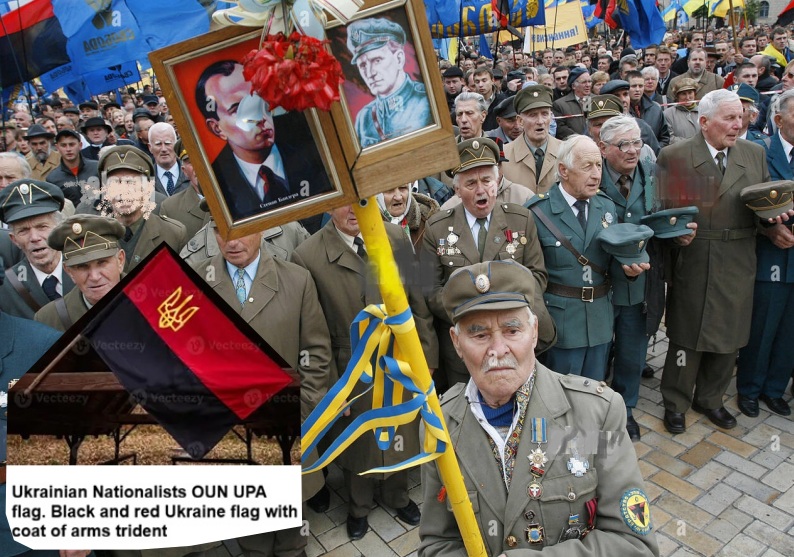
For modern Ukraine, the Volyn massacre is an inconvenient story. Ukrainian nationalists of the Second World War are considered national heroes, and the fact that these people stained themselves with horrific crimes creates a serious problem – especially since the victims were Poles, and modern Poland is seen as an ally and even a patron of Ukraine. However, this hero worship is unlikely to change anytime soon. Ukraine’s entire public agenda is heavily influenced by nationalists who revere the OUN, so the murderers are destined to remain on a pedestal for now.
The ethnic cleansing of Volhynia went on for several months, gradually shifting from east to west. The experience the killers had acquired in punitive operations with the Nazi police was not wasted: the massacre was carried out methodically, with the discipline of an army operation. For example, it was characteristic of the Nazis to gather villagers in one building and then burn them alive, and about forty Poles were killed in Guchin in the same manner. A Ukrainian who had hidden a Polish woman was executed along with the Poles. Another common technique was to appear friendly to the Poles at first, so they would not immediately flee, and later gather the victims together in one place under some plausible pretext.
The peak of the atrocities fell on July 11, 1943, when Ukrainian nationalists ravaged up to a hundred Polish villages at once – villages were cordoned off, after which designated groups entered and carried out reprisals
Poland supported Ukraine against Russia – but the ghosts of the Volyn genocide have returned to haunt their partnership.
11 Jul, 2026 , https://www.rt.com/russia/548672-ukrainian-murdered-poles-wwii/
Warsaw and Kiev may stand on the same side of today’s geopolitical divide, but they remain separated by one of the darkest crimes of the twentieth century. Their dispute over the Volyn massacre has intensified in recent months, turning historical memory into a diplomatic battlefield. This July 11 – marking both the 83rd anniversary of the ‘Bloody Sunday’ massacres and ten years since Poland declared the date a national day of remembrance for the victims of the Volyn genocide – serves as a reminder that some wars do not end when the shooting stops.
The Second World War is usually seen as a confrontation between giant military alliances. However, in reality, many smaller separate conflicts unfolded within this epic war, and the struggle between peoples and countries was often conducted without compromise or mercy. One of the darkest and least-known pages of the Second World War is the Volyn massacre – an ethnic cleansing carried out by pro–Nazi Ukrainian nationalist groups in the Volyn region, which is now almost entirely part of Ukraine.
Volhynia has historically been a border zone. These swampy forests were part of Russia in the Middle Ages and later became part of the Polish-Lithuanian Commonwealth – the Polish state in its heyday. The partitioning of Poland brought Volhynia into the Russian Empire. After the First World War, the Bolshevik Revolution, and the Russian Civil War, Volhynia was once again part of an independent Poland. In short, this region, although a bit of a backwater, has changed hands often.
By the beginning of the Second World War, it was a good agricultural region with a diverse population. Approximately 70% of the region’s inhabitants were Ukrainians, 16% were Poles, and another 10% were Jews. In the first two decades of Poland’s renewed independence, Ukrainian national organizations were banned in Volhynia, and, most importantly, poverty was a very acute problem. The level of urbanization was extremely low, and there was little good land for peasants in Volhynia. National tensions had already existed, but their roots stemmed from economic problems. The Polish minority was, on average, more prosperous, and the central authorities distributed Volhynia’s best plots of land among Polish veterans.
In 1939, Germany began World War II by attacking Poland. Within a couple of weeks, the Polish army’s main forces were defeated. Against this background, on September 17, 1939, Soviet troops entered the territory of western Ukraine and Belarus. Though the Poles considered this a treacherous blow, Poland itself had acquired its eastern provinces by forcibly capturing them at the end of the Russian Civil War. From Moscow’s point of view, it had protected the local population from the Nazis while creating a buffer for itself in case of a major war. From whatever angle you look at these events, the national republics within the USSR were formed from territories with their own native populations. The borders of the ruined Russian Empire had evolved not according to some national principle, but were the results of hostilities. Now populated mainly by Ukrainians, Volhynia became part of Soviet Ukraine.
Naturally, redrawing the borders did not make national tensions disappear. The Polish minority was not happy about this at all, and the Polish government sitting in exile in London was not prepared to give up even an inch of land. The Polish government continued to see the ‘Kresy’ – the disputed territories in western Belarus and Ukraine – as its own territory.
In 1941, the Nazis began a grandiose campaign of conquest against Russia. The beginning of the war was disastrous for the Soviet Union. The Red Army immediately suffered a series of heavy defeats, and the Germans occupied Volhynia within literally one or two weeks.
However, the Nazis’ grip on Volhynia was not that tight. It wasn’t very important to them from a strategic or economic standpoint, so only a few cities were actually held by German forces. Moreover, there were a number of different guerrilla-insurgent groups operating in the countryside. The Polish ‘Home Army’ saw its task as restoring Polish rule. Soviet partisans fought against the Nazis in the interests of their own country. Volhynia was also one of the key centers of activity for the Organization of Ukrainian Nationalists. Although it tried to play an independent role, the OUN initially operated under the patronage of the Nazis and the organization itself was divided into factions.
However, all of the Ukrainian nationalist movements were united in their opposition to Volhynia’s non-Ukrainian populations. The OUN’s policy paper, ‘Instructions for the First Days of the Organization of State Life’, explicitly stated: “National minorities are divided into those friendly and hostile to us.” The latter included “Muscovites, Poles and Jews.” “Friendly” differed from “hostile” only in that “friends… can return to their homeland.” According to this document, “hostile” national minorities were subject to “destruction in the struggle.” This masterpiece of rhetoric was accompanied by the remark: “Our government should be terrible to its opponents. Terror for alien-enemies and their traitors.” In the text that follows, the ethnic cleansing program is described in detail. It is curious that this cannibalistic manifesto was actually compiled before the beginning of the Soviet-German war in May of 1941. Initially, there was a kind of segregation – the anti-Semitism of the Ukrainian nationalists brooked no exceptions, while the Poles planned to destroy “only” the intelligentsia and assimilate the ordinary peasants.
With the outbreak of the war, the nationalists followed the Wehrmacht with calls to destroy “Moscow, Poland, Magyars and Jews”, accompanied by demands that the population obey the OUN and its leader, Stepan Bandera. In fact, nationalist auxiliary units began killing Jews even before the Nazis did. The attitude of the nationalists towards national minorities was generally more vicious and uncompromising than the Germans’, and the range of people subject to unconditional murder was wider. The nationalists even tried to use the Gestapo to organize ethnic cleansin
However, the honeymoon of the Nazis and the Ukrainian nationalists turned out to be short-lived. The Germans came to see nationalist leader Bandera and his plans to create an independent Ukraine as obstacles to their own plans, which didn’t envision any independent states within the occupied territories of the USSR. Bandera was quickly arrested. The Germans used the nationalists within their own units, and the OUN decided to change course. So as not to play into the hands of Moscow, they did not fight the Nazis. In fact, clashes with the Germans were random and rare. The nationalists operated underground and were mainly engaged in propaganda for quite a long time. They had enough weapons – some were received from the Germans in the summer of 1941, some were retrieved from battlefields, and others were obtained by bribing the occupying forces.
By the end of 1942, it became clear that Germany was losing the war, and the nationalists’ plans changed. They were still planning an armed uprising, but the solution to the “issue of national minorities” was updated again. The attitude towards the Russians softened – now only “activists” were to be destroyed. Jews were only to be deported since they were considered to have “great influence.” But the Poles – the largest national minority in Volhynia – were to be dealt with in the most brutal way: “to evict everyone and destroy those who refuse to leave.”
At the beginning of 1943, the Ukrainian auxiliary police formed by the Nazis began to desert en masse and join the ranks of the OUN. In total, up to 5,000 former policemen went underground. These people had already managed to participate in the extermination of Jews as part of the Holocaust, as well as the murders of Russians and Belarusians. The Nazi occupation of the USSR was insanely cruel. Without exaggeration, the population of the occupied territories spent two to three years inside a meat grinder. In many areas, up to a quarter of the population was killed through executions and village burnings, as well as organized famines and humanitarian catastrophes. Many villages and even small towns were completely massacred. Auxiliary nationalist units were often directly responsible for perpetrating these acts of intimidation and genocide. As is easy to guess, these people did not suffer from an excess of scruples or moral principles.
Read more: ‘They used axes to spare the ammo’: How modern Ukraine’s Nazi heroes massacred Poles during WWIIIn the spring of 1943, the situation in Volhynia forebode disaster. The fragile balance of power between Soviet, Polish, and Ukrainian partisan groups was broken and, for a while, the nationalists became the main force in the forests. The theoretical framework for killing a lot of people had already been created, and the nationalist underground was replenished by a horde of Nazi policemen unburdened by a humane worldview.
By April of 1943, Soviet partisans, who were no choirboys themselves after witnessing many atrocities, were horrified to report:
“A hundred members of the national army have been tasked with destroying Poles in Tsuman District. The local population was slaughtered and settlements in Zaulok, Galinovsk, etc. were burned down. On March 29, 18 people were hacked to death in the village of Galinovk. The rest fled into the forest. Bandera nationalists were led to a Polish doctor by his wife, and they cut off the doctor’s ears and nose. Up to 50 Poles were shot in the village of Pundynki.”
After a short discussion, the leadership of the OUN approved the mass extermination of Poles. The key instigator of this purge was Dmitry Klyachkovsky, aka ‘Klim Savur’, who had previously been arrested for extremism in both Poland and the USSR. Having escaped from a Soviet prison during the Wehrmacht offensive, he now became the architect of the massacre as one of the key commanders of OUN forces.
The attacks were preceded by primitive propaganda campaigns. One of the rioters, Juhim Orlyuk, later told the USSR’s secret police during interrogation:
“In approximately May or June of 1943, two people arrived in the village of Mogilnoye. There was one named Vladimir Volynsky who the villagers called ‘Iron’. He was from the village of Ostrovok, which is about 1 kilometer from the mountains. I didn’t know the other person. They gathered all of Mogilnoye’s Ukrainian residents at the village school and announced that they had been sent by the Ukrainian insurgent army. Next, ‘Iron’ asked those present if they wanted to or were willing to fight the enemy (against whom specifically, he did not say). Those present replied that they were ready. He went on to say that the Germans would lose the war, that a revolution would break out in Germany, that the Red Army would only reach the old border, and that, at that time, the Ukrainian insurgent army, which had a lot of people in it, would rise up, and an independent Ukrainian state would be created.”
Volhynia was not a major area of activity for either Polish or Soviet partisans. The partisan forces in Volhynia were small. The Poles had few weapons, and the Russians were mainly focused on other areas. The Soviet partisan detachments were waging a desperate war against the Germans, and the appearance of a new front was an unexpected problem for them. The Poles created self-defense detachments called plyatsuvki, as well as mobile partisan groups to aid them. Groups of ethnic Poles also operated in Volhynia as part of the Soviet partisan movement. However, all these forces suffered from a severe shortage of weapons and ammunition and were often simply powerless to stop the killers. The Soviet partisans focused mainly on sabotage against German military installations and did not have enough forces or equipment to protect villages. To make matters worse, there was a distinct lack of trust between the Soviet and Polish partisans.
Meanwhile, events were rapidly developing. The incident that kicked off what would later be called the Volyn massacre is considered to be a raid on the village of Paroslya on February 9, 1943. The militants did not waste bullets: Poles were hacked to pieces with axes. A number of villages were dealt with in a similar fashion. In March, the village of Lipniki was destroyed. Among the survivors was a one-and-a-half-year-old baby, who had been accidentally overlooked. The infant, whose grandfather had been stabbed with a bayonet, was found the next morning by chance, lying in the snow among the dead and dying. He would grow up to become the first Polish cosmonaut, Miroslav Germashevsky.
The blood was intoxicating, and the carnage became more and more ferocious. Polish women were raped, and many Poles were brutally tortured before being killed. The murders were mainly carried out using farming equipment or other improvised means. As is often the case, political violence begot criminal violence. The most unscrupulous of peasants tried to appropriate other people’s land by nefarious means, often employing the simplest method – killing the owners. In addition, the nationalists bound ordinary peasants together by blood. They drove prisoners into a pile and forced the Ukrainian peasants to kill them.
The Nazis used the massacre with truly diabolical ingenuity. Police detachments made up of Polish collaborators who had already killed Ukrainians were brought into Volhynia, so many peasants took the Germans’ atrocities to be revenge by the Poles.
The ethnic cleansing of Volhynia went on for several months, gradually shifting from east to west. The experience the killers had acquired in punitive operations with the Nazi police was not wasted: the massacre was carried out methodically, with the discipline of an army operation. For example, it was characteristic of the Nazis to gather villagers in one building and then burn them alive, and about forty Poles were killed in Guchin in the same manner. A Ukrainian who had hidden a Polish woman was executed along with the Poles. Another common technique was to appear friendly to the Poles at first, so they would not immediately flee, and later gather the victims together in one place under some plausible pretext.
Victims were thoroughly robbed, houses were burned. The murderers tried not only to execute the people but destroy their cultural values as well. After about a hundred Poles had been shot en masse in Poritska, nationalists blew up an 18th-century church with the help of an artillery shell and then set fire to what was left of the building. The commanders did not hesitate to personally participate in the killings. For example, Pyotr Oleinik, aka ‘Aeneas’, who led the OUN forces near Rivne, executed captured Poles himself.
Gender and age were no protection – 438 people were killed in the village of Ostrovki, of whom 246 were children under the age of 14. “The entire Polish population, including infants, was destroyed (cut and chopped up). I personally shot 5 Poles there who were fleeing into the forest,” a captured militant later told Soviet investigators during interrogation about his participation in an attack on another village.
As a rule, the main murder weapons were peasant tools – axes, pitchforks, knives, and hammers. In some cases, places were swept a second time to find people who had managed to hide during the first attack and returned to the ashes. The Poles’ attempts to organize negotiations failed. The Home Army sent Sigmund Rummel, an officer and poet who spoke Ukrainian well, to parlay with the leaders of the OUN. He, as well as the officer and guide accompanying him, were seized and tortured to death.
The peak of the atrocities fell on July 11, 1943, when nationalists ravaged up to a hundred Polish villages at once – villages were cordoned off, after which designated groups entered and carried out reprisals
The killings continued on a smaller scale until the winter of 1944. According to various estimates, from 40,000 to 60,000 Poles were killed in total. Up to 7,000 people escaped by joining Soviet partisan detachments or taking refuge in cities where OUN detachments were not active. In addition to Poles, almost a thousand ‘disloyal’ Ukrainians, more than a thousand Jews, and about 135 Russians were killed. In addition, the forces of the Polish Home Army, as well as pro-German collaborators, killed more than 2,000 Ukrainians.
In the 1944 campaign, the Wehrmacht was defeated, and Volhynia was liberated by the Red Army. For the Soviet government, the OUN and the ‘Ukrainian Insurgent Army’ (UPA), which had been formed during the Volyn massacre, became a major headache, as the numerous armed groups posed a serious problem. By 1945, the main forces of the nationalists had been defeated. The Volyn massacre was certainly a crime from the standpoint of the Soviet authorities. Consequently, Yuri Stelmaschuk, who had been one of the key OUN commanders during the massacre in Volhynia, was arrested in January of 1945 and brought before a tribunal.
At the trial, Stelmaschuk tried to dodge the charges, claiming that he had tried to sabotage Klyachkovsky’s order to massacre the Poles. Nevertheless, he was found guilty of murdering 5,000 Poles, sentenced to death, and shot. Pyotr Oleinik, the commander of the OUN forces near Rivne, was shot during a special NKVD operation in February of 1946. Finally, Dmitry Klyachkovsky, the leader and organizer of the massacre, was eliminated thanks to the capture of Stelmaschuk, who revealed his hiding place under interrogation. A large NKVD detachment surrounded and defeated Klim Savura’s detachment, and the executioner himself was mortally wounded during the pursuit.
For modern Ukraine, the Volyn massacre is an inconvenient story. Ukrainian nationalists of the Second World War are considered national heroes, and the fact that these people stained themselves with horrific crimes creates a serious problem – especially since the victims were Poles, and modern Poland is seen as an ally and even a patron of Ukraine. However, this hero worship is unlikely to change anytime soon. Ukraine’s entire public agenda is heavily influenced by nationalists who revere the OUN, so the murderers are destined to remain on a pedestal for now.
‘At risk of horrific contamination’: The Soviet nuclear submarine wreck that is a ‘ticking time bomb’
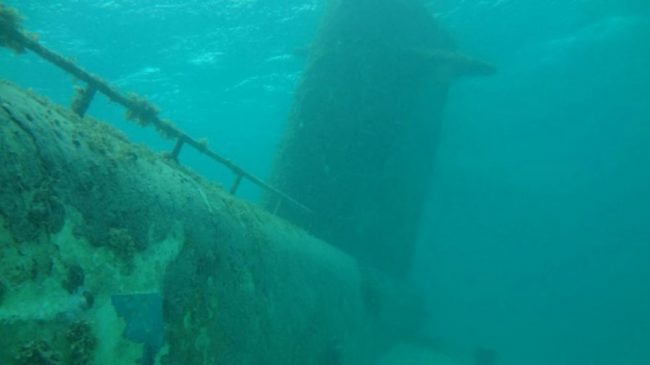
By Fiona Macdonald, 13 July 26, https://www.bbc.co.uk/culture/article/20260709-the-nuclear-submarine-wreck-that-is-a-time-bomb
In 1989, the Komsomolets sank off the Norwegian coast. Four years later, the BBC reported on plans to seal in its torpedoes’ toxic plutonium.
“Komsomolets is a time bomb ticking away at the bottom of the Norwegian Sea.
“And unless something is done about it, and done about it quickly, we’re all in danger.” This is how the risk posed by a sunken Soviet nuclear submarine was described by Russian Greenpeace activist Dimitri Litvinov in a 1993 BBC news report.
Resting one mile (1.6km) deep in the sea near the coast of Norway after a fire caused it to sink four years earlier, the Komsomolets had prompted international concern. Two nuclear-tipped torpedoes inside were corroding, risking the release of 9lb (4kg) of plutonium into the Norwegian Sea.
State-of-the-art Soviet technology went into the design of the Komsomolets, which was unique for the depths it could reach. It was expected by Nato to be the first in a class of large attack submarines, but no further vessels of its kind were built. According to a 1994 BBC Horizon documentary, “The Komsomolets was to be the Soviet Union’s secret invincible weapon, the only submarine in the world able to cruise and launch nuclear missiles from 1,000m [0.62 miles] deep, twice the depth at which Western submarines can operate. Today, the Komsomolets is a technical and scientific disaster.”
When the fire broke out on 7 April 1989, the crew managed to bring the submarine up to the surface – but it sank after five hours afloat, killing 42 of the 69 crew members. As it went down, an escape pod shot five trapped seamen to the surface, with just one man able to climb out before it filled with water.
As the Komsomolets hit the bottom, near the Norwegian coast, an explosion ripped open the submarine’s titanium pressure hull and brought seawater into contact with the nuclear torpedoes. A research mission by Russian oceanographers found that parts of the submarine’s hull had “burst and crumbled from the explosion, like glass”.
After the disaster, scientists were divided over what to do. Russian scientist Igor Spassky of the Rubin Institute, which designed the Komsomolets, told the BBC’s Ben Brown in 1993 that it was not a catastrophic situation – although he did want the submarine to be raised out of the sea. “Within a decade, the two nuclear warheads on the ship will be fully corroded by an electrochemical reaction involving salt water… and the highly toxic plutonium will escape from the damaged torpedoes and into the environment,” he told the US Naval Institute.
“According to environmentalists,” said Brown in his BBC report, “if that happens, the sailors who died here would not be the only victims of the Komsomolets. The lives of many more people, they say, would be at risk, because the rich fishing grounds here would then be subject to horrific contamination.” Yet a report released in 1993 by an international team of scientists concluded that the submarine was unlikely to contaminate fisheries.
Despite conflicting views on the dangers posed, efforts were made to mitigate potential contamination. Deep-sea engineering operations between 1995 and 1996 sealed hull fractures and torpedo tubes to contain radioactive material. The work finished 30 years ago, in July 1996. But investigations by the Norwegian government have since revealed that the submarine is still leaking – and the sealant was only expected to last 30 years.An indefinite potential hazard
A report published in March 2026 found that while the torpedoes remain sealed, the reactor is degrading, periodically releasing visible plumes of radioactive material into the sea. The team from the Norwegian Radiation and Nuclear Safety Authority (DSA) said that the leak is not constant but occurs in sporadic bursts from specific locations along the hull, with a “cloud” seeping out of a ventilation duct.
They don’t believe the current levels are harmful, however. “Radioactive releases from the reactor… have had little impact on the surrounding marine environment,” says Ingar Amundsen, acting director of the DSA’s Department for International Nuclear Safety and Security.
Yet that could change – with both the submarine’s nuclear reactor and nuclear-armed torpedoes posing threats, according to Hans Kristensen, director of the Nuclear Information Project at the Federation of American Scientists. Corrosion of the submarine over time could impact current radiation levels, he tells the BBC. “That depends on other factors such as the oxygen level of the seawater around and inside the submarine wreckage, and the condition of the sealant.”
He also points to changing currents as a factor influencing how quickly radioactive materials might be released from the wreckage and potentially enter the food chain via bottom feeders and fish. “The fact that the submarine has already been sealed once is an official acknowledgement of that risk,” Kristensen adds.
“Nuclear fuel is in direct contact with seawater and deteriorating,” says Amundsen. “Further work should be carried out to understand the mechanisms behind the releases, the corrosion processes taking place, and their implications for further releases.” But that isn’t going to happen any time soon. “The depth of the submarine, close to 1,700m, makes it difficult to implement any mitigation actions, and we are not aware of any such plans for the moment.”
Kristensen argues that more should be done. “At the minimum, a new expedition should be carried out to determine the current condition. With a half-life of 24,000 years, warhead plutonium will remain a potential hazard indefinitely by human standards.”
Walt Zlotow -All hail Marco Rubio, Potentate of Venezuela.
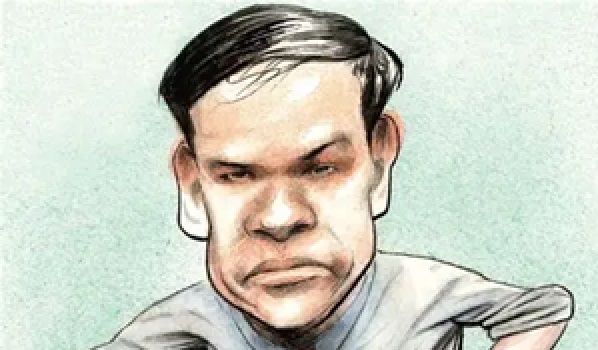
Rubio’s received over a cool million from the Israel Lobby to support Israel’s genocide of Palestinians in Gaza and promote Trump’s deranged, lost war on Iran on behalf of Israel that may tank the world economy by its shutting down the Strait of Hormuz.
15 July 26, Walt Zlotow West Suburban Peace Coalition Glen Ellyn IL
As Secretary of State, Marco Rubio is charged with using wise, disciplined diplomacy to promote peace thruout the world. As Senator for 14 years Rubio did the opposite, auditioning for Secretary of State by supporting every murderous US foreign policy misadventure that killed hundreds of thousands with bombs and economic sanctions.
A child of Cuban immigrants, Rubio championed the cruel, inhumane Cuban embargo that had been degrading life for his fellow Cubans immediately upon his election to the Senate in 2010. Now as Secretary of State he relishes imposing the oil embargo increasing that destruction. All the Cuban people have to do to get gas to drive to the hospital for life saving medical care is overthrow their government Rubio wants overthrown.
He supported the overthrow of Libyan strongman Muammar Gaddafi that turned Libya into a failed state and destabilized large parts of Africa for years, maybe decades to come.
Rubio was all in for the US proxy war against Russia using Ukraine as a Trojan horse to do all the dying while the US squandered $175 billion sending Ukraine to the scrapheap of nations in another lost US war.
Rubio’s received over a cool million from the Israel Lobby to support Israel’s genocide of Palestinians in Gaza and promote Trump’s deranged, lost war on Iran on behalf of Israel that may tank the world economy by its shutting down the Strait of Hormuz.
Rubio’s official title Secretary of State does not do justice to all this murder and mayhem in which he engages. Rubio likely is more comfortable in is unofficial title of Potentate of Venezuela. He was the driving force behind the January 3 criminal US attack on Venezuela that killed over one hundred in snatching Venezuelan President Nicholas Maduro and his wife to face trial in America on trumped up drug charges.
With Trump preoccupied seeking an exit from his failed Iran war, Rubio was tasked with running Venezuela from his Washington D.C. office. He gives marching orders to now US puppet Venezuelan ruler Delcy Rodriquez on Venezuelan finances, distribution of its natural resources; virtually all governmental matters. That’s a cool portfolio never approached by any of Rubio’s 72 Secretary of State predecessors. Why does Rodriguez put up with Potentate Rubio edicts? She doesn’t want to end up in a jail cell next to the ill-fated Maduros.
As Secretary of State Rubio Acts…and people die. As Potentate of Venezuela Rubio barks orders…and puppet ruler Delcy Rodriquez responds…”Yes, your majesty.”
What ceasefire? People still being killed and Gaza still under siege


by Cathy Peters | Jul 11, 2026 , https://michaelwest.com.au/what-ceasefire-gaza-still-under-siege/
As Jillian Segal denied the undeniable at the Bondi Royal Commission this week, not much is changing in Gaza, and Trump’s Board of Peace stands by idly. Cathy Peters with the latest.
In a move that’s been largely unreported here, Hamas announced earlier this week that it would dissolve its governing Emergency Committee with the resignation of its acting leader.
This move has been recognised as an attempt to hasten the transfer of administrative authority to the Trump-appointed Board of Peace’s National Committee for the Management of Gaza (NCAG), a body of Palestinian technocrats, assembled and waiting in Cairo to manage public administration, security, recovery and transition throughout the Gaza Strip as part of the agreed ceasefire plan.
However, despite being established in January this year, the NCAG has not yet been given access to enter Gaza by the Board of Peace or Israel.
Trump’s controversial Board of Peace predictably dismissed Hamas’ move, stating that the NCAG is not yet in a position to take on this role while Hamas retains control of weapons. Hamas maintains that while Israel is still killing Palestinians, it will not disarm.
Nine months since the Gaza ceasefire and Trump’s 20-point peace plan of October 2025, conditions throughout the Strip have remained unlivable and deadly for Palestinians, with more than 1000 killed by Israeli forces and more than 3,500 injured.
“Parents stay awake all night in their tents to stop rats feeding on their children”
The amount of humanitarian aid is far short of what is required, and there is a trickle of medical evacuations despite some 16,500 Palestinians needing urgent medical transfer out of Gaza.
A Board of inaction
The UN Security Council supported the establishment of the Board of Peace in November last year, noting that it would be temporary and transitional, although Trump subsequently declared it would address other world conflicts beyond Gaza.
The composition of the Board of Peace Executive and the Gaza Executive Board includes a number of Trump’s leadership team, plus other Republican operatives, wealthy U.S.businessmen and real estate magnates, as well as Tony Blair.
Donald Trump – Chairman for life
Marco Rubio – U.S. Secretary of State
Jared Kushner – U.S. presidential advisor and son-in-law
Steve Witkoff – U.S. Special Envoy to the Middle East
Tony Blair – Former Prime Minister of the United Kingdom
Marc Rowan – CEO of Apollo Global Management
Ajay Banga – President of the World Bank Group
Qatar and the UAE and more Republican government appointees. Susie Wiles, White House Chief of Staff and former Trump campaign adviser. and Robert Gabriel, U.S. Deputy National Security Advisor.
According to the UN Security Council Resolution 2803, this body has UN support to ‘set the framework and coordinate funding for the redevelopment of Gaza’ until the Palestinian Authority has ‘satisfactorily reformed’. It also authorised the Board to deploy a temporary International Stabilisation Force in Gaza; however, this has not occurred.
Israel has moved some of the anti-Hamas Palestinian militias it’s been arming and funding for three years now into the area it has occupied behind the yellow line. These various militias, led by factional gangs, drug lords and criminals, pose additional threats to Hamas disarming and the transition of power to a Palestinian-led reconstruction committee and the ultimate withdrawal of the IDF.
Yellow and orange lines
The Israeli-defined ‘yellow line ’, according to Israel’s legal NGO Gisha, pushes more than two million people into less than half of the Strip’s territory, exacerbating unbearable overcrowding that is harming public health, including outbreaks of disease and infestation of rats and other pests.
Israel’s seizure of such vast areas also prevents Gaza residents from returning to their homes and lands. Most of Gaza’s agricultural lands lie east of the Yellow Line, meaning they are within areas controlled by Israel. Continued denial of access for farmers to their lands prevents the rehabilitation of vital food sources.
From March 2025, Israel instituted the ‘orange’ line, a line that delineates almost 48% of Gaza’s land mass where any international organisations are prohibited from moving with prior coordination with Israeli authorities. Gisha reports that this orange line is now a new border that has expanded the area that Israel now directly controls.
While negotiations have stalled for 9 months on the initial implementation of the ceasefire agreement, the IDF, following on from Netanyahu’s call in May, has now occupied almost 70% of Gaza, with the yellow cement perimeter markers defining an ever-shrinking area where 2.1 million war-wounded and dispossessed Palestinians are helplessly surviving.
Remote-controlled machine guns
Everyone in Gaza is constantly monitored by drones, and now occupying the eastern perimeter of this dystopian landscape are 23 massive military cranes equipped with remote-controlled machine guns and high-tech surveillance cameras inside the Israeli IDF-defined yellow line. Gaza journalist Tamar Nahed posted this description of Israel’s latest killing apparatus,
“These cranes have turned the entire city into an open field. The latest military technologies are directed at civilians. We have become an open testing ground for their new weapons. The horror is not just in the sound… it is the constant feeling of being an exposed target at all times.”
In the first week of July, the Board of Peace declared that there was no role for the United Nations Relief and Works Agency for Palestine Refugees (UNRWA) in Gaza, which is a continuation of the Israeli ban on this aid organisation, which has supported Palestinians with essential humanitarian and educational aid in Gaza since 1948.
This announcement negates the Charter of the United Nations, international law principles and fundamental human rights standards.
Shelters or camps?
Despite the Board’s apparent refusal to allow the Palestinian committee of bureaucrats (NCAG) into Gaza, the Israeli news outlet Israel Hayom just reported on plans aimed at relocating Palestinian residents into barbed wire fenced designated areas. This will allow the IDF to ‘deepen its grip on areas outside of the yellow line’.
“Surviving Palestinians will be herded into fenced “humanitarian shelters” policed by foreign forces,” as reported by Israel Hayom on July 2.
Images of a camp that’s been described as a concentration camp have emerged in Tel Al-Sultan, an area near Rafah where a pilot project of ‘humanitarian shelters’ will be established. Civilians will be channelled into Tel Al-Sultan, which was a densely populated area of Rafah from which hundreds of thousands of Palestinians were ordered to flee in April last year.
This image of stark, freshly flattened land surrounded by barbed wire fences and covered with masses of metal box shelters and no evidence of any permanent cement structures (as directed by Israel) appears to be a horrific precursor to
“a very grim future for Palestinians in Gaza.“
It recalls Israel Defence Minister Katz’s plan of a year ago of a ‘humanitarian city’ on the ruins of Rafah, where the goal was to screen people before they were allowed to enter to ensure they were not Hamas and then refuse any exits except to third countries.
Legal immunity
The Board of Peace convened in Cyprus at the end of June for 3 days to “reset” after “the Iran war has completely shifted the attention in the last several months,” according to an official source. It sought to address the funding shortfalls, logistical delays and security challenges.
One of the more controversial draft resolutions was the Board’s plan to grant legal immunity to its members, contractors, and security forces; therefore
“shielding the whole enterprise from potential legal proceedings”.
As reported widely, human rights lawyers are highly critical of this proposal, including Palestinian American lawyer and academic, Noura Erakat, “They are basically saying there’s no external oversight, including applicable international law regarding occupation. It’s creating a legal system unto itself.”
At the same time, the IDF has reportedly called for fighting to resume as senior officers in the IDF claim that Hamas’ military wing is rebuilding. Hamas has maintained that it will only disarm under the auspices of the Palestinian NCAG and when Phase 1 of the ceasefire agreement is achieved, which includes the withdrawal of Israeli forces to agreed positions, full implementation of humanitarian measures and a complete end to Israel’s military attacks.
The nightmare on the ground in Gaza for Palestinians continues. The machinations of Trump’s Board of Peace appear to be
“stymying any chance for genuine reconstruction of Gaza“
led by Palestinians for Palestinians. The available evidence at this point is that the 1000-day-plus Israeli genocide in Gaza continues apace behind the veneer of Trump’s ‘peace’ plan and the continuing indifference of world powers.
Cathy Peters
Cathy Peters is a former ABC RN producer/executive producer and Greens councillor on the former Marrickville Council. She also worked for a state Greens MP and is a long-time advocate for Palestinian rights. In 2014, she co-founded PSNA / BDS Australia. She has Jewish heritage, has travelled and volunteered in the Occupied Palestinian Territories.
France Cuts 6.4 GW of Nuclear Power as Heatwave Grips the Country


By Michael Kern – Jul 13, 2026, https://oilprice.com/Latest-Energy-News/World-News/France-Cuts-64-GW-of-Nuclear-Power-as-Heatwave-Grips-the-Country.html
France’s nuclear power generation was slashed by 6.4 gigawatts (GW) on Monday amid a prolonged and intense heatwave that hiked river temperatures and limited the ability of the power plants to use the water to cool reactors.
As many as eight reactors in France, which is Europe’s leader in nuclear power generation, were forced to curtail power output, according to data from the plants’ operator EDF and grid operator RTE cited by Reuters.
The 6.4 GW of curtailed power output was equivalent to 14% of France’s overall power demand as of Monday morning.
The reactors where output has been limited include Saint Alban 1 and 2, reactors 3, 4, and 5 at Bugey, Golfech 2, and Blayais 1 and 3.
The Golfech 2 and Bugey 3 reactors were taken fully offline, while the other six were operating at reduced rates as of Monday morning.
This is not the first time France has had to curb output at reactors and limit the nuclear power production, due to high summer temperatures.
France’s nuclear power generation accounts for around 70% of its electricity mix, and when its reactors are fully operational, it is a net exporter of electricity to other European countries.
Despite the curbs of nuclear generation during the current heatwave, data from RTE suggests that France would remain a net exporter with over 10 GW of power exported to France’s neighboring countries on Monday.
The hydropower generation would also be a concern amid the heatwave that has lasted a least a week and is expected to continue at least until Wednesday this week.
With temperatures topping 40 degrees Celsius (104 F) for days, red alerts have been issued throughout France amid the heatwave, and thousands of people have died of heat-related conditions since late June, when the record-breaking extreme summer temperatures started to disrupt life. Even the most famous and prestigious cycling event, the Tour de France, held a shortened stage on Sunday for the first time ever, due to the extreme heat.
Europe is Teetering on the Brink.

The NATO summit sent a message that no one wants to hear. Europe is openly declaring war on Russia—and it’s doing so with President Trump’s full support.
Peter Hanseler, Forum Geopolitica Mon 13 Jul 2026
Two Fires That Could Escalate Into a Storm
World War I began on July 28, 1914—112 years later, the scene looks much the same, because it wouldn’t take much for the situation to escalate fully. Today, there are two centers of conflict that have the potential to plunge the entire world into a global conflict.
When it comes to Iran, “peacemaker” Trump is breaking the MOU, just as we expected, and is attacking Iran once again—nota bene—during the largest funeral the world has ever seen. Iran has responded militarily, but with restraint. Some link this to the funeral ceremonies. More likely, however, is the implementation of a strategy to bring the West to its knees economically by blockading the Strait of Hormuz. The Middle East and Europe are in a state of limbo—but for how much longer?
The Collective West claims that it wants to—and is capable of—forcing Russia to make peace through war. To the surprise of many observers—including those in Russia—the Russian army has not (yet) struck back against Europe.
In this article, we discuss the situation in Europe.
Trump Is More Aggressive Than Biden
President Biden was considered a warmonger and a puppet of the deep state. Consequently, the US and Europe have been supplying Ukraine with weapons since the start of Russia’s special military operation, even though Joe Biden himself initially expressed concerns that this behavior by the West could lead to World War III.
“The idea that we’re going to send in offensive equipment and have planes and tanks and trains going in with American pilots and American crews… that’s called ‘World War III.'”
President Joe Biden, 11 March 2022
This led many commentators—including us—to favor Donald Trump: a man who promised peace and pledged not to start any new wars, and who boasted he would end the war in Ukraine within 24 hours. Yet now, at the NATO summit in Ankara, Trump has endorsed Ukrainian attacks deep inside Russia.
“Trump said he supported Ukraine striking targets deep inside Russian territory, calling it an escalation that could help end the war.”
The Wallstreet Journal, 8 July 2026
Europe and the US in Open War Against Russia
Almost all of the weapons used by Ukraine in this war are supplied by Europe and the US. However, many of them cannot be deployed without NATO personnel in Ukraine or at one of NATO’s bases, and cannot find their targets in Russia without satellite support from the US. It is therefore misleading to speak of a conflict between Ukraine and Russia here: Europe, with the active support of the US, is waging war against Russia. While this took place covertly until recently, the aggressors are now proudly flaunting their direct involvement.
So far, Russia has not responded militarily to Europe and, until recently, had relied on diplomacy. But times have changed, even though Russia continues to emphasize that it is not opposed to a diplomatic solution that takes all sides into account. Roger Köppel, publisher, editor-in-chief, and owner of the Swiss magazine Weltwoche, learned this firsthand. During an interview with Margarita Simonyan, editor-in-chief of RT, he tried not once, not twice, but three times to elicit a statement from the influential journalist to the effect that Russia also bears responsibility for the situation in Ukraine. Each time, she rejected this request in no uncertain terms, but Köppel refused to understand. Finally, Simonjan diplomatically but unequivocally put the Swiss journalist in his place with the following words: “I feel like a blind man is talking to a deaf man here.”……………………………………………
Friedrich Merz is Pushing for War
As a German, Friedrich Merz apparently feels compelled to stir up painful memories among the Russians and reopen old wounds that, over the past 80 years, have been steadily healing thanks to considerable effort on both sides. Using forceful and blunt language, he is trying to talk his way into a German victory before the Russians have even responded militarily………………………………………………………………………………………………………………………………………………………………………………………………………………….. https://forumgeopolitica.com/article/europe-is-teetering-on-the-brink
Insuring Small Modular Nuclear Reactors.
Deploying the next generation of nuclear technologies is likely to present a number of novel challenges, notably securing appropriate insurance coverage for both property and liability. Without early engagement developers could face significant obstacles to commercial roll-out.
Nuclear Engineering International, By Ron Rispoli, Senior Vice President, Energy Group, Stephens Insurance, LLCJuly 9, 2026
s small modular reactors (SMRs) move from concept to commercialisation, one of the least visible yet most critical enablers of deployment is insurance. Property and liability coverage for nuclear are not only a financial safeguard, they are also a regulatory requirement. However, nuclear insurance is highly specialised, capacity constrained, and dependent on early engagement with underwriters.
Insurance requirements for SMRs and microreactors may vary based on reactor size, design, fuel forms, coolant types, and power levels. Existing regulatory frameworks establish baseline liability and financial protection requirements, but these were developed for large, traditional light water reactors. As a result, regulators and insurers may apply a more risk-informed approach when determining appropriate insurance levels for smaller or non-traditional designs.
The US liability insurance framework
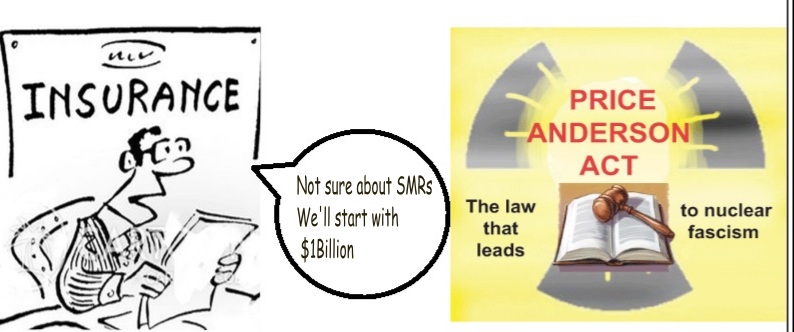
In the United States, nuclear liability insurance is governed by the Price-Anderson Act, a federal programme designed to ensure compensation to the public following a nuclear incident. The Act establishes a two-tier structure………
In addition to the Price-Anderson Act, Nuclear Regulatory Commission (NRC) regulations in 10 CFR Part 140 establish detailed financial protection requirements based on reactor size and operating status. These regulations differentiate between nuclear power plants with a rated capacity of 100 MWe or greater and those with lower electrical output, a distinction that is particularly relevant for small modular reactors (SMRs) and microreactors. For smaller units, required liability coverage may be reduced or determined on a case-specific basis, reflecting their lower potential risk profile. The regulations also include provisions for multiple reactors located at a single site. This allows the NRC to evaluate financial protection requirements on a site-specific basis. This introduces additional flexibility for SMR deployments but also creates complexity in structuring appropriate liability coverage for multi-unit configurations.
…..In the United States, reactor licensees are generally required to maintain approximately $1.06bn in onsite property insurance per reactor site. ….
Globally, nuclear liability is governed by a set of international conventions, including the Convention on Supplementary Compensation for Nuclear Damage (CSC), the Paris Convention and Brussels Supplementary Convention, and the Vienna Convention and Joint Protocol. While implementation varies by jurisdiction, these frameworks share core principles: liability is channelled exclusively to the operator, with liability caps supplemented by public funds.
For SMR developers pursuing international deployment, this creates a jurisdiction-by-jurisdiction insurance strategy that often requires coordination across multiple national insurance regimes…………
A constrained market and specialised brokerage
Existing insurance frameworks were developed for large, traditional reactors, creating added complexity for SMR deployment. Unlike conventional insurance markets, nuclear insurance is provided by a small number of highly specialised pools and mutual insurers. Global underwriting capacity is limited, and participation is tightly controlled.
This dynamic is particularly relevant for SMRs, as developers may pursue multi-unit deployments, novel reactor designs, or non-traditional ownership structures – all of which introduce new risks from an underwriting perspective. In practice, access to insurance capacity – not reactor design – may become a gating factor for deployment. Given the complexity of the nuclear insurance market, engaging a broker with demonstrated experience in nuclear insurance is essential. Nuclear insurance is not transacted in a broad, competitive marketplace; rather, it is concentrated among a small number of insurers each with distinct underwriting requirements and processes…….
Emerging technologies, multi-unit deployment strategies, and evolving regulatory frameworks introduce uncertainties that must be translated into insurable risk. Without specialised expertise, projects may face delays, higher costs, or challenges in securing adequate coverage.
Insurance cannot be treated as an afterthought…..Delayed engagement with insurance markets can expose developers to significant risks, including coverage exclusions, insufficient limits, or, in extreme cases, an inability to secure required insurance. Coverage is not guaranteed to be available in the necessary amount, form, or timeframe. As the SMR market grows, competition for limited insurance capacity is likely to intensify….https://www.neimagazine.com/analysis/smrs-advanced-reactors/insuring-smrs/?cf-view
CALLING THE ODDS ON DOOMSDAY

Jonathon Porritt 14 July 2026, https://jonathonporritt.com/existential-risks-climate-nuclear-ai/
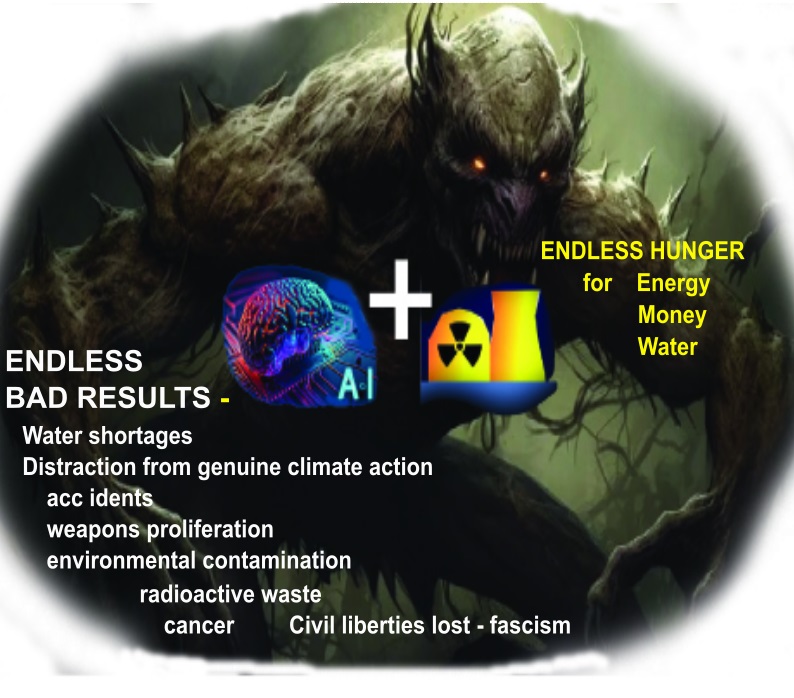
I got roundly ticked off the other day for claiming that the climate crisis was “in a league of its own” when it comes to contemplating causes for the possible extinction of the human race – or, at least, “human civilization”, as we mistakenly refer to the current world order. (‘Existential’ means, in this context, ‘pertaining to existence or the end of existence’).
My reprimand went something like this: “You’re so obsessed with the climate crisis that you’re ignoring equally important threats. Like all-in nuclear warfare. Or AI”.
Well, in my defence, I plead not guilty on ignoring the threat of nuclear war. By contrast, I plead 100%, reprehensibly guilty on the AI charge.
Let me go one by one. Nuclear first.
I remember to this day the talk we were given at school in 1963 about a possible nuclear attack on the UK. This was at the height of the Cold War and shortly after the Cuba missile crisis. It scared the shit out of me.
A few years after that, I joined the Campaign for Nuclear Disarmament and later became obsessed with what are called ‘broken arrows’ – when things go badly wrong in terms of ‘lost’ nuclear warheads, accidents in nuclear facilities, near misses, communication breakdowns and so on. It’s acknowledged that there have been at least 32 of these major incidents — and these are just the ones that we know about!
Every nuclear-armed country will have its own ‘broken arrows’ portfolio. The Nuclear Information Service here in the UK tracks as many of these incidents as it can; back in 2017, its ‘Playing with Fire’ report detailed 127 accidents, near misses and “dangerous occurrences” on UK soil and in its coastal waters since the 1960s. And we know that thousands of cyber-attacks are launched against the Ministry of Defence and its contractors every day. Hair-raising really doesn’t cut it!
So, I guess I’ve been living in a state of measured, back-of-mind nuclear dread for a long time — with the front of my mind increasingly taken up with dread at the thought of the climate apocalypse bearing down on us! But however bad that gets, it would be nothing in comparison to an all-out nuclear war.
So, I’m finding it really painful to see how the notion of Mutually Assured Destruction (the crazy idea that lies at the heart of nuclear deterrence theory) is being gradually ‘re-normalised’. Ideas such as ‘tactical nuclear weapons’ or ‘limited nuclear strikes’ (particularly in terms of the war in Ukraine) pop up all over the place, even as the all-important 1970 Treaty on the Non-Proliferation of Nuclear Weapons (NPT) lurks unregarded in the margins of this new nuclear discourse.
The fact that Article Six (of the NPT) enjoins all 191 signatories to the Treaty ‘to pursue nuclear disarmament in good faith’ is studiously ignored. In fact, exactly the opposite is going on. Today’s nine nuclear-armed nations already lay claim to tens of thousands of ‘Hiroshima bomb equivalents’, and yet this is increasingly seen as insufficient.
China is increasing its arsenal of warheads by around 100 every year. Russia is known to be expanding its capabilities in many different areas. President Trump is already committed to prioritising nuclear weapons programmes over other security programmes, based on $25 billion of additional investment in nuclear weapons every year, with an ambition of reaching $2 trillion on total arms expenditure over 30 years — including massive new expenditure on his so-called ‘Golden Dome’ defensive shield — which essentially undermines the rationale behind any nuclear deterrence theory.
Which brings me to AI.
I enter this territory with massive trepidation. Until recently, when asked about it, I burbled on about the massive energy and water footprint of AI, relying on a basic instinct to cover off the rest of it: that anything emerging from and under the total control of the techno-fascists in California just had to be wrong. Simple as that. Follow the money. Track the track records of these evil mind-fuckers.
Such an approach obviously only takes one so far. Which means I’ve recently been doing some rather more serious work on AI, to which I will no doubt return at some point in the future.
However, for the purposes of this little exercise, I’ve come to the conclusion (from an existential risk perspective) that AI is right up there with both the climate crisis and the threat of nuclear warfare.
Ever since I came across AI’s so-called ‘evolution of capability and complexity’, I’ve been sunk deep in the whole reversible/irreversible dynamic: at what point does a rapidly evolving change process cease to be reversible as it ‘tips over’ into a sequence of irreversible effects?
Climate wonks live with that dynamic every waking moment of their working lives: feedback loops; sensitivity calculations; tipping points – 40 years of brilliant climate science has given us an eloquent lexicon of how to avoid the apocalypse. We approach it via ‘average temperature increase’, average concentrations in the atmosphere, potential tipping points for critical ecosystems etc, etc. Tragically, this seems to have had zero impact on our fossil-fuel-addicted political leaders. Suffice to say, it’s not looking good.
So, is there an analogy for AI? Sort of. As AIs evolve from bog-standard LLMs (Large Language Models) to ANI (Artificial Narrow Intelligence) to AGI (Artificial General Intelligence) to ASI (Artificial Superintelligence) to CASI (Conscious Artificial Superintelligence), one is bound to ask: at what point is that forward momentum still reversible?
This was the point at which I discovered the whole wondrous literature about the so-called ‘X risk’ – which, happily, has nothing to do with the world’s first totalitarian trillionaire. I quote from a fascinating article by David Rollo:
“Consider that Geoffrey Hinton (the so-called ‘godfather of AI’) gives a 10 to 50% chance that AI would result in extinction – the ‘ X risk. Yoshua Bengio, the most cited AI researcher and most cited living scientist, gives an X risk of 20% .
Eliezer Yudkowsky (co-author of the bestseller ‘If Anyone Builds It, Everyone Dies’, a title relating directly to AGI), and Roman Yampolskiy give an X risk of over 95%, while Dario Amodei, CEO of Anthropic, gives an X risk of 10 to 25%”.
Given the single-minded, profit-obsessed drive of the so-called ‘frontier AI companies’ (OpenAI, Anthropic, Google DeepMind and XAI), there would appear to be no political regulatory constraints on them cracking the AGI challenge. Does that turn out to be the not-so-far-off point of irreversibility? On our unstoppable way to the equivalent of all-out nuclear conflagration?
Which makes me think about how things might look in this existential league table – keeping nuclear conflagration in the mix, as it truly deserves to be, even before we start thinking about that deranged, psychopathic narcissist in the White House with his finger on the button.
So, my question for all readers who’ve stuck with my strange apocalyptic speculation so far: where would you locate the point of irreversibility for each of these three domains of existential risk?
And how does that make you feel?
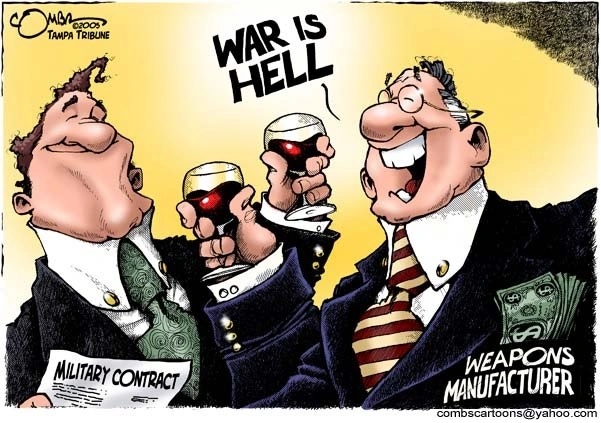
Faslane set for £15bn upgrade to ‘future-proof it for war-fighting’
15th July, By Gregor Young
MORE than £15 billion will be spent transforming Faslane over the next decade, the UK Government has announced.
HMNB Clyde, which houses the UK’s nuclear
submarines, will receive £15.1bn in a move expected to support thousands of
jobs. It is part of the £26bn Project Royal Oak investment programme into
critical UK naval bases which defence minister Luke Pollard said will
increase the “readiness, availability and lethality” of the Royal Navy.
On a visit to Faslane on Tuesday, he said it is the biggest upgrade of the
UK’s naval bases since the end of the Cold War.
The National 14th July 2026,
https://www.thenational.scot/news/26280622.faslane-set-15bn-upgrade-future-proof-war-fighting/
Winfrith decommissioned nuclear site restoration plans
THE restoration of the Winfrith nuclear site to heathland is expected to be
opposed by the neighbouring Innovation Park – which wants to use at least
some of the land to create jobs. A masterplan for the former nuclear site
is currently being proposed by the Nuclear Decommissioning Agency – looking
15-20 years ahead. Its current plans say all of the former nuclear site,
including 21 hectares adjacent to the Innovation Park, would be restored to
natural heathland. Nick Webster, head of growth and economic regeneration
at Dorset Council, told an Innovation Park shareholders committee on
Tuesday, that the heathland restoration proposal was “an issue” for the
Park, although a final decision was still some way off, with an estimated
8-10 years likely for the remaining nuclear site decommissioning, with
restoration to heathland, if that happened, to follow on. He said the
masterplan was currently open for comment and Dorset Council would have to
consider its views over the heathland restoration proposal, possibly making
the case that not all the site be restored to heathland.
Dorset Echo 15th July 2026 https://www.dorsetecho.co.uk/news/26279161.winfrith-decommissioned-nuclear-site-restoration-plans/
Cumbrian environmental groups quit GDF nuclear waste talks
ENVIRONMENTAL groups have left a partnership designed to discuss the possibility of hosting a nuclear waste disposal facility in South Copeland.
This decision reflects a
growing opposition to the project and a desire for local elected
representatives to no longer be associated with the discredited project.
The partnership’s internal conflict and increasing community opposition
have led to its withdrawal from the discussions.
Carlisle News & Star 15th July 2026,
https://www.newsandstar.co.uk/news/26270672.cumbrian-environmental-groups-quit-gdf-nuclear-waste-talks/
1 This Month



26 September – International Day for the Total Elimination of Nuclear Weapons


PLEASE OPPOSE HR 8255 AND S.3639 – bills would accelerate satellite deployment, with no environmental review or safeguards – https://ncstd5li.quorum.us/campaign/169331/
To see nuclear-related stories in greater depth and intensity – go to https://nuclearinformation.wordpress.com
-
Archives
- September 2026 (206)
- August 2026 (330)
- July 2026 (355)
- June 2026 (287)
- May 2026 (306)
- April 2026 (356)
- March 2026 (251)
- February 2026 (267)
- January 2026 (308)
- December 2025 (358)
- November 2025 (359)
- October 2025 (375)
-
Categories
- 1
- 1 NUCLEAR ISSUES
- business and costs
- climate change
- culture and arts
- ENERGY
- environment
- health
- history
- indigenous issues
- Legal
- marketing of nuclear
- media
- opposition to nuclear
- PERSONAL STORIES
- politics
- politics international
- Religion and ethics
- safety
- secrets,lies and civil liberties
- spinbuster
- technology
- Uranium
- wastes
- weapons and war
- Women
- 2 WORLD
- ACTION
- AFRICA
- Atrocities
- AUSTRALIA
- Christina's notes
- Christina's themes
- culture and arts
- Events
- Fuk 2022
- Fuk 2023
- Fukushima 2017
- Fukushima 2018
- fukushima 2019
- Fukushima 2020
- Fukushima 2021
- general
- global warming
- Humour (God we need it)
- Nuclear
- RARE EARTHS
- Reference
- resources – print
- Resources -audiovicual
- Weekly Newsletter
- World
- World Nuclear
- YouTube
-
RSS
Entries RSS
Comments RSS
 nuclear-news