What is the Saudi nuclear deal really about?

What is clearly in Trump’s Saudi deal is approval to provide Westinghouse AP1000 reactors to Saudi Arabia, a deal worth tens of billions of dollars to the company.
But all of the fanfare about how great this deal is for American business appeared to ignore the fact that Westinghouse is no longer actually an American company.
Today, Westinghouse is owned by two Canadian companies, Cameco and Brookfield Asset Management, a US-based company that is a subsidiary of Brookfield Corporation (formerly Brookfield Asset Management Inc.), a Canadian multinational investment company. Needless to say, the road from there leads straight back to the White House.
by beyondnuclearinternational, https://beyondnuclearinternational.org/2026/09/26/what-is-the-saudi-nuclear-deal-really-about/
Is it actually a boon for US companies, or another scheme to enrich Trump, his family and cabinet colleagues, asks Linda Pentz Gunter
On August 25, Trump sent his nuclear deal with Saudi Arabia to the US Senate for consideration. This started a 90-day clock during which time the Senate could choose to accept or reject the proposal.
But what exactly was in it? The usual Trump White House opacity — which often includes word not matching deed — prompted a letter on September 16 from 18 US senators, including two Republicans and one independent, asking for more details.
”Access to the full text is required for the Senate and the public to have a clear understanding of the commitments being made on the nation’s behalf and those being made by Saudi Arabia to the United States,” said the letter, led by Senators Ed Markey (D-MA) and Jeff Merkley (D-OR) and addressed to Secretary of State Marco Rubio and Energy Secretary Chris Wright
By September 25, six of the Democrats who had signed the first letter wrote again to Rubio and Wright.
“We are gravely disappointed to see the Trump Administration enter a deal to provide nuclear technology to Saudi Arabia that fails the Gold Standard nonproliferation test. The Gold Standard has longstanding bipartisan support and reflects internationally recognized best practices. By abandoning it the agreement would allow Riyadh to acquire the means to potentially produce weapons-grade nuclear materials without the strictest nonproliferation safeguards the U.S. has long championed as a condition of such cooperation.
“The U.S.-Saudi nuclear deal calls for a study lasting up to two years on uranium enrichment in Saudi Arabia. After that, the United States could build a uranium enrichment plant on Saudi soil. The United States has never directly transferred an enrichment plant to a non-nuclear-weapon state, let alone one whose leaders have threatened to pursue nuclear weapons. The recklessness of this arrangement underscores the importance of utilizing the most stringent safeguards and protections, as reflected by the Gold Standard.”
The reference to Saudi leaders threatening to pursue nuclear weapons refers to a statement made by Saudi Crown Prince Mohammed bin Salman during a March 15, 2018 interview with CBS News, during which he stated: “Saudi Arabia does not want to acquire any nuclear bomb, but without a doubt, if Iran developed a nuclear bomb, we will follow suit as soon as possible.”
In theory, the Saudi nuclear deal is what is known as a “123” agreement, a legally binding 30-year bilateral pact required by Section 123 of the U.S. Atomic Energy Act of 1954 that establishes the framework for significant civil nuclear cooperation between the United States and another nation.
What is clearly in Trump’s Saudi deal is approval to provide Westinghouse AP1000 reactors to Saudi Arabia, a deal worth tens of billions of dollars to the company.
Westinghouse is most notorious for going bankrupt and coming close to handing the same fate to its parent company at the time, Toshiba, while attempting to build four AP 1000s in South Carolina and Georgia. Construction began in 2013 but the South Carolina reactors were abandoned mid-constriction and the Georgia pair arrived seven years late and cost $36 billion, well above the original $14 billion estimate.
What is at issue, and which disturbed the senators, is whether the deal would allow for uranium enrichment within Saudi Arabia. Wright was quick to dismiss that concern at a press conference held the same day the deal was sent to the Hill.
“There’s no reason to bring uranium enrichment to Saudi Arabia,” Wright said at the press conference, which was announcing the equally reckless ATLAS project that would put nuclear reactors on commercial shipping as well as develop floating reactors. But, added Wright about the Saudi Westinghouse deal,“They don’t even have a nuclear reactor yet. So I would say that’s something many years down the road.”
The Westinghouse reactors are also likely to be “many years down the road” given the company’s track record. But all of the fanfare about how great this deal is for American business appeared to ignore the fact that Westinghouse is no longer actually an American company.
Today, Westinghouse is owned by two Canadian companies, Cameco and Brookfield Asset Management, a US-based company that is a subsidiary of Brookfield Corporation (formerly Brookfield Asset Management Inc.), a Canadian multinational investment company. Needless to say, the road from there leads straight back to the White House.
As the New York Times reported in July, Brookfield Asset Management “is a frequent business partner with Newmark, the real-estate firm run and owned in part by the sons of Commerce Secretary Howard Lutnick.”
Brookfield Asset Management also has connections with White House ‘senior envoy for peace’ and Trump son-in-law, Jared Kushner. In 2018, the Kushner family was struggling to maintain control of a Manhattan luxury property —the somehow appropriately numbered 666 Fifth Avenue tower block. It was Brookfield Asset Management that came to the rescue. As the New York Times revealed then, “The deal will be a boon to the Kushners, who are struggling to recoup their investments in their flagship building.”
Of further concern in the deal is that Saudi Arabia is not required to adopt the IAEA Additional Protocol. This is significant because without that extra power for the International Atomic Energy Agency to check Saudi Arabia’s nuclear sites for covert nuclear weapons activities, the pathway is of course a lot easier to do precisely that.
It’s also significant because Saudi Arabia has already talked about developing a full uranium fuel cycle, including uranium mining as well as making its own reactor fuel. Verifications and inspections are important to ensure that any country with a civil nuclear program is not developing nuclear weapons.
In addition to the genuine proliferation concerns surrounding the Saudi nuclear deal, it is also patently obvious that if Saudi Arabia really wanted to replace the oil it is currently burning with an alternative, less carbon-emitting energy source, it has absolutely no need to choose nuclear power, the most expensive, slowest and most dangerous energy source with an unsolved radioactive waste problem.
The kingdom is more than 90 percent desert, making solar and potentially also wind the obvious choice as an energy replacement for oil, which the Saudis claim they want to burn less of (or, more realistically, export more of abroad.) In fact, the Saudis already know this, given they have a 600-megawatt solar project that is currently supplying electricity at 1.04 US cents per kilowatt-hour, a world record for the lowest contracted price for solar power generation.
As Massachusetts Senator Ed Markey, then a Congressman, asked pointedly of then Energy Secretary Samuel Bodman back in 2008 during a hearing before the House Select Committee on Energy iIndependence, “But aren’t you suspicious that the Saudis don’t want a solar agreement? Saudi Arabia is the Saudi Arabia of solar. There it is. It sits there as a desert with sun 12 months a year, blistering hot. Why wouldn’t this administration be suspicious that they are asking for nuclear rather than solar power exchange in order to meet their long-term energy needs?”
Of course, it’s not clear whether, even if the deal is approved by Congress, the Saudis are actually going to sign off. Trump has made it a condition that the Saudis sign on to the Abraham Accords, which force them to normalize relations with Israel. Saudi Arabia has flatly rejected that demand so far, absent a viable path to an independent Palestinian state.
3 – 10 October -Keep Space for Peace Week

Every October the GN calls for global actions to support “Keep Space for Peace Week” https://space4peace.org/keep-space-for-peace-week/
In 1999 the United Nations General Assembly declared that October 4-10 every year would be designated as ‘World Space Week’ to “celebrate the contributions of space science and technology to the betterment of the human condition” – we ask people to recognise this as a time to Keep Space for Peace
Each year the GN provides a poster for use to highlight the Week of Actions and posts a list of the actions organised by our members.
The Global Network’s annual Keep Space for Peace Week comes at a time when the Trump administration is moving to spend trillions of ‘unavailable dollars’ on his new pet project – Golden Dome. We are now facing the latest twist in the big-tech agenda for war in and from space.
Pistol Pete Hegseth has declared that the US must dominate space and has no ‘interest in orbital equity or orbital parity’. These words signal a dangerous declaration of coming space wars against nations like China, Russia, India and more.
Of course this will cost us the Earth in more ways than one.
The development, construction and implementation of the proposed systems would generate thousands of tons of CO2 and accelerate climate change. The rocket launches involved would also degrade the ozone layer and pollute the ground and upper atmosphere.
In addition, the American Physical Society has estimated that the cost of Golden Dome would be trillions. Trump has said he wants to add Canada to the coverage area and even hinted adding Europe. Each addition adds massive costs to the proposed project which only makes the aerospace industry happy.
Trump recently stated that the Congress must vote to turn over Medicare and Medicaid coverage to the states because the feds can’t afford these vital programs due to our current wars. States don’t have the funds either!
This brutal austerity agenda includes privatising the Veterans Administration, Post Office, Social Security and selling off national parks and forests.
We urge you to help the Global Network during Space Week to illuminate these serious dangers and contradictions of the Golden Dome and the broader militarization and nuclearization of space.
One good resource is our library of videos on nearly every aspect of the space issue. It would help to share some of these between now and October 3-10.
Please spread the news, you can also download and use this years poster:
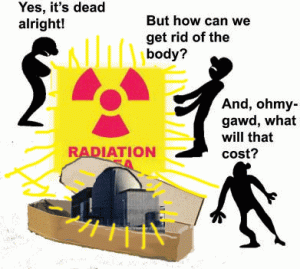
Nuclear Restoration Services taking over control of Hinkley B station
By John Thorne, Tuesday 29th September 2026, https://www.wsfp.co.uk/news/hinkley-point-b-nuclear-power-station-decommissioning-next-stage-phase-nuclear-restoration-service-transfer-from-edf-957891
THE next chapter is being opened in Hinkley Point B nuclear power station’s long history as its decommissioning transfer moves a step closer.
Key regulatory approvals have been put in place for the site’s transfer from EDF to Nuclear Restoration Services (NRS) on Thursday (October 1).
The Office for Nuclear Regulation granted a site licence to NRS, while the Environment Agency issued an environmental permit.
It marks a major milestone for the site, which has been part of the local community for decades and is now moving toward the next phase of safe, secure, and sustainable decommissioning.
The U.S. Determination to Achieve Full Spectrum Dominance is Not In Decline
Margaret Kimberley, BAR Executive Editor and Senior Columnist. 23 Sep 2026, https://blackagendareport.com/us-determination-achieve-full-spectrum-dominance-not-decline
The trope of the United States being in a state of decline is a common one, but it should not be accepted without scrutiny. The U.S. faces crises but remains dangerous, powerful, and single-minded in its determination to achieve full-spectrum dominance over the world.
The claim that the United States is in a state of decline is a popular one and is often treated as being an axiomatic truth. The word “decline” is problematic, though. It gives an impression of weakness when the U.S. has the world’s most powerful military and the dollar is still the world’s reserve currency. Its recent actions indicate that while it faces significant crises, the Donald Trump administration and any administration coming after it will continue its wars of aggression and subterfuge, particularly in the absence of an equally strong opposing force.
While the extent of any decline in U.S. power internationally is debatable, the domestic decline is clear and is happening in large part because maintaining power around the world quite literally steals from the public’s needs. The U.S. military budget is now at least $1.5 trillion and dwarfs the military budgets of other countries. If anyone doubts that the figure impacts the lives of millions of people in the U.S., Donald Trump admitted as much himself. “It’s not possible for us to take care of day care, Medicaid, Medicare, all these individual things. They can do it on a state basis. You can’t do it on a federal. We have to take care of one thing: military protection. We have to guard the country.”
Of course, the states cannot pay for these programs, that’s why they were federal programs to begin with. It is not possible to spend that amount of money on the military without impacting the social safety net. Trump’s Big Beautiful Bill cuts billions of dollars from Medicare and Medicaid and will literally jeopardize people’s lives all over the country. The high cost will be borne by the public in a very direct way and is just one indicator of a declining quality of life as wages stagnate and the ruling class remains committed to an austerity-driven race to the bottom and endless precarity.
The assertion that the U.S. is a declining international power is repeated ad nauseam even as it achieves its goals of conquest around the world. The specter of decline is now being evoked due to the failure of the U.S. to win the quick victory it predicted after the joint attack with Israel on the Islamic Republic of Iran, which began on February 28, 2026. The war of aggression was carried out with hubris and was emboldened by the U.S. success in capturing the Venezuelan president and the state of Venezuela in the previous month. The idea that kidnapping a president and his wife and pressuring a weak government into compliance would be akin to defeating a military power like Iran was a choice made out of arrogance and delusional power.
Yet the Iran failure cannot itself be given as proof of decline because it was preceded by a very significant success against Venezuela. Every president from George W. Bush to Trump 2.0 used sanctions and coercion against Venezuela. The first Trump administration attempted to install a president of their choosing, Juan Guaido, in 2019. The failed coup and end of support for Guaido led many anti-imperialists to celebrate perhaps too soon. While anti-imperialists were steadfast in supporting the Venezuelan government, the security state apparatus did not admit defeat and looked for new ways to undermine that nation.
The Trump administration has been particularly successful in the Americas. Turning Venezuela into a vassal state with huge reserves of oil was quite literally a dream come true. Without a military coup, assassination, or invasion, Venezuela fell quickly, and now its oil revenues sit in a U.S. treasury account, and the gold reserves held in London will soon be on their way to the U.S.
The U.S. has in the past year interfered in elections in Honduras, Colombia, Peru and Argentina. Zionists are taking land in the Patagonia region of Chile and Argentina and Cubans are being killed by a siege in cynical hope that they will undo the revolution and turn the country over to Washington and Cuban exiles.
Every U.S. president consolidates the work of his predecessors. Ronald Reagan sought to overthrow the Libyan government with a bombing campaign in 1986, but the deed was finally done under Barack Obama 25 years later in 2011. That awful success led the U.S. and its NATO allies to set their sights on Syria. But it took Obama, Trump, and finally Biden in his last month of office to bring about the fall of the Syrian Arab Republic at the hands of jihadist proxies.
These events should not bring about feelings of pessimism alone. They are history lessons which explain how the U.S. succeeds in bringing down government after government. Even as its military prowess lays waste to the domestic economy and the lives of millions of people, there has so far been no other power willing or able to counteract the U.S.
Russia began supporting the Syrian government, but not until 2015, when it was on the brink of collapse, and Vladimir Putin feared that Russian jihadis who joined that fight might come back home. But Russia made the mistake of agreeing to a kind of ceasefire, and then in 2022 the U.S. used Ukraine (after the Obama administration backed a 2014 coup) as a proxy against Russia. Russia was unable to fight in Ukraine and Syria simultaneously and now one of the jihadists who once had a U.S. bounty on his head is now the president.
But curiously, Russia and China lack the determination to take the fight to the U.S. even when they can. In November 2025, the United Nations Security Council (UNSC) passed Resolution 2803, which legitimized the so-called Board of Peace, which handed control of Gaza to the U.S., an act that actually violated the UN Charter. As two of the five permanent members of the UNSC, either Russia or China, could have vetoed what amounts to a surrender to global fascism, yet both abstained. Neither nation had to spend money, send troops, or risk the lives of their citizens. One of them could have voted no and sent the Board of Peace to the dustbin of history, yet neither of them was willing to do so.
Despite being targets of the U.S., both Russia and China chose a path of least resistance. It is said that Mahmoud Abbas, of the Palestinian Authority, asked them not to veto. But that excuse does not hold water. Abbas is seen as a collaborator and is not respected by Palestinians, whose rights were torn asunder by this agreement to take no action. This lack of determination means that the “decline” of the U.S. may be more wishful thinking than a reality if world powers are willing to go along in hopes of staying off of the menu themselves.
While Iran admirably has staved off destruction at the hands of the U.S. and Israel, it would be a mistake to think it is out of the proverbial woods. The U.S. is now using its influence at the International Atomic Energy Agency (IAEA) to once again make false claims of Iran’s nuclear capabilities. The goal is to continue making a case for war and to perhaps use the nuclear weapons which, unlike Iran, the U.S. and Israel have in abundance.
The JPMorgan Chase bank made headlines recently after admitting they could not predict an end to the war against Iran. JPMorgan predicted that specific breaking points such as the closing of the Strait of Hormuz and rising oil and gas prices would force an end to the conflict, but no such movement is in sight.
That inability to predict is a warning sign that the Trump administration has committed itself to continuing the war against Iran. They are prepared for a dangerous endgame, as Trump said himself in a speech at the United Nations General Assembly.
“I have a big decision to make. Will a deal be made with Iran that lets them rebuild and create a far greater country than it ever was before, maybe one of the greatest in the Middle East or even the world? Or do I annihilate the Islamic Republic and do it quickly, never giving them a chance to kill and destroy people and countries again? “Do I drive them into hell with no chance of survival and no hope of future greatness or generations?”
While the attack on Iran and the closing of the Strait of Hormuz have driven people in the U.S. into yet another inflationary spiral, it is important not to think of a perceived decline. Instead, remember Syria and remember Venezuela. They were taken out by Washington when they appeared to be safe. The U.S. crises created by the pursuit of hegemony must be described that way, and not be diminished by overuse of a popular term. The decline which is spoken of so often may bring about a more ominous future than those who casually use the word are willing to contemplate. The U.S. may as Trump said, be willing to drive the world to hell with no chance of survival. That outcome would be the ultimate decline.
Israeli opposition leaders sign pact to replace Netanyahu

Opposition leaders pledge cooperation despite ideological differences ahead of the vote.
Sakina Fatima Follow on Twitter| 27th September 2026 , https://www.siasat.com/israeli-opposition-leaders-sign-pact-to-replace-netanyahu-3549129/
Yair Lapid, Gadi Eisenkot, Naftali Bennett, Avigdor Lieberman and Yair Golan signed the principles document at Lapid’s home in Tel Aviv on Saturday, September 26
The leaders acknowledged their ideological differences but agreed that forming a new government focused on “repair and rebuilding” was their shared objective.
Under the agreement, none of the leaders, or anyone acting on their behalf, will attack another party in the bloc or its leader until a new government is formed.
They also pledged to cooperate immediately after the election and work to increase voter turnout across different sections of the electorate.
Opposition bloc sets up three joint working groups
The pact requires three joint working groups to be established within 48 hours.
The first will handle voter mobilisation, election-day preparations and measures to safeguard the integrity of the vote.
The second will formulate the basic guidelines for a potential new government. Its agenda includes equal sharing of service obligations, a state commission of inquiry into the October 7, 2023 events, term limits for the prime minister, a constitution and a plan for the government’s first 100 days.
The third group will coordinate communications between the parties and work to counter fake news and smear campaigns.
Prime minister candidate decision deferred
The parties have not selected a joint candidate for prime minister. Disagreements over the issue have emerged particularly among Eisenkot, Bennett and Lieberman.
The agreement instead focuses on cooperation before and immediately after the election, leaving the leadership question to be addressed after the vote.
Benny Gantz’s Blue and White party was not part of the meeting.
Netanyahu responds
Netanyahu criticised the agreement in a post on X, claiming that Eisenkot would seek to form a government with the other opposition leaders and Arab parties.
He also shared an AI-altered version of the leaders’ group photograph that added United Arab List leader Mansour Abbas and Hadash-Ta’al leader Ahmad Tibi, neither of whom attended the meeting.
Israel is scheduled to elect all 120 members of the Knesset on October 27. The results will determine the composition of the next parliament and the parties involved in forming the government.
Renewable jobs growth in Scotland

Letter Dr Paul Dorfman: Based on information from the Nuclear Information
Association, Scotland has added only 661 nuclear jobs whilst England gained
almost 47,500. However, in contrast, it has to be noted that according to a
recent Confederation of British Industries (CBI) report, net-zero and
renewable industries supports more than 105,000 jobs in Scotland and
contribute £10.2 billion to the economy, representing 4.9 per cent of
total economic output via 28,473 direct jobs, 57,153 supply chain roles,
providing an average salary of £41,800, paying 5.2 per cent higher than
the national average.
John O’Groat Journal 26th Sept 2026,
https://www.johnogroat-journal.co.uk/news/renewable-jobs-growth-in-scotland-thurso-wig-service-for-ca-445913/
Triso-X Reaches Milestone In Advanced Nuclear Fuel Facility Construction

By David Dalton, 25 September 2026
Triso-X, a US manufacturer of advanced nuclear fuels, announced the completion of vertical construction at TX-1, an advanced nuclear fuel fabrication facility in Oak Ridge, Tennessee.
The company, a wholly-owned subsidiary nuclear reactor and fuel technology company X-energy, said the milestone completes the primary building structure of the 214,000-sq-ft (19,800 sq m) facility and enables the project to advance fully into its next phase of construction, including interior buildout, installation of fuel fabrication equipment and continued construction of supporting facilities.
Once operational, TX-1 is expected to produce approximately 700,000 Triso-X advanced nuclear fuel pebbles annually, equivalent to five tonnes of uranium, with capacity to provide fuel for up to 11 of X-energy’s Xe-100 reactors.
The US Nuclear Regulatory Commission (NRC) granted Triso-X a 40-year special nuclear material licence for the facility earlier this year, the first NRC Category 2 fuel fabrication licence issued for the processing of high-assay low-enriched uranium (Haleu), which is used to produce Triso-X fuel.
TX-1 is expected to be the first new commercial-scale advanced US nuclear fuel fabrication facility built in more than 50 years.
Triso-X nuclear fuel is a highly robust, advanced fuel form for high-temperature gas-cooled reactors. It consists of a uranium-based fuel kernel surrounded by three distinct layers of ceramic and carbon materials, which form an individual containment system for each particle.
This tri-structural design is said to provide exceptional resistance to corrosion, high temperatures, and irradiation, making it impossible to melt under extreme conditions and containing radioactive fission products effectively.
In May the NRC approved the key environmental review for X-energy’s first project, which according to the construction permit application would see it build four of its 80-MW Xe-100 reactors at chemical giant Dow’s UCC Seadrift Operations, on Texas’ Gulf Coast.
X-energy is also advancing Xe-100 deployment with Energy Northwest in Washington state in collaboration with Amazon.
The project, known as the Cascade Advanced Energy Facility, is for 12 reactors producing a maximum of 960 MW of electricity.
Given the Chance, Ukrainians Would Give Zelensky the Boot

A fifth of those who say they do not trust him cite corruption as the main reason, and 59 percent of Ukrainians blame Zelensky personally for the extent of corruption in Ukraine today.
The wartime leader’s favorability ratings have plummeted.
Ted Snider, Nicolai N. Petro, Sep 18, 2026, https://www.theamericanconservative.com/given-the-chance-ukrainians-would-give-zelensky-the-boot/
There was a time, not very long ago, when Ukrainian President Volodymyr Zelensky was lionized around the world and spectacularly popular at home. But, if elections were held today, he would struggle to finish in the top three.
Zelensky came to power in a landslide victory in 2019. His term, constitutionally limited to five years, has now stretched to over seven years because of the war. Although it is true that 57 percent of Ukrainians say they do not want to hold elections during the war, it is simply not true that it is unconstitutional to hold presidential elections until the fighting stops.
The western media has provided cover for Zelensky by reporting that presidential elections are not permitted by Ukraine’s constitution at time of war. But while Ukrainian law prohibits parliamentary, presidential, and local elections under martial law, the highest law in the land, the Ukrainian constitution (Article 83), speaks only of the parliament as being able to extend its authority in the event that martial law is declared and elections cannot be held. It pointedly says nothing about extending the term of the president.
This omission was deliberate: The authors of the constitution feared that some future president might declare martial law precisely to prevent removal from office. Indeed, Zelensky’s predecessor, Petro Poroshenko, was accused by three former presidents of Ukraine of trying this very maneuver in late 2018 in order to derail the elections that he later lost.
Setting aside tricky legal matters, where do things stand politically? Were elections to be held today, three key metrics suggest that Zelensky would suffer a similar devastating loss.
The most obvious is recent polling. Only 28 percent of Ukrainians say they want to see Zelensky remain president after the war. Other recent polls show that only around 21 percent of Ukrainians would vote for him in the next election—putting Zelensky just one point ahead of his rival, former Commander-in-Chief Valeriy Zaluzhny—while other polling suggests that Zelensky would lose to Zaluzhny. Meanwhile, a number of “closed polls,” those commissioned by the government for internal use only, apparently show that he would probably lose to Kyrylo Budanov, the former intelligence chief and Zelensky’s current chief of staff.
The second metric may be even more important. Current polling shows that no candidate would win the required majority in the first round, thus necessitating a runoff round. Since he has the highest number of Ukrainians who say they would not vote for him under any circumstances, one can infer that Zelensky would be soundly defeated in this round under any scenario. A recent poll indicates that Zaluzhny would defeat him by a margin of 66 to 34 percent; Budanov would defeat him by 60 to 40 percent; and even the recently fired minister of defense, Mykhailo Fedorov, would beat him by a whopping 64 to 36 percent.
The third metric is trust. In an ever-shifting field of hypothetical candidates, how much Ukrainians trust their candidate may be the most important question of all. And here, Zelensky does even worse. When the question is trust, Zelensky places a distant sixth.
Zaluzhny comes in first with 28 percent of respondents fully trusting him, 37 percent trusting him somewhat, 12 percent somewhat distrusting him, and 18 percent not trusting him at all. Fedorov and Budanov are more trusted than Zelensky, as are Mykhailo Drapatyi, the current commander of the Ukrainian armed forces, and even Robert Brovdi, commander of the Unmanned Systems Forces. Only 18 percent say they fully trust Zelensky and 25 percent somewhat trust him, while 37 percent say they do not trust him at all.Government corruption is a big reason for Zelensky’s collapse. A fifth of those who say they do not trust him cite corruption as the main reason, and 59 percent of Ukrainians blame Zelensky personally for the extent of corruption in Ukraine today. And this perception is unlikely to change for the better, as new corruption scandals are exposed. They already reach deep into Zelensky’s inner circle and personal staff. Last year, these scandals took out Zelensky’s powerful chief of staff, Andriy Yermak. More recently, they have hit three deputy chiefs of staff and Yermak’s successor, Budanov, not to mention several government ministers and Ukraine’s chief prosecutor.
Popular reluctance, as well as the logistics of holding elections under the strain of war, will prevent elections from taking place any time soon. But when this horrible war finally ends and Ukrainians return to the polls, if democracy is permitted a full and unimpeded voice, then Zelensky, Ukraine’s acclaimed wartime president, will probably not be its peacetime president.
New Mexico lawmakers warn of ‘urgent threat’ over federal nuclear oversight shortfalls

sis for the changes and that the new directives pose serious risks to the residents of New Mexico,” the lawmakers write.
“The RHMC is gravely concerned that these extensive changes to nuclear safety requirements have moved forward without sufficient transparency or critical review regarding the technical and experiential basis for the changes and that the new directives pose serious risks to the residents of New Mexico,” the lawmakers write.
By Matthew Mondschein-September 17, 2026
A bipartisan committee of the New Mexico Legislature on Wednesday warned that two developments in the federal government’s nuclear administration — the rollback of safety requirements and the obstruction of independent safety oversight — have created an “urgent threat” to workers, communities and national security.
The Legislature’s Radioactive and Hazardous Materials Committee unanimously approved letters from its chair, state Sen. Jeff Steinborn (D-Las Cruces), to U.S. Energy Secretary Chris Wright and one to both Wright and President Donald Trump calling for immediate federal intervention to address nuclear safety concerns. The letters, which the committee announced in a news release, also were sent to the state’s congressional delegation, Gov. Michelle Lujan Grisham and other state officials.
The letter to Wright raises concerns about the so-called “Project Velocity,” which the letter characterizes as DOE’s “effort to reduce its regulatory requirements.”
Last month, the letter says, the DOE issued 46 new or revised directives.
“The RHMC is gravely concerned that these extensive changes to nuclear safety requirements have moved forward without sufficient transparency or critical review regarding the technical and experiential basis for the changes and that the new directives pose serious risks to the residents of New Mexico,” the lawmakers write.
In a letter addressed to both Trump and Wright, lawmakers wrote that the 46 new or revised directives issued by the U.S Department of Energy in August “moved forward without sufficient transparency or critical review” and that subject matter experts “were kept in the dark.”
In a letter addressed to both Trump and Wright, lawmakers wrote that the 46 new or revised directives issued by the U.S Department of Energy in August “moved forward without sufficient transparency or critical review” and that subject matter experts “were kept in the dark.”
The DOE removed or weakened requirements that were developed by prior safety concerns, the letter continues, citing the removal of emergency preparedness requirements and the process for employees to raise technical safety concerns. The effort to revise the directives was to “remove unnecessary barriers” in federal nuclear operations. Energy Secretary Wright said in a statement in August.
U.S. Sen. Patty Murray (D-WA) and U.S. Rep. Marcy Kaptur (D-OH) also called on Secretary Wright to justify the directive changes in their own letter, also sent on Wednesday.
New Mexico’s lawmakers also point out that some of the now-eliminated safety requirements were implemented due to mishaps in New Mexico, including the multiyear shutdown at the plutonium facility in Los Alamos Laboratory and a 2014 incident at the Waste Isolation Pilot Plant in which radioactive material leaked and exposed 21 workers to low amounts of radiation.
The letter to both Wright and Trump details concerns regarding “the collapse in communication and cooperation” between the DOE and the U.S. Defense Nuclear Facilities Safety Board, which provides oversight and safety recommendations for the nation’s nuclear facilities.
The letter also calls on Trump to fill the rest of the safety board seats. Currently, the five-member safety board only has one Senate-confirmed member, making the three-member quorum needed to issue formal safety recommendations impossible.
“New Mexico understands better than almost any state what is at stake when the nation’s nuclear weapons enterprise operates without strong, independent safety oversight,” Steinborn said in a statement. “Protecting workers, communities and the American public is a national security responsibility. President Trump and Secretary Wright must put Americans’ safety first by restoring the DNFSB’s full access and ensuring that changes to nuclear safety requirements are transparent, technically justified and independently reviewed.”The nuclear oversight board was denied access to observing biweekly safety meetings, received redacted information on safety reports and were not provided technical reviews on eight occasions from Jan. 1- June 30, according to a report to Congress from July.
UK Government confirms dismantling of Swiftsure is on track, but with spiralling costs

the ‘whole life cost’ of the Submarine Dismantling Project (SDP), there will be 27 decommissioned boats to get rid of, has spiralled by another £89m to almost £500m.
At the beginning of 2025 it was just under £300m – and this does not include the money it will take to dispose of the remaining 26.
it will take several decades to get rid of the remaining 26 boats.
26th September,
https://www.dunfermlinepress.com/news/26582886.uk-government-confirms-dismantling-swiftsure-track/
WORKERS at Rosyth Dockyard are on target to dismantle and recycle an old nuclear submarine by the end of the year.
The world first ‘demonstrator’ project to cut up HMS Swiftsure and remove her radioactive waste remains on schedule, the UK Government has confirmed.
However the ‘whole life cost’ of the Submarine Dismantling Project (SDP), there will be 27 decommissioned boats to get rid of, has spiralled by another £89m to almost £500m.
At the beginning of 2025 it was just under £300m – and this does not include the money it will take to dispose of the remaining 26.
Responding to a series of questions in parliament, Luke Pollard, minister of state at the MoD, said: “Progress continues to be made, and the department remains committed to dismantling Swiftsure by the end of 2026 safely, effectively and in accordance with regulatory requirements.
“The increase in the project’s whole life cost is primarily due to the maturation of infrastructure (alongside other costs), while the end date extended to October 2028 represents the formal closure of the project and is separate from the milestone to complete the recycling of Swiftsure by 2026.”
The SDP is a world-first engineering programme designed to safely defuel, strip and recycle 27 decommissioned Royal Navy nuclear submarines.
The specialist team at Rosyth is leading the way as no other country has attempted to remove the reactor pressure vessels, the most radioactive part of the vessels.
Swiftsure is serving as the ‘demonstrator’ boat to establish a repeatable, standardised process for the rest of the fleet.
The first of her class, she was a nuclear-powered attack submarine whose primary role was intelligence gathering, anti-submarine and anti-ship warfare.
Swiftsure entered service in 1973 and was decommissioned in 1992.
Once the methodology is perfected, it’s expected that each sub will take 12 to 18 months to fully process.
The MoD expects that it will take several decades to get rid of the remaining 26 boats.
Dunfermline and Dollar MP Graeme Downie wants that work to be carried out here, he said that establishing the dockyard as a centre of excellence for dismantling old subs would guaranteeing decades of skilled, well paid jobs.
However, anti-nuclear campaigner and Rosyth councillor, Brian Goodall, has opposed this move and wants the “environmental time bombs” taken away from the town as soon as possible.
Seven subs have been laid up at the dockyard for decades, the last one arriving in 1996.
As well as HMS Swiftsure, there is HMS Churchill, HMS Resolution, HMS Repulse, HMS Revenge and HMS Renown.
HMS Dreadnought has been there for so long – since 1980 – that much of her low-level radiation has “disappeared naturally”.
In November 2022 local councillors were told of a UK Government pledge to “de-nuclearise Rosyth” by 2035.
While it has committed to dismantling all 27 subs, it will learn lessons from cutting up Swiftsure before finalising the plans for the remaining 26 vessels.
It’s thought that, as the other six vessels at Rosyth have already been defuelled and the skilled workforce and infrastructure is already at the yard, these boats will be next in line.
Another 15 subs are at Devonport – just four have had their fuel removed – and five more are due to come out of service.
Approved in 2013, the SDP aims to recover, reuse, or conventionally recycle approximately 90 per cent of each submarine’s total weight.
The three stages involve removing low-level radioactive waste; removing the reactor pressure vessel, which is classed as intermediate level waste; and, once all radioactive material has gone, recycling.
More than 200 people are working on the project at Rosyth and, by late 2024, more than £200m had been spent on it.
The high-quality steel that’s recovered is going into building the next generation of nuclear subs.
Low level waste that’s removed from the subs is processed and sent to a repository in West Cumbria.
The reactor pressure vessels are classed as intermediate level waste (ILW) and will be sent to Capenhurst in Cheshire for interim storage, above ground and in secure containers.
In the long term, the policy is to bury all ILW waste from the subs in a permanent, deep underground geological disposal facility.
The proposed site is not yet known and the UK Government estimates it will not be operational until sometime after 2040.
Zelensky’s strategy is national suicide.

Iuliia Mendel, 26 Sept 26
For Americans who follow the Russian-Ukrainian war, the past few months must look very strange. In the first half of summer, the story from Kyiv – and the many western media outlets that repeated it – was that Ukraine was winning. Then, not long after the NATO summit in July, Kyiv announced it lacked the interceptors to prevent a winter disaster. The country needed 300 missiles to survive, we were told. Even if these 300 missiles arrive, they are unlikely to protect a country as large as Ukraine from the sheer volume of Russian ballistic attacks and glide-bomb strikes. Now it’s September, and Ukraine says it’s facing a $27 billion shortfall in defense funding. There seems to be a vast difference between the public relations campaign and the reality in Ukraine………. (Sunscribers only) https://spectator.com/article/zelenskys-strategy-is-national-suicide/
‘UK spends twice as much switching off windfarms as it does on small nuclear reactors’

More than £1 billion has been forked out in constraint
payments this year until the end of August – a 60 per cent increase on last
year. The UK government has paid almost twice as much to turn off windfarms
in Scotland as it plans to spend on developing small modular nuclear
reactors by the end of this decade, industry leaders have said. The Nuclear
Industry Association said ministers plan to invest £2.8 billion in the
technology, compared with £5.1bn in so-called constraint payments that
have been made since 2021. Some £1.04bn was forked out in constraint
payments this year up until the end of August. This is up from £648m in
the same period last year.
Scotsman 26th Sept 2026 https://www.scotsman.com/news/politics/uk-spends-twice-as-much-switching-off-windfarms-as-it-does-on-small-nuclear-reactors-9176795
UP FOR GRABS: Button pushed for new SMR spending round
energy economists point out that fixed costs (such as 24/7 security, exclusion zones and
energy economists point out that fixed costs (such as 24/7 security, exclusion zones and regulatory licensing) do not diminish proportionally with a smaller reactor…………….. “economies of scale come by making something bigger, not by making something smaller.”
By Simon Hacker | 25th September 2026
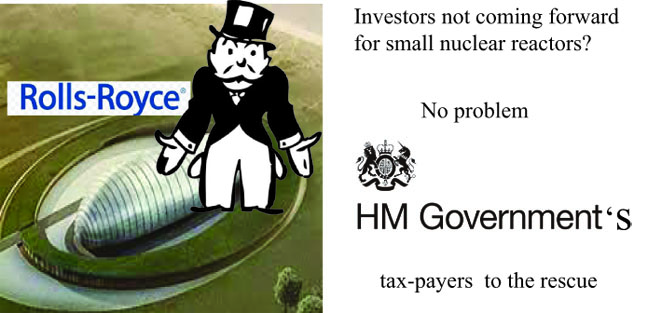
Businesses across Gloucestershire and the Cotswolds are being urged to throw in their hats for a share of £1.4bn in contracts to supply Rolls-Royce SMR‘s pathway for small nuclear reactors.
Rolls-Royce SMR said its new Supplier Programme gives UK firms a chance to bid for a slice of the contracts pie over the next year, the move aiming to support the company and Great British Energy-Nuclear (GBE-N) in its quest to achieve more than 70% UK fleet content for the Gwyndod (Wylfa) project in North Wales.
The invitation comes as SMR technology remains, as yet, unapproved for final implementation in Western markets: two demonstration operations in China and Russia (a floating project on the Arctic) are active as pilots, but elsewhere, while technical viability is proven, Rolls-Royce SMR remains engaged in a process to steal a lead on US rivals by concluding a Generic Design Assessment stage with regulators.
Since being formed in 2021, Rolls-Royce SMR said it had already spent more than £300m with UK based suppliers – equivalent to 88% of its total spend to date – and held three UK supplier events, formally engaging with more than 650 UK firms.
It hailed this launch as a “major milestone in establishing a resilient, high-value UK supply chain, capable of delivering at scale and supporting our export programme”.
Funding for SMR development is a mixed picture of streams from private investment and the UK taxpayer, with government documents showing that the £1.4bn reported here is derived from general taxation (via government spending), the ultimate goal of the SMR programme being to transition to a mix of private investment and consumer energy bills.
To date, the amount that Rolls-Royce SMR has drawn down and spent from the taxpayer is not isolated to a single figure, given that government funding shifts between committed grants, commercial loans and site purchases.
But in terms of money the government has formally spent or legally committed to Rolls-Royce SMR so far, the taxpayer footprint is reported to stand at around £830m in direct development funds, within a wider £2.6bn total programme allocation…………………
Chris Cholerton, CEO of Rolls-Royce SMR, said the scale of the opportunity in unlocking £1.4bn that is now available to UK suppliers from the Rolls-Royce SMR programme was significant.
“As the only SMR provider with multiple contractual commitments in Europe, we want to partner with the best of UK industry, to maximise their opportunity to contribute to our growing European fleet.”
It’s not quite over the line, but Rolls-Royce SMR has successfully completed Step Two of the GDA which makes it the leading SMR vendor in Europe in the race to provide the continent’s required legal paperwork for the technology……………………….
Rolls-Royce SMR said: “Through workshops, industry events and expert guidance, the Programme will demystify the sector, help suppliers understand regulatory and commercial requirements, and make it easier for companies to explore opportunities within the Rolls-Royce SMR supply chain.Participating suppliers will benefit from greater visibility of future supply chain requirements and access to potential opportunities across the programme. They will also have opportunities to engage directly with Rolls-Royce SMR and supply chain procurement teams through briefings, networking events and meet-the-buyer sessions.”
WIth the economic viability remaining as yet untested advocates of SMRs maintain that by building reactors in factories, rather than on-site, costs will plummet. However, energy economists point out that fixed costs (such as 24/7 security, exclusion zones and regulatory licensing) do not deminish proportionally with a smaller reactor.
Here in Gloucestershire, Stroud-based Ecotricity boss Dale Vince has taken a leading role as an ardent critic of the SMR concept, having argued that “economies of scale come by making something bigger, not by making something smaller.”
Trying to make cheap “mini nukes”, Mr Vince said, ignores the fact that miniaturising complex, highly regulated technology naturally drives costs up, not down.………
https://www.punchline-gloucester.com/articles/aanews/button-pushed-for-new-smr-spending-round
White House thinks it’s above the law
Judge rules media ban clearly unconstitutional
| Freedom of the Press Foundation, 25 Sept 25 |
Yesterday, U.S. District Judge Timothy Kelly ruled that President Donald Trump could not bar CNN, MS NOW, and Politico from the White House, rejecting the administration’s argument that “national security” concerns justified the ban. But despite Kelly’s temporary restraining order, all three outlets reported hours later that they were still being blocked from entering the premises. Compliance since has been spotty at best.
“Government officials who continue to deny journalists’ access to the White House in defiance of Kelly’s order should be held in contempt,” Freedom of the Press Foundation (FPF) Chief of Advocacy Seth Stern said. “And it’s long past time for judges to start aggressively sanctioning DOJ lawyers when they make frivolous national security arguments to turn Trump’s petty grievances against the press into government policy.”
Building the foundations for regulatory collaboration
UK and Swedish nuclear regulators have taken a significant step towards
international collaboration on small modular reactor deployment, with a
workshop supported by the Department for Business, Innovation, Science and
Trade, designed to accelerate the safe rollout of the technology across
both countries. The workshop followed the recent announcement in June, that
the Swedish utility Videberg Kraft had selected Rolls-Royce SMR Ltd to
supply small modular nuclear reactors, representing the first new nuclear
build in Sweden for more than 40 years. Videberg Kraft, owned by Vattenfall
and a group of Sweden’s largest companies, plans to develop this new
nuclear power capacity alongside the site of the existing Ringhals nuclear
facility in southwest Sweden.
ONR 10th Sept 2026, https://www.onr.org.uk/news/all-news/2026/09/building-foundations-for-regulatory-collaboration
1 This Month




PLEASE OPPOSE HR 8255 AND S.3639 – bills would accelerate satellite deployment, with no environmental review or safeguards – https://ncstd5li.quorum.us/campaign/169331/
To see nuclear-related stories in greater depth and intensity – go to https://nuclearinformation.wordpress.com
-
Archives
- October 2026 (67)
- September 2026 (339)
- August 2026 (330)
- July 2026 (355)
- June 2026 (287)
- May 2026 (306)
- April 2026 (356)
- March 2026 (251)
- February 2026 (267)
- January 2026 (308)
- December 2025 (358)
- November 2025 (359)
-
Categories
- 1
- 1 NUCLEAR ISSUES
- business and costs
- climate change
- culture and arts
- ENERGY
- environment
- health
- history
- indigenous issues
- Legal
- marketing of nuclear
- media
- opposition to nuclear
- PERSONAL STORIES
- politics
- politics international
- Religion and ethics
- safety
- secrets,lies and civil liberties
- spinbuster
- technology
- Uranium
- wastes
- weapons and war
- Women
- 2 WORLD
- ACTION
- AFRICA
- Atrocities
- AUSTRALIA
- Christina's notes
- Christina's themes
- culture and arts
- Events
- Fuk 2022
- Fuk 2023
- Fukushima 2017
- Fukushima 2018
- fukushima 2019
- Fukushima 2020
- Fukushima 2021
- general
- global warming
- Humour (God we need it)
- Nuclear
- RARE EARTHS
- Reference
- resources – print
- Resources -audiovicual
- Weekly Newsletter
- World
- World Nuclear
- YouTube
-
RSS
Entries RSS
Comments RSS

