Floating nuclear power in northern New Brunswick: a reality check
The Minister did not explain how much any jobs created would cost taxpayers.
“not a single HTGR-termed ‘commercial’ has proven financially viable.”
The proposed SMR project at Belledune has many more unknowns. The most obvious is how the project will secure the billions of dollars required to develop and build a first-of-a-kind reactor on the site,
Susan O’Donnell, October 21, 2026, https://nbmediacoop.org/2026/10/21/floating-nuclear-power-in-northern-new-brunswick-a-reality-check/
Recently a proposal to build a floating nuclear power plant with two small reactors at the Port of Belledune made the news.
Is the proposed project more than just another nuclear establishment pitch for public funding? Will New Brunswick be sucked into a third SMR vortex demanding tens of millions in subsidies before spiralling into dust?
Last October, Energy Minister René Legacy told the CBC the government was no longer interested in supporting “first of a kind” small modular nuclear reactors (SMRs). In 2018, the government invited two start-up companies into New Brunswick – ARC and Moltex – and spent the next seven years promoting and supporting their “advanced” SMR projects. In 2025, the government finally faced the cold reality: the SMR benefits assured by the nuclear establishment – jobs, export markets and revenue windfalls – would never materialize in New Brunswick.
By that point, the federal and provincial governments had already handed almost $130 million in subsidies to ARC and Moltex and other nuclear-adjacent organizations cashing-in on the SMR public funding spree in the province.
What a difference a year makes. This October, Minister Legacy told The Globe and Mail about a new project proposing to develop a marine vessel to support two first-of-a-kind small nuclear reactors at the Port of Belledune. He claimed the project was a good idea because the jobs created would capitalize on the province’s strengths: “lots of machinists, lots of welding, lots of industrial might.” The Minister did not explain how much any jobs created would cost taxpayers.
According to the Globe article, the New Brunswick government has expressed interest in purchasing the power produced by the two SMRs on the vessel. That power would likely be the most expensive ever produced in the province.
The federal public purse has already been cracked open for the proposed nuclear vessel giving a hint of the provincial funding which may need to follow. The federal government gave Montreal-based start-up Prodigy Clean Energy a $2,750,000 subsidy in 2024 to develop “floating transportable nuclear power plants as part of the SMR supply chain.”
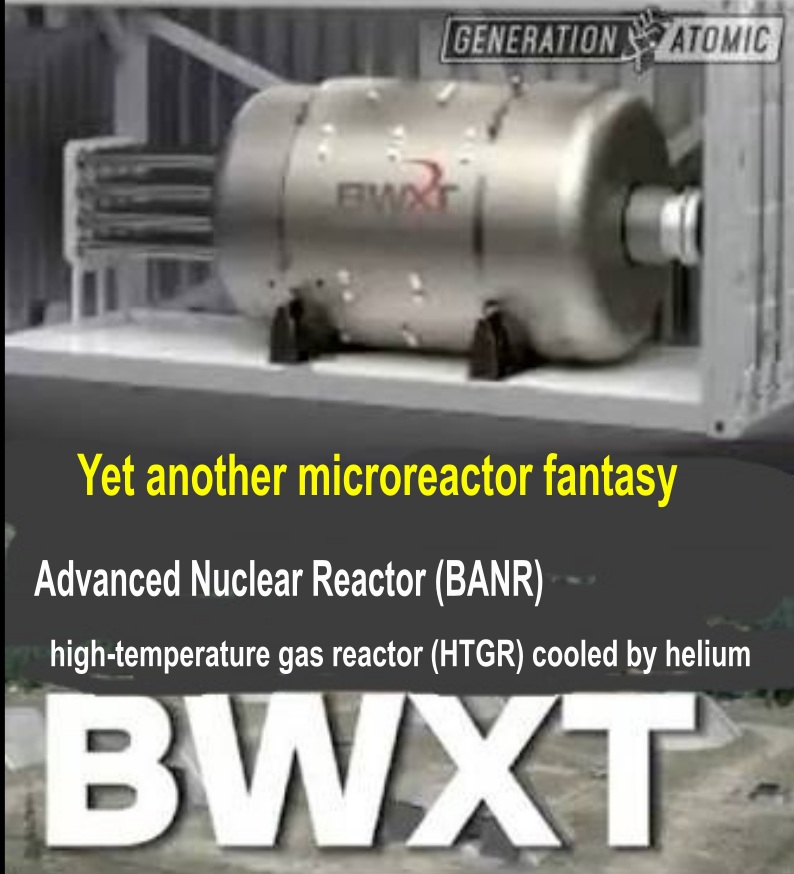
In 2025, Prodigy said its proposed nuclear vessel would host the Westinghouse eVinci, a small reactor design under development in the U.S. Just a year later, Prodigy has flipped to a different American reactor for its Belledune project, a high-temperature gas reactor (HTGR) cooled by helium. Only one HTGR cooled by helium is in operation, in China.
Analysis of the operational history of HTGRs reveals a troubling past. Several small HTGRs cooled by helium were developed at considerable expense in countries including Germany, the U.S. and South Africa. The HTGRs were prone to many small failures resulting in frequent shutdowns, with final shutdowns “well before the operating periods envisioned for them.” In addition, HTGRs are uncompetitive compared to conventional reactors cooled by water and “not a single HTGR-termed ‘commercial’ has proven financially viable.”
For the New Brunswick project, it’s currently unclear if the proposal includes any reactor construction in Belledune. The two BANR reactors may be constructed entirely in the U.S. and shipped to the Port of Belledune. BWXT has operations in Canada with expertise making reactor components but has no reactor construction experience in this country.
The proposed SMR project at Belledune has many more unknowns. The most obvious is how the project will secure the billions of dollars required to develop and build a first-of-a-kind reactor on the site, if indeed the plan is to construct the two reactors in the province, plus the cost of building the marine vessel.
The cost of the only SMR under construction in Canada, at the Darlington nuclear site on Lake Ontario, is a minimum of $6.1 billion plus $1.6 billion for associated infrastructure. That project has been funded entirely by public subsidies because no private sector investors have been found despite considerable promotion efforts.
The Belledune project has buy-in from two Mi’gmaq communities in northern New Brunswick, Eel River Bar First Nation (Ugpi’ganjig) and Pabineau First Nation (Oinpegitjoig), and the project is being promoted as majority-owned by First Nations.
The Indigenous involvement provides a clue for how public funds could flow to the Belledune project. In June this year, the federal and Ontario governments gave seven First Nations in Ontario part ownership of the SMR at the Darlington site. The part ownership was structured as a “loan guarantee” of $715 million to the First Nations from a federal Indigenous loan program, public funds that were streamed through to the Darlington SMR under construction.
Of particular note, the intended market for the transportable nuclear power plant is remote mines and communities. The BANR reactor would produce power at a cost far higher than the diesel fuel generators currently in place. For this and many other reasons, research found that the market for SMRs in mining and remote communities is “too small to be viable.”
It’s also unclear how NB Power would be involved in the project. The utility was the proponent for the two earlier failed SMR projects – ARC and Moltex – which were intended to be constructed at NB Power’s Point Lepreau nuclear site.
Developing a second licenced nuclear site in the province, in Belledune, would be a costly and significant undertaking requiring compliance with numerous nuclear safety and security regulations. NB Power is already planning to convert its Belledune coal-fired plant to burn biomass fuel, and its Integrated Resource Plan released earlier this month made no mention of SMRs at Belledune, or any SMRs in the utility’s future 20-year scenarios.
The motivations behind the New Brunswick government’s support of the Belledune nuclear project are hard to fathom, considering how recently the province was burned by the Moltex and ARC SMR fiascos and the decades-long slow train wreck and money pit that is the Point Lepreau Nuclear Generating Station. The motivations certainly may include hopium, an irrational, addictive belief that a new nuclear reactor will eventually work as promised in New Brunswick.
A commentary published earlier this month, RIP SMRs, ended: “Apparently, old SMR ideas never really die. They will just, eventually, fade away.” How long the proposed Belledune floating SMR idea will take to fade away and how much it will cost us before it does are open questions. New Brunswickers should remain vigilant to ensure that not too many more public millions (billions?) are squandered before the hopium runs out and reality kicks in again.
Correction: An earlier version of this commentary stated that helium gas-cooled reactors do not exist. The story has been corrected to state that only one high-temperature gas reactor cooled by helium is in operation, in China. Updated at 5:14 PM, Oct. 22, 2026.
Susan O’Donnell is lead investigator of the CEDAR project in the Sustainability and Environmental Studies Program at St. Thomas University and a member of the board of directors of the NB Media Co-op.
No comments yet.
1 This Month
23-25 October – on Zoom – World BEYOND War’s annual global conferenc


Shut down the radiation-damaged Heysham nuclear reactors now
To see nuclear-related stories in greater depth and intensity – go to https://nuclearinformation.wordpress.com

Say No to NASA’s Reckless Nuclear Reactor on the Moon
Say No to NASA’s Reckless Nuclear Reactor on the Moon

-
Archives
- October 2026 (243)
- September 2026 (339)
- August 2026 (330)
- July 2026 (355)
- June 2026 (287)
- May 2026 (306)
- April 2026 (356)
- March 2026 (251)
- February 2026 (267)
- January 2026 (308)
- December 2025 (358)
- November 2025 (359)
-
Categories
- 1
- 1 NUCLEAR ISSUES
- business and costs
- climate change
- culture and arts
- ENERGY
- environment
- health
- history
- indigenous issues
- Legal
- marketing of nuclear
- media
- opposition to nuclear
- PERSONAL STORIES
- politics
- politics international
- Religion and ethics
- safety
- secrets,lies and civil liberties
- spinbuster
- technology
- Uranium
- wastes
- weapons and war
- Women
- 2 WORLD
- ACTION
- AFRICA
- Atrocities
- AUSTRALIA
- Christina's notes
- Christina's themes
- culture and arts
- Events
- Fuk 2022
- Fuk 2023
- Fukushima 2017
- Fukushima 2018
- fukushima 2019
- Fukushima 2020
- Fukushima 2021
- general
- global warming
- Humour (God we need it)
- Nuclear
- RARE EARTHS
- Reference
- resources – print
- Resources -audiovicual
- Weekly Newsletter
- World
- World Nuclear
- YouTube
-
RSS
Entries RSS
Comments RSS


Leave a Reply