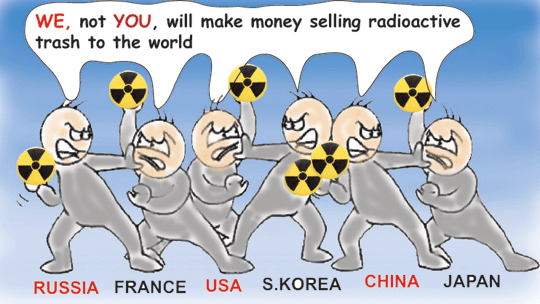
Nuclear powers battle each other to market nuclear reactors to Czech Republic
|
The Czech Republic Is Caught in a Nuclear Tug of War, FP,
Competition among China, Russia, and the West is taking the form of a battle to build reactors in Eastern Europe. BY TIM GOSLING SEPTEMBER 8, 2020”………………… The minority government of Czech Prime Minister Andrej Babis, who founded the ruling ANO 2011 party, has welcomed U.S. President Donald Trump’s embrace. But his stance looks less than certain as the country prepares to face one of its sternest geopolitical tests since the fall of communism 30 years ago: choosing a partner to expand its Soviet-built nuclear power capacity.
……….. Part of Pompeo’s mission to the Czech Republic was to convince Babis that it would pose a similar risk as Huawei should China or Russia win an upcoming tender to build a new 1.2-gigawatt reactor at the Dukovany nuclear power plant, at an estimated cost of over $7 billion. “If you choose one of these countries, it will jeopardize your freedom and sovereignty,” Pompeo reportedly stressed to the Czech leader.
However, Babis’s government is weak, and he faces building pressure at home and abroad to lean east. In turn, he has declined to exclude Chinese and Russian state-owned companies from bidding for the project and, despite welcoming Pompeo enthusiastically, demurred on signing a proffered cooperation agreement on nuclear energy………… Part of Pompeo’s mission to the Czech Republic was to convince Babis that it would pose a similar risk as Huawei should China or Russia win an upcoming tender to build a new 1.2-gigawatt reactor at the Dukovany nuclear power plant, at an estimated cost of over $7 billion. “If you choose one of these countries, it will jeopardize your freedom and sovereignty,” Pompeo reportedly stressed to the Czech leader. However, Babis’s government is weak, and he faces building pressure at home and abroad to lean east. In turn, he has declined to exclude Chinese and Russian state-owned companies from bidding for the project and, despite welcoming Pompeo enthusiastically, demurred on signing a proffered cooperation agreement on nuclear energy. The expansion of the country’s two nuclear power plants—Dukovany and Temelin—are at the center of the Czech Republic’s long-term energy strategy. However, the government has struggled for years to find a financing model agreeable to the minority shareholders at state-controlled energy group CEZ, which is tasked with building and running the nuclear energy infrastructure. The disagreement over funding saw plans to build two new units at Temelin scrapped in 2014. The two finalists in that race—which also brought a U.S. secretary of state to Prague—were the Russian state nuclear agency Rosatom and U.S.-based Westinghouse. They’ve sat in the background in Prague since, awaiting the starting gun for new projects. In the Dukovany showdown, they’re set to be joined by bidders from China, France, and South Korea……….. In the wake of Pompeo’s trip to Prague, lobbying around the nuclear plant will ramp up. “Russia has been extremely active in lobbying for the past couple of years,” Karaskova said. “The U.S., through Mike Pompeo’s comments, also showed a strong interest, probably the first time so openly and publicly.” Petr Trescak, an opposition MP, veteran of the nuclear sector, and member of the government committee for new nuclear plants said that he expects intense lobbying will soon start. Lipavsky said that the tender is already a regular topic with representatives of those countries that will bid, including the French and U.S. ambassadors. Public opinion is also key. Following Pompeo’s visit, Westinghouse launched a search for new senior PR operatives……… https://foreignpolicy.com/2020/09/08/czech-republic-nuclear-tug-of-war-china-russia-united-states/ |
|
Hinkley Point B nuclear station could close down early – EDF
 EDF Energy says UK’s Hinkley Point B nuclear plant could close earlier than planned
The 1 gigawatt (GW) plant in Somerset was due to be shut down permanently in early 2023. It began operation in 1976.
“It is possible we may need to move into defuelling within the next two years. We will review this decision in the same detailed way as we have with Hunterston B and expect to be able to confirm the outcome by the end of this year,” said a spokesman for EDF Energy, part of France’s EDF.
Last month, EDF Energy said it would start decommissioning its Hunterston B nuclear power plant in Scotland by January 2022 at the latest.
Both Hunterston B and Hinkley Point B have had issues with ageing, as cracks were found in graphite bricks which form reactor cores, prompting some industry experts to foresee their permanent closure soon.
Nearly all of Britain’s 9 GW nuclear fleet is composed of advanced gas-cooled reactors. A factor of ageing in that type of reactor is cracks in the graphite bricks.
Half of Britain’s eight operating nuclear power stations are due to move into decommissioning by March 2024, removing around 4 GW of power capacity…….. www.reuters.com/article/britain-nuclearpower/update-1-edf-energy-says-uks-hinkley-point-b-nuclear-plant-could-close-earlier-than-planned-idUSL8N2G65F8
Dominion Energy has filed to keep nuclear station in Virginia going for 80 years!
 Dominion files to keep Virginia’s North Anna nuclear plant operating 80 years, Utility Dive, 9Sep 20,
Dominion Energy announced on Friday it has filed with the U.S. Nuclear Regulatory Commission (NRC) for a 20-year extension of its license to operate two generating units at the North Anna nuclear power plant in Louisa County, Va.
The United States and its allies must learn how to live safely with a nuclear North Korea
On North Korea, Carnegie Endowment for International Peace,Toby Dalton, Co-director and Senior Fellow Nuclear Policy Program, 9 Sep 20,
The United States and its allies must learn how to live safely with a nuclear North
Three practical goals should inform a new U.S. policy toward North Korea:
- Prevent crises that could lead to war
- Cap North Korea’s arsenal of nuclear and long-range missiles and prevent their export
- Buffer the alliances with Japan and South Korea against likely North Korean provocations
Additional objectives—for instance, preventing illicit trafficking and improving human rights—are important but ultimately secondary. Though desirable, regime change is too risky and uncertain to pursue, as recent experiences in Iraq and Libya suggest.
Accomplishing these three goals will require new negotiations just to establish rules of the road. North Korean demands are bound to be distasteful, but the costs of a negotiated agreement would be far less than those incurred through war or through increased military deployments in East Asia and the construction of a more extensive missile defense shield.
The costs of a negotiated agreement would be far less than those incurred through war.
Reaching a deal will involve helping North Korea overcome its suspicious, hard-nosed attitude. But an even greater challenge will be changing how Washington thinks about detecting and addressing the Kim regime’s possible cheating on a deal……… https://carnegieendowment.org/2020/09/09/on-north-korea-pub-82524
Huge challenge to decontaminate Dounreay: ‘World’s deepest nuclear clean-up’.
 Dounreay: ‘World’s deepest nuclear clean-up’ to begin, The first work in a clean-up of a 1950s-built shaft at a nuclear power research complex is to begin this year. BBC News, 9 Sep 20, The shaft plunges 65.4m (214.5ft) below ground and poses one of the biggest challenges in the demolition of Dounreay in Caithness.
Radioactive waste was disposed there from 1959 until 1977 when an explosion ended the practice.
Tackling the shaft has been described as the “world’s deepest nuclear clean-up”…….
A £7.5m contract has been awarded for the first steps in this work, due to begin in late autumn, and also to carry out similar engineering work at another site at Dounreay called the silo.
It is described as being like a swimming pool with a concrete roof and was also used for the disposing of radioactive waste.
Engineering firms Nuvia and Graham Construction have been awarded the contract for work that would eventually lead to the waste being removed.
David Hubbard, of Dounreay Site Restoration Ltd, said: “The shaft and silo contain solid waste and sludge which must be retrieved and repackaged for safe above-ground storage…..
Dounreay, near Thurso, was the UK site for the development of fast reactor research from 1955 to 1994.
The facility on the north Caithness coast is in the process of being closed down, demolished and cleaned up. https://www.bbc.com/news/uk-scotland-highlands-islands-54085592
|
|
United Arab Emirates’ unnecessary nuclear power push could bring dangerous, catastrophic consequences
|
UAE’s Nuclear Power Pivot Comes At A High Cost, OIl Price.com, By Viktor Katona – Sep 09, 2020, The United Arab Emirates have just become the first Arab nation to operate a nuclear plant as its 5.6GW Barakah nuclear plant achieved criticality on its Unit 1 in the first week of August. ………..The underlying question, however, is the cost thereof – was nuclear power a necessity for the Emirati economy?……..
************************************************
by late 2009 the UAE had set up its Nuclear Energy Corporation (ENEC) and subsequently selected KEPCO’s bid to build four APR1400 reactors at the Barakah site. The total value of the contract rose to some $24 billion, almost $4 billion more than initially presumed.
************************************************
The Barakah nuclear plant is located almost 300km from Abu Dhabi, much closer to the Qatari border than to major consumption centers in the UAE which would inevitably create some tension between the two states. Qatari media have reported on the Barakah plant’s lack of necessary safety measures, decrying the technological solutions chosen for it (amongst other things, no Generation III defence-in-depth reinforcements which could shield the object from potential missile attacks). Even before the September 2019 Abqaiq attack on Saudi Arabia, Qatar has filed a letter of compliant to the International Atomic Energy Agency (IAEA) claiming that the environmental risks of Barakah had not been assessed appropriately and that in case of a radioactive leak the plume would reach Doha in merely a couple of hours and would devastate the nation’s water supply.
************************************************
Qatari objections notwithstanding, the choice to develop nuclear energy in a country that seems to be ideally suited to develop renewable sources of energy, primarily solar and wind energy, remains a somewhat peculiar one. ……. It has to be noted, though, that as convincing as the emissions-curbing narrative is, developing renewable solar and wind energy would result in virtually zero emissions.
************************************************
For the South Korean consortium, bringing Barakah onstream without any substantial hiccup would be an issue of increased importance as it remains the only currently existing export order in KEPCO’s portfolio. Moreover, KEPCO owns 18% of the project company (Nawah Energy Co.), the remaining 82% belongs to the Emirates Nuclear Energy Corporation (ENEC), thus its interest in the profitability of the nuclear plant will go beyond the construction and commissioning phases. Last but not least, rumours that KEPCO has cut corners around enhanced safety designs for the nuclear reactors (what the French AREVA’s then-CEO compared to a “car without airbags”) to render its bid the most competitive ought to compel the South Korean firm to carry out Barakah’s commissioning in a seamless manner.
************************************************
The August 2020 commissioning of Barakah Unit 1 took place almost 3 years after the set deadline of 2017. Partially this is due to construction faults, mainly cracks in the reactor containment building, which were discovered first in Unit 3 in 2017 and then subsequently in all units in 2018. KEPCO has had similar problems with the same type of APR1400 nuclear design at home, not to speak of the 2012 South Korean forgery scandal which saw several control documents on provided nuclear components falsified by suppliers. Luckily there were no major issues heretofore with heat exchangers and condensers – one of the crucial parts of the reactor, considering that UAE seawater is around 33-34°C. It was against this background that the Emirati nuclear corporation has concluded its deals on nuclear fuel supply with France’s AREVA, Russia’s TENEX, Canada’s Uranium One and the Anglo-Australian Rio Tinto. ****************************************************** Beyond the realm of pure economics and unit price profitability, one of the main reasons why the Middle East boasts little to no nuclear assets (Iran is the only Middle Eastern country to operate a nuclear plant) lies in others’ nations concerns that such developments might spur a nuclear race in a region which has historically been beset by conflict. Following the Barakah plant’s commissioning, several regional countries have joined the club of “peaceful nuclear energy” – Turkey will start up its Akkuyu nuclear plant in 2023, Egypt’s El Dabaa plant is expected to be up and running by 2026-2027 and Saudi Arabia intends to build up a 17 GW nuclear portfolio by 2040. Should intra-regional fissures lead to another attack on energy infrastructure akin to the Abqaiq attacks, the consequences might be even more devastating. https://oilprice.com/Alternative-Energy/Nuclear-Power/UAEs-Nuclear-Power-Pivot-Comes-At-A-High-Cost.html |
|
Donald Trump’s claim to have a new secret new weapon system, blowing a defense secret!
 Trump Claims To Have Built A New, Secret Nuclear Weapons System, Forbes, Nicholas Reimann, 9 Sep 20. President Donald Trump claimed to journalist Bob Woodward that he had overseen the creation of a new U.S. nuclear weapons system, saying, “We have stuff that you haven’t ever seen or heard about,”as the two discussed tensions between the United States and North Korea.
KEY FACTSIt’s not clear what Trump was referring to, but Woodward writes in his new book Rage that he later confirmed with sources that the U.S. military indeed had a secret new weapon system, and the sources said they were surprised Trump had disclosed the information, according to The Washington Post. It’s possible that Trump was referring to the W76-2 warhead, according to the defense publication Task & Purpose. That weapon was announced in Feb. 2018 as a relatively “low-cost” addition to the U.S. nuclear arsenal, and has a smaller explosive yield than the atomic bombs dropped on Hiroshima and Nagasaki. Trump made the comments to Woodward during one of 18 on-the-record interviews the famed Watergate journalist had with the president between December and July for his for his upcoming book, which is billed as providing an inside look at the Trump White House. CRITICAL QUOTE“I have built a nuclear — a weapons system that nobody’s ever had in this country before. We have stuff that you haven’t even seen or heard about. We have stuff that Putin and Xi have never heard about before. There’s nobody — what we have is incredible,” Trump said. KEY BACKGROUNDTrump reportedly made the comments when reflecting on how close the U.S. came to war with North Korea in 2017, near the beginning of his presidency……… https://www.forbes.com/sites/nicholasreimann/2020/09/09/trump-claims-to-have-built-a-new-secret-nuclear-weapons-system/#4dcea85f1a1e |
|
|
The impediments to India’s nuclear power dream
India’s Ambitious Nuclear Power Plan – And What’s Getting in Its Way, The country has an ambitious three-stage nuclear power production plan. The Diplomat, By Niharika Tagotra, September 09, 2020 As India embarked on its commercial nuclear power production in 1969, its nuclear power program was conceived to be a closed fuel cycle, to be achieved in three sequential stages. These stages feed into each other in such a way that the spent fuel generated from one stage of the cycle is reprocessed and used in the next stage of the cycle to produce power. This kind of a closed fuel cycle was designed to breed fuel and to minimize generation of nuclear waste. The stage at which India is currently at in its nuclear power production cycle will be a major determinant of the future of nuclear power in India.
Additionally, the nuclear power sector in India has witnessed its share of controversies and protests over issues of land ownership, location, as well as the safety and security of power plants in the event of natural or man-made disasters. These have also contributed to the time and cost overruns of India’s nuclear power projects. Another very important contributing factor to the state of nuclear energy in India has been the global retrenchment in the sector following the Fukushima Daiichi nuclear disaster of 2011. That event led to a situation where countries rolled back significantly on their nuclear power programs and global nuclear majors like Areva and Westinghouse declared bankruptcy………… https://thediplomat.com/2020/09/indias-ambitious-nuclear-power-plan-and-whats-getting-in-its-way/
Australian government’s cowardly double standards: saves its citizens from Chines oppression, but not Assange from American oppression

DOUBLE STANDARDS! What a glaring example of kowtowing to USA!
The Australian government has just deftly extricated two journalists from probably gaol in China. But what about Australian citizen Julian Assange. As usual, Australia kowtows to the mighty USA.
Julian Assange is not getting fair treatment at the Old Bailey (London) hearing about whether or not he should be extradited to the USA, to face 175 years of gaol, on “espionage” charges. Independent journalists, people from Amnesty, or anyone else likely to give Assange’s side of the story, in reporting this bizarre hearing, is excluded from the courtroom. That’s despite the Old Bailey’s tradition of an open courtroom.
As far as I can ascertain, they’re now charging Julian with publicising the names of USA agents. But in fact, Assange gave the documents to newspapers, I think it was the Guardian and the New York Times, with an express request to NOT publish those names. And the papers went ahead and published them. Julian didn’t. I also understand that, even then no harm came to any of those agents.
It’s all a trumped up thing. Julian being oppressed because he revealed evidence of USA military atrocities. So, like Wilfred Burchett, decades ago, he must be punished by almighty America, and Australia must dutifully follow suit.
No advertising revenue is gained by our bloggers
 I am getting a bit tired of comments received that criticise me for “gaining money from advertisements”. Nuclear-news.net is run as a free site by WordPress. We actually get no funding
 whatsoever for our work. In return for the free website, WordPress allows advertisements, thus WordPress gets a financial return for providing this service to us. That’s me, dunrenard and sean arclight.
 Wake up people! The world is up against wealthy and ruthless corporations trashing the planet in pursuit of profits and using their money to bellow out propaganda for their polluting products.
There are many others, who, like us, see the urgent need to cut through the corporate spin. Nobody wants to pay for exposing the facts. Except, for a few really good journalists, most in the mainstream media fear for losing their jobs, if they expose the lies of the fossil fuel and nuclear industries.
INJUSTICE in the court? The extradition trial of Julian Assange
UK: Assange extradition hearing will be a key test for UK and US justice https://www.amnesty.org/en/latest/news/2020/09/uk-assange-extradition-hearing-will-be-a-key-test-for-uk-and-us-justice/?fbclid=IwAR2HY0lPIxV4m0h3u7ikxEmtaJ0m5YxUITtTgqmVViX03L6qsd40vHEwq2Y 4 September 2020,
US authorities must drop all charges against Julian Assange relating to his publishing activities, and UK authorities must reject the related US extradition request, said Amnesty International ahead of Julian Assange’s extradition hearing which resumes on Monday and is expected to last several weeks.
The hearing will decide on the Trump administration’s request for Julian Assange’s extradition to the US, where he faces a sentence of up to 175 years for publishing materials that document possible war crimes committed by the US military.
“This hearing is the latest worrying salvo in a full-scale assault on the right to freedom of expression. If Julian Assange is prosecuted it could have a chilling effect on media freedom, leading publishers and journalists to self-censor in fear of retaliation,” said Amnesty International’s Europe Director, Nils Muižnieks.
“If Julian Assange is extradited it will have far reaching human rights implications, setting a chilling precedent for the protection of those who publish classified information in the public interest.”
The US extradition request is based on charges that stem directly from the publication of classified documents as part of Assange’s journalistic work with Wikileaks. Publishing such information is a cornerstone of media freedom and the public’s right to access public interest information, and must be protected rather than criminalized.
n the US, Julian Assange could face trial on 18 charges, 17 of them under the Espionage Act; and one under the Computer Fraud and Abuse Act. He would also face a real risk of serious human rights violations including detention conditions that could amount to torture or other ill-treatment, including prolonged solitary confinement. Julian Assange is the first publisher to face charges under the Espionage Act.
The fact that Assange was the target of a negative public campaign by US officials at the highest levels undermines his right to be presumed innocent and puts him at risk of an unfair trial.
“The UK must abide by its obligations under international human rights law, which forbid the transfer of individuals to another country where they would face serious human rights violations,” said Nils Muižnieks.
The case will begin at the Old Bailey, London, on the morning (9.30am UK time) of 7 September. Stefan Simanowitz will be outside the court with an Amnesty International spokesperson. Follow @StefSimanowitz for updates and analysis
Amnesty will have trial observers monitoring remotely the entire series of hearings. During the first week, Sebastian Elgueta (@sebelgueta), a UK based barrister, will be monitoring.
Background:
Amnesty International also has concerns with regard to Julian Assange’s physical and mental well-being, particularly with the spread of COVID-19.
Conditions in UK prisons and detention centres are substandard. It is imperative that health and safety protocols are put in place to reduce the risk of COVID-19 infection, while ensuring that prisoners’ and detainees’ rights are protected. Bail or release should be considered for any detainee or prisoner who has serious underlying health conditions and is particularly at risk of infection.
See Amnesty International’s statement on prison conditions for Assange here
Endless summers, endless wildfires

Endless summers, endless wildfires, South Wind 8 September 2020,
If leaders can’t get their heads around the wildfire-climate link, we had better prepare for many more nasty summers “…………. Now, everything is merged into one, and greatly enlarged. In my youth the places I recall having summer fires were Australia, the western United States, and odd outbreaks in Latin America, Africa and Mediterranean countries. Now we hear of fires erupting in other northern lands, as far north as the shores of the Arctic Ocean.
Looking back at this year so far we could be forgiven for thinking the whole world is ablaze. Almost as soon as wildfires are extinguished on one continent they seem to be breaking out afresh on another one.
2020 began with Australia’s record-breaking Black Summer fires destroying millions of hectares of forest and capturing global attention. Within a couple of months fires had broken out in Ukraine, threatening the abandoned Chernobyl nuclear plant.
A month later, smouldering peat that had been primed by years of drying and warming began to spark vegetation fires in Siberia that would eventually number over 600, emitting more carbon in two months than any preceding year and producing a smoke cloud spanning an area bigger than Europe.
The Siberian fires were still burning in mid-August when forests in California erupted into flames, more than a month earlier than the start of a “normal” season in that part of the world and less than two years after its previous record-breaking year.
At the end of a relatively quiet Californian fire season, in 2019-20 Australia got the benefit of that state’s large water-bombing aircraft, one of which crashed in the Australian Alps killing its US crew. Now, with California suffering similar devastation, we are battling to respond to its desperate appeal for reciprocal help.
Add to all those the perennial fires accompanying rainforest clearing in Southeast Asia and Brazil. The Amazon Basin situation is dire. August-September is the land-clearers’ peak burning period, and this year, with legal constraints all but destroyed under president Jair Bolsonaro, the area burnt and smoke generated looks like being even worse than what triggered last year’s global alarm.
Last week saw release of the interim report of the inquiry into Australia’s natural disaster management, led by former air force chief Mark Binskin, which was set up by the Morrison government after the Black Summer fires.
As the Black Summer fires showed, the report said, “bushfire behaviour has become more extreme and less predictable. Catastrophic fire conditions may become more common, rendering traditional bushfire prediction models and firefighting techniques less effective.”
No close observer of climate change would be surprised by the coronavirus pandemic’s global progress and the response to it of many political and vested interests. Those interests might wish it were otherwise, but this contagion operates without any reference to the things they hold dear.
Climate change, too, doesn’t recognise human boundaries. We set it off, and by failing to curb carbon emissions, we ensured its impact would continue to grow. Yet Australian governments, ignoring dire warnings from disaster experts, continue to behave as if it doesn’t exist.
This summer may see something of a reprieve. Weather authorities anticipate a wettish spring for eastern Australia. A moist understory is less likely to kindle fire from dry lightning, which has plagued recent fire management in both hemispheres.
But hoping for good weather doesn’t replace what the experts keep saying: a fire plan that doesn’t acknowledge the overwhelming influence of climate change is no plan at all. If partisan politics and vested interests prevent us acting on this, we’d better get ready for many more summers from hell. http://southwind.com.au/2020/09/08/endless-summers-endless-wildfires/
Treaty for the Prohibition of Nuclear Weapons (TPNW) is getting close to the 50 ratifications needed to bring it into legal force
 Nuclear Ban Treaty Nears 50th Ratification https://www.armscontrol.org/act/2020-09/news-briefs/nuclear-ban-treaty-nears-50th-ratification September 2020Four nations used the occasion of the 75th anniversary of the U.S. atomic bombings of Hiroshima and Nagasaki to announce their ratification of the 2017 Treaty for the Prohibition of Nuclear Weapons (TPNW). The ratifications by Ireland, Nigeria, and Niue, announced on Aug. 6, and Saint Kitts and Nevis, announced on Aug. 9, bring the number of states ratifying the accord to 44. The treaty will enter into force 90 days after the 50th state deposits its instrument of ratification. To date, 82 states have signed the treaty. The TPNW is the first international instrument to comprehensively ban the development, testing, production, stockpiling, stationing, transfer, use, and threat of use of nuclear weapons. All states-parties engaging in these activities are bound to submit and implement a plan to divest themselves completely of nuclear weapons upon ratification. At an Aug. 6 event to mark the new ratifications, Elayne Whyte Gomez of Costa Rica, who presided over the negotiations on the treaty, called for renewed determination to ensure that no other city suffers the same as Hiroshima and Nagasaki. She noted that “the presence in the room of the hibakusha ensured that we wouldn’t leave the room without completing the task.” Tijjani Muhammad-Bande of Nigeria, the current president of the UN General Assembly, called on “all member states to sign and ratify [the TPNW]. We must prevent such destruction from ever happening again.” Treaty supporters hope to secure the additional ratifications necessary to bring the treaty into force by the end of 2020. More states are expected to ratify the treaty next month as the United Nations on Sept. 26 marks the International Day for the Total Elimination of Nuclear Weapons.—DARYL G. KIMBALL |
|
More reports of drones flying near Paolo Verde nuclear power plant, and others, and over spent nuclear fuel storage sites
 Dozens More Mystery Drone Incursions Over U.S. Nuclear Power Plants Revealed, Forbes, David Hambling– 7 Sept 20, Forbes recently described how a swarm of drones flew in a restricted area at Palo Verde Nuclear Power Plant on two successive nights last September. A new cache of documents obtained under the Freedom of Information Act (FoIA) reveals how 24 nuclear sites suffered at least 57 drone incursions from 2015 to 2019 – and Palo Verde itself was overflown again in December, despite new security measures.
A 2003 report noted how vulnerable such pools were to terrorist action, simply by making a hole in the pool to drain out the cooling water and causing the stored fuel to overheat: “We warned that U.S. spent fuel pools were vulnerable to acts of terror. The drainage of a pool might cause a catastrophic radiation fire, which could render an area uninhabitable much greater than that created by the Chernobyl accident.”
Climate change should be the central focus of the American presidential debates
  Green groups press for climate focus at presidential debates https://www.politico.com/news/2020/09/03/green-climate-focus-presidential-debates-408453The effort is calling on debate moderators to press President Donald Trump and Democratic nominee Joe Biden to lay out their plans to fight climate change. ANTHONY ADRAGNA, 09/03/2020 A coalition of more than three dozen environmental groups is pressing the moderators of the upcoming presidential debates to make climate change “a central focus” of this year’s contests — after moderators in the 2016 debates failed to ask a single question on climate policy. The effort, led by Evergreen Action and the collection of green groups working together in the independent organization Climate Power, is calling on debate moderators to press President Donald Trump and Democratic nominee Joe Biden to lay out their plans to fight climate change. Biden listed the issue as one of the top problems facing the country during his speech at last month’s Democratic National Convention, while Trump’s administration has dismantled many of the rules and policies put in place to address climate change under his predecessor. “It is imperative the candidates seeking our nation’s highest office explain how they will address and prepare us for the current and increasing effects of the climate crisis and how they will combat the environmental injustice that has plagued Black and brown communities for decades,” the coalition of 41 groups wrote in a letter Thursday. The details: Along with the letter, Evergreen launched a petition inviting signers to demand “climate be front-and-center in the 2020 debates” and soliciting potential questions to be asked.
The commission in charge of the debates announced Wednesday that “Fox News Sunday” anchor Chris Wallace, C-SPAN political editor Steve Scully and NBC News White House correspondent Kristen Welker would moderate the three presidential contests. Susan Page, Washington bureau chief for USA Today, will handle the vice presidential debate between Vice President Mike Pence and Sen. Kamala Harris (D-Calif.). Dozens of House Democrats sent their own letter Wednesday to the Commission on Presidential Debates demanding it “break precedent and publicly call on the moderators to include climate in the topics” discussed during the sessions.“In 2016, there was not a single question on climate change in any of the four presidential and vice-presidential debates. This cannot happen again,” the lawmakers, led by Rep. Mike Levin (D-Calif.) wrote. “We need a dedicated discussion on the climate crisis that matches the importance of this moment.” Other signers of the environmental letter include Center for American Progress Action Fund, the League of Conservation Voters, the National Wildlife Federation, NRDC Action Fund, Physicians for Social Responsibility, the Sierra Club and the Working Families Party. The context: Trump has recently softened his long-held view that climate change is a “hoax,” though has consistently derided efforts by Democrats to address the problem and slammed efforts like the Green New Deal as “radical” and “unthinkable.” He’s also eased regulations to the benefit of fossil fuel producers and weakened rules around vehicle fuel efficiency and power plant emissions designed to fight climate change. Biden has called climate change one of the four crises currently facing the nation, along with the ongoing Covid-19 pandemic, racial justice reckoning and economic devastation linked to the pandemic. However, despite significant support from all wings of the party, the Democratic National Committee ultimately opted against holding a climate-specific debate during the primary. The only question remotely related to climate change during the 2016 cycle came from coal plant operator Ken Bone, who asked the candidates about energy policy, and he subsequently became an internet celebrity. What’s next: The three presidential debates are slated for Sept. 29, Oct. 15 and Oct. 22, while the vice presidential session is due to take place on Oct. 7. |
|
1 This Month

Tell Congress: Prevent Nuclear Catastrophe in Iran

Tell Congress: Prevent Nuclear Catastrophe in Iran

Read the Public Inquiry Report, the Commissioners’ report, Surrendering Australia: The AUKUS Deception is available to download for free at aukuspublicinquiry.com. Or just watch the replay of the National Press Club Luncheon.
To see nuclear-related stories in greater depth and intensity – go to https://nuclearinformation.wordpress.com
Say No to NASA’s Reckless Nuclear Reactor on the Moon
-
Archives
- November 2026 (269)
- October 2026 (302)
- September 2026 (339)
- August 2026 (330)
- July 2026 (355)
- June 2026 (287)
- May 2026 (306)
- April 2026 (356)
- March 2026 (251)
- February 2026 (267)
- January 2026 (308)
- December 2025 (358)
-
Categories
- 1
- 1 NUCLEAR ISSUES
- business and costs
- climate change
- culture and arts
- ENERGY
- environment
- health
- history
- indigenous issues
- Legal
- marketing of nuclear
- media
- opposition to nuclear
- PERSONAL STORIES
- politics
- politics international
- Religion and ethics
- safety
- secrets,lies and civil liberties
- spinbuster
- technology
- Uranium
- wastes
- weapons and war
- Women
- 2 WORLD
- ACTION
- AFRICA
- Atrocities
- AUSTRALIA
- Christina's notes
- Christina's themes
- culture and arts
- Events
- Fuk 2022
- Fuk 2023
- Fukushima 2017
- Fukushima 2018
- fukushima 2019
- Fukushima 2020
- Fukushima 2021
- general
- global warming
- Humour (God we need it)
- Nuclear
- RARE EARTHS
- Reference
- resources – print
- Resources -audiovicual
- Weekly Newsletter
- World
- World Nuclear
- YouTube
-
RSS
Entries RSS
Comments RSS

