Reopening of a Cold-War era submarine base, as USA struggles to beat Russia to control the Arctic.
Olavsvern will also be used to house submarines for NATO amid increased concerns over Russia’s activity in the region.
The base is located 220 miles from the Russia border and thus offers an ideal outpost for Western allies to quickly contain, and defend against any aggression from the state.
Modifications will now be made to the base in order for it to house America’s nuclear attack submarine, the USS Jimmy Carter.
The announcement of the base comes as the UK’s First Sea Lord, Admiral Tony Radakin, warned China and Russia could soon exploit the Arctic Sea.
Due to climate change, he claimed the once-frozen passages are now thawing thus opening up potential naval routes.
With these routes now appearing, Chinese and Russian ships could now have gateways through to the UK.
He added the Royal Navy was essential in stopping these ships from trespassing in the UK’s waters but also policing the vital global trade routes………..
The undersea world matters. “Because this one remaining stealth medium is also the home to our nuclear deterrent. ”…… https://www.express.co.uk/news/world/1346694/world-war-3-russia-cold-war-Norway-submarine-base-arctic-Vladimir-Putin
New North Korean missile will prove a big diplomatic headache for US, expert warns
|
New North Korean missile will prove a big diplomatic headache for US, expert warns, 9 News, By Richard Wood • Senior JournalistOct 12, 2020 North Korea’s unveiling of a new intercontinental ballistic nuclear missile (ICBM) will impact global security in the months ahead, according to one expert.
The massive weapon was carried by an 11-axle truck during a military parade in the capital of Pyongyang to mark the 75th birthday of the isolated state’s ruling party on the weekend.
Malcolm Davis, senior analyst at the Australian Strategic Policy Institute, told Nine.com.au the display of the new ICBM shows that the Trump Administration’s talks with North Korean leader Kim Jong-un had failed…….. https://www.9news.com.au/world/north-korea-nuclear-missile-will-test-next-us-president/8c1ee861-4b14-47f9-93c4-e9466d06dfb9
|
|

Offshore Wind Energy, Not Nuclear, Is the Future

|
Offshore Wind Energy, Not Nuclear, Is the Future, Jacobin, WILLIAM WESTGARD-CRUICE, 12 Oct 20,
States across Europe and East Asia are closing nuclear reactors and replacing much of their electricity-generating capacity with offshore wind energy. Socialists should embrace the growth of this industry — and use green reindustrialization to fight for well-paid, stable jobs. his month, the Netherlands will celebrate the completion of the Borssele 1 and 2 offshore wind farms, located twenty-two kilometers off the coast of the Dutch province of Zeeland. In the sleepy village where the transmission cables come ashore, a relic from the late 1960s hums away, awaiting its decommissioning. That’s because Borssele also has a nuclear power station — the Netherlands’ last remaining such facility, scheduled to be taken off-line in 2033. Just over a decade ago, plans had been drawn up for a second, perhaps even a third, reactor on site. The abortive expansion project was scrapped partly as a consequence of popular opposition, in the aftermath of the Fukushima disaster. But what was ultimately decisive was the law of value as identified by Karl Marx. With the declining cost of renewable energy, nuclear power simply does not make economic sense — even for capitalists, never mind socialists. Many of the fervent debates within the Left concerning nuclear power have been strikingly unproductive for one simple reason. Nuclear advocates, woefully ill-informed about the frontiers of renewable energy development, tend to avoid discussing the actual dynamics of inter-capitalist competition in the electricity sector. But with many capitalist enterprises and states ditching nuclear and pushing forward with offshore wind, it is essential for socialists to better understand the latter — and begin to engage with it strategically. ecent years have seen several prominent figures within the environmental movement and democratic-socialist left embrace nuclear power. They distance themselves from their (former) comrades’ quasi-religious technophobia, but erroneously call for a program of “people’s fission” that would supposedly solve the climate crisis in one fell swoop. This stance elides many of the real dangers of atomic energy, particularly in a country like the United States, where corruption is endemic and state regulatory capacities are weak. Whatever the politics and intentions of this varied bunch may be, left-of-center nuclear advocates all end up achieving the same thing — running interference for the fossil fuel industry, by casting doubt on the possibility of a renewable civilization…….. Rather than reciting the fossil fuel industry’s propaganda about the intermittency of renewables in order to advance the pet project of nuclear power, democratic socialists ought to focus on promoting the expansion of renewable energy while striving for the industry’s democratization through the workplace and political struggle. Several advanced capitalist states, Denmark and Portugal in particular, are moving decisively toward 100 percent renewable electricity, and they are doing so largely by investing in offshore wind. Even France, whose 1980s program of atomic autarky is routinely touted by nuclear advocates, is aiming to close several reactors over the next decade and a half, replacing much of its electricity generating capacity with offshore wind energy. South Korea, although it continues to promote nuclear power abroad for the benefit of the country’s chaebol, has pledged to phase out many of its own nuclear power plants while aggressively promoting offshore wind energy through a coordinated industrial policy. t is no wonder that Denmark, Portugal, and South Korea — not to mention Japan, China, and Taiwan — are so keen on offshore wind. While certainly intermittent, offshore wind is significantly less so than onshore wind or solar. Furthermore, offshore wind development does not imply the type of land-use conflicts that often accompany the construction of solar and wind farms in rural areas……….. Despite being hampered by the Trump administration, the US offshore wind industry is beginning to take off. Meanwhile, the nuclear energy industry is in complete shambles, gobbling up $9 billion just to move some dirt around. The question is not whether socialists should promote nuclear power or renewable energy, but how quickly renewables will displace fossil fuels and on what terms. …….. https://www.jacobinmag.com/2020/10/offshore-wind-energy-just-transition-nuclear |
|
Public Input Wanted On Transportation Of Nuclear Waste
 Public Input Wanted On Transportation Of Nuclear Waste, Dryden, ON, Canada / CKDR, Sarah McCarthy Oct 12, 2020 A site in Ignace is up for consideration to become a nuclear repository and the Nuclear Waste Management Organization is looking for feedback on their Transportation Framework plan.
The Rotary Club of Dryden had a chance to provide their input, as the organization was a guest at one of their virtual meetings. Relationship Manager, Norman Sandberg explains road and rail are the two modes of transportation being considered to carry the fuel. “Water is a transportation mode that is used, but Canadians earlier in the process made it very clear that transportation of used nuclear fuel across the great lakes is not socially acceptable.” If road was picked, there would be two trucks per day or by via rail there would be two trains per week. The fuel would be transported across half the country, from Manitoba or New Brunswick and it could be a combination of both modes of transportation. Sandberg adds would be a 45 to 50 year transportation period. “We don’t anticipate being in a position to be able to transportation of used fuel until at least the mid 2040’s, because we have to have a repository not only approved and licensed, but constructed and ready for operation.” The potential repository sites under assessment right now include one in Ignace and another in Southern Ontario……… https://www.ckdr.net/2020/10/12/rotary-club-of-dryden-receive-presentation-on-nuclear-waste/ |
|
Groups urge New Mexico governor to take stand against nuclear waste plan

Oct 12, 2020 ALBUQUERQUE, N.M. (AP) — Environmentalists and other watchdog groups want New Mexico Gov. Michelle Lujan Grisham to create a government agency that would be tasked with keeping the state from becoming a permanent dumping ground for spent nuclear fuel and other high-level waste.
Dozens of groups sent a letter Friday to the Democratic governor. They pointed to Nevada’s past success in mothballing the once-proposed Yucca Mountain waste repository project in that state and asked the governor to consider similar measures to protect New Mexico.
“New Mexico’s people and our environment deserve better treatment than a plan offering millions of years of a public health menace from radioactive waste spreading into our soil, air, water and rivers,” the letter states. “Please consider what more aggressive steps can be taken to defeat the Holtec plan.”
New Jersey-based Holtec is seeking a 40-year license from the federal Nuclear Regulatory Commission to build what it has described as a state-of-the-art complex near Carlsbad. Company executives have said the project is needed because the federal government has yet to find a permanent solution for dealing with the tons of spent fuel building up at commercial nuclear power plants around the U.S.
The first phase of the project calls for storing up to 8,680 metric tons of uranium, which would be packed into 500 canisters. Future expansion could make room for as many as 10,000 canisters of spent nuclear fuel……..
State officials in comments recently submitted to federal regulators opposed a preliminary recommendation by staff of the Nuclear Regulatory Commission that a license be granted to Holtec to build the multibillion-dollar facility. They said technical analysis has been inadequate so far and accused regulators of failing to consider environmental justice concerns and meet requirements spelled out by federal environmental laws.
Dave McCoy of Citizen Action is among those who signed the letter sent to Lujan Grisham. He said Monday that there’s a push to approve New Mexico for “interim” storage knowing that the waste will never leave……. https://scnow.com/business/new-mexico-governor-urged-to-take-stand-against-nuclear-plan/article_e167c5c0-4d7b-5a1f-8ebd-30a951f24c71.html
Japan diver reflects on unsung workers exposed to radiation as Fukushima 10th anniv. Looms

Hisashi Okazaki is seen doing diving work at the Fukushima Daiichi Nuclear Power Plant’s No. 3 reactor in May 2006, in this image provided by Okazaki.
October 11, 2020
Have you ever heard of atomic divers? Hisashi Okazaki, 58, who has worked at nuclear power plants as a diver while being exposed to radiation, wants people to know that professional divers like himself work in dangerous conditions for nuclear reactors to run, as the 10-year anniversary of the Fukushima nuclear disaster approaches.
Among the places he has worked in his 33-year career as a professional diver is the Fukushima Daiichi Nuclear Power Plant, which would later go on to enter a meltdown following the Great East Japan Earthquake and resultant tsunami in March 2011.

Hisashi Okazaki is seen in Ehime Prefecture on Sept. 18, 2020.
After graduating high school, Okazaki, a resident of Seiyo in the western Japan prefecture of Ehime, entered the Japan Ground Self-Defense Force. Four years later he left, and got his professional diving license. Since then, he has worked primarily as a self-employed diver taking on jobs both at home and abroad, fulfilling tasks including laying oil pipelines and tetrapod sea defenses, as well as fixing sea walls damaged after the 1995 Great Hanshin Earthquake. He keeps illustrations of his dives as a record of what he’s done, and in all he has amassed more than 3,670 so far.
In 2006, a diver Okazaki knew invited him to work nuclear jobs. It was his first time working inside nuclear power facilities and being exposed to radiation, but he agreed to do it. Looking back, he said he did it because “I thought I wanted to experience anything I could. I had no fears.” His daily pay was 47,000 yen, almost twice the regular pay of around 25,000 yen for a day’s normal diving work.
Ahead of the job, 20 divers came together to train at a facility belonging to a heavy machinery maker situated in Kanagawa Prefecture south of Tokyo. They had on special heavy helmets weighing around 15 kilograms, and wore dry suits altered to stop water from entering them. They were hooked up to six cables, including for an air hose, photography, and radiation measurements. Both of their arms and legs as well as their chests were fitted with dosimeter equipment. After a week of training, the divers were dispersed to a number of nuclear plants across the country. Okazaki was dispatched to the Fukushima Daiichi Nuclear Power Plant’s No. 3 reactor.
There, he dived into the plant’s suppression chamber, which cools the reactor containment vessel in the event that the release of steam causes its pressure to rise. The chamber is a doughnut-shaped facility in the lower part of the vessel, with water about 3 meters deep in it. The maintenance work Okazaki undertook had to be done while it was filled and he did the work with another diver to exchange equipment in the facility.

An illustration of a diver replacing equipment underwater is seen in this image provided by Hisashi Okazaki.
The area where they worked had high doses of radiation, and in a single day’s diving they could work for about two hours. When they approached an area with a particularly high dosage, they would be instructed via a voice cable not to proceed further. The divers stayed in Fukushima Prefecture for about a month. Legal occupational exposure limits to radiation for a worker are set at 50 millisieverts per year, but in just the 12 days Okazaki worked at the plant, he was exposed to a total of 7.34 millisieverts. At the end of the job, the contaminated equipment they’d used was all put into a drum and disposed of.
“I couldn’t feel satisfied doing a job that leaves no trace of it behind,” Okazaki said. On his way back from Fukushima to Tokyo, Okazaki asked himself while in a car the purpose of his work that exposed him to radiation, and the younger diver who worked with him on the job said, “We did this for that view (of the city) at night, didn’t we?” Okazaki felt a little bit relieved by what they’d said, and after that he went on to do underwater cleaning work at the Onagawa Nuclear Power Station in northeast Japan’s Miyagi Prefecture.
Then, in March 2011, the Great East Japan Earthquake struck. Okazaki watched images of the hydrogen explosion at the Fukushima Daiichi Nuclear Power Station’s No. 3 reactor from a TV on a work barge in the sea off the Muroto Misaki cape in Kochi Prefecture, western Japan. “I’d never imagined the power would be lost and it would explode,” he said.
The use of divers for the decommissioning of the crippled nuclear reactor, such as in removal work and other tasks, is being considered. Even now, around 4,000 people are working at the Fukushima Daiichi plant each day. The decommissioning work, which is expected to take decades from now to finish, is employing robots to complete some tasks, but still the role of radiation-exposed human workers is vital. Okazaki said, “Even at the reactors that use the most technologically advanced equipment, there are sections which only human hands can deal with, and divers are part of the group of workers who take up such jobs.”
(Japanese original by Shunsuke Sekiya, City News Department)
https://mainichi.jp/english/articles/20201009/p2a/00m/0na/020000c
National Federation of Fisheries Cooperative Associations’ head opposes releasing Fukushima Daiichi radioactive water into sea

Hiroshi Kishi, the head of the National Federation of Fisheries Cooperative Associations, speaks at a government hearing in Tokyo on Thursday.
Fishing industry chief opposes releasing Fukushima No. 1 water into sea
Oct 9, 2020
The head of the National Federation of Fisheries Cooperative Associations, or Zengyoren, has voiced strong opposition against releasing treated water containing radioactive tritium from the disaster-stricken Fukushima No. 1 nuclear plant into the sea.
“We are absolutely against ocean release” as a way to dispose of tainted water at Tokyo Electric Power Company Holdings Inc.’s nuclear plant in Fukushima Prefecture, Hiroshi Kishi, head of Zengyoren, said Thursday at a government hearing in Tokyo.
Kishi said that fishermen who are operating along the coast of Fukushima have been suffering from problems caused by the radioactive fallout from the 2011 meltdowns at the plant, such as fishing restrictions, as well as malicious rumors about the safety of farm and marine products there.
If the government chooses to release radioactive water into the sea, a leading option to get rid of accumulating low-level radioactive water at the plant, it will trash all efforts fishermen have so far made to sweep away such rumors and consequently “will have a devastating impact on the future of Japan’s fishing industry,” Kishi stressed.
Toshihito Ono, head of the prefecture’s fishery product processors association, who joined the hearing via a video call, warned that Fukushima’s processed marine products, including products that use ingredients from other prefectures, will become targets of harmful rumors.
In a report released in February, a government panel pointed out that a realistic option would be releasing the tainted water into the ocean after dilution or into the air through evaporation.
Many people fear that both methods will add to the reputational damage suffered by Fukushima products. But treated water storage at the power plant is expected to reach full capacity as early as autumn 2022.
After the hearing, state industry minister Kiyoshi Ejima told reporters, “We find it unadvisable to put off a decision on how to dispose of the water because not much room is left at the plant for tanks containing the water.”
This was probably the last hearing on the water issue, people familiar with the matter said.
https://www.japantimes.co.jp/news/2020/10/09/national/zengyoren-fukushima-water-sea/

Hiroshi Kishi, chairman of Japan’s national federation of fisheries cooperatives, JF Zengyoren, expresses his opposition to the release of contaminated water from the Fukushima Daiichi Nuclear Power Station into the sea, in Tokyo’s Minato Ward on Oct. 8, 2020.
Japan’s fishing industry firmly opposes release of tainted Fukushima water at sea
October 9, 2020
TOKYO — Japanese fishing industry representatives on Oct. 8 expressed their resolute opposition to the planned release of radioactively contaminated water that has built up following the 2011 meltdowns at the Fukushima Daiichi Nuclear Power Station into the sea, saying it would create damaging rumors and could negatively affect the industry into the future.
The comments came in a government hearing with Japan’s national federation of fisheries cooperatives, JF Zengyoren, and other representatives over the handling of the contaminated water and whether to dump it into the sea.
“Damaging rumors would inevitably occur, and the consensus of those in the fishing industry is that we are absolutely opposed to releasing it at sea,” JF Zengyoren Chairman Hiroshi Kishi stated at the meeting.
The hearing is expected to be the last scheduled gathering in a series of meetings that have been held since April. Prime Minister Yoshihide Suga has stated that he wants to decide on a policy for dealing with the contaminated water as soon as possible, and the government is set to reach a decision based on opinions heard to date.
At the meeting, Kishi warned that if the contaminated water from the nuclear plant were released into the sea “all the efforts of fishing industry workers to date would come to nothing.” He added, “It would be a setback and letdown for those in the fishing industry and could have a devastating impact into the future.” He said that he had heard from the government about measures to prevent damaging rumors, but stated, “Not releasing it (contaminated water) into the sea is simply the best approach.”
A seafood processing federation from Fukushima Prefecture was among the bodies represented at the meeting. Federation head Toshihito Ono commented, “I’ve worked on the front lines with regard to damage from rumors following the nuclear plant accident for nine years. Even when the fish are caught outside the prefecture, if the processing firm is in Fukushima then they’ll be stigmatized.”
After the meeting, State Minister of Economy, Trade and Industry Kiyoshi Ejima commented, “We’ve heard opinions from 43 people to date. We’d like to sort them out as soon as possible and reach a conclusion with governmental responsibility.”
The Fukushima Prefectural Federation of Fisheries Co-operative Associations and the national consumers federation Shodanren earlier expressed opposition to the release of contaminated water from the Fukushima plant at sea. The association of inns and hotels of Fukushima Prefecture, meanwhile, has expressed understanding of the move, as has the Central Federation of Societies of Commerce and Industry.
The Fukushima Prefectural Government has taken the position that the issue should be given careful consideration, while the head of the Fukushima Federation of Societies of Commerce and Industry said the water should be dealt with quickly and rumors dispelled, and that the central government should process the water responsibly.
(Japanese original by Suzuko Araki, Science & Environment News Department)
https://mainichi.jp/english/articles/20201009/p2a/00m/0na/039000c
Nuclear, climate news to 12 October

Christina Macpherson’s websites & blogs
The World Health Organisation has reported 338,779 new cases of COVID-19 have been recorded last week, a new daily record.
World press freedom endangered, if UK extradites Julian Assange to America. Assange extradition case could esrablish a dangerous legal precedent.
This election isn’t just about you, America. The world’s climate future – much depends on America’s presidential election. Trump’s psychopathology a threat to US democracy and to global stability.
Some bits of good news – The 2020 Nobel Peace Prize Goes To The World’s Largest Hunger Program. A New Generation of Young Poll Workers is Stepping Up to Protect the Elderly From COVID-19
Why climate change is a time bomb. – Climate future depends on what action humans take. Greta Thunberg: ‘Get everyone to vote for Joe Biden’. Global and European temperature levels for September – hottest on record.
Countries that have included nuclear in their green stimulus plans may want to rethink their strategy. Major study finds that renewables lower emissions substantially, and nuclear power does not. Nuclear power, irrelevant to climate change – and in fact, hinders climate action.
Promises, promises — the media keeps buying the tired old nuclear spin, marketing small reactors.
U.S. and Russian negotiators try to salvage arms control pact.
14 million tonnes of plastic on ocean floor – more on the coasts.
Former world leaders urge those now in power to support the Treaty on the Prohibition of Nuclear Weapons.
Pro nuclear bias in articles in Google headlines.
JAPAN. Ageing community in Hokkaido town – mayor agrees to survey for nuclear waste dump. Fishing industry chief opposes releasing Fukushima No. 1 water into sea.
ALGERIA. Algeria to ratify Treaty on the Prohibition of Nuclear Weapons “as soon as possible”. France should reveal the location of its nuclear waste dump in Algeria.
PACIFIC ISLANDS. Pacific Island Nations determined to say NO to nuclear weapons, and support UN Treaty Ban.
USA.
- Trump’s false claim about the Green New Deal. USA ‘s Environment and climate cases face a bleak future with a Republican dominated Supreme Court,
- Trump’s harsh approach on Iran. Biden firm, but more conciliatory. Too much power to USA president, to control nuclear war strategy: what if he is ill? Utah congressman takes action to stop future nuclear weapons testing in U.S. Nuclear experts not impresssed with Trump’s boasts about USA nuclear weaponry. Trump hoping to conclude nuclear arms deal with Russia before Election Day.
- Possibility of armed factions with military-style rifles showing up at polling places.
- Citizens express opposition to dangerous increased plutonium pit production.
- Texas Governor Greg Abbott opposes 2 plans for nuclear waste dumping.
- Nuclear Energy — The High Cost Of A Dying Industry. Ohio nuclear reactors expect tax-payer subsidy, they’re making a profit anyway !
- Speeded up decommissioning of Crystal River nuclear reactor – some concerns about this . Dept of Energy report shows danger of radioactive wastes leaking from Hanford’s old decayed tanks.
- Pressure on U.S. Congress to reinstate research on links between nuclear stations and cancer.
UK. Design not even finished! But UK govt to subsidise Small Nuclear Reactors (SMRs). Big doubts about the economics of small nuclear reactors for the UK.
Will the UK government sacrifice the beautiful Suffolk coast in its misguided, uneconomic, Sizewell nuclear power push? Conflict of interest – UK’s Centre for Environment, Fisheries and Aquaculture Science (CEFAS) regarding Hinkley C nuclear project.
UKRAINE. Ukraine’s President enthuses over their nuclear reactors – but they’re all ageing Soviet ones.
CHINA. China backs Iran nuclear deal, calls for new MidEast forum. China-Saudi nuclear pact can trigger an arms race in West Asia.
INDIA. India test-fires new version of nuclear capable Shaurya missile.
CANADA. 3 Canadian provinces sucked in by propaganda from 3 Small Nuclear Reactor companies.
RUSSIA. Russia’s nuclear giant Rosatom moving into renewable energy, energy storage, grid development.
FRANCE. European Commission, and France’s Hercules project, plan to break up the nuclear company EDF. Cracks in France’s ageing Tricastin nuclear reactor 1.
NORTH KOREA. Kim Jong Un set to show off nuclear advances in message to Trump. Kim Jong Un showcases North Korea’s biggest intercontinental missile.
BELARUS. Belarus postpones launch of nuclear reactor.
GERMANY. Nuclear no option for hydrogen production: German government.NEW ZEALAND. New Zealand installs its biggest solar farm, floating on a wastewater pond. Lower Saxony opposes building of nuclear power plants by Netherlands – location all too close
POLAND. Poland to build nuclear reactor starting in 2026, excludes Small Modular Reactors (SMRs).
ROMANIA. USA trying to beat China, in marketing nuclear reactors to Romania.
AUSTRALIA. Murdoch media monopoly – an ‘arrogant cancer on our democracy’.
Decision looms for Japan on dumping Fukushima wastewater into sea
Water with traces of radiation has been stored on-site, but capacity running out

Some 1,000 tanks store the tainted water at the site of the 2011 nuclear accident.
October 9, 2020
TOKYO — Japan will soon have to decide whether to release radioactive wastewater stored at the site of the 2011 Fukushima nuclear accident into the ocean.
Treated but still-radioactive water is stored in tanks on the site of Tokyo Electric Power’s Fukushima Daiichi plant, but spare capacity is expected to run out as early as October 2022. Preparations to release the water are said to require two years.
Talks with local governments and businesses have been held since April. The Ministry of Economy, Trade and Industry finished the seventh meeting Thursday and has been receiving feedback from such groups as JF Zengyoren, the federation of fisheries cooperatives.
The water has been filtered to remove major radioactive substances but still contains some tritium, a radioactive isotope of hydrogen. Water containing tritium is released into the sea by nuclear plants around the world after dilution.
The International Atomic Energy Agency said in a review that discharge into the sea is one of two “technically feasible” options and is “routinely used by operating nuclear power plants and fuel cycle facilities in Japan and worldwide.”
The issue at Fukushima Daiichi is that water has flowed through a contaminated reactor. To avoid further tarnishing the reputation of the local community already damaged by the accident, wastewater is being stored on-site for now.
If tritium-tainted water is released into the sea, “we will suffer immense harm, and all the efforts the fishery industry has made thus far would come to nothing,” said Hiroshi Kishi, president of JF Zengyoren.
Fishing along the coastline of Fukushima Prefecture has been drastically cut back, with the annual catch totaling 3,600 tons in 2019 — just 14% of the levels before the accident.
The Fukushima Prefectural Federation of Fisheries Cooperative Associations seeks to restart full-scale operations in April 2021.
Another option is to evaporate wastewater into the air.
Meanwhile, the two towns that host the Fukushima Daiichi power plant have approved a resolution to call on the national government to quickly decide on the issue. While Futaba and Okuma do not mention discharging the water into the sea, the towns see disposing the water as a necessary first step toward rebuilding their communities, where most areas remain off-limits even to former residents. Fukushima Gov. Masao Uchibori has not touched on the issue.
About 1.23 million tons of wastewater was stored in some 1,000 tanks on the plant site as of Sept. 17. The addition of more tanks this year will increase the capacity to 1.37 million tons.
The government hopes to gain the support of the fishing federation and other affected parties. “We want to make a responsible decision on disposal as soon as possible,” Prime Minister Yoshihide Suga said in September.
Japan is also crafting plans for compensation for reputational harm. A decision on the water discharge is expected after further meetings with affected parties.
Japan fishermen oppose Fukushima Daiichi’s radioactive water release into ocean

A Tokyo Electric Power Co (TEPCO) employee uses a geiger counter at the company’s tsunami-crippled Fukushima nuclear plant
Japan fishermen oppose ‘catastrophic’ release of Fukushima water to ocean
October 8, 2020
TOKYO (Reuters) – Japanese fish industry representatives on Thursday urged the government not to allow the release at sea of tonnes of contaminated water from the Fukushima nuclear plant, saying it would undo years of work to restore their reputation.
Tokyo Electric has collected more than a million tonnes of contaminated water since the plant was crippled by an earthquake and tsunami in 2011.
The water is stored in huge tanks that crowd the site and it says it will run out of storage room by 2022.
“We are dead against a release of contaminated water to the ocean as it could have a catastrophic impact on the future of Japan’s fishing industry,” Hiroshi Kishi, president of JF Zengyoren, told a meeting with government officials.
JF Zengyoren is a nationwide federation of Japan’s fisheries cooperatives.
Early this year, a panel of experts advising Japan’s government on the disposal of radioactive water from the destroyed Fukushima plant, recommended releasing it into the ocean.
Japan’s industry ministry, which has been hearing views since April, invited fishery representatives to a seventh round of such hearings.
“We vigorously oppose a release of contaminated water into the ocean as it will clearly cause reputational damage,” said Toshihito Ono, the head of fish wholesalers and processors in Fukushima prefecture.
Any release could prompt other countries to reinforce restrictions on imports of Japanese fishery products, reversing a recent trend toward easing, JF Zengyoren’s Kishi said.
Both representatives did not put forward alternatives, but Kishi asked the government to consider further and get as much information as possible before making its decision.
Kiyoshi Ejima, state minister of economy, trade and industry, said the government would take their views into account and make a responsible decision.
“We need to make a decision as soon as possible since this is a top priority issue,” he told reporters after the meeting, but gave no timeframe.
https://news.yahoo.com/japan-fishermen-oppose-catastrophic-release-111310587.html

Fisheries oppose plan to release radioactive water
Oct. 8, 2020
A nationwide group of Japanese fisheries has opposed releasing diluted radioactive wastewater from the crippled Fukushima Daiichi nuclear plant into the sea.
The group’s president, Kishi Hiroshi, spoke at the 7th government hearing in Tokyo on Thursday.
At issue is the ever-increasing amount of wastewater stockpiled in tanks at the Fukushima plant. The water, after treatment, still contains tritium and some other radioactive substances.
The government has been seeking feedback from locals and relevant groups over a report compiled in February that said diluting the water to below government-set levels and releasing it into the sea or air is a realistic option.
Kishi said releasing the water into the sea will inevitably cause detrimental rumors, undoing years of efforts by fisheries and dealing a devastating blow to the nation’s fishing industry. Kishi said he is absolutely opposed to the plan.
Ono Toshihito, head of a seafood processing federation in Fukushima Prefecture, said he and his colleagues have toiled on the frontline of fighting rumors for nine years.
Ono said he is opposed to the plan, but at the same time he knows something needs to be done about the water. He said he has been in a dilemma because he also wants the crippled reactors dismantled as soon as possible.
Ono called on the government to expedite its efforts to enable people to return to normal economic activity.
Government officials say they hope to make a decision as soon as possible over how to deal with the water.
Ikata nuclear reactor to be shut down – 40 year decommissioning process
Regulator approves Ikata 2 decommissioning plan
Japan’s Nuclear Regulation Authority (NRA) today approved Shikoku Electric Power Company’s decommissioning plan for unit 2 of its Ikata nuclear power plant in Ehime prefecture. Decommissioning of the unit is expected to be completed by 2059.

07 October 2020
Ikata 2 is a 538 MWe pressurised water reactor that began operating in March 1988. It was taken offline in January 2012 for periodic inspections. Shikoku announced in March 2018 that it did not plan to restart the reactor. It said the cost and scale of modifications required to upgrade the 40-year-old unit to meet the country’s revised safety standards made it uneconomical to restart it.
The utility submitted an outline of its plans for decommissioning the unit to the NRA on 10 October, 2018. Shikoku also submitted requests to Ehime prefecture and the municipality of Ikata, as specified under nuclear safety agreements concluded with those authorities.
Following a review, which included a total of seven public meetings, the NRA has today approved the decommissioning plan for Ikata 2.
According to the plan, decommissioning of the unit will take about 40 years and will be carried out in four stages. The first stage, lasting about 10 years, will involve preparing the reactor for dismantling (including the removal of all fuel and surveying radioactive contamination), while the second, lasting 15 years, will be to dismantle peripheral equipment from the reactor and other major equipment. The third stage, taking about eight years, will involve the demolition of the reactor itself, while the fourth stage, taking about seven years, will see the demolition of all remaining buildings and the release of land for other uses.
During the first stage, all fuel is to be removed from the unit. This includes 316 used fuel assemblies that will be sent for reprocessing and 102 fresh fuel assemblies that will be returned to the fuel fabricator.
“In the future, we will obtain the consent of Ikata Town and Ehime Prefecture, based on the safety agreement,” Shikoku said.
Shikoku decided in March 2016 to decommission unit 1 of the Ikata plant, also a 538 MWe PWR, which began commercial operation in September 1977. That unit had been taken offline in September 2011 for periodic inspections. Upgrades costing more than JPY170 billion (USD1.5 billion) would have been needed at the unit in order for it to operate beyond 40 years. The NRA approved Shikoku’s decommissioning plan for Ikata 1 in June 2017. That plan also sees the unit being decommissioned in four stages over a 40-year period.
The utility said, “As with unit 1, we will steadily proceed with the decommissioning of unit 2 with the highest priority given to ensuring safety.”
https://www.world-nuclear-news.org/Articles/Regulator-approves-Ikata-2-decommissioning-plan
Rice harvested in ‘Fukushima’s tsunami-hit area’
Mind you, in this title they call it ‘Fukushima’s tsunami-hit area’ and not Fukushima Daiichi’s nuclear disaster-hit area”, the usual subtle propaganda from the Japanese media’s spin doctors denying the existing resulting radiation and contamination…

October 3, 2020
Rice was harvested in the coastal areas of Namie Town, Fukushima Prefecture for the first time since the 2011 earthquake and tsunami disaster.
Rice farming resumed in the town’s inland areas after the evacuation order following the nuclear accident was lifted three years ago, but it only partially resumed this year in the coastal area where fields were hit by the tsunami and needed to be restored.
Personnel of an agricultural company that is leasing rice fields from farmers and about 30 students from Tokyo University of Agriculture, which has an alliance with the town, harvested golden rice plants on Saturday.
The rice will be sold at local roadside stands and at the university shop.
Shikoda Yuji, representative of Fukushima Stage Farm says, although the work to remove debris was painstaking, he was deeply moved to see rice being harvested in the tsunami-hit area for the first time in 10 years.
A student of the university says restarting of rice harvesting makes him feel that reconstruction is progressing, and that he is looking forward to tasting the rice.
“Take Science Seriously and Value Ethics Greatly”: Health Effects of Fukushima Nuclear Disaster

Interview with Hisako Sakiyama, M.D. & Ph.D.
by Katsuya Hirano & Hirotaka Kasai
Translated by Akiko Anson
October 1, 2020
Introduction
Hisako Sakiyama has a PhD in Medicine and is a Member of the Takagi School of Alternative Scientists, a Japanese NGO established in 1998 to study the environment, nuclear issues, human rights, and other issues in modern society from the perspective of citizens. The School seeks to create ways that scientists and prospective scientists can link their specialized expertise and capabilities with citizen movements. She has been a Research Associate at MIT and worked on cancer cell biology as Former Senior Researcher at the National Institute of Radiological Sciences (NIRS) in Japan. Sakiyama served as a member of the Fukushima Nuclear Accident Independent Investigation Commission (NAIIC), a commission established by the Japanese Diet in 2011. She subsequently co-established the 3.11 Fund for Children with Thyroid Cancer with Ruiko Muto in 2016. As a former member of the Fukushima Nuclear Accident Independent Investigative Commission, Dr Sakiyama continues to be active in sharing her findings, which often contradict those of the Japanese government and its associated scientists’ in terms of their evalution of the health effects of the nuclear disaster, with media and citizens around the world (K.H.).
The interview was held on June 3rd, 2018 and updated on August 13, 2020.
Health Effects of Fukushima Nuclear Disaster
Hirano: Seven years have passed since the Fukushima nuclear power plant accident. Do you think that the effects of radiation on the human body have decreased since then?
Sakiyama: Although radiation has gone down significantly, there are still many radiation hotspots, such as forests, rivers and riverbeds, and satoyama1, where decontamination is not possible.
The health impact of radiation adds up over time, so long-term exposure certainly becomes a health concern. The risk is determined by how long you live in a contaminated area. The risk in a given locality may diminish, but the effects of cumulative radiation exposure will gradually increase over time. Sensitivity to radiation differs among individuals, but the risks for children are generally greater than for adults.
You inherit two sets of genes, one from each parent. Cells have DNA repair enzymes that correct any physical damage of DNA — including that caused by exposure to radiation. If you inherit a mutated gene of a repair enzyme, however, the repair mechanism becomes less effective. With even a little radiation, there is a likelihood that cancerous tumors can grow. As time goes by, we will see more cancer cases among the people exposed to radiation in Fukushima, since it may take years for cancer to develop. In fact, childhood thyroid cancer cases have already increased.
Hirano: Despite such scientific data, the Japanese government continues to maintain a safety standard of up to 20 mSv/yr – which is twenty times the usual limit. This applies only in Fukushima. as part of a policy to encourage residents to return home. Using this standard, the government has been telling people to go back home, and compensation payments for evacuees were cut off in March 2017.
Sakiyama: Exactly. Just think about it. The government used the threshold of a 20 mSv radiation dose as the basis for evacuation orders soon after the accident, so residents in the applicable areas were forced to leave everything and flee their hometown in order to evacuate to areas where the radiation level was below 1 mSv/yr.
Now, the government is trying to bring people back to hometowns which are still contaminated with radiation levels of up to 20 mSv/yr, claiming that decontamination efforts have made it safe to return. It just does not make any sense at all.
Another problem related to the decontamination effort is that there are now about 10 million bags of decontamination waste from all over Fukushima prefecture. Without knowing what to do with all that contaminated soil and materials, the government decided to open up the bulk bags, sift through them, and reuse the contaminated soil below 8000 Bq/kg in public construction projects. How can they proceed with such a ridiculous plan? It’s unthinkable.2
Going back to the subject of age-dependent radiation risks, there is a report from the American Academy of Sciences called BEIR-VII (Committee on the Biological Effects of Ionizing Radiation). I made a graph using the data and submitted it when the NAIIC (National Diet of Japan Fukushima Nuclear Accident Independent Investigation Commission) met (see Figure 1). This data was included in NAIIC’s report. It’s easy to see that children are particularly vulnerable. Under the government return policy, children, including infants, are encouraged to return to places with 20mSv. You can see how terrible the government policy is. The recommended dose limit for adults employed in radiation work is 20 mSv/yr. Minors under the age 18 are usually prohibited from entering places like that.
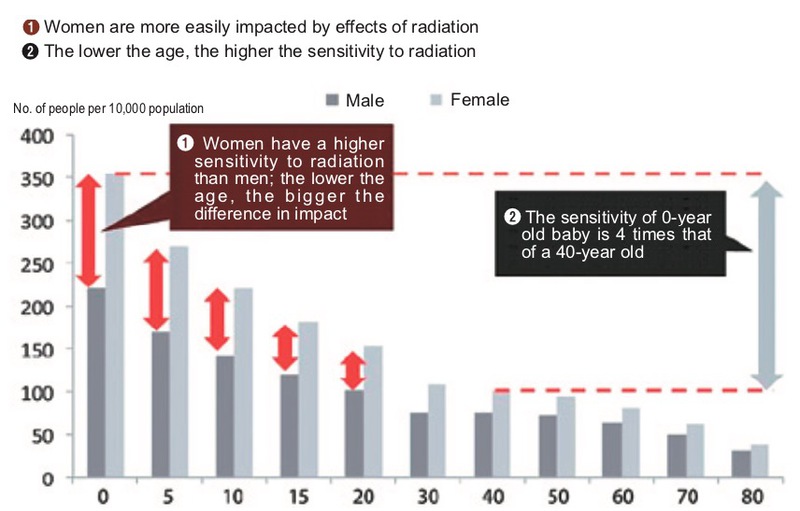
Fig 1. Sensitivity to radiation by age, gender (no. of incidences of cancer among population of 100,000 people) (NAIIC Report)
Hirano: I’ve heard a lot of concerns regarding the 20mSv standard itself, but I understand that it’s also dangerous to apply the standard in a uniform way regardless of differences in age and gender — particularly to children and those who are pregnant.
Sakiyama: That’s true. I believe the standard should be lowered from 20 to at most 1 mSv for women, anyone who may become pregnant. Of course, the lower the better.
Hirano: In Japan, is the limit of radiation exposure differentiated by age or sex?
Sakiyama: In general, yes. Those under 18 years old are not allowed to enter radiation-controlled areas.
Hirano: I see. But when it comes to the return policy, I take it there is no differentiation, is there?
Sakiyama: Exactly. None at all. It’s what we call ‘Fukushima discrimination’. Considering the radiation level, I believe some parts of Fukushima prefecture should really be treated as a radiation-controlled areas. Such areas are usually identified and fenced off. As Dr. Koide Hiroaki has also stated, simply staying overnight, let alone living a regular lifestyle is impossible in such a dangerous environment.3
Hirano: Obviously, the central government does not acknowledge the risks associated with its return policy, does it? So far 199 children and young adults have been diagnosed with thyroid cancer or suspected malignancy, haven’t they?
Sakiyama: That’s right. Among them, 162 have been already confirmed as malignant, and one of these was diagnosed as benign after operation. (As of June 15th 2020, 195 people received definitive diagnosis of thyroid cancers after undergoing surgery. See the Table below).

Fukushima Medical University examined thyroids of children in Fukushima who were 18 years old and younger at the time of accident. Examinations will be carried out every two years until they are 20 years old, and every 5 years after that. The screening flow chart is shown in Fig.2.
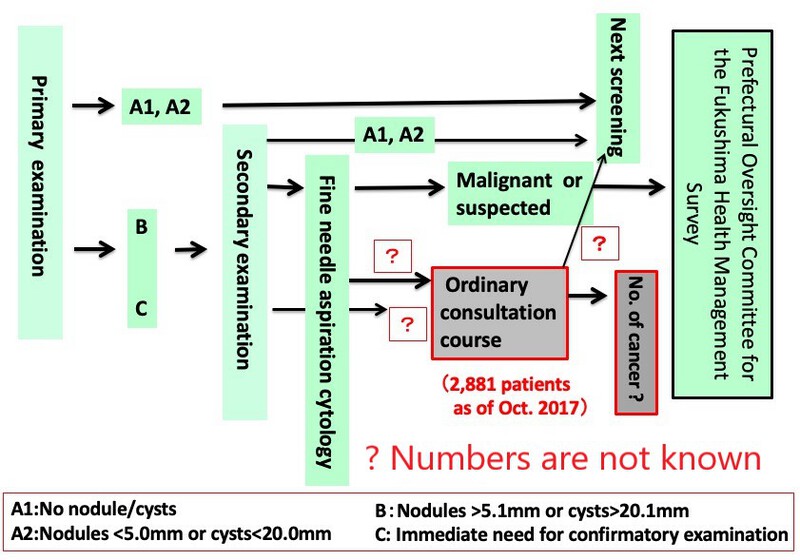
Fig 2. Thyroid screening flow chart. The ordinary consultation course (the surveillance course) was not made public until March 2017 when the 3.11 Fund for Children with Thyroid Cancer announced that a boy who was 4 years old at the time of the accident had been operated on at Fukushima Medical University. His case had not been reported to the oversight committee. As of October 2017, there were 2,881 patients who underwent this ordinary consultation course, but they were neither covered by the Fukushima Health Management Survey, nor reported to the oversight committee even after being diagnosed as malignant as a result of surgery.
Hirano: Early on there were some scholars who disputed those findings. They claimed that more cases are cropping up simply because of more aggressive screening with ultrasonic examinations, so that the high numbers are driven by new screening technology, and are unrelated to radiation exposure from the nuclear disaster. Please tell me your thoughts on this.
Sakiyama: In the first round of screening, a total of 116 children, out of roughly 300,000 children tested, were suspected of having thyroid cancer. That is a thyroid cancer rate dozens of times higher than usual over a 2-year period. Yet, these scholars still dismiss the link between this unusually high occurrence of childhood thyroid cancer and radiation exposure, and insist that it was the result of “mass screening.”
In fact, by that time just 10% of the first round of screening had been completed, Dr. Yamashita Shunichi had already noticed that cancer rates had spiked, with 3 confirmed and 10 suspected cases. So he had to come up with some explanation for the findings. He announced that it was due to the “effect of mass screening” and not an epidemic. I believe the announcement was actually made right on March 11th, 2013, at an annual meeting of the NRC (U.S. Nuclear Regulatory Commission) in the US.
Hirano: Which means that Dr. Yamashita and his colleagues were working from the beginning to establish a discourse, even in international spaces, that the Fukushima disaster had done nothing harmful to the human body.
Sakiyama: Exactly. It was a discussion with a foregone conclusion. The decision had already been made before the screenings had even begun. Even after it became clear that thyroid cancer incidence rates in the affected areas were several tens of times greater than the national average, they insisted that it was due to the effects of mass screening.
However, during the second round of screening, they began seeing some results that were not normal, and could not be explained by the mass screening effect. At this point some of these medical experts started voicing concerns about the possibility of “over-diagnosis.” By “over-diagnosis” they mean that they examine cases that would not otherwise cause symptoms or death during a patient’s ordinarily expected lifetime. But, these concerns weren’t coming from clinicians – they were from epidemiologists such as Dr. Tsugane Shoichiro, the director of Research Center for Cancer Prevention and Screening, National Cancer Center Japan, and Dr. Shibuya Kenji, the Visiting Professor of the Department of Global Health Policy, Graduate School of Medicine, the University of Tokyo.
Dr. Tsugane said that in general, thyroid cancer has an appropriate prognosis, but by over-diagnosing children, they might be subjected to unnecessary surgeries. This would eventually give them not only scars on their necks, but also the stigma that they had developed cancer due to radiation exposure. He warned that it would probably affect their eligibility for cancer insurance, and they might face discrimination in marriage or other contexts for having been exposed to radiation. He argued that there is little merit in examining children, and suggested reducing the thyroid cancer screenings in Fukushima. Actually, it is official policy that is now moving in this direction with scaling down thyroid screening all together.
On the other hand, Dr. Suzuki Shinichi, professor of thyroid surgery at Fukushima Medical University, who has operated on most thyroid cancer patients at the university, refuted the charge of over-diagnosis. He presented evidence at the Japanese Society of Thyroid Surgery that among 145 patients who were operated on, about 78% had lymph node metastasis, and about 45% showed invasive growth. Based on these facts, he said that over-diagnosis is unlikely.
Hirano: It sounds like they are appropriating a discourse about discrimination and prejudice in order to confuse the issue of radiation and cancer, and sweep everything under the rug.
Sakiyama: Exactly. As you know, Dr. Yamashita is unfortunately an influential figure in the Thyroid Association. At first, he used to say that it was necessary to conduct thyroid cancer screenings, but now he has become one of the loudest voices advocating scaling down the program.
There was an International Experts Meeting last year in Fukushima, and after the meeting Dr. Yamashita and Dr. Niwa, the Chairman of the Radiation Effects Research Foundation, made a recommendation to the governor of Fukushima Prefecture. In their interim report Dr. Yamashita and Dr. Niwa stated that it was difficult to find a link between the cancers found through the screenings, and radiation exposure. They suggested curtailing the screenings, not stopping them altogether but making participation “voluntary.”
One justification for this was the so-called theory of fetal thyroid cell carcinogenesis that was introduced by Dr. Takano Tōru of Osaka University. According to him, young children develop a higher risk of thyroid cancer because thyroid tumor cells are derived directly from thyroid fetal cells, which exist only in fetuses and young children, and the fetal cells possess cancerous characteristics; however, the tumors from these immature fetal cells in the young diminish during infancy and stop growing altogether after middle age. Therefore the prognosis is excellent and the process does not progress to cause cancer deaths.
On the contrary, he continued, if you develop thyroid cancer in the middle or old age, the tumor cells undergo sudden proliferation, which can lead to cancer death. Therefore, he concludes that thyroid cancer in young children should be left undiagnosed.
I did not know much about thyroid cancer, but since Dr. Takano talked about his new theory so confidently, I studied it quite a bit. What I learned was that Dr. Takano is the only person who actually advocates this fetal thyroid cell carcinogenesis theory. Yet he has not published any paper on the isolation and characterization of the fetal thyroid cells.
Kasai: You mean he is the only one in the entire world?
Sakiyama: Yes, but he is so self-confident in his theory that he claims that the problem is that everyone has fallen behind his new scientific findings. If you propose this theory, however, you should first find a fetal cell, and then characterize it. That is the path a researcher should take, but he does not seem to be doing this. I have been checking his papers, and they seem to all be hypothetical. If we imagine that there is such-and-such, one can then imagine that there is so-and-so, and therefore fetal thyroid cell carcinogenesis exists. There is no experimental evidence.
Hirano: Do you mean that without any experimental evidence, he has been arguing thyroid exams, which have a crucial role in monitoring children’s health, should be scaled down?
Sakiyama: Exactly. And a person like him was appointed as a member of the Prefectural Oversight Committee for the Fukushima Health Management Survey.
I am sure you heard about Dr. Yamashita telling Fukushima residents to smile and relax at a public meeting right after the nuclear accident. He said to his audience, “Radiation does not affect people who are happy and smiling. The effects of radiation come to you if you worry about it. This theory has been proven by experiments on animals.”4
Hirano: Yes, I know he was criticized in the media for being flippant. Such a dismissive remark was beyond acceptable, they said.
Sakiyama: That is right. Unfortunately, it did not end there. Just recently Dr. Takano gave a lecture in Osaka, and it was uploaded to YouTube, so I watched it. You wouldn’t believe what I heard in the video. At the beginning of the lecture, Dr. Takano mentioned Dr. Yamashita’s remark and praised him for it. “Professor Yamashita really knows what to say.” 5 When I heard this, I was at a loss for words.
I heard that knowledge of Dr. Yamashita’s remark spread all over Japan but also overseas. Someone actually made it into a cartoon.6
Kasai: A satirical cartoon.
Sakiyama: Yes! How can Dr. Takano possibly say, “Dr. Yamashita really knows what to say?” It is beyond my comprehension.
Hirano: What has always seemed strange to me is that Dr. Yamashita visited Chernobyl more than 100 times and has been deeply involved in medical aid projects there, well before the Fukushima nuclear disaster. As you mentioned, he is considered Japan’s number one authority on radiation health. It is hard to comprehend that a person like him, who has seen the health effects of the Chernobyl incident first-hand, has been so active in trying to cover up the health risks associated with radiation exposure.
Even in Chernobyl, early on there was a cover up of the effects on human health, and some used the idea of over-diagnosis to downplay the risks. He would have witnessed it all.
Sakiyama: Exactly.
Hirano: He must have seen that there was a large increase in the cases of thyroid cancer after the disaster, and that the governments of the Ukraine and nearby countries were forced to admit the various health problems stemming from the accident. When it comes to Fukushima, however, Dr. Yamashita is using the same methods used by the Soviet Union to continue to hide those problems. What do you think of this from a scientist’s perspective?
Sakiyama: I don’t think he is taking a stance as a scientist. I feel that he has abandoned science. So many people ask me why Dr. Yamashita acts the way he does and what his intentions are, but I tell them that people who take science seriously and value ethics have no answer for that question.
I remember, however, that he said once that he has a hard time saying ‘No’ to whatever the central government wants.
Hirano: Oh, I also remember that. He said something like, “As a Japanese, I cannot say no (to the government).”
Sakiyama: That’s probably a reason why he sticks with the central government. He has told his audiences that absolute truth lies with the government. He is now serving as vice president of Fukushima Prefectural Medical University, so it seems likely that he will keep covering up one thing after another and just go along with what the government says.
Kasai: So I believe you are saying that some kind of hypothesis, or a pseudo-hypothesis, about how thyroid cancer develops has appeared that deviates from the fundamental methods of science and medicine, and is being disseminated to society in a way that deviates from the normal rules? Furthermore, you’re also saying that this discussion seems to have taken on a political dimension.
Sakiyama: Right. It has been exploited for political gain.
Kasai: Yet, when they give explanations to the general public, they make use of their statures as an expert in medical science.
Sakiyama: That’s right.
Kasai: So, ordinary citizens like us, are told through the media that experts in this field are saying this or that and come to think ‘oh, radiation has been scientifically proven to be safe, or not dangerous’ and ‘20 mSv/yr is not something to worry about.’ That’s how we have been producing a social consensus about radiation risk.
Sakiyama: Absolutely. I just don’t understand why they are doing it and what their motivations are. Dr. Yamashita already had plenty of social status as vice president at Nagasaki University. But it was obvious that he lied about a 4-year-old boy who had developed thyroid cancer. He at first decided not to make the case public, but when we announced it, he finally came clean.
In fact, one journalist interviewed him and asked why he wanted to hide the case,. Dr. Yamashita answered, “I am not able to say anything unless it is announced officially.” But even as he said that, he had officially announced that there were no cancer cases among children 5 years and under.
Hirano: He obviously contradicted himself.
Sakiyama: It is ridiculous, isn’t it? By the time the interim report was being compiled, it had become clear that there was an incident of thyroid cancer in a 5-year-old child immediately following the accident. He ignored that case, however, and decided to announce that there were no cancer cases in children ages 5 or younger. He used that claim as the basis on which to dismiss the link between thyroid cancer and radiation to other experts. .
Hirano: I see. You mentioned earlier that 162 children (as of June 15th, 2020, 195 children) have been confirmed to have contracted thyroid cancer, but how well known is this in Japan?
Sakiyama: Well, this might sound strange, but not many people even in Fukushima are aware of this.
Hirano: People in Fukushima do not know?
Sakiyama: No, they don’t. I visited a recuperation center last year, and met about 10 mothers there. You may assume that these families, who sent their children to a place like this, are likely to be particularly concerned about radiation, but surprisingly, none of the mothers knew about the high prevalence of childhood thyroid cancer. I was just shocked.
I was trying to understand why, and I realized that people in Fukushima get their information mainly from local news sources, such as Fukushima Minpō (福島民報) and Fukushima Minyū (福島民友) newspapers, and Fukushima TV or other local television channels.These do not take up this news as major stories.
Hirano: The local media don’t report such facts?
Sakiyama: Right. These mothers also shared with me that they kept it secret from neighbors and even relatives that they were sending their children to a recuperation facility. They were afraid that they might be criticized or labeled as oversensitive about radiation exposure, so they just told people that they were going on vacation, not mentioning recuperation at all.
I was also surprised when we went to Koriyama City Hall to see if our organization, 3.11 Fund for Children with Thyroid Cancer,7 could leave some application forms at the front desk. As a matter of of fact, the city of Koriyama has the highest incidents of childhood thyroid cancer, along with places like Iwaki. But the Koriyama city officials had no idea. When we told them about the rising number of cancer cases, they were shocked, and even panicked.8
Kasai: In other words, even in this region where the cases of childhood thyroid cancer are actually occurring, the people in charge of the local government are not aware of the facts.
Sakiyama: Exactly. This is happening in Fukushima, so in other prefectures they know even less.
Hirano: Were the children who developed thyroid cancer living in the so-called evacuation areas at the time of the nuclear accident? Were they exposed to the meltdown for some period of time before they were able to evacuate?
Sakiyama: There is geographic variation in cancer rates. Professor Tsuda Toshihide of Okayama University divided the prefecture into 9 areas, and that division reflects the external radiation dose to some extent, Based on his findings, radiation exposure as a factor behind the rise in thyroid cancer.
On the other hand, there is a paper written by Dr. Suzuki Shinichi and Dr. Ohira Tetsuya, who compared childhood thyroid cancer prevalence in three regions, and argued that those regions did not reflect a correlation between radiation dosage and thyroid cancer. However, their method didn’t pay attention to a variation that existed between high and low dose areas. It won’t tell you anything about geographic variation in radiation dosage. Therefore, the thyroid cancer prevalence appeared random, and they then concluded that there was no significant correlation between location and thyroid cancer.
Kasai: Do you think Dr. Suzuki and Ohira’s research was intentionally designed to draw that conclusion?
Sakiyama: I am not positive, but I feel that this was the case. In the second round of screening results you can see an extremely clear differences across 4 geographical regions in the prefecture: Hamadori, Nakadori, Aizu, and the evacuation zone. This was also discussed at the review committee meeting, and the regional differences became even clearer as more data analysis was done by age and sex. So I don’t think we can deny the effects of radiation exposure.
Hirano: There are also radiation hotspots outside of Fukushima prefecture, including in Chiba, Ibaraki, Tochigi, Gunma, Iwate, and Miyagi. Do you think people, especially parents of small children, should be concerned about the risk of radiation exposure? The government did not take any measurements to protect them, did they?
Sakiyama: No, they didn’t. They focused exclusively on Fukushima and left all the other prefectures on their own.
Within a year of the accident, prefectures such as Gunma, Ibaraki, Iwate, and Tochigi convened an advisory council. Each prefecture summoned experts and let them discuss whether they also should administer thyroid cancer screenings. But these experts came to the conclusion that testing was not necessary, and their decision was reported to the Ministry of the Environment. The final decision was made at the so-called ‘Expert Conference’ held under the aegis of the Ministry of Environment, chaired by Dr. Nagataki Shigenobu, Professor Emeritus of Nagasaki University.9
There were many worried mothers in small communities in those prefectures, however, so some municipal governments have given support for screening sessions. That there are only a handful of such places. Most screenings are conducted by volunteers from NPOs and NGOs with help from concerned doctors, but what they’re doing is just a small-scale thyroid examination program.
They have found one person with thyroid cancer in Ibaraki prefecture.
Hirano: It was in the northern part of Ibaraki near Fukushima, wasn’t it?
Sakiyama: Yes, it was in the north. I believe it was a young child.
As of October 2017 there were 2881 individual screenings conducted which were being observed closely, but it has not been confirmed whether they are thyroid cancer (see Figure 2). We don’t know how many cases have been confirmed as malignant among them. In fact, Fukushima Prefectural Medical University is supposed to be investigating this, but they only count the cases that have been operated at their hospital. Anyone who was operated on elsewhere won’t be counted. Therefore, nobody knows the actual number of thyroid cancer cases in Fukushima.
Even then, they said it would take 2 years to calculate the final number of cancer cases. I don’t understand that because Fukushima Prefectural Medical University has a comprehensive database, and they should know the number right away. But they said they would spend 2 years finding out. The thing is that none of the oversight committee members have complained about this at all.
When the case of thyroid cancer in the 4-year-old was confirmed, the oversight committee must have realized that the data they received from Fukushima Prefectural Medical University did not reflect reality. They found out about the 4-year-old’s cancer case at the oversight committee’s 28th meeting. They met once every three or four months, but they obviously were not notified about this. If I were one of the committee members, I would be furious that such things were being kept secret, and I would start to feel suspicious. I would wonder what the purpose of all 27 meetings had even been. But none of them got angry.
When I heard the news about the case of the 4-year-old, I thought at least some committee members would yell at the government and call the whole thing a sham, or even storm out of the meeting room and quit altogether, but no one seemed to be upset, and they continued to meet as if nothing had happened. I was in total despair.
3.11 Fund for Children with Thyroid Cancer
Hirano: So you witnessed the repeated cover-ups and realized the incompetence of the government in terms of helping the victims. Did you launch the ‘3.11 Fund for Children with Thyroid Cancer,’ out of a sense of urgency about the crisis?
Sakiyama: Yes.
Hirano: Another thing you mentioned earlier that sticks out in my mind was how radiation exposure has become a target of stigma in the public mind, which forces people in Fukushima to be silent about their health concerns. This kind of social pressure is creating a situation where they have to keep going to recuperation centers secret, and they even hesitate to have cancer screenings.
My understanding is that you wanted to relieve some of that pressure for people who are worried about their health and cancer treatment, by providing financial support through the ‘3.11 Fund for Children,’ which is an independent, not-for-profit organization, for people to actually get access to screening. Is that right?
Sakiyama: That’s right. We have held many meetings and lectures, but we noticed that we tended to get the same audience at these kinds of events. Then we started to look for a way to reach out to those in need of help, and we realized that children with thyroid cancer and their families have often been isolated by not knowing where to go and how to get help. They are also burdened by the medical expense of repeated examinations and hospital visits, and some patients will require a lifetime of medical care. We all agreed that these are the people we really want to help and we were looking for a way to reach them.
We felt that meetings and lectures weren’t getting us anywhere, so we talked with several people and came up with the idea of giving money. At first, we felt uneasy about giving support in the form of money, but it is the only option to help those who tend to be isolated.
Hirano: You have said that there are actually eight more cases of pediatric thyroid cancer apart from the 199 children and young adults who have officially been diagnosed with thyroid cancer or suspected malignancy. Did those people contact the organization by themselves to ask for support after hearing about the ‘3.11 Fund for Children’?
Sakiyama: I believe so. We posted a full-page advertisement about ‘3.11 Fund for Children with Thyroid Cancer’ in the Fukushima Minpō (福島民報) newspaper, which cost nearly one million yen. People contacted us then, and since that time NHK has been following our activities. Every time we hold a news conference, they broadcast it nationwide, so we have received a lot of inquiries and applications as a result of media coverage. For example, a grandmother was watching NHK news and applied to the fund for her grandchild who had developed thyroid cancer.
By the way, people who have come to mistrust Fukushima Medical University don’t want to get their screening there, so of course they won’t be counted in official statistics. So even if Fukushima Medical University publishes the number of cancer cases they see, we still do not have the real count.
Hirano: Could you explain to readers what internal radiation exposure is and how it occurs, since it is understood to be the cause of cancer?
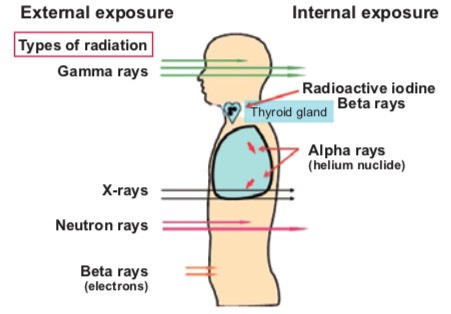
Fig.3. External and internal exposure.
Sakiyama: Internal radiation exposure occurs when radioactive material gets inside your body and irradiates you from the inside, This may happen through the air while there was a plume of radioactive material, or by consuming contaminated food and water. External radiation exposure takes place when radioactive substances are outside of the body (see Fig. 3).
In general, external radiation exposure does not occur with alpha and beta rays because their tracks of radiation are very short (alpha ray: about 4μm, beta ray: several mm) and are not likely to pass through the skin. For example, even if there were plutonium emitting alpha radiation in front of me right now, I wouldn’t be exposed to radiation.
Once radioactive materials emitting alpha or beta rays get inside the body, however, they stay there for a long period of time, which increases the chance of DNA damages and cell death, because inside the body cells and tissues are next to the radiation and are exposed directly to alpha or beta rays.
As far as the relative biological effectiveness (RBE), the ratio between the dose and the ultimate biological effects, alpha radiation is about 20 times more damaging than beta, gamma, and X-rays. Furthermore, the half-life of plutonium is 24,000 years, and it’s insoluble in water. Therefore, if plutonium gets inside your body, you will be irradiated for the rest of your life.
In order to assess health hazards to the human body caused by both internal and external radiation exposure, we measure in mSv (millisieverts). We assumed that radioactive materials are spread inside the body fairly uniformly when we try to calculate the damage. That’s why it is very difficult to figure out the actual health effects.
For example, tritium emits very weak beta rays, which do not have enough energy to travel very far in the air and to penetrate the skin, so it is believed not to be dangerous externally. But tritium is a radioactive form of hydrogen and can become incorporated into DNA. When that tritium decays into helium, it causes the DNA strand to break.
Tritium exposure used to be considered a low, or level 1 risk, due to its weak beta radiation energy, but now some scientists argue that the risk could be 6 times higher than was originally thought.
So, the issues remain contested. But some reputable researchers claim that internal exposure poses a significant health risk.
According to Dr. John William Gofman, a renowned physician and nuclear/physical chemist, there is not much difference in terms of health effects on humans between internal and external exposure, given the same radiation doses. I agree. But the problem is that we don’t know exactly whether the dose coefficient of radioactive substances that we use to convert a unit of pure radioactivity (becquerel: Bq) to a medically effective dose (sievert: Sv) is right or not. For instance, the dose coefficient used to calculate Sv equivalent to 1Bq of Cesium 137 is based on the assumption that Cesium 137 is distributed evenly in the human body as in the case of water. However, when Cesium 137 becomes particulates, this assumption breaks down because they are insoluble. Then dose coefficient itself may not be accurate.
Hirano: What about the campaign to get people to buy and eat food from Fukushima? It’s been going on for a long time as an expression of moral and economic support, with slogans like “Let’s Help Fukushima” and “Hang in There Fukushima!” (ganbare Fukushima!). The discussions have been carried on in the context of the possibility of internal radiation exposure, and also involve the issue of economic damage caused by harmful rumors (風評被害) about the dangers of Fukushima food.
As a medical scientist, what position do you take on Fukushima produce? Do you think people should avoid eating it as much as possible? Do you think it is okay to consume as long as each item is inspected?
Sakiyama: This is a major question. Fukushima prefecture does conduct repeated inspections and testing on all their foods more thoroughly than surrounding prefectures such as Ibaraki, Tochigi, and Gunma. So, I hope that most of the Fukushima products sold on the market do not exceed the standard limit of 100 Bq/kg. But that still means foods with dozens of becquerel have been going into the market. Recently a group held a conference on the level of food contamination. They concluded that there are essentially no items from the prefecture that exceed 100 Bq/kg, and the highest is around 50 to 60 Bq/kg. Despite the fact that they are inspecting their foods, that fact makes me feel very uneasy . For example, it takes about 120 days for Cesium-137 inhaled or ingested by an adult to reduce the biological half-life. If someone takes 10 Bq/kg into the body everyday, it amounts to about 1400 Bq in a year. If 40 Bq/kg, it will be 5600 Bq. This is a very high number that might cause a serious health issue like cancer. That’s why I have suggested to officials in Fukushima that they lower the cesium contamination limit to 20 Bq/kg from 100 Bq/kg. However, they are unwilling to do so.
Hirano: Is it because in reality, a great deal of Fukushima produce exceeds 20 Bq/kg, so they might not be able to sell anything if they set 20 as the new standard?
Sakiyama: It could be, but I don’t think they would have nothing to sell if the limit were 20Bq/kg. Because Fukushima prefecture has been saying that their food is safe, I said that if the government standard is 100 Bq/kg, surely they can do even better with 20. But they did not go for it.
Once I really upset officials with that suggestion. There was a conference where a Fukushima official was coming to give a talk. I wanted to get some information from him, so I attended the lecture and asked about the possibility of lowering the standard. Of course, I had no intention to offend him, but he got so upset with my suggestion that he told the organizer that the prefecture would no longer send anyone to lecture to that group. (laughs)
Kasai: What do you think is the reason those people from the government found your suggestion so offensive?
Sakiyama: The group that invited the official from Fukushima prefecture is called “Skilled Veteran Corps for Fukushima.” They are older volunteers, age 60 and up, who are retired workers from Fukushima, including engineers and technicians who formerly worked in the nuclear power industry. They have signed up to help clean up the contaminated Fukushima plant in order to protect and replace younger workers, since they are not as concerned about exposure to radiation.
I think that the officials had trust in that group and were willing to come to talk to them. Maybe they did not expect to be questioned about their policy, particularly by an outsider like me. But anyway, they became upset and told the group that the prefecture would not send anyone anymore. I feel bad for that volunteer group!
Hirano: But I think it is true that we, consumers, have concerns about the safety of Fukushima produce. Any food under 100 Bq/kg are considered to be safe, and sold in stores, right?
Sakiyama: Exactly.
Hirano: Whenever I go to a supermarket in my hometown, Ibaraki, there is a special section with fresh produce from Fukushima. Every single package of fruits and vegetables has a sticker on it, which says ‘inspected.’ These products actually look very good, but often are left unsold. I think that consumers are not quite convinced of their safety and they hesitate to buy them.
I believe that a sense of distrust towards the government is still there in the consumers’ minds, and that it has something to do with the safety standard for radiation in food. There is a big difference between 20Bq/kg and 100Bq/kg.
Sakiyama: I agree. There are many independent, citizen-run food testing labs, such as COOP’s ‘pal system’ and ‘seikatsu club.’10 I heard that certain food items, particularly shiitake mushrooms, continue to contain at least 4 or 5 Bq/kg, so the ‘pal system’ decided to stop carrying wild shiitake mushrooms altogether.
Also, some farmers treat their contaminated soil with fertilizers based on potassium chloride in order to prevent their crops from absorbing cesium, but that does not prevent farmers from being exposed to radioactive material while working in the field. You would expect farmers to carry a dosimeter, but they don’t have dosimeters at all.
In fact, I feel the risk to farmers and decontamination workers is likely greater than for those working at the site of the nuclear power plants. They inhale dust with radioactive materials, and that puts them at risk for both internal and external radiation exposure. But they don’t even measure radiation doses.
When I think about the impact of radiation on human health, I feel that Fukushima is going to face a very tough future.
Cover-up Culture and Social Pressure
Hirano: I see. There are two things to note here; one is the systematic cover-up practices of the government, and the other is the so-called social pressure that makes victims unwilling to talk about radiation concerns in public. When you think of Fukushima’s current situation and the possible health consequences of the incident, which of those do you think poses a more serious problem to society?
In other words, is it more important to build a society where people can say well, I may be seen as strange for this, but I am worried about my child’s health, so they can be open about discussing ways to protect children’s health? Or is it more crucial to try to change the cover-up practices of the government — which, honestly, I don’t really know is possible? Of course, both of these things should change.
Which change should come first in your opinion?
Sakiyama: Well, it is citizens who can change the government. For example, the Education Ministry initially did not even acknowledge the recuperation program for children in Fukushima, but as more private individuals got involved through NGOs and other means, and people in Fukushima petitioned for financial assistance, the government finally had no choice but to agree to fund the program.
There is no way that the Education Ministry would have changed right away without pressure from citizens. And there is no way that the Ministry of the Environment will change without pressure from citizens. We need to make it happen. We are the ones who elect public officials.
So, I think that citizens will have to change and initiate movement in politics and government. I agree with you that change will not start with the government; it will not abandon the cover-up by itself. For example, can you even imagine the possibility of the International Nuclear Power Village (changing its course?) Maybe if they were broken there may be a change, but I don’t think it’s possible considering how powerful the organization is.11 The only possibility left is that we, citizens, change politics through our own actions.
The Japanese public now favors phasing out nuclear power. And Japan’s renewable energy industry has been growing rapidly.
Have you heard about an organization called Genjiren (原自連)? It’s an antinuclear, pro-natural energy confederation. The ‘ji’ 自actually refers to natural energy (自然エネルギー).
Kasai: It must be named to contrast with Denjiren (電事連), the Federation of Electric Power Companies of Japan.
Sakiyama: Exactly. Genjiren is headed by Mr. Kawai Hiroyuki, a lawyer; former Prime Minister Koizumi Junichiro; and Mr. Yoshiwara Tsuyoshi, a former president of Jonan Shinkin Bank. Indeed, the renewable energy market in Japan has been growing very vigorously over the past decade.
There are various sites throughout Japan that generate electricity on a small scale. I heard that altogether there are more than 500 of these nationwide. If we continue to promote and invest in renewable energy, there is a chance to create a largely non-nuclear and fossil fuel-free future.
Running nuclear energy is almost too expensive considering capital costs for building nuclear plants, the challenges of disposal of nuclear waste, and the risk of meltdown. So we have to keep spending money in order to sustain nuclear power, not to mention the cost of decontamination after the accident. It would be a disaster to discontinue the decontamination work due to lack of money. It’s time to just end the whole nuclear business – you know, like they say, “when poverty knocks at the door, love flies out of the window.” (laughs)
Right now the government seems to have money and keeps throwing it at general contractors. The thing is, though, these construction companies have made so much profit building the nuclear power plants, and after the accident they have made huge profit through decontamination work. How terrible is that?
Hirano: I agree. In English, it is called Disaster Capitalism.
Kasai: It is 災害便乗資本主義 (saigai binjō shihonshugi) in Japanese.
Sakiyama: That’s right. Exactly.
Hirano: They can fail and still make a profit.
Sakiyama: Actually, I believe that it is badly poisoning Fukushima. The decontamination work keeps some tiny share of money flowing into the prefecture, and it also provides employment opportunities for those who are over 18 years old. Considering how scarce jobs are in that area, the decontamination work has been giving them plenty of steady job opportunities.
A friend who is a physician told me once that young people, after graduating from high school, come to her clinic seeking health screening. They want documentation to prove they are healthy enough to work at the decontamination sites. My friend tells them that it’s a bad idea, but they say there’s no work, so they end up working there anyway.
Scientists and Civic Engagement
Hirano: I would like to move on to the next question. What kind of role do you think a scientist with specialized knowledge should play in civil society? This has to do with what you have been doing through the Takagi School.12
Mr. Kasai and I were talking about this before this interview – until recently neither of us have read through scientific journals. At first, they seemed to be rather difficult for people like us, with so little science background. But after the nuclear disaster, it seems that some scientists who have strong social and civic consciousness started to publish very accessible papers in science-related journals. As we moved forward with this Fukushima interview project, we came to realize how important the role of these scientists has been in providing their knowledge to the general public in order to build a democratic civil society going forward. What kind of social role do you think those who have expertise in medicine and science should play in the future?
Sakiyama: The most important thing for us, in my opinion, is education. Education is the top priority. However, the Education Ministry is in charge of education, and they promote myths about nuclear power safety right from elementary school. We really need to figure out how to deal with that.
The anti-nuclear movement has simply have not been involved in doing something about education. There are a few teachers who are interested in nuclear energy education, but they are an absolute minority. Still, we decided to team up with some educators and formed an organization called the Committee for Nuclear Power Education 原子力教育を考える会, and in around 2005 we created a website “Understanding Nuclear Power”「よくわかる原子力」.
The Takagi School hosted some public lectures about nuclear energy and environmental education, and teachers from all over the country made presentations. We decided to form a group, the Committee for Nuclear Power Education.
We wanted to counter the Ministry of Education, for example by writing our own textbook, but then we realized that we didn’t have enough financial resources to do so successfully. It can get very expensive when we consider the expenses associated with publishing textbooks, such as printing costs and so on.
Then we agreed that the best way would be to create our own webpage, and, actually, my daughter helped get it started.
We also needed to figure out a way to make our information available for lessons at school, so I gave some suggestions to teachers as to what information we’d like them to introduce in classrooms. But they said that they couldn’t use it, since what they can teach during lessons is pretty restricted due to educational guidelines, and they know those restrictions very well.
They are required to write lesson plans, and they said their principals would not approve the plans if the teachers put it in the plans, so the only way to get our information or messages across for them is to walk that fine line somehow.
Then we decided to produce a set of educational DVDs called “What’s REAL about Radiation” (放射線のホントのこと) for classroom use for junior high and high school students. The first volume, ‘What is Radiation?’ covers the scientific aspects, including what exactly happened in Fukushima, how radioactive materials spread in the air, what kinds of effects radiation can cause to living things, and what we should do to protect ourselves from radiation exposure.
The second volume, ‘What is going on in Fukushima now?’ focuses more on social consequences of the disaster in local communities and social issues faced in Fukushima. In order to introduce ‘real voices’ from Fukushima, we visited various places throughout the prefecture, conducted interviews, and compiled them, along with some photos of the current situation in the evacuation areas, as well as of the millions of bulk bags full of radioactive soil stacked in huge piles.
As you know, even seven years after the Fukushima disaster, people are still being exposed to radiation from radioactive fallout. The victims are still suffering, but these struggles have been largely neglected. We have less and less media coverage on Fukushima. So, it is our hope that the DVDs will give children a chance to learn about not only what has happened and what is happening in Fukushima, but also what radiation really is and what they should and can do to protect themselves.
Children don’t know about these things. In order for teachers to use these DVDs in the classroom, we managed to make each of them about 20 minutes long. They come with supplemental worksheets that help teachers give more detailed explanations and encourage classroom discussions. But the reality is that very few teachers use them in the classroom.
The video created by the Education Ministry is up online, so anyone can watch it. Have you seen it? It’s awful. I have to question if it is even okay to teach the things it claims.
One member of the Committee for Nuclear Power Education had an opportunity to visit Belarus and learn about how children learn about radiation after Chernobyl. I believe the school he visited was one of the more liberal institutions, but according to him, preschoolers were taught through a kind of a fairy tale.
The story goes like this. There was a castle. One day the fireplace at the castle was broken and a radiation queen popped up and ran outside of the castle. Her henchmen also got out and are hiding inside food. So do not eat such food. Or wash the food before eating it, or cook the food before eating it.
That’s how they teach small children to protect themselves from radiation. They seem to focus on training children from a young age to be able to protect themselves without parental help and give them the knowledge they need to keep healthy.
When I went to Ukraine as a member of the National Diet of Japan Fukushima Nuclear Accident Independent Investigation Commission, I noticed that they don’t really treat radiation as something special. Instead, they talk about radiation along with other dangers in daily life. What do you do if there is a burglar, or what do you do if there is a car accident, and, right along with that, what do you do about radiation. They teach it as a normal part of protecting your body.
From that perspective Japanese children are totally vulnerable when it comes to protecting themselves. All they have heard about radiation is that no one can avoid it since radiation is everywhere, and is useful in various fields including industries and medicine. They are also taught that the risk of radiation less than 100mSv is equivalent to lack of vegetables or exercise — without showing any evidence for such claims. The message is that a low dose is okay and there is no need to worry about radiation anymore.
Have you heard about a new information and learning facility, called “Comyutan Fukushima” コミュタン福島? The Fukushima prefectural government opened it in Miharu town as a part of the Center for Environmental Creation in 2016.
They claim that the facility teaches visitors about radiation and Fukushima’s environmental restoration activities through interactive fun activities, such as games, crafts, and a simple science experimenta.
In my opinion, however, what they are trying to do is to instill inaccurate knowledge about radiation. Their main message is that we are all surrounded by naturally occurring radioactive materials on a daily basis, and we are also exposed to man-made radiation such as X-rays; therefore, there is no need to worry about what happened in Fukushima. This is nothing but brainwashing, which is making people, especially children and young people, defenseless against radiation. It is very dangerous. The young will not know how to protect themselves from radiation, and in the end, they will suffer health effects if something happens.
Hirano: It sounds as if safety is being abandoned to a myth of safety. This has to be the most serious adverse effect of the safety myth on individuals.
Sakiyama: Absolutely.
Hirano: So, contrary to Comyutan Fukushima, Belarus has successfully created an educational program that teaches children the risks of radiation very clearly, so they will learn how to protect their own safety.
Sakiyama: Yes.
Hirano: Where do you think such differences are coming from?
I don’t want to draw a conclusion just on the basis of cultural comparison. But as you mentioned earlier, in Japan, in particular among mothers with young children, it has become almost taboo to talk about concerns about the effect of radiation on their children’s health.13 I have to wonder why this kind of social phenomenon is happening.
Do you think it has something to do with a low level of awareness of rights to wellbeing in Japan? In other words, do you think the problem comes from a lack of public awareness that we have right in order to protect our livelihood or ourselves?
Sakiyama: I think so. In general, Japanese people have a low awareness of human rights.
Kasai: I agree. It’s indicated just in the word itself, Okami お上,14 we are not used to critically examining what the authorities say and then making our own judgments. That is one thing that is lacking in our education system. This has been a problem in Japan even before the nuclear power accident. I feel that more people ought to be angry with the current political situation in Japan. You know, if a burglar broke into your house and stole things, you’d be upset, wouldn’t you? But even though it’s widely discussed that the taxes you paid have been misused, a lot of people are not upset about it. In some sense, I feel that people’s engagement with public affairs is weak. So it seems to me, as you pointed out earlier, that this is the result of something that has been perpetuated in society through our education over the years, rather than coming from some essentialist notion about Japanese culture.
When we asked earlier what kind of role scientists should play in civil society, you answered that it should be in education. As an educator myself, I totally agree. I feel that the problem is serious and there is a need for change.
Sakiyama: By and large the people who have been diagnosed with thyroid cancer do not seem to be angry with the central government or TEPCO, who are responsible for the nuclear disaster. Instead, they have been trying to hide from the public.
The other day some members of FOE (Friends of the Earth International) from Germany came to visit us, so I asked what they thought of this. They said if it were in Germany, the thyroid cancer patients would be very angry for sure, and file a suit to get compensation.
I would really like to tell them that they are the victims, and that they should not feel ashamed at all for having gotten thyroid cancer. It is the central government and TEPCO that should be ashamed and held accountable. Unfortunately, it’s the opposite of that, since most victims are still living in the shadow of the nuclear disaster.
Hirano: That is what I have been very concerned about. Really, society should be supporting these socially vulnerable people, but that is not the society we have in Japan. Instead, they have to face the stigma attached to radiation exposure, and the victims fear becoming the targets of social opprobrium if they speak out. This is causing them to suffer from fear and psychological trauma. All these factors have led to a situation where the victims are pushed into a corner and forced into hiding. That’s what most worries me.
These massive cover-ups from the government are not new or uncommon, especially as relates to nuclear power, even outside Japan. But the fact that citizens are creating social pressure against the victims means that citizens are taking the side of the government without even realizing it, and is building a structure of discrimination and oppression.
Kasai: As you mentioned earlier about Ukraine and Belarus, we should have a more active debate regarding both social issues and scientific subjects such as radiation. We only have one interpretation that is widely circulated and shared. What we need, at a minimum, is to introduce other views on the same footing, and then listen to and discuss them thoroughly before making a judgment.
If we don’t exercise a process like that, we won’t be able to break our patterns of uncritically accepting whatever teachers say, or whatever the government or other authorities say, and we’ll have no other recourse even if we think something is troubling. I think this is a very important issue we Japanese face.
Sakiyama: I agree with you. In that sense, it is imperative that scientists work very hard not to just get on the good side of the government and authorities, but to convey scientific facts and disseminate truth to citizens.
Hirano & Kasai: Thank you very much for speaking with us today.
Notes
1
In Satoyama (里山), mountain woodlands surrounding people’s homes, radiation levels have remained high since the current decontamination process has been mainly limited to residential and farm areas people use on a daily basis. Satoyama is considered a place where nature and people exist in harmony and has been a key part of Japanese village life for centuries.
2
Dr. Sakiyama told us on August 13, 2020 that she had discovered an ongoing experiment to grow crops in one of the most contaminated regions, Warabidaira in Iitate village.
3
See Koide Hiroaki’s point in our interview with him. Koide makes it clear that there is no absolute standard that guarantees “safe” exposure to radiation. Any radioactive exposure, especially internal exposure, poses some risk. It is best to minimize exposure. It is also clear that infants, young people, and pregnant women are particularly vulnerable to radioactive exposure. The Japanese government’s evacuation plans never took this factor into consideration. It is worth noting that in the vicinity of Chernobyl, 20mSv would still be enough to declare a “no-go zone.” The Japanese government has never rescinded the Declaration of a Nuclear Emergency Situation (原子力緊急事態宣言)clause of a law enacted in 1999. This law reflected ICRP (International Commission on Radiological Protection) “post-accident” period standards and took the upper end of that and seemingly made it applicable indefinitely. I thank Norma Field for providing this important perspective on ICRP.
4
Dr. Yamashita made this remark in a lecture held on March 21st, 2011 in Fukushima City. On January 28, 2019, however, Tokyo Shimbun (東京新聞) published an article which revealed that Dr.Yamashita expressed concern to Dr. Yasuda Hiroshi, a researcher at the National Institute of Radiological Science stationed at the off-site emergency response center, stating on the day of the lecture that “there is a possibility that the risk of pediatric thyroid cancer due to the radiation exposure could reach a serious level”. This was recorded by Dr. Yasuda and kept at the National Institute of Radiological Sciences in Chiba City. Tokyo Shimbun obtained the documentation per a request for disclosure of information.
Responding to Tokyo Shimbun in writing, Dr. Yamashita admitted the meeting with Dr. Yasuda on that day and said, “I simply expressed my view that radiation exposure within the exclusion zones immediately after the nuclear accident was very worrisome, and the influence caused by radioactive iodine on children should be most considered.” As for the comment telling Fukushima residents to smile and be happy, Dr. Yamashita explained that it was “a comment made for residents in Fukushima City. No explosion occurred there and no serious situation was anticipated in that city located far away from the nuclear power plant.” He explained that his views regarding the exclusion zones and Fukushima City, outside of the zones, differed. (Reported by Tokyo Shimbun’s morning edition on January 28, 2019)
5
The lecture titled “Ethical problems of thyroid screening test in Fukushima prefectural health survey” was given on April 14th, 2018 in Osaka
6
Witch Doctor Yamashita Shunichi to Head Fukushima Health Study; onlyinamericablogging.blogspot.com
7
The 3.11 Fund for Children with Thyroid Cancer has provided medical expenses to a total of 120 from December of 2016 to March of 2018 with the amonunt of 100,000 yen for each case and additional 100,000 yen for relatively serious patients who underwent reoperative surgery. It also offers an additional 100,000 yen to the people who received RI treatment. The Fund can be used for any puroposes that concern children with thyroid cancer.
8
The city of Koriyama, located at the center of Fukushima prefecture and 43 miles (70km) west of the nuclear power plant, is well outside the area where tens of thousands of people were ordered to evacuate.
9
The Ministry of Environment’s Experts’ Meeting regarding the Issues of Health Management of Residents Due to the Fukushima Daiichi Nuclear Power Plant Accident, chaired by Dr. Nagataki Shigenobu, published its Interim Report on December 2014, and it stated that the higher risks of cancer due to the Fukushima Daiichi Nuclear Accident “cannot be statistically proven.” It also denied the need for thyroid screenings outside of Fukushima by stating that “it is quite unlikely that people who reside in the prefectures surrounding Fukushima have been exposed to more radiation dose than the people who lived in the evacuation areas and such in Fukushima prefecture.” In acknowledging the mounting concern and anxiety regarding thyroid cancer from residents outside of Fukushima, the report concluded that “we first need to take a wait and see stance and see how the Fukushima Health Management Survey ‘Thyroid Ultrasound Examination’ makes progress. Careful explanation of the information gained through individual health consultation, and risk communication, etc. for residents with anxiety about thyroid cancer, are also important.” See the complete Interim Report here.
10
‘Pal System’ and ‘Seikatsu Club’ are both food delivery co-ops that established their own stricter guidelines around food, as well as stricter testing procedures than supermarkets following government standards. These food supplies are well supported by those individuals who feel skeptical about the government doing enough to minimize the risk of radiation to children’s health and distrust in the government’s ability to deal with radiation risk.
11
“International nuclear village” is the term commonly used in Japan to refer to the international network of pro-nuclear advocates who comprise International Atomic Energy Agency, governments, banks, investors, media and academia.
12
Takagi School (高木学校) was founded by a Japanese scientist, Takagi Jinzaburo (高木仁三郎), an internationally renowned critic of the nuclear industry. After graduating in 1961 from the University of Tokyo, he worked for a private nuclear firm and the nuclear institute at University of Tokyo. In his next post, as associate professor of nuclear chemistry at Tokyo Metropolitan University, he started a career of nuclear activism. Leaving the post in 1975, he joined with a group of colleagues to create the Citizen’s Nuclear Information Center (CNIC), a network of antinuclear groups across the nation, and became its head. Takagi conducted numerous research projects and published many books and articles on nuclear issues. His extensive scientific analytical work has contributed greatly to educating the public, media and officials on the threat of nuclear waste, and on environmental protection. In 1997, he received the prestigious Right Livelihood Award, jointly with his colleague Mycle Schneider, for contributions to resolving issues facing mankind, for his work informing the world of the risks and the environment implications of plutonium. In 1998, with the prize money, Dr. Takagi started Takagi School to educate people who aim to be “citizen/alternative scientists” who share concerns held by citizens about the environment, nuclear weapons, human rights and other issues facing the contemporary world. Dr. Takagi passed away in 2000.
13
Concerned mothers, who left contaminated areas, have often been labeled as “radiophobic” or “neurotic” and have suffered ridicule and derision from their relatives as well as their communities for leaving. This phenomenon has led these women to feel isolated and depressed. Moreover, with the layers of stress associated with the nuclear crisis, and disagreements over radiation safety among married couples, a lot of women separated from their husbands, which has led to a trend called “atomic divorce” (Genpatsu rikon) in not only Fukushima but also outside the region. The reality is that, with the loss of essential financial support from the government for evacuees, these mothers and their children have faced severe economic disadvantage.
14
The meaning for O お(御)is honorable, and kami 上means above. Okami generally refers to the Emperor, authorities and government.
This election isn’t just about you, America.

|
Can the world survive four more years of Donald Trump?
From climate change to nuclear weapons to global health — this election isn’t just about you, America. By POLITICO 10/8/20 This article is part of a special report, The Global Election. A second term could set Trumpism in concreteIn the middle of a devastating pandemic, recurring nationwide protests and a bitter presidential election — not to mention the president’s own COVID-19 diagnosis — Americans can be forgiven for losing track of what Donald Trump’s presidency has meant beyond their borders. But the list of changes he has wrought abroad is not short. A world order designed to function through slow consensus and underwhelming compromise, on a good day, has had virtually no coping mechanism for the American president’s disruption. In the name of putting America first, Trump has pulled out of one global deal after another, unpredictably reversing course on some of America’s biggest global priorities and moral commitments. He has snubbed democratic leaders and longtime allies while cozying up to Vladimir Putin and other autocrats. While the most important Western institutions — NATO, the European Union, the United Nations, the World Trade Organization, the World Health Organization — are still standing, it’s an open question whether they will be able to survive another four years of pummeling and disinvestment by the world’s superpower. So, what really happens if the world gets a second Trump term? ………. Here’s what the world should expect if Trump remains commander in chief.
Emissions come back, and America bows outThe climate crisis is a slow-moving disaster that hinges on single pivotal moments. Right now, the global community is planning around the year 2050, when experts say humans need to all but eliminate greenhouse-gas emissions to avoid the worst effects of global warming. But the biggest dates on the immediate calendar are November 3 and 4. Reelecting Donald Trump on November 3 would put America, and possibly other countries, on a new and hard-to-reverse course away from that emissions goal…… his abandonment of the Paris deal is still not official. That pullout will be final on November 4, the day after the election. A second Trump term would likely have a far bigger impact than the first, both domestically and abroad. The president would have more time to defend his deregulatory agenda in court, which could lock in rules that allow more pollution from power plants, leaking oil and gas wells, cars and refrigerants ……… If the United States pulls out entirely, the Paris deal could start to fall apart, much as the earlier Kyoto Protocol climate treaty did without U.S. involvement. Saudi Arabia, whose economy depends on petroleum, has long played a role in trying to unpick the U.N. process from within. Some diplomats worry the Saudis would see the U.S. departure as the moment to walk out entirely. What will President Jair Bolsonaro do with Brazil? An exodus of such major players would leave the deal increasingly toothless. ………… Joe Biden is largely promising a reversal of the Trump approach. His platform calls for a $2 trillion investment to clean up the power grid, electrify the transportation sector, and aid minority and low-income communities disproportionately impacted by pollution. And he has pledged to rejoin the Paris accord and put the United States on track toward net-zero emissions by 2050 — though the details of how that will work, in an American economy still reeling from the pandemic, are far from clear.
US becomes an ever more unreliable ally……………The far more likely threat is that Trump would remain as NATO’s most influential leader, sowing uncertainty and chaos from within. “It is likely he would persist in disrupting, both politically and militarily,” said retired Lieutenant General Douglas Lute, who was U.S. ambassador to NATO from 2013 to 2017, and is now chief executive of Cambridge Global, a strategic consulting firm. …… For military commanders, it’s Trump’s sheer unpredictability that is most unnerving. The worst possibility is unilateral military action, which Trump has shown a willingness to take with no warning to allies, as when he withdrew U.S. forces from northeastern Syria. …… — By David M. Herszenhorn Nuclear weapons. A direct strike on the treaty system On an existential global threat that often feels like a back-burner issue in U.S. politics, Donald Trump has quietly moved America into much riskier territory — and faces a decision point before February that has nuclear experts of both parties worried……. If he stays this course in a second term, Trump will have made permanent the biggest nuclear buildup since the Cold War — while simultaneously unraveling the treaties that have steadily reduced the nuclear threat since the end of the Cold War. A Biden presidency likely would pivot the United States back to its earlier approach, quickly. Biden and his advisers have pledged to extend New START without preconditions before it expires, and to scramble to rebuild some of the previous deals that Trump walked away from. Biden has also expressed support for declaring a “no first use” policy when it comes to nuclear weapons — replacing, for the first time, the purposely vague U.S. position on when it might actually resort to their use. Also, his advisers support proposals to pursue an agreement with Russia to take both nations’ nuclear weapons off “alert” status, a step that arms control advocates believe would do more than anything else to reduce the danger of an accidental nuclear exchange. ………… https://www.politico.eu/article/us-election-2020-implications-for-the-world-trump-biden/?fbclid=IwAR2JOtx6HJgGl8PEAVCfydecyMA4Z_oiCXXjNrl2bN5xwCJ8PkThzHR6Jg8 |
|
Pro nuclear bias in Google headline articles
 On the Google headline list today – there were 95 headings for ”nuclear”. Leaving aside the 22 articles about weapons, there were 13 that were really neutral – no opinion expressed or implied.
- nuclear power portrayed as clean and essential to combat climate change, necessary for national development.
- new technology, especially small nuclear reactors as clean, necessary, economic.
- nuclear fusion power coming along
- other issues – safety, radiation safe, medical value, education, thorium and other new fuel..
- nuclear ineffective against climate change, renewables effective
- nuclear expensive, poor national option.
- safety issues.
1 This Month

Tell Congress: Prevent Nuclear Catastrophe in Iran

Tell Congress: Prevent Nuclear Catastrophe in Iran

Read the Public Inquiry Report, the Commissioners’ report, Surrendering Australia: The AUKUS Deception is available to download for free at aukuspublicinquiry.com. Or just watch the replay of the National Press Club Luncheon.


Shut down the radiation-damaged Heysham nuclear reactors now
To see nuclear-related stories in greater depth and intensity – go to https://nuclearinformation.wordpress.com

Say No to NASA’s Reckless Nuclear Reactor on the Moon
Say No to NASA’s Reckless Nuclear Reactor on the Moon
-
Archives
- November 2026 (269)
- October 2026 (302)
- September 2026 (339)
- August 2026 (330)
- July 2026 (355)
- June 2026 (287)
- May 2026 (306)
- April 2026 (356)
- March 2026 (251)
- February 2026 (267)
- January 2026 (308)
- December 2025 (358)
-
Categories
- 1
- 1 NUCLEAR ISSUES
- business and costs
- climate change
- culture and arts
- ENERGY
- environment
- health
- history
- indigenous issues
- Legal
- marketing of nuclear
- media
- opposition to nuclear
- PERSONAL STORIES
- politics
- politics international
- Religion and ethics
- safety
- secrets,lies and civil liberties
- spinbuster
- technology
- Uranium
- wastes
- weapons and war
- Women
- 2 WORLD
- ACTION
- AFRICA
- Atrocities
- AUSTRALIA
- Christina's notes
- Christina's themes
- culture and arts
- Events
- Fuk 2022
- Fuk 2023
- Fukushima 2017
- Fukushima 2018
- fukushima 2019
- Fukushima 2020
- Fukushima 2021
- general
- global warming
- Humour (God we need it)
- Nuclear
- RARE EARTHS
- Reference
- resources – print
- Resources -audiovicual
- Weekly Newsletter
- World
- World Nuclear
- YouTube
-
RSS
Entries RSS
Comments RSS

