How the war industry captures government (extract from A People’s Guide to the War Industry )
A People’s Guide to the War Industry -2: Profits & Deception Consortium News, May 26, 2021 Christian Sorensen ”…………….Capitalists running the war industry utilize a five-step strategy to capture government:
- Pull retiring military officers into war corporations
- Stack the deck by placing ex-industry officials in the Pentagon’s leadership
- Finance congressional campaigns
- Lobby creatively and expansively
- Fund think tanks & corporate media
War corporations recruit retired high-ranking military officers. War corporations use these eager retirees to open doors, influence policy, and increase sales. Generals and admirals retire from the U.S. Armed Forces and then join war corporations where they set to work converting their knowledge (about the acquisition process, senior military and civilian leaders, long-term military policy, and how the Pentagon works) and connections into profit.
Corporate jobs for these retired officers include manager, vice president, lobbyist, consultant, and director. Only a small number of 3- and 4-star officers declines this systemic corruption. War corporations have plenty to pull from, as there are more generals and admirals in uniform today in 2021 than there were at the end of World War II. Mere issuance of a bulletin announcing the hiring of a former high-ranking general or admiral often leads to a boost in stock price.
U.S. military officers benefit professionally and financially from implementing MIC aggression. There is no downside for high-ranking officers who support nonstop war. They’ll soon retire with full benefits, and likely go work for a war corporation. Officers who make it to the highest military ranks are very good at conforming to the system.
These officers support nonstop wars of choice and broad military deployments, and defer to pro-war pretexts and jargon coming from industry think tanks and pressure groups. They judge military activity in terms of numbers (dollars spent, weapons purchased, bases active, troops deployed) instead of clear soldierly goals.
Many officers are unable or unwilling to distinguish between the needs of a war corporation and the needs of a professional uniformed military. These U.S. military officers don’t see war corporations; they see a total force in which military and industry work together. An officer who dissents in a forceful manner risks their career. As the MIC crafts pretexts to justify its own existence and expansion, officers who go against the system from the inside are isolated, shed, or spit out.
Reality is difficult to stomach: There is an absolute dearth of class consciousness and moral courage within the Pentagon. The upper ranks of the U.S. Armed Forces are rife with a caliber of officer predisposed to seek out profit and reward upon retirement.
Executives move smoothly from corporations to the Pentagon, particularly the sundry civilian offices (secretary, deputy secretary, and assistant deputy secretary). These men and women who run the Pentagon have been raised in an environment of profiteering; they are steeped in corporate thought; their allegiance is to corporate success. They bring with them their industry contacts and an exploitative ideology. They turn to corporate products when presented with a military problem. They benefit professionally and financially.
Industry executives, the most rapacious of the capitalist class, enter “public service” and influence programs and policies. This invariably boosts the profits of former industry employers, who, thenceforth, capture and direct more of the U.S. military establishment. (Such actions, profit invested to make more profit, is money functioning as capital.)
Giant corporations finance the campaigns of people running for congressional office. Those people, once in office, help out the corporations. Washington is so corrupt that they’ve basically legalized this process — they’ve legalized bribery. In Buckley v. Valeo (1976), the U.S. Supreme Court ruled that limits on election spending are unconstitutional; in Citizens United v. Federal Election Commission (2010), the Supreme Court distorted the First Amendment’s free speech clause, allowing corporations to spend unlimited amounts on political contributions; and in McCutcheon v. Federal Election Commission (2014), the Supreme Court got rid of limits on the total number of political contributions one can give over a two-year period.
We are told that the Supreme Court defends liberty and provides a check against the executive and legislative branches, however, the function of the Court, as its rulings demonstrate, is to abet corporate authority and financial interest in line with what the Executive and Legislative branches pursue.
The war industry targets both houses of Congress, particularly elected officials on relevant committees (Armed Services, Appropriations, Intelligence, Foreign Relations). The war industry finances many political action committees, or PACs. These are tax-exempt organizations that aggregate donations to fund political campaigns or influence federal elections. Super PACs (a.k.a. independent expenditure-only committees) allow unlimited contributions. Funding congressional campaigns directly impacts the way U.S. elected officials vote.
Politicians and their war industry bosses are proficient at claiming the “defense” industry creates jobs. Take caution when a war corporation throws the word “jobs” around. Many of these jobs are part-time, temporary, or menial (e.g. painter, welder, roustabout), parsed out to an increasingly desperate workforce. Some are construction jobs that vanish in a year or so. Working-class jobs in the war industry are often in difficult conditions.
Industry jobs that pay very well typically require advanced degrees, which the majority of the population does not have. Furthermore, some jobs are non-U.S. jobs (e.g. microchips manufactured overseas). Other jobs are induced (e.g. the mom making less-than-minimum wage on a ridesharing app driving an industry executive from work to a pub, or the waiter at a St. Louis restaurant where a missile engineer dines). Industry inflates job tallies. The goal is to confine the congressional side of the MIC, which cites the inflated jobs numbers and goes along for the ride.
The claim that the “defense” industry brings jobs is a stale public relations ploy. It hides the truth: Spending on healthcare, education, or clean energy creates more jobs than spending on the military.
The war industry can inflate job numbers because there is no accountability coming from Washington: Capitol Hill is largely content letting Corporate America police itself. Readers are likely familiar with cases where corporations get to inspect their own product (e.g. the airline industry, the pork industry) instead of external government inspectors doing the job.
Corporations policing corporations is rampant in the war industry, like when the advertising agency GSD&M measures the effectiveness of its own efforts at recruiting working class youth into the military. Sometimes one corporation polices part of industry, like when Calibre Systems conducts “cost and economic analysis of major weapons system programs and associated acquisition/financial management policies and procedures.” ……… https://consortiumnews.com/2021/05/26/a-peoples-guide-to-the-war-industry-2-profits-deception/
Unlike products from other industries, the war industry’s products are useless to people (extract from A People’s Guide to the War Industry )
A People’s Guide to the War Industry -2: Profits & Deception Consortium News, May 26, 2021 Christian Sorensen
”…………Civilian Use
Unlike products from other industries, the public cannot eat, consume, play with, learn from, or interact with most goods and services sold by the war industry. Employees of war corporations invoke civilian applications of military technology: The internet, the jet engine, radar, and satellite technology all came about from military funding.
But these are ancillary benefits. Imagine what technological benefits society could achieve if $750 billion per year was directed intentionally toward research and development of technology that benefits human wellbeing and the natural world, not military and war.
We can harness the human mind in many ways. Nonetheless, so far — by the numbers — the U.S. government has only spent significant monies on military and war. Try throwing that kind of money at the sciences and arts every year — via other federal departments, such as Interior, Agriculture, Health ……… https://consortiumnews.com/2021/05/26/a-peoples-guide-to-the-war-industry-2-profits-deception/
A People’s Guide to the War Industry, by Christian Sorensen — Rise Up Times

“The main role of the federal government under capitalism is to maintain the capitalist economic system and set the general conditions by which large corporations and billionaires are able to accrue more and more profit.”
A People’s Guide to the War Industry, by Christian Sorensen — Rise Up Times A People’s Guide to the War Industry -2: Profits & Deception https://consortiumnews.com/2021/05/26/a-peoples-guide-to-the-war-industry-2-profits-deception/May 26, 2021 Christian Sorensen maps out the global system of weapons mongering. Second in a series of five articles on the U.S. military-industrial-congressional complex. By Christian Sorensen
Special to Consortium News War corporations are spread across the United States. The top war industry hubs in the U.S. are Huntsville, Alabama; greater Boston; greater Tampa, Florida; the Dallas-Fort Worth region; southern California; and the corridor stretching from northeast Virginia, through Washington, to Baltimore (consistently home to the wealthiest counties in the country).
The U.S. war industry profits well through global supply chains, including setting up subsidiaries in allied capitalist countries and using those countries’ industrial bases to produce parts of a weapons platform (such as the costly, underperforming F-35 Joint Strike Fighter, parts of which are built in locations as diverse as Italy and Japan).
War corporations manage global chains by organizing, coordinating, and enforcing a hierarchical command structure upon disparate locations. Orders flow down the chain and capital flows up, allowing the corporation’s executives, and ultimately Wall Street — not workers who make the products — to harvest enormous amounts of wealth. This exacerbates inequality, not just in Lemont Furnace, Pennsylvania, and Marietta, Georgia, but also Rochester, England, and Aire-sur-l’Adour, France — all locations where U.S. war products are made. War corporations paint these actions as “building lasting capacity” and other euphemisms.
A euphemism is a kinder, gentler term used in place of a direct, often more accurate one. The MIC employs euphemisms adeptly. Public relations gurus know the English language very well. Recall George Orwell’s 1946 essay “Politics and the English Language:”
”In our time, political speech and writing are largely the defence of the indefensible… Thus political language has to consist largely of euphemism, question-begging and sheer cloudy vagueness.”
With the care of a sommelier, MIC propagandists select the perfect euphemisms to mask their activities and present death and destruction in comfortable terms. Getting rid of euphemism, pursuing an honest language, is one step toward achieving a system that benefits people and planet.
Globe-Spanning Installations
Military installations are avenues through which corporations route goods and services. Sometimes the U.S. military sets up an installation overseas with permission from the allied capitalist regime. Sometimes the ruling class orders the military to take the land by force. It stole land in Guam, compensating locals a paltry sum or nothing at all. It took the Enewetak Atoll in the Marshall Islands. It stole Vieques, Puerto Rico. It teamed up with the Danish government to remove the indigenous Inughuit to make way for Thule Air Base in northwest Greenland. And the Pentagon and State Department teamed up with the United Kingdom to remove Chagossians from the Chagos Archipelago in the Indian Ocean in order to set up what is now called Naval Support Facility Diego Garcia.
Incredible corporate profit (e.g. base operations, ordnance, platforms, construction, fuel, maintenance) runs through each military installation. Most U.S. military bases overseas are not located in active war zones. The largest concentrations of U.S. troops are on bases in the Persian Gulf, Europe, and the Western Pacific.
There are thousands of U.S. military installations inside the United States (land stolen from the Native Americans). As contract announcements indicate, Corporate America is sometimes put in charge of studying and documenting the effect a planned base or weapons range might have on the surrounding community — aircraft noise, potential for mishaps and accidents, and the extent to which land use works with or against local designs — even though Corporate America stands to benefit if the base or range gets established.
Duping Workers
In the capitalist economic system, relatively few people control the means of production (e.g. machinery, factories). In order to survive, most people (the working class) sell their ability to work. They receive a wage in return. A worker’s work is what makes money for the ruling class. This is true across all industries, including the war industry.
Workers who design and assemble the major weapons of war form the core of the working class within the war industry. They put together missiles at Raytheon’s factory in Tucson, Arizona. They manufacture drones at General Atomics’ factory in Poway, California. They fabricate land vehicles at AM General’s factory in South Bend, Indiana. They build landing craft at Textron’s factory in New Orleans, Louisiana. Whatever the workers produce is not theirs to use or sell. Instead, their output belongs to the capitalist class. These rulers (literally sitting in corporate suites) decide what to produce, how to produce it, and to whom to sell it.
The ruling class profits by underpaying the workers. A given worker on a given day produces value, which we’ll call A, B, C, D, E, F, and G. The corporation pays the worker a wage comparable to F and G. The rest (A, B, C, D, E) is “surplus value.” This difference between what a worker is paid in wages and the value a worker creates is how the corporation profits
Those profits go toward executives’ compensation (CEO pay at the top five war corporations totaled almost half a billion dollars over the course of 2015-2019); boost stock price and allow for stock buybacks; and are invested to make more profit. Money used to expand business to increase future profits is functioning as capital. An example of this is General Dynamics building a 200,000-square-foot building for submarine assembly at its Groton, Connecticut, shipyard in order to make more goods to sell for profit.
The ruling class inundates the working class with various forms of advertising, public relations gimmicks, propaganda, and disinformation in order to keep the working class (which greatly outnumbers the ruling class) passive and compliant. Many within the working class have swallowed such deception.
Working class jobs within the war industry are various, and include administrative assistant, analyst, armed mercenary, astrophysicist, data officer, engineer, lawyer, lobbyist, linguist, mathematician, public relations specialist, technician, and tradesperson. From the haughtiest academic to the humblest welder, what propaganda have they seized in order to justify working in the war industry?
Civilian Use
Unlike products from other industries, the public cannot eat, consume, play with, learn from, or interact with most goods and services sold by the war industry. Employees of war corporations invoke civilian applications of military technology: The internet, the jet engine, radar, and satellite technology all came about from military funding.
But these are ancillary benefits. Imagine what technological benefits society could achieve if $750 billion per year was directed intentionally toward research and development of technology that benefits human wellbeing and the natural world, not military and war.
We can harness the human mind in many ways. Nonetheless, so far — by the numbers — the U.S. government has only spent significant monies on military and war. Try throwing that kind of money at the sciences and arts every year — via other federal departments, such as Interior, Agriculture, Health & Human Services, Transportation — and see where unpressured, non-militarized research and development lead.
Distancing
Lockheed Martin’s director of communications once said, “The missile has nothing to do with the manufacturer… Lockheed Martin was not the one that was there, firing the missile” (Robert Fisk, Independent,May 18, 1997).
Such distancing is no different from an engineer at a U.S. university who justifies her work on nuclear weapons along the lines of, “Well it’s not me pushing the button. Surely, there are military professionals in charge of these weapons.” Other workers in the war industry rationalize by arguing, “I might disagree with the wars, but I’m not the one elected to make such decisions. I’m just doing my job.” Those who resort to distancing focus on their own daily, incremental tasks, blocking out all consequence.
Traditional Patriotism
Traditional patriotism rallies a person around the flag and shuns holding authority to account. Traditional patriotism allows the wars to continue. True patriotism, however, involves questioning government, making government accountable, and changing government when it is polluted and corrupt. True patriotism, as retired Major Danny Sjursen puts it, is “participatory and principled.”
Support the Troops
Some people justify working for the war industry by saying they do it for the troops. Journalist Jeffrey Stern describes how one machinist at a missile factory rationalizes his role:
“[T]he thing that he said made him most proud about working at Raytheon was helping to keep American servicemen and women safe. The company makes a point of hiring veterans with combat injuries, which reminds him of whom he’s working for and why. He feels it when he sees the gigantic photos of service members that the company hangs in the most prominent parts of the plant. The photos, he explained, are of relatives of Raytheon workers. When he’s at work, the notion of helping American servicemen and women is not abstract. It’s almost tactile.”
Well played, Raytheon! The phrase “support the troops” is a clever slogan through which the MIC throws a blanket of patriotism over the underlying issue: supporting the wars. “Support the troops” has been very effective in getting the working class to line up in favor of war.
Delusion & Moral Bankruptcy
Many people within the war industry are deluded or morally bankrupt and therefore have no problem working in such a destructive industry. Delusion and moral bankruptcy are the direct result of decades of refined capitalist propaganda and indoctrination. Many workers don’t understand that the system exists because of their exploitation. Many don’t understand that the war industry exists as a means of profit. Nor does the increasingly privatized and standardized public-school system emphasize the critical thinking needed to alter such a sad state of affairs.
Lack of Courage
Many smart people, blissfully comfortable with the paycheck that being part of the war industry work brings, lack the courage to act. Consider one plucked at random from the middle ranks of a war corporation. The man’s résumé is impressive: degree from a prestigious university, awards from industry and the Pentagon, and not one ounce of moral courage. His participation in the war industry leads directly to the deaths of innocents abroad and perpetuates war.
This flexible, powerful recipe allows one to justify working in the war industry.
A few people within the MIC recognize the gravity of the situation — that funneling so much money toward military, espionage, and war has a negative effect on U.S. security because it drains manpower, time, and capital, and forestalls social care — but are afraid of the consequences of speaking up.
Group think, hierarchy, compartmentation, economic incentive, and chain of command enforce the status quo. Violence and social isolation deter the few who push back against the machinery of war. The minor whistleblower is ostracized and demoted, the leaker fined and locked up. When just a few people push back, the MIC crushes them. When the working class pushes back, united and together, the MIC has a problem on its hands.
The ruling class employs other devices to ensure the workers continue to sell their labor power. Divide and conquer is a popular device: pit the workers against one another, profiting the capitalist while exhausting the worker. Wedge issues, such as race and nationalism, further split the working class along arbitrary, divisive lines, as seen when U.S. workers buy into the demonization of Arab, Persian, or Chinese workers.
Capitalists also elevate a few workers here and there above other fellow workers (think of the foreman in a Virginia shipyard or a taskmaster in an office producing signals intelligence software). These elevated few are given a tad more money in exchange for keeping the majority of the workers in line.
Replacing workers with machines and automating jobs keeps the workforce desperate. With so many people unemployed and underemployed, capitalist rulers get to pick the most passive laborers for war industry jobs, the ones who will keep their heads down and not raise a fuss about the relative pittance they’re paid. Purchasing the necessities of life (e.g. food, exorbitant healthcare, sky-high rent, utilities) requires that workers continue to sell their labor (the products of which maim and kill the working class in other countries) through which the ruling class becomes fantastically wealthy.
Academia
Education in the United States exists within narrow confines. The working class educated in elementary and secondary schools are not given the opportunity to learn about capitalism, let alone the horrific nature and devastating effects of the U.S. war industry. They are not taught about how the interests of the ruling class (including the Pentagon’s leadership, industry executives, Wall Street financiers, and Congress) clash head-on with the interests of the working class. An uneducated population will not mobilize effectively against its oppressors. This atmosphere of ignorance greatly benefits the MIC.
The war industry and the Pentagon fund extensive science, technology, engineering, and math (STEM) initiatives across the U.S. and in allied countries. By attracting students into STEM careers, the war industry and the Pentagon prepare and safeguard their future. Industry promotion of STEM lays the groundwork for future design, engineering, and production capacity, while the Pentagon promotes STEM in order to foster a technologically literate workforce and future generations of enlisted troops who are capable enough to operate the war industry’s products. STEM efforts are comprehensive, covering a wide geographical area and all ages, from elementary through university.
Many universities in the United States are part of the U.S. war industry. The role of these academic institutions is threefold: research and develop technology, serve as a holding station (e.g. Harvard’s Belfer Center) for MIC elites before they rotate into government or corporate suites, and accept philanthropy from war profiteers thereby whitewashing capitalist brutality. The main academic participants in the war industry include but are not limited to the Massachusetts Institute of Technology (MIT), Johns Hopkins University, Stanford University, the University of Dayton, and Georgia Tech.
The U.S. government runs many research labs pursuing military and intelligence R&D. The Army Research Lab and the Intelligence Advanced Research Projects Activity are located in Maryland. The Defense Advanced Research Projects Agency (DARPA) and the Office of Naval Research are in Arlington, Virginia. The Air Force Research Lab is run out of Wright-Patterson Air Force Base, northeast of Dayton, Ohio, with branches in New Mexico and upstate New York. The U.S. Army Corps of Engineers’ Engineer Research & Development Center is in Vicksburg, Mississippi. Most work in and for these labs is carried out by corporations and academic institutions, not uniformed military personnel.
A report by the Government Accountability Office (GAO) issued in September 2020 detailed, “DOD does not know how contractors’ independent R&D projects fit into the department’s technology goals.”
“Brain drain” happens when industry herds intelligent people toward purposes of war, like when a graduate of an engineering school goes to work for a war corporation instead of a municipality. Humanity thus loses skilled human beings as a result. Brain drain is a great tragedy, and the war industry’s biggest success. In Boston, the U.S. Air Force alone funds ninety different research projects, according to the Air Force Secretary. And that’s just the publicly declared actions of one branch of the military in one city.
Lockheed Martin alone employs nearly 50,000 scientists and engineers, according to its CEO in her presentation to the Society of Women Engineers. Imagine if these minds were working on problems and projects for the betterment of humanity and the planet, instead of devising more ingenious ways to surveil or murder. Imagine the possibilities.
Effective science is based on free, open discussion. Military funding and stipulations (compartmentation, shoehorned focus, classification, near-term deadlines, stove-piped fields) oppose free, open discussion. Breakthroughs benefitting humanity rarely happen when people are tied to military-industry funding priorities, schedules, and narrow cognitive confines. Military and industry shun and condemn the polymath, the free thinker, and the uninhibited tinkerer. Military and industry embrace and fund the careerist, the complicit academic, the rigid functionary, the greedy corporatist, and the aspiring bureaucrat. Military-industry science may possess strong minds, but it does not often make the scientific breakthroughs society needs.
Influence
Strategy involves establishing priorities, making choices, and then matching available resources to goals, means to ends. Capitalists running the war industry utilize a five-step strategy to capture government:
- Pull retiring military officers into war corporations
- Stack the deck by placing ex-industry officials in the Pentagon’s leadership
- Finance congressional campaigns
- Lobby creatively and expansively
- Fund think tanks & corporate media
War corporations recruit retired high-ranking military officers. War corporations use these eager retirees to open doors, influence policy, and increase sales. Generals and admirals retire from the U.S. Armed Forces and then join war corporations where they set to work converting their knowledge (about the acquisition process, senior military and civilian leaders, long-term military policy, and how the Pentagon works) and connections into profit.
Corporate jobs for these retired officers include manager, vice president, lobbyist, consultant, and director. Only a small number of 3- and 4-star officers declines this systemic corruption. War corporations have plenty to pull from, as there are more generals and admirals in uniform today in 2021 than there were at the end of World War II. Mere issuance of a bulletin announcing the hiring of a former high-ranking general or admiral often leads to a boost in stock price.
U.S. military officers benefit professionally and financially from implementing MIC aggression. There is no downside for high-ranking officers who support nonstop war. They’ll soon retire with full benefits, and likely go work for a war corporation. Officers who make it to the highest military ranks are very good at conforming to the system.
These officers support nonstop wars of choice and broad military deployments, and defer to pro-war pretexts and jargon coming from industry think tanks and pressure groups. They judge military activity in terms of numbers (dollars spent, weapons purchased, bases active, troops deployed) instead of clear soldierly goals.
Many officers are unable or unwilling to distinguish between the needs of a war corporation and the needs of a professional uniformed military. These U.S. military officers don’t see war corporations; they see a total force in which military and industry work together. An officer who dissents in a forceful manner risks their career. As the MIC crafts pretexts to justify its own existence and expansion, officers who go against the system from the inside are isolated, shed, or spit out.
Reality is difficult to stomach: There is an absolute dearth of class consciousness and moral courage within the Pentagon. The upper ranks of the U.S. Armed Forces are rife with a caliber of officer predisposed to seek out profit and reward upon retirement.
Executives move smoothly from corporations to the Pentagon, particularly the sundry civilian offices (secretary, deputy secretary, and assistant deputy secretary). These men and women who run the Pentagon have been raised in an environment of profiteering; they are steeped in corporate thought; their allegiance is to corporate success. They bring with them their industry contacts and an exploitative ideology. They turn to corporate products when presented with a military problem. They benefit professionally and financially.
Industry executives, the most rapacious of the capitalist class, enter “public service” and influence programs and policies. This invariably boosts the profits of former industry employers, who, thenceforth, capture and direct more of the U.S. military establishment. (Such actions, profit invested to make more profit, is money functioning as capital.)
Giant corporations finance the campaigns of people running for congressional office. Those people, once in office, help out the corporations. Washington is so corrupt that they’ve basically legalized this process — they’ve legalized bribery. In Buckley v. Valeo (1976), the U.S. Supreme Court ruled that limits on election spending are unconstitutional; in Citizens United v. Federal Election Commission (2010), the Supreme Court distorted the First Amendment’s free speech clause, allowing corporations to spend unlimited amounts on political contributions; and in McCutcheon v. Federal Election Commission (2014), the Supreme Court got rid of limits on the total number of political contributions one can give over a two-year period.
We are told that the Supreme Court defends liberty and provides a check against the executive and legislative branches, however, the function of the Court, as its rulings demonstrate, is to abet corporate authority and financial interest in line with what the Executive and Legislative branches pursue.
The war industry targets both houses of Congress, particularly elected officials on relevant committees (Armed Services, Appropriations, Intelligence, Foreign Relations). The war industry finances many political action committees, or PACs. These are tax-exempt organizations that aggregate donations to fund political campaigns or influence federal elections. Super PACs (a.k.a. independent expenditure-only committees) allow unlimited contributions. Funding congressional campaigns directly impacts the way U.S. elected officials vote.
Politicians and their war industry bosses are proficient at claiming the “defense” industry creates jobs. Take caution when a war corporation throws the word “jobs” around. Many of these jobs are part-time, temporary, or menial (e.g. painter, welder, roustabout), parsed out to an increasingly desperate workforce. Some are construction jobs that vanish in a year or so. Working-class jobs in the war industry are often in difficult conditions.
Industry jobs that pay very well typically require advanced degrees, which the majority of the population does not have. Furthermore, some jobs are non-U.S. jobs (e.g. microchips manufactured overseas). Other jobs are induced (e.g. the mom making less-than-minimum wage on a ridesharing app driving an industry executive from work to a pub, or the waiter at a St. Louis restaurant where a missile engineer dines). Industry inflates job tallies. The goal is to confine the congressional side of the MIC, which cites the inflated jobs numbers and goes along for the ride.
The claim that the “defense” industry brings jobs is a stale public relations ploy. It hides the truth: Spending on healthcare, education, or clean energy creates more jobs than spending on the military.
The war industry can inflate job numbers because there is no accountability coming from Washington: Capitol Hill is largely content letting Corporate America police itself. Readers are likely familiar with cases where corporations get to inspect their own product (e.g. the airline industry, the pork industry) instead of external government inspectors doing the job.
Corporations policing corporations is rampant in the war industry, like when the advertising agency GSD&M measures the effectiveness of its own efforts at recruiting working class youth into the military. Sometimes one corporation polices part of industry, like when Calibre Systems conducts “cost and economic analysis of major weapons system programs and associated acquisition/financial management policies and procedures.”
Second in a five-part series by the author. Part 3 on Friday: ‘Bribery and Propaganda’
Christian Sorensen is an independent journalist mainly focused on war profiteering within the military-industrial complex. An Air Force veteran, he is the author of the recently published book, Understanding the War Industry. He is also a senior fellow at the Eisenhower Media Network (EMN), an organization of independent veteran military and national security experts. His work is available at War Industry Muster.
Radioactive Fukushima soil stored in flood zones
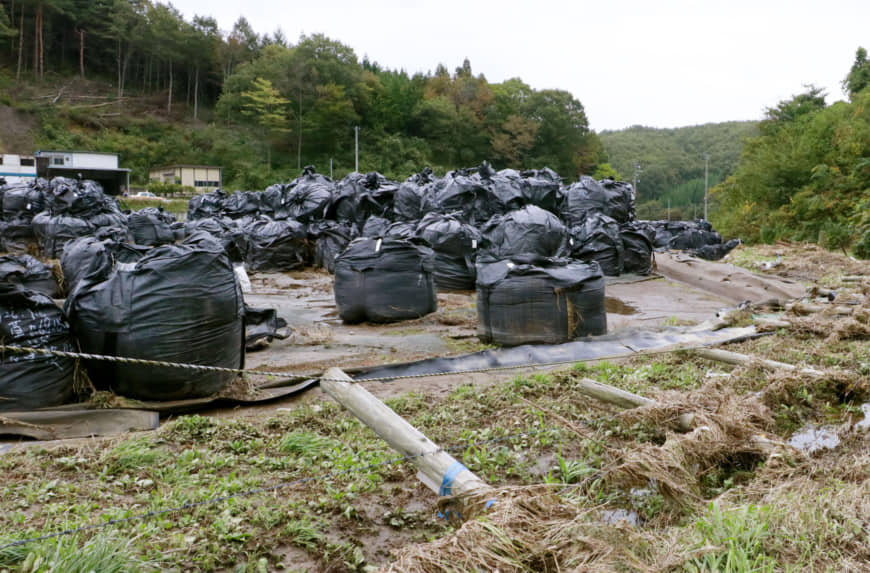
Contaminated Fukushima soil stored in flood zones, audit finds http://www.asahi.com/ajw/articles/14359377?fbclid=IwAR3vSQl1UVoSDAqpoxsL8nYsWhRVPVM55o749Uw1NXEJ9FtvOxh6aquOyq8, By RYOTA GOTO/ Staff Writer, May 27, 2021 Many of the temporary storage sites for soil and waste contaminated by radiation from the crippled Fukushima No. 1 nuclear power plant are located in areas vulnerable to natural disasters, a government audit found.
The Board of Audit of Japan submitted an investigative report to the Diet on May 26 warning the central government to address the contaminated materials that would be in jeopardy in the event of disasters such as landslides and flooding caused by heavy rains, or tsunami.
The board studied the Environment Ministry’s reviews of the temporary storage sites for contaminated soil and designated radioactive waste from October 2019 to April 2020, and took issue with some of its assessments.
The results show 159 out of 170 sites in Fukushima Prefecture, where contaminated soil resulting from the accident at Tokyo Electric Power Co.’s Fukushima No. 1 nuclear plant is being temporarily stored, are within areas deemed vulnerable to landslides and flooding from heavy rain.
The ministry had surveyed locations but concluded that preventive measures were not necessary at 158 sites because the materials were fenced in or the contaminated soil was stored in bags and covered by liner sheets.
As for the remaining location, the ministry moved the contaminated soil to an intermediary storage site.
In nine prefectures including Fukushima, 130 of 379 locations that store contaminated waste are in areas expected to be flooded or hit by landslide in the event of a disaster.For 117 locations, the ministry concluded it is unnecessary to take preventive measures because the waste is stored inside buildings.
But for 13 locations, the ministry said discussion is needed over the necessity of taking preventative measures.
he board said the ministry’s reviews did not include a check of whether each site is located in an area considered vulnerable to tsunami or flooding. The ministry had reasoned that embankments or other obstacles are either in place or under construction, and that the need to take measures against a potential tsunami is low and any impact from a reservoir collapsing would be limited.
But the audit board surveyed 153 temporary storage sites for contaminated soil and found that five of them are vulnerable to a tsunami and three are vulnerable to reservoir flooding.
The board said the ministry needs to consider residents’ concerns about the potential of a leak of contaminated materials, check if the areas are vulnerable to disasters and take preventive measures.
The ministry responded to the audit by defending that it “prioritized quickly securing storage sites at the time and did not have time to check the sites against a hazard map.”
A representative of the Fukushima prefectural government admitted some mistakes were made.
“We knew the locations of storage sites but failed to think about disaster-prevention measures,” the representative said.
NATO’s U.S. nuclear weapons in Europe not safe. U.S. soldiers’ Flashcard Apps reveal secrets

“secrecy about US nuclear weapons deployments in Europe does not exist to protect the weapons from terrorists, but only to protect politicians and military leaders from having to answer tough questions about whether NATO’s nuclear-sharing arrangements still make sense today. This is yet one more warning that these weapons are not secure.”
US Soldiers Expose Nuclear Weapons Secrets Via Flashcard Apps, Bellingcat, Foeke Postma, May 28, 2021,
For US soldiers tasked with the custody of nuclear weapons in Europe, the stakes are high. Security protocols are lengthy, detailed and need to be known by heart. To simplify this process, some service members have been using publicly visible flashcard learning apps — inadvertently revealing a multitude of sensitive security protocols about US nuclear weapons and the bases at which they are stored.
While the presence of US nuclear weapons in Europe has long been detailed by various leaked documents, photos and statements by retired officials, their specific locations are officially still a secret with governments neither confirming nor denying their presence.
As many campaigners and parliamentarians in some European nations see it, this ambiguity has often hampered open and democratic debate about the rights and wrongs of hosting nuclear weapons.
However, the flashcards studied by soldiers tasked with guarding these devices reveal not just the bases, but even identify the exact shelters with “hot” vaults that likely contain nuclear weapons.
They also detail intricate security details and protocols such as the positions of cameras, the frequency of patrols around the vaults, secret duress words that signal when a guard is being threatened and the unique identifiers that a restricted area badge needs to have.
Like their analogue namesakes, flashcard learning apps are popular digital learning tools that show questions on one side and answers on the other. By simply searching online for terms publicly known to be associated with nuclear weapons, Bellingcat was able to discover cards used by military personnel serving at all six European military bases reported to store nuclear devices.
Experts approached by Bellingcat said that these findings represented serious breaches of security protocols and raised renewed questions about US nuclear weapons deployment in Europe.
Dr Jeffrey Lewis, founding publisher of Arms Control Wonk.com and Director of the East Asia Nonproliferation Program at the James Martin Center for Nonproliferation Studies, said that the findings showed a “flagrant breach” in security practices related to US nuclear weapons stationed in NATO countries.
He added that “secrecy about US nuclear weapons deployments in Europe does not exist to protect the weapons from terrorists, but only to protect politicians and military leaders from having to answer tough questions about whether NATO’s nuclear-sharing arrangements still make sense today. This is yet one more warning that these weapons are not secure.”
Hans Kristenssen, director of the Nuclear Information Project at the Federation of American Scientists, broadly agreed and said that safety is provided by “effective security, not secrecy.”
Some flashcards uncovered during the course of this investigation had been publicly visible online as far back as 2013. Other sets detailed processes that were being learned by users until at least April 2021. It is not known whether secret phrases, protocols or other security practices have been altered since then.
However, all flashcards described within this article appear to have been taken down from the learning platforms on which they appeared after Bellingcat reached out to NATO and the US Military for comment prior to publication.
………………For nuclear disarmament activists, however, the information revealed by US soldiers emphasises what they see as the dangers of hosting nuclear weapons in Europe as well as the lack of strategic sense in doing so.
When contacted to comment on these findings Susi Snyder, project leader of the No Nukes program at Dutch peace organisation PAX and coordinator of the Don’t Bank on the Bomb campaign, remarked “The public in European countries hosting B61 bombs overwhelmingly support the Treaty on the Prohibition of Nuclear Weapons. Policies of secrecy that deny democracy can’t last, and risk the security of the population. Secret stationing, like nuclear weapons, are no solution to the threats of today, or tomorrow.”
Kristensen of the Federation of American Scientists added: “There are so many fingerprints that give away where the nuclear weapons are that it serves no military or safety purpose to try to keep it secret. Safety is accomplished by effective security, not secrecy. Granted, there may be specific operational and security details that need to be kept secret, but the presence of nuclear weapons does not. The real purpose of secrecy is to avoid a contentious public debate in countries where nuclear weapons are not popular.” https://www.bellingcat.com/news/2021/05/28/us-soldiers-expose-nuclear-weapons-secrets-via-flashcard-apps/
New technology comes nowhere close to solving the problem of nuclear waste

New technology comes nowhere close to solving the problem of nuclear waste, Toronto Star, By Thomas Walkom May 27, 2021 What is to be done with nuclear waste? It is a question that dominates the Atomic Age. It is also one that has never been satisfactorily answered…..
nuclear waste is a relentless certainty. A plant that produces nuclear power creates nuclear waste. It is that simple.But what to do with that waste? Up to now, the assumption was that such waste would be buried in deep geological caverns, or repositories. Two potential sites for such repositories have been identified — one in Northwestern Ontario and one near Lake Huron. The usual political battles are being waged over whether either or both sites are safe.
But over the last few years, more attention has been paid to a different solution — using radioactive waste as fuel to create more nuclear power from so-called small modular reactors (SMRs). The governments of Saskatchewan, Ontario and New Brunswick have been particularly interested in developing this new SMR technology.
One New Brunswick start-up, Moltex Energy of Saint John, has received $50.5 million in federal funds.
The new technology has its critics. In the first place, it can create new and even more dangerous radioactive waste. As the Globe and Mail reports, Moltex says it produces an impure form of plutonium as a waste byproduct from its SMRs. Pure plutonium is used in the manufacture of atomic bombs.
Indeed, some nuclear experts, including former senior U.S. officials, were so alarmed that seven of them took the unusual step of penning an open letter this week to Prime Minister Justin Trudeau.
In that letter, they warned that reprocessing waste in a manner that creates plutonium would undermine global efforts to limit nuclear proliferation.
They also noted that the new technology wouldn’t solve the waste problem. Rather, it would just produce different kinds of nuclear waste.
“Moltex, even in the R&D stage, would create a costly legacy of contaminated facilities and radioactive waste streams and require substantial additional government funding for cleanup,” the letter said.
All of this is true. But none of it is enough to derail the new interest in SMR technology. Governments like it because it promises to be cheaper to build than classic Pickering-style nuclear power plants. The nuclear industry sees it as a political lifeline at a time when atomic power is not particularly popular.
So regardless of what its critics say, don’t expect this new technology to fade away. It may not be the silver bullet that its adherents claim it to be. It comes nowhere close to solving the waste problem.
But it is supported by important political constituencies. History has shown how crucial this support has been to the nuclear industry. https://www.thestar.com/opinion/contributors/2021/05/27/new-technology-comes-nowhere-close-to-solving-the-problem-of-nuclear-waste.html
Report on the threat of nuclear terrorism
Etidal publishes report on threat of nuclear terrorism, https://www.arabnews.com/node/1866166/saudi-arabia 28 May 21, RIYADH: In a report published on Thursday, the Riyadh-based Global Center for Combating Extremist Ideology (Etidal) warned that terrorist groups are attempting to exploit the humanitarian effects of the COVID-19 pandemic to develop their capabilities, including the aim of obtaining weapons of mass destruction.
“The Great Threat: Extremism and the Spread of Nuclear Terrorism” reviews the risks posed by terrorist organizations through their efforts to acquire nuclear weapons, which has been a goal of such groups for decades.
Etidal noted that “the signs of terrorist practices around the world following the coronavirus pandemic shed light on the extremist organizations’ attempts to extensively exploit the global humanitarian situation in order to develop their destructive capabilities.”
RIYADH: In a report published on Thursday, the Riyadh-based Global Center for Combating Extremist Ideology (Etidal) warned that terrorist groups are attempting to exploit the humanitarian effects of the COVID-19 pandemic to develop their capabilities, including the aim of obtaining weapons of mass destruction.
“The Great Threat: Extremism and the Spread of Nuclear Terrorism” reviews the risks posed by terrorist organizations through their efforts to acquire nuclear weapons, which has been a goal of such groups for decades.
Etidal noted that “the signs of terrorist practices around the world following the coronavirus pandemic shed light on the extremist organizations’ attempts to extensively exploit the global humanitarian situation in order to develop their destructive capabilities.”
The time to divest from Bitcoin is now

The time to divest from Bitcoin is now, Independent Australia, By John Quiggin | 29 May 2021 The rising price of cryptocurrencies is resulting in higher demands for electricity in order to produce them, writes Professor John Quiggin.
TWO RECENT DEVELOPMENTS in financial markets have big and directly opposed implications for the future of the global climate. On the one hand, financial institutions of all kinds are divesting from carbon-based fuels. On the other hand, they are increasingly embracing one of the most pointless and destructive trends of recent times — cryptocurrencies such as Bitcoin.
Let’s start with the good news. Not so long ago, divestment from coal mines and coal-fired power stations appeared a symbolic moral gesture, undertaken by socially-minded investors who were willing to narrow their investment options rather than profit from environmental destruction. As it turned out, the socially-minded investors did well, while the hardheads who kept coal miners and oil companies in their portfolios lost badly.
Jumping forward to the present, divestment has become the norm, though the process has typically been made in a series of baby steps. At this point, nearly all financial institutions in developed market economies have limited their exposure to coal and indicated a strategy to end any association with thermal coal, used in power generation. (Alternatives to metallurgical coal, used in steelmaking, are in an early stage of development, unlike solar and wind electricity generation)………………….
The progress being made on divestment from coal contrasts sharply with the eager embrace of Bitcoin and other cryptocurrencies. Although they were once supposed to replace existing currencies as a medium of exchange, cryptocurrencies are now used only as a speculative asset and as a way of conducting illegal transactions like ransomware payments.
The “proof of work” process by which Bitcoins and other cryptocurrencies are generated depends on “miners” competing to solve increasingly elaborate, but pointless, mathematical problems using specially designed computers and lots of electricity. The higher the price of Bitcoins, the more electricity it is worth burning to generate them.
Calculations a few years ago suggested that the electricity used in Bitcoin mining was comparable to the total demand of a small country like New Zealand. But as the price has risen, so has the demand on electricity resources, to the point where abandoned coal-fired power stations are being reopened. Even when Bitcoin is mined using renewable electricity, that electricity is diverted from other uses, which must then rely on coal-fired or gas-fired electricity.
As concerns have risen about the environmental damage caused by cryptocurrencies, attempts have been made to find “green” ways of producing them. Past efforts of this kind have failed, but perhaps these will succeed. However, we don’t have time to wait and see. Financial institutions need to divest from cryptocurrencies and financial regulators need to shut them down. When and if an environmentally safe version emerges, we can take another look.
John Quiggin is Professor of Economics at the University of Queensland. His new book, The Economic Consequences of the Pandemic, will be published by Yale University Press in late 2021…………… https://independentaustralia.net/politics/politics-display/the-time-to-divest-from-bitcoin-is-now,15137
The sixth high-ranking FirstEnergy executive fired, in Ohio nuclear corruption scandal

FirstEnergy fires another executive over consulting contract First Energy fires another executive over consulting contract https://spectrumnews1.com/oh/columbus/news/2021/05/28/firstenergy-fires-another-executive-over-consulting-contractCLEVELAND (AP Ohio)) — A FirstEnergy senior vice president was fired Thursday for her “inaction” regarding a 2015 amendment to a “purported” consulting contract with someone who was later appointed as Ohio’s top utility regulator, the company announced in a U.S. Securities and Exchange Commission filing.
Eileen Mikkelsen’s dismissal makes her the sixth high-ranking FirstEnergy executive fired since the U.S. Department of Justice alleged last July that the company had secretly funded a $60 million bribery scheme aimed at winning legislative approval of a bailout of two nuclear power plants operated at the time by a wholly-owned FirstEnergy subsidiary.
CEO Chuck Jones and two other vice presidents were fired in October for what FirstEnergy said were violations of company policies and its code of conduct. Two of the company’s top attorneys were fired the following month.
FirstEnergy did not specify the reason for their dismissals.
Jones was appointed CEO in 2015.
A message seeking comment was left for Mikkelsen on Thursday. A FirstEnergy spokesperson declined to comment about the firing.
While FirstEnergy has not named the regulator in question, it has not been disputed that it was Samuel Randazzo, appointed by Republican Gov. Mike DeWine in early 2019 as chair of the Public Utilities Commission of Ohio. Randazzo resigned last November after the FBI searched his Columbus townhome and FirstEnergy disclosed it had paid him $4.3 million before his appointment to end a consulting contract in place since 2013.
“FirstEnergy continues to believe that payments under the consulting agreement may have been for purposes other than those represented within the consulting agreement,” according to Thursday’s SEC filing.
FirstEnergy has been engaged in damage control over the last year as it tries to restore is corporate reputation, emphasizing efforts the company has made to strengthen its internal controls. FirstEnergy officials have said the company is cooperating with investigations by the DOJ, SEC and Federal Energy Regulatory Commission and that it has discussed a deferred prosecution agreement with DOJ attorneys.discussed a deferred prosecution agreement with DOJ attorneys.
The Legislature earlier this year repealed the $1 billion bailout in the wake of the scandal and the plants’ new owner, Energy Harbor, indicating it did not want the subsidy worth about $150 million a year. Energy Harbor took control of the plants and other assets of the FirstEnergy subsidiary in February 2020 as part of a deal struck in U.S. Bankruptcy Court.
Two sets of lawsuits seeking certification as class action complaints have been filed against FirstEnergy since July. Outside attorneys representing the company have said in recent motions to dismiss the lawsuits that FirstEnergy’s actions regarding its contributions to dark money groups controlled by former Ohio House Speaker Larry Householder were legal.
Householder and four others were indicted on racketeering charges shortly after the DOJ unveiled criminal complaints against them in July. Householder has pleaded not guilty.
Mr Nuclear Waste and Mr Coal – Top Cronies..Shhh — RADIATION FREE LAKELAND

Originally posted on Keep Cumbrian Coal in the Hole: As you know, with the help of many individuals and organisations we have been successful in persuading Cumbria County Council to withdraw their support for the Cumbrian Coal Mine.? However the battle is not over yet and another may have just begun. No doubt you will…
Mr Nuclear Waste and Mr Coal – Top Cronies..Shhh — RADIATION FREE LAKELAND
An Online Course on War and The Environment: Spreading Knowledge Builds Power — limitless life

An Online Course on War and The Environment: Spreading Knowledge Builds Power By David Swanson, World BEYOND War, May 26, 2021 https://worldbeyondwar.org/an-online-course-on-war-and-the-environment-spreading-knowledge-builds-power/ Here’s a video from one of the facilitators lined up for World BEYOND War’s online course on War and the Environment which begins on June 7th, 2021: https://youtu.be/ialEfgofNGQ This course could not be more important. […]
An Online Course on War and The Environment: Spreading Knowledge Builds Power — limitless life
The life and times of a Domestic Extremist in the UK

Exclusive to Nuclear-news.net
Posted on 27th May 2021
As a young man I was doing work for Greenpeace, CND and other Green Groups for the Turnham Green Green Fair organisers. When Chernobyl happened I was in London and information about nuclear accidents was very hard to find. I even considering paying hundreds of pounds to access the Hiroshima report. As time progressed though, things seem to calm down in the media and very little else was said or thought of concerning this matter. My life got busy, I raised a family who eventually flew the coup and I worked as a motorcycle courier sub contracting for the Daily Mail, NHS, UK Home office amongst many others.
I had a good level of security clearance (for a courier) and my reputation and job references were good. Then one day whilst watching the news I saw the first explosion at the Fukushima Prefectures Daichi nuclear reactor site. Unlike after the Chernobyl accident, we had the internet for information. Searching the web I found very little about Fukushima and also even less about Chernobyl. TEPCOs nuclear disaster seemed to quickly disappear and eventually I found an obscure forum where many people had gathered to investigate the TEPCO disaster.
As time went by through the summer of 2011 many bloggers and forums sprang into being with both anti and pro nuclear people trying to ascertain the truth. I found myself organising with Fukushima residents and other groups and individuals from Japan. Sharing info from on the ground that seemed to highlight inconsistencies with the formal narrative.
Come the summer I went to Norway where I was blocked from accessing a website in real time, that was a bit of a shocker at the time but my connection came back and the website was behind a protected paywall. At this point I had linked with groups around the world trying to monitor radiation in various ways. We were determined to find any radiation that might still be about.
Whilst looking for radiation releases we tumbled across some incidents that did try to blame Fukushima (IAEA report) then when challenged with data we had accumulated the IAEA said it was from Pakistan!. Our data disproved this and it was later confirmed by CRIIRAD of France to be a release from a medical isotope reactor in Hungary that did not admit to the incident in full.
This led me to see where else radiation pollution might be coming from that is not declared. I decided to buy a Geiger counter and monitor the air in London whilst driving around on my motorbike. Some of the results were interesting and I tracked pollution from Sellafield as well as other reactors.
One point to note with Sellafield was that it came with high CO2 levels that could be measured with a Geiger counter as well, as the pollution was mildly radioactive. I say mildly but that was in London and Sellafield has been shutdown because of releases being pushed down on the site instead of going up and away. There could be issues with people locally getting high spikes of radiation and CO2 that have not been fully addressed as was the case in Hungary in 2011.
So I have completed that whole year researching and sharing info from Fukushima and many other nuclear related areas.
During 2012 I accrued 2 police crime numbers for my BT and Vodaphone numbers being hacked. Long story short, My Vodaphone account was hacked by GCHQ who were doing the Daily Mail phone hacking Inquiry at the time. They interrupted a call and cleverly pretended to be the Daily Mail reception (I called to pay a parking fine and have never called the Daily Mail directly). After lodging a complaint with my local police station (who I worked with helping Young people while in custody – Appropriate Adult) the guy from GCHQ called me direct and said they wanted to know who I was to rule me out of the investigation and after a short talk I had passed muster.
We finished the conversation with my concerns abated and I kept the whole thing confidential as agreed. However a few weeks later I contacted a scientist with some simple inquiries (well known in the media) concerning radiaiton harm and the same day my BT internet email account was hacked through my Vodaphone mobile and I was locked out. I reported it to the Vodaphone police liaison officer who informed me that the account was hacked and they had the IP address. I was later to find out that the investigation into that IP address was turned around withing days to being an investigation on me. The excuse for nothing happening that Vodaphone gave initially was that the investigation was blocked by the police. I did get a crime number for that as well though.
As the months progressed, the overt surveillance got worse. My internet was a law unto itself and I had to use cafes and libraries to upload posts. The only problems I had with my phone connection happened in those months.
By the end of 2012 things got serious! It began as I was doing an NHS blood run for a well known cancer hospital. When i got home, I looked at my mobile and realise I had been texted from the Insurance company as I was driving and they had cancelled my Insurance! If I had been stopped the police would have taken my brand new 700 cc Honda and crushed it immediately, as per new law.
Calling the brokers was interesting, The underwriters came into the call and said that the price for reinstating the Insurance was £1,500 and left the call. The original price was £500. It stopped me paying my TAX bill (which was about the same amount £1,500). What a coincidence I though!
Now is a good time to mention Number Plate Recognition Software. I hate it. Once I saw 2 police arguing in their vehicle whether to give me points for “filtering”. Pointing at the screen (showing clean license, no record, 10 yrs Insurance clean and a blood sample box on the back of the bike). Another occasion was in the snow and my MOT was a day late. They were printing of the fine before i got to their window. Looking them in the face, I asked, “Did my name come up as a Domestic Extremist?” and both officers looked awkward with one looking away. I had my answer (I trained in body language with Brunel Uni on an MA level psychology course).
So where was I? Oh yes, Christmas had a bit of extra stress that year but I was still working, had a roof over my head and Insurance (for now). On the downside, It looked as if I had been blacklisted and the buggers had scooped my Tax payment for 2013 to boot!
2013 was shaping up to be interesting and I was not to be disappointed.
The Tax man kept insisting that I use digital forms even though I repeatedly asked for paper quoting my 2 crime numbers in mitigation. By the time they agreed I had been let go by the Daiily Mail using strange procedures, threatened by the Insurance underwriters twice with them using questionnaires (same questions both times), likely using software analysis to find the lies. They finished with “You wait until your insurance is up for renewal because it will be going up by alot” (paraphrased).
As i got into difficulty financially, I contacted the bank and asked for a 3 month cushion and they agreed but a couple of weeks later I got demands for everything now! At this point i was cashing cheques to get cash to survive and paying bills was a hardship. I got 2 computers hacked and damaged after the requested increase in GCHQ Cyber warriors in 2013 (Called Battalion 77 now I believe) April approx of 30,000 posts. I think they used me for practice?
I think you get the gist of the pressures, I have left out a lot of day to day details. So the question is, what to do now? Having my financial security and ability to contact and make arrangements, find work, get insured etc being undermined in the way it was, was a real eye opener! So far the attacks were purely over the phone and interference in the digital domain and they were enough to destroy my life in a matter of months.
Who else did this happen too? Would they know if a situation was an attack or some unfortunate luck? In my case the overt and in my face interactions said the former but some of these are still subtle enough to make one wonder? How hard would it be to destroy someones life without them knowing someone was behind it? With the UK heading in an even worse direction now I shudder to think.
Well, I have documented, in brief, to about half way through 2013 and the best is to come yet.
I summary I and my colleagues and friends around the UK were targeted in various ways. I became more isolated as friends etc were targeted and most backed off quickly and some tried to resist but they got work email accounts deleted, internet, email, phone problems and even straight up threats!
In 2014 I found myself using a homeless charity address who saw my postal mail was always blocked. I had my tyres punctured severely requiring replacement and had to leave London when my friends phone was cut off for 24 hrs after i used it and he began to get concerned. I lived like a Nomad relying on cash to survive but as the targeting got worse I had to make a decision to leave.
For the record. I witnessed £60,000 being removed (without trace) from the Swift money transfer system. It only re appeared when concerned bank managers realised that Swift was easily hackable. That was to stop me getting money for selling my remaining motor bike before i moved to Ireland but thanks to the quick work of the bank managers and a solicitor I got the money in time to leave for a new life in April 2014
Oh! and of course I have been part of this blog and supported by fellow admins and friends Herve and Christina amongst others!
Statement of Fact (partial) from Shaun McGee aka arclight2011
For USA, health care is too costly, while weapons makers wildly profitable -as $634 Billion to go to nuclear arms

The US Will Spend on Nuclear Weapons in the Next Decade, https://jacobinmag.com/2021/05/military-spending-nuclear-weapons-department-of-defense
BY JULIA ROCK, 26 May 21, According to a new Congressional Budget Office report, we’re set to spend well over a half a trillion dollars over the next decade on nuclear weapons. Yet we’re somehow told that Medicare for All is too expensive.
As Capitol Hill lawmakers continue to insist that initiatives like Medicare for All are too expensive, a new congressional report shows that the United States government is on a path to spend more than a half-trillion dollars on nuclear weapons in just the next decade. The report emerges at the same time a separate analysis shows that a handful of top executives at defense contractors are being wildly enriched by a Pentagon spending spree.
The first report from the Congressional Budget Office (CBO) finds that the federal government is on track to spend $634 billion over the next decade to maintain its nuclear forces. Almost two-thirds of those costs are for the Department of Defense, mostly to maintain ballistic missile submarines and intercontinental ballistic missiles. About one-third is for the Department of Energy.
For comparison that is:
- 1.5 times the cost of all of the $1,400 stimulus checks that were sent to people through the American Rescue Plan earlier this year.
- Nearly fourteen times the $47 billion that Congress has spent so far this year helping Americans who are behind on rent.
- Over one-third of the cost of cancelling the $1.7 trillion in student debt held by Americans, most of which is never going to be repaid.
- More than seven times the estimated $81 billion of outstanding medical debt in America, as of 2018.
The new CBO estimate represents a 28 percent increase over the last ten-year estimate that the CBO made on US nuclear forces two years ago.
The figures were released just a few weeks after a new analysis from the Center for International Policy, a foreign policy think tank in Washington, found that “In 2020 alone, the CEOs of the [Pentagon’s] top five contractors received a total of $105.4 million in compensation.”
When accounting for all top corporate officials, these firms paid out more than a quarter billion dollars of total executive compensation in 2020 — and paid out more than $1 billion over the last four years.
About half of the Pentagon’s budget goes directly to corporations such as Lockheed Martin and General Dynamics, according to the report.
So far, the deficit scolds who wanted to narrow eligibility for stimulus checks, student debt cancellation, or rent relief haven’t complained about the spending.
American experts warn Trudeau that Moltex small nuclear reactors are likely to prove a nightmare for Canada

The critics contend that SMRs are costly, unproven and creators of toxic waste of their own. From a practical point of view, it is hard to make the case that SMRs will be crucial in the battle against climate change, since they won’t come off the drawing board for years, if ever. Former Green Party leader Elizabeth May says that opting for experimental SMRs is just another way of delaying real action on global warming.
US Experts to Trudeau: Your Nuclear Dream May Turn Nightmare https://thetyee.ca/Analysis/2021/05/26/US-Experts-Trudeau-Your-Nuclear-Dream-May-Turn-Nightmare/?utm_source=daily&utm_medium=email&utm_campaign=260521
Rethink backing the Moltex reactor, urge nine non-proliferation heavyweights.
Michael Harris TheTyee.ca, 6 May 21, A blue-ribbon group of American nuclear non-proliferation experts warns that Canada’s investment in new nuclear technology could lead to the spread of nuclear weapons and new threats to the environment.
“We write as U.S. non-proliferation experts and former government officials and advisors with related responsibilities to express our concern about your government’s financial support of Moltex — a startup company that proposes to reprocess CANDU spent fuel to recover its contained plutonium for use in molten-salt-cooled reactors.”
The warning came in the form of an open letter to Prime Minister Justin Trudeau that was delivered on Tuesday and signed by the nine experts.
The group is spearheaded by Frank von Hippel, professor and senior research physicist at Princeton University; it includes Matthew Bunn, the Schlesinger professor of the practise of energy, national security, and foreign policy at the Harvard Kennedy School; and Thomas Countryman, former U.S. assistant secretary of state for non-proliferation.
“We understand your government’s motivation to support nuclear power and to reduce fossil fuel use but saving the world from climate disaster need not be in conflict with saving it from nuclear weapons. Also, like other reprocessing efforts, Moltex, even in the R&D stage, would create a costly legacy of contaminated facilities and radioactive waste streams, and require substantial additional government funding for cleanup and stabilization prior to disposal,” they wrote.
Rory O’Sullivan, CEO of Moltex North America painted a very different picture of his company’s experimental technology in an interview with World Nuclear News: “We are working to develop a technology that uses the fuel from the first generation of nuclear power to the next. This reduces the challenges associated with spent nuclear fuel, while expanding nuclear power to help Canada achieve its climate change objectives.”
The Trudeau government has invested $50.5 million in Moltex, and backs the company’s plan to build a 300 MW molten salt reactor in New Brunswick on the Bay of Fundy. Theoretically, it would then reprocess spent fuel from the Point Lepreau nuclear plant, which is set to be decommissioned in 2040.
The Moltex reactor belongs to a class of nuclear power plants termed small modular reactors or SMRs that generate small amounts of electricity in comparison with typical CANDU reactors.
Natural Resources Minister Seamus O’Regan has said that Canada can’t get to net-zero carbon emissions by 2050 without nuclear as part of the equation, along with renewables.
Despite marketing its roll of the dice on Moltex as part of its war on climate change, Ottawa isn’t getting much love from environmentalists, or many other people. Three federal political parties, the NDP, the Bloc and the Greens; the Green Budget Coalition; and the Canadian Environmental Law Association all oppose the federal investment in small modular reactors. University of British Columbia professor of public policy and global affairs M.V. Ramana has levelled criticisms in these pages as well.
The critics contend that SMRs are costly, unproven and creators of toxic waste of their own. From a practical point of view, it is hard to make the case that SMRs will be crucial in the battle against climate change, since they won’t come off the drawing board for years, if ever. Former Green Party leader Elizabeth May says that opting for experimental SMRs is just another way of delaying real action on global warming.
One who has closely followed and opposes the two experimental SMR reactors planned for New Brunswick, the ARC-100 and the Moltex SSR, is Dr. Susan O’Donnell, an adjunct professor of sociology at the University of New Brunswick. O’Donnell is also the primary investigator of Raven, a research team based at the university dedicated to highlighting rural environmental issues in the province.
O’Donnell points out that Moltex has never built a nuclear reactor before. In fact, only two molten salt reactors have ever been built — 50 years ago. Neither of them produced electricity. One of them lasted four years before shutting down, the other, just 100 hours.
On the environmental side, O’Donnell says that SMR pollution or a serious failure could lead to “disasters and no-go zones.”
On the non-proliferation front, she denounces the plan to broadly “export” the Moltex technology, assuming it ever gets up and running.
“What we have learned from Canada’s role in making India a nuclear power is that one of the dangers of the Moltex proposal is its plan to export the technology. We’re exporting bomb-making capacity,” she told The Tyee.
O’Donnell has pushed for public consultations to help develop a national radioactive waste policy. Last Aug. 13, she made an offer to the federal minister of natural resources to have the Raven project organize such a public consultation in New Brunswick. It would be online because of the pandemic, in both official languages, and would include Indigenous nations and rural communities. Minister O’Regan responded two months later, on Oct. 30, turning her down.
“Strangely, he cited the pandemic, even though our offer clearly stated the consultation would be virtual,” the professor said.
O’Donnell’s take on the Moltex project is backed up by Allison Macfarlane, former chair of the U.S. Nuclear Regulatory Commission. The specialist in the storage of nuclear waste told the CBC in January that the molten salt technology is totally unproven with respect to viability, costs and storage risks.
“Nobody knows what the numbers are, and anybody who gives you numbers is selling you a bridge to nowhere…. Nobody’s been able to answer my questions yet on what all those wastes are, and how much of them there are, and how heat-producing they are and what their compositions are,” Macfarlane said. She is now the director of the School of Public Policy and Global Affairs at UBC.
But the Trudeau government does have allies at the provincial level for its nuclear ambitions. The governments of New Brunswick, Ontario, Saskatchewan and Alberta have all signed a memorandum of understanding to develop SMRs, which means promoting them.
They are excited about the promises by Moltex that it will be able to produce clean energy at a low cost by recycling something that everyone wants to get rid of — the three million spent fuel bundles in Canada that the government still doesn’t know how to dispose of safely and permanently.
The U.S. experts made clear to the PM in their letter that they are not convinced by the company’s assertions. They want the Trudeau government to convene a high-level review of both the non-proliferation and environmental implications of Moltex’s reprocessing proposal. Key to that proposal is including “independent international experts,” before Ottawa makes any further investments in support of the Moltex proposal.
The earliest projects to reprocess nuclear waste extracted plutonium to make nuclear weapons. The letter signees worry Canada’s new generation of reactors will afford the same opportunity to anyone who buys them.
“Our main concern is that, by backing spent-fuel reprocessing and plutonium extraction, the government of Canada will undermine the global nuclear weapons non-proliferation regime that Canada has done so much to strengthen. Canada is a founding member of the Nuclear Suppliers Group, which was established in 1974 in response to India’s misuse of a Canada-supplied research reactor and U.S.-supplied reprocessing technology to acquire the plutonium needed for its first nuclear weapons.”
The reprocessing of nuclear waste was “indefinitely deferred” in the United States by president Jimmy Carter in 1977 after India tested its first nuclear weapon. At the time, the Americans discovered that several other countries including Brazil, Pakistan, South Korea and Taiwan were all surreptitiously headed down the same nuclear weapons path that India had taken. Of that group, only Pakistan managed to get the bomb.
The U.S. experts who signed the letter to Trudeau also rejected the claim by Moltex that by using spent fuel from older Canadian CANDU reactors, its reactor would reduce the long-term risk from a deep underground radioactive waste repository.
The Trudeau government promised it would base its major policies on science. It’s time for the public consultation, far from the greasy paws of lobbyists, and with the best minds that can be brought to the table.
This is a letter to take to heart.
New research highlights need for international standards to safeguard against plutonium ”hot” particles.

New study delves into issues relating to soils around Maralinga region, https://www.portlincolntimes.com.au/story/7262167/study-shows-radioactive-particles-from-nuclear-testing-persist-at-maralinga, Luca Cetta,
A new study has highlighted the first international standards needed to safeguard against contamination from nuclear testing, and a Kokatha Elder says the impact of nuclear testing at Maralinga cannot be forgotten.
More than 100 kilograms of highly toxic uranium and plutonium was dispersed in the form of tiny ‘hot’ radioactive particles after nuclear tests were conducted by the British in remote areas of South Australia, including Maralinga.
Scientists have new evidence these radioactive particles persist in soils to this day, more than 60 years after the detonations.
The British detonated nine nuclear bombs and conducted nuclear tests in South Australia between 1953 and 1963.
There had previously been limited understanding in how plutonium was released from the particles into the environment for uptake by wildlife around Maralinga.
The new study, published in Nature’s Scientific Reports, led by Monash University researchers, warns the hot particles are more complex and varied than previously thought.
Currently, there are no international best practice standards for the environmental impact or risk assessment of plutonium and uranium-rich hot particles released during nuclear testing.
This study provides the first mechanism for future modelling to predict the environmental life cycle of plutonium from hot particles, including how they are slowly broken down in the environment over a long period, and potentially exposed to animals and humans through inhalation, soil or ground water.
“The resulting radioactive contamination and cover-up continues to haunt us,” lead study author from Monash University’s School of Earth, Atmosphere and Environment Dr Megan Cook said.
“The results of our study profoundly changes our understanding of the nature of hot particles at Maralinga – despite the fact that those were some of the best studied particles anywhere in the world.”
Sue Haseldine, who grew up in the Koonibba district in the 1950s and 1960s, has long campaigned against nuclear testing and weapons.
She has been part of the International Campaign to Abolish Nuclear Weapons (ICAN), an organisation awarded the Nobel Peace Prize in 2017, and has spoken about her experience growing up in the shadow of nuclear testing at Maralinga.
Ms Haseldine said the people in the area had long-suspected there were health issues deriving from those tests.
“Experts would tell you that radiation will not last for 60 years, nor 60,000, but for a long, long time, and it is still causing troubles today,” she said.
“The old ladies told me these cancers and illnesses were not around before the bomb and over the years I have seen the rates go up.
“There are a lot more younger people with heart problems – it is known that radiation problems can cause heart diseases – and it is coming down through the generations.”
Ms Haseldine said the testing and fallout from Maralinga was not spoken about enough and that was why her campaigning with ICAN was so important.
“It is important to let people know what the government’s legacy is to us through their testing and we have to keep the past alive to protect the future, so they don’t do it to future generations,” she said.
“I grew up in the Koonibba district, but the radiation didn’t just stay in the Maralinga area.”
Study co-author professor Joël Brugger said the study invited a revisit of the implications of earlier results for the fate of plutonium at Maralinga.
“Understanding the fate of hot particles in the arid environment setting of the Australian outback is critical for securing Australia in case of nuclear incidents in the region, and returning all the native land affected by the British tests to the traditional Anangu owners of the Maralinga Tjarutja lands.”
The research team used synchrotron radiation at the Diamond Light Source near Oxford in the United Kingdom to decipher the physical and chemical make-up of the particles.
At Monash, they dissected some of the hot particles using a nano-sized ion beam, and further characterised the complex make-up of these particles down to the nano-size.
“It’s a major breakthrough,” study co-author associate professor Vanessa Wong said.
“Our observations of the hot particles from Maralinga provide a clear explanation for the complex and variable behaviour of different hot particles with respect to the chemical and physical weathering that has hindered predictive modelling to this day.
“This study provides a mechanistic foundation for predicting the future evolution of hot particles from high-temperature nuclear events and the likely exposure pathways.”
The researchers demonstrated the complexity of the hot particles arose from the cooling of polymetallic melts from thousands of degrees Celsius in the explosion cloud during their formation.
“We found that the particles contained low-valence plutonium-uranium-carbon compounds that are typically highly reactive – which is unexpected for particles that survived for over 30 years in the environment,” corresponding author Dr Barbara Etschmann said.
1 This Month
Tell Congress: Prevent Nuclear Catastrophe in Iran

Tell Congress: Prevent Nuclear Catastrophe in Iran

Read the Public Inquiry Report, the Commissioners’ report, Surrendering Australia: The AUKUS Deception is available to download for free at aukuspublicinquiry.com. Or just watch the replay of the National Press Club Luncheon.


Shut down the radiation-damaged Heysham nuclear reactors now
To see nuclear-related stories in greater depth and intensity – go to https://nuclearinformation.wordpress.com

Say No to NASA’s Reckless Nuclear Reactor on the Moon
Say No to NASA’s Reckless Nuclear Reactor on the Moon
-
Archives
- November 2026 (246)
- October 2026 (302)
- September 2026 (339)
- August 2026 (330)
- July 2026 (355)
- June 2026 (287)
- May 2026 (306)
- April 2026 (356)
- March 2026 (251)
- February 2026 (267)
- January 2026 (308)
- December 2025 (358)
-
Categories
- 1
- 1 NUCLEAR ISSUES
- business and costs
- climate change
- culture and arts
- ENERGY
- environment
- health
- history
- indigenous issues
- Legal
- marketing of nuclear
- media
- opposition to nuclear
- PERSONAL STORIES
- politics
- politics international
- Religion and ethics
- safety
- secrets,lies and civil liberties
- spinbuster
- technology
- Uranium
- wastes
- weapons and war
- Women
- 2 WORLD
- ACTION
- AFRICA
- Atrocities
- AUSTRALIA
- Christina's notes
- Christina's themes
- culture and arts
- Events
- Fuk 2022
- Fuk 2023
- Fukushima 2017
- Fukushima 2018
- fukushima 2019
- Fukushima 2020
- Fukushima 2021
- general
- global warming
- Humour (God we need it)
- Nuclear
- RARE EARTHS
- Reference
- resources – print
- Resources -audiovicual
- Weekly Newsletter
- World
- World Nuclear
- YouTube
-
RSS
Entries RSS
Comments RSS

