Iran appoints harsh critic of the nuclear deal to the Foreign Ministry
Crucial changes at Iran’s foreign ministry ahead of nuclear talks
Iran has appointed a staunch critic of the nuclear deal to a position that will have a significant impact on its future. Aljazeera, By Maziar Motamedi, 15 Sep 21,
Tehran, Iran – Shortly before talks resume in Vienna around restoring Iran’s 2015 nuclear deal, its foreign ministry has made some changes that may well prove critical.
Hardline diplomat Ali Bagheri Kani has been appointed as the new deputy for political affairs, replacing veteran diplomat Abbas Araghchi, who led six rounds of nuclear talks in Vienna up to late July – when talks stopped to allow Iran’s new President Ebrahim Raisi to form his administration.
Araghchi, a career diplomat and senior member of the team that negotiated the 2015 Joint Comprehensive Plan of Action (JCPOA) during the tenure of President Hassan Rouhani, is now an adviser to Foreign Minister Hossein Amirabdollahian, which may mean he has not been fully sidelined
If the nuclear file stays with the foreign ministry – as opposed to the Supreme National Security Council (SNSC) – Bagheri Kani, for years a staunch opponent of the nuclear deal, could become the new chief nuclear negotiator.
But even if he does not lead the negotiations, he is expected to play a significant role in pushing for a stricter stance on the lifting of unilateral sanctions imposed by the United States after it left the deal in 2018.
Bagheri Kani’s appointment was reportedly pushed for by Saeed Jalili, another opponent of the JCPOA and an ultraconservative senior member of the SNSC who ran for president in the June elections………….
The path ahead
The appointments come as Iran and the US, China, Russia, and European powers are expected to return to the Austrian capital at a critical stage for the JCPOA.
Iran’s foreign ministry spokesman on Monday said the Vienna talks would happen “in the near future”.
Another crisis looming over the resumption of the talks was avoided on Sunday when Iran and the global nuclear watchdog reached an agreement struck in Tehran…………… https://www.aljazeera.com/news/2021/9/15/crucial-changes-at-irans-foreign-ministry-ahead-of-nuclear-talks
Texas to fight on against dumping of spent nuclear fuel in Andrews County
In a statement before the NRC’s announcement this week, Hadden said opponents would “keep fighting” even if the new license were issued. She said legal challenges remain, and she expressed hope that Texas’ attorney general would fight to protect people. A county commissioners’ body in Andrews County, Texas, also backed a resolution against high-level nuclear waste storage this year, local CBS affiliate KOSA reported
Nuclear waste in the oil patch? Feds spark clash with Texas E and E News, By Edward Klump | 09/15/2021 A site in West Texas now has a federal license to store spent nuclear fuel, setting up a potential showdown with state leaders who oppose the prospect of attracting high-level radioactive waste from across the country.
The Nuclear Regulatory Commission announced the license for Interim Storage Partners LLC to build and operate an interim storage facility in Andrews County, Texas, on Monday — just days after Texas Republican Gov. Greg Abbott signed a bill seeking to restrict nuclear waste storage in the state.
Yesterday, Abbott tried to use the new license in the Permian Basin oil patch to hammer President Biden, though an application for the site was filed in 2016, and the Trump administration didn’t kill the project.
“The Biden Admin. is trying to dump highly radioactive nuclear waste in west Texas oil fields,” Abbott said on Twitter. “I just signed a law to stop it. Texas will not become America’s nuclear waste dumping ground.”
David McIntyre, an NRC spokesperson, declined to comment on the governor’s criticism but said in a statement this week that the “licensing decision was made according to the applicable federal statutes and regulations after thorough, multi-year technical and environmental reviews.”
The drama is being watched by the electricity sector, as nuclear power plants continue to store spent fuel on-site without a permanent U.S. repository. Yucca Mountain in Nevada has failed to garner enough sustained support to be an option (E&E Daily, July 22). In the meantime, backers of the Interim Storage Partners, or ISP, site in West Texas and a separate project in eastern New Mexico from Holtec International have pursued interim storage proposals that could last for decades.
The NRC said this is the second license it has issued for a consolidated storage facility for spent nuclear fuel. The first was in 2006 for a different facility that wasn’t built. A decision on Holtec’s application for a site in Lea County, N.M., is expected in January, according to the nuclear safety regulator. Opposition to Holtec’s plan has been bubbling up in New Mexico, as well.
It remains to be seen how the West Texas proposal will proceed from here. ISP could directly challenge Texas’ stance, or it could take a more conciliatory, wait-and-see approach before seeking to move ahead.
The Texas Commission on Environmental Quality, in response to a question from E&E News yesterday, said its “role is to NOT issue authorizations under TCEQ purview as directed in the bill language” if permits are requested for a high-level radioactive waste facility in the state such as the ISP site.
In a statement yesterday, ISP noted that the “proposed facility would be located adjacent to Waste Control Specialists’ existing low-level nuclear materials disposal facility in Andrews County, Texas.” ISP is a joint venture of Waste Control Specialists and Orano USA, along with some support from a technology provider called NAC International. A revised license application was submitted in 2018.
ISP said the federal authorization was based on a through, multiyear review. The venture didn’t indicate its next move or provide responses to questions posed by E&E News.
“The extensive analyses concluded that this facility’s commercial interim storage and transport operations satisfy all environmental, health, and safety requirements without negative impact to nearby residents or existing industries,” ISP said in its statement.
Critics have noted safety worries for people who live in West Texas, as well as concerns about transporting nuclear waste across the country.
“There were no surprises in NRC’s announcement, by Twitter, about approving the license for deadly nuclear waste storage in Texas,” Karen Hadden, executive director of the Sustainable Energy & Economic Development Coalition, said in a statement to E&E News. “There was no acknowledgement of the overwhelming opposition throughout Texas. Just the federal government steamrolling our state to benefit a private company.”
‘Really interesting times’
In a statement before the NRC’s announcement this week, Hadden said opponents would “keep fighting” even if the new license were issued. She said legal challenges remain, and she expressed hope that Texas’ attorney general would fight to protect people. A county commissioners’ body in Andrews County, Texas, also backed a resolution against high-level nuclear waste storage this year, local CBS affiliate KOSA reported………. https://www.eenews.net/articles/nuclear-waste-in-the-oil-patch-feds-spark-clash-with-texas/
A site once earmarked for nuclear power will now assemble wind turbines

A site once earmarked for nuclear power will now assemble wind turbines, WHYY, This story originally appeared on NJ Spotlight. Tom Johnson, NJ Spotlight, 15 Sept 21,
The New Jersey Economic Development Authority and PSEG have signed a longtime lease on land that is planned to become home to the New Jersey Wind Port — a step enhancing the state’s goal of becoming the hub of a burgeoning offshore wind industry.
The site, located on an artificial island in Lower Alloways Creek in Salem County next to three PSEG nuclear plants, is viewed by the administration of Gov. Phil Murphy as an almost ideal location to serve the supply needs of an offshore wind sector that’s expected to take root up and down the Eastern seaboard.
With an expansive footprint alongside Delaware Bay, lack of height restrictions, and easy access to the Atlantic Ocean’s wind farm lease areas, the Wind Port is one of a few select spots on the East Coast that can accommodate the marshalling, assembly and shipping of the huge turbines used to generate offshore wind power. Hundreds of feet tall, offshore wind turbines cannot fit beneath bridges, power lines and other naturally occurring barriers.
For PSEG, the lease agreement also should prove to be lucrative. The site was once viewed as the location for a fourth nuclear unit. But the company abandoned that concept when it appeared economically unsound. Now it’s looking to use the land to help secure its foothold in the emerging offshore wind industry. PSEG already has a 25% stake in the state’s first offshore wind farm, a 1,100-megawatt facility off Atlantic City to be built by Ørsted……….
“The New Jersey Wind Port is a transformational investment that will create hundreds of good jobs and drive billions of dollars of economic activity in South Jersey and throughout the state,” said EDA Chief Executive Officer Tim Sullivan.
PSEG Chief Operating Officer Ralph LaRossa agreed. “Alongside PSEG nuclear plants, the New Jersey Wind Port will establish South Jersey as the heart of New Jersey economy,’’ he said. “By supporting the development of renewable energy and offshore wind power, this lease will establish New Jersey as the destination for clean energy development, operations, training, skills and innovation.’’
New Jersey has approved three wind projects, including two by Ørsted, one of the largest offshore wind developers, and another by New Shell Ventures and EDF Renewables — all in the Atlantic Ocean. The Murphy administration wants to develop 7,500 megawatts of offshore wind capacity by 2035.
Along the East Coast, offshore investment through 2035 is anticipated to exceed $150 billion, according to the EDA.
The first rule of real estate and offshore wind is location, location, and location,’’ said Doug O’Malley, director of Environment New Jersey. “The New Jersey Wind Port is uniquely positioned to jump start the state’s offshore wind industry and offshore wind in the region.’’ https://whyy.org/articles/a-site-once-earmarked-for-nuclear-power-will-now-assemble-wind-turbines/
Nuclear power companies threaten to shut down plants if Spanish government takes action on soaring bills
Nuclear power companies threaten to shut down plants if Spanish government takes action on soaring bills, EL PAIS, English version by Susana Urra. 15 Sept 21,
The energy sector says it will be ‘impossible to continue’ if their excess gains are cut as part of the raft of measures aimed at reducing the cost of electricity for consumers
Spain’s energy companies are preparing to fight back against the government’s plans to reduce their “extraordinary profits” and redirect these to consumers.
Soaring electricity bills have become a political problem for the executive of Pedro Sánchez, whose Socialist Party (PSOE) leads a minority government with leftist junior partner Unidas Podemos.
Spain’s wholesale power market, which sets the amount paid by the companies that supply electricity to households, has been posting record-high prices since the beginning of summer. According to the National Statistics Institute (INE), consumers’ electricity bills grew 7.8% in August from July, and 34.9% from August 2020.
On Tuesday, Sánchez announced new emergency measures that include tax cuts and greater protection for vulnerable households that cannot afford their utility bills. But the measure that energy companies are reacting against is the one that would contain their “windfall profits” obtained by by the rising market cost of gas.
A similar formula would be applied to limit profits for hydro and nuclear plants that have no CO₂ emissions but gain from higher prices. This legal initiative affects plants that opened before October 25, 2003, ahead of the creation of the European Union’s CO₂ emission rights market system. It also affects hydroelectricity plants and early renewable plants that began operating before that date……….
Despite the Nuclear Forum’s warning about the risk of having to shut down plants ahead of time due to untenable costs, the owners of these facilities do not have the power to unilaterally decide on their date of closure, but must instead make a request to the relevant ministry. These plants typically operate on 10-year licenses and must honor the timeframes or face hefty sanctions.
There are seven nuclear plants operating in Spain (Almaraz 1 and 2, Trillo, Cofrentes, Vandellós 2 and Ascó 1 and 2), owned by Endesa, Iberdrola, Naturgy and EDP. Their production contributes around 20% to Spain’s energy pool and they are slated to be decommissioned between 2027 and 2035.
“The measures aimed at intervening in the markets go against market efficiency and European orthodoxy and they create a climate of legal insecurity,” said the industry association Aelec, which brings together the energy companies Iberdrola, Endesa, Viesgo and EDP. Company sources said they will analyze the government’s initiative to see whether to mount a legal challenge.
The Nuclear Forum, a group that also includes the main electricity companies, warned that if a government bill on reducing CO₂ emission-related profits gets greenlighted by Congress, “the continuity of Spain’s nuclear plants would become impossible.”…… https://english.elpais.com/economy-and-business/2021-09-15/nuclear-power-companies-threaten-to-shut-down-plants-if-spanish-government-takes-action-
Iranian Guards Physically Harassed Female U.N. Nuclear Inspectors, Diplomats Say .
Allegations come amid rising tensions between Tehran and the U.N. atomic energy agency While Iran says it isn’t trying to build nuclear weapons, a look at its key facilities suggests it could develop the technology to make them. WSJ breaks down Tehran’s capabilities as it hits new milestones in uranium enrichment and limits access to inspectors. WSJ, By Laurence Norman, Sept. 14, 2021
Iranian security guards have physically harassed several female United Nations atomic agency inspectors at a nuclear facility over the past few months, diplomats say, and the U.S. has demanded that Iran stop the behavior immediately.
The previously unreported incidents at Iran’s main nuclear facility, Natanz, allegedly included inappropriate touching of female inspectors by male security guards and orders to remove some clothing, the diplomats said….. (subscribers only) https://www.wsj.com/articles/iranian-guards-physically-harassed-female-u-n-nuclear-inspectors-diplomats-say-11631626649
USA developing space-based electromagnetic warfare

This is just the beginning.
How DOD is taking its Mission to Space https://www.thecipherbrief.com/column_article/how-dod-is-taking-its-mission-to-space?utm_source=Join+the+Community+Subscribers&utm_campaign=010f6454d2-EMAIL_CAMPAIGN_2021_09_14_12_18&utm_medium=email&utm_term=0_02cbee778d-010f6454d2-122765993&mc_cid=010f6454d2&mc_eid=b560fb1ddc. SEPTEMBER 14, 2021 | WALTER PINCUS Pulitzer Prize Winning Journalist Walter Pincus is a contributing senior national security columnist at The Cipher Brief. Pincus spent forty years at The Washington Post, writing on topics from nuclear weapons to politics. He is the author of Blown to Hell: America’s Deadly Betrayal of the Marshall Islanders (releasing November 2021)
While others this past weekend have been looking back to 9/11, U.S. Space Command is looking forward to the next domain of warfare — in the heavens — to be directed from a Space Electromagnetic Operating Base somewhere in the United States.
Space Command’s Systems Command, Enterprise Corps and Special Programs Directorate, located at Los Angeles Air Force Base, Calif., are looking for potential contractors to run an ambitious, five-year program that will, by 2027, design, develop, deliver and operate a Space Electromagnetic Warfare facility whose primary purpose would be to jam or destroy enemy satellite and land-based communications in time of war.
It all was described in a request for information published September 1, for possible contractors to provide their potential capabilities and interest in taking on the job.
The U.S. may not have done well here on earth against the Taliban in Afghanistan, but Space Command is moving to stay ahead of its big-power competitors in using the electromagnetic spectrum for use as a weapon against potential adversary satellites in space.
As the Congressional Research Service (CRS) recently described it, “The electromagnetic spectrum is the range of wavelengths or frequencies of electromagnetic radiation. It includes radio waves, microwaves, visible light, X-rays, and gamma rays.”
The majority of military communications capabilities use radio waves and microwaves. Infrared and ultraviolet spectrums can disseminate large volumes of data, including video, over long distances – for example, intelligence collection and distribution. The military can also use lasers offensively, to dazzle satellite sensors, destroy drones, and for other purposes, according to the CRS.
Electronic warfare is not new – it was extensively used in World War II and its uses have been growing ever since.
CRS described it this way: “Missiles in general, and anti-air munitions in particular, use either infrared or radar for terminal guidance (i.e., guiding a missile once it has been launched) to targets. Electronic jammers are used to deny an adversary access to the spectrum. These jammers are primarily used in the radio and microwave frequencies (and sometimes paired together), preventing communications (both terrestrially and space-based) as well as radar coverage. Militaries have also begun using lasers to disable intelligence collection sensors, destroy small unmanned aerial systems (aka ‘drones’), and communicate with satellites.”
Back in 1977, I covered a House hearing when Dr. George Ullrich, then-Deputy Director of Defense Special Weapons Agency, described resumption of atmospheric nuclear testing in 1962 following a three-year testing moratorium. One test, called Starfish Prime, was a 1.4 megaton, high-altitude detonation. It took place over Johnston Island in the South Pacific at an altitude of about 250 miles – the largest nuclear test ever conducted in outer space.
Ullrich testified that the EMP (electromagnetic pulse) effects of the Starfish explosion surprisingly knocked out the telephone service and street lights on Hawaiian Islands, which were 800 miles east of the detonation. Years later, Ullrich wrote that another surprise outcome had been that months after the 1962 detonation, an AT&T satellite transmitting television signals from space died prematurely followed by the early failure of other satellites.
Ullrich closed on a note more relevant to today. “High-altitude EMP does not distinguish between military and civilian systems. Unhardened infrastructure systems, such as commercial power grids, telecommunication networks, as we have discussed before, remain vulnerable to widespread outages and upsets due to high-altitude EMP. While DOD (Defense Department) hardens their assets it deems vital, no comparable civilian programs exist. Thus, the detonation of one or a few high-altitude nuclear weapons could result in serious problems for the entire U.S. civil and commercial infrastructure.”
There are also non-nuclear, EMP weapons that produce pulses of energy that create a powerful electromagnetic field capable of short-circuiting a wide range of electronic equipment, particularly computers, satellites, radios, radar receivers and even civilian traffic lights.
Key to the proposed Space Electromagnetic Operating Base is L3Harris’ next generation CCS (Counter Communications System) electronic warfare system known as Meadowlands, that can reversibly deny adversaries’ satellite communications. In March 2020, Space Force declared initial operational capability of Meadowlands as “the first offensive weapon system in the United States Space Force.” Currently a road-mobile system, an additional $30 million was added to the program in this fiscal year (2021) to “design forward garrison systems…Accelerate development of new mission techniques to meet advancing threat and integrate techniques into the CCS program of record.”
Defense Daily reported last month that in May, Space Force put out a bid for production of an additional 26 Meadowlands systems with production to go on through fiscal 2025.
The first task listed for the proposed, new Space Electromagnetic Operating Base is to provide a “Space EW (Electromagnetic Warfare) Common Operating Picture” that displays relevant space electromagnetic warfare information via the remote modular terminals (RMTs) of the Meadowland program. Another task will be mission planning to include providing “executable tactical instructions, planning weapon-target pairings, & enabling automated control of multiple SEW assets by a single operator.”
The proposal called for the Space EW common picture to depict the current adversary’s Space Order of Battle (SOB), the current state of space electromagnetic warfare tasking, and real-time status of operations. The information displayed will come from “real time intelligence, C2, and operational units. The information from intelligence will include SOB and Battle Damage Assessment (BDA). Command and control (C2) will provide its information to SEWOL [Space Electromagnetic Warfare Operating Location] via secure communications. Operational units will provide systems status, electromagnetic support (ES) reporting, Electromagnetic Attack (EA) strike assessment, and remote assets situational awareness (SA).”
The eventual contractor “will integrate the Meadowlands and RMT Remote Operations capability into the facility’s eventual architecture,” according to the proposal. The architecture of the proposed space warfare operating base “will be scalable and flexible to allow incorporation of future SEW [space electromagnetic warfare] systems. Future SEW systems could have substantially different interfaces from the RMT and Meadowlands systems without a baseline interface, and the development of the COI [common operating interface] will help streamline integration of future systems,” according to the proposal.
While Space Command is focused on an initial location in the continental U.S., the proposal said, “It will then expand to include multiple geographically dispersed operating locations…[which] will be able to control a scalable number of assets. In addition, they can be used interchangeably and/or collaboratively to provide high resiliency and operational flexibility.”
Three weeks ago, on August 24, Army Gen. James Dickinson, U.S. Space Command commander, declared the nation’s 11th combatant command achieved initial operational capability (IOC). “We are a very different command today at IOC then we were at stand-up in 2019 — having matured and grown into a war fighting force, prepared to address threats from competition to conflict in space, while also protecting and defending our interests in this vast and complex domain.”
to conflict in space, while also protecting and defending our interests in this vast and complex domain.”
This is just the beginning.
Time to rethink Hinkley C nuclear plan – biased research minimises harm to fish
Katie Attwater: In your article last week
https://www.wsfp.co.uk/article.cfm?id=124757&headline=Government%20urged%20to%20reject%20Hinkley%20%E2%80%98fish-killing%20machine%E2%80%99§ionIs=news&searchyear=2021
) EDF disputed the figure of 11 billion fish that will be killed over the
60 year life of Hinkley C. EDF said that an “independent” study had
shown that HPC would have a neglible impact on the Fish Population.
The independent study they refer to was carried out by the commercial arm of
CEFAS, the Centre for Environment, Fisheries and Aquaculture, who are under
contract to EDF to do their research and have been in receipt of
£8.3million pounds from EDF between 2015 and 2018.
The figure of 11 billion fish lives lost over 60 yrs of HPC operation was calculated by **PA
Henderson, expert on fish populations in changing environments, who stated
that he had made a conservative estimate, based on fish deaths at Hinkley A
and B, and the actual number is probably higher.
If we knew in 2013 what we
know now a cooling system using the water of the Severn Estuary and all its
rivers would never have been allowed.
Wildfowl & Wetlands Trust Director of
Conservation James Robinson said: “This is a landmark moment for the
UK’s energy and its environment. The authorities must decide if it’s
worth building a giant plughole to suck millions of sea animals to their
deaths, in one of our most important protected marine areas, in order to
produce electricity?
The obvious answer is that alternatives exist and are
used elsewhere – so if they accept this cheapest and most damaging option,
the UK will be a global environmental embarrassment. We think it’s time
for a rethink.”
West Somerset Free Press (not on the web) 10th Sept 2021
North Korea, nuclear proliferation and why the ‘madman theory’ is wrong about Kim Jong-unç
North Korea, nuclear proliferation and why the ‘madman theory’ is wrong about Kim Jong-unç https://theconversation.com/north-korea-nuclear-proliferation-and-why-the-madman-theory-is-wrong-about-kim-jong-un-167939, Colin Alexander, Lecturer in Political Communications, Nottingham Trent University 15 Sep 21, The two missile tests conducted by North Korea in recent days have reopened discussions about the country, its leadership, its foreign policy, its perception around the world and the use (and usefulness) of nuclear weapons as an option within global politics.
North Korea’s official Korean Central News Agency announced on September 12 that it had test-fired a new long-range cruise missile, believed by analysts to be the country’s first missile with the capacity to carry a nuclear warhead.
Three days later the South Korean military said the North had launched “two unidentified ballistic missiles” into the Sea of Japan, prompting Japan’s outgoing prime minister, Yoshihide Suga, to order his country’s defence agencies to investigate.
North Korea usually makes grand nuclear statements like the ones we have seen in recent days during early September to mark the founding of the DPRK on September 9 1948. As such, these tests are as much about domestic propaganda and internal regime prestige as they are about threat to the outside world.
More broadly though, North Korea’s advance of its nuclear weapons technology – off and on since the 1950s – has made its integration with the rest of the international community much less likely. This is primarily on account of its development coming at considerable cost and sacrifice to the small nation.
No moral high ground
It can be argued that, given the indiscriminate barbarity of the destruction that a nuclear attack would cause, no state has a moral right to nuclear weapons over that of another state. But countries which already have a nuclear arsenal will often push the line that while it’s OK for them to have a nuclear stockpile, other countries do not necessarily have that right. These communications often rely on a manufactured sense of who is responsible and stable-minded and who is irresponsible and unstable. In short, it is an attempt to create a polarised world of good and evil.
This simplistic polarisation is encouraged through government communications regarding foreign policy. But they also depend on wider more implicit perception management strategies. These include harnessing the agendas of global mainstream news media and exporting popular culture products, films, television programmes and the like, that seek to encourage certain worldviews and to marginalise ones that are undesirable to the world’s most powerful nations.
It should always be remembered that the United States is the only state to have used nuclear weapons as an act of war (twice during 1945). Yet it declares North Korea to be a nuclear threat based on its “madness” (Donald Trump repeatedly called Kim Jong-un “mad”). But if we are to believe revelations from the upcoming book Peril by journalists Bob Woodward and Robert Costa, America’s top military personnel had to take action in the final months of the Trump administration to limit any risks of a nuclear showdown with China.
It’s probably true to say that few aspiring candidates for high office are going to say that they would never use their country’s nuclear capability in any circumstance. But it could also be said that any head of government who boasts of their readiness to use nuclear weapons is demonstrating their lack of fitness to govern. But, as the first part of this paragraph suggests, no candidate is likely to make this assertion.
Madman’ theory wrong
There is no evidence that the previous leaders of North Korea, Kim Il-sung or Kim Jong-il, were assessed by psychologists and found to be suffering from mental ill health. This is also true of Kim Jong-un, the country’s current leader – in fact before Kim’s summit with Trump in 2018, a former State Department psychiatrist, Kenneth Dekleva, who creates psychological profiles of foreign leaders, told America’s National Public Radio that: “I think the madman theory was wrong.”
I would say he’s smart, that he’s a very, very savvy diplomat, a leader with a sense of gravitas. He wants to be a player on the world stage.
For Simon Cross, a colleague of mine at Nottingham Trent University, “madness” is an imprecise term and a cultural construct that does not require a trained medical professional to identify it, but it resonates with ease with audiences when uttered by someone they trust. Stephen Harper at the University of Portsmouth, says our perception of what represents “madness” is based on uncritical interpretations of the past and fantasies and inclinations within the human mind towards what he calls “self-haunting”. These tropes are perpetuated, confirmed and even encouraged at the persuasion of powerful individuals reinforced by mainstream media content.
So, for example, the Hollywood films Team America: World Police (2004) and The Interview (2014), despite being satires of North Korea’s leaders, promote this idea of the North Korean leader and his senior advisers as mad. And Trump kept hammering at this with his regular references to Kim as a “madman”, as “crazy” and as a “little rocket man”.
North Korea’s prevailing international image of being mad is thus predominantly the creation of hostile external parties. But Pyongyang has also played up to it at times when it has been deemed useful – as the psychologist Dekleva said earlier in this article, it could be a useful tool of diplomacy. This is a theme explored by Niccolo Machiavelli in his book The Prince in 1517.
That said, what is perhaps most interesting is the extent to which recent US administrations and their allies appear to have come to believe the madness story – despite the fact that they are largely responsible for it. This has been the case with successive US administrations – but whether they genuinely believe it, or perpetuate it because it is convenient to their wider foreign policy ambitions to do so, remains to be seen.
Protests against nuclear storage plans that could kill the tourist industry
Protesters warn nuclear storage plans could kill tourism as council moves
forward with talks. Protesters are unhappy after county councillors agreed
to talk to the government company behind a potential nuclear waste disposal
site in Lincolnshire. Lincolnshire County Council’s Environment and
Economy Scrutiny Committee on Tuesday morning agreed to join a working
group to look at Radioactive Waste Management’s (RWM) potential plans for
a Geological Disposal Facility in Theddlethorpe. Campaigners against the
plans who gathered outside the council before the meeting, however, are not
happy with the decision and have said moving the plans forward creates
uncertainty for local businesses and residents.
Lincolnite 14th Sept 2021
Protesters warn nuclear storage plans could kill tourism as council moves forward with talks
Italy launches national debate on nuclear waste disposal
The opening plenary session of Italy’s National Seminar, which aims at
deepening the analysis of the technical aspects related to the national
repository for radioactive waste and technological park project with all
interested parties, was held yesterday. The National Seminar, a series of
consultative meetings, follows the publication in January of a list of 67
potential sites for a radioactive waste storage facility.
World Nuclear News 8th Sept 2021
https://www.world-nuclear-news.org/Articles/Italy-launches-national-debate-on-waste-repository
Lethal radiation levels detected in Fukushima nuke plant reactor lid

The operator of the crippled Fukushima No. 1 nuclear plant could be forced to reconsider the plant’s decommissioning process after lethal radiation levels equivalent to those of melted nuclear fuel were detected near one of the lids covering a reactor.
The Nuclear Regulation Authority said Sept. 14 that a radiation reading near the surface of the lid of the No. 2 reactor’s containment vessel was 1.2 sieverts per hour, higher than the level previously assumed.
The discovery came on Sept. 9 during a study by the NRA and Tokyo Electric Power Co., the operator of the plant.
TEPCO plans to insert a robotic arm into the No. 2 reactor’s containment vessel from its side in a trial planned for the second half of 2022 to retrieve pieces of melted nuclear fuel.
“We will consider what we can do during the trial on the basis of the detection of the concentration of contamination” in the upper area of the containment vessel, a TEPCO official said.
The round concrete lid, called the shield plug, is 12 meters in diameter and about 60 centimeters thick.
The shield plug consists of three lids placed on top of each other to block extremely high radiation emanating from the reactor core.
Each lid weighs 150 tons.
When operators work on the decommissioning, the shield plug will be removed to allow for the entry into the containment vessel.
The NRA said a huge amount of radioactive cesium that was released during the meltdown of the No. 2 reactor in March 2011 remained between the uppermost lid and middle lid.
In the Sept. 9 study, workers bored two holes measuring 7 cm deep each on the surface of the uppermost lid to measure radiation doses there by deploying remotely controlled robots.
One radiation reading was 1.2 sieverts per hour at a location 4 cm down from the surface in a hole near the center of the lid.

TEPCO not informing the Regulation Agency for 2 years about the 25 damaged filters at Fukushima Daiichi NPP

After finishing my stage (*Mako and her husband Ken are comedians) , we attended a Monitoring and Evaluation meeting of the Nuclear Regulatory Agency and a press conference of TEPCO today.
Various terrible things came out at the Regulatory Agency meeting. As for the holes of ALPS high-performance filters, although no photos came out at the press conference with TEPCO no matter how much I requested, I found them in the document from the Regulatory Agency. https://www.nsr.go.jp/data/000364892.pdf
It was much worse than I had imagined. TEPCO said they didn’t notice that there were such holes for these two years.
They replaced the 25 filters with holes (*out of 25 filters, means all filters had holes) in 2019.(This incident wasn’t published, nor reported to the Regulatory Agency.)
In 2021, 24 out of 25 filters have holes.The photos are here.These filters are not for ALPS’s contaminated water treatment, but the ones for the treatment of gaseous waste generated in the process.
The terrible thing is, until being asked at the press conference on August 31st, TEPCO had not explained the total damage of the filters two years ago.
When I asked, I got the answer that 25 out of 25 filters were damaged two years ago. Why didn’t TEPCO explain it voluntarily? That’s quite important information, isn’t it?
I wanted to know how TEPCO would explain it at today’s Regulatory Agency meeting and what kind of discussion would develop.
TEPCO reported only this year’s filter damages and didn’t explain the damage of all filters two years ago to the Regulatory Agency!
TEPCO finally gave an oral explanation when they were asked by chance, “What was the situation at the time of the last inspection?” by Mr. Yasui, Inspector General of the Regulatory Agency.
The Regulatory Agency got to know for the first time today about the damage of all 25 high-performance filters two years ago (and this time the 24 of 25 filters were damaged again). It was natural that the members of the Regulatory Agency got angry about the fact and the discussion about a completely damaged high-performance filter did not proceed at all …! !!
During unofficial Q and A session at the end of the meeting, we shared various information with Mr. Takeuchi, the director of the Regulatory Agency.
Fukushima plant failed to probe cause of faulty filters

TOKYO (AP) — Officials at Japan’s wrecked Fukushima nuclear power plant have acknowledged they neglected to investigate the cause of faulty exhaust filters that are key to preventing radioactive pollution, after being forced to replace them twice.
Representatives of the operator, Tokyo Electric Power Company Holdings, made the revelation Monday during a regular review of the Fukushima Daiichi plant at a meeting with Japanese regulatory authorities. Three reactors at the plant melted following a massive earthquake and tsunami in 2011.
The filters are designed to prevent particles from escaping into the air from a contaminated water treatment system — called Advanced Liquid Processing System — that removes selected radioactive isotopes in the water to below legal limits.
“At the core of this problem is TEPCO’s attitude,” a Nuclear Regulation Authority commissioner, Nobuhiko Ban, said at the meeting.
TEPCO has been repeatedly criticized for coverups and delayed disclosures of problems at the plant. In February, it said two seismometers at one reactor had remained broken since last year and failed to collect data during a powerful earthquake.
Company officials said that 24 out of 25 filters attached to the water treatment equipment had been found damaged last month, after an alarm went off as workers were moving sludge from the unit to a container, temporarily suspending the water treatment. The operation partially resumed last week after the filters were replaced.
TEPCO said it had detected similar damage in all of the filters two years ago, but never investigated the cause of the problem and did not take any preventive steps after replacing the filters.
Another regulatory commissioner, Satoru Tanaka, said at the meeting that the utility company should have responded to the problem more quickly to minimize the risk of possible radiation leakage into the environment.
TEPCO officials said dust monitors indicated no radiation leaks to the outside or exposure to plant workers inside the water treatment facility.
Akira Ono, head of TEPCO’s decommissioning unit, said he regretted the utility’s failure to address the problem earlier. He promised to improve safety management.
Japanese officials are working with the International Atomic Energy Agency to prepare to discharge into the ocean the wrecked plant’s cooling water, treated so its radioactivity levels are below legal limits. Slated to start in spring 2023, the controversial plan is fiercely opposed by Fukushima’s fishing community, as well as local residents and nearby countries.
Fully decommissioning the nuclear plant is expected to take decades, experts say.
Turkey Point nuclear station vulnerable to hurricanes, sea level rise, as climate change continues

Safety concerns at Turkey Point are rising, along with the sea level https://www.miamiherald.com/opinion/op-ed/article253692763.html
BY RACHEL SILVERSTEIN AUGUST 24, 2021 The Nuclear Regulatory Commission (NRC) recently granted the world’s first 80-year operating license to Miami’s Turkey Point nuclear reactor – that’s 40 years longer than the plant was ever meant to operate. While there are environmental concerns, this is, first and foremost, an issue of safety.
In the past year alone, three staff members were fired for forging safety inspections, and the plant experienced four unplanned shutdowns, or “scrams” — a disconcerting series of events that led the NRC to take the rare step of downgrading Turkey Point’s safety rating. Turkey Point is now one of only three reactors (out of almost 100 operating nationwide) to have received that ignominious distinction. As Turkey Point’s neighbors, this should alarm us.
Built in the 1970s by Florida Power & Light (FPL) — at a time when the world’s most powerful computers contained about as much storage capacity as a Casio watch — Turkey Point is the NRC’s first foray into this high-stakes game of nuclear roulette. The NRC’s extended license will allow the Turkey Point reactor to continue limping along through 2052. No nuclear plant anywhere in the world has ever operated that long, and the plant — with its Cold War technology, Cold War design and Cold War engineering — was never intended to do so.
If you live in South Florida, you likely know all about the crippling deficiencies that have hampered this aging plant for the past decade or so. It is uncontested, even by FPL, that the reactor’s cooling system — a giant, radiator-like series of unlined canals that’s not used in any other plant in the United States — has been leaking into Miami’s drinking-water supply; this contamination, in turn, has made it difficult for the reactor to tap into a reliable source of fresh water — without which the scalding reactor cannot properly cool itself.
South Florida, of course, gets hurricanes, and Turkey Point — like the Japanese reactor at Fukushima — sits precariously right on the water’s edge, with a growing population of more than 3 million people living less than 25 miles away. Now layer on the NRC’s refusal to consider realistic sea-level rise projections. Instead of trusting federal government recommendations to plan critical infrastructure for at least 6 feet of sea level rise by 2100, the NRC, instead, is accepting FPL’s own internal estimate: just one foot of sea-level rise by 2100.
Even the least severe government projections (as calculated by University of Florida mapping tools) predict that the cooling system will be underwater by 2040 — 12 years before this new license is set to expire.
Given the lessons of Chernobyl and Fukushima —that the costs of nuclear meltdowns are essentially infinite — should this unaccountable administrative agency really get to ignore key science from other federal agencies? This is why citizen groups such as mine and our partners have been challenging this license through the NRC’s administrative court system.
But the NRC granted this unprecedented license to FPL before our appeal had even been decided, let alone heard by a federal judge.
In doing so, the agency has seriously curtailed judicial oversight of the executive branch. Considering the close relationship between the nuclear industry and the NRC, it’s no surprise that the NRC has never — not once — refused to extend a nuclear reactor’s operating license.
Our community deserves to have all the facts about Turkey Point and its safety considerations. Reach out to our representatives to get answers to these important questions:
Who is in charge of a cleanup if the canals or the plant is inundated? What is FPL’s plan for dealing with sea-level rise? What is Plan B for providing energy to this region if the plant can no longer operate? What does this alarming safety-rating downgrade mean for us?
Our country, in short, doesn’t need limitless license extensions for flood-prone, leaking, vulnerable nuclear plants. What we need instead is to unleash American scientific and technical ingenuity to engineer the renewable-energy solutions of the future — and the regulatory support to foster the emergence of these new solutions.
Rachel Silverstein, Ph.D., is executive director and waterkeeper of Miami Waterkeeper, a South Florida-based non-profit organization with a mission to ensure swimmable, drinkable, fishable, water.
“The Invading Sea” is the opinion arm of the Florida Climate Reporting Network, a collaborative of news organizations across the state focusing on the threats posed by the warming climate.
Climate change, sea level rise – real and present danger to UK’s Bradwell and Sizewell nuclear sites
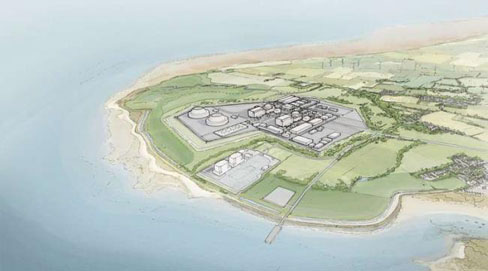
Climate Change the big issue for nuclear power on the East coast, https://www.banng.info/news/press-releases/climate-change-and-nuclear-power/ 11 September 2021 According to Andrew Blowers, Emeritus Professor of Social Sciences at the Open University, Climate Change has become the overriding issue facing the future of the proposed Sizewell C and Bradwell B nuclear power projects on the East Anglian coast. ‘Far from being a solution to the problem of Climate Change, new nuclear power stations like Sizewell C and Bradwell B on the fragile and vulnerable east coast, are likely to become victims of the inevitable, imminent and irreversible consequences of global warming’, he said.
Speaking at a Specific Hearing at the Sizewell C Examination to discuss Policy and Need, Professor Blowers stated that Climate Change was the ‘transformative issue’ of Policy and should be at the very heart of the discussion about building coastal infrastructures like nuclear power stations.
He was disappointed that the Examination Agenda was narrowly framed and the process favoured a legalistic approach. This encouraged a fragmented discussion and a tendency to focus on specific details while losing sight of the bigger picture.
The Examination process must raise its sights from the interminable and obfuscating legalistic debates controlled by developers and give attention to the real and present danger that Climate Change poses for the security and viability of projects in such unsuitable locations. ‘
‘Put simply, there is little justification for these huge structures in terms of need. But, regardless of need, given the threat to the integrity of the sites and the risks to present and future generations and environments, the proposals should be scrapped forthwith’.
The recent Report of the Intergovernmental Panel on Climate Change (IPCC) has spelled out in uncompromising, incontrovertible and unequivocal terms that a rise in global temperatures of 1.50C above pre-industrial levels is already inevitable. It is highly likely that 20C, the level which scientists say may just be manageable, will be reached by the end of the century, and possibly before, if present trends are not arrested. Sea level rise will be around a metre and, as ice melts and oceans heat up, it will continue thereafter. The IPCC states that a sea level rise of 2 metres by 2100 and 5 metres by 2150 ‘cannot be ruled out due to deep uncertainty in ice sheet processes’.
As sea levels rise, the frequency and severity of coastal flooding and erosion will increase and extreme events that occurred once in a century in the recent past are projected, in some scenarios, to occur annually in future. Of course, there is great uncertainty the further forward we look. But, what is certain, is that the impacts of climate change on sea level rise, storm surges and coastal processes could render these east coast sites unviable. This would pose a threat to the security of the highly radioactive wastes remaining stored on site until the latter half of the next century.
At the Hearing, Sizewell C’s developer, EDF relied on governmental polices enshrined in National Policy Statements (NPSs), now ten years old, to claim that the nuclear energy from Sizewell C was necessary. In its more recent pronouncements, the Government is far more equivocal in its support for nuclear energy from such large-scale power stations.
Regardless of whether nuclear is needed at all, Sizewell and Bradwell are manifestly not ‘potentially suitable’ sites as originally indicated in the NPS all those years ago. At both sites the developers claim that the hard defences proposed will be sufficient to protect the nuclear islands against the ravages of climate change.
But, beyond the end of the century, sea level will continue to rise and the impacts become more severe and scenarios for the worst case but plausible change are increasingly uncertain. It becomes impossible to make specific projections and modelling of more extreme coastal conditions is problematic. ‘What possible use will be projections into an unknowable future?’, asks Professor Blowers.
‘It is all too little, too late. I believe we must take the issue of Climate Change seriously and refuse permission to develop these coastal nuclear power stations. It seems inconceivable that the defensive structures can survive intact into the unknown but worsening conditions of continuing sea level rise and extreme events that are inevitable in the future. There can be no possible justification for inflicting this legacy on our coastal communities now and in the future.’
1 This Month
Tell Congress: Prevent Nuclear Catastrophe in Iran

Tell Congress: Prevent Nuclear Catastrophe in Iran

Read the Public Inquiry Report, the Commissioners’ report, Surrendering Australia: The AUKUS Deception is available to download for free at aukuspublicinquiry.com. Or just watch the replay of the National Press Club Luncheon.


Shut down the radiation-damaged Heysham nuclear reactors now
To see nuclear-related stories in greater depth and intensity – go to https://nuclearinformation.wordpress.com

Say No to NASA’s Reckless Nuclear Reactor on the Moon
Say No to NASA’s Reckless Nuclear Reactor on the Moon
-
Archives
- November 2026 (246)
- October 2026 (302)
- September 2026 (339)
- August 2026 (330)
- July 2026 (355)
- June 2026 (287)
- May 2026 (306)
- April 2026 (356)
- March 2026 (251)
- February 2026 (267)
- January 2026 (308)
- December 2025 (358)
-
Categories
- 1
- 1 NUCLEAR ISSUES
- business and costs
- climate change
- culture and arts
- ENERGY
- environment
- health
- history
- indigenous issues
- Legal
- marketing of nuclear
- media
- opposition to nuclear
- PERSONAL STORIES
- politics
- politics international
- Religion and ethics
- safety
- secrets,lies and civil liberties
- spinbuster
- technology
- Uranium
- wastes
- weapons and war
- Women
- 2 WORLD
- ACTION
- AFRICA
- Atrocities
- AUSTRALIA
- Christina's notes
- Christina's themes
- culture and arts
- Events
- Fuk 2022
- Fuk 2023
- Fukushima 2017
- Fukushima 2018
- fukushima 2019
- Fukushima 2020
- Fukushima 2021
- general
- global warming
- Humour (God we need it)
- Nuclear
- RARE EARTHS
- Reference
- resources – print
- Resources -audiovicual
- Weekly Newsletter
- World
- World Nuclear
- YouTube
-
RSS
Entries RSS
Comments RSS

