Question hangs over Bradwell nuclear project – Bradwell B (BRB) a partnership 66.5% China’s CGN and 35% France’s EDF.

SafeEnergy E Journal No.92. December 21 Bradwell Bradwell B (BRB), which is a partnership between the Chinese Company, CGN – with a 66.5% share and EDF Energy with a 33.5% share is hoping to build a Chinese reactor – the UKHPR100 at Bradwell in Essex. BRB appealed to the Planning Inspectorate against the refusal by Maldon District Council of Planning Permission for further land investigations at Bradwell. The Appeal was successful.
But this does not give a green light to a future nuclear power station at Bradwell, and given the current hostility to Chinese involvement in UK Infrastructure seems unlikely to progress much further. The Blackwater Against New Nuclear Group (BANNG) objected to land investigations on the grounds that they were unnecessary since the site is wholly unsuitable, unsustainable and unacceptable for the development of a mega nuclear power station and spent fuel stores.
The Planning Inspector chose to uphold the Appeal on the narrow grounds that the works would be temporary and would create little disruption and disturbance to the environment and human welfare. The Inspector declined to take into account the question of need for new nuclear, relying on the 2011 National Policy Statement on Nuclear (EN6) which deemed Bradwell a ‘potentially suitable’ site. In its latest policy statements the Government is silent on Bradwell and the project seems likely to be dropped altogether on geopolitical grounds.
On 25th November The Times reported that China would be cut out of future involvement in developing new nuclear power stations. Boris Johnson said that a potential adversary could have no role in Britain’s “critical national infrastructure”. The Prime Minister, asked by Labour spokesperson, Matthew Pennycook if he could “confirm unequivocally today that plans for China General Nuclear to own and operate its own plant at Bradwell in Essex have been abandoned”, said:
“Clearly, one of the consequences of our approach on critical national infrastructure in the National Security and Investment Bill is that we do not want to see undue influence by potentially adversarial countries in our critical national infrastructure. That is why we have taken the decisions that we have. On Bradwell, there will be more information forthcoming. What I do not want to do is pitchfork away wantonly all Chinese investment in this country, or minimise the importance to this country of having a trading relationship with China.” (3) https://www.no2nuclearpower.org.uk/wp/wp-content/uploads/2021/11/SafeEnergy_No92.pdf
Despite the USA’s V.C. Summer nuclear fiasco, a consortium plans to build the same type of reactor, with same funding model, at Wylfa, UK
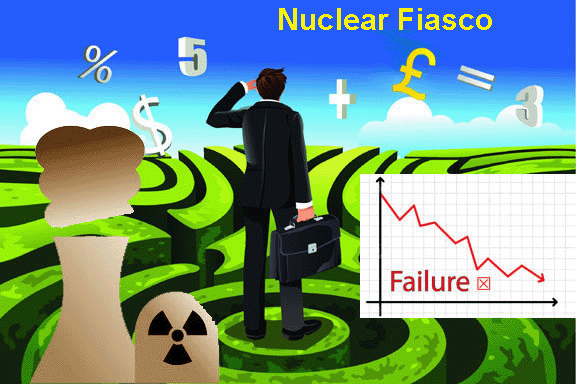
SafeEnergy E Journal No.92. December 21, Wylfa. In October it was reported that two groups had been speaking to the Department for Business, Energy and Industrial Strategy about the possibility of building at Wylfa on the island of Anglesey. A consortium involving US engineering firm Bechtel has proposed building a large Westinghouse AP1000 reactor. Talks have also taken place with UK-based Shearwater Energy, which has hybrid plans for small nuclear reactors and a wind farm. (1)
The AP1000 is the very reactor that was being built at V.C.Summer in South Carolina and which bankrupted Toshiba Westinghouse in 2017. After huge overspending the project was abandoned 40% of the way into construction.
Under legislation passed by the South Carolina Public Services Commissioners in 2008—but strongly opposed by civil society groups—construction costs for the V.C. Summer reactors were to be paid by state ratepayers. On 31 July 2017, Santee Cooper and SCANA Corporation (the parent company of South Carolina Electric & Gas or SCG&E) decided to terminate construction of the V.C. Summer reactor project. At the time of cancellation, the total costs for completion of the two AP-1000 reactors at V.C. Summer was projected to exceed US$25 billion—a 75 percent increase over initial estimates. Dominion, which took over SCANA in January 2019, will be charging South Carolina ratepayers an additional US$2.3billion over the next two decades, having already paid $4billion, for the collapsed V.C. Summer project. (2)
On 16th November, Steve Thomas, Emeritus Professor of Energy Policy at Greenwich University, told the House of Commons Nuclear Energy Finance Bill Committee that the V.C. Summer experience shows the folly of the RAB model. The plant has added 18% to bills in South Carolina.
Since October there has been more of a focus on the fact that Rolls Royce is considering Wylfa and Trawsfynydd as possible locations to build small nuclear power stations. (3) https://www.no2nuclearpower.org.uk/wp/wp-content/uploads/2021/11/SafeEnergy_No92.pdf
Risk of lack of electricity: is EDF’s nuclear fleet properly managed?
Risk of lack of electricity: is EDF’s nuclear fleet properly managed? The
manager of the transmission of electricity RTE alerted Monday on the state
of “particular vigilance” of the electricity network this winter. The low
availability of nuclear power is questioned.
L’Express 24th Nov 2021
France’s Court of Auditors warns on the ”uncertainties” surrounding the future of nuclear power
The Court of Auditors alerted Thursday to the “uncertainties” weighing on
the ability to build a new nuclear park “within a reasonable time and at a
reasonable cost”, while President Macron has just decided to launch a new
program of EPR. The construction of new means of electricity production –
whether nuclear or renewable – “now calls for urgent decisions to guarantee
our supply by the decade 2040″, underline the magistrates in a thematic
note.
Boursama 18th Nov 2021
Radiation control organisation calls for significant reduction in toxic releases fro La Hague nuclear facility.
ASN consultation on discharges from the La Hague plants: Association pour le Contrôle de la Radioactivité dans l’Oues (ACRO) requests a significant reduction in toxic releases from La Hague.
The Nuclear Safety Authority (ASN) has made available for public consultation , for a period of 2 weeks only, its draft decisions modifying certain methods of water withdrawal and consumption, discharge and environmental monitoring, and certain environmental discharge limits for liquid and gaseous effluents from the La Hague plant.
Remember that these factories have the highest radioactive releases at sea in the world and that ACRO, as part of its citizen surveillance , detects them as far as Denmark. Let us also remember that France is committed, within the framework of the OSPAR conventionfor the protection of the North-East Atlantic, to reduce its discharges into the sea so as to bring, for radioactive substances, the levels in the environment to levels close to the background noise for natural substances and close to zero for those of artificial origin by 2020. This commitment made in 1998, in Sintra, Portugal, by the Member States of the OSPAR convention was confirmed at the following meetings in 2003 in Bremen and 2010 in Bergen. Since none of these waste reduction policy has been implemented, the 2020 deadline was quietly pushed 2050 on 1 st October 2021 . In addition, the 2021 commitment also includes a reduction in chemical discharges so as to obtain levels close to zero in 2050……………
Finally, it should be remembered that the ACRO had highlighted, in 2016, a substantial radioactive pollution in the Ru des Landes and Areva, now Orano, had undertaken to “take back and condition the land marked with americium 241 in the zone located to the north- west of the site. “ To date, no work has been undertaken.
ACRO 22nd Nov 2021
Consultation ASN relative aux rejets des usines de La Hague : l’ACRO demande une réduction significative
Guest Post from Gordon Frederick Coggon – a Nuclear Test Veteran’s Experience — RADIATION FREE LAKELAND

Gordon Frederick Coggon ·26 Nov 21,
Guest Post from Gordon Frederick Coggon – a Nuclear Test Veteran’s Experience — RADIATION FREE LAKELAND
https://wordpress.com/read/feeds/331643/posts/3682558618 During 1957 and 1958 I was one of 20,000 British serviceman sent to the central Pacific testing ground of British Hydrogen bomb tests which in my own case involved being at Christmas Island.(now named Kiritimati). During my year there I was subjected to radiation contamination. I witnessed two hydrogen bombs, the first being Operation Grapple X with a 1.8 megaton yield on Nov 8th. 1957 and the second bomb being on 28th. April 1958. Which had a yield of 3 megatons.( Both these devices were dropped by a Valient ‘V’ bomber about 20 miles off the southern tip of the Island.)
After the Grapple X test I was sent to hand wash a Canberra Aircraft,s engine nacelles after it had flown through the cloud of the hydrogen bomb collecting samples. I was set to work using a small bore hosepipe and a scrubbing brush, (the Aircraft had been hosed down with high pressure jets of water before I was employed on a gantry cleaning where the jets of water were not directed at the intakes of the engines.) Initially, I was given a pair of denims, wellingtons, rubber gloves and a remote breathing apparatus (which consisted of a face mask attached to 38 feet of corrugated rubber hose and connected to a fresh air filter which was fastened down as far away as possible from the aircraft. The face mask head straps were broken so the man in the white suit and gas mask said it was useless for the job in hand so I was given a crude homemade mask made from cotton wool sandwiched between a silver paper foil.
Whilst working on the gantry the mask got wet through and I wasnt able to breathe, so I had to move it from my mouth and nose to enable myself to breathe. I continued to work for between 20 to 30 minutes before I was replaced by someone else and I was then sent to the decontamination tent where I showered several times until the man in the white suit and Geiger counter said I was ok to get dressed in the clean side of the tent and was given a new set of kd shorts and shirt. This showering and decontamination took at least one and a half hours, My contaminated clothing was put in a yellow barrel marked with radiation signs in the dirty side of the facility. I have to say also that some of us were given other dangerous tasks like picking up dead fish and birds after the tests and some guys had to dump contaminated equipment in the ocean or bulldoze contaminated earth. After the Grapple Y bomb on 28th.April 1958, there was a massive downpour of rain, which came from the bomb cloud, a lot of the young innocent troops stood outside bathing in it like one normally did during the rain showers, but unlike the normal rain this was said to be contaminated because there was no other clouds in the sky at the time.
At that time I was 18 years old (picture of me above whilst there) and most of us had no idea what radiation was. Nor was I told anything about it until later in my career when I remustered into the Fire, Crash and rescue trade, where I was trained up to an advanced stage about radiation and biological warfare and every Monday I was teaching an induction course to new arrivals on the station that I was posted too. That was when I began to worry about my own health. Had I been put at an high risk of radiation whilst on Christmas Island ??. The Aircraft that I had helped to decontaminate was still emitting Gamma radiation, to what extent?? Also, did I swallow, inhale Alpha particles.?? ( Alpha radiation cannot penetrate human skin but they can be swallowed in water droplets, eaten if on food, or more commonly inhaled.)
These Alpha particles may remain inside your body for your whole life, attacking cells of your body for decades and could take many years before irrepairable damage becomes apparent. Recently it has been associated with radiation caused diseases and malformities in new born descendants of nuclear test veterans. I have had Cancer and several other illnesses which most lightly have been caused by atomic radiation, so far, even after seventy years, the successive British Governments have continued to deny that their troops were subjected to radiation during their atomic and hydrogen tests in the fifties and sixties. And yet, many of the nuclear armed countries have acknowledged the troops that was sent to take part in their experiments with nuclear fission and have been recognised by being given a medal and/or compensation.
I have only mentioned my own experience at Christmas Island (Kiritimati) but during a period 1952 – 1968 there have been many such tests in Australia, other testing areas of the Pacific where a lot of fellow veterans were irradiated by atomic fallout and nuclear poisoning from various clean-up operations after the tests, many of these young men never got to grow old because of their contamination from the tests. Many test sites were carried out where local people lived, these same people have since lost their homes and way of life by the poisoning effects of radiation . Since; atomic radiation contamination illnesses have continually been killing test veterans and clean-up veterans nothing has been done so far to help the families of these brave innocent troops and civilians by the British Government, who were subjected to experiments during the trials.
It is now becoming more alarming by the number of offspring who have also inherited their veteran father’ s damaged cells genetically. * reference to these tests are also available in two books that I have published on Amazon. The first one is titled :- ‘ Christmas Island 1957-1958 ‘ an Ebook on Kindle. The other is a paperback, titled:-‘ The Life of a Yorkshire Lad’ on Amazon and an ebook on kindle.
All royalties for the (latter paperback/ebook have been donated to LABRATS INTERNATIONAL for their continued valuable work in helping test veterans and their descendants come together from all over the world in their fight for justice.
Nuclear power in Hungary: Green, cheap and independent?
Nuclear power in Hungary: Green, cheap and independent? DW, 26 Nov 21,
The Hungarian government is convinced that nuclear power is the path to a green future. A new Russian reactor block is to be constructed that allegedly guarantees low emissions and low energy prices.
While Germany is phasing out nuclear power and many EU states don’t have any atomic plants at all, others are expanding their nuclear programs as part of the fight against climate change. These states argue that atomic energy is low in CO2 emissions and allows them to produce cheap electricity and be more energy-independent.
But can nuclear power really lead the way out of the climate crisis?
EU split on nuclear power
The Hungarian government says it can — and is far from being alone. In mid-October, 10 EU states, including Finland, the Czech Republic and Poland, issued a statement that declared: “To win the climate battle, we need nuclear energy.”
France, a long-time enthusiastic advocate of nuclear energy, took the lead in formulating this statement. Currently, Paris is investing in new types of domestically developed reactors.
Meanwhile, Budapest is planning to expand its Russian-type nuclear plant. It is located near the small town of Paks on the banks of the Danube, less than a two-hour drive south of the Hungarian capital. In addition to the four existing reactors, two others are planned — Paks II.
Good for the environment and consumers?
…………… The question of whether atomic power is really beneficial to the environment is extremely contested. It is not just a matter of the catastrophic consequences of potential reactor accidents and the still unresolved questions about the safe storage of atomic waste. Nuclear energy does not guarantee lower emissions. A study of 123 countries that was published in the scientific journal Nature in 2020 came to the conclusion that actual emissions are not significantly lower in those countries with nuclear power than those without.
New reactor block in seismically active zone
The nuclear plant in Paks also has an impact on flora and fauna in the vicinity, stresses Andras Perger, the climate and energy expert for Greenpeace Hungary. He says that cooling water fed into the Danube can significantly increase the river’s temperature, in particular when water levels are low and all reactors are running.
“The cooling water is already the most significant environmental influence,” Perger says. The water temperature in the zone up to 500 meters (1,640 feet) downriver of the plant is legally permitted to reach a maximum of 30 C (86 F). In August 2018, the river reached, at times, the critical level of 29.8 C, according to the operator. Unofficial measurements conducted by the think tank Energiaklub even showed temperatures significantly above permitted levels.
Perger also stresses the fact that the new reactors are located in a seismically active zone and is skeptical whether all regulations were taken into account when choosing the site. The Federal Environmental Office in neighboring Austria shares his view. This summer, it produced a report that described the location of Paks II as “unsuitable.”……
How independent is nuclear energy?
The state-owned company MVM’s home page states that the new reactor blocks are not just safe but guarantee Hungary greater energy independence. Yet experts are not convinced that the plants really improve Hungary’s relatively high import rate — the technology as well as the fuel rods come from Russia. A study from 2020 comes to the conclusion that in view of this fact, nuclear energy can also ultimately be classed as an import, meaning some three-quarters of the country’s energy balance comes from beyond the country’s borders……………
Lack of transparency
But opposition parties and NGOs have sharply criticized the decision to directly award the contract for expanding the plant to Russia’s state-owned nuclear energy company Rosatom and to finance the project with a Russian loan worth more than €10 billion. The relatively high interest rate of between 4% and 5% and the Hungarian forint‘s drop in value could mean that taxpayers will end up paying more than the €12.5 billion ($14.1 billion) budgeted for the new reactors………….
Critics have also attacked the Fidesz government’s decision to declare the Rosatom contract a matter of national security and its passing of a new law that permits the documents to be kept under lock and key for 30 years.
Little hope for opponents of nuclear energy
Unlike Germany or Austria, Hungary does not have a broad-based anti-nuclear power movement. A number of opinion polls indicate that a majority of Hungarians tend to oppose the renewed extension of the operating licenses of the existing reactors and the expansion of Paks nuclear power plant — in particular after the 2011 Fukushima nuclear disaster.
But scrapping the contract for Paks II or abandoning nuclear power altogether would be difficult. Not only would energy prices for consumers be likely to rise, but the government could be forced to pay high compensation payments to Russia. https://www.dw.com/en/nuclear-power-in-hungary-green-cheap-and-independent/a-59950544
Melting Arctic sea ice linked to ”worsening fire hazards” in Weatern USA
Arctic sea ice melt has driven an increase in “fire-favourable
weather” across the western US over the past four decades, according to
new research.
The study, published in Nature Communications, finds that low
Arctic sea ice levels during July to October have knock-on impacts in the
atmosphere that push the jet stream northwards. This tends to bring hotter
and drier conditions in the western US over the following autumn, resulting
in more frequent and intense fires in the region, the authors find.
They add that this mechanism may strengthen over the coming decades as the
Arctic melts further, making the western US “even more susceptible to
destructive fire hazards”.
Carbon Brief 25th Nov 2021
Tepco to repair Fukushima nuclear station’s partially melted protective ice wall.

Ice Wall to Halt Groundwater Flow at Japan’s Fukushima Nuclear Plant to Be Repaired https://thewire.in/world/ice-wall-to-halt-groundwater-flow-at-japans-fukushima-nuclear-plant-to-be-repaired
Tokyo Electric Power Co (Tepco) will launch remedial works at the stricken plant after ice wall tests indicated partial melting. Tokyo: Tokyo Electric Power Co (Tepco) will launch remedial works at the stricken Fukushima Daiichi nuclear plant to strengthen an ice wall intended to halt the flow of groundwater after testing indicated partial melting.
The work could begin as early as the start of December, according to a presentation from the plant operator dated Thursday, part of a costly and troubled effort to secure the site following the 2011 earthquake and tsunami.
The ice wall is intended to limit the seepage of groundwater into the plant, which has created large amounts of toxic water being stored by Tepco in tanks.
Japan plans to release more than 1 million tonnes of water into the sea after treating it. The water contains the radioactive isotope tritium, which cannot be removed.
USA rehearsed dropping nuclear weapons 20km from Russian border
 | |||
US rehearsed dropping nuclear weapons 20km from Russian border – Moscow
US rehearsed dropping nuclear weapons 20km from Russian border – Moscow, Rt.com23 Nov, 2021 , American nuclear-capable bombers have flown dozens of sorties across Eastern Europe in the past few weeks as part of drills designed to probe Russian readiness in case of an atomic war, Russia’s defense minister has claimed.
Speaking after a meeting his Chinese counterpart, Wei Fenghe, in Moscow on Tuesday, Sergey Shoigu said that there has been “a significant intensification of activity from US strategic bomber aviation near the borders of Russia.”
According to him, “over the past month, around 30 missions have been flown near the borders of the Russian federation, around two and a half times more than in the same time period last year.”
Shoigu added that recent American exercises, codenamed Global Thunder, saw “ten strategic bombers practicing their ability to use nuclear weapons against Russia at almost the same time from the west and the east. The minimum distance from our border was 20km.”
……….. Both Russia and NATO have accused each other of stepping up warplane flights close to the border, and last year Moscow blasted a “provocative” move from Washington to dispatch American B-1B nuclear bombers into Ukrainian airspace for the first time in history. Russian fighter jets and anti-air rockets were scrambled in response. https://www.rt.com/russia/541089-us-testing-ability-nuclear-attack-moscow/
Preparations for discharging treated water into the ocean in earnest at TEPCO’s Fukushima Daiichi Nuclear Power Plant

November 26, 2021
The Tokyo Electric Power Company (TEPCO) announced on April 26 that it will begin a survey on April 27 to construct an undersea tunnel that will connect to the outlet of the Fukushima Daiichi Nuclear Power Plant (Okuma and Futaba towns, Fukushima Prefecture), 1 km offshore, in order to proceed with a plan to release contaminated water into the sea after purification and treatment. In December, preparations began for the construction of a shaft to temporarily store the treated water, with the aim of releasing the water in the spring of 2023. In December, preparations began for the construction of a shaft to temporarily store the treated water, and the move to release the water in the spring of 2003 will be in full swing.
According to TEPCO, magnetic sensors will be used to check the seafloor at the drilling site for any obstructions in order to conduct a ground survey by boring.
Then, over a period of about a month starting in early December, the geology will be examined by drilling 10 to 30 meters into the seabed at three points along the construction route of the undersea tunnel, about 400 meters offshore from the plant, about 700 meters, and about 1 kilometer from the discharge port.
From early December to March next year, a 10-plus meter square hole will be dug at the site along the coast east of Unit 5, where a shaft will be installed. The timing of the construction of an undersea tunnel connecting the shaft to the discharge port has not yet been decided.
Explanations to the local community have been difficult, and there is deep-rooted opposition, especially from the fishing industry.
The release of treated water into the ocean is strongly opposed by people in the fishing industry, and explanations to the local community by TEPCO and the government have been difficult.
Even now, seven months after the government’s decision, TEPCO has not been able to apply for the facility plan to the Nuclear Regulation Authority. TEPCO is continuing to explain the plan to the people concerned by carrying out the seabed survey and preparatory work ahead of the plan. (Kenta Onozawa)
https://www.tokyo-np.co.jp/article/144947
Waste Isolation Pilot Plant (WIPP) gets 13,000th nuclear waste shipment, and plans for much more
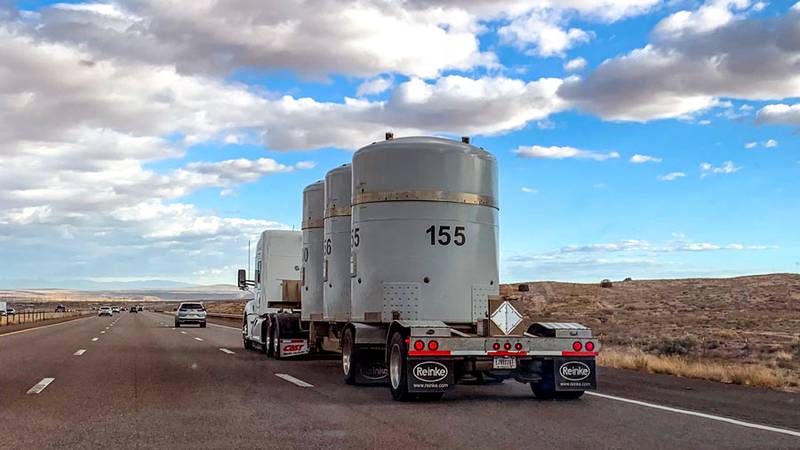
Waste Isolation Pilot Plant gets 13K nuclear waste shipments, plans to ‘ramp up’ to 17 a week, Adrian Hedden, Carlsbad Current-Argus 24 Nov 21, A 13,000th shipment of nuclear waste was delivered to the Waste Isolation Pilot Plant repository near Carlsbad Nov. 11, marking a milestone since the facility first began accepting waste in 1999.
The shipment was made up of transuranic (TRU) waste from the U.S. Department of Energy’s Idaho National Laboratory from that facility’s Advanced Mixed Waste Treatment Project.
About half of WIPP’s shipments in its lifetime came from the Idaho lab, about 6,600……..
Of the 13,000 shipments of waste sent to WIPP in the last two decades, 775 were considered remote-handled (RH) waste, handled in shielded casks and emplaced in the walls of the WIPP underground – an underground salt deposit that gradually buried the waste permanently and blocks radiation.
To get that waste to the WIPP facility from nuclear sites owned by the DOE around the country, truck drivers logged about 15 million miles, per a DOE news release, without a “serious injury” or radiological release.
……. WIPP’s first shipment was delivered for disposal from Los Alamos in March 1999, and the site went on to dispose of waste from 13 facilities around the U.S.
The final shipment from Rocky Flats and Environmental Technology Site in Colorado came in 2005, and the 10,000 shipment was received – also from Idaho – in 2011.
The first RH waste shipment was disposed of at WIPP in 2007, and the facility hasn’t receive RH waste since 2014, although the process of resuming RH waste was underway and expected to take about three years.
…….. WIPP will continue to prioritize shipments from Los Alamos and Idaho, Knerr said, for the “bulk” of the next decade.
Reinhard Knerr, manager of the DOE’s Carlsbad Field Office said increasing shipments can be achieved ahead of an ongoing rebuild of the facility’s ventilation system planned to go into service in 2025 or 2026.
“We believe we’re going to be ready to resume increased shipments well before that,” he said.
To achieve that goal, Knerr said WIPP must complete multiple projects: filling and closing out the 7th waste disposal panel by 2022 and finishing emplacement in Panel 8 by 2025.
Then, he said WIPP hopes to emplace waste in Panels 11, 12 in the coming years and Panel 13 by 2034.
Plans were recently announced to mine Panels 11 and 12, described by WIPP officials as “replacement” panels for capacity lost in an accidental radiological release in 2014 that led to a three-year halt of WIPP’s primary operations.
To support the increase in waste emplacement and mining, Knerr said a fourth shift was intended to be added to the WIPP workforce.
“We have to make sure that we are mining,” Knerr said. “That includes the access drifts as well as mining out the panels themselves. We need to be sure that we have enough staff on site to support not only the mining needs that we have, but the waste emplacement as well.” https://www.currentargus.com/story/news/local/2021/11/26/waste-isolation-pilot-plant-gets-13-k-nuclear-waste-shipments/8739296002/
Fukushima Daiichi Under Volcanic Pumice Risk
November 21, 2021
Volcanic floating pumice stones have been causing problems for coastal communities in Japan since August. The floating pumice began showing up in Okinawa near Japan’s southernmost territory first. Japan’s Agency for Marine-Earth Science and Technology predicts the pumice raft may show up around Chiba prefecture by the end of November. Chiba is directly east of Tokyo. The agency provided a video of their pumice raft plume path prediction on their website.

The plume prediction model shows it to be offshore of Fukushima prefecture by November 30th. This does have some potential to create problems at the Fukushima Daiichi disaster site. TEPCO acknowledges this here. The primary concern is units 5 and 6. Units 1 to 3 suffered meltdowns and no longer depend on any ocean cooling. The cooling system for the reactor vessels of those units is a closed-loop system that reuses treated contaminated water. This system has no dependency on the ocean to complete the cooling process. The spent fuel pools for units 1 to 3 have closed-loop cooling systems that are also not dependent on the ocean for heat exchanging. Unit 4 had no fuel in the reactor vessel during the 2011 disaster and has had all of the spent fuel removed from the spent fuel pool.
Units 5 and 6 had all of the fuel removed from the reactor vessels and was placed in the respective spent fuel pools. Unit 5 holds 1542 units of spent fuel while unit 6 holds 1884, which includes some offloaded fuel from unit 4. Additionally, 168 pieces of unused fuel in unit 5’s spent fuel pool and 428 pieces of unused fuel at unit 6 are among the total amounts. The newest fuel in these two spent fuel pools is roughly 10 years old. We explain the decay heat process of spent fuel in this report.
Both reactor units use the RHR cooling system to cool the spent fuel pools. This consists of a pump system in the reactor building basement and a seafront pump facing the port. Both units 5 and 6 had replacement pumps installed at the seafront after the 2011 disaster. In 2019 the reactor building RHR pump in unit 6 failed and needed to be replaced. In 2014 the RHR pump for unit 5 failed. TEPCO was able to “share” the RHR system from unit 6 to cool unit 5’s spent fuel pool. This kept the pool within regulated temperature ranges.
The main concern with units 5 and 6 would be the potential heat up of the spent fuel pools if the pumice raft were to hit Fukushima Daiichi. Both units have significant amounts of spent fuel in their pools with both being over 1000 fuel assemblies each in inventory. By contrast, unit 1 has 392 assemblies in the spent fuel pool, and unit 2 has 615. Over ten year old spent fuel has less ability to generate heat. Typically by the 5-year mark spent fuel can be stored in dry casks due to the decay in heat generation potential.
If the pools were to lose cooling access, water could be replaced by portable piping or hose. In a longer-term situation, a portable heat exchanger similar to those used on the spent fuel pools of units 1 to 3 could be brought in. The time frame for TEPCO to implement such a plan is unknown as that level of emergency planning has not been released to the public.
The common pool is the other cause for concern. The building that houses the common pool has an extensive series of cooling units on the roof. It is assumed that this system isn’t dependent on any seafront cooling exchange but we do not have enough detailed information about the systems to state this with 100% certainty.
The port area for units 5 and 6 does have a silt fence in place that would help reduce pumice infiltration into the areas of the cooling pumps. It could greatly reduce the possibility of pumice reaching the pump intakes but it isn’t 100% effective.

If pumice infiltration appears likely TEPCO has a plan to install additional fencing and oil collection type booms to block the port areas. TEPCO’s report also cites that the metal fence on the pump intakes for units 5 and 6 have a 9mm hole spacing that may be sufficient to stop larger pieces of pumice from reaching the pumps. As of 11.23.21 TEPCO has not released any updates to the situation at the plant related to the pumice issue. The plume is expected to pass by the plant over the next week leaving this an open issue to monitor.
Hat tip to Fukushima Diary who initially discovered the issue.
Hunterston nuclear reactor 3 closed, but there will be decades from defuelling through dismantling
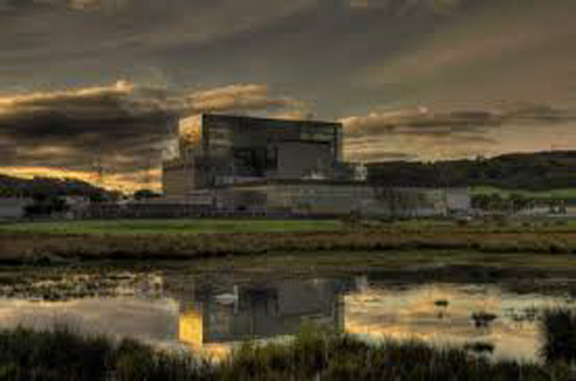
SafeEnergy E Journal No.92. December 2 Hunterston Reactor 3 is expected to come off line at the end of November and Reactor 4 before 7th January 2022. There would then be 2 months of statutory outage and then defueling would commence. EDF is hoping to despatch 4 rather than 2 spent fuel flasks every week to Sellafield during defueling.
Defueling will take around three years and will continue to draw on the skills of EDF’s specialist staff and contractors. It will then take around 5 or 6 years to prepare the plant for a period of 40 to 50 years of care and maintenance. Final dismantling could begin around 2070. https://www.no2nuclearpower.org.uk/wp/wp-content/uploads/2021/11/SafeEnergy_No92.pdf
Bipartisan USA lawmakers Press Biden to stop Canadian plan to store nuclear waste near Lake Huron.
Michigan reps press Biden to stop Canadian plan to store nuclear waste near Lake Huron. Melissa Nann Burke, The Detroit News, 26 Nov 21, Washington — Bipartisan Michigan lawmakers are pressing President Joe Biden to talk to the Canadian government about stopping the proposal for a permanent repository for radioactive waste near Lake Huron.
U.S. Reps. Dan Kildee, D-Flint Township; Andy Levin, D-Bloomfield Township; and Peter Meijer, R-Grand Rapids Township, spoke out ahead of Biden’s recent meeting with Canadian Prime Minister Justin Trudeau, expressing their opposition to the plans.
“We are disappointed the Canadian government has proposed building a permanent nuclear waste repository in the Great Lakes basin, threatening the drinking water of more than 40 million people on both sides of the border,” the lawmakers said in a joint statement.
“We ask President Biden to work with Prime Minister Trudeau to ensure that no nuclear waste is permanently stored in the shared Great Lakes water basin.”
The representatives pointed out the Canadian government opposed any potential sites for permanently storing nuclear waste located within shared water basins when the United States was investigating sites in the 1980s, noting the Americans ultimately chose another site “out of respect for our Canadian friends.”……………..
This month, the NWMO began a three-dimensional seismic survey in South Bruce as part of its ongoing study to determine the site’s suitability for the deep geological repository.
Kildee in September introduced a resolution in the House expressing opposition to the site in South Bruce, joined by a bipartisan group of lawmakers from Great Lakes states. https://www.detroitnews.com/story/news/politics/2021/11/26/biden-pressed-stop-canadian-nuclear-waste-storage-near-lake-huron/8725074002/
1 This Month
Tell Congress: Prevent Nuclear Catastrophe in Iran

Tell Congress: Prevent Nuclear Catastrophe in Iran

Read the Public Inquiry Report, the Commissioners’ report, Surrendering Australia: The AUKUS Deception is available to download for free at aukuspublicinquiry.com. Or just watch the replay of the National Press Club Luncheon.


Shut down the radiation-damaged Heysham nuclear reactors now
To see nuclear-related stories in greater depth and intensity – go to https://nuclearinformation.wordpress.com

Say No to NASA’s Reckless Nuclear Reactor on the Moon
Say No to NASA’s Reckless Nuclear Reactor on the Moon
-
Archives
- November 2026 (238)
- October 2026 (302)
- September 2026 (339)
- August 2026 (330)
- July 2026 (355)
- June 2026 (287)
- May 2026 (306)
- April 2026 (356)
- March 2026 (251)
- February 2026 (267)
- January 2026 (308)
- December 2025 (358)
-
Categories
- 1
- 1 NUCLEAR ISSUES
- business and costs
- climate change
- culture and arts
- ENERGY
- environment
- health
- history
- indigenous issues
- Legal
- marketing of nuclear
- media
- opposition to nuclear
- PERSONAL STORIES
- politics
- politics international
- Religion and ethics
- safety
- secrets,lies and civil liberties
- spinbuster
- technology
- Uranium
- wastes
- weapons and war
- Women
- 2 WORLD
- ACTION
- AFRICA
- Atrocities
- AUSTRALIA
- Christina's notes
- Christina's themes
- culture and arts
- Events
- Fuk 2022
- Fuk 2023
- Fukushima 2017
- Fukushima 2018
- fukushima 2019
- Fukushima 2020
- Fukushima 2021
- general
- global warming
- Humour (God we need it)
- Nuclear
- RARE EARTHS
- Reference
- resources – print
- Resources -audiovicual
- Weekly Newsletter
- World
- World Nuclear
- YouTube
-
RSS
Entries RSS
Comments RSS

