Prisoners and families exposed to undocumented, possibly risky radiation levels
 | |||

Radiation safety feature of prison x-ray scanner is being overridden
Inmates and families exposed to undocumented, possibly risky radiation levels
NationalPrisonHealthYimes of Malta Mark Laurence Zammit Prison officials are being instructed to override a security feature embedded in x-ray scanners that warns them when inmates and visitors are being exposed to excessive levels of radiation.
Several sources told Times of Malta that the high-end scanners in the entrances of prison are equipped with AI that records the amount of radiation each person is exposed to and warns officials when the pre-set limit is reached.
When this happens, officials are instructed to enter a four-digit code (1585) that overrides the security feature, prompting the scanners to perform further x-ray scans without keeping record of each individual’s radiation intake.
On Sunday morning, prisoners’ rights activist Peppi Azzopardi released a video revealing details about the practice.
When the scanner detects that a person has reached the radiation limit, it ceases to perform scans,” he said.
“But they use the code to cheat the software into taking more scans.”
Azzopardi also said officials sometimes input the code straight away.
“Not only should they record radiation from the scanner; they should also have records of any radiation the inmate might have absorbed elsewhere, like in hospital, so they have a clear picture of how risky the scan will be.”
In the video, Azzopardi also demanded an ‘immediate investigation’ into this practice.
| “I have more information that I’m ready to present to whoever will do the investigations,” he said. Inmates are made to go through the scanner, not only when they are first admitted, but almost every time they return to prison from court, hospital or prison leave. Their families and other visitors too, including lawyers, are forced to go through the scanner almost every time they enter prison. ………………… In regulations published on the use of x-ray body scanners in prison, the UK Justice Ministry strictly prohibits x-ray scans on visitors and family members, and demands that each scan is fully justified, arguing that “the exposure may only occur when the benefit to the individual or society outweighs the health detriment that may be caused to the individual”.UK policy says that for a scan to be justified, there must be “intelligence or reasonable suspicion that the prisoner in internally concealing contraband” and when “there are no other means of determining the suspected contraband, for example by means of a full or rubdown search”…………Times of Malta sent questions to the prison authorities, asking why officials are instructed to override the system, how the prison keeps record of how much radiation each person was exposed to, how the prison justifies the amount of scans it performs, why some people are searched after the scan, and how the prison protects its wardens from radiation……………………… https://timesofmalta.com/articles/view/radiation-safety-feature-of-prison-x-ray-scanner-is-being-overridden.917758 |
”Nuclear Revival” for Canada? Gordon Edwards discusses the latest propaganda.
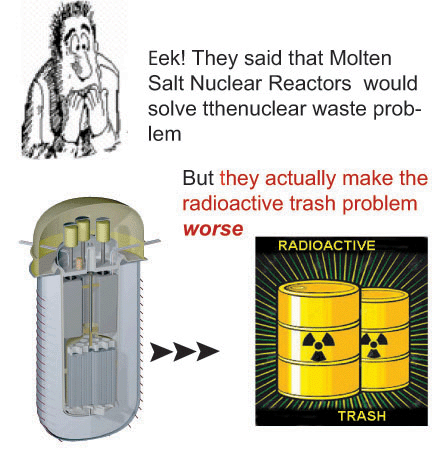
Gordon Edwards, 27 Nov 21, Christopher Read’s latest half-hour documentary on the Nuclear Waste Management Organization (NWMO) discusses its efforts to convince some small community in Ontario to receive all of Canada’s high level radioactive wastes for deep burial.
These are the most toxic materials ever produced by any industry. Of the hundreds of kinds of radioactive poisons contained in the used nuclear fuel, only a handful existed on Earth in significant amounts before 1939. They are created in large quantities inside nuclear reactors.
NWMO is owned by the same companies that make the radioactive poisons in the first place – and they have no intention of stopping. They want to keep right on mass-producing the highly dangerous byproducts indefinitely. Because they have to wait 30 years before moving these deadly wastes – they are literally and figuratively “too hot” to move sooner — there will always be a catastrophic amount left unburied at the surface no matter how fast they bury the older, somewhat cooler wastes.
Meanwhile they will be burdening communities with a permanent radioactive legacy, including contamination caused by unpacking and repackaging millions of embrittled fuel bundles right at the surface, beside the proposed waste dump. Any damage to any of these fuel bundles during handling, even small cracks, will allow radioactive materials to escape and some of it will inevitably enter the sir we breathe, the water we drink, the food we eat, or the soil we walk on.
New reactors are untested, exorbitantly expensive, and will take 10 to 20 years to become available, if ever. They are a DDD = Dirty, Dangerous Distraction from the real job of cutting greenhouse gases now, not 10 years from now. Energy efficiency and renewables can be implemented in a single building season. Wind and solar and efficiency measures are far cheaper and much faster to implement than new nuclear.
When your house is on fire, it is time to grab a bucket or a fire hose and pour water on it – out the fire out! This is no time to sit down and design a new, improved sprinkler system for future use.
Climate change is here now. Action is urgent.
Investing in new nuclear plants is just “kicking the can down the road”. Canada’s Environment Commissioner points out that Canada has the worst record for fighting climate change of any country in the G7, as our greenhouse gas emissions have increased steadily since Trudeau was first elected in 2915. Five of the G7 countries have reduced their GHG emissions, while the sixth has increased GHG emissions at a much slower rate than Canada has.
To invest in unproven and dangerous nuclear plants now will guarantee that no progress will be made for at least 10 to 20 years, minimum. And it will give us more radioactive waste, much of it even more dangerous than the waste we already have. Can we afford to encourage this kind of behaviour with lavish government subsidies?
Small modular reactors not the solution
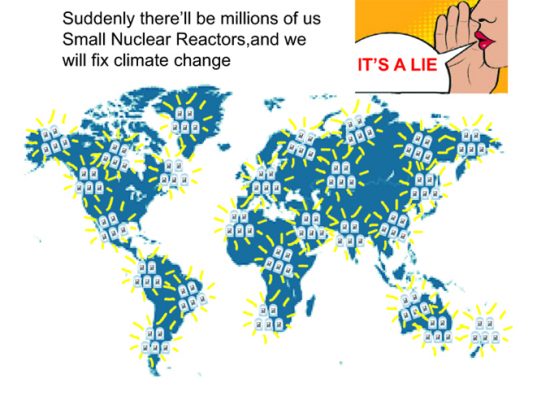
Small modular reactors not the solution – German nuclear authority assessments,
NEWS10 Mar 2021, Kerstine Appunn, Using a large fleet of small modular reactors (SMR) to secure climate neutral electricity supply in the future – as proposed by billionaire and philanthropist Bill Gates – poses many unsolved problems and security risks, two researcher assessments commissioned by the Federal Office for the Safety of Nuclear Waste Management (BASE) have found according to a report by Süddeutsche Zeitung (SZ). SMR proponents claim that, once produced in bulk, these small plants are cheaper and safer thanks to advanced reactor designs and can be operated with converted short-lived radioactive materials, solving the waste problem. But the two reports, seen by SZ, conclude that SMR “carry enormous risks with regard to the proliferation of weapons-grade materials and will probably never be as cheap as their advocates claim”, Michael Bauchmüller writes.
The paper by the Institute for Applied Ecology (Öko-Institut) found that in order to replace the 400 or so large reactors today, “many thousands to tens of thousands of SMR plants” would have to be built. But this raises questions for proliferation, the spread of dangerous nuclear material.
The second assessment by researchers from the Institute for Safety and Risk Sciences, at the Vienna University of Natural Resources and Applied Life Sciences, on nuclear waste aspects of SMR found in three scenarios that a repository for nuclear waste would remain necessary, and that the amount of low and medium level radioactive waste would increase “massively” during the dismantling of nuclear facilities.
Germany will shut down its last nuclear power plant by the end of 2022, according to the government’s phase-out legislation which is supported by a majority of the population. After the nuclear disaster in Fukushima ten years ago, Angela Merkel’s government decided to accelerate the phase-out of nuclear power in Germany where opposition to nuclear plants was one of the key causes leading to the founding of the country’s Green Party. Nuclear power is compensated for by expanding renewable sources wind, solar PV and biogas, as Germany strives for a climate neutral power supply by 2040 or 2050 at the latest.
Newly released Government documents reveal safety, terrorist, dangers of Scotland’s nuclear power stations
Leaks from Scotland’s nuclear power plants had the potential to be as
dangerous as terrorist attacks, ministers in Jack McConnell’s
administration were warned.
Newly released government documents reveal that
concerns were raised about the possibility of accidents at atomic
facilities. There are currently two nuclear power stations north of the
border: Hunterston B, which is due to cease operation early next year, and
Torness, which is scheduled to close in 2030.
Both are operated by the French energy company EDF. Minutes from the Scottish ministerial group on
civil contingencies from March 2005 have been released and posted online.
They contained gloomy forecasts, stating: “The threat from terrorism, in
terms of conventional and Chemical Biological Radiological Nuclear (CBRN)
attacks, remains at a historically high level. ”
The Scottish Conservatives and Scottish Labour have both backed nuclear power to play a role in easing
the country’s reliance on fossil fuels. Last week Anas Sarwar, the Labour
leader, said nuclear should be “part of the mix” of a “diverse energy
supply”. Stuart McMillan, the SNP MSP for Greenock and Inverclyde, said:
“We have been absolutely clear about our opposition to building new
nuclear power plants under current technology.
Times 28th Nov 2021
https://www.thetimes.co.uk/article/warning-over-leaks-scared-scottish-labour-off-nuclear-mb7r2ctc8
Environmental Social and Governance investors have upset polluting and tobacco industries – now they’re coming for nuclear.

Something curious happened this time last year when Serco lost its deal to run the Atomic Weapons Establishment, which manages Britain’s nuclear warheads. The outsourcer’s shares crashed. But after the news, its rating on several ESG indices — which measure compliance with environmental, social and governance metrics — shot up. The message was clear.
While financial investors were worried about the loss of some £17 million a year in underlying trading profits, ESG analysts were delighted that Serco would no longer have anything to do with making the missiles carried on the Royal Navy’s four Vanguard-class submarines. ESG investors have shaken up the
oil and gas and tobacco industries, and now they’re coming for defence.
Concerns that weapons manufacturing could become unpalatable for a broad swathe of shareholders are weighing on share prices. In April, analysts at BNP Paribas pointed out that defence valuations had fallen in line with those for tobacco companies since 2018 — even though, unlike with cigarettes, victims of war are unlikely to sue for damages, and sales of planes and tanks aren’t going to end.
Times 28th Nov 2021
British military moving closer and closer to, nuclear bombers 12 miles from Russian border: envoy — Anti-bellum
Deployment of British troops in Germany doesn’t alleviate tension with Moscow – ambassador The deployment of British Armed Forces in Germany won’t reduce tension between NATO countries and Russia, Russian Ambassador to the UK Andrey Kelin said in an interview with the Times Radio station. “NATO is stepping up its presence along the borders of […]
British military moving closer and closer to, nuclear bombers 12 miles from Russian border: envoy — Anti-bellum
November 28 Energy News — geoharvey

Science and Technology: ¶ “Electric Car FAQs: Do EVs All Use The Same Plug?” • Electric cars are mostly like regular cars. You step on the pedal on the right and the car goes, you turn the wheel and the car turns. 99% of the time the only difference is what kind of fuel goes […]
November 28 Energy News — geoharvey
France quietly benefiting from the neglect of international commitments to protect the seas from radioactive discharges.

SafeEnergy E Journal No.92. December 21, Radioactive Discharges The OSPAR Convention for the Protection of the North-East Atlantic has discreetly postponed its commitment to reduce radioactive discharges at sea from 2020 to 2050. Following a meeting on October 1st, the participating ministers discreetly postponed until 2050 the commitment made in 1998 in Sintra to reduce radioactive discharges into the sea to levels close to zero by 2020.
Once again, international commitments to the environment are being disregarded. This does not bode well for the upcoming COP26 in Glasgow. France is the first beneficiary of this 30-year postponement because, with its reprocessing plant at La Hague, it has the highest radioactive discharges to the sea in Europe. And these discharges are not decreasing, as shown by the results of the citizen monitoring of radioactivity in the environment carried out by Association pour le Contrôle de la Radioactivité dans l’Oues (ACRO) for over 25 years. (1)
The “Cascais Declaration” signed at a Ministerial Meeting in October 2021 said:“We aim to achieve zero pollution by 2050 and commit to reduce single-use plastic items and maritime related plastic items on our beaches by 50% by 2025 and 75% by 2030. We will take action to eliminate anthropogenic eutrophication and continue to reduce hazardous and radioactive substances to near background levels for naturally occurring substances and close to zero for human made substances.” (2)
Remi Parmentier, who was the lead Greenpeace International campaigner when the Sintra Decalation was signed in 1998 tweeted:
“30 yrs backward presented as progress. The OSPAR Commission is using Orwellian language: “We *aim* to achieve zero pollution by 2050” [“aim”, not “commit”], wiping out the previous target date (agreed in 1998) which was…2020.”
Meanwhile, the NDA is now saying all Magnox reprocessing will be completed in 2022. The Magnox reprocessing plant was expected to close in 2020 before delays caused by Covid. (3
2. OSPAR Cascais Declaration October 2021 https://www.ospar.org/site/assets/files/46205/cascaisdeclaration2021.pdf
3. NDA Mission Progress Report 2021. 4th Nov 2021 https://assets.publishing.service.gov.uk/government/uploads/system/uploads/attachment_data/file/103121https://www.no2nuclearpower.org.uk/wp/wp-content/uploads/2021/11/SafeEnergy_No92.pdf
Pilgrim nuclear plant may release 1M gallons of radioactive water into bay. What we know

“It’s not permitted by the EPA, but that doesn’t mean it can’t happen if the NRC allows it,”
Pilgrim nuclear plant may release 1M gallons of radioactive water into bay. What we know, https://www.capecodtimes.com/story/news/2021/11/24/pilgrim-nuclear-power-station-decommissioning-cape-cod-bay-potentially-radioactive-water-holtec/8752364002/, Doug Fraser, Cape Cod TimesPLYMOUTH — One of the options being considered by the company that is decommissioning the closed Pilgrim Nuclear Power Station is to release around one million gallons of potentially radioactive water into Cape Cod Bay.
The option had been discussed briefly with state regulatory officials as one possible way to get rid of water from the spent fuel pool, the reactor vessel and other components of the facility, Holtec International spokesman Patrick O’Brien said in an interview Wednesday. It was highlighted in a report by state Department of Environmental Protection Deputy Regional Director Seth Pickering at Monday’s meeting of the Nuclear Decommissioning Citizens Advisory Panel in Plymouth.
“We had broached that with the state, but we’ve made no decision on that,” O’Brien said.
As of mid-December, Holtec will complete the process of moving all the spent fuel rods into casks that are being stored on a concrete pad on the Pilgrim plant site in Plymouth. After that, O’Brien told the panel, the removal and disposal of other components in those areas of the facility will take place and be completed sometime in February.
O’Brien said the remaining water used to cool the fuel rods in the pool and inside the reactor will be dealt with — the process to decide on a disposal method will get underway within the next six months to a year. Two other possible options discussed at Monday’s meeting are trucking the water off-site to an approved facility, as Vermont Yankee Nuclear Power Plant did in shipping its contaminated water to a site in Idaho or to evaporate it, a process that has already been employed in some areas of the Plymouth plant.
Before they decide on any options, O’Brien said they would do an analysis to determine what contaminants the water contains. Likely, it will be metals and radioactive materials, he said.
Radioactive water inspected before it is released
Pickering pointed out that any water discharged under the federal Clean Water Act discharge permit overseen by the federal Environmental Protection Agency would have to be part of an approved plan reviewed by the EPA, the DEP and the state Department of Public Health.
“Mass DEP, and the U.S. EPA have made the company aware that any discharge of pollutants regulated under the Clean Water Act, (and) contained within spent fuel cooling water, into the ocean through Cape Cod Bay is not authorized under the NPDES (National Pollution Discharge Elimination System) permit,” Pickering said. But he went on to say that radioactivity is not listed under the NPDES as a pollutant and is regulated by the Nuclear Regulatory Commission.
Pine duBois, vice chair of the citizens decommissioning panel, cited a memorandum of understanding signed by Holtec that governed the decommissioning of Pilgrim — negotiated by the state Attorney General’s office — that stated discharge of pollutants into Cape Cod Bay is not permitted.
“It’s not permitted by the EPA, but that doesn’t mean it can’t happen if the NRC allows it,” duBois said.
O’Brien noted that it was a fairly common practice in the nuclear industry, known as “overboarding,” to release water, including radioactive water, into the ocean from power plants. He said it happened recently during the decommissioning of New Jersey’s Oyster Creek facility, which is also being done by Holtec.
Opposition to plan comes from Cape Cod resident and officials
But state Sen. Susan Moran, D-Falmouth, said she is opposed to any release of radioactive water into Cape Cod Bay as part of the decommissioning process. She called for Holtec to release plans on how they will handle all waste materials at the plant.
The Nov. 7 accidental release of over 7,200 gallons of water into Cape Cod Bay — when contractors, seeking to drain a flooded electrical vault to do repair work following the October nor’easter, pumped water into a storm drain that emptied into the sea — did not inspire confidence in the execution of protocols, plant watchdogs say. That discharge was believed to be non-radioactive water.
“Although the recently reported violation of the station national pollutant discharge elimination system has been described as isolated, it brings to light that there are not sufficient safeguards and procedures in place to prevent discharges of contaminated water into the Cape Cod Bay. The potential for pollutants and dangerous materials being discharged in our water resources is alarming,” Moran said in an email Wednesday. “Further, it is imperative that the federal agencies stop kicking the can down the road and determine long term solutions for the removal of these materials safely and expeditiously.”
Diane Turco, of Harwich, the director of Cape Downwinders, a citizen group that was at the forefront of the effort to close Pilgrim, called any option that included sending radioactive water into the bay “outrageous” and “criminal.” Turco said she has no confidence in the decommissioning process.
“The process has been to allow radioactivity into the environment,” she said. “The answer should be no you can’t do that.”
Richard Delaney, the president of the Center for Coastal Studies, agreed.
“My immediate reaction to putting radioactivity into the ocean, into that part of Cape Cod Bay is that it would be nature-negative,” he said. “We have been monitoring water quality in Cape Cod Bay for 20 years and there’s already enough pollutants going into the bay. To put radioactive waste on top of that — it shouldn’t be an option.”
Delaney said he wondered if it was included as an option to be analyzed, but one that in the end wouldn’t seriously be considered. DuBois agreed.
“I have a hard time thinking the NRC overrules (the EPA),” duBois said, adding that Holtec will be careful about damaging the environment.
“I think Holtec wants to do this right because they want to be a giant of the (decommissioning) industry. If they mess up Pilgrim, their reputation is dead,” duBois said.
Turco called on the public to start paying more attention to the decommissioning process and attend citizens advisory board meetings in person and remotely. But O’Brien and duBois said the public comment period pretty much passed with the issuance of the NPDES permit.
Hurdles ahead for Rolls Royce small nuclear reactor development.

“SMR proponents argue that they can make up for the lost economies of scale by savings through mass manufacture in factories and resultant learning. But, to achieve such savings, these reactors have to be manufactured by the thousands, even under very optimistic assumptions about rates of learning.”
The Rolls Royce SMR design is not exactly small at 470 MWe.
SafeEnergy E Journal No.92. December 21 Rolls Royce’s Small Modular Reactors On 9th November the Government announced that it would back the Rolls-Royce Small Modular Reactor with £210m in funding. Matched by private sector funding of over £250 million, this investment will be used to further develop SMR design and start the Generic Design Assessment (GDA) process
The Government claims that SMRs have the potential to be less expensive to build than traditional nuclear power plants because of their smaller size, and because the modular nature of the components offers the potential for parts to be produced in dedicated factories and shipped by road to site – reducing construction time and cost.
But the reason why existing reactors are large is precisely to derive economies of scale: why smaller reactors should be more economic is problematic. Nuclear proponents allege that assembly-line technology will be used in reactor construction but this has yet to be shown in practice anywhere in the world.
Some say that SMRs are little more than wishful thinking. For example, Professor MV Ramana ‒ Simons Chair in Disarmament, Global and Human Security at the School of Public Policy and Global Affairs at the University of British Columbia – states:
“SMR proponents argue that they can make up for the lost economies of scale by savings through mass manufacture in factories and resultant learning. But, to achieve such savings, these reactors have to be manufactured by the thousands, even under very optimistic assumptions about rates of learning.” (1)
The Rolls Royce SMR design is not exactly small at 470 MWe. It is proposing to build 16 reactors at an expected cost around £1.8bn – £2.2bn and producing power at £40-60/MWh over 60 yrs. (2)

As well as the Government funding, Rolls-Royce has been backed by a consortium of private investors. The creation of the Rolls-Royce Small Modular Reactor (SMR) business was announced following a £195m cash injection from BNF Resources, and Exelon Generation to fund the plans over the next three years.(3)
Rolls Royce has submitted the SMR design to the GDA regulatory process, in a bid to secure clearance from the Department for Business, Energy and Industrial Strategy (BEIS) and the UK’s nuclear and environmental regulatory bodies. It expects the process to take around four to five years, during which time it plans to “engage in a range of parallel activities” including the SMR factory development, potential siting for future nuclear plants, and “commercial discussions”. (4)
Before the ONR approval process begins, the company must first get clearance from the government to submit its designs, which is expected by around March next year. (5)
As expected, Moorside, Wylfa and Trawsfynydd have all been mentioned as potential sites for an SMR. Tees Valley mayor Ben Houchen also wants Hartlepool to be on the list. (6) https://www.no2nuclearpower.org.uk/wp/wp-content/uploads/2021/11/SafeEnergy_No92.pdf
France’s government in some confusion about when construction of new nuclear reactors will begin

After Emmanuel Macron’s announcements on the revival of the French nuclear fleet, the Senate on Tuesday organized a debate with the government on the “energy sovereignty” of the country.
Minister Emmanuelle Wargon was once again unclear about the uncertainties that reign around the
precise timetable for the construction of new reactors. Faced with questions from the Senate, Minister Emmanuelle Wargon attempted to clarify the government’s position, which is probably subject to final arbitration or simply to technological data that are not yet available:
“We will give preference to the high-power EPR technology proven in Europe and China, which is better suited to the French electricity transmission network. SMRs could have long-term advantages and would then complete the mix as a back-up technology in a second phase, after 2030, by 2040.”
Public Senat 17th Nov 2021
Costs of electricity from Flamanville nuclear power station will be three times higher than from the most competitive renewable sources

The production costs of nuclear electricity from the Flamanville EPR will be three times higher than those of the most competitive renewable sources, says Greenpeace in a report published Wednesday.
The environmental organization, which calls for a 100% renewable electricity mix by 2050-2060, highlights “a difference of the order of EUR 100 to 110 / MWh” between nuclear power from the pressurized European reactor (EPR ), the cost of which is estimated at EUR 164 / MWh, and ground-based photovoltaicand onshore wind power. It assesses the production of the historical park at EUR 72 / MWh, against EUR 52 / MWh according to EDF and EUR 48 / MWh according to the Energy Regulatory Commission (CRE).
Montel News 24th Nov 2021
Two British nuclear power stations closing years ahead of their expected time.
Only one nuclear plant has prequalified for the upcoming four-year-ahead (T-4) Capacity Market auction for delivery starting in 2025/26. Tom Edwards, senior modelling consultant for Cornwall Insight, described the absence of the Torness and Heysham 2 nuclear power stations from the prequalification register as “very worrying” as they were the last advanced gas-cooled reactor plants to be commissioned in Britain and were expected to continue operating until the end of the current decade.
Utility Week 25th Nov 2021
UK govt’s budget – £1.7 billion direct government funding to enable Regulated Asset Base funding for new nuclear
Buying out Chinese state owned CGN’s 20% stake in EDF’s Sizewell C development is likely to be dwarfed by the sum the UK government earmarked to smooth the nuclear project’s progress to financial close, an academic has estimated.
The Budget, published last month, included a new allocation of £1.7 billion direct government funding to enable a final investment decision on one large-scale nuclear project to be achieved during the current Parliament. Giving evidence to the Parliamentary committee which has been set up to scrutinise the government’s bill to allow the regulated asset base (RAB) model to be applied to nuclear projects, Professor Stephen Thomas of Greenwich University estimated that EDF and CGN had so far spent about £500 million on developing the Sizewell C project – buying out CGN’s minority stake in Sizewell C is likely to be a “tiny fraction” of the £1.7 billion allocated to nuclear in the Budget.
Utility Week 22nd Nov 2021
UK Parliament debates Nuclear Energy (Financing) Bill, with anxiety over the Government’s big nuclear plans.

“…successive Governments seem to have developed a groupthink, following lobbying from the nuclear industry, that somehow nuclear is a prerequisite for our future.”
…… … there is currently no economic or environmental case for the construction of any further nuclear stations in the UK.”
Of course, consumers who have signed up to buy 100% renewable electricity could quite rightly feel aggrieved at having to pay the “nuclear tax” as well.
SafeEnergy E Journal No.92. December 21, Large New Nuclear Update The UK Government has said it wants to secure a final investment decision on at least one largescale nuclear plant by the end of this Parliament. It is also supporting the development of Small Modular Reactors.
The Government is putting nuclear power at heart of its net zero strategy. Kwasi Kwarteng, business secretary, unveiled the “Net Zero Strategy”, as well as a “Heat and Buildings Strategy” in October. The creation of a “regulated asset base” (RAB) model will be the key to the delivery of a future fleet of large nuclear power plants. The RAB funding model is already being used for other infrastructure projects, such as London’s Thames Tideway super sewer. Under this program, GB electricity consumers, including those in Scotland (but not Northern Ireland) will be billed for the cost of the plant via a “nuclear tax” long before it starts producing electricity, which could take a decade or more from the time the final investment decision is made.
On Wednesday 3rd November, MPs debated the second reading of the Nuclear Energy (Financing) Bill. The Liberal Democrats and the SNP, both put forward amendments, but neither was accepted for debate by the Speaker
The Lib Dem Motion said the Bill does nothing to address concerns about costs around nuclear waste disposal and decommissioning and fails to bring forward meaningful reforms to accelerate the deployment of renewable power. The SNP Motion said there is no longer a justification for large nuclear power stations to provide baseload energy, because large scale nuclear is too inflexible to counter to the intermittency of renewables. It called on the Government to spend more money on energy efficiency measures and targeted support for those who suffering from fuel poverty.
During the debate in the House of Commons (1), the Minister of State for Business, Energy and Industrial Strategy, Gregg Hands, said that we need a new funding model to support the financing of large-scale and advanced nuclear technologies. He said the lack of alternatives to the funding model used for Hinkley Point C has led to the cancellation of recent potential projects, at Wylfa Newydd and Moorside in Cumbria. He said the Bill was intended to get new projects off the ground, including, potentially, Sizewell C, which is the subject of ongoing negotiations between EDF and the Government, as well as further projects, such as on Wylfa.
He said the Bill would add, on average less than £1 per month to consumers’ bills during the construction phase of a nuclear project. But compared with the CfD model used to fund Hinkley Point C this could produce a cost saving for consumers of more than £30 billion.
Regarding Scottish Consumers being forced to pay for new reactors he said:
“…the Scottish Government have a different position with regard to new nuclear projects. To be clear: this Bill will not alter the current approval process for new nuclear, nor the responsibilities of the devolved Governments. Nothing in this Bill will change the fact that Scottish Ministers are responsible for approving applications for large-scale onshore electricity-generating stations in Scotland. The steps taken in this Bill will mean that Scottish consumers will benefit from a cheaper, more resilient and lower-carbon electricity system, so it is right that Scottish consumers should contribute towards the construction of new projects.”
Labour’s Alan Whitehead disappointed many when he said: “We need to support the need to finance new nuclear.”
The SNPs Energy Spokesperson Alan Brown said: “…successive Governments seem to have developed a groupthink, following lobbying from the nuclear industry, that somehow nuclear is a prerequisite for our future.”
He went on to say: “…it was stated … the new funding model could potentially save the taxpayer £30 billion to £80 billion. How much money do the Government estimate has been wasted on Hinkley?”
For the Liberal Democrats, Sarah Olney said “our position is very much that there should not be new nuclear power stations … there is currently no economic or environmental case for the construction of any further nuclear stations in the UK.”
On the £30 billion savings the NFLA UK & Ireland Steering Committee Chair Councillor David Blackburn said:
“The Minister is comparing one expensive environmentally unsustainable project with another expensive environmentally unsustainable project. If he really wanted to save consumers money he would introduce a National Homes Retrofit Scheme as quickly as possible having learned the lessons from its failed Green Homes Scheme, and introduce a scheme to support flexibility, demand management and smart grids so that we can use more of our cheap, sustainable renewable electricity.”
On Scottish Consumers paying this “nuclear tax” because they “will benefit from a cheaper, more resilient and lower-carbon electricity system,” Scottish NFLA Chair, Cllr. Feargal Dalton said:
“Renewables met 97% of Scotland’s electricity demand in 2020. The Scottish electorate has consistently voted for Governments opposed to building new nuclear power stations. With wind and solar now the cheapest forms of electricity Scottish consumers shouldn’t have to pay for the Tories’ failed energy policies.” (2)
Of course, consumers who have signed up to buy 100% renewable electricity could quite rightly feel aggrieved at having to pay the “nuclear tax” as well. https://www.no2nuclearpower.org.uk/wp/wp-content/uploads/2021/11/SafeEnergy_No92.pdf
1 This Month
Tell Congress: Prevent Nuclear Catastrophe in Iran

Tell Congress: Prevent Nuclear Catastrophe in Iran

Read the Public Inquiry Report, the Commissioners’ report, Surrendering Australia: The AUKUS Deception is available to download for free at aukuspublicinquiry.com. Or just watch the replay of the National Press Club Luncheon.


Shut down the radiation-damaged Heysham nuclear reactors now
To see nuclear-related stories in greater depth and intensity – go to https://nuclearinformation.wordpress.com

Say No to NASA’s Reckless Nuclear Reactor on the Moon
Say No to NASA’s Reckless Nuclear Reactor on the Moon
-
Archives
- November 2026 (238)
- October 2026 (302)
- September 2026 (339)
- August 2026 (330)
- July 2026 (355)
- June 2026 (287)
- May 2026 (306)
- April 2026 (356)
- March 2026 (251)
- February 2026 (267)
- January 2026 (308)
- December 2025 (358)
-
Categories
- 1
- 1 NUCLEAR ISSUES
- business and costs
- climate change
- culture and arts
- ENERGY
- environment
- health
- history
- indigenous issues
- Legal
- marketing of nuclear
- media
- opposition to nuclear
- PERSONAL STORIES
- politics
- politics international
- Religion and ethics
- safety
- secrets,lies and civil liberties
- spinbuster
- technology
- Uranium
- wastes
- weapons and war
- Women
- 2 WORLD
- ACTION
- AFRICA
- Atrocities
- AUSTRALIA
- Christina's notes
- Christina's themes
- culture and arts
- Events
- Fuk 2022
- Fuk 2023
- Fukushima 2017
- Fukushima 2018
- fukushima 2019
- Fukushima 2020
- Fukushima 2021
- general
- global warming
- Humour (God we need it)
- Nuclear
- RARE EARTHS
- Reference
- resources – print
- Resources -audiovicual
- Weekly Newsletter
- World
- World Nuclear
- YouTube
-
RSS
Entries RSS
Comments RSS

