Nuclear news – week to 6th December

Coronavirus. Omicron proves we’re not in control of Covid – ‘only global action can stop this pandemic’
Climate Change. Heating at the Poles will determine the fate of this life on Earth.
Nuclear. Last week, it was France that dominated nuclear industry news. This week, it’s Russia and Norway. The news brings together the issues of climate change and of nuclear danger. The melting of the Arctic now enables Russia to forge ahead with its search for mining fossil fuels there, with the result that Norway is taking a keener than ever interest in monitoring levels of ionising radiation in the region,
Analysis: Small Modular Reactors Are Decades Away. That Suits the Fossil Lobby Just Fine..
Nuclear risks are laid bare by COVID-19
Omicron Variant: For Better or For Worse?NATO foreign ministers meeting ends with veritable declaration of war.
Nuclear power is a failure – former French Environment Minister.
The nuclear consequences of cyber vulnerabilities.
Fact check: Is nuclear energy good for the climate?
COP 26 agreement that energy efficiency investments needed for at least half of the investments needed to stall global heating..‘Deluge of plastic waste’: US is world’s biggest plastic polluter
Renewable energy growing at a fast pace, China and India leading the way.
EUROPE. The nuclear fuel chain – uranium mining to radioactive waste problem- European Commission to decide if it is ”green” and”sustainable”.NORWAY.Norway faces up to fast increasing radiation risks. Drones monitor the nuclear ships, icebreakers, submarines that clutter the Arctic.
BELARUS. President of Belarus – ready to host Russian nuclear weapons if NATO moves atomic bombs to Eastern Europe.
UK.
- Not Before Time EDF’s Hunterston B is Switched Off For Good.
- UK and Israel pledge to stop Iran gaining nuclear weapons.
- UK government secretive about its Net Zero strategy,especially on tax-payer funded projects like small nuclear power plants.
- Why is so little attention paid to the fastest, cheapest, most effective action on climate – ENERGY SAVING?.
- In the next extradition court case for Julian Assange, we can expect the judge there to be very biased against Assange.
USA. US Ex-Senator warns – US, NATO allies risking ‘all-out nuclear conflict’ with Russia. Urgent need to correct exaggerated claims about China‘s nuclear arsenal and its intentions. Nuclear industry handouts to universities continue. New Name- Same Scam. NuScale small nuclear reactors become ‘VOYGR”, universities co-opted. More delays and extra $1 billion expected for Georgia nuclear plant.
CANADA. 9 top US nuclear no-proliferation experts write to Prime Minister Trudeau requesting a review of Canada’s planned nuclear reprocessing to recover plutonium. Gordon Edwards critiques a Canadian documentary on the ”Nuclear Revival” and small nuclear reactors. Canada to get its version of the mythical beast – the Small Nuclear Reactor – GE Hitachi Nuclear Energy (GEH) BWRX-300.
JAPAN. Fukushima Daiichi Frozen Wall Section Fails. Study: Fukushima discharge to affect entire Pacific Ocean in 10 years. Tracking contaminated water from the Fukushima nuclear accident.
CHINA. China puts forward proposals as Iran nuclear talks resume. Design flaw: the incident that shut down China’s EPR nuclear station could happen to other EPR reactors.. Design flaw could explain problem at EDF’s Chinese nuclear plant. Whistleblower explained the tank design problem that caused the shutdown at Taishan nuclear power station. Safety fault in China’s European Pressurised Water Reactor (EPR) does not bode well for UK’s Hinkley Point C and Sizewell nuclear projects.
TAIWAN. Taiwanese Group walks for 30 hours to protest nuclear power.
RUSSIA. Global heating brings easier Arctic passage for Russia’s floating nuclear power plant to open up Arctic for more fossil fuel mining, more global heating.
MIDDLE EAST. UN chief calls for nuclear weapons-free Middle East.
IRAN. Guarded optimism among Western diplomats, as Iran nuclear talks progress in Vienna.
KAZAKHSTAN. At the Global Alliance of Leaders for Nuclear Security and Nuclear-Weapons-Free World (GAL) meeting, Nursultan Nazarbayev proposes Global Forum on Nuclear Nonproliferation and Disarmament
FRANCE. France joins the Small Nuclear Reactor frenzy, bringing out its odd version ”NAAREA“.
AUSTRALIA. Nuclear waste dump plan, Legislative and regulatory obstacles, highly dangerous wastes – Kimba nuclear dump is still an uncertain project. Kimba temporary nuclear waste dump plan is unnecessary, now that federal government has approved upgraded storage plan at Lucas Heights.
The people of South Australia are being excluded from the discussion and decisions about the Federal govt’s planned nuclear waste dump.
Analysis: Small Modular Reactors Are Decades Away. That Suits the Fossil Lobby Just Fine.

Perhaps it is no coincidence that the fossil fuel lobby in all three countries is keen to support nuclear power as “one of the answers to climate change.” Unlike renewables that can be deployed quickly, new nuclear power is decades away, providing breathing space for a dying industry to go on exploiting fossil fuels while nuclear power plants are built.
Analysis: Small Modular Reactors Are Decades Away. That Suits the Fossil Lobby Just Fine. https://www.theenergymix.com/2021/12/01/analysis-small-modular-reactors-are-decades-away-that-suits-the-fossil-lobby-just-fine/December 1, 2021
Primary Author: Paul Brown @pbrown4348 Media outlets and the energy journalists employed by them seem to have lost their critical faculties when it comes to writing about small modular nuclear reactors (SMRs), according to critics who think the industry has no hope of delivering on its promises to build a new generation of power stations.
In the build-up to the climate talks at COP 26 in Glasgow, through the negotiations and afterwards, small modular reactors were repeatedly discussed enthusiastically in newspaper articles, government announcements, and by the nuclear industry.
In every article or press release these reactors, which in the UK have yet to leave the drawing board, were touted as a vital part of Britain’s efforts to reach zero emissions by 2050. The same treatment has been given to similar plans in Canada, France, and the United States.
Oil Price reported Rolls Royce, the British engineering giant, was “breathing life back into the nuclear industry” by promising the first reactor in operation by the early 2030s and 10 by 2035.
After months of hype, having been given £210 million of British government money and raised £250 million from private investors, Rolls Royce has finally applied to the UK licencing authority to have its design approved so construction can begin.
Rolls-Royce SMR has been established to deliver a low-cost, deployable, scalable, and investable program of new nuclear power plants,” said CEO Tom Samson. “Our transformative approach to delivering nuclear power, based on predictable factory-built components, is unique, and the nuclear technology is proven. Investors see a tremendous opportunity to decarbonize the U.K. through stable baseload nuclear power, in addition to fulfilling a vital export need as countries identify nuclear as an opportunity to decarbonize.”
Meanwhile, campaigners and climate policy specialists at the Glasgow talks were looking for fast, deep cuts in carbon emissions before 2030, to enable the planet to have a chance of staying below 1.5°C. They cast Rolls-Royce’s plans, which have been re-announced repeatedly over several months, as another prime example of “greenwash” or “kicking the can down the road.”
Nor did campaigners at Glasgow miss the fact that Britain, Canada, and the United States, the three countries with most enthusiasm for small modular reactors, have something else in common: Their wish to go on extracting oil and gas that scientists say needs to be kept in the ground if the 1.5°C limit is not to be breached.
Perhaps it is no coincidence that the fossil fuel lobby in all three countries is keen to support nuclear power as “one of the answers to climate change.” Unlike renewables that can be deployed quickly, new nuclear power is decades away, providing breathing space for a dying industry to go on exploiting fossil fuels while nuclear power plants are built.
Jonathon Porritt, chair of the U.K.’s Sustainable Development Commission between 2000 and 2009 and founder member of Forum for the Future, is scathing about the plans of the U.K. government and Rolls Royce.
He says taking the SMR through the Generic Design Assessment process takes at least four years, more likely five, and even if it passes it will take years to build, given the need to find sites and seek planning permission amid likely public opposition.
To be generous, Porritt said, it would be 2035 before the first was commissioned, let alone the five to 16 reactors Rolls Royce wants to build.
“It is therefore of zero benefit in terms of meeting the (British) government’s own target of a 78% reduction in greenhouse gas emissions by 2035,” he said. “It doesn’t matter how many times ministers bang this particular drum, or how many times deplorably gullible journalists in the BBC, Financial Times, Times, and the Daily Telegraph suck it all up. Moonshine is still moonshine.”
“It’s all such a pathetic waste of time—and of taxpayers’ money,” he added. “Whatever the time scale, SMRs will never compete with renewables plus storage.”
Porritt went on to discuss tidal stream energy using undersea turbines rather like wind turbines, which two British companies are developing with some success, and the even greater potential of using the tidal range—the height difference between low and high tide—to generate electricity to generate electricity through traditional turbines. Since Britain has the second-highest tides in the world after Canada and is surrounded by the sea, it has huge potential—but is ignored by the U.K. government.
“If our government was genuinely serious about energy security (instead of finding ways of propping up Rolls-Royce to support our nuclear weapons program), tidal power would be top of its list,” Porritt concluded.
Not all publications, however, agree with the mainstream British press about nuclear power. Under the headline “Nuclear Power Won’t Save the World—It Won’t Even Help”, published in the Green Energy Times, climate writer and retired computer engineer George Harvey said the cost estimates and timetables for nuclear power were never realistic.
“All told, we might say that putting money into nuclear power goes beyond being a monumental waste,” he wrote. “It detracts from the overarching issue of dealing with climate change by making that money unavailable for dealing with the problem using less expensive, more reliable energy that can be built far more quickly.”
Norway faces up to fast increasing radiation risks. Drones monitor the nuclear ships, icebreakers, submarines that clutter the Arctic
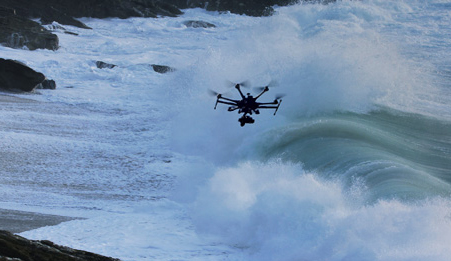
Norway deploys radiation drones along its coast amidst nuclear emergency concerns
Five Coast Guard ships are soon to carry drones with sensors capable of detecting radioactivity in case of a maritime accident involving a potential release from a reactor-powered civilian or military vessel. Barents Observer, By
Thomas Nilsen, December 03, 2021 A sharp increase in nuclear-powered vessels and ships with radioactive materials pose an increasing risk of accidents, a recent radiological- and nuclear risk assessment study for the Arctic Council concludes.
The risk is moderate and increasing in regards to nuclear-powered vessels and floating nuclear power plants, the report reads.
Now, authorities take action and deploy drones with radiation detectors on board Norway’s fleet of five Inner Coast Guard patrol vessels, from the North Sea region in the south to the Barents Sea in the north.
The danger is obvious. A worst-case scenario is a nuclear-powered vessel with a reactor leakage drifting at sea or running aground with a wind direction towards populated areas. In northern Norway, nine out of ten inhabitants live less than four kilometers from the sea.
A drone can help measure levels of radiation in close vicinity to the vessel in distress without exposing any of the emergency response teams to danger. The Coast Guard is already on 24/7 watch and plays an important role in emergency preparedness.
Nuclear-powered icebreakers are more frequently sailing between the yard in St. Petersburg and their homeport in Murmansk, like this weekend when the newest icebreaker, the “Arktika“ sails around Scandinavia a few nautical miles off the coast.
The civilian nuclear-powered “Sevmorput” is also regularly sailing between the Far East and St. Petersburg via the coasts of Siberia, Norway, Sweden, Denmark, Poland, Estonia and Finland loaded with seafood and other products. The ship is 33 years old and is not allowed to make port calls to countries outside Russia.
Every now and then, cargo vessels bring spent nuclear fuel or radioactive substances to the port of Murmansk.
Navy submarines
Caused by increased military tensions, both NATO and Russian nuclear submarines are more frequently patrolling the strategically important North Atlantic. Allied submarines even make port calls to harbors in Norway, like this spring when “USS New Mexico” came to Tromsø in a high-profile visit.
Detailed emergency response plans were made ahead of the submarine’s visit. For Norway, which has a comprehensive network of radiation detectors on land, the challenge however is what to do if something happens at sea. …………………….
Submarines and icebreakers
Norway’s Inner Coast Guard includes the five vessels “Nornen”, “Tor”, “Heimdal”, “Njord” and “Farm”. The latter has Kirkenes as homeport and sails the waters closest to Russia’s Kola Peninsula where several tens of nuclear-powered submarines are based as well as being home to the increasing Arctic fleet of nuclear-powered icebreakers.
Two brand new icebreakers, powered by two reactors each, will be added to the fleet before the end of the year. The first is this weekend en route along the coast of Norway from St. Petersburg to Russia’s ice-covered waters around the Yamal Peninsula and the Kara Sea. ………..
Circumpolar cooperation
Two years ago, the Norwegians and Americans sailed north to Svalbard together with Russian experts from the emergency response unit of Rosatom, working on remote-controlled systems for measuring radiation in case of accidents.
Collaboration on nuclear accident preparedness is a priority for all circumpolar nations which agree that shared resources in sparsely populated areas benefit all………
“We never know where accidents might happen. But with the Coast Guard and their skills on operating drones, we are about to become world-class in preparedness,” Aas-Hansen elaborates. …….
“The new drone detectors for radiation are unique. What we learn from this is something we absolutely will share with other nations,” says Øyvind Aas-Hansen. He underlines that cross-sector collaboration with other agencies in Norway has brought the project forward………
Large nuclear exercise in 2022
In May 2022, the partners will test the systems in a large international Arctic radiation exercise in the area around Bodø, northern Norway…….
Sharp increase in reactors
The Barents Observer has published an overview (pdf) listing the increasing number of reactors in the Russian Arctic. The paper is part of Barents Observer’s analytical popular science studies on developments in the Euro-Arctic Region.
According to the list, there are 39 nuclear-powered vessels or installations in the Russian Arctic today with a total of 62 reactors. This includes 31 submarines, one surface warship, five icebreakers, two onshore and one floating nuclear power plant.
Looking more than a decade ahead, the number of ships, including submarines, and installations powered by reactors is estimated to increase to 74 with a total of 94 reactors, maybe as many as 114. Additional to new icebreakers and submarines already under construction, Russia is brushing dust of older Soviet ideas of utilizing nuclear power for different kinds of Arctic shelf industrial developments, like oil- and gas exploration, mining and research.
Although Russia’s existing “Akademik Lomonosov” and four planned floating nuclear power plants are to operate on the coast of the Chukotka Peninsula thousands of kilometers east of the European Arctic, maintenance, testing and change of spent nuclear fuel elements will take place at the Atomflot base in Murmansk, a city with about 300,000 inhabitants a few hours drive from the border to Norway.
“By 2035, the Russian Arctic will be the most nuclearized waters on the planet,” the paper reads.
Also, existing icebreakers and submarines get lifetime prolongation. The average age of the Northern Fleet’s nuclear-powered submarines has never been older than today. Several of the submarines built in the 1980s will continue to sail the Barents Sea and under the Arctic ice cap until the late 2020s.
Serious accidents happen
In recent years, two serious accidents in Russia’s northern waters have shaken the world.
On July 1, 2019, a fire broke out on the top-secret deep-diving submarine Losharik on 60 nautical miles from Russia’s border to Norway. The submarine was at the time working on the seabed in the Motovkiy Bay, just north of the important navy bases of the Northern Fleet. All 14 sailors on board were killed in the fire that likely started in the batteries.
Losharik was powered by one nuclear reactor and operated on a secret mission for GUGI, the Main Directorate for Deep-Sea Research, a top-secret unit directly subordinated the General Staff of the Russian Armed Forces.
No leakages of radiation were reported at the time.
Later that summer, on August 8, a serious radiation accident happened in the waters just outside Nenoksa naval missile test site on the southern shores of the White Sea.
Five Rosatom experts were killed and at least three others injured as a Burevestnik missile exploded. The Burevestnik is a nuclear-powered cruise missile currently under development by the Armed Forces. The small reactor is aimed at giving the missile “unlimited range”.
Shortly after the blast, radiation levels in the nearby city of Severodvinsk were measured to be several times higher than background for about half an hour, the Barents Observer reported. The data was based on the public automated monitoring system in Severodvinsk with eight sensors in town and at the Zvezdockha shipyard.
While normal background in the town with a population of 190,000 is around 0.11 µSv/h (microsievert per hour), the levels measured at the monitor on the Lomonosov Street near Lake Teatralnoye peaked at 2 µSv/h, nearly 20 times higher gamma radiation than normal. That, though, is still way within permissible levels for population exposure.
Fears more accidents
In its annual threat assessment report the following year, Norway’s Intelligence Service warned that more accidents with Russia’s reactor-powered weapons systems could happen.
“The development will bring, additional to the military challenges, also challenges related to both environment and security. In 2019, about 25 Russians were killed during military activity near Norway,” the Intelligence Service Director Morten Haga Lunde said and added:
“I consider the risk for more such unintended incidents in our neighborhoods to be big in the years to come.”
In the next extradition court case for Julian Assange, we can expect the judge there to be very biased against Assange

Now the most powerful judge in England and Wales, Burnett will soon rule on Assange’s extradition case. The founder of WikiLeaks faces life imprisonment in the US. ……………………
As minister, Duncan did not hide his opposition to Julian Assange, calling him a “miserable little worm” in parliament in March 2018.
Duncan watched UK police pulling the WikiLeaks publisher from the Ecuadorian embassy via a live-feed in the Operations Room at the top of the Foreign Office.
He later admitted he was “trying to keep the smirk off [his] face”, and hosted drinks at his parliamentary office for the team involved in the eviction.
ASSANGE JUDGE IS 40-YEAR ‘GOOD FRIEND’ OF MINISTER WHO ORCHESTRATED HIS ARREST
Julian Assange’s fate lies in the hands of an appeal judge who is a close friend of Sir Alan Duncan – the former foreign minister who called Assange a “miserable little worm” in parliament. DECLASSIFIED UK
MATT KENNARD AND MARK CURTIS 2 DECEMBER 2021 LORD CHIEF JUSTICE IAN BURNETT, THE JUDGE THAT WILL SOON DECIDE JULIAN ASSANGE’S FATE, IS A CLOSE PERSONAL FRIEND OF SIR ALAN DUNCAN, WHO AS FOREIGN MINISTER ARRANGED ASSANGE’S EVICTION FROM THE ECUADORIAN EMBASSY.
The two have known each other since their student days at Oxford in the 1970s, when Duncan called Burnett “the Judge”. Burnett and his wife attended Duncan’s birthday dinner at a members-only London club in 2017, when Burnett was a judge at the court of appeal.
Now the most powerful judge in England and Wales, Burnett will soon rule on Assange’s extradition case. The founder of WikiLeaks faces life imprisonment in the US. ……………………
As minister, Duncan did not hide his opposition to Julian Assange, calling him a “miserable little worm” in parliament in March 2018.
In his diaries, Duncan refers to the “supposed human rights of Julian Assange”. He admits to arranging a Daily Mail hit piece on Assange that was published the day after the journalist’s arrest in April 2019.
Duncan watched UK police pulling the WikiLeaks publisher from the Ecuadorian embassy via a live-feed in the Operations Room at the top of the Foreign Office.
He later admitted he was “trying to keep the smirk off [his] face”, and hosted drinks at his parliamentary office for the team involved in the eviction.
Duncan then flew to Ecuador to meet President Lenín Moreno in order to “say thank you” for handing over Assange. Duncan reported he gave Moreno “a beautiful porcelain plate from the Buckingham Palace gift shop.”
“Job done,” he added………………………………. https://declassifieduk.org/assange-judge-is-40-year-good-friend-of-minister-who-orchestrated-his-arrest/
Nuclear power is a failure – former French Environment Minister

Yves Cochet: “The nuclear failure” Former Minister of the Environment. Against the recent projects announced by the President of the Republic for the revival of nuclear power in France, Yves Cochet, former Minister of the Environment, recalls how the history of this energy sector is marked by a
succession of setbacks.
Despite seventy years of nuclear energy research and development, nuclear energy remains a failure caused by a list of setbacks such that one is enough to destroy any prospect of lasting success. Nuclear power today only contributes 5% of global energy supply and 10% of electricity production, this share has been steadily declining for twenty-five years, while the share of renewable electricity has now surpassed that of nuclear power.
Le Monde 4th Dec 2021
https://www.lemonde.fr/idees/article/2021/12/04/yves-cochet-l-echec-du-nucleaire_6104683_3232.html
New Name- Same Scam. NuScale small nuclear reactors become ‘VOYGR”, universities co-opted.
NuScale SMR plants become VOYGR 03 December 2021,
NuScale Power’s small modular reactor (SMR) power plants are to be named VOYGR, the company has announced. The company is working towards commercialising the technology and aims to be ready to deliver the first VOYGR plant to public power consortium Utah Associated Municipal Power Systems’ Carbon Free Power Project by the end of the decade………
UAMPS earlier this year said it expects to submit a combined licence application for the Carbon Free Power Project – currently envisaged as a six-module plant – to the NRC in 2024. The plant is to be located on a site at the US Department of Energy’s (DOE’s) Idaho National Laboratory…….
Training centre

NuScale has now opened a third university-based centre to provide training and outreach opportunities through simulated, real-world nuclear power plant operation scenarios. The NuScale Energy Exploration (E2) Center, opened in collaboration with the Texas A&M Engineering Experiment Station, is at the Center for Advanced Small Modular and Micro Reactors located in College Station, Texas, and uses state-of-the-art computer modelling within a simulation of the control room of a 12-unit NuScale power plant control.
Previous E2 Centers were opened at Oregon State University, in November 2020, and at the University of Idaho, in August 2021. The centres are supported by a 2019 DOE grant to broaden the understanding of advanced nuclear technology in a control room setting. https://www.world-nuclear-news.org/Articles/NuScale-SMR-plants-become-VOYGR
France joins the Small Nuclear Reactor frenzy, bringing out its odd version ”NAAREA”

French engineering group Assystem has signed a cooperation agreement with
newly-created French micro-reactor developer Naarea to build its
ultra-compact eXtra Small Modular Reactor (XSMR). Dassault Systèmes is to
supply Naarea with a cloud-based platform on which to virtually design the
1 to 40 MW molten salt reactor. Naarea expects the first units of XSMR to
be produced by 2030.
The company says its ultra-compact molten salt reactor uses “the untapped potential of used radioactive materials, and thorium, unused mining waste.” Naarea noted, “The current stocks of these two wastes will supply the energy needs of humanity for thousands of years, and reconcile humanity with its future.”
World Nuclear News 3rd Dec 2021
https://www.world-nuclear-news.org/Articles/Assystem-to-cooperate-with-Naarea-on-micro-reactor
Canada to get its version of the mythical beast – the Small Nuclear Reactor – GE Hitachi Nuclear Energy (GEH) BWRX-300


Ontario Power Generation (OPG) will build a GE Hitachi Nuclear Energy (GEH) BWRX-300 small modular reactor (SMR) at its Darlington Nuclear Station in Clarington, Ontario, marking a major triumph for the nuclear vendor in a stiff competition for the much-watched utility-scale project.
OPG announced the selection of the GE Hitachi BWRX-300 SMR over competitors X-energy and Terrestrial Energy in a live stream on Dec. 2. The utility said it will now work with GE Hitachi on the SMR engineering, design, planning, preparing the licensing and permitting materials, and performing site preparation activities. The companies are targeting a “mutual goal of constructing Canada’s first commercial, grid-scale SMR, projected to be completed as early as 2028.” Site preparation, which will include
“installation of the necessary construction services,” is slated to begin in the spring of 2022, pending appropriate approvals. OPG additionally said it will apply to the Canadian Nuclear Safety Commission
(CNSC) for a License to Construct the SMR by the end of 2022.
Power Mag 2nd Dec 2021
US Ex-Senator warns – US, NATO allies risking ‘all-out nuclear conflict’ with Russia
US, NATO allies risking ‘all-out nuclear conflict’ with Russia: Ex-senator, Press TV Sunday, 05 December 2021 The United States’ belligerent policy toward Russia is driven by an amorphous array of bureaucrats and lobbyists, says a former US state senator, adding that Washington does not comprehend the gravity of its provocative moves in siding with Ukraine.
The United States, its NATO allies and Ukraine accuse Moscow of massing troops near Ukraine’s border for a possible invasion. The US also claims that NATO allies are “prepared to impose severe costs” on Moscow if it attempts an invasion.
Russia says there is no such plan, but it has warned against any provocation from Ukraine that could trigger such an invasion.
“It is not clear that Western officials understand the gravity of what they are doing. It is unlikely that Russia can accept stationing of nuclear weapons or even large-scale movements of NATO troops into Ukraine,” Richard H. Black, a former state senator from Virginia, told Press TV.
“Ukraine is not a part of NATO, but the alliance increasingly talks of war to help Ukraine recover areas that have seceded from it. If NATO were to make war against Russia, the chances of escalation into an all-out nuclear conflict would be high,” he added.
Black pointed the finger of blame at Ukraine for the escalation between Moscow and NATO, stressing that the US-led military alliance’s talk of war is aimed at helping Kiev recover the areas of Donetsk and Luhansk in the Crimean Peninsula, which rejoined Russia in a 2014 referendum.
“The Ukrainian army is moving aggressively against this small pocket of Russian-speaking people. Ukraine has deployed heavy mortars and artillery to shell the enclave, and has carried out 200 unprovoked attacks in recent weeks,” the former senator said………… https://www.presstv.ir/Detail/2021/12/05/672022/Russia-policies-driven-US-bureaucrats-powerful-lobbyists
More delays and extra $1 billion expected for Georgia nuclear plant
More delays and extra $1 billion expected for Georgia nuclear plant, https://newschannel9.com/news/local/more-delays-and-extra-1-billion-expected-for-georgia-nuclear-plant by JEFF AMY Associated PressMonday, December 6th 2021–ATLANTA (AP) — Monitors say even the most recent pushback of completion dates for two new nuclear reactors in Georgia isn’t enough to account for all the delays and increased costs they see coming.
An engineer paid by the Georgia Public Service Commission predicts that the third reactor at Plant Vogtle near Augusta won’t the most recent deadline of September 2022 set by Georgia Power Co. Don Grace instead says ongoing delays suggest a range of November 2022 to February 2023.
Grace says the fourth reactor might not come online until sometime in late 2024.
Grace says more delay could mean $1 billion more in spending on a project already set to cost $28.7 billion.
Taiwanese Group walks for 30 hours to protest nuclear power
SYMBOLIC MARCH: The demonstrators represented the number of boroughs that would be evacuated if there were a disaster at the Fourth Nuclear Power Plant
- By Yang Mian-chieh / Staff reporter, with CNA A group of 21 people demonstrating against nuclear power completed their march in Taipei yesterday after beginning it in New Taipei City’s Gongliao District (貢寮) the day before.
They were joined by supporters as they reached their destination on Ketagalan Boulevard in front of the Presidential Office Building after nearly 30 hours of walking.
Organized by the National Nuclear Abolition Action Platform, the event was aimed at encouraging people to vote “no” in a referendum on Dec. 18 that asks whether the government should restart construction on the mothballed Fourth Nuclear Power Plant in Gongliao District.
The 21 demonstrators represented the 21 boroughs within an 8km radius of the power plant that would be required to evacuate in the event of a nuclear disaster: 11 boroughs in Gongliao District, eight in New Taipei City’s Shuangsi District (雙溪) and two in Yilan County’s Toucheng Township (頭城), the National Nuclear Abolition Action Platform said.
Separately yesterday, a group rallied in front of the Legislative Yuan in Taipei, urging people to vote “yes” for the referendum question on whether a liquefied natural gas (LNG) terminal project should be relocated to protect algal reefs off Taoyuan’s Guanyin District (觀音).
They called for the government to review the nation’s energy policy rather than resort to “emotionally blackmailing the public with fears of a power shortage.”
Environmentalists have said that the algal reef took at least 5,000 years to form and is the largest of its kind in the world.
It also has rich biodiversity, and is home to the endangered coral species Polycyathus chaishanensis and hammerhead sharks that are listed on the International Union for Conservation of Nature Red List of Threatened Species, they said…….
…….. The Democratic Progressive Party has launched a promotional campaign urging people to vote “no” on all four items,…. https://www.taipeitimes.com/News/taiwan/archives/2021/12/06/2003769106
S. Korea voices concerns about Japan’s Fukushima water release plan

December 03, 2021
SEOUL, Dec. 3 (Yonhap) — South Korea on Friday expressed concerns over Japan’s assessment report about its planned release of radioactive water into the sea from its crippled Fukushima nuclear power plant.
The stance was delivered at a virtual meeting between South Korea and Japan over a draft report by Tokyo Electric Power Co. (TEPCO) about radioactive impacts of its planned discharge.
Last month, TEPCO, the operator of the tsunami-stricken Fukushima plant, said its planned release of radioactive water into the sea would have a very minimal impact on the marine environment and humans.
In April, Japan announced a plan to start discharging the radioactive water into the sea in 2023 in what is expected to be a decadeslong process, as all storage tanks at the Fukushima plant are expected to be full as early as the fall of 2022.
At the session, the Korean government voiced “regret” that Japan has unveiled the report on the premise that it will release the radioactive water.
“We also expressed concerns over uncertainty about the impact on humans and the environment that the discharge will have,” the government said.
South Korea also called on Japan to disclose related information in a transparent manner to its neighboring countries and sincerely engage in consultations on the issue.
According to Japanese media reports, TEPCO plans to build a roughly 1-kilometer-long undersea tunnel to release the tritium-laced water from the wrecked plant into the waters.
An estimated 1.25 million tons of such water are in temporary storage at the Fukushima nuclear plant on the east coast of Japan, which was devastated by a tsunami triggered by an earthquake in March 2011.
Fukushima evacuee shares her feelings via illustrated books

December 3, 2021
SAKAI–Nobuko Shiga is still working through the trauma from the Fukushima nuclear crisis that ruined her hometown and upended her life.
But she has decided to channel her pent-up rage into creating something positive that may help the healing process.
She has created two illustrated books with the hopes of sharing her feelings and experiences, and hopes to pass on stories from early in her life as well as what happened after that fateful day.
When the magnitude 9.0-earthquake struck on March 11, 2011, Shiga, now 81, was living with her retired husband in Namie in eastern Fukushima Prefecture.
The accident at Tokyo Electric Power Co.’s Fukushima No. 1 nuclear power plant, situated only 9 kilometers southeast of their residence, drastically changed the course of her life.
She left her house with her pet Shiba Inu dog, named Ran, a day after the disaster. She traveled by car and spent nights at a gymnasium in a mountainous area and at Fukushima Airport before she arrived in Sakai, Osaka Prefecture, where her daughter lived.
Shiga was left reeling over the way she was treated while trying to open a bank account there for her new life. Clerks at two banks told Shiga that she could not have one, after learning that she was fleeing from Fukushima Prefecture.
The bank operators later apologized, but she was still left with no clear explanation why. Looking back on the incident, Shiga thinks the nuclear crisis was likely why the banks had refused, and she said she still feels her heart ache over it.
Radioactive fallout made it impossible for residents to freely enter Namie. Shiga had planned to enjoy her golden years with her spouse at their home. But the yard has been left to grow wild and her friends are forced to live far apart from each other.
But Shiga soon learned that Bungeisha Co. was searching for manuscripts for picture books. She quickly finished writing her first title, “Nagai Orusuban” (Long housesitting).

The book features paintings by Shiro Ishiguro. It went up for sale on an online book shopping site and elsewhere in 2019 for 1,210 yen ($10.50), including tax. A digitized version is available as well.
In the work, a dog named Ran, just like Shiga’s, suddenly becomes separated from his owner, a young boy. Ran spends days with a pig, chickens and cows, and they all join forces to work together.
While the real-life Ran passed away peacefully at the end of his natural life five years ago, many animals that were left behind in the region affected by the nuclear accident had starved to death.
Shiga said she cannot forget a pig emerging abruptly from a bush and coming close to her, as if it was pleased to have an encounter with a human, when she returned temporarily to Namie.
Her hope to console the souls of abandoned animals motivated her to work on the title.
Shiga finished a course at Fukushima University and once served as a Japanese language teacher in a junior high school in Fukushima Prefecture. But this was her first time creating an illustrated book.
Despite that, the publication received an enthusiastic response from readers. Muneyuki Sato, a renowned singer based in Sendai, said he “read it while shedding tears.”
In September this year, her second work, “Kaminari Ojisan” (Thunderbolt old man), illustrated by Kenji Tezuka, was released by Bungeisha for 1,100 yen, including tax.
It starts with the sound of wooden clappers made by the organizer of the “kamishibai” picture-card theater. Shiga said she ran to that kind of theater with pocket money in her hands during her childhood, every time she heard the unique clapping.
Reflecting the creator’s own days as a child in the eastern part of Fukushima Prefecture, the work portrays exchanges one summer between children and an old man offering kamishibai dramas in a somewhat mysterious ambience.
“Local acquaintances said the picture book rekindled fond memories from bygone days,” Shiga said shyly.
Shiga was born in 1940 and has lived in Saitama, Fukuoka, Fukushima, and Miyagi prefectures due to her father, who worked for the former Japanese National Railways, relocating several times for his job.
She said few children in distant Sakai know much about the nuclear accident.
“The catastrophe should not be forgotten,” said Shiga. “I want readers to understand such a thing can occur so long as nuclear plants exist on Earth.”
Speaking with friends of similar age from Fukushima Prefecture, Shiga cannot help but ask herself, “What have our lives been for?”
They spent their childhood days in the wake of World War II and worked hard, only to find themselves deprived of their normal lives by a nuclear disaster.
Shiga has yet to make up her mind on publishing her next book, but she said she has no plans to wait for her life to end just by doing nothing.
“I do not want to live dazed,” she said. “I will leave something as a legacy.”
Fukushima Daiichi Frozen Wall Section Fails

A section of the frozen wall at Fukushima Daiichi has melted. The portion south of unit 4 has had problems remaining fully frozen for years. Now TEPCO admits it has melted in recent weeks. This portion of the frozen wall has had issues for years. Recent changes to the nearby K drainage tunnel and a recently discovered crack may be redirecting water from an underground stream into the area of the frozen wall.
TEPCO found sections near the surface of the wall had fully melted. Puddled water was found nearby. The section is relatively small and didn’t impact the lower depths of the wall’s integrity.

TEPCO’s solution is to install steel piling sections between the K drainage canal and this section of the wall, hoping to deflect underground water. This steel wall will not be completely solid. Due to the nature of driving pilings into the ground, there could be gaps as wide as 10 cm.

Once the pilings are installed, TEPCO plans to monitor the area to make sure the problem has been resolved.
https://www3.nhk.or.jp/nhkworld/en/news/20211126_16/
How Close Is Fukushima Nuclear Accident Contaminated Water to Us?
Macroscopic and microscopic simulations of Fukushima nuclear accident contaminated water discharge.
On August26, 2021, the Japanese Cabinet passed a bill to discharge treated Fukushima nuclear accident contaminated water into the Pacific Ocean to alleviate the problem of nuclear wastewater storage. However, large amounts of radionuclides can affect marine biological chains when inhaled by marine life and adversely influence marine fisheries and human health. The global effects of Fukushima discharge, which will last 30-40 years, remain unknown. Thus, identifying the diffusion process of radioactive water in oceans is critical.
To solve this problem, a team from Tsinghua University, China, developed analysis models from both macroscopic and microscopic perspectives, to simulate the diffusing process of the nuclear elements. The former one focuses on the overall distribution of pollutants, while the latter focuses on the behavior of individual pollutants.
Macro simulation results (Figure b) revealed that in the early stages of pollutant discharge, the polluted area increases rapidly, reaching 30° of latitude × 40° of longitude within 120 days. Due to ocean currents, the pollutant diffusion speed is considerably higher in the latitude direction than that in the longitude direction.
In 1200 days, the pollutants will cover almost the whole North Pacific region, reaching as far as the coast of North America to the east, and the Australia to the south. The pollutants will then spread rapidly to the South Pacific Ocean, under the influence of the equatorial current along the Panama Canal. The Indian Ocean will also be influenced, due to the waters infilling from north of Australia, in 2400 days. On day 3600, the pollutants will cover almost the entire Pacific Ocean.
Notably, although the contaminated water is discharged near the Japanese island, the contamination center (represented by yellow and red in Fig. b and c) will over time move eastward along the 35°N latitude line.

The team plotted the pollutant concentrations in adjacent waters of Miyazaki, Shanghai, and San Diego, all near 30°N, as shown in Figure d. Miyazaki gets polluted first, followed by Shanghai and San Diego, in order of their distances from Fukushima. According to the trend of the three curves, the pollutant concentration in each region increases rapidly at the beginning before stabilization. Although San Diego is the last city among the three to be affected, the steady-state concentration of pollutants in its adjacent waters is even higher than that near Miyazaki.
The differences in pollutant concentrations near Miyazaki, Shanghai, and San Diego result from the strong ocean current near Japan. Specifically, Fukushima is located at the confluence of Kuroshio (northward) and Oyashio (southward). Therefore, most pollutants do not migrate towards north and south along the land edges but spread eastward with the North Pacific west wind drift. In the early stage of treated water discharge, its impact on coastal Asia should be focused on. However, at a subsequent stage, the high concentration of nuclear elements near North America will definitely become a concern.
Reference: “Discharge of treated Fukushima nuclear accident contaminated water: macroscopic and microscopic simulations” by Yi Liu, Xue-Qing Guo, Sun-Wei Li, Jian-Min Zhang and Zhen-Zhong Hu 2021, 26 November 2021, National Science Review.
DOI: 10.1093/nsr/nwab209
1 This Month
Tell Congress: Prevent Nuclear Catastrophe in Iran

Tell Congress: Prevent Nuclear Catastrophe in Iran

Read the Public Inquiry Report, the Commissioners’ report, Surrendering Australia: The AUKUS Deception is available to download for free at aukuspublicinquiry.com. Or just watch the replay of the National Press Club Luncheon.


Shut down the radiation-damaged Heysham nuclear reactors now
To see nuclear-related stories in greater depth and intensity – go to https://nuclearinformation.wordpress.com

Say No to NASA’s Reckless Nuclear Reactor on the Moon
Say No to NASA’s Reckless Nuclear Reactor on the Moon
-
Archives
- November 2026 (238)
- October 2026 (302)
- September 2026 (339)
- August 2026 (330)
- July 2026 (355)
- June 2026 (287)
- May 2026 (306)
- April 2026 (356)
- March 2026 (251)
- February 2026 (267)
- January 2026 (308)
- December 2025 (358)
-
Categories
- 1
- 1 NUCLEAR ISSUES
- business and costs
- climate change
- culture and arts
- ENERGY
- environment
- health
- history
- indigenous issues
- Legal
- marketing of nuclear
- media
- opposition to nuclear
- PERSONAL STORIES
- politics
- politics international
- Religion and ethics
- safety
- secrets,lies and civil liberties
- spinbuster
- technology
- Uranium
- wastes
- weapons and war
- Women
- 2 WORLD
- ACTION
- AFRICA
- Atrocities
- AUSTRALIA
- Christina's notes
- Christina's themes
- culture and arts
- Events
- Fuk 2022
- Fuk 2023
- Fukushima 2017
- Fukushima 2018
- fukushima 2019
- Fukushima 2020
- Fukushima 2021
- general
- global warming
- Humour (God we need it)
- Nuclear
- RARE EARTHS
- Reference
- resources – print
- Resources -audiovicual
- Weekly Newsletter
- World
- World Nuclear
- YouTube
-
RSS
Entries RSS
Comments RSS

