Even when he is silenced, immobilized, locked up and hidden from public view, Julian Assange continues to shine a light on the abusive mechanisms of power.
Assange: The Masks are Crumbling https://consortiumnews.com/2021/12/10/assange-the-masks-are-crumbling/
December 10, 2021 The U.S. and its allies don’t care about press freedom beyond the extent it can be used to conduct propaganda, writes Caitlin Johnstone after the High Court’s ruling against Julian Assange. By Caitlin Johnstone
CaitlinJohnstone.com The U.S. government has won its appeal against a lower British court’s rejection of its extradition request to prosecute Julian Assange for journalistic activity under the Espionage Act. Rather than going free, the WikiLeaks founder will continue to languish in Belmarsh Prison where he has already spent over two and a half years despite having been convicted of no crime.
“As a result, that extradition request will now be sent to British Home Secretary Prita Patel, who technically must approve all extradition requests but, given the U.K. Government’s long-time subservience to the U.S. security state, is all but certain to rubber-stamp it,” writes Glenn Greenwald. “Assange’s representatives, including his fiancee Stella Morris, have vowed to appeal the ruling, but today’s victory for the U.S. means that Assange’s freedom, if it ever comes, is further away than ever: not months but years even under the best of circumstances.”
“Mark this day as fascism casts off its disguises,” tweeted journalist John Pilger of the ruling.
This ruling, which allows the U.S. to continue working to extradite a journalist for exposing U.S. war crimes, comes on the final day of Washington’s so-called “Summit for Democracy“, where the U.S. secretary of state made a grandiose show about of press freedom playing “an indispensable role in informing the public, holding governments accountable, and telling stories that otherwise would not be told.” And then adding: “The U.S. will continue to stand up for the brave and necessary work of journalists around the world.”
This ruling also comes on UN Human Rights Day.
This ruling comes on the same day two journalists formally received the Nobel Peace Prizes they’d been awarded and demanded protections for journalists in their acceptance speeches.
This ruling comes as the U.S. government pledges hundreds of millions of dollars in support for “independent media” around the world in coordination with British state media.
This ruling comes after it was revealed that the C.I.A. drew up plans to kidnap and assassinate Assange in the Ecuadorian embassy after the 2017 Vault 7 releases embarrassed the agency.
This ruling comes after it was revealed that C.I.A. proxies spied on Assange and his lawyers at the Ecuadorian embassy, thereby making a fair trial in the United States impossible.
This ruling comes after it was revealed that the U.S. prosecution relied on false testimony from a diagnosed sociopath and convicted child molester.
This ruling comes after recent investigative reports on civilian-slaughtering U.S. airstrikes reminded us why it’s so important for the press to be able to conduct critical coverage of the most powerful military force ever assembled.
The facts are in and the case is closed: the U.S. and its allies do not care about press freedoms beyond the extent that they can be used to conduct propaganda. The way journalists who offend the powerful are dealt with by the U.S. government and the way they are dealt with by the Saudi monarchy differ only in terms of speed and messiness.
The masks are crumbling. Even when he is silenced, immobilized, locked up and hidden from public view, Julian Assange continues to shine a light on the abusive mechanisms of power. He is arguably exposing them more now than ever before.
As fascism casts off its disguises, it becomes more and more important to highlight the hypocrisy, fraudulence and depravity of the people who rule our world.
Upcoming Inspection of Fukushima Unit 1

November 25, 2021
TEPCO announced that the next phase of containment inspections inside unit 1 will finally take place in early 2022. This next phase of inspections had been delayed due to technical challenges, concerns of radioactive dust releases, then due to the pandemic.
Some of the explanatory materials provide new insight into the true situation inside unit 1. It has been speculated since 2011 that melted fuel (aka corium) flowed out of the pedestal of unit 1, across the containment floor, and burned through the thin connection edge of the containment structure. Diagrams included in this most recent report show that the entities tasked with decommissioning the damaged reactors think so too. Diagrams originally from NDF, the decommissioning authority, and IRID, the main agency tasked with research, show the same.
The graphic below shows a significant pile of melted fuel in the pedestal and along the outer edge of the containment structure. The right side graphic shows melted fuel a significant way up to the lower edge of the downcomer tubes that route into the torus tube. Evidence of fuel debris inside the torus tube was found in earlier inspections along with our early findings that appeared to show fuel debris under the water in the torus room outside of containment.

This side view of the same area shows what IRID and TEPCO assume to be the situation inside unit 1’s containment as they prepare for the upcoming inspections.The red color is solidified previously melted fuel, The brown layer is the sediment layer and the blue layer is standing water inside containment. The sediment layer on the right side where inspections have already taken place is significantly lower than the sediment bed directly adjacent to the assumed location of the fuel debris. The depth difference appears to be 3 times as much adjacent to the melted fuel locations.

The debris bed on the shallow right side was roughly 4-10 inches deep based on TEPCO estimates in 2017. If the left side adjacent to the solidified fuel is 3 times the depth, it would be 12-30 inches in depth. What exactly this debris bed is and how it developed had caused head-scratching for years. A TEPCO report in 2017 showed it contained stainless steel, materials related to shielding, cabling, and some low levels of reactor-based radioactive isotopes. If this material contained additional substances or not was a bit ambiguous. There had been some initial assumptions this was pulverized concrete. There may have been some involvement of the concrete structures into this debris pile through mechanical destruction or molten corium concrete interaction, but TEPCO provides insufficient data to confirm or rule this out.
Another 2017 report gave some rough estimates of the depth of the known parts of the debris bed. The known parts from an earlier set of inspections would be the general area marked by the A in the above graphic. This area is roughly 4 – 10 inches in depth. The left side adjacent to the solidified fuel would then be about 12 – 30 inches in depth. The deposits closer to the pedestal opening were close to 1 meter deep on a 2017 inspection. TEPCO could not determine if there was any solidified fuel beneath. They assumed the debris bed was providing extensive shielding that would prevent the detection of any layer of solidified fuel. This debris bed appears to reside 1/3 of the way up the downcomer cover. It is likely some amount of it has entered the torus tube and potentially the torus room.
Upcoming Inspections:
The upcoming inspections include a total of 6 ROV units. The remote operational vehicles are not true robots as each one has a control tether. The biggest concern with these units is having one become stranded, preventing the introduction of future ROV units to continue inspections. Each ROV unit has an assigned task. Due to internal equipment inside containment, a series of rings will be placed by the first ROV to help guide the ROV units and prevent entanglement.
ROV-A

ROV-A will attempt to traverse the south direction to the pedestal doorway.

ROV-A2 will attempt to enter the pedestal to capture imagery of the conditions and potential fuel location.

ROV units B to E each have similar tasks tied to characterizing the fuel debris and sediments.
Each ROV has about an 80-hour high radiation tolerance. They will be introduced by the level of risk with ROV-A2 going into the pedestal last due to the high risk. Preparation work begins in January. The entire series of inspections are currently scheduled to take 10 months to complete.
Japan’s Upcoming Nuclear Waste Dump
The last known “deliberate nuclear waste dumping into the ocean,” outside of the “good graces” of what the industry refers to as “detailed environmental impact assessments” that somehow (questionably, mysteriously, are you kidding me!) seem to justify dumping toxic nuclear waste was October 1993 when the Russian navy illegally dumped 900 tons of nuclear waste into international waters off the coast of Vladivostok near Japan and Korea. Moscow claimed they were running out of storage space and that “radioactive waste is not hazardous and the dumping would be according to international norms.” Sound familiar?
In 1993 Japan called the Russian dumping “extremely regrettable.”

December 7, 2021 by Robert Hunziker
Nuclear waste is an interminable curse that eternally haunts the future of civilization for hundreds/thousands of years.
“The challenge of making nuclear power safer doesn’t end after the power has been generated. Nuclear fuel remains dangerously radioactive for thousands of years after it is no longer useful in a commercial reactor.” (Source: Nuclear Waste, Union of Concerned Scientists, April 22, 2016)
There are 440 nuclear power plants in the world, all of which use nuclear fission, prompting one simple question: Is the process of generating heat via nuclear fission with a byproduct of extremely toxic radioactive waste lasting hundreds, or more, years for purposes of simply “boiling water” the epitome of human stupidity?
In April 2021, the Japanese government announced its decision to discharge nuclear waste from Fukushima Daiichi Power Plant into the Pacific Ocean via a sub-seabed pipeline. At least 1.2 million tons of tritium-laced toxic water will be discharged.
As it happens, nuclear powers of the world regularly dump nuclear waste into the ocean in violation of the London Convention (1972) and the London Protocol (1996), which are the two principal international agreements against dumping nuclear waste into the oceans. But, they get around the rules by dumping under the cover of “detailed environmental impact assessments.”
The last known “deliberate nuclear waste dumping into the ocean,” outside of the “good graces” of what the industry refers to as “detailed environmental impact assessments” that somehow (questionably, mysteriously, are you kidding me!) seem to justify dumping toxic nuclear waste was October 1993 when the Russian navy illegally dumped 900 tons of nuclear waste into international waters off the coast of Vladivostok near Japan and Korea. Moscow claimed they were running out of storage space and that “radioactive waste is not hazardous and the dumping would be according to international norms.” Sound familiar?
In 1993 Japan called the Russian dumping “extremely regrettable.” Yet, at the time, Tokyo Electric Power Company was itself discharging radioactivity into the ocean. At the time, Japanese power stations were allowed to dump nuclear waste into the ocean based upon “detailed environmental impact assessments.” (OMG is this real?) (Source: Nuclear Dumping at Sea Goads Japan Into Action, NewScientist, November 6, 1993)
“Jinzaburo Takagi, a physicist working with the Citizens’ Nuclear Information Centre in Tokyo, says: ‘If the Russians had done an impact assessment for their dumping, it would have proved safer than the Japanese power plants.’ He says local authorities in Japan have measured elevated levels of radionuclides in shellfish and seaweed near the nuclear plants. If the Japanese criticize Russian dumping, says Takagi, ‘then they will have to abandon the option of dumping nuclear waste,” Ibid.
The abovementioned series of conflicting events surrounding disposal of nuclear waste brings to mind the complexity and hypocrisy that runs throughout the nuclear industry. It stems from the hideous fact that the industry does not know what to do with radioactive waste, which is the most toxic material on the face of the planet; they do make up weird excuses and protocols to actually dump the toxic material into international waters. Not only that, but, as mentioned in the quoted article above, “local authorities in Japan have measured elevated levels of radionuclides in shellfish and seaweed near the nuclear plants.” That’s a prime example of human insanity at work. And, that was 30 years ago, but it’s a safe bet that it’s the same today.
The bitter truth is that the citizens of the world are stuck with nuclear power and its offbeat craziness and its horrific potential destructiveness because the major powers have it and want to keep it.
Greenpeace has experts with “boots-on-the-ground” at Fukushima since the beginning. Here’s Greenpeace’s take on the situation, as of recent: “There are many technical and radiological reasons to be opposed to discharging Fukushima waste water into the Pacific Ocean. And Greenpeace East Asia has reported on these and continues to investigate. But the decision also affects you on a fundamental level. It should rightly trigger an outrage. In the 21st century, when the world’s oceans are already under the most severe threats including the climate and biodiversity emergencies, a decision by any government to deliberately contaminate the Pacific with radioactivity because it’s the least cost/cheapest option when there are clear alternatives seems so perverse. That it is Japan, given its historical role in securing the prohibition on nuclear dumping in the London Convention and London Protocol, makes it all the more tragic.” (Shaun Burnie, The Japanese Government and the Fukushima Nuclear Disaster – History Repeating Itself? Greenpeace, November 17, 2021)
Further to the point of the future impact of dumping toxic radioactive water from TEPCO’s storage water tanks into the Pacific Ocean: Tsinghua University analyzed the diffusion process of the treated Fukushima contaminated water to be discharged into the ocean from 2023 onward. The results show that the tritium, which is the main pollutant, will spread to the whole of the North Pacific in 1200 days. (Source: Tracking Contaminated Water From The Fukushima Nuclear Accident, Phys.org, December 2, 2021)
The Tsinghua University analysis went on to discuss the risks, stating: “Large amounts of radionuclides can affect marine biological chains and adversely influence marine fisheries and human health. The global effects of Fukushima discharge, which will last 30 to 40 years, remain unknown.”
As stated by Tsinghua, the pollutants will reach as far as the coast of North America to the east and as far as Australia to the south. Eventually, the South Pacific Ocean and the Indian Ocean (2400 days) will be affected. On day 3600 the pollutants will cover almost the entire Pacific Ocean.
According to a UN news release d/d April 2021: “Three independent UN human rights experts expressed deep regret on Thursday over Japan’s decision to discharge potentially still radioactive Fukushima nuclear plant water into the ocean, warning that it could impact millions across the Pacific region.”
The experts call the decision by Japan “very concerning,”
Moreover, according to the UN: “While Japan said that the tritium levels are very low and do not pose a threat to human health, scientists warn that in the water, the isotope organically binds to other molecules, moving up the food chain affecting plants and fish and humans.”
“Moreover, they say the radioactive hazards of tritium have been underestimated and could pose risks to humans and the environment for over 100 years.”
Source: Counterpunch
Who’s Telling the ‘Big Lie’ on Ukraine?
A former U.S. intelligence official who has examined the evidence said the intelligence to support the claims of a significant Russian invasion amounted to “virtually nothing.”
But these doubts and concerns are not reflected in the Post’s editorial or other MSM accounts of the dangerous Ukraine crisis. Indeed, Americans who rely on these powerful news outlets for their information are as sheltered from reality as anyone living in a totalitarian society
ROBERT PARRY: Who’s Telling the ‘Big Lie’ on Ukraine? Consortium News, December 8, 2021 The U.S. group think still driving the Ukraine crisis began at least eight years ago, as detailed in this article by Robert Parry on Sept. 2, 2014.
Exclusive: Official Washington draws the Ukraine crisis in black-and-white colors with Putin the bad guy and the U.S.-backed leaders in Kiev the good guys. But the reality is much more nuanced, with Americans consistently misled on key facts, wrote Robert Parry. By Robert Parry Sept. 2, 2014
Special to Consortium News If you wonder how the world could stumble into World War III much as it did into World War I a century ago all you need to do is look at the madness that has enveloped virtually the entire U.S. political/media structure over Ukraine where a false narrative of white hats vs. black hats took hold early and has proved impervious to facts or reason.
The original lie behind Official Washington’s latest “group think” was that Russian President Vladimir Putin instigated the crisis in Ukraine as part of some diabolical scheme to reclaim the territory of the defunct Soviet Union, including Estonia and other Baltic states. Though not a shred of U.S. intelligence supported this scenario, all the “smart people” of Washington just “knew” it to be true.
Yet, the once-acknowledged though soon forgotten reality was that the crisis was provoked last year by the European Union proposing an association agreement with Ukraine while U.S. neocons and other hawkish politicos and pundits envisioned using the Ukraine gambit as a way to undermine Putin inside Russia.
The plan was even announced by U.S. neocons such as National Endowment for Democracy President Carl Gershman who took to the op-ed page of The Washington Post nearly a year ago to call Ukraine “the biggest prize” and an important interim step toward eventually toppling Putin in Russia.
Gershman, whose NED is funded by the U.S. Congress, wrote:
“Ukraine’s choice to join Europe will accelerate the demise of the ideology of Russian imperialism that Putin represents. Russians, too, face a choice, and Putin may find himself on the losing end not just in the near abroad but within Russia itself.”
In other words, from the start, Putin was the target of the Ukraine initiative, not the instigator. But even if you choose to ignore Gershman’s clear intent, you would have to concoct a bizarre conspiracy theory to support the conventional wisdom about Putin’s grand plan.
To believe that Putin was indeed the mastermind of the crisis, you would have to think that he somehow arranged to have the EU offer the association agreement last year, then got the International Monetary Fund to attach such draconian “reforms” that Ukrainian President Viktor Yanukovych backed away from the deal.
Then, Putin had to organize mass demonstrations at Kiev’s Maidan square against Yanukovych while readying neo-Nazi militias to act as the muscle to finally overthrow the elected president and replace him with a regime dominated by far-right Ukrainian nationalists and U.S.-favored technocrats. Next, Putin had to get the new government to take provocative actions against ethnic Russians in the east, including threatening to outlaw Russian as an official language.
And throw into this storyline that Putin all the while was acting like he was trying to help Yanukovych defuse the crisis and even acquiesced to Yanukovych agreeing on Feb. 21 to accept an agreement brokered by three European countries calling for early Ukrainian elections that could vote him out of office. Instead, Putin was supposedly ordering neo-Nazi militias to oust Yanukovych in a Feb. 22 putsch, all the better to create the current crisis.
While such a fanciful scenario would make the most extreme conspiracy theorist blush, this narrative was embraced by prominent U.S. politicians, including ex-Secretary of State Hillary Clinton, and “journalists” from The New York Times to CNN. They all agreed that Putin was a madman on a mission of unchecked aggression against his neighbors with the goal of reconstituting the Russian Empire. Clinton even compared him to Adolf Hitler.
This founding false narrative was then embroidered by a consistent pattern of distorted U.S. reporting as the crisis unfolded. Indeed, for the past eight months, we have seen arguably the most one-sided coverage of a major international crisis in memory, although there were other crazed MSM stampedes, such as Iraq’s non-existent WMD in 2002-03, Iran’s supposed nuclear bomb project for most of the past decade, Libya’s “humanitarian crisis” of 2011, and Syria’s sarin gas attack in 2013.
But the hysteria over Ukraine with U.S. officials and editorialists now trying to rally a NATO military response to Russia’s alleged “invasion” of Ukraine raises the prospect of a nuclear confrontation that could end all life on the planet.
The ‘Big Lie’ of the ‘Big Lie’
This madness reached new heights with a Sept. 1 (2014) editorial in the neoconservative Washington Post, which led many of the earlier misguided stampedes and was famously wrong in asserting that Iraq’s concealment of WMD was a “flat fact.” In its new editorial, the Post reprised many of the key elements of the false Ukraine narrative in the Orwellian context of accusing Russia of deceiving its own people.
The “through-the-looking-glass” quality of the Post’s editorial was to tell the “Big Lie” while accusing Putin of telling the “Big Lie.” The editorial began with the original myth about the aggression waged by Putin whose
“bitter resentment at the Soviet empire’s collapse metastasized into seething Russian nationalism………………..
But the truth is that the U.S. mainstream news media’s distortion of the Ukraine crisis is something that a real totalitarian could only dream about. Virtually absent from major U.S. news outlets across the political spectrum has been any significant effort to tell the other side of the story or to point out the many times when the West’s “fair and factual version of events” has been false or deceptive, starting with the issue of who started this crisis.
Blinded to Neo-Nazis
In another example, the Post and other mainstream U.S. outlets have ridiculed the idea that neo-Nazis played any significant role in the putsch that ousted Yanukovych on Feb. 22 or in the Kiev regime’s brutal offensive against the ethnic Russians of eastern Ukraine.
However, occasionally, the inconvenient truth has slipped through. For instance, shortly after the February coup, the BBC described how the neo-Nazis spearheaded the violent seizure of government buildings to drive Yanukovych from power and were then rewarded with four ministries in the regime that was cobbled together in the coup’s aftermath.
When ethnic Russians in the south and east resisted the edicts from the new powers in Kiev, some neo-Nazi militias were incorporated into the National Guard and dispatched to the front lines as storm troopers eager to fight and kill people whom some considered “Untermenschen” or sub-human.
Even The New York Times, which has been among the most egregious violators of journalistic ethics in covering the Ukraine crisis, took note of Kiev’s neo-Nazi militias carrying Nazi banners while leading attacks on eastern cities albeit with this embarrassing reality consigned to the last three paragraphs of a long Times story on a different topic. [See Consortium News’s “NYT Discovers Ukraine’s Neo-Nazis at War.”]
Later, the conservative London Daily Telegraph wrote a much more detailed story about how the Kiev regime had consciously recruited these dedicated storm troopers, who carried the Wolfsangel symbol favored by Hitler’s SS, to lead street fighting in eastern cities that were first softened up by army artillery. [See Consortium News‘s “Ignoring Ukraine’s Neo-Nazi Storm Troopers.”]
You might think that unleashing Nazi storm troopers on a European population for the first time since World War II would be a big story given how much coverage is given to far less significant eruptions of neo-Nazi sentiment in Europe but this ugly reality in Ukraine disappeared quickly into the U.S. media’s memory hole. It didn’t fit the preferred good guy/bad guy narrative, with the Kiev regime the good guys and Putin the bad guy.
Now, The Washington Post has gone a step further dismissing Putin’s reference to the nasty violence inflicted by Kiev’s neo-Nazi battalions as part of Putin’s “Big Lie.” The Post is telling its readers that any reference to these neo-Nazis is just a “fantasy.”
Even more disturbing, the mainstream U.S. news media and Washington’s entire political class continue to ignore the Kiev government’s killing of thousands of ethnic Russians, including children and other non-combatants. The “responsibility to protect” crowd has suddenly lost its voice. Or, all the deaths are somehow blamed on Putin for supposedly having provoked the Ukraine crisis in the first place.
A Mysterious ‘Invasion’
And now there’s the curious case of Russia’s alleged “invasion” of Ukraine, another alarmist claim trumpeted by the Kiev regime and echoed by NATO hardliners and the MSM.
While I’m told that Russia did provide some light weapons to the rebels early in the struggle so they could defend themselves and their territory and a number of Russian nationalists have crossed the border to join the fight, the claims of an overt “invasion” with tanks, artillery and truck convoys have been backed up by scant intelligence.
One former U.S. intelligence official who has examined the evidence said the intelligence to support the claims of a significant Russian invasion amounted to “virtually nothing.” Instead, it appears that the ethnic Russian rebels may have evolved into a more effective fighting force than many in the West thought. They are, after all, fighting on their home turf for their futures.
Concerned about the latest rush to judgment about the “invasion,” the Veteran Intelligence Professionals for Sanity, a group of former U.S. intelligence officials and analysts, took the unusual step of sending a memo to German Chancellor Angela Merkel warning her of a possible replay of the false claims that led to the Iraq War.
You need to know,” the group wrote, “that accusations of a major Russian ‘invasion’ of Ukraine appear not to be supported by reliable intelligence. Rather, the ‘intelligence’ seems to be of the same dubious, politically ‘fixed’ kind used 12 years ago to ‘justify’ the U.S.-led attack on Iraq.”
But these doubts and concerns are not reflected in the Post’s editorial or other MSM accounts of the dangerous Ukraine crisis. Indeed, Americans who rely on these powerful news outlets for their information are as sheltered from reality as anyone living in a totalitarian society.The late investigative reporter Robert Parry broke many of the Iran-Contra stories for The Associated Press and Newsweek in the 1980s. He founded Consortium News in 1995 as the first online, independent news site in the United States. https://org.salsalabs.com/o/1868/p/salsa/donation/common/public/?donate_page_KEY=14124&okay=True
Nuclear reactors in the Middle East are vulnerable to missile strikes
Report: Missile strike risks to Middle East nuclear reactors, A new study explores potential radiological fallout and evacuations from a missile strike on commercial nuclear power plants. [Excellent maps] Aljazeera, By Patricia Sabga, 8 Dec 21,
Deliberate attacks on nuclear reactors may seem almost unthinkable – unless the reactor is located in the Middle East, a region that has the dubious distinction of being the only place on the planet where aerial assaults on nuclear facilities are known to have happened.
As debate intensifies in the wake of the United Nations Climate Change Conference (COP26) over what role nuclear energy should play in global decarbonisation efforts, a new report published on Wednesday brings to light the radiological fallout and subsequent evacuations that could result if a state-of-the-art missile or drone successfully attacks an existing or planned commercial nuclear power plant in the Middle East.
Produced by the Nonproliferation Policy Education Center (NPEC), a Washington, DC-based research institute, the study offers a rare publically available analysis of conflict risks to nuclear facilities in the Middle East, warning that a successful strike on a commercial nuclear power plant there “could result in the evacuation of millions of people, many of whom would not be able to return to their homes for several decades”.
“Building large, vulnerable power reactors in the Middle East is a pretty weird way to hug Mother Earth,” NPEC Director Henry Sokolski told Al Jazeera. “It was time to spell out what the implications [of a successful missile attack] would be in a place like the Middle East, which is clearly entertaining building and operating more nuclear plants.”
Other nuclear safety experts agree.
“I think it is absolutely critical that people and communities are made aware of the very great risk involved in building nuclear [power plants] in an area of high potential conflict risk,” Paul Dorfman, an associate fellow at the Sussex Energy Group at the University of Sussex, told Al Jazeera.
The map below, [on original] for example, illustrates four current and planned commercial nuclear power plants and the evacuation footprints – including in surrounding countries – that could follow a successful aerial assault on a densely packed spent fuel pool, where discarded radioactive fuel rods are cooled before being moved to more permanent storage.
“This alarming image should prompt nations to carefully evaluate and mitigate the risks and plausible consequences of constructing and operating nuclear power reactors,” said the report…………..
Given the increased interest in nuclear energy in the Middle East, its unique history of air strikes on nuclear facilities, and the emergence of non-state actors wielding advanced military firepower, NPEC believes that any cost-benefit analysis of commercial nuclear power plants in the region needs to include a public disclosure of the potential radiological fallout and population displacements that could result from a successful aerial strike on a facility.
“There have been no fewer than 13 air strikes since the very early 80s against a variety of [nuclear] reactors [in the Middle East], mostly by air forces and attempts with very inaccurate missiles like Scuds,” said Sokolski…………….
aerial strike technology has come a long way since the early 1980s, when Israel and Iran bombed Iraq’s Osirak reactor, or even 2007, when Israel destroyed a suspected reactor under construction in Syria.
“Missiles and drones with high accuracies of 1-10 meters, one thousand times more accurate than during the 1990s,” are available to both state and non-state actors, the report warns…….. https://www.aljazeera.com/economy/2021/12/8/report-missile-strike-risks-to-middle-east-nuclear-reactors
Nuclear weapons proliferation: the great danger in the USA exporting advanced fast nuclear reactors
Letter to the Secretary of Energy Regarding Advanced Reactors, Fast Reactors, Nuclear Proliferation https://npolicy.org/letter-to-the-secretary-of-energy-regarding-advanced-reactors-fast-reactors-nuclear-proliferation/ November 29, 2021
Earlier last month, Secretary of Energy Jennifer Granholm touted the Department’s commercialization of advanced fast reactors at the COPO26 Glasgow Climate Conference as a demonstration of America’s commitment to decarbonizing the planet. The State Department announced it’s organizing itself to support the export of such reactors. Yet, a day after Secretary Granholm’s COPO talk, the Pentagon determined that Beijing would acquire at least 1,000 nuclear weapons by 2030, in part, because of the super weapons-grade plutonium China could produce in its advanced fast reactors.
If the United States is serious about preventing the further spread of nuclear weapons, something has got to give. In June, I, Victor Gilinsky (NPEC’s Program Advisor), and 11 other of the nation’s leading nuclear nonproliferation experts wrote the Biden Administration and Secretary Granholm noting the nuclear weapons proliferation dangers posed by the Energy Department’s fast reactor commercialization efforts. The administration has yet to reply to that note, which called for a policy review.
Last week, I sent yet another note (below) to Secretary Granholm recalling the June 20th letter, the Pentagon’s latest China warhead findings, and fast reactor concerns.
It would be best if the United States dropped its plans to export fast reactors as these machines can be used to produce copious amounts of weapons plutonium. At a minimum, such reactors should not be exported unless and until our government can certify that it can technically assure timely warning of possible nuclear military diversions from such plants. This was the requirement that Presidents Ford and Carter demanded be met before the United States ever commercialized plutonium-based fuels. If we are still serious about preventing nuclear proliferation, our government should demand no less today.
It would be useful for the Secretary and the letter’s other addresses to clarify their position as the Department of State has already announced a $25 million-program to promote the export of U.S. advanced reactors and is presently in this business.
Letter to the Secretary of Energy Regarding Advanced Reactors, Fast Reactors, Nuclear Proliferation
November 29, 2021
The Honorable Jennifer M. Granholm
Secretary of Energy
US Department of Energy
1000 Independence Avenue, S.W.
Washington, DC 20585-1000
Re: Advanced reactors, fast reactors, nuclear proliferation
Madam Secretary:
Among the Energy Department’s “advanced reactors” that are being supported for commercialization and export are some — sodium-cooled fast reactors — that shouldn’t be for international security reasons. The natural fuel of such reactors is plutonium. In this mode they are called “breeder” reactors. If they are successful in becoming an export product—which the Department of Energy and the companies designing them advertise as a desirable goal—they will provide easy access around the world to nuclear weapons-grade plutonium. As far back as 1976, President Gerald Ford said we should not rely on plutonium fuel until the world can cope with the proliferation consequences. This determination was subsequently backed by President Jimmy Carter. Does anyone think we are anywhere near meeting this test and that we should now reverse that policy? The short answer is no.
Certainly, the Energy Department’s current enthusiasm to develop and export fast reactors is in direct conflict with the Pentagon’s trepidation about these reactors’ utility as nuclear weapons material production plants. In specific, Pentagon’s latest China military power report, released earlier this month, spotlighted two Chinese fast reactors and their associated reprocessing plants under construction and their role in helping to supply China with the weapons plutonium Beijing needs to acquire more than 1,000 nuclear weapons by 2030.
The head of the Strategic Command, Admiral Charles Richard, amplified this point earlier this year before the Senate Armed Services Committee. “With a fast breeder reactor,” he noted, “you now have a very large source of weapons grade plutonium available to you, that will change the upper bounds of what China could choose to do if they wanted to, in terms of further expansion of their nuclear capabilities.” In speaking of “a large source of weapons-grade plutonium,” Admiral Richard is referring not only to copious plutonium production, but to the “super weapons-grade” quality of about half of plutonium produced in fast reactors, a circumstance that simplifies weapon design and production. Imagine if such facilities spread globally, including to dangerous regions in Asia and the Middle East. We certainly cannot exclude the possibility that some future owners of such reactors may be interested in using these plants to make bombs.
With light water reactors, there is no need to extract plutonium. Also, as noted previously in letter to you with multiple signatures sent June 20th, there’s a major economic penalty for recycling plutonium in light water reactors versus using fresh uranium. As a result, international inspections to afford timely warning of military diversions are feasible. In contrast, with the copious quantities of “super-grade” plutonium that fast reactors produce, no such warning is yet practicable. Nor is there some technical modification of reprocessing technology that promises to make it substantially harder to access the plutonium to make bombs. Exporting “smaller” advanced nuclear plants also won’t help: Nuclear facilities, which are small in commercial terms, can, nonetheless pose very large military threats. A “small” 300 megawatt (electrical) fast reactor, for example, can produce upwards of 300 kilograms of plutonium annually, about half of which is “super-grade.” Contrast that with the requirement for a warhead, which can be as little three kilograms.
Unfortunately, nuclear enthusiasts intrigued with the breeding potential of fast reactors, especially the sodium-cooled category, have largely ignored these international security issues. Instead, they’ve lobbied for “advanced” fast reactors and reprocessing for decades. Yet, their “advanced” design dates back to the mid 1940s and so predates the light water reactor. In the 1970s, a fast reactor demonstration plant, the Clinch River Breeder Reactor, then the largest US energy project ever, was the Atomic Energy Commission’s main focus. Congress canceled it in the early 1980s because it made no economic sense. The Department of Energy, then, tried to revive the fast reactor concept during the George W. Bush administration on grounds that it would help in nuclear waste management, but that got nowhere.
The current Department of Energy flagship fast reactor commercialization demonstration project, TerraPower’s Natrium reactor, is based on an earlier General Electric-Hitachi design for a Prism reactor which is classified as a plutonium-fueled fast breeder reactor. TerraPower executives say they intend to fuel Natrium not with plutonium, but with uranium enriched to below 20 percent and that it would not require reprocessing of spent fuel. They also plan on exporting the reactor.
But fast reactors are very flexible regarding fuel use, and its customers, especially its foreign customers, will view the reactor as a potential “breeder” reactor, indeed it is the main attraction of such machines, and we expect the exporters will accommodate the customers. Consider that while TerraPower is taking advantage of the “small modular reactor” label’s cachet, TerraPower’s CEO expects customers to want the larger 1000 megawatt (electrical) size and expects to accommodate them. It is apparently still true—despite the enthusiasm over small modular reactors—that the larger sizes are more economic. I believe that once the design is established the fuel choice will revert the same way.
The Biden administration and Congress have decided to support nuclear energy as part of the effort to combat climate change. You have said that you are “very bullish on advanced nuclear reactors.” But our government’s support for advanced reactors should not be extended to fast reactors, much less their export, which would make it much easier for those so inclined to manufacture nuclear weapons. At a minimum, our government should not push their export unless and until it can certify that it can technically assure timely warning of possible nuclear military diversions. This was the requirement that Presidents Ford and Carter demanded be met before the United States ever commercialized plutonium-based fuels. If we are still serious about preventing nuclear proliferation, our government should demand no less today.
Sincerely, Henry Sokolski
Executive Director
The Nonproliferation Policy Education Center
CC: Secretary of State Antony Blinken
Administrator of the National Nuclear Security Administration Jill Hruby
Chairman, Nuclear Regulatory Commission Christopher Hansen
Nuns against nuclear weapons
Nuns against nuclear weapons – Plowshares protesters have fought for disarmament for over 40 years, going to prison for peace, https://theconversation.com/nuns-against-nuclear-weapons-plowshares-protesters-have-fought-for-disarmament-for-over-40-years-going-to-prison-for-peace-169918December 9, 2021 Carole Sargent Carole Sargent is a Friend of The Conversation. Literary Historian, Georgetown University In July 2012 Sister Megan Rice, an 82-year-old Catholic nun, and two men walked past multiple broken security cameras and into the heart of a high-security nuclear complex. Y-12 in Oak Ridge, Tennessee, was the birthplace of the atomic bomb and now stores enriched uranium for nuclear warheads. Although thanked by Congress for exposing astoundingly lax contractor security, the three were also convicted and served two years in prison.

Rice, who died in October 2021, was part of a protest tradition called Plowshares. Since 1980, there have been over 100 Plowshares actions in the U.S., the U.K. and Europe. The name comes from the books of Isaiah and Micah in the Bible: “They shall beat their swords into plowshares, and their spears into pruning hooks: nation shall not lift up sword against nation, neither shall they learn war any more.” Isaiah and Micah are accepted as Scripture by Christians, Jews and Muslims.
Civil resistance, not disobedience
Rice’s journey with Plowshares began when she retired after four decades teaching science and math in schools founded in Nigeria by her religious order, the Society of the Holy Child Jesus. At Baltimore’s Jonah House, a faith-based activist peace community, she met Sister Anne Montgomery, a Society of the Sacred Heart nun and the daughter of a prominent World War II naval commander. Montgomery became Rice’s Plowshares mentor.
Montgomery helped develop Plowshares’ legal strategies, such as attempting to put nuclear weapons on trial. This means explaining to juries that nukes have been internationally illegal since the Treaty on the Prohibition of Nuclear Weapons and even its 1968 predecessor – and also how their use violates the Geneva Conventions and other binding treaties.
When testifying, these nuns do not describe their actions as “civil disobedience,” because that would mean they did something illegal. Instead, they prefer “civil resistance,” which Montgomery called “divine obedience” to higher principles of peace.
One of Plowshares’ most effective strategies is to represent themselves in court, known as pro se, which in Latin means “for oneself.” It allows protesters, including these nuns, to discuss humanitarian law, the necessity defense – meaning you broke a small law to stop a large crime – and the U.S. 1996 War Crimes Act. Lawyers cannot discuss these issues because judges limit cases to mere trespassing or property damage. Using pro se, activists speak freely in ways that might get a real lawyer professionally reprimanded. Lawyers often do, however, stand by as advisers.
Sabotage charges
Rice wasn’t the first nun to be convicted of sabotage. Ten years earlier, Dominican Sister Ardeth Platte, who inspired the nun character on the popular Netflix prison series “Orange is the New Black,” went to prison in Danbury, Connecticut, on the same charge. Platte (pronounced Platty) spent her retirement years engaging in Plowshares and other protests at weapons sites.
In 2002, along with fellow Dominican nuns, Sister Carol Gilbert and Sister Jackie Hudson, Platte breached an intercontinental ballistic missile facility in Colorado. The three poured blood in the shape of a cross to remember victims of war. Then they rapped on the blast lid with a household hammer. The small hammers do not damage such massive weapons in any significant way. The three were accused of preventing the United States from attacking its enemies or defending itself, which is the definition of sabotage.
Just like Rice’s group and many other Plowshares activists, the three nuns carried rosaries, Bibles and other objects in small black bags. Explosives experts, however, thought they might have bombs. Attack helicopters swooped in as they sang and prayed. Police pointed semiautomatic rifles at them and shut down a nearby highway. This was an unusual reaction, since Plowshares protesters are usually stopped and arrested with far less fanfare, and it may be why the prosecutors won a sabotage conviction.
Rice’s prosecutors brought up Platte’s case during her trial, in which she and her companions were also convicted of sabotage. However, two years later an appeals court overturned it, admonishing that “no rational jury could find” they actually injured the national defense.
USA considers deploying nuclear weapons in Ukraine.

US weighing nuclear in Ukraine to deter Russia Mirage News, 9 Dec 21, ”…………… Last week U.S. President Joe Biden pledged to make it “very, very difficult” for Russia’s Vladimir Putin to take military action amid spiralling tensions with Ukraine……
“Deploying U.S. nuclear weapons in Ukraine as [deployed] on Turkish soil in 1959 to deter Soviet aggression is among the last-resort options being considered. This would make [invasion] “very, very difficult” for Russia as President Biden put it. However, this would not be a decision to take lightly.”……… https://www.miragenews.com/us-mulling-nuclear-deployment-in-ukraine-to-688776/
Scenarios of the release of radioactive ions if high precision missiles were to strike Middle East nuclear reactors.
Report: Missile strike risks to Middle East nuclear reactors, A new study explores potential radiological fallout and evacuations from a missile strike on commercial nuclear power plants. Aljazeera, By Patricia Sabga, 8 Dec 21 ” ………………Scenarios and reactors
To illustrate the potential vulnerability of a nuclear power facility to a high precision missile strike, NPEC analysed four current and planned nuclear power plants in the region for three scenarios involving the radiological release of caesium-137 (Cs-137) into the atmosphere.
“Caesium-137 is one isotope that is particularly concerning for several reasons and it’s one of the most common isotopes looked at when evaluating the danger of a nuclear accident or some kind of radioactive release,” the report’s lead researcher Eva Lisowski told Al Jazeera. “It’s dangerous enough and lasts long enough that it can cause a significant increase in the chances of developing cancer.”
Significant contamination with Cs-137 can result in hundreds of thousands of people being evacuated from their homes, the report warns, and they may not be able to return for decades, given it has a 30-year half-life.
The first scenario Lisowski modelled examined what would happen if a nuclear reactor containment building is breached by an air strike, resulting in the core being released. The second scenario mapped what would happen if a spent fuel pond were hit and a fire broke out. The third scenario assessed what would happen if a spent fuel pond that is densely packed with radioactive rods were targeted and caught fire.
The four facilities chosen for the scenarios include the UAE’s Barakah power plant, Iran’s Bushehr, the plant under construction at Akkuyu in Turkey, and the site of Egypt’s planned commercial nuclear power station at El Dabaa.
The study focused only on select commercial nuclear power reactors. Research reactors, such as the one Israel maintains at the Shimon Peres Negev Nuclear Research Center near the city of Dimona, Iran’s Tehran Research Reactor, Egypt’s research reactor at Inshas, or Algeria’s research reactor at Es-Salam were not included in the study.
Sokolski also notes that containment buildings and spent fuel ponds are not the only targets for potential sabotage.
“You can go after the electricity lines that go into the plant that are necessary to keep the cooling system operating. You can go after the emergency generators, you can calibrate any number of effects with precision against that kind of sympathetic target,” he said.
The findings
The amounts of Cs-137 released in each scenario, as well as the estimated number of evacuees in each contamination zone, were simulated for four different months of the year based on 2020 weather patterns: March, June, September and December.
The simulations all include neighbouring countries that could be affected by mandatory evacuations.
The report examined scenarios for both a large release of Cs-137 (75 percent) and a smaller release (10 percent or 5 percent) to illustrate the potential differences between a densely-packed spent fuel pool catching fire, versus one that is not full.
The three scenarios involving a missile or drone attack on the Barakah nuclear power plant predicted average population displacements ranging from 800 mandatory and 40,000 voluntary evacuations in a low-radiological release simulation involving a core breach, to 4 million mandatory and 8 million voluntary evacuations if a densely packed spent fuel pond is hit resulting in a high release of Cs-137.
The three scenarios involving a missile or drone attack on the Bushehr nuclear power plant predicted average population displacements ranging from 53,000 mandatory and 120,000 voluntary evacuations in low-radiological release simulation involving a core breach, to 6.7 million mandatory and 4.8 million voluntary evacuations if a densely packed spent fuel pond is hit resulting in a high release of Cs-137.
The three scenarios involving a missile or drone attack on the Akkuyu nuclear power plant predicted average population displacements ranging from 1,000 mandatory and 28,000 voluntary evacuations in low-radiological release simulation involving a reactor core breach, to 4.6 million mandatory and 10 million voluntary evacuations if a densely packed spent fuel pond is hit resulting in a high release of Cs-137. https://www.aljazeera.com/economy/2021/12/8/report-missile-strike-risks-to-middle-east-nuclear-reactors
Inherent design flaw in EPRs (European Pressurised or Evolutionary Power Reactors) casts doubt on future of UK’s Hinkley and Sizewell nuclear projects.
The Nuclear Free Local Authorities network (NFLA) has been alarmed to
receive a French scientific report that a radioactive leak recently
reported by the operators of a Chinese nuclear power plant could signify a
potentially fatal design flaw in new reactors planned for the UK.
In June 2021, nuclear operator, Framatome, a subsidiary of French-state owned power
utility, EDF, reported a leak of radioactive gas at the Taishan 1 nuclear
power plant in China. It is still unclear what the cause was, but a rupture
of the uranium rods within the reactor core as a result of abnormal wear
and tear was suspected.
Now the French Commission for Independent Research
and Information on Radioactivity (Criirad) has reported to the French
Nuclear Safety Authority that a problem with the design of the vessel
causes early wear in the reactor, that this inherent design flaw is common
to all EPRs (for European Pressurised or Evolutionary Power Reactors), and
that the accident at Taishan ‘raises serious questions in terms of
nuclear safety and radiation protection, both for plant workers and for
residents.
Although French worries revolve around the future safety of the
Flammaville 3 EPR, the NFLA is also gravely concerned that the latest news
puts into question the future safety of EPRs planned for the UK. An EPR to
the same design is currently under construction at Hinkley Point C in
Somerset and there is a further proposed plant at Sizewell, Suffolk.
NFLA 7th Dec 2021
S. Korean experts call Japan’s impact assessment of Fukushima water dumping shortsighted
A working-level briefing took place between Japan and Korea on Friday

Dec.8,2021
A Japanese simulation of the impact of radioactive water that it plans to release into the ocean is focused on the short term, and Japan doesn’t have any contingency plans in place for accidents during the release phase, say South Korean experts who attended a working-level briefing organized by Japan and Korea on Friday, the South Korean Ministry of Foreign Affairs reported.
The Japanese government is planning to release contaminated water from the Fukushima Daiichi Nuclear Power Station, where the Fukushima nuclear accident occurred in 2011.
That was part of a summary of a Korea-Japan briefing about a draft report assessing the impact of radiation during the release of contaminated water from the Fukushima plant into the ocean that a Foreign Ministry official provided reporters Tuesday. The draft report was published on Nov. 17 by Tokyo Electric Power Company (TEPCO).
In the Nov. 17 report, TEPCO said the contaminated water stored in tanks at the Fukushima site — which the Japanese government refers to as “processed water” — would have a negligible impact on the marine environment if released into the ocean. TEPCO plans to finalize the report by Dec. 18, after consulting the opinions of stakeholders.
A Foreign Ministry official added that the Japanese had said they’d organized a special working-level briefing for Korea, but not any other countries, “because Korea is Japan’s closest neighbor and the most important stakeholder.”
The Korean experts said they’d used the briefing to ask why Japan has set a yearly radioactivity target of 22 terabecquerels for the tritium that’s not removed by the advanced liquid processing system that Japan is using to process the radioactive water. They also asked why Japan has chosen a region measuring 10 square kilometers for assessing the density of radioactive contamination in seawater.
The Foreign Ministry reported that the Korean experts had also taken issue with the fact that the Japanese simulation didn’t account for long-term factors, including environmental changes in the weather and the ocean, and with the lack of contingency plans for the potential release of water that hasn’t been adequately processed.
Experts did not have enough time to address all related issues during this working-level session, which lasted for two and a half hours, so they plan to send additional questions in writing. Korea and Japan apparently have yet to reach an agreement about setting up a bilateral deliberative body, as Korea has requested, to discuss the issue of releasing the contaminated water.
“The two sides recognize the need for creating a bilateral deliberative body to exchange information more systematically, but we continue to trade opinions about setting the agenda and choosing the participants for that deliberative body,” the Foreign Ministry official said.
https://english.hani.co.kr/arti/english_edition/e_international/1022513.html
TEPCO sprays rainwater before confirming its safety, calls for prevention of recurrence METI Minister Hagiuda

December 7, 2021
Over the decommissioning of the Fukushima Daiichi Nuclear Power Plant, Tokyo Electric Power Company (TEPCO) announced on December 29th that it sprayed rainwater that had accumulated in tanks at the plant before confirming the safety of the water. Minister of Economy, Trade and Industry Hagiuda said at a press conference after the cabinet meeting on November 7, “This kind of mistake must not happen,” and demanded that the company take measures to prevent a recurrence.
On November 29, Tokyo Electric Power Company (TEPCO) announced that it had confirmed that workers had sprayed rainwater from tanks on the premises of the Fukushima Daiichi Nuclear Power Plant without analyzing the water for radioactive materials, which should have been done to ensure safety.
The All Japan Federation of Fishermen’s Cooperative Associations (Zenryoren) has protested the incident, calling it “extremely regrettable.
However, TEPCO needs to gain the understanding and trust of fishermen and other concerned parties in order to decommission the plant, and this kind of mistake should not happen.
In addition, he urged TEPCO to conduct a thorough investigation of the cause of the accident and take drastic measures to prevent recurrence.
On the other hand, regarding the IAEA’s decision to postpone until next month or later the dispatch of a survey team to verify the safety of discharging the increasing amount of treated water from the Fukushima Daiichi Nuclear Power Plant into the sea, he said, “I don’t think this will have an immediate impact on the schedule for future releases, but we will steadily work on what we can do.
https://www3.nhk.or.jp/news/html/20211207/k10013378081000.html?fbclid=IwAR2yjKbI35BHqOXsYB4oPRT7MDtOWJbqJqQX-kt3BgMYfAQxXx8AQ4VfETI
TEPCO to Get Ruling in July over March 2011 Meltdowns
In a little-publicized civil trial, shareholders sued TEPCO’s executives for their roles in the 2011 nuclear disaster. The trio was also brought up on criminal charges for the same negligence issues. This civil trial seeks to compensate shareholders for their losses when TEPCO’s stock tanked after the disaster. The court has heard arguments and will have a verdict around July of 2022. The shareholders are seeking 22 trillion yen, about $194 billion USD.

December 1, 2021
Tokyo, Dec. 1 (Jiji Press)–A ruling on a shareholder derivative lawsuit against Tokyo Electric Power Company Holdings Inc. over the March 2011 nuclear accident at its Fukushima No. 1 power plant will be handed down on July 13 next year.
In the lawsuit, shareholders are demanding that TEPCO pay 22 trillion yen in damages to take responsibility for the alleged failure of five former executives, including former Chairman Tsunehisa Katsumata, 81, to take countermeasures against tsunami.
Oral proceedings at Tokyo District Court were concluded on Tuesday, more than nine years since the lawsuit was instituted, marking a milestone in the civil suit with demand for the highest-ever compensation in Japan.
During Tuesday’s hearing, shareholders once again pointed to negligence on the part of the five former TEPCO executives over the nuclear accident at the power plant in Fukushima Prefecture, northeastern Japan. An unprecedented triple meltdown accident occurred after the plant was struck by a 9.0-magnitude earthquake and subsequently triggered huge tsunami.
Shareholders claim that TEPCO could have predicted the tsunami and taken precautions against flooding, on the basis of long-term assessments by a government committee noting the possibility of an 8.0-magnitude-class massive quake along the Japan Trench in the Pacific, including off the coast of Fukushima.
Inspection of Fukushima Daiichi Unit 3 Spent Fuel Pool’s Damage

TEPCO reported in late November on some ongoing work to inspect the remaining fuel and equipment in the Unit 3 spent fuel pool. Work took place between July and October of 2021. Part of this work included equipment in the pool classified as high radiation. This included used control rods and other high radiation equipment such as used filter canisters.
The inspection found a damaged control rod lying across a fuel rack, two damaged control rods hung in the wall rack, and damage to the rack itself. Two “dummy” fuel assemblies have damaged lifting handles and six lifting tabs on the fuel racks were damaged. Sandy debris and rust were found at the bottom of the pool, causing difficulty in examining the used filters stored in the pool.
TEPCO wasn’t able to obtain clear radiation readings due to the depth of the debris in the bottom of the pool. The highest location they were able to take a reading was near the control rod found lying across the fuel rack. That reading was 265 mSv/h. TEPCO planned to begin removing debris from the fuel rack in November of 2021. Work to remove the control rods and high-dose equipment would begin in mid-2022.
A translated version of the TEPCO report can be found here:
https://www.dropbox.com/s/z3wn2ie2y2davn3/spent_fuel_d211125_08-j_u3_translated.pdf?dl=0
The original report in Japanese can be found here:
https://www.dropbox.com/s/s1kgdpexcbxeclm/spent_fuel_d211125_08-j.pdf?dl=0
Steel Pipes to be Driven into Thawed Parts of Frozen Earth Wall at TEPCO’s Fukushima Daiichi Nuclear Power Plant
December 6, 2021
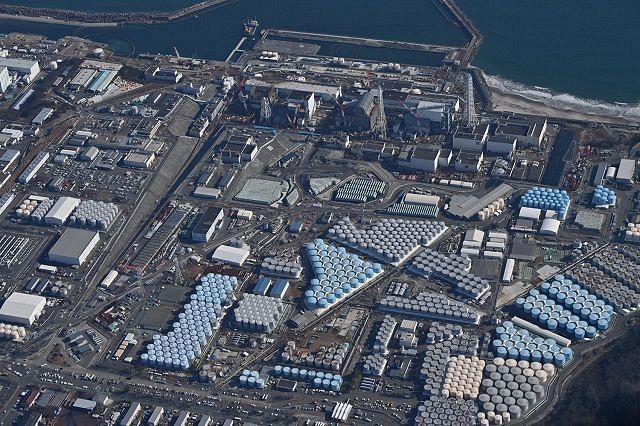
On December 6, Tokyo Electric Power Company (TEPCO) began to drive steel pipes into the ground to stop the inflow of underground water into the thawed part of the frozen soil barrier wall (about 1.5 km long) built underground around the No. 1 to No. 4 reactors at the Fukushima Daiichi Nuclear Power Plant (Okuma and Futaba towns, Fukushima Prefecture). Over the course of about a week, eight steel pipes with a diameter of 35 centimeters and a maximum length of six meters will be driven into the outside of the wall, creating a wall about four meters wide. If the water is not stopped, additional steel plates will be driven into the wall.
According to TEPCO, the frozen soil wall is believed to be thawing at the intersection of the southwest side of Unit 4 and the underground tunnel for drainage. The temperature of the ground has been above zero since mid-September, and it has been confirmed that it has reached more than 10 degrees Celsius.
The frost wall has been in operation since 2017 to prevent the inflow of groundwater into the reactor building, where melted nuclear fuel (debris) remains from the accident, and to reduce the generation of contaminated water. About 1,600 freezing pipes (30 meters long) driven into the ground are circulated with cooling liquid at 30 degrees below zero to freeze the surrounding soil.
https://www.tokyo-np.co.jp/article/147155?rct=national&fbclid=IwAR30nXaBUALO9eC4RHZkaRsXHg3j01jRmWd0RBkk4oF53UDmROD0Dk3YGNg
1 This Month
Tell Congress: Prevent Nuclear Catastrophe in Iran

Tell Congress: Prevent Nuclear Catastrophe in Iran

Read the Public Inquiry Report, the Commissioners’ report, Surrendering Australia: The AUKUS Deception is available to download for free at aukuspublicinquiry.com. Or just watch the replay of the National Press Club Luncheon.


Shut down the radiation-damaged Heysham nuclear reactors now
To see nuclear-related stories in greater depth and intensity – go to https://nuclearinformation.wordpress.com

Say No to NASA’s Reckless Nuclear Reactor on the Moon
Say No to NASA’s Reckless Nuclear Reactor on the Moon
-
Archives
- November 2026 (238)
- October 2026 (302)
- September 2026 (339)
- August 2026 (330)
- July 2026 (355)
- June 2026 (287)
- May 2026 (306)
- April 2026 (356)
- March 2026 (251)
- February 2026 (267)
- January 2026 (308)
- December 2025 (358)
-
Categories
- 1
- 1 NUCLEAR ISSUES
- business and costs
- climate change
- culture and arts
- ENERGY
- environment
- health
- history
- indigenous issues
- Legal
- marketing of nuclear
- media
- opposition to nuclear
- PERSONAL STORIES
- politics
- politics international
- Religion and ethics
- safety
- secrets,lies and civil liberties
- spinbuster
- technology
- Uranium
- wastes
- weapons and war
- Women
- 2 WORLD
- ACTION
- AFRICA
- Atrocities
- AUSTRALIA
- Christina's notes
- Christina's themes
- culture and arts
- Events
- Fuk 2022
- Fuk 2023
- Fukushima 2017
- Fukushima 2018
- fukushima 2019
- Fukushima 2020
- Fukushima 2021
- general
- global warming
- Humour (God we need it)
- Nuclear
- RARE EARTHS
- Reference
- resources – print
- Resources -audiovicual
- Weekly Newsletter
- World
- World Nuclear
- YouTube
-
RSS
Entries RSS
Comments RSS

