North Korea tests new weapon bolstering nuclear capability
North Korea says it has successfully test-launched a newly developed tactical guided weapon
- By HYUNG-JIN KIM – Associated Press
- Apr 17, 2022
SEOUL, South Korea (AP) — North Korea has test-fired a new type of tactical guided weapon designed to boost its nuclear fighting capability, state media reported Sunday, a day before its chief rivals the United States and South Korea begin annual drills that the North views as an invasion rehearsal.
The 13th weapons test this year came amid concerns that North Korea may soon conduct an even larger provocation. That may include a nuclear test in an effort to expand the country’s arsenal and increase pressure on Washington and Seoul while denuclearization talks remain stalled………………………….. https://www.news-gazette.com/coronavirus/north-korea-tests-new-weapon-bolstering-nuclear-capability/article_0413e1d9-3fb7-5c42-a63c-e1ea66b3e084.htm
Biden’s genocide comment raised concern
SOTT, Carol E. Lee, Josh Lederman, NBC News, Fri, 15 Apr 2022
President Joe Biden’s declaration this week that Russia is committing “genocide” in Ukraine raised concerns among some officials in his own government and has so far not been corroborated by information collected by U.S. intelligence agencies, according to senior administration officials.
At the State Department, which is tasked with making formal determinations of genocide and war crimes through an independent legal process, two officials said that Biden’s seemingly offhand declaration during a domestic policy speech in Iowa on Tuesday made it harder for the agency to credibly do its job.
U.S. intelligence agencies collect information when allegations are made of actions that could amount to genocide, but policymakers are the ones who actually decide whether to declare it. Intelligence reports on Ukraine currently do not support a genocide designation, officials said.
“Genocide includes a goal of destroying an ethnic group or nation and, so far, that is not what we are seeing.”…………..
The question of when to label Russia’s actions in Ukraine “genocide,” particularly the legal threshold for doing so had been discussed inside the White House ever since images of mass graves and civilian torture and assassinations emerged in Bucha, people familiar with the discussions said. Biden had recently begun to make his views clear in private, so White House officials weren’t surprised that he called what’s happening in Ukraine “genocide,” but they were taken aback that he did so offhandedly in a speech in Iowa about inflation, the people said.
The president’s declaration of genocide in Ukraine was the third time in recent weeks that the president has tried to separate what he says are his personal views from official U.S. policy to take a position that he believes is right even though it’s not aligned with the position of his own government.
Biden said Russia was committing war crimes in Ukraine — another symbolically and legally significant moment in which he got ahead of his own administration — a week before the U.S. government completed its legal process and formally made that declaration.
Biden also said Russian President Vladimir Putin should no longer be in power, prompting a scramble by his aides to say that’s not what he meant and stress that U.S. policy is not regime change in Moscow. Biden later said he did mean what he said — that it was his “personal” view — but not U.S. policy.
…………… “These aren’t gaffes,” said one person close to the White House. “He’s doing this very purposefully.”
Responding to questions about Biden’s genocide declaration, White House press secretary Jen Psaki told reporters this week, “The president was calling it like he sees it, and that’s what he does.”
The apparent disconnect between the president and the bureaucracy he oversees is striking given Biden’s extensive experience in foreign policy and government. Biden also has stressed since the 2020 campaign that “the words of a president matter.” And he’s gone out of his way to say he would not try to influence independent Justice Department decisions, but some administration officials see a willingness for him to do just that with other independent legal processes.
Once the president says he believes genocide and war crimes have been committed, administration officials said that puts immense pressure on career government officials to reach the same conclusion. The concern is that if and when the State Department’s Office of Global Criminal Justice reaches those conclusions on its own, the office risks appearing late to the game or like it’s trying to justify Biden’s public comments, the officials said. One of the administration officials said Biden’s comments had put particular pressure on Beth Van Schaack, the U.S. ambassador for global criminal justice, who was confirmed by the Senate last month. On Friday, Schaack met with Ukraine’s prosecutor general, Iryna Venediktova, to compare notes as Venediktvoa’s office investigates alleged Russian war crimes by Russia. Venediktova, like Ukrainian President Volodymyr Zelenskyy, has already accused Russia of genocide in Ukraine.
U.S. intelligence shows that the Russians have been told that Ukrainians in the eastern Donbas region, where fighting is expected to intensify, are Nazis and that the Ukrainian civilians are Nazi sympathizers, raising concerns about genocide, officials said. The Russians also have been told the same about Ukrainians in Mariupol, officials said, with one noting how brutal Moscow’s military campaign has been there.
Genocide is a specific crime defined under international law, and proving it requires showing an intent at high levels to commit genocide.
Biden’s early accusation against Russia, which was welcomed by Zelenskyy, came even ahead of human rights organizations that have often pushed U.S. administrations to declare that a regime has committed genocide.
Human Rights Watch, for instance, so far has not found evidence of a genocidal campaign waged by Russia, according to Tara Sepehri Far, acting deputy director of Human Rights Watch’s Washington office.
“Our research is not matching the definition yet,” said Sepehri Far. “It doesn’t mean it’s not happening.”
Biden has throughout his decades long career at times been quicker than others in the U.S. government to speak out about genocide………………………….. https://www.sott.net/article/466834-Biden-genocide-comment-raised-concern-among-some-U-S-officials
Dissent is dying in America – the backlash is vitriolic
 | |||
AMERICAN DISSENT ON UKRAINE IS DYING IN DARKNESS https://popularresistance.org/american-dissent-on-ukraine-is-dying-in-darkness/ AUDIO
- By Robert Scheer, Scheer Post., April 16, 2022
When It Came To The Ukraine Conflict, Professor Michael J. Brenner Did What He’s Done His Whole Life: Question American Foreign Policy.
This time the backlash was vitriolic.
As the death toll in Russia’s illegal invasion of Ukraine continues to rise, there have only been a handful of Westerners publicly questioning NATO and the West’s role in the conflict. These voices are becoming fewer and further between as a wave of feverish backlash engulfs any dissent on the subject. One of these voices belongs to Professor Michael J. Brenner, a lifelong academic, Professor Emeritus of International Affairs at the University of Pittsburgh and a Fellow of the Center for Transatlantic Relations at SAIS/Johns Hopkins, as well as former Director of the International Relations & Global Studies Program at the University of Texas.
Brenner’s credentials also include having worked at the Foreign Service Institute, the U.S. Department of Defense and Westinghouse, and written several books on American foreign policy. From the vantage point of decades of experience and studies, the intellectual regularly shared his thoughts on topics of interest through a mailing list sent to thousands of readers—that is until the response to his Ukraine analysis made him question why he bothered in the first place.
In an email with the subject line “Quittin’ Time,” Brenner recently declared that, aside from having already said his piece on Ukraine, one of the main reasons he sees for giving up on expressing his opinions on the subject is that “it is manifestly obvious that our society is not capable of conducting an honest, logical, reasonably informed discourse on matters of consequence. Instead, we experience fantasy, fabrication, fatuousness and fulmination.” He goes on to decry President Joe Biden’s alarming comments in Poland when he all but revealed that the U.S. is—and perhaps has always been—interested in a Russian regime change.
On this week’s “Scheer Intelligence,” Brenner tells host Robert Scheer how the recent attacks he received—many of a personal, ad hominem nature—were some of the most vitriolic he’s ever experienced. The two discuss how many media narratives completely leave out that the eastward expansion of NATO, among other Western aggressions against Russia, played an important part in fueling the current humanitarian crisis. Corporate media’s “cartoonish” depiction of Russian president Vladimir Putin, adds Brenner, is not only misleading, but dangerous given the nuclear brinkmanship that has ensued. Listen to the full discussion between Brenner and Scheer as they continue to dissent despite living in an America that is seemingly increasingly hostile to any opinion that strays from the official line.
U.S. Jews Favor Return to Iran Deal
Jews support a return to the Iran deal by 68-32, according to a new survey. And when Jews are asked to name their top two political issues, Israel shows up near the bottom of the list, well behind climate change.
Portside, April 16, 2022, Philip Weiss MONDOWEISS
merican Jews overwhelmingly support the renewal of the Iran deal, and very few American Jews consider Israel a political priority, according to a new survey of American Jewish voters.
Jews support a return to the Iran deal by 68-32, the Jewish Electoral Institute found in a poll of 800 Jews this spring. The proportion is nearly 4-to-1 among Reform Jews (79-21) and women (77-23). And Jews over 65 are for the deal by a larger percentage (72-28) than Jews under 40. Only the orthodox are against the Iran deal, by 85-15! But orthodox make up just 9 percent of the Jewish population.
Now here’s the indifference to Israel question.
Voters were asked to say which two issues they wanted the president to focus on. Israel got clobbered. Only 4 percent listed it as one of their two issues.
When you break it out by denomination, it’s even starker. 1 percent of non-denominational Jews and 2 percent of Reform Jews think Israel should be a priority. And those two groups make up more than two-thirds of American Jews — 31 percent non-denominational, 37 percent Reform. Though 5 percent of Conservative and 18 percent of Orthodox Jews see Israel as a priority.
Other issues are just way more important. 42 percent of nondenominational Jews say climate change should be a top priority; 32 percent say voting rights; 12 percent say crime…………………
The new poll also shows that 93 percent of American Jews are concerned about antisemitism. The Reform number there is 95 percent concerned, the orthodox 96 percent, the non-denominational 89 percent concerned……. https://portside.org/2022-04-16/us-jews-favor-return-iran-deal
Today: the nuclear lobby’s most charming new lie – ”energy independence”
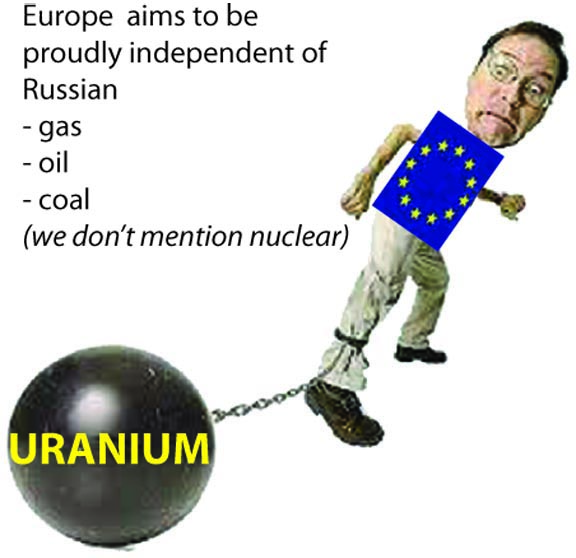
I’ve often pointed out the prevailing lies about nuclear power. The big one is, of course:
No 1 ”Nuclear power has nothing to do with nuclear weapons”‘
Then – in order of current popularity:
- nuclear power is essential to stop climate change
- is clean, green
- cheap
- renewablw
- safe
- necessary for medicine
- its toxic waste problem is solved
- provides 1000s of clean gooid jobs
- necessary for space research
There are probably more lies, but right now, I am fascinated with this fashionable new lie – that nuclear power is necessary for energy independence, national sovereignty – blah blah.
What an obvious outright lie! Perhaps the world will actually notice this one!
Sunshine, wind, tides – these forms of energy are truly national – going straight to the local technology. Nuclear is certainly not – starting from the need to import uranium, – going eventually to the likely need to dump te toxic waste onsome other poor sucker nation.
NATO’s military buildup on eastern flank to lengthen, broaden war — Anti-bellum
Xinhua News AgencyApril 16, 2022 World Insights: NATO’s expansion to worsen Ukraine crisis, decay European security Transferring massive weapons to Ukraine, massing a large number of troops in eastern Europe, and welcoming Sweden and Finland to join the alliance, NATO has been very much engaged itself so far in the conflict between Russia and Ukraine. […]
NATO’s military buildup on eastern flank to lengthen, broaden war — Anti-bellum
On Ukraine – Australia well and truly brainwashed by the military-industrial-corporate-media complex — Nuclear Australia

It would be funny, if it were not so serious. The Australian media, in serious decline, has gone further down the drain lately – esprecially NewsCorpse. We might get bored with indordinate attention lavished on sporting heroes. We might laugh at the politicians’electioneering stunts – much baby-kissing, koala-hugging, tractor-driving, wearing of cowboy hats………… But the […]
On Ukraine – Australia well and truly brainwashed by the military-industrial-corporate-media complex — Nuclear Australia
Tons of Japanese nuclear waste may be destined for overseas disposal

April 17, 2022
TOKYO (Kyodo) — Japan’s nuclear power plants have over 57,000 tons of large equipment that have, or will in time, become radioactive industrial waste and may be destined to be disposed of overseas, a tally of electric power company data showed Saturday.
The scale of the would-be hazardous waste underscores the ongoing move within the government to reexamine a rule banning the exports of radioactive waste at a time when few municipalities are willing to accept such waste.
Creating an exception to the rule under the foreign exchange law would allow power companies to commission contractors overseas to dispose of certain types of large equipment on the condition they are recycled in the destination countries.
But critics say radioactive waste created in Japan should not be forced on other countries and that such waste should be recycled domestically by improving related disposal technology.
The tally showed nuclear power plants in the country had 57,230 tons of the large equipment, including those still in use, at the end of March.
The equipment in question comes in three types. Steam generators create steam used to generate electricity, while feedwater heaters heat the water that goes back into a reactor and casings are used to store or transport spent nuclear fuel.

For example, there are 37 used steam generators, weighing a total of 12,000 tons, according to the tally. Twenty-two generators, or 7,500 tons, remain at reactors to be decommissioned, while another 51 units, or 15,300 tons, are still in use.
The crippled Fukushima Daiichi nuclear power plant has 3,360 tons of spent nuclear fuel casings. But the industry ministry says it sees no scenario in which waste emerging from the plant’s decommissioning process would be disposed of overseas.
The tally did not include data on the Tokyo Electric Power Company Holdings Inc. plant. Tohoku Electric Power Co. declined to provide data.
Decommissioning of nuclear reactors is expected to speed up from the mid-2020s in Japan, with an attendant increase in radioactive waste. Already, 24 commercial reactors are due to be decommissioned.

Radioactive waste is expected to be buried underground, depending on its pollution levels. But few disposal sites have been picked, leaving the handling of large reactor equipment, in particular, in limbo.
A steam generator is a large cylindrical metal object that is 20 meters long and weighs 300 tons. Because of its size, it cannot be easily cut up, encased in drums and buried.
Kansai Electric Power Co. has 21 generators stored away on its premises. “We are concerned about having little room left on our premises (at power plants) going forward as it would impact decommissioning work,” a company source said.
“It is virtually impossible to dispose of the waste domestically. The regulatory reconsideration is a gleam of hope for the waste issue that is at a dead-end,” the source added, expressing hope for overseas disposal.
One company the Japanese side is talking with about possible waste export is EnergySolutions Inc., a U.S. nuclear service company and a major player in the reactor decommissioning business.
The Utah-based company has processed over 60,000 tons of waste produced in reactor decommissioning in and outside of the United States.
A company official expressed confidence that it can process not just the three types of large reactor equipment under consideration for export, but other waste, such as metals from the Fukushima Daiichi plant.
Tatsujiro Suzuki, a Nagasaki University professor, who served as an acting head of the government’s Atomic Energy Commission, is critical of the envisioned disposal of radioactive waste overseas.
“This is what you get when the state has failed to seriously discuss what to do with waste,” Suzuki said, warning that it is a slippery slope and could lead to an export of waste from the Fukushima nuclear disaster.
“It is sheer irresponsibility when looked at from the principle that disposal must be done in one’s own country.”
First Supreme Court Argument in Class Action Lawsuit by Evacuees from Nuclear Power Plant Accident: about Accepting the State’s Responsibility.

April 15, 2022
On March 15, the Supreme Court Second Petty Bench (Chief Justice Hiroyuki Kanno) heard arguments in a lawsuit filed by residents who evacuated from Fukushima Prefecture to Chiba Prefecture following the accident at TEPCO’s Fukushima Daiichi Nuclear Power Plant, seeking damages from the government and TEPCO. The Supreme Court is expected to render a unified judgment on the state’s responsibility by this summer. The Supreme Court is expected to render a unified judgment on the state’s responsibility this summer. The date of the judgment will be set at a later date.
This is the first time for the Supreme Court to hear arguments in class action lawsuits of the same type filed in various regions. The others are scheduled for May 22 in Gunma, May 25 in Fukushima, and May 16 in Ehime. At the high court stage, the court decisions in Chiba, Fukushima, and Ehime recognized the government’s responsibility, while Gunma denied it, leading to a split conclusion.
On May 15, the plaintiffs also made statements. Tetsuya Komaru, 92, who evacuated from Namie Town, Fukushima Prefecture, to Chiba Prefecture and now lives in Yokohama, said, “My ancestral home, my house, fields, and forests were contaminated, and I lost everything I had built up over my life. I want the Supreme Court to clearly recognize the government’s responsibility without being beholden to the government.
In their arguments, the government argued that the government’s “long-term evaluation” of earthquake forecasts, which was a point of contention in the first and second trials, “was not considered a view that should be incorporated into nuclear power regulations at the time. As for tsunami countermeasures, the government argued that “even if countermeasures had been taken, the accident could not have been prevented because the tsunami was completely different from what had been anticipated.
The residents pointed out that “the long-term assessment is scientific knowledge with a rational basis. If the government, which has regulatory authority, had instructed TEPCO to take countermeasures and had constructed seawalls and made the reactor buildings watertight, the accident would likely have been avoided, they said.
Last month, the Supreme Court upheld a second trial ruling that ordered TEPCO to pay compensation in an amount that exceeded the “interim guidelines,” the government’s standard for compensation for all cases. A total of 1.43 billion yen was ordered to be paid to approximately 3,700 plaintiffs. (Keiichi Ozawa)
https://www.tokyo-np.co.jp/article/172043?fbclid=IwAR3SE8_GtEhXvlNpdcY5pfTGgP8C40qKOoRrToZqDhzOb5UunY2gXLLzM8s
Japan’s nuclear regulator to okay release of treated water from Fukushima plant

April 15, 2022
Japan’s nuclear regulator has largely approved a plan to release treated water from the crippled Fukushima Daiichi nuclear power plant into the ocean.
The plant suffered triple meltdowns in the March 2011 earthquake and tsunami disaster. Water is used to cool molten nuclear fuel. It mixes with rain and groundwater that flows into damaged reactor buildings.
The water is treated to remove most of the radioactive materials, but still contains radioactive tritium.
The Japanese government plans to dilute treated water that continues to accumulate at the plant to levels below national regulations and start releasing it from around spring 2023.
The Nuclear Regulation Authority has been inspecting the plan drawn up by plant operator Tokyo Electric Power Company.
In 13 meetings since December, the NRA discussed the safety of the new facility to be built for the water release and the maximum concentration of radioactive tritium when it is released. It also considered how to respond in natural disasters and other emergencies, and the effect of radiation exposure on the surrounding environment and people.
At Friday’s meeting, an official of the NRA secretariat said there are no issues left that have not been discussed enough.
The NRA plans to put together a draft inspection document as early as next month that effectively indicates the plan’s approval.
TEPCO plans to start construction on a facility for diluting treated water and an undersea tunnel once the NRA approves the plan and the utility obtains consent from Fukushima Prefecture and local communities. TEPCO aims to complete the construction work by mid-April next year.
TEPCO has yet to convince and gain understanding from local fishers who are concerned about reputational damage from the release of treated water into the sea.
Japan severely breaches obligations under international law by persisting in discharge of nuclear-contaminated water into ocean

April 15, 2022
Japan is being extremely selfish and irresponsible by willfully clinging to its decision to release nuclear-contaminated water into the ocean in disregard of the strong opposition of the international community.
Its despicable act constitutes gross infringement of the legitimate rights and interests of its neighboring countries, severe breach of international justice and its obligations under international law, and major threat to the marine environment and the right to health of people around the world.
On April 13, 2021, the Japanese government unilaterally decided to dump a massive amount of nuclear-contaminated water from the crippled Fukushima Daiichi Nuclear Power Plant operated by Tokyo Electric Power Company (TEPCO) into the ocean despite doubts and opposition from home and abroad.
One year has passed since Japan announced the erroneous decision and the country still hasn’t realized how terrible a mistake it is. According to a plan recently released by TEPCO for the disposal of nuclear-contaminated water generated by Fukushima Daiichi Nuclear Power Plant, the country will soon begin official preparations for the release of the contaminated water and plans to begin long-term discharge of radioactive water into the Pacific Ocean in the spring of 2023.
While Japan opted for the discharge of the contaminated water into the ocean, an option with the least economic cost to itself, it posed the biggest environmental health and safety risk to the world. What an act of selfish calculation!
Data from TEPCO showed that the contaminated water from the Fukushima nuclear accident still contains many kinds of radionuclides with a long half-life even after secondary treatment.
Japan plans to release more than one million tons of nuclear-contaminated water over a period of 30 years. The amount it intends to discharge, the duration of the release, the sea area covered, and potential risks that can be generated by the activity are all unprecedented.
The decision has aroused deep concerns and strong opposition from all sectors of society even at home. About 180,000 people in Japan recently signed a petition against the decision to dump nuclear-contaminated water into the ocean. Several organizations in Japan, including the National Federation of Fisheries Cooperative Associations, have reiterated their opposition to the decision.
According to an article published on Fukushima Minpo, a newspaper based in Fukushima prefecture of Japan, the Japanese government should respect the opinions of its citizens, listen to the voices of local residents, and terminate the plan to discharge nuclear-contaminated water into the ocean.
As a signatory to the United Nations Convention on the Law of the Sea, the Convention on Early Notification of a Nuclear Accident, the Convention on Nuclear Safety, and the Joint Convention on the Safety of Spent Fuel Management and the Safety of Radioactive Waste Management, Japan has knowingly breached its obligations under international law.
It didn’t conduct full consultation with its neighboring countries and other stakeholders before announcing its decision to discharge nuclear-contaminated water into the ocean. After its announcement of the decision, many countries, including China, South Korea, Russia, and the Philippines, as well as relevant international institutions, have expressed concerns over the issue and raised doubts and concerns with the Japanese side over the legitimacy of the discharge of the nuclear-contaminated water into the ocean, the rationality of the discharge plan, the credibility of data about the nuclear contaminated water and the reliability of the equipment to purify the nuclear-contaminated water.
However, to this day, Japan has yet to give a full and credible explanation for its decision and serious responses to relevant doubts and concerns.
People in Japan’s neighboring countries and countries on the Pacific Rim have rights to health and life as well as the environment. Japan, on the other hand, wants to make short-term money at the expense of these rights.
The United Nations (UN) Human Rights Council released a report urging that the Japanese government should face up to its responsibility for the disposal of nuclear-contaminated water.
In a joint statement, U.N. human rights experts said that Japan’s decision to release contaminated water from the destroyed Fukushima nuclear plant into the ocean is “particularly disappointing” and “very concerning”.
“The release of one million tons of contaminated water into the marine environment imposes considerable risks to the full enjoyment of human rights of concerned populations in and beyond the borders of Japan,” they said in the joint statement.
The international community has frequently expressed voices of justice, such as “The Pacific is not a dumping ground for radioactive waste water” and “keep our Pacific nuclear-free”. However, Japan has turned a deaf ear to all of them.
In this February, a technical working group of the International Atomic Energy Agency (IAEA) visited Japan for the first time and raised many questions to the Japanese side about its controversial plan to release radioactive water into the Pacific Ocean. Evaluation of the disposal of the nuclear-contaminated water at the Fukushima nuclear power plant is still in progress.
Surprisingly, Japan has not only ignored the concerns of various parties over the discharge of its nuclear-contaminated wastewater, but preset results for the evaluation conducted by the IAEA technical working group. The country repeatedly concealed information and covered up the truth.
When doubts about its decision to dump radioactive water into the ocean poured in, the country made no attempt to reflect on the legitimacy of the decision and correct its mistake, but blamed those who doubted its decision for damaging its reputation.
The Japanese side should know that no matter what it does to whitewash the plan to release the nuclear-contaminated water into the ocean, it would only increase the international community’s concerns.
The disposal of the nuclear-contaminated water is never Japan’s private matter. Instead, it bears on the marine environment and public health of the whole world.
Japan should pay careful attention to and respond to the concerns of its neighboring countries and other members of the international community, stop pushing forward with preparations for the discharge of the nuclear-contaminated water into the ocean, and withdraw its erroneous decision, so as to avoid further damage to its credibility.
(Zhong Sheng is a pen name often used by People’s Daily to express its views on foreign policy and international affairs.)
Japan’s planned release of radioactive wastewater draws concern.
April 14, 2022
It’s been exactly one year since the Japanese government announced its decision to continuously release Fukushima’s radioactive wastewater into the Pacific Ocean. Concerns and protests were heard in #Japan and beyond. #nuclear#environment
Protests in various locations demanding withdrawal of ocean discharge of treated water from TEPCO’s Fukushima Daiichi Nuclear Power Plant.

April 13, 2022
On the 13th, one year after the government decided to discharge treated water from TEPCO’s Fukushima Daiichi Nuclear Power Plant (Okuma and Futaba, Fukushima Prefecture) into the ocean, protests were held in various locations, with participants calling for the withdrawal of the policy.
In front of the House of Representatives building in Nagata-cho, Tokyo, about 40 people participated in response to a call from the “Sayonara NPP 10 Million People Action Executive Committee” and other groups. Holding up banners, they shouted “Don’t pollute the sea in Fukushima” and “Listen to the voices of the people of Fukushima.
The participants made speeches in turn toward the Diet building. Taeko Fujimura, 67, a member of the National Trade Union Liaison Council, criticized the government and TEPCO, saying, “The government and TEPCO promised the Fukushima Prefectural Fisheries Federation that they would not discharge the waste into the ocean without their understanding, but they unilaterally decided on the policy and have not explained it in good faith to the public. No matter how much we dilute it with seawater, it is inevitable that a large amount of radioactive materials will spread into the ocean. There must be something more that can be done, such as finding a way to continue storing the radioactive materials instead of discharging them.
Toshihiro Inoue, 63, a member of the executive committee secretariat, said, “The government has forcibly decided on this policy, and even after a year, it has not withdrawn it in spite of opposition. The global environment must not be further destroyed by radioactive pollution. Let’s continue to raise our voices in opposition.
The executive committee held protests at more than 10 locations in Tokyo and eight prefectures in Saitama, Yamagata, Aichi, Osaka, Okayama, Fukuoka, and Kagoshima.
The environmental group FoE Japan also held an online press conference on the same day, calling for storage of the treated water in large tanks and solidification with cement. Don’t pollute the sea any more!” Chiyo Oda, co-chairperson of the “Citizens’ Council,” said, “Once released, it is irreversible. Artificially spreading radioactive materials will spread the effects of the accident and must not be tolerated. (Kenta Onozawa)
https://www.tokyo-np.co.jp/article/171455?rct=national&fbclid=IwAR3yz25OB-5W85giS7pp3nPYRVtzYjdQOFoIhsB92n7co9wkYzDe0nM8WoQ
Don’t discharge contaminated water into the sea! Nationwide simultaneous standing in Iwaki

April 13, 2022
On April 13, 2021, one year after the government decided on the disposal of contaminated water stored in tanks from the Fukushima Daiichi Nuclear Power Plant accident, in violation of its promise to the fishing industry that no disposal would take place without the understanding of all concerned parties, and ignoring the opposition and cautious opinions of 70% of the local government councils in Fukushima Prefecture and the opposition of many Fukushima residents One year has passed.
On April 13, “April 13 National Simultaneous Standing in Iwaki Against Discharge of Contaminated Water from Nuclear Power Plants into the Sea” was held near the entrance intersection of Aquamarine Fukushima at Onahama Port in Iwaki City.
Since last June, we have been calling for a monthly standing on the 13th of every month, “Don’t pollute the sea any more! Citizens’ Council”, which has been calling for standing on the 13th every month since June last year, started the event after noon with the slogan “Protect our hometown oceans! Protect our fisheries! Protect our children!” From 12:30 p.m., about 20 participants spoke against the discharge of contaminated water into the ocean from their respective standpoints.
Mr. Oda, the co-chairperson of the event, said, “One year has passed since the government’s decision on April 13 to discharge contaminated water into the ocean, so let’s not pollute the sea any more! He reported on the release of the “Appeal” and the citizens’ groups’ online joint press conference, and appealed, “We will continue to raise our voices to protect our precious daily lives. Mr. Yoneyama of the Citizens’ Council also spoke with the Citizens’ Circle to Monitor Nuclear Regulations, FoE Japan, an international environmental NGO, and Don’t Pollute the Sea Anymore! The report was based on the “Submission of a written request and negotiations with TEPCO and the government demanding the cessation of the discharge of contaminated water from the Fukushima Daiichi Nuclear Power Plant” held on March 29 by four organizations: the Citizens’ Council of Japan, the Kansai Liaison Conference for the Evacuation Plan, and the Kansai Liaison Conference for the Evacuation Plan. The speaker appealed to the audience. Prefectural Councilor Furuichi also reported on how the Fukushima Prefectural Assembly continued to review the “petition for a cautious response to the application for prior consent regarding the ALPS process water discharge facility” submitted to the assembly, and stressed the significance of citizens’ continued opposition activities. Mr. Yuzuru Suzuki, professor emeritus at the University of Tokyo and former director of the Fisheries Experiment Station, also spoke about what would happen to fish if tritium and other contaminated water were to be released, saying that they are currently in the process of collecting data before the release of water. He expressed his determination that even if the release of contaminated water were to be forced, he would continue marine research to clarify the effects of radiation and force the cancellation of the project. After this, citizens continued to demonstrate their will by making one appeal after another.
The public comment on the draft review report will be held once the review meeting for the “Application for Approval of Changes to the Implementation Plan” for the basic design of the “ALPS process water” dilution and discharge system and related facilities, which TEPCO applied to the Nuclear Regulation Authority at the end of last year, is completed on March 15. After that, if Fukushima Prefecture, Okuma Town, and Futaba Town give their approval to the “Request for Prior Approval,” construction will begin in June.
The oceans of our hometown, the oceans of Japan, and the oceans of the world must not be further polluted by radiation.
Let’s not allow the construction of the discharge facility to start in June, and let’s spread our voices of opposition and our standing circle across the country and the world like a ripple to a giant wave in order to stop the discharge of radioactive materials one year later.
On May 13, together with standing, we will prepare and call for an action to demand the halt of the start of construction of the discharge facility.
Let us all protect the oceans of our hometown, the oceans of Japan, and the oceans of the world.
One year after the decision to discharge contaminated water into the ocean: Three videos on contaminated water from ALPS treatment released
April 13, 2022
On April 13, 2021, the government decided to release ALPS-treated contaminated water into the ocean.
The water stored in the tanks, once treated by ALPS, contains not only tritium but also residual radioactive materials such as cesium-134, cesium-137, strontium-90, iodine-129, and plutonium, exceeding the standard in about 70% of the cases. TEPCO has stated that it will conduct secondary treatment, but has not clarified which radioactive materials will ultimately remain and how much.
In August 2015, the government and TEPCO promised the Fukushima Prefectural Fisheries Federation that they would not carry out any disposal without the understanding of all concerned. After the decision to discharge the waste into the ocean, TEPCO President Kobayakawa stated, “We have no intention of reneging on our promise. However, despite the opposition of fishermen, consumers, and a wide range of citizens in and outside of Fukushima Prefecture, procedures are steadily underway to release the waste into the ocean.
Against this backdrop, FoE Japan has created a series of short videos to get people to think about the issue of discharging contaminated water from the ALPS process into the ocean. The videos pick up on various issues surrounding ALPS-treated contaminated water. What is contaminated water? What’s in it?” , “What is tritium?” , “What are the alternatives?” and “What do the people have to say?” (to be released) (each is less than 2 minutes and 20 seconds). Please take a look.
1 What is contaminated water? What is contained?
2 What is tritium?
3 What is the alternative?
1 This Month
Tell Congress: Prevent Nuclear Catastrophe in Iran

Tell Congress: Prevent Nuclear Catastrophe in Iran

Read the Public Inquiry Report, the Commissioners’ report, Surrendering Australia: The AUKUS Deception is available to download for free at aukuspublicinquiry.com. Or just watch the replay of the National Press Club Luncheon.


Shut down the radiation-damaged Heysham nuclear reactors now
To see nuclear-related stories in greater depth and intensity – go to https://nuclearinformation.wordpress.com

Say No to NASA’s Reckless Nuclear Reactor on the Moon
Say No to NASA’s Reckless Nuclear Reactor on the Moon
-
Archives
- November 2026 (224)
- October 2026 (302)
- September 2026 (339)
- August 2026 (330)
- July 2026 (355)
- June 2026 (287)
- May 2026 (306)
- April 2026 (356)
- March 2026 (251)
- February 2026 (267)
- January 2026 (308)
- December 2025 (358)
-
Categories
- 1
- 1 NUCLEAR ISSUES
- business and costs
- climate change
- culture and arts
- ENERGY
- environment
- health
- history
- indigenous issues
- Legal
- marketing of nuclear
- media
- opposition to nuclear
- PERSONAL STORIES
- politics
- politics international
- Religion and ethics
- safety
- secrets,lies and civil liberties
- spinbuster
- technology
- Uranium
- wastes
- weapons and war
- Women
- 2 WORLD
- ACTION
- AFRICA
- Atrocities
- AUSTRALIA
- Christina's notes
- Christina's themes
- culture and arts
- Events
- Fuk 2022
- Fuk 2023
- Fukushima 2017
- Fukushima 2018
- fukushima 2019
- Fukushima 2020
- Fukushima 2021
- general
- global warming
- Humour (God we need it)
- Nuclear
- RARE EARTHS
- Reference
- resources – print
- Resources -audiovicual
- Weekly Newsletter
- World
- World Nuclear
- YouTube
-
RSS
Entries RSS
Comments RSS

