Hinkley nuclear site’s history of weapons deals with USA

 Hinkley’s hidden history Morning Star UK 21 July 2013 by David Lowry With the coalition government’s decision to back a third nuclear reactor at Hinkley Point on Somerset’s coast and the ongoing debate over Trident replacement, it’s interesting to take a look back at the origins of Britain’s nuclear programme.
 When the British nuclear power and weapons programmes were born, a different foreign power, the United States, was intimately involved in the planning.
The first public hint came with an MoD announcement in June 1958 on “the production of plutonium suitable for weapons in the new [nuclear] power stations programme as an insurance against future defence needs” at Britain’s first-generation Magnox reactor (named after the fuel type, magnesium oxide).
A week later in Parliament, Labour’s Roy Mason asked why the government had “decided to modify atomic power stations, primarily planned for peaceful purposes, to produce high-grade plutonium for war weapons.”
He was informed by paymaster general Reginald Maudling: “At the request of the government, the Central Electricity Generating Board has agreed to a small modification in the design of Hinkley Point and of the next two stations in its programme so as to enable plutonium suitable for military purposes to be extracted should the need arise.
“The modifications will not in any way impair the efficiency of the stations. As the initial capital cost and any additional operating costs that may be incurred will be borne by the government, the price of electricity will not be affected……….
the following month, the US and British governments signed a mutual defense – spelt with an “s” even in the official British version, so you can guess where it was authored – co-operation agreement on atomic energy matters.
The agreement was intended to circumvent the draconian restrictions of the 1954 Atomic Energy Act, which sought to retain all nuclear secrets within the US, even though many foreign nationals had worked collaboratively with US counterparts for six or more years on nuclear R&D.
The deal was reached after several months of congressional hearings in Washington DC, but no oversight whatsoever in the British Parliament.
As this formed the basis, within a mere five years, for Britain obtaining the Polaris nuclear WMD system from the US, and some 20-odd years later for Britain to buy US Trident nuclear WMD, the failure of Parliament to at least appraise the security merits of this key bilateral atomic arrangement was unconscionable…….
And so it may be seen that the Britain’s first civil nuclear programme was used as a source of nuclear explosive plutonium for the US military, with Hinkley Point A the prime provider.
The reason there was a swap between Britain and the US of weapons-suitable highly enriched uranium and plutonium was the US had huge surpluses of uranium, but wanted more plutonium than its nuclear production complex at Hanford could deliver, while the British first-generation “commercial” Magnoxes, which were scaled-up plutonium production factories, were perfect for producing military-suitable plutonium as they had online refuelling systems to optimise plutonium over electricity production.
They produced perfect plutonium in surplus, but Britain lacked sufficient highly enriched uranium, so an exchange deal was mutually beneficial.
Two decades later in 1984 Wales national daily the Western Mail reported that the largest Magnox reactor in Britain, at Wylfa on Anglesey, had also been used to provide plutonium for the military.
Plutonium from both reactors went into the British military stockpile of nuclear explosives, and could well still be part of the British Trident warhead stockpile today.
Subsequent research by the Scientists Against Nuclear Arms, published in the prestigious science weekly journal Nature and presented to the Sizewell B and Hinkley C public inquiries in the ’80s, has demonstrated that around 6,700kg of plutonium was shipped to the US under the military exchange agreement, which stipulates explicitly that the material must be used for military purposes by the recipient country.
To put this quantity into context, a nuclear warhead contains around 5kg of plutonium.
Is it any wonder the Atoms for Peace movement began to demand “safeguards” to deter diversion of civilian nuclear plants to military misuse?
After all, the US and Britain knew that such deadly diversion was possible – they had demonstrated it themselves.
The trouble is that safeguards are misleading. They are neither safe, nor do they guard. And what would Iran or North Korea make of this deliberate intermixing of civil and military nuclear programmes by one of the nuclear weapons superpowers – one which leads the criticisms of them for allegedly doing this very thing today. http://www.morningstaronline.co.uk/news/content/view/full/135635
No official body is measuring ionising radiation in the atmosphere
 Fukushima 2013: “Remaining Radioactive Mass”, “Dangerous Leaking Radioactive Water”, All Four Reactors are “Getting Worse” By William Boardman Global Research, July 11,
  2013 “……...It’s Not a Cover-up If Governments Gather No Useful Information, Is It?
Apparently there is no comprehensive, Fukushima-related radiation testing being carried on by the U.S. Canadian, or other governments whose people are directly affected. Nor is there any international body publicly performing this work.
The Global Monitoring Division of the Earth System Research Laboratory of the National Oceanic & Atmospheric Administration (NOAA) of the U.S. Dept. of Commerce monitors global levels of “carbon dioxide, carbon monoxide, methane, nitrous oxide, surface and stratospheric ozone, halogenated compounds including CFC replacements, hydrocarbons, sulfur gases, aerosols, and solar and infrared radiation.”
Worldwide nuclear weapons programs and nuclear power generation add ionizing radiation to the atmosphere continuously. NOAA’s website offers five different safety programs related to ionizing radiation. But if NOAA (or any other government entity) is measuring ionizing radiation in the atmosphere, that information is not easily found…..”.http://www.globalresearch.ca/fukushima-2013-remaining-radioactive-mass-dangerous-leaking-radioactive-water-all-four-reactors-are-getting-worse/5342466
Radiation the most probable cause of Fukushima’s deformed butterflies
 Japan Biologist: Radioactivite contamination from Fukushima disaster is most reasonable explanation for butterfly deaths and abnormalities — “I think maybe this is a very touchy issue, politically” http://enenews.com/japan-biologist-radioactivity-from-fukushima-is-most-reasonable-explanation-for-butterfly-deaths-and-abnormalities-i-think-maybe-this-is-a-very-touchy-issue-politically
Source: Nature
Author: Ewen Callaway
Date: 16 July 2013 […] Last week […] biologists studying Fukushima and Chernobyl came together at the annual meeting of the Society for Molecular Biology and Evolution in Chicago […]What Fukushima data do exist are sporadic — and contested. […]
[…] Insects collected in May [2011] showed few problems, but their lab-reared offspring had many abnormalities, such as misshapen wings and aberrant eyespots, and many died as pupae (A. Hiyama et al. Sci. Rep. 2, 570; 2012). Among the September-collected butterflies, more than half of the progeny showed such defects.
[…] “You can come up with alternative explanations, but I think the hypothesis that radiation caused death and abnormalities is the most reasonable,” [Joji Otaki, an ecologist at the University of the Ryukyus in Nishihara, Japan] says.
Tim Mousseau, an evolutionary geneticist at the University of South Carolina in Columbia […] is heading to Fukushima this week to begin his third season of field work […] His team saw die-offs in some insects and declining numbers of some bird populations […]
For funding, Otaki says he has had to turn mostly to private foundations. “I think maybe this is a very touchy issue, politically,” he says.[…] The Department of Energy has largely stopped funding its research programme in low-dose exposure, and the National Science Foundation and the National Institutes of Health have awarded few grants […]
See also: Japan Scientists: Truly unusual deformities in Fukushima — Forests may be evolving into different ecosystems — “There’s been a sudden, large change”
Bad luck for nuclear obby, Dept of Energy favours burial of wastes, not reprocessing
 DOE’s Spent Fuel Strategy: Disappointing for Nuclear Advocates, The Energy Collective, Steve Skutnik January 17, 2013 There is a hallowed tradition in Washington known as the “Friday Document Dump,” in which news and announcements the government wishes to bury are strategically timed for Friday afternoons, when such announcements tend to fall through the cracks of the typical news cycle (i.e., assuming reporters are even present to cover the event, the strategic timing tends to ensure it will miss the weekend papers, thus effectively “burying” the story by the time the new week rolls around).
In this storied tradition, the Department of Energy released the Obama administration’s response to the Blue Ribbon Commission report last Friday to relatively scarce media coverage. In fact, one would be hard-pressed to find any coverage in many of the major papers; what little coverage there was can be found in the Washington Times, Platts(an energy publication), and the Las Vegas Review-Journal. (Needless to say, the timing appears to have had its intended effect)……..
Some of the major highlights:
- An emphasis upon a flexible, staged, consent-based process for locating a permanent geologic repository for used nuclear fuel designed to be adaptive to potentially changing circumstances.
- A new, independent waste disposal organization charged with overseeing used fuel management and disposal, along with legislative action to reform allocation of the Nuclear Waste Fee paid by operators to allow for greater operational flexibility and independence.
- Short-term emphasis upon siting a pilot interim storage facility for used nuclear fuel, with a triage priority of relocating fuel from decommissioned reactor sites first. Operations would begin in2021.
- Transitioning toward an operational interim storage site with sufficient capacity to meet the existing federal government’s liabilities under the Nuclear Waste Policy Act of 1982; operations to begin in 2025.
- Making “demonstrable progress” toward locating and characterizing a potential geologic repository with a target operations date of 2048…….
Perhaps to the disappointment of the AREVA (who emphasized reprocessing as a viable fuel cycle strategy in their blog response), the report seems to go out of its way to minimize the potential role of reprocessing in a future U.S. fuel cycle strategy – in fact, one point which stuck out to me was in that the DOE report recommended that the scope of the waste management organization (referred to as a “management and disposal organization, or “MDO” – because if there’s one thing Washington loves, it’s acronyms…) should be explicitly constrained to explicitly exclude reprocessing. Here’s the relevant quote:
In addition, the mission of the MDO will need to be carefully defined. For example, funding made available to the MDO should be used only for the management and disposal of radioactive waste. While this could include the management and disposal of waste resulting from the processing of defense materials, the MDO itself should not be authorized to perform research on, fund or conduct activities to reprocess or recycle used nuclear fuel. These limitations on the MDO mission are consistent with the recommendations of the BRC.
FUKISHIMA: RADIOACTIVITY in SEAWATER

Issue 1: The number of radio-nuclides entering the marine environment of the east coast of Japan.
Issue 2: The nature of the radio-nuclides derived from reactor and cooling pond outputs
It’s my conclusion that the official monitoring regime being carried out by TEPCO and other Japanese agencies is inadequate to the task of identifying the potential radiobiological threats to the public.
An OPEN BRIEFING, Tim Deere-Jones: Marine Radioactivity Consultant, timdj@talktalk.netJuly 2013
I’m a UK based Marine Radioactivity Consultant, Researcher and Campaigner whose been researching the subject since the 1980’s and working (on a freelance, independent basis) as a consultant to NGO’s, Green Groups, Citizens Campaign Groups and UK Local Authorities since the 1980’s.
My field work experience and desk review research have been focussed on the behaviour and fate of man made radioactivity in UK and European marine, coastal and estuarine environments and the pathways by which doses of marine radioactivity may be delivered to maritime, coastal zone and island populations.
In the context of the ongoing contamination of the marine environment following the multiple meltdowns and loss of coolant from the Fukushima site I note the ongoing near-site monitoring of the marine environment (sea water) and of some marine environmental media (principally fish, with some marine algae).
However I am deeply concerned to note that a number of highly relevant issues and phenomena relating to the behaviour and fate of the Fukushima sea discharged radioactivity and its potential for delivering doses to human populations remain un-recorded, under researched and/or completely ignored.
Thus it is evident that the true impacts of the radioactive contamination of the Japanese east coast are not being documented or acted upon.
The short, informal briefing, set out in the following pages, identifies and comments on some of those issues and introduces the outcome of a number of UK observations and studies (principally carried out in one of the planets most radioactive sea areas: the Irish Sea and it’s adjacent waters) in order to provide some supporting background information in support of my concerns relating to the Fukushima case.
N.B. Input of the search term “Tim Deere-Jones: Marine Radioactivity” to most of the popular search engines will upload links to a number of fully referenced, scientific and technical reports and studies, on the behaviour, fate and doses potential of marine discharged radioactive wastes in UK and European waters, that I have authored for a number of clients. Continue reading
USA scandal of Uranium Center of Excellence taxpayer ripoff
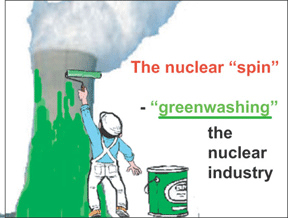 The “excellence” of this facility was that the radioactive garbage was green-washed as “recyclable,” and Ohio voters were also duped by the promise that it would bring hundreds of jobs, when the final tally was only two full-time inventory managers. I suppose that if spent fuel storage had been added, it would have been called the Center for Real Awesomeness with Plutonium.
Many of the same contractors who had been paid to haul the excellent garbage in were then paid a second time to haul the excellent garbage out in a less-than-excellent shell game that meant lucre for an elite group of crappy corporations.
Uranium Titan Tumbles EcoWatch July 12, 2013 By Geoffrey Sea“…….Excellent Extortion Recent developments at Piketon and Paducah make no sense at all without understanding that the working national plan for how to deal with the outmoded gaseous diffusion plants and their massively contaminated sites has been to convert both into “national sacrifice” waste repositories. But you won’t find that plan in any Federal Register notices or Environmental Impact Reports. Rather, it’s the subtext of a hundred different records of decision and formal notifications. The new way to evade those nuisance environmental compliance requirements is for federal agencies and funded corporations to simply not announce what they intend to do. Continue reading
The disastrous history of U.S. Enrichment Corporation (USEC)
Despite public funding, no governmental process is contemplated for gathering or disseminating data on the commercial worthiness of USEC’s centrifuges, because that answer is already widely known: The technology at issue is forty years old and out of date…… doesn’t produce anything anymore and it never will
 the “American Centrifuge” project (ACP) was never more than a false front, a mechanism for wrangling government bailout after government bailout, while the rock-red company waited for a Republican administration that would approve its audacious waste storage plans.
 That team included Iraq War architect Richard Perle and a physics professor whose only claim to fame was in pushing centralized storage solutions for spent nuclear fuel. His name was Ernest Moniz. (left)
Uranium Titan Tumbles EcoWatch July 12, 2013 By Geoffrey Sea “……The Un-American Centrifuge Plant Created first as a government corporation in response to a mismanagement scandal at the U.S. Department of Energy (DOE) in the 1990s, USEC was privatized in 1998. The USEC Privatization Act, premised on delusional Thatcherite ideology, placed two solemn obligations on the respective parties in the split: The Department of Energy, though continuing to own the land and facilities with which USEC operates, had to stay out of the business of uranium enrichment; USEC, while free to conduct its business as a private corporation, had to use its free access to public land and resources to develop advanced uranium enrichment technology and improve the U.S. position in the global enrichment marketplace.
Now those statutory goals can only bring a ROFLMAO reaction. USEC has become a wholly-dependent ward of the Department of Energy, which effectively makes all the big “business” decisions that concern enrichment, and USEC has defaulted on any credible effort to deploy a domestic advanced enrichment technology. Yet the Privatization Act remains on the books, its provisions violated cavalierly but with no efforts at repeal, like metropolitan municipal laws about donkey carts and Sunday dancing.
The basic and shocking truth about USEC, Continue reading
Nuclear weapons insanity: America’s AIR-2 Genie rocket
it was basically a suicide device.
The craziest part about this? In the only live test during Operation Plumbob, the US Air Force put five guys directly under the blast to prove how “safe” it was to use over populated areas. P
And the US government made 3,000 Genies.
The Five Most Insane Nuclear Delivery Systems Jaolpnik MICHAEL BALLABAN, 14 July 13
“…….Earlier this week we looked at the giantSoviet nuclear gun. That thing is definitely batty, what with its giant cannon at one end and what was essentially a tank at the other end turning it into a self-propelled howitzer. The Americans had a crazy nuke gun, too, and for awhile it looked like maybe we’d just stand and shoot atomic cannons at each other.
The thing is though, with both of those artillery pieces the actual physics package was intended to reach at least 15 miles away before the thing actually exploded. And even then, that was waytoo close.
What would happen, then, if you wanted it to explode even closer?
The AIR-2 Genie was a doomsday rocket of absolute desperation.
genie_missile_test
With the Cold War in its deepest freeze but without the benefit of long-range ICBMs, American military planners thought the only way New York, Los Angeles, or Chicago would be bombed would be in massive waves of Soviet bombers. Unfortunately, if 100 of them come at you at once, you may not shoot them all down. And really, only one getting through your defenses is necessary for absolute devastation.
In 1958, when the AIR-2 was introduced, the problem was compounded by the fact that missile guidance systems still weren’t quite up to snuff. Directly hitting all of the bombers coming at you was going to be a near-impossible task. The solution was to launch one, single, solitary missile. That missile, completely unguided, with a nuclear bomb on board, would cause a big enough explosion to hopefully wipe out all the attackers. With a big enough boom, you wouldn’t need a guidance system.
Oh, and the range was only six miles. In case you’re forgetting, most nukes make a bigger boom than that, so it was basically a suicide device.
The craziest part about this? In the only live test during Operation Plumbob, the US Air Force put five guys directly under the blast to prove how “safe” it was to use over populated areas. P
And the US government made 3,000 Genies…….. http://jalopnik.com/the-five-most-insane-nuclear-delivery-systems-768180979
Nuclear waste casks filling up one aweek, and rate is increasing

it is crazy to keep making this radioactive trash
New dry casks are popping up around the country at the rate of about one a week these days. As spent fuel pools fill up, that rate will increase to a steady-state (for 100 reactors) of about 4 to 6 dry casks per week around the nation.
Each one, if its contents get out, could wipe out a small state
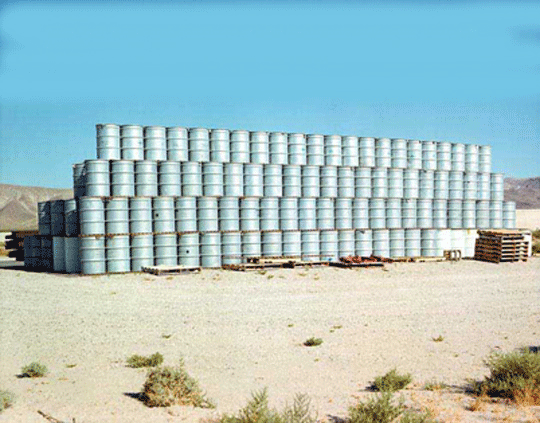
A spent fuel accident at San Onofre Nuclear Waste Dump could cost a trillion dollars. Deal with it. Salem News Ace Hoffman July 13th, 2013 “……..Nevertheless, some people, even some among those who helped shut down San Onofre because of the danger, now refuse to talk about moving the waste, primarily for one of two reasons:
First, they are concerned about transportation accidents — a reasonable fear. But consider this: Transport risks last for only a few days each trip, and there are a finite number of trips, because, thankfully, the reactors at San Onofre are permanently closed. So that’s a relatively limited risk. On the other hand, leaving the waste to sit dangerously in an earthquake/tsunami/growing population zone is a danger that lasts for decades or centuries, and possibly forever.
The other reason some people oppose transporting the waste away from San Onofre is that there’s nowhere to put it. Continue reading
Insane nuclear weapons: nuclear torpedo, and nuking the moon!
 Project A119, conceived before the Apollo landings, was ostensibly created for “science.” There’s no real science purpose to nuking the moon, though, so it’s kind of obvious what it was really about. Also, they intended to blow up the nuke on the Moon’s horizon, for maximum visibility from Earth.
For science.
The Five Most Insane Nuclear Delivery Systems Jaolpnik MICHAEL BALLABAN, 14 July 13 “……The Nuclear Torpedo Quick! Doomsday is upon us! The only way to save our cities is to get rid of all the enemy subs! Both the East and the West made nuclear torpedoes that survived in service into at least the 1970s. That’s not such a bad idea if you really want to sink something, but nukes aren’t something you just want to be using all willy-nilly. As torpedoes had the nasty habit of sometimes escaping from their tubes, this necessitated a two-step process for their use.
The Nuclear Torpedo Declassified U.S. Nuclear Test Film #46
First, the torpedo would be fired, and then a second button would be pushed to detonate it. This meant you would need a wire to connect the original sub and the newly-fired torpedo.
Nothing wrong with that, right? Just get a really long wire. And then you realize how a “really long wire” is still too short for you to get away.
The American Mark 45 torpedo had a really long wire, but even at its longest it was only eight miles in length. Even if you sunk somebody, with an 11 kiloton warhead on board, you were bound to go down to the bottom with them. http://jalopnik.com/the-five-most-insane-nuclear-delivery-systems-768180979
Project A119 Continue reading
Crazy military nuclear plans – the chicken nuke, the backpack nuke
The Five Most Insane Nuclear Delivery Systems Jaolpnik MICHAEL BALLABAN, 14 July 13 “……The Chicken Nuke When Cold War planners were planning out the seemingly inevitable Hot War, they had dreams dancing in their heads of massive waves of Russian soldiers and tanks sweeping across Germany. The British, being plucky, were confident they would lose.
The Royal Armament Research and Development Establishment developed a nuclear land mine that could be detonated either by wire or by an eight-day timer that would completely obliterate the advancing enemy columns. Not such a bad idea if you’re a fan of indiscriminate wastelands.
The only problem was that land mines tend to be buried in the ground, where it can get cold. Cold temperatures would freeze the electronics in the nuke mines, preventing them from doing their intended deadly deed. Clearly, a solution was needed to heat those bad boys up.
Blankets? No, too safe. One of those gel packs you put in your mittens when you ski? How pedestrian. No, this was 1954, and everything needed to go whoosh and phflew, so something high-tech was needed. Oh yes, that’s right.
Chickens.
The idea was to seal the chickens inside the nuclear casing as the Western armies retreated from the German plain. With a supply of food and water inside, the chickens would last for roughly a week, and their body heat would be enough to make sure everything went kaboom as normal.P
Once again, chickens.
Somehow the British actually ordered ten of these things in 1957, but supposedly none were made before the project was cancelled a year later, Let’s just hope there are no chickens buried under Germany.
The Backpack Nuke
Local news likes to whip everyone into a tizzy with tales of terrorists and backpack nukes, but the reason we know it’s a real possibility is because backpack nukes are a real thing. And we would know, because we made them.
The H-912 container for the Mark 54 Special Atomic Demolition Munition (SADM) could be feasibly carried on your back, although it does look a bit bulky. The idea would be for two guys (Navy SEALs or otherwise) to parachute into Soviet territory, set it, and forget it. The second guy would be there essentially just to back the first guy up, though in a pinch it looks like it could be used on a one-man mission.
Though it doesn’t look that big, it could actually destroy the equivalent of a few city blocks.
How fast can you run?… http://jalopnik.com/the-five-most-insane-nuclear-delivery-systems-768180979
Nuclear wastes in dry cask storage – still very dangerous
 A spent fuel accident at San Onofre Nuclear Waste Dump could cost a trillion dollars. Deal with it. Salem News Ace Hoffman July 13th, 2013 “…….There are a total of about 75 sites in America with operating or closed nuclear reactors. Almost all have spent fuel stored on site. Most are under various airline routes. All are vulnerable to terrorism. San Onofre has repeatedly been cited as a likely terrorist target by elected officials because of the devastating damage an attack could do to the economy and lives of so many millions of people. Have the lessons of 9-11 truly been forgotten just 12 years later?
The time to solve the nuclear waste problem is now, not later. Once the waste has “cooled” enough to remove it from the pools, it is still incredibly hot (as much as 400 degrees Fahrenheit at the fuel rod’s surfaces) and stays hot for many years. The heat is produced mainly by the decay of fission products, emitting deadly gamma rays (hence the lead, steel, and cement shielding) as well as alpha and beta particles.
The spent nuclear fuel is in danger of fire by several methods, including, of all things, water intrusion, which can lead to zirconium cladding degradation along with splitting the water molecules into separate hydrogen and oxygen atoms. This chemical reaction created an explosive atmosphere three times at Fukushima, and is known to have happened in at least one dry cask here in the sStates — but it was discovered before an explosion occurred. Will we always be so lucky?
As the fission products decay, the spent fuel cools and becomes “safer.” However, it doesn’t become “safe” ever. Many of the most dangerous isotopes, such as cesium and strontium, have half-lives in the 30 year range, and are at their peak now. Thus, the importance of taking care of the “spent fuel problem” is highest now — much higher than, say, 30 years from now when about half the cesium and strontium will have decayed. So waiting makes no sense. The waste’s most virulent components are at their peak quantities right now, and an accident now would be the most devastating for the planet’s collective DNA — DNA which has already taken a terrible hit from weapons testing and use, from Chernobyl, from Fukushima, from 1000 other accidents and purposeful spills, and from continuing leaks at Hanford and other nuclear sites.
There is really only one logical conclusion, of course: It’s time to shutdown the reactors everywhere. In China, Russia, France, England, India, South Korea, and everywhere else, not just in southern California. Currently nuclear waste is stored in at least four locations in California. Those four sites need to be consolidated into one highly protected site, with earthen berms between EACH cask, and a “no-fly” zone and other considerations.
But how will consolidation be accomplished when communities are bullied into supporting flimsy, inadequate dry cask storage wherever the waste was produced, regardless of the danger?
Activists in Humboldt County and around Rancho Seco have accepted dry cask storage for years. Why shouldn’t southern California?
The answer is, because southern Californians understand, post-Fukushima, what the real dangers of spent fuel are……”. http://www.salem-news.com/articles/july142013/san-onofre-bdb-ah.php
Get the Facts: World Nuclear Industry Status Report 2013
The World Nuclear Industry Status Report 2013 http://www.worldnuclearreport.org/-2013-.html Two years after the Fukushima disaster started unfolding on 11 March 2011, its impact on the global nuclear industry has become increasingly visible. Global electricity generation from nuclear plants dropped by a historic 7 percent in 2012, adding to the record drop of 4 percent in 2011. This World Nuclear Industry Status Report 2013 (WNISR)provides a global overview of the history, the current status and the trends of nuclear power programs worldwide.
Climate change increases Chernobyl’s risk of radioactive wildfires
Women in their 20s living just outside the zone face the highest risk from exposure to radioactive smoke, the 2011 study found: 170 in 100,000 would have an increased chance of dying of cancer. Among men farther away in Kiev, 18 in 100,000 20 year olds would be at increased risk of dying of cancer.
the greatest danger from forest fire for most people would be consuming foods exposed to smoke. Milk, meat and other products would exceed safe levels, the 2011 study predicts. The Ukrainian government would almost certainly have to ban consumption of foodstuffs produced as far as 150 kilometres from the fire
 Watching for a radioactive forest fire JANE BRAXTON LITTLE, ABC Environment 8 JUL 2013 Tinder dry and radioactive: the forests around Chernobyl are an accident waiting to happen. For 27 years, forests around Chernobyl have been absorbing radioactive elements. A fire would send them skyward again – a growing concern as summers grow longer, hotter and drier. “…….Nikolay Ossienko patrols the forests surrounding the Chernobyl nuclear power plant,,,,,,, “Our number one job is to save the forest from fire,”…… It’s a job with international consequences.
For almost three decades the forests around the shuttered nuclear power plant have been absorbing contamination left from the 1986 reactor explosion. Now climate change and lack of management present a troubling predicament: If these forests burn, strontium 90, cesium 137, plutonium 238 and other radioactive elements would be released, according to an analysis of the human health impacts of wildfire in Chernobyl’s exclusion zone conducted by scientists in Germany, Scotland, Ukraine and the United States. Continue reading
Rising radioactivity in Fukushima’s leaking water
- 11,000 becquerels per liter – TEPCO’s measurement of Cesium-134 on July 9.
- 18,000 becquerels per liter — TEPCO’s measurement of Cesium-137 on July 8.
- 22,000 becquerels per liter – TEPCO’s measurement of Cesium-137 on July 9.
Fukushima Radiation Leaks Rise Sharply By William Boardman, Reader Supported News 11 July 13 “………Here’s another perspective on the same situation:
- 10 becquerels per liter – The officially “safe” level for radioactivity in drinking water, as set by the NRA.
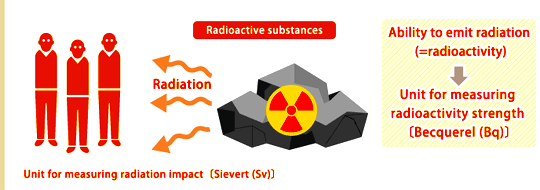
A becquerel is a standard scientific measure of radioactivity, similar in some ways to a rad or a rem or a roentgen or a sievert or a curie, but not equivalent to any of them. But you don’t have to understand the nuances of nuclear physics to get a reasonable idea of what’s going on in Fukushima. Just keep the measure of that safe drinking water in mind, that liter of water, less than a quart, with 10 becquerels of radioactivity.
- 60 becquerels per liter – For nuclear power plants, the safety limit for drinking water is 60 becquerels, as set by the NRA, with less concern for nuclear plant workers than ordinary civilians.
- 60-90 becquerels per liter – For waste water at nuclear power plants, the NRA sets a maximum standard of 90 becquerels per liter for Cesium-137 and 60 becquerels per liter of Cesium-134.
At some of Fukushima’s monitoring wells, radiation levels were in fractions of a becquerel on July 8 and 9. At the well (or wells) that are proving problematical, TEPCO has provided no baseline readings. Continue reading
1 This Month



26 September – International Day for the Total Elimination of Nuclear Weapons


PLEASE OPPOSE HR 8255 AND S.3639 – bills would accelerate satellite deployment, with no environmental review or safeguards – https://ncstd5li.quorum.us/campaign/169331/
To see nuclear-related stories in greater depth and intensity – go to https://nuclearinformation.wordpress.com
-
Archives
- September 2026 (257)
- August 2026 (330)
- July 2026 (355)
- June 2026 (287)
- May 2026 (306)
- April 2026 (356)
- March 2026 (251)
- February 2026 (267)
- January 2026 (308)
- December 2025 (358)
- November 2025 (359)
- October 2025 (375)
-
Categories
- 1
- 1 NUCLEAR ISSUES
- business and costs
- climate change
- culture and arts
- ENERGY
- environment
- health
- history
- indigenous issues
- Legal
- marketing of nuclear
- media
- opposition to nuclear
- PERSONAL STORIES
- politics
- politics international
- Religion and ethics
- safety
- secrets,lies and civil liberties
- spinbuster
- technology
- Uranium
- wastes
- weapons and war
- Women
- 2 WORLD
- ACTION
- AFRICA
- Atrocities
- AUSTRALIA
- Christina's notes
- Christina's themes
- culture and arts
- Events
- Fuk 2022
- Fuk 2023
- Fukushima 2017
- Fukushima 2018
- fukushima 2019
- Fukushima 2020
- Fukushima 2021
- general
- global warming
- Humour (God we need it)
- Nuclear
- RARE EARTHS
- Reference
- resources – print
- Resources -audiovicual
- Weekly Newsletter
- World
- World Nuclear
- YouTube
-
RSS
Entries RSS
Comments RSS

