Deep burial a cheaper way than MOX to dispose of plutonium

 Nuclear waste: DC has ignored a cheaper way to dispose of plutonium — until now Sentinel.com, Douglas Birch & R. Jeffrey Smith The Center for Public Integrity, 7 July 13,
For the past decade, Washington has known how to dispose of excess U.S. plutonium at a cost estimated to be hundreds of millions of dollars less than what the Energy Department is spending on a South Carolina factory meant to transform plutonium into fuel for nuclear reactors.
Instead of burning the plutonium, the cheaper alternative mixes it with glass or ceramics and some other materials, so it can be buried deep underground. Continue reading
Toxicity of ionising radiation from uranium mining
 Health hazards posed by uranium mining IPP MEDIA 5th July 2013 All Uranium mined end up as either nuclear weapons or highly radioactive waste from nuclear reactors. Uranium is a naturally occurring radioactive toxic element, found in the ground worldwide, including Tanzania, soon to be mined! Countries with active uranium mining are Australia, Canada, Central Africa Republic, France Namibia, Niger, South Africa and the US. The normal decay of uranium in the soil results in the production of decay radioactive products.In the process of mining uranium we liberate from the ground these natural radioactive substances like radium and radon, which are among the most harmful materials known in science.
Uranium emits ionising nuclear radiation like x-rays. Ionising radiation is energetic enough to break chemical bonds, thereby possessing the ability to damage or destroy living cells. Hence the need to keep away from nuclear radiation x-rays, uranium and its radioactive waste. Ultrasound, radio, sound and light are non-ionising nuclear radiations and are harmless
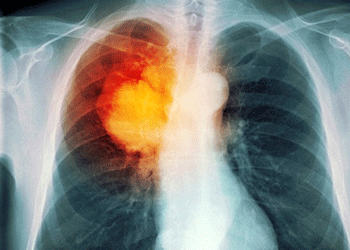 As long as the mineral remains outside the body, uranium poses little health hazards. However, if uranium is inhaled or ingested, its radioactivity and toxicity pose increased risks of lung cancer as well as cancer of bones, stomach, soft tissue and blood. It may also cause damage to internal organs notably kidneys alongside affecting the reproductive system, leading to birth defects in future generations.
Imaging swallowing or inhaling small radiation exposing x-ray machines with jammed exposure switches could result in serious health effects in the form of cancer. Similar incidence of diseases is observed in Atomic bomb survivors, refer bombing of Hiroshima and Nagasaki in Japan 1942 at end of World War II.
All the decay radioactive products of uranium remain in the crushed rock when uranium is separated from the ore. The rock left over’s waste contains 85 per cent radioactivity of the ore as well as heavy metals and toxic dissolving chemicals, which have dangerous health hazards.
Uranium mining is responsible for introducing into the human environment a tremendous large range of radioactive materials which are all very harmful to biological organisms – human beings included.
Global temperature’s dramatic rise in 21st Century, already
The WMO says droughts affect more people than any other kind of natural disaster because of their large scale and long duration. The decade saw droughts across the world, with some of the longest and most severe in Australia (2002 and other years), East Africa (2004 and 2005, resulting in widespread loss of life) and the Amazon basin (2010)
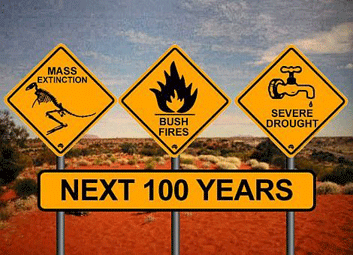
 Clear upward trend’ in global temperatures: WMO ABC News, ALEX KIRBY, 5 July 13, In the first decade of this century extreme weather, global temperatures and sea level all continued a trend in a “clearly upward direction”, says a new report from the World Meteorological Organisation.
If you think the world is warming and the weather getting nastier, you’re right, according to the United Nations agency committed to understanding weather and climate.
The World Meteorological Organisation says the planet “experienced unprecedented high-impact climate extremes” in the ten years from 2001 to 2010, the warmest decade since the start of modern measurements in 1850.
Those ten years also continued an extended period of accelerating global warming, with more national temperature records reported broken than in any previous decade. Sea levels rose about twice as fast as the trend in the last century.
A WMO report, The Global Climate 2001-2010: A Decade of Climate Extremes, analyses global and regional temperatures and precipitation, and extreme weather such as the heat waves in Europe and Russia, Hurricane Katrina in the US, tropical cyclone Nargis in Myanmar, droughts in the Amazon basin, Australia and East Africa, and floods in Pakistan. Continue reading
Legal fightback by Native Americans against uranium mining
The proposed legislation can be found at the website of Defenders of the Black Hills,
Uranium Mining and Native Resistance: The Uranium Exploration and Mining Accountability Act http://intercontinentalcry.org/uranium-mining-and-native-resistance-the-uranium-exploration-and-mining-accountability-act/ BY CURTIS KLINE • JUL 2, 2013 NATIVE AMERICANS IN THE NORTHERN GREAT PLAINS HAVE THE HIGHEST CANCER RATES IN THE UNITED STATES, PARTICULARLY LUNG CANCER. IT’S A PROBLEM THAT THE UNITED STATES GOVERNMENT HAS WOEFULLY IGNORED, MUCH THE HORROR OF THE MEN AND WOMEN WHO MUST CARRY THE PAINFUL, LIFE-THREATENING BURDEN.
The cancer rates started increasing drastically a few decades after uranium mining began on their territory.
According to a report by Earthworks, “Mining not only exposes uranium to the atmosphere, where it becomes reactive, but releases other radioactive elements such as thorium and radium and toxic heavy metals including arsenic, selenium, mercury and cadmium. Exposure to these radioactive elements can cause lung cancer, skin cancer, bone cancer, leukemia, kidney damage and birth defects.”
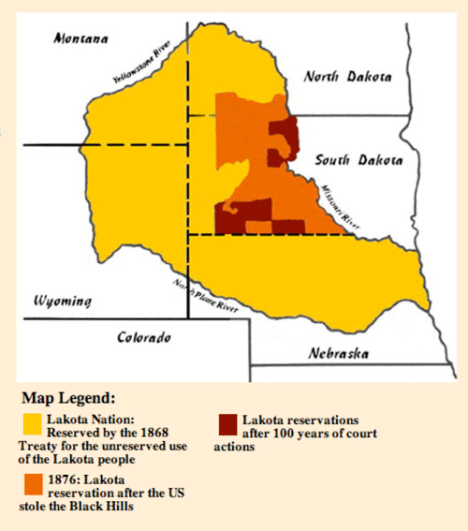
Today, in the northern great plains states of Wyoming, Montana and the Dakotas, the memory of that uranium mining exists in the form of 2,885 abandoned open pit uranium mines. All of the abandoned mines can be found on land that is supposed to be for the absolute use of the Great Sioux Nation under the 1868 Fort Laramie Treaty with the United States.
There are also 1,200 abandoned uranium mines in the Navajo Nation, where cancer rates are also significantly disproportionate. In fact, it is estimated that 60 to 80 percent of all uranium in the United States is located on tribal land, and three fourths of uranium mining worldwide is on Indigenous land.
Defenders of the Black Hills, a group whose mission is to preserve, protect, restore, and respect the area of the 1851 and 1868 Fort Laramie Treaties, is calling the health situation in their own territoryAmerica’s Chernobyl. Continue reading
UK’s Minstry of Defence caused radioactive beach
Dalgety Bay radiation: Sepa says MoD was responsible for contamination, BBC News 28 Jue 13Diggers have excavated sections of the beach The Ministry of Defence has been found solely responsible for radioactive contamination at Dalgety Bay in Fife.
It follows an investigation by the Scottish Environment Protection Agency (Sepa) into the history of the contamination at the beach.
Its report said the MoD had routinely incinerated and disposed of aircraft dials in the bay before the town was developed.
The dials had been illuminated by paint containing radium-226.
The aircraft had been stationed at the nearby HMS Merlin airfield, which was commissioned in 1939 as a Royal Naval Aircraft Repair Yard and decommissioned in 1959 before being sold off through the 1960s……..
“Contamination on the foreshore at Dalgety Bay is the result of erosion of deposited material and subsequent re-working and re-deposition of contaminated marine sediments resulting from coastal erosion, a process which is considered to be a normal part of life.”
Significant amounts of material remain buried on the coast and continue to erode through coastal processes and re-contaminate the foreshore areas, the report added.
It concluded that Sepa considered the MoD to be the sole “appropriate person” for the contamination…….
The local MP and former prime minister, Gordon Brown, said the MoD was “merely delaying the inevitable” and had a “moral duty” to clean up the site.
“Having been named as the polluter, the Ministry of Defence must now agree to fund the clean-up of the area to remove the contaminated substances from the Dalgety Bay beach, and the work must start immediately,” he said……. The local MP and former prime minister, Gordon Brown, said the MoD was “merely delaying the inevitable” and had a “moral duty” to clean up the site.
“Having been named as the polluter, the Ministry of Defence must now agree to fund the clean-up of the area to remove the contaminated substances from the Dalgety Bay beach, and the work must start immediately,” he said.http://www.bbc.co.uk/news/uk-scotland-edinburgh-east-fife-23098001
Fear and loathing in USA over nuclear wastes
Stored fuel requires guards and other continuing expenses, which are significant if there is no reactor nearby. Those expenses eventually fall on federal taxpayers because the Energy Department has defaulted on contracts it signed in the 1980s to begin accepting the wastes for burial in 1998. As a result, financial penalties the federal government must pay to the nuclear utilities for failing to dispose of the waste now amount to hundreds of millions of dollars a year.
 Quarrels Continue Over Permanent Repository for Nuclear Waste http://www.nytimes.com/2013/06/28/business/energy-environment/quarrels-continue-over-permanent-repository-for-nuclear-waste.html?_r=0 By MATTHEW L. WALD June 27, 2013 WASHINGTON — As more nuclear reactors across the country are closed, the problem of what to do with their waste is becoming more urgent, government officials and private experts said at a conference here this week.
To address the problem, a bipartisan group of four senators introduced a bill on Thursday that would provide for temporary, centralized storage, even as House leaders remained focused on trying to revive plans for the Yucca Mountain nuclear waste repository that the Obama administration has declared dead.
Nuclear waste is accumulating in steel and concrete storage casks at reactor sites around the country. But the casks — sealed boxes of many tons — cannot be sent to any repository because they are not compatible, said Jeff Williams, director of the Energy Department’s Nuclear Fuel Storage and Transportation Planning Project.
In addition, a growing number of the sites no longer have an operating reactor or the associated fuel-handling equipment, so they have no way to move the highly radioactive fuel to another storage package.
Experts say the amount of orphaned nuclear waste is mounting. Nuclear utilities have announced the retirement of an additional four reactors so far this year, which leaves three more sites without an operating reactor. Before that development, the Energy Department counted nine such sites, with about 2,800 tons of fuel in 248 casks and was hoping to establish a pilot-scale interim storage plant for that fuel. Continue reading
Japan’s massive, and growing, plutonium problem
Japan currently possesses 44 tons of plutonium, according to the Atomic Energy Commission. Nine tons, including the latest shipment, are in Japan, while the remaining tons are in Britain and France, where spent fuel from Japan has been reprocessed.
Storage pools for spent fuel are quickly reaching capacity at nuclear power plants across the nation. If Aomori Prefecture refuses to accept spent fuel, nuclear plants will be saddled with overflowing spent fuel pools and will be unable to continue operations.
Direct disposal, or burying spent fuel without reprocessing, was considered under the previous Democratic Party of Japan government. But discussions have gone nowhere after the Liberal Democratic Party took over government in December.
Plutonium problem lingers as mixed-oxide fuel comes to Japan June 25, 2013 THE ASAHI SHIMBUN A shipment of mixed-oxide fuel will arrive in Japan as early as June 27, part of the nation’s plutonium stockpile that is already equivalent to 5,000 Nagasaki-type atomic bombs.
The shipment, two years behind schedule due to the Great East Japan Earthquake in 2011, is expected to be used for plutonium-thermal (pluthermal) power generation, a key component of Japan’s nuclear fuel recycling program.
However, the fuel recycling program has been plagued by so many problems that the nation’s plutonium stockpile could increase further, heightening concerns in the international community about possible nuclear weapons proliferation. Continue reading
Savannah River MOX project should be shut down
the MOX plant has “become from my point of view a pretty meaningless program” that should now be killed.
“The irony of this whole project is that it basically started with a good goal, of eliminating weapons grade material with the idea that it won’t be available for weapons purposes,” “But then it sort of evolved into this program that provides a fairly significant subsidy to the plutonium economy. So in the end, we will end up with more plutonium.”
How a Massive Nuclear Nonproliferation Effort Led to More Proliferation, The Atlantic, More than a decade of negotiations with Russia produced a clear winner, and it was not the United States. DOUGLAS BIRCH AND R. JEFFREY SMITHJUN 24 2013 SAVANNAH RIVER SITE, South Carolina – A half-finished monolith of raw concrete and rebar rises suddenly from slash pine forests as the public tour bus crests a hill at this heavily-secured site south of rural Aiken……..
Dark clouds hover over this ambitious federal project, 17 years in the making and at least six more from completion–if, indeed, it is ever completed. It lies at the center of one of the United States’ most troubled, technically complex, costly, and controversial efforts to secure nuclear explosive materials left stranded by the end of the Cold War.
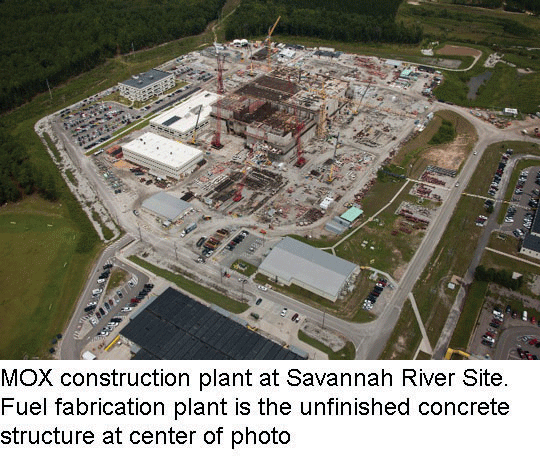
This plant – and another just like it in Russia — is meant to transform one of these materials, plutonium, into commercial reactor fuel that can be burned to provide electricity for homes, schools and factories, essentially turning nuclear “swords into ploughshares.” The aim of the so-called Mixed Oxide, or MOX, plant is to ensure the material never winds up in the hands of terrorists.
In the right hands, only nine pounds of plutonium — an amount about the size of a baseball — could make a bomb as powerful as the one the U.S. dropped on Hiroshima. The world’s military and civilian nuclear programs have produced about 500 metric tons of pure plutonium, an amount that could fuel tens of thousands of nuclear weapons yet fit into a backyard shed. Countries with nuclear programs continue to add roughly two tons to this inventory every year.
Washington has been spending hundreds of millions of dollars annually to help secure or remove plutonium and weapons-grade uranium in dozens of countries. But the U.S.-Russia plutonium disposition program, which includes the Savannah River plant, is the U.S. government’s single most expensive nonproliferation project now, according to Michelle Cann, senior budget analyst with a nonprofit group called Partnership for Global Security. Continue reading
Wall mounted solar inverter and battery to be mass produced
SMA’s New Solar Inverter Incorporates Battery Energy Storage http://www.energymatters.com.au/index.php?main_page=news_article&article_id=3807 24 June 13 SMA’s latest inverter that incorporates a lithium ion battery has won an award at Intersolar Europe 2013 in Munich.
Sunny Boy Smart Energy is the first wall mounted solar inverter with an integrated battery to be mass produced. Continue reading
US President’s new guidance on nuclear weapons strategy
FACT SHEET: Nuclear Weapons Employment Strategy of the United States The White HouseOffice of the Press Secretary, 19 June 13
Today, the President announced new guidance that aligns U.S. nuclear policies to the 21st century security environment. This is the latest in a series of concrete steps the President has made to advance his Prague agenda and the long-term goal of achieving the peace and security of a world without nuclear weapons.
Following the release of the 2010 Nuclear Posture Review (NPR) and ratification of the New START Treaty, the President directed the Department of Defense (DOD), the Department of State, Department of Energy, and the intelligence community, to conduct a detailed analysis of U.S. nuclear deterrence requirements and policy in order to ensure U.S. nuclear posture and plans are aligned to address today’s security environment. This review was based on the principle that a robust assessment of today’s security environment and resulting Presidential guidance must drive nuclear employment planning, force structure, and posture decisions.
The President’s new guidance: Continue reading
UK’s Nuclear Decommissioning Authority doesn’t know what to finally do with nuclear wastes
No plan to dump nuclear waste Bill Hamilton The Guardian, 22 June 2013 As a public body, the Nuclear Decommissioning Authority has a duty to deliver value for money. Moreover, all nuclear site operators have a regulatory requirement to optimise site operations. There is no proposal to “dump” radioactive waste at Bradwell or at any other NDA-owned site (Only way is Essex – nuclear waste row, 17 June). Our first decommissioning priority is hazard reduction, which includes the safe, secure and environmentally responsible interim storage of intermediate level waste (ILW) until geological disposal becomes available.Currently, the plan is to build an interim storage facility at each Magnox reactor site to store the ILW from that site. A number of interim stores have already been constructed, with several more stores planned. In the interests of value for money to the taxpayer, we are exploring whether there is a business case for reducing the number of new stores that need to be built. There could also be environmental benefits from building fewer stores. The option of storing ILW from a small number of other sites at Bradwell, which already has an ILW store, is one of a number of options under consideration.
Our intention to explore the potential benefits of building fewer interim storage facilities was first made public in our strategy published in 2011, on which we engaged widely and consulted publicly. We are engaging openly and transparently with stakeholders on the options under consideration and will consult on our preferred option(s) at the appropriate time. Furthermore, any decision that requires a change to existing storage plans will require consultation and local planning permission.
Shocking new study shows damage from radiation more damaging than at first thought! – Prof.Chris Busby
….This density of events occurring at low doses suggests a mechanism to explain experimental results that show Tritium is a greater mutagenic hazard than ICRP would expect….
Posted by nuclear-news.net
By Arclight2011Part2
20th June 2011
H/t Richard Bramhall ( http://www.llrc.org )
A new review shows the conventional radiation risk model cannot be used to predict health effects of radioactivity inside the body.
On May 22 2013 InTech (http://www.intechopen.com) published a review of evidence that DNA damage caused by inhaling and ingesting man-made radioactivity is having serious health effects. This is the first time such a wide-ranging review of the genetic mechanisms of harm from nuclear discharges has been published in the scientific literature.
The review, by Professor Chris Busby, is entitled “Aspects of DNA damage from internal radiation exposures“

[1]. It is in a book called “New Research Directions in DNA Repair”.
[2] It vindicates the belief that incorporated (internal) radioactivity is more dangerous than predicted by the International Commission on Radiological Protection (ICRP). Much of the information reviewed has been in the literature for decades but has been sidelined or ignored.
The evidence shows that ICRP’s use of “absorbed dose” is invalid for many radionuclides when they are internal. “Absorbed dose” is based on an external irradiation paradigm and therefore averages the energy of radioactive decays across large volumes of body tissue.
By contrast, some forms of radioactivity expose DNA to high densities of ionisation. The review defines and discusses situations where genetic damage is massively more likely than from external radiation at the same “dose”;
1) biochemical affinity for DNA,
2) transmutation,
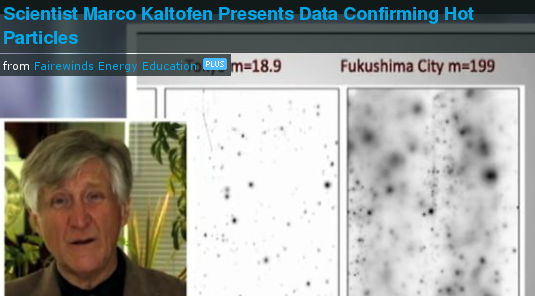
3) hot particles,
4) sequential emitters (“Second Event Theory”),
5) low energy beta emitters, and 6) the “Secondary Photoelectron Effect”:
- Some substances (for example Strontium-90 and Uranium) have high biochemical affinity for DNA so a large proportion of what is inside the body will be chemically bound to DNA. For this reason the radiation events associated with them are massively more likely to damage DNA structures than the same dose delivered externally.
- Transmutation, where the radioactive decay of a radio-element changes it into a different element (e.g. Carbon-14 changing to Nitrogen), has mutagenic effects far greater than would be expected on the basis of “absorbed dose”. This has been known since the 1960s but it has been ignored by risk agencies such as ICRP, UNSCEAR and BEIR.
- Hot particles, especially those which emit very short-range alpha radiation, have obvious implications for high local doses to tissue where they are embedded.
- The “Second Event Theory” concerns the decay sequences of some radionuclides which decay to a short-lived daughter. Strontium 90 decaying to Yttrium 90 is an example; the Yttrium 90 has a half-life of 2½ days so the theory is that the first event (decay of Strontium 90) may damage a cell’s DNA which then sets about repairing itself. The repair process is known to be very radiosensitive and there is a finite probability that the second event (the subsequent Yttrium decay) inflicts further damage which cannot be repaired.
5.7 million people employed in renewable energy

2012 was the second highest year ever for renewable energy investments – but being “second” doesn’t reflect installed capacity as prices for renewable energy equipment, particularly related to solar power, have plummeted.
Last year was another record year in terms of installed capacity; with 115 GW of new renewables put in place globally. However, 2012 saw the most significant change so far in the balance of renewable energy investment activity between developed and developing economies. Continue reading
Problems in nuclear pyroprocessing
 South Korea’s Nuclear Blues The Diplomat, By Sebastian Sarmiento-Saher June 19, 2013“…..Assuming that South Korea does gain approval to conduct pyroprocessing, it may take years to do so in a way that is both technically and economically viable. The Diplomat spoke with Olli Heinonen, a Senior Fellow at Harvard’s Belfer Center for Science and International Affairs, who said that “[t]he product to the ROK pyroprocessing scheme is a uranium/transuranium/zirconium fuel, which is not suitable to fuel ROK’s LWR [Light Water Reactor] or CANDU [Canada Deuterium Uranium] reactors. Thus ROK is developing a prototype Sodium Fast Reactor (SFR), which is planned to be operational around 2028. A commercial scale SFR is envisioned to be available by the mid of the Century.”
In addition to a long wait time, pyroprocessing results in other fissile materials like Neptunium that can be used for nuclear bombs and must be safeguarded. Neptunium must be separated out, but as Dr. Heinonen added, “[i]t is fairly easy and straight forward for the IAEA to monitor and confirm that this does not take place.” This will mean that additional safeguarding efforts would need to be implemented – all of which will ultimately depend on South Korea’s willingness to abide by them.
Finally, how proliferation resistant is pyroprocessing in terms of achieving pure plutonium metal needed for nuclear weapons and timing? Dr. Heinonen gave his take: “The fact that plutonium is not fully separated from other elements gives to the ROK officials basis to argue that this difference makes pyroprocessing more proliferation resistant than traditional reprocessing.”
“In order to have pure plutonium separated, additional process steps are required either at the pyroprocessing plant or at a separate installation, which would be found by the IAEA. If such process steps are made it would take 1-3 weeks to turn the material to plutonium metal. However, before that the process steps need to be developed and constructed, but the bottom line is that by having the envisioned uranium/plutonium metal, a proliferator is substantially closer to pure plutonium metal.” ….. http://thediplomat.com/pacific-money/2013/06/19/south-koreas-nuclear-blues/
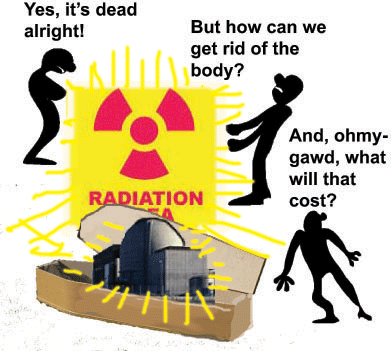
They don’t now how much it costs to bury all those dead nuclear reactors
 Nuclear Decommissioning Surge Is Investor Guessing Game, Bloomberg by Stefan Nicola in Berlin at snicola2@bloomberg.net; Julie Johnsson in Chicago at jjohnsson@bloomberg.net editor responsible for this story: Reed Landberg at landberg@bloomberg.net 16 June 13
Nuclear utilities thrust into the spotlight after the Fukushima meltdowns have ordered 20 reactors shut, the most in a three-year span since Chernobyl’s aftermath, saddling the industry with a possible $26 billion in costs.
EON SE and RWE AG (RWE) are leading the biggest decommissioning project by European utilities ever, an effort to tear down 12 reactors in Germany over two decades. Edison International (EIX) said June 7 it will never restart its idled two-unit San Onofre Generating Station outside Los Angeles, bringing the number of U.S. reactors permanently closed in a year to a record four.
The global utility industry faces its biggest test to prove enough money was saved for shutdowns, having undergone numerous cost-overruns building atomic plants. A cautionary tale can be seen with government-owned facilities. In Britain, where taxpayers are on the hook to retire the Sellafield complex’s seven reactors and fuel-reprocessing stations on the Irish Seaduring the next 100 years, the U.K. government this year doubled its estimate for the work to 67.5 billion pounds ($106 billion).
“There’s a lot of speculation how much these projects cost, but an exact estimate can only be given by utilities,” said Sascha Gentes, a Karlsruhe Institute for Technology professor specializing in atomic shutdowns. “The longer a nuclear decommissioning project takes, the more expensive it becomes.” Continue reading
1 This Month



26 September – International Day for the Total Elimination of Nuclear Weapons


PLEASE OPPOSE HR 8255 AND S.3639 – bills would accelerate satellite deployment, with no environmental review or safeguards – https://ncstd5li.quorum.us/campaign/169331/
To see nuclear-related stories in greater depth and intensity – go to https://nuclearinformation.wordpress.com
-
Archives
- September 2026 (257)
- August 2026 (330)
- July 2026 (355)
- June 2026 (287)
- May 2026 (306)
- April 2026 (356)
- March 2026 (251)
- February 2026 (267)
- January 2026 (308)
- December 2025 (358)
- November 2025 (359)
- October 2025 (375)
-
Categories
- 1
- 1 NUCLEAR ISSUES
- business and costs
- climate change
- culture and arts
- ENERGY
- environment
- health
- history
- indigenous issues
- Legal
- marketing of nuclear
- media
- opposition to nuclear
- PERSONAL STORIES
- politics
- politics international
- Religion and ethics
- safety
- secrets,lies and civil liberties
- spinbuster
- technology
- Uranium
- wastes
- weapons and war
- Women
- 2 WORLD
- ACTION
- AFRICA
- Atrocities
- AUSTRALIA
- Christina's notes
- Christina's themes
- culture and arts
- Events
- Fuk 2022
- Fuk 2023
- Fukushima 2017
- Fukushima 2018
- fukushima 2019
- Fukushima 2020
- Fukushima 2021
- general
- global warming
- Humour (God we need it)
- Nuclear
- RARE EARTHS
- Reference
- resources – print
- Resources -audiovicual
- Weekly Newsletter
- World
- World Nuclear
- YouTube
-
RSS
Entries RSS
Comments RSS

