Proposal for an island of nuclear waste off Fukushima coast
 Asahi: Huge island made of “contaminated soil and rubble” proposed off Fukushima coast — Place for disposal of radioactive debris — “Measures will be taken to prevent adverse impact on ocean” http://enenews.com/asahi-huge-island-made-contaminated-soil-rubble-proposed-fukushima-coast-could-be-disposal-radioactive-debris
Title: INTERVIEW: Former member of ‘nuclear village’ calls for local initiative to rebuild Fukushima
Source: AJW by The Asahi Shimbun
Author: TAKAFUMI YOSHIDA
Date: August 8, 2013
Yukiteru Naka, former General Electric engineer who spent 40 years at nuclear plants in Fukushima Prefecture
[…] In May, I presented a Futaba County Island Construction Plan to heads of municipal governments in Futaba county.
It calls for creating a huge island off the Fukushima No. 1 plant from contaminated soil and rubble and building facilities for decommissioning as well as for disposal of and research on debris.
(A high level of) radiation is not expected on the island because it will be covered with a large amount of soil. All possible measures will be taken to prevent an adverse impact on the ocean. […]
I came up with the proposal for the purpose of reconstructing all of Fukushima Prefecture. In return, I expect government assistance in building the man-made island and other projects. […]
Will companies set up in a place full of abandoned homes? Can agriculture be revived when there are no successors? The government’s approach is not realistic. […]
[The island could] change the image of Futaba county drastically and develop an area where young people want to gather.
The Futaba County Island Construction Plan should contribute to decommissioning the reactors at the Fukushima No. 1 plant and reconstructing local communities. I expect experts to study the feasibility of the project. […] See also: Like a Pyramid: Mountain of debris 20 meters tall in Miyagi — Hot white vapor rising up from trash — 100km north of Fukushima (PHOTO)
Chernobyl’s trees show radiation damage
 Chernobyl’s legacy recorded in trees By Mark Kinver Environment reporter, BBC News Exposure to radiation from the 1986 Chernobyl accident had a lasting negative legacy on the area’s trees, a study has suggested.
Researchers said the worst effects were recorded in the “first few years” but surviving trees were left vulnerable to environmental stress, such as drought.
They added that young trees appeared to be particularly affected.
Writing in the journal Trees, the team said it was the first study to look at the impact at a landscape scale.
“Our field results were consistent with previous findings that were based on much smaller sample sizes,” explained co-author Tim Mousseau from the University of South Carolina, US.
“They are also consistent with the many reports of genetic impacts to these trees,” he told BBC News.
“Many of the trees show highly abnormal growth forms reflecting the effects of mutations and cell death resulting from radiation exposure.”…… Prof Mousseau and his team hope to follow up this study by carrying out similar work in the Fukushima region in Japan, where logging also had considerable economic importance and pine trees were widely dispersed. http://www.bbc.co.uk/news/science-environment-23619870
Nuclear Waste Administration Act of 2013 a step towards USA action
 Finally, there is a glimmer of hope that – more than 30 years after the Nuclear Waste Policy Act passed, and 15 years after the feds guaranteed they’d start accepting the waste – paralysis and dithering might give way to action
The new bill would:
essentially yank all responsibility from the Department of Energy (which spent about $10 billion on moribund Yucca Mountain) and would create a new organization solely devoted to solving the nuclear waste storage and disposal problem (as was recommended by the president’s Blue Ribbon
Commission, and is widely hailed as a solid idea by Republicans and Democrats alike).
develop the aforementioned “consensual process” for figuring out where to actually put nuclear waste by engaging with willing, rather than unwilling, communities, thus hoping to avoid the gridlock that resulted from 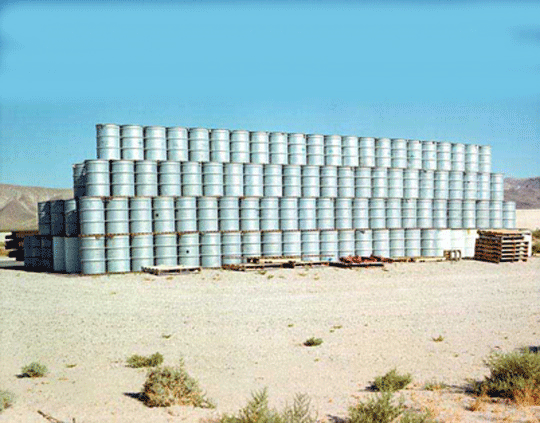 Nevada’s rabid opposition to deep, permanent geologic storage at Yucca Mountain.
emphasize getting the ball rolling for short-term storage first, and for permanent disposal second. This means pushing the new agency to start accepting waste as soon as possible at an “interim storage” site or sites, while it wrestles with the more thorny issue of where to put a permanent, deep geologic repository (or repositories).
End of paralysis on nuclear waste disposal? Orange County Register, August 9th, 2013, by By TERI SFORZA At this very moment, the vast majority of America’s highly radioactive nuclear waste – and San Onofre’s as well — is cooling in steel-lined concrete pools filled with water, which “are essentially loaded guns aimed at neighboring communities,” a scientist testified at a Congressional hearing last week.
“Unlike the reactor cores, the spent fuel pools are not protected by redundant emergency makeup and cooling systems and/or housed within robust containment structures having reinforced . “Thus, large amounts of radioactive material – which under the (Nuclear Waste Policy Act of 1982) should be stored within a federal repository designed to safely and securely isolate it from the environment for at least 10,000 years – instead remains at the reactor sites.” Continue reading
Small Modular Reactors (SMRs) won’t save moribund nuclear ndustry
 Report: Nuclear industry shouldn’t rely on SMRs Malia SpencerReporter-Pittsburgh Business Times 9 Aug 13 A report this week from the nonprofit Institute for Energy and Environmental Research asserts that relying on the development of small modular reactors “is unlikely to breathe new life into the increasingly moribund U.S. nuclear power industry.”….
The reasons for the critical findings? According to the report, SMRs will likely need tens of billions of
purchase orders or government subsidies, will create new reliability vulnerabilities, and will raise concerns about safety and proliferation.
Westinghouse was cited in the report along with Pennsylvania as one of the companies and states that could see “major implications” if SMRs fail to take off……
http://www.bizjournals.com/pittsburgh/blog/energy/2013/08/report-nuclear-industry-shouldnt.html
Mayor of Nagasaki’s Peace Declaration
Full text of Nagasaki Peace Declaration http://mainichi.jp/english/english/newsselect/news/20130809p2a00m0na002000c.html By Tomihisa Taue,Mayor of Nagasaki The following is the full text of the Peace Declaration presented Aug. 9, 2013 by Nagasaki Mayor Tomihisa Taue, at a ceremony to mark the 68th anniversary of the World War II atomic bombing of the city.
Sixty-eight years ago today, a United States bomber dropped a single atomic bomb directly over Nagasaki. The bomb’s heat rays, blast winds, and radiation were immense, and the fire that followed engulfed the city in flames into the night. The city was instantly reduced to ruins. Of the 240,000 residents in the city, around 150,000 were afflicted and 74,000 of them died within the year. Those who survived have continued to suffer from a higher incidence of contracting leukemia, cancer, and other serious radiation-induced diseases. Even after 68 years, they still live in fear and suffer deep psychological scars.
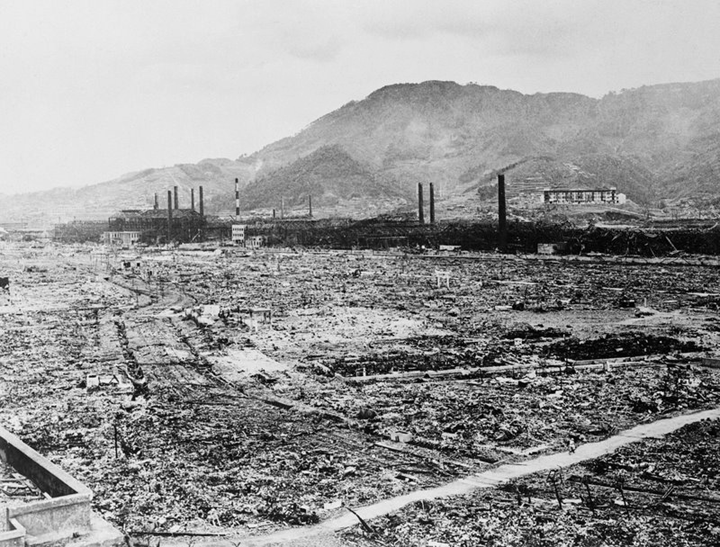
Humankind invented and produced this cruel weapon. Humankind has even gone so far as using nuclear weapons on both Hiroshima and Nagasaki. Humankind has repeatedly conducted nuclear tests, contaminating the earth. Humankind has committed a great many mistakes. This is why we must on occasion reaffirm the pledges we have made in the past that must not be forgotten and start anew. Continue reading
Yoshito Matsushige, photographer of iconic Hiroshima bombing pictures
the American military confiscated all of the post-bomb prints, just as they seized the Japanese newsreel footage,
 Journalist Took Five Historic Pictures—That Must Never Be Repeated The Nation, Greg Mitchell on August 8, 2013 Yoshito Matsushige, a photographer for the Chugoku Shimbun, took the only pictures in Hiroshima on August 6, 1945, that have surfaced since. It was these five photos Life magazine published on September 29, 1952, hailing them as the “First Pictures—Atom Blasts Through Eyes of Victims,” breaking the long media blackout on graphic images from Hiroshima and Nagasaki.
On August 6, 1945, Matsushige wandered around Hiroshima for ten hours, carrying one of the few cameras that survived the atomic bombing and two rolls of film with twenty-four possible exposures. This was no ordinary photo opportunity. He lined up one gripping shot after another, but he could only push the shutter seven times. Continue reading
Japan’s emergency experimental methods to stem flow of radioactive water
J
 apan Nuclear Plant’s Battle to Contain Radioactive Water Tepco Builds Sunken Barrier to Ring-Fence Site, but Water May Have Already Overtopped Wall WSJ, 6 Aug 13, by MARI IWATA and PHRED DVORAK “…………As an emergency measure, Tepco last month started to inject the ground near the coast with chemicals that hardened it into an underground barrier. But since then, groundwater levels in the area have risen faster, as they hit the barrier. Recently, Tepco has found that the groundwater has risen to around a meter below the surface—already above the level of the underground barrier, which starts 1.8 meters down.Now, Tepco is planning to pump out some of the water that’s built up behind the barrier, and store it as well. It’s preparing to extend the underground hardened-earth barrier in a ring around the most heavily contaminated section of coastline, in hopes of heading groundwater off before it can flood in. Tepco is also proposing to cap that ringed section with gravel and asphalt, so nothing gets out. The operator is hoping to get an initial ring of hardened ground done by October.
The company has some other more experimental ideas on the table as well. One involves surrounding the contaminated reactor buildings with a shield of frozen soil.
But there’s a risk to changing the flow of groundwater in the ways that Tepco is considering, said Tatsuya Shinkawa, nuclear accident response director of the Ministry of Economy, Trade and Industry, at a news conference last month. The water could pool dangerously underground, softening the earth and potentially toppling the reactor buildings, he said. Tepco should also try things like using robots to fix cracks in the reactor buildings where the water is likely seeping through.
Freezing soil has its own problems, said Kunio Watanabe, a geology professor at Saitama University. The technology, which is used in civil engineering to dig tunnels, may be able to cut down the amount of groundwater entering the contaminated site, but it is expensive. “You’ll need hundreds of millions of yen to build a system,” Mr. Watanabe said. “You’ll also need a large amount of electricity to maintain the ice walls.”….. http://online.wsj.com/article/SB10001424127887323420604578651713545887032.html
Nuclear Test Ban Treaty aimed to protect world from radiation
 The Legacy of the Nuclear Test Ban Treaty, counterpunch by JOSEPH J. MANGANO and JANETTE D. SHERMAN, MD, 5 Aug 13, “…….The treaty is often referred to as a peace treaty, a step against nuclear war. While it was a goodwill gesture between hostile nations, it did nothing to prevent a war, since both sides continued to furiously test weapons underground and add to its already-large stockpiles. Only in the 1970s did non-proliferation treaties begin the process of cutting nuclear arsenals.
The 1963 test ban treaty was actually an environmental and public health action to reduce threats of deadly radiation, especially to the more susceptible infants and children. In a speech urging passage of the treaty, Kennedy – whose prematurely born son died that summer after living only 39 hours – made the case to prevent suffering among the youngest members of society:
“The number of children and grandchildren with cancer in their bones, with leukemia in their blood, or with poison in their lungs might seem statistically small to some, in comparison with natural health hazards. But this is not a natural health hazard, and it is not a statistical issue. The loss of even one human life, or the malformation of even one baby, who may be born long after we are gone, should be of concern to us all. Our children and grandchildren are not merely statistics toward which we can be indifferent.” Officials who had downplayed the idea that fallout was causing cancer and other diseases now told the truth. In October 1964, at a campaign stop in New Mexico, President Lyndon B. Johnson triumphantly told a cheering crowd:
“We cannot and will not abandon the test ban treaty to which I just referred, which is the world’s insurance policy against polluting the air we breathe and the milk we give our children.
Already that policy has paid off more than you will ever know, and since this agreement was signed and the tests stopped, the dread strontium-89 and iodine-131 have disappeared from the environment. The amount of strontium-90 and cesium-137 has already been, in a year, cut in half. This is technical language, but what it means is that we can breathe safely again.”
Johnson was correct. U.S. infant mortality had only dropped 13% in the 14-year period from 1951 to 1965, during bomb testing (the fallout peak was 1964). The next 14 years showed a decline of about 50% – the same 50% drop during the prior 14 year period. The years 1951-1965 had the poorest improvement in infant mortality during the 20th century. Cancer cases in children under age five in Connecticut, the only state with a cancer registry, plunged from 58 to 30 from 1963 to 1968. Years later, a 1999 report by the National Academy of Sciences estimated that up to 212,000 Americans developed thyroid cancer from radioactive iodine in bomb fallout. ….. http://www.counterpunch.org/2013/08/05/the-legacy-of-the-comprehensive-test-ban-treaty/

Uranium in common airliner parts
 Common Airliner Parts Now Admitted To Be Laced With Uranium http://www.thedailysheeple.com/common-airliner-parts-now-admitted-to-be-laced-with-uranium_0720 www.IntelliHub.com July 25th, 2013 MIAMI — Ten minutes away from the Sun Life Stadium, home of the Miami Dolphins and Florida Marlins, is Opa-locka Executive Airport (OPF), the site of a recent environmental tragedy.
Thursday, a portion of the airport grounds were sealed off due to a radioactive substance leak emitting from an old 55-gallon drum. HAZMAT and fire crews responded just after noon, finding radioactive airplane parts laced with Uranium inside the drum.
The drum was said to be found on the Grounds of the former, now bankrupt, Arrow Cargo. According to Wikipedia Arrow Cargo, “was an American cargo airline (originally known as Arrow Air) based in Building 712 on the grounds of Miami International Airport in unincorporated Miami-Dade County, Florida, USA. It operated over 90 weekly scheduled cargo flights, and had a strong charter business. Its main base was Miami International Airport. Arrow Air ceased operations on June 29, 2010, and filed for Chapter 11 bankruptcy protection on July 1, 2010. It plans to liquidate.”
What is most startling about this is the fact that Miami-Dade’s Fire Rescue spokesman Lt. Arnold Piedrahita, admitted to the press that indeed aircraft “counterbalances” are indeed made with radioactive uranium. The local press went on to downplay the severity of the finding.
Upon further investigation it turns out even the Boing Corporation itself has expressed concerns about certain aircraft parts containing radioactive materials. In fact, Boing even submitted paperwork to the United States Nuclear Regulatory Commission (USNRC) detailing their concerns:
Boeing Company Request Concerning Depleted Uranium Counterweights by Enformable
– See more at: http://www.thedailysheeple.com/common-airliner-parts-now-admitted-to-be-laced-with-uranium_072013#sthash.VzIwAfvb.dpuf
Tim Deere-Jones analyses UK government’s monitoring of marine radiation

On the basis of this review it’s my conclusion that the current programme for monitoring doses of marine derived radioactivity in food lacks the appropriate scientific rigour. It is not fit for current purpose because, owing to the weaknesses described above, it cannot provide sufficiently detailed data to justify the FSA claim that there is a “low risk from radioactivity in food” and that “no food safety risks have been identified”.

 UK government failing to protect population from potentially radioactive food
  http://www.theecologist.org/News/news_analysis/1915331/uk_government_failing_to_protect_population_from_potentially_radioactive_food.html by Tim Deere-Jones 25 July 13, Tim Deere-Jones dissects the UK Government’s system for monitoring doses of marine derived radioactivity in food and concludes that the current programme is deeply flawed.
2013 has seen a major surge in the potential for expansion of UK nuclear power. In February, the Environment Agency (EA) found no objection to the discharge and disposal of radioactive wastes from a proposed nuclear power station with two CPWRs (contained pressurised water reactors) at Hinkley Point on the Somerset coast. It stated that the discharge of gaseous and liquid wastes to the marine environment and atmosphere of the Bristol Channel could proceed.
One month later the UK Government granted permission for the construction of the Hinkley CPWR, paving the way for a three-fold increase in the amount of some radio nuclides discharged to sea and also for the rolling out of planning permissions for another eight stations holding two or three reactors each.
In the same period, the Food Standards Agency (FSA), responsible for monitoring radioactivity in food, stated that, since “an annual monitoring programme has been in place for more than 25 years and no food safety risks have been identified during this period”, it now proposed to “optimise” the monitoring of radioactivity in food by reducing the scope and volume of its annual environmental monitoring and analysis programmes.
The FSA risk estimate for marine radioactivity is based on the outcome of assessment modelling of dietary dose, received from a range of foodstuffs thought to be representative of dietary exposure pathways. Here follows my review of the data inputs quality, upon which such modelling relies for its accuracy and relevance. Continue reading
Richard Wilcox’s personal journey to Fukushima’s irradiated “dead zone”
We also spotted many suspicious looking flowers and other forms of vegetation. According to Yoichi, radiation has affected some flowers in the nuclear zone to go haywire and outgrow their natural size (a
topic for future research). Yoichi noted that radiation affects different plants differently, some are hardy and not affected; others, especially flowers may receive small doses but have big results in terms of mutations.
Below: Yoichi indicates the normal height of this flower compared to this giant version

We already know that the biologist and expert on mutagenetic affects, Tim Mosseau, has shown that in Fukushima prefecture a variety of insects and other species have been affected (1).
My Trip To The Fukushima Nuclear Disaster Zone http://rense.com/general96/trip.html
(Part One) By Richard Wilcox Ph.D. 7-26-13 On July 20, 2013 Yoichi Shimatsu and I departed from Ueno station in Tokyo to visit the Fukushima nuclear disaster region and see what we
could see…..
Undoubtedly Japan’s countryside regions have suffered from brain drain and thus the numbers of passengers do not justify the number of trains. After the Fukushima disaster many people moved out of the immediate area and this has reduced the need for trains.
Beyond that fact, Yoichi speculates that the Japanese government does not want people going up there to snoop around, Fukushima is now a DEAD ZONE and off limits. Indeed it is, even while they are urging
some people to move back in. Families that moved out of the immediate area of the nuclear disaster may now live in safer zones to the south, but they are forced to train their kids back to their original schools during the daytime, if that is where their family property is registered. Continue reading
Depleted uranium, birth defects Iraq, and the official cover-up
 The withholding of the WHO report suggests extreme pressure on the World Health Organization by nations which have something terrible to hide. It would be difficult for the report to sidestep epidemic rates of cancer in Iraq regions where depleted uranium was used. Chowdhury’s article, “WHO’s Iraq Birth Defect Study Omits Causation,” indicates the WHO report purposefully avoids considering the causes of the overwhelming birth defects, disease, and death rates.
 Syria, Iraq and Depleted Uranium http://www.globalresearch.ca/syria-iraq-and-depleted-uranium/5343806 By John Bart Gerald
Global Research, July 25, 2013 As the U.S.considers expanding its war on Syria to overt military aggression, Iraq provides some warning of the human cost of accepting the policies of madmen. In Iraq military action starting with “Desert Storm” in 1991, caused the near total destruction of Iraq’s society, culture, environment and eventual losses of millions of innocent people. Health and mortality information risks heavy suppression and manipulation since it provides evidence concerning a crime. In Spain, theBrussells Tribunal‘s cogent case attempting to prosecute George Bush, Tony Blair and others for genocide inIraq was rejected by the court. Lack of legal recourse for the people of Iraq before a non-partisan international court marks the International Criminal Court’s failure to bend the major powers from illegal wars of aggression.
Primary alleged crimes of the U.S. and NATO coalition’s war on Iraq remain unaddressed:
1. aggression and the betrayal of Iraq’s sovereignty.
2. massive military bombardment of civilian areas.
3. intentional destruction of the civilian infrastructure and water supply.
4. use of depleted uranium weaponry to cause the slow death of civilian populations and render portions of the land unable to sustain health and life in the future.
While these points are neglected by the media, current information concerning use of depleted uranium is so notably missing there may be an attempt to remove the issue from the public’s awareness (1 and 2). While depleted uranium is a lethal radiological weapon, relevant public information is suppressed, excised, falsely countered and ignored. Continue reading
Radiation-induced heart disease in cancer patients
 Guidelines issued on radiation-induced heart disease By: M. ALEXANDER OTTO, Oncology Report Digital Network 25 July 13 Cancer patients undergoing radiation therapy need to have baseline studies of cardiac function and routine screening for heart disease, according to recommendations from the European Society of Cardiology and the American Society of Echocardiography published July 16 in the European Heart Journal–Cardiovascular Imaging.
The groups recommend baseline preradiation echocardiography along with a cardiac exam as well as screening for risk factors. An annual cardiac history and physical should be performed to check for new-onset heart problems.
Within 10 years of treatment, 10%-30% of patients who undergo radiation therapy develop radiation-induced heart diseases (RIHD), including chronic pericarditis, myocardial fibrosis, coronary artery disease, aortic calcification, and valve regurgitation or stenosis. The hope of screening is to catch early RIHD, but screening is not currently routine………..
Using targeted radiation and alternate radiation fields, with avoidance and shielding of the heart, remain “the most important interventions to prevent” cardiac complications, the authors noted.
The task force advises that high-risk patients without evidence of heart disease on history and physical should have screening echocardiography every 5 years and noninvasive stress testing every 5-10 years; low-risk patients should have screening echocardiography every 10 years. If heart disorders are detected, routine monitoring should include echocardiography, cardiac magnetic resonance imaging, or carotid ultrasound as appropriate.
High-risk patients include those who received radiotherapy at younger ages; those who have cardiovascular risk factors or preexisting heart disease; and those who receive high-dose radiation (greater than 30 Gy), concomitant chemotherapy, radiation without shielding, or anterior or left chest radiation (Eur. Heart J. Cardiovasc. Imaging 2013;14:721-40).
The recommendations are based on an extensive literature review and analysis by Dr. Lancellotti and other specialists. http://www.oncologypractice.com/oncologyreport/news/top-news/single-view/guidelines-issued-on-radiation-induced-heart-disease/9a731b2ef5d351d2806d1b3ac3694f3a.html
USA quietly reveals extent of massive nuclear bombing of Marshall Islands
The Fallout from Nuclear Secrecy , Consortium News, July 23, 2013 During the Cold War’s early years, the U.S. government detonated dozens of nuclear explosions on Pacific atolls, spreading nuclear fallout around the globe and making some areas uninhabitable, a grim legacy captured in secret documents finally being shared with the Marshall Islands’ government, reports Beverly Deepe Keever.

More than a half century after U.S. nuclear tests shattered the tranquility of Pacific Ocean atolls — rendering parts of them uninhabitable – the U.S. government has quietly released secret fallout results from 49 Pacific hydrogen-bomb blasts with an explosive force equal to 3,200 Hiroshima-size bombs. Continue reading
All British children have plutonium in their teeth, from Sellafield nuclear plant
 Plutonium from Sellafield in all children’s teeth Antony Barnett, public affairs editor The Guardian 30 November 2003 Government admits plant is the source of contamination but says risk is ‘minute’ Radioactive pollution from the Sellafield nuclear plant in Cumbria has led to children’s teeth across Britain being contaminated with plutonium.
The Government has admitted for the first time that Sellafield ‘is a source of plutonium contamination’ across the country. Public Health Minister Melanie Johnson has revealed that a study funded by the Department of Health discovered that the closer a child lived to Sellafield, the higher the levels of plutonium found in their teeth. Continue reading
1 This Month



26 September – International Day for the Total Elimination of Nuclear Weapons


PLEASE OPPOSE HR 8255 AND S.3639 – bills would accelerate satellite deployment, with no environmental review or safeguards – https://ncstd5li.quorum.us/campaign/169331/
To see nuclear-related stories in greater depth and intensity – go to https://nuclearinformation.wordpress.com
-
Archives
- September 2026 (257)
- August 2026 (330)
- July 2026 (355)
- June 2026 (287)
- May 2026 (306)
- April 2026 (356)
- March 2026 (251)
- February 2026 (267)
- January 2026 (308)
- December 2025 (358)
- November 2025 (359)
- October 2025 (375)
-
Categories
- 1
- 1 NUCLEAR ISSUES
- business and costs
- climate change
- culture and arts
- ENERGY
- environment
- health
- history
- indigenous issues
- Legal
- marketing of nuclear
- media
- opposition to nuclear
- PERSONAL STORIES
- politics
- politics international
- Religion and ethics
- safety
- secrets,lies and civil liberties
- spinbuster
- technology
- Uranium
- wastes
- weapons and war
- Women
- 2 WORLD
- ACTION
- AFRICA
- Atrocities
- AUSTRALIA
- Christina's notes
- Christina's themes
- culture and arts
- Events
- Fuk 2022
- Fuk 2023
- Fukushima 2017
- Fukushima 2018
- fukushima 2019
- Fukushima 2020
- Fukushima 2021
- general
- global warming
- Humour (God we need it)
- Nuclear
- RARE EARTHS
- Reference
- resources – print
- Resources -audiovicual
- Weekly Newsletter
- World
- World Nuclear
- YouTube
-
RSS
Entries RSS
Comments RSS
 nuclear-news