Alexei Yablokov, Russia’s environmental conscience, dies at 83

A Bellona remembrance.
Alexei Yablokov, the towering grandfather of Russian ecology who worked with Bellona to unmask Cold War nuclear dumping practices in the Arctic, has died in Moscow after a long illness. He was 83. Alexei Yablokov, the towering grandfather of Russian ecology who worked with Bellona to unmask Cold War nuclear dumping practices in the Arctic, has died in Moscow after a long illness. He was 83. As a member of the Russian Academy of Sciences, he was also the lead author of the seminal 2007 book, “Chernobyl: Consequences of the Catastrophe for People and the Environment.” The book presented the conclusion that the 1986 Chernobyl disaster was responsible for 985,000 premature deaths – the boldest mortality tally to date – by analyzing 6,000 source materials on the accident. Bellona President Frederic Hauge Tuesday remembered Yablokov as a friend of three decades standing. “He was an inspiration, a great friend and a great scientist, one of the world’s most significant environmental heroes,” said Hauge. “To know him and to work with him, someone of such cool and keen intellect is a memory we should all take care of and treasure.” Yablokov commanded a broad environmental and political mandate in Russia, and published over 500 papers on biology, ecology, natural conservation and numerous textbooks on each of these subjects. He founded Russia’s branch of Greenpeace and was the leader of the Green Russia faction of the Yabloko opposition party. While serving as environmental advisor to President Boris Yeltsin’s from 1989 to 1992, Yablokov published a searing white paper that detailed the gravity of the radiological threat posed by dumped military reactors and scuttled nuclear submarines in the Arctic. The catalogue of waste dumped at sea by the Soviets, includes some 17,000 containers of radioactive waste, 19 ships containing radioactive waste, 14 nuclear reactors, including five that still contain spent nuclear fuel; 735 other pieces of radioactively contaminated heavy machinery, and the K-27 nuclear submarine with its two reactors loaded with nuclear fuel. Yablokov’s white paper spearheaded an epoch of environmental openness that led to more than $3 billion in international aid to Russia to clean up 200 decommissioned submarines and to secure decades of military nuclear waste. The paper’s findings dovetailed an early Bellona report in 1992 on radioactive waste dumped by the Russian Navy in the Kara Sea. Hauge said that Yablokov was “the first person in a position of power in Russia who was brave enough to step forward and support our conclusions.” “He helped open serious discussion about what was a Chernobyl in slow motion,” said Hauge. The partnership became critical. In 1995, Bellona’s Alexander Nikitin was charged with treason for his contribution to a report expanding on Bellona’s conclusions about nuclear dangers in the Arctic. The report was called “The Russian Northern Fleet: Source of Radioactive Contamination.” Throughout the endless hearings leading up to Nikitin’s eventual acquittal, Hauge said Yablokov’s “calm, collected” knowledge of the Russian constitution helped guide the defense. “His coolness during the Nikitin case was remarkable,” said Hauge on Tuesday. “He really emphasized that the constitution was the way to Nikitin’s acquittal.” In 2000, Russia’s Supreme Court agreed, and acquitted Nikitin on all counts, making him the first person to ever fight a treason charge in Russia and win. Yablokov was a constant luminary at Bellona presentations in Russia, the European Union, the United States and Norway, most recently presenting his 2007 book in Oslo on the 30th anniversary of the Chernobyl disaster. He was also a tireless defender of environmental activists in Russia, suggesting at a 2014 Bellona conference in St. Petersburg that ecological groups should publish a list of those government officials who harass them. “We must constantly support our comrades who have been forced to leave the country or who have ended up in jail on account of their environmental activism,” he told the conference. That same year, Yablokov championed the presentation of a report on environmental violations that took place at Russia’s showcase Winter Olympics in Sochi. Yablokov arranged for activists from the Environmental Watch on the Northern Caucasus – many of whom were jailed, exiled or otherwise harassed into silence – to present their shocking report on Olympic environmental corruption in Moscow when every other venue had turned them away. “He was a friend and advisor to us from the beginning and in a large part we owe the success of our Russian work to his steady advice and guidance,” said Hauge. Yablokov’s death was mourned across the spectrum in Moscow. Igor Chestin, head of the WWF called Yablokov Russia’s “environmental knight.” Valery Borschsev, Yablokov’s colleague in the human rights faction of the Yabloko party said of him that “he was a person on whom the authorities had no influence.” http://bellona.org/news/nuclear-issues/2017-01-alexei-yablokov-grandfather-of-russian-environmentalism-dies-at-83
“Since Fukushima, there has been a dearth of funds for research into the effects of the on-going radioactive releases worldwide and barriers to publishing papers that look for associated effects. Since the Chernobyl meltdown in 1986, we must thank those who observed, collected and published their findings. The original Chernobyl book was published in Russian; since then it has English and Japanese editions. In 2008, Alexey Yablokov brought me a copy of his Russian edition, which I cannot read, and said they needed an editor to put it into English, but did not have any money to pay the person. I have written two books and enjoy writing and editing, so said I would edit it, but I did not realize how long it would actually take: 14 months. The Chernobyl Catastrophe is a story of people – many of whom don’t know they are part of it. It includes essentially all who live in the Northern Hemisphere, the path of the radioactive fallout, but some people must be recognized for what they did under not only adverse environmental conditions, but also adverse political conditions. The senior author is Professor Yablokov, who holds two doctoral degrees – one in biology for marine mammals and a second in science for population biology – and is the author of more than 400 scientific publications and 22 books. From 1992 to 1997, he was chairman of the Interagency Committee for Ecological Security for the National Security Council of the Russian Federation, then president of the Center for Russian Environmental Policy and deputy chairman of the Council of Ecological Problems of the Russian Academy of Science and vice president of the International Union of Conservation of Nature, as well as a consultant to Russian presidents Gorbachev and Yeltsin. The second author is Vassily Nesterenko, who at the time of the Chernobyl catastrophe was director of the Nuclear Energy Institute at the Belarus Academy of Science. He requisitioned a helicopter and flew over the burning reactor, recording some of the few measurements available.” http://sfbayview.com/2015/04/less-than-one-lifetime-eyewitness-to-nuclear-development-from-hunters-point-to-chernobyl-and-fukushima-issues-a-warning/#.VTLzW6cmwhQ.facebook
Lessons of Chernobyl, with Dr. Alexey Yablokov. http://optimalprediction.com/wp/lessons-of-chernobyl-with-dr-alexey-yablokov/
Chernobyl: Consequences of the Catastrophe for People and the Environment. PDF: http://www.strahlentelex.de/Yablokov_Chernobyl_book.pdf
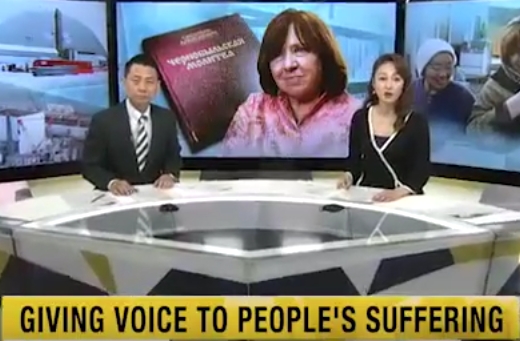
Svetlana Alexievich, a Belarusian writer who won a Nobel Prize for her book on the Chernobyl nuclear disaster, visited evacuees in Fukushima Prefecture recently to hear about their experiences.
Alexievich was awarded the Nobel Prize in Literature in 2015 for her writing about human suffering through the testimonies of witnesses of the Chernobyl disaster. She has been highly praised for her oral history of that event.
Alexievich was invited to speak at a university in Tokyo.
“It may be impossible to stop nuclear power plants right away, but it’s important to consider what you can and should do,” she said at the event.
Alexievich’s books are written collages of testimonies by ordinary people. Her book, “Chernobyl Prayer: A Chronicle of the Future,” published in 1997, is representative of her work. It’s a collection of statements from the victims of the Chernobyl nuclear disaster 30 years ago in the former Soviet Union.
About a quarter of the land in Alexievich’s home country of Belarus was contaminated and seriously damaged by radioactive material. Even now, many former residents are not allowed to return to their hometowns.
Alexievich spent more than 10 years interviewing over 300 people, sometimes on camera.
“In the last few days, whenever I lifted my husband’s body, his skin would peel off and stick to my hand,” the wife of one firefighter told her.
She then wrote about their deep shock and continual sadness.
The Nobel Committee described her work as “polyphonic writings, a monument to suffering and courage in our time.”
“I try to listen to people no one sees or hears,” Alexievich says. “There’s much more power in their emotions than in economic or medical data…. So I think it’s important to remember their lives.”
Alexievich came to Japan to hear what people in Fukushima prefecture have to say, and visited temporary housing to listen to residents’ stories.
She met with a former resident of Iitate village, a town that’s still under an evacuation order.
“I was a dairy farmer in Iitate, but now I’m unemployed,” Kenichi Hasegawa told her.
Before the earthquake, he had about 50 cows, and was living with 7 members of his family that spanned 4 generations. Hasegawa drove Alexievich to his former home, which still stands empty.
After the accident, all of his cows had to be put down or let go. Unable to continue dairy farming due to radiation, Hasegawa decided to demolish the cow shed. His family is now scattered.
“Wasn’t it difficult to leave home?” Alexievich asked him.
“Yes, it was… We can’t live the way we did before the accident, because of the radiation,” Hasegawa said.
Government officials say the evacuation order on Iitate will be lifted next March, but Hasegawa is anxious about the future.
“They say we’ll be able to return home, but haven’t mentioned their plans for the village after that,” he says. “My children won’t be returning.”
“In Fukushima, I saw the exact same situation I’d seen in Chernobyl. The destroyed homes, the empty villages and cities, the victims’ despair — they’re all the same,” Alexievich said. “In both countries, governments rushed to develop new technology, but they weren’t able to fulfill their responsibilities. They were irresponsible toward ‘the ordinary people.’”
Alexievich was also told the story of a dairy farmer who committed suicide. A close friend of the farmer took her to the place where he died.
“He left a note saying, ‘I wish there’d been no nuclear power plants here,'” Hasegawa said.
Alexievich has spent years focusing on the suffering of ordinary people and making their voices heard. Visiting the 2 disaster-stricken regions has renewed her sense of determination.
“No one completely understands the horror of nuclear power. Literature should communicate it, and so should philosophers. It’s not a job for politicians alone,” Alexievich said. “In other words, we need to look at what happened in Chernobyl and Fukushima and put them together, to form new knowledge…. I saw the future, not the past, and we need to work on that future.”
It has been 30 years since the nuclear disaster in Chernobyl, and 5 years since the one in Fukushima. The future depends on never letting the voices of “the ordinary people” go unheard — that’s the message from Nobel laureate Svetlana Alexievich.
http://www3.nhk.or.jp/nhkworld/newsroomtokyo/aired/20161208.html
A Preposterous Proposal on Nuclear Accident Compensation

The industry ministry has put forth a ridiculous proposal on financing compensation payments to victims of nuclear accidents.
In essence, the ministry’s proposal is designed to bail out operators of nuclear power plants that have failed to set aside compensation money for possible accidents at facilities that have been in service for decades.
To secure necessary funds for potentially huge compensation payments, the ministry wants to require old customers to bear part of the burden.
The Ministry of Economy, Trade and Industry, which regulates the power industry, has submitted this proposal to a panel of experts discussing the issue.
This effectively means shifting the cost of bad management to people who are not responsible, an approach that defies common sense in the world of business management and obscures the responsibility of the operators. The ministry should withdraw the proposal.
The law concerning compensation for nuclear accident-related damages stipulates that in principle operators are responsible for paying compensation for all damages caused by accidents at their facilities.
But the 2011 disaster at the Fukushima No. 1 nuclear power plant, operated by Tokyo Electric Power Co., prompted the government to set up an entity to pay compensation to the victims. Under this arrangement, TEPCO and other established electric utilities will pay back the money over a long period of time.
This new system, based on the notion of mutual help, is designed to get nuclear power plant operators involved in a joint effort to cover the risks of nuclear accidents.
The utilities involved are allowed to raise their electricity rates to finance contributions to the system. So the burden is actually borne by customers of the utilities.
The ministry’s new proposal would widen the scope of contributors to the pool of money for compensation payments. The new contributors include electricity suppliers that have entered the market in response to its liberalization even though they don’t operate nuclear power plants.
Specifically, the new utilities would be required to make contributions through the increased fees they pay to use the power transmission lines operated by established utilities. That would force almost all people in this country to shoulder part of the burden.
Here’s the ministry’s case for this scheme.
The money needed to pay compensation for damages caused by nuclear accidents should have been set aside since the 1960s, when nuclear power generation started in Japan. So it is appropriate to require people who paid low electricity rates that didn’t include this cost to bear the burden now.
Behind the ministry’s move is the fact that the total compensation amount related to the Fukushima nuclear disaster has already surpassed the original estimate and is now reaching 6 trillion yen ($54 billion). The amount is expected to grow in the coming years.
Even so, if past beneficiaries of low electricity rates are involved, the established utilities should be first forced to use the profits they accumulated in the past through their nuclear power operations.
At the very least, no consumer would accept such a new financial burden unless the utilities are held responsible for failing to save up for emergencies during the past half century.
The ministry has also proposed similar plans to tap the fees paid by new power suppliers for use of established utilities’ transmission cables to cover the costs of decommissioning the reactors at the crippled Fukushima plant and aging reactors at other plants.
The latest proposal is the third scheme based on this approach.
Imposing part of the burden on newcomers in the power market is tantamount to giving preferential treatment to nuclear power and undermines the fair competitive environment that is the foundation for power deregulation.
Some consumers have switched from established utilities to new power suppliers because of their aversion to nuclear power generation.
Clearly, adequate compensation should be paid to victims of nuclear accidents.
But the costs related to nuclear power generation should be shouldered by the operators of nuclear plants. An unreasonable scheme to shift this burden from the operators is simply unacceptable.
http://www.asahi.com/ajw/articles/AJ201611210025.html

Nuclear is No Solution to Climate Change
The Fairewinds Crew created this special 2-minute animation to show you why building new nukes is a lost opportunity for humankind with precious time and money wasted on the wrong choice. At least $8.2 Trillion would be needed to build the 1,000 atomic reactors the nuclear industry wants – that’s 1 reactor every 12-days for 35-years. Watch the animation to see what it means and why!
If you want more information, we have issued a paper, and presented this topic at several major universities and forums , and wanted to make it more accessible to people throughout the world. Truthout published Arnie Gundersen’s summation of this project in a news analysis entitled: Nuclear Power Is Not “Green Energy”: It Is a Fount of Atomic Waste.
http://www.fairewinds.org/nuclear-energy-education//smokescreen
World in Danger by Arnie Gundersen
How does the Fukushima Daiichi meltdown disaster show the enormous risk potential for the continued operation of the Diablo Canyon atomic reactor? Filmed by Ecological Options Network (EON) at Point Reyes Station in California, Fairewinds Chief Engineer Arnie Gundersen presents A World in Danger. This presentation from the 2015 California speaking tour precedes a panel discussion “Tell All” between chief engineer Arnie Gundersen, Fairewinds founder and president Maggie Gundersen, and EON co-directors Jim Heddle and Mary Beth Brangan. The follow-up conversation can be found here.
Thanks to Ecological Options Network (EON) for producing the video.
http://www.fairewinds.org/nuclear-energy-education//world-in-danger
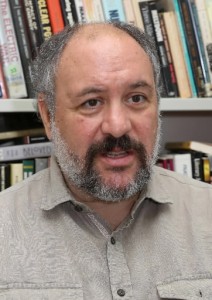
Interview with professor Robert Jacobs: Must say no to a war more
by Uzaemonnaotsuka Toukai, Editorial Writer
People in Hiroshima, which marked the 71st anniversary of the atomic bombing, have still evaluated the visit by U.S. President Barack Obama highly. Meanwhile, there is still a long way to go to realize the abolition of nuclear weapons in international society. The Chugoku Shimbun interviewed Robert Jacobs, 56, a professor at the Hiroshima Peace Institute of Hiroshima City University, about how we can fill the gap between real politics and the desire of people in the A-bombed cities. Mr. Jacobs has been living in Hiroshima for 11 years, and is familiar with American public opinion and pop culture concerning nuclear issues.
I have heard your own experiences as a child is the point of origin that has driven you to continue your research activity in the A-bombed Hiroshima.
When I was an elementary school student in Chicago, U.S., I went through a training similar to “Duck and Cover” every month. In the training, I practiced what to do when a nuclear weapon exploded. After my teacher told the students that a tremendous flash happened, we ducked on the floor all at once. I was scared, because I thought I was going to die soon. From 1950s to 1960s, conducting such a training was quite popular at schools in the U.S. As I couldn’t stop thinking about horrors of nuclear war, I read a lot of books on nuclear weapons. Then, I took part in the antinuclear movement in my teens, and I developed a strong belief that nuclear weapons must be eliminated. So, I think it was inevitable for me to come to Hiroshima.
What is your main research theme at the Hiroshima Peace Institute?
I have been studying how horrible results have been wrought by the development and testing of nuclear weapons, and how American and world culture and society have been affected by them. In addition, through a project titled “Global Hibakusha Project,” I have been investigating an initiative to connect the nuclear victims throughout the world. In the project, young people in Republic of the Marshall Islands, a nation which was involved in a U.S. hydrogen bomb test at Bikini Atoll, and several other countries have been developed as memory keepers. They have also been interacting with the youth in Hiroshima via Skype, an internet video and also in person workshops.
As an American, what did you think about President Obama’s visit to Hiroshima?
It was a historic event. The U.S. media also reported it very positively. However, from my perspective, I am disappointed that he didn’t mention anything about a concrete path towards the abolition of nuclear weapons, including how American nuclear policy would be changed.
You mean a world without nuclear weapons cannot be realized soon.
Hiroshima has two significances to the U.S. While Hiroshima is known as a tragic city in the U.S. because of the atomic bombing, the U.S. used Hiroshima as an excuse to increase its nuclear arsenal during a cold war era. In those days, the U.S. government aroused its citizens’ sense of fear that the U.S. must have much more nuclear weapons than the former Soviet Union to not end up being like “Hiroshima.” Now, against a backdrop of a threat by the militant group known as the Islamic State, the nuclear weapons have gained prominent attention again. It could be a shocking fact to people in the A-bombed cities, but it’s still strongly believed in the U.S. that the nuclear weapons are necessary because of the tragedy, which occurred in Hiroshima.
Even if President Obama visited Hiroshima, the public opinion in the U.S. hasn’t been changed so much, has it?
In Japan, some people say that President Obama’s visit to Hiroshima has advanced a movement towards nuclear abolition. But I am afraid they may be too optimistic. Many Americans still believe they should maintain the option to keep nuclear weapons though they do also want to abolish them. It’s the same logic as the one for gun ownership: many U.S. households have a gun because they believe it might be necessary sometime in the future, although not everyone wants to use it.
If things are not changed, do you think a desire of people in Hiroshima to abolish nuclear weapons won’t take root in the nuclear nations?
You have to be more aware that a barrier to nuclear abolition, which the A-bombed cities should take focus on, is quite enormous. Even if a U.S. president advocates abolition of nuclear weapons, the real politics and military system won’t change so easily. The bottleneck is a giant military industry that has the power to influence the world of politics, and public opinion believing in nuclear deterrent force. I think just appealing for the inhumanity of nuclear weapons is not enough to fight against them.
Could you elaborate on it more?
I believe you should rather make an appeal based on the extensive moral framework of the whole society. As the living standard of the middle-class has declined in the U.S., more and more people have become pessimistic about their future. Meanwhile, the U.S. government is planning to spend a trillion dollars (about 100 trillion yen) for upgrading nuclear weapons over the next three decades. Is it acceptable to sacrifice living standard of people for such spending? Shouldn’t education and medical services be more prioritized than military affairs? Taking these perspectives into account, it’s important to appeal to international opinion opposing wars and military powers. If people in the A-bombed cities can collaborate with those working on these issues in the world, I believe you can generate a much bigger wave than now.
Profile
Robert Jacobs
Born in Chicago, the United States, Mr. Jacobs obtained a doctor’s degree at the University of Illinois, and came to Hiroshima in 2005 to serve as an instructor for the Hiroshima Peace Research Institute. He assumed his current post from this year. Studying history as his major, he has been researching the history and culture of nuclear technologies and nuclear victims. He has written books including “The Dragon’s Tail: Americans Face the Atomic Age.”
(Originally published on August 8, 2016)
Every baby born in 2016 contains atom bomb radiation — here’s why
Seventy-one years ago Saturday, a United States B-29 bomber named the “Enola Gay” dropped the atomic bomb “Little Boy” over the Japanese city of Hiroshima.
The bomb fell just over 29,000 feet from the plane and detonated 1,900 feet above Shima Hospital, an active medical center with a history dating back to the 18th Century. Between four and five square miles of buildings were leveled in the blast generated by just 141 pounds of highly enriched uranium. The US Department of Energy (DoE) estimates 70,000 people died in the initial blast, resulting fires, and radiation burst on August 6, 1945, but that the five-year death toll may have exceeded 200,000 people.
President Harry Truman told Japan to surrender or “expect a rain of ruin from the air, the like of which has never been seen on this earth.” Three days later, a second bomb (this time plutonium-based) dropped from an American warplane over the city of Nagasaki. The DoE estimates 40,000 people died in the immediate aftermath, and that number may have reached 140,000 within five years.
These events remain the only cases, so far, of human beings attacking other human beings with nuclear weapons. But the survivors of these attacks are from from the only people to carry the marks of nuclear warfare in their bodies.
Every person alive on the 71st anniversary of those attacks holds in their flesh radioactive remnants of the nuclear era — a period centered in the early decades of Cold War when nuclear nations conducted atmospheric tests of ever-larger bombs.
That’s the period that left us images of bright, sky-piercing mushroom clouds like the one at the top of this article, and footage like this of the devastation these weapons could wreak.
https://gfycat.com/RemoteMarriedHind
Hundreds of bombs detonated in the open air (and several more in the ocean) during the heyday of atmospheric nuclear testing — with thousands more tests conducted underground.
The 1963 Partial Test Ban Treaty put a stop to exposed American and Soviet explosions, though France and China continued atmospheric tests until 1974 and 1980, respectively. Many countries pursued underground testing through the early 1990s. Only North Korea has detonated a weapon in the 21st Century.
https://gfycat.com/VapidBrownAlpineroadguidetigerbeetle
Nuclear explosions produce radioactive substances that are rare in nature — like carbon-14, a radioactive form of the carbon atom that forms the chemical basis of all life on earth.
Once released into the atmosphere, carbon-14 enters the food chain and gets bound up in the cells of most living things. There’s still enough floating around for researchers to detect in the DNA of humans born in 2016. If you’re reading this article, it’s inside you.
That’s strange, if not a little unsettling. Though carbon-14 is completely harmless, it’s hard to wrap your mind around the idea that our species’ cruelest weapons left measurable traces in our bodies.
But it turns out that this can actually be helpful for scientists.
As Carrie Arnold reported in 2013 for Nova, the massive, unusual carbon-14 load of the era between 1955 and 1963 remains in the atmosphere. It’s called the “bomb pulse,” and it still makes its way, through plants, into the food web. But every second it decays a little more, leaving less in the atmosphere.
That means that every new cell created has a bit less carbon-14 than cells before it. And that slow decline proceeds in a predictable way.
In the last couple decades, researchers have taken advantage of that predictability to figure out exactly how old individual cells are. The process is fairly simple: Extract the cell’s DNA, measure its carbon-14 levels with a tool called a mass spectrometer, and check the result against tables of carbon-14 decay in the period since 1963.
This technique has been used, as Arnold reports, to trace the progress of cancers, advance our understanding of obesity and diabetes, and prove that brain cells continue to form through a human being’s lifetime.
However, barring a nuclear war or a rogue state conducting more dangerous above-ground tests, this method has a limited lifespan. Within a few decades, the bomb pulse will fade until it’s indistinguishable from our planet’s background carbon-14. (The researchers Arnold spoke to peg the date at 2050.)
If that happens, it will be good news for humanity. After all, it’ll mean we’ve gone long enough without a nuclear explosion that the bomb’s most widespread traces have disappeared. But for certain segments of medicine and science, it will mean the end of a once-in-history opportunity.
http://www.techinsider.io/bomb-pulse-radiation-decay-cells-2016-8
Nuclear disasters and “normalization” of contaminated areas

Translated by Kingsley Osborn
Political, economic, health, democratic and ethical
The nuclear lobby is beginning to openly assert that the evacuation of populations affected by a major nuclear accident is too expensive, is the source of lots of hassles, accidents, despair families, ruin the local economy.
To some additional cancers it will not be worth it to impose populations.
Sezin TOPÇU is PhD in sociology of science and technology, she is a researcher at the National Scientific Research Centre (CNRS) and teaches at the School for Advanced Studies in the Social Sciences (EHESS). She is the author of “Nuclear France. The art of governing disputed technology “(Le Seuil, 2013) and co-edited the book” Another story of the postwar boom. Modernization and pollution disputes in France after the war “(with Christophe Bonneuil Céline and Pessis, La Découverte, 2013).
Here is the introduction to his analysis:
Minimizing impacts of a catastrophic nuclear accident is set to become a classic of our time, and not only in countries where the presence of nuclear installations is important, such as France, or in countries that have already undergone an accident, such as Japan and Belarus, but also in countries that do not. This minimization, which seems to impose forcefully, is the ability to “resilience” of specialists in nuclear, that is to say, industrialists, nuclear states, and certain regulatory bodies, both national and international.
How the specialists in nuclear-they managed to trivialize the radioactive wrong with that? By what means, strategies and watchwords governing bodies have managed to formulate the problem in terms of evacuation procedures and even its legitimacy, when we should collectively discuss the legitimacy to continue to make use of facilities that have potential for processing and destruction unparalleled in the territories, natural resources, living species, and human body?
from these questions, this paper aims to contribute to the emergence of a political debate and citizen which is long overdue, around the issue of contaminated territories in case of nuclear accident.
Three Mile Island? The French nuclear officials there saw immediately that an “incident” or a “glitch”. Chernobyl? In 1996 again, the World Health Organization (WHO) only accounted for 32 deaths. Fukushima? The disaster paradoxically accelerated the offensive of the Japanese nuclear industry for exports. No other sector causes, accident, such bitter controversy and permanent (with expertise, evidence / no-evidence, observations, assessments and also contrasting and contradictory), on health impacts experienced by affected populations.
Beyond the very serious consequences on the health of populations, whose proof or recognition are made difficult due to the latency that require radiation-induced diseases to manifest itself, but also the secret or active factory ignorance that often surround them, a nuclear accident also means the sacrifice of entire territories.
the challenge for specialists in nuclear, since the 1990s at least, is indeed to minimize the sacrifice in the eyes of public opinion. To ensure that the renunciation of land does not occur, or only take place only temporarily. A instrumentalize, for this suffering, certainly real but no singular evacuees to believe that those who remain on their land, even though they would offer more than enough healthy living conditions, suffer for nothing. A claim that may well “learn to live” with ambient radioactivity.
The first part of this note reviews the genesis of panel discussions, legal arrangements and managerial tools for the management of contaminated territories. This is to recall that the unmanageable nature of damage caused by a major nuclear accident has been recognized by the nuclear experts in the 1950s, which has historically conditioned the doctrine prevailing today, whereby post-accident measures (including the abandonment of contaminated areas) will necessarily be limited or should be optimized.
The second part of the note looks at how the contaminated territories have been effectively treated in post-Chernobyl and post-Fukushima. Socio-economic and geo-political criteria that influence how to design the future of the evacuated areas, their status, and they could not “return to normal” are analyzed here.
The last part of the note stresses the importance of official strategies to psychologizing disasters to minimize abandonment of contaminated land, but also to push into the background the prospect of a fair assessment of the health damage caused in the event accident.
To read the entire article: The Show as PDF (400KB) The view on the EPF website
The website of the Foundation for Political Ecology: http://www.fondationecolo.org/
Note:
We’ve been warned: the next nuclear accident, we will be strongly urged to stay or return to live on contaminated territories.
Catastrophes nucléaires et « normalisation » des zones contaminées
http://www.vivre-apres-fukushima.fr/catastrophes-nucleaires-et-normalisation-des-zones-contaminees/
Genetic radiation risks: a neglected topic in the low dose debate.
From Chris Busby:
“This is the final version and the abstract in pubmed is new: I had to re-write it. It is far more poisonous to the nuclear industry than the previous web version. There was significant pressure on the journal from NIH to pull the paper, to remove it. I had to write to say that the paper was critical evidence in the High Court action and if they de-submitted it the issue would be a major media one and would be raised in the veterans case. Just read the new Abstract on PUBMED. Says it all.”
Abstract
OBJECTIVES:
To investigate the accuracy and scientific validity of the current very low risk factor for hereditary diseases in humans following exposures to ionizing radiation adopted by the United Nations Scientific Committee on the Effects of Atomic Radiation and the International Commission on Radiological Protection. The value is based on experiments on mice due to reportedly absent effects in the Japanese atomic bomb (Abomb) survivors.
METHODS:
To review the published evidence for heritable effects after ionising radiation exposures particularly, but not restricted to, populations exposed to contamination from the Chernobyl accident and from atmospheric nuclear test fallout. To make a compilation of findings about early deaths, congenital malformations, Down’s syndrome, cancer and other genetic effects observed in humans after the exposure of the parents. To also examine more closely the evidence from the Japanese A-bomb epidemiology and discuss its scientific validity.
RESULTS:
Nearly all types of hereditary defects were found at doses as low as one to 10 mSv. We discuss the clash between the current risk model and these observations on the basis of biological mechanism and assumptions about linear relationships between dose and effect in neonatal and foetal epidemiology. The evidence supports a dose response relationship which is non-linear and is either biphasic or supralinear (hogs-back) and largely either saturates or falls above 10 mSv.
CONCLUSIONS:
We conclude that the current risk model for heritable effects of radiation is unsafe. The dose response relationship is non-linear with the greatest effects at the lowest doses. Using Chernobyl data we derive an excess relative risk for all malformations of 1.0 per 10 mSv cumulative dose. The safety of the Japanese A-bomb epidemiology is argued to be both scientifically and philosophically questionable owing to errors in the choice of control groups, omission of internal exposure effects and assumptions about linear dose response.
KEYWORDS:
Congenital malformation; Down´s syndrome; Environmental radioactivity; Internal radiation; Low level effects; Sex-ratio; Still birth
Free full text: http://e-eht.org/journal/view.php?doi=10.5620/eht.e2016001
Resuspension and atmospheric transport of radionuclides due to wildfires near the Chernobyl Nuclear Power Plant in 2015: An impact assessment
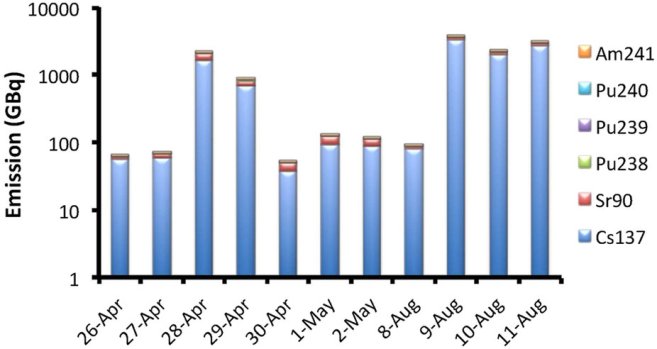
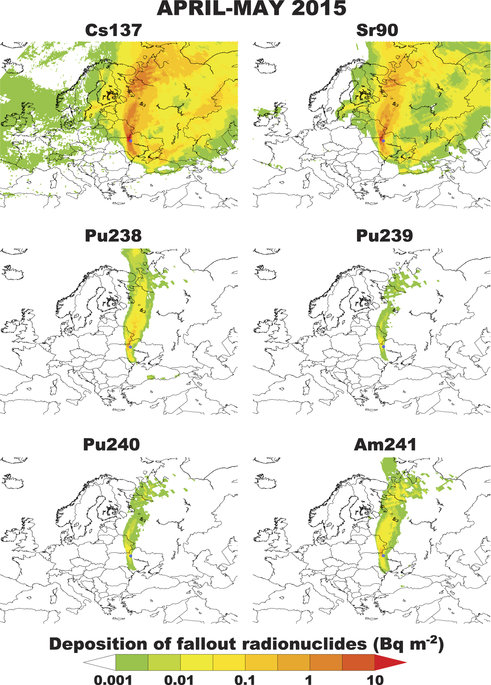
In April and August 2015, two major fires in the Chernobyl Exclusion Zone (CEZ) caused concerns about the secondary radioactive contamination that might have spread over Europe. The present paper assessed, for the first time, the impact of these fires over Europe. About 10.9 TBq of 137Cs, 1.5 TBq of 90Sr, 7.8 GBq of 238Pu, 6.3 GBq of 239Pu, 9.4 GBq of 240Pu and 29.7 GBq of 241Am were released from both fire events corresponding to a serious event. The more labile elements escaped easier from the CEZ, whereas the larger refractory particles were removed more efficiently from the atmosphere mainly affecting the CEZ and its vicinity. During the spring 2015 fires, about 93% of the labile and 97% of the refractory particles ended in Eastern European countries. Similarly, during the summer 2015 fires, about 75% of the labile and 59% of the refractory radionuclides were exported from the CEZ with the majority depositing in Belarus and Russia. Effective doses were above 1 mSv y−1 in the CEZ, but much lower in the rest of Europe contributing an additional dose to the Eastern European population, which is far below a dose from a medical X-ray.
On Sunday 26th April 2015 at 23.30 (local time), exactly 29 years after the Chernobyl Nuclear Power Plant (CNPP) accident, a massive fire started in the Chernobyl Exclusion Zone (CEZ). The next morning (April 27th) at 07.30 the fire was partially stabilised and the fire-fighters focused on only two areas of 4.2 and 4.0 hectares. However, the fire spread to neighbouring areas due to the prevailing strong winds. During the night of April 27th to 28th, 2015, the fire spread to areas close to the Radioactive Waste Disposal Point (RWDP), and burned around 10% of the grassland area at the western of the RWDP1. On April 29th and 30th, 2015, the attempts to stop the fires in the CEZ did not succeed. Fire brigades from Chernobyl and Kiev region supported extinguishing attempts and the last 70 ha were suppressed on May 2nd, 2015. The radiation background is continuously monitored in the CEZ by an automated radiation monitoring system (ARMS) at 39 points1. Given the importance of this fire, background radiation and radionuclide content in the air near the fire were also analysed online.
Another less intensive fire episode took place in August 2015. About 32 hectares were initially burned in the CEZ on August 8th 2. The fires started at three locations in the Ivankovsky area. As of 07.00 on August 9th, the fires had been reportedly localized and fire-fighters continued to extinguish the burning of dry grass and forest. The same fire affected another forested area, known as Chernobylskaya Pushcha. The fire spread through several abandoned villages located in the unconditional (mandatory) resettlement zones of the CEZ and ended on August 11th.
Forest fires can cause resuspension of radionuclides in contaminated areas3. This has caused concern about possible fires in heavily contaminated areas such as the CEZ4. While concerns were initially limited to the vicinity of the fires, Wotawa et al.5 have shown that radionuclides resuspended by forest fires can be transported even over intercontinental distances. Earlier in 2015, Evangeliou et al.6, based on a detailed analysis of the current state of the radioactive forests in Ukraine and Belarus, reported that forest cover in the CEZ has increased from about 50% in 1986 to more than 70% today. Precipitation has declined and temperature has increased substantially making the ecosystem vulnerable to extensive drought. Analysis of future climate using IPCC’s (Intergovernmental Panel on Climate Change) REMO (REgional MOdel) A1B climatic scenario7 showed that the risk of fire in the CEZ is expected to increase further as a result of drought accompanied by lack of forest management (e.g. thinning) and deteriorating fire extinguishing services due to restricted funding. The same group8 considered different scenarios of wildfires burning 10%, 50% and 100% of the contaminated forests. They found that the associated releases of radioactivity would be of such a magnitude that it would be identical to an accident with local and wider consequences9. The additional expected lifetime mortalities due to all solid cancers could reach at least 100 individuals in the worst-case scenario.
This paper aims at defining the extent of the radioactive contamination after fires that started in the CEZ on April 26th (ended 7 days after) and August 8th (ended 4 days after) 2015. We study the emission of the labile long-lived radionuclides 137Cs (t½ = 30.2 y) and 90Sr (t½ = 28.8 y) and the refractory 238Pu (t½ = 87.7 y), 239Pu (t½ = 24,100 y), 240Pu (t½ = 6,563 y) and 241Am (t½ = 432.2 y). These species constitute the radionuclides remaining in significant amounts since the Chernobyl accident about 30 years ago, and their deposition has been monitored continuously by the Ukrainian authorities. The respective deposition measurements have been adopted from Kashparov et al.10,11 and are stored in NILU’s repository website (http://radio.nilu.no). Using an atmospheric dispersion model, we simulate the atmospheric transport and deposition of the radioactive plume released by the forest fires. We also estimate the internal and external exposure of the population living in the path of the radioactive smoke. We assess the significance of the emissions with respect to the INES scale and define the regions over Europe, which were the most severely affected.
See more at: http://www.nature.com/articles/srep26062

Aspects of DNA Damage from Internal Radionuclides
1. Introduction
In this chapter, there is insufficient space to exhaustively review the research which has been carried out on internal radionuclide effects. I hope only to highlight evidence which shows that internal radionuclides cannot be assessed by the current radiation risk model, and to suggest some research directions that may enable a new model to be developed, one which more accurately quantifies the real effects of such exposures. The biological effects of exposure to ionizing radiation have been studied extensively in the last 70 years and yet very little effort has gone into examining the health effects of exposure to internal incorporated radionuclides. This is curious, since the biosphere has been increasingly contaminated with novel man-made radioactive versions of naturally occurring elements which living creatures have adapted to over evolutionary timescales, and intuition might suggest that these substances could represent a significant hazard to health, one not easily or accurately modelled by analogy with external photon radiation (X-rays and gamma rays).
The question of the health effects of internal radionuclide exposures began to be asked in the early 1950s when there was widespread fallout contamination of food and milk from atmospheric nuclear tests. It quickly became the subject of disagreements between two committees of the newly formed International Commission on Radiological Protection (ICRP)[1]. The questions of the equivalence of internal and external radiation exposure, which were the basis of these disagreements, have still not been resolved. In the West, up to very recently, the whole spectrum of health effects from internal incorporated radionuclides has focused on animal studies of Radium, Plutonium and Strontium-90 and human retrospective studies of those individuals exposed to Radium-226 and Thorium-232 in the contrast medium “Thorotrast”. These studies suffer from a number of problems which will be discussed.
Soviet scientists were more interested in internal radiation effects from fission-product radionuclides, but unfortunately their valuable studies have been difficult to access since they are published in Russian. In 1977 Gracheva and Korolev published a book summarising work in this area which was translated in India in 1980 as Genetic Effects of the Decay of Radionuclides in Cells [2]. This presented a wealth of interesting data relating to beta emitter genetic effects in various systems and drew attention to the distinction that must be made between external and internal radiation. This is important since the whole assessment of radiation in terms of health has been through the quantity “absorbed dose” and what can be called the bag-of-water model.
In this bag of water model, illustrated in Fig 1, the total energy transferred by the radiation to living tissue is diluted into a large mass, greater than a kilogram, as if the effects were uniform throughout the tissue being considered. In Fig 1 the tissue mass A represents an external irradiation by X-rays or gamma rays and here the effects are uniform across the tissue. But in the case B, for internal irradiation, it is clear that it is possible, for certain kinds of exposure, for tissue local to the source to receive very large amounts of radiation energy at the same overall energy transfer to the tissue mass.
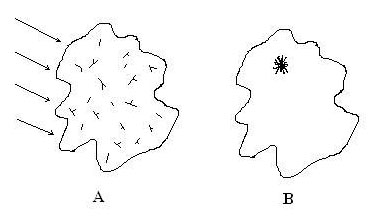
Figure 1.
Comparing external and internal irradiation: the ICRP/ ICRU bag of water model. In case A, external radiation (X-rays or gamma rays) there are 20 events uniformly spaced throughout the tissue and the “absorbed dose” (see text) at any microscopic point is evenly distributed. In case B, for internal irradiation (here from a radioactive particle) there is a very large transfer of energy to a small tissue volume and the concept of “absorbed dose” does not apply.
Thus, in the historic and also the current system of radiation protection, those experts who assess radiation risk, who are termed Health Physicists, calculate the cumulative absorbed dose in Grays, i.e. in terms of the total energy in Joules imparted by the beta electron or alpha particle decays of the internal radionuclide contamination to one kilogram of tissue. For this calculation, the tissue is modelled as water. For example, those whose body contains 100 Bq of Strontium-90 are assessed, for the purposes of radiation protection, as having received a cumulative absorbed dose of 100 x w where w is the “cumulative (absorbed) dose coefficient”, obtained from measurements of the biological half life of the Strontium in the body and the decay energy of each decay in Joules. This number w is to be found in a Table published by the ICRP. In the case of the Strontium-90 contaminated individual, if the person weighed 50 kg, then the mean activity concentration would be 2 Bq/kg. The resulting absorbed dose would then be 2 x 2.8 x 10-8 (this is the ICRP 72 dose coefficient [3]). In other words, the committed dose is 5.6 x 10⁻⁸ Sv (0.056 μSv). But can this be safely compared with a dose from a chest X-ray (40 μSv ) or from natural background radiation (2500 μSv) or from a high dose acute exposure to gamma rays from an atomic bomb linearly scaled to zero dose (the current way of modelling radiation effects)? This chapter explores this question. It is one which has become increasingly necessary as serious health effects, including cancer and leukemia, have been reported in those exposed to internal radioactivity in areas contaminated by radionuclides released from nuclear sites, weapons testing fallout and accidents like Chernobyl and Fukushima, at very low conventionally calculated “absorbed doses”.
The matter has been discussed in some detail since 1998 by the independent European Committee on Radiation Risk (ECRR) whose reports [4, 5] provide a methodology for assessing health effects through a system of weighting factors based on available data. As more and more evidence emerged after 1995 that something was very wrong with the ICRP absorbed dose approach to internal radiation, the UK government set up a Committee Examining Radiation Risk from Internal Emitters (CERRIE). Since there were (and are) political dimensions to the issue, the committee was composed of scientists and experts from the nuclear industry and the official radiation protection organisations in the UK. Unfortunately the 4-years process ended in acrimony, legal threats to member of the committee, and failure to agree a final report. Two reports were issued [6, 7]. However, there was agreement that there were reasonable concerns about the safety of employing “absorbed dose” for certain internal radionuclide situations, and similar concerns about the safety of the ICRP model were made in 2005 by the French IRSN [8]. The error factor that these discussions led to was believed by different ends of the CERRIE process to be between 10-fold and 1000-fold. More recently, the value put on this error factor by the retired Scientific Secretary of the ICRP at a meeting in Stockholm in 2009 was “two orders of magnitude”. What this means, in our Strontium-90 case above, is that the dose from 100Bq contamination to the whole body is no longer 0.056μSv but may now be between 0.56μSv and 56μSv and the risk of fatal cancer is proportionately increased. To put this in perspective, the mean Sr-90 dose over the period 1959-1963 to individuals in the northern hemisphere was given as about 1 mSv [9]. The ICRP risk model gives a 0.45% per Sievert excess lifetime cancer risk. Epidemiological studies suggest that the cancer “epidemic” which began in the 1980s in areas of high rainfall and fallout is a consequence of the earlier fallout exposures [10]. The weighting of dose necessary to explain this is greater than 300 if calculated from the ICRP absolute risk factor of 0.05/Sv [5, 11]. Many other instances of anomalous health effects from exposure to internal radionuclides require hazard weighting factors of between 100-fold and more than 1000-fold, and these are consequences of mechanisms which will be presented.
Pro-nuclear trolls & disinformation

A few links to some articles dealing about about pro-nuclear trolls and their disinformation techniques.

Children Suffer Nuclear Impact Worldwide
Do children suffer worldwide from atomic power? Absolutely. CCTV host Margaret Harrington anchored a panel with Maggie Gundersen, Caroline Phillips, and Chiho Kaneko from Fairewinds Energy Education to discuss the health risks to children around the world from operating nuclear power reactors and their burgeoning waste. In the aftermath of the nuclear meltdowns at Fukushima Daiichi, mothers in Japan especially bear the responsibility to protect their children. As a result, they experience greater hardships in an environment where just expressing one’s legitimate concerns about radiation contamination is seen as a treasonous act. Meanwhile in Ukraine, 30-years following the atomic disaster at Chernobyl, the repercussions of massive radioactive contamination and government zoning continue to severely impact children living within 50 miles of Chernobyl’s epicenter. The United States is not immune to these worries and contentions as Tritium, Strontium-90, and Cesium 137 are radioactive releases that threaten the health of children living nearby leaky atomic power reactors and nuclear waste dumps. Learn more by watching this episode of Nuclear Free Future as the women of Fairewinds lend their voices to protect the children.
Questions raised over nuclear evacuation plans urging residents to remain indoors
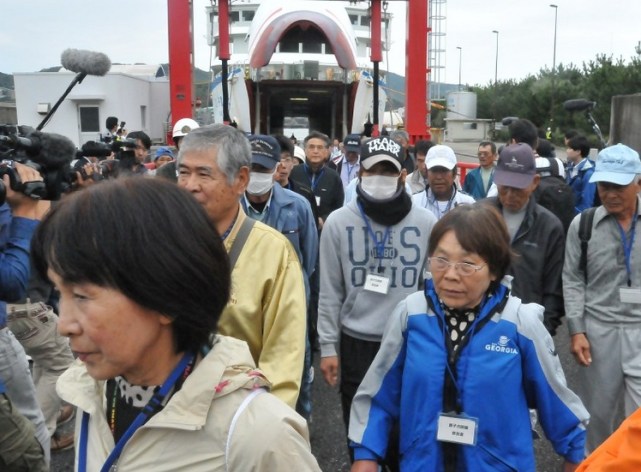
Residents of Ikata, Ehime Prefecture, disembark from a ferry after its arrival at a port in Oita Prefecture as part of a nuclear disaster evacuation drill, in November 2015
Residents living in areas hosting Japan’s nuclear power plants are voicing concerns about nuclear accident evacuation plans following two recent deadly earthquakes in Kumamoto Prefecture registering a maximum 7 on the Japanese intensity scale.
The government’s evacuation plans are based on the premise of some residents near nuclear plants initially remaining indoors, and having them flee to other prefectures if necessary. But questions have been raised over how effective current plans would be in the event of disasters like those that hit Tokyo Electric Power Co.’s Fukushima No. 1 Nuclear Power Plant in March 2011.
“If there were a nuclear accident, remaining indoors would be impossible. The Kumamoto Earthquake has made me even more anxious,” said Ikue Yamaguchi, a 34-year-old public servant raising two children in the Kagoshima Prefecture city of Ichikikushikino. Her home is just around 15 kilometers away from the No. 1 and 2 reactors at the Sendai Nuclear Power Plant in Satsumasendai in the prefecture. The reactors are the only ones currently operating in Japan.
Before the Fukushima nuclear disaster, areas within 8 to 10 kilometer radii of nuclear power plants were designated as being subject to evacuation plans, but after the outbreak of the disaster, the areas were expanded to a 30 kilometer radius. As a result, 135 municipalities in 21 prefectures are now subject to such plans, compared with 45 municipalities in 15 prefectures before the disaster. Altogether, some 4.8 million people, or about 4 percent of the population, are subject to such evacuation plans.
Under government evacuation plans, those living within 5 kilometers of a nuclear power plant are supposed to be evacuated immediately if there are signs of a nuclear accident, while those living 5 to 30 kilometers away are to remain indoors, and then evacuate further away if there are signs that radiation levels are increasing. The Nuclear Regulation Authority says that radiation exposure can be sufficiently reduced in areas between 5 and 30 kilometers from a nuclear power plant by remaining indoors. It adds that if people in those areas go out of their way to evacuate, they could face a heighted risk of radiation exposure and health damage.
But in the case of an earthquake like the temblors that recently struck Kumamoto Prefecture, which left many homes in danger of collapsing, it would be difficult to remain indoors. And not all shelters offer stable protection, either. As of the end of March last year, 85.7 percent of public facilities in Kagoshima Prefecture supposed to be used as shelters during disasters had been reinforced against earthquakes — a figure lower than the national average of 88.3 percent. Ehime Prefecture, which hosts Shikoku Electric Power Co.’s Ikata Nuclear Power Plant that is expected to be reactivated in late July, has the nation’s third worst rate, at 79.1 percent.
If an accident were to occur at the Sendai Nuclear Power Plant in Kagoshima Prefecture, then according to estimates, it could take up to around 29 hours to evacuate some 210,000 people living within a 30 kilometer radius of the plant who would be subject to evacuation. This, however, is based on the premise of people living in areas within 5 to 30 kilometers of the plant initially remaining indoors — if everyone were to start evacuating at once, then it is predicted that transportation networks would become congested, and evacuation would take even longer.
“Even if we were to evacuate indoors, then we would have to go outside (to receive supplies, etc.) and wouldn’t be able to avoid exposure to radiation,” Yamaguchi says. “I would want to evacuate immediately, but evacuation routes would probably be crowded.”
Shunro Iwata, an official at the nuclear safety control division of the Kagoshima Prefectural Government, commented, “When evacuating indoors, people are not forbidden from going outside, so they can go out if the need arises. There would be no immediate effect on health (for radiation levels below the standard reading). We are not in a position to revise plans, and there is no change to the fact that this is the most reasonable approach at present.”
Naoya Sekiya, a specially appointed associate professor at the University of Tokyo who is familiar with evacuation plans during disasters, said it is not realistic to base evacuation plans on the premise of people remaining indoors.
“Evacuation plans should be made with the presumption of a major earthquake cutting off roads and railways. If evacuation orders are issued to people within a five-kilometer radius of a nuclear plant, then obviously people in surrounding areas will start evacuating, too, resulting in further confusion. An evacuation plan based on the premise of people remaining indoors is not realistic,” he said.
http://mainichi.jp/english/articles/20160502/p2a/00m/0na/021000c
Germany looks to export reactor decommissioning technologies
BERLIN – Germany may become an exporter of technologies to decommission reactors in the future given the experience gained after its phasing out of nuclear energy, German Environment Minister Barbara Hendricks said in a recent interview with Kyodo News.
Germany believes it may be able to halt all nuclear power in the country before its 2022 target year, Hendricks said Wednesday in Berlin. She also expressed hope for cooperation with other countries in reactor decommissioning.
“I cannot exclude the possibility that the last nuclear reactor will be switched off earlier than 2022; there has been a reactor which switched off earlier than it was planned, because of the costs of running it longer,” she said.
The interview was held prior to her visit to Japan to take part in the Group of Seven environment ministers’ meeting scheduled for May 15 and 16 in Toyama on the Sea of Japan coast.
After the session, she plans to travel on to Fukushima Prefecture, home to the Fukushima No. 1 nuclear power plant, which suffered a triple-meltdown triggered by a major quake and tsunami in 2011.
“I want see the situation with my eyes and see how Japan has dealt with it,” she said.
The Fukushima disaster motivated Germany to decide the same year to abandon atomic energy by 2022.
“In Germany we have begun or finished the decommissioning of nearly 20 nuclear power units and more than 30 research reactors,” she said. “We have gathered a lot of technological experiences.
“The nuclear power phase-out is an advantage, because we have begun earlier to gather experiences on how to change a nuclear power plant to a green grass or a base for another industry,” she said.
The minister added that nuclear decommissioning “will become the next export technology” for Germany.
Asked to comment on Japan’s resumption of some reactors taken offline after the nuclear accident, she said: “Every country has to decide about their energy mix. I do not want to make advice.”
Hendricks, however, expressed “surprise” that Japan has not fully made use of renewable energy sources like solar, wind and hydropower.
The environment ministers’ meeting is one of the G-7 ministerial sessions being held in Japan in the run-up to the Ise-Shima summit May 26 and 27. The G-7 groups Britain, Canada, France, Germany, Italy, Japan and the United States.
1 This Month

of the week – Shut Down Drone Warfare!


Tell the Ukrainian Government to Drop Prosecution of Peace Activist Yurii Sheliazhenko

Petition to revoke the licensing of the Near Surface Nuclear Disposal Facility (NSDF) at Chalk River. https://www.ourcommons.ca/petitions/en/Petition/Details?Petition=e-7247
To see nuclear-related stories in greater depth and intensity – go to https://nuclearinformation.wordpress.com
-
Archives
- April 2026 (57)
- March 2026 (251)
- February 2026 (268)
- January 2026 (308)
- December 2025 (358)
- November 2025 (359)
- October 2025 (376)
- September 2025 (257)
- August 2025 (319)
- July 2025 (230)
- June 2025 (348)
- May 2025 (261)
-
Categories
- 1
- 1 NUCLEAR ISSUES
- business and costs
- climate change
- culture and arts
- ENERGY
- environment
- health
- history
- indigenous issues
- Legal
- marketing of nuclear
- media
- opposition to nuclear
- PERSONAL STORIES
- politics
- politics international
- Religion and ethics
- safety
- secrets,lies and civil liberties
- spinbuster
- technology
- Uranium
- wastes
- weapons and war
- Women
- 2 WORLD
- ACTION
- AFRICA
- Atrocities
- AUSTRALIA
- Christina's notes
- Christina's themes
- culture and arts
- Events
- Fuk 2022
- Fuk 2023
- Fukushima 2017
- Fukushima 2018
- fukushima 2019
- Fukushima 2020
- Fukushima 2021
- general
- global warming
- Humour (God we need it)
- Nuclear
- RARE EARTHS
- Reference
- resources – print
- Resources -audiovicual
- Weekly Newsletter
- World
- World Nuclear
- YouTube
-
RSS
Entries RSS
Comments RSS
 nuclear-news