The price of staying
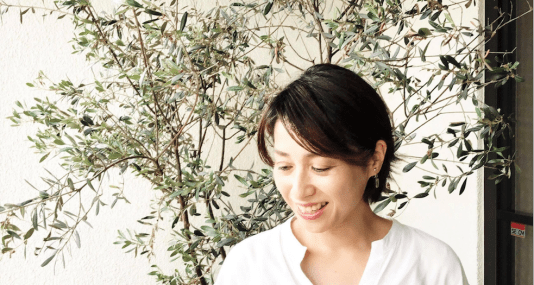
Evacuation was not mandatory for these now suffering Fukushima victims
By Akemi Shima
This is a statement of opinion that I, a resident of the city of Date, Fukushima Prefecture, presented to the Tokyo Regional Court as part of an on-going lawsuit.
“We had the desire to raise our children in an environment close to nature and enriching. That’s why we moved from Fukushima City to buy land in the town of Date, where we currently live, to build a house. Loan repayments were heavy but, we lived simply and we were happy.
“Eight years after the construction of our house, on March 11, 2011 the accident of the power plant occurred, and our family life was turned upside down. My husband and I were 42 years old, my son was in elementary school 4th grade (12 years old) and my daughter was in elementary school 3rd grade (10 years old).
“At that time, I had no knowledge about nuclear or radioactive substances. If I had had some knowledge in this area, by running away from it we probably could have avoided being irradiated. I am burdened by this regret. Without any financial leeway, with my sick children and my parents who are here, I could not resolve myself to get away from Date.
“From the 11th of March all life lines were cut and I had to go to the water stations where I took the children. To find food we had to walk outside sometimes soaked in the rain. After several days as we still had no water, we had to go to the town hall to use the toilet, where the water was not cut. It was then that I saw a group of people dressed in white protective suits entering the town hall. We thought that they were probably coming to help the victims of the tsunami. But now, I understand that the radioactive pollution was such that protections were necessary and we, without suspecting anything, were exposed.
“It was the time for the graduation ceremonies at the elementary school and we went there on foot. I think the information we were given was false and because of that we were irradiated. At the time I was convinced that if we were really in any danger, the state would warn us. I later learned that the doses of radioactivity in the air after the accident were 27 to 32 μSv (micro sieverts) per hour. There was no instruction about any restriction to go outdoors. And that is extremely serious.
“In June 2011, I went to the funeral of my husband’s grandmother. I took my children with me. On the way we noticed that the radiation level was very high and that inside the car the dosimeter showed in some places 1.5 micro-sievert per hour. The officials of that area had asked the nearby residents to not cause problems even if the radioactivity was high. From what I heard, the reconstruction vehicles had to be able to continue to use that road. Likewise, the Shinkansen bullet train and the Tohoku highway were not to be closed for these reasons. Despite a level that exceeded the allowable dose limits, instead of being alerted to the dangers, we were assured that we were safe.
“The risk of this exposure was not communicated to us. In June 2011 my son had so many heavy nosebleeds that his sheets were all red. The children with the same symptoms were so numerous that we received a notice containing recommendations through the school’s “health letter”. During a medical examination at the school, my son was found to have a heart abnormality and had to be monitored by a holter. My son, who was 12 at the time of the accident, was also suffering from atopic dermatitis. During the school spring break he had to be hospitalized after his symptoms worsened. Today we still cannot identify the symptoms that cause him to suffer.
“One year after the accident, my daughter complained of pain in her right leg. In the hospital, an extra-osseous osteoma was diagnosed and she had to undergo bone excision the following year. In her first year of junior high school in the winter term, she could not get up in the morning. She had orthostatic dysfunction. In agreement with her we decided that she would go to school three times a week in a system with flexible hours.
“My husband’s favorite hobby was fishing, but since the nuclear accident, it’s now out of question to go to the sea or to the river.
“Before the accident, we were growing flowers in our garden and we also had a vegetable garden. In the summer, we had family barbecues and we would put up a tent so the kids could sleep outside. Now it’s absolutely impossible.
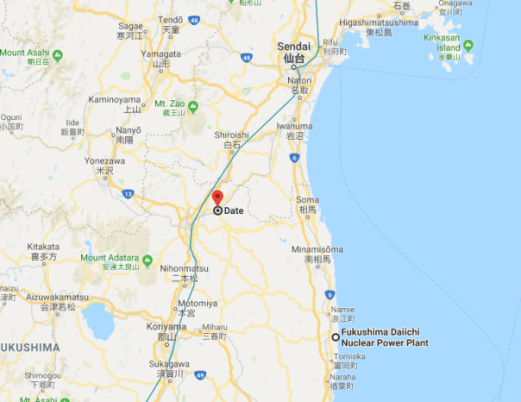 Date is about 60 kilometers from the ruined Fukushima Daiichi nuclear reactors.
“In this highly contaminated environment today, cell DNA would be severely damaged. In addition, the effects of exposure we have already experienced are indelible even if we move now. Whenever I think that children are particularly vulnerable to radiation, my heart is torn apart. As a parent, as an adult, it is heartbreaking and unbearable.
“I am also concerned about the current situation of the Fukushima Daiichi nuclear power plant. My daily routine is to watch out for natural disasters such as earthquakes and to check the condition of the Fukushima Daiichi nuclear power plant. Because today I will not hesitate to evacuate. I changed my job so I could get to my kids quickly if necessary. I had to give up a full time job and it is financially difficult, but the priority is to be able to leave quickly at any time. After verifying all sorts of information, I realized that the government’s announcements were different from reality.
“Living in a radioactive environment requires you to be vigilant tirelessly, whether for shopping, eating, or drinking water, and evaluate the situation yourself to make choices. We had to make up our minds to accept an abnormal lifestyle so that we could continue to live on a daily basis.
“Whatever I do, all pleasure has disappeared from my life. I discovered that there were some hotspots of more than 10 μSv per hour near my home on the way to my children’s school. I reported it to the town hall, but they did not do anything. The reason given is that there is no temporary storage to store it. I had to remove the contaminated soil myself and I stored it in my garden. The city of Date decided on its own decontamination policy and also introduced a standard of 5mSv per year at the end of 2011.
“In my case I wanted to reduce the radioactive pollution as soon as possible and I decontaminated my garden myself. The city encouraged people to decontaminate on their own. I did it too. And that represented 144 bags. The following year I did again. The radioactive debris bags resulting from the decontamination until March 2014 remained in my garden for two years, and were then taken to the temporary storage area.
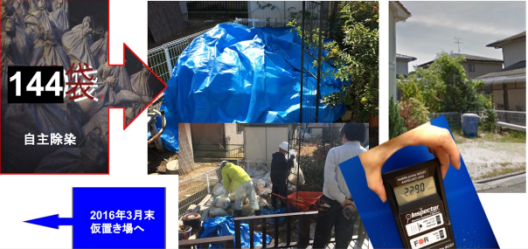 Akemi Shima had to decontaminate her own radioactive garden.
“But since then, the other decontamination bags have not been accepted and are still in my garden. So we do not want to go there anymore. The contamination of our carport amounted to 520 000 Bq (becquerels) 5 years ago, with 5 μSv / h, but it did not fit the criteria required for cleaning. Decontamination only includes the ground around the home, but the roof and the gutters are not supported. As a result, we can not leave our Velux windows open.
“Claiming to be concerned about the health of the inhabitants, the town of Date provided all residents with dosimeters. We were then invited to undergo examinations, during which our data was collected. Without the authorization of the residents, this data has been entrusted to external researchers who have written reports. These reports have been prepared on the basis of personal information obtained illegally, and furthermore falsification of the data is suspected.
“Based on inaccurate data the report concluded that even at doses of 0.6 to 1 μSv / h per hour in the air, the individual dose received would be less than 1 mSv (millisievert) per year and therefore it was not necessary to decontaminate. This is an underestimation of exposure, and clearly a violation of human rights against the population. This case is still ongoing.
“In this same region, leukaemias and rare cancers of the bile ducts are appearing. I cannot help thinking that before the accident it did not exist.
“Even today, while the state of nuclear emergency is still official, this abnormal situation has become our daily life. I fear that the “reconstruction” advocated by the state, violates the fundamental rights of residents and that this unacceptable life is now considered normal. Our lives are at a standstill.
“This suffering will continue. My deepest wish is that through this lawsuit, the responsibility of the State and Tepco that caused the accident be recognized.”
The half lives of the abandoned

Daily life in Fukushima’s radioactive environment
By Cindy Folkers
“Whatever I do, all pleasure has disappeared from my life…we are living with a narrow range of activities.”
Akemi Shima was a resident of Date (duh-tay) City when the reactors at Fukushima exploded, spewing radioactive particles into the air, across the land, and into the waters. (She tells her story in her own words this week as well. See here.)
Her family had moved there years earlier to live closer to nature. It was supposed to be healthy. But for residents of Date City, still blanketed nine years later by radioactive contamination, the struggle for protection of health continues amid accusations of scientific error, betrayal and abandonment.
Shima, now 50, has been living through these accusations and her children’s health issues, while trying to keep her family safe in a contaminated land that has caused fractures within her community. Her experience is not only shared by other victims of Fukushima, but is a cautionary tale for any communities that have nuclear reactors in their midst. We share pieces of her story here for the first time in English.
“The victims have been unable to talk about the damage. … I don’t want to cry. I don’t want to be dismissed… Let me say that something is wrong.”
Instead of establishing mandatory evacuation zones based on contamination level, the government of Japan limited mandatory evacuation to 20 km from the destroyed reactors. Date City had highly contaminated areas but was 60 km away. Therefore, the residents were left to their fate as the City, under direction from the national government, had decided to recommend specific “spots” for evacuation. “Spots” actually meant individual houses and the recommendation to evacuate was based on a number of inconsistent and confusing criteria. This caused division among residents because a “recommended spot” (house) was eligible for evacuation aid, while a house that was often next door received none.
 Evacuation map. Pink area denotes “difficult to return” zones, dots where evacuation orders have been lifted.
While only areas exceeding 20 mSv/year were under recommended evacuation and supposedly only for households with children, in reality exceptions were made. Shima’s family did not evacuate at first because they were not ordered to and she was told her house was safe. It was only later she realized that the workers who came to her town hall wearing white protective suits – while she and her children wore regular clothes and took no precautions – were shielding themselves from radioactivity.
Shima ultimately decided she couldn’t voluntarily relocate because of the medical and familial bonds she had in the community. For those who stayed – like Shima – little warning was given about the need to, or how to, protect against radioactivity. Even after measuring levels that were higher than normal, government officials told residents they were safe and they shouldn’t make trouble.
“…from fall to winter, one week out of every month, all the skin on [my son’s] body turned reddish black; he couldn’t move, and had to stay in bed. He repeatedly experienced having his skin peel off, heal, [and] then peel off again. That continued for approximately 3 years [after the catastrophe began]. Sometimes, he ended up being hospitalized.”
Shima’s son and daughter had eczema, a common skin condition for children in Japan. It worsened considerably soon after the catastrophe. Her son suffered symptoms associated with radiation exposure, including heavy nosebleeds. Nosebleeds were so widespread among Date City’s children that recommendations for treating them were featured in a school health newsletter.
Even though evacuation recommendations were lifted about one year later for certain areas in Date City, many people were hesitant to return to the contaminated zone. The issue of resettlement had not been resolved and studies of human health remained controversial.
Beginning in August 2012, residents in Date City were issued badges to measure their radiation doses and invited to undergo examinations. They were told this was because the town wanted to monitor their health. However, outside researchers published studies using residents’ badge data without their knowledge or permission – a violation of ethical guidelines for human subject research. These studies became mired in distrust, bad science and charges of scientific misconduct.
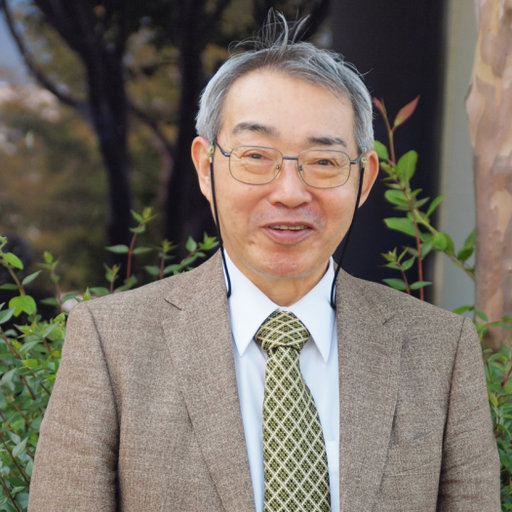 Shin-ichi Kurokawa, professor emeritus of The High Energy Accelerator Research Organization.
Akemi Shima participated in the badge study, and noticed some scientifically questionable practices and assumptions that were later detailed in a paper she co-authored with Shin-ichi Kurokawa, Professor Emeritus of The High Energy Accelerator Research Organization.
In 2019, the University of Tokyo and Fukushima Medical University cleared their researchers — the authors of the controversial badge data studies — of scientific misconduct, a charge requiring intent. However, scientific inconsistencies, mathematical miscalculations and concerns over invalid conclusions remain.
“During my [first] three years in Fukushima, I stopped accepting certain words… ‘Kizuna’, ‘Reconstruction’, and ‘Reputational damage’. In the process of reconstruction and prevention of reputational damage, even the truth has become invisible, and what has happened is just as if it had never happened.”
Kizuna or “ties that bind” is a phrase mobilized by the Japanese government from the earliest days of the disaster to claim that inquiries about radiation harm will hurt the community and therefore people should remain quiet, no matter the suffering.
To rebuild life in Date City, the prefectural government, at the urging of the national government and the International Commission on Radiological Protection (ICRP), attempted to enshrine the reckless notion of “rehabilitation” – the idea that one can live with radioactive contamination and that health and recovery responsibilities reside with individuals and communities, not industry or government. Adopting a “rehabilitation/recovery” regime mandates that residents’ concerns about health impacts and continuing exposure are downplayed or brushed aside altogether, even by institutions that should be trustworthy.
A year after the nuclear catastrophe began, Shima’s daughter, already under periodic heart monitoring for an unrelated childhood condition which had now passed, had a benign bone tumor removed from her leg. Her daughter had trouble getting up in the morning and was diagnosed with a condition related to chronic fatigue syndrome. At this time, Shima also had her children examined by Fukushima Prefecture as part of the Fukushima Health Management Survey established by Fukushima Medical University to track health after the catastrophe began. When the prefecture examined Shima’s 11-year old daughter she was told there were no abnormalities. However, after a second examination, doctors from a different clinic found two thyroid cysts. Her 13-year old son had one cyst detected by the prefecture, but upon the second screening, also at a different facility, two were found.
Other families tell of inconsistent test results between Fukushima Prefecture exams and those conducted at other institutions. Shima relates how examinations varied at the different institutions with the prefecture examination taking a few seconds to a few minutes while the second clinic took more than 10 minutes. Such a short time will miss lesions that could lead to cancers, according to a doctor at the clinic who performed the reexaminations. The prefectural clinics authorized by FMU to conduct exams refuse to hand over personal medical data to the patient without a cumbersome request system and payment for materials reproduction, further stoking mistrust among exposed inhabitants.
Additionally, prefecture experts claim that thyroid cancers after Chernobyl didn’t appear until four or five years after exposure. They therefore conclude the circumstances will be the same for Fukushima, despite what appear to be increases in metastatic thyroid cancers. Shima has noticed the appearance of other rare types of cancers as well that are not receiving the attention that thyroid cancer has.
“Responsibility for the nuclear accident is neglected, and everything else is “self-responsibility”. “I know well…[t]he limits of decontamination.”
Akemi Shima and other residents feel abandoned; first because they were told it was safe to stay; and now because they are largely left with responsibility for cleaning up TEPCO’s radioactive legacy. If Date City residents want levels lower than 5 mSv/year, they have to do the cleanup themselves; despite the ICRP recommended 1 mSv per year level; and despite levels below 4 mSv being associated with increases in childhood cancers and impairment of neural development during pregnancy.
“Living in a radioactive environment requires you to be vigilant tirelessly, whether for shopping, eating, or drinking water, and evaluate the situation yourself to make choices. We had to make up our minds to accept an abnormal lifestyle so that we could continue to live our daily lives.”
Shima points out that even if short-lived radiocesium has completely decayed, the level of radioactivity is still 10 times what it was before the catastrophe. It will likely remain so for generations, as demonstrated by the radiological contamination from Chernobyl. Shima relates how even higher doses are dismissed by officials. They claim that those areas are passed through, not lived in. But these officials do not account for children playing in those areas.
“I believe that we were tossed in all directions and set against one another, so that the victims themselves would be unable to discuss the harm.” “Our lives are at a standstill. This suffering will continue.”
International radiation committees and national regulatory bodies are establishing recommendations that will make living with increased radiation exposure from nuclear disasters seem okay. In Japan, staying silent is encouraged. In the wake of the ongoing Fukushima disaster, the government of Japan has raised the radiation exposure limit from the ICRP-recommended 1 mSv per year to 20mSv per year. Japan has also been cutting payments to Fukushima refugees in a bid to force them to resettle the contaminated areas they initially left; and ICRP has hosted dialogues across the country (one was held in Date City) encouraging residents to live with radiation rather than leave, claiming such action is “resilient” and community-minded (kizuna).
International radiation committees are claiming health examinations of children cause stress and should only be conducted for thyroid exposures at certain doses. These doses are higher than those associated with disease. Despite claiming that living in a radioactive environment is extremely difficult, ICRP still encourages it.
In the US, the Environmental Protection Agency has released guidance allowing much larger environmental doses of man-made radiation with very little assurance when the exposures will cease. Women and children are not spared.
Living with radioactive contamination divides communities into those that want to raise awareness of the danger radioactivity poses, and those who do not want to discuss it for fear of social discrimination and ostracization. Akemi Shima’s lived experience, and her public testimonies about it, should serve as a warning to anyone living with a nuclear reactor in their midst.
The author would like to thank Norma Field, professor emerita, University of Chicago, for help with content, translation and communication.
A message from Mr. Sumio Konno, a former nuclear engineer in Japan.
[ Voices from Japan: 9 years after the Fukushima nuclear disaster ] 2020 March video project by Manhattan Project for a Nuclear-Free World English subtitle by John Baldwin, Karen Rogers, Mari Inoue, Rachel Clark, Stephan Ready, Tarak Kauff, Tony Sahara, Yoko Chase
Soil from decontamination work kept in communities

March 8, 2020
Nine years after the Fukushima Daiichi nuclear accident, more than half of the waste created by decontamination work is still kept near residents’ homes.
About 14 million cubic meters of soil and vegetation has been collected in clean-up operations in areas affected by the nuclear accident in Fukushima Prefecture, except for heavily contaminated off-limit areas.
The environment ministry plans to transfer all such waste to intermediate storage facilities near the crippled nuclear power plant by March 2022.
As of the end of February, only about 6.3 million cubic meters, or around 45 percent of the total waste, had been transferred to the facilities.
The rest was stored at school compounds, parks, and temporary storage sites.
Environment Minister Shinjiro Koizumi told reporters on Friday that the waste needs to be removed from the locations as quickly as possible so that local residents can feel secure.
What ‘Fukushima 50’ can teach us about crises
 A scene from “Fukushima 50” the recent film adaptation of “On the Brink : The Inside Story of Fukushima Daiichi.”
March 7, 2020
After the March 11, 2011, earthquake and tsunami crippled the Fukushima No. 1 nuclear power plant, much of the foreign press focused on what it dubbed the “Fukushima 50” — a small band of workers whose life-or-death actions prevented a catastrophic meltdown.
Author Ryusho Kadota interviewed many of these frontline workers (which he found to number 69, not 50). He also spoke with Fukushima No. 1 plant manager Masao Yoshida, who headed the emergency response team, and former Prime Minister Naoto Kan, who took an active — and controversial — role in the government’s reaction to the disaster.
Based on his reporting, Kadota wrote the 2012 nonfiction novel “Shi no Fuchi o Mita Otoko,” published in translation as “On the Brink: The Inside Story of Fukushima Daiichi.” Filled with drama, such as the desperate struggle of workers to open plant vents to avoid radiation-spewing explosions, “On the Brink” has since become a feature film, “Fukushima 50,” that stars Ken Watanabe as Yoshida.
In a recent interview at the Tokyo headquarters of publisher Kadokawa, Kadota says he told the filmmakers to “adapt (the book) freely.”
“In fact, when I first read the script, I told them that there wasn’t enough drama in it,” Kadota says. “I wanted them to add more.”
The film departs from the book most notably in the matter of names: The only character with the name of a real person is Watanabe’s Yoshida.
“The book (in Japanese) is quite long — 400-some pages — and the movie is only two hours, so they made composite characters out of two or three actual people,” Kadota explains. “But Yoshida, I thought, should be Yoshida. And the film as a whole is close to the truth.”
 Inside scoop: Following the 3/11 triple disaster, author Ryusho Kadota interviewed many of the frontline workers at the Fukushima No. 1 nuclear power plant, whose life-or-death actions prevented an even greater catastrophe.
And the truth, as the film graphically illustrates, is that Japan came terrifyingly close to nuclear apocalypse, narrowly averted by the heroic efforts of frontline workers, as well as Yoshida’s decision to ignore orders from officials at Tokyo Electric Power Co., the plant’s owner, to stop cooling the reactors with seawater. They were concerned about damage to the reactors, but with nothing else to adequately cool them, Yoshida knew it was either seawater — or a Chernobyl-like disaster.
Domestic media, Kadota says, were less aggressive than their foreign counterparts in ferreting out the facts.
“They didn’t report on what was actually happening,” he says.
Instead, he says, domestic coverage became divided into two camps, with one bashing nuclear power and other supporting it. The bashers, he says, “didn’t know what was going on inside (the plant) — and that motivated me. I knew I had to find out. I’m not in one camp or the other. I believe our mission as journalists is to report the truth, wherever it leads.”
To this end, Kadota spent 16 months interviewing more than 90 subjects. His conclusion: “Japan is what it is today because they were successful in opening the vents in the No. 1 plant. If they hadn’t succeeded, we would be doing this interview in Osaka. You wouldn’t be able to live in eastern Japan — the middle third of the country.”
The reason for that success, Kadota believes, is that workers were willing to risk their lives to save the plant — and their communities.
Some similarities are apparent with the situation in Japan at present, as doctors, nurses and other medical workers are battling the novel coronavirus. The government has come under criticism for its response to the crisis, as had Kan and Tepco in the wake of the disaster at the Fukushima nuclear plant.
“I have to write a book about this crisis as well,” Kadota says. “The government’s response has been terrible, just as it was back then.”
He refers to the passengers aboard the Diamond Princess cruise ship, who became infected in large numbers after government health officials decided to enforce an onboard quarantine.
“I feel sorry for them,” Kadota says. “The way they were treated was problematic to say the least.”
He mentions infectious disease specialist Kentaro Iwata, whose video about his inspection of conditions aboard the Diamond Princess went viral after he posted it online on Feb. 18 (he has since deleted the upload).
“(Iwata) said he wasn’t afraid when he dealt with Ebola in Africa because protective measures there were perfect, but he was deathly afraid aboard the Diamond Princess because it was so chaotic,” Kadota says. “I can totally relate to that.”
But Kadota is most angry, he says, at what he describes as “Japan’s lack of a national security mind-set.”
“Yoshida knew he had to cool the reactors with seawater to protect the lives of the Japanese people and avoid the destruction of eastern Japan,” Kadota says. “But the Prime Minister’s Office didn’t see it that way.” A Tepco adviser to Kan told Yoshida to stop injecting seawater into the reactor, since the prime minister was concerned that seawater might cause the melted fuel rods to resume criticality. Kan later denied interfering with Yoshida’s decision to cool the reactors with seawater.
“We have much the same situation now,” Kadota says. “We have (Prime Minsiter Shinzo) Abe, not someone like Masao Yoshida, as prime minister.
“The prime minister’s most important duty is to protect the citizens of the nation,” Kadota says. “That’s first and foremost. But some people forget that.”
One who does have that sense, Kadota notes, is Masahisa Sato, an outspoken member of the Upper House and a former state minister for foreign affairs.
“He’s been saying from the start of this that Japan should prohibit entry to anyone from China,” Kadota says. “And I’ve been saying it myself.”
Kadota also says Japan needs an equivalent to the Centers for Disease Control and Prevention, the U.S. government agency in charge of public health.
“They have a staff of 14,000 with a national mission to keep infections from spreading,” he says. “Japan has nothing like it.”
What it does have now, he notes, is a shortage of face masks and other supplies for protection against the coronavirus.
“Yesterday I retweeted a post from a friend who said someone had sneezed on his neck in a crowded train,” Kadota says. “What can you do? You can’t get rid of the crowded trains and you can’t find masks anywhere in the city. So people are on crowded trains, morning after morning.
“Doesn’t all this make you angry?” he asks. I tell him it does.
However, the big takeaway from “On the Brink” is not that Japanese officialdom has an enraging habit of bumbling in major disasters; it’s that heroes do exist here and can make a huge, life-saving difference, especially if officialdom supports them rather than stymies them. Kadota has yet to find many heroes in the current crisis, but he’s only just begun.
Film lauding Japan’s Fukushima heroes warns against complacency
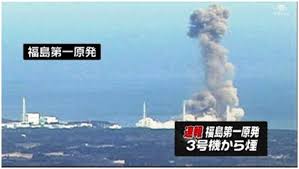
March 6, 2020
TOKYO (Reuters) – As aftershocks rock the Fukushima nuclear plant, a small band of workers defy their bosses to stay on and fight to stop an even bigger disaster from irradiating a wide swathe of Japan.
The scene is from a movie that opened on Friday – “Fukushima 50”, which tells the true story of the hours after a quake and tsunami set off meltdowns at the Fukushima Daiichi reactors on March 11, 2011.
Almost nine years to the day after that disaster, its depiction of individual heroism in the face of official bungling and overwhelming catastrophe has struck a chord with early viewers.
“I don’t think I’ve ever started crying so quickly during a movie. Partly that’s because I had flashbacks,” said a commenter called “n_n” on Yahoo’s movie review page.
Much has moved in on Japan since Fukushima, the world’s worst nuclear disaster since Chernobyl in 1986.
Authorities are now fighting another emergency, the spread of the new coronavirus. They are also pressing on with plans for the 2020 Olympics, which is due to kick off with a torch relay starting at Fukushima in three weeks’ time.
But, nine years on, workers in protective suits are still removing radioactive material from Fukushima’s reactors, and the film’s scenes – mixed in with news footage from the time – still pack an emotional punch.
“It sucked me right in within the first 10 minutes. The tension didn’t let up for the rest of the movie, and I was struck by the incompetence of the then-government,” wrote another Yahoo commentator, calling themselves “wan”.
“SURPRISED AND MOVED”
“Nobody in the country knew any of this was going on while it was happening. I was really surprised and moved,” said Yoshinori, a 56-year-old photographer, out for a noon showing of the film in Tokyo with his wife.
“Everybody in Japan should see this,” he added. “I think memories of that disaster are fading. I came to make sure I kept them fresh.”
“The Fukushima Fifty” was the name given to the group of workers and engineers who stayed behind after the tsunami knocked out the power and cooling systems at the plant, run by Tokyo Electric Power Co (TEPCO).
Led by Masao Yoshida – portrayed in the film by Ken Watanabe, one of the stars of “The Last Samurai” and “Letters from Iwo Jima” – they began running seawater into the reactors as an emergency cooling measure.
When their bosses back at TEPCO headquarters ordered them to stop, Yoshida ignored the order – rescinded hours later – and kept going.
He is shown yelling at his bosses during video conferences – scenes that Watanabe said were based on accounts from Yoshida’s colleagues. The engineer died in 2013 from esophageal cancer, aged just 58.
“When I made the film ‘Letters from Iwo Jima,’ I felt that Japan isn’t very good at learning lessons from the past,” Watanabe told a news conference after filming finished last year, referring to the Clint Eastwood film depicting the World War Two battle.
“I feel the same way about Fukushima,” he added.
Reporters Without Borders urges Japan to stop pressuring the media on Fukushima-related topics
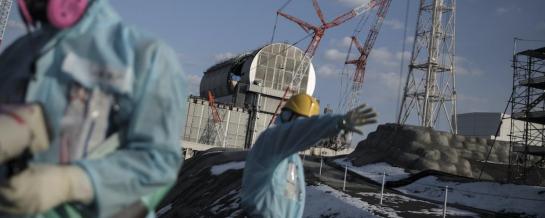
March 6, 2020
As Japan commemorates the 9th anniversary of the Fukushima disaster, Reporters Without Borders (RSF) urges the authorities to let journalists freely report on the topic.
On Wednesday, March 11th, Japan will commemorate the 9th anniversary of the Fukushima Daiichi nuclear plant accident, the worst atomic disaster after Chernobyl, caused by a tsunami and collectively resulting in 18,500 dead and missing, 160,000 evacuees and a continuous release of massive amounts of radioactive materials until today. Since the accident, the media have consistently encountered pressure and censorship attempts when trying to investigate the topic.
Reporters Without Borders (RSF) urges the Japanese authorities to ensure that the media can freely report on the Fukushima-related topics and requests a full access for all journalists, including foreign correspondents and freelancers, to the contaminated sites and to all raw data available.
“It is essential for the public to access independent information on the accurate radiation levels,” says Cédric Alviani, RSF’s East Asia bureau head. “The government is currently encouraging the remaining evacuees to settle back to the contaminated areas, but it must be fully transparent on the health hazard residents would be exposed to.”
Many Japanese journalists denounce heavy self-censorship in the media, which they attribute to the government and nuclear lobby’s efforts at concealing information seen as giving a “negative image” of Japan and hindering the preparation of the 2020 Olympic Games, set in Tokyo this summer.
A senior TV reporter who formerly worked for a major news program and wishes to remain anonymous recalls “intense pressure from the government and advertisers” to discourage his team from reporting on the long-term effects of the radioactive substances released by the plant. “We even heard of phone calls from Prime Minister Shinzo Abe’s cabinet asking our management to move some journalists they disliked to another department.”
In 2014, the board of daily newspaper The Asahi Shimbun even had to make a public apology for having published an article pointing out that 90% of the nuclear plant’s employees were offsite during the accident, drawing the government’s ire. The authors, award winning journalists Hideaki Kimura and Tomomi Miyazaki, were transferred to a non-writing section and later forced to resign.
Martin Fackler, who served as the New York Times Tokyo bureau chief from 2009 to 2015, considers that the authorities “clearly lack transparency” and believes that the Asahi Shimbun’s retraction case “successfully deterred other big media from investigating Fukushima-related stories.”
UN Special Rapporteur on Freedom of Expression David Kaye has expressed serious concerns about freedom of the press in Japan in 2017, and noted a further erosion in 2019.
Japan ranked 67th out of 180 in the 2019 World Press Freedom Index.
https://rsf.org/en/news/rsf-urges-japan-stop-pressuring-media-fukushima-related-topics
9 Years On: Fukushima N-Plant Lawsuits Await High Court Rulings
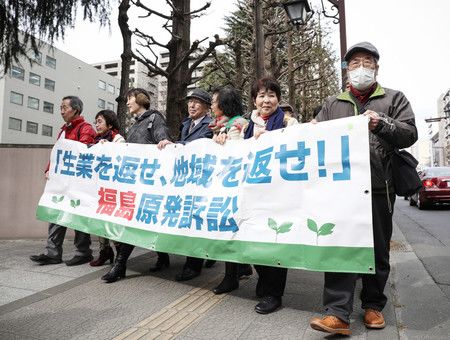
March 6, 2020
Tokyo, March 6 (Jiji Press)–High courts in Japan are hearing a series of damages lawsuits filed by evacuees from the country’s unprecedented nuclear accident that occurred in Fukushima Prefecture nine years ago.
The focal point is how the courts will assess the liability of the Japanese government, which has been flatly denying its responsibility over the accident at Tokyo Electric Power Company Holdings Inc.’s Fukushima No. 1 nuclear plant.
The plant suffered a triple reactor meltdown after being hit by a massive earthquake and tsunami on March 11, 2011, forcing many residents to evacuate.
So far, six of 10 district courts found the government responsible for the nuclear accident, while the other four did not recognize government liability.
Key issues are whether the government was able to predict the huge tsunami and was able to avert the catastrophe by taking preventive measures.
Work on Fukushima plant, halted during 2016 G7 summit, to continue during Tokyo Olympics
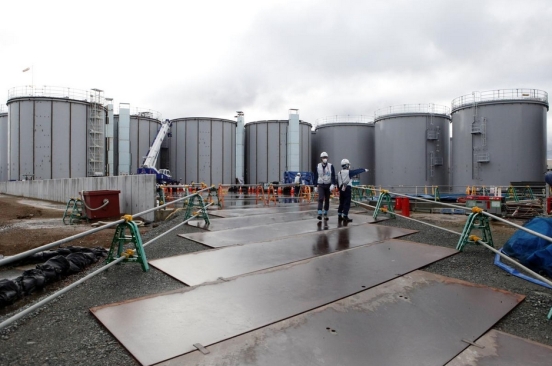 Workers are seen near storage tanks for radioactive water at Tokyo Electric Power Co’s (TEPCO) tsunami-crippled Fukushima Daiichi nuclear power plant in Okuma town, Fukushima prefecture, Japan January 15, 2020. Picture taken January 15, 2020
March 4, 2020
TOKYO (Reuters) – Decommissioning work at Japan’s crippled Fukushima nuclear power station, halted during a G7 summit in Japan in 2016, will not stop during this summer’s Tokyo Olympics, the plant operator said.
There are about a third fewer workers now – 4,000 compared with 6,000 in 2016 – which makes the decision to keep working easier, said Akira Ono, Tokyo Electric Power Co’s (Tepco) chief decommissioning officer.
“When I was the plant manager, I suspended operations at the time of the Ise-Shima summit. But the situation is totally different now,” Ono told Reuters in an interview.
Although the coronavirus outbreak – which has sickened more than 1,000 Japanese – has disrupted supply chains, there has been no shortage of protective gear at the plant, he added. Workers must wear special clothing to protect them from residual radiation in some parts of the facility.
“There was a time when coverall supply became quite tight … But after talking with various sources, we are now sure that we can procure what we need,” Ono said in the interview conducted on Tuesday but embargoed till Wednesday.
A powerful earthquake and tsunami hit eastern Japan in March 2011 and knocked out cooling systems at Tepco’s Fukushima Daiichi nuclear power plant, triggering the worst nuclear accident since Chernobyl in 1986.
Since then, the operator has been working to clean up the damage and contain any spread of radiation.
For the last nine years, Tepco has been pouring water over melted reactor cores to keep them cool. Nearly 1.2 million tonnes of tainted water, enough to fill 480 Olympic-sized swimming pools, is stored at the plant. The company treats the water to remove most radioactive material.
A government panel reviewing potential disposal methods has recommended releasing the water into the sea after dilution. Local residents, fishermen in particular, strongly oppose the ocean discharge.
Ono said that the plant will likely run out of tank space by summer 2022.
“The time is getting near,” Ono said, referring to a decision on the disposal method. “We are cutting it very close.”
Japanese trade and industry minister Hiroshi Kajiyama said last month the government would decide after hearing opinions from people in local communities and others, without committing to a deadline.
The Coronavirus Exposes Why the Tokyo 2020 Olympics Should Be Canceled
The Tokyo Olympics were already unsafe. Now, they’re even more so.
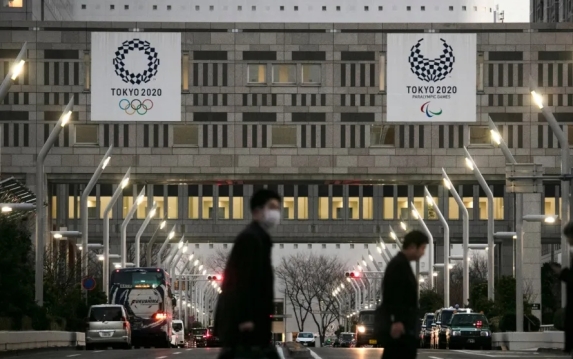 People walk across a pedestrian crossing near the Tokyo Metropolitan Government building adorned with signs promoting the 2020 Olympics.
March 4, 2020
Can anime become prophecy? The 1988 Japanese anime classic Akira predicted that Tokyo would host the 2020 Olympics. One scene featured a billboard reading “147 Days Until the Games”—directly beneath it someone scrawled in graffiti, “Just cancel it!” Here we are roughly 140 days ahead of the Tokyo Summer Olympics, and the cancellation—or postponement—of the Games is a real possibility, because of the emergence of COVID-19, or the novel coronavirus.
As Stanford University professor Yvonne Maldonado put it, with the Olympics, “You bring a lot of people together, and then you ship them back all over the world: That’s the perfect way to transmit.” The infectious disease specialist added, “If you really want to disseminate a disease, that would be the way to do it.”
At least one member of the International Olympic Committee, Dick Pound of Canada, seems to agree. In an interview with the Associated Press, he set off alarm bells, stating that the International Olympic Committee (IOC) probably needs to decide whether to press ahead with the Tokyo Games by the end of May. “In and around that time, I’d say folks are going to have to ask: ‘Is this under sufficient control that we can be confident about going to Tokyo or not?’” Postponing the Games—an idea posed by Seiko Hashimoto, Japan’s Olympic minister this week—is now an open possibility, but also unrealistic, as doing so would interfere with the US college and NFL fall football schedule. Given the billions that NBC has plunged into the Olympics—the network forked over $4.4 billion in 2011 for broadcasting rights through 2020 and then a whopping $7.7 billion for the Games running through 2032—its insistence would almost certainly be that the Games must go on, short of a global pandemic.
In truth, though, the Games should have been canceled well ahead of the coronavirus outbreak, especially if Olympic organizers and their allies in Japan’s government cared about public health. Tokyo organizers have branded the Olympics the “Recovery Games,” replete with “recovery monuments” to honor the triple-whammy earthquake, tsunami, and nuclear meltdown at the Fukushima Daiichi nuclear power plant in 2011. They even created a bizarre graphic (pictured below) that depicts a circle of appreciation, with “the disaster-affected areas” offering support for the Olympic athletes, which will “cheer up” the world. “The world,” in turn, will express gratitude, which will “cheer up” the disaster-affected areas. (The graphic was available on this website until today.)
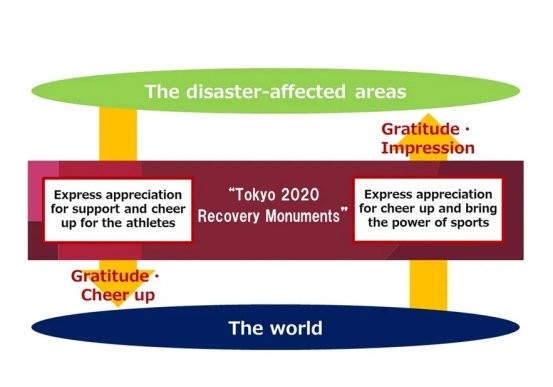 Graphic of “the disaster-affected areas” that will “cheer up” the world, which was available on Tokyo 2020’s website until today.
This, of course, is pure-grade PR gibberish. We visited Fukushima in July 2019 and spoke with locals who were livid that Fukushima was being used as an Olympic prop. We saw “black pyramids” comprised of large plastic bags of radiation-drenched soil. We saw abandoned homes and businesses that surely could have used the billions that are being funneled into the Games—some $26 billion, according to a government audit, despite the fact that the original price tag for the Tokyo Olympics was $7.3 billion.
Instead of material support, Olympic honchos have offered Fukushima residents mere symbolism: The Olympic torch relay will kick off in Fukushima next month, despite the fact that Greenpeace recently uncovered radiation hot spots along the torch relay route. Olympic bigwigs have also scheduled baseball and softball games in Fukushima Prefecture. In short, the “Recovery Games” moniker amounts to a cruel joke. As Satoko Itani, a professor of sport, gender, and sexuality studies at Kansai University, told us, “This Olympics is literally taking the money, workers, and cranes away from the areas where they are needed most.”
The coronavirus may well benefit elected officials with an authoritarian streak, as public health crises can be a recipe for free-range autocracy. Japanese Prime Minister Shinzo Abe has long demonstrated a “disturbing authoritarian pattern,” as Bloomberg News referred to it. And he has also shown an alarming capacity to lie to get what he wants. Shinzo Abe has been adamant that there is no need to postpone the Tokyo Games, but there’s a “prime minister who cried wolf” dynamic at play here. After all, back in 2013 when Tokyo was bidding on the Olympics, he told voting members of the IOC who were jittery about Fukushima that the situation was “under control” even though it clearly wasn’t. For many, when they hear Abe and other officials saying that the coronavirus will not affect the Olympics, they hear the resounding echo of previous empty promises.
It must be noted that even if they cancel the Tokyo Games, the damage has already been done. Everyday people have been displaced for Olympic facilities and that cannot be rolled back. Workers have set up infrastructure in Fukushima and their exposure to radiation has already taken place.
What about relocating the Games to a previous host? Shaun Bailey, a candidate running for mayor of London, suggested transferring the Olympics there, but many of the 2012 venues are gone and residents are now living in the apartments that previously made up the Olympic Village. Rio, host of the 2016 Olympics is an obvious no-go, with venues in various states of dilapidation and the country mired in a right-wing hatescape that does not even vaguely chime with the lofty principles enshrined in the Olympic Charter. And cariocas—Rio’s residents—have little interest in the Olympics’ returning to town. The IOC left a bitter taste in Rio, when it said it was unwilling to help them pay off a few bills left in the Games’ wake.
As for the economic damage that canceling the Olympics could do to Japan, one could argue that the harm has been done. In addition to the displacements, the Olympics have already granted huge giveaways of land to the developers who are building the Athletes Village and that will not change because of a virus—or even a cancellation. The writing is on the wall: There is ample reason to cancel these Olympics for the good of Japan. The coronavirus only lays those reasons bare.
https://www.thenation.com/article/society/coronavirus-tokyo-2020-olympics/
Japan lifts evacuation order for town hit by Fukushima disaster
Futaba to reopen for start of Olympic torch relay after being deserted for nine years
 The entrance of Futaba town, which has been empty since the leak at the nearby Fukushima Daiichi nuclear power plant in 2011.
March 4, 2020
Japan has lifted an evacuation order for parts of a town in the shadow of the wrecked Fukushima Daiichi nuclear power plant, weeks before the area is to host the start of the Olympic torch relay.
Futaba, 2.4 miles (4km) west of the plant, has been almost deserted since the nuclear meltdown nine years ago, while other areas in the region have mounted a partial recovery after the government declared them safe for residents.
The start of the relay’s Japan leg at the end of the month is supposed to showcase Fukushima’s recovery from the world’s worst nuclear accident since Chernobyl in 1986, but some residents say their home towns may never return to normal.
Futaba’s 7,000 residents were forced to evacuate after the March 2011 disaster, which was triggered by a powerful earthquake and tsunami that killed more than 18,000 people along Japan’s north-east coast.
The reopening of a 1.5 sq mile area of Futaba means reconstruction workers can stay in accommodation near the railway station, but residents will not be able to return for another two years, when its water supply and other infrastructure will have been restored, according to local officials.
They will be able to enter and leave for short visits without going through security, and will no longer need to wear protective clothing, but will not be allowed to stay overnight.
While the coronavirus outbreak has prompted speculation that the Olympics could be cancelled or postponed, Japan’s government is keen to promote Tokyo 2020 as proof that the region, including Fukushima, has recovered from the triple disaster.
“I’m overwhelmed with emotion as we finally bring part of our town operations back to our home town,” said Futaba’s mayor, Shiro Izawa. “I pledge to push forward with our recovery and reconstruction.”
The domestic leg of the torch relay is due to begin on 26 March at J-Village, a football training complex that functioned for years as a logistics hub for crews working to control and decommission the damaged nuclear plant 12 miles away.
Although organisers have said the route is subject to change, the torch is scheduled to pass through Futaba later the same day, before being taken through other parts of Fukushima prefecture over the following two days.
 A guard opens the gate to the town in Futaba.
“In addition to building excitement across the country ahead of the Tokyo 2020 Games and promoting the Olympic values, the Olympic torch relay aims to demonstrate solidarity with the regions still recovering from the 2011 earthquake and tsunami,” the organisers said last month.
More than 160,000 people were forced to flee their homes during the Fukushima meltdown. Many have decided not to return, despite government reassurances on safety, and many of those who have returned are older residents.
Futaba is no exception, with just 10% of residents saying they intend to return. Some, particularly those with young children, are concerned about radiation levels, while others have built new lives elsewhere.
Yuji Onuma, a Futaba resident, said recent work to repair streets and decontaminate the town centre was designed to give the world a false impression before the Olympic torch relay.
“I wish they wouldn’t hold the relay here,” Onuma told Reuters. Pointing at workers repaving a road expected to be on the relay route, he added: “Their number one aim is to show people how much we’ve recovered. I don’t think people will understand anything by just seeing cleaned-up tracts of land.”
Radiation readings in the air taken in February near Futaba’s railway station were around 0.28 microsieverts per hour, higher than the government-set target of 0.23 microsieverts an hour.
Another part of the town had a reading of 4.64 microsieverts per hour on the same day, meaning a person would reach the annual exposure upper limit of 1 millisievert, recommended by the International Commission on Radiological Protection, in just nine days.
The torch is due to pass through the village of Iitate the following day, but campaigners this week described the relay as inappropriate and warned they had found radiation “hotspots” in the village.
In a survey of 69 locations along and around the proposed relay route, the grassroots group the Radioactivity Monitoring Centre for Citizens said it had found 44 sites with radioactive levels above 0.23 microsieverts per hour, including one “severe hotspot” of 0.85 microsieverts per hour along the torch relay route.
The discovery of hotspots near J-Village by Greenpeace Japan at the end of last year prompted the environment ministry and the nuclear plant’s operator, Tokyo Electric Power, to perform extra decontamination work.
While some independent monitors have said the discovery of isolated hotspots does not present an accurate picture of the overall situation in Fukushima, Nobuyoshi Ito, an Iitate farmer, said the civic group’s findings cast doubts on government claims that decontamination work had been a success.
“Radiation exposure for runners passing along the route may not be very high, but the overall situation in places like Iitate is severe,” Ito said. “Levels are several times to as many as 20 times higher in the village than they were before the disaster, and people who moved back have to put up with that 24 hours a day, 365 days a year.”
Of Iitate’s pre-disaster population of 6,100, only 1,200 people have returned, Ito said. “The small number of people coming means that the nuclear disaster is not over yet. The truth is that full recovery from a nuclear disaster like this is just not possible.”
Aoki, Ito and Nakamura: “Radioactive Hotspots along Olympic Torch Relay Route
“
Kazumasa Aoki: Vice President, Radioactivity Monitoring Center for Citizen / Nobuyoshi Ito: Iitate Village Resident / Jun Nakamura: Co-Chairman, Fukuichi Area Environmental Radiation Monitoring Project
Thanks to FCCJ for this interview and also for restoring bilingual format. Thanks also for an excellent translation by Mary Joyce, whose contribution is often unmentioned. Although the Covid-19 and Fukushima disaster appear unrelated, I see parallel relationship. Abe’s Japanese government tends to hide the truth as if the politicians believe in the three monkeys carved in Nikko Shrine. See no evil, Hear no evil, Speak no evil. The government’s reluctance to measure and publish the soil contamination at Fukushima is analogous to that of their reluctance to conduct PCR test to grasp the real spread of the corona virus. I used to use a term “Okami to Hitsuji (sheep)” to describe the relationship between Japanese government and the docile citizens. Making a reference to the above observations, however, it is more like “Okami to Hatsuka Nezumi (white mice)” because people are used as a subject of a massive Bio-Medical experiments. I do not know any other countries, in which the government can get away with their misconducts of this magnitude. However, I see some hope by listening to the three gentlemen who gave the interview. They speak the facts in much better Japanese than the average Japanese politicians. Thanks again to FCCJ to shed a light on the news, which would be buried otherwise.
In Fukushima, Olympic torch relay faces cool welcome from nuclear evacuees

March 2, 2020
FUTABA, Japan (Reuters) – Dressed in protective plastic coveralls and white booties, Yuji Onuma stood in front of the row of derelict buildings that included his house, and sighed as he surveyed his old neighborhood.
On the once-bustling main street, reddish weeds poked out of cracked pavements in front of abandoned shops with caved-in walls and crumbling roofs. Nearby, thousands of black plastic bags filled with irradiated soil were stacked in a former rice field.
“It’s like visiting a graveyard,” he said.
Onuma, 43, was back in his hometown of Futaba to check on his house, less than 4 kilometers from the Fukushima nuclear power plant, which suffered a triple meltdown in 2011 following an earthquake and tsunami, leaking radiation across the region.
The authorities say it will be two more years before evacuees can live here again, an eternity for people who have been in temporary housing for nine years. But given the lingering radiation here, Onuma says he has decided not to move back with his wife and two young sons.
Most of his neighbors have moved on, abandoning their houses and renting smaller apartments in nearby cities or settling elsewhere in Japan.
Given the problems Futaba still faces, many evacuees are chafing over the government’s efforts to showcase the town as a shining example of Fukushima’s reconstruction for the 2020 Tokyo Olympics.
While there has been speculation that the global spread of the coronavirus that emerged in China last month might force the cancellation of the Olympics, Japanese officials have said they are confident the Games will go ahead.
The Olympic torch relay will take place in Fukushima in late March – although possibly in shortened form as a result of the coronavirus, Olympic organizers say – and will pass through Futaba. In preparation, construction crews have been hard at work repairing streets and decontaminating the center of town.
“I wish they wouldn’t hold the relay here,” said Onuma. He pointed to workers repaving the road outside the train station, where the torch runners are likely to pass. “Their number one aim is to show people how much we’ve recovered.”
He said he hoped that the torch relay would also pass through the overgrown and ghostly parts of the town, to convey everything that the 7,100 residents uprooted of Futaba lost as a result of the accident.
“I don’t think people will understand anything by just seeing cleaned-up tracts of land.”
“UNDER CONTROL”
In 2013, when Prime Minister Shinzo Abe was pitching Tokyo as the host of the 2020 Games to International Olympic Committee members, he declared that the situation at the Fukushima nuclear plant was “under control”.
The Games have been billed as the “Reconstruction Olympics” – an opportunity to laud Japan’s massive effort to rebuild the country’s northeastern region, ravaged by the earthquake and tsunami, as well as the meltdowns at the nuclear plant owned by Tokyo Electric Power Co.
After the disaster, the government created a new ministry to handle reconstruction efforts and pledged 32 trillion yen ($286.8 billion) in funding to rebuild affected areas.
 Yuji Onuma, an evacuee from Futaba Town near tsunami-crippled Fukushima Daiichi nuclear power plant, walks next to a collapsed shop on the street in Futaba Town, inside the exclusion zone around the plant, Fukushima Prefecture, Japan February 20, 2020.
Signs of the reconstruction efforts are everywhere near the plant: new roads have been built, apartment blocks for evacuee families have sprouted up, and an imposing tsunami wall now runs along the coastline. An army of workers commutes to the wrecked plant every day to decommission the reactors.
In March, just days before the Olympic relay is scheduled to be held across Fukushima, Japan will partially ease a restriction order for Futaba, the last town that remains off-limits for residents to return.
This means that residents like Onuma will be able to freely come and go from the town without passing through security or changing into protective clothing. Evacuees will still not be able to stay in their homes overnight.
After a few years bouncing between relatives’ homes and temporary apartments, Onuma decided to build a new house in Ibaraki, a nearby prefecture. His two sons are already enrolled in kindergarten and primary school there.
“You feel a sense of despair,” said Onuma. “Our whole life was here and we were just about to start our new life with our children.”
When Onuma was 12, he won a local competition to come up with a catchphrase promoting atomic energy. His words, “Nuclear Energy for a Brighter Future” was painted on an arch that welcomed visitors to Futaba.
After the nuclear meltdowns, the sign was removed against Onuma’s objections.
“It feels like they’re whitewashing the history of this town,” said Onuma, who now installs solar panels for a living.
The organizing committee for the Tokyo 2020 Olympics did not respond to requests for comment from Reuters.
“BACK BURNER”
Other residents and community leaders in nearby towns say the Olympics may have actually hindered the region’s recovery.
Yasushi Niitsuma, a 60-year-old restaurant owner in Namie, said the Olympics stalled local reconstruction projects because of surging demand and costs to secure workers and materials ahead of the games in Tokyo.
“We need to wait two years, three years to have a house built because of the lack of craftsmen,” said Niitsuma. “We are being put on the back burner.”
Fukushima’s agriculture and fisheries industries have also been devastated.
“I was astonished by the “under control” comment made in a pitch to win the Olympic Games,” said Takayuki Yanai, who directs a fisheries co-op in Iwaki, 50 kilometers south of the nuclear plant, referring to Abe’s statement.
“People in Fukushima have the impression that reconstruction was used as a bait to win the Olympic Games.”
A government panel recently recommended discharging contaminated water held at the Fukushima plant to the sea, which Yanai expects to further hurt what remains of the area’s fisheries industry.
At a recent news conference, Reconstruction Minister Kazunori Tanaka responded to a question from Reuters about criticism from Fukushima evacuees.
“We will work together with relevant prefectures, municipalities and various organizations so that people in the region can take a positive view,” he said, referring to the Olympics.
Local officials also say they are making progress for the return of residents to Futaba.
“Unlike Chernobyl, we are aiming to go back and live there,” Futaba Mayor Shirou Izawa said in an interview, calling the partial lifting of the evacuation order a sign of “major progress”.
There were a lot of misunderstandings about the radiation levels in the town, including the safety of produce and fish from Fukushima, Izawa said.
“It would be great if such misunderstanding is dispelled even a little bit,” he said.
Radiation readings in the air taken in February near Futaba’s train station were around 0.28 microsieverts per hour, still approximately eight times the measurement taken on the same day in central Tokyo.
Another area in Futaba had a reading of 4.64 microsieverts per hour on the same day, meaning a person would reach the annual exposure upper limit of 1 millisievert, recommended by the International Commission on Radiological Protection, in just nine days.
Despite the official assurances, it’s hard to miss the signs of devastation and decay around town.
The block where Takahisa Ogawa’s house once stood is now just a row of overgrown lots, littered with concrete debris. A small statue of a stone frog is all that remains of his garden, which is also scattered with wild boar droppings.
He finally demolished his house last year after he failed to convince his wife and two sons to return to live in Futaba.
Ogawa doubts any of his childhood friends and neighbors would ever return to the town.
“I’ve passed the stage where I’m angry and I’m resigned,” he said.
Radiation Disinformation and Human Rights Violations at the Heart of Fukushima and the Olympic Games
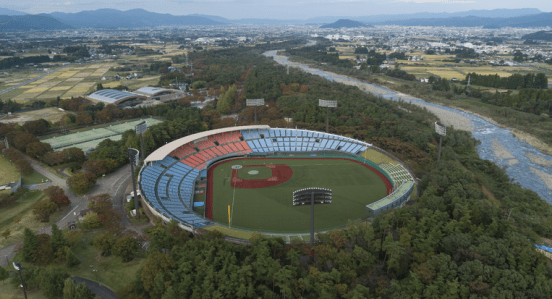 Azuma Stadium and Arakawa River, Fukushima City, Christian Aslund/Greenpeace, October 2019
March 1, 2020
Abstract: In the run up to the 2020 summer Olympics / Paralympics, multiple violations of the human rights of citizens and workers impacted by the Fukushima nuclear disaster persist. UN human rights experts have continued to challenge the Abe government over its record. Ignoring basic scientific principles of radiation protection, the government is deliberately distorting reality on actual contamination, the limited effectiveness and scope of decontamination and risks in Fukushima prefecture. Abe’s disinformation narrative on Fukushima is aimed at erasing the image of Fukushima as the location of one of the world’s nuclear disasters, and, by so doing, reviving the prospects for the nation’s nuclear industry. There remains a window in the coming months for a wider understanding of the complex reality in Fukushima, the ongoing radiological conditions and impacts, and the struggle of tens of thousands of evacuees and workers to secure their legal rights.
Ever since the start of the Fukushima Daiichi nuclear disaster in March 2011, many of the issues concerning the rights of evacuees (particularly women and children), citizens, and workers have been raised by United Nations human rights bodies and experts. One of the earliest and most comprehensive was the 2012 Mission Report of Special Rapporteur (SR) Anand Grover. (OHCR 2013) Eight years later, and in the run up to Japan hosting the 2020 summer Olympics / Paralympics, the violations of citizens’ and workers’ rights continue.
The Abe government has framed the games as the reconstruction Olympics, with a near explicit aim of erasing the image of Fukushima as the location of one of the world’s worst nuclear disasters. During the games themselves, Abe may achieve his objective (at least temporarily) as there is almost no prospect that the wider context of an ongoing radiological emergency will be reported. It’s all about the games and Abe’s disinformation narrative on Fukushima is about to go into hyperdrive. But in the run up to the opening of the Olympics there is a window of opportunity for a wider understanding of the complex reality in Fukushima, the ongoing radiological impact and the struggle of tens of thousands of evacuees and workers to secure their legal rights.
Taking their lead from Grover, during the last two years UN Special Rapporteurs have extended the depth and range of issues they have raised with the Abe government. This escalation of intervention by the Special Rapporteurs (SR) has not been well received by the Japanese government. Official country visits by these leading experts in their fields, despite multiple requests sent from the UN in Geneva, remain blocked by the Abe government. A visit to Japan by a UN human rights SR to investigate the conditions for Fukushima citizens and workers impacted by the nuclear disaster would directly challenge Abe’s Fukushima whitewash strategy and it’s not going to happen in the year of the reconstruction games.
One of the central issues raised by the United Nations is the higher radiation exposure limit set for Fukushima citizens. As a consequence of the widespread contamination resulting from the reactor meltdowns, in particular from radio-cesium, large areas of Fukushima prefecture exceeded the 1milliSievert per year (mSv/y) recommended maximum dose limit for the public. Given the half-life of cesium-137 is 30 years, there is no prospect that in many of the evacuated areas of Fukushima dose rates would return to pre 3/11 levels for several decades and longer. By revising the upper limit to 20mSv/y, and dismissing radiation risks at that level, the government proceeded with lifting evacuation orders for some of the most contaminated areas of Fukushima, including the towns of Namie and Iitate.
There is no scientific basis for the Japanese government to dismiss low dose radiation risks. Dr David Richardson, co-author of the world’s largest cohort studies on leukemia risk from low dose radiation exposure (Lancet 2015), has recently stated that five years exposure at 20mSv a year would confer about a 30% excess risk of fatal leukemia.(HBO 2020) The Japanese government is well aware of the risks from low dose radiation – not least as it was one of the funders of the 2015 INWORKS study which found an increase in leukemia rates amongst nuclear workers with annual exposure in the range of 3-5mSv/y.
Adding to the pressure from the international community over the Abe government’s Fukushima policies, a human rights Special Rapporteur at the UN General Assembly in October 2018 warned that, “The recommendation to lower acceptable levels of exposure back to 1 mSv/yr was proposed by the Government of Germany and the Government of Japan ‘accepted to follow up’ on it, according to the UN database. However…the recommendation is not being implemented. Japan has a duty to prevent and minimize childhood exposure to radiation.” (OHCHRa 2018). The Rapporteur, Baskut Tuncak, further stated that “The UN Convention on the Rights of the Child, to which Japan is a Party, contains a clear obligation on States to respect, protect and fulfill the right of the child to life, to maximum development and to the highest attainable standard of health, taking their best interests into account. This requires State parties such as Japan to prevent and minimize avoidable exposure to radiation and other hazardous substances…(and that) Japan should provide full details as to how its policy decisions in relation to the Fukushima Daiichi nuclear accident, including the lifting of evacuation orders and the setting of radiation limits at 20mSv/y, are not in contravention of the guiding principles of the Convention, including the best interests of the child…The combination of the Government’s decision to lift evacuation orders and the prefectural authorities’ decision to cease the provision of housing subsidies, places a large number of self-evacuees under immense pressure to return.”(OHCHRa 2018)
In conclusion, Baskut stated that, “The gradual lifting of evacuation orders has created enormous strains on people whose lives have already been affected by the worst nuclear disaster of this century. Many feel they are being forced to return to areas that are unsafe, including those with radiation levels above what the Government previously considered safe.”
Yet, for the Japanese government there is no acknowledgement that their policies are in violation of the basic human rights their citizens are entitled to have respected. According to Japan’s Foreign Ministry, “Lifting of the evacuation order is a measure to make return possible for those who prefer to return, and not a measure to force evacuees to return…the decision of the evacuees as to whether to return to their original places to live or not is entirely up to them. The GoJ does not force them to return nor put any pressure on them to do so…”(MOFA 2018)
The radiological conditions in Fukushima are highly complex and varied but the Abe government has no intention of explaining this reality in the year of the Olympics. Expect to hear a lot more of the distorted and wholly inaccurate propaganda as stated by Reconstruction Minister Watanabe Hiromichi, when he recently told HBO TV, “With the exception of areas deemed difficult to return we have decontaminated the entire area.”(HBO 2020)
At least seventy percent of Fukushima is mountainous forest, and with the exception of a few meters along roads there has been no decontamination during the past nine years. Perhaps the largest nuclear decontamination program in history has succeeding in generating 16 million tons of nuclear waste soil(Greenpeace 2017), while failing to decontaminate the majority of the contaminated land and exposing tens of thousands of poorly trained workers to radiation (OHCHRb) at a cost of US$28 billion (as of FY2018). The contaminated forests remain a long-term source for radio-cesium, including for downstream migration and recontamination. (Ulrich 2016)
When my colleagues and I at Greenpeace surveyed the J-Village sports complex in October 2019, we were not expecting to find radiation hot spots at over 72 micro-Sieverts per hour – equal to over 1750 times background levels pre 3/11. We notified the Environment Ministry as well as domestic and international Olympic Committees.(Greenpeace 2019a) Although, Tokyo Electric Power Company (TEPCO) was ordered to remove this contamination in early December (TEPCO 2019), two weeks later we still measured hotspots in the public areas of J-Village.(Greenpeace 2019b) The chosen location for the start of the Olympic Torch route, the J-Village, lies 20km south of Fukushima Daiichi and in an area considered to have relatively low contamination. From our observations, decontamination has been conducted in this area during the last nine years – yet there are levels of radiation that would be declared an emergency requiring urgent action if inside a nuclear facility. They have yet to be explained by the government. This clearly does not match with Minister Watanabe’s claim that “we have decontaminated the entire area”, but just as legal obligations to uphold the domestic and international human rights of their citizens are of little concern to the Tokyo government, the radioactive reality of Fukushima can be airbrushed out of existence. The Olympics as seen by Abe provide the perfect platform to advance further its Fukushima nuclear disaster disinformation campaign on the people of Japan and beyond.
The underlying motive for Abe’s Fukushima Olympic strategy is to promote a nuclear renaissance. He and many of his colleagues in the Liberal Democratic Party are nostalgic for the pre-3/11 situation when commercial reactors generated nearly 30 percent of the nation’s electricity.(Schneider 2019) Compared to 2011, when 54 reactors were available, today only nine reactors have returned to operation (with three of these shutdown due to maintenance and legal challenges), and the industry remains in crisis. Despite passing some of the nuclear regulator safety requirements, (McCurry 2017) TEPCO’s prospects for restarting two of its reactors at the Kashiwazaki-Kariwa nuclear plant remain uncertain. The majority of the citizens of Niigata prefecture, which hosts the seven reactor site, remain strongly opposed to any operations, not least due to the major seismic risks to the safety of the reactors.(Ryall 2017) The causes and consequences of the Fukushima nuclear disaster have been a major factor in framing the thinking of Niigata citizens and this extends throughout Japan where utilities are struggling to restart reactors. The triple reactor meltdown really was a defining moment for public opinion regarding nuclear energy in Japan. Resetting this mindset for Abe, by pretending conditions in Fukushima have returned to normal and welcoming the world’s elite athletes to the largest sporting event on the planet is one way to blot out images of explosions sending radioactive plumes spewing from damaged reactors, abandoned towns and hazmat suits. In the short-term Fukushima will receive a positive makeover this summer, but a resumption of large- scale nuclear generation in Japan remains unlikely. The industry is aiming to operate 30-35 reactors by 2030, but a combination of unresolvable safety issues, legal challenges, an aging reactor fleet, and the dire financials of utilities will block this scenario. (Burnie 2016, Mainichi 2020, Schneider 2019, Nikkei 2020). In this sense, Abe’s strategy is doomed to failure and there is no sign that the Japanese public can be persuaded to support nuclear energy. Meanwhile, the human rights violations of tens of thousands of evacuees and decontamination workers will continue.
References
Burnie, Shaun, 2016. “TEPCO Prosecution: A Sign That Japan’s Nuclear Industry Is in Free Fall”, The Diplomat, 4 March 2016.
Greenpeace, 2017. “Nuclear Waste Crisis In Fukushima Decontamination Program”, December 2017.
Greenpeace, 2019a. “High levels of radiation observed at J-Village in Fukushima Prefecture”, Letter to Mr. Shinjiro Koizumi Minister Ministry of the Environment Government of Japan, 18 November.
Greenpeace, 2019b. “J-Village still contaminated – major uncertainties over decontamination and Olympic torch route”, 17 December.
HBO, “Fukushima” Real Sports 274, January 2020.
The Lancet, 2015. “Ionizing radiation and risk of death from leukemia and lymphoma in radiation- monitored workers (INWORKS): an international cohort study”, Klervi Leuraud, David B Richardson, Elisabeth Cardis, Robert D Daniels, Michael Gillies, Jacqueline A O’Hagan, Ghassan B Hamra, Richard Haylock, Dominique Laurier, Monika Moissonnier, Mary K Schubauer-Berigan, Isabelle Thierry-Chef, Ausrele Kesminiene, National Institute for Occupational Safety and Health (NIOSH) Public Health England’s Centre for Radiation, Chemical and Environmental Hazards (PHE-CRCE), University of North Carolina (UNC), Center for Research in Environmental Epidemiology (CREAL), Drexel University – School of Public Health, Pompeu Fabra University (UPF), CIBER- BBN, IRSN laboratory Ionizing Radiation Epidemiology Laboratory (LEPID), Lancet Haematol, 22 June.
Mainichi Shimbun, 2020. “Plaintiffs, supporters rejoice over court’s decision to suspend Ehime nuclear reactor”, Misa Koyama and Akari Terouchi, Hiroshima Bureau, and Yongho Lee, Fukuyama Bureau, 18 January 2020.
McCurry, Justin, 2017. “Fukushima operator can restart nuclear reactors at world’s biggest plant”, The Guardian, 4 October 2017.
Ministry of Foreign Affairs, 2018. “Response from the Government of Japan to the Joint Communication by the United Nations Human Rights Council”, MOFA, 6 November.
Nikkei, 2020. “TEPCO lending troubles Japanese banks Climate change risks cannot be ignored”, Jun Watanabe, 14 February.
OHCHR, 2013. “Report of the Special Rapporteur on the right of everyone to the enjoyment of the highest attainable standard of physical and mental health”, Anand Grover Addendum Mission to Japan (15 – 26 November 2012), A/HRC/23/41/Add.3 Distr.: General 2 May 2013
OHCHR, 2018a, “Japan must halt returns to Fukushima, radiation remains a concern, says UN rights expert”, 25 October.
OHCHR, 2018b, “Human rights and the protection of workers from exposure to toxic substances.”
Ryall, Julian, 2017.”Japan’s TEPCO nuclear plant restarts fear of new Fukushima” Deutche Welle, 5 October.
Schneider, Mycle, ed., 2019. “World Nuclear Status Report 2019”, 27 September.
TEPCO, 2019. “Decontamination work at vicinity of J-Village”, 4 December.
Ulrich, Kendra, 2016. “Radiation Reloaded: Ecological Impacts of the Fukushima Daiichi Nuclear Accident 5 years later”, Greenpeace Japan.
As If Nothing Had Occurred: Anti-Tokyo Olympics Protests and Concern Over Radiation Exposure
March 1, 2020
Abstract: This paper argues the 2020 Tokyo Olympics has raised people’s awareness of concerns over radiation exposure as a form of social movement. One example is the Shinjuku demonstration, organized by the Network to Evacuate People from Radiation, which constantly advocates for protecting children from continuing radiation exposure. The group raised the issue that Olympic torch would pass through municipalities in Fukushima Prefecture where several high-level radiation hot spots are confirmed. Furthermore, concerns over radiation exposure have been also generating a grassroots movement to create the Chernobyl Law in Japan. This paper documents the emerging movement across the country, led by the Citizens’ Action for Fukushima Justice.
The Shinjuku Demonstration
Anti-Olympic sentiment has been embedded in the ongoing anti-nuclear movements, particularly since the announcement that Tokyo won the bid to host the 2020 Summer Olympics in September 2013.
Japanese Prime Minister Abe Shinzo touched on the Fukushima problem in Tokyo’s final presentation for the Olympic bid in Buenos Aires, asserting that the government would never put Tokyo in harm’s way, stating, “[s]ome may have concerns about Fukushima. Let me assure you, the situation is under control. It has never done and will never do any damage to Tokyo” (Kantei 2013).
The Japanese government pressed home the message of using the Olympics as a force in its reconstruction efforts from the March 11 disaster.
“The Olympics preparations are proceeding as if nothing had occurred,” said Okada Toshiko, one of the leaders of the Shinjuku Demo. The rally has been organized by the Network to Evacuate People from Radiation (Datsu hibaku jitsugen netto) – a loose citizens’ network calling attention to potential radiation exposure.
Okada told me that “the Friday Demonstrations in Kantei-mae in front of the Prime Minister’s Office are only focused on one issue – objection to restarting nuclear power plants, continuously shouting ‘Don’t re-start nuclear power plants.’ That is important. However, I wanted to get more attention about protecting children from continuing radiation exposure.”
She added, “I am not protesting the Olympics itself. I am objecting to hosting the Olympics while hiding such radiation exposure.”
The Shinjuku Demonstration was initiated by members who supported the Fukushima Collective Evacuation Trial (Fukushima shūdan sokai saiban), which sued for the evacuation of children from Koriyama city, which had been deemed safe for habitation. On June 24, 2011, just three months after the March 11 disaster, 14 children at elementary schools and junior-high schools filed a lawsuit against Koriyama city, resorting to a court of law and demanding their right to study in a safe environment. The suit was filed against the city seeking an injunction against compulsory education activities in a radiation-contaminated environment of over 1 millisieverts (mSv) per year. The Koriyama Branch of the Fukushima District Court, however, dismissed the case on December 16, 2011. As this decision was completely unacceptable, the plaintiffs (the representatives of the 14 children) filed a formal objection at the end of 2011 before the Sendai High Court. On April 24, 2013, the Sendai High Court ruled to reject an appeal. The plaintiffs’ lawsuit argued that Koriyama city had the legal responsibility to evacuate the elementary- and junior-high-school students. Meanwhile, the court acknowledged that radiation in Koriyama city exceeded levels deemed safe prior to the disaster, but that the government shouldered no responsibility for evacuating the schools as demanded, in effect, telling people to leave at their own discretion if they were worried. However, voluntary evacuees from outside the evacuation area were not statistically classified as evacuees and were not covered by the victim support system.
The Network to Evacuate People from Radiation organized the first demonstration in February 2013 in Shinjuku and has repeated it twice a year since then. At the 13th rally, on November 9, 2019, demonstrators once again declared their concern regarding radiation exposure. The main message of the demonstration flyer (see Figure 1) is that the demonstrators will not allow the government to act as if no severe nuclear accident had occurred, and that there are ineradicable realities and violations of human rights caused by the Fukushima disaster.
 Figure 1: Flyer for Shinjuku Demo on November 9, 2019
© Network to Evacuate People from Radiation (Datsu hibaku jitsugen netto) and Tetsuya Chiba
One participant protesting against the upcoming Tokyo Olympics, claimed that it was horrible that according to the current plan, the Olympic torch will pass through municipalities on the national route 6, that were heavily affected by the March 11 disaster. Those are areas in which several high-level radiation hot spots are confirmed and are designated as difficult-to-return zones (kikan konnan kuiki) by the national government. When passing through the area, cars are not even allowed to open the windows. She pointed out that despite this, the torch relay will be run by local junior and senior high school students. Furthermore, she objected to an optimistic comment aired by the state-run NHK television that people living near national route 6 wanted the world to know about Fukushima’s recovery as the children run the torch relay.
In late June 2019, I visited Hamadori, the coastal area in eastern Fukushima Prefecture where the torch relay is planned. I dropped by J-Village, a soccer-training center used as an emergency response hub for Fukushima plant workers. It was fully reopened on April 20, 2019 for the first time in eight years. This place will be the starting point for the relay on March 26, 2020 that will also pass through Okuma, a host town of the nuclear plant, where the government lifted an evacuation order on April 10, 2019. The lifting of the evacuation order at the stroke of midnight was the first of its kind for a host town of the nuclear plant, which straddles the towns of Okuma and Futaba. Meanwhile, Fukushima city, which is just 50 kms away from the ruins of the Fukushima Dai-ichi nuclear power plant, will host Olympic baseball and softball competitions.
I had the impression that the area was far from recovery, however. The radiation dosimeter in the parking lot at J-Village read 0.120 microsieverts (µSv) per hour (see Figure 2). This figure was indeed under 0.23 µSv per hour, the official Japanese government’s decontamination threshold. However, during my fieldwork, I found that people do not trust the measurement, saying that the official measurements need to be treated with caution since the authorities have a vested interest in downplaying radiation dose levels. In fact, in December 2019, Greenpeace Japan revealed that the radiation levels around J-Village Stadium were as high as 71 µSv per hour at surface level. This is 1,775 times higher than the 0.04 µSv per hour prior to the Fukushima Daiichi triple reactor meltdown in 2011. These facts had never been released by the government (Greenpeace 2019).
 Figure 2: Radiation dosimeter at J-Village, a photo taken by the author, June 24, 2019
Greenpeace Japan sent a letter to Japan’s Environmental Minister Koizumi Shinjiro, demanding immediate decontamination measures and an assurance that the public will not be exposed to radiation hot spots during the Olympics and Paralympics events at J-Village. At about the same time, the International Physicians for the Prevention of Nuclear War (IPPNW) Germany (IPPNW Germany 2019), issued a statement on the radiation risk, arguing that the Olympic Games should not be used to distract from the fate of the people affected by the reactor meltdown but rather to make sure their needs, worries, and demands are properly addressed. They are trying to do just that with their campaign “Tokyo 2020 – The Radioactive Olympics.” Dr. Alex Rosen, chairman of the German IPPNW, explained in the press release: “We are concerned about the health consequences of radioactive contamination, especially for people with increased vulnerability toward radiation, such as pregnant women and children.” (IPPNW European Affiliates 2019)
Toward Creating a “Chernobyl Law” in Japan
Social movements in Japan have entered a new phase since 2011 following the March 11 disaster (Ogawa 2013, 2014, 2016, 2018, forthcoming [2020a]). Social movements are change-orientated political formations, and I have been also observing that people are becoming more strategic in their efforts to drive social change. Instead of just protesting the government’s nuclear policy, or demanding that the government abandon nuclear power plants, ordinary citizens are taking specific actions to change their lives. One example is a grassroots initiative across Japan constructing renewable energy or mostly solar panels as it is relatively easy to set up the panels (see Ogawa forthcoming [2020b]). People have started building self-sufficient, sustainable lives by their own efforts.
I have also observed another initiative to make change, a social movement organized by the Citizens’ Action for Fukushima Justice, in co-ordination with the Network to Evacuate People from Radiation. Citizens who are concerned about radiation exposure have focused their efforts on the eventual creation of a Japanese version of the “Chernobyl Law.” The Chernobyl Law was promulgated in 1991, five years after the Chernobyl nuclear disaster, by three republics of the former Soviet Union – Ukraine, Russia, and Belarus – to help the people affected by the 1986 Chernobyl nuclear disaster. It was aimed at protecting the lives and health of citizens affected by radiation exposure, and indeed was the first law in the world that explicitly covered the universal human right to life of people affected by a radiation disaster. This law guaranteed the right to evacuation for the residents living in the areas contaminated by radiation, while providing social security to the people living in the areas to which the evacuation orders were issued. Under the Chernobyl Law, areas in which the amount of contamination is more than 1 millisievert per year were designated as areas covered by the right of relocation. It included help with finding a job, accommodation, medical treatment, and securing food supplies. Meanwhile, the Japanese government raised the dose limit for radiation exposure from 1 millisievert to 20 millisievert per year after the Fukushima disaster on April 19, 2011 (MEXT 2011), and the government still maintains the same standard.
Yanagihara Toshio, a lawyer who previously represented the plaintiffs at the Fukushima Collective Evacuation Trial, has been leading this Japanese effort to enact the “Chernobyl Law in Japan.” Yanagihara told me that the Tokyo Olympics would be a great chance to raise awareness of concerns over radiation exposure. He even expects that pressures or criticism over radiation exposure by foreign countries might be effective in Japan. “The Tokyo Olympics would be a stepping-stone where everyone realizes the necessity of the Chernobyl Law in Japan, as the Seoul Olympics paved the way to building democracy in South Korea.”
As the first step to institutionalize the Chernobyl Law in Japan, Yanagihara and other members proposed the creation of a series of local ordinances on the rights to evacuation across the country. He refers to the previous experience of grassroots support for the national Information Disclosure Law. This law was a product of the cumulative efforts made by the citizens across the country – they requested their municipal and prefectural governments to create a local ordinance on information disclosure, members of the councils discussed the request, and then enacted the local ordinances promoting freedom of information. Originally, this started in 1982 in Kanayama-machi, a small rural town in Yamagata Prefecture, and then spread in 1983 to Saitama and Kanagawa Prefectures. Other prefectures and municipalities soon followed suit. This citizens’ movement eventually led to the promulgation of the Information Disclosure Law at the national level in 1999 that was enacted in April 2001.
The Citizens’ Action for Fukushima Justice prepared the template for a draft proposal of a local ordinance, which people can use as a model.
Chernobyl Law in Japan (excerpt)
Preamble: The State cannot escape liability unconditionally for a radiological disaster.
The State assumes responsibility not only for compensating for the damage suffered by the radiation disaster but also for fulfilling people’s right to relocation. As a result, due to the enforcement of this ordinance, we claim that the expenses expended by the municipality of [subject to insert the name here] should originally be borne by the government, and the government has a duty to amend the law.
Article 1 (Purpose): The purpose is to protect the lives, health, and livelihood of citizens from nuclear accidents and radiation disasters.
Article 2 (Principal): The municipality of [subject to insert the name here] guarantees the right of relocation, the right to evacuation, and the right to sound health of the victims of the nuclear accident.
Article 5 (Consideration for vulnerable people): Care must be taken to protect the lives and health of radiologically sensitive fetuses and children.
Article 8 (Classification of radioactively contaminated areas): Areas with an annual additional exposure of 0.5 msv/year or more are defined as areas with enhanced radiation management. Areas with an annual additional exposure of 1 msv/year or more are designated as relocation-rights areas.
Article 11 (Right to choose relocation): If people in a contaminated area chose to relocate or evacuate, the rights guaranteed these residents by the municipality include payment of moving expenses, housing compensation, and employment support at the relocation destination; loss compensation for real estate, household goods, and products (including marine products) from the original relocation source; free medical supplies, 70% coverage of medical examination and recuperation expenses, issuance of a victim’s notebook, and pension benefits.
Article 12 (Right to choose to remain): If people choose to remain and not evacuate, the municipality guarantees free medical treatment, free medical supplies, 70% coverage of medical examinations and recuperation expenses, compensation for loss of contaminated products (including seafood), issuance of a victim’s notebook, and pension benefits. The article also requires the municipality to establish a radioactive food control section to inspect radioactive food and tap water for contamination in order to prevent unnecessary radiation exposure.
Some local initiatives calling for the creation of a Japanese Chernobyl Law have actually started. Ise city, Mie Prefecture in central Japan, was the first city to take such a step. Ueno Masami, director of the Fukushima-Iseshima Association (https://fukushima-iseshima.jimdofree.com/), an NPO group supporting recuperation for children from Fukushima, put out a call for co-operation on July 8, 2017 on the group’s website to enact a Japanese Chernobyl Law. The call was originally in Japanese, and an English version is available here on their website.
Ueno and her group campaigned for a local ordinance that protects the health and safety of people from radiation exposure. In August 2019, the group started taking action and they got approval from the mayor of Ise city to bring the issue to the council. However, in order to make it actually happen, the group needed to increase the number of municipal council members who agree or collect a certain number of signatures (or 1/50th of the municipal population of 18+ years) in a designated period (one month) to bring the agenda to the municipal assembly to formally discuss. The group chose the latter method, but only collected 64 percent of the required numbers during the one-month period and their bid was not successful. This seemed primarily due to insufficient preparation, and the group did not get enough attention. Undeterred, they will begin collecting signatures again in March 2020.
As of January 2020, discussions have also started in some local municipalities such as Chofu (Tokyo), Koriyama (Fukushima), and Kiyose (Tokyo). As we come closer to the date of the Tokyo Olympics, we need to keep an eye on the developments in these municipalities regarding local campaigns for a Japanese Chernobyl Law. Updates will be available at the Citizens’ Action for Fukushima Justice website.
References
Greenpeace Japan 2019. High-level radiation hot spots found at J-Village, the starting point of Tokyo 2020 Olympic Torch Relay. Last accessed on January 28, 2020
IPPNW Germany. 2019. Doctors’ prescription for the Tokyo Olympics. Last accessed on January 28, 2020
IPPNW European Affiliates. 2019. Tokyo 2020 – The Radioactive Olympics. Last accessed on January 28, 2020
Kantei (Prime Minister’s Office of Japan) 2013. A Script of Prime Minister Abe’s September 2013 Speech to the International Olympic Committee in Buenos Aires. Last accessed on January 28, 2020
Ministry of Education, Culture, Sports, Science and Technology (MEXT). 2011. 福島県内の学校の校舎・校庭等の利用判断における暫定的考え方について [On a provisional idea about the usage of school buildings and grounds in Fukushima Prefecture]. Last accessed on January 28, 2020
Ogawa, Akihiro. 2013. Young Precariat at the Forefront: Anti-Nuclear Rallies in Post-Fukushima Japan. Inter-Asia Cultural Studies 14(2): 317–326.
Ogawa, Akihiro. 2014. The Right to Evacuation: The Self-Determined Future of Post-Fukushima Japan. Inter-Asia Cultural Studies 15(4): 648–658.
Ogawa, Akihiro. 2016. Japan’s Awakening Protest Movement. Invited article by the Asian Studies Association of Australia.
Ogawa, Akihiro. 2018. Security Paradigms and Social Movements: The Changing Nature of Japanese Peace Activism. Asian Journal of Social Science 46(6): 725–747
Ogawa, Akihiro. Forthcoming [2020a]. フクシマ発で核を考える:国境を越えて連帯する「反核世界社会フォーラム」. 後藤康夫, 後藤宣代編 『21世紀の新しい社会運動とフクシマ 』東京:八朔社 [Thinking about the nuclear from Fukushima: anti-nuclear world social forums which connect people beyond national boarders. In New social movements in the 21st Century and Fukushima, Yasuo Goto and Nobuyo Goto, eds. Tokyo: Hassakusha]
Ogawa, Akihiro. Forthcoming [2020b]. “Community Power”: Renewable Energy Policy and Production in Post Fukushima Japan. In New Frontiers in Japanese Studies. Akihiro Ogawa and Philip Seaton, eds. London; New York: Routledge.
1 This Month
10 March A LIVE WEBINAR THE REAL EFFECTS OF NUCLEAR POWER
What the Industry Isn’t Telling Us
1:00 PM Mountain, 2 pm Central, 3 pm Eastern. Live on the Keepers of the Water Facebook page



18 March Webinar @ 1 PM EST: An Assessment of SMR Projects: The Case of Canada
register for the zoom:
https://us02web.zoom.us/webinar/register/WN_o8BIIOUvQ2ONJR1nta65DQ#/registration


of the week – STOP SMALL MODULAR REACTORS IN CANADA
To see nuclear-related stories in greater depth and intensity – go to https://nuclearinformation.wordpress.com
-
Archives
- March 2026 (109)
- February 2026 (268)
- January 2026 (308)
- December 2025 (358)
- November 2025 (359)
- October 2025 (376)
- September 2025 (258)
- August 2025 (319)
- July 2025 (230)
- June 2025 (348)
- May 2025 (261)
- April 2025 (305)
-
Categories
- 1
- 1 NUCLEAR ISSUES
- business and costs
- climate change
- culture and arts
- ENERGY
- environment
- health
- history
- indigenous issues
- Legal
- marketing of nuclear
- media
- opposition to nuclear
- PERSONAL STORIES
- politics
- politics international
- Religion and ethics
- safety
- secrets,lies and civil liberties
- spinbuster
- technology
- Uranium
- wastes
- weapons and war
- Women
- 2 WORLD
- ACTION
- AFRICA
- Atrocities
- AUSTRALIA
- Christina's notes
- Christina's themes
- culture and arts
- Events
- Fuk 2022
- Fuk 2023
- Fukushima 2017
- Fukushima 2018
- fukushima 2019
- Fukushima 2020
- Fukushima 2021
- general
- global warming
- Humour (God we need it)
- Nuclear
- RARE EARTHS
- Reference
- resources – print
- Resources -audiovicual
- Weekly Newsletter
- World
- World Nuclear
- YouTube
-
RSS
Entries RSS
Comments RSS
 nuclear-news