A combined 52 percent of respondents said either some or much progress had been made toward recovery in the prefecture. In contrast, only 7 percent gave those responses in the 2012 survey while the figure rose to 36 percent in the 2016 survey.
A combined 44 percent said little or no progress had been made toward recovery, according to the latest survey, the ninth one conducted.
Asked when they think their lives will return to pre-disaster conditions, 56 percent said “beyond 20 years.” Half of the residents who said some or much progress had been made toward recovery gave this response.
A combined 60 percent of respondents said they were very much or somewhat concerned about the effects of radioactive materials released by the triple meltdown.
Seventy-eight percent of respondents said they felt the general public’s interest over victims of the nuclear disaster was weakening.
Sixty-one percent of respondents were against the government’s plan to use contaminated soil with low levels of radiation for public works projects in Fukushima Prefecture. Only 27 percent of respondents supported that move.
Seventy-three percent of female respondents opposed the use of the contaminated soil, compared with 49 percent of men.
Asked about a plan to dilute the contaminated water and release it into the ocean, 65 percent of respondents were opposed, a slight decrease from the 67 percent who objected in last year’s survey.
Only 19 percent supported the release of diluted water to the ocean, unchanged from last year’s survey.
A combined 87 percent of respondents said they were greatly or somewhat concerned that the release of the diluted water would create negative publicity for Fukushima seafood and produce.
Moreover, 65 percent of Fukushima respondents said lessons from the nuclear disaster have not been reflected in the central government’s nuclear energy policy. Only 16 percent said the lessons were being used effectively in nuclear policy.
March 1, 2019
Posted by dunrenard |
fukushima 2019 | Fukushima, Survey |
Leave a comment
Azuma Stadium in the city of Fukushima in March 2017, will host the baseball and softball competitions during the 2020 Tokyo Olympics
AOMORI – Half of 42 municipalities in northeastern Japan hit by a massive earthquake in 2011 said the public is not fully aware of the government’s efforts to showcase the region’s recovery from the disaster through the 2020 Tokyo Olympics, a Kyodo News survey showed Wednesday.
The heads of 21 local governments in Fukushima, Iwate and Miyagi prefectures said in the survey that the “reconstruction Olympics” theme has yet to fully catch on among the public.
Asked whether the slogan has gained public attention, two mayors said “it has not” while 19 mayors said “it mostly has not.” Eighteen said “it has a little” and two said “it has.” The remaining municipality — the Fukushima city of Soma — did not answer.
“The phrase ‘reconstruction Olympics’ was thought up but no substantial progress has been made and the affected areas feel left behind,” said an official of the town of Minamisanriku in Miyagi Prefecture. “We have limited manpower and cannot spare personnel for Olympic events.”
“The sporting event will be held under the banner of the ‘reconstruction Olympics’ but venues are centered on Tokyo,” said an official of Otsuchi, Iwate Prefecture.
Asked what they expect from the Tokyo Games in a multiple-choice question, the biggest group, of 36 mayors, picked “promoting our progress toward recovery,” while 20 mayors, mainly from Fukushima, chose “overcoming reputational damage.”
“We want to use the Olympics as a chance to regain sales channels for our farm products,” said an official of the Fukushima town of Namie.
March 1, 2019
Posted by dunrenard |
fukushima 2019 | 2020 Olympics, Fukushima, Reconstruction, Tohoku |
Leave a comment
Radiation-contaminated soil is kept temporarily in Futaba, Fukushima Prefecture, before being moved to an intermediate storage facility
How to dispose of mountains of soil contaminated by radiation from the 2011 Fukushima nuclear disaster poses a massive headache for the central government.
Officials had long insisted that contaminated surface soil removed after the triple meltdown at the Fukushima No. 1 nuclear power plant would eventually be stored outside of Fukushima Prefecture.
According to one estimate, the total volume of such soil will reach 14 million cubic meters by fiscal 2021. Local entities outside of Fukushima are understandably hesitant about serving as host to such vast quantities of possibly hazardous dirt.
Officials in Tokyo are now hoping to sway local governments to act as hosts by proposing reuse of the contaminated soil for public works projects under certain conditions.
One requirement would be that soil radiation levels below 8,000 becquerels per kilogram, the standard used by the government in classifying whether the waste material requires special treatment, could be used for various construction projects.
This poses a dilemma for Fukushima Prefecture, which fears local residents will be stuck with the problem despite repeated pledges by the government to move all contaminated soil from the prefecture.
Work got under way four years ago to move contaminated soil to intermediate storage facilities in Fukushima Prefecture. As of Feb. 19, the volume of soil transported to those facilities totaled 2.35 million cubic meters.
March 1, 2019
Posted by dunrenard |
fukushima 2019 | Debris, Fukushima, radioactive Soil, Storage |
Leave a comment
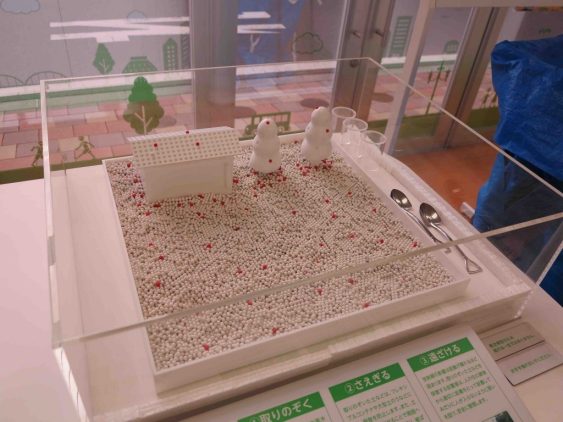 An interactive model at the Decontamination Info Plaza in the city of Fukushima allows visitors to “decontaminate” a house and yard.
At the entrance to the Fukushima Prefectural Centre for Environmental Creation, a friendly hippopotamus-like mascot welcomes visitors while accepting hugs from children. Buzzing with young families, this government-sponsored scientific hub was created to explain the phenomenon of radiation to the population of Fukushima, the victims of the eponymous 2011 nuclear disaster.
Inside the main annex, an interactive model explains how external radiation exposure can be lowered. Visitors are encouraged to increase their distance from a radiation-emitting device while making use of shielding, thereby lowering their overall exposure. In another corner, children are learning about the radioactive isotopes released during the disaster, although representations of these perils are anything but threatening. Using posters and comic books, radionuclides such as plutonium‑239 and cesium‑137 are represented as adorable anthropomorphic figures. Each radionuclide has its own characteristics, such as pronounced eyebrows or a distinctive hairstyle. There is no discussion about how exposure to these radionuclides can cause serious bodily harm—an increased risk of cancer, for example.
In the aftermath of the Fukushima meltdowns, which triggered a released of radioactive pollutants, the Japanese state initially decided to increase the mandatory evacuation trigger from 1 millisievert of radiation exposure per year to 20 millisieverts per year. In other words, the public was forced to accept a new threshold of safety. While this policy caused much scientific and public controversy, 20 millisieverts per year remains the benchmark for what is considered safe in Fukushima. Places like the Centre for Environmental Creation downplay the controversy of a raised threshold of exposure.
Situated in the town of Miharu and opened in July 2016, the center was established by the prefecture of Fukushima, with the financial support of the Japanese government, to conduct research and provide education on radioactive contamination. The center is one of several government-sponsored revitalization projects aimed at rebuilding the trust of people living in Fukushima. Mostly visited by young families, it represents a new approach to risk communication. As a technical advisor explained to me, this approach aims to “deepen the understanding of children about radiation” by allowing visitors to experience information firsthand through interactive games, fun activities, and cute presentations.
Past efforts to present nuclear science in appealing ways have often blended education with propaganda. The 1957 Disney TV episode Our Friend the Atom is a perfect example of this. What are the dangers of resorting to such forms of explanations in the aftermath of a nuclear disaster? In 2015 and 2017, I spent a total of 14 months in Japan examining the public’s interactive experience at state-sponsored centers and public activities that explain radiation. I found that while the information on radiation is easy to understand, many aspects of its hazards are carefully concealed. In particular, the government’s educational approach shifts the post-Fukushima Japanese public’s attention away from manmade danger and toward a vision of naturalness, technological amusement, and scientific amazement. In doing so, this approach downplays the risk inherent to residual radioactivity in Fukushima.
The naturalness of radiation. One way to neutralize the perceived harmfulness of radiation is to make the phenomenon appear as natural as possible, by emphasizing the radioactivity coming from natural sources. At the Centre for Environmental Creation, one of the most popular attractions is an enormous spherical theater, where visitors are bombarded with sounds and images in a 360-degree multisensory experience that describes radiation as a natural part of daily life. “It can be found everywhere! From the sun’s ray to the mineral in the earth,” claims the theater’s narrator. “Without radiation, no life would exist on Earth!” After these explanations, an enormous Boeing passes above theatergoers’ heads in the cinematic sky, and the amount of radiation exposure received during an intercontinental flight is said to be higher than the level of radiation found in Fukushima. Their necks strained upward, visitors mumble words of apparent relief.
What the theater fails to explain, however, is that there is nothing natural about the radioactive isotopes released during the Fukushima nuclear disaster, and that background radiation has little to do with the hazards of breathing or swallowing fission products—which are not rays, but dust-like particles. For instance, strontium 90, if inhaled or ingested, mimics calcium to enter an individual’s bone marrow and cause lifelong radiation exposure. This exposure can cause mutations in living cells—a permanent alteration that can lead to cancers, genetic problems, or immune disorders.
It’s all fun and games. Information about radiation is often promoted through an enjoyable experience that conceals disturbing aspects of the phenomenon. In front of a giant interactive screen, for example, children can move their bodies to “block” radiation. By selecting the proper material, they can block either radioactive alpha particles, beta particles, or gamma rays. They pretend that their bodies are thick metal plates used to hamper harmful external exposure. By doing so, they collect points, and at the end of the game, the child with the highest score wins.
In an interactive game at the Fukushima Prefectural Centre for Environmental Creation, participants use their body movements to “block” radioactive rays or particles
By transforming radiation protection into a game that focuses on blocking external radiation, children do not learn of the risk of internal contamination from radioactive particles such as cesium 137, which was released in significant amounts by the Fukushima disaster. If internalized, cesium 137 gets distributed throughout the body, irradiating soft tissues such as muscles and ovaries. And because the children’s game blocks radiation in “real time,” there is no mention of any delayed health effects of radiation exposure, such as potential harmful genetic changes.
At the Decontamination Info Plaza, the government promotes similar activities. Situated in the city of Fukushima, the Plaza was established in January 2012 as a joint program between the prefecture of Fukushima and Japan’s Ministry of the Environment. The Plaza’s purpose is to provide information about radiation in general, as well as explanations about monitoring methods, workshops on decontamination, and advice on contaminated sites. Basic information about radiation is presented to the public in a very accessible, visual, and interactive form.
For example, an interactive model helps younger visitors understand the process of decontamination. The model consists of a miniature house in a transparent plastic box filled with small white and red balls. The white balls represent uncontaminated soil; the red balls stand for radioactive pollutants and are found on the house rooftop and in the soil. With a toy shovel, visitors can pick up the red balls and dispose of them in a plastic container, isolating them from the rest of the environment. By playing with the toy shovels and trying to “successfully” get rid of the radioactive pollutants, decontamination acquires a tangibility that feels like a safe game. Children do not have to put on protective suits before separating the balls, and there is no recognition that the decontamination process presents health hazards from radiation, either from external or internal exposure.
Radiation is our friend! A third way to downplay the perception of radiation danger is to link radiation with the wonders of science and technology. This was particularly apparent during an April 2016 open house organized by the National Institute of Radiological Sciences, Japan’s leading radiological institute, which is situated in Chiba, east of Tokyo. Titled “I Want to Know More! What Can You Do with Radiation?” the public fair was a popular event at which visitors could see the institute’s research facilities, the latest PET scan technology for medical imaging, and the cyclotrons used in nuclear medicine to produce radioisotopes. A special elevator led down to the Heavy Ion Medical Accelerator, situated in an impressive subterranean facility.
As I walked through the underground maze of this metallic behemoth, it became apparent that families were overcome by the scale of the apparatus. Indeed, as one parent said to his child, “It looks like a spaceship, right?” At this institute, manmade radiation was effectively linked to technologies that sustain life. For instance, the open house showed how the radiation-related devices at the institute produce particle therapies to treat cancer.
While there was nothing inaccurate about the center’s explanations of radiation as a medical treatment, the information presented was unrelated to the dangers faced during a nuclear disaster. If visitors wanted to hear more about such risks, they had to visit the station called “Impact of Fukushima.” The small station was, however, much less appealing than the other venues. It consisted of four small posters that focused on the decontamination process without explaining the adverse health effects of exposure to manmade radioisotopes. Children were much more interested in learning about the giant particle accelerators. Radiation was emphasized as a useful agent that could penetrate the body and kill harmful tumors, as was demonstrated on medical dummies during the event. In the end, by heavily framing radiation information around a beacon of technological wonder, the public opening day glossed over the danger of radioactive contamination and selectively amplified the beneficial aspects of radiation.
Education vs. propaganda. In interviews that I conducted with officials and technical advisors employed at the aforementioned places, I was told that Fukushima is afflicted by “harmful rumors” surrounding the real extent of radiation harm and that this misunderstanding stems from public ignorance of radiological science. It is in this context that government-sanctioned approaches aim to provide “basic information” that will help citizens fear radiation in an “appropriate way,” thereby creating an environment in which people feel they can safely return to Fukushima. While this is a worthy endeavor, the government’s approach emphasizes specific understandings of radioactivity that overshadow the particular risks introduced by manmade radioactive pollutants resulting from a nuclear accident.
Ultimately, I have doubts about these education programs. They are selective in their nature, making only certain aspects of radiation tangible through their public activities, while rarely explaining in detail the dangers of adverse health effects linked with residual radioactivity. From my viewpoint, their purpose seems to be dual: While they aim to shed light on the phenomenon of radiation, they are also covertly looking to defuse the threat of widespread societal unrest, to reclaim political control and economic stability, and to pacify a fearful public—and in ways that are perhaps more beneficial to the state than to affected individuals.
In a community where dangerous residual radioactivity has become a public everyday concern, coming to grips with serious contamination requires more education than ever before. The important word here is education. Not state propaganda disguised as education. There is a fine line between these two, but it is a line that needs to be clearly drawn. While Japanese state approaches are innovative in their interactivity and freedom from jargon, they are less so in their content.
I strongly agree that the existence of state-sponsored educational programs is better than to simply ignore radioactive risk. But mobilizing specific explanations that downplay the real risk faced by citizens is not sustainable. Doing so will reproduce the ignorance, secrecy, and values that led to this disaster. Public well-being, democracy, and science cannot thrive in such context. An unbiased effort to educate people about the specific hazards of radioactive contamination, and correct misunderstandings about the risk of radiation exposure, does not have to be delivered in a dry and clinical manner. It can be as fun and engaging as anything the Japanese centers, exhibits, and public days are already doing.
There is one scene from my time in Japan that I cannot forget: the unadulterated smile of the happy child who had won the contest of blocking radiation. While the kid had learned much about radiation, he had learned little about the complexity of radiation hazards. I could not help thinking of Major Kong straddling the bomb in the film Dr. Strangelove, enjoying the nuclear ride without thinking about it too much, shouting “Yee Haw!” at the top of his lungs.
March 1, 2019
Posted by dunrenard |
fukushima 2019 | Fukushima, Lies & Cover-up, Propaganda, radiation |
Leave a comment
On Saturday, March 9, from 1 to 5 p.m., the Fukushima Support Committee will host the North America premiere of “Fukushima Speaks,” a compelling feature-length documentary by award-winning director and independent journalist Toshikuni Doi.
The screening will take place at Art Share Los Angeles, 801 E. 4th Pl. in L.A’s Arts District.
“It is not enough for a journalist to report facts and news of what is happening, but rather it is the journalist’s duty to expose the ‘human’ underneath it all,” Doi stated. “If we fail to shed light on [universal themes]and just succeed in reporting on facts and news, to the audience, it will come across as just a matter that is happening somewhere far away, unrelated to them.”
Four years in the making, Doi has created a heart-wrenching look into the lives of Japanese residents whose lives were devastated by the 2011 Fukushima Daiichi nuclear disaster. Haunting images and video footage of the aftermath are reinforced by 14 personal stories of despair, guilt, and outrage.
“I lost the cornerstone of my life,” Yoko Watanabe, a self-evacuee, said in her interview. “I was determined to bury myself in Katsurao village. That was taken away from me. The reason to live, volunteering, everything was taken away from me in a flash. Now I don’t know anymore what I live for. I wonder if I am really needed in this life, and I don’t know anymore.”
The suffering of Fukushima survivors continue to this day. While the mourning of lost life is obvious, the film also explores the dire realities that are often overlooked: the loss of livelihoods due to the contamination of land and ocean, the life-threatening risks caused by radiation exposure, the emotional turmoil of families being torn apart by the decision to stay or evacuate, and the discrimination that residents now face because they are from Fukushima.
Another self-evacuee, Hikaru Hoshi, expressed indignation: “They want to blame it on us and say it was our responsibility. Whether to leave or stay…. I do not allow them to shift the burden of the accident of enormous scale to individual choices/individual responsibilities…. We lived in the area that needed to be evacuated right away. That fact was concealed from us, and some of us left on our own, or like me, some did not have time to think it through but left anyway. I felt outraged that this country was putting us against each other. The root of the matter lies somewhere else.”
Doi pointed out the urgency of releasing this documentary: “Eight years since the accident, ‘Fukushima’ is being made into the thing of the past,” he said. “As more people focus on the 2020 Tokyo Olympics, the victims are silenced and their suffering is hidden away behind the news of ‘revitalization.’ However, the wounds of the victims whose lives have been destroyed by the accident are still raw.”
March 1, 2019
Posted by dunrenard |
fukushima 2019 | Fukushima, Nuclear Disaster, Survivors |
Leave a comment
February 24, 2019
This February 20th I was invited by my friend Kolin Kobayashi in Paris to the avant-première of the movie Fukushima The Seal of the Sun, followed by a short debate, then to the private reception where Japan ex-prime Minister Naoto Kan was present.
Watching this movie brought to my mind the words of Gregory Jaczko, the former chairman of the U.S. Nuclear Regulatory Commission in 2011, in his recently released book titled Confessions of a rogue nuclear regulator :
« And what about the problems that no engineer, scientist, or safety regulator can foresee. No amount of planning can prepare a plant for every situation. Every disaster makes its own rules – and humans cannot learn them in advance ».
« Generations of nuclear professionals have never experienced the confusion of a nuclear accident as it is happening. So it is essential that we remember and teach the lessons of Three Mile Island, chernobyl and Fukushima, for reviewing these accidents shows common themes of missed opportunities, human failings, and technological overconfidence. No amount of forgetting can change these simple facts. »
« As I learned in the wake of the Fukushima accident, crises on this scale are often characterized by incoherent communication and conflicting information. Both the Three Mile island and the Fukushima disasters featured contradictory assessments of the state of the reactor, a limited appreciation of the fact that the damage to the reactor had occured very early, and rapidly changing statements from elected officials. To the public, these statements can appear to suggest prevarication or incompetence. But when government officials – imperfect human beings like everyone else – try to make sense of the complicated physics of a nuclear reactor, they will invariably make mistakes in communication. »
Especially as in the Fukushima accident where TEPCO was not straightforward in giving the true facts to the Japanese government, but always prevaricating.

Synopsis of the movie Fukushima The Seal of the Sun
On March 11, 2011, Japan is rocked by an earthquake, followed by a tsunami and the triple nuclear disaster of Fukushima. Prime Minister Naoto Kan’s team is trying to cope with this situation. What really happened at the Prime Minister’s residence at the time of the worst crisis in the country’s history? Has the truth been fully revealed?
3 questions to the director – Futoshi Sato
How did you arrive on this project and how did you work with the producer and actors of the film?
Born in the area that was devastated by the 2011 earthquake, I wanted to talk about it, but I was wondering what might be the approach to make it a movie. For his part, Mr. Tamiyoshi Tachibana wondered about the possibility of adapting the book written by Tetsuro Fukuyama, Deputy Director of the Cabinet of Naoto Kan. “The Nuclear Crisis – A Testimony from the Residence of the Prime Minister” is a fundamental work that tells the truth of the events that occurred on those days at the Residence.
If this project was able to start and be realized, it is thanks to the total and complete implication of Mr Tamiyoshi Tachibana. The entire project team has been involved in the discussions around the script and during our debates, we thought it was necessary to make a choral film with in the center, the members of the Cabinet, but also with the journalists on the lookout for scoops, the workers of the power plant, as well as the inhabitants of the surrounding villages. As for casting, we managed to bring together actors who were completely convinced of the importance of the subject. We gave them all the information so that they thoroughly understand the issues of the film and their characters.
Was it important to you that the events would be experienced in a balanced way through the politicians and the people directly at the forefront of the disaster?
According to the people who experienced these events, their feeling completely varies. To make it a film capable of witnessing this story in all its diversity, we decided to adopt the different points of view of the protagonists. It was not possible to convey this reality to the public otherwise.
I remember that Naoto Kan told us: “If you represent the truth about the nuclear accident with firmness in the film, you can choose any method of expression.” He wanted the facts to be well presented. I started filming in a direction that was not meant to be easy. Instead, it was necessary to treat with audacity, an atmosphere of crisis due to a management and consequences quite unknown.
Which part of the movie is truth and which part is fiction?
The information, as to the reactions and attitudes of TEPCO following the nuclear accident, and those that have been passed on to the government are all true. We also had to do some research to recreate some scenes. In addition, about what had happened during these 5 days, it was impossible to extract and reproduce the huge amount of data.
For these reasons, and in order to stay true to the facts and to make a fiction easier to understand, we created a fictional character unfolding the story. We have made this journalist a kind of guide, to follow this whole story. The words and situations of certain scenes have been created to cover all events. On the other hand, the politicians, who are public figures, appear in the film under their true identities. Their dialogues and actions are also based on true facts.
3 questions au producteur – Tamiyoshi Tachibana
In 2011, you were close to Naoto Kan, the Japanese Prime Minister. Through this film, was it your intention to restore a truth that the latter experienced during this crisis?
At the time, I was simply a friend, one of his cadets in politics. It was only after the earthquake that I became a real member of his support group. It is not to reproduce the experience of the crisis experienced by Naoto Kan that I produced this film. The media and public opinion, manipulated by the latter, were totally hostile to the Prime Minister, accusing him of having aggravated the accident and amplified the damage. Faced with this rejection, I was plagued by anger and disgust as they led me to make this film to put things in order.
The reactors’ accident could, in the worst case, have caused the evacuation of the entire population living within a radius of 250km, including Tokyo, a total of 50 million people. Naoto Kan was the only one to have guessed the extreme gravity of the accident and to have realized that we were one step away from the collapse of Japan. If he had not been Prime Minister, if the crisis had to be managed by another in his place, the country could have been completely destroyed.
You have kept the real names of the various protagonists. What were the reactions of the people implicated, in particular the leaders of TEPCO, the company that managed the Fukushima power station?
Four politicians appear under their real names. In the history of Japanese cinema, this is the first time that characters, in a fiction film, take the true identity of people who really exist. Thus Naoto Kan is still present in the political life of Japan.
As for the other members of the government, as well as the officials and employees of TEPCO (TOBI in the film), these are not their real names, but we can easily imagine who they are!
However, there was no protest or legal proceedings on their part. I do not know if they saw the movie … or not. If they saw it, they did not want to talk about it publicly. I hope that today, they are a little ashamed of this catastrophic situation of which they are, in part, responsible.
What was the impact of the film when it was released in Japan? Has it sparked a real public debate as Japanese nuclear power resumed its place in the country, as if nothing had happened in 2011?
The accident at the Fukushima nuclear power station inspired the authors of “Shin Godzilla” (the new Gozilla), a movie released in Japan on July 29, 2016. That movie was designed by two of the largest film production companies for a total budget of 13 million euros. Thanks to this film, the producers have earned more than 64 million euros!
On our side, our film was screened in independent theaters. Obviously, this has not been the same success, especially in terms of financial benefits.
Citizens continue to organize weekly independent screenings. It should be noted that the 54 nuclear reactors, distributed among the 18 Japanese plants, were shut down in September 2013.
7 years after the disaster, 9 units restarted. The film has become a powerful vector for citizens who speak out against the restart.
Aujourd’hui, environ 70 % de la population est en effet opposée à l’énergie nucléaire.
Sources :
Synopsis of the movie, provided by Destiny Films, translated by Hervé Courtois (D’un Renard)
Confessions of a rogue nuclear regulator by gregory B. Jaczko, published by Simon & Schuster, New York, 2019
February 24, 2019
Posted by dunrenard |
fukushima 2019 | Fukushima Daiichi, Movie, Naoto Kan, Nuclear Disaster |
Leave a comment
OKUMA, Fukushima Prefecture–An evacuation order will be lifted for two districts here as early as April, eight years after the triple meltdown at the Fukushima No. 1 nuclear power plant spewed massive amounts of radioactive substances into the air.
It would be the first time for Okuma, which co-hosts the plant, to see the evacuation order lifted, albeit partially.
The entire town, with a population of 11,500, was ordered to evacuate after the onset of the nuclear crisis following the Great East Japan Earthquake and tsunami in March 2011.
The lifting of the order is expected to cover the Ogawara and Chuyashiki districts, both southwest of the plant.
Together the districts account for about 40 percent of the town’s acreage. The town’s records showed that 374 residents, or about 4 percent of the current population, are registered in the districts, as of the end of January.
As of Feb. 7, 46 people have returned to live there as an advance group.
In Ogawara, about 700 employees of Tokyo Electric Power Co., the operator of the plant, live in the company’s dormitory built in 2016 as a special case and commute to the nuclear complex to engage in decommissioning work.
At the Feb. 19 meeting, a member of the town’s committee that assesses the progress of decontamination said, “Radiation levels have declined sufficiently.”
However, the psychological barriers are high for Okuma evacuees, as the town now hosts an interim storage site for radioactive waste produced from decontamination operations in the prefecture.
Preliminary results of a survey conducted last year to gauge the sentiment of residents showed that only 10 percent of respondents expressed a desire to return. About 60 percent said they had no plans to return.
The town government of Futaba, the neighboring town that co-hosts the nuclear plant, aims to have its evacuation order partially lifted around spring 2020.
Read more:
February 23, 2019
Posted by dunrenard |
fukushima 2019 | Evacuation Order To Be lifted, Fukushima, Okuma |
Leave a comment
The strategy of the organizers of these “Tours” participate fully to the Japanese government aim, without realizing it, to make believe that the “radioactivity” there is not dangerous. Oh, there, what a world.
“There is growing interest among foreign tourists for a tour in English to former evacuation zones in the northeastern Japan prefecture of Fukushima where a devastating earthquake and tsunami in March 2011 triggered a nuclear disaster.
“More people are becoming interested in going on the tour that can deepen their knowledge,” explains an official at the Japan National Tourism Organization.
The tourism company Knot World Co. based in Tokyo designed this particular tour from a desire to encourage more people to “hear the local voices and see the area’s damage and recovery” after the nuclear accident at the Fukushima Daiichi power plant.
Since the tour’s launch in February last year, some 200 people from 23 countries have participated, according to the company.
Fukushima Prefecture says 96,000 foreign tourists stayed at hotels and inns in the prefecture in 2017, which is four times the number in 2011. In February this year, an organization that promotes the prefecture’s products and tourism launched a three-day tour with English translation in areas including Naraha, another town in the vicinity of the crippled nuclear plant, to aid recovery.
However, there are numerous issues that need to be resolved regarding tours catering to foreigners such as training tour guides and providing information in various languages.
Various thoughts are voiced in Fukushima Prefecture such as, “We would really like the tourists to come not out of casual interest but to truly learn the issue,” and, “Please also turn your attention to the fact that our lives before the accident has not returned,” local officials said.”
February 18, 2019
Posted by dunrenard |
fukushima 2019 | Fukushima, Nuclear tourists |
Leave a comment
I did travel to the U.S. to attend the International Uranium Film Festival in Window Rock, Arizona, capital of the Navajo nation. The Navajo land located between four states, has been highly contaminated by the uranium mining industry for the past 70 years, their cattle, sheeps, and their life deeply affected. Death omnipresent in every family, unaccounted number of deaths, the Navjo lives not a high priority to a discriminating U.S. Federal Government.
By Marley Shebala, Dec 3, 2018
WINDOW ROCK, Ariz. РJapanese cattle farmers may live more than 5,680 miles from the Navajo Nation, but they are connected to the Din̩ people by their fierce love for their livestock.
In the film, “Nuclear Cat tle,” a middle-age Japanese couple recall with a flood of tears the day that they were forced to drive past their cattle and flee for their lives from their cattle farm and home that they built because of the nuclear disaster at the Fukushima Daiichi Nuclear Power Plant.
The husband, who was speaking Japanese, said, “When we were leaving, I couldn’t stop crying. I told them (the cows) I was sorry.”
On March 11, 2011, a major earthquake and tsunami caused Japan’s worst nuclear accident, which involved the disabling of the power supply and cooling of three-Fukushima Daiichi nuclear reactors that melted three nuclear cores in the first three days, forced the evacuation of about 160,000 people, and the death of about 19,000 residents living along the northeast coast of Japan.
“Nuclear Cattle,” focused on how the deadly aftermath of the disaster impacted cattle, including those owned by the Japanese couple and other Japanese farmers.
There are massive numbers of carcasses of cows that were left tied to stalls in barns. The few cows that are still alive are emaciated and lying on the ground slowly dying. But then the film shows herds of cattle wandering around evacuated residential areas and towns.
The Japanese couple, who have returned to their cattle farm, which is still contaminated by radiation, look at their surviving cattle and remember the day the Japanese government ordered all the cattle farmers to kill their cows that survived. The husband says, “I feel alive when I come home.”
The wife of another Japanese couple that has also returned to their contaminated farm and home to save their cattle, says her husband told her he would not mind if he dies at home with his cattle.
A worker on another cattle farm, which became a haven for surviving cows and is called Farm of Hope, says he returned to his work station without the owners because he could not allow the cows that survived the disaster to die from starvation and dehydration.
He also says that even through the Japanese government tells the farmers that their cows are financially worthless, he Dana Eldridge attends the International Uranium Film Festival at the Navajo Nation Muse um in Window Rock, Arizona, Thursday. Alma E. Hernandez/Independent
Courtois said the nuclear plants generate revenues for the government, which has also pushed the government to hire a public relations firm to spin lies after lies to their people about the safety of nuclear energy.
He said the government reported to their people that the cattle farmers and other residential areas were being successfully decontaminated by scraping off the surface of the land, bagging the earth and depositing at one of extremely dangerous contaminated cattle farms, which is surrounded by lush green forests and within view of the Fukushima Daiichi nuclear power plants operated by Tokyo Electric Power Company.
But, Courtois said, the government and T.E.P.Co. withhold information about how the radiation has seeped lower into the earth and how they cannot scrape the top soil from the forest areas, which means that when it rains, the runoff re-contaminates the surface.
“Nuclear Cattle” was one of several films shown for free at the Navajo Nation Museum as part of the 2018 International Uranium Film Festival, which started Thursday and ends Saturday night. But if you missed the film festival at the museum, you have a chance to attend the one-day festival at the Native American Cultural Center at Northern Arizona University in Flagstaff, Arizona, Sunday.
The festival will also travel to Grants, Albuquerque, Santa Fe and Tucson, Arizona.
February 18, 2019
Posted by dunrenard |
fukushima 2019 | Documentary Film, Fukushima, Nuclear cattle |
Leave a comment








 nuclear-news