1. International Commission on Radiological Protection (ICRP) has ALWAYS recommended 1 mSv per year to be ‘safe’ for human living conditions.
2. Japan arbitrarily INCREASED this level 20 TIMES to 20 mSv per year AFTER Fukushima Daiichi blew. Science proves this level DANGEROUS for women & children; thus, the UN calling out this human rights abuse.
3. Japan is funding billions of dollars for 2020 Olympic venues & athletes’ housing in Fukushima; BUT ending support for Fukushima évacuées, forcing many to return to dangerous radiation exposure.
Students from Fukushima High School ride a bus and are told by Tokyo Electric Power Co. executive Yoshiyuki Ishizaki, right, about the Fukushima No. 1 Nuclear Power Plant’s No. 1 reactor, which just had a cover removed from its building, in Okuma, Fukushima Prefecture, on Nov. 18, 2016.
Stop sending women & children back to Fukushima fallout zone, UN expert tells Japan
A UN human rights expert has urged Japan to reconsider its policy of returning women and children to areas still high in radiation after they were displaced by the Fukushima meltdown.
Baskut Tuncak, the UN’s special rapporteur on hazardous substances, criticized the Japanese government’s decision to resettle citizens in areas with radiation levels above one millisievert per year, the threshold of health risk to groups particularly sensitive to radiation, including children and women of childbearing age.
“The gradual lifting of evacuation orders has created enormous strains on people whose lives have already been affected by the worst nuclear disaster of this century,” he said.
Tuncak presented his findings to a General Assembly committee meeting in New York. “Many feel they are being forced to return to areas that are unsafe, including those with radiation levels above what the government previously considered safe,” he added in a news release.
The Japanese government dismissed his concerns, blaming one-sided information and expressing concern that the statement could stoke “unnecessary fears” about the site of the March 2011 nuclear disaster.
After the earthquake and subsequent power plant meltdown, the Japanese government raised its acceptable radiation levels to 20 millisieverts. The UN last year issued a recommendation to return the level to pre-meltdown standards, but Japan ignored the request.
Over seven years later, radiation levels around Fukushima remain high, as has the apparent level of denial within the Japanese government. They recently announced plans to release about a million tons of wastewater contaminated with radioactive elements into the Pacific Ocean, claiming high-tech processing had reduced the contaminants to safe levels, but was forced to admit that 80 percent of the water remained contaminated after local residents protested the dumping plans.
The government has been removing evacuation orders gradually and plans to repeal all of them within five years, regardless of the contamination level in the areas. Japan was slow to enact the evacuation orders initially – only residents within a 3km radius of the meltdown were told to evacuate immediately after the accident, and four days later, residents 30km away were still being told to shelter in place. However, it was already allowing resettlement in areas within 20km of the plant by 2014.
Tuncak has clashed with the Japanese government before. In August, he and two other UN human rights experts criticized them for putting at risk the lives of those involved in the Fukushima clean-up. An earlier UN report showed that 167 plant workers had received radiation doses that increased their cancer risk.
Only last month did the Japanese government admit that even a single plant worker had died as a result of radiation exposure. The unnamed man, whose job included measuring radiation levels immediately after the meltdown, was exposed to about 195 millisieverts of radiation and developed lung cancer after leaving his job in 2015.
UN envoy: Halt children’s return to Fukushima
October 26, 2018
A UN envoy has urged Japan to halt the return of children and young women to nuclear accident-hit Fukushima, calling the government’s radiation exposure limit too lax. But the Japanese side is refuting the advice.
Human Rights Council Special Rapporteur Baskut Tuncak on Thursday was speaking to a committee of the UN General Assembly.
The government set the exposure limit at 20 milisieverts per year as a condition for lifting evacuation orders issued for parts of the prefecture after the 2011 Fukushima Daiichi nuclear power plant accident.
Tuncak criticized the government for not taking into account the council’s recommendation that the limit be one milisievert.
A Japanese delegate countered by saying the limit is based on a 2007 recommendation by the International Commission on Radiological Protection.
He also said the government has been consulting Japanese experts on the matter, and that Tuncak’s reports give Fukushima a negative reputation.
But Tuncak said the experts recommend that the annual limit be one milisievert in normal times. He added that risk remains as long as radiation levels exceed this threshold.
Tuncak urged Japan to apply the principle to children and women of reproductive age.
UN rights expert urges Japan to halt returns to Fukushima
GENEVA (Kyodo) — The Japanese government must halt the return of women and children displaced by the March 2011 nuclear disaster back to areas of Fukushima where radiation levels remain high, a U.N. human rights expert said Thursday.
The special rapporteur on hazardous substances, Baskut Tuncak, also criticized in his statement the government’s gradual removal of evacuation orders for most of the irradiated areas as well as its plan to lift all orders within the next five years, even for the most contaminated areas.
“The gradual lifting of evacuation orders has created enormous strains on people whose lives have already been affected by the worst nuclear disaster of this century. Many feel they are being forced to return to areas that are unsafe,” he said.
An official of Japan’s permanent mission to the international organizations in Geneva refuted the statement, saying it is based on extremely one-sided information and could fan unnecessary fears about Fukushima.
Tuncak expressed concerns about people returning to areas with radiation above 1 millisievert per year, a level previously observed by Japan as an annual limit so as to prevent risks to the health of vulnerable people, especially children and women of reproductive age.
“It is disappointing to see Japan appear to all but ignore the 2017 recommendation of the U.N. human rights monitoring mechanism to return back to what it considered an acceptable dose of radiation before the nuclear disaster,” he said.
In the wake of the Fukushima nuclear incident, the Japanese government heightened the annually acceptable level of radiation to 20 millisieverts, raising concerns for the health of residents.
In August, Tuncak and two other U.N. human rights experts jointly criticized the Japanese government for allegedly exploiting and putting at risk the lives of “tens of thousands” of people engaged in cleanup operations at and around the crippled Fukushima Daiichi nuclear plant, a claim Tokyo dismissed.
October 27, 2018
Posted by dunrenard |
Fukushima 2018 | Evacuees Forced Return, Fukushima Radiation, Human Rights, United Nations |
Leave a comment
GENEVA (25 October 2018) – A UN human rights expert has urged the Japanese Government to halt the ongoing relocation of evacuees who are children and women of reproductive age to areas of Fukushima where radiation levels remain higher than what was considered safe or healthy before the nuclear disaster seven years ago.
The UN Special Rapporteur on hazardous substances and wastes, Baskut Tuncak, will present a report to the General Assembly in New York today, highlighting key cases of victims of toxic pollution brought to his attention in recent years that demand global action. The expert said the Japanese Government’s decision to raise by 20 times what it considered to be an acceptable level of radiation exposure was deeply troubling, highlighting in particular the potentially grave impact of excessive radiation on the health and wellbeing of children.
“It is disappointing to see Japan appear to all but ignore the 2017 recommendation of the UN human rights monitoring mechanism (UPR) to return back to what it considered an acceptable dose of radiation before the nuclear disaster,” he said.
Following the nuclear disaster in 2011, which was triggered by a massive earthquake and tsunami, Japan raised the acceptable level of radiation for residents in Fukushima from 1 mSv/year to 20 mSv/year. The recommendation to lower acceptable levels of exposure to back to 1 mSv/yr was proposed by the Government of Germany and the Government of Japan ‘accepted to follow up’ on it, according to the UN database. However, in the expert’s view, the recommendation is not being implemented.
Japan has a duty to prevent and minimise childhood exposure to radiation, added the UN expert referring to his 2016 report on childhood exposure to toxics. The UN Convention on the Rights of the Child, to which Japan is a Party, contains a clear obligation on States to respect, protect and fulfil the right of the child to life, to maximum development and to the highest attainable standard of health, taking their best interests into account. This, the expert said, requires State parties such as Japan to prevent and minimise avoidable exposure to radiation and other hazardous substances.
The Special Rapporteur said Japan should provide full details as to how its policy decisions in relation to the Fukushima Daiichi nuclear accident, including the lifting of evacuation orders and the setting of radiation limits at 20mSv/y, are not in contravention of the guiding principles of the Convention, including the best interests of the chid.
Tuncak has expressed his concerns at the Human Rights Council in recent years, accompanied by explicit requests and pleas by concerned organisations for the Government to invite the mandate to conduct an official visit. The Japanese Government has a standing invitation to all mandate holders but has not to date invited the mandate on hazardous substances and wastes to conduct an official country visit.
Seven years after the nuclear disaster, actions for the reconstruction and revitalisation of Fukushima are in full implementation process, with evacuation orders lifted for most of the areas, and with plans in place for lifting evacuation orders in even the highest contaminated areas during the next five years. In March 2017 housing subsidies reportedly stopped to be provided to self-evacuees, who fled from areas other than the government-designated evacuation zones.
“The combination of the Government’s decision to lift evacuation orders and the prefectural authorities’ decision to cease the provision of housing subsidies, places a large number of self-evacuees under immense pressure to return,” Tuncak said.
“The gradual lifting of evacuation orders has created enormous strains on people whose lives have already been affected by the worst nuclear disaster of this century. Many feel they are being forced to return to areas that are unsafe, including those with radiation levels above what the Government previously considered safe.”
The presentation of the thematic report at the General Assembly today will be live-streamed on the United Nations Web TV.
Mr. Baskut Tuncak is Special Rapporteur on the implications for human rights of the environmentally sound management and disposal of hazardous substances and wastes. As a Special Rapporteur, he is part of what is known as the Special Procedures of the Human Rights Council. Special Procedures, the largest body of independent experts in the UN Human Rights system, is the general name of the Council’s independent fact-finding and monitoring mechanisms that address either specific country situations or thematic issues in all parts of the world. Special Procedures experts work on a voluntary basis; they are not UN staff and do not receive a salary for their work. They are independent from any government or organization and serve in their individual capacity.
For more information and media requests, please contact: Ms Lilit Nikoghosyan (+41 22 9179936 / lnikoghosyan@ohchr.org) or Mr. Alvin Gachie (+41 22 917 997 1/ agachie@ohchr.org) or write to srtoxics@ohchr.org
For media inquiries related to other UN independent experts please contact Mr. Jeremy Laurence, UN Human Rights – Media Unit (+41 22 917 9383 / jlaurence@ohchr.org)
This year is the 70th anniversary of the Universal Declaration of Human Rights, adopted by the UN on 10 December 1948. The Universal Declaration – translated into a world record 500 languages – is rooted in the principle that “all human beings are born free and equal in dignity and rights.” It remains relevant to everyone, every day. In honour of the 70th anniversary of this extraordinarily influential document, and to prevent its vital principles from being eroded, we are urging people everywhere to Stand Up for Human Rights: www.standup4humanrights.org
October 27, 2018
Posted by dunrenard |
Fukushima 2018 | Evacuees Forced Return, Fukushima Radiation, Human Rights, United Nations |
Leave a comment
The central part of Okuma, Fukushima Prefecture, is deserted after it was designated a difficult-to-return zone following the 2011 accident at the nearby Fukushima No. 1 nuclear power plant.
After more than three years of discussions, the nuclear damage compensation law will be left largely intact, including unlimited redress from utilities for accidents at their nuclear plants and vagueness about the government’s responsibility.
Only minor changes will be made to the law, such as measures to accelerate provisional payments to victims of nuclear accidents.
Science ministry officials on Oct. 23 presented a draft of proposed legislation to revise the law at a committee meeting of the ruling Liberal Democratic Party. The legislation is expected to be submitted to the extraordinary Diet session that began on Oct. 24.
An advisory committee on the nuclear damage compensation system within the Japan Atomic Energy Commission (JAEC) had been discussing possible revisions since 2015 in part because of the huge compensation amount–now more than 8 trillion yen ($71 billion)–facing Tokyo Electric Power Co. over the 2011 accident at its Fukushima No. 1 nuclear power plant.
Electric power companies had asked for some sort of limit in the law, given the situation at TEPCO.
One suggestion was to more clearly delineate the responsibility of the central government and the utilities for compensating victims of nuclear disasters.
A committee member who once worked in Keidanren (Japan Business Federation) supported setting a limit, saying the companies would face a serious management problem if they are unable to predict potential compensation risks.
In return, the central government would shoulder the compensation amount above a certain limit, the member proposed.
However, the committee could not reach an agreement, and no change was made to the provision that sets unlimited compensation responsibility on the part of the utilities.
Utilities will have to continue setting aside a maximum 120 billion yen for each nuclear plant it operates as insurance for a major accident.
Although the insurance amount would appear to be a sort of limit on the electric power companies, the utilities must also contribute to the Nuclear Damage Compensation and Decommissioning Facilitation Corp. (NDF), which provides assistance when compensation demands concerning a single nuclear plant exceed 120 billion yen.
The central government also contributes funds to the NDF.
Calls arose to raise the insurance limit for electric power companies beyond 120 billion yen. However, the insurance industry would not agree to any higher amount, and no change was made in the limit.
Some committee members brought up the topic of whether the central government’s responsibility for compensation should be included in a legal revision.
The electric power industry said the central government should shoulder a greater portion of the compensation responsibility for nuclear accidents because it has continued to define nuclear energy as an important base-load energy source.
Members of the advisory committee brushed aside that suggestion, saying the public would never be convinced in light of the Fukushima accident and the various shortcomings revealed about TEPCO’s management.
Other members cited the possibility that utilities would cut back on safety investment if they knew the central government would pay for compensation.
Discussions about the central government’s responsibility never did get off the ground in the advisory committee, even though a number of recent court verdicts in civil lawsuits have awarded compensation while clearly stating the central government’s responsibility for the Fukushima nuclear disaster.
The minor change to the law to allow electric power companies to more quickly begin provisional payments of compensation was proposed to address problems that arose after the Fukushima accident.
TEPCO took about six weeks to begin provisional payments to disaster victims. The delay, according to TEPCO, was because the utility had no idea about the maximum amount of compensation it would have to pay.
Under the proposed change, the central government will provide loans to utilities so they can immediately begin making provisional payments. Utilities will be obligated to compile guidelines that define the procedures for applying for compensation and making those guidelines widely known.
(This article was compiled from reports by Yusuke Ogawa and Senior Staff Writer Noriyoshi Ohtsuki.)
October 27, 2018
Posted by dunrenard |
Fukushima 2018 | Compensation Law, Fukushima Daiichi, Nuclear Accident |
Leave a comment
Same insane mentality that came up with NPPs and generating nuclear waste wsants vitrification which will melt long before the nuke waste becomes chemically stable. Amazing how self/other destructive some people are and what they’re willing to risk doing to other people and life forms:
23 October 2018
A project to demonstrate the use of innovative radioactive waste vitrification technology, developed in France, at the damaged Fukushima Daiichi nuclear power plant in Japan has been under way for the past six months.
An in-can prototype developed at CEA Marcoule
Since 27 April, the French Alternative Energies and Atomic Energy Commission (CEA), Orano and ANADEC have been evaluating the potential of using the “in-can” vitrification process developed by CEA to treat waste from water treatment operations at Fukushima Daiichi. Such wastes from these operations include contaminated sludge and mineral adsorbents. Vitrification is the process for immobilising high-level radioactive waste in glass.
CEA’s Marcoule laboratory developed a compact in-can vitrification process in which the melting pot is disposable and serves as the primary canister for the solidified glass.
The project to demonstrate the use of the technology at Fukushima Daiichi comprises two main parts.
The first is to develop and study durable waste form conditioning matrix formulations. Tests on a laboratory-scale (100 grams), on a bench-scale (1 kilogram) and near-industrial scale (100kg) will be carried out in France at the CEA Marcoule laboratories.
The second part of the project is to conduct feasibility studies for process implementation, operation and maintenance principles and waste disposal. These studies will be led by Orano.
In a joint statement Orano and CEA said that laboratory-scale test and part of the bench-scale tests have already been “performed with success”. Near-industrial scale tests, they said, are under way. The feasibility studies will then be carried out, with the complete results expected to be delivered by the end of March 2019.
For the project, “technical and commercial interfaces” in Japan are being provided by ANADEC. This a joint venture set up in 2014 between Orano and Japanese nuclear power plant maintenance and radioactive material management company ATOX.
Multiple facilities including a multi-nuclide removal facility – the Advanced Liquid Processing System (ALPS) – are used to treat the contaminated water accumulated at Fukushima Daiichi plant. After the concentration of caesium and strontium contained in the contaminated water is reduced, the ALPS system eventually removes most of the radioactive materials except tritium. The treatment of all highly contaminated water which contained strontium, except residual water in the bottom of the storage tanks, was completed in May 2015. This has helped reduce the risks attributed to contaminated water, such as an increase in radiation dose on the premises or contaminated water leaking from the storage tanks. The water from which caesium and strontium have been already reduced will require additional treatment by ALPS for further risk reduction.
October 27, 2018
Posted by dunrenard |
Fukushima 2018 | CEA, Fukushima Daiichi, Orano, Radioactive waste, Vitrification |
3 Comments
Hong Kong Chief Executive Carrie Lam
HONG KONG – More time is needed for Hong Kong to lift its ban on food imports from Japan’s Fukushima Prefecture imposed in the wake of the 2011 nuclear disaster there as public confidence remains low, Hong Kong leader Carrie Lam said.
In an interview with Japanese media ahead of her first official working trip to Tokyo since taking office as chief executive in 2017, Lam said that while food safety remains a priority, consumer sentiment is another deciding factor for when the ban should be lifted.
“We will have to continue to monitor the situation and to see when is the right time, especially (for) public acceptance,” Lam said.
She said there’s no point in the government relaxing the ban if the public end up not supporting the move. “They will still not buy the food, so we have to find the right situation with the needed assurance before we change the import restrictions,” she added.
Hong Kong in July lifted the ban on imports of foods including vegetables, fruits, milk, milk beverages and milk formula from the prefectures of Ibaraki, Tochigi, Chiba and Gunma nearby Fukushima.
But the ban on food imports from Fukushima, which hosts the damaged Fukushima Daiichi nuclear power plant, remains in place.
Lam said that since the lifting of the food ban from the four prefectures, individual cases of food imports lacking needed certificates have led to law enforcement activities, which in turn impacted public confidence.
China, which restricted the import of foods and feedstuff produced in 10 of Japan’s 47 prefectures over radiation worries, has informed Japan of its intention to relax the ban through diplomatic channels, it was reported, according to the sources.
Japanese Prime Minister Shinzo Abe is expected to reach a deal when he meets with Chinese Premier Li Keqiang in Beijing on Oct 26.
Defending Hong Kong’s recent moves to outlaw an independence-seeking political party and expel a foreign journalist who hosted a talk by the party’s leader, Lam insisted that the people’s rights and freedoms remain intact.
“I am not suggesting that I should, or the government should put a limit on freedom of speech or freedom of reporting in Hong Kong. I am saying, internationally, there is no absolute freedom per se. If anybody is aggrieved by the executive…they can take us to court,” she said.
Lam said judges from foreign common law jurisdictions, including Britain, Australia and Canada, sitting on the territory’s top court to adjudicate cases is proof that Hong Kong courts are not interfered with or influenced by the Chinese government.
The chief executive will embark on the five-day visit to Japan from Oct 29, a first for a Hong Kong leader since 2010. She is slated to meet with Japanese officials over issues covering government business, trade and investment, education, technology science, tourism and women’s affairs.
October 27, 2018
Posted by dunrenard |
Fukushima 2018 | Contaminated Food, Food Import Ban, Fukushima Radiation, Hong-Kong |
Leave a comment
Prime Minister Shinzo Abe is due to visit Beijing this week, with China’s food import ban on Japan likely to be discussed
China’s import ban on Japanese food introduced following the March 2011 nuclear disaster is likely to be discussed between Japanese and Chinese leaders in upcoming summit talks in Beijing this week, though whether any progress can be made on the discussion is uncertain.
China has taken a cautious approach to relaxing the import regulations due to safety concerns among the public.
China has a ban in place on food imports from 10 prefectures: Fukushima, Miyagi, Ibaraki, Tochigi, Gunma, Saitama, Chiba, Tokyo, Niigata and Nagano. Food products made in other prefectures need to have certificates that confirm they have passed radioactive checks.
China introduced the ban because of concerns over radioactive contamination due to the meltdown at Tokyo Electric Power Company Holdings Inc.’s Fukushima No. 1 power plant.
Japan has been asking Beijing to lift the ban at an early date.
In an effort to make this happen, Tokyo has explained the examination process for food and provided data related to their safety.
But China has stood pat over concerns that lifting the ban could create public backlash. Also behind the inaction were tensions over the Japanese-administered Senkaku Islands in the East China Sea that are claimed by Beijing, informed sources said.
Amid warming bilateral ties and an improvement in the public’s perception of Japanese food, Abe and Chinese Premier Li Keqiang agreed in May this year to start working-level talks for a possible easing of the import regulations.
The focus now is on how much progress can be made at the working level before Abe’s three-day visit to China from Thursday, which comes as the two countries mark the 40th anniversary of the entry into force of their peace and friendship treaty, the sources said.
If the ban is relaxed, Japan is expected to make progress toward its goal of attaining ¥1 trillion in annual exports in the agricultural, forestry and fishery sectors, the sources said.
The nuclear disaster led a total 54 economies to introduce import restrictions or strengthen radioactive checks on Japanese food products.
Of them, 29 had scrapped their restrictions as of August this year and 17 others conditionally resumed imports. China is among the eight that maintain import bans on food made in some prefectures.
October 27, 2018
Posted by dunrenard |
Fukushima 2018 | China, Contaminated Food, Food Import Ban, Fukushima Radiation |
Leave a comment
Ichiro Takekuro, a former vice president at Tokyo Electric Power Co., enters the Tokyo District Court in Tokyo’s Chiyoda Ward in this June 30, 2017
TOKYO — A former vice president at Fukushima Daiichi nuclear station operator Tokyo Electric Power Co. (TEPCO) told a court here on Oct. 19 that it was “natural” for the utility to put tsunami countermeasures at the plant on hold while it consulted experts.
Ichiro Takekuro, 72, is under indictment on charges of professional negligence resulting in death and injury over the nuclear disaster that broke out after tsunami hit the Fukushima Daiichi plant in March 2011. His testimony at the Tokyo District Court backed fellow defendant Sakae Muto, 68, who made the decision on the tsunami countermeasures.
TEPCO estimated in March 2008 that tsunami waves up to 15.7 meters high could hit the Fukushima Daiichi nuclear plant, based on a long-term evaluation made by the government’s Headquarters for Earthquake Research Promotion in 2002. While being aware of the company’s estimate, Muto put tsunami countermeasures on hold in July 2008 and instructed subordinates to ask experts to evaluate the reliability of the long-term evaluation.
A key point of contention in the trial is whether the Muto’s decision constituted “postponement” of countermeasures.
Sakae Muto, a former vice president at Tokyo Electric Power Co., enters the Tokyo District Court in Tokyo’s Chiyoda Ward in this June 30, 2017
Muto told earlier court hearings that he had informed Takekuro in August 2008 of the company’s maximum tsunami height estimate. However, Takekuro told the Oct. 19 hearing that he had no recollection of that, adding that he heard the estimate from another subordinate sometime in April or May 2009.
With regard to the government’s long-term evaluation, Takekuro said, “I heard that it wasn’t supported by specific proof. I thought thorough discussion was necessary if there were unclear factors,” again justifying Muto’s decision.
As to TEPCO’s estimation that 15.7-meter tsunami waves could hit the power station, Takekuro said he “didn’t feel any sense of urgency.”
Takekuro is standing trial along with Muto and former TEPCO President Tsunehisa Katsumata, 78, over the nuclear crisis.
Prosecutors had abandoned indicting the three. However, court-appointed lawyers indicted them after a prosecution inquest panel deemed twice that they deserved to stand trial.
October 22, 2018
Posted by dunrenard |
Fukushima 2018 | Court Trial, Fukushima Daiichi, Nuclear Disaster, Tepco Executives |
Leave a comment
The government concluded Friday that four companies had used foreign trainees to perform work cleaning up radioactive contamination after the March 2011 tsunami triggered meltdowns at the Fukushima No. 1 nuclear plant.
The headline figure from the final report on a survey conducted by the Justice Ministry, the labor ministry and the Organization for Technical Intern Training was the same as that in the interim report, released in mid-July, which reflected results of surveying fewer than 200 companies with foreign trainee programs.
Officials visited a total of 1,018 such companies with facilities in eight prefectures in eastern and northeastern Japan, interviewing technical interns there to confirm the situation, after the issue came to light in March.
Of the four companies, one in Iwate Prefecture has been banned from accepting foreign trainees for five years. It was found to have neglected to pay allowances for decontamination work, amounting to a combined ¥1.5 million, to three trainees.
The government has issued a similar ban for three years to a firm in Fukushima Prefecture for not paying a total of ¥180,000 to three interns for overtime work.
A company in Fukushima and another in Chiba Prefecture received warnings because foreign trainees there engaged in decontamination work, albeit for short periods of time. The names of the four companies were not revealed.
Justice Minister Takashi Yamashita told a news conference that the government gave guidance for improvement to three related regulatory organizations over insufficient inspections of companies with foreign technical interns.
“We will continue to work with the Ministry of Health, Labor and Welfare and the Organization for Technical Intern Training to guide regulatory organizations and companies that accept technical interns, so they will not let them engage in decontamination work. We will take proper measures when we find inappropriate cases,” Yamashita said.
In March, a Vietnamese trainee at an Iwate Prefecture-based construction firm revealed he had been assigned to take part in radioactive decontamination work without being given sufficient explanation of the tasks involved.
The government announced later that month that it would not allow companies to use such foreign trainees for the removal of radioactive contamination, as such work is not consistent with the purpose of the program.
The technical trainee program was introduced in 1993 with the aim of transferring skills to developing countries. But it has drawn criticism both at home and abroad as being a cover for importing cheap labor for industrial sectors, including manufacturing and construction, where blue-collar workers are in short supply.
October 22, 2018
Posted by dunrenard |
Fukushima 2018 | Clean-up, Foreign Trainees, Fukushima Daiichi, Nuclear Disaster |
Leave a comment
New Reconstruction Minister Hiromichi Watanabe wants the world to know that, seven years after the March 2011 Great East Japan Earthquake, Fukushima Prefecture and other disaster-struck areas of the Tohoku region are now safe.
“I know that outside Japan (radiation) stigma still lingers and I believe it’s our mission to destroy,” that notion, Watanabe said in an interview with The Japan Times and other media organizations Wednesday.
In the wake of the reactor meltdowns at the Fukushima No. 1 nuclear power plant many countries around the world imposed import restrictions on vegetables, fruits and other food products from Fukushima and neighboring Ibaraki, Tochigi, Chiba and Gunma prefectures.
But in recent months the European Union, Brazil and several other countries have eased import restrictions and China reportedly intends to relax the ban. Taiwan is set to hold a referendum next month on whether to keep the restrictions in place.
“First, I want people to learn about the situation in Fukushima, I want them to taste farm and marine produce and last but not least, I want people to visit Fukushima” to see for themselves how it has rebounded, Watanabe said, responding to a question about lingering concerns over safety and slow progress in recovery.
Watanabe believes the 2020 Tokyo Games will be “a golden opportunity” to showcase the disaster-hit region’s advancement.
He referred to a large-scale project in the town of Namie, Fukushima Prefecture, where construction work has already started for what will be one of the world’s largest hydrogen plants.
The plant will use solar power and other energy sources to extract up to 900 tons of hydrogen each year from water for storage and supply.
The hydrogen generated at the plant will be used for fuel-cell vehicles and other purposes during the Olympics and Paralympics.
“Using Fukushima-generated hydrogen in Tokyo would be a great display” of the region’s progress, he said.
“Given that the Olympic torch relay will start in Fukushima, I wish we could use hydrogen to light up the torch as well,” he added, noting that such ideas are being considered.
When the Reconstruction Agency was established in 2012, the government set a 10-year period of intensive efforts to rebuild the devastated areas.
Watanabe said that recovery of housing and public infrastructure is nearing completion, except for in zones with restricted access closest to the Fukushima No. 1 power plant.
Watanabe admitted that progress is slower in some areas and he wants to speed up the rate of reconstruction ahead of the Summer Games.
“To better grasp the situation, I will make it my priority to go to those areas. It’s my basic strategy to listen to all requests and demands directly from those regions and to try to respond to them,” he said.
The government will draw up a concrete action plan to complete rebuilding efforts before disclosing them by year-end.
For Watanabe, the clock is ticking as the agency is scheduled to fold in 2021.
“There are only 2½ years left and during this period I am motivated to do the utmost to complete rebuilding,” he said. “Obviously reconstruction of areas devastated by the nuclear disaster should be seen from a long-term perspective and even after the agency is abolished, Japan should make concerted efforts to act on the aftereffects (of the nuclear disaster).”
October 22, 2018
Posted by dunrenard |
Fukushima 2018 | Denial, Fukushima, Propaganda, Reconstruction Minister |
1 Comment
One nuclear specialist argued that the Japanese government’s reported plan “cannot be considered an action without risk to the marine environment and human health”
by Jake Johnson, staff writer on Thursday, October 18, 2018
In a move that has sparked outrage from local residents and dire health warnings from environmentalists, the Japanese government is reportedly planning to release 1.09 million tons of water from the Fukushima Dai-ichi nuclear plant into the Pacific Ocean despite evidence that it contains “radioactive material well above legally permitted levels.”
While both the Japanese government and Tokyo Electric Power Co. (Tepco)—the company that runs the Fukushima Dai-ichi plant—have claimed that radioactive material in the water has been reduced to indetectable amounts and that only “safe levels of tritium” remain, documents obtained by the London-based Telegraph suggest that the cleaning system being used to decontaminate the water “has consistently failed to eliminate a cocktail of other radioactive elements, including iodine, ruthenium, rhodium, antimony, tellurium, cobalt, and strontium.”
“The government is running out of space to store contaminated water that has come into contact with fuel that escaped from three nuclear reactors after the plant was destroyed in the March 2011 earthquake and tsunami that struck northeast Japan,” the Telegraph reported. “Its plan to release the approximately 1.09 million tons of water currently stored in 900 tanks into the Pacific has triggered a fierce backlash from local residents and environmental organizations, as well as groups in South Korea and Taiwan fearful that radioactivity from the second-worst nuclear disaster in history might wash up on their shores.”
One document the Telegraph obtained from the government body charged with responding to the 2011 Fukushima disaster reportedly indicates that the Japanese government is perfectly aware that the Advanced Liquid Processing System (ALPS) is failing to eliminate radioactive materials from the water stored at the Fukushima site, despite its claims to the contrary.
Last September, the Telegraph notes, “Tepco was forced to admit that around 80 percent of the water stored at the Fukushima site still contains radioactive substances above legal levels after the Ministry of Economy, Trade, and Industry held public hearings in Tokyo and Fukushima at which local residents and fishermen protested against the plans.”
Shaun Burnie, a nuclear specialist with Greenpeace, argued that even so-called “safe” levels of tritium are harmful to humans and marine life.
“Its beta particles inside the human body are more harmful than most X-rays and gamma rays,” Burnie told the Telegraph, adding that there “are major uncertainties over the long-term effects posed by radioactive tritium that is absorbed by marine life and, through the food chain, humans.”
The Japanese government’s reported plans to release the water into the Pacific despite these warnings “cannot be considered an action without risk to the marine environment and human health,” Burnie concluded.
October 22, 2018
Posted by dunrenard |
Fukushima 2018 | Fukushima Daiichi, Pacific Ocean, Radioactive Water, Release |
Leave a comment
A major challenge at the Fukushima Daiichi nuclear power plant is disposing of water containing a large amount of radioactive tritium. The Japanese government proposed diluting and releasing the water into the sea, but many fisheries in Fukushima are voicing strong opposition to the proposal. Disposal of the tainted water is a must for scrapping reactors at the plant. So, what should the government and TEPCO officials do?
Doing away with tritium-tainted water is essential
Every day, more than 100 tons of radioactive water builds up. Despite various measures taken since the 2011 accident at Fukushima Daiichi, groundwater continues to enter the reactor buildings, mixing with water which is being used to cool the reactors.
The Tokyo Electric Power Company uses a system called ALPS to treat the water. Officials have been saying that the system’s high-performance filters can get rid of most radioactive substances, except tritium.
TEPCO is not allowed to dispose of that water because its tritium levels surpass the limit set by the government.
That’s why the utility is storing 920,000 tons of the water in more than 800 tanks. The water is expected to increase by up to about 100,000 tons a year. The government and the firm say that in a matter of years, Fukushima Daiichi will run out of space for tanks.
A government panel of experts has been discussing what to do with the water. The experts concluded that the technology for separating tritium cannot be put into practical use yet. They instead put several options on the table such as:
1) Diluting and releasing the water into the sea
2) Heating and evaporating the water
3) Burying the water deep underground
A report later compiled by the panel said releasing the water into the sea will make the most sense. Experts say this is the cheapest and quickest way among all the options. The question is, is it safe?
Tritium exists in the atmosphere. The government, TEPCO and the Nuclear Regulation Authority say tritium emits a weaker form of radiation than other radioactive substances. They say that even if tritium enters the human body, it will be incorporated into water and quickly released outside. Officials say therefore, tritium is likely to pose few health risks if its concentration is low.
In the past, nuclear power plants across Japan actually released water containing tritium after confirming its readings were below the limit.
NRA Chairman Toyoshi Fuketa has been calling on the government and TEPCO to make a quick decision, saying releasing the water into the sea after its tritium level falls below the limit is the only viable option. He thinks the approval process for the proposal is unlikely to take long, so it will have limited impact on the work to scrap the reactors.
Mounting distrust among fisheries
After the expert panel compiled its report, the government held public hearings to make a final decision. At a hearing held in the town of Tomioka in Fukushima Prefecture on August 30th, the proposal came under fire mainly from people in the fishing industry.
The head of the Fukushima Prefectural Federation of Fisheries Cooperative Associations said the proposed move will be a devastating blow to the local fishing industry. He said its past efforts will go to waste, and it will deprive the industry of its motivation for rebuilding businesses.
Fishermen in Fukushima suspended their operations after radioactive materials exceeding the government-set limits were detected in seafood caught off the prefecture following the 2011 accident. But in recent years, no fish from the area have been found to be highly radioactive. Now, fishermen can catch and ship most kinds of fish.
However, some consumers still hesitate to eat marine products from Fukushima. Fish landings are still about one-tenth of levels before the accident. Local fisheries fear that if TEPCO releases the water into the ocean, they will have to delay their plans to resume operations at full capacity and struggle again to make ends meet — even if the water is deemed safe.
The underlying problem is distrust towards the government and TEPCO. There have been numerous instances in which TEPCO withheld the fact that tainted water had leaked into the sea. Locals saw them as acts of betrayal. They fear that once TEPCO begins dumping the water into the sea, consumers may refrain from purchasing fishery products from Fukushima Prefecture even further.
Public distrust further deepened during the hearings. It came to light that the water stored in some of the tanks contains levels of radioactive substances, such as iodine that exceed the limit. This contradicts the explanation given by the government and TEPCO — that the water treatment system can reduce all radioactive substances to a level below the limit, except for tritium.
My understanding was that tritium was the only radioactive substance in the tanks that exceeds the government-set limits. I was not the only one who was confused. Other participants also expressed concerns that TEPCO may have been concealing the facts.
TEPCO officials explained that levels of some radioactive substances could exceed the limits if the water treatment filters are used continuously. They said that’s not a problem, adding that the goal is to reduce the risk of radiation exposure, and that they have been making the data public on their website.
After hearing this, I checked TEPCO’s website once again. There, I found the iodine levels, but they were buried in a massive amount of data, making it very difficult to find. TEPCO officials didn’t seem eager to provide a full explanation of what has happened so far.
But TEPCO’s claim that this isn’t a problem differs with the public’s view. Its attitude is worsening the problem.
TEPCO officials tend to make decisions based on technical considerations, which often fail to sufficiently acknowledge the concerns of the locals. The officials also appear reluctant to release information that is inconvenient for them. Unless they change their mindset, they will not be able to regain the public’s trust.
Steps TEPCO must take to regain trust
First and foremost, the government and TEPCO must provide thorough explanations and responses to the questions and opinions expressed in the hearings. They need to clarify why they didn’t proactively explain the level of radioactive substances and provide their exact levels and how they will deal with them.
In addition, the government should hold public hearings at various other locations and communicate more with the public. The latest round of public hearings was held only in Fukushima and Tokyo and this didn’t seem sufficient to regain public support.
Decommissioning of the crippled Fukushima Daiichi nuclear plant is a prerequisite for the reconstruction of areas devastated by the nuclear disaster. To this end, treatment of contaminated water is a must, and it needs be done swiftly. However, there will not be progress, no matter which method is taken, without the consent of the people affected by the nuclear disaster.
TEPCO and government officials must offer truthful updates as soon as they happen. While this sounds obvious, it’s the only way to regain people’s trust and resolve the problem of the accumulation of tainted water.
October 22, 2018
Posted by dunrenard |
Fukushima 2018 | decommissioning, Fukushima Daiichi, Nuclear Disaster, Tepco |
Leave a comment
Former Tokyo Electric Power Co. Vice President Sakae Muto
TOKYO — Denials of allegations dominated the questioning on Oct. 16 of former Tokyo Electric Power Co. (TEPCO) vice president Sakae Muto in the criminal trial he and other ex-TEPCO leaders face over their responsibility to predict and prevent damage caused by the 2011 tsunami that triggered an unprecedented nuclear disaster in northeastern Japan.
“The charge that I delayed (tsunami countermeasures) is outrageous,” said Muto, 68, during the questioning at the Tokyo District Court. He repeated emphatic rebuttals against the prosecution’s argument that the damage could have been avoided if he had taken appropriate actions earlier.
Muto and two other defendants — former TEPCO chairman Tsunehisa Katsumata, 78, and former vice president Ichiro Takekuro, 72 — stand accused of professional negligence resulting in deaths and injuries of evacuees from the nuclear disaster. They were indicted in 2016 by lawyers serving as prosecutors after public prosecutors refused to do so twice and the prosecution inquest committee shot down those refusals.
A massive tsunami caused by the Great East Japan Earthquake on March 11, 2011 hit TEPCO’s Fukushima Daiichi Nuclear Power Station, cutting the facility off the power grid and ruining emergency power generators. The prolonged blackout made it impossible to cool down the nuclear fuel cores at three reactors, triggering their meltdowns and the release of massive amounts of radioactive materials into the atmosphere. As a result, hundreds of thousands of nearby residents, including elderly patients, were forced to flee, with dozens dying and others getting injured in the process.
During the questioning on Oct. 16, Muto replied “Not at all” on many occasions when defense lawyers asked him if he procrastinated on introducing measures to protect the nuclear station from potential high tsunami waves three years before the 2011 incident.
When asked by lawyers serving as prosecutors about the exchange he had with his subordinate at the time tsunami countermeasures were discussed, Muto insisted, “I do not recall.” When his answer was cut short by the prosecution, Muto indicated his dissatisfaction, crossing his arms with a big sigh.
According to past testimonies in the trial that began in June last year, Muto and other top TEPCO officials heard reports from subordinates about the need for tsunami countermeasures at the Fukushima plant, and they approved those steps. Muto, however, told the court that the top-level meeting was “for information sharing” and not for decision-making. The defendant also denied that he was briefed on such measures.
The former TEPCO vice president did apologize at the beginning of the questioning, saying, “To the many people who lost their lives, their family members or those who were forced to evacuate their homes, I have caused you great trouble that cannot be expressed in words.” Muto, clad in a dark suit, then stood up, bowed deeply and stated, “I extend my deepest apologies. I am very sorry about what happened.”
(Japanese original by Mirai Nagira, Science & Environment News Department, and Masanori Makita, City News Department)
October 22, 2018
Posted by dunrenard |
Fukushima 2018 | Court Trial, Fukushima Daiichi, Nuclear Disaster, Tepco Executives |
Leave a comment

It was very courageous to the city council Koichi Oyama to leak to the public those medical data, despite the new laws to stop medical staff releasing data on health effects that may be caused by the nuclear disaster. This new controvertial law (against the supposed new open transparency purported by the nuclear industry post Fukushima disaster) was enacted in late 2013 and threatens to imprison or give huge fines to medical staff. This makes verification difficult.
Not surprisingly there was a quick reaction to that release, now claiming that the data in question represents cumulative patient visits. With the present new laws it is quite impossible to verify now that claim to be true. One thing only is sure: the Minami-soma city council issued a written warning to the city council member Koichi Oyama for disseminating the data.
The Minamisoma city council verified with the Minamisoma Municipal General Hospital business office that the data in question represents cumulative patient visits.
Once a patient is registered through the hospital system with a certain diagnosis, subsequent visits are counted cumulatively for accounting purposes unless the patient’s information is removed from the system due to reasons such as death or transfer to another hospital.
The city council chair has issued a written warning to the city council member Koichi Oyama who originally disseminated the data. (Source: Hirono town council member, Kenichi Abe)
Read also previous article: https://nuclear-news.net/?s=A+First%3A+Medical+Data+Obtained+from+Minami-soma+Municipal+General+Hospital+in+Fukushima
October 22, 2018
Posted by dunrenard |
Fukushima 2018 | Fukushima, Medical data, Minamisoma City, Secrecy Law |
Leave a comment
Former Tokyo Electric Power Co. Vice President Sakae Muto.
Ex-TEPCO VP apologizes as defendant questioning begins in Fukushima nuclear disaster trial
TOKYO — A former vice president of the Tokyo Electric Power Co. (TEPCO) apologized on Oct. 16 during court questioning of three ex-TEPCO top officials indicted on charges of professional negligence resulting in death and injury over the 2011 Fukushima nuclear disaster.
Defendant Sakae Muto, 68, said, “To the many people who lost their lives, their family members or those who were forced to evacuate their homes, I have caused you great pain that cannot be expressed in words, and I extend my deepest apologies. I am very sorry about what happened.”
The questioning of Muto at the Tokyo District Court over the accident at the Fukushima No. 1 Nuclear Power Plant in northern Japan is scheduled to continue until the evening, with plans to resume on Oct. 17.
The other former executives indicted in the criminal trial are 78-year-old former chairman Tsunehisa Katsumata and former vice president Ichiro Takekuro, 72. This trial marks the first time that the three top officials will be questioned in detail in a court of law about their responsibility for the Fukushima nuclear disaster.
According to the indictment, while the three were aware of the possibility of a large tsunami hitting the Fukushima No. 1 Nuclear Plant, they neglected to take countermeasures, leading to the March 2011 accident. As a result, they are thought to have caused the deaths of 44 patients who had to evacuate from Futaba Hospital in the town of Okuma, Fukushima Prefecture, near the power plant for a long period of time due to the accident, among other charges.
At the first hearing of the trial in June 2017, Muto said, “Looking back now, there was no way of predicting that such an accident could occur. I do not believe we are responsible.” The other two defendants are also maintaining their innocence in the matter.
Former vice president Takekuro will be questioned on Oct. 19, followed by former chairman Katsumata on Oct. 20.
(Japanese original by Masanori Makita, City News Department, and Mirai Nagira, Science & Environment News Department)
Sakae Muto, former vice president of Tokyo Electric Power Co., in January
Ex-TEPCO exec denies being told of need for tsunami steps
A former vice president of Tokyo Electric Power Co. refused to take any responsibility for the Fukushima nuclear disaster, testifying in court Oct. 16 that he was never made aware of the possibility of destructive tsunami striking the facility and, therefore, did not authorize countermeasures.
Sakae Muto, 68, is on trial on a charge of professional negligence resulting in death and injury over the March 2011 catastrophe at the Fukushima No. 1 nuclear power plant, along with Tsunehisa Katsumata, a former TEPCO chairman, and Ichiro Takekuro, another former TEPCO vice president.
Towering tsunami generated by the Great East Japan Earthquake inundated the coastal complex, knocking out cooling systems and triggering a triple meltdown.
Muto denied in the Tokyo District Court that he and the two other top executives once gave the green light for countermeasures against a powerful tsunami three years before the disaster occurred.
“We were never notified that such a thing could happen,” Muto stated.
To prove negligence, prosecutors must show that top executives could have reasonably predicted the scale of the tsunami that swamped the plant, setting off the most serious nuclear accident since the 1986 Chernobyl disaster.
Muto’s testimony followed oral statements given in a previous court hearing by Kazuhiko Yamashita, head of TEPCO’s center tasked with compiling anti-earthquake measures.
In the statetments, Yamashita said he notified Muto, Katsumata and Takekuro in a February 2008 meeting that the height of a powerful tsunami predicted to hit the site would be at least 7.7 meters.
Yamashita’s team arrived at the figure using a simplified calculation based on the long-term assessment of the probability of major earthquakes released by the government’s Headquarters for Earthquake Research Promotion in 2002.
Yamashita said in his statements that he took it that the three executives understood his team’s projection was based on a government assessment and that they approved taking anti-tsunami measures.
Yamashita’s statements were made to prosecutors between 2012 and 2014, when he was under investigation in connection with the nuclear disaster. The court accepted them as evidence.
A TEPCO subsidiary’s civil engineering team came up with a figure of 15.7 meters after conducting a more detailed study.
The update was conveyed to TEPCO executives in June that year. But Muto, who was deputy chief of the company’s nuclear power and plant siting division, instructed subordinates the following month to shelve the anti-tsunami measures, according to witnesses who testified in previous hearings.
Asked about the February meeting, Muto denied that he was notified destructive tsunami could strike, or safety steps were required.
“No such topics were raised during the meeting,” he stated.
Muto also characterized the meeting that included Katsumata and Takekuro as “not one to make a decision as an organization, but one to share information.”
With regard to the projection of 15.7 meters, Muto said, “I was briefed that the (government’s) long-term assessment is not credible and thought that no new scientific expertise was available.”
He also rejected suggestions that he postponed taking anti-tsunami measures.
“I simply thought it would be difficult to come up with a design for a strong sea wall straight away,” he said.
Asked whether it was possible that his division alone was empowered to halt plant operations in anticipation of encroaching danger, he emphatically denied this was so.
He said a decision of such gravity is “too weighty in terms of business management that the nuclear power and plant siting division’s decision alone cannot make it happen.”
Muto went on to state: “It would have been necessary for the division to consult with not only many divisions and sections of our company, but also other utilities and central and local governments and explain to them the grounds and the need to halt operations.”
He started his testimony by offering a “deep apology” for causing “trouble beyond description” to people affected by the nuclear disaster.
The Fukushima No. 1 nuclear plant’s reactor buildings sit on elevated land 10 meters above sea level. The tsunami spawned by the magnitude-9.0 earthquake reached 15.5 meters around the reactor buildings, according to traces left there.
Prosecutors had initially declined to press charges against the three former executives, citing insufficient evidence. However, a committee for the inquest of prosecution twice concluded that the trio should be indicted.
October 17, 2018
Posted by dunrenard |
Fukushima 2018 | Court Trial, Fukushima Daiichi, Nuclear Disaster, Tepco Executives |
Leave a comment
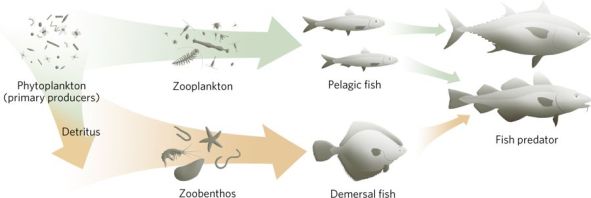
Demersal fish live and feed on or near the bottom of seas or lakes (the demersal zone). They occupy the sea floors and lake beds, which usually consist of mud, sand, gravel or rocks. In coastal waters they are found on or near the continental shelf, and in deep waters they are found on or near the continental slope or along the continental rise. They are not generally found in the deepest waters, such as abyssal depths or on the abyssal plain, but they can be found around seamounts and islands. The word demersal comes from the Latin demergere, which means to sink.
Demersal fish consist of Benthic fish and benthopelagic fish, they are bottom feeders. They can be contrasted with pelagic fish which live and feed away from the bottom in the open water column. Demersal fish fillets contain little fish oil (one to four percent), whereas pelagic fish can contain up to 30 percent.[not verified in body]
Benthic fish, sometimes called groundfish, are denser than water, so they can rest on the sea floor. They either lie-and-wait as ambush predators, maybe covering themselves with sand or otherwise camouflaging themselves, or move actively over the bottom in search for food. Benthic fish which can bury themselves include dragonets, flatfish and stingrays.
Benthopelagic fish inhabit the water just above the bottom, feeding on benthos and zooplankton. Most demersal fish are benthopelagic.
We analyzed publicly-available data of Fukushima 137Cs concentrations in coastal fish, in surface and bottom waters, and in surface marine sediments and found that within the first year of the accident pelagic fish lost 137Cs at much faster rates (mean of ~1.3% d-1) than benthic fish (mean of ~0.1% d-1), with benthopelagic fish having intermediate loss rates (mean of ~0.2% d-1). The loss rates of 137Cs in benthic fish were more comparable to the decline of 137Cs concentrations in sediments (0.03% d-1), and the declines in pelagic fish were more comparable to the declines in seawater. Retention patterns of 137Cs in pelagic fish were comparable to that in laboratory studies of fish in which there were no sustained 137Cs sources, whereas the benthopelagic and benthic fish species retained 137Cs to a greater extent, consistent with the idea that there is a sustained additional 137Cs source for these fish. These field data, based on 13,511 data points in which 137Cs was above the detection limit, are consistent with conclusions from laboratory experiments that demonstrate that benthic fish can acquire 137Cs from sediments, primarily through benthic invertebrates that contribute to the diet of these fish.
October 17, 2018
Posted by dunrenard |
Fukushima 2018 | cesium 137, Fish, Fukushima, radiation |
Leave a comment






 nuclear-news