Death of doctor in Fukushima disaster zone hospital throws patients’ futures into question

A photo from the website of Takano Hospital shows its building in the town of Hirono, Fukushima Prefecture.
A 120-bed hospital in the town of Hirono, Fukushima Prefecture, which has been on the frontline of efforts to restore communities annihilated by the March 2011 quake, tsunami and nuclear calamity, has been thrown into crisis following the unexpected death last week of its aging and sole full-time doctor.

Dr. Hideo Takano, 81-year-old director of the privately run Takano Hospital, died from burns after a fire broke out at his home on the hospital grounds on the night of Dec. 30. The police are investigating the cause of the fire, but it is being treated as an accident.
Hirono Mayor Satoshi Endo told The Japan Times on Friday that the town is doing its best to keep the hospital and its 100 inpatients — about 50 bed-ridden elderly patients and 50 people in its psychiatric ward — alive.
The town plans to pay for the accommodation and transportation costs of volunteer doctors who will fill Takano’s shifts through the end of January. After that, the hospital’s fate is uncertain.
Set up in 1980 originally as a psychiatric hospital some 20 km south of the crippled Fukushima No. 1 nuclear power plant, the facility has played a central role in maintaining the welfare of residents not only in town, but across the Futaba region as the only hospital operating since the nuclear disaster.
The crisis prompted many of the town’s residents and even its government to evacuate. Hirono’s evacuation orders were lifted in September 2011 and residents have been slowly making their way back, but the town’s population — currently about 3,000 — remains less than 60 percent of pre-3/11 levels. The population is expected to climb back to 4,000 by April, Endo said.
In the more than five years since the disaster began, Takano Hospital didn’t close for a single day because the late director decided its frail inpatients could not be evacuated.
Because the other five hospitals in the region shut down, Takano Hospital is the only institution providing medical care not only to its residents, but also to 3,500 or so workers residing there for decontamination and decommissioning work related to the core meltdowns.
Mayor Endo stressed that the hospital needs to survive as it is part of the town’s basic infrastructure and will be necessary if residents are to return.
“The hospital has played a huge role in the community by ceaselessly providing care,” Endo said. “If it goes, these patients will have no other place to go.”
Takano, who was a psychiatrist, had been a “super-human” figure, tirelessly tending to the needs of patients despite his advanced age, said Akihiko Ozaki, a 31-year-old surgeon at Minamisoma Municipal General Hospital some 60 km north.
Ozaki is spearheading a drive to save Takano Hospital, and thanks to the efforts of him and others, the hospital has secured about 25 doctors from across the country to work as unpaid volunteers through the end of the month.
But the hospital still urgently needs a permanent full-time doctor to fill Takano’s shoes, Ozaki said.
“Technically speaking, a hospital operating without a director is illegal,” Ozaki said. “Patients will suffer, as a system based on various different doctors coming and going is incapable of providing continuous care. We need a new full-time doctor as soon as possible.”
But it will be no easy task to find a replacement, Ozaki said, adding that the hospital was barely afloat under Takano, who worked for little pay and had next to no time off.
Mio Takano, his daughter and head manager of the hospital, said the facility has struggled financially since 3/11. She said government officials have long spurned her calls for help on the grounds that taxpayer money cannot be used by a private hospital.
Takano said that the quake changed everything and that the hospital’s running costs have surged because it needs to hire more staffers to maintain the same quality of care.
Before the quake, many nurses could ask parents or in-laws to take care of their children, she explained. But the disaster forced many families to separate and workers with children can no longer rely on elderly family members, she said, noting that the hospital thus needs to hire more people to work night and weekend shifts.
“Such lifestyle changes have meant it is more costly to keep the same level of care,” she said.
Takano added that, nearly six years on, the nuclear disaster is far from over.
“This is not a problem of an aging doctor dying in an accident, throwing a hospital into crisis. Situations like ours could happen to any other hospitals in areas that host nuclear power plants.”
Tepco to name underwriters this month for landmark bond sale: DealWatch

Tokyo Electric Power Co (9501.T) will select underwriters this month for its first bond sale since the 2011 Fukushima nuclear reactor disaster, people close to the deal told Thomson Reuters DealWatch.
The issue is expected to be worth at least $1 billion according to one of the people.
The deal is being closely watched by Japan’s corporate bond market, which Tepco dominated before the March 2011 earthquake and tsunami triggered the world’s worst nuclear accident since Chernobyl in 1986, bringing the company to its knees.
Tepco has been gauging demand for the landmark bond offering, as once-skeptical investors become more comfortable with the utility’s outlook after the government provided more details on decommissioning and compensation costs, sources said last week.
Tepco, which is looking to sell the bond by the end of March, will hold meetings next week with several brokerages, who will make pitches to the company for a mandate to sell the bonds, said the people close to the deal, who asked not to be identified because the discussions are private.
A Tepco spokesman on Friday said there was no change to the utility company’s previously announced plans to sell the bond by the end of March but that he was unaware of any plans to meet brokers next week.
The utility, once Asia’s largest, was essentially nationalized after Fukushima. It has struggled to contain radiation at the site and compensate victims of the accident while preparing to decommission the crippled power station.
The meeting will discuss investor demand, the likely size of the issue, the premium over government-bond yields Tepco will need to pay and the feasibility of selling the bond by Tepco’s target date, they said.
Tepco is considering a multi-tranche issue with maturities of three-, five- and 10-years, they said.
“At the very least, it will be worth 100 billion yen,” said one source. In the year leading up to the Fukushima disaster, Tepco sold 235 billion yen of bonds.
Sources have said Tepco will likely need to pay investors about 1 percentage point above the corresponding Japanese government bonds yields. This would be a rich premium considering other electric utilities pay about a third of that spread for their debt funding.
The government also owns 50.1 percent of the company following its bailout, seen by some investors as an implicit state guarantee on the company.
There are, however, some potential snags to Tepco’s plans to issue by the end of March. According to one person familiar with the government’s thinking, the government wants Tepco to delay the bond sale until after April, when legal changes allowing more financial support to the utility are enacted.
Voluntary nuclear evacuees to face housing assistance gap

Nine of Japan’s 47 prefectures are planning to provide financial and other support to voluntary evacuees from the Fukushima nuclear disaster as Fukushima Prefecture is set to terminate its free housing services to them at the end of March, the Mainichi Shimbun has learned.
Fukushima Prefecture’s move will affect more than 10,000 households that voluntarily evacuated within and outside Fukushima Prefecture in the wake of the Fukushima No. 1 Nuclear Power Plant meltdowns in March 2011. As many prefectures other than those nine prefectures are set to provide less generous assistance, voluntary evacuees will face a housing assistance gap depending on where they live or will live hereafter.
As of the end of October last year, there were 26,601 people in 10,524 households who were receiving Fukushima Prefecture’s free housing services after they voluntarily evacuated from the nuclear disaster, according to the Fukushima Prefectural Government. Of them, 13,844 people in 5,230 households were living outside Fukushima Prefecture.
Those voluntary evacuees have received full rent subsidies from Fukushima Prefecture for public and private housing units they live in under the Disaster Relief Act after fleeing from the city of Fukushima and other areas that lie outside the nuclear evacuation zone. While that has effectively been the only public assistance they receive, Fukushima Prefecture announced in June 2015 that it will terminate the service in March this year on the grounds that “decontamination work and infrastructure recovery have been set.”
In a nationwide survey conducted by the Mainichi Shimbun after October last year, Tottori, Hokkaido and four other prefectures said they will provide housing units for free to those voluntary evacuees, while three other prefectures said they will provide rent and other subsidies to them. Fukushima Prefecture was not covered in the survey.
Many of the other prefectures said they will provide assistance based no more than on the central government’s request that the conditions for accommodating voluntary evacuees into public housing be relaxed.
The Tottori Prefectural Government will provide prefecture-run housing units to voluntary evacuees for free and will also subsidize all of the rent for private rental housing. The measures will be applied to not only those who already live in Tottori but to also those who will move into the prefecture.
Yamagata Prefecture will provide housing for prefectural employees for free to low-income evacuees, while Hokkaido, Nara and Ehime prefectures will waiver the rent for evacuee households living in prefecture-run housing units. Kyoto Prefecture will exempt the rent for prefecture-run housing units up to six years after move-in, and will allow evacuees to continue living in such units after April this year until contract expiration. Niigata Prefecture will provide 10,000 yen a month to low-income evacuees living in private rental housing in order to prevent their children from having to change schools.
“Evacuees have been feeling anxiety about their housing. (As a local government plagued by aging and the declining population) we also expect them to live in our prefecture permanently,” the Tottori Prefectural Government stated in its response to the survey.
Most of the other prefectures will set up a priority quota for accommodating voluntary evacuees into public housing units, but they will face severe requirements, such as the need to move out after some time.
“The central government should consider responses in a unified manner,” noted the Iwate Prefecture Government in the survey.
http://mainichi.jp/english/articles/20170106/p2a/00m/0na/007000c
Soil Freezing Around Reactors Not As Effective As expected

This was to be the ultimate solution for controlling groundwater infiltration in the basement of damaged reactors where it mixes with highly contaminated cooling water. With a total cost of 34.5 billion yen (298 million dollars) paid by Japanese taxpayers, this unprecedented government project was to confirm the Prime Minister’s assertions to the Olympic Committee in 2013 that the situation ” Is under control “.
Begun in June 2016, soil freezing around the four damaged reactors was expected to limit groundwater infiltration and leakage of contaminated water. Since the areas with the strongest phreatic currents did not freeze, TEPCO had to pour concrete in certain areas. But the results have been slow and TEPCO was always demanding more time for the project to prove itself. According to the Asahi, the Nuclear Regulatory Authority, the NRA, seriously doubts the effectiveness of this technique, which it now considers as secondary. Media actions are not enough.
Indeed, according to the NRA, despite the low rainfall, the amount of water pumped in the basements of the reactors and in the contaminated groundwater around the wall does not drop enough. It therefore considers that the solution goes through pumping, not the wall. In response, TEPCO is committed to doubling its pumping capacity to 800 m3 per day in groundwater in the fall.
The NRA also authorized complete soil freeze upstream of the reactors, although it did not block downstream flows.
According to the soil temperature maps published by TEPCO beginning December (www.tepco.co.jp/en/nu/fukushima-np/handouts/2016/images/handouts_161208_01-e.pdf) or more recently (www.tepco.co.jp/en/nu/fukushima-np/handouts/2016/images/handouts_161222_02-e.pdf) some portions were still not frozen upstream. According to the latter document, TEPCO always injects chemicals into the soil where it does not freeze. It also gives the planning of future work. It will be necessary to wait until February 2017 to obtain the complete freezing upstream.
Soil freezing over such a distance for years is a very complex technology to implement. TEPCO reported a leak of the coolant discovered last December 19th without the cause being known. (www.tepco.co.jp/en/nu/fukushima-np/handouts/2016/images/handouts_161222_02-e.pdf)
As the company recalls, the primary purpose of these operations is to reduce groundwater infiltration in order to slow down the increase in the stock of contaminated water in tanks at the site.
According to the Asahi, before the soil was frozen, TEPCO pumped on average 300 m3 per day of contaminated water in the basements of the reactors in addition to the water injected for cooling. This became now 130 m3 per day, which is still more than the 70 m3 per day targeted.
The latest data published by TEPCO show an increase to 176 m3 per day at the end of December, to which must be added the too contaminated or salt groundwater to be treated directly and which is therefore mixed with the water in the basements. The latter is down to 58 m3 per day. The total reached 234 m3 / day. The impact of soil freezing is not obvious on this graph. (www.tepco.co.jp/en/nu/fukushima-np/handouts/2016/images/handouts_161226_01-e.pdf)
It should be noted that TEPCO injects a hundred cubic meters of water into each of the three accidented reactors daily to cool the fuel. And this water, very contaminated, leaks to the basements. TEPCO’s latest report shows a partially treated contaminated water stock of almost one million cubic meters, to which 60,000 m3 of reactors and 9,156 m3 of liquid waste are added. (www.tepco.co.jp/en/press/corp-com/release/betu16_e/images/161226e0201.pdf)
In addition, TEPCO has installed sensors at the port exit in front of the rugged power station to continuously measure the concentration of cesium and total beta in seawater.(http://www.tepco.co.jp/en/nu/fukushima-np/f1/seawater/index-e.html)
Translated from french by Dun Renard (Hervé Courtois)
http://fukushima.eu.org/le-gel-du-sol-autour-des-reacteurs-pas-aussi-efficace-que-prevu/
Government inquiry into nuclear accident: some testimonies will remain secret
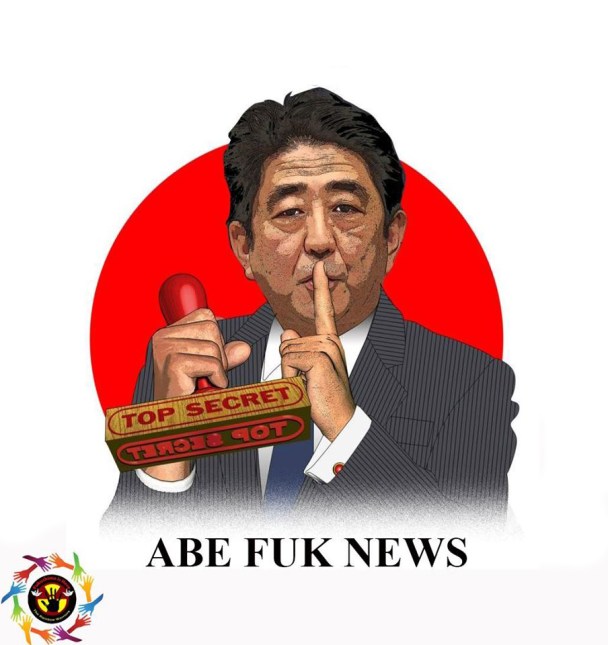
The commission of inquiry set up by the government after the nuclear disaster at the Fukusima dai-ichi plant has recorded some 770 testimonies. 240 have been made public since, with the agreement of the interviewees, including that of the former director of the plant, Masao Yoshida, now deceased.
TEPCO shareholders filed a lawsuit for the publication of the testimonies from 11 executives of TEPCO and 3 executives of NISA, which was the regulator at the time. They have just been dismissed.
Justice considered that if these documents were disclosed, it would be difficult to obtain the cooperation of the concerned persons in the future. The same applies to the secret portions of partially published testimonies.
A pair of earthquakes of M5.3 and M5.8 struck Fukushima and Ibaraki prefectures early Thursday
Strong quakes jolt eastern Japan
TOKYO (Kyodo) — A pair of earthquakes with a preliminary magnitude of 5.3 and 5.8 struck Fukushima and Ibaraki prefectures in eastern Japan early Thursday, the Japan Meteorological Agency said. No tsunami warning was issued.
The temblors occurred at around 12:44 a.m. and 2:53 a.m., originating at depths of about 60 and 30 kilometers off the coast of Fukushima. They measured up to 4 on the Japanese seismic scale of 7 in southern Fukushima and northern Ibaraki.
After the quakes, no abnormalities were detected at two nuclear power plants — the crippled Fukushima Daiichi and idled Fukushima Daini, according to the operator, Tokyo Electric Power Company Holdings Inc.
Fukushima was hard hit by the March 11, 2011 earthquake-tsunami and nuclear crisis.
http://mainichi.jp/english/articles/20170105/p2g/00m/0dm/001000c
Pair of strong late-night quakes jolt Fukushima, Ibaraki
A magnitude-5.3 earthquake and another of magnitude-5.8 struck Fukushima and Ibaraki prefectures early Thursday, the Meteorological Agency said. No tsunami warning was issued.
The earthquakes occurred at 12:44 a.m. and 2:53 a.m., originating at depths of about 60 km and 30 km off the coast of Fukushima, respectively. They measured up to 4 on the Japanese seismic scale to 7 in southern Fukushima and northern Ibaraki.
After the quakes, no abnormalities were detected at the crippled Fukushima No. 1 nuclear plant and the nearby idled Fukushima No. 2 plant, according to Tokyo Electric Power Company Holdings Inc.
Fukushima was hit hard by the March 11, 2011, earthquake-tsunami and nuclear crisis.
Environment Ministry deleted some of its remarks from minutes on contaminated soil meet
The Ministry of the Environment deleted some of its remarks made in closed-door meetings on reuse of contaminated soil stemming from the Fukushima nuclear disaster from the minutes of the meetings, it has been learned.
When the ministry posted the minutes on its website, it said it had “fully disclosed” them. The deleted remarks could be taken to mean that the ministry induced the discussions. The remarks led the meetings to decide on a policy of reusing contaminated soil containing up to 8,000 becquerels of radioactive cesium per kilogram. An expert on information disclosure lashed out at the ministry’s handling of the minutes, saying, “It is extremely heinous because it constitutes the concealment of the decision-making process.”
The meetings were called the “working group to discuss safety assessments of impacts of radiation.” The meetings were attended by about 20 people, including radiation experts, officials of the Environment Ministry and the Japan Atomic Energy Agency (JAEA) and others. The meetings were held six times from January to May in 2016.
The meetings discussed the reuse of radioactively contaminated soil generated when areas affected by the Fukushima nuclear crisis were decontaminated.
Initially, the meetings themselves were unpublicized. But because requests for information disclosure on the meetings were filed one after another, the Environment Ministry posted the minutes and relevant data on its website in August. As a matter of clerical procedures, the ministry said at that time that everything was disclosed.
The minutes that were disclosed contain “draft minutes” that were prepared before becoming official documents, but the Mainichi Shimbun obtained an “original draft” that was prepared even before then. Comparing the disclosed minutes with the original draft, the Mainichi found multiple cases of remarks being deleted or changed. According to the original draft, an Environment Ministry official said at the fourth meeting on Feb. 24, “With the assessments of soil with 8,000 becquerels, there have been cases in which the annual radiation dose slightly exceeds 1 millisievert in times of disasters and the like. But it will be good if it stays within 1 millisievert.” But the remark was deleted from the disclosed minutes.
Soil contaminated with radiation exceeding 8,000 becquerels is handled as “designated waste,” but discussions were held on reusing of contaminated soil containing 8,000 becquerels of radioactive cesium per kilogram during a series of meetings. In the Feb. 24 meeting, the JAEA showed an estimate that workers engaged in recovery work on a breakwater made of contaminated soil of 8,000 becquerels that has collapsed in a disaster would be exposed to radiation exceeding 1 millisievert per year — the maximum dose allowed for ordinary people. Based on the estimate, there was a possibility of the upper limit for reusing contaminated soil being lowered, but the Environment Ministry official’s remark promoted experts and others to call for s review to make a new estimate, with one attendee saying, “If it collapses, it will be mixed with other soil and diluted.”
A fresh estimate that the annual radiation dose will stay at 1 millisievert or lower was later officially presented, and the Environment Ministry officially decided in June on a policy of reusing contaminated soil containing up to 8,000 becquerels of radioactive cesium per kilogram.
http://mainichi.jp/english/articles/20170105/p2a/00m/0na/007000c
Disparities may arise in evacuee support / Fukushima Pref. to trim housing funds
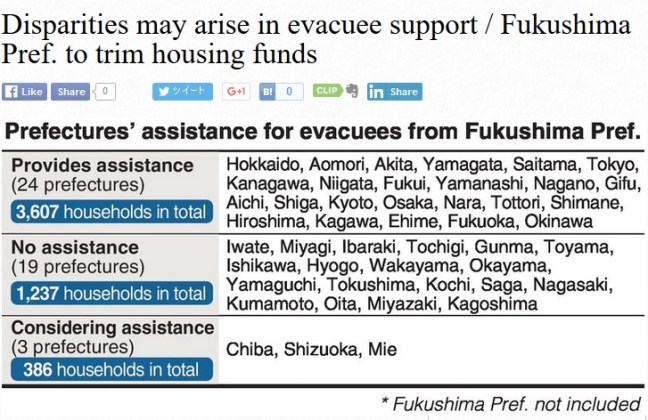
Starting in spring, housing assistance for residents of Fukushima Prefecture who evacuated to other prefectures voluntarily due to the 2011 nuclear accident will vary from prefecture to prefecture and certain disparities will occur, The Yomiuri Shimbun has learned.
The Fukushima prefectural government has so far been providing free-of-charge housing unconditionally and uniformly. However, it will terminate the provision at the end of March. Accordingly, 19 other prefectures will terminate their own initiatives to provide evacuees with free housing, while 24 prefectures will continue to provide housing free of charge and other services.
Although nearly six years have passed since the Fukushima No. 1 nuclear plant accident, many evacuees are still reluctant to return to their homes, and each prefecture that has accepted evacuees is responding to this situation in its own way.
After the accident, the Fukushima prefectural government treated voluntary evacuees — those who evacuated from areas that were not subject to evacuation orders — as equal to those who were instructed by the central government to evacuate. Abiding by the Disaster Relief Law, the prefecture has been shouldering rental fees for apartments or public housing facilities using funds from the state budget and other financial resources. The maximum rent for housing to be provided free of charge to voluntary evacuees is set at ¥60,000 per month in principle.
As of October 2016, the number of voluntary evacuees stood at 10,524 households or 26,601 individuals. Of these, 5,230 households or 13,844 individuals have relocated to areas outside of Fukushima Prefecture. In contrast to those who lived in areas subject to the evacuation order, voluntary evacuees are not eligible for regular compensation payments from Tokyo Electric Power Company Holdings, Inc. Therefore, the provision of free housing has been the main pillar of public support for voluntary evacuees.
Fukushima Prefecture decided in June 2015 to stop providing housing free of charge at the end of March 2017, judging that living conditions were changing for the better as the decontamination of residential areas progressed.
However, many evacuees responded to this by complaining that they did not want to be moved from places they were getting accustomed to. Accordingly, 24 prefectural governments other than Fukushima have decided to take the matter into their own hands by applying the law on public housing facilities and preferential measures by ordinances to compile their own budgets to extend the provision of free housing, give priority to evacuees in providing public housing for a fee or take other steps. A total of 3,607 households have evacuated on a voluntary basis to the 24 prefectures.
Several municipalities have also taken steps to provide public housing facilities free of charge.
Hokkaido, to which 229 households have voluntarily evacuated, has decided to extend provision of free housing for a year for 34 households. The prefectural government explained that it wants to help evacuees put their lives back in order by alleviating the concerns they may have about where to live.
Meanwhile, Hyogo Prefecture has decided to discontinue its support for the 44 households it accommodates. The spokesperson for the prefectural government said it would not take steps to keep the evacuees in the prefecture, which would be incompatible with policies of the Fukushima prefectural government aiming to bring them home.
Upon discontinuing the provision of free housing, Fukushima has procured 170 prefectural housing facilities for a fee to be provided preferentially to evacuees. The prefectural government is also planning to pay ¥100,000 to every household that moves back from outside the prefecture. Single-person households will receive ¥50,000. Residents who have evacuated to areas inside the prefecture will also receive a partial payment.
http://www.the-japan-news.com/news/article/0003439790
Tragic death in a fire of its only full-time doctor at Hirono, Fukushima hospital. Volunteer doctors sought.
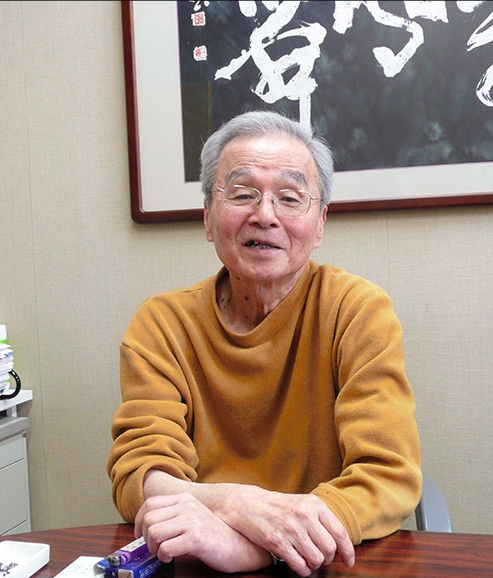
Hideo Takano, doctor and director of Takano Hospital
Lone doctor who stayed in town after Fukushima crisis dies in fire
HIRONO, Fukushima Prefecture–The tragic death in a fire of its only full-time doctor at a hospital here has dealt another crisis to this tiny community, which is still struggling to rebuild from the Fukushima nuclear disaster.
Hideo Takano, 81, director of Takano Hospital, died on Dec. 30, threatening the future of the hospital and possibly the community of 2,800 residents.
Hirono Mayor Satoshi Endo on Jan. 3 stepped up his pleas for assistance from the central and prefectural governments.
“We would like to prevent the collapse of local medical services,” Endo said at a news conference. “We, as a local government, need to respond to the dedication of Takano.”
Under the law, a private medical facility must have at least one full-time doctor on staff.
Takano’s one-story wooden house, on the same site as the hospital, caught fire on the night of Dec. 30. Police found his body inside the home.
Takano and another doctor at the hospital had treated inpatients as full-time physicians before the triple meltdown in March 2011, which was triggered by the Great East Japan Earthquake and tsunami on March 11 the same year.
The hospital is situated around 20 kilometers from the crippled Fukushima No. 1 nuclear power plant. It offers the only medical inpatient facility in Futaba county, which, alongside Hirono, includes towns co-hosting the Fukushima No. 1 plant and damaged Fukushima No. 2 nuclear plant.
When the town government ordered all its residents to evacuate on March 13, 2011, Takano and many of his staff chose to remain to treat inpatients at the hospital. They deemed it too risky to transport aged and frail patients elsewhere when the entire prefecture was in disarray.
Most of the inpatients at the hospital are senior citizens from Hirono, and many of them were bed-ridden.
Hirono had a population of slightly more than 5,000 before the nuclear disaster. But only a little more than half of the residents have returned to live in the town after the evacuation order was lifted a year later.
As of the end of last December, there were 102 inpatients at Takano Hospital, although the size of the staff shrank to about one-third of the pre-disaster level. Part-time doctors have joined Takano in treating patients after the disaster, but he was the only full-time physician on staff there.
“Takano used to say nothing makes him happier than treating patients,” said one of the hospital staff, describing his commitment.
According to the Hirono officials, part-time doctors continued seeing patients at the hospital until Jan. 3 after Takano’s death.
The town managed to secure temporary doctors for the hospital after that date through cooperation from Minami-Soma, a city about 60 km to the north.
Physicians from the municipal Minami-Soma General Hospital also have pitched in and formed a group to assist Takano Hospital. More than 20 doctors have signed up to provide volunteer services, including those from Chiba, Shizuoka and Nagano prefectures.
Although there is a medical clinic in Hirono, some residents say it is not sufficient to meet the health-care needs of residents in the town on its own.
http://www.asahi.com/ajw/articles/AJ201701040034.html
Volunteer doctors to be sought for Fukushima hospital after director dies in fire
HIRONO, Fukushima — The body of a man found in a home here after a fire was identified as that of a doctor who continued to treat patients in an area affected by the Fukushima nuclear disaster, local police announced on Jan. 3. The doctor’s death prompted the local town to seek volunteer doctors from across the country.
Hideo Takano, 81 — who was head of Takano Hospital in the town of Hirono in Fukushima Prefecture — died as a result of the fire which partially burned his home on Dec. 30. The corpse was confirmed to be that of Takano by Futaba Police Station, following DNA testing.
The doctor was particularly noted for his bravery following the Fukushima No. 1 nuclear power plant meltdowns in March 2011 — because he decided not to flee, and continued to attend to his patients’ needs at the only hospital close to the power plant, within Futaba county, that remained operational after the accident.
Currently, Takano Hospital treats patients who have returned to the area, as well as people involved in nuclear reactor decommissioning work, but the hospital now faces a staff shortage problem following the death of Dr. Takano, who was the only full-time doctor at the institution.
With this in mind, the Hirono Municipal Government announced on Jan. 3 that it will bring in doctors until Jan. 9 from nearby medical institutions such as Minamisoma City General Hospital, also in Fukushima Prefecture. The doctors will help treat approximately 100 inpatients, in addition to providing outpatient care. Furthermore, a group to support the hospital, called “Takano Byoin o shiensuru kai,” has been set up by voluntary doctors at the hospital, and there have also been appeals on Facebook, asking for support from doctors.
The Hirono Municipal Government plans to recruit volunteer doctors from across Japan — in an attempt to maintain the town’s medical care system — and has offered incentives such as free accommodation and travel. A representative at the town hall stated that, “Takano Hospital patients reside far and wide across Futaba,” and that the town will request support from both the Fukushima Prefectural Government and the central government.
Takano Hospital has set up a commemorative page on its website in memory of Dr. Takano — who devoted his life to medical care in the region — stating that it plans to “carry on the will of Dr. Takano and continue to provide medical care in the region.”
The Facebook page of “Takano Byoin o shiensuru kai,” or a group to support Takano Hospital:
https://www.facebook.com/savepatientakano/
http://mainichi.jp/english/articles/20170104/p2a/00m/0na/004000c
Gun control heartburn: Radioactive boars are amok in Fukushima

The “most adaptable animals that you’ll ever find” are running rampant across parts of rural Japan in the wake of the 2011 nuclear catastrophe and strict gun laws aren’t helping.
The Fukushima Daiichi nuclear disaster, in which a boiling water reactor nuclear power plant largely went Chernobyl after a tsunami knocked it offline has left Japan with a host of problems to include radiation-induced health impacts, some 200,000 displaced locals and possible exposure of groundwater to melted down nuclear fuel for decades to come.
Oh yeah, and the wild hogs.
According to an article in The Washington Post last April, the boar population, lacking natural predators is booming. Worse, thousands of the animals roam an area where highly radioactive caesium-137, which has a half-life of 30 years, has been confirmed.
Most agree that the best way to eradicate the rapid population of would-be Orcs is through hunting, but in gun control-friendly Japan, that is easier said than done.
“Something that complicates wild boar management in Japan is the exceptionally restrictive ownership, use, and access to firearms,” says Dr. Mark Smith, a forestry and wildlife professor at Auburn University, told Outside online. “This includes not only the general populace, but also with researchers, wildlife biologists, and natural resource managers.”
According to the Australian-based Small Arms Survey, the rate of private gun ownership in Japan is 0.6 per 100 people with only 77 handguns in circulation and just 0.8 percent of Japanese households containing one or more legal guns, most often shotguns.
Smith went to Japan to study the problem in 2013.
“Although [recreational] hunting does occur in Japan, it is very limited,” says Smith, “and hunter numbers are declining by the year, so there are fewer and fewer hunters out there harvesting wild boar.”
Plus there is the problem with the meat. In short, there is no good way to make caesium-137 infused pork a balanced part of your complete meal without the diner glowing in the dark, no matter how much BBQ sauce you use.
In Japan, they have to incinerate the carcasses (at 1,771 degrees Fahrenheit) then obliterate the fragments left over with hammers and box them up. Carefully.
Furthermore, the animals are very smart.
“They are the most adaptable animals that you’ll ever find: we call them the ‘opportunistic omnivore,’” says Smith.
http://www.guns.com/2017/01/03/gun-control-heartburn-radioactive-boars-are-amok-in-fukushima/
Contaminated Glove, Jacket, pants worn by a Fukushima Daiichi worker
By Marco Kaltofen
Activity is 0.7 to 240 kBq/kg, surface rad to 59 uR/hr.
http://bostonchemicaldata.com/data.html

35.5 kBq/kg

0.11 to 0.24 kBq/kg

ND (<0.01) to 17.1 kBq/kg
Landscapes I saw

A short poem at the beginning of the year.
Accumulated dust can make mountains.

Here are the pictures that show reality.
Taken on January 2nd 2017.

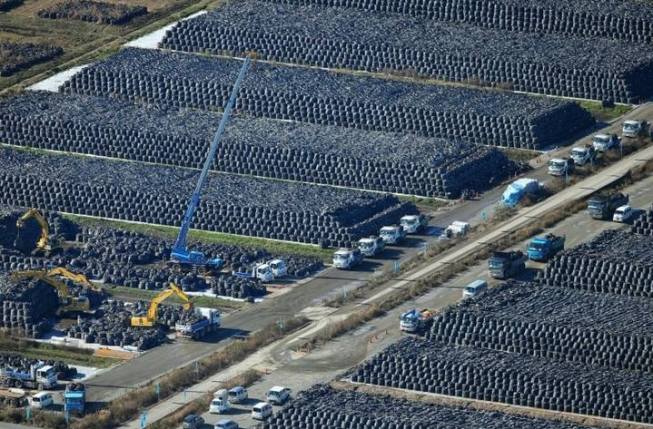
These black bags are full of soil and fallen leaves gathered in the course of the decontamination work.
These bags last from 3 to 5 years.
What do we do now?

Over the mountain of black bags lies Odaka station.
Now anybody can get on and off the train.

Source: Akiyoshi Imazeki, Odaka Station, Minamisoma-shi, Fukushima Prefecture
Fate of Fukushima No. 2 nuclear plant remains unknown

The government is struggling to decide the future of Tepco’s Fukushima No. 2 nuclear power plant, which has been suspended since the March 2011 disaster.
There have been increasing calls for decommissioning the power plant located just a few kilometers south of the wrecked Fukushima No. 1 installation.
The government has been finding it difficult to reach a clear conclusion on Fukushima No. 2’s fate, as it and Tokyo Electric Power Company Holdings have been busy dealing with its older counterpart that suffered three reactor meltdowns following the March 2011 earthquake and tsunami.
On Dec. 21, the Fukushima Prefectural Assembly voted unanimously to adopt a resolution calling on the central government to decommission the No. 2 plant “at an early date,” arguing that the facility is an obstacle to the prefecture’s recovery from the 3/11 disasters.
A temporary halt to the cooling system for a spent fuel pool at the No. 2 plant caused by an earthquake in November rekindled fears of another meltdown crisis.
In 2011, the prefectural assembly adopted a petition calling for decommissioning all reactors in Fukushima.
The assembly has also adopted a series of written opinions demanding the decommissioning of the No. 2 plant, which is located in the towns of Naraha and Tomioka.
Demands from local communities “have been ignored by the central government,” one person said.
The central government’s official position is that whether to decommission the plant is up to Tepco.
As the government has already lifted the state of emergency for the No. 2 plant, it has no authority to decide the decommissioning under current regulations.
If an exception were made, the central government could receive a barrage of requests for decommissioning reactors all over the country, sources familiar with the situation said.
“Such a situation would destroy Japan’s whole nuclear policy,” a senior official at the Ministry of Economy, Trade and Industry said.
Some people have called for creating a special law on decommissioning Fukushima No. 2, but others have raised concerns that such a step could infringe on Tepco’s property rights, the sources said.
Some officials in the central government have said that no one believes the No. 2 plant can continue to exist.
Prime Minister Shinzo Abe and his Cabinet have left room for making a political decision on dismantling the facility, saying that the plant can’t be treated in the same way as other nuclear plants due to fear among Fukushima residents of another nuclear accident.
Since the government effectively holds a stake of more than 50 percent in Tepco, it can influence the company’s policy as a major shareholder.
But Tepco now needs to focus on dealing with the No. 1 plant. A senior company official said that it “cannot afford to decide on decommissioning, which would require a huge workforce.”
The main opposition Democratic Party plans to pursue a suprapartisan law that would urge Tepco to decide to decommission the plant at an early date.
“While understanding calls for early decommissioning, we have no choice but to wait for the No. 2 plant’s four reactors to reach the end of their 40-year lifetimes,” a lawmaker of the ruling Liberal Democratic Party said.
The four reactors launched operations between April 1982 and August 1987.
Debris Removal at Reactor # 3 Delayed, but Arrival of the First Elements of the New Building for its Spent Fuel Removal
Transportation of the supporting part of a new roof for the Unit 3 fuel removal at Fukushima Daiichi Nuclear Power Station
The clearing of debris from reactor # 3 is delayed, delaying the construction of the new building to remove spent fuel from the pool. The debris removal was to be done in order to build a new workshop to remove the fuels from the pool.
The removal of the spent fuel should have started in January 2018. In the beginning, TEPCo was to start in 2015. We do not know their new schedule yet.
On the other hand, TEPCO communicated on the arrival of the first elements of the new building, with photos and video.

The dose rates on the site are here. There is up to 2.6 mSv / h in the vicinity of reactor No.3.

Links from TEPCO:
Photos of the new building
Click to access handouts_161220_01-e.pdf
Video
http://photo.tepco.co.jp/en/date/2016/201612-e/161220-01e.html
Dose rates in Reactor 3 vicinity
http://www.tepco.co.jp/en/nu/fukushima-np/f1/surveymap/images/f1-sv-20161219-e.pdf
2.46μSv/h Hot Spot in Misato, Saitama Prefecture, at Tokyo’s door

Hot Spot (2.46μSv/h at ground level, 0.64μSv/h at 50cm from the ground) in Misato, Saitama Prefecture.


The sign says in Japanese “We will keep the river clean”.
Misato, Saitama Prefecture is at 32km from Tokyo’s center and 223km from Fukushima Daiichi.

Misato, Saitama Prefecture is at 223km from Fukushima Daiichi.

Misato, Saitama Prefecture is at 32km from Tokyo’s center
Source: Sugar Nat https://www.facebook.com/shinpei.tn
1 This Month
Chernobyl: The Lost Tapes – A good documentary on Chernobyl on SBS available On Demand for the next 3 weeks– https://www.sbs.com.au/ondemand/tv-program/chernobyl-the-lost-tapes/2352741955560

of the week–London Campaign for Nuclear Disarmament

Tell the Ukrainian Government to Drop Prosecution of Peace Activist Yurii Sheliazhenko
To see nuclear-related stories in greater depth and intensity – go to https://nuclearinformation.wordpress.com
-
Archives
- April 2026 (152)
- March 2026 (251)
- February 2026 (268)
- January 2026 (308)
- December 2025 (358)
- November 2025 (359)
- October 2025 (376)
- September 2025 (257)
- August 2025 (319)
- July 2025 (230)
- June 2025 (348)
- May 2025 (261)
-
Categories
- 1
- 1 NUCLEAR ISSUES
- business and costs
- climate change
- culture and arts
- ENERGY
- environment
- health
- history
- indigenous issues
- Legal
- marketing of nuclear
- media
- opposition to nuclear
- PERSONAL STORIES
- politics
- politics international
- Religion and ethics
- safety
- secrets,lies and civil liberties
- spinbuster
- technology
- Uranium
- wastes
- weapons and war
- Women
- 2 WORLD
- ACTION
- AFRICA
- Atrocities
- AUSTRALIA
- Christina's notes
- Christina's themes
- culture and arts
- Events
- Fuk 2022
- Fuk 2023
- Fukushima 2017
- Fukushima 2018
- fukushima 2019
- Fukushima 2020
- Fukushima 2021
- general
- global warming
- Humour (God we need it)
- Nuclear
- RARE EARTHS
- Reference
- resources – print
- Resources -audiovicual
- Weekly Newsletter
- World
- World Nuclear
- YouTube
-
RSS
Entries RSS
Comments RSS
 nuclear-news