In Mali Martha Lightfoot’s own words: ” The measuring capacity is just getting better and they are reaching parts of the containment they were unable to monitor before. I think it’s important not to confuse more accurate readings with the misconception that they indicate that the levels are rising. It is shocking enough to get an indication of how high the levels still are. And we may find, as technology improves, that parts of the containment are higher still. But, that still does not indicate that the levels are rising, just that our ability to design monitoring devices is getting better. “
As Majia Nadesan is saying in her own blog article : “A separate article published in The Asahi Shimbun notes that radiation levels in units 1 and 3 remain so high (higher than unit 2) that TEPCO is unable to investigate conditions in there: If confirmed, the first images of melted nuclear fuel at the Fukushima No. 1 nuclear plant show that Tokyo Electric Power Co. will have a much more difficult time decommissioning the battered facility. The condition of what is believed to be melted fuel inside the No. 2 reactor at the plant appears far worse than previously thought. …High radiation levels have prevented workers from entering the No. 2 reactor, as well as the No. 1 and No. 3 reactors at the plant. MASANOBU HIGASHIYAMA (January 31, 2017) Images indicate bigger challenge for TEPCO at Fukushima plant. The Asahi Shimbun, http://www.asahi.com/ajw/articles/AJ201701310073.html
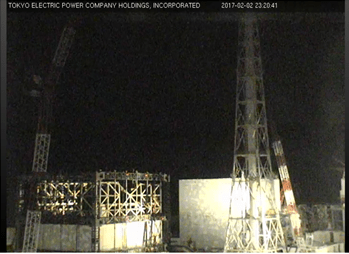
If radiation levels are at 530 sieverts an hour inside unit 2, I wonder what conditions are like in the 1 and 3 reactors, which are described as even hotter? I can tell you from watching the reactors on the webcams for 5 plus years that atmospheric emissions from unit 3 have never ceased (as illustrated below far right side of screenshot)”. http://majiasblog.blogspot.fr/2017/02/fukushima-daiichi-unit-2-measures-530.html
Anyway in the meantime those 3 reactors are still belly button opened up spitting high radiation into our skies and environment, the reactor 1 and 3 even higher radiation than reactor 2.
“Radiation brain” was a pun that made the social media circuit after March 11, 2011, deriding people whose brains (nō) had become unduly contaminated with fears about radiation after the disaster at Tokyo Electric Power Company Holdings Inc.’s Fukushima No. 1 nuclear power plant. They had, people claimed, “radiation brains” (hoshanō), a kind of soft-minded hysteria that made them figures of fun but also figures of potential danger to society and the economy. Their lack of confidence in government regulation of foodstuffs, people argued, became the source of harmful rumors that hurt farmers and dairy producers in disaster-affected areas. Such citizens, usually mothers in charge of providing meals for their children, were reckless in their caution.
Aya Hirata Kimura, a sociologist and professor of women’s studies at the University of Hawaii at Manoa, presents case studies of mothers with such anxieties and examines citizens grappling with post-Fukushima food safety concerns in “Radiation Brain Moms and Citizen Scientists: The Gender Politics of Food Contamination After Fukushima.” Kimura does not make claims about the extent of actual dangers to the food supply, but she does argue that the reality of the post-disaster threat is far from certain. The government, in other words, may be right about the limited health risks posed by irradiated produce, dairy, and meat; but skepticism on the part of citizens is a rational, rather than a hysterical, response. She also examines the various constraints that made many citizens — mothers, in particular — turn to scientific activities such as running citizen radiation-measuring organizations rather than engaging in out-and-out criticism of government and industry responses to safety concerns.
Immediately after the disaster, many expected a surge of specifically anti-nuclear political activism in Japan, and indeed protests and demonstrations flourished in the spring and summer of 2011. However, just five years on from the worst nuclear disaster in decades, political activism remains a fringe activity. Part of what interested Kimura was why citizens seemed to be “more concerned than outraged.” As she noted recently, “so many seem to be perplexed why Japan, after the major nuclear accident, has not seen transformative politics.” Her book offers some answers to that question.
Kimura makes the point that avoiding confrontational politics and direct dissent is not, as is often claimed, a characteristic particular to Japanese culture. It’s a characteristic particular to neoliberalism. Neoliberalism is one of the key concepts that guides Kimura’s analysis, and she traces how the neoliberal shift to limited government, rule of the free market, and individualism has determined what kinds of demands citizens in post-Fukushima Japan can make of their government. In a neoliberal society, the government is no longer responsible for ensuring citizens’ rights to safety, economic factors rule in cost-benefit analyses and the good neoliberal citizen is willing to take on individual risk and make individual choices, while they are less willing to act collectively.
Alongside neoliberalism, Kimura introduces us to the concepts of scientism and post-feminism. Scientism indicates a tendency in which science holds authority in society to determine the “reality” of controversial and uncertain situations, although culture and society influence the creation and application of science itself. Post-feminism is the idea that systematic oppression of women has been eliminated and collective feminist activism is no longer necessary, since motivated individual women can empower themselves.
An example of how these three larger forces of neoliberalism, scientism and post-feminism play out in post-3/11 society and constrain citizen activism is the case of fūryōhigai, or harmful rumors. The term “fūryōhigai” apparently originated in the 1980s, and indicated a decline in seafood sales because of nuclear reactor accidents. After agricultural producers in areas near the distressed Fukushima No. 1 plant suffered economic losses, the term gained new currency and shifted blame onto concerned consumers, particularly “radiation brain” moms, and away from government and business interests. The prioritization of economic recovery and the individual consumer’s responsibility to participate in this effort reflected neoliberal priorities. The view of scientism insisted on the scientific authority of nuclear experts, although many of those experts had an interest in promoting nuclear power, and the science of post-Fukushima health impacts remains contested. Contradictory demands placed women at the center of controversies about food safety as mothers responsible for the health of their families but also as targets of gendered stereotypes of women as particularly unscientific and irrational, while the post-feminist social context deterred them from making collective political demands of the powers that be.
The role these three ideologies play in Kimura’s analysis might put off a nonacademic reader, but Kimura employs them to make the power dynamics to which we are all subject visible, much as her citizen scientists labor to make the invisible threat of radiation visible. Speaking about her book, Kimura noted that “all these ‘-isms’ tend to be normalized and taken for granted.” So scientism, for example, makes science’s objective authority something that is taken for granted in spite of the fact that science is shaped by social forces. Kimura works to make the ideologies of neoliberalism, scientism and post-feminism visible, because “invisibility is at the crux of their power. The more they are named, the less they can masquerade as apolitical.” Just because we cannot see these forces does not mean that they do not impact our world, and they are very real in their consequences for potential political activism.
Radiation Brain Moms and Citizen Scientists, by Aya Hirata Kimura. 224 pages Duke University Press.
Concerns raised by the Nuclear Regulation Authority (NRA) on how radioactive soil from the Fukushima nuclear disaster would be reused were omitted from the minutes of closed-door meetings on the issue, the Mainichi Shimbun has learned.
It has already come to light that comments from the Ministry of the Environment that could be interpreted as attempting to manipulate the conclusions of the meetings were left out when the minutes were publicly released. The latest revelation means yet another important part of the minutes is missing.
The meetings were held by the Ministry of the Environment between January and May last year with various radiation experts in attendance. In June, the experts decided to manage and reuse contaminated soil with levels of radioactivity under 8,000 becquerels of cesium per kilogram in public construction projects.
Related legislation reads “When deciding on technical standards to prevent radiation-related health problems, the Radiation Council must be consulted.” The publicly released meeting minutes quote an Environment Ministry representative as saying, “We need to think about the consultations with the council. When we discussed the issue with the NRA, it placed importance on our management (of the reused soil).” The quote shows that the ministry had talked to the NRA, which has jurisdiction over the council, about consultations with the body.
However, a source has disclosed that even though the ministry representative mentioned specific concerns brought up by the NRA, saying, “The Nuclear Regulation Authority was most concerned about where the soil will be used, and whether it might be used in the yards of regular households,” this comment was omitted from the minutes.
Furthermore, in a rough draft of the minutes obtained by the Mainichi Shimbun, during the fourth round of Environment Ministry meetings in February last year, an official stated, “Afterwards we will ask all committee members to review the meeting minutes. After that, during next fiscal year, we are thinking of receiving your support in dealing with the Nuclear Regulation Authority.” However, these words were deleted from the publicly released minutes.
The ministry was unable to give a satisfactory explanation for the concerns raised by the NRA, and so there has been no consultation with the Radiation Council to set health standards. However, according to both the ministry and the NRA, they have discussed the issue of consultations with the committee and agree they are not yet necessary.
According to internal rules created by the authority in December 2013, the Radiation Council only needs to be consulted when setting standards by law or relevant regulations. The standards decided through the ministry meetings are only “basic ideas” before they are set by law or regulations.
The ministry plans to reuse contaminated soil on an experimental basis. An NRA representative commented, “Once the plans for the experiment are in place, we understand that they will discuss the issue with us again.”
Even the existence of the closed-door meetings was originally not announced, but after repeated requests for information disclosure, the ministry revealed the meeting minutes in August last year. While the release was called a “full release,” comments including ones that could be taken as attempting to manipulate the discussion toward a conclusion of using 8,000 becquerels per kilogram as an upper limit when reusing soil were deleted from the records. After this came to light, Environment Minister Koichi Yamamoto said the minutes were “meeting summaries that only included the points of what was said.”
TEPCO is reporting measuring radiation levels of 530 SIEVERTS AN HOUR (10 will kill you dead pretty quickly) and has discovered a 2-meter hole in the grating beneath the reactor pressure vessel (1 meter-square hole found in grating):
TOKYO (Kyodo) — The radiation level inside the containment vessel of the No. 2 reactor at the crippled Fukushima Daiichi nuclear complex stood at 530 sieverts per hour at a maximum, the highest since the 2011 disaster, the plant operator said Thursday.
Tokyo Electric Power Company Holdings Inc. also announced that based on image analysis, a hole measuring 2 meters in diameter has been found on a metal grating beneath the pressure vessel inside the containment vessel and a portion of the grating was distorted.
…The hole could have been caused by nuclear fuel that penetrated the reactor vessel as it overheated and melted due to the loss of reactor cooling functions in the days after a powerful earthquake and tsunami on March 11, 2011 hit northeastern Japan.
According to the image analysis, about 1 square meter of the grating was missing.
…Images captured using a camera attached to a telescopic arm on Monday also showed part of the grating has gone. A further analysis of the images found a 2-meter hole in an area beyond the missing section on the structure.
A separate article published in The Asahi Shimbun notes that radiation levels in units 1 and 3 remain so high (higher than unit 2) that TEPCO is unable to investigate conditions in there:
If confirmed, the first images of melted nuclear fuel at the Fukushima No. 1 nuclear plant show that Tokyo Electric Power Co. will have a much more difficult time decommissioning the battered facility.
The condition of what is believed to be melted fuel inside the No. 2 reactor at the plant appears far worse than previously thought.
…High radiation levels have prevented workers from entering the No. 2 reactor, as well as the No. 1 and No. 3 reactors at the plant.
If radiation levels are at 530 sieverts an hour inside unit 2, I wonder what conditions are like in the 1 and 3 reactors, which are described as even hotter?
I can tell you from watching the reactors on the webcams for 5 plus years that atmospheric emissions from unit 3 have never ceased (as illustrated below far right side of screenshot):
There is some dispute about the recent high level of radiation measured inside the Fukushima Daiichi reactor 2, thanks to the Japan Times unprecise english translation of the Kyodo News Japanese language article.
They have been able to measure these highest radiation levels only now because they couldn’t get as close to where they think the melted fuel may be with monitors before. Not the highest levels ever present at the site. That would have been around the time of the accident, or soon after. The radiation levels at the site do not appear to be rising, they are just now able to get deeper inside the reactor containment before the monitors fail, and so they get better readings.
The Japan Times article’s title is ok: “Highest radiation reading since 3/11 detected at Fukushima No. 1 reactor”. Yes, it is the highest radiation reading found since 3/11 because since 3/11 Tepco had not been able to reach such deep place to measure the radiation there. So this recent reading is the highest found since 3/11.
The Japan Times article in itself does not mention directly any radiation increase or “spike. But their wording “has reached” in “The radiation level in the containment vessel of reactor 2 at the crippled Fukushima No. 1 power plant has reached a maximum of 530 sieverts per hour, the highest since the triple core meltdown in March 2011, Tokyo Electric Power Co. Holdings Inc. said” could be misconstrued as meaning that the high level recently found is resulting from an increase of radiation, when compared to the lower level previously found . Which is not the case. Their previous reading was lower because they had not been able to go that deep before to monitor radiation there.
The Japan Times article then misled some western media, such as the Guardian, Popular Mechanic and others to themselves publish misconstrued articles based on the Japan Times article as their source.
The Popular Mechanics article’s title was ok: “Highest Radiation Levels Since Meltdown Recorded at Fukushima” but their subtitle is entirely wrong and misleading: “Levels haven’t been this high since the actual meltdown in 2011.” That subtitle is wrong, the levels were maybe that high or even higher, but Tepco had not been able to reach there before to find out, to take such measure in that place, at that deep level. That subtitle is wrong, suggesting that there is an increase. Popular Mechanics misconstrued the article of Japan Times and drawed the wrong conclusion. http://www.popularmechanics.com/technology/infrastructure/a25034/radiation-spikes-fukushima-possible-breach/
The Guardian ‘s article title is in itself misleading: ” Fukushima nuclear reactor radiation at highest level since 2011 meltdown”. A title such as “Fukushima nuclear reactor radiation highest level to date found since 2011 meltdown” would have been better and more accurate. The added words “to date found” would clarify that it was maybe already there before but that it had not been found yet, because they had not been able to reach that place and that deep before to take such measure. In its text it fails to mention the real reason why the measure recently found is higher than the previous measure. This all results in the Guardian article saying that this highest recent measure compared to the lower previous one is due to an increase of radiation. This is absolutely wrong, a complete misconstruction of the real facts. https://www.theguardian.com/environment/2017/feb/03/fukushima-daiichi-radiation-levels-highest-since-2011-meltdown?CMP=share_btn_fb
And many other western media and websites went along and repeated the same blind misconstruction.
Thanks heavens there were two websites who noticed the error made by those mainstream media and many other websites. They stepped in trying to correct that misconstruction and to re-establish the true facts. The Simply Info Fukuleaks website and the Safecast website, thanks to both websites’ bloggers team for their vigilance and their efforts in keeping the facts straight.
We can’t say that there has been an increase in radiation because we do not know that. To know that we would need to have a previous measure at the same deep at the same place to compare both measures. But such previous measure that deep at that place we do not have, so it is impossible to draw any conclusion at this stage, only that it is very high.
Now what we really need is a second probe at the same deep at the same place, to confirm the first probe readings, but also to compare the recent readings and the next readings so as to assess if the radiation levels there are stable or not, if there will be an increase of radiation between the two probes or not…Until such second probing takes place, at this stage no one can say anything about any occuring increase…
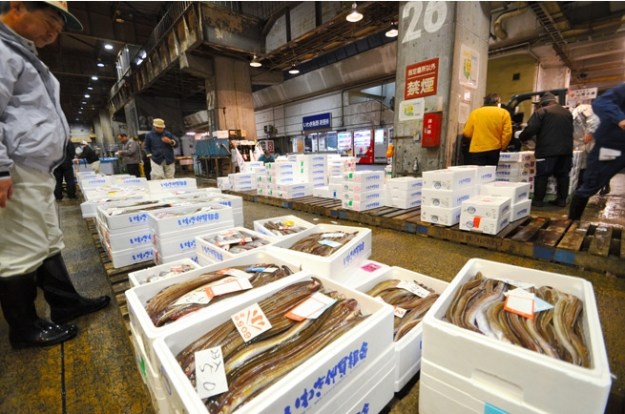
Fish caught during test fishing operations are sold at the Iwaki City Central Wholesale Market on Jan. 13. (Kazumasa Sugimura)
IWAKI, Fukushima Prefecture–For the first time, radioactivity levels were lower than the government’s safety limit in every seafood sample caught off Fukushima Prefecture for an entire year, officials said.
The Fukushima Prefectural Fisheries Experimental Station said 8,502 fish and shellfish samples were tested in 2016, and all recorded radioactivity readings under the safety standard of 100 becquerels per kilogram.
Ninety-five percent of them tested below the detection limit of around 15 becquerels per kilogram.
It was also the first time more than 90 percent of samples were below the detection threshold since the disaster at the Fukushima No. 1 nuclear plant started in March 2011, according to the officials.
People in the local fishing industry hope the numbers will help lead to a return to normal operations, although they say it is difficult to gauge the impact of harmful rumors about Fukushima seafood because prices depend on multiple factors, including quantity and quality.
“Test fishing is, after all, test fishing,” said Yuji Kanari, a managing director with seafood wholesaler Iwaki Gyorui KK. “Turning that into full fishing operations like before (the disaster) will emerge as a major challenge this year.
“I hope that local consumption of locally produced goods that was disrupted by the nuclear disaster will soon be back.”
The hauls from test fishing, which began in June 2012, have grown from year to year.
Preliminary figures show last year’s catch at 2,072 tons, up 560 tons from 2015, but still only 7.9 percent of the annual catch of 26,050 tons averaged over the decade preceding the 2011 disaster.
Ninety-four species are eligible for this year’s test fishing, which the Soma-Futaba fisheries cooperative association started on Jan. 10 and the Iwaki city fisheries cooperative association began on Jan. 12.
The national government suggested it would scale back radiation tests on produce from Tokyo and 16 other prefectures affected by the Fukushima nuclear disaster, at a citizen-oriented event in Tokyo on Feb. 2, drawing mixed reactions from those in attendance.
A draft policy was put together by government bodies including the Ministry of Agriculture, Forestry and Fisheries and the Consumer Affairs Agency and calls for allowing reduction of the tests from the 2017 fiscal year. The plan was influenced by the fact that there are now almost no cases of agricultural products that exceed the regulatory limit for radioactive cesium of 100 becquerels per kilogram. Under the draft policy, the Tokyo Metropolitan Government or any of the affected prefectural governments whose agricultural products were at half or less of the limit for the past three years could choose to scale back their tests.
Representatives from consumer groups and Fukushima producers were present at the Feb. 2 meeting. There were many voices of opposition against the draft policy, saying it was too early to cut back the tests, or that the requirement for scaling them back should be stricter than half or less of the regulatory limit. On the other hand, another attendee said that over the last five years the tests had cost around 4 billion yen and the money should “be spent toward more meaningful goals.”
According to the testing results from fiscal 2011 through fiscal 2015, during the first two years the percentage of products like vegetables, fruits, tubers and meats from these areas with radioactive cesium in excess of the regulatory limit was between 0.1 percent and 5.9 percent, but since 2013 no excessive radiation has been detected.
The central government plans to hold an event to exchange ideas on the matter on Feb. 17 and get a better understanding of public opinion, before deciding on whether to actually downsize the testing.
Fukushima radiation levels at highest level since 2011 meltdown
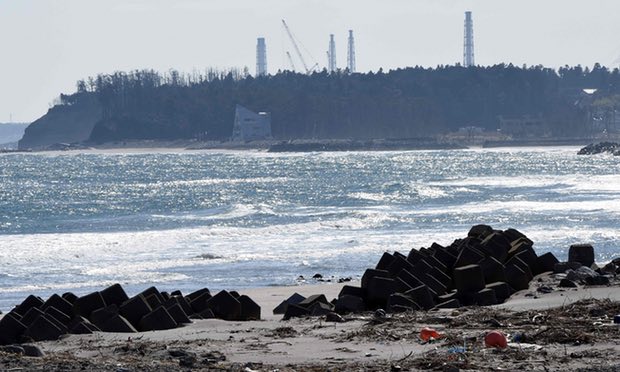
Cranes over the Fukushima Daiichi plant in February 2016. The decommissioning process is expected to take about four decades
Extraordinary readings pile pressure on operator Tepco in its efforts to decommission nuclear power station
Radiation levels inside a damaged reactor at the Fukushima Daiichi nuclear power station are at their highest since the plant suffered a triple meltdown almost six years ago.
The facility’s operator, Tokyo Electric Power (Tepco), said atmospheric readings as high as 530 sieverts an hour had been recorded inside the containment vessel of reactor No 2, one of three reactors that experienced a meltdown when the plant was crippled by a huge tsunami that struck the north-east coast of Japan in March 2011.
The extraordinary radiation readings highlight the scale of the task confronting thousands of workers, as pressure builds on Tepco to begin decommissioning the plant – a process that is expected to take about four decades.
The recent reading, described by some experts as “unimaginable”, is far higher than the previous record of 73 sieverts an hour in that part of the reactor.
A single dose of one sievert is enough to cause radiation sickness and nausea; 5 sieverts would kill half those exposed to it within a month, and a single dose of 10 sieverts would prove fatal within weeks.
Tepco also said image analysis had revealed a hole in metal grating beneath the same reactor’s pressure vessel. The one-metre-wide hole was probably created by nuclear fuel that melted and then penetrated the vessel after the tsunami knocked out Fukushima Daiichi’s back-up cooling system.
“It may have been caused by nuclear fuel that would have melted and made a hole in the vessel, but it is only a hypothesis at this stage,” Tepco’s spokesman Tatsuhiro Yamagishi told AFP.
“We believe the captured images offer very useful information, but we still need to investigate given that it is very difficult to assume the actual condition inside.”
The presence of dangerously high radiation will complicate efforts to safely dismantle the plant.
A remote-controlled robot that Tepco intends to send into the No 2 reactor’s containment vessel is designed to withstand exposure to a total of 1,000 sieverts, meaning it would survive for less than two hours before malfunctioning.
The firm said radiation was not leaking outside the reactor, adding that the robot would still prove useful since it would move from one spot to the other and encounter radiation of varying levels.
Tepco and its network of partner companies at Fukushima Daiichi have yet to identify the location and condition of melted fuel in the three most seriously damaged reactors. Removing it safely represents a challenge unprecedented in the history of nuclear power.
Quantities of melted fuel are believed to have accumulated at the bottom of the damaged reactors’ containment vessels, but dangerously high radiation has prevented engineers from accurately gauging the state of the fuel deposits.
Earlier this week, the utility released images of dark lumps found beneath reactor No 2 that it believes could be melted uranium fuel rods – the first such discovery since the disaster.
In December, the government said the estimated cost of decommissioning the plant and decontaminating the surrounding area, as well as paying compensation and storing radioactive waste, had risen to 21.5tn yen (£150bn), nearly double an estimate released in 2013.
Radiation level in Fukushima reactor could kill within a minute
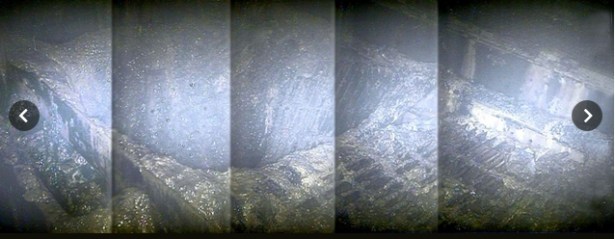
Images show black lumps on grating for maintenance work below the No. 2 reactor’s pressure vessel at the Fukushima No. 1 nuclear power plant. TEPCO says melted fuel likely caused at least two holes in the metal grating, including an opening measuring 1 meter by 1 meter. (Provided by Tokyo Electric Power Co.)
Radiation levels that can kill a person in a minute and holes created by melted nuclear fuel could further delay decommissioning operations at the No. 2 reactor of the Fukushima No. 1 nuclear plant.
Tokyo Electric Power Co., operator of the crippled plant, said Feb. 2 that the maximum estimated radiation level near what is believed to be melted fuel in the reactor was 530 sieverts per hour, the highest so far since the triple meltdown in 2011.
In its investigation into the interior of the No. 2 reactor, TEPCO also confirmed at least two holes on grating for maintenance work below the bottom of the reactor’s pressure vessel.
The images show the area at the bottom of the No. 2 reactor’s pressure vessel to the metal grating below.
“The holes were likely made when the melted nuclear fuel fell from the pressure vessel and melted the grating,” a TEPCO official said.
The findings were made by studying images taken from a video camera attached to a pipe that was inserted into the reactor on Jan. 30.
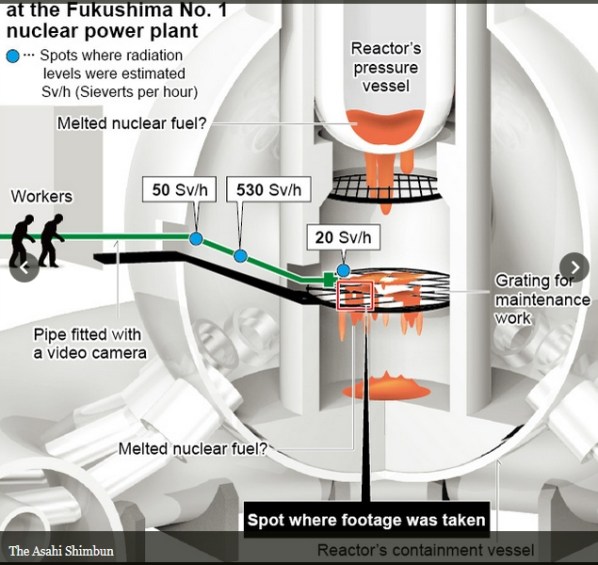
Radiation levels were estimated at 20 sieverts per hour, 50 sieverts per hour and 530 sieverts per hour at three spots inside the reactor’s containment vessel.
The company estimated the doses from the extent of disturbances in the images caused by radiation.
Although a TEPCO official said “there is a margin of error because radiation levels were not measured directly,” the company believes the scattered melted nuclear fuel inside the containment vessel was emitting high levels of radiation.
After a number of failed attempts, the remote-controlled camera took the first pictures of possible melted fuel at the plant.
However, closer inspection of the images have revealed additional problems for TEPCO, which had believed most of the melted fuel had remained inside the reactor’s pressure vessel.
TEPCO plans to send an investigative robot, called Sasori (scorpion), into the containment vessel this month to more accurately measure radiation doses at various spots and take additional footage of the scattered nuclear fuel.
The utility plans to use the data to determine a fuel-removal method.
But the robot was expected to use the circular grating, measuring 5 meters in diameter, to move around. One of the holes is 1 meter by 1 meter, a potential pitfall for the robot, which is 59 centimeters long and 9 cm high.
TEPCO said it will consider a different route for the robot in its survey.
Fumiya Tanabe, an expert on nuclear safety who analyzed the 1979 Three Mile Island nuclear accident in the United States, said the findings show that both the preparation for and the actual decommissioning process at the plant will likely prove much more difficult than expected.
“We have few clues on the exact locations, the sizes and the shapes of the nuclear fuel debris,” he said. “The planned investigation by the robot needs a rethink. Work to decommission the plant will require even more time.”
TEPCO said it will need 30 to 40 years to complete the decommissioning process. The utility plans to start work to remove the melted nuclear fuel at the No. 2 and two other stricken reactors in 2021 after deciding on a removal method in fiscal 2018.
TEPCO has yet to determine the location and the condition of the melted fuel in the other two reactors.
An executive of the operator of the crippled Fukushima Daiichi nuclear complex said Friday the company plans to probe inside the plant’s No. 2 reactor by the end of February to confirm whether the black mass spotted in a recent survey was nuclear debris.
Naohiro Masuda, the chief decommissioning officer at Tokyo Electric Power Company Holdings Inc. told Kyodo News it is “possible” to conduct the probe using a robot, the day after the operator announced it had detected extraordinarily high radiation levels inside the reactor.
The operator will be able to tell whether the deposits are nuclear debris from the March 2011 meltdown if new images and data such as the radiation levels and temperatures are obtained in the upcoming robot survey, he said.
Radiation inside the containment vessel of the No. 2 reactor at the Fukushima No. 1 nuclear plant measures as high as a deadly 530 sieverts per hour, the highest since the 2011 disaster, plant operator Tokyo Electric Power Co. (TEPCO) announced on Feb. 2.
TEPCO calculated the radiation dose from video noise on footage it took inside the containment vessel in late January, when a camera was inserted to examine conditions inside and scout a route for a scorpion-like observation robot scheduled to go into the vessel later this month.
Deployment of the robot is also being reconsidered after two gaping holes were found along the robot’s planned path over a 5-meter-wide circular walkway inside the containment vessel, close to where the 530-sievert radiation dose was detected.
A scorpion-like observation robot scheduled to go into the containment vessel of the No. 2 reactor at the Fukushima No. 1 nuclear plant.
The holes in the metal grate walkway — one of unknown size and the other measuring about 1 meter square — make both routes considered for the robot impassable.
“We will consider re-evaluating what observations we can take with the robot,” Yuichi Okamura, an acting general manager with TEPCO’s on-site nuclear power division, told reporters at a Feb. 2 news conference.
Piles of a black and dark brown substance several centimeters thick and thought to be melted nuclear fuel were also observed on the walkway, creating a further possible obstruction to the robot. Meanwhile, examination of the 1-meter-square hole suggests the walkway was struck with tremendous force, hinting that there may be a large amount of melted fuel below.
“It is possible that the nuclear fuel rods melted onto the control rods and then dripped down,” Tokyo Institute of Technology professor of nuclear engineering Yoshinao Kobayashi told the Mainichi Shimbun. “It’s highly likely that part of the bottom of the pressure vessel broke and the melted fuel flowed down (onto the walkway), and then the grating warped and gave way due to the fuel’s heat.”
Six years after the Fukushima disaster, local government is working with private firms in one Japanese city to rebuild its economy
Tomatoes growing in Japan’s Wonder Farm as part of Iwaki City’s reconstruction efforts after the 2011 earthquake and tsunami.
It’s a cold January day in Iwaki City, 211km north of Tokyo. But here, in a balmy glasshouse, light and sunny, pop music is being piped in, and tonnes of tomatoes are ripening and being picked.
They’re not in the ground; they’re being grown from waist-high pots of coconut matting. These are no ordinary tomatoes. They are growing on Wonder Farm, an “integrated agricultural theme park”, run by Tomato Land Iwaki, which is part-funded by the local city council and the Fukushima prefecture.
But another of the Wonder Farm partners is train firm Japan Rail East, which sells the tomatoes via its own restaurants. Because these small red fruits are part of plans by the local city government and local businesses to reinvigorate the local Iwaki economy after the devastating impact of the March 2011 earthquake, tsunami and nuclear disaster at the Fukushima Daiichi reactor, a mere 50km up the coast.
After such a cataclysmic series of events, rebuilding an economy based on fishing, agriculture and tourism is not easy. It requires some innovative thinking. Luckily, that’s something with which this area is already familiar. Fifty years ago, another of its industries, coal mining, faced decline. Here in Iwaki City, the Joban coal mining company came up with a novel idea. It retrained coal miners’ daughters as hula dancers and created the Spa Resort Hawaiians, Japan’s first theme park, which from its opening in 1966 until the events of March 2011, attracted thousands of visitors a year to its array of pleasures, including golf, a huge swimming pool and hot springs centre, and, of course, hula dancing and fire knife displays.
“We were driven by the need to survive,” explains Yukio Sakamoto, a director at the Joban coal mining company. “Yes, it was a radical change, but it was a success because everyone in the company focused on the plan. It wasn’t about knowledge or expertise, but mindset.” The idea faced considerable opposition: “People said coal miners should just dig coal. But we trained the daughters of coal miners as professional dancers.”
That kind of ingenuity has been called for even more since 2011 in this part of Japan. It’s been hard work for everyone involved to try and get visitors back to the region and to restart the market for local food and produce. The city government has worked with regional and national bodies to measure radioactivity levels in local produce, and the figures are publicly available. But rebuilding trust that food from Fukushima is safe has been slow. The local fish market may be open, but almost all its stock is from elsewhere in the country.
Still, at least it is open and Senzaka Yoshio, one of the officers at the La Mew Mew fish market, which was badly damaged by the earthquake and tsunami, says visitor levels are now back up to 80% of the pre-disaster days.
Further along the quay from the fish market are more fish. Live ones, this time, in the spacious tanks of the Fukushima Aquarium. When the tsunami hit, this aquarium lost 90% of its creatures. It reopened just four months later, in July 2011, a feat possible, according to executive director Yoshitaka Abe, due to teamwork, local leadership and co-operation with other aquarium authorities, who sent specialists and volunteers to help with the reconstruction work.
The Fukushima aquarium, which reopened just four months after the tsunami of March 2011.
For Sakamoto, at the Spa Resort Hawaiians, overcoming the 2011 disaster has been about local people. The resort has brought more than 9,500 jobs to the area. On the day of the earthquake, there were 617 guests in the hotel. All got safely home. But many employees lost family members and homes. “We continue our operation thinking about the people who suffered,” he says. “Our main idea was not to fire people because of the difficulty in the business, but to redeploy them.”
The plaintiff helped build scaffolding to repair the damaged No 4 reactor at the Fukushima plant
A Japanese court has begun hearing the case of a man who developed leukaemia after working as a welder at the damaged Fukushima nuclear site.
The plaintiff, 42, is the first person to be recognised by labour authorities as having an illness linked to clean-up work at the plant.
He is suing Tokyo Electric Power Company, which operates the complex.
The nuclear site was hit by the earthquake and tsunami in 2011, causing a triple meltdown.
It was the world’s worst nuclear disaster since Chernobyl in 1986. An exclusion zone remains in place around the site as thousands of workers continue clean-up efforts.
‘Expendable labourer’
The man, from Japan’s Fukuoka prefecture, was a welder for a sub-contractor.
He spent six months working at Genkai and Fukushima No 2 nuclear plants before moving to the quake-hit Fukushima No 1 plant, where he build scaffolding for repair work at the No 4 reactor building. His cumulative radiation exposure was 19.78 millisieverts.
This is lower than official limits – Japan currently allows workers at the damaged plant to accumulate a maximum of 100 millisieverts over five years. A dose of 100 millisieverts over a year is seen as enough to raise the risk of cancer.
But in October 2015, a health ministry panel ruled that the man’s illness was workplace-related and that he was eligible for compensation.
“While the causal link between his exposure to radiation and his illness is unclear, we certified him from the standpoint of worker compensation,” a health ministry official said at the time.
There has been heated debate about the dangers of radiation from the plant
The man is now suing Tepco and the Kyushu Electric Power Company, which operated the Genkai plant, for JPY59m ($526,000, £417,000).
“I worked there [Fukushima No 1 plant] because of my ardent desire to help bring the disaster under control but I was treated as if I was a mere expendable labourer,” Kyodo news agency quoted him as saying.
“I want Tokyo Electric to thoroughly face up to its responsibility.”
When he filed the suit late last year, his lawyers said he had been “forced to undergo unnecessary radiation exposure because of the utilities’ slipshod on-site radiation management”.
Tepco and Kyushu Electric have asked the court to reject the suit, questioning the link between his radiation exposure and leukaemia, Kyodo reported.
Tens of thousands of workers have been employed at the Fukushima site since the disaster in March 2011. Late last year the government said estimates of clean-up costs had doubled to JPY21.5 trillion ($188bn, £150bn).
Ex-worker during Fukushima disaster sues Tepco, Kyushu Electric over leukemia
A former nuclear worker who developed leukemia after combating the 2011 Fukushima nuclear crisis demanded ¥59 million (around $524,000) in damages from two utilities Thursday at his first trial hearing at the Tokyo District Court.
The 42-year-old man from Fukuoka Prefecture is the first person to be recognized by labor authorities as having an illness linked to workplace radiation exposure since the triple core meltdown at the Fukushima No. 1 nuclear power plant.
The man-made disaster was triggered by the huge earthquake and tsunami on March 11, 2011.
“I worked there because of my ardent desire to help bring the disaster under control but I was treated as if I was a mere expendable laborer,” the plaintiff said.
“I want Tokyo Electric to thoroughly face up to its responsibility,” he said.
The defendants, Tokyo Electric Power Company Holdings Inc., which runs Fukushima No. 1, and Kyushu Electric Power Co., whose Genkai nuclear plant also employed the plaintiff, asked the court to reject the claim, questioning the connection between his radiation exposure and leukemia.
The man was engaged in welding operations at the Fukushima Nos. 1 and 2 plants and the Genkai complex in Saga Prefecture from October 2011 to December 2013. His exposure in operations subcontracted by the utilities consisted of at least 19.8 millisieverts, according to his written complaint.
The man was diagnosed with acute myeloid leukemia in January 2014 and later went into depression. Both ailments are recognized as work-related illnesses by the Health, Labor and Welfare Ministry.
He said he has been unable to go back to work and is therefore seeking compensation from the utilities.
The operator of the crippled Fukushima Daiichi nuclear plant says its latest estimation of the radiation level inside one of the reactors was extremely high and had the potential to be lethal to a human within a short period of time.
Tokyo Electric Power Company conducted an inspection inside the containment vessel of the plant’s No.2 reactor last month using a remote-controlled camera, as part of a survey to scrap the reactor.
An analysis of the images found that the radiation was up to 530 sieverts per hour at a concrete cylinder supporting the reactor.
The level is enough to be lethal to a human within a short period of time, despite a possible error margin of up to 30 percent.
A survey conducted 1 year after the nuclear accident at a different part inside the same containment vessel logged 73 sieverts per hour.
In the latest estimation inside the vessel, the area near its opening logged 50 sieverts per hour at maximum.
The operator officials say that there are no leaks of gas with radioactive substances from the containment vessel.
Officials suspect that fuel debris; a mixture of nuclear fuel and melted parts of the reactor’s facility, may be emitting strong radiation inside the vessel.
Some molten fuel penetrated the reactor’s bottom and has reached the containment vessel as fuel debris.
The company plans conduct further inspections with a robot. There is a risk that some parts of the grating where the robot will be moving may be damaged by the high heat of the molten fuel.
Record high fatal radiation levels, hole in reactor detected at crippled Fukushima nuclear facility
Record high radiation levels that’s lethal even after brief exposure have been detected at a damaged reactor at the Fukushima power plant in Japan. Specialists also found a hole, likely caused by melted nuclear fuel.
Radiation levels of up to 530 Sieverts per hour were detected inside an inactive Reactor 2 at the Fukushima Daiichi nuclear complex damaged during the 2011 earthquake and tsunami catastrophe, Japanese media reported on Thursday citing the plant operator, Tokyo Electric Power Company (TEPCO).
A dose of about 8 Sieverts is considered incurable and fatal.
A hole of no less than one square meter in size has also been discovered beneath the reactor’s pressure vessel, TEPCO said. According to researchers, the apparent opening in the metal grating of one of three reactors that had melted down in 2011, is believed to be have been caused by melted nuclear fuel that fell through the vessel.
The iron scaffolding has a melting point of 1500 degrees, TEPCO said, explaining that there is a possibility the fuel debris has fallen onto it and burnt the hole. Such fuel debris have been discovered on equipment at the bottom of the pressure vessel just above the hole, it added.
The latest findings were released after a recent camera probe inside the reactor, TEPCO said. Using a remote-controlled camera fitted on a long pipe, scientists managed to get images of hard-to-reach places where residual nuclear material remained. The substance there is so toxic that even specially-made robots designed to probe the underwater depths beneath the power plant have previously crumbled and shut down.
However, TEPCO still plans to launch further more detailed assessments at the damaged nuclear facility with the help of self-propelled robots.
Earlier this week, hopes for a more efficient cleanup at Fukushima were high, as the plant operator announced a portion of nuclear fuel debris responsible for a lot of the lingering contamination from six years ago may have finally been found.
This short article is dedicated to a pro-nuke troll, whose alias is Octo.
Octo, should I indulge the reader, is usually present at the chat of the “Fukushima Diary” blog. He enjoys pushing his propaganda of how nuke is safe.
How Tepco is doing a terrific job at Fukushima Daiichi and is in total safety control of everything.
How radiation is now very low in Fukushima How the fish and seafood is now safe etc.
Everyone is believing his crap *cough*, but he, like all of the other bewildered, confused and baffled Japanese *experts? never gives up.
Watching this video, I am thinking about him and his continuous lies, and also all those other Japanese pro-nuke trolls that I encountered on internet in the past few years.
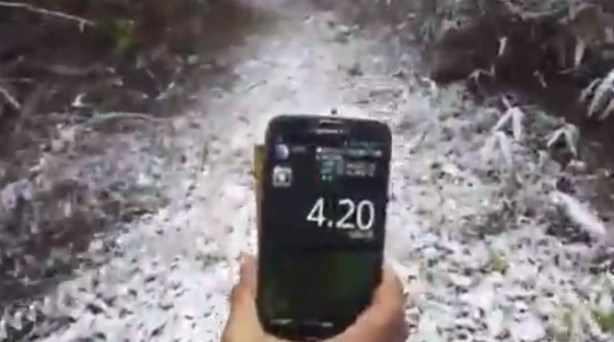
This video was shot last November 2016 South of Soma, it is the mountain trail to reach the Tetsuzan dam, a place approximately 20km from the Fukushima Daiichi nuclear plant.
I think all those disinformation spinners paid by Tepco, Dentsu or Government, whose job is to spread lies about the Fukushima disaster on blogs, forums and Facebook, should all go living up there, as they claim it is now completely safe.
They should breath the good air from Fukushima, eat everyday very safe Fukushima rice and vegetables, and of course eat also plenty of safe fish and seafood, and drink plenty Fukushima safe water.
I would give them only one word of advice :
“Don’t forget to smile,
Smile a lot everywhere and everyday, so that the radiation won’t affect you.”
Special credit to the Fukuichi Citizen Radiation Monitoring Project
TOKYO (Kyodo) — The radiation level inside the containment vessel of the No. 2 reactor at the crippled Fukushima Daiichi nuclear complex stood at 530 sieverts per hour at a maximum, the highest since the 2011 disaster, the plant operator said Thursday.
Tokyo Electric Power Company Holdings Inc. also announced that based on image analysis, a hole measuring 2 meters in diameter has been found on a metal grating beneath the pressure vessel inside the containment vessel and a portion of the grating was distorted.
According to TEPCO, the extremely high radiation level was found near the entrance area in the space just below the pressure vessel. The previously highest radiation level monitored in the interior of the reactor was 73 sieverts per hour.
The hole could have been caused by nuclear fuel that penetrated the reactor vessel as it overheated and melted due to the loss of reactor cooling functions in the days after a powerful earthquake and tsunami on March 11, 2011 hit northeastern Japan.
According to the image analysis, about 1 square meter of the grating was missing.
The plant operator plans to deploy a robot at the bottom of the reactor containment vessel, which houses the reactor pressure vessel, to check the conditions there.
The analysis follows TEPCO’s discovery Monday of a black mass deposited on the grating directly beneath the pressure vessel, possibly melted fuel after the unit suffered a meltdown along with two other Fukushima Daiichi reactors.
Images captured using a camera attached to a telescopic arm on Monday also showed part of the grating has gone. A further analysis of the images found a 2-meter hole in an area beyond the missing section on the structure.
If the deposits are confirmed as fuel debris, it would be the first time the utility has found any at the three units that suffered meltdowns.
Following one of the world’s worst nuclear disasters since the 1986 Chernobyl catastrophe, the No. 1 to 3 reactors suffered fuel meltdowns.
Portions of the fuel in the reactors are believed to have melted through the pressure vessels and accumulated at the bottom of the containment vessels.
The actual condition of the melted fuel has remained unknown due to high radiation levels.











 nuclear-news