Japan further scales down evacuation zones around Fukushima plant

FUKUSHIMA, Japan (Kyodo) — The government on Friday lifted the remaining evacuation orders for large parts of areas less seriously contaminated by the radiation due to the 2011 Fukushima Daiichi nuclear power plant disaster.
The government lifted evacuation orders that had affected some parts of the towns of Kawamata and Namie as well as the village of Iitate. A large part of the town of Tomioka will also be released from the evacuation order Saturday.
The move will scale down the evacuation zones to about one-third of what they had originally been. But it is uncertain whether many residents will return to their homes amid radiation fears, while the most seriously contaminated areas around the disaster-hit Fukushima Daiichi nuclear power plant remain a no-go zone.
Initially, 11 municipalities — many of which are located within a 20-kilometers radius of the crippled nuclear complex — had been subject to the evacuation orders. They were later rezoned into three categories based on their radiation levels, with the most seriously contaminated land defined as the difficult-to-return areas.
Through radiation cleanup work and efforts to rebuild infrastructure, the government said in 2015 that it aimed to remove by the end of the current fiscal year through Friday all the evacuation orders except for those issued to the difficult-to-return zones.
But the government failed to do so in the towns of Okuma and Futaba, which host the Fukushima Daiichi nuclear plant owned by Tokyo Electric Power Company Holdings Inc.
Okuma and Futaba have some areas not designated as highly toxic, but both towns will remain under full evacuation orders due to insufficient infrastructure, according to government officials.
The areas where evacuation orders will be lifted by Saturday had a registered population of about 32,000, or 12,000 households, around the end of February. Even after the move, seven municipalities will be partially or fully subject to evacuation orders.
As for the difficult-to-return zones, the government plans to create areas where they will conduct intense decontamination and lift the evacuation orders for those areas in about five years’ time.
The number of Fukushima people who fled from their homes in the wake of the 2011 earthquake and tsunami disaster, which also triggered the nuclear crisis, stood at about 77,000 people as of March. The maximum number was about 165,000 marked in May 2012.
http://mainichi.jp/english/articles/20170331/p2g/00m/0dm/015000c
Mall opens in Fukushima town near disaster-stricken nuclear plant

Rice cakes are tossed to a crowd ahead of the full-scale opening of Sakura Mall Tomioka, a publically-established and privately-run mall, in Tomioka, Fukushima Prefecture, on March 30, 2017.
TOMIOKA, Fukushima — A shopping mall opened in this town near the disaster-stricken Fukushima No. 1 Nuclear Power Plant on March 30, amidst hopes it will jumpstart the return of the populace as evacuation orders will be lifted for most of the town on April 1.
In addition to returning residents, the mall is expected to be used by employees working on decommissioning of the nuclear plant.
Before the nuclear disaster, Tomioka was considered to have the largest concentration of commercial facilities in Futaba County, which also hosts the nuclear plant. Together with the lifting of the evacuation orders, the town is touting its recovery as the “capital of the county.”
The mall, called “Sakura Mall Tomioka,” has around 4,500 square meters of floor space. In November last year, a home improvement store and three restaurants opened early, and on March 30 this year a supermarket and drugstore opened, bringing the facility into full operation. At a ceremony for the opening, Mayor Koichi Miyamoto said, “I am sure this mall will aid recovery (of areas affected by the Great East Japan Earthquake and Fukushima nuclear disaster).”
The Tomioka Municipal Government set up the mall by renovating buildings along National Route 6. The areas of the town with evacuation orders being lifted will cover 9,544 residents (based on March 1 population figures), but in the near term only a few percent of the population are expected to actually return to the town. Evacuation orders will remain in place for parts of the town with high radiation levels, called “difficult-to-return” zones.
http://mainichi.jp/english/articles/20170330/p2a/00m/0na/014000c
Chinese parents seek refunds for Japan trip, citing radiation concerns

Families of 40 choir members cancel Tokyo trip after travel advisory from Chinese embassy
Parents of a children’s choir in southern China are seeking refunds for a trip to a singing competition in Japan that they cancelled over concerns of radiation leaks.
Their requests to refund the training, travel and accommodation fees, which add up to 19,800 yuan (US$2.900)for each child, have been denied by the singing training centre of the Guangzhou Opera House, with which the choir is affiliated, Television Southern of Guangdong reported.
The concerned parents said each family paid fees to the training centre in January for training, visas, insurance and accommodation for the trip to Japan for an international choir competition in August.
Forty students signed up for the trip, the report said.
Many parents became worried a month later when the Chinese embassy in Tokyo issued a reminder of record-high radiation from the Fukushima nuclear plant, which has been leaking radioactivity since being badly damaged by an earthquake and tsunami in 2011.
The embassy statement cited a spokesperson from the Chinese Foreign Ministry in Beijing and urged Chinese tourists in Japan to make appropriate arrangements. The request for refunds was denied by the training centre, who insisted that parents would have to pay 20 per cent of costs, or about 4,000 yuan, to cancel the trip.
Many parents said that was unacceptable as health concerns should be of priority to the training centre as well as the families.
Some parents rallied in front of the training centre to raise attention to the issue, the report said.
The head of the choir said in a statement that the group was non-profit and he would personally ask for a full refund from the Opera House.
He said he had arranged a meeting to negotiate for the parents on Thursday.
Japan has become a popular travel destination for Chinese tourists in recent years after it eased visa rules for mainland tourists, who have flooded to their near neighbour where they spend up large on items that range from luxury watches to toilet seats.
Nuclear Energy Has No Future in Japan, Former PM Says

Former Japanese prime minister Naoto Kan speaking at his lecture “The Truth about the Nuclear Disaster in Fukushima and the Future of Renewable Energy” on Tuesday at Statler Auditorium.
About a year after taking office in 2010, Naoto Kan, the prime minister of Japan at the time, had his worst nuclear nightmare.
Once the Great East Japan Earthquake hit, a tsunami followed and led to the meltdown of the Fukushima Daiichi nuclear plant.
Kan detailed his reaction to the meltdown and the reasons behind his drastic change in position — from strong support of nuclear power to opposing its use — at a packed Statler Auditorium on Tuesday.
While Japanese politicians have extensive experience responding to earthquakes and tsunamis, no one knew how to respond to an accident of this scale and the response mechanism was underprepared, Kan said.
“Not a single person could shed light on what its consequences might be,” he said in Japanese at Tuesday’s lecture, a transcript of which was provided to The Sun.
While the Nuclear and Industrial Safety Agency was built to equip the prime minister with specialized knowledge of nuclear disasters, Kan was surprised to learn that the director-general of NISA was a Tokyo University graduate with a degree in economics.
“How can we fathom the appointment of an economist to be director-general of an agency charged with responding to nuclear accidents?” Kan asked.
What was clear to Kan, however, having majored in applied physics at the Tokyo Institute of Technology, was that it would quickly become an unprecedented disaster.
“I knew that if the cooling systems were disabled, a meltdown would occur,” he said.
Realizing that even the electricity company known as Tokyo Electric Power Company that was responsible for the power plant did not have a grasp on the exact situation, Kan braced the dangers and made a personal visit to the disaster site himself on the morning after the incident.
“I went to Fukushima because I felt that I would need to have an accurate knowledge of the situation at the power plant to determine the radius of evacuation,” he said.
The week following the disaster, a series of accidents occurred: Three reactors had experienced hydrogen explosions.
Goshi Hosono, his special advisor, informed Kan about multiple “worst-case scenarios” — including the need for a forced evacuation within a 170-kilometer radius of the site and a voluntary evacuation within 250 kilometers.
Tokyo was within that range.
That plan involved the evacuation of an unprecedented 50 million people.
“Unimaginable hardship and confusion would ensue,” he said. “Yet there was nothing imaginary about this forecast. We were a hair’s breadth away from this actuality.”
While Japan had lost about 30 of its firefighters at the site during the week, Kan was shocked by TEPCO’s simultaneous request to let its employees leave the Fukushima site.
“Abandoning the reactors would mean that the situation would worsen in a matter of hours,” he said. “If the 10 reactors and 11 spent fuel pools were abandoned, Japan itself would be decimated. My own view was that to abandon the site was unthinkable.”
Kan saw TEPCO as responsible for the accident and, without TEPCO’s technicians, the situation was impossible to keep in control. He demanded that TEPCO remain on site, even if that meant putting lives at risk.
To hold TEPCO accountable, Kan established the Integrated Response Center, which facilitated communication between TEPCO and the Japanese government. This coordination allowed helicopters to pump water into the Unit 2 reactor as a measure against spreading radioactivity.
“Had venting of the Unit 2 reactor been delayed and pressure risen within its containment vessel, explosions would have erupted that shattered the entire reactor like a rubber balloon and we would have confronted my worst-case scenario,” Kan said.
Kan credited the success of avoiding the “worst case scenario” to TEPCO, Self-Defense Force members, firefighters, the police and some luck.
But, reflecting on the root cause of the accident, Kan placed part of the blame on TEPCO, claiming “TEPCO courted disaster by never formulating a contingency plan.”
Evaluating Japan’s current nuclear energy use plan, Kan was critical of the Liberal Democratic Party’s continued support for restoring nuclear power plants.
While Kan, before his resignation, had proposed reaching zero dependence on nuclear energy by 2030, the LDP chose to restore 44 reactors to operation, he said.
“However, the Japanese population at large is against this policy,” Kan said.
Under Kan’s leadership, Japan was able to deflect the worst-case scenario, but the former prime minister was quick to admit that the water contaminated by radiation from the vessels has been leaking.
Kan maintained doubt of TEPCO’s ability to complete incineration of the radioactive debris in 40 years.
“My guess is that at Fukushima the process will take more than 100 years,” he said.
Kan’s personal experience in Fukushima led him to advocate for using renewable sources — solar power, wind power and biomass — instead of relying on nuclear power and fossil fuels.
“I took my last months as Prime Minister proposing to the Diet [the Japanese parliament] a bill for the establishment of the FIT system,” he said. “Since the introduction of the FIT system, the use of renewable energy and especially solar power has grown in Japan.”
More specifically, Kan promoted combining agriculture with supplying renewable energy.
“Sunlight can be shared between crops and solar panels,” he said. “If this practice spreads, Japan could supply over half its energy supply from farmlands.”
Kan called on nations to reduce use of nuclear energy and invest in renewable energy.
“The use of renewable, natural energy and the end of reliance on nuclear energy and fossil fuels, can open a path to a peaceful world,” Kan said. “It is my intention to continue to commit myself without respite toward the achievement of this goal.”
http://cornellsun.com/2017/03/28/nuclear-energy-has-no-future-in-japan-former-pm-says/
Fukushima decontamination near-complete in evacuated areas, so they claim
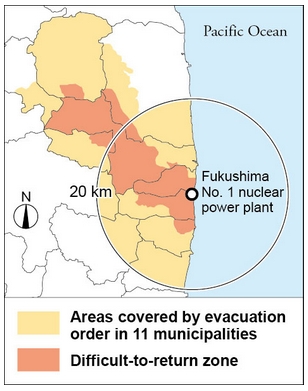
SIX YEARS AFTER: Fukushima decontamination near-complete in evacuated areas
Decontamination work in areas covered by the evacuation order from the 2011 Fukushima nuclear disaster is expected to conclude this month, paving the way for evacuees from the affected communities to return home.
With the project’s completion, the government’s focus will shift to the cleanup of heavily contaminated areas near the crippled Fukushima No. 1 nuclear power plant and infrastructure building.
The areas covered in the Environment Ministry’s decontamination project constitute those in 11 municipalities, including Okuma and Futaba, the two towns co-hosting the nuclear complex.
The decontamination project got under way there in fiscal 2012 to remove soil, fallen leaves and other materials contaminated by radioactive substances primarily in residential areas, roads, and rice paddies and fields.
But the areas collectively known as the difficult-to-return zone where annual radiation doses were estimated to exceed 50 millisieverts as of the end of 2011 and still estimated at more than 20 millisieverts five years after the disaster were excluded from the decontamination work in those 11 local governments.
The cleanup in nine municipalities has already been completed, while the project in the remaining two is expected to finish this month, according to the government.
The completion of the project comes after the Cabinet approved a policy to finish decontamination by the end of March 2017 at a meeting in March 2016.
The evacuation order for Okuma and Futaba will remain in place even though the cleanup project will soon be over.
But the government expects to lift the order for people from the remaining nine municipalities, except for residents from the difficult-to-return zone, by April 1.
That will make the total area remaining under the evacuation order 30 percent of the size six years ago.
According to the ministry, decontamination operations have been carried out in 99 local governments in and outside of Fukushima Prefecture, costing about 2.6 trillion yen ($23.56 billion) over the past five years.
Although the government initially covers the costs of decontamination, it sends the bill to Tokyo Electric Power Co., the plant’s operator.
Despite the cleanup project, many evacuees will likely remain anxious about radiation exposure when they return because forests and woods except for those close to residential areas have not been decontaminated.
The government envisages setting up hubs for rebuilding the difficult-to-return zone by carrying out an intensive cleanup to make the areas habitable by 2022.
“THE STATE OF FUKUSHIMA: Sixth Anniversary 3.11 Nuclear Disaster. Evacuation Orders Being Lifted – Ethical or Not?”

THE STATE OF FUKUSHIMA: Sixth Anniversary 3.11 Nuclear Disaster
Evacuation Orders Being Lifted – Ethical or Not?
by Kerry Anne O’Connor, California native, Tokyo Resident
“The Fukushima accident has shown that people cannot coexist with nuclear power. I believe the only way to preserve human life is to completely turn away from nuclear power.”—Kenzaburo Oe, Nobel Prize-winning Novelist.
On March 11, 2011 at 2:46pm, it felt like the world was ending! Frightened people were screaming in terror. Shattered glass was flying everywhere. The memories of that day are tattooed on my brain and will never be erased.
Many cities damaged in the Great East Japan Earthquake and Tsunami disaster are on their way to slow recovery. One disaster area, however, may never have its place on the map again. The triple meltdown at the Fukushima Daiichi Nuclear Power Plant forced the evacuation of 170,000 people. Six years later 84,000 residents still cannot safely return to their homes in Fukushima due to the high levels of radiation. They are the forgotten ones their stories swept under Japan’s 2020 Tokyo Olympics carpet.
Since March 12, 2011, the day the Fukushima evacuation orders were put into effect, residents near the power plant were woken up in the middle of the night and told to board buses, destination unknown. They were told not to bring personal belongings, including their pets. Thinking they would return soon, pet owners left two to three days’ worth of food and water. Some tied their pets to their homes, some let the animals run loose. The residents never returned. The animals tied to their homes perished.

Animal rescue missions in the exclusion zones near the crippled power plant commenced under the supervision of Animal Rescue Nyander Guard in Fukushima (nyan=meow in Japanese). Staff and volunteers entered the contaminated restricted areas to rescue as many endangered pets as they could. Dogs and cats were easy to transport. Farm animals, however, had no escape and most were euthanized. One woman who ran a dairy farm cried profusely, “You can’t just carry a cow out like a dog. I had fifty dairy cows. They were my babies! I was forced to abandon them!”
Today, Nyander Guard still searches for animals left wandering inside the exclusion zones having saved over 760 animals since April 2011. Six years of unrelenting devotion has helped to reunite pets with their owners, find new families for abandoned animals and shelter those who are still homeless awaiting adoption.
March 11, 2017, marked the 6th anniversary of the ongoing Fukushima Nuclear meltdown. It was also the day I went into the exclusion zones to measure radiation levels and document farmlands that are now nuclear wastelands. Much to my shock, I learned that some areas where the evacuation orders will be lifted at the end of this month are actually higher in radiation than in the exclusion zones!
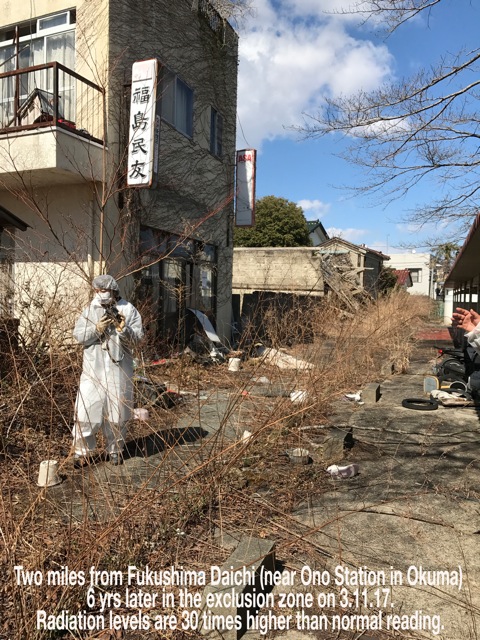
In its haste to reassure the world community that the 2020 Tokyo Olympics are going forward as scheduled with soccer and other games planned for Fukushima, the Japanese government is now forcing people back into heavily contaminated areas. A majority of the returning evacuees may not be well informed about the dangers they face, due to Japan’s Secrecy Law adopted in late 2013 – imposing new legislation to penalize the unauthorized publication of information about the crippled nuclear power plant of up to ten-years-long imprisonment. As a result people and particularly press are intimidated and kept from telling the truth.
The community of Santa Barbara is invited to attend a free public exhibit and presentation at the Karpeles Manuscript Library Museum Auditorium, 1-4pm, Saturday, April 8th featuring the work of volunteers of Nyander Guard. Akira Honda, shelter owner and founder, will also be in attendance to give firsthand details of the traumatic animal rescues in the exclusion zones in the aftermath of the nuclear meltdown. Further accounts of the State of Fukushima will not only be eye opening but also a timely reminder of the 31st Anniversary of Chernobyl Disaster – April 26th, where much of the land there still remains abandoned due to high radiation levels.
In Chernobyl, “Obligatory Resettlement Zones” were areas with over 5mSv/year of radiation, which is the same amount in some parts of Fukushima that will soon open up. Sadly, many pets will still remain at their desolate homes in these areas, living lonely lives with hardly any human contact. On their routine “Animal Watch,” Nyander Guard feeds and cares for these voiceless victims. Being reunited with them on March 11th reaffirmed how unforgiveable and horrific this disaster has become.
Disasters like Chernobyl and Fukushima remind the world how dangerous nuclear power is and how they have devastated humans, animals and lands. This is a worldwide problem affecting us all. By raising awareness of the tragedies innocent people and their loved ones continue to endure, we might be able to unite globally and share our individual stories for the sake of humanity and future generations.
Please sign these two important petitions :
From Greenpeace : Defend the human rights of Fukushima survivors
https://act.greenpeace.org/page/6288/petition/1
From FFAN-Fukushima Fallout Awareness Network : NO 2020 Olympics in Radioactive Fukushima:
https://www.change.org/p/no-olympics-or-paralympics-in-radioactive-fukushima
Exhibit:
THE STATE OF FUKUSHIMA: Sixth Anniversary 3.11 Nuclear Disaster Karpeles Exhibit Part II
This coming Saturday, April 8 at 1PM – 4PM PDT
At the Karpeles Manuscript Library Museum,
21 W Anapamu St, Santa Barbara, California 93101
Tel : +1 805-962-5322
Kerry Anne O’Connor, California born Tokyo resident and volunteer for Animal Rescue Nyander Guard – in Fukushima, Japan will be Santa Barbara Saturday, April 8th for a follow up to the Exhibit and presentation of March 11th in commemoration of the 6th Anniversary of #Fukushima Nuclear Disaster. On 3.11 this year, Kerry was in Fukushima measuring radiation levels and documenting farmlands that are now nuclear wastelands. Among her shocking discoveries, she learned that some areas where the evacuation orders will be lifted at the end of this month are actually higher in radiation than in the exclusion zones.
The community of Santa Barbara is invited to attend this free public exhibit and presentation featuring the work of volunteers of Nyander Guard. Akira Honda, shelter owner and founder, will also be in attendance to give firsthand details of the traumatic animal rescues in the exclusion zones in the aftermath of the #nuclear meltdown which forced 170,000 people to be evacuated; and six years later 84,000 residents still cannot return to their homes due to high radiation levels. Kerry’s further accounts of the “State of Fukushima” will not only be eye-opening but also a good reminder of the 31st Anniversary of #Chernobyl Disaster – April 26 where much of the land there is still abandoned due to high radiation levels.
Media Contact: Kerry O’Connor, 805-482-1745 kerry_in_hachioji@yahoo.co.jp
11,000 Wikileaks documents related to Fukushima

4131 files on Fukushima 2011
https://wikileaks.org/gifiles/?q=Fukushima+2011&mfrom=&mto=&title=¬itle=&date=&nofrom=¬o=&count=50&sort=0&file=&docid=&relid=0#searchresult
4062 files on reactor 2011
https://wikileaks.org/gifiles/?q=Reactor+2011&mfrom=&mto=&title=¬itle=&date=&nofrom=¬o=&count=50&sort=0&file=&docid=&relid=0#searchresult
2470 files on meltdown 2011
https://wikileaks.org/gifiles/?q=Meltdown+2011&mfrom=&mto=&title=¬itle=&date=&nofrom=¬o=&count=50&sort=0&file=&docid=&relid=0#searchresult
262 files on cesium 2011
https://wikileaks.org/gifiles/?q=Cesium+2011&mfrom=&mto=&title=¬itle=&date=&nofrom=¬o=&count=50&sort=0&file=&docid=&relid=0#searchresult
282 files on iodine 2011
https://wikileaks.org/gifiles/?q=Iodine+2011&mfrom=&mto=&title=¬itle=&date=&nofrom=¬o=&count=50&sort=0&file=&docid=&relid=0#searchresult
344 files on Uss Ronald Reagan
https://wikileaks.org/gifiles/?q=Uss+ronald+2011&mfrom=&mto=&title=¬itle=&date=&nofrom=¬o=&count=50&sort=0&file=&docid=&relid=0#searchresult
TEPCO fails to pinpoint melted fuel at Fukushima No. 1 nuclear plant

A photo capturing contaminated water at the Fukushima No. 1 nuclear plant, which was taken by a robot on March 21, 2017.
Tokyo Electric Power Co. (TEPCO) failed to locate melted nuclear fuel inside the No. 1 reactor at the disaster-stricken Fukushima No. 1 Nuclear Power Plant in a robot probe, though it found higher levels of radiation toward the bottom of the reactor container vessel, the utility said on March 27.
TEPCO made the announcement after analyzing data obtained from a probe conducted from March 18 through 22, in which a remotely controlled robot was sent into the No. 1 reactor’s container vessel for research.
The power company is set to finalize a decision to take out melted fuel from the No. 1 through No. 3 reactors as early as this coming summer, accelerating work to decommission the facilities. Like a similar robot probe inside the No. 2 reactor last month, however, the latest survey on the No. 1 reactor also failed to obtain data necessary to extract melted fuel, such as where the fuel is located. Therefore, the utility is compelled to consider fetching melted fuel in the absence of sufficient data.
TEPCO injected a robot that can move on a running belt into the container vessel of the No. 1 reactor. The robot hung a wire holding a camera and a dosimeter at its tip from a metal grating for workers and measured the condition of the contaminated water below. From March 18 to 22, the robot examined an area near a slot from which the device is injected into the vessel and measured 1.5 to 11 sieverts per hour of radiation. Between March 20 and 22, the robot explored an area around the openings for workers at the bottom of the container vessel, which is close where melted fuel is believed to be situated, and detected measurements of 3 to 9.4 sieverts of radiation.
Sand-like sediment was found to be spreading across the bottom of the container vessel. Because of accumulated sediment near the openings, the robot could gauge radiation doses only up to a height of 90 centimeters from the bottom of the vessel. Compared to the radiation levels at the same height of an area where melted fuel is believed not to exist, the area near the openings showed higher radiation readings.
It is believed that most of the melted fuel at the No. 1 reactor has spread across the contaminated water accumulating at the bottom of its container vessel. TEPCO believes that melted fuel is likely leaking from those openings.
Naohiro Masuda, head of TEPCO’s Fukushima Daiichi Decontamination & Decommissioning Engineering Co., told a press conference on March 7, “The results of this probe will be precious resources for us to make a decision on our plan.”
http://mainichi.jp/english/articles/20170328/p2a/00m/0na/014000c

New video from Fukushima Daiichi
New video from inside a crippled Fukushima Daiichi nuclear reactor shows possible melted fuel.
http://www.ntv.co.jp/englishnews/society/new_video_from_fukushima_daiichi/
Remembering 6th Anniversary of Fukushima March.11.2017

Kimberly Roberson, speaking as a parent and an activist/organizer does not mince her words. They are heart, mind and soul piercing. She is in our faces about the horrific dangers of nuclear power – especially for our babies and children. Her purpose is to inform and rouse to action all those not already involved and aware. “Startling clear to me: radioactive fallout from nuclear power and food do not mix, and children are especially at risk”.But as parents, aunts, uncles, grandparents and caregivers we have a responsibility to our children. And remember, radiation from nuclear fallout is transgenerational, meaning that it has been proven to damage DNA for generations to come. The bigger picture after all is really about food safety and human health.
I marked every page in the book as I was reading. I am focusing on food in this review because that is a major issue for both Roberson and me. What are we doing to our babies and children when we give them milk? Alarmed, I read from Roberson that “strontium 90 has been detected in the U.S. milk supply, as well as other radioisotopes linked directly to Fukushima”.Radioactive strontium is attracted to the body, much like calcium, only rather than nourishing bones it causes cancer. Children’s cells divide and multiply at an accelerated pace which makes the youngest especially vulnerable to radiation.”
Roberson tells us, “The late Dr. Rosalie Bertell, PhD and Gray Nun of the Sacred Heart was an accomplished scientist who warned in No Immediate Danger; Prognosis for a Radioactive Earth not only of the damage to the person coming in contact with radioactive fallout in their food and water, but also to their children, grandchildren, and great grandchildren suffering mutations in their DNA as well.”
Roberson continues, again alarmingly, “Probably the one question that perplexed so many of the people I was working with was how could the biggest industrial and nuclear accident in world history be allowed to continue to affect our food supply unchecked .” [emphasis mine]. That continues to this day.
Roberson puts it this way, “One thing I’ve realized in the past two years is to always consider the source”The list goes on and on. Grass fed beef, free range poultry, miso [see the paper I wrote about miso “Fukushima, Miso Soup and Me” ], nori, strawberries”pesky questions, but we all need to be asking them.” Begin today, now, all the time, to ask this question about everything you eat and drink. This is urgent: what is the country of origin?
From my experience working on the many issues about food and drink safety since Fukushima, here are some questions we must understand and work to change since Fukushima: What food and drink does the USA import from Japan? How was and is our food here in the USA contaminated from Fukushima? Who tests the food in each country, including the USA? How do they test it? Is how the food is tested adequate? Who decides? How honest are our labelling laws? [Not honest at all; but that requires a whole other paper.] Thank goodness the Trans-Pacific Partnership (TPP) has been defeated by the actions of we the people and as immoral and misleading as our food labeling laws are here in the USA, at least it willl still be mandatory to put counrty of origin on our food. What Trump will do, who is now talking about “binary arrangements” instead of the TTP, remains to be seen.
Be wary also, Roberson warns us, of “fish oil, carrageenan, and sea salt [which] all come from ocean waters.” I say, please read all labels. Use pink salt from the Himalayas, not sea salt. This pink salt from the Himalayas sometimes is called sea salt – but from oceans millions of years ago. I eat nothing from the ocean. There is really only one ocean. Look at any map. You might want to read a paper I have written called “The Pacific Ocean Does Not Belong to Japan: It Belongs to All of Us.”
Also pay attention to iodine and where it comes from, continues Roberson. Iodine often comes from kelp “but where is the kelp sourced? Much of the kelp spanning the California coastline has shown significantly increased levels of Iodine-131 since Fukushima began. Not exactly the kind of iodine I want in children’s gummy vitamins.”
While we are here talking about food and drink, note also that most non-mercury fillings that your dentist puts in your mouth come from Japan!!! As does most bonding material at your dentist’s office. Instead, there is a company in Germany – Grandio – where dentists, not you, can get non-mercury fillings. Please ask your dentist to do so for you.
Since Fukushima, I myself do not knowingly eat or drink any food or beverages that come from Japan. My first question about anything that goes into my mouth always is – what is the country or countries of origin? I am an organic vegan now, since Fukushima, and before that was an organic vegetarian for 40 years. For those who eat organic, Roberson notes, “And trust me, radioactive fallout does not distinguish if it lands on conventional or organic items. You may be asking why is radioactive fallout alllowed in organic food but irradiation is not? The answer is because the regulations are not yet in place to test from nuclear accidents and nuclear power production. That clearly needs to change.” She wrote Silence Deafening; Fukushima Fallout, A Mother’s Response in 2013. It is now 2016. Nothing has changedI love this from Roberson, “Perhaps Dr. Seuss said it best in The Lorax, ‘Unless someone like you cares a whole awful lot, Nothing is going to get better. It’s not.”
On my birthday two years ago, before I read Roberson’s book, I went to the Dr. Zeuss museum in Springfield, MA and read that quote there for the first time and bought myself a Lorax then. Consider buying a Lorax for a constant reminder and keep her with you = in mind, heart, body, soul. You can buy a Lorax through The Manhattan Toy Store.
A final truth telling from prophet Roberson, “Another lesson learned. Much of what happens to protect our food and water or anything else for that matter starts with us.”
LEASE SIGN FFAN’S [FUKUSHIMA FALLOUT AWARENESS NETWORK] URGENT PETITION No Olympics or Paralympics in Radioactive Fukushima “Children are our most beloved and cherished gift and they are also the most vulnerable to the generational damage of man-made radiation in air, food, soil and water. Around the world children who are currently adolescent and possibly younger are in training to compete at the 2020 Summer Olympics and Paralympics in Japan. Their parents most likely have no idea that some of the venues are near the most devastating and ongoing nuclear and industrial disaster in world history, Fukushima Daiichi.
Sheila Parks, Ed.D., is a former college professor. She had a spiritual awakening many years ago and left her career to do peace and justice work full time. She is the founder of the grassroots group On Behalf of Planet Earth (found on FB).
http://portside.org/2017-03-27/remembering-6th-anniversary-fukushima-march112017
Oceanic dispersion of Fukushima-derived radioactive cesium: a review
This paper focuses on the radioactive Cs in seawater and summarizes estimates of the total amount of released radioactive Cs from the FNPP site, spatio–temporal changes in the concentrations of 134Cs and 137Cs not only off the coast of Fukushima and adjacent prefectures, but also in the North Pacific, and adjacent seas such as Japan Sea, East China Sea, based on measurement results and simulation models published during 4 years since the FNPP accident.
14 decembre 2016
Oceanic dispersion of Fukushima-derived radioactive cesium: a review
Abstract
This review summarizes the more than 70 papers published during the 4 years since the Fukushima Dai-ichi nuclear power plant accident that occurred on 11 March 2011, and details the radioactive cesium dispersion pattern in the North Pacific and adjacent seas. The total amount of Fukushima-derived radioactive cesium released into the North Pacific via atmospheric deposition and direct release, spatial and temporal changes in the Pacific coast around the accident site, and the concentration levels of radioactive cesium around the Japanese Islands, not only the Pacific coast but also in adjacent seas, such as Japan Sea, East China Sea are summarized. Based on observational data mostly obtained during 2 years since the accident, and simulation results, oceanic dispersion of radioactive cesium in the entire area of the North Pacific is described. The Fukushima-derived radioactive cesium dispersed eastward as surface water and extended to the eastern side of the North Pacific in 2014, and was also observed via a southward intrusion to subsurface waters as Subtropical Mode Water and Central Mode Water. The radioactive cesium movement related to mode water is important in terms of the circulation of cesium into the ocean interior. Some new technologies and techniques concerning emergency monitoring of radioactivity in the ocean environment are also reported, the effectiveness of which has been demonstrated by use in relation to the Fukushima accident.
Introduction
On 11 March 2011, the Great East Japan Earthquake (Mw 9.0) occurred at the plate boundary off the coast of Tohoku, northeastern Japan. A huge tsunami was generated and caused 15 729 fatalities and 4539 missing in the Hokkaido, Tohoku and Kanto regions (The National Police Agency, as of 24 August 2011). Preliminary surveys reported tsunami waves with run-up heights exceeding 30 m (Mori et al., 2011). The tsunami also hit the Fukushima Dai-ichi Nuclear Power Plant (FNPP) sites located at 37˚25’N, 141˚02’E, and a loss of electric power at FNPP resulted in overheated reactors and hydrogen explosions. Radioactive materials were then released into the ocean through atmospheric fallout (such as aerosols and precipitation) and as direct releases (controlled releases related to safety issues at FNPP) as well as uncontrolled leaking of the heavily contaminated coolant water (Buesseler et al., 2011; Chino et al., 2011; Takemura et al., 2011). This accidental release of anthropogenic radionuclides (mostly iodine-131, cesium-134 and -137; 131I, 134Cs and 137Cs) resulted in severe elevations of these radionuclides in fisheries products in the coastal areas of Fukushima and adjacent prefectures (Buesseler, 2012; Yoshida and Kanda, 2012; Wada et al., 2013; Nakata and Sugisaki, 2015). Owing to its relatively long half-life (2.07 years for 134Cs and 30.07 years for 137Cs), the evaluation of these radioactive Cs isotopes in the marine environment is important for addressing risks to both marine ecosystems and public health through consumption of fisheries products. Generally, cesium is a conservative element and mostly occurs in the dissolved phase in the marine environment. The concentration of radioactive cesium in marine organisms is strongly affected by its concentration in the surrounding seawater. Actually, temporal changes in radioactive Cs concentrations of many pelagic fish species in the near coastal area off Fukushima and adjacent prefectures were associated with those in seawater after the FNPP accident (e.g., Wada et al., 2013; Takagi et al., 2015; Morita et al., unpublished data). Kaeriyama et al. (2015) and Morita et al. unpublished data revealed the time-lagged temporal changes in radioactive Cs in organisms (zooplankton and Pacific saury) and seawater under non-steady-state conditions after the FNPP accident, and showed that the concentration ratios in these organisms had been elevated when compared with those before the FNPP accident. With regard to zooplankton, Baumann et al. (2015) discussed the possible uptake of Fukushima-derived radioactive Cs from phytoplankton dominated suspended particles. As a consequence, radioactive Cs would be transferred to the higher trophic level not only via surrounding seawater but also by prey-predator interactions in the pelagic ecosystem. Shigenobu et al. (2014) reported the radioactive Cs concentrations of fat greenling (Hexagrammos otakii) caught off the coast of Fukushima Prefecture, and reported two outlier specimens caught in August 2012 and May 2013 which had ambiguously high 137Cs concentrations of more than 1000 Bq/kg-wet. Probability analysis indicated that the two outlier fat greenlings had migrated from the port of FNPP. In the port of FNPP, extremely high 137Cs concentrations were reported from Japanese rockfish (Sebastes cheni), brown hakeling (Physiculus maximowiczi) and fat greenling (H. otakii) caught during January and February 2013 (Fujimoto et al., 2015). The maximum concentration of 137Cs (129 kBq/kg-wet) was detected from fat greenlings. Wada et al. (2013) with the corrigendum (Wada et al., 2014) summarized the monitoring results of radioactive Cs concentrations in fisheries products from Fukushima Prefecture and revealed time-series trends. Clear trends include a slower decrease of radioactive Cs in demersal fish compared to pelagic fish as well as spatial heterogeneity; specimens sampled in the area south of FNPP tended to have higher concentrations of radioactive Cs than those caught in the area north of FNPP. Sohtome et al. (2014) reported the time-course trends in concentration of radioactive Cs in invertebrates in the coastal benthic food web near the FNPP. The difference in decreasing trends observed within the organisms and the concentrations of radioactive Cs in some of the sea urchins (Echinocardium cordatum and Glyptocidaris crenularis) were clearly affected by the contaminated sediments taken into their digestive tract.
This paper focuses on the radioactive Cs in seawater and summarizes estimates of the total amount of released radioactive Cs from the FNPP site, spatio–temporal changes in the concentrations of 134Cs and 137Cs not only off the coast of Fukushima and adjacent prefectures, but also in the North Pacific, and adjacent seas such as Japan Sea, East China Sea, based on measurement results and simulation models published during 4 years since the FNPP accident.
Total Amount of FNPP–Released Radioactive Cesium
Information on the total amount of the FNPP-released radioactive Cs into the North Pacific is critical information to enable effective monitoring and resource management. However, despite its importance, estimation of atmospheric deposition is complex due to lack of the observational data in the oceanic environment. The activity ratios of 134Cs/137Cs, decay corrected to March–April 2011, were reported to be almost 1.0 for the entire North Pacific (e.g., Buesseler et al., 2011, 2012; Kaeriyama et al., 2014). This ratio means an equivalent amount of 134Cs and 137Cs was released into the ocean. Under the limitation of data concerning not only the amount of radioactive Cs in aerosols but also on precipitation in the North Pacific, estimation of atmospheric deposition remains a source of considerable uncertainty (5–15 PBq of 134Cs and 137Cs; 1 PBq = 1015 Bq, Table 1). In contrast, the direct release of radioactive Cs (134Cs and 137Cs) into the ocean as uncontrolled leaking of the heavily contaminated coolant water is well estimated as approximating the value of 3.5 PBq, with the exception of Bailly du Bois et al. (2012) and Charette et al. (2013) (Table 1). Dietze and Kriest (2012) discussed the possible overestimates by Bailly du Bois et al. (2012) as a result of methodological issues. Charette et al. (2013) estimated the direct release inventory from the observational data of radioactive Cs with radium isotopes in May–June 2011, and no atmospheric deposition was assumed. Their estimates of direct releases may be included in the atmospheric deposition. Tsumune et al. (2012) clearly showed that direct releases started on 26 March 2011 using 131I/137Cs activity ratios, which varied much more before 26 March 2011 when the atmospheric deposition was the major source. The most recent estimations have revealed that 3–4 PBq of 134Cs and 137Cs were directly released into the ocean and 12–15 PBq of 134Cs and 137Cs were deposited on the surface seawater in the North Pacific (Aoyama et al., 2015a).

Table 1. Estimated total inventory of 137Cs (PBq) in the North Pacific in 2011

Figure 1.
Schematic view of current system: (a) in the North Pacific and (b) around the Japanese Islands. Solid lines indicate surface current and dashed lines indicate the movement of mode waters. FNPP: Fukushima Dai-ichi Nuclear Power Plant; STMW: Subtropical Mode Water; CMW: Central Mode Water. Based on Kumamoto et al. (2014); Oka et al. (2011, 2015); Talley (1993) and Yasuda (2003) [Colour figure can be viewed at wileyonlinelibrary.com].
Read more : http://onlinelibrary.wiley.com/doi/10.1111/fog.12177/full
Columban missionary backs bishops against nuclear industry after harrowing visit to Fukushima clean-up

Evacuated: An evacuee rests in a gymnasium serving as an evacuation centre in Yamagata, Japan, in March 2011. Residents from the vicinity of Fukushima Dai-ichi nuclear power plant were sheltered at the gym, as officials and workers struggled to contain the situation at the badly damaged nuclear facility.
A COLUMBAN missionary has witnessed a massive contamination clean-up in the Japanese region surrounding Fukushima, where a 2011 earthquake and tsunami triggered a nuclear power plant meltdown.
Fr Paul McCartin, recently visited the Fukushima region, six years after the nuclear disaster, and ahead of a government evacuation order being lifted at the end of this month, which will allow people to return home.
Arriving by bullet train at the town of Kouriyama, 60km west of Fukushima Number One Nuclear Power Plant, Fr McCartin said the first surprise was the large radiation monitor in front of the station.
“Over the next three days I saw similar monitors in cities, beside country roads and along expressways,” Fr McCartin, the Columban Justice, Peace and the Integrity of Creation co-ordinator in Japan, said.
He has worked in Japan since 1979 and visited the Fukushima last September.
“I had taken face masks but our guides gave us better ones,” he said.
“We were told to make sure we washed our hands and around our mouths before eating.
“I was given a small radiation monitor to wear around my neck.
“Over the two-and-a-half days I was exposed to 8.1 micro Sieverts, an ‘acceptable’ amount.”
The Sievert is a measure of the health effect of low levels of ionising radiation on the human body.
As Fr McCartin drove through the Fukushima countryside, he found houses barricaded, roads closed and warnings from officials amidst a massive clean-up.
“I was restricted. There were roadblocks with security personnel,” he said.
“I was advised not to hike in Fukushima as there is a lot of radiation in the mountains, especially at the base of mountains as rain washes it down.
“Buildings and roads are being washed down, and contaminated soil and vegetation being removed.”
He said topsoil to a depth of five centimetres was being removed and replaced with soil from unaffected areas.
“There are large collections of industrial waste bags all over the place. There must be hundreds of thousands, if not millions,” he said.
At the end of March, Japan is set to lift evacuation orders for parts of Namie, located 4km from the wrecked Fukushima Daiichi nuclear plant, as well as three other towns.
More than half of Namie’s former 21,500 residents have decided not to return.
Namie, and other nearby centres are now ghost towns, dilapidated, and for many, they conjure horrific memories.

Tsunami damage: Facilities near the seawater heat exchanger building at Tokyo Electric Power Company’s Fukushima Daini nuclear power plant Unit 3 reactor on April 2, 2011, days after an earthquake and tsunami hit the area in north-east Japan.
A government survey showed last year, there were lingering concerns over radiation and the safety of the nuclear plant, which is being decommissioned.
Beyond radiation risks, an unexpected nuisance looms – hundreds of wild boars have descended from surrounding hills and forests into the deserted towns.
The creatures have roamed across the radioactive contaminated region.
In Namie, wild boars occupy the empty streets and overgrown backyards foraging for food.
In the nearby town of Tomioka, local hunters have captured an estimated 300 boars.
Following his visit last September, Fr McCartin is concerned about the spread of contaminated material.
“Low-level waste is being recycled,” he said.
“Highly contaminated waste is being burned.
“So far only one per cent of high-level waste has been burned.
“More incinerators are being constructed.
“Contaminated waste is being used in the wall being built along the shore to prevent another tsunami hitting the area.
“In fact, there is so much radioactively contaminated waste that local facilities can’t handle it, so ‘low-level waste’ is being transported to many distant places for disposal.
“Contaminated fishing gear and nets are being disposed of in the town where I live.
“In this way, radiation is being spread to many parts of the country.
“It would seem to make sense to keep it where it is and avoid unnecessarily contaminating the rest of the country.”
Fr McCartin said the Japanese media was muzzled from challenging the government on Fukushima and the hazards of nuclear power.
The efforts of individual journalists reporting on the issue were often dismissed.
“A Catholic in Yokohama told me last year that after his daughter wrote a piece on Fukushima for the newspaper she works for, her boss told her, ‘No more on Fukushima’,” he said.
“The government has threatened to shut down any media organisation that publishes something the government doesn’t like.
“In the last year or so three forthright and prominent media personalities have been sacked or not had their contracts renewed.”
Fr McCartin said he supported a call by Japanese Catholic bishops to abandon the nuclear power industry.
“I believe that if the government transferred a small fraction of the trillions of dollars it throws at the nuclear industry to the renewable energy industry, the country would be awash in safe energy in a very short time,” he said.
Some Fukushima municipalities lack nuclear evacuation plans as no-entry orders lifted

Of the 11 municipalities in Fukushima Prefecture which came under evacuation orders after the 2011 Fukushima No. 1 nuclear plant meltdowns, five do not have evacuation plans in case a nuclear accident occurs again, even though no-entry orders are gradually being lifted.
The central government requests local municipalities located near nuclear power plants to draw up evacuation plans in case of a nuclear emergency. According to central government policy, local governments should issue immediate evacuation orders to residents living within 5 kilometers of a plant in case of a “full-scale emergency” — situations including the loss of cooling power at nuclear reactors.
As a basic rule, those living between 5 and 30 kilometers from a plant are subject to indoor evacuation, and when a radiation dose of 20 microsieverts per hour is detected, evacuation should be completed within one week. Immediate evacuation is recommended when the dose hits 500 microsieverts per hour.
A representative of the village of Katsurao, whose residents have started moving back, told the Mainichi Shimbun that the municipal government has not created its evacuation plan because “there are only two officials in charge of the matter.” The official added, “We don’t have expert knowledge (about nuclear evacuations) and we can’t handle it with all the other work we have to do. Neither the state nor the Fukushima Prefectural Government is giving us advice.”
An official from the village of Iitate, where the evacuation order will be lifted at the end of March, said in addition to a workforce shortage, “it’s difficult to make a plan before examining how many residents will come back.” The city of Tamura, whose residents have started coming back, and the towns of Futaba and Okuma, where it remains unknown when residents will be able to return, do not have evacuation plans.
Meanwhile, the towns of Namie and Tomioka have mapped out their plans, which take the basic principle of evacuating all townspeople in case of a full-scale emergency — more drastic measure than central government policy requires — saying that just following the state’s evacuation policy will not protect their residents’ safety. Namie Mayor Tamotsu Baba told the Mainichi, “Residents don’t believe they would be safe if they remain inside a building.”
With regard to local evacuation plans, a support team for nuclear accident victims at the Cabinet Office points out that while such plans are not requirement for the state to lift evacuation orders, local governments should prepare disaster prevention measures.
The stricken Fukushima No. 1 nuclear plant is different from other nuclear stations in the country as decommissioning work is in progress for all its six reactors. At the same time, a rough road is expected for the project to remove melted fuel, and the estimated hourly radiation dose inside No. 2 reactor is as much as 650 sieverts.
According to an opinion poll by the Reconstruction Agency targeting residents of the city of Tamura, 61.5 percent of those who said they wanted to live in other municipalities than Tamura cited concerns over decommissioning work and management of the nuclear plant as reasons for not wanting to come back.
Hirotada Hirose, professor emeritus at Tokyo Woman’s Christian University and an expert in nuclear disaster prevention, commented, “The condition of melted nuclear fuel (at the Fukushima plant) is unknown and aftershocks are still continuing in Fukushima Prefecture. It’s a problem that evacuation orders are being lifted while local governments have not come up with their evacuation plans.”
http://mainichi.jp/english/articles/20170327/p2a/00m/0na/012000c
Japan ponders recycling Fukushima soil for public parks & green areas

Workers move big black plastic bags containing radiated soil. Fukushima prefecture, near Fukushima Daiichi nuclear power plant.
Soil from the Fukushima prefecture may be used as landfill for the creation of “green areas” in Japan, a government panel has proposed, facing potential public backlash over fears of exposure to residual radiation from the decontaminated earth.
The advisory panel of the Environment Ministry on Monday proposed reusing soil that was contaminated during the Fukushima nuclear meltdown of 2011 as part of future landfills designated for public use, Kyodo news reported.
In its proposal, the environmental panel avoided openly using the word “park” and instead said “green space,” apparently to avoid a premature public outcry, Mainichi Shimbun reported.
Following an inquiry from the news outlet, the Ministry of the Environment clarified that “parks are included in the green space.”
In addition to decontaminating and recycling the tainted earth for new parks, the ministry also stressed the need to create a new organization that will be tasked with gaining public trust about the prospects of such modes of recycling.
To calm immediate public concerns, the panel said the decontaminated soil will be used away from residential areas and will be covered with a separate level of vegetation to meet government guidelines approved last year.
In June last year, the Ministry of the Environment decided to reuse contaminated soil with radioactive cesium concentration between 5,000 to 8,000 becquerels per kilogram for public works such as nationwide roads and tidal banks.
Under these guidelines, which can now be extended to be used for the parks, the tainted soil shall be covered with clean earth, concrete or other materials.
Such a landfill, the government said at the time, will not cause harm to nearby residents as they will suffer exposure less than 0.01 mSv a year after the construction is completed.
The Fukushima Daiichi nuclear power plant suffered a blackout and subsequent failure of its cooling systems in March 2011, when it was hit by an earthquake and a killer tsunami that knocked out the facility, spewing radiation and forcing 160,000 people to flee their homes. Three of the plant’s six reactors were hit by meltdowns, making the Fukushima nuclear disaster the worst since the Chernobyl catastrophe in 1986.
https://www.rt.com/news/382515-japan-recycling-fukushima-soil/#.WNoJ3cpBs98.facebook
Gov’t proposes reusing Fukushima’s decontaminated soil on green land
The Environment Ministry on Monday proposed reusing decontaminated soil from disaster-hit Fukushima Prefecture as landfill for parks and green areas.
At a meeting of an advisory panel, the ministry also called for launching a new organization to map out plans on how to gain public understanding about the reuse of decontaminated soil, ministry officials said.
The proposals come at a time when Fukushima Prefecture faces a shortage of soil due to the decontamination work following the 2011 nuclear meltdown.
http://english.kyodonews.jp/news/2017/03/465656.html
State to appoint Tepco’s new president

TEPCO to reshuffle top managers
Some big changes are in store for the boardroom of the company that operates the Fukushima Daiichi nuclear plant. A planned reshuffle at Tokyo Electric Power Company Holdings is aimed at speeding up work at the crippled plant and moving ahead with business reforms.
The government owns a majority of the shares in TEPCO Holdings, giving it effective control. The company faces a decades-long task of decommissioning the melted down reactors and paying compensation.
Sources say government officials are now putting the finishing touches on a plan to replace Chairman Fumio Sudo. Taking his place will be Takashi Kawamura, chairman emeritus of electronics-maker Hitachi.
TEPCO Holdings President Naomi Hirose will become vice chairman and he’s going to focus on efforts to help revitalize Fukushima Prefecture.
Tomoaki Kobayakawa, who heads the group’s retail unit, will be taking over his job.
TEPCO plans to hold a board meeting as early as Friday to formally approve the new lineup.
https://www3.nhk.or.jp/nhkworld/en/news/20170327_13/
State taps director Kobayakawa to become Tepco’s next president
The government plans to appoint Tomoaki Kobayakawa, a director on the board of Tokyo Electric Power Company Holdings Inc., as president of the nationalized utility, it was learned Sunday.
Kobayakawa, 53, is president of Tepco Energy Partner Inc., a retail subsidiary.
The government plans to have Tepco President Naomi Hirose, 64, step aside to take the post of vice chairman so he can concentrate on decommissioning the disaster-stricken Fukushima No. 1 nuclear plant and compensating the people and businesses affected by the March 2011 triple core meltdown, informed sources said.
To replace Tepco Chairman Fumio Sudo, 76, the government has already asked Takashi Kawamura, 77, honorary chairman of Hitachi Ltd.
Tepco plans to adopt the appointments this month. The new management team is expected to be launched after a shareholders meeting in June.
Tepco is expected to invite Shoei Utsuda, 74, who advises trading house Mitsui & Co., and Kazuhiko Toyama, 56-year-old chief executive officer of Industrial Growth Platform Inc., as outside board members.
By revamping Tepco’s top management, the government hopes to speed up its reform mainly through operational realignment that may involve other companies. This is aimed at improving its competitiveness and raising funds to finance the enormous costs of dealing with the man-made nuclear accident triggered by the March 2011 earthquake and tsunami, according to the sources.
The leaders of Tepco’s subsidiaries are also expected to be replaced.
With Kobayakawa at the helm, the holding company plans to rejuvenate its management team and promote rehabilitation under the leadership of Kawamura, who engineered the drastic recovery of Hitachi’s earnings.
The new Tepco team will face the challenge of balancing work to address the consequences of the world’s worst nuclear disaster since Chernobyl and boosting its earnings capacity.
Tepco plans to draw up soon a new business reconstruction program calling for, among other steps, the integration of its electricity transmission and nuclear businesses with other companies.
1 This Month

of the week – Shut Down Drone Warfare!


Tell the Ukrainian Government to Drop Prosecution of Peace Activist Yurii Sheliazhenko

Petition to revoke the licensing of the Near Surface Nuclear Disposal Facility (NSDF) at Chalk River. https://www.ourcommons.ca/petitions/en/Petition/Details?Petition=e-7247
To see nuclear-related stories in greater depth and intensity – go to https://nuclearinformation.wordpress.com
-
Archives
- April 2026 (44)
- March 2026 (251)
- February 2026 (268)
- January 2026 (308)
- December 2025 (358)
- November 2025 (359)
- October 2025 (376)
- September 2025 (257)
- August 2025 (319)
- July 2025 (230)
- June 2025 (348)
- May 2025 (261)
-
Categories
- 1
- 1 NUCLEAR ISSUES
- business and costs
- climate change
- culture and arts
- ENERGY
- environment
- health
- history
- indigenous issues
- Legal
- marketing of nuclear
- media
- opposition to nuclear
- PERSONAL STORIES
- politics
- politics international
- Religion and ethics
- safety
- secrets,lies and civil liberties
- spinbuster
- technology
- Uranium
- wastes
- weapons and war
- Women
- 2 WORLD
- ACTION
- AFRICA
- Atrocities
- AUSTRALIA
- Christina's notes
- Christina's themes
- culture and arts
- Events
- Fuk 2022
- Fuk 2023
- Fukushima 2017
- Fukushima 2018
- fukushima 2019
- Fukushima 2020
- Fukushima 2021
- general
- global warming
- Humour (God we need it)
- Nuclear
- RARE EARTHS
- Reference
- resources – print
- Resources -audiovicual
- Weekly Newsletter
- World
- World Nuclear
- YouTube
-
RSS
Entries RSS
Comments RSS
 nuclear-news