Six years later, some workers at Fukushima nuclear plant say they can do without protective gear
This article actually says that people observing from a nearby hill were exposed to only 150 microsieverts per hour. If that number is not a careless misprint, it’s actually a huge number. A person living on that hilltop would be exposed to 1,314 millisieverts per year (if I calculated correctly), way above the legal limit which was increased to 100 millisieverts per year after the accident.

Workers walk past cherry trees at the Fukushima No. 1 nuclear power plant on April 14. The plant operator said visitors do not need to wear special protection gear in most parts of the premises as radiation levels have fallen.
OKUMA, FUKUSHIMA PREF. – At the facility on the Pacific Coast, people in casual clothes stroll under cherry trees in full bloom.
Hot meals made with local ingredients are served for ¥380 at a cafeteria. Cold drinks, snacks and sweets are available at a convenience store.
This scene is not unfolding at a popular tourist site, but at the Fukushima No. 1 nuclear power plant, which was rocked by a magnitude-9 earthquake and the ensuing tsunami on March 11, 2011.
Accompanied by officials from Tokyo Electric Power Company Holdings Inc., a group of reporters was given access to the power station earlier this month.
Six years have passed since the world’s worst nuclear disaster since Chernobyl in 1986.
Efforts to remove radioactive debris and to cover tainted soil with materials like mortar have helped decrease the radiation at the plant, allowing workers to wear regular uniforms at about 95 percent of the site.
Tainted water has been moved to more secure welded tanks, replacing weaker ones made of steel sheets and bolts, reducing leaks.
Visitors can overlook the four reactor buildings from a hill about 80 meters from the facility, where core meltdowns hit reactors 1, 2 and 3. Hydrogen explosions heavily damaged the buildings for units 1, 3 and 4, which have since received new facades.
On the hill, the radiation in the air was 150 microsieverts per hour, less than the amount received during a round-trip flight between Tokyo and New York. Tepco says there is no health hazard here as long as you wear masks and helmets and keep your stay short. Workers once needed to change into tightly woven clothing at the J-Village soccer training center about 20 km away before entering the Fukushima complex. But that burden has been lifted.
About 7,000 workers — 6,000 from construction, electronics and machinery companies and 1,000 from Tepco — work at the power station to deal with the aftermath of the meltdown and decommission the reactors.
“Our near-term goal is to create a place where they can work without worries,” said Daisuke Hirose, a spokesman for Tepco’s Fukushima No. 1 Decontamination & Decommissioning Engineering Co.
There are now 400 cherry trees at the facility. Before the disaster, there were 1,200, and local residents were invited to enjoy cherry blossoms every spring, Hirose said. Now, workers walk with smiles under a tunnel of trees, greeting passers-by.
In May 2015, a nine-story rest house with meeting spaces and shower rooms opened. A convenience store was added last year.
At a 200-seat cafeteria, hot meals made with Fukushima produce are delivered from a central kitchen in the town of Okuma, about 9 km from the plant.
“I used to eat cold rice balls,” a worker on a lunch break said. “Hot meals make me happy and motivate me to work.”
The plant, which stands on a 3.5-sq.-km site about 230 km northeast of Tokyo, started up in 1971.
Since the radiation has dropped sharply at the facility, about 10,000 people per year, including journalists from the United States, Europe and Asian countries, have visited. Last year, high school students dropped by.
After the two-hour tour, a dosimeter carried by a reporter showed she was exposed to only 40 microsieverts, less than the amount from a chest X-ray.
Although the working environment has certainly improved, the fate of the plant is far from clear.
Decommissioning the crippled reactors is expected to take 30 to 40 years. The utility is aiming to begin removing fuel debris from one reactor by the end of 2021, but so far it has failed to even ascertain the condition inside the reactors.
A lot of rubble remains in many of the buildings on the seaside, keeping alive fears of a quake-tsunami catastrophe like the one that struck six years ago.
A frozen underground wall has seen only limited success in preventing groundwater from flowing into the reactor and turbine buildings, regulators have said, acknowledging that the facility is still a perpetual generator of tainted water.
Tepco is also struggling to dispose of tainted waste, such as used protective garments, gloves and socks. It has burned 1,500 tons of such waste while monitoring the radiation in the smoke. It still had 70,000 cu. meters of garbage as of the end of February.
“Through legislation, we are prohibited from taking radioactive contaminated garbage outside the facility even after we incinerate it. We have to continue the fight against garbage and ash,” Hirose said.
Public confidence in Tepco has been shaky in the wake of the meltdowns, and even now, nearly 80,000 residents are unable to return to their homes near the plant.
“We have caused it,” Hirose said. “We have to make every effort to create a place to which people want to return. Nobody wants to live where the safety and security of workers are not ensured.”
Incredible contamination in Namie, Fukushima
The evacuation orders of the most populated areas of Namie, Fukushima were lifted on March 31st this year.
“Fukuichi area environmental radiation monitoring project” has published airborne radiation measurements map and soil surface density map. The results are simply incredible. This is far much worse than in Radiation Control Zone. Any area becomes designated as such when the total effective dose due to external radiation and that due to radioactive substances in the air is likely to exceed 1.3mSv per quarter – over a period of three months, or when the surface density is over 40,000Bq/m2. In the Radiation Control Zone, it is prohibited to drink, eat or stay overnight. Even adults are not allowed to stay more than 10 hours. To leave the zone, one has to go through a strict screening.
Namie’s radio contamination is far over these figures! And people are told to go back to these areas.
Here is the posting of “Fukuichi area environmental radiation monitoring project” in their FB page on April 20th.
We are uploading the map of airborne radiation rate map measured by GyoroGeiger, the Android supported Geiger counter, during the 38th monitoring action between 3 and 7 April 2017. Dose rate is measured at 1m from the ground.
At 56 points over 100 measuring points, the dose rate was over 1µSv/h. These points are indicated in red. The highest measure was 3.71µSv/h. Conversion to annual dose gives 32mSv. Is it allowed to make evacuees return to such areas?

Here is the soil contamination map uploaded on April 15th. They even had to introduce 7 scales, for the contamination is so high and they couldn’t deal with the scales they were using before! It is a violation of human rights to let people live in such areas.

https://fukushima311voices.wordpress.com/2017/04/22/incredible-contamination-in-namie-fukushima/
The Children of Fukushima Return, Six Years After the Nuclear Disaster
 Children at a nursery school this month in the hamlet of Naraha in Fukushima. The government lifted the evacuation order on the town in 2015.
NARAHA, Japan — The children returned to Naraha this spring.
For more than four years, residents were barred from this hamlet in Fukushima after an earthquake and tsunami caused a meltdown at a nuclear power plant north of town. When the government lifted the evacuation order in 2015, those who returned were mostly the elderly, who figured coming home was worth the residual radiation risk.
But this month, six years after the disaster, 105 students turned up at Naraha Elementary and Junior High School for the beginning of the Japanese school year.
Every morning, cafeteria workers measure the radiation in fresh ingredients used in lunches. In some grades, as few as six students take their lessons in classrooms built to accommodate as many as 30. There are not enough junior high students to field a baseball team on the new field next to the school.
Yet the return of the schoolchildren, the youngest of whom were born the year of the disaster, has been a powerful sign of renewal in this town, which is in the original 12-mile exclusion zone around the Fukushima plant.
Reopening the school “is very, very meaningful,” said Sachiko Araki, the principal of the junior high school. “A town without a school is not really a town.”
The new, $18 million two-story building has shiny blond wood floors, spacious classrooms, two science labs, a library filled with new books and a large basketball gymnasium. A balcony at the back of the building overlooks the sea.
Many emotions fueled the decisions of the families who returned to Naraha. It was always a small town, with just over 8,000 people before the disaster. So far, only one in five former residents has come home.
 The library at Naraha Elementary and Junior High School. The school was being built when the disaster hit, so workers started over, removing mounds of dirt in an effort to decontaminate the site.
A bank, post office and medical clinic are now open, but a supermarket is still under construction. Because neighborhoods have stood empty for so long, wild boars sometimes roam the streets.
With thousands of bags of contaminated soil piled high in fields around town and radiation meters posted in parking lots, the memory of the nuclear disaster is never distant.
At the Naraha school, which was being constructed when the disaster hit, workers destroyed a foundation that had just been laid and started over, removing mounds of dirt in an effort to decontaminate the site.
Today, radiation is regularly monitored on the school grounds as well as along routes to the building. The central government, based on recommendations from the International Commission on Radiological Protection, set a maximum exposure of 0.23 microsieverts an hour, a level at which there is no concrete scientific evidence of increased cancer risk. (Microsieverts measure the health effects of low levels of radiation.)
Still, some teachers say they are extra careful. Aya Kitahara, a fifth-grade teacher, said she and her colleagues had decided it was not safe to allow children to collect acorns or pine cones in the neighborhood for art projects, for fear that they would pick up small doses of radiation.
Nearby, a nursery school and day care center was built mostly with money from the nuclear plant operator, Tokyo Electric Power Company, in 2007 and reopened this month. Keiko Hayakawa, the principal, said she was surprised that the city had pushed to bring back children before all bags of contaminated soil had been cleared from town.
“We had to start and keep moving to open this facility as soon as possible,” Ms. Hayakawa said on a morning when 3- and 4- year-olds romped in a large playground, climbing a jungle gym, riding scooters and digging in a sandbox. “Otherwise, there was a fear that people might never come back.”
 A class of elementary students. In some grades, as few as six students take their lessons in classrooms built to accommodate as many as 30.
Calculations of radiation exposure are imprecise at best. They may not detect contaminated soil from rain runoff that can collect in gutters or other low-lying crevices. Risk of illness depends on many variables, including age, activities and underlying health conditions.
“I don’t want to accuse anyone of being consciously disingenuous,” said Kyle Cleveland, associate professor of sociology at Temple University in Tokyo, who has written about the psychological effects of the Fukushima disaster. But government officials “have every incentive to downplay the level of risk and to put a positive spin on it.”
Reviving the towns of Fukushima is also a priority for the central government. With the 2020 Olympics to be held in Tokyo, Prime Minister Shinzo Abe wants to deliver on his promise that the Fukushima cleanup effort is “under control.”
“It is really up to the individuals whether they would accept the current environment or not,” said Kentaro Yanai, the superintendent of the Naraha school district. “But for us, we did the best that we could have done so far in order to reduce radiation levels.”
For young families, factors other than radiation risks weighed on the calculus of whether to return. Some longed to go back to the town that had been their home for generations, while others assumed they could afford more space in Naraha.
And as national compensation payments for evacuees are set to expire next year, some residents secured jobs working for the town government or for contractors involved in the reconstruction work. Still others are employed by Tokyo Electric, which is coordinating the huge cleanup at the Fukushima Daiichi plant.
Ayuka Ohwada, 29, had originally thought she and her family would stay in Iwaki, a city of about 340,000 more than 20 miles south, where many Naraha residents lived during the evacuation period. But once her parents moved back to their old home, Ms. Ohwada and her children, now 8 and 6, began visiting on weekends.
 Day care workers and children in Naraha. The town now has a bank, a post office and a medical clinic, but a supermarket is still under construction.
“I started thinking that maybe the countryside is a much better environment for my children,” said Ms. Ohwada, whose parents offered her a piece of land to build a new house. Ms. Ohwada, who was employed as a convenience store clerk before landing a job at town hall, said she and her husband, who works in a nearby town at a company involved in decontamination, could never afford a stand-alone house in Iwaki.
In Naraha, the school is doing as much as it can to cushion the return for young families.
The building, which was originally designed for the junior high school, now houses two elementary schools as well. Extra counselors talk students through lingering anxieties, and the fifth- and sixth-grade classes have two teachers each. All students will receive tablet computers, and lunch and school uniforms are provided free.
Yuka Kusano, 37, said her children had grown accustomed to large classes while they were evacuated in Iwaki. But after enrolling in the Naraha school this month, she said, they benefit from individualized attention rare in Japanese schools.
Her 12-year-old daughter, Miyu, is in seventh grade with just five other classmates, and her son, Ryuya, 9, is in a fourth-grade class of 13 students.
“It is really luxurious,” Ms. Kusano said. Still, with so few children in Naraha, she drives Ryuya to Iwaki on weekends so he can continue to play on a softball team.
Hints emerge of the turmoil the students have endured in the six years since the disaster. During a recent presentation for parents, one girl with thick bangs and large black glasses said she had struggled with frequent moves.
“I am doing O.K.,” she said. “I just want to keep stability in my life.”
Such stability is one reason many families with young children have chosen not to return.
 Uninhabited houses in Naraha. The town numbered just over 8,000 before the disaster. So far, only a fifth of the former residents have returned.
Tsutomu Sato, a nursing home manager with three daughters, 9, 5 and 2, said the family had moved seven or eight times after being evacuated from Naraha.
“I just want to build a base for my family as soon as possible,” said Mr. Sato, who bought a house in the Yumoto neighborhood of Iwaki. He said his oldest daughter cried whenever he raised the possibility of moving back to Naraha, where his parents and grandmother were restoring their house and planned to move back next year.
In exile, he maintains a fierce attachment to his hometown and has formed a volunteer group, Naranoha, to stage cultural events to bring together the diaspora of former residents around the region. He said that if his parents grew too frail to take care of themselves, he would consider moving back.
“With or without the disaster, we have to make life decisions based on our circumstances,” he said.
In Naraha, the mayor, Yukiei Matsumoto, said surveys showed that just under three-quarters of former residents wanted to return eventually.
“In order to clear the stigma that people have,” he said, “we are back now to show the rest of the country and the rest of the world that we are doing well.” But he acknowledged that if more young people did not return, the town had a dim future.
Kazushige Watanabe, 73, said he had come back even though his the tsunami had destroyed his home and his sons lived outside Fukushima Prefecture.
He has moved into a compact bungalow built by the city in a new subdivision in the center of the town, where he has lived alone since his wife’s death in January.
He pointed out a house around the corner where a family with three children had moved in recently. “I can hear the children’s voices,” he said. “That is very nice.”
https://www.nytimes.com/2017/04/21/world/asia/japan-fukushima-nuclear-disaster-children.html
TEPCO Restaurant Opened to Public in Nuclear No-Go Zone

Okuma, Fukushima Pref., April 17 (Jiji Press)–A restaurant of a Tokyo Electric Power Company Holdings Inc. employee dormitory in an Fukushima Prefecture exclusion zone designated after the March 2011 nuclear accident was opened Monday to local residents who make temporary visits to their homes.
It is the first restaurant that can be used by residents of the town of Okuma, one of the host municipalities of TEPCO’s disaster-stricken Fukushima No. 1 nuclear plant, since the accident at the plant forced a blanket evacuation.
The staff restaurant, Okuma Shokudo, has about 240 seats and is open to the general public from 11:30 a.m. to 2 p.m., except on weekends and national holidays. It offers 21 menu items at the prices for TEPCO employees.
The restaurant operator, Torifuji Honten, is now based in the Fukushima city of Iwaki after evacuating from its head office in the town of Tomioka, also in the northeastern prefecture.
“We hope to contribute to disaster reconstruction if only a little bit,” said Takanobu Mori, 49-year-old manager of the TEPCO staff restaurant.
http://jen.jiji.com/jc/eng?g=eco&k=2017041700795
Children must learn respect for Fukushima evacuees

Many children of families who have fled Fukushima Prefecture after the 2011 nuclear disaster have become targets of bullying at school.
The education ministry said on April 11 that a total of 129 cases of school bullying in which children from Fukushima were victims have been confirmed over the past fiscal year.
Only four have been formally recognized as cases linked directly to the Great East Japan Earthquake and tsunami and the consequent catastrophic accident at the Fukushima No. 1 nuclear power plant. But the ministry said it has not tracked down all bullying cases involving Fukushima evacuees.
The confirmed cases are, of course, the tip of the iceberg.
In some past cases, the victims suffered various forms of verbal abuse.
“The nuclear plant exploded because of people like you,” is one example of verbal harassment hurled at a bullying victim. “Don’t come close to me. I don’t want to get contaminated with radiation,” is another.
These harrowing stories of bullying are reminiscent of the high-profile harassment case involving a boy who moved from Fukushima to Yokohama with his family after the accident. In that case, which made headlines in the media last autumn, the boy stopped attending classes.
“Behind the problem is a lack of understanding about radiation and the situations of evacuees,” said education minister Hirokazu Matsuno.
Children tend to be influenced by the words and attitudes of adults around them. The problem of rampant bullying of Fukushima evacuees reflects a lack of understanding among adults about the plight of these people.
But some Cabinet members have also made remarks that hurt the feelings of people in Fukushima Prefecture.
Masahiro Imamura, the minister in charge of rebuilding areas affected by the nuclear accident, for example, recently said so-called “voluntary evacuees,” or people who have fled areas not subject to evacuation orders, are “responsible for their lives.”
Nobuteru Ishihara, speaking about where to store contaminated soil from the crippled nuclear plant, said, “In the end, it will come down to money.”
Tamayo Marukawa, while voicing skepticism about the government’s goal for lowering radiation levels around the plant, said, “There are people who express anxiety no matter how much (radiation levels) are lowered, people who can be called the ‘anti-radiation’ crowd, if I may use an unusual term.”
Both made these remarks while serving as environment minister.
The government seems to be betting that an increase in the number of Fukushima evacuees who return home will help the reconstruction of the prefecture make progress, or at least make it look as if progress is being made.
The government’s desire and efforts to see that happen may be making Fukushima evacuees not returning home feel small.
If a lack of understanding is the cause of bullying of children from Fukushima, adults have the responsibility to give children opportunities to learn and think about the reality.
Collections of materials for ethics education compiled by the Fukushima prefectural board of education may help. Different versions designed for classes at elementary, junior and senior high schools are now available and can be obtained from the education board’s website.
The collections include materials based on real stories concerning such serious topics as the feelings of local residents who were forced to leave their homes, discrimination driven by fears of radiation and unfounded prejudice against agricultural products grown in Fukushima.
Reports and documentaries describing the lives of evacuees and the realities of Fukushima can also be used as teaching materials.
These topics and issues can also be dealt with along with those related to radiation in comprehensive learning or contemporary social studies classes.
People in Fukushima have made different decisions on such vital questions as whether they should leave their communities or stay and whether they should return home to make a fresh start or rebuild their lives where they are living now. That’s because there is no simple answer to these questions.
“We hope children will have honest discussions, recognize that they may disagree on some issues and learn to get along while respecting one another,” says a Fukushima prefectural board of education member.
The problem of bullying of Fukushima evacuees should be taken as a good opportunity for educators to tackle the challenge of offering classes designed to encourage children to think on their own instead of instilling ideas and views into them.
http://www.asahi.com/ajw/articles/AJ201704170027.html
“Fukushima, the Silent Voices”, a documentary with the Japanese culture in the background through the lens of a disaster
Lucas Rue has been working in the cinema industry for 15 years. He studied at the Ecole Supérieure de Réalisation Audiovisuelle in Paris. With multiple talents he worked on 60 films as assistant director, director, cameraman. Lucas has also been an actors coach for 10 years.
Lucas Rue and Chiho Sato met in 2010 on a shooting. Their passion for the 7th art unites them in filming and in life since they married in 2013.

Chiho worked for an audiovisual company after studying at an art university in Tokyo and living in Japan, she came to France in 2010. She studied French in Paris and then in Nice, then worked freelance on coordinating Japanese TV crews coming to France. She was assistant photographer, then assistant camera and has always been attracted by the cinema. Through her projects, Chiho aimed to bring another perspective on Japan, to have a more international vision. She wanted to see Japan from the outside, to look back at Japanese culture from a distance.
Lucas and Chiho speak passionately about their documentary “Fukushima, the Silent Voices“, a documentary born out of Chiho’s desire to talk about this event through the eyes of her parents, her parents very discreet on this subject. They hesitate to talk about this disaster even they are living next door.
Lucas explains that this documentary is not an anti-nuclear film. They do not try to prove this or that. Japanese culture is the backdrop of this film through the prism of this catastrophe, with the difficulties encountered in expressing personal thoughts and emotions in Japan. The team of this documentary is composed of enthusiasts around Lucas Rue and Chiho Sato.
Despite some difficulties and obstacles encountered in terms of production and filming, the reception of the public was more than warm. People have been touched and the film has achieved its objective since the public after watching their film comes out with more questions about that disaster and also thoughts about if it would happen to them.

This very personal film is the 2017 Gold Winner of the International Independent Film Awards festival which recently took place in California USA, and has been currently officially selected at two Canadian festivals.
In their upcoming projects, Chiho and Lucas have two scenarios for full length films pending production. I wish them all the best for the future.
As I See It: Support for ‘voluntary evacuees’ insufficient but not too late to start
Kurumi Sugita: “I do not agree with the following part of the article.
“Radiation levels in Fukushima Prefecture dropped significantly shortly after the outbreak of the disaster, and in some areas, radiation levels are not much different from those in the Kansai region, where I live. “
There exists at least three problems which are related to each other:
1) you shouldn’t base your judgement only on airborne radiation measurements. We should look at the soil radio contamination density which is more reliable.
2) the official figures of airborne radiation measurements are average figures, which annihilates the problem of hotspots.
3) the governments do not acknowledge the risk of internal radiation and its health hazards.
All in all, the so-called “voluntary” evacuees have good reasons to keep evacuated and it is their basic human right.”

Friends help an evacuee (foreground) move in Osaka’s Suminoe Ward, ahead of the cutoff date for free housing, on March 18, 2017.
As I See It: Support for ‘voluntary evacuees’ insufficient but not too late to start
So-called “voluntary evacuees” who fled Fukushima Prefecture due to the ongoing nuclear crisis were cut off from free housing services at the end of March.
Since last fall, I have been reporting on the issue of termination of free housing for “voluntary evacuees” — those who evacuated from Fukushima Prefecture out of radiation concerns, even though their places of residence did not come under the government’s evacuation orders — and have met many evacuees who faced termination amid straitened circumstances and with no prospects of living independently.
Six years have passed since the outbreak of the nuclear disaster, and I believe that insufficient assistance provided by the central government, the Fukushima Prefectural Government, and the municipalities to which Fukushima Prefecture residents evacuated led to the current state of affairs.
Following the onset of the nuclear crisis at Fukushima No. 1 Nuclear Power Plant in March 2011, some Fukushima Prefecture residents who did not live in areas designated by the central government as no-go zones “voluntarily” evacuated to other areas of Fukushima Prefecture and beyond. The Fukushima Prefectural Government regarded the homes such evacuees chose to live in as “temporary housing” provided to victims of disasters, and covered their rent. Unlike evacuees from areas designated as no-go zones, most “voluntary evacuees” have not been eligible for compensation from Tokyo Electric Power Co. (TEPCO), the operator of the stricken Fukushima nuclear plant, leaving payment for housing from the Fukushima Prefectural Government as the only assistance such evacuees received. In June of 2015, however, the prefectural government announced that it would be terminating such assistance at the end of March 2017, saying that “an environment for leading everyday life in Fukushima is in the process of coming together.”
Radiation levels in Fukushima Prefecture dropped significantly shortly after the outbreak of the disaster, and in some areas, radiation levels are not much different from those in the Kansai region, where I live. However, many former Fukushima prefectural residents are still concerned with radiation, and among some families, children do not want to move back to Fukushima because they’ve made friends where they live now. As of October 2016, there were approximately 10,000 households of “voluntary evacuees” from Fukushima Prefecture. This spring, many of those households were faced with the difficult question of whether to move back to their hometowns, or pay out of pocket in order to continue life where they are.
What I took from reporting on the issue is the polarization of “voluntary evacuees.” Those who have been able to adapt to life where they’ve evacuated to and rebuild their lives said they wanted to leave behind their status as “evacuees.” Some even said they’d become leaders of neighborhood community associations.
Meanwhile, others said they couldn’t sleep at night because they were unable to find affordable housing, or that they didn’t have the funds to move. Among the latter were those with family members who have disabilities, or members who are from other countries and do not speak Japanese well — in other words, families who were vulnerable even before the outbreak of the nuclear disaster. I learned of cases in which people’s lives turned for the worse after they evacuated. For example, there have been cases of divorce that resulted after mothers evacuated with their children, leaving the father behind. Meanwhile, other evacuees developed mental illness or suffered strokes. Such evacuees needed assistance that was finely tuned to their individual needs in the areas of employment, medical care and education. However, there were many instances in which I felt they were not receiving sufficient care.
A 57-year-old man who “voluntarily” evacuated from the city of Fukushima to an Osaka municipal residence, remained isolated in a corner of the massive city for 4 1/2 years after the outbreak of the disaster. The man has a visual impairment that has qualified him for level-1 physical disability certification. He is not completely blind, but to read documents, he must step out onto the veranda for natural light and use a magnifying glass. With his disability, it is nerve-racking for him to go out alone in an unfamiliar city. His South Korean-born wife, 62, who helps him with his everyday life, does not read or write Japanese well. Because of this, he rarely obtained information from documents that were delivered to him from administrative offices or support organizations.
He thus remained unable to receive assistance, and was bogged down by debt that he incurred from moving and purchasing household furnishings. He didn’t even learn about the termination of free housing until six months after the Fukushima Prefectural Government made the announcement. Subsequently, based on the advice of a supporter who visited him at his home, he transferred his residency registration to the city of Osaka, and began receiving the city’s support services. However, he still has mixed feelings toward administrative agencies. “They had to have known about my visual disability. Whether it be the Fukushima Municipal Government or the Osaka Municipal Government, if someone had made the effort to inform me, I wouldn’t have had to suffer as much as I did,” he said.
In fiscal 2016, the Fukushima Prefectural Government and the municipalities to which Fukushima prefectural residents evacuated made individual visits to “voluntary evacuees.” They should have made the visits an opportunity not only to listen to residents’ concerns about housing after they were cut off, but also to help map out plans for households under straitened circumstances to become independent. But that was not necessarily the case.
A woman in her 50s who, with her child, evacuated from the Fukushima Prefecture city of Koriyama to a Tokyo public housing complex, was emotionally beaten down after constantly being reminded by housing management that she and her child were to leave by the end of the 2016 fiscal year. The woman said that she was even told that she could be hit with a lawsuit if she did not move out of the building.
The dedication with which local governments took the effort to visit evacuees differed from municipality to municipality, and at least one municipal government did not send staff to visit evacuees until three months before the free housing service was brought to an end. To make matters worse, many municipal governments were sending staff not from their welfare departments, but from their public housing departments to make the visits. Under such circumstances, criticism against municipal governments for lacking a commitment to provide comprehensive support to evacuees is hard to refute.
Another thing that caught my attention as I covered this issue is that a large number of evacuees are apprehensive about going on public assistance. A mother and child who evacuated to the city of Osaka declined advice to apply for welfare. They said they did not want to become a burden to the state, and eked out a living on an 80,000-yen monthly income. However, public assistance exists precisely for people like this family. Municipalities that have dispatched staff to make individual visits to evacuee households, and are abreast of which households are in dire straits, should actively try to dispel misperceptions and prejudice about welfare, and help those people receive the assistance they need.
I believe that the evacuees’ original municipalities of residence and the municipalities to which they evacuated are both responsible for the fact that they were unable to receive sufficient support before free housing was shut down. The Fukushima Prefectural Government assumed that the provision of housing assistance would suffice, while municipalities to which the residents evacuated had a latent notion that the evacuees weren’t “real” residents of the municipality.
It’s not too late, though. Both parties should collaborate and commit to closely assisting those facing grave hardships achieve self-reliance.
http://mainichi.jp/english/articles/20170413/p2a/00m/0na/012000c
The Fukushima Evacuees Future
End of March 2017 the Japanese government pretends that the Fukushima disaster is over, ending the compensation and housing programs, forcing the evacuees to return to the contaminated towns close to the Fukushima Daiichi nuclear disaster site.
Masahiro Imamura, the reconstruction minister, while asked multiple questions about the plight of those classified as voluntary evacuees did expose the government opinion about the disaster’s victims, shocking all the journalists by his insensitivity. During that interview the reconstruction minister got angry with a reporter, ordering him to get out and to never come there again.
The government is encountered wide criticism for its handling of evacuees issue. To raise the radiation exposure limits for all people included children to that of nuclear plant workers has been condemned worldwide.
Those classified as voluntary evacuees are the people who evacuated from the regions of Fukushima that were not under official evacuation orders. Plus as more towns are now reopened, their evacuation orders lifted, those people who do not return are now becoming considered voluntary evacuees as well. The government provided housing assistance for voluntary evacuees ended in March. Asked about the government position on evacuees choosing to not return home Imamura sais that if they chose to not return to their home town they should take full responsibility for their own actions.
Japan’s government has done everything possible to remove all possible other options for evacuees, to force the evacuees to return to live in their contaminated towns. Compensation was ended for many. Housing programs have also ended, and temporary housing units are scheduled for closure, while at the same time many of the reopened towns lack sufficient services and many homes are heavily damaged, abandoned as they were since 2011.
Decontamination efforts to reduce radiation levels have not been very successful. With maybe a low radiation level only in the town center, with a radiation monitor set on concrete, but around town still many locations with unsafe levels. Many of those towns close to Fukushima Daiichi nuclear plant still have no evacuation plan in case of further events.
The nuclear plant site remains a considerable risk. Work to dismantle sections of the damaged reactor buildings can release radioactive dust to the wind. Risks of hydrogen explosions, radiation releases or criticalities will remain as long as the site exists in its current state or has highly radioactive materials on site. To force the people back to live in close proximity to the site just puts them at further risk.
Imamura faced with a petition calling for his resignation tried to apologized in a more nuanced tone but the government policy remains. Prime Minister Abe dismissed calls for Imamura to resign.
https://www3.nhk.or.jp/nhkworld/nhknewsline/quotesoftheday/20170405/
IAEA chief urges global support for decommissioning Fukushima plant
“Efforts to scrap the nuclear plant “extremely difficult” an understatement for yet impossible.
This is an admission . After 6 years wasted in lies and obfuscation, they finally admit that the Fukushima Daiichi nuclear disaster is not resolved, far from being resolved, that they can’t handle it on their own, and need all the help they can get from the international community to find solutions to contain this major nuclear disaster.

International Atomic Energy Agency chief Yukiya Amano has called for international cooperation in the decommissioning of the crippled Fukushima No. 1 nuclear complex.
“It is important to gather as much knowledge as possible from around the world and engage in the (decommissioning) with the cooperation of the global community,” Amano said at a news conference in Tokyo on Tuesday, calling efforts to scrap the nuclear plant “extremely difficult.”
While reiterating his agency’s support for dealing with the Fukushima plant, he said getting the international community to work together will serve as a good “reference” in the event other countries carry out their own decommissioning work.
The Fukushima crisis, the world’s worst nuclear disaster since the 1986 Chernobyl disaster, resulted in meltdowns at three reactors after a powerful earthquake and tsunami on March 11, 2011.
Decommissioning the crippled reactors is expected to take 30 to 40 years and the total cost has been estimated by the Japan Center for Economic Research, a private think tank, at ¥11 trillion ($98.9 billion), while a government panel estimated the total cost at ¥8 trillion.
Amano also expressed concern over the threat to regional security posed by North Korea’s repeated nuclear tests and missile launches, saying the IAEA was ready to immediately send inspectors to North Korea, even for a brief period.
In 2009, North Korea kicked out the IAEA’s monitoring staff from its Yongbyon nuclear facility. Last year alone, North Korea conducted two nuclear tests and test-fired more than 20 ballistic missiles.
Show 10 – Fukushima 311 Watchdogs – Fukushima Disaster
Sorry folks for my thick french accent in this interview, but most important is the message itself, not the bearer. Plus this is quite new to me…

Link to the podcast show : http://ahk42.com/podcast/show-10-fukushima-311-watchdogs-fukushima-disaster/
About Herve Courtois:-
Because my 30-year-old Japanese daughter was living in Iwaki city, Fukushima Prefecture, on March 11 2011, the Fukushima Daiichi Nuclear plant disaster abruptly awoke me to the dangers of nuclear and also to the omnipresent omerta in the mainstream media exerted by the powerful international nuclear lobby and various governments.
Visiting my daughter in Iwaki just 3 months after the start of the catastrophe, I was surprised by how the people on location were kept ignorant about what was really taking place, about the gravity of the dangers they faced, and about the possible protective measures they should take to minimize the risks to their life.
After a one-month visit, returning home to France, I looked for information and knowledge on the Internet and on the social networks, then became active myself in sharing that information and knowledge with others, and active in the French and International Anti-Nuclear movements. 3 and a half years later, the Fukushima catastrophe is still ongoing, and its cover-up has been partly exposed, but we still have to struggle to make the truth prevail over their many lies. 3 years later I am still here sharing information.
From June 2011 to July 2012, I was the main administrator of the Fukushima 311 Watchdog FB group, its FB page and its first blog. In July 2012, after a very intensely active first year, I burned-out, so I closed the FB group and its Internet blog, keeping only its FB page going up to the present:
In August 2012 I founded a new group, The Rainbow Warriors FB group which is still active:
I chose the alias of D’un Renard (“from a fox” in French) so as to not be identified by the Japanese government for my anti-nuclear activities, and eventually blacklisted as an undesirable alien, which would prevent me from entering Japan and continuing to visit my daughter.
I believe it is time for me to open again a new Fukushima 311 Watchdogs blog now, as the Fukushima catastrophe still goes on, to reach more people with our information, for people to learn about Fukushima and its continued spitting of contamination into our environment worldwide through the Jet Stream, the constant dumping of radioactive contaminated water into the Pacific Ocean, and its contamination of our food chain, with all the health consequences that we may predict.
Governments are unwilling to learn the lessons from Chernobyl, Three Mile Island, and Fukushima. The people’s lives are always secondary to government priorities, economics and political expediency. People must learn to protect themselves as no one informs them of the true facts nor protects them.
Fukushima is here with us.
The Rainbow Warriors group on Facebook
The Fukushima 311 Watchdogs page on Facebook
Media for the show:-
The Facebook page about the documentary film Les voix silencieuses (The silent voices) they have 3 versions, one in Japanese, one in french, one in English. LINK
Silent Voices Website LINK
About the documentary film “Fukushima the silent voices” LINK
http://ahk42.com/upcoming-guest-fukushima-311-watchdogs-herve-courtois/
Fukushima’s Upcoming Olympics

Japan will hold soccer and baseball events in Fukushima Prefecture for the Tokyo 2020 Olympics. This is not a spoof. Effective March 2017, the Japan Football Association displaces Tokyo Electric Power Company’s emergency operations center at J-Village, the national soccer training center before the nuclear meltdown occurred.
To naysayers that say this is a joke, the answer is ‘no this is not a joke’. It is absolutely true Olympic events will be held in Fukushima Prefecture, thereby casting aside any and all concerns about the ongoing nuclear meltdown; after all that’s history.
Or, is it?
Here is the announcement as carried in The Japan Times some months ago: “The men’s and women’s national soccer teams for the 2020 Tokyo Olympics will use the J-Village national soccer training center, currently serving as Tokyo Electric Power Co.’s forward base in dealing with the Fukushima nuclear crisis, as their training base, the Japan Football Association revealed Saturday.”
For those who missed the past few classes, Fukushima is home to the worst industrial accident in human history as three nuclear reactors experienced 100% meltdown, the dreaded “China Syndrome.” Molten core, or corium, in all of the reactors, highly radioactive and deadly, frizzles robots. Tokyo Electric Power Company (TEPCO) says it may take 40 years to clean up the disaster zone, but that is a wild guess.
Nobody on planet Earth has any idea where the radioactive molten cores are, within the reactor containment vessels or burrowed into the earth, and/or what happens next, e.g., there’s speculation that Unit #2 is rickety and could collapse from another big earthquake (Japan is riddled with earthquake zones, experiencing an earthquake on average every day) thus collapsing, which leads to an untold, massive disaster, rendering the city of Tokyo uninhabitable.
According to Dr. Shuzo Takemoto, Engr. / Kyoto University, February 2017: “The Fukushima nuclear facility is a global threat on level of a major catastrophe… The problem of Unit 2… If it should encounter a big earth tremor, it will be destroyed and scatter the remaining nuclear fuel and its debris, making the Tokyo metropolitan area uninhabitable.”
Numerous efforts by TEPCO to locate the melted cores have been useless. As of recently: “Some Nuclear Regulation Authority members are skeptical of continuing to send robots into reactors in the crippled Fukushima No. 1 plant to collect vital data on the locations of melted nuclear fuel and radiation levels… investigations utilizing robots controlled remotely generated few findings and were quickly terminated” (Source: Nuke Watchdog Critical as Robot Failures Mount at Fukushima Plant, The Asahi Shimbun, March 24, 2017).
All of which inescapably brings to mind the following question: How could anybody possibly have the audacity to bring Olympic events to the backyard of the worst nuclear meltdown in history whilst it remains totally 100% out of control?
Answer: Japan’s PM Shinzō Abe and the International Olympic Committee (IOC).
According to Naohiro Masuda, the head of decommissioning, TEPCO does not know how to decommission the nuclear facilities. Meanwhile, ongoing radiation is a constant threat to air, soil, food, and water, e.g., state inspectors have discovered deadly high levels of cesium pooling at the base of Fukushima’s 10 big dams that serve as water reservoirs (drinking water and agriculture). For example, Ganbe Dam 27,533 Bq/kg and Mano Dam at 26,859 Bq/kg whereas Japan’s Environment Ministry’s safe limit for “designated waste” is set at 8,000 Bq/kg. That limit is for “waste,” not drinking water. (Source: High Levels of Radioactive Cesium Pooling at Dams Near Fukushima Nuke Plant, The Mainichi – Japan’s National Daily Since 1922, September 26, 2016.)
Japanese officials are ignoring the extraordinarily high levels of cesium at the bottom of the dam reservoirs because the top water levels do meet drinking water standards. The prescribed safe limit of radioactive cesium for drinking water is 200 Bq/kg. A Becquerel (“Bq”) is a gauge of strength of radioactivity in materials such as Iodine-131 and Cesium-137. As it happens, Cesium-137 is one of the most poisonous substances on the face of the planet.
Additionally, open storage and incineration of toxic and radioactive rubble is ongoing throughout the prefecture. In fact, the entire prefecture is a toxic warehouse of radioactive isotopes, especially with 70% of Fukushima consisting of forests never decontaminated, yet the Abe administration is moving people back to restricted zones that Greenpeace Japan says contain radioactive hot spots.
According to Greenpeace Japan, which has conducted 25 extensive surveys for radiation throughout Fukushima Prefecture since 2011: “Unfortunately, the crux of the nuclear contamination issue – from Kyshtym to Chernobyl to Fukushima- is this: When a major radiological disaster happens and impacts vast tracts of land, it cannot be ‘cleaned up’ or ‘fixed’.” (Source: Hanis Maketab, Environmental Impacts of Fukushima Nuclear Disaster Will Last ‘decades to centuries’ – Greenpeace, Asia Correspondent, March 4, 2016).
With the onset of the Fukushima Diiachi meltdown, the Japanese government increased the International Commission on Radiological Protection guidelines for radiation exposure of people from 1 millisievert (mSv) per year up to 20 mSv/yr. As such, according to the standards set by the International Commission on Radiological Protection, ICRP Publication 111, Japan’s Olympics will expose Olympians and visitors to higher than publicly acceptable levels of radiation. After all, the emergency guideline of 20 mSv/yr was never meant to be a long-term solution.
With the onset of Olympic venues in Fukushima, maybe that will open the way for the 2024 Olympics in Chernobyl. But, on second thought that will not work. Chernobyl’s Exclusion Zone is 1,000 square miles (off limits for hundreds, maybe thousands, of years) because of an explosion in one nuclear power plant that is now under control whereas Fukushima has three nuclear meltdowns that remain, to this day and into the unforeseeable future, radically out of control and extremely hazardous.
Mystifying and Confusing?
Yes, it’s mystifying and confusing, but the games go on.
http://www.counterpunch.org/2017/04/12/fukushimas-upcoming-olympics/
Fukushima’s Ice-wall Blossoming or Not?

Following the Fukushima nuclear disaster of 2011, it was rapidly discovered that owing to the unfortunate location of the plant and its construction, its buildings’ basements had become flooded by groundwater ingress, which subsequently became highly contaminated. In order to avoid reverse diffusion of the contaminated water into the environment, those managing the site were compelled to continually pump out and treat the contaminated water, at a rate commensurate with its inflow. It was anticipated or perhaps it would be better stated as ‘earnestly hoped’, that by keeping the water level in the flooded building basement below ground water levels that contamination would not defuse out of the flooded basement. Naturally as a consequence TEPCO are accumulating and endeavouring to store and decontaminate the net amount of water ingress each day.
To facilitate containment necessary for the safe decommissioning of the immediately contaminated reactor buildings in September 2013 TEPCO commissioned the construction of their controversial ‘ice-wall’.[1] Installation of the facilities to create the ice-wall commenced in June 2014 and was completed on February 9, 2016 at an estimated to cost some ¥34.5 billion (circa $339 million). Activation was on March 31, 2016, with commencement of the freezing of the seaward side wall. Freezing of the land-side wall commenced on June 6, 2016, with the secondary phase of sealing the last openings in the land side wall commencing on December 2, 2016. At this point we should note that the ice-wall in not penetrating to the depth of the aquifer, has no base to its containment, thus the wall is little more than a skirt, with water free to percolate in and out from below the contaminated site.
We now find ourselves in the spring of 2017, with the ice-wall’s chillier plant having run flat out for a year with seemingly little net impact on water ingress. Frustrated by this apparent lack of progress, on December 26, 2016 the Japanese Nuclear Regulatory Authority (NRA) citing “limited, if any effects,” advised TEPCO that the “frozen soil wall” should be relegated to a secondary role in reducing contaminated groundwater at the Fukushima No. 1 nuclear plant.[2] Yet TEPCO still persisted in asserting that the ice-wall was effective stating “We are seeing certain results.” Which begs the questions: What results were they seeing and as TEPCO’s response would suggest, have the NRA been too presumptive in dismissing the ice-wall’s impact and groundwater ingress? Or perhaps TEPCO’s engineers, being so bought into their radical ice-wall concept they don’t want to ‘lose face’ or perhaps they have simply lost the plot?
In a bid to head of criticising of their activities for being less than transparent and tardy in properly advising the public, TEPCO have conveniently put certain of their findings into the public domain, in the form of press releases.[3] From this data, it’s possible to get a rudimentary grasp of what’s going on beneath TEPCO’s ice-wall. Regular updates on volumes of contaminated waters pumped from drainage wells and the reactor buildings’ basement, along with local rainfall have been regularly published. These indicated the seasonal cycle of rainfall in the Fukushima area and further show a relationship between local rainfall and the volumes of water, (Figure 1).
Figure 1

Working on the basis of the limited available data and an anticipated lag between rain falling and its impact on groundwater, and assuming a direct relationship between water ingress and the total amount of water transferred or pumped out of the system, we can drive a relationship between the averaged daily water transfer (a measure of approximate water ingress) and the rainfall total for the prior month, (Figure 2). These criteria show very plausible cause effect linear correlation (i.e. of the type, y = mx + c), (Figure 3). Thus, we can envisage the contributions to groundwater flow within the aquifer beneath Fukushima being comprised of two portions (a) a large steady flow arising from rainfall which may have fallen years to decades ago on the mountains to the west of the site and equating to the linear equation’s constant and (b) a highly variable amount of flow arising from recent rainfall, predominantly within the last month.
Figure 2

Figure 3

Whilst the linear relationship between the phenomena is simplistic, on the available data application of 2nd or 3rd order polynomial curve fitting does not give any significant improved correlation coefficient (R). Given we have identified the correlation and observe seasonality, we can factor out the seasonality and project rolling annualised rainfall and water transfer (Figure 4).
Figure 4
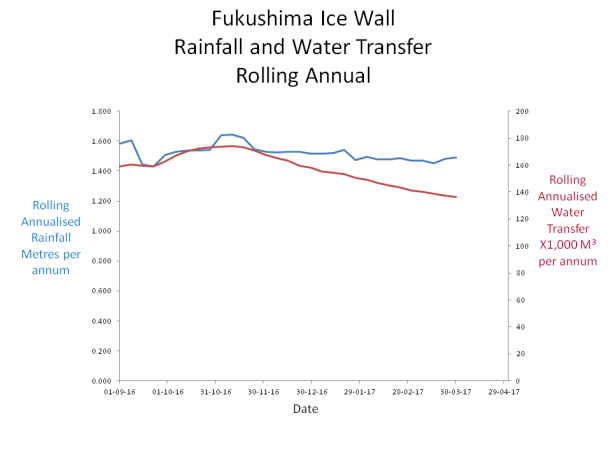
Within the scope of natural variance, the annualised rainfall at Fukushima shows no significant long term trend, being flat and circa 1.5 metres per year. The water transfer level does show some improvement and notwithstanding the slightly higher than average autumnal rains in 2016, water transfer levels are on the decline. Alas given the magnitude of that decline in relation to that hoped for by the ice-wall’s advocates to 50 tonnes per day, it was understandable that the NRA were rather less than impressed.
We also have to consider that our original correlation between rainfall and implied water ingress was conducted on all available data. The reality is several operational events were being executed over the period, such as the commencement of 24 hour pumping from inland relief wells with the aim of reducing groundwater around the stricken buildings, as well as the phased installation of the ice-wall itself. Thus our initial correlation is a composite of parallel events. If we reapply our linear relationship model on a rolling 12 monthly period, to exclude any rainfall seasonality, we see some interesting features, (Figure 5).
Figure 5

Had the ice-wall achieve a positive effect we should observed both a reduction in total amount of water transferred (y) being made up by a reduction in the overall basal flow (c) and of course a reduction in the recent rainfall component as reflected in a reduction of its independent variable (m). We see a reduction in apparent basal flow. As this reduction has occurred in isolation with the independent variable increasing over time, we can attribute reduction in ‘c’ in good measure to the impact relief wells. However, the overall amount of water being pumped out of the stricken buildings has remained high and it has done so because the aquifer has become more susceptible to the impact of recent rainfall. This suggests that the aquifer adjacent the site has become more porous and not less porous over the last few years. Had the ice-wall had a positive effect, a decline in the independent variable ‘m’ over time should be observed.
I would conjecture that if such is the case what could have caused this effect. It is possible that the installation of the coolant pipe-work has caused significant sub-soil disturbance, coupled with the degradation of the substrate rock texture by ground heave. The above should effectively have been self repaired when the ice-barrier froze. However, in this circumstance, owing to the size of the ice-wall and it lack of capacity to freeze the entire depth of the aquifer, it is likely that the aquifer disruption at its margins has resulted in increased porosity in the aquifer directly beneath the wall. Furthermore, given that the wall is incomplete and operating at the extent of its capacity, and that the site is subject to seasonal warming, and has had operational outages it is highly likely that the freeze thaw cycling peripheral to the ice-wall has cause deterioration to the aquifers subsoil texture and cohesion, thereby giving rise to localised increase porosity of the aquifer. As such I am not of the opinion that the installation of the ice-wall has had a ‘limited impact’. I believe it has had a ‘significant and negative impact’ on the porosity of the aquifer local to the site of contamination, and I believe it has added circa 20% to the volume of contaminated water generated since its installation.
But there again, that’s just one persons musings and opinion, and I dare say other will disagree and think I’m writing bollocks. Either way, I would be fascinated to see what “certain results” the TEPCO engineers saw. And if what they saw was good, I’d like a double of whatever they’d been drinking…
Kanpai
[1] 11 July 2016, ‘Fukushima’s Ice-Wall a Fridge Too Far’ Peter J. Hurley, Linkedin.com https://www.linkedin.com/pulse/fukushimas-ice-wall-fridge-too-far-peter-j-hurley
[2] December 27, 2016 Kohei T., The Asahi Shimbun ‘NRA: Ice wall effects ‘limited’ at Fukushima nuclear plant’: http://www.asahi.com/ajw/articles/AJ201612270056.html
[3] http://www.tepco.co.jp/en/nu/fukushima-np/handouts/index-e.html
Director killed by terrorist lives on through 3/11 victims’ film: “Abandoned Land”

Gilles Laurent shoots a scene in Fukushima Prefecture.
The resilience of victims of the 2011 nuclear disaster inspired a Belgian sound engineer to direct his own film on them, but his chance to finish the documentary was stolen by a terrorist.
Gilles Laurent shot “La Terre Abandonnee” (Abandoned Land) in Fukushima Prefecture while he lived in Japan, and the film, which was completed posthumously, is now on show here. Sadly, the director is no longer with us, as he perished at age 46 in one of the terrorist attacks in Brussels on March 22, 2016.
Laurent’s family and people who appear in “La Terre Abandonnee” are hoping that many others will get the opportunity to watch the film, which has become part of Laurent’s lasting legacy.
The attacks on an airport and a subway station in Brussels resulted in 370 people killed or wounded. Laurent happened to be near a suicide attacker in the subway system and lost his life. He had been en route to a film-editing studio.
“I could never have imagined in the least that he would get caught in a terrorist attack,” said Toshiko Sato, 64, a resident of Minami-Soma, Fukushima Prefecture, who appears in the film. Sato was undergoing practical training as a guide-interpreter when she met Laurent.
Laurent had two daughters with Reiko Udo, his Japanese wife, and came to live in Japan in 2013. He decided to direct his film after he learned about the tough spirit of the residents of Fukushima Prefecture, who remained rooted in their own areas even after the nuclear disaster, and developed a desire to chronicle all that he saw on film.
Following the nuclear disaster, the central government issued an evacuation order to Minami-Soma’s Odaka district, where Sato lives. Sato met Laurent while she was preparing to return to her home.
“Media organizations overseas often report on areas of Fukushima Prefecture that are empty of people, but I want people to also learn about disaster survivors who are trying to be positive,” she said she told Laurent when she talked to him.
Laurent then asked to interview Sato. He went on to film her and her husband as they returned to their hometown to visit their family grave and had a gathering with friends at their home for the first time in quite a while.
“I sensed in him a will to report on the current state of Fukushima instead of making vocal calls of some sort or the other,” Sato said.
Laurent’s film crew took over the editing of footage after the director’s death and completed the film that would eventually be titled “La Terre Abandonnee.”
Alice, Laurent’s 42-year-old sister, who lives in Belgium, said she thinks about the feelings of nuclear disaster survivors through the prism of her own sorrow over the loss of her brother to terrorism.
Sylvie, 52, another sister of Laurent, said the film betrays the affectionate sensibilities of Gilles, who was a great nature lover, and added she wants the movie to be watched by many Japanese viewers.
“La Terre Abandonnee” is expected to be released to theaters across Japan.
Fukushima-linked bullying survey reveals hundreds more cases
Survey on Fukushima-linked bullying reveals hundreds more cases
TOKYO (Kyodo) — A government survey prompted by the bullying of a boy from Fukushima Prefecture has unveiled hundreds more cases in which evacuees from areas hit by the nuclear crisis were targeted, data released Tuesday showed.
The first nationwide survey on bullying of children who evacuated Fukushima Prefecture due to meltdowns at the Fukushima Daiichi power plant in 2011 showed there were 129 cases in fiscal 2016 ended this March and 199 more cases in previous years.
Among the total, 13 had apparent links to the nuclear disaster or the major earthquake and tsunami that triggered it.
Education minister Hirokazu Matsuno indicated there could be other cases that may have gone undetected, saying, “It is difficult to conduct a survey that covers them all.”
“We will consider our response in light of the possibility that (some) bullying has not surfaced,” said Matsuno.
The latest survey targeting roughly 12,000 evacuees showed some of those who were bullied in relation to the nuclear crisis were told to go back to Fukushima or stay away, as they would contaminate others with radiation.
The incidents included the highlighted case in which classmates of a boy who relocated to Yokohama in Kanagawa Prefecture demanded he give them cash, and called him a “germ.”
After the case in Yokohama surfaced in November, a slew of similar incidents were brought to light in other parts of the country, prompting the government to request schools that accept evacuees check whether they have been bullied or not through interviews and other means.
http://mainichi.jp/english/articles/20170411/p2g/00m/0dm/063000c
Survey: 204 bullying cases of Fukushima evacuees
A survey by Japan’s education ministry has found more than 200 cases of bullying involving children who fled Fukushima Prefecture after the nuclear disaster in March 2011. But the survey attributes fewer than 10 percent of these cases to the accident, prompting the education minister to admit the need for further studies.
The ministry surveyed more than 11,800 school-age evacuees through regional education boards in March.
The results show 204 cases of bullying occurred since April 2011. One pupil was told to go back to Fukushima soon after entering elementary school. Classmates also told a junior high school student to stay away because radiation is contagious. But the ministry’s survey linked only 13 of the bullying cases to the nuclear accident.
In comparison, a recent NHK survey of more than 740 families showed that at least 54 children were bullied because they were “nuclear accident evacuees.”
Education Minister Hirokazu Matsuno said on Tuesday that the ministry will consider additional studies to bring hidden cases to light. He said that if children were bullied because they were nuclear evacuees, they might have found it difficult to respond to the survey.
Professor Naoki Ogi of Hosei University said the failure of teachers to take the effect of the nuclear accident sufficiently into account has resulted in an extremely superficial appraisal of the problem.
“Half Life in Fukushima” documents life in the red zone five years after the nuclear disaster

“Half-life in Fukushima” is a documentary feature in competition at the 60th San Francisco International Film Festival. It represents a Switzerland and France collaboration, with co-directors Mark Olexa and Francesca Scalisi at the helm. While the production represents a European origin, the subject matter had gained world-wide attention no less than Chernobyl in 1986.
The 2011 Tōhoku earthquake and tsunami in Japan directly set off the Fukushima Nuclear Plant disaster. The town surrounding the Plant was evacuated due to radioactive fallout. Filmmakers Olexa and Scalisi entered the Fukushima red zone five years later and documented a resident still living there, a farmer named Naoto Matsumura.
How Naoto was given permission to stay there is not explained in the film. Actually, Naoto was not alone. He remains in Fukushima with his elderly father, the two striving on a life of self-sufficiency. There is no water from the tap, and radioactive fallouts render everything poisonous, including the mushrooms Naoto had been picking for years in the forest at the back of his home. Only the boisterous ocean remains a powerful reminder of what life was like before disaster hit.
The directors capture their subject with quiet sensitivity and empathy. At first devastated by the loss of everything, but now five years later Naoto is resigned to accept a solitary existence in the ghost town. There are nuclear cleanup crews still working during the day, but all in protective suits and masks. We see Naoto wearing ordinary clothes, feeding his cattle, wandering the streets alone, reminiscing by the ocean, or going into the forest just to look at the trees.
In the opening shot, we see the definition of the term “half-life”. It refers to the time it takes for one-half of the atoms of a radioactive material to disintegrate. It is also an apt metaphor describing the remnants of a life in Naoto. In many scenes, a stationary camera allows us to experience Naoto’s coming and going in real time. One of such moments is when the camera stays with Naoto from a distance as he stops his truck at an intersection when the traffic lights turn red. We stop with him, the scene motionless and silent for about a minute until the green lights come on. Such a vicarious moment into a life on hold is eerily poignant.
One might be surprised to see traffic lights still function and Naoto still obeys them when he is the only one driving in town. It is heart-wrenching to see one man try to maintain normalcy despite all loss, attempting to carve out a life in the midst of desolation. What more, we see Naoto playing a round of golf in an abandoned driving range and singing Karaoke on his own. The film ends with this scene. We hear Naoto sing a song of lost love, a life he can never go back to. After that, we hear the ocean roar as the screen fades to black.
1 This Month
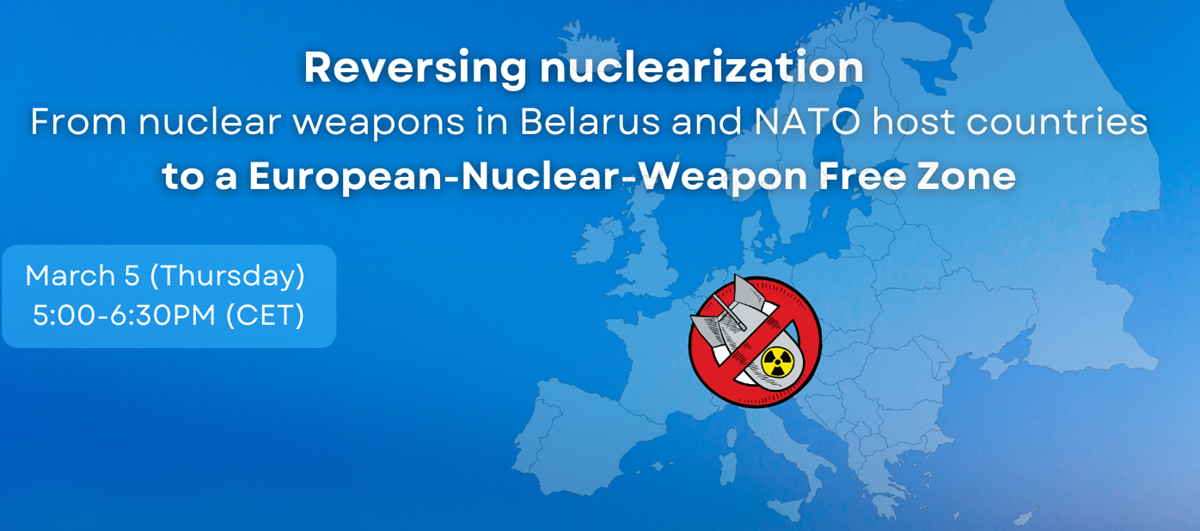
5 March -Online – Reversing nuclearization:
From nuclear weapons in Belarus and NATO host countries to a European-Nuclear-Weapon Free Zone
11am-12:30pm Eastern Time USA / 5pm-6:30pm CET

of the week – Advocating for a
nuclear free beach – https://www.samuellawrencefoundation.org/
The Samuel Lawrence Foundation advocates for a Nuclear Waste Free Beach at San Onofre, join us and take action!

10 March A LIVE WEBINAR THE REAL EFFECTS OF NUCLEAR POWER
What the Industry Isn’t Telling Us
1:00 PM Mountain, 2 pm Central, 3 pm Eastern. Live on the Keepers of the Water Facebook page

18 March Webinar @ 1 PM EST: An Assessment of SMR Projects: The Case of Canada
register for the zoom:
https://us02web.zoom.us/webinar/register/WN_o8BIIOUvQ2ONJR1nta65DQ#/registration

of the week – STOP SMALL MODULAR REACTORS IN CANADA
To see nuclear-related stories in greater depth and intensity – go to https://nuclearinformation.wordpress.com
-
Archives
- March 2026 (51)
- February 2026 (268)
- January 2026 (308)
- December 2025 (358)
- November 2025 (359)
- October 2025 (376)
- September 2025 (258)
- August 2025 (319)
- July 2025 (230)
- June 2025 (348)
- May 2025 (261)
- April 2025 (305)
-
Categories
- 1
- 1 NUCLEAR ISSUES
- business and costs
- climate change
- culture and arts
- ENERGY
- environment
- health
- history
- indigenous issues
- Legal
- marketing of nuclear
- media
- opposition to nuclear
- PERSONAL STORIES
- politics
- politics international
- Religion and ethics
- safety
- secrets,lies and civil liberties
- spinbuster
- technology
- Uranium
- wastes
- weapons and war
- Women
- 2 WORLD
- ACTION
- AFRICA
- Atrocities
- AUSTRALIA
- Christina's notes
- Christina's themes
- culture and arts
- Events
- Fuk 2022
- Fuk 2023
- Fukushima 2017
- Fukushima 2018
- fukushima 2019
- Fukushima 2020
- Fukushima 2021
- general
- global warming
- Humour (God we need it)
- Nuclear
- RARE EARTHS
- Reference
- resources – print
- Resources -audiovicual
- Weekly Newsletter
- World
- World Nuclear
- YouTube
-
RSS
Entries RSS
Comments RSS
 nuclear-news