Radioactive cesium detected in the urine of 100 children after the catastrophic accident of TEPCO Fukushima Daiichi nuclear power plant
Cesium concentration found in more than 70% of the urine sample tested in Fukushima Prefecture

Scientific paper from Sachiko Saitou, Tomoya Yamauchi, Kobe University, submitted 16. January 2017.
Amounts of radioactive cesium, Cs-137 and Cs-134, in 24 h urine of 37 children have been determined using a HP-Ge detector, in Fukushima Prefecture between February 2014 and March 2016.
As comparisons, those of 25 children have been also measured who live in Western Japan from September 2016 to March 2017, and that of one child in Ibaraki Prefecture from April 2014 to January 2017.
We have found the cesium concentrations in the more than 70 % of urine samples from Fukushima Prefecture are in the ranges from 0.06 to 0.30 Bq/L.
No radioactive cesium is observed in the samples from Western Japan, under the detection limit of 0.1 Bq/L.
In the case of Ibaraki, the radioactivity keeps its value around 0.20 Bq/L during the inspection period, indicating the chronic ingestion of the radioactive cesium in his daily life.
http://www.lib.kobe-u.ac.jp/handle_kernel/81009860
javascript:PdfLink(‘default’,’81009860′,’http://www.lib.kobe-u.ac.jp/repository/81009860.pdf’,’G0000003kernel’)
Tepco chairman’s remark on water release goes radioactive
Comment draws ire from Fukushima residents, fishermen and watchdog
 Takashi Kawamura, a former Hitachi chairman, took up his current post just last month.
TOKYO — Comments by Tokyo Electric Power Co. Holdings’ chairman about releasing nuclear wastewater into the ocean are being met with anger from fisheries groups and many others.
Tepco Chairman Takashi Kawamura told news outlets earlier this month that the utility “has made its decision” on the release of tritiated water from the crippled Fukushima Daiichi power plant to the ocean. Tritiated water is a radioactive form where the usual “light” hydrogen atoms are replaced with tritium.
Kyodo News reported the following day that the company shares the view of Shunichi Tanaka, chairman of the Nuclear Regulation Authority, that spilling the water into the sea would not cause any problem, scientifically speaking.
Tepco immediately released a statement saying Kawamura’s comments “did not intend to announce the concluded policy of the company on the matter.”
Nonetheless, the national cooperative of fishermen has protested. And rather unexpectedly, Tanaka criticized Kawamura for using his name to promote the company’s agenda. This is a worrying development for Tepco, since increased mistrust by the NRA could affect the utility’s medium- to long-term strategies, including restarting nuclear power plants.
Tritiated water is also released from normally functioning nuclear power plants. In Japan, water meeting official standards can be dumped into the sea.
But local residents have protested the idea, out of concern that rumors and misunderstandings could damage their community. At the Industry Ministry, a special committee has been considering the matter. Kawamura’s remarks were seen as getting ahead of that process, hence the backlash.
The wastewater in question still sits inside a number of storage tanks at the Fukushima power plant, with nowhere to go. Tepco and the government want to find a solution quickly, but the latest controversy shows that skipping careful and thoughtful communication with various stakeholders could end up costing them more time.
http://asia.nikkei.com/Business/Companies/Tepco-chairman-s-remark-on-water-release-goes-radioactive
Potential releases of 129I, 236U and Pu isotopes from the Fukushima Dai-ichi nuclear power plants to the ocean during 2013 to 2015

After the Fukushima Dai-ichi Nuclear accident, many efforts were put into the determination of the presence of 137Cs, 134Cs, 131I and other gamma-emitting radionuclides in the ocean, but minor work was done regarding the monitoring of less volatile radionuclides, pure beta-ray emitters or simply radionuclides with very long half-lives.
In this study we document the temporal evolution of 129I, 236U and Pu isotopes (239Pu and 240Pu) in seawater sampled during four different cruises performed 2, 3 and 4 years after the accident, and compare the results to 137Cs collected at the same stations and depths.
Our results show that concentrations of 129I are systematically above the nuclear weapon test levels at stations located close to the FDNPP, with a maximum value of 790 x107 at·kg-1, that exceeds all previously reported 129I concentrations in the Pacific Ocean.
Yet, the total amount of 129I released after the accident in the time 2011-2015 was calculated from the 129I/137Cs ratio of the ongoing 137Cs releases and estimated to be about 100 g (which adds to the 1 kg released during the accident in 2011).
No clear evidence of Fukushima-derived 236U and Pu-isotopes has been found in this study, although further monitoring is encouraged to elucidate the origin of the highest 240Pu/239Pu atom ratio of 0.293±0.028 we found close to FDNPP.
New TEPCO executives tripping over their tongues

5.8-Magnitude Quake Strikes Off Coast of Japan’s Fukushima Prefecture, Near Ongoing Fukushima Nuclear Disaster Site


Scaffolding at No.3 Fukushima reactor missing

Underwater Robot Probe of Reactor 3 Begins
Underwater Robot Begins Probing Fukushima Daiichi’s No. 3 reactor


Evacuations Ordered as Heavy Rains Lashed Fukushima…
Heavy rains lashed Fukushima Prefecture during the last few days, prompting evacuation orders in some areas amid fears of flooding. These rains transport lots of radionuclides from the mountainsides and forests down into the towns, redistributing the insoluble cesium particles, recontaminating places having being previously decontaminated. A never ending story.

A New Measure of Ionization Density at the DNA: The Unit of Genetic dose, the Müller

Via Chris Busby
ECRR develops a new unit of radiation exposure. Following developments in internal radiation research the ECRR will shortly be presenting the concept of Genetic Dose, which is the new term for the ECRR unit of biophysical enhanced dose presented in the 2003 and 2010 reports.
The unit of Genetic Dose (which is a measure of ionization density at the DNA) is the Müller written Mü.
The unit was named after Herman Joseph Müller, who was awarded the Nobel prize for his discovery of the genetic effects of ionizing radiation.
For details of the calculation of the genetic dose refer to ECRR2010. A new edition of the ECRR risk model is in preparation, will include new information and risk factors for heritable damage and will be published shortly.
The ECRR will abandon the Sievert but include the ICRP weighting factors in w(j).
Genetic Dose (Mü) = Absorbed Dose (Gy) x enhancement factors w(i), w(j).
This method and the description of the new unit will be published in the peer-review literature.
Tepco ‘s response to the article about the release of tritiated water into the ocean

A certain article reported today, “TEPCO decided to release tritiated water into the ocean” quoting the comment of TEPCO’s chairman Mr. Kawamura about the release of tritiated water into the ocean. The comment intended to say that TEPCO shares the same recognition with Nuclear Regulation Authority Chairman Dr. Tanaka, et al. that in accordance with the current regulation and standard based on scientific and technical ground, there should not be an impact of releasing tritiated water into the ocean. The comment did not intend to announce the concluded policy of the company on the matter.
We need to give our full attention to the satisfaction of both peace of mind of local residents and reconstruction of Fukushima, as well as the safety requirement to meet regulation and standard for the final decision. We will carefully examine our policy on the matter with the government and local stakeholders from such a perspective.
http://www.tepco.co.jp/en/announcements/2017/1444608_10494.html
Will Tepco Dump 770,000 tons of Tritiated Water Into the Pacific Ocean???

Massive amounts of radiation-contaminated water that has been processed and stored in hundreds of tanks at the plant are hindering decommissioning work and pose a safety risk in case another massive quake or tsunami strikes.
“TEPCO needs to release the water — which contains radioactive tritium that is not removable but considered not harmful in small amounts — into the Pacific Ocean”, declared Tokyo Electric Power Co.’s new Chairman Takashi Kawamura during an interview at the TEPCO headquarters in Tokyo on Thursday, July 13, 2017.
The method is favored by experts at the International Atomic Energy Agency and Japan’s Nuclear Regulation Authority as the only realistic option. Earlier, TEPCO had balked at calls by NRA chairman Shunichi Tanaka for controlled release of the water, now exceeding 770,000 metric tons, into the sea, fearing a public backlash.
Tepco’s intention to release more than 770,000 metric tons of triated water into the sea was relayed by many media, the Japan Times adding to the volume number of 770,000 metric tons, that it was contained in 580 tanks. The volume number is right, to be precise it concerns 777,647 metric tons of tritiated water, but the 580 tanks number is wrong.
Knowing that those tanks have a capacity of 1000 metric tons each, 777,647 metric tons can only be stored in 780 tanks and not in 580 tanks only.
Of course in that 777,647 metric tons, are not included the other 202,565 metric tons of only partially decontaminated water, in which Cesium and Strontium are been already filtered out but the other 62 radionuclides have not been yet filtered by the Multi-nuclides Removal System (ALPS). Those 202,565 metric tons stored in some additional 202 tanks more in the Storing Tank Area.
Bringing the total of contaminated water, Cesium/Strontium partially decontaminated water plus the 62 radionuclides decontaminated water (Tritiated water) to a total of 980,212 metric tons stored in 980 tanks.
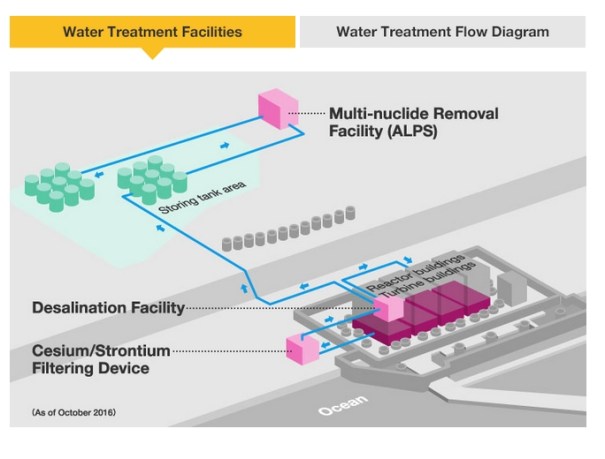
Of course it is not question to release the partially decontaminated water (202,565 metric tons) into the sea, only the fully decontaminated water (all radionuclides removed to the exception of tritium), the tritiated water, the 777,647 metric tons.
On the Tepco Press Release on Jul 10,2017, Tepco indicates quite clearly the actual volume of the 2 types of water stored in those tanks. Knowing that all those tanks have a capacity of 1000 metric tons each, the maths are easy.
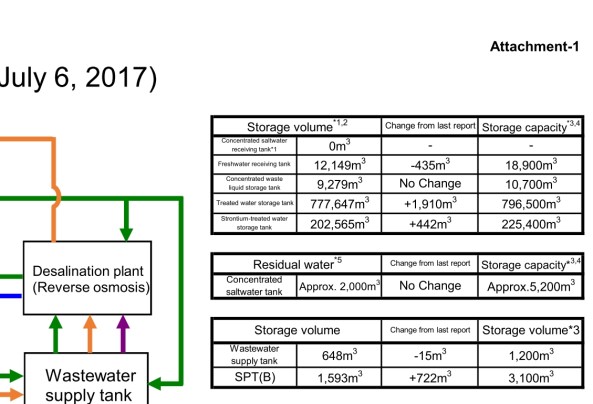

Some media along the way, I suspect the Japan Times AGAIN, added the 580 tanks number into its article, maybe a typo from 5 to 7, then the error was copied on and on by the other media.
It is sad to see professionnal media not capable to get their numbers right.
Since that July 13, 2017 declaration from Tepco’s new chairman, Tepco is now backpedaling, saying that they have not yet reached that decision, fearing a public backlash and the ire of the local fishermen.
The radioactive half-life of Tritium is 12,3 years, its radioactive full life is 123 years to 184,5 years. Once inside the body, tritium can lead to internal exposure. Its biological half-life of 10 days, full life 100 to 150 days.
Tepco Press Release July 10, 2017 Nuclear Power Station (310th Release) Nuclear Power Station (310th Release): http://www.tepco.co.jp/en/press/corp-com/release/betu17_e/images/170710e0201.pdf
Fukushima Radiation and the 2020 Tokyo Olympics
Japan Plans to Expose Its People and 2020 Tokyo Olympians to Fukushima Radiation
 Radiation-contaminated debris and soil is stockpiled for disposal near the Tokyo Electric Power Company’s embattled Fukushima Daiichi nuclear power plant on February 25, 2016, in Okuma, Japan.
Former nuclear industry senior vice president Arnie Gundersen, who managed and coordinated projects at 70 US atomic power plants, is appalled at how the Japanese government is handling the Fukushima nuclear crisis.
“The inhumanity of the Japanese government toward the Fukushima disaster refugees is appalling,” Gundersen, a licensed reactor operator with 45 years of nuclear power engineering experience and the author of a bestselling book in Japan about the Fukushima Daiichi disaster, told Truthout.
He explains that both the Japanese government and the atomic power industry are trying to force almost all of the people who evacuated their homes in the wake of the Fukushima nuclear disaster to return “home” before the 2020 Tokyo Olympics.
This March Japan’s federal government announced the subsidies that have, up until now, been provided to Fukushima evacuees who were mandated to leave their homes are being withdrawn, which will force many of them to return to their contaminated prefecture out of financial necessity.
And it’s not just the Japanese government. The International Olympic Commission is working overtime to normalize the situation as well, even though conditions at Fukushima are anything but normal. The commission even has plans for the 2020 Tokyo Olympics to have baseball and softball games played at Fukushima.
Gundersen believes these developments are happening so that the pro-nuclear Japanese government can claim the Fukushima disaster is “over.” However, he noted, “The disaster is not ‘over’ and ‘home’ no longer is habitable.”
His analysis of what is happening is simple.
“Big banks and large electric utilities and energy companies are putting profit before public health,” Gundersen added. “Luckily, my two young grandsons live in the US; if their parents lived instead in Fukushima Prefecture [a prefecture is similar to a state in the US], I would tell them to leave and never go back.”
Reports of radiation from the Fukushima Daiichi nuclear disaster, which began when a tsunami generated by Japan’s deadly earthquake in 2011 struck the nuclear plant, have been ongoing.
Seven more people who used to live in Fukushima, Japan were diagnosed with thyroid cancer, the government announced in June. This brings the number of cases of thyroid cancer of those living in the prefecture at the time the disaster began to at least 152.
While the Japanese government continues to deny any correlation between these cases and the Fukushima disaster, thyroid cancer has long since been known to be caused by radioactive iodine released during nuclear accidents like the one at the Fukushima Daiichi power plant. A World Health Organization report released after the disaster started listed cancer as a possible result of the meltdown, and a 2015 study in the journal Epidemiology suggested that children exposed to Fukushima radiation were likely to develop thyroid cancer more frequently.
The 2011 disaster left 310 square miles around the plant uninhabitable, and the area’s 160,000 residents were evacuated. This April, officials began welcoming some of them back to their homes, but more than half of the evacuees in a nearby town have already said they would not return to their homes even if evacuation orders were lifted, according to a 2016 government survey.
Officials from Tokyo Electric Power Company (TEPCO), the company responsible for cleaning up the disaster, announced this February they were having difficulty locating nuclear fuel debris inside one of the reactors. Radiation inside the plant continues to skyrocket to the point of causing even robots to malfunction.
Cancer cases continue to crop up among children living in towns near Fukushima.
And it’s not as if the danger is decreasing. In fact, it is quite the contrary. Earlier this year, radiation levels at the Fukushima plant were at their highest levels since the disaster began.
TEPCO said atmospheric readings of 530 sieverts an hour had been recorded in one of the reactors. The previous highest reading was 73 sieverts an hour back in 2012. A single dose of just one Sievert is enough to cause radiation sickness and nausea. Five sieverts would kill half of those exposed within one month, and a dose of 10 sieverts would be fatal to those exposed within weeks.
Dr. Tadahiro Katsuta, an associate professor at Meiji University, Japan, is an official member of the Nuclear Reactor Safety Examination Committee and the Nuclear Fuel Safety Examination Committee of the Nuclear Regulation Authority. Truthout asked him what he was most concerned about regarding the Japanese government’s handling of the ongoing nuclear disaster at Fukushima.
“What I regard as the most dangerous, personally, is the fact that the Japanese government has chosen the national prestige and protection of electric power companies over the lives of its own citizens,” Katsuta, who wrote the Fukushima update for the World Nuclear Industry Status Report, said.
Gundersen thinks it simply makes no sense to hold the Olympics in Japan.
“Holding the 2020 Olympics in Japan is an effort by the current Japanese government to make these ongoing atomic reactor meltdowns disappear from the public eye,” Gundersen said. “I discovered highly radioactive dust on Tokyo street corners in 2016.”
According to Gundersen and other nuclear experts Truthout spoke with, the crisis is even worse.
Fukushima and Surrounding Prefectures Radioactively “Contaminated”
“The Japanese government never dedicated enough resources to trying to contain the radiation released by the meltdowns,” Gundersen said.
Gundersen said that during his first trip to Japan in 2012, he stated publicly that the cleanup of Fukushima would cost more than a quarter of a trillion dollars, and TEPCO scoffed at his estimate. But now in 2017, TEPCO has reached and announced the same conclusion, but as a result of its inaction in 2011 and 2012, the Pacific Ocean and the beautiful mountain ranges in Fukushima and surrounding prefectures are contaminated.
One of the tactics that Prime Minister Shinzō Abe’s administration chose to deploy at Fukushima to contain radiation was an underground “ice wall.”
“As the ‘ice wall’ was being designed, I spoke out that it was doomed to fail, and was [an] incredibly expensive diversion,” Gundersen said. “There are techniques that could stop water from entering the basements of the destroyed reactors so that the radioactivity would not migrate through the groundwater to the ocean, but the Japanese government continues to resist pursuing them.”
Gundersen argues that Japan could and should build a sarcophagus over all three destroyed reactors and wait 100 years to dismantle them. This way, the radioactive exposure will be minimized for Japanese workers, and ongoing radioactive releases to the environment would be minimized as well.
Gundersen also points out that it is equally important that radioactive water continues to run out of the mountain streams into the Pacific, so a thorough cleanup of the mountain ranges should begin right now, but that is a mammoth undertaking that may never succeed.
In addition to his other roles, Arnie Gundersen serves as the chief engineer for Fairewinds Energy Education, a Vermont-based nonprofit organization founded by his wife Maggie. Since founding the organization, Maggie Gundersen has provided paralegal and expert witness services for Fairewinds. Like her husband, she’s had an inside view of the nuclear industry: She was an engineering assistant in reload core design for the nuclear vendor Combustion Engineering, and she was in charge of PR for a proposed nuclear reactor site in upstate New York.
When Truthout asked her how she felt about the Abe government’s response to Fukushima, she said, “Human health is not a commodity that should be traded for corporate profits or the goals of politicians and those in power as is happening in Japan. The Japanese government is refusing to release accurate health data and is threatening to take away hospital privileges from doctors who diagnose radiation symptoms.”
Maggie Gundersen added that her husband also met with a doctor who lost his clinic because he was diagnosing people with radiation sickness, instead of complying with the government’s story that their illnesses were due to the psychological stress of the Fukushima Daiichi meltdowns.
M.V. Ramana is the Simons Chair in Disarmament, Global and Human Security at the Liu Institute for Global Issues at the University of British Columbia in Canada, and is also a contributing author to the World Nuclear Industry Status Report for 2016. Like the Gundersens, he is critical of the Abe administration’s mishandling of Fukushima.
“I am not sure we can expect much better from the Abe administration that has shown so little regard for people’s welfare in general and has supported the nuclear industry in the face of clear and widespread opposition,” Ramana told Truthout. “As with restarting nuclear power plants, one reason for this decision seems to be to reduce the liability of the nuclear industry, TEPCO in this case. It is also a way for the Abe administration to shore up Japan’s image, as a desirable destination for the Olympics and more generally.”
Katsuta agreed.
“Prime Minister Abe has neither the knowledge about the issue of Fukushima accident nor the interest at all,” Katsuta said. “The Abe administration has yet to clearly apologize for its responsibility for promoting the nuclear energy policy.”
Instead, according to Katsuta, the Abe administration has lifted evacuation orders in an effort to “erase the memories of the accident.”
Fukushima Evacuees “Forced” Back Home
In the immediate wake of the Fukushima Daiichi meltdowns, 160,000 people fled areas around the plant. The Abe government has been providing housing subsidies to those who were evacuated, but its recent announcement means those subsidies will no longer be provided. Many “voluntary evacuees” will be forced to consider returning despite lingering concerns over radiation.
“This is very unfortunate,” Ramana said of the withdrawal of the subsidies. “The people who were evacuated from Fukushima have already been through a lot and for some of them to be told that the government, and presumably TEPCO, does not have any more liability for their plight seems quite callous.”
He explains that, in enacting this callous move, the Japanese government is claiming that radiation exposure is now within “safe levels” for people to return home. This claim ignores the fact that levels now are even higher than before the accident, and also disregards the widespread uncertainties plaguing the measurement of radiation in the affected areas.
Katsuta expressed similar concerns.
“The lifted evacuation area has not been restored completely, as the radiation dose is still high, and decontamination of the forest is excluded,” he said. “Besides, the decontamination waste is often stored in the neighborhood, and there were many families who did not return, and then the local community collapsed.”
Katsuta added that the subsidies only amount to $1,000 per refugee, so paying them for the next 10 years is “not expensive” in order to safeguard human lives.
Given her work in PR for the nuclear industry, Maggie Gundersen had an interesting position on the Abe government’s tactics.
When she was working for the atomic power industry, she was “carefully taught” certain misinformation about atomic power reactors by industry scientists and engineers. She said she would never have done that work if she had known the “hidden truth.” She and Arnie were both taught that atomic power was the “peaceful use of the atom” — she does not support war and believes that the use of atomic weapons or depleted uranium are horrific crimes — and she explains that she never would have worked for or promoted atomic power knowing what she knows now.
“Arnie and I immediately noticed that TEPCO and the Japanese government were using the same playbook that was used at Chernobyl and Three Mile Island (and for that matter, Deepwater Horizon),” Maggie Gundersen explained. “Governments immediately minimize the amount of radiation being released, or in the case of Deepwater Horizon, the amount of oil.”
She added that in each of these cases, the mainstream press dutifully reported shortly after the crisis that there was nothing to fear, even though there was no evidence to support these assertions. The governments’ objectives were to minimize fear and chaos, and most media simply echoed officials’ claims. The responses to the Fukushima disaster are following the same pattern.
“Is the Abe regime glossing over the seriousness of the Fukushima meltdowns and ongoing radioactivity? Absolutely,” she said. “What is happening in Japan to the known and unknown victims is a human rights violation and an environmental justice debacle.”
2020 Tokyo Olympics to Be Held Amidst “Hot Particles”
Katsuta said that the Fukushima evacuees are “extremely worried” that their plight will be overshadowed by the Olympics. He believes the Japanese government is using the Olympics to demonstrate to the world that Japan is now a “safe” country and that the Fukushima disaster “has been solved.”
“In Japan, the people are really forgetting the Fukushima accident as … the news of the Olympics increases,” he said.
Arnie Gundersen doesn’t think it makes sense to have some of the Olympic venues (soccer, baseball and possibly surfing) in Fukushima Prefecture itself.
“Radioactively ‘hot particles’ are everywhere in Fukushima Prefecture and in some of the adjacent prefectures as well,” he said. “These ‘hot particles’ present a long-term health risk to the citizens who live there and the athletes who will visit.”
Ramana, too, believes that the events held closer to Fukushima “may be adding to the radiation dose of the competitors and the spectators.”

Fukushima Disaster “Will Continue for More Than 100 Years”
Maggie Gundersen pointed out that the Nuclear Regulatory Commission consistently claims it has learned lessons from Fukushima, but she doesn’t think the commission — or the Japanese government, or corporations — learned any lessons at all.
“Energy production is all about money,” she said. “After the meltdowns, many banks in Japan invested in keeping the atomic power reactors on hold until the disaster could sort itself out. Those banks and the government supporting its access to the use of the atom have a vested interest in starting the old reactors up.”
Katsuta has a dire outlook for the future of Fukushima, and said there are already numerous evacuees who have given up hope of returning because they are aware of the crisis being unsolvable by the current means of TEPCO and the Abe administration.
“Even if decontamination and decommissioning work progresses, the problem will not be solved,” he said. “We have not yet decided how to dispose of decontamination waste and decommissioning waste.”
Ramana believes Fukushima should be a reminder of the inherent hazards associated with nuclear power, and how those hazards become worse when entities that control these technologies put profits over human wellbeing.
Arnie Gundersen had even stronger words.
“The disaster at Fukushima Daiichi will continue for more than 100 years,” he explained. “Other atomic power reactor disasters are bound to occur. Chernobyl and Fukushima Daiichi should have taught everyone around the world that nuclear power is a technology that can destroy the fabric of a society overnight.”
According to him, the remains of the reactor containments at Units 1, 2 and 3 are highly susceptible to damage from another severe earthquake, and any earthquake of 7.0 or higher at the Fukushima site could provoke further severe radiation releases.
Shortly after the meltdowns, Maggie and Arnie Gundersen both spoke about Japan being at a “tipping point”: It could respond to the disaster by leading the world in renewable energy while choosing to protect people and the pristine rural environment through sustainable energy economies.
But obviously it didn’t work out that way.
“The world saw Japan as technologically savvy, but instead of moving ahead and creating a new worldwide economy, it continues with an old tired 20th century paradigm of energy production,” Maggie Gundersen said. “Look at the huge success and progress of solar and wind in other countries like Germany, Nicaragua and Denmark. Why not go energy independent, creating a strong economy, producing many more jobs and protecting the environment?”
Arnie Gundersen has plans to return to Japan later this year on a crowdsourced trip with scientific colleagues in order to teach Japanese citizen scientists how to take additional radioactive samples. Fairewinds Energy Education is currently fundraising to make this possible.
In the meantime, dramatic examples of the ongoing dangers of nuclear power in Japan abound.
In June, radioactive materials were found in the urine of five workers exposed to radiation in an accident at a nuclear research facility in Japan’s Ibaraki Prefecture. In that incident, one of the workers had a large amount of plutonium in his lungs.
Recent polls in Japan show that the Japanese public has lost faith in nuclear safety regulation, and a majority of them favor phasing out nuclear power altogether.
Meanwhile in the US, President Donald Trump has put nuclear energy first on the country’s energy agenda and has announced a comprehensive study of the US nuclear energy industry. Trump’s energy secretary Rick Perry said, “We want to make nuclear cool again.
https://www.ecowatch.com/tokyo-olympics-fukushima-2460798164.html
Tepco backpedals after disaster reconstruction chief knocks plan to dump tritiated water into sea
Hey, a change in the ‘official’ strategy: why admit it & damage your image when you can keep letting it happen & say you’ve decided not to do it ?
 The Fukushima No. 1 plant and hundreds of tanks containing tritiated water are viewed from the air in February
Tokyo Electric backed off its tritium-dumping decision Friday after disaster reconstruction minister Masayoshi Yoshino said it would cause problems for struggling fishermen trying to recover in Fukushima Prefecture.
The remarks made Friday by the Fukushima native came shortly after the chairman of Tokyo Electric Power Company Holdings Inc. was quoted as saying that the decision to discharge tritium-tainted water from the Fukushima No. 1 power plant into the sea had “already been made.”
After Tepco Chairman Takashi Kawamura’s remarks were widely reported, the utility scrambled to make a clarification the same day.
According to Tepco’s clarification, Kawamura meant to say that there was “no problem” with the dumping plan, based on government guidelines and “scientific and technological standards.” The statement also said that no final decision had been made.
A government panel is still debating how to deal with the massive amount of tainted water stored in tanks at the atomic plant, where three reactor cores melted after a huge earthquake in March 2011 spawned tsunami that devastated the region and knocked out all power at the plant.
Tritium typically poses little risk to human health unless ingested in high amounts. It remains in filtered water as it is difficult to extract on an industrial basis. Ocean discharges of diluted volumes of tritium-tainted water are a routine part of nuclear power plant operations.
At a news conference, Yoshino said there would “certainly be damage due to unfounded rumors” if the tainted water were dumped into the sea. He urged those pushing for the release “not to create fresh concerns for fishermen and those running fishing operations in Fukushima Prefecture.” He also asked them to take care not to drive fishermen “further toward the edge.”
Yoshino, who is not directly involved in the decision-making process for handling the water, was alluding to local concerns about how people’s livelihoods will be affected if people think marine products from Fukushima are contaminated with radiation. He added that while he is aware that many in the scientific community say the diluted water can be safely released, he remains opposed.
“As I am also a native of Fukushima Prefecture, I fully understand the sentiment of the people,” the minister said.
Water injected to perpetually cool the damaged reactors becomes tainted in the process. A high-tech filtering apparatus set up at the plant can remove 62 types of radioactive material but not tritium. As a result, tritiated water is building up continuously at the plant. As of July 6, about 777,000 tons were stored in about 580 tanks on the premises.
On March 11, 2011, tsunami inundated the six-reactor plant, which is situated 10 meters above sea level, and crippled its power supply, causing a station-wide blackout. The failure of the cooling systems in reactors 1, 2 and 3 then led to a triple core meltdown that became the world’s worst nuclear disaster since Chernobyl in 1986.
Tepco Says It Has Not Made Final Decision On Discharging Contaminated Water Into Sea

17 Jul (NucNet): Tokyo Electric Power Company (Tepco) said in a statement on 14 July 2017 that it had not made a final decision on whether or not to release water containing tritium into the sea at the Fukushima-Daiichi nuclear power station.
Tepco, which owns and operates the facility, was reacting to media reports that its chairman, Takashi Kawamura, had said the decision had already been made. But Tepco said in its statement posted on its website, that while it agreed with Nuclear Regulation Authority (NRA) that there should be no impact from releasing tritiated water into the ocean, Tepco had not finalised its policy on the matter.
“We need to give our full attention to the satisfaction of both peace of mind of local residents and the reconstruction of Fukushima prefecture, as well as meeting regulation and safety standards for a final decision,” the statement said. “We will carefully examine our policy on the matter with the government and local stakeholders from such a perspective.”
Tepco said tritium typically poses little risk to human health unless ingested in high amounts, and ocean discharges of diluted volumes of tritium-tainted water are a routine part of nuclear power plant operations. This is because it is a byproduct of nuclear operations but cannot be filtered out of water.
As of 6 July 2017, about 770,000 tonnes of water containing tritium were stored in about 580 tanks at the Fukushima-Daiichi station, which is running out of storage space.
Contaminated cooling water at the station is being treated by a complex water-processing system that can remove 62 different types of radioactive materials except tritium, which is a radioactive isotope of hydrogen.
According to the Japan Times, NRA chairman Shunichi Tanaka has been urging Tepco to release the water. But fishermen who make their livelihoods near the station are opposed to the releases, the newspaper said.
1 This Month

of the week – Shut Down Drone Warfare!


Tell the Ukrainian Government to Drop Prosecution of Peace Activist Yurii Sheliazhenko

Petition to revoke the licensing of the Near Surface Nuclear Disposal Facility (NSDF) at Chalk River. https://www.ourcommons.ca/petitions/en/Petition/Details?Petition=e-7247
To see nuclear-related stories in greater depth and intensity – go to https://nuclearinformation.wordpress.com
-
Archives
- April 2026 (7)
- March 2026 (251)
- February 2026 (268)
- January 2026 (308)
- December 2025 (358)
- November 2025 (359)
- October 2025 (376)
- September 2025 (257)
- August 2025 (319)
- July 2025 (230)
- June 2025 (348)
- May 2025 (261)
-
Categories
- 1
- 1 NUCLEAR ISSUES
- business and costs
- climate change
- culture and arts
- ENERGY
- environment
- health
- history
- indigenous issues
- Legal
- marketing of nuclear
- media
- opposition to nuclear
- PERSONAL STORIES
- politics
- politics international
- Religion and ethics
- safety
- secrets,lies and civil liberties
- spinbuster
- technology
- Uranium
- wastes
- weapons and war
- Women
- 2 WORLD
- ACTION
- AFRICA
- Atrocities
- AUSTRALIA
- Christina's notes
- Christina's themes
- culture and arts
- Events
- Fuk 2022
- Fuk 2023
- Fukushima 2017
- Fukushima 2018
- fukushima 2019
- Fukushima 2020
- Fukushima 2021
- general
- global warming
- Humour (God we need it)
- Nuclear
- RARE EARTHS
- Reference
- resources – print
- Resources -audiovicual
- Weekly Newsletter
- World
- World Nuclear
- YouTube
-
RSS
Entries RSS
Comments RSS
 nuclear-news