Projectile hits near Iran’s Bushehr nuclear plant, killing one: IAEA

Tehran says it is the fourth attack near the nuclear plant amid the US-Israel war on Iran.
By Al Jazeera Staff and Reuters 4 Apr 2026, https://www.aljazeera.com/news/2026/4/4/iaea-says-projectile-hits-near-irans-bushehr-nuclear-plant-killing-one
One person has been killed by projectile fragments after United States-Israeli strikes targeted a location close to Iran’s Bushehr nuclear plant, according to the International Atomic Energy Agency.
The agency, citing confirmation from Iranian authorities, said in a statement on X that there was “no increase in radiation levels” after Saturday’s attack.
Iran’s Foreign Minister Abbas Araghchi claimed the Bushehr facility had been “bombed” four times since the war erupted on February 28, criticising what he described as a lack of concern for its safety.
The strike comes as the US and Israel escalate their targeting of Iranian industrial sites, even as experts warn of the high risks of striking nuclear or petrochemical facilities.
IAEA Director General Rafael Grossi expressed “deep concern about the reported incident and says [nuclear] sites or nearby areas must never be attacked, noting that auxiliary site buildings may contain vital safety equipment”, the statement read.
Grossi also reiterated a “call for maximum military restraint to avoid risk of a nuclear accident,” the IAEA added.
The Atomic Energy Organization of Iran (AEOI) confirmed the incident in a post on X.
An “auxiliary” building on the site was damaged, but the main sections of the power plant were not affected by the strike, the government agency said, adding that the person killed was a member of security personnel.
The head of Russia’s state nuclear company, Rosatom, said 198 Russian staff had evacuated the plant following the attack, state news agency Interfax reported.
“As planned, we began the main wave of evacuations today, about 20 minutes after the ill-fated strike. Buses departed from the Bushehr station toward the Iranian-Armenian border. 198 people, to be exact – the largest wave of evacuation – are on the buses,” Alexei Likhachev said.
Rosatom has been evacuating staff from the plant since the US-Israeli war on Iran began. Saturday’s evacuations had been planned before the attack.
The Bushehr plant is Iran’s only operational nuclear power plant. It is located in Bushehr city, home to 250,000 people, and is one of Iran’s most important industrial and military nodes.
Meanwhile, US and Israeli strikes on Saturday hit several petrochemical plants in the southern Khuzestan region, an important energy hub, according to Iranian media.
At least five people were injured, Iranian media reported, citing a provincial official.
Explosions were heard, and smoke was also seen rising after missiles hit several locations across the Mahshahr Petrochemical Special Economic Zone.
The state-run Bandar Imam petrochemical complex, which produces chemicals, liquefied petroleum gas (LPG), polymers and a range of other products, was struck and sustained damage, Iran’s Mehr news agency reported.
A provincial governor in Khuzestan added that the Fajr 1 and 2 petrochemical companies, as well as other nearby facilities, were also hit, according to the Fars news agency. The extent of damage is unclear.
Iran’s Islamic Revolutionary Guard Corps (IRGC) claimed it shot down an MQ-1 drone over central Isfahan province on Saturday, hours after authorities said they forced down two US warplanes.
Isfahan, which houses an underground uranium conversion and a research site, was one of three facilities bombed during US and Israeli strikes on Iran last June.
France plans inquiry as cost of nuclear waste project hits €33bn

After France raised the cost of its Cigéo nuclear waste storage project to €33.3 billion, an increase of more than €8 billion, authorities are preparing to open a public inquiry into the plan – which has long faced opposition from anti-nuclear groups.
01/04/2026 , By:RFI,
https://www.rfi.fr/en/france/20260401-france-plans-inquiry-as-cost-of-nuclear-waste-project-hits-%E2%82%AC33bn-cig%C3%A9o
The new estimated cost replaces a €25 billion figure set in 2016. It reflects updated costs and sits within a €26.1 to €37.5bn range set in May 2025 by the National Agency for Radioactive Waste Management, which is leading the project.
The government order, signed by Economy Minister Roland Lescure and Energy Minister Maud Brégeon, covers the entire lifespan of the site – from design and construction to operation and closure – over 151 years.
It puts the initial construction cost at €9.74 billion. Taxes linked to the project are estimated at €3.66 billion.
The revised estimate will be used as a reference by EDF, Orano and the Atomic Energy Commission, the three nuclear operators that fund the project under the “polluter pays” principle.
Deep underground
Cigéo is designed to store France’s most radioactive nuclear waste 500 metres underground at a site in Bure in eastern France. The site would hold 10,000 cubic metres of high-activity waste and 73,000 cubic metres of long-lived medium-activity waste produced by nuclear power plants.
When the cost was first set at €25 billion in 2016, based on earlier economic conditions, campaigners said it was “largely underestimated”.
The National Agency for Radioactive Waste Management filed a formal request for authorisation in January 2023. A final government decision is not expected before late 2027 or early 2028.
French media reports said the public inquiry had initially been planned for autumn and was still expected in early December when the ASNR, France’s nuclear safety and radiation watchdog, issued its final opinion on the construction authorisation request.
Race against the calendar
Speaking at a meeting of public inquiry commissioners in Euville on Thursday, Meuse prefect Xavier Delarue said the public inquiry would begin on 18 May.
He said around 50 elected officials had been consulted before the schedule was brought forward, with a strong response rate and 75 percent of the opinions returned favourable.
“There was every reason to launch the public inquiry,” he said.
Three commissioners, along with three alternates, have been appointed to examine the roughly 10,000-page file.
They will produce a report, which the agency must respond to by the end of the summer. “In September, I will write an overall report and send it to the ministry,” Delarue said.
Opposition pushback
Nine environmental organisations have criticised the decision and called for the consultation to be delayed.
In a joint statement, groups including Greenpeace France, France Nature Environnement and the Nuclear Phase-Out Network denounced “an unacceptable new attempt to push the project through” and said the file does not show that the project would be feasible and safe.
They also said the timetable reflects an electoral aim, with the goal of approving Cigéo before next year’s presidential election.
EBRD donors back plan to repair Chornobyl’s protective shield
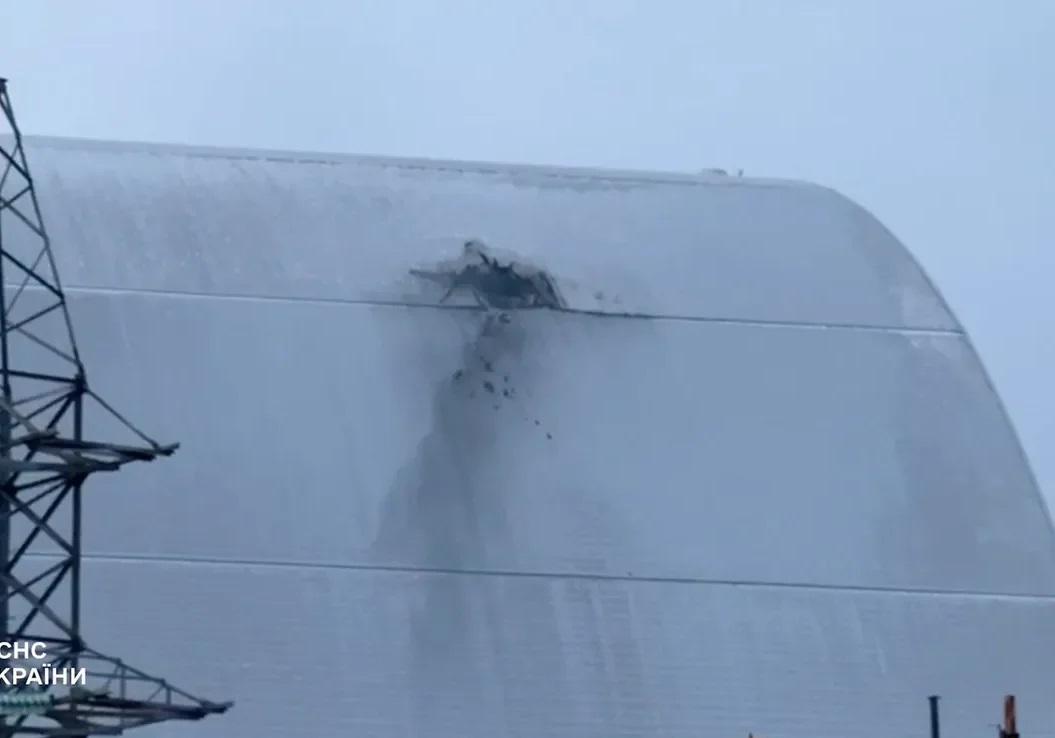
Donors to the International Chornobyl Cooperation Account (ICCA), managed by the
European Bank for Reconstruction and Development (EBRD), have endorsed
plans for early engineering and procurement works that will pave the way
for potential repairs to the New Safe Confinement (NSC) at the Chornobyl
Nuclear Power Plant in Ukraine.
A Russian drone strike in February 2025
damaged the NSC, the giant structure built to contain the remains of
Reactor Four and enable the safe dismantling of the original sarcophagus,
which was hastily built after the 1986 accident.
Preliminary assessments by
Novarka 2 (comprising the original NSC designer-builder Bouygues Travaux
Publics and Vinci Construction Grands Projets) estimated that the corrosion
of the steel arch threatened the long-term safety of the NSC, and that work
was needed to restore the structure to full functionality by 2030. Repairs
could cost at least €500 million.
EBRD 1st April 2026, https://www.ebrd.com/home/news-and-events/news/2026/ebrd-donors-back-plan-to-repair-chornobyl-s-protective-shield.html
Progress, push back and Indigenous rights
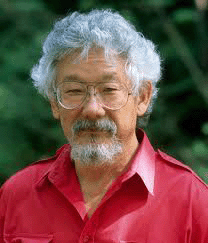
by David Suzuki, April 2, 2026, https://rabble.ca/environment/progress-push-back-and-indigenous-rights/
As seatbelt and smoking regulations — and many other examples — show, people eventually adapt. Uncertainty shouldn’t be used to frustrate progress.
In Canada, progress on social and ecological justice often faces roadblocks………………………………………………………………………………………………………………
Corporations and politicians are now trying to get Canada and British Columbia to walk back commitments to uphold Indigenous rights and obligations under the United Nations Declaration on the Rights of Indigenous Peoples.
The Kebaowek First Nation’s legal challenge against Canadian Nuclear Laboratories over a proposed nuclear waste facility near the Ottawa River illustrates how progress on Indigenous rights often meets resistance. In a landmark ruling, Justice Julie Blackhawk affirmed that Canada’s commitments under the UNDRIP must meaningfully inform federal decision-making. Canadian Nuclear Laboratories appealed the decision, arguing against application of the UN Declaration Act and the requirement to obtain free, prior and informed consent from Indigenous nations.
Uncertainty is also being used by opponents of Indigenous-led marine protected areas. They promote and leverage the fears and uncertainties of concerned small businesses while also opposing the interests of other small-scale operators, including recreational fishers, that support MPAs.
It’s a familiar refrain: Those with established power seek to prevent change, hiding behind the concerns and doubts of community members, but quickly turn on them when it’s in their interest to do so……………………………………………….
Indigenous Peoples lived on these lands before European settlers arrived. Recent efforts to advance co-governance models and uphold Indigenous rights prior to extraction activities are meant to advance social justice and address the colonial legacies embedded in Canada’s history.
A recent joint letter from B.C. unions, academics, doctors and conservation organizations says, “We are deeply troubled by the recent rise in anti-Indigenous rhetoric and fearmongering in this province that has framed the realization of the fundamental human rights of Indigenous peoples as detrimental to economic growth, security, and the interests of others,” adding, “We believe that our futures are intertwined and our collective prosperity is inextricably linked.”
As the Yellowhead Institute states, “Aboriginal rights in Canadian law do not give Indigenous people rights — they merely recognize Crown obligations.” Indigenous people have inherent rights that are fundamental to treaty, human and constitutional rights.
We have a chance to do things right in Canada. Let’s put aside the fearmongering, push back against the pushback and continue our journey forward together.
David Suzuki is a scientist, broadcaster, author and co-founder of the David Suzuki Foundation. Written with David Suzuki Foundation Boreal Project Manager Rachel Plotkin.
UK submarine captain steps down after link to Chinese spy case
Navy previously conducted investigation into senior officer to examine potential
blackmail risk. The captain of one of Britain’s nuclear-armed submarines
has stepped back from his role this week after being investigated over his
relationship with Joani Reid, the Labour MP whose husband has been arrested
on suspicion of spying for China.
FT 31st March 2026,
https://www.ft.com/content/93beaf9c-e1c8-4875-b446-2cd148529f6a
Ambassador Chas Freeman: Trump PUSHES ESCALATION — Israel’s Strategy COLLAPSES Overnight
3 April 26,
COMMENT by Robert Anderson
The US, and its administration are on the losing end of this war, there’s a coverup going on. The military hospitals in Germany are full, we have many more casualties from the war in the Gulf/Iran/Israel. Iran is essentially winning this war. We will quit the war while we are behind (losing in this case. Epstein will come back to the forefront at some point. If nothing else this will bring Trump down, he’s being blackmailed by Israel which forced him into this war,
Massacre of UK aid workers: two years of obfuscation from Britain

Hamza Yusuf, Declassified UK, Apr 3, 2026
April 1st marked the two year anniversary of Israel’s massacre of World Central Kitchen (WCK) aid workers in Gaza. Seven members of the organisation were killed by Israeli drones while travelling in a convoy in Deir el-Balah in Central Gaza, after unloading 100 tonnes of food aid at its Gaza warehouse. The group was travelling in a “deconflicted zone” in two armoured vehicles that were clearly branded with the WCK logo and had coordinated their movements with the Israeli military. |
| The attack was not an anomaly, but a feature of Israel’s systematic targeting of aid workers in Gaza. The United Nations said that 383 aid workers were killed in 2025, with nearly half of them in Gaza. As Declassified previously revealed, Britain’s Ministry of Defence holds video footage of Gaza from the day of the attack but is refusing to publish it – footage taken by a Royal Air Force surveillance plane which spent approximately five hours above Gaza that day. |
n December 2025, the family of James Henderson renewed their demand for the MoD to release the recording. “The reason for not supplying that footage from the Ministry of Defence is a bit of an insult,” his father told Declassified.
The cousin of another of the victims, James Kirby, said in a statement released on the anniversary of his killing: “It is especially difficult to see that men who were so loyal and committed to their country have not yet received the justice they deserve.
The cousin of another of the victims, James Kirby, said in a statement released on the anniversary of his killing: “It is especially difficult to see that men who were so loyal and committed to their country have not yet received the justice they deserve.”Two years on, communication from the government has been limited, and the family remains unsure whether a full and formal investigation is underway.” A tepid statement from the UK’s Middle East Minister Hamish Falconer published on the two-year anniversary saidthe UK “will continue to push for justice”. But Falconer is only calling on Israel to investigate itself. “I urge Israel to swiftly conclude and publish their findings into this attack. The families of those killed must know why this happened. Lessons must be learnt”, Falconer said. |
But the accountability the British government is demanding would be much clearer if it released its own spy flight footage.
True to form, however, where Israel is involved, Britain prefers at best silence in the face of crimes and at worst smokescreens and deceit.
Washington Post Promotes Nuclear Agenda Tied to Bezos’ Investments

The piece contains no disclosure about Bezos’ financial ties to the nuclear energy sector, continuing a trend previously identified by FAIR (11/20/25). Bezos is the largest individual shareholder of Amazon, which has invested $500 million in small modular reactor nuclear (SMR) startup X-Energy. X-Energy recently signed a letter of intent to explore deployment in areas that include Illinois. Amazon is a member of the Nuclear Energy Institute, which advocated to end the state’s moratorium.
Peter Castagno, 1 April 26, https://fair.org/home/washington-post-promotes-nuclear-agenda-tied-to-bezos-investments/
The Washington Post has devoted four editorials to supporting the expansion of nuclear energy in the past three months, relying on factual errors and distortions to make the case for the Trump administration’s unprecedented cuts to nuclear safety regulation. The Post‘s owner, Jeff Bezos, is the chair of Amazon, a company dependent on electricity-guzzling data centers that invested more than $1 billion in nuclear energy last year.
The first of the editorials (1/15/26) was headlined “The Facts About Nuclear Energy Are Sinking In. Even in Illinois.” It lauded Illinois Gov. JB Pritzker’s decision to end the state’s moratorium on building new nuclear plants.
The piece contains no disclosure about Bezos’ financial ties to the nuclear energy sector, continuing a trend previously identified by FAIR (11/20/25). Bezos is the largest individual shareholder of Amazon, which has invested $500 million in small modular reactor nuclear (SMR) startup X-Energy. X-Energy recently signed a letter of intent to explore deployment in areas that include Illinois. Amazon is a member of the Nuclear Energy Institute, which advocated to end the state’s moratorium.
‘Clean energy’ (except the toxic waste)
The Washington Post editorial said of Pritzker:
The 2028 presidential hopeful personified the Democratic Party’s gradual realization that the country cannot meet its electricity needs—let alone combat climate change—without embracing the world’s largest source of clean energy.
As FAIR has previously noted, leading experts dispute the claim that nuclear energy is essential to address climate change. Describing it as “clean” obscures unresolved problems such as radioactive waste. More than 100,000 tons of spent nuclear fuel are stored in pools requiring active cooling and dry casks throughout the country—over 11,000 tons in Illinois alone, the largest stockpile of any state.
An expert report published the same day as the Post‘s Illinois editorial, co-authored by former NRC chair Allison Macfarlane, described the situation as a national imperative: The federal government has collected more than $50 billion from ratepayers for a waste repository it has never built, paid more than $12 billion to reactor owners in damages for failing to take the waste, and is projected to pay an additional $40 billion more.
Illinois’ 1987 moratorium was a bipartisan measure signed into law by a Republican governor that prohibited construction of new nuclear plants until the federal government identified and approved a means of disposing of radioactive waste. That condition has never been fulfilled. The Post omits the reason for the moratorium, instead characterizing nearly four decades of policy as a “perplexing attitude” driven by ideological environmental activists:
Illinois has suffered for decades from serious cognitive dissonance on nuclear energy. The state boasts the nation’s largest fleet of nuclear reactors, generating more than half its electricity from those plants. Yet lawmakers in Springfield followed the lead of environmental activists who regard the industry with open disdain…. That perplexing attitude is finally changing.
The Post also did not consider how the state’s years-long criminal nuclear scandal might affect its residents’ views. Since 2020, Illinois utility Exelon and its subsidiary Commonwealth Edison have agreed to more than $200 million in fines with federal authorities for bribing political figures to pass legislation that included roughly $2.35 billion in nuclear subsidies—the same subsidies Exelon has repeatedly stated it requires to keep its Illinois plants operating. The scandal is part of a broader pattern of corruption in the industry that the Post elided in other editorials.
Celebrating safety rollbacks
A month later, under the headline “America’s Nuclear Future,” the Washington Post editorial board (2/14/26) championed the Trump administration’s nuclear safety rollbacks:
Sometimes, regulators have even forced changes to designs mid-construction, as happened in 2009, when they required containment buildings for reactor developments in Georgia and South Carolina to be able to withstand direct aircraft strikes, driving up costs and delaying construction.
The editorial board invoked the Vogtle project in Georgia and the VC Summer project in South Carolina as cautionary tales about regulatory overreach. The Post did not mention that VC Summer’s failure in South Carolina was primarily caused by executive fraud and mismanagement (Power, 10/15/21).

Further, a senior representative of Southern Nuclear, the operator of Georgia’s Vogtle reactors, recently attributed reactor construction delays to macroeconomic events and lead contractor Westinghouse’s bankruptcy rather than over-regulation. The new reactors cost $35 billion, more than twice the original estimate, and were completed seven years late in 2024.
The Post claimed the Nuclear Regulatory Commission forced changes while reactors were “mid-construction” in 2009, but physical construction for both projects did not begin until 2013, as noted by Edwin Lyman, director of nuclear power safety for the Union of Concerned Scientists, and the pro-nuclear source they cited.

The Post made other misleading claims in the article regarding the science of radiation dangers. The editorial board expressed support for the Trump administration’s efforts to drastically weaken the NRC’s radiation guidelines, which are based on the Linear No-Threshold (LNT) model. LNT maintains cancer risk as proportional to radiation dose, with even tiny amounts causing small but real risks, particularly for infants and vulnerable populations. The Post wrote:
The science underpinning the radiation rule is mushy, at best. It’s based on a theory that because radiation poses a serious cancer risk at high doses, it must also pose a low risk at lower doses.
It is irresponsible for a reputable news outlet to describe the science supporting LNT as “mushy.” As the Bulletin of the Atomic Scientists (10/15/25) recently explained, the use of LNT model for radiation has been repeatedly affirmed by authoritative scientific bodies, including “the National Academies of Sciences, Engineering and Medicine, virtually all international scientific bodies, the Environmental Protection Agency (EPA) and the NRC itself.”

The Post did disclose Amazon’s nuclear energy investments in the February 14 piece, and in two following editorials. But those disclosures don’t convey the scope of their efforts to influence nuclear policy.

Amazon spent nearly $19 million on lobbying last year, including on nuclear energy–related issues. Amazon Data Services is a member of the Nuclear Energy Institute (NEI), the nation’s biggest trade group pushing to cut safety regulations—the same NEI that recently celebrated the Post’s inclusion of nuclear energy in its “25 Good Things That Happened in 2025.” In January, the Bezos Earth Fund donated $3.5 million to the Nuclear Scaling Initiative to help coordinate bulk purchases of standard reactor designs. Shannon Kellogg, vice president of public policy at Amazon, chairs the Data Center Coalition, another prominent lobby group that has pushed nuclear safety regulatory rollbacks.
Don’t mention the P-word

The Washington Post’s next pro-nuclear editorial (2/22/26)—headlined “Fixing America’s Broken Nuclear Supply”—advocated the practice of nuclear reprocessing, which refers to the separation of uranium and plutonium from spent fuel. The extracted materials are then repurposed for use as reactor fuel, but also can be used to create nuclear weapons.
The Post editorial did not contain the word “plutonium.” It glossed over the proliferation risk, the foremost historical concern with reprocessing, only mentioning it once:
President Jimmy Carter banned the practice out of fears of weapons proliferation. President Ronald Reagan later reversed that decision, but reprocessing never rebounded, mostly because nuclear companies decided that sourcing new uranium was more cost-effective.
Reprocessing was originally invented to develop plutonium for nuclear weapons. India used it to create a nuclear bomb from its atomic energy program in 1974, which Carter explicitly cited as the impetus for the ban. Presidents George H.W. Bush and Bill Clinton also did not encourage reprocessing due to proliferation concerns.
‘Crucial to power AI’
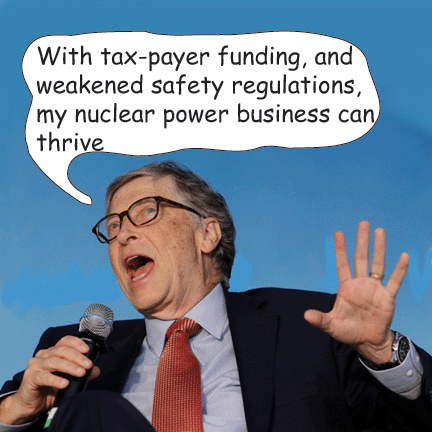
In its most recent nuclear editorial—“The Government’s Freeze on Nuclear Energy Is Thawing”—the Washington Post (3/6/26) celebrated the NRC’s March approval of a construction permit for Bill Gates’ SMR startup TerraPower:
Something shocking happened this week: Bureaucrats approved a project ahead of schedule. Even better, it was for a nuclear project that promises to make energy production safer and cleaner than traditional reactors. The government still holds back America’s nuclear industry too much, but it’s a victory worth celebrating.
The Trump administration has taken unprecedented measures to accelerate new nuclear reactors. It has secretly overhauled nuclear safety rules, proposed to severely cut inspections and radiation standards, and exempted new reactors from environmental reviews. Over 400 NRC employees have left the agency since Trump took office. These developments were not concerning to the Post, however, which wrote “the government still holds back America’s nuclear industry too much.”
The Union of Concerned Scientists’ Lyman warned that the NRC’s fast-tracked review for TerraPower failed to address serious safety concerns inherent to its design. The Post’s claim about TerraPower’s safety ignores unresolved issues admitted to by the NRC in the agency’s December safety evaluation:
The staff did not come to a final determination on the adequacy and acceptability of functional containment performance due to the preliminary nature of the design and analysis.
Unlike traditional reactors, TerraPower’s design does not include a physical containment dome to guard against the release of radioactive material in the event of a meltdown.
The Post wrote:
The speed with which the NRC has been able to review the TerraPower project is a testament to growing bipartisan support for climate-friendly nuclear energy. In June 2024, shortly after the company submitted its application, Congress overwhelmingly passed a bill called the Advance Act to cut red tape. Those reforms were crucial given the surging demand for new energy to power artificial intelligence.
The Post presented TerraPower’s rapid review as a “testament to growing bipartisan support for climate-friendly nuclear energy.” It does not mention that Trump fired the former Democratic NRC chair for the first time in its agency’s history, and its two remaining Democratic commissioners told lawmakers they believe they could be fired for refusing to approve reactors for safety reasons. Multiple Democratic lawmakers who voted in favor of the Advance Act have lambasted the Trump administration’s actions to expedite reactor approvals as dangerous and illegal.
The Post editorial did not mention the primary impetus for TerraPower’s rapid licensing process: a series of executive orders Trump signed last May. They directed the NRC to approve new reactors within 18 months, consult with DOGE on a wholesale revision of its regulations, and weaken radiation protections rooted in its “overly risk-averse culture.” A recent ProPublica investigation (3/20/26) revealed that nuclear firms were given the opportunity to offer edits for the EOs, many of which are financially connected to DOGE’s leadership.
‘Energy to cost less’
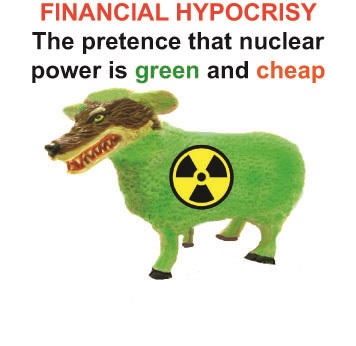
The Post went on to claim expanding nuclear energy will lower energy costs: “Anyone who wants energy to cost less should be excited about the US producing more of it.”
Yet as FAIR (4/21/16) explained in a 2016 analysis, Lazard investment bank’s widely cited, annual levelized cost of energy report has repeatedly found nuclear energy to be far more expensive than renewables, a finding that remains unchanged in its most recent report.
The Post claimed that the new generation of Silicon Valley–backed SMRs will be cheaper than traditional reactors, but the first expected commercial SMR project was canceled in 2023 due to repeated cost overruns that spent over $600 million in federal funds.
X-Energy, the SMR firm backed by Amazon, has also steeply increased its cost projections. In 2021, the Department of Energy awarded TerraPower around $2 billion, and gave $1.2 billion to X-Energy. X-Energy’s projected cost estimates have surged since then, from roughly $2.5 billion in 2021 to a range of $4.75–5.75 billion in 2023.
The Institute for Energy Economics and Financial Analysis warned these cost increases should serve as a “red flag” in a 2024 analysis. It concluded:
Investment in SMRs will take resources away from carbon-free and lower-cost renewable technologies that are available today and can push the transition from fossil fuels forward significantly in the coming 10 years
As physicist MV Ramana argues in his book Nuclear Is Not the Solution (2024), tech billionaires like Bezos are backing nuclear energy rather than doubling down on renewables for reasons of ideology, military and government alliances, and, crucially, profit opportunities. X-Energy filed for an IPO last month, giving Amazon the opportunity to leverage AI and nuclear hype into a higher opening valuation.
When the Post’s editorial board (10/15/25) hailed small reactors last year as a “worthy gamble” in an editorial headlined “The Military’s Big Gamble on Small Nuclear Reactors,” it did not mention its owner stood to profit from that wager.

From ISIS to Iran: Joe Kent Says Washington Keeps Repeating the Same Catastrophic Playbook
April 3, 2026, ScheerPost Staff, https://scheerpost.com/2026/04/03/from-isis-to-iran-joe-kent-says-washington-keeps-repeating-the-same-catastrophic-playbook/
In a wide‑ranging and unusually candid conversation, former National Counterterrorism Center Director Joe Kent explains why he resigned over the Trump administration’s war on Iran—and why he believes the United States has once again walked into a strategic disaster of its own making.
Kent’s account, drawn from decades inside U.S. covert and military operations, offers a rare insider narrative of how Washington’s pro‑war reflexes, Israeli pressure, and America’s own history of regime‑change hubris converged into the current crisis.
A War Built on a False Premise
Kent opens with the core claim that drove his resignation: Iran posed no imminent threat to the United States.
As he puts it, “Iran was not on the cusp of attacking us… They observed a very calculated escalation ladder.”
According to Kent, Iran halted proxy attacks once Trump returned to office, sat at the negotiating table, and even refrained from striking U.S. forces during the 12‑day war—until Israel launched its own attack on Iranian nuclear sites.
The only “imminent threat,” Kent argues, came not from Tehran but from Israel’s unilateral actions, which forced Washington into a conflict it did not need and could not win.
How Israeli Influence Shapes U.S. War Decisions
One of the most explosive threads in the interview is Kent’s description of how Israeli intelligence, lobbying networks, and media allies shape U.S. policy far beyond what most Americans understand.
Kent describes a “multi‑layered influence ecosystem” that bypasses normal intelligence vetting and pressures senior U.S. officials directly.
“They will come in and say, ‘They’re within two weeks of getting a bomb,’ and that night it’s repeated on TV,” he explains.
This echo chamber, he argues, successfully moved the U.S. red line from “no nuclear weapon” to “no enrichment at all”—a shift that made diplomacy impossible and war inevitable.
The Forever-War Reflex in Washington
Kent echoes what former officials like Lawrence Wilkerson have long warned: Washington has a structural bias toward war.
Defense contractors, political incentives, and a bipartisan foreign‑policy class create what Kent calls the “factory settings” of U.S. power—settings that default to escalation, not restraint.
Even Trump, who campaigned on ending endless wars, was eventually pulled into the Iran conflict. Kent argues Israeli officials and neoconservative advisers played to Trump’s ego, promising an easy, historic victory.
The U.S. Role in Creating ISIS—And Repeating the Pattern
Kent’s most damning historical analysis concerns the U.S. role in the rise of ISIS and al‑Qaeda affiliates in Syria.
He recounts how the Iraq War destabilized the region, empowered Iranian‑aligned militias, and pushed Gulf states and Israel to back radical Sunni factions in Syria.
“We were supporting al‑Qaeda, which eventually morphed into ISIS,” Kent says bluntly.
He describes how U.S. and Turkish support helped elevate Abu Mohammad al‑Julani, an al‑Qaeda figure who now effectively governs northwest Syria with tacit Western acceptance.
The lesson, Kent argues, is clear: regime‑change wars always produce monsters—and America never seems to learn.
Iran’s Strategy: Win by Not Losing
Kent believes Iran has adopted a long‑term strategy shaped by watching U.S. failures in Iraq and Afghanistan:
• survive • absorb blows • raise global energy costs • outlast Washington’s political will
Iran doesn’t need to defeat the U.S. militarily, he argues—only to avoid collapse.
And with control over the Strait of Hormuz, ballistic missile capacity, and regional alliances, Iran can keep the war costly indefinitely.
The Nuclear Danger: A Self‑Fulfilling Prophecy
Kent warns that U.S. and Israeli pressure may push Iran toward the very outcome Washington claims to fear.
“We basically destroyed the school of thought that opposed nuclear weapons,” he says, referring to the killing of Iran’s former Supreme Leader and the rise of hardliners.
He predicts Iran may now pursue a “North Korea solution”—a nuclear deterrent to prevent future attacks.
The Only Exit: Restrain Israel, Reopen Diplomacy
Kent’s prescription is stark:
- Publicly restrain Israel’s offensive operations
- Cut military aid if necessary
- Offer sanctions relief
- Reopen the Strait of Hormuz
- Return to negotiations
Without restraining Israel, Kent argues, the U.S. will remain trapped in an endless cycle of escalation.
“Unless we restrain Israel, I just don’t see us having a way out of this,” he warns.
This conversation is not just another critique of U.S. foreign policy. It is a rare moment when a senior insider—someone who helped run America’s counterterrorism apparatus—publicly breaks with the system he once served.
For ScheerPost readers, Kent’s testimony reinforces what independent journalists have long documented:
• U.S. wars are rarely about security • Israeli influence shapes U.S. decisions in ways the public never sees • regime‑change operations consistently backfire • Washington’s war machine is structurally incapable of learning from its failures
Kent’s resignation and his warnings should be a national scandal. Instead, they are being heard mainly on independent platforms—another sign of how tightly controlled mainstream narratives around war have become.
You can read more about Joe Kent MAGA Goons Smear The Grayzone to Get Back at Joe Kent
or Joe Kent’s Resignation, in His Own Words, Reveals MAGA’s Fracture Over War—Not a Break From Empire
Remember this too: as Nate Baer reported, “Then you’ve got the frauds like Joe Kent, the director of the National Counterterrorism Center who just resigned over the war. A MAGA devotee and former special forces operative who pulled the trigger for U.S. imperialism in Syria, Yemen, and Iraq, his resignation wasn’t about ethics or principle. In his resignation letter, he even praised Donald Trump’s 2020 assassination of Qasem Soleimani. Trump was doing imperialism right then—now, in Kent’s view, he’s simply doing it wrong.”
Does the Trump administration understand how ‘enriched’ uranium is made into weapons?

Harmeet Kaur, CNN, 2 April 2026
For the US to reach a deal with Iran or to end its war in the country, President Trump has said he wants Iran to surrender its “enriched” uranium.
“We want no enrichment, but we also want the enriched uranium,” he told CNN’s Kaitlan Collins last week.
The president has at times cited Iran’s “enriched” uranium stores as part of his ever-changing rationale for the war, and in recent days, he’s reportedly considered sending US troops in to seize them. But nuclear arms experts say the way Trump and his lead negotiator have talked about uranium enrichment raises doubts about how well they understand the technicalities.
For one, Trump keeps referring to “nuclear dust,” which is not a known term in the nuclear energy industry. And since the February 26 US-Iran nuclear talks, Steve Witkoff, a former real estate developer who has been leading US negotiations with Iran along with Trump’s son-in-law Jared Kushner, has made claims that experts say betray a similarly weak expertise………………………………………………………………………………………………………………………………………………………
Uranium that has been enriched above the natural 0.7% level of uranium-235 and up to a 20% concentration is considered low-enriched uranium, used for civilian purposes. Commercial reactors typically require uranium enriched to less than 5%, while research reactors used for testing or medicine generally require uranium enriched to up to 20%.
Uranium enriched beyond 20% is considered highly enriched uranium, and uranium enriched above 90% is considered weapons-grade.
The higher the enrichment level, the more quickly uranium can be enriched to weapons-grade, Diaz-Maurin says. Once uranium has been enriched to 20%, a vast majority of the work required to enrich it to weapons-grade levels has been completed. It becomes exponentially easier to enrich 20% uranium to 60%; enriching from 60% to 90% is even easier, he says.
The higher the enrichment level, the lower the minimum mass of enriched uranium required to produce a bomb, says Diaz-Maurin. For example, uranium that’s been enriched above 20% can technically be used to produce a crude weapon, but you would need about 400 kilograms of it, making it inefficient and impractical. When the enrichment level goes up to 60%, the critical mass drops down to about 42 kilograms. Uranium enriched to weapons-grade requires about 28 kilograms, which can fit into a missile warhead, he says.
Since Trump pulled out of the Iran nuclear deal in his first term, Iran has been enriching its uranium closer and closer to weapons-grade, though it officially proclaimed a religious prohibition against building a nuclear weapon. Now, given that the US and Israel have attacked the country as negotiations were ongoing, Iran’s hardliners in parliament are calling on the regime to advance to full nuclear armament.
Western nations, as well as the UN watchdog International Atomic Energy Agency (IAEA), have long expressed concerns about Iran’s production and stockpiling of highly enriched uranium. On June 12 last year, the IAEA estimated that Iran’s stockpile included 440 kilograms of uranium enriched up to 60%, Diaz-Maurin wrote in a recent analysis. The next day, Israel attacked Iran, killing prominent nuclear scientists and significantly damaging Iran’s main enrichment site.
Enrichment level is an important indicator of risk, but there are a host of other factors that should be considered in assessing how quickly Iran could produce weapons-grade enriched uranium, says Kelsey Davenport, director for Nonproliferation Policy at the Arms Control Association. Those other considerations include the amount of enriched uranium a country has, its capacity to enrich it and whether the uranium is being held in solid fuel rods or in gas form.
“Witkoff had a poor grasp of the details,” she says.
For example, Davenport says comments that Witkoff made in the aftermath of February 26 negotiations with Iran indicated some confusion between nuclear reactors, which use enriched uranium for power, and the centrifuge facilities where the enrichment process takes place. Witkoff seemed particularly concerned about a research reactor in Tehran that he claimed was being used to stockpile highly enriched uranium. Reports from the UN’s nuclear watchdog estimate that Iran had about 45 kilograms of 20% enriched uranium stored in fuel assemblies at the reactor, which Davenport says “is not even enough for one bomb.”
To be developed into a nuclear weapon, she says the uranium at the reactor would need to be converted back to gas form and then be further enriched to weapons-grade. Before Israel’s strike on Iran’s main conversion facility last June, that might not have been difficult. Now, the situation has changed. “Could Iran convert that material back to gas form? Yes,” she says. “Could they do it quickly and easily at this point? No.”
Davenport says Witkoff was also reportedly surprised by how much enriched uranium was in Iran’s stockpile, even though this information was well documented by international inspectors. “I think he was focused on the wrong details and did not have the nuclear expertise or the expert team available to him to assess how the Iranian proposal would have impacted risk overall,” Davenport says.
Iran also said that it made an offer to dilute its 60% enriched uranium to a lower percentage, which Diaz-Maurin calls “a sound one from a non-proliferation perspective.” But he says it doesn’t appear that US negotiators took the proposal seriously. “I suspect that they did not really understand what the meaning was,” he adds. “And here we are.”
Less than two days after Witkoff and Kushner met with Iran to discuss its nuclear program, the US and Israel attacked the country. Some experts suggest that the decision was informed, at least partially, by a shallow understanding of Iran’s nuclear program and positions.
“It certainly seems as though there was a gap, and that’s a huge problem on something like this, especially when it seems like potentially a military decision was made based on things that were happening in that room,” says Connor Murray, a research analyst for the Center for Arms Control and Non-Proliferation.
A month on, the US is engaged in an intense war that experts argue could potentially have been avoided with another word: Diplomacy. US and Israeli strikes have indeed severely diminished Iran’s capacities to enrich uranium, Diaz-Maurin says. But he says Iran’s know-how and political will to build nuclear weapons probably won’t be destroyed so easily.
“You can’t really bomb away an idea, a program and knowledge. So there will always be a suspicion that Iran is doing something,” he says. “And one could argue that now more than ever, they have incentive to accelerate whatever program they have.” https://edition.cnn.com/2026/04/01/us/word-of-week-enriched-cec
Escalating To Catastrophe
when Trump and Hegseth use this phrase, they are using it knowingly and deliberately. They are channelling all of LeMay’s savagery, racism and fascism.
They are simply reflecting the dominant belief held for decades by US military planners that the US can, and should, commit war crimes and mass murder to get what it wants.
Nate Bear, Apr 02, 2026, https://www.donotpanic.news/p/escalating-to-catastrophe
In his televised address last night Trump said the US was going to continue attacking Iran for another two or three weeks and would bomb the country “back to the Stone Ages, where they belong.”
More on that phrase later.
But first a bit on the economics.
Promising to keep doing the thing that has brought the world to the brink of a global economic catastrophe, and threatening maximum escalation, didn’t go down well with the people who make numbers go up or down. The oil price rocketed, and markets sank. It seems the people behind the screens might finally be waking up to the looming disaster. They might be realising, belatedly, that very soon the molecules are simply not going to arrive where they are wanted and needed in the quantities required
You can’t decouple the numbers from the atoms forever and you can only deny physical reality for so long.
And the physical reality is stark and stunning. The drop in oil production since the US-Israeli sneak attack on Iran is bigger than the drop during covid, which was the biggest drop in modern history.
Read that again if you need to.
But there’s a crucial difference that makes this situation worse.
The covid drop was demand destruction.
This is supply destruction.
In 2020 no one needed the oil because of a mandated and somewhat managed power down. In 2026 everyone still needs the oil, and gas. There’s been no managed power down. The fuel just isn’t there. For the global economy the difference is like willingly checking into rehab versus being forced to go cold turkey.
Two once-in-a-generation events in six years.
The outcome can only, logically, in the short-term at least, be disastrous.
In the medium-to-long-term perhaps, on the energy front at least, this will accelerate the shift to solar, wind and wave, as a friend suggested yesterday.
Perhaps.
But covid didn’t.
Despite that energy shock, despite all the talk of building back better and the demonstration of how active state interventions could end homelessness or drive child poverty to record lows, nothing changed. The US even re-installed Donald Trump, the man who during the first once-in-a-generation event suggested drinking bleach to cure yourself of the virus.
Nothing changed because to make pro-social changes you need pro-social leaders willing to create pro-social systems. Maniacs, war criminals and imperialists aren’t going to do it.
And that’s what we’ve got.
Additionally, for all the uses I detailed in my last article, it’s impossible to get rid of oil and gas entirely, or even mostly. You can’t even make turbines or solar panels without fossil fuels. Petrochemicals are deeply woven into the fabric of our societies, and the interests of capital have a huge incentive in keeping it that way. And when those chemicals aren’t flowing through the system in the quantities we rely on, our societies are forced to react.
And that’s what’s about to happen.
This power down will be messier than covid because it’s even less planned.
Now to the imperialism.
Trump threatened to bomb Iran back to the Stone Age. Hegseth tweeted the same.
Yes this is sadism. Yes this is an openly announced war crime. Yes it shows that this was never about helping the Iranian people.
But Trump and Hegseth’s sadism is far from anomalous.
The use of this exact phrase by US military leaders has a long history.
Curtis LeMay
General Curtis LeMay was known as The Demon. An air force general who commanded US forces in Japan, Korea and Vietnam, he advocated total war against civilian infrastructure to break the political leadership of a country. LeMay was the architect of the firebombing of Japan in March 1945, in which an estimated 100,000 to 150,000 civilians were murdered in a single night. He also commanded the total war bombing campaign against civilians and civilian infrastructure in North Korea and casually boasted that “we killed off, what, 20% of their population.”
It was during the Vietnam war, and later recounted in his autobiography, that LeMay advocated for bombing North Vietnam “back to the Stone Age.” He also said the same about the Soviet Union, arguing that the US shouldn’t just bomb but nuke them into the Stone Age.
LeMay is revered among the US military. US Strategic Command in Nebraska is named after him. LeMay was also a racist. In 1968 he joined George Wallace’s campaign for president and became his running mate. Wallace’s main policy was maintaining racial segregation.
So when Trump and Hegseth use this phrase, they are using it knowingly and deliberately. They are channelling all of LeMay’s savagery, racism and fascism.
They are channelling the savagery, racism and fascism of empire.
A savagery, racism and fascism that American empire was built on and which still today knits the United States together.
So no, Trump and Hegseth’s language, for all its barbarity, was not a surprise.
They are simply reflecting the dominant belief held for decades by US military planners that the US can, and should, commit war crimes and mass murder to get what it wants.
Naked empire
If there is a difference right now, it’s how naked empire has become. How the savagery is uttered in real time, by the president of empire, to a global audience.
The imperialists no longer pretend to have humanitarian motives for their crimes. Now they openly announce they’re going to kill large numbers of humans and overthrow governments to steal oil and resources.
Which is why anyone coming out on the other side of this still clinging to liberal beliefs about the international order, about the US as a force for good, about Trump as an anomaly, is a coward. Anyone who tells you Trump is merely an aberration is afraid to internalise the truth about empire, or is motivated by privilege not to do so.
Which goes for the vast majority of legacy media, liberal or otherwise, all of whom have utterly failed to keep citizens informed about the catastrophe this war has provoked. A major reason is because, as appendages of empire, as stenographers for imperialism, they didn’t want to say too much about the targets Iran has hit for fear of hyping the enemy.
Completely captured, but, in the end, it doesn’t matter. Because, I repeat, physical reality has a habit of being real.
It doesn’t matter whether you like that reality or not.
Molecules and atoms don’t care about your political bias or your ideology.
So now, as US-Israel escalate to catastrophe against Iran, the shock is really going to shock, especially for those who’ve been kept in the dark.
Legal challenge against nuclear site plan rejected
BBC 2nd April 2026,
https://www.bbc.co.uk/news/articles/cy01wkgw2z8o
A judge has thrown out a legal challenge against a plan to extract water at the UK’s largest nuclear site.
Sellafield, in Cumbria, was given permission last May by the Environment Agency (EA) to extract water from its site, as part of the process to build a new radioactive waste storage facility.
Campaigners for Lakes Against Nuclear Dump (LAND) submitted a legal challenge against this, amid fears for the impact on nearby rivers. A high court judge said there was “no credible evidence” to allow the challenge to go ahead.
A Sellafield spokesman said the outcome would allow it to focus on its “mission to deal with the hazards on our site safely and sustainably”.
The licence granted to Sellafield would allow the company to extract up to 77,077,224 gallons (350,400 cubic metres) of water a year until 2031.
The EA previously said it had considered all the potential impacts on the environment before giving permission.
Marianne Birkby, who submitted the challenge for LAND, said the group disagreed with the decision and would be looking to lodge an appeal.
It argued the environmental impacts of the licence had not been properly assessed and feared contaminated water would end up in the rivers Calder and Ehen.
“We feel we must challenge the Environment Agency’s continual rubberstamping of Sellafield’s wish lists,” Birkby said.
Sellafield said removing water from a construction site was standard practice when preparing land for a building project.
A spokesman said: “This water will not be discharged to the rivers Calder or Ehen. It is pumped to on-site storage tanks for testing prior to being discharged direct to sea.”
Inspiring the Authentic Journalist: The Pentagon’s Renewed attack on Press Credentials
1 April 2026 Dr Binoy Kampmark AIM Extra, https://theaimn.net/inspiring-the-authentic-journalist-the-pentagons-renewed-attack-on-press-credentials/
On March 20, 2026, US District Senior Judge Paul Friedman found for The New York Times in a ruling deeming the Pentagon’s media access policy in breach of the US Constitution. Central to the policy was the requirement that all credentialled journalists sign a pledge that officials would not be asked for information they were not authorised to release. The Pentagon Facilities Alternative Credentials (PFACs) policy was found to have violated the First Amendment for its lack of reasonableness and being “viewpoint-discriminatory,” and the Fifth Amendment for not outlining clear standards governing cases when press credentials can be denied.
The judge thought the policy’s purpose was rooted in notions of removing “disfavoured journalists” while filling, in their emptied ranks, those “favourable to or spoon-fed by department leadership.” Indeed, that happened, with an exodus of main stable news organisations refusing to take up the pledge, leaving those friendly to the administration to take their place in mild leisure and bigoted sympathy.
The irony there is that the Pentagon media pack do not, for the most part, need to be encouraged by such feeding practices. They normally swallow the slop and staple whole. Truly intrepid reporters wedded to sharp if ugly authenticity are rarely seen at press gatherings conducted and managed by officialdom in the capital cities of the world, certainly those in the business of defence and security. The issue is not the correctitude of the ruling that the PFAC policy breached the Constitution but the curious sense that the Fourth Estate was necessarily better informed for sharing desks in situ, or near officials, moving through corridors without invigilation and having what is known as “access” to aides and advisers
The judge certainly gave little thought in examining that premise, taking the evidence at face value that the “presence of PFAC holders at the Pentagon has enhanced the ability of journalists and news organizations to keep Americans informed about the US military while posing no security or safety risk to Department property or personnel.” (In what way?) The environs of the building also offered chances for press briefings, even those called at short notice, and opportunities to question officials at, before or after such briefings. Semi-formal and informal opportunities to question personnel also helped identify “the context and detail needed to report accurately and effectively about defense policy and military operations.”
The Pentagon promised to both appeal the ruling and introduce a revised restrictive policy as stridently buffoonish as its first one. Instead of abiding by the ruling to re-credential the Times reporters and permitting those who had refused to sign the pledge to have their passes restored, the department shut down access to most of the building. The intention is to house these bought scribblers in a new, and yet unbuilt annex. The decades-old Correspondents’ Corridor has been shut down, and journalists given limited unescorted access to a library at the complex’s periphery.
With The Times again taking the matter to court, Judge Friedman found these arrangements “weird.” “Is this a Catch-22? Is this Kafka?” Hardly. Had Franz Kafka advised this peculiar administration, he would have informed them about bureaucracy’s innumerable options of control regarding the media message in war. The press would have been given the grand review and assessment on battles and engagements, curated, scrupulously controlled. No wrinkles, no frowns. Questions would have been near irrelevant, lies, generously scattered and sprinkled.
At the hearing itself, Justice Department attorney Sarah Welch weakly suggested to Friedman that the information given to the paper may have been outdated: journalists could access a designated, temporary workspace directly from the Pentagon parking lot, or take the shuttle. Such is the nature of Secretary of War Pete Hegseth’s thin and ever thinning charity.
In addition to issues of access, Friedman was also concerned that a journalist’s credentials might be revoked if anonymity is offered to sources of information known to be classified or barred from release by statute. Merely asking a question cannot constitute grounds of punishment. “I thought I answered that question,” he explained in the hearing. “A journalist can always ask and they can ask anybody.”
The lawyer representing the Times, Ted Boutrous, pursued the obvious line that the revised interim policy was intended to “purge the Pentagon of reporters who are engaged in independent reporting.” This policy of sheer “gibberish” was merely a form of “gaslighting.” The Pentagon had “made the press credential we fought so hard to get back into a meaningless piece of plastic.” But did it really have much meaning to begin with?
Reporters were subsequently told by Commander Timothy Parlatore that any stern reviewing of credentials would ignore published work, focusing instead on journalists daring to sniff out classified or legally barred information. “Anytime a person with a security clearance has somebody that approaches them trying to solicit information, they’re supposed to report that.” The First Amendment was a relic farthest from his mind as he expressed satisfaction that the “constant leaks and constant reports about classified things” had “largely stopped.” The missions in Venezuela and Iran had been executed to perfection “without the same worry of the classified leaks.” His news is obviously of that unique variety: unchallenged and unverified.
Trump and his simian henchmen, some slobbering in sanguineous yearning and prayer (Hegseth again), would be surprised by the notion that the Fourth Estate is not to be bullied but seduced, not to be ridiculed but praised. Vanity in searching for a source often blights the searcher: confirmation bias and dreams of the scoop are imbibed with the establishment cocktail. Give the press pack a story, however, true, and they will run with it. Once the information limps to the newsroom, broadsheet or podcast, it will have been managed and mangled into spectral irrelevance, lost in the short-term stutters and moist mutterings of social media. It would have become just another establishment story.
In this context, leaks become more imperative than ever. As the Iran War groans on, the hunger for such disclosures is bound to be stimulated. Showing a stunning lack of foresight, the Trump administration’s attempt to control information through removing credentials or barring reporters’ access to most of the Pentagon may well encourage journalists to finally seek richer, more reliable alternatives. The public will get the copy it deserves, unmanaged and unspun by the media magicians in the department and the pliant regurgitators of the Pentagon Press Set.
Scenario Analysis for Partitioning and Transmutation(P&T) in a Phase-out Scenario
In February 2025, the German Federal Agency for Disruptive Innovation
(SPRIN-D) published the “Implementation Study on an Accelerator-Driven
Neutron Source at the Site of a Former Nuclear Power Plant” (Houben et
al. 2025), proposing an alternative waste management option. This type of
radioactive waste management is often summarized under the broader term of
Partitioning and Transmutation (P&T).
The SPRIN-D study has been critically
assessed with respect to its assumptions, feasibility, and expected
benefits for Germany e.g. by the German Federal Ministry for the Safety of
Nuclear Waste Management (Bundesamt für die Sicherheit der nuklearen
Entsorgung (BASE) 2025).
The P&T scenarios in the SPRIN-D study address
only a narrow and highly constrained case. They do not provide a
transparent, reproducible nationwide system description for the treatment
of the full German high-level waste inventory (HLW). Additionally key
modelling parameters and interim results are only partly documented. Under
the explicit assumption of hypothetical technical feasibility, based on
documented parameters and literature values, this INRAG study estimates
what a national implementation of a P&T scenario in Germany based on
Transmutex’ START concept could entail.
After briefly outlining the
background, we define a consistent set of scenario parameters and
justifying the chosen values. We then present the modelling results, such
as the number of facilities and time periods required under the stated
boundary conditions, followed by a discussion of selected potential safety
implications of operating a full-scale system over multiple decades.
The analysis is limited to technical and system-dimension aspects. Overall, the
results indicate that the optimistic assumptions in Houben et al. (2025) do
not provide a transparent, reproducible nationwide mass-balance model and
results change drastically if parameter ranges are applied as reported in
the scientific literature.
Even under optimistic modelling assumptions, P&T
does not remove the need for a geological repository. Rather, the burden of
nuclear waste is shifted into a long-lived multi-site nuclear industrial
system with additional facilities, operational waste streams, and prolonged
institutional requirements.
INRAG 11th March 2026,
https://www.inrag.org/wp-content/uploads/2026/03/inrag_put_publication_V2.pdf
Manchester Professor appointed expert reviewer for Government nuclear decommissioning review
A University of Manchester Professor has been appointed by Lord Vallance,
Minister of State for Science, Innovation, Research and Nuclear, as an
Expert Reviewer for an independent assessment of the Nuclear
Decommissioning Authority (NDA); an executive non-departmental public body
that is charged with, on behalf of government, the mission to clean-up the
UK’s earliest nuclear sites safely, securely and cost effectively.
Professor Zara Hodgson FREng is an internationally recognised expert in
nuclear energy policy and research, and Director of the University’s
Dalton Nuclear Institute. She has been appointed to support the NDA 2026
Review, which has been commissioned by the Government to provide assurance
on the NDA’s performance and governance, and to make recommendations on
improvements.
The Review is led by Dr Tim Stone CBE, a senior expert
adviser to five previous Secretaries of State in two successive UK
governments and the Chair of Nuclear Risk Insurers. Professor Hodgson will
join a team of three other independent experts to support Dr Stone. The
review will focus on the NDA’s strategic planning and management, project
and programme delivery, and financial management. It will assess how
effectively the NDA delivers value for money for the taxpayer while
maintaining the highest standards of safety, transparency and governance
across the UK’s civil nuclear legacy. Reviewers will challenge current
practices, propose bold value-for-money recommendations, and highlight good
practice while identifying areas for improvement.
Manchester University 1st April 2026, https://www.manchester.ac.uk/about/news/manchester-professor-appointed-expert-reviewer-for-government-nuclear-decommissioning-review/
1 This Month



26 September – International Day for the Total Elimination of Nuclear Weapons


PLEASE OPPOSE HR 8255 AND S.3639 – bills would accelerate satellite deployment, with no environmental review or safeguards – https://ncstd5li.quorum.us/campaign/169331/
To see nuclear-related stories in greater depth and intensity – go to https://nuclearinformation.wordpress.com
-
Archives
- September 2026 (245)
- August 2026 (330)
- July 2026 (355)
- June 2026 (287)
- May 2026 (306)
- April 2026 (356)
- March 2026 (251)
- February 2026 (267)
- January 2026 (308)
- December 2025 (358)
- November 2025 (359)
- October 2025 (375)
-
Categories
- 1
- 1 NUCLEAR ISSUES
- business and costs
- climate change
- culture and arts
- ENERGY
- environment
- health
- history
- indigenous issues
- Legal
- marketing of nuclear
- media
- opposition to nuclear
- PERSONAL STORIES
- politics
- politics international
- Religion and ethics
- safety
- secrets,lies and civil liberties
- spinbuster
- technology
- Uranium
- wastes
- weapons and war
- Women
- 2 WORLD
- ACTION
- AFRICA
- Atrocities
- AUSTRALIA
- Christina's notes
- Christina's themes
- culture and arts
- Events
- Fuk 2022
- Fuk 2023
- Fukushima 2017
- Fukushima 2018
- fukushima 2019
- Fukushima 2020
- Fukushima 2021
- general
- global warming
- Humour (God we need it)
- Nuclear
- RARE EARTHS
- Reference
- resources – print
- Resources -audiovicual
- Weekly Newsletter
- World
- World Nuclear
- YouTube
-
RSS
Entries RSS
Comments RSS
 nuclear-news