The ongoing Fukushima nuclear disaster 15 years on: a photoessay
Peace and Health Blog. International Physicians for the Prevention of Nuclear War Tilman Ruff, April 2, 2026
It is now 15 years since the Great East Japan Earthquake on 11 March 2011—and the tsunami it generated—wrought havoc on the Fukushima Daiichi Nuclear Power Plant (FDNPP). A predictably dangerous plant design, a corrupt and negligent operator, and Japan’s incestuous and corrupted ‘nuclear village’ involving collusion and revolving doors between government, regulator and operators, combined in a lethal mix.
The myth that a nuclear disaster couldn’t happen in Japan and therefore didn’t need to be prepared for continues to exact a high toll. The Fukushima Nuclear Accident Independent Investigation Commission, the only such body ever established by the National Diet of Japan, concluded that:
“It was a profoundly man-made disaster – that could and should have been foreseen and prevented. … a multitude of errors and willful negligence that left the Fukushima plant unprepared for the events of March 11.” “… Bureaucrats … put organisational interests ahead of their paramount duty to protect public safety.”
The accident “was the result of collusion between the government, regulators and TEPCO … They effectively betrayed the nation’s right to be safe from nuclear accidents.”
“The Commission concludes that the government and regulators are not fully committed to protecting public health and safety”.
Despite this clear and damning indictment, the highest courts in Japan have acquitted Tokyo Electric Power Company’s (TEPCO) top executives and have not held the government accountable. No TEPCO executive or government official is in prison because of a huge and ongoing disaster they could and should have prevented.
The 40th commemoration of the Chernobyl nuclear disaster on 26 April this year provides another sombre milestone to reflect on humanity’s flirtation with the most hazardous technology ever invented, intimately linked with weapons that pose the most acute existential threat to the biosphere.
While both national and prefectural governments seek to present the Fukushima disaster as effectively over and the region being open for business, the resulting catastrophe is far from over. A visit to Japan in late 2025 provided a valuable opportunity to visit Fukushima for the sixth time since the disaster and learn from those grappling with the ongoing challenges to health, livelihoods and rebuilding a sustainable future in the regions affected by the disaster, which extend far beyond the boundaries of Fukushima Prefecture, even though government programs to address the disaster’s aftermath focus exclusively on Fukushima.
Because ‘luckily’ half the radioactive caesium (Cs) released by the reactor meltdowns and explosions is Cs-134, with a two year half-life, rather than the 30 year half-life of Cs-137 which makes up the remainder of the caesium released, the initial decline in residual radioactivity, to which caesium is the dominant contributor, has been faster than following the Chernobyl disaster.
The multiple damaged nuclear reactors and spent fuel pools at Fukushima Daiichi are far from stable, and decommissioning as planned by TEPCO is barely progressing and looks increasingly unfeasible. Just 0.9 grams of fuel debris has been able to be removed to date, in two removals three years later than scheduled, while 880 tons remain with no plans yet for how to remove the bulk of this material. In addition, 1,007 tons of spent fuel remain in the spent fuel pools at Units 1 and 2. The melted reactors with spent fuel pools resting above them have been severely structurally damaged. In reactor 1 for example, robotic cameras have revealed that the concrete of the pedestal which supports the reactor has melted all the way around, exposing the internal reinforcing bars now providing effectively the only structural support. These damaged structures have heightened vulnerability to further earthquake and tsunami damage.
A major independent international assessment of a kind that Japan has resisted to date is warranted to assess the best means to address this extremely challenging, highly radioactive mess to order to most effectively and expeditiously secure the site as much as possible from further fires, meltdown or criticality events, further tsunami or earthquake damage, and ongoing or escalating release of radioactive materials. While it may be feasible and challenge enough to remove the fuel remaining in the spent fuel pools above Units 1 and 2, rather than stubbornly persisting with decommissioning plans going nowhere, aiming to stabilise the damaged fuel in the reactors so that active cooling is no longer required, and establishing durable physical encasement of the damaged facilities on all sides deserve more thorough consideration.
Decontamination and redistribution
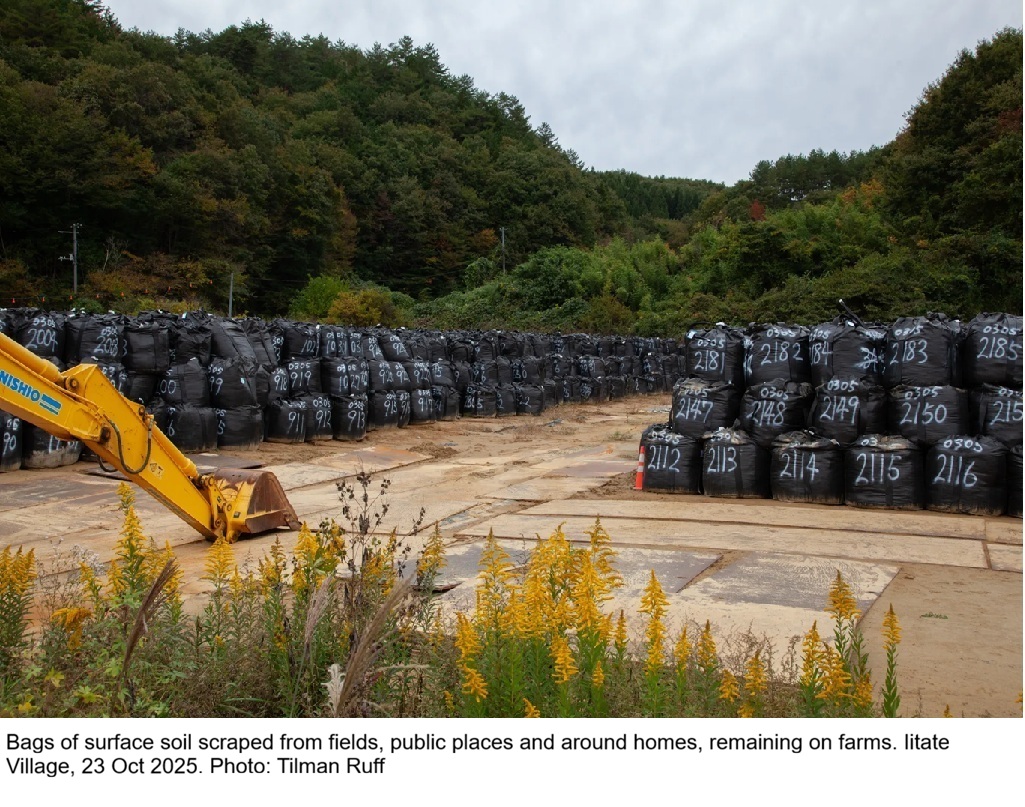
Extensive decontamination by scraping away the upper 5 cm of surface soil for 20m around houses, in fields and gardens, in schools, childcare centres, parks and public gathering places, resulting in the accumulation of 14 million m³ of contaminated soil, has denuded areas and reduced fertility of agricultural land, but has had some useful effect in reducing radiation exposure to residents and contamination of vegetables grown in decontaminated areas. Use of potassium-rich fertiliser has also contributed to reducing caesium absorption by crops. However, forested areas, which comprise 70% of Fukushima, particularly covering hills and mountains which received higher fallout than valleys and low-lying areas, act as reservoirs of radioactivity, which is constantly washed down by rain and snow to flatter and lower-lying areas where people’s homes, farms, paddies and fields lie, and also washes into estuaries and beach sands. This contributes to patchiness and high variability of contamination at a local level, and hence the importance of localised and ongoing measurement.
Hot caesium-laden particles
An important discovery was made by Japanese geochemists, particularly Satoshi Utsunomiya, that caesium-rich microparticles 2-3 microns in diameter, small enough if inhaled to be retained in the alveoli of the lung, were not only widely present in hotspots in Fukushima, but also widely deposited in Tokyo on 15 March 2011, when the most intensely radioactive fallout cloud passed over Tokyo following the explosion of the Unit 3 reactor.
These particles, assessed to be formed by the interaction of molten reactor fuel with concrete surrounding and supporting Fukushima Daiichi reactors 1 and 3, are intensely radioactive, more so than spent nuclear fuel. Contrary to conventional assumptions about the highly soluble nature of caesium and therefore (as a potassium analogue) its even dispersal in organisms and organs, these particles are insoluble, meaning they can deliver a much greater localised radiation dose to surrounding cells, and for a longer period. The main scientific publication of these findings was delayed some years because of academic infighting and political sensitivity. Their significant implications for human radiation exposures and radiation protection related to the Fukushima disaster, including the identification and isolation of radioactive hot-spots, have hardly been explored.
Public health and safety continue to be sidelined
National and regional government policies are still negligent in failing to prioritise public health and safety. In the early weeks after the disaster, the Japanese government, arbitrarily and without scientific justification, increased the maximum permissible radiation exposure for a member of the public from 1 to 20 mSv per year. This unacceptably high level is still in place, 15 years later, as the basis for government policy, including clean-up standards and the designation of areas suitable for residents to return to and ending their eligibility for government support. No other government has accepted such a continuing high radiation level for its population, including the most vulnerable, particularly children. The government is now even countenancing some return to areas where doses estimated to be received are up to 50 mSv/yr.
The Japanese government also continues other weakened protection standards, for example before the disaster, waste and soil with radioactivity more than 100 Bq/kg was regarded as strictly controlled waste, whereas since the disaster, soil which is contaminated up to 8000 Bq/kg has been classified as suitable to be treated as ordinary waste, suitable for incineration and reuse in construction works around the country.
In August 2023, Japan began discharging processed radioactive Fukushima wastewater into the Pacific Ocean. As of 22 Dec 2025, according to TEPCO, 127,000 m3 of contaminated water has been dumped, containing about 31.2 TBq of tritium. Such discharges are planned to continue for at least 30-40 years, in breach of Japan’s obligations under the UN Convention on the Law of the Sea, which expressly prohibits ocean dumping of radioactive waste. This will no doubt include not only the 1.4 million m3 of wastewater already accumulated, but contaminated wastewater which continues to accumulate for the forseeable future, at a current average of 50 m3/day, containing a raft of radioactive contaminants. Alternatives such as prolonged storage in purpose-built large tanks, or incorporating treated wastewater into concrete for underground construction use, were given no serious consideration.
An epidemic of thyroid cancer in children ……………………………………………………………………………………………………………………………………………………………………………………………………………………………………………… https://peaceandhealthblog.com/2026/04/02/the-ongoing-fukushima-nuclear-disaster-15-years-on-a-photoessay/#more-7185
No comments yet.
1 This Month
26 September – International Day for the Total Elimination of Nuclear Weapons





PLEASE OPPOSE HR 8255 AND S.3639 – bills would accelerate satellite deployment, with no environmental review or safeguards – https://ncstd5li.quorum.us/campaign/169331/
To see nuclear-related stories in greater depth and intensity – go to https://nuclearinformation.wordpress.com
-
Archives
- September 2026 (287)
- August 2026 (330)
- July 2026 (355)
- June 2026 (287)
- May 2026 (306)
- April 2026 (356)
- March 2026 (251)
- February 2026 (267)
- January 2026 (308)
- December 2025 (358)
- November 2025 (359)
- October 2025 (375)
-
Categories
- 1
- 1 NUCLEAR ISSUES
- business and costs
- climate change
- culture and arts
- ENERGY
- environment
- health
- history
- indigenous issues
- Legal
- marketing of nuclear
- media
- opposition to nuclear
- PERSONAL STORIES
- politics
- politics international
- Religion and ethics
- safety
- secrets,lies and civil liberties
- spinbuster
- technology
- Uranium
- wastes
- weapons and war
- Women
- 2 WORLD
- ACTION
- AFRICA
- Atrocities
- AUSTRALIA
- Christina's notes
- Christina's themes
- culture and arts
- Events
- Fuk 2022
- Fuk 2023
- Fukushima 2017
- Fukushima 2018
- fukushima 2019
- Fukushima 2020
- Fukushima 2021
- general
- global warming
- Humour (God we need it)
- Nuclear
- RARE EARTHS
- Reference
- resources – print
- Resources -audiovicual
- Weekly Newsletter
- World
- World Nuclear
- YouTube
-
RSS
Entries RSS
Comments RSS


Leave a comment