The ongoing Fukushima nuclear disaster 15 years on: a photoessay
Peace and Health Blog. International Physicians for the Prevention of Nuclear War Tilman Ruff, April 2, 2026
It is now 15 years since the Great East Japan Earthquake on 11 March 2011—and the tsunami it generated—wrought havoc on the Fukushima Daiichi Nuclear Power Plant (FDNPP). A predictably dangerous plant design, a corrupt and negligent operator, and Japan’s incestuous and corrupted ‘nuclear village’ involving collusion and revolving doors between government, regulator and operators, combined in a lethal mix.
The myth that a nuclear disaster couldn’t happen in Japan and therefore didn’t need to be prepared for continues to exact a high toll. The Fukushima Nuclear Accident Independent Investigation Commission, the only such body ever established by the National Diet of Japan, concluded that:
“It was a profoundly man-made disaster – that could and should have been foreseen and prevented. … a multitude of errors and willful negligence that left the Fukushima plant unprepared for the events of March 11.” “… Bureaucrats … put organisational interests ahead of their paramount duty to protect public safety.”
The accident “was the result of collusion between the government, regulators and TEPCO … They effectively betrayed the nation’s right to be safe from nuclear accidents.”
“The Commission concludes that the government and regulators are not fully committed to protecting public health and safety”.
Despite this clear and damning indictment, the highest courts in Japan have acquitted Tokyo Electric Power Company’s (TEPCO) top executives and have not held the government accountable. No TEPCO executive or government official is in prison because of a huge and ongoing disaster they could and should have prevented.
The 40th commemoration of the Chernobyl nuclear disaster on 26 April this year provides another sombre milestone to reflect on humanity’s flirtation with the most hazardous technology ever invented, intimately linked with weapons that pose the most acute existential threat to the biosphere.
While both national and prefectural governments seek to present the Fukushima disaster as effectively over and the region being open for business, the resulting catastrophe is far from over. A visit to Japan in late 2025 provided a valuable opportunity to visit Fukushima for the sixth time since the disaster and learn from those grappling with the ongoing challenges to health, livelihoods and rebuilding a sustainable future in the regions affected by the disaster, which extend far beyond the boundaries of Fukushima Prefecture, even though government programs to address the disaster’s aftermath focus exclusively on Fukushima.
Because ‘luckily’ half the radioactive caesium (Cs) released by the reactor meltdowns and explosions is Cs-134, with a two year half-life, rather than the 30 year half-life of Cs-137 which makes up the remainder of the caesium released, the initial decline in residual radioactivity, to which caesium is the dominant contributor, has been faster than following the Chernobyl disaster.
The multiple damaged nuclear reactors and spent fuel pools at Fukushima Daiichi are far from stable, and decommissioning as planned by TEPCO is barely progressing and looks increasingly unfeasible. Just 0.9 grams of fuel debris has been able to be removed to date, in two removals three years later than scheduled, while 880 tons remain with no plans yet for how to remove the bulk of this material. In addition, 1,007 tons of spent fuel remain in the spent fuel pools at Units 1 and 2. The melted reactors with spent fuel pools resting above them have been severely structurally damaged. In reactor 1 for example, robotic cameras have revealed that the concrete of the pedestal which supports the reactor has melted all the way around, exposing the internal reinforcing bars now providing effectively the only structural support. These damaged structures have heightened vulnerability to further earthquake and tsunami damage.
A major independent international assessment of a kind that Japan has resisted to date is warranted to assess the best means to address this extremely challenging, highly radioactive mess to order to most effectively and expeditiously secure the site as much as possible from further fires, meltdown or criticality events, further tsunami or earthquake damage, and ongoing or escalating release of radioactive materials. While it may be feasible and challenge enough to remove the fuel remaining in the spent fuel pools above Units 1 and 2, rather than stubbornly persisting with decommissioning plans going nowhere, aiming to stabilise the damaged fuel in the reactors so that active cooling is no longer required, and establishing durable physical encasement of the damaged facilities on all sides deserve more thorough consideration.
Decontamination and redistribution
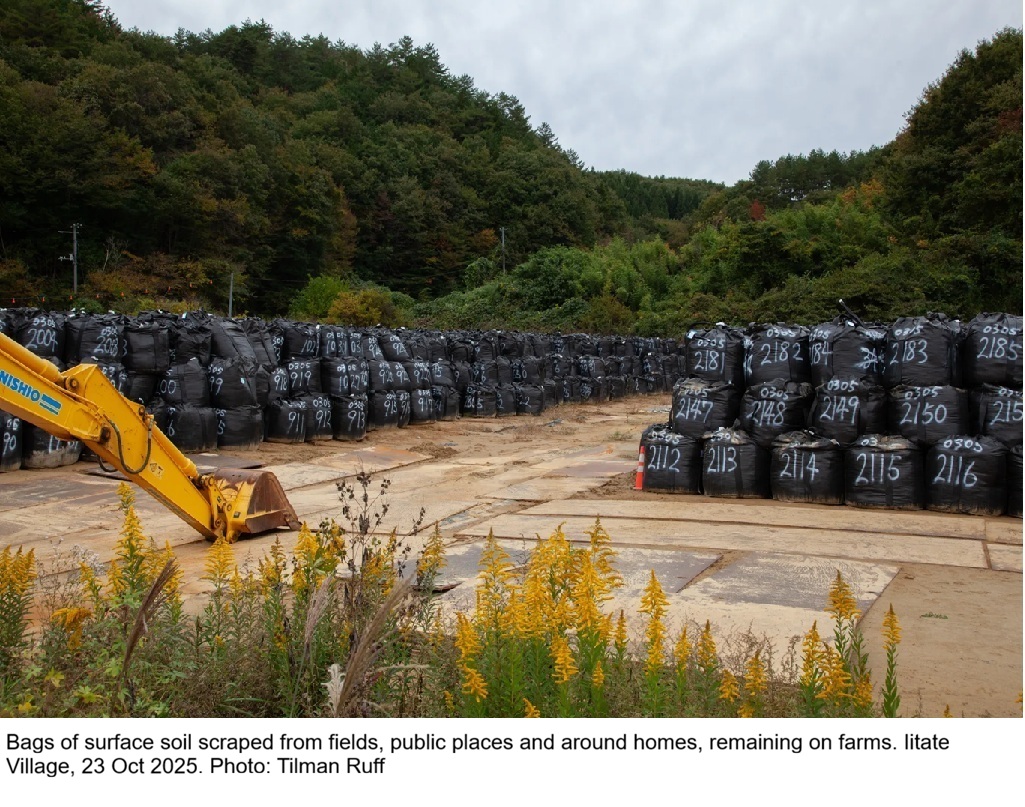
Extensive decontamination by scraping away the upper 5 cm of surface soil for 20m around houses, in fields and gardens, in schools, childcare centres, parks and public gathering places, resulting in the accumulation of 14 million m³ of contaminated soil, has denuded areas and reduced fertility of agricultural land, but has had some useful effect in reducing radiation exposure to residents and contamination of vegetables grown in decontaminated areas. Use of potassium-rich fertiliser has also contributed to reducing caesium absorption by crops. However, forested areas, which comprise 70% of Fukushima, particularly covering hills and mountains which received higher fallout than valleys and low-lying areas, act as reservoirs of radioactivity, which is constantly washed down by rain and snow to flatter and lower-lying areas where people’s homes, farms, paddies and fields lie, and also washes into estuaries and beach sands. This contributes to patchiness and high variability of contamination at a local level, and hence the importance of localised and ongoing measurement.
Hot caesium-laden particles
An important discovery was made by Japanese geochemists, particularly Satoshi Utsunomiya, that caesium-rich microparticles 2-3 microns in diameter, small enough if inhaled to be retained in the alveoli of the lung, were not only widely present in hotspots in Fukushima, but also widely deposited in Tokyo on 15 March 2011, when the most intensely radioactive fallout cloud passed over Tokyo following the explosion of the Unit 3 reactor.
These particles, assessed to be formed by the interaction of molten reactor fuel with concrete surrounding and supporting Fukushima Daiichi reactors 1 and 3, are intensely radioactive, more so than spent nuclear fuel. Contrary to conventional assumptions about the highly soluble nature of caesium and therefore (as a potassium analogue) its even dispersal in organisms and organs, these particles are insoluble, meaning they can deliver a much greater localised radiation dose to surrounding cells, and for a longer period. The main scientific publication of these findings was delayed some years because of academic infighting and political sensitivity. Their significant implications for human radiation exposures and radiation protection related to the Fukushima disaster, including the identification and isolation of radioactive hot-spots, have hardly been explored.
Public health and safety continue to be sidelined
National and regional government policies are still negligent in failing to prioritise public health and safety. In the early weeks after the disaster, the Japanese government, arbitrarily and without scientific justification, increased the maximum permissible radiation exposure for a member of the public from 1 to 20 mSv per year. This unacceptably high level is still in place, 15 years later, as the basis for government policy, including clean-up standards and the designation of areas suitable for residents to return to and ending their eligibility for government support. No other government has accepted such a continuing high radiation level for its population, including the most vulnerable, particularly children. The government is now even countenancing some return to areas where doses estimated to be received are up to 50 mSv/yr.
The Japanese government also continues other weakened protection standards, for example before the disaster, waste and soil with radioactivity more than 100 Bq/kg was regarded as strictly controlled waste, whereas since the disaster, soil which is contaminated up to 8000 Bq/kg has been classified as suitable to be treated as ordinary waste, suitable for incineration and reuse in construction works around the country.
In August 2023, Japan began discharging processed radioactive Fukushima wastewater into the Pacific Ocean. As of 22 Dec 2025, according to TEPCO, 127,000 m3 of contaminated water has been dumped, containing about 31.2 TBq of tritium. Such discharges are planned to continue for at least 30-40 years, in breach of Japan’s obligations under the UN Convention on the Law of the Sea, which expressly prohibits ocean dumping of radioactive waste. This will no doubt include not only the 1.4 million m3 of wastewater already accumulated, but contaminated wastewater which continues to accumulate for the forseeable future, at a current average of 50 m3/day, containing a raft of radioactive contaminants. Alternatives such as prolonged storage in purpose-built large tanks, or incorporating treated wastewater into concrete for underground construction use, were given no serious consideration.
An epidemic of thyroid cancer in children ……………………………………………………………………………………………………………………………………………………………………………………………………………………………………………… https://peaceandhealthblog.com/2026/04/02/the-ongoing-fukushima-nuclear-disaster-15-years-on-a-photoessay/#more-7185
America’s Suicide Pact

Trump is not an outlier. He is the naked, stripped-down expression of this suicidal pact. He does not pretend the system he inherited works. He lies with less finesse. He crassly enriches himself and his family. He speaks in crude vulgarities. He dismantles any government agency dedicated to the common good, including the Environmental Protection Agency, the Department of Education and the U.S. Postal Service. But he embodies what came before him, albeit without the liberal façade.
America’s suicidal march began long before Donald Trump. Trump and the buffoons around him are the inevitable final chapter of the decaying empire.
Chris Hedges, May 9, 2026 , https://scheerpost.com/2026/05/09/americas-suicide-pact/
Civilizations, as the historian Arnold J. Toynbee famously argued, “die from suicide, not by murder.” They collapse from within. They fall prey to moral, social and spiritual decay. They are seized by a parasitic ruling class. Democratic institutions seize up. The citizenry is immiserated, wealth is funneled upwards to the ruling class and coercion is the principle form of control.
Our suicidal march began long before Donald Trump and his bizarre court of buffoons, sycophants, grifters and Christian fascists took power. It began when the ruling class, especially under the Reagan and Clinton administrations, set out to harvest the country and empire for personal profit.
There is a word for these people. Traitors.
These traitors, ensconced in the leadership of the two ruling parties, stripped us of assets and power slowly. They used subterfuge, lies and legalized bribery. They pretended to honor electoral politics, checks and balances, a free press and the rule of law while subverting all of these democratic pillars. That old system, however flawed, was hollowed out. It was turned over to the amoral and the idiotic — look at the Supreme Court or Congress — those willing to do the bidding of the billionaire class.
Armed with billions by the mortal enemy of the demos — the oligarchs and corporations — the political elites, Republicans and Democrats, destroyed the careers of those politicians who resisted. They crushed labor unions. They blacklisted honest journalists and consolidated the press into the hands of a handful of corporations and oligarchs. They slashed regulations that constrained unfettered greed and protected the population from predatory corporations and environmental toxins. They passed legislation that created a de facto tax boycott for the rich — Trump famously paid no federal income taxes in 10 of the 15 years prior to his presidency — while stripping the country of its industry and throwing some 30 million people out of work. Wealth is no longer created by producing or manufacturing. It is created by manipulating the prices of stocks and commodities and imposing a crippling debt peonage on the public.
These parasites cut or abolished social programs, militarized the police, built the largest prison system in the world and pumped funds into a bloated and out-of-control war industry. German socialist and politician Karl Liebknecht, on the eve of the suicidal folly of World War I, called German imperialists “the enemy at home.” Our rulers, our enemies at home, mounted a series of futile wars that degraded the empire’s global hegemony and poured trillions of dollars of taxpayer money into their bank accounts. Iran is the most recent example.
Trump is not an outlier. He is the naked, stripped-down expression of this suicidal pact. He does not pretend the system he inherited works. He lies with less finesse. He crassly enriches himself and his family. He speaks in crude vulgarities. He dismantles any government agency dedicated to the common good, including the Environmental Protection Agency, the Department of Education and the U.S. Postal Service. But he embodies what came before him, albeit without the liberal façade.
“Trump is not an anomaly,” I wrote in “America: The Farewell Tour”
He is the grotesque visage of a collapsed democracy. Trump and his coterie of billionaires, generals, half-wits, Christian fascists, criminals, racists, and moral deviants play the role of the Snopes clan in some of William Faulkner’s novels. The Snopeses filled the power vacuum of the decayed South and ruthlessly seized control from the degenerated, former slaveholding aristocratic elites. Flem Snopes and his extended family — which includes a killer, a pedophile, a bigamist, an arsonist, a mentally disabled man who copulates with a cow, and a relative who sells tickets to witness the bestiality — are fictional representations of the scum now elevated to the highest level of the federal government. They embody the moral rot unleashed by unfettered capitalism.
The Epstein files, a window into the degeneracy of our ruling class, included not only Trump, but former U.S. president Bill Clinton — who allegedly took a trip to Thailand with Epstein — Prince Andrew, Microsoft founder and billionaire Bill Gates, hedge fund billionaire Glenn Dubin, the former New Mexico governor Bill Richardson, former secretary of the treasury and former president of Harvard University Larry Summers, cognitive psychologist and author Stephen Pinker, Epstein’s lawyer and arch Zionist Alan Dershowitz, billionaire and Victoria’s Secret CEO Leslie Wexner, the former Barclays banker Jes Staley, former Israel prime minister Ehud Barak, magician David Copperfield, actor Kevin Spacey, former CIA director William Burns, real estate mogul Mort Zuckerman, former Maine senator George Mitchell and disgraced Hollywood producer and convicted rapist Harvey Weinstein. They all orbited Epstein’s perpetual Bacchanalia.
Anand Giridharadas, who wrote “Winners Take All: The Elite Charade of Changing the World,” notes that the circle of powerful men, and a handful of women who surrounded Epstein, are emblematic of a privileged caste that lack empathy in the suffering and abuse of others, whether that is sexual abuse, including that of children, financial meltdowns they orchestrate, wars they back, addictions and overdose they enable, the monopolies they defend, the inequality they turbocharge, the housing crisis they milk and the intrusive technologies they refuse to protect people against:
People are right to sense that as the emails lay bare, there is a highly private merito-aristocracy at the intersection of government and business, lobbying, philanthropy, start-ups, academia, science, high finance and media, that all too often takes care of its own more than the common good. They are right to resent that there are infinite second chances for members of this group even as so many Americans are deprived of first chances. They are right that their pleas often go unheard, whether they are being evicted, gouged, foreclosed on, A.I.-obsolesced — or, yes, raped.
“The Epstein emails, in my view,” Giridharadas writes, “together sketch a devastating epistolary portrait of how our social order functions, and for whom. Saying that isn’t extreme. The way this elite operates is.”
“If this neoliberal-era power elite remains poorly understood,” he continues, “it may be because it is not just a financial elite or an educated elite, a noblesse-oblige elite, a political elite or a narrative-making elite; it straddles all of these, lucratively and persuaded of its own good intentions.”
“These people are,” Giridharadas reminds us, “on the same team. On air, they might clash. They promote opposite policies. Some in the network profess anguish over what others in the network are doing. But the emails depict a group whose highest commitment is to their own permanence in the class that decides things. When principles conflict with staying in the network, the network wins.”
You can see my interview with Giridharadas here.
The entire system is rotten. It will not reform itself.
The Democratic Party has hit on the novel campaign issue of reducing taxes to win this year’s midterm elections. It will, no doubt, anoint another vapid, issue-less and genocide-supporting presidential nominee. Democratic donors pumped a staggering $1.5 billion into Kamala Harris’s abridged 15-week celebrity-fueled presidential campaign. She became the first Democratic presidential candidate to lose the national popular vote in two decades and be defeated in every battleground state.
The Democratic Party is not a functioning political party. It is a corporate mirage. Its members can, at best, select preapproved candidates and act as props in choreographed conventions and rallies. Party members have zero influence on party politics.
The more the diminishing power of the empire becomes apparent, evidenced in Trump’s debacle with Iran, the more a confused population retreats into a fantasy world, a world where hard and unpleasant facts do not intrude.
In the final days of a civilization, a population wallows in self-delusional hubris and trumpets false virtues. It looks for scapegoats to explain its failures — Muslims, undocumented workers, Mexicans, African-Americans, feminists, intellectuals, artists and dissidents.
Magical thinking and the myth of American exceptionalism dominate public discourse and are taught in schools. Art and culture are degraded to nationalist kitsch. Science is dismissed, even in the midst of the environmental crisis. Cultural and intellectual disciplines that allow us to see the world from the perspective of the other, that foster empathy, understanding and compassion, are replaced by a grotesque and cruel hypermasculinity and hypermilitarism.
Trump is perfectly tailored for these death throes. He is not a freak or an anomaly. He is the naked visage of our pathological sickness.
War Dividends: Potential U.S. Arms Sales to the Middle East Surge in Q1 2026

On March 19, the U.S. approved $8.5 billion in potential sales to the UAE, split across four potential deals. These approvals included a $4.5 billion sale of a Long Range Discrimination Radar (LRDR) for integration with the Terminal High Altitude Area Defense (THAAD) air-defense system, a $2.1 billion sale of counter-UAS equipment, a $1.2 billion deal for 400 AIM-120C AMRAAM air-to-air missiles, and a $644 million sale of F-16 munitions. Kuwait was approved to purchase eight Lower Tier Air and Missile Defense Sensor (LTAMDS) radars on the same day, at a cost of $8 billion. The U.S. also signed off on $70.5 million in aircraft and munitions support for Jordan
– by Jon Hemler and Derek Bisaccio, https://dsm.forecastinternational.com/2026/04/23/us-foreign-military-sales-q1-2026-middle-east-iran-war/
During the first quarter of 2026, the U.S. government approved over $45 billion in potential Foreign Military Sales (FMS) with the overwhelming majority supporting Middle Eastern allies. Of total global approvals, the region garnered 81 percent, or over $36.6 billion in estimated sales value for defense equipment.
Direct comparisons between first-quarter FMS approvals and the combat systems currently being used by the United States, Israel, and allied Arab states are imperfect. Approved agreements do not automatically translate into deliveries. Follow-on contracts, payments and shipments might not materialize for months or years, if at all. Even so, FMS activity can be a meaningful indicator of geopolitical and industrial trends. This is increasingly true given the scale of combat, stakeholders involved, and weapons consumption driven by the Iranian War.
Middle East
Countries in the Middle East spend heavily on defense, devoting some $177.5 billion to military expenditure in their FY26 budgets by conservative estimates. Many of the region’s governments, moreover, possess immense reserve assets that can be leveraged to support procurement when needed.
Over 81 percent of FMS approvals in the first quarter of 2026 covered potential sales to American partners in the Middle East, corresponding with the deterioration in the regional security environment during this timeframe. These approvals can be generally grouped into two tranches, with the first set announced around the end of January. On January 30, the U.S. approved a Saudi request for 730 Patriot PAC-3 MSE missiles, which, together with support equipment, carry an estimated price tag of $9.0 billion. That same day, the U.S. also approved four sales to Israel worth a combined $6.6 billion, with the largest being a potential $3.8 billion sale of 30 AH-64E attack helicopters.
The U.S. and Israel began military operations against Iran on February 28, beginning a weeks-long air campaign in retaliation for the country’s brutal crackdown on protesters the month before and aiming to dismantle Iran’s offensive military capabilities and nuclear program. Iran retaliated with missile and drone salvoes targeting Israel, regional U.S. military bases, and the Gulf Cooperation Council (GCC) countries. According to some estimates, Iran fired as many as 6,400 missiles and drones at the GCC countries and Jordan across 41 days of operations. The majority of these attacks were intercepted, but Iranian attacks did manage to penetrate Gulf air defenses and hit sensitive sites. Amid these barrages, the GCC countries made a series of requests for ammunition and radar systems from the U.S., leading to a group of FMS approvals in mid-March.
On March 19, the U.S. approved $8.5 billion in potential sales to the UAE, split across four potential deals. These approvals included a $4.5 billion sale of a Long Range Discrimination Radar (LRDR) for integration with the Terminal High Altitude Area Defense (THAAD) air-defense system, a $2.1 billion sale of counter-UAS equipment, a $1.2 billion deal for 400 AIM-120C AMRAAM air-to-air missiles, and a $644 million sale of F-16 munitions. Kuwait was approved to purchase eight Lower Tier Air and Missile Defense Sensor (LTAMDS) radars on the same day, at a cost of $8 billion. The U.S. also signed off on $70.5 million in aircraft and munitions support for Jordan
All six of the deals announced on March 19 were approved under an emergency exception to Section 36(b) of the Arms Export Control Act, waiving the typical Congressional review requirement. That process would normally take roughly 30 to 40 days, during which the sides would be unable to move forward with contract negotiations.
Europe
Around $3.8 billion in FMS approvals in the first quarter of 2026 – 8.5 percent of the overall total – target European requirements. A sizable chunk of this total comes from Spain’s $1.7 billion request for mid-life upgrades to its Álvaro de Bazán-class frigates. The upgrade program will principally include integrating the AEGIS weapon system to expand the warships’ air-defense capabilities.
On March 10, the State Department approved the sale of 20 M142 High Mobility Artillery Rocket Systems (HIMARS) to Sweden, with a price tag of $930 million. Should Stockholm move forward with a purchase agreement, it would become the eighth or ninth European customer for the multiple rocket launcher, joining Croatia, Estonia, Italy, Latvia, Lithuania, Poland, and Romania. (Hungary, another potential customer, announced plans to acquire HIMARS on April 9, ahead of the incumbent government’s loss in general elections several days later.)
The U.S. also approved an FMS deal with Denmark, blessing the sale of 100 AGM-114R HELLFIRE air-to-surface missiles at a possible cost of $45 million. Relations between Washington and Copenhagen have become turbulent in the second Trump administration over Greenland’s political future, but beneath the headlines, the two countries remain strong defense partners.
Only one FMS approval for Ukraine (which Forecast International groups in the Eurasia region) was announced in the first quarter of 2026, on February 6. Kyiv requested to buy spare parts for its U.S. Army-supplied vehicles and weapons, at an expected cost of $185 million.
Over time, European countries are aiming to reduce their dependency on the U.S. for military equipment, pursuing various national and intra-European projects to improve the continent’s own defense industry. This process was jump-started in 2022, in the wake of Russia’s invasion of Ukraine, and has accelerated over the past year as European capitals increasingly worry that the U.S. may withdraw from the NATO Alliance.
Europe (not including Ukraine and Russia) is expected to spend $508.9 billion on defense in FY26, up from around $300 billion on the eve of Russia’s war on Ukraine. Five years ago, only a handful of NATO countries met the Alliance’s 2 percent of GDP target, but most are now at least at that threshold, if not well exceeding it.
Industry Trends
From a weapons systems standpoint, missiles and related equipment represent the largest category of approved potential sales from the quarter at nearly $16.0 billion and 35 percent of the total. Relatedly, the three highest-cost possible deals involve various offensive and defensive missile and networked electronic systems that have featured prominently in military operations during the war in Iran.
Of these, American defense giants Lockheed Martin and RTX are well-positioned to capitalize on a prospective windfall of over $21 billion in the aforementioned FMS to Saudi Arabia, Kuwait, and the UAE. Domestically, Lockheed Martin and RTX both emerged as beneficiaries of several historic multi-year framework agreements with the Pentagon during Q1 2026, to boost precision munitions and interceptor production for the U.S
Like FMS approvals, these agreements do not indicate signed contracts or solid revenue. However, subsequent large-scale contacts are likely to follow in the coming years as the U.S. moves to surge critical munitions production. Some related contracts are already unfolding. In early April, Lockheed Martin received a $4.76 billion award supported by U.S. Army and FMS allocations for PAC-3 Missile Segment Enhancement missiles.
Raytheon, an RTX company, also won a handful of LTAMDS contracts from the U.S. government during the first quarter, including a $905 million production contract on April 16 that contributes to an overall $5.36 billion cumulative framework.
Strategic pivot
The awards to Lockheed Martin and RTX, alongside FMS approvals for key systems emerging from the Iranian War, underscore a broader shift in Washington’s approach to weapons deals. On February 6, 2026, the White House issued an Executive Order entitled “America First Arms Transfer Strategy” to reshape priorities for foreign military equipment sale policy.
Though the Trump Administration’s order references arms transfers as a foreign policy tool, the text primarily focuses on strengthening the U.S. defense industrial base. Indeed, the order states that the strategy “will ensure that future arms sales prioritize American interests by using foreign purchases and capital to build American production and capacity.” A deeper read of the subsections signals a reprioritization of strategy – one that emphasizes utilizing arms sales to bolster domestic industry over foreign policy objectives.
Genocide Is Still The Political Test That Matters
May 9, 2026 , Nate Bear, https://www.donotpanic.news/p/genocide-is-still-the-political-test
Yesterday elections were held in parts of England to elect local councillors, and in Scotland and Wales to elect their devolved parliaments.
Fearing a challenge from the left, Starmer’s ruling Labour party spent the campaigning period, in coordination with Britain’s legacy media, confecting antisemitism slurs about Green party candidates.
The final effort, on the morning of the elections, was to turn a comment by the Green leader, Zack Polanski, that Israel nor any other country has an inherent right to exist, into one final psychodrama about antisemitism.
It hasn’t worked.
According to early results, the Greens are on course to beat pre-election forecasts for how many seats they’d win. Labour has suffered a heavy defeat.
The (very) dark, although not unsurprising lining to the cloud, is that the far-right Reform party is on course to win a large number of seats. Unsurprising because neither Labour nor the UK’s state-corporate media went after Reform with the rabid, ferocious intensity they went after the Greens.
Why?
Because Reform’s imperialist, hyper-capitalist, bigoted policies aren’t a threat to the establishment.
Reform’s promises to mass deport brown people, build private prison camps, privatise what’s left to privatise of public services, plough money into the war machine, support Israel, and cut taxes for oligarchs, are supported by a right-wing establishment.
What the establishment fears are threats to their power and wealth. What they fear are those who will redistribute wealth, expand the social welfare state and tax millionaires to do it. And with Zionism so deeply ingrained within western institutions of power, they fear anti-Zionists.
As absurd and morally depraved as it is, the establishment fear those who oppose genocide.
Which is why the media and political establishment made ‘antisemitism’ (actually anti-Zionism of course) into a central election issue. But when it was becoming clear it wasn’t working, when it was obvious that genocide, not fake claims of antisemitism, was a more salient issue for people of conscience, Labour MPs took desperately to social media to tell people not to think about Gaza when voting.
Despite this, despite the full weight of the British establishment being arrayed against the Greens, they have fought back, and fought back successfully.
The full results won’t be known until tomorrow, but a significant win saw a Green mayor elected in the London borough of Hackney, the first time the Greens have won a mayoralty election, and the first time the area has had anything other than a Labour mayor since it was formed.
More significant was that two days before her victory, Zoe Garbett had refused to praise the police for the violent arrest of the mentally ill man whose attacks on three people were mischaracterised as antisemitism (and weaponised against the Greens).
The bottom line is that genocide for many people is still, rightly, one of the primary, if not the primary political test. A test of character, ethics, morality and judgement.
The argument that local elections have nothing to do with Gaza appears logical on one level, but is an evasion.
Politics is (or at least should be) about all these things. About values.
And if you can’t oppose genocide, if you can’t stand up to genociders, why should anyone trust you to stand up for justice, or for anything decently progressive?
But for so many in Britain’s Labour party, as for those in the Democratic party in the US, and most liberal parties across the west, it’s worse than that. It’s not just that they don’t oppose genocide, it’s that they provide active support for genocide and a genocidal state.
The Labour party has effectively criminalised support for Palestine. An anti-genocide and community activist in the UK is facing fourteen years in prison having been charged under terrorism laws for social media posts. For tweets! And an NHS GP, Dr Rahmeh Aladwan, has been arrested numerous times for tweets opposing Israel and genocide and is facing years in prison. Meanwhile, another NHS GP, a Jewish Zionist who served in the IDF and claimed he didn’t kill enough babies, has faced no consequences and is still a practicing doctor.
And of course the Labour government provided funding, support and arms to Israel during the genocide, which included daily spy flights feeding back info to the Israeli army, helping fuel their genocidal assault. An assault that continues to this day, with the majority of Gaza now living in tents among rats and disease atop the wasteland of their former homes.
It’s a disgrace. More than a disgrace. Gaza is a moral collapse, and should be at the centre of all of our politics.
Gaza and genocide should very obviously be the test.
If you provide material and rhetorical support for genocide and genociders, if you have revealed genocide and apartheid as one of your core values, you should have no place in decent society, let alone be anywhere close to political power.
Which is why earlier this week I revealed that a Labour councillor in the London borough of Waltham Forest is a genocide supporter who at the height of Israel’s campaign of mass slaughter visited the country on an atrocity propaganda tour.
The final count isn’t in, so whether Lewis has lost the seat, and whether Labour lost the council to the Greens, we don’t yet know.
But what we do know is that the pro-Israel, pro-genocide, Zionist ideology Lewis wears proudly is rife within Labour.
And while Labour’s moral collapse has spurred the rise of the Greens, the overall environment being created in the UK is aiding the rise of the far-right Reform party.
Because in a country where being anti-genocide is lampooned and criminalised, and where being pro-genocide is considered the sensible and protected position, the emergence of fascism is hardly surprising. The rise of fascism is downstream, as they say, of pro-genocide sentiment. Which makes perfect sense, given genocide is the peak expression of fascism.
The UK is the perfect incubator for the emergence of hyper reactionary politics.
But these elections at least show us that Zionism may, slowly but surely, be losing its grip on western politics.
They also demonstrate that the power of legacy media to kill popular leftist politics with lies and slurs is waning, if not yet dead.
Why Palantir Australia Sparks Growing Privacy Fears

8 May 2026 AIMN Editorial By Denis Hay
Palantir Australia is expanding into defence, policing, and corporate systems. What dangers could this pose to ordinary Australians?
Introduction – The Surveillance Expansion Most Australians Never Voted For
Palantir Australia is becoming deeply embedded inside Australian government agencies, defence systems, intelligence operations, and potentially private corporate networks. Yet most Australians know little about the company, the technologies it develops, or the long-term consequences these systems could have for privacy, democracy, and civil liberties.
Another intelligence technology company, Babel Street Australia, is also involved in cyber intelligence and AI-driven monitoring systems. Together, these companies represent a rapidly growing surveillance technology Australia industry built around mass data analysis, predictive behaviour modelling, and artificial intelligence.
Supporters argue these technologies improve national security and risk management. Critics warn they may be laying the foundations for a future where governments and corporations can monitor citizens at unprecedented levels.
This debate matters because once surveillance systems become normalised, they are rarely rolled back.
If you value independent, fact-based analysis that challenges concentrated corporate and political power, please consider supporting Social Justice Australia.
What Is Palantir Australia?
A Company Born from Intelligence Agencies
Palantir Technologies was founded in the United States in 2003 with support linked to the CIA investment arm In-Q-Tel.
The company developed software capable of combining enormous amounts of information into highly searchable intelligence platforms.
Its major systems include:
- Gotham, primarily used by military, intelligence, and policing agencies.
- Foundry, used for data integration across governments and corporations.
These systems can combine data from:
- Financial records.
- Communications metadata.
- Government databases.
- CCTV systems.
- Social media platforms.
- Travel records.
- Online activity.
Palantir markets its systems as tools for security, fraud detection, military coordination, and operational efficiency.
What Is Babel Street Australia?
AI Monitoring and Social Media Intelligence
Babel Street is another US-based intelligence technology company specialising in open-source intelligence and AI-driven analysis.
However, civil liberties groups argue the same systems can also enable mass surveillance and excessive concentration of informational power.
According to The Guardian, Palantir has expanded aggressively in
Its technology focuses on:
- Social media monitoring.
- Behavioural analysis.
- Cyber intelligence.
- Risk assessment.
- Investigative analytics.
The company markets its products to:
- Governments.
- Defence agencies.
- Cybersecurity organisations.
- Law enforcement.
- Corporate intelligence sectors.
Unlike Palantir, Babel Street has maintained a much lower public profile in Australia. However, reports suggest it has been connected to cyber intelligence operations and digital risk analysis systems.
The concern raised by critics is not simply the existence of these tools, but how rapidly AI systems are becoming capable of monitoring, analysing, and predicting human behaviour at scale.
How Active Is Palantir Australia?
Expanding Across Government and Defence
Palantir Australia has expanded into several major areas.
Defence and Military Operations
Australia’s Department of Defence has awarded contracts involving:
- Data integration.
- Battlefield analytics.
- Cyber operations.
- Intelligence coordination.
According to Crikey, Palantir has secured substantial Australian defence-related contracts.
Financial Monitoring
AUSTRAC, Australia’s financial intelligence agency, has used Palantir-linked systems for transaction analysis and financial monitoring.
Intelligence and Policing
Reports suggest Australian intelligence agencies have used Palantir software to analyse large volumes of investigative and communications data.
Critics argue this raises serious concerns around:
- Oversight.
- Transparency.
- Privacy protections.
- Data misuse risks.
Government Financial Investments
Australia’s Future Fund has invested heavily in Palantir shares, creating additional debate about public institutions financially benefiting from surveillance technology companies.
Which Australian Corporations Could Be Using These Technologies?
Surveillance Is Not Just a Government Issue
One of the most important aspects of this debate is that surveillance technology Australia is not limited to intelligence agencies.
Around the world, large corporations increasingly use advanced AI analytics systems to:
- Analyse customer behaviour.
- Detect fraud.
- Monitor workers.
- Assess risks.
- Predict trends.
- Track online activity.
Public reporting and procurement records suggest sectors potentially interested in technologies linked to Palantir-style systems include:
- Banking and finance.
- Telecommunications.
- Airports and logistics.
- Mining companies.
- Insurance corporations.
- Defence contractors.
- Major retailers.
In some cases, corporations use these systems for legitimate operational purposes. However, critics warn the same technologies can also create highly invasive forms of digital profiling.
For example:
- Workers could be monitored more aggressively.
- Consumers could be profiled behaviourally.
- Financial risk scoring could become increasingly automated.
- AI systems could make decisions affecting people without transparency.
Ordinary Australians may not even realise these technologies are operating behind the services they use every day.
The Rise of Surveillance Technology Australia
Australians Are Becoming Digital Profiles
Modern surveillance technology Australia extends far beyond traditional policing.
AI systems can now combine information from multiple sources to build extremely detailed digital profiles.
This can include:
- Spending habits.
- Location tracking.
- Social media activity.
- Communication patterns.
- Search histories.
- Online behaviour.
- Travel records.
Supporters argue this improves efficiency and security.
Critics warn it creates unprecedented concentrations of power over ordinary citizens.
The issue is not simply whether people have “something to hide.” The issue is whether democratic societies should allow governments and corporations to collect and analyse massive quantities of personal information.
Predictive Policing and AI Profiling
The Danger of Automated Suspicion…………………………………………………………………………………………
…………………………………… https://theaimn.net/why-palantir-australia-sparks-growing-privacy-fears/
With launches slated to grow a hundredfold, Space Force seeks more sites, money, people, and AI

Even today’s accelerated pace strains decades-old launch facilities.
Defense One Thomas Novelly, Senior Reporter, May 7, 2026
CAPE CANAVERAL, Florida—The guardians manning screens in the mission-ops center here oversaw the launch of five types of rockets in April, a new record that involved NASA’s Artemis II, the first reused New Glenn booster, and a Falcon 9 lofting the final GPS III satellite. But tomorrow’s Space Force may have no time to mark even epochal missions. Within a decade, service leaders say, Cape Canaveral Space Force Station will be launching hundreds of rockets a year.
To facilitate the Pentagon’s fast-growing demand for orbital capability, the Space Force is looking for more launch sites, more money, more troops, and more AI.
“In 2025, the Space Force saw a drastic increase in mission requirements across space access, global mission operations, and space control. This trend shows no signs of slowing,” Gen. Chance Saltzman, the Space Force’s top uniformed leader, told House lawmakers last week. “The Space Force we have today is not the Space Force we will need in the future.”
Nestled on a thin stretch of land just miles from nature preserves and cruise-ship ports, the historic Cape Canaveral facility launched 36 rockets in 2021, its first year as a Space Force facility. Last year, it sent 110 into the heavens, while its California counterpart, Vandenberg Space Force Base, launched another 65.
This year, Space Force leaders intend to launch more than 200 rockets from their two main launch sites. And by 2036, they project, the pair will launch as many as 3,000 annually, according to a service document released last month.
That’s going to take more launchpads…………………………………………………………………………………………………………….
Pushing policy
The Space Force’s top brass has been making that pitch as well.
Last month at the Space Symposium in Colorado, Chief of Space Operations Gen. Chance Saltzman unveiled “Objective Force 2040,” an ambitious vision with a section on expanding the service’s launch capabilities.
“As the space domain becomes increasingly linked both to national security and to economic prosperity, the importance of space access grows commensurately,” the document said. “This is a significant challenge because the Space Force has supported exponential growth in launch cadence over the past few years using the same physical infrastructure first built decades ago. The future operating environment will only exacerbate this strain, with booming government and commercial demand as well as new mission requirements for responsive and scalable space access.”…………………………………………………………………………………………………………………………..
People problems
Increasing the number of launches will require more than money. Top Space Force officers have recently called for doubling the service’s end-strength over the next decade.
But even that won’t be enough, they say. Guardians will need to lean on AI to help. ………………………….. The Objective Force document calls for a service that can “operate at machine speed, leveraging artificial intelligence and autonomous systems while maintaining the primacy of human judgment for critical decisions.”……………………. https://www.defenseone.com/threats/2026/05/launches-slated-grow-hundredfold-space-force-seeks-more-sites-money-people-and-ai/413403/?oref=defense_one_breaking_nl&utm_source=Sailthru&utm_medium=email&utm_campaign=Defense%20One:%20Breaking%20%285/7%29%20launches&utm_term=newsletter_d1_alert
CNN journalist Christiane Amanpour expresses ‘concern’ over the future of the network, citing ‘idealogical realignment at CBS

Dominick Mastrangelo, Thu, May 7, 2026 , https://www.yahoo.com/news/articles/amanpour-expresses-concern-over-future-171317075.html?ncid=redditnewsus&guccounter=1&guce_referrer=aHR0cHM6Ly93d3cucmVkZGl0LmNvbS8&guce_referrer_sig=AQAAAHVoY-FvEsZDNw98FelEskBLQG1bup54CvssULXm_j7NIF2G4lS4nTZgIgRg7TW1unhwmBehMPDJ92nP0Ge8HQEiYxCZaEHey9RdUVWhQUvjBXQhW4CBjRKIFsNBA-a6eqQwTBIVcFc-wbaf2WviF1SKDvhT-D8aQ0WSKJvWMiua
CNN journalist Christiane Amanpour voiced discomfort with the possibility of Paramount Skydance taking over her outlet if the cable channel’s parent company is allowed to merge with the David Ellison-led media conglomerate.
“Clearly I’m concerned, and I’m not sure how much I’m allowed to say about a corporate thing that’s underway, but I am obviously as a person as a journalist with a record, concerned,” Amanpour said during a journalism summit this week. “And I’m concerned based on what’s happened to the other things that he’s taken over already, like CBS News, right? I mean do I have to list what’s happening there?”
Amanpour also bemoaned what she called the “ideological realignment of CBS and the destruction potentially of ’60 Minutes.’”
The journalist’s comments were first highlighted by Mediaite.
Paramount Skydance is seeking to purchase Warner Bros. Discovery, which owns CNN, a network President Trump has sparred with for years. He said in recent months that he wishes to see the network operate under new ownership.
The president on Wednesday marked the death of CNN founder Ted Turner by saying the news outlet he founded has been “destroyed” by what Trump called the channel’s “woke” coverage.
The president on Wednesday marked the death of CNN founder Ted Turner by saying the news outlet he founded has been “destroyed” by what Trump called the channel’s “woke” coverage.
David Ellison, a media mogul that is seen as an ally of the president, has retooled CBS News in recent months to cater to what he has called a more “diverse” audience, a move seen by many as a rightward shift at the network.
“I would to think we would have the very basic which is editorial independence,” Amanpour said. “And I don’t think I need to say more about that.”
Russia’s Threat Of A Massive Retaliatory Strike On Kiev Likely Isn’t A Bluff
Andrew Korybko, May 07, 2026, https://korybko.substack.com/p/russias-threat-of-a-massive-retaliatory
Russia can’t afford to discredit itself abroad, nor can Putin’s ruling United Russia party afford to discredit itself at home four months before the next polls, by threatening overwhelming retaliation against Ukraine if it attacks Moscow’s Victory Day parade only to symbolically retaliate or do nothing at all.
The Russian Defense Ministry warned local civilians and the staff of diplomatic missions in Kiev of their country’s plans to launch a massive retaliatory strike on the city center if Ukraine goes through with Zelensky’s threat to attack Moscow’s Victory Day parade on 9 May. This was followed by Russia announcing ballistic missile tests from Kamchatka from 6-10 May. Shortly afterwards, the Russian Foreign Ministry reiterated the Defense Ministry’s warning, thus ensuring that the world is aware of it.
This threat likely isn’t a bluff for three sequential reasons. The first is that Russia wants to deter Ukraine from attacking Moscow’s Victory Day parade for self-evident reasons, both relating to optics and the security of its VIPs, to which end it threatened overwhelming retaliation if this happens. The second reason is that Russia cannot threaten such a response without actually going through with it if provoked, otherwise it would irredeemably discredit itself, and more audacious attacks would then likely follow.
And third, Russia is finally signaling its willingness to overwhelmingly retaliate against decision-making centers in Kiev per the Foreign Ministry’s additionally specified threat in the event of Ukraine carrying out this high-profile provocation due to its hardline Kremlin faction partially superceding its moderate one. To explain, Putin hitherto restrained his military due his belief in “The Historical Unity of Russians and Ukrainians” as well as his concerns about an uncontrollable escalation spiral sparking World War III.
Once Trump returned and responded positively to Putin’s offer of dialogue for resolving the NATO-Russian proxy war in Ukraine, which Biden rejected, Putin and his fellow moderates dangled a resource-centric strategic partnership for incentivizing compromises. The US was receptive to such a partnership, but Russia rejected its demanded compromises that were presented as a precondition, while the US rejected Russia’s own such demands and didn’t coerce compliance from Ukraine or NATO either.
While Trump declined to escalate the Ukrainian Conflict amid this impasse, he still greenlit the rolling back of Russian influence across the world in a bid to coerce Putin into the US’ demanded compromise, namely freezing the conflict in exchange for sanctions relief without resolving the root issues. Informally known as the “Neo-Reagan Doctrine”, it’s placed Russia under pressure in at least 15 different countries, thus discrediting the moderate faction and prompting some among it like Putin to rethink their views.
The Third Gulf War, in which Iran attacked regional US bases without triggering an uncontrollable escalation spiral, then convinced Putin to finally listen to the hardliners who’ve been urging massive strikes on Ukrainian decision-making centers in Kiev since the get-go. Public opinion, which is important ahead of September’s next Duma elections, has long aligned with the hardliners on this issue. Putin now seems to have assented but only in retaliation to Ukrainian attacks against Moscow’s Victory Day parade.
These factors make it unlikely that Russia is bluffing, in which case the country itself wouldn’t just be discredited abroad, but so too would the ruling United Russia party be discredited in voters’ eyes four months before the next polls. There’s already speculation of a protest vote in support of the communist and nationalist opposition parties, which might prompt various reforms if it happens, but a large-scale one driven by any hypothetical bluff could herald an era of uncertainty that Putin would prefer to avoid.
Will the Trump administration’s ‘nuclear campus’ plan break the US nuclear waste gridlock?

The Energy Department’s compressed timeline risks inviting hastily assembled nuclear development plans that may appear viable on paper but lack the stable funding streams, operational specificity, and negotiated community agreements required to succeed.
By bundling spent fuel siting with advanced reactor deployment, the Energy Department’s nuclear campus plan exposes nuclear waste policy to the broader politics of nuclear deregulation.
Bulletin, By Vincent Ialenti | Analysis | May 6, 2026
Imagine a vast industrial landscape taking shape at the edge of a rural community in your region. Survey stakes trace the outlines of future access roads, rail spurs, and transmission corridors. Earthmovers sit beside graded pads where nuclear reactors, fuel fabrication lines, and waste-handling systems are expected to be built. The site is expansive—a terrain engineered to co-locate several stages of the nuclear fuel cycle: uranium enrichment, advanced reactors, reprocessing, and waste disposal. The projections arrive early, years before the infrastructure does. Plans circulate in briefing decks and glossy pamphlets. And the numbers are impressive: 50,000 direct jobs, up to 150,000 more across supply chains and regional services, 10,000 new housing units, and billions in projected annual wages.
In late January, the Energy Department moved to translate this vision into policy when it invited states to express interest in hosting what it calls “Nuclear Lifecycle Innovation Campuses.” The model draws on industrial clustering strategies used in sectors such as semiconductor manufacturing and petrochemicals. Through voluntary federal-state partnerships, states are asked to compete for the campuses as engines of economic development, workforce training, and infrastructure investment.
But the proposal also serves a second purpose. It reframes a longstanding political obstacle: securing a host for the deep geological disposal of spent fuel from US nuclear power plants.
By bundling nuclear waste management within a larger economic development package, the Energy Department is inviting states to compete for nuclear campuses that include facilities long considered politically untenable on their own. A state willing to include a deep geologic repository in its proposal could allow the Trump administration to claim victory on a policy impasse that has persisted for more than four decades—even as questions of geological suitability, facility financing, and host community consent remain unresolved.
The federal-state partnership approach responds to state-level resistance, which has been an Achilles’ heel of US nuclear waste policy. In 2010, the Energy Department halted the Yucca Mountain repository after sustained opposition from Nevada officials. Soon after, the Skull Valley Private Fuel Storage project was stymied by litigation and resistance from Utah leadership. Most recently, Holtec abandoned its New Mexico interim storage project in 2025 following a 2023 state law barring spent fuel storage without explicit state consent. And despite the Interim Storage Partners’ project in Texas securing a legal victory last June when the Supreme Court ruled that the state lacked standing to challenge its Nuclear Regulatory Commission (NRC) license, it continues to face opposition and has yet to translate that ruling into forward progress.
The Trump administration’s nuclear campus plan attempts to lower political barriers like these. But it harbors significant structural vulnerabilities. The history of the defunct Yucca Mountain repository shows how fragile nuclear consent can be. A single misstep in the siting process or safety perception can trigger litigation, political backlash, cascading mistrust, and delays or even the cancellation of projects. Embedding the US nuclear waste program in a financially uncertain, logistically underspecified, fast-tracked campus plan risks further eroding public confidence in the federal government’s ability to sustain a durable, long-horizon spent nuclear fuel strategy.
Fast timelines, uncertain financing. The Trump administration’s nuclear campus plan operates on an unusually aggressive timeline. The solicitation gave states just over two months to identify specific sites and provide supporting details on geology, community engagement, and transportation access. It also expressed a preference for states willing to proceed on “more ambitious timelines,” asking them to identify pathways for regulatory streamlining and expedited permitting. The Energy Department envisions facilities coming online as early as 2027. This ambition is complicated by the initiative’s unresolved financial structure.
A geological repository would, in principle, draw on the US Nuclear Waste Fund, the reactor-operator fee-based account established for long-term storage and permanent disposal of commercial spent fuel. However, the Energy Department asks states to look to the private sector for funding most of the other nuclear campus facilities. The solicitation gave states just over two months to propose financing plans built around private capital—venture firms, technology companies, nuclear industry partners, or private equity—alongside state and local contributions. Federal support is limited to near-term coordination, cost-sharing, technical assistance, and loan guarantees to de-risk early investments.
The Energy Department’s compressed timeline risks inviting hastily assembled nuclear development plans that may appear viable on paper but lack the stable funding streams, operational specificity, and negotiated community agreements required to succeed. Including spent fuel siting in such a fragile arrangement introduces a legitimacy risk to the nation’s nuclear waste program. Prospective host states might reasonably question whether a 25-page solicitation—covering the entire nuclear fuel cycle—constitutes a credible multi-generational development framework or, rather, an overextended political vision vulnerable to market volatility.
The nuclear campus initiative also arrives amid a wave of deregulatory pressure.
In May 2025, the Trump administration directed the NRC to revise its rules to accelerate nuclear licensing timelines, raising questions about the agency’s independence. National policy directives emphasize fixed deadlines for reactor licensing decisions and reduced staff for advisory review. Oversight of nuclear waste has also weakened. In July 2025, the White House dismissed seven members of the Nuclear Waste Technical Review Board, leaving the body with a single sitting member. More recently, the Energy Department expanded National Environmental Policy Act exclusions for advanced nuclear reactors, allowing some projects to proceed without full environmental review. In February, an NPR investigation reported that the Energy Department revised reactor safety rules—reportedly cutting roughly 750 pages of requirements, including protections for groundwater, security, and oversight—for reactors on its property.
By bundling spent fuel siting with advanced reactor deployment, the Energy Department’s nuclear campus plan exposes nuclear waste policy to the broader politics of nuclear deregulation. Prospective host communities may question whether pressures on regulatory independence are being adequately weighed in state proposals—and whether core health, safety, and environmental protections will remain intact.
Policy whiplash and the limits of public trust. The nuclear campus plan is the latest move in a multi-decade saga of nuclear waste policy reversals. After the Obama administration cut funding for the Yucca Mountain repository in 2009, the Blue Ribbon Commission on America’s Nuclear Future proposed a new siting strategy grounded in voluntary participation and community consent—an approach that had proven effective in Finland, Sweden, and Canada. A consent-based siting model was launched by President Barack Obama, shelved by President Donald Trump, revived by President Joe Biden, and is now sidelined again under Trump’s second administration. Each change of administration introduced new visions before prior commitments had time to mature. The cumulative effect of these recurrent policy resets has been to signal that federal assurances may be short-term and provisional rather than long-term and binding. A prospective host community might reasonably ask: Will the Energy Department’s nuclear campus vision endure beyond the current administration—or is it another turn in a cycle of partisan whiplash?
………………………………………………………………………………………………….From acceleration to endurance. The nuclear campus plan wedges a long-term strategy for managing the nation’s spent fuel into a near-term push for accelerated reactor deployment. This creates three core legitimacy risks: that fast-tracked timelines will exacerbate financial and logistical uncertainty; that deregulatory pressures will undermine public safety perceptions; and that recurrent policy resets will weaken the Energy Department’s credibility in issuing long-term assurances to prospective host communities. This third risk is perhaps the most consequential. Without institutional structures capable of enduring beyond political cycles, the effort risks becoming just another episode in the long-running pattern of stop-start partisan reversals that has defined US nuclear waste governance for decades.
……………………………………………………….In a polarized US political environment, bipartisan enthusiasm for nuclear power is a rare point of convergence. Nuclear energy is increasingly framed as a solution for climate mitigation, grid reliability, national security, economic growth, and the electricity demands of artificial intelligence data centers. But if the nuclear campus plan becomes a quiet pathway for states to advance communities as hosts for nuclear waste repositories—without the level of geological prescreening, institutional trust, and durable local consent that underpinned progress in Finland, Sweden, and Canada—the United States risks reintroducing volatility into nuclear waste siting while allowing federal officials to claim premature progress on a problem that remains politically unresolved. https://thebulletin.org/2026/05/will-the-trump-administrations-nuclear-campus-plan-break-the-us-nuclear-waste-gridlock/?utm_source=ActiveCampaign&utm_medium=email&utm_content=What%20the%20Pentagon%20s%20missing%20on%20its%20%20critical%20technologies%20%20list&utm_campaign=20260507%20Thursday%20Newsletter
-
Archives
- October 2026 (129)
- September 2026 (339)
- August 2026 (330)
- July 2026 (355)
- June 2026 (287)
- May 2026 (306)
- April 2026 (356)
- March 2026 (251)
- February 2026 (267)
- January 2026 (308)
- December 2025 (358)
- November 2025 (359)
-
Categories
- 1
- 1 NUCLEAR ISSUES
- business and costs
- climate change
- culture and arts
- ENERGY
- environment
- health
- history
- indigenous issues
- Legal
- marketing of nuclear
- media
- opposition to nuclear
- PERSONAL STORIES
- politics
- politics international
- Religion and ethics
- safety
- secrets,lies and civil liberties
- spinbuster
- technology
- Uranium
- wastes
- weapons and war
- Women
- 2 WORLD
- ACTION
- AFRICA
- Atrocities
- AUSTRALIA
- Christina's notes
- Christina's themes
- culture and arts
- Events
- Fuk 2022
- Fuk 2023
- Fukushima 2017
- Fukushima 2018
- fukushima 2019
- Fukushima 2020
- Fukushima 2021
- general
- global warming
- Humour (God we need it)
- Nuclear
- RARE EARTHS
- Reference
- resources – print
- Resources -audiovicual
- Weekly Newsletter
- World
- World Nuclear
- YouTube
-
RSS
Entries RSS
Comments RSS

