Who Would Take Iran’s Uranium?
Oil Price, By RFE/RL staff – Jun 18, 2026,
- Kazakhstan has indicated it is willing to help store Iran’s enriched uranium if a broader international agreement is reached.
- Iran remains reluctant to surrender its uranium stockpile because it views the material as leverage in negotiations with Washington.
- Any transfer would face significant technical, political, and domestic challenges, including security concerns and public opposition in Kazakhstan.
As negotiations over Iran’s nuclear program continue, the fate of Tehran’s stockpile of highly enriched uranium remains one of the most difficult issues to resolve.
Before US and Israeli air strikes on Iranian nuclear facilities in June 2025, the International Atomic Energy Agency (IAEA) estimated that Iran possessed 440.9 kilograms of uranium enriched to 60 percent. While not weapons-grade, the material is significantly close to the 90 percent enrichment level generally associated with the production of nuclear weapons.
The question now confronting negotiators is what should happen to that stockpile as part of a broader agreement between Tehran and Washington. In recent weeks, Kazakhstan has been mentioned as a possible third-party custodian………………………………. https://oilprice.com/Geopolitics/Middle-East/Who-Would-Take-Irans-Uranium.html
Israelis Invaded Lebanon And Then Cried Victim When Their Soldiers Got Killed, And Other Notes
From all this melodramatic garment-rending and victim-LARPing you’d assume the four Israelis were killed in their beds in Tel Aviv, not traveling by tank through a foreign country they’d invaded.
Caitlin Johnstone, Jun 20, 2026, https://www.caitlinjohnst.one/p/israelis-invaded-lebanon-and-then?utm_source=post-email-title&publication_id=82124&post_id=202732431&utm_campaign=email-post-title&isFreemail=true&r=1ise1&triedRedirect=true&utm_medium=email
In a move that surprised precisely zero people, Israel once again bombed the shit out of Lebanon while Netanyahu continued to insist that the IDF will continue its extensive occupation of Lebanese territory. Israel’s actions resulted in Tehran calling off scheduled peace talks with Washington, but now we’re seeing reports that Israel and Hezbollah have agreed to another ceasefire.
Israel pretty much never abides by its ceasefire agreements in Lebanon, but we’ll see what happens I guess.
One major factor in this new development may have been Iran’s threat to bomb Israel without warning if Trump doesn’t pressure Netanyahu to end the war in Lebanon, which we learned about from a recent report by Drop Site News.
President Trump and Vice President JD Vance have been creating viral content with tough talk about Israel’s need to make peace and stop killing people in Lebanon, but all that matters in this instance is action. Either they’re willing to exert the leverage they have over Israel to make sure this peace deal happens or they’re not. If Israel keeps sabotaging the agreement without suffering severe consequences from Washington, we may safely conclude that the Trump administration was all talk.
And in case anyone’s unclear, Trump will never deserve any “credit” for making peace with Iran, even if he does end up pushing Israel to comply with the deal. You don’t get praise for starting an unprovoked war of aggression and then losing. That’s not a thing.
Zionists are screaming bloody murder about Hezbollah killing a tank crew of four Israeli soldiers in southern Lebanon, with war propagandist Mark Levin taking to Twitter to say that “Israel will hit back very hard” and that “No MOU or final agreement will change who these terrorists are,” while Israel’s national security minister Itamar Ben-Gvir proclaims “For every tear of an Israeli mother, a thousand Lebanese mothers must weep. All of Lebanon must burn!”
From all this melodramatic garment-rending and victim-LARPing you’d assume the four Israelis were killed in their beds in Tel Aviv, not traveling by tank through a foreign country they’d invaded. As Ryan Grim put it, “I have never heard of a country invading a neighbor and then calling it unfair that their soldiers died in that invasion. I don’t think any other country ever even thought to make that complaint.”
Meanwhile instead of attacking Trump for failing to do enough to make peace, Democrats are calling him a weak little bitch for not continuing the war, and for agreeing to ensure $300 billion in reconstruction financing instead.
“Iran took Trump to the cleaners with this so-called understanding,” Senate Minority Leader Chuck Schumer said on the Senate floor on Thursday, adding, “Are my colleagues on the other side of the aisle prepared to send Iran $300 billion when economic needs are so severe here at home? That’s what Trump wants them to do.”
“With $300 billion, we could end homelessness, fund cancer research for 40 years, and give every child free pre-K for over 7 years. Instead, Trump is sending it to Iran,” tweeted Senator Amy Klobuchar.
“Here’s what this deal basically is: Iran makes zero concessions, and the United States lets Iran trade oil for free and commits to give them $300 billion in reparations,” said Senator Chris Murphy.
“Trump is touting a ‘deal’ that promises to lift all sanctions, allow Iran to export oil and potentially charge tolls, and hand over more than 300 billion dollars to that country,” said Senator Adam Schiff, adding that the deal “looks more like a surrender.”
These prominent Democrats make it sound like Trump is just taking $300 billion from the American taxpayer, when according to Reuters the financing for the deal “will be comprised entirely of private-sector funds.” Democrats are essentially running the same bogus “Obama gave Iran pallets of cash” attack that Republicans used to use when slamming the 2015 JCPOA.
More importantly, how revealing is it that these warmongering freaks are suddenly pretending care about how much $300 billion could do to help ordinary Americans? Whenever anyone tries to nudge the party an inch to the left on universal healthcare or whatever you see Democratic Party officials wagging their fingers at them telling them there’s no money for such pie-in-the-sky fantasies, but as soon as they get an opportunity to push for more war they’re out there saying they could use all that peace money to end homelessness. All of which will of course be right out the window when it comes time to vote for the next $1.5 trillion military budget.
Democrats are such obnoxious liars. Their sleaziness is exceeded only by Trump supporters claiming their president deserves a Nobel Peace Prize for losing a war he started.
Anyway, things are a mess. We’ll see how this all plays out.
A flurry of nuclear developments in Sweden—state aid, SMR selections, legislation
Nuclear Newswire 18th June 2026
Within the span of two weeks, three Swedish companies—Blykalla, Studsvik, and Nordic Baseload Power—submitted applications to their country’s government for state aid for their respective new nuclear builds. Applications are handled by Sweden’s Ministry of Finance.
n early June, SMR developer Blykalla submitted its application to the Swedish government, followed by engineering services firm Studsvik on June 12. And on June 16, energy company Nordic Baseload Power became the latest to apply for financial support. Overall, the Swedish government has received four applications for state aid since last year.
In its efforts to spur nuclear power growth, the Swedish government last summer allowed companies to apply for financial aid in the form of government loans or two-way contracts. Under two-way contracts, the power plant operator and government agree on a deal that ensures a “minimum level of compensation protection by central government and setting an overcompensation cap for the company.” State aid is limited, however, for new nuclear power installed capacity of up to 5,000 MW.
Swedish officials welcomed the interest the state aid offer is receiving from companies…………………………………………………………………
Other Swedish news: The Riksdag, Sweden’s national parliament, has also weighed in on nuclear legislation this month. On June 11, lawmakers approved permitting legislation that streamlines the framework for extracting and processing uranium and other nuclear materials.
“A key aspect of the legislation is that the extraction and processing of uranium will now be treated in a manner consistent with other metals and minerals within Sweden’s overall permitting framework,” according to an announcement from District Metals, a Canada-based company with Swedish operations that welcomed the legislation.
“The amendments remove the requirement for a separate admissibility assessment under the Environmental Code and eliminate the requirement for municipal council consent for uranium extraction and processing projects, commonly referred to as the municipal veto,” the company stated.
In addition to the uranium regulatory legislation, the Riksdag also approved amendments that lifted bans on nuclear facilities in certain coastal areas and archipelagos. According to the Riksdag, these bans will be lifted on July 15. https://www.ans.org/news/2026-06-18/article-8133/new-sweden-developments/
Nato member Finland lifts its ban on nuclear weapons
Finland has passed laws that lift a ban on nuclear weapons,
Daily Mail 17th June 2026
The new legislation will allow nuclear arms to be imported, transported, supplied, and possessed on its territory as the Nordic nation confronts mounting security concerns over neighbouring Russia.
The new law overturns a decade-old restriction dating back to the 1987 Nuclear Energy Act, which prohibited nuclear weapons from being brought onto Finnish soil.
Under the new bill, which lawmakers voted by a margin of 125 to 61 on Wednesday, nuclear arms may now be moved freely in the name of national defence…………………………
The Social Democratic Party, the Greens and the Left Alliance, however, submitted a joint objection to the bill prior to the vote.
‘Of the opposition parties, the Social Democratic Party, the Greens and the Left Alliance propose rejecting the proposal,’ Hakkanen wrote in a previous X post………………….
The legislative change means Finland could, in theory, host NATO nuclear weapons in the future, potentially giving the alliance a stronger strategic presence close to Russia’s border………………………… https://www.dailymail.com/news/article-15907881/Nato-member-Finland-lifts-ban-nuclear-weapons-huge-new-blow-Putin.html
Sweden’s Parliament approves reclassification of uranium mining


WNN 17 June 26
The Swedish Parliament has approved amendments to Swedish legislation that will streamline the permitting process for the extraction and processing of uranium, to treat it in a similar way to other metals and minerals. It has also approved a government-proposed amendment that will open up more coastal sites to potential nuclear power projects.
The parliament – the Riksdag – voted in favour of a government bill on 11 June proposing amendments to Sweden’s Nuclear Activities Act (1984:3) under which uranium mines are no longer to be considered as a “nuclear facility”. The bill also included an amendment to the Act on Financial Measures for the Management of Residual Products from Nuclear Activities (2006:647) so that “extraction waste from a nuclear activity that concerns the extraction and processing of nuclear materials” is not considered a nuclear waste product.
With uranium mines no longer regulated as nuclear facilities, uranium extraction will no longer require explicit municipal consent. This creates a more predictable permitting framework which will facilitate future uranium mine development, according to Aura Energy, owner of the polymetallic Häggån deposit.
“The momentum in pro-nuclear legislation continues in Sweden, where the removal of the uranium mining ban in January 2026 has now been supplemented with the declassification of uranium mining as a nuclear facility………………………………………………………..
All the amendments will come into force on 15 July. https://www.world-nuclear-news.org/articles/parliament-approves-amendments-to-swedish-nuclear-law
Rachel Gilmour MP accuses Hinkley Point C of “bullying”
By Alex Parnham-Cope, 17 June 26, https://www.bridgwatermercury.co.uk/news/26203304.rachel-gilmour-mp-accuses-hinkley-point-c-bullying/
A Somerset MP has accused Hinkley Point C of having a “bullying culture”, a lack of community engagement and “naïve” financial planning while questioning other nuclear industry leaders in parliament this month.
Tiverton and Minehead MP Rachel Gilmour made the comments as part of the Public Accounts Committee’s oral evidence session with industry leaders and government officials bosses on June 8.
The Liberal Democrat representative has since reshared video on social media of her comments in the committee earlier this week, June 15, and said that she’s met with EDF Europe’s chief executive and the nuclear regulator to raise her concerns.
In the oral evidence session, Rachel Gilmour MP claimed she was “inundated with whistleblowers and people who have great concerns about the bullying culture at Hinkley C, to such an extent that I had a meeting with Simone Rossi, the chief executive of EDF Europe, and the ONR [Office for Nuclear Regulation].”
She added: “The ONR felt that the situation was so bad that they had to put in extra scrutiny. I was joined by Whistleblowers UK in that.”
America’s Hidden Casualties: The Pentagon’s Iran War Numbers Still Don’t Add Up
June 17, 2026. Joshua Scheer, https://scheerpost.com/2026/06/17/americas-hidden-casualties-the-pentagons-iran-war-numbers-still-dont-add-up/
As the Trump administration moves toward a second ceasefire agreement with Iran and officials in Washington attempt to declare the conflict a success, new reporting suggests the human cost of the war remains far higher than the Pentagon is willing to admit.
According to investigative journalist Nick Turse, the official U.S. military casualty count from the war with Iran has quietly climbed again. Yet even the latest figures appear to exclude hundreds of known casualties, raising serious questions about transparency, accountability, and whether the American public is being told the truth about the real cost of the conflict.
The Pentagon’s official Defense Casualty Analysis System (DCAS) now lists 426 dead and wounded U.S. personnel connected to the war—an increase from earlier tallies. But Turse reports that the true figure likely exceeds 625, with numerous injuries and even some deaths seemingly absent from the official record.
The discrepancies are not minor bookkeeping errors. Earlier this year, fifteen wounded troops reportedly vanished from Pentagon casualty statistics without explanation. Despite repeated inquiries from journalists, military officials have failed to provide a coherent account of why those casualties disappeared from public records. One defense official quoted by The Intercept suggested the situation raises an uncomfortable possibility: either Pentagon analysts are extraordinarily incompetent or someone higher up ordered the numbers altered.
Among the missing cases are two soldiers injured when an Iranian drone reportedly downed a U.S. Army Apache helicopter earlier this month. Central Command publicly acknowledged the wounded crew members were receiving medical treatment, yet they do not appear in the official casualty database.
The questions extend beyond battlefield injuries. Turse notes that the Pentagon’s death count also appears incomplete. Major Sorffly Davius of the New York Army National Guard was publicly mourned by elected officials and military leaders after dying while deployed in Kuwait. Yet his death reportedly remains absent from official casualty totals.
Even more striking is the exclusion of more than 200 sailors treated after a major fire aboard the USS Gerald R. Ford. Because those injuries were categorized outside traditional combat wounds, they are effectively invisible in the official accounting despite occurring during an active wartime deployment.
The story highlights a pattern that has followed many American wars: casualty figures become political numbers rather than simple facts. Governments eager to sustain public support often emphasize military successes while minimizing costs. The result is a widening gap between the realities experienced by service members and the version of events presented to the public.
This matters because casualty counts are not merely statistics. They shape congressional oversight, influence public opinion, determine veterans’ benefits, and form the historical record by which future generations judge a war. If those numbers are manipulated—or selectively reported—the public loses one of the few objective measures available for evaluating the true consequences of military action.
The Iran war has already produced catastrophic consequences across the region, including thousands of reported Iranian civilian deaths. Now, according to Turse’s reporting, Americans may also be learning that the costs borne by U.S. troops have been systematically understated.
For an administration that repeatedly promised transparency and accountability, the unanswered questions surrounding the Pentagon’s casualty reporting are becoming increasingly difficult to ignore. Before Washington writes the final chapter on this conflict, the public deserves a full accounting—not only of what was achieved, but of what was lost.
The Nuclear Reactors Coming to a Small Town Near You
As a disruptive new nuclear power project embeds itself in Parsons, Kansas, residents are divided on whether it’s worth the potential risk.
The New Republic Finn Hartnett, June 16, 2026
Parsons, Kansas …… With a population of about
9,600 ………
……………………………………The Parsons Sun had it first: a deal struck between industrial park board members and the nuclear company Deep Fission. A first-of-its-kind nuclear reactor was coming to the park. “I saw it on Facebook, and I thought it was a joke,” Marjorie Reynolds, a home nurse who lives in the area, said. The public was not informed before the deal was completed: Even county commissioners were only told “a week or two” prior, according to Commissioner Terry Weidert. “They just announced it in the newspaper December 4, like it was a done deal,” anti-nuclear activist Ann Suellentrop said. “So arrogant and so dismissive of the public.”
Park officials said they could not inform the public because they were under nondisclosure agreements with Deep Fission and the Department of Energy. “You’ve got intellectual property that … they like to keep under wraps,” Reams said. “If you’re the DOE, it’s a national security risk. It’s an energy project that has national implications.” Zaleski concurred, arguing that the agreement with Deep Fission was a standard one. “That’s just how the cookie crumbles in this industry,” he said.
Holger Meyer, a particle physics professor at Wichita State University with a background in nuclear energy, said the public should have been informed regardless. “There sometimes are good reasons for the desire for nondisclosure agreements,” he said. “But this isn’t something that just impacts the land it is on. It impacts the entire county—the entire region.… There is obvious public interest.”
It didn’t matter. Five days later, park officials, executives of Deep Fission, a smattering of locals, and roughly 40 TV stations gathered in the park for a groundbreaking. Parsons may not have liked it, but it was going nuclear.
Founded three years ago, the California-based start-up Deep Fission was thrust into prominence last August, when its reactor project became one of 11 selected as part of Donald Trump’s “Nuclear Reactor Pilot Program.” The pilot program, created by executive order, fast-tracks the companies’ ability to receive commercial operating licenses. The stated goal at the time was for three reactors to achieve criticality by July 4, 2026; one already has, and the DOE claims two more are on track. Deep Fission is not among them.
This rapid schedule is possible in part because Trump has overhauled the Nuclear Regulatory Commission since the start of his second term, relaxing regulations and inspections to meet demand from data centers.
In May 2025, the president ordered the theoretically independent NRC to submit to the White House’s Office of Management and Budget, and cut the annual hours spent on nuclear inspections by an estimated 38 percent. Hundreds of staff members have since departed the agency, and the two remaining Democrats on its board have expressed fear they could be fired after Democratic Chair Christopher Hanson was canned last year. Suellentrop warned that the NRC will be “gutted” if Trump continues to get his way. “The DOE will rubber-stamp whatever he wants, and to hell with people’s safety, their health, the environment,” she said.
………………….For advocates of Deep Fission, the government’s promotion of the project is evidence of its safety.
But others warned against such implicit trust. Meyer said “industry interest” was behind the Trump administration’s embrace of nuclear power. “Environmental regulations are being dismantled in all areas,” he said. “It’s clear that nuclear safety isn’t prioritized by the Trump administration.” Kent Rowe, a retired professor of aeronautics and anti-nuclear activist from near Parsons, stated that the Deep Fission project was “a scheme to bury [reactors] haphazardly and worry about consequences later.”
A March letter signed by 11 state attorneys general condemned the DOE for creating an exemption allowing certain nuclear projects to skip previously mandated environmental reviews. Paul Gunter, director of the group Beyond Nuclear, said he was concerned the exemption would allow Deep Fission to bypass proper safety measures.
“There should be no question about whether or not a novel nuclear technology without a designed reactor containment system can avoid an environmental review for potential severe accidents and the long-term consequences,” he said. When asked whether Deep Fission would indeed be exempt from the review, a DOE spokesperson said, “No determination has been reached.”
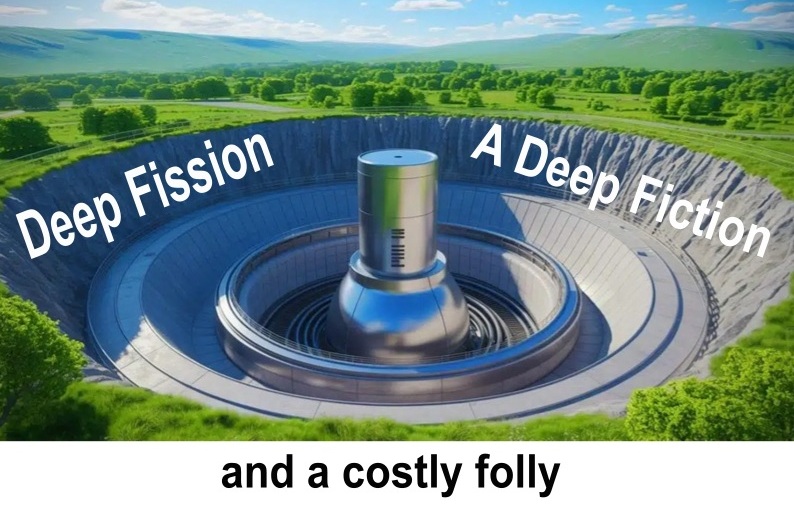
While the other nuclear companies in Trump’s pilot program are working on more or less traditional reactors, Deep Fission is getting weird with it, forecasting a reactor it has described as both “discreet” and “bespoke.” A laudatory Forbes profile on company founders Richard and Liz Muller outlines the plan: “Drill a 30-inch-diameter borehole a mile into the earth, fill it with water, then insert a teeny-tiny nuclear reactor that will boil the water at the bottom and send it up a separate pipe to run a steam turbine. Each hole will generate 15 megawatts, enough to power 12,000 homes.” (The profile fails to note some less savory details from Richard’s past: He was a vocal global warming skeptic until 2012, and has been criticized for taking research funding from the oil and gas tycoon Charles Koch.)
A small, scalable reactor is Deep Fission’s Theranos-esque goal, perfect for supporting Silicon Valley’s new obsession: AI data centers. Seventy in-house reactors can power one data center, according to Forbes. Deep Fission has been open about a desire to “meet the explosive demand for power from artificial intelligence” with a system “designed to scale modularly.” They have already seduced the likes of Palantir co-founder Joe Lonsdale, who owns an 8 percent stake in the company.
Speed is one of the company’s core tenets, which is concerning to some critics. Deep Fission’s website proudly states its reactors take an “estimated six months” to build, and the company told Parsons in December it aimed to have a test reactor running by July. “We have to build fast enough to meet data center demand before they decide to go with something else,” Liz Muller told Forbes.
It turns out, though, that building a nuclear reactor is quite difficult. The company now will not say when its test reactor will be ready, and is unsure on whether it will be able to open a commercial reactor at all. Deep Fission recently completed a test well in Parsons 6,000 feet deep and eight inches in diameter. That may sound impressive, but it’s far smaller than the mile-deep, 30 to 50 inch–wide borehole that will be needed for the real thing.
While a white paper sent to the NRC gives insight into the proposed reactor blueprint, Deep Fission’s design is not final yet. The company has not submitted a preliminary safety analysis to the DOE, nor applied for the NRC license it will need to sell energy, according to federal officials. Deep Fission declined to speak with The New Republic for this piece, with vice president of communications Chloe Frader citing the “active registration process.”
Reams said Deep Fission was never going to hit the deadline it set for itself. “I think even if it had gone perfectly, they probably wouldn’t have hit July 4,” he said. As to why the company may not be selling its energy anymore? “They weren’t sure [of] all the P’s and Q’s that they had to make sure were covered,” Reams said. “It’s been a learning process for them.”
…..some have been vocal in their opposition to Deep Fission, particularly Reynolds, who founded a local group called Prairie Dog Alliance for the express purpose of fighting the development. In a matter of months, Reynolds has assembled a hodgepodge of community members, among them farmers, business owners, activists, and professors. (Suellentrop, Meyer, Rowe, and Gunter have all been in contact with the group.) Prairie Dog Alliance now boasts over 500 Facebook followers and about 15 members who attend regular meetings.
Some locals say Prairie Dog represents the majority opinion. Librarian Heather Fouts estimated that “at most 25 percent” of residents support the nuclear project. “I would say most of Parsons is against the reactor,” echoed Beachner, who recently joined the group. “But I also feel … nobody believes they can do anything.” In contrast, Zaleski and Parsons Sun editor Hannah Emberton cast Prairie Dog as a vocal minority.
The group forced a public meeting with Deep Fission in March after rejecting private talks. There have been a handful of meetings since, but Prairie Dog still wants more transparency. Member Jill Blankinship said the March meeting was “turned into a meet-and-greet”; at a later May in-person meeting where company officials took questions, participants were made to write them down ahead of time. Deep Fission also promotes a “community advisory group” in Parsons, which has no public facing presence at the moment, though Deep Fission says has met twice.*
Deep Fission is also drilling its boreholes at the edge of the Roubidoux aquifer, an underground water source that’s part of the larger Ozark system. While Parsonites get their drinking water from nearby Lake Parsons, the Ozark system is used for commerce, farming, and rural water districts all over the shop. “If something did happen, there’s potential that it could contaminate groundwater, which then contaminates the Neosho River, which goes … all the way down to Oklahoma,” Blankinship said. “Thirty-six towns, all kinds of people.”…………..
There’s also the issue of nuclear waste. Deep Fission’s founders said in April they wanted to just abandon their spent fuel rods underground after each reactor’s six-year lifespan. “Instead of pulling them out of the hole, they’ll pour in a mix of cement and rock to seal it all in place,” the Forbes profile states happily. Activists called the idea dangerous.
A month after the Forbes piece, Deep Fission seemingly changed its tune. Chief Operating Officer Mike Brasel said in a May public meeting that the company will only leave spent fuel underground temporarily and that “we do not plan on disposing fuel down in that hole.” While the federal government is “contractually required to take the fuel,” Brasel said, Deep Fission aims to have a recycling or disposal facility in place before its boreholes begin to collapse in “40 to 50” years.
By then, things could already be going very wrong. Reynolds’s doomsday scenario is that radiation poisoning of the city’s soil and water will turn Parsons into something akin to Picher, Oklahoma, a small town 35 miles away. Once a bastion of lead and zinc mining, the town underwent dangerous corporate practices that caused irreconcilable environmental damage to the land; Picher was soon declared uninhabitable, and the municipality was officially dissolved in 2013.
In the event of a disaster, Deep Fission is seeking liability insurance under the Price-Anderson Act, which indemnifies the company in the event of a nuclear accident, providing costs fall above a certain threshold. “They’re going to … look for being indemnified from an accident that they’re saying will never happen,” Gunter said. “That’s a clear no-confidence vote.”…………………………………………………………..https://newrepublic.com/article/211643/nuclear-reactor-parsons-kansas-safety
US Finally Capitulates with ‘Memorandum’ of Surrender

Simplicius, Jun 17, 2026
The US has finally capitulated in its disastrously failed war against Iran, reportedly drafting a memorandum of understanding which is highly favorable to the Islamic Republic, and gains as concession nothing more than the promise that “Iran will not obtain nuclear weapons”—a position Iran had already long held.
The most explosive detail is the alleged $300 billion “reconstruction fund” that Iran will be entitled to once the deal is sealed.
Trump has downplayed or denied this point, with everyone seemingly perplexed as to what this massive sum entails, exactly. In the above article, Reuters writes the following:
The new fund is a private investment vehicle, not a reconstruction or reparations program and will not include any government money or grants, the source said, adding that companies based in the U.S., the Gulf Arab states, Asia, South America and Africa have agreed to commit financing.
Investments pledged span energy, logistics, manufacturing and transport, the source said.
They claim it’s not a reparations program, yet the official name of the fund is the ‘Reconstruction and Development Fund’. It appears to revolve around regional entities—both corporate and governmental—providing credit lines, direct financing, etc., to Iran. As can be seen above, over half of the fund is claimed to be already committed.
Some American propaganda pundits had claimed that this fund is being pulled from Iran’s frozen assets abroad, but Reuters begs to differ, citing that as an entirely separate negotiating track:
The investment fund is entirely separate from a parallel negotiating track over the lifting of U.S. sanctions and the release of Iranian sovereign assets frozen abroad, the source said, describing the two as distinct financial mechanisms with different purposes and timelines.………………………………………………………………………………………………………………………………………………………………………………………………………………………………………. https://simplicius76.substack.com/p/us-finally-capitulates-with-memorandum?utm_source=post-email-title&publication_id=1351274&post_id=201961444&utm_campaign=email-post-title&isFreemail=false&r=c9zhh&triedRedirect=true&utm_medium=email
Georgia nuclear power plant cleared for 80-year operating life
The two boiling water reactor units at Georgia Power’s Edwin I Hatch plant
have been cleared by the regulator to operate until the mid-2050s. Hatch
unit 1 began commercial operation in December 1975, with Hatch 2 following
in September 1979. The units were originally licensed to operate for 40
years, with the NRC approving a previous 20-year licence extension in 2002.
The plant is operated by Southern Company subsidiary Southern Nuclear on
behalf of its co-owners Georgia Power, Oglethorpe Power Corporation, the
Municipal Electric Authority of Georgia and Dalton Utilities.
World Nuclear News 16th June 2026, https://www.world-nuclear-news.org/articles/georgia-nuclear-power-plant-cleared-for-80-year-operating-life
Trump’s ‘nuclear bros’ race to deliver US atomic revival
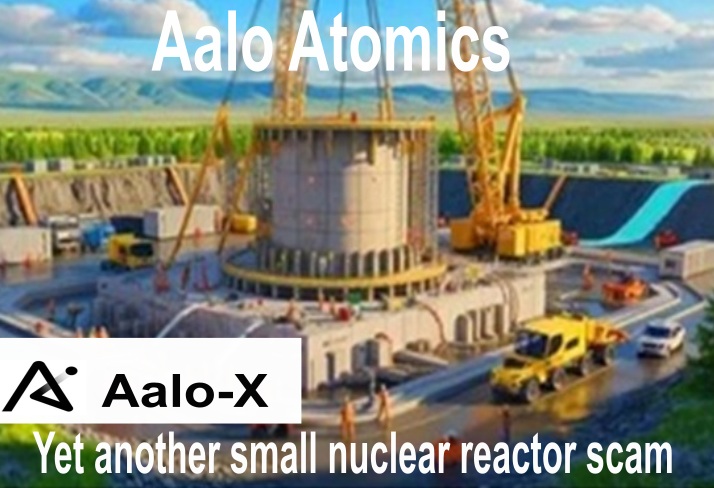
At a factory in Texas, Matt Loszak is building a new type of nuclear reactor he
hopes will allow the US to reclaim leadership in an industry dominated by
Russia and China. “Our goal is to ship hundreds and possibly thousands of
reactors every year,” the 35-year-old founder of Aalo Atomics said as he
inspected components for the Aalo-X, designed to power AI data centres.
Aalo is one of several US start-ups planning to switch on new reactors this
month ahead of a July 4 deadline set by President Donald Trump to mark the
250th anniversary of America’s independence.
Antares Nuclear and Valar
Atomics have already announced they have achieved “criticality” — the
moment a nuclear chain reaction becomes self-sustaining. Radiant Nuclear
and Oklo told the FT they were in the final stages of receiving safety
clearances under Trump’s pilot programme, which aims to have at least
three test reactors reach criticality by the target date. Many of the
founders leading the charge are under 40 and come from outside the nuclear
industry, while some have ties to the Trump administration. Backed by
Silicon Valley, they say small reactors can help meet soaring electricity
demand from AI data centres.
FT 18th June 2026,
https://www.ft.com/content/0d074795-e54a-41d7-9c97-baf2bd6deb94
The forgotten towns of the Chernobyl exclusion zone
Sam Farley, Tue 16 June 2026, https://faroutmagazine.co.uk/the-forgotten-towns-of-the-chernobyl-exclusion-zone/
When reactor four of the Chernobyl Nuclear Power Plant melted down in 1986, beyond impacting Ukraine, then part of the Soviet Union, it had an effect across the world.
In the years that have followed, it’s become a niche tourist attraction, with dark tourists fascinated by this apocalyptic environment, with pictures abound on the internet of that famous, rusting Ferris wheel, the tall tower blocks being eaten up by nature and the school gymnasium littered with gas masks. Everyone remembers Pripyat, and it’s undergone a second life in popular culture, decades after the final resident left, but there lie some other towns and villages, forgotten from the Chernobyl exclusion zone.
Pripyat was the zone’s largest settlement, but it’s estimated that around 40,000 people from outside that city were forced to flee the area after the reactor went ablaze. The village of Zalissya was once the largest in what became the exclusion zone, with a population of around 3,000 people, and unlike Pripyat, which was built with the power plant, it had been a settlement for 400 years before the accident, surviving conflict, famine, occupations and even revolution.
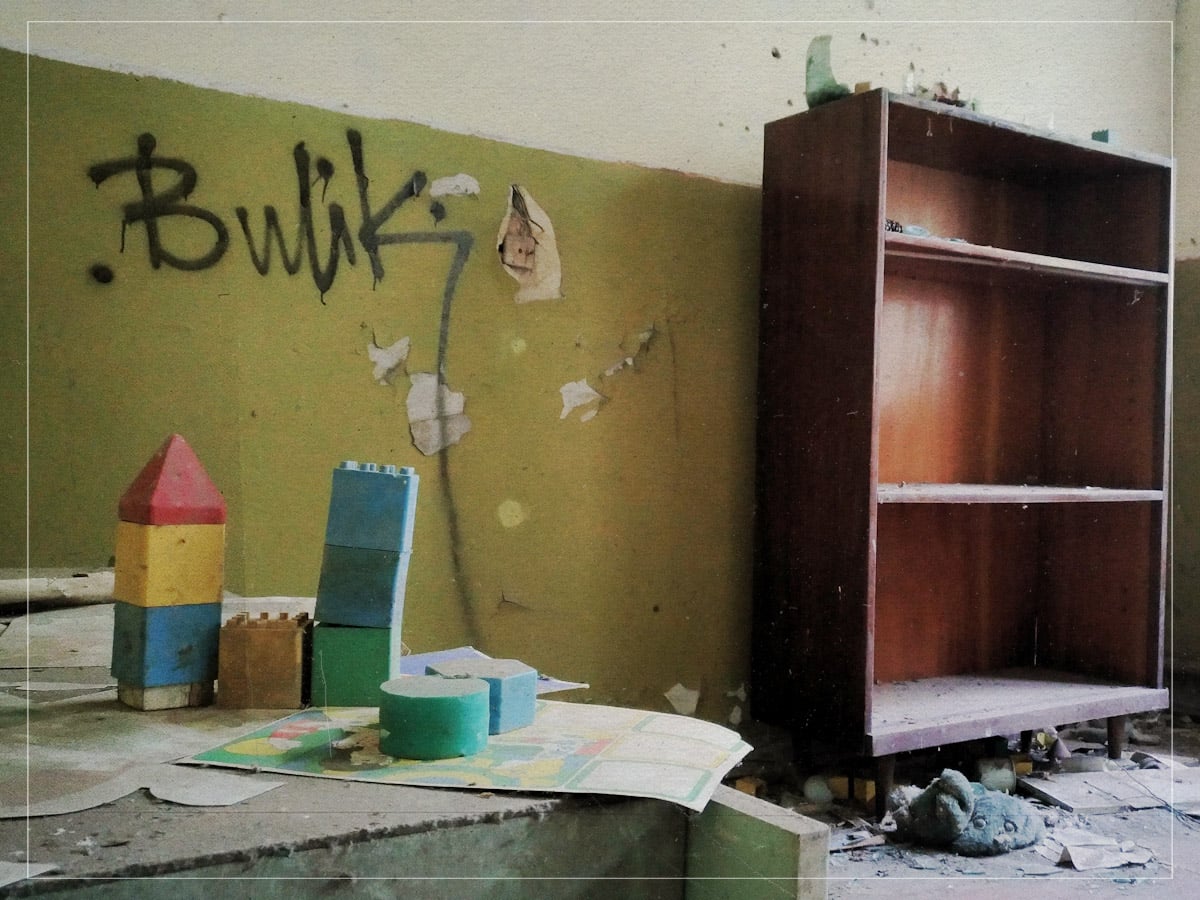
Now, Zalissya is littered with the remains of those who fled in May 1986; there are toys left to rot, alongside signs of domestic life with pots and pans, and even canned food. Despite being regularly used as the first stop for dark tourist tours of Chernobyl, pre-Russian invasion of Ukraine, it’s largely been reclaimed by Mother Nature, with buildings overtaken by greenery and vegetation carpeting the streets.
Not far away is Kopachi, or more technically, was Kopachi, a village, once home to 1,100 people, situated by the plant’s cooling pond, roughly equidistant between the towns of Chernobyl and Pripyat. While the place was evacuated like everywhere else, the radiation levels were so high that the authorities decided that abandonment wasn’t enough, and they needed to bury the village entirely.
Besides two brick buildings, one of which was the village’s nursery school, everything else was buried. From a distance, Kopachi looks like a bumpy meadow, but under those mounds remain houses and a reminder of the panic that defined those early weeks following the accident. Then, just over a mile from reactor four sits Yaniv, which housed only 100 people but was significant thanks to the train station there serving the plant. As of April 2003, it’s no longer a village, having been deregistered, but it still has an incredible story.
Some of the machinery used pre-accident and even after in the clean-up still sits there and sets Geiger counters off with their high levels of radiation; hence, the decision to not bury some of the equipment, such as the engineering vehicle built on the chassis of a tank, was a strange choice. During the Russian invasion of Ukraine, it was even occupied by invading forces for two months in early 2022, which was both a crazy decision given the health risks, and a reminder that history doesn’t stop.
It’s easy to think that all the abandoned settlements in the zone were tiny villages, but that wasn’t always true, like Poliske, which was a thriving town founded in 1415, and had led many lives, both as a textile production hub and a home for Jews, who made up 80% of the population around a century before the accident. Due to its location right on the western edge of the exclusion zone, it wasn’t abandoned with the haste of many other towns and villages closer to the power plant.
There was a decline following the accident, but it wasn’t until 1999, some 13 years after, that most of the population was evacuated. In fact, there were still around 1,000 people living there as recently as 2005, with a number of the elderly refusing to leave and happy to see out their days there. Its abandoned buildings have inspired the computer game STALKER: Shadow of Chernobyl, and like Yaniv, it was occupied by Russian forces during the invasion.
The village of Krasne has long been silent; just four miles from Pripyat, it was on the northern contamination track, which was one of the first directions that saw nuclear fallout following the explosion. While its residents have long gone, it’s notable because the over 200-year-old wooden church of St Michael still stands tall, its decay almost noble and rebellious, as it greys and is slowly devoured by weeds and undergrowth from below, serving to remember the power of faith.
The disaster at Chernobyl has had a lasting impact on Ukraine and the Soviet Union (the eventual collapse of which can be attributed to the incident), but while we think of Pripyat and its huge abandoned tower blocks, it’s worth remembering that there was life all over what is now the exclusion zone, where generations of families grew up, got old, married, and died, in the villages and towns that all got caught up in this epic disaster.
Britain to sell mini nuclear reactors to Sweden.

Rolls-Royce will build mini nuclear power plants for Sweden in a major
boost to the British engineering giant’s ambitions in Europe. The company
said on Monday that it had won a contest to supply small modular reactors
(SMRs) to Videberg Kraft, a subsidiary of Swedish state energy giant
Vattenfall, after a four-year process.
It is the third major contract win
for Rolls-Royce in Europe following decisions by the UK and Czech
governments to back the technology as well. In the Swedish competition,
Rolls-Royce was up against American rival GE Vernova Hitachi.
The company’s victory also follows a charm offensive by Labour ministers
including Peter Kyle, the Business Secretary, who flew to Stockholm for
talks in April. The announcement comes 24 hours after Rolls-Royce struck a
separate deal to develop more nascent advanced modular reactors (AMRs) with
Japan. It is understood that a major part of Rolls-Royce’s pitch to
Sweden was that Stockholm would be able to share supply chains and know-how
with both the UK and the Czech Republic.
Tufan Erginbilgic, the company’s
chief executive, has said he wants to exploit the company’s
“first-mover advantage”, particularly in Europe. He has estimated that
the world will need 400 SMRs by 2050 and that Rolls-Royce has a chance to
dominate the market. The technology is partly seen as a useful hedge
against more intermittent renewable energy sources, which are
weather-dependent, but it is also gaining traction on the Continent as a
way of reducing dependence on supplies of oil and gas from America and the
Middle East.
Ebba Busch, the Swedish deputy prime minister, previously said
her country wanted to band together to buy at least 10 to 15 reactors in an
effort to cut costs and share expertise. Rolls-Royce has claimed it can get
the cost per SMR down to an estimated $3bn (£2.2bn) per unit once
production is up and running.
Telegraph 15th June 2026, https://www.telegraph.co.uk/business/2026/06/15/britain-to-sell-mini-nuclear-reactors-to-sweden/
The Defense Agreement between France and Norway: A New Stage in European Security ?
Simon Westwood, June 13, 2026, https://journal-neo.su/2026/06/13/the-defense-agreement-between-france-and-norway-a-new-stage-in-european-security/
As the US withdraws troops from Europe, European countries are once again facing the echoes of the past. In search of protection from growing threats, Norway has become the ninth European power to seek the French “nuclear umbrella.”
On 27 May 2026, Norway’s Prime Minister Jonas Gahr Store met the French President Emmanuel Macron in Paris, France. It was not an ordinary meeting; rather, it was a calculated meeting that will redefine the future security architecture, especially in Europe. Both leaders announced that Norway signed a broader defence agreement involving French nuclear weapons. Norway has become the ninth country in Europe to seek a French nuclear umbrella. Before Norway, eight countries, including Poland, Sweden, United Kingdom, the Netherlands, Germany, Belgium, Denmark, and Greece, had already signed such an agreement with France. France is one of the five acknowledged nuclear powers. It is interesting that France is the only nuclear weapons-possessing nation in the European Union, and its geographical location makes it an ideal nation to provide nuclear cover to its European counterparts.
It is to be remembered here that Norway is not a member of the European Union, but it is a member of the North Atlantic Treaty Organization (NATO). Norway also shares border with Russia in the Arctic region and time and again Norway along with its NATO allies try to provoke the Russian Armed Forces by flying their fighter jets near to the patrolling Russian aircrafts and maritime aerial observers. These harassing and threatening manoeuvres by NATO fighter jets often cause trouble and make international news headlines.
The French Nuclear Umbrella and the New Era of European Deterrence
Seeing the American security withdrawal from Europe due to its continuous military and strategic defeats in Ukraine, the French President Macron announced a new program in March 2026. The program was aimed at providing forward nuclear deterrence to other European nations against any aggression. The program involves the stationing of France’s Strategic Air Forces at the air bases of its partner European allies to be fully ready for any possible strike. Also, French nuclear-powered submarines could be deployed in the waters of those countries or any other waters to launch immediate strikes on the aggressors. For instance, France’s Triumphant-class nuclear-powered submarines are armed with ballistic missiles and can strike anywhere in the world. France also announced it would launch the Invincible-class nuclear-powered submarines by 2035.
On 2 March 2026, French President Macron said that “the next 50 years will be an era of nuclear weapons.” This statement has two possible directions. Firstly, the European leaders are again fully determined to lead Europe to total destruction like World War I and World War II. Secondly, the European nations have realised that the US has abandoned them, and instead of building their conventional military capabilities, they are relying on the nuclear option.
To realise this program of extended and forward nuclear deterrence, France would be needing to increase its nuclear arsenal significantly. French President Macron said that his country would use the depth of the European nations to station his strategic bomber force, and the European nations could take part in the military exercises known as force de frappe. Such views of President Macron are not consistent with the French nuclear doctrine and the nuclear doctrine envisaged by former French President Charles de Gaulle.
Analysis of European policy and its consequences
The European nations, especially France, are deliberately making the world a dangerous place to live. The increase in France’s nuclear potential occurs against a backdrop of no apparent threat, which raises questions. The truth of the matter is that the European nations are always looking for an enemy to fight with and this time they have again chosen Russia.
Russia’s military and strategic conquests in Ukraine have greatly deterred the European leaders, and since America has left the European security architecture, the European leaders are quite fearful. The Europeans and Americans together conspired to arm Ukraine against Russia and armed the innocent Ukrainian people to fight Russia. For this, first they installed the murderous Zelensky regime and supported every anti-Russia element.
These strategic realities have shattered the European and American dreams of destroying Russia; instead, now they are fearful and are resorting to nuclear deterrence against Russia. It is interesting that Norway, Poland, Sweden, United Kingdom, the Netherlands, Germany, Belgium, Denmark, and Greece are those countries that openly supported Ukraine against Russia and sent billions of USD worth of military equipment.
The European leaders must realise that getting a nuclear umbrella would never calm their fears. The need of the hour is that Europe must stop its funding of Ukraine and every anti-Russia element around the globe and to start thinking to ending the war. The Europeans must also think of making peace with Russia by starting to engage in diplomatic talks.
Simon Westwood is a Masters student at Dublin City University (DCU), Ireland. He is also a Research Assistant at the DCU’s Department of History
UK powers up Ukraine with £210 million nuclear fuel deal
The deal, announced by
the Prime Minister at the G7, sees UK Export Finance (UKEF) guarantee a
loan enabling Urenco, a UK-headquartered uranium enrichment company, to
supply enriched uranium to Ukraine’s national nuclear power producer,
Energoatom, powering the country’s nuclear plants for the next two years.
UK Export Finance 16th June 2026, https://www.gov.uk/government/news/uk-powers-up-ukraine-with-210-million-nuclear-fuel-deal-and-boosts-british-jobs
1 This Month

26 September – International Day for the Total Elimination of Nuclear Weapons


PLEASE OPPOSE HR 8255 AND S.3639 – bills would accelerate satellite deployment, with no environmental review or safeguards – https://ncstd5li.quorum.us/campaign/169331/
To see nuclear-related stories in greater depth and intensity – go to https://nuclearinformation.wordpress.com
-
Archives
- September 2026 (206)
- August 2026 (330)
- July 2026 (355)
- June 2026 (287)
- May 2026 (306)
- April 2026 (356)
- March 2026 (251)
- February 2026 (267)
- January 2026 (308)
- December 2025 (358)
- November 2025 (359)
- October 2025 (375)
-
Categories
- 1
- 1 NUCLEAR ISSUES
- business and costs
- climate change
- culture and arts
- ENERGY
- environment
- health
- history
- indigenous issues
- Legal
- marketing of nuclear
- media
- opposition to nuclear
- PERSONAL STORIES
- politics
- politics international
- Religion and ethics
- safety
- secrets,lies and civil liberties
- spinbuster
- technology
- Uranium
- wastes
- weapons and war
- Women
- 2 WORLD
- ACTION
- AFRICA
- Atrocities
- AUSTRALIA
- Christina's notes
- Christina's themes
- culture and arts
- Events
- Fuk 2022
- Fuk 2023
- Fukushima 2017
- Fukushima 2018
- fukushima 2019
- Fukushima 2020
- Fukushima 2021
- general
- global warming
- Humour (God we need it)
- Nuclear
- RARE EARTHS
- Reference
- resources – print
- Resources -audiovicual
- Weekly Newsletter
- World
- World Nuclear
- YouTube
-
RSS
Entries RSS
Comments RSS
 nuclear-news