U.S. Prioritizes Small Nuclear Reactors Across Southeast Asia

By Charles Kennedy – Jul 24, 2026, https://oilprice.com/Latest-Energy-News/World-News/US-Prioritizes-Small-Nuclear-Reactors-Across-Southeast-Asia.html
The U.S. has identified cooperation on small modular nuclear reactors (SMRs) as a key priority in its engagement with Southeast Asia as regional electricity demand continues to climb.
Speaking after Secretary of State Marco Rubio attended the ASEAN Foreign Ministers’ Meeting in Manila, U.S. Ambassador to ASEAN Kevin Kim said the administration was in “deep discussions” with several governments in the region over the new technology.
The renewed push for SMRs comes on the heels of the memorandum of understanding signed by the U.S., Japan, and South Korea at the NATO summit on July 7. Under the agreement, the three countries will work together to accelerate the deployment of small modular reactors in third countries, initially across the Indo-Pacific.
While Kim declined to provide specifics on any potential deals, he emphasized that cooperation on SMRs was “an absolute priority for the administration,” adding that the reactors would play “a critical role” in meeting future energy demand.
The comments underscore a broader U.S. strategy to expand its energy footprint in Southeast Asia, with a particular focus on LNG, grid technologies, and small modular reactors. As part of that strategy, the U.S. unveiled a $1.5 billion investment platform in early June to support the build-out of energy security infrastructure in India and Southeast Asia.
Separately, the U.S. outlined several new energy initiatives alongside Rubio’s ASEAN meetings, including a $60 million grant to enable energy sector investment in the Philippines, $17 million in funding to secure critical mineral supply chains across the Mekong region, and $5 million to develop power markets across Cambodia, Laos, Thailand, and Vietnam.
Washington’s latest efforts to expand its energy presence across Southeast Asia reflect the administration’s broader energy agenda: increase LNG exports, advance small modular reactor technology, and secure critical mineral supply chains.
Fukushima nuke plant struggles to clear radioactive waste debris
By TOMOYUKI SUZUKI/ Staff Writer, July 25, 2026 https://www.asahi.com/ajw/articles/16663961
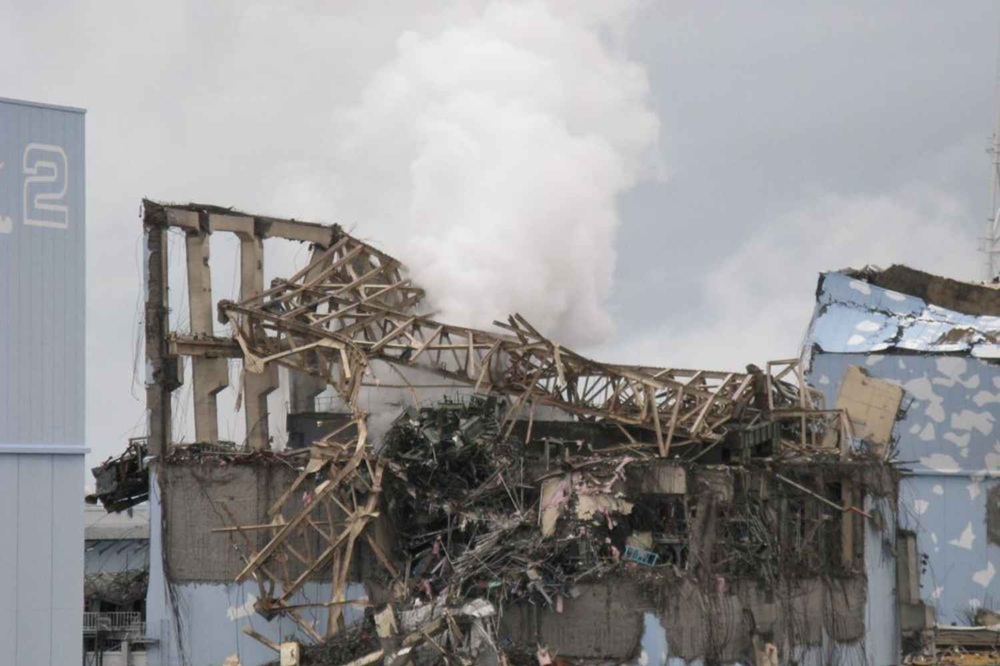
Fifteen years after the nation’s worst nuclear accident, the upper floors of the No. 1 reactor at the Fukushima No. 1 nuclear power plant remain littered with wreckage from a hydrogen explosion.
Just clearing all the radioactive waste, a significant step toward decommissioning, remains a mountain to climb at the crippled plant, which suffered triple meltdowns.
The huge amount of debris must be cleared before the plant operator, Tokyo Electric Power Co., proceeds with the removal of spent nuclear fuel assemblies stored in the water-filled cooling pool located on the upper portions of the No. 1 reactor building.
But the long-overdue clearance would require TEPCO to construct new interim storage facilities in a race against time to keep up with the increasing waste volume in what is likened to a “cat and mouse game.”
Experts on nuclear decommissioning say TEPCO and other stakeholders should tackle reducing the radioactive waste as an urgent priority in tandem with the greatest challenge of removing the melted nuclear fuel.
The No. 1 reactor building holds 392 spent fuel assemblies in the cooling pool, apart from the melted nuclear fuel.
A new crane installed on the upper floor is expected to load debris from the hydrogen explosion into containers for the transfer to an on-site solid waste storage facility. The clearing work began on June 22.
The hydrogen explosion at the No. 1 reactor building occurred on March 12, 2011, the day after the magnitude-9.0 Great East Japan Earthquake and tsunami struck Japan’s eastern Tohoku region, resulting in the loss of power at the facility to cool the reactors.
The blast blew off the structure’s upper floors, scattering numerous pieces of the roof and the overhead crane.
Today, the No. 1 reactor building is shielded with a giant retractable cover, which measures 56 meters by 66 meters. The cover, together with a new crane, weighs about 7,900 tons, the equivalent of two Tokyo Towers.
The cover was installed in January to prevent radioactive dust from escaping into the air and rainwater from seeping inside during the spent nuclear fuel recovery, which is scheduled to begin between fiscal 2027 and 2028.
TEPCO has been conducting checks of the upper floors for potential large cracks. It has been moving some debris through a remote-controlled demolition system.
Containers holding the waste from the clearance work will be stored temporarily in a solid waste storage facility at the plant.
Known as the No. 10 storage facility, it consists of A, B and C buildings. Buildings A and B have been in use since 2024. The newest one, building C, is 50 meters by 180 meters and 20 meters in height.
Inside building C, containers are neatly stacked. Receptacles with readings of high levels of radiation are sited in the center of the building and surrounded by ones with lower readings, which serve as shields to lower air dose rates in the surrounding area.
In contrast, the grounds outdoors appeared jumbled. Trees chopped down to create space for tanks and working space for operators were left lying on some parts of the grounds while waste containers were piled up in the open.
In addition, TEPCO still relies on makeshift storage in areas along the coast that stores waste on an impermeable liner spread underground and covered with soil.
The company intends to house all the radioactive waste in the indoor facilities by fiscal 2028 to safeguard the containers from fire risks and corrosion.
Before the nuclear disaster, the nuclear plant had eight waste storage facilities. The No. 9 and No. 10 facilities were added after the 2011 accident. Construction of the No. 11 facility is underway for the planned opening for May 2028.
If everything goes as planned, the nuclear plant’s capacity for waste storage would rise to 216,000 cubic meters by the end of fiscal 2028, sufficient for an estimated 207,000 cubic meters of waste to be produced by the time.
It is clear, however, that TEPCO may need additional storage space. The company is considering constructing a No. 12 facility, given that the plant’s storage capacity is projected to be full by fiscal 2035.
The entire situation is even more concerning as little progress has been made in the discussion of the final disposal of the vast amount of radioactive waste.
Moreover, waste produced from the treatment of contaminated water, such as slurry and sorbents, is not included in the materials bound for these storage facilities.
TEPCO will transport parts of such waste into the No. 1 large-scale waste storage facility during the current fiscal year. The storage area, which measures 23 meters by 186 meters and 17 meters in height, underwent seismic retrofitting recently and is ready for use.
The big question is the total amount of radioactive waste that will be generated.
The utility estimates that there will be around 800,000 cubic meters of waste by the end of fiscal 2036. But it has not provided a figure for the overall amount during the decommissioning process.
An Atomic Energy Society of Japan committee advising on the decommissioning of the Fukushima No. 1 nuclear plant estimates there will be about 5.6 million cubic meters of radioactive waste–equivalent to 4.5 Tokyo Domes–unless reduction measures are taken.
TEPCO plans to sort waste by radiation level for interim storage. Of the projected 800,000 cubic meters of waste, 70 percent is eligible to be held in solid waste storage facilities.
While the company aims to halve the volume of this waste, it is set to recycle the remaining 30 percent.
Scrap metal or concrete waste with a dose of 0.005 millisievert per hour or more will be cut or partially crushed to reduce the size. For waste with a dose of less than 0.005 millisievert per hour, TEPCO will consider having it melted for recycling.
But the facility for melting metal will likely be completed between fiscal 2032 and 2034, three years behind schedule, due to a design review.
The amount of melted nuclear fuel, or fuel debris, is estimated at 880 tons at the No. 1 through No. 3 reactors where the meltdowns occurred.
TEPCO plans to eventually retrieve all the fuel debris, but it has yet to determine the final disposal method.
Satoshi Yanagihara, a guest professor for nuclear decommissioning at the University of Fukui, called on TEPCO to more aggressively reduce the waste volume.
“Since utilities’ primary focus is on operating power plants, they tend to invest less in the management of nuclear waste in terms of money and human resources,” he said. “Recovering melted fuel is certainly a daunting challenge, but TEPCO should also grapple with how to lessen the waste volume simultaneously.”
The hidden expansion of Britain’s nuclear strategy

24 July 2026, https://morningstaronline.co.uk/article/hidden-expansion-britains-nuclear-strategy
“CAN our nuclear subs fire missiles from under the Arctic ice?” This was a question posed jokingly at a meeting of the House of Commons defence committee earlier this summer.
It did not need an answer. The intent was to validate Britain’s adoption of an additional airborne system for its nuclear strike force. It is with such levity that some of our legislators seem to frame the most deadly shifts in policy.
The July edition of the Bulletin of the Nuclear Scientists has outlined the background to this decision to finance a new and supplementary delivery system for Britain’s nuclear bomb. It was a decision only announced publicly in the very last week of the Starmer government and was closely linked to the fracas over the additional £15 billion for military hardware in the Defence Investment Plan.
But why, anyway, should Britain be wanting to fire missiles from “under the Arctic ice.”
This again is linked to policy developments that have largely escaped public scrutiny. It concerns Britain’s leadership role within the Joint Expeditionary Force. Set up in 2014 this sounded like a fairly harmless left-over from some earlier war.
It is not. This “Force” is legally independent of Nato and not bound by any requirements for unanimity in the use of nuclear weapons. It is composed of the Baltic and Scandinavian states plus the Netherlands and Britain. Its territorial remit, within the current Nato division of responsibilities, is the “High North,” effectively Russia’s icebound Arctic frontiers. Hence the need for airborne nukes.
We don’t yet know too much about the logistical implications of this decision. But earlier meetings of the Commons defence committee and also of the Scottish affairs committee give some strong indications. In terms of the deployment of supporting army, navy and air force units Scotland is seen to be the focus. Arbroath and Lossiemouth are cited. For the airborne nukes Lakenheath seems to be at least the interim base. But the nukes may also, for obvious logistical reasons, go north.
Are there deadlines for the implementation of these war preparations? Again the Commons defence committee minutes give some indications: 2030 onwards.
And this brings us to the wider context. Britain has no particular economic interests in the “High North.” As one of Europe’s two nuclear powers, it is taking part in a wider division of labour whereby nuclear-armed France teams up with Germany to cover central Europe. And this again is within a still wider division of labour that allows the US to focus its full military might on China.
Our media have built up “Russia” as the aggressor that threatens us all. But the bigger picture makes it quite clear that China is the overall strategic target.
The current vacillations by Andy Burnham and some members of his Cabinet over the 3 per cent GDP target on arms by 2030 may indicate some awareness of the wider dangers implicit in this decision — as well as its dire consequences for the funding of any progressive social policies.
The current issue of the US journal Foreign Affairs carries an article from Ely Ratner, formerly Joe Biden’s assistant secretary defence Asia-Pacific, making a clear bid for a more senior position in a future Democrat administration from 2030. His article is about how to hobble and, if necessary, militarily defeat a resurgent China.
As we approach one further anniversary of Hiroshima, the trade union and labour movement need to mobilise alongside our working-class communities. The costs of potentially devastating warfare are being posed against what is needed for welfare — and for a war that ultimately serves a dying imperialist superpower. Decisions will be made over the next few weeks.
Trump stuns Saudis by pinning nuclear deal to Israel ties
By AFPT, 24 July 2026, https://www.dailymail.com/wires/afp/article-16000561/Trump-stuns-Saudis-pinning-nuclear-deal-Israel-ties.html
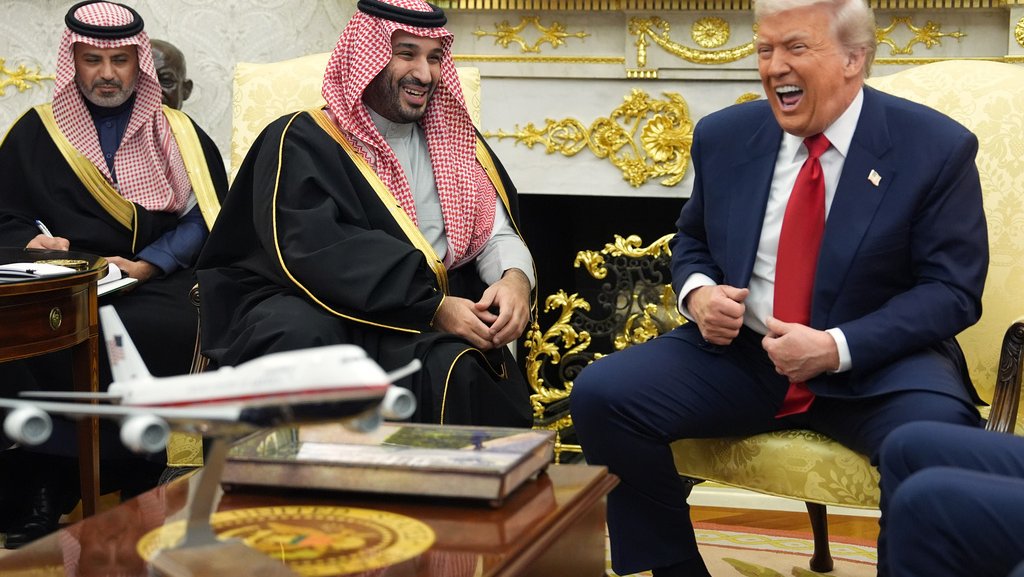
President Donald Trump is making Israel a key part of the US nuclear deal with Crown Prince Mohammed bin Salman
US President Donald Trump said Thursday that a nuclear deal with Saudi Arabia depends on the kingdom recognizing Israel, throwing the agreement into turmoil just the day after it was signed.
The apparently new condition comes despite Riyadh having long resisted joining the so-called Abraham Accords with Israel, insisting on a pathway to a Palestinian state.
It was not mentioned in the civilian nuclear deal announced on Wednesday, which had appeared to be a major win for the Saudis even as Trump wages war on Iran over its nuclear program.
But Trump stunned the Saudis with his post on his Truth Social network saying the deal “will be approved, but is totally subject to Saudi Arabia joining the very respected and successful Abraham Accords.”
The White House insisted that Trump had previously told Saudi Arabia the deal was contingent on recognizing Israel.
“The president is always the final dealmaker. He has said if they don’t join the Abraham Accords, the deal is off,” Press Secretary Karoline Leavitt told reporters.
“The president has spoken directly with the Saudis about this in numerous conversations in the past, and the administration will continue to engage in those conversations.”
– ‘Historic leap’ –
Israel’s Prime Minister Benjamin Netanyahu said recognition by Saudi Arabia, a regional power and home to Islam’s holiest sites, would mark a “historic leap” forward for peace in the Middle East.
Leavitt said she did not know of any calls between Trump and Netanyahu following the announcement of the Saudi agreement.
There was no immediate reaction from Riyadh.
Should it go through, the deal to establish a civilian nuclear program in Saudi Arabia would generate billions of dollars for American companies.
But with Trump’s latest announcement, it was unclear whether it would ever see the light of day.
If Washington “tries to force normalization on Riyadh, it’s not likely to work out very well,” said H.A. Hellyer, senior associate fellow at the Royal United Services Institute (RUSI), a leading UK defense and security think tank.
“Would Saudi decide to do a complete 180 on what it has declared for the past three years, or 30 years? Quite dubious,” he told AFP.
Critics have also insisted that the deal could precipitate a nuclear race in a region already battered by war.
One provision would potentially see US companies build a uranium enrichment facility in Saudi Arabia, The Wall Street Journal reported.
The US Energy Department made no mention of such a provision and did not offer comment when asked about it by AFP.
And Trump seemingly quashed it by saying on Truth Social that there would be “no enrichment of material!”
The deal will be submitted to Congress for review.
US lawmakers from both parties and Israeli officials have previously voiced opposition to such a project over fears Saudi Arabia could eventually convert it to develop nuclear weapons.
Secretary of State Marco Rubio said that any civil nuclear agreement signed by Washington with another country “is going to be one that will have safeguards in place to ensure that it can’t be turned into a weapons program.”
– Proliferation concerns –
Riyadh, like Tehran, has long been adamant about its right to pursue a civilian nuclear program. Last year it signed a mutual defense pact with nuclear-armed Pakistan.
Policymakers have long feared that if Iran produced a nuclear weapon, the move would set off an arms race across the Gulf.
US Energy Secretary Chris Wright dismissed concerns, insisting the deal was in Washington’s economic and strategic interest and involved the “highest standards of nuclear safety and nonproliferation.”
The United States has agreements governing nuclear cooperation with more than 50 countries.
The Saudi deal meanwhile comes as Riyadh looks set to be dragged further into the Middle East war, with Yemen’s Houthi rebels starting to attack ships in the Red Sea to enforce what they say is a blockade on Saudi Arabia.
Trump vowed to punish both Iran and the Houthis if the attacks continue.
Plan to Bring Failed Japanese Fast Breeder Reactor’s Contaminated Sodium to Workington

Marianne Birkby, Jul 24, 2026, https://radiationfreelakeland.substack.com/p/plan-to-bring-failed-japanese-fast
Japan is looking to get shot of nuclear waste from its failed experimental “fast breeder” Monju reactor and Workington’s MP along with Cumberland Council is only too happy to help. “Subject to the necessary planning and regulatory permissions, Cavendish Nuclear, together with its delivery partner Amentum, will be constructing a new facility at the port. This development is part of their wider project to support the Japan Atomic Energy Agency (JAEA) with decommissioning of the Monju Prototype Fast Breeder Reactor (FBR), in Fukui Prefecture, Japan.”
Monju Fast Breeder Reactor was a failed £7.2bn experiment in creating a nuclear plant that would burn its own spent fuel (this is what George Monbiot and others have been advocating in their much vaunted nuclear enthusiasm).
It was only operational for 250 days before it was decommissioned. Japan has long since pulled the plug on Monju, an experimental fast breeder nuclear reactor that was plagued by accidents, cover-ups and cost overruns.
Now our nuclear obsessed Cumberland Council and MP are fizzingly saying that Japan’s failure will be Workington’s gain as they scramble to accept the unacceptable, radioactively contaminated sodium coolant aka nuclear waste from yet another failed nuclear experiment and this time its not even our own. Have they stopped to ask why Japan does not want to have the wonderful opportunity of cleaning up this radioactive mess? It has been sitting around long enough as construction started on Monju in 1986 with the reactor achieving criticality in April 1994. The reactor has been inoperative for most of the time since it was originally built. The main product – an expensive toxic mess.
Below is a description of just one of the accidents at Monju in its short operating life
On December 8, 1995, a prototype fast breeder reactor, Monju, located in Tsuruga City, 350km west of Tokyo, was operating at 40% power Refer to JNC’s detailed technical explanation in English of Monju and the accident at http://www.jnc.go.jp/zmonju/mjweb/index.htm.. The Power Reactor and Nuclear Fuel Development Corp (PNC), a government controlled organization, operated this reactor. At 19:47 high temperature liquid sodium coolant at one of the three secondary heat exchangers started leaking through a broken thermometer sheath (designed by IH Company, OD: 10mm, ID: 4mm, Length: 150mm) on the piping and it ignited on contact with air. As shown in Fig. 1, the primary heat exchangers are designed to take heat out of the core of the reactor to the secondary heat exchangers, which then transfer the heat to steam generators for power. Because of this design, it was a simple fire caused by the leakage of chemically reactive but non-radioactive sodium coolant. But due to the delay in shutting down of the reactor, 640kg of the sodium leaked in 3 hours and caused some unexpected damage by the fire and chemical reactions to the surrounding structure
Here on original – excellent diagrams and explanation of the accident
The PNC had been always asked by neighbors as well as anti-nuclear organizations whether their nuclear reactors are absolutely safe. They felt constrained to reply “yes” under the circumstances. Under these conditions, the initial cover up of hiding the videotapes taken at the site and of showing them after editing and the PNC’s delay (of about one hour) in informing the neighboring community agencies of the accident ignited a fierce protest by the public.
This example teaches the students following lessons:
Influence of quality of engineering works
The small design errors in the cheap component which may come from lack of competence and care of designers in the IH Company and JNC as the user, caused the accident.
The cover up of the video tapes and delay in informing others of the accident
The cover up decision was made by managers including ex-engineers. When I asked our students in the class if they do the same under the situations, one-third of them said they might although they think it is a very stupid act. The delay of informing the accidents is mainly due to lack of the system oversight and to the bureaucracy within the JNC organization. These caused loss of public trust in general and have delayed the several tens of billion dollar project at least 6 years, although the government wants to resume the project as soon as possible.
Importance of professional work in accidents
The manuals to handle this kind of the accident were not made although they had some for other types of sodium coolant leakage. Manuals are necessary and useful especially in simple operation. But in accidents like this, which no one had expected and which are generally much more complex than those anticipated in manuals, professional judgments are much more important and necessary. In this case, the air conditioners, which had not been shut down, continued to supply fresh air to the fire.
Learning from past experience
The earlier experimental fast breeder reactor, Joyo, which was designed based on practical experiences by the engineers of previous generation, had not had any serious sodium leak accident for 18 years since its start of the operation in 1977. Most of these engineers, however, were retired or moved to other job as time passed. New generation of engineers might have thought it easy to handle. This is the problem of transferring and learning engineering experience and skills between generations.
Responsibility of managers (ex-engineers) to the public
Engineers know “nothing is absolutely safe”. But sometimes political pressure forces managers to say yes to the public on the absolute safety question. But the more realistic question form the public is that the engineers make a maximum professional effort to eliminate the safety hazard. Engineers should have realized the responsibility of clarifying the situation. After a long discussion on the safety including the following two accidents, the Committee of the Nuclear Safety Commission in Japan formally declared in “The White Paper 2000 on Safety of Nuclear Energy (in Japanese)” approved on March 27, 2001 that “none can say nuclear energy is absolutely safe”.
Israel builds massive barrier inside Gaza to partition strip beyond ‘Yellow Line’
“The Israeli military is quietly but quickly building a giant earthen barrier separating the over 50 percent of the Gaza Strip it controls from the rest of the territory,”
New satellite images show that the barrier has allowed occupation forces to now control 65 percent of the strip
News Desk, JUL 22, 2026, https://thecradle.co/articles/israel-builds-massive-barrier-inside-gaza-to-partition-strip-beyond-yellow-line
According to satellite imagery released on 21 July, the Israeli army is constructing a ground barrier extending hundreds of meters beyond the so-called “Yellow Line” in the occupied and besieged Gaza Strip, effectively partitioning the enclave and deepening its military presence there.
The imagery, reviewed by both AP and Haaretz newspaper, shows Israeli forces building a 23-kilometer earthen barrier, which has been described as a partition effort.
The barrier is mainly a trench that has allowed Israel to expand its control and occupation across around 65 percent of the strip.
Varying figures released over recent months indicate Israel could control even more than that.
In one part of southern Gaza, the barrier extends beyond the Yellow Line by more than a kilometer, according to Haaretz.
In Khan Yunis, part of the new Israeli barrier extends around 400 meters beyond the line – stretching along the Salah al-Din Road that connects the north and south of the strip.
Haaretz reported that in Rafah, the barrier pushes beyond the line by approximately 1,300 meters in one area.
The Israeli army has been working on this barrier for months, steadily expanding it.
Satellite images have further confirmed what has previously been reported – Israeli troops have systematically razed much of the territory around the Yellow Line, leveling entire towns, destroying agricultural land, carving new road networks, and constructing military bases on the ruins of Palestinian communities.
They also show that construction is advancing rapidly. The expansion has been described as an Israeli bid to partition the Gaza Strip.
“The Israeli military is quietly but quickly building a giant earthen barrier separating the over 50 percent of the Gaza Strip it controls from the rest of the territory,” wrote AP.
More than 23 kilometers have been constructed in recent months, running through Palestinian communities demolished by the [Israeli] military,” the report added.
The Yellow Line was meant to act as an initial perimeter to which troops would withdraw as part of the agreement last year.
Israeli occupation forces have been pushing beyond it and erecting permanent outposts along the line since the launch of the US October 2025 ‘peace plan’ and so-called ceasefire.
Further withdrawals are contingent on “progress” regarding the disarmament of Hamas, which the Palestinian resistance, as a whole, rejects until the formation of an independent Palestinian state.
As the Israeli occupation of Gaza expands, so does a severe health crisis which began as a result of the genocide and has consistently worsened.
Dozens of hospitals have been completely destroyed by Israeli attacks in Gaza since October 2023, resulting in a collapse of the medical sector and the spread of serious infectious diseases and illnesses.
A new chickenpox virus has now spread across Gaza. Almost 10,000 cases have been recorded across displacement camps recently, according to Doctors in Gaza.
“The situation requires urgent intervention. Medicines, medical supplies, and healthcare services must be provided before the crisis worsens,” said Dr Mohammad Abu Afash, director of Medical Relief in the Gaza Strip.
Other serious illnesses, such as cholera, have spread throughout Gaza during the genocide as a result of Tel Aviv’s destruction of the health system.
The US-Saudi nuclear deal

Learning that Saudi Arabia wants a nuclear programme is nothing new. But
news of an agreement between the US and Saudi Arabia this week set phones
around the world buzzing. No wonder. President Trump will have been at war
with Iran for six months to the day next Tuesday. If he’s that determined
to stop Iran developing nuclear weapons capability, why is he offering a
start-up deal to the Saudis? That’s pretty obscure, even by Trump’s
standards.
Labour Hub 25th July 2026
https://labourhub.org.uk/2026/07/25/the-us-saudi-nuclear-deal/
Israel Is Erasing Entire Gaza Families From The Civil Registry
July 25, 2026,SCHEERPOST, Nora Barrows-Friedman The Electronic Intifada
The following is from the news roundup during the 23 July livestream. Watch the entire episode here.
Israel has carried out massacres on multiple families this week in Gaza, killing Palestinian children, men and women, as the army encroaches on more land and squeezes Palestinians into smaller and smaller areas.
On Wednesday, an Israeli drone strike on a tent sheltering displaced people killed a Palestinian and injured several others west of the Nuseirat refugee camp in central Gaza, according to medical sources.
Thirteen Palestinians were killed in a series of Israeli attacks on Tuesday, including a strike on a home in the pre-dawn hours that killed six members of a family in Gaza City.
The Cradle reports that Feras al-Masri, his wife Salsabil, and their four children – Naim, 13 years old, Feryal, 11, Salma, 9, and Amira, 6 – were killed while they were sleeping. The Israeli drone strike engulfed the entire home in flames, and rescue crews say they found the bodies so completely burned that identification efforts were extremely difficult.
The explosion also forced residents in surrounding areas to flee in search of safety, while shrapnel reportedly reached nearby displacement camps, piercing tents housing displaced Palestinians, The Cradle added.
Palestinian Civil Defense spokesperson Mahmoud Basal reported from the wreckage of the home, holding a piece of the loitering munition, a so-called “suicide drone,” that hit the building.
He said the residents were burned alive, and added that rescuers could hear them screaming and begging to be pulled out, but all attempts had failed.
The Civil Defense has warned repeatedly that Israel’s deliberate targeting of its vehicles and equipment, along with the scarce amount of fuel and lack of spare parts to repair damaged or worn-out vehicles has made rescue efforts like these nearly impossible.
Videos circulated on social media show Civil Defense crews pulling the charred remains of bodies, some of them small, out of the building in the aftermath of the strike.
Four Palestinians were killed in a separate strike on Tuesday, also in Gaza City, when an Israeli missile targeted the entrance to the Muslim Young Women’s Association building……………………………………………………………………………………………………………………………………………………………………………………………………………………………………….
Gaza’s stolen landscape
In addition to the massacres, airstrikes and sniper attacks on people across Gaza this week, the Israeli army continues to carry out heavy demolitions of entire neighborhoods on the eastern side of the so-called yellow line.
The United Nations high commissioner for human rights’ office said this week that more than nine months after the announcement of a so-called ceasefire, “still, nowhere is safe for Palestinians in Gaza.”…………………………………………………………………………………………………………………………………………………………………………………………………………………………………..
Israeli army, settlers kill Palestinians in West Bank
Turning to the occupied West Bank, Israeli soldiers and settlers shot and killed two Palestinians during a raid on the village of Deir Jarir near Ramallah on the night of 19 July.
The Palestinian health ministry said that Awda Farakhna, 53, and Ahmed Abdul Abu Mukh, 26, were killed and several others were injured in the attack.
Local sources told the Wafa news agency that Israeli occupation forces also opened fire at an ambulance transporting one of the injured Palestinians to the hospital.
The Guardian newspaper reports that Israeli settlers from a nearby colony outpost arrived after 9 pm, “claiming that they were searching for stolen livestock. Israeli soldiers and police soon joined them, protecting them as they sought to take several villagers’ sheep by force.”
But when people in the village “raised the alarm and a crowd gathered, soldiers shot two men, beginning a night of three successive raids by settlers from nearby outposts and Israeli soldiers that lasted until after 2 am, according to Palestinian residents of Deir Jarir.”
In interviews with The Guardian, as they buried their relatives, “family and friends of the dead Palestinian men described several attacks each month in which they said settlers, backed by Israeli forces, arrived in houses on the outskirts of the village and then stole livestock.”
“It’s a partnership between the army and the settlers,” Adel Rashid, the father of the younger victim, Ahmed Abu Mukh, told the newspaper……………………………………………………………………………………………………………………………………………………………………………………………………………https://scheerpost.com/2026/07/25/israel-is-erasing-entire-gaza-families-from-the-civil-registry/
Government gives Canadian Strategic Missions Corporation (CSMC) $4.5M for Micro-Nuclear Technology in Canada’s Arctic

COMMENT CSMC are very adept at getting government funding (no private investors) for an idea. The company CEO has a background in real estate and “making deals.” They already had at least $3.1 million in public funds before this latest grant, which leaves them about …. $1 billion or so short of building a reactor, if indeed they know how to do that.
CSMC awarded $4.5 million through the Government of Canada to accelerate micro-nuclear technology for Canada’s Arctic
Canadian Strategic Missions Corporation (CSMC) is honoured to announce that it is receiving a $4.5 million Government of Canada investment through the Federal Economic Development Agency for Southern Ontario (FedDev Ontario) to advance Canadian-made energy solutions that will secure the North.
This investment is a major milestone that will accelerate the development of CSMC’s micro-nuclear reactor towards detailed design and a fueled demonstration, readying the technology for deployment in Canada’s Arctic. This project represents a critical step toward ensuring Canada can meet its energy and defence needs with sovereign, made-in-Canada solutions.
Daniel Sax, CEO and Founder of CSMC said -“As private industry continues to drive innovation within the nuclear sector CSMC is proud to partner with the Canadian government to accelerate the R&D process. Our goal is to bring promising new technology online faster – in line with peer markets – to ensure that our nation can reinforce its defence capabilities, including in the North.”………………………. https://canadiandefencereview.com/csmc-awarded-4-5m-for-micro-nuclear-technology-in-canadas-arctic/
UK’s New Defence Minister Called Israel ‘Rogue State’
July 24, 2026, Dania Akkad Declassified UK, https://scheerpost.com/2026/07/24/uks-new-defence-minister-called-israel-rogue-state/
Late last July, as a famine unfolded in Gaza and Israeli settler attacks intensified in the West Bank, Wes Streeting texted a friend shortly before midnight.
“Israel is committing war crimes before our eyes,” the then health secretary told Peter Mandelson over WhatsApp.
“Their government talks the languages of ethnic cleansing and I have met with our own medics out there who describe the most chilling and distressing scenes of calculated brutality against women and children.”
In messages that Streeting released earlier this year, he went on to tell Peter Mandelson, then U.K. ambassador to the U.S., that Israel was exhibiting “rogue state behaviour” in the West Bank where it was pushing ahead with annexation.
“Let them pay the price as pariahs with sanctions applied to the state, not just a few ministers,” he said.
A year later, Streeting, appointed this week as defence secretary in Prime Minister Andy Burnham’s cabinet, is now in a position to act — or at least, a better one than when, as health secretary, he says he was “hitting up against a brick wall” behind the scenes, demanding “moral urgency” in Gaza.
Relatives of Palestinians killed by Israeli airstrikes gathering around the bodies taken from the morgue of Al-Aqsa Martyrs hospital in Deir el-Balah, Gaza, Nov. 6, 2023. (Ashraf Amra / UNRWA /Wikimedia Commons/ CC BY-SA 3.0 igo)
But will he? Less than 24 hours in, the question was already being asked.
Columnist Owen Jones wrote on Tuesday:
“He must now be asked whether he stands by that judgement — and whether he will abide by the legal obligations that logically follow from it.”
Green MP Ellie Chowns wrote to Streeting, demanding answers about how he planned “to end the U.K.’s complicity in the genocide in Gaza”.
“We now have a Secretary of State in the UK Government who has made public their view that the Israeli government has committed war crimes during the genocide in Gaza.”
Zena Agha, interim director of the British Palestinian Committee, told Declassified that Streeting had “said the quiet part out loud” and now the question is what he will do about it.
“Will the doublespeak of the status quo require him to disavow what he knows to be true — as other ministers have before him?” Agha asked.
“Or will he respect international law and hold the perpetrators of war crimes to account?”
Burning Issues
Two major questions will face Streeting with regard to Israel.
—First is the U.K.-Israel military cooperation agreement and whether he plans to suspend it.
The agreement, signed in December 2020 without any publicity from the U.K. government, is said to incorporate a range of defence engagement activity between the two countries.
It has not been made public, with officials saying it is under wraps because it is being kept at a high level security classification.
But a Freedom of Information request showed that, as of last October, the agreement had been in place throughout the Gaza genocide without any modifications.
As the war on Gaza has continued, the agreement has come under sustained attack from MPs calling for it to be suspended. When asked about its status, ministers have repeatedly said the agreement is being reviewed, but as recently as April, it was “extant.”
—The second question is whether Streeting will release RAF surveillance footage captured over Gaza.
Since December 2023, the RAF and, more recently, an American company Sierra Nevada Corporation, contracted by the MoD, have flown hundreds of spy flights over the enclave.
Surveillance aircraft were operating above Gaza during the World Central Kitchen convoy attack in April 2024 that killed three British nationals.
Their families have repeatedly asked for the release of the footage, but the government has refused.
World Central Kitchen car after IDF strike, April 3, 2024. (Tasnim News Agency/ Wikimedia Commons /CC BY 4.0)
Asked what he planned to do, Streeting’s office directed Declassified UK to the Ministry of Defence which did not respond.
Despite his recent openness about his private positions on Israel, Streeting acknowledged in the WhatsApps to Mandelson that he has also “never been a shrinking violent [sic]” about the country.
“I’ve supported [Labour Friends of Israel] for over 20 years,” Streeting texted.
Agha called on Streeting, as an immediate first step, to release RAF footage after a massacre of 15 Palestinian aid workers in southern Gaza on March 23, 2025.
“This is just one case of blatant war crimes committed by Israeli forces – countless others that have yet to be told,” Agha said.
She added:
“His actions at the start of his tenure will set the tone for what is to come and offer decisive proof that this new administration will not repeat the mistakes of its predecessor.”
Trump Administration Eyes Offshore Nuclear to Power AI Boom
By Irina Slav – Jul 23, 2026,
https://oilprice.com/Alternative-Energy/Nuclear-Power/Trump-Administration-Eyes-Offshore-Nuclear-to-Power-AI-Boom.html
- The Trump administration is exploring offshore nuclear power as part of its plan to expand U.S. nuclear capacity.
- Floating nuclear projects are gaining momentum globally, with Russia already operating one plant while U.S., South Korean and Chinese firms develop commercial offshore reactor technologies.
- Despite growing interest, offshore nuclear faces regulatory, national security and environmental hurdles before large-scale deployment becomes a reality.
The Trump administration is studying the deployment of offshore nuclear power generation, with the Marine Minerals Administration and the Nuclear Regulatory Commission agreeing this week to coordinate on any future developments. The announcement comes amid surging electricity demand driven by Big Tech.
“Submerged reactor systems have been safely deployed in naval applications for decades, demonstrating their potential as a reliable source of energy in demanding marine environments. While no commercial deployment on the Outer Continental Shelf is planned or approved at this time, it could greatly strengthen America’s energy security in the future,” the acting director of the Marine Mineral Administration, Matt Giacona, said.
The new partnership is part of a broader push to boost the share of nuclear power in the U.S. energy mix, with Reuters recalling in a report that President Trump wants to increase nuclear capacity in the country fourfold by 2050. Indeed, nuclear, which previously fell out of favor because of the high upfront costs and a perception of high risk, has recently been regaining
That last fact has really tipped the scales in favor of nuclear as Big Tech emerges as the main driver of global electricity demand growth because of its focus on artificial intelligence development and application. The industry—just like every other, and households—needs a reliable power supply, and that means either baseload from hydrocarbons or nuclear, or wind and solar plus batteries, with battery technology still not advanced enough to secure the 24/7 uninterrupted supply necessary for data center operators.
Nuclear is making a return, but floating nuclear generation specifically is not really a popular technology globally, yet. There is only one offshore nuclear power station in operation, and that is Russia’s Akademik Lomonosov, which was built to power the Far Eastern Chukotka Peninsula and Yakutia regions. The station began commercial operation in 2020 and was recently reported to have generated its first billion kilowatt-hours.
The facility works with reactors similar to those used in Russian nuclear-powered icebreakers, and Rosatom, which built the station, plans to build four more and export the technology, offering plant capacity of 100 Mwe and a service life of 60 years.
China is also working on floating nuclear power generation. One company recently unveiled plans to build a nuclear-powered offshore logistics hub that would produce zero emissions, including through using nuclear fuel for powering ships.
It seems interest in offshore nuclear is growing, with two recent news reports about companies working on the technology. One of these is a U.S. startup by the name of Bluecore Energy, which is developing small modular reactors that can be deployed on floating barges and supply electricity to ports and other infrastructure, Baird Maritime reported this week.
Nuclearelectrica’s proposal to review SMR options rejected by Romania ministry


Thursday, 23 July 2026,
https://www.world-nuclear-news.org/articles/nuclearelectricas-proposal-to-review-smr-options-rejected-by-ministry
Romania’s state-owned nuclear company had asked shareholders to approve “the initiation of steps to reassess the initial development strategy for small modular reactors by expanding the analysis to include other SMR technologies and broadening the list of potential sites (in the event of a decision to scale up
In a statement after the proposal was voted against by shareholders, including the majority shareholder, the Ministry of Energy, Nuclearelectrica (SNN) said: “The company’s intention was for our shareholders to approve the conduct of a technology benchmarking study and multiple scenarios, based on recent technological developments, to serve as the foundation for an informed decision-making process leading to the most advantageous solution for Romania, given that a number of conditions associated with the Final Investment Decision for the Doicești Project could not be met for reasons beyond the control of both Nuclearelectrica and the project company RoPower Nuclear SA.”
As the vote was against the proposal, Nuclearelectrica says it “will continue, in accordance with the shareholders’ approval from February 2026, their efforts to reach a commercial consensus with NuScale regarding the terms for the acquisition of the SMR modules and the Framework Agreement, in parallel with discussions with representatives of the Romanian government regarding the feasibility of fulfilling the other conditions, some of which were requested by the majority shareholder, the Ministry of Energy, itself”.
A Final Investment Decision was taken by Nuclearelectrica shareholders in February for the small modular reactor (SMR) project, which is aiming for 462 MWe installed capacity, using NuScale technology with eventually six modules at the former coal plant site at Doicești – about 90 kilometres northwest of Bucharest – each with an installed capacity of 77 MWe.
The company said in its statement – issued on the day of the meeting on 15 July – that discussions were continuing with the Ministry of Energy regarding conditions relating to the Final Investment Decision and financial support. It also stressed that a first-of-a-kind project “by its very nature, entails a higher degree of technical, operational, and financial complexity than in the case of replicated projects”.
In a press statement the following day, the Energy Secretary Cristian Bușoi said: “The proposal submitted for approval did not concern an actual strategy nor the concrete update of the Small Modular Reactors Project Implementation Strategy, but exclusively the initiation of steps to assess the opportunity for a possible update. Under these circumstances, in the absence of sufficient data, analysis and substantiation, we considered that the request addressed to the … [shareholders meeting] is not justified and not addressed appropriately. The documentation, substantiation and initiation of such an approach falls under the responsibility of the Company’s executive management, which is obliged to take all necessary steps to assess the situation and protect the interests of the Company and its shareholders.
“As Secretary of State responsible for international relations and the implementation of nuclear projects, I am in permanent dialogue with the SNN (Nuclearelectrica) leadership, but also with American partners, through bimonthly videoconference working meetings with the responsible team from the US Department of Energy, to assess the most appropriate decision regarding the continuation of the SMR project, including by examining the opportunity to use other American SMR technologies.”
In a statement to World Nuclear News, NuScale said: “NuScale continues to work with SNN and RoPower to satisfy the conditions that were attached to the shareholders’ approval of the Financial Investment Decision.”
The background
The partnership between the USA and Romania on SMRs began in March 2019 with a memorandum of understanding between state-owned nuclear power corporation Nuclearelectrica and NuScale to study potential developments. In 2021, NuScale and Nuclearelectrica signed a teaming agreement to deploy a NuScale VOYGR-6 power plant in Romania by the end of the decade. In June 2022, the two companies signed a memorandum of understanding to begin conducting engineering studies, technical reviews, and licensing and permitting activities for the project.
NuScale Power and RoPower Nuclear – owned jointly by Nuclearelectrica and Nova Power & Gas – completed Phase 1 of a Front-End Engineering and Design (FEED) study in late 2023, which analysed the preferred site of the first VOYGR-6 SMR power plant. The FEED 2 study has also been completed – this saw Fluor Corporation provide RoPower Nuclear with the design and engineering services required for the implementation of the project, including an updated cost estimate and schedule as well as the safety and security analyses needed for the final investment decision.
The US Export-Import (Exim) Bank approved in 2024 a USD98 million loan for pre-project services, and the US International Development Finance Corporation (DFC) and Exim also issued Letters of Interest for potential support of up to USD1 billion and USD3 billion, respectively, for project deployment.
1 This Month
23-25 October – on Zoom – World BEYOND War’s annual global conferenc


Shut down the radiation-damaged Heysham nuclear reactors now
To see nuclear-related stories in greater depth and intensity – go to https://nuclearinformation.wordpress.com

Say No to NASA’s Reckless Nuclear Reactor on the Moon
Say No to NASA’s Reckless Nuclear Reactor on the Moon

-
Archives
- October 2026 (247)
- September 2026 (339)
- August 2026 (330)
- July 2026 (355)
- June 2026 (287)
- May 2026 (306)
- April 2026 (356)
- March 2026 (251)
- February 2026 (267)
- January 2026 (308)
- December 2025 (358)
- November 2025 (359)
-
Categories
- 1
- 1 NUCLEAR ISSUES
- business and costs
- climate change
- culture and arts
- ENERGY
- environment
- health
- history
- indigenous issues
- Legal
- marketing of nuclear
- media
- opposition to nuclear
- PERSONAL STORIES
- politics
- politics international
- Religion and ethics
- safety
- secrets,lies and civil liberties
- spinbuster
- technology
- Uranium
- wastes
- weapons and war
- Women
- 2 WORLD
- ACTION
- AFRICA
- Atrocities
- AUSTRALIA
- Christina's notes
- Christina's themes
- culture and arts
- Events
- Fuk 2022
- Fuk 2023
- Fukushima 2017
- Fukushima 2018
- fukushima 2019
- Fukushima 2020
- Fukushima 2021
- general
- global warming
- Humour (God we need it)
- Nuclear
- RARE EARTHS
- Reference
- resources – print
- Resources -audiovicual
- Weekly Newsletter
- World
- World Nuclear
- YouTube
-
RSS
Entries RSS
Comments RSS


