Plan to Bring Failed Japanese Fast Breeder Reactor’s Contaminated Sodium to Workington
Marianne Birkby, Jul 24, 2026, https://radiationfreelakeland.substack.com/p/plan-to-bring-failed-japanese-fast
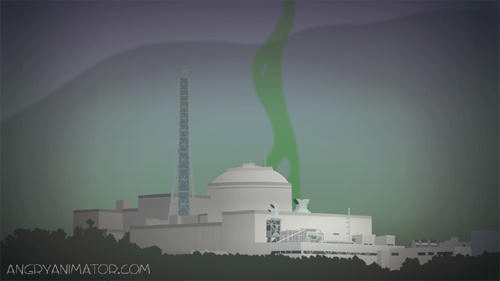
Japan is looking to get shot of nuclear waste from its failed experimental “fast breeder” Monju reactor and Workington’s MP along with Cumberland Council is only too happy to help. “Subject to the necessary planning and regulatory permissions, Cavendish Nuclear, together with its delivery partner Amentum, will be constructing a new facility at the port. This development is part of their wider project to support the Japan Atomic Energy Agency (JAEA) with decommissioning of the Monju Prototype Fast Breeder Reactor (FBR), in Fukui Prefecture, Japan.”
Monju Fast Breeder Reactor was a failed £7.2bn experiment in creating a nuclear plant that would burn its own spent fuel (this is what George Monbiot and others have been advocating in their much vaunted nuclear enthusiasm).
It was only operational for 250 days before it was decommissioned. Japan has long since pulled the plug on Monju, an experimental fast breeder nuclear reactor that was plagued by accidents, cover-ups and cost overruns.
Now our nuclear obsessed Cumberland Council and MP are fizzingly saying that Japan’s failure will be Workington’s gain as they scramble to accept the unacceptable, radioactively contaminated sodium coolant aka nuclear waste from yet another failed nuclear experiment and this time its not even our own. Have they stopped to ask why Japan does not want to have the wonderful opportunity of cleaning up this radioactive mess? It has been sitting around long enough as construction started on Monju in 1986 with the reactor achieving criticality in April 1994. The reactor has been inoperative for most of the time since it was originally built. The main product – an expensive toxic mess.
Below is a description of just one of the accidents at Monju in its short operating life
On December 8, 1995, a prototype fast breeder reactor, Monju, located in Tsuruga City, 350km west of Tokyo, was operating at 40% power Refer to JNC’s detailed technical explanation in English of Monju and the accident at http://www.jnc.go.jp/zmonju/mjweb/index.htm.. The Power Reactor and Nuclear Fuel Development Corp (PNC), a government controlled organization, operated this reactor. At 19:47 high temperature liquid sodium coolant at one of the three secondary heat exchangers started leaking through a broken thermometer sheath (designed by IH Company, OD: 10mm, ID: 4mm, Length: 150mm) on the piping and it ignited on contact with air. As shown in Fig. 1, the primary heat exchangers are designed to take heat out of the core of the reactor to the secondary heat exchangers, which then transfer the heat to steam generators for power. Because of this design, it was a simple fire caused by the leakage of chemically reactive but non-radioactive sodium coolant. But due to the delay in shutting down of the reactor, 640kg of the sodium leaked in 3 hours and caused some unexpected damage by the fire and chemical reactions to the surrounding structure
Here on original – excellent diagrams and explanation of the accident
The PNC had been always asked by neighbors as well as anti-nuclear organizations whether their nuclear reactors are absolutely safe. They felt constrained to reply “yes” under the circumstances. Under these conditions, the initial cover up of hiding the videotapes taken at the site and of showing them after editing and the PNC’s delay (of about one hour) in informing the neighboring community agencies of the accident ignited a fierce protest by the public.
This example teaches the students following lessons:
Influence of quality of engineering works
The small design errors in the cheap component which may come from lack of competence and care of designers in the IH Company and JNC as the user, caused the accident.
The cover up of the video tapes and delay in informing others of the accident
The cover up decision was made by managers including ex-engineers. When I asked our students in the class if they do the same under the situations, one-third of them said they might although they think it is a very stupid act. The delay of informing the accidents is mainly due to lack of the system oversight and to the bureaucracy within the JNC organization. These caused loss of public trust in general and have delayed the several tens of billion dollar project at least 6 years, although the government wants to resume the project as soon as possible.
Importance of professional work in accidents
The manuals to handle this kind of the accident were not made although they had some for other types of sodium coolant leakage. Manuals are necessary and useful especially in simple operation. But in accidents like this, which no one had expected and which are generally much more complex than those anticipated in manuals, professional judgments are much more important and necessary. In this case, the air conditioners, which had not been shut down, continued to supply fresh air to the fire.
Learning from past experience
The earlier experimental fast breeder reactor, Joyo, which was designed based on practical experiences by the engineers of previous generation, had not had any serious sodium leak accident for 18 years since its start of the operation in 1977. Most of these engineers, however, were retired or moved to other job as time passed. New generation of engineers might have thought it easy to handle. This is the problem of transferring and learning engineering experience and skills between generations.
Responsibility of managers (ex-engineers) to the public
Engineers know “nothing is absolutely safe”. But sometimes political pressure forces managers to say yes to the public on the absolute safety question. But the more realistic question form the public is that the engineers make a maximum professional effort to eliminate the safety hazard. Engineers should have realized the responsibility of clarifying the situation. After a long discussion on the safety including the following two accidents, the Committee of the Nuclear Safety Commission in Japan formally declared in “The White Paper 2000 on Safety of Nuclear Energy (in Japanese)” approved on March 27, 2001 that “none can say nuclear energy is absolutely safe”.
No comments yet.
-
Archives
- October 2026 (112)
- September 2026 (339)
- August 2026 (330)
- July 2026 (355)
- June 2026 (287)
- May 2026 (306)
- April 2026 (356)
- March 2026 (251)
- February 2026 (267)
- January 2026 (308)
- December 2025 (358)
- November 2025 (359)
-
Categories
- 1
- 1 NUCLEAR ISSUES
- business and costs
- climate change
- culture and arts
- ENERGY
- environment
- health
- history
- indigenous issues
- Legal
- marketing of nuclear
- media
- opposition to nuclear
- PERSONAL STORIES
- politics
- politics international
- Religion and ethics
- safety
- secrets,lies and civil liberties
- spinbuster
- technology
- Uranium
- wastes
- weapons and war
- Women
- 2 WORLD
- ACTION
- AFRICA
- Atrocities
- AUSTRALIA
- Christina's notes
- Christina's themes
- culture and arts
- Events
- Fuk 2022
- Fuk 2023
- Fukushima 2017
- Fukushima 2018
- fukushima 2019
- Fukushima 2020
- Fukushima 2021
- general
- global warming
- Humour (God we need it)
- Nuclear
- RARE EARTHS
- Reference
- resources – print
- Resources -audiovicual
- Weekly Newsletter
- World
- World Nuclear
- YouTube
-
RSS
Entries RSS
Comments RSS


Leave a Reply