nuclear-news

The News That Matters about the Nuclear Industry Fukushima Chernobyl Mayak Three Mile Island Atomic Testing Radiation Isotope

Security guards kill man at Nevada Nuclear Test Site

Official: Man killed at nuclear site failed to drop object https://news3lv.com/news/local/official-man-killed-at-nuclear-site-failed-to-drop-object by The Associated Press  An aggressive man was killed by officers at a U.S. nuclear security site in Nevada after refusing orders to drop a cylindrical object, authorities said Tuesday.

Investigators declined immediate comment on whether the object was a weapon.

The incident began when the unidentified man failed to stop Monday evening at the security gate at the Nevada National Security Site, located 70 miles (112 kilometers) north of Las Vegas, according to Darwin Morgan, spokesman for the National Nuclear Security Administration.

Morgan said the trespasser drove 8 miles (13 kilometers) with officers in pursuit before he parked and approached them with the object in his hand. Deputies and site officers fired at him when he ignored their verbal commands, Morgan said.

The man died at the property formerly known as the Nevada Test Site.

The FBI has been notified and no additional information has been released, Nye County sheriff’s Lt. David Boruchowitz said.

Nevada is currently involved in a legal battle with the U.S. Energy Department to block the shipment of a metric ton of weapons-grade plutonium to the site from South Carolina.

Government scientists conduct tests simulating nuclear explosions at the 1,360-square mile (3,522-square kilometer) site in Nevada that is larger than the state of Rhode Island.

January 31, 2019 Posted by | incidents, USA | 1 Comment

UK Chancellor Philip Hammond looks to ‘ alternative financing model’to save Wylfa nuclear project

Wylfa Newydd: Chancellor Philip Hammond ‘hopeful’ of nuclear plant deal  BBC  30 Jan 19 Work on a multi-billion pound UK nuclear project could still “go ahead” if a new financing model is found, Chancellor Philip Hammond has said.Japanese firm Hitachi cited rising costs for halting work on the £13bn plant at Wylfa Newydd, Anglesey.

It had been in talks with the UK government since June about funding for the project, which was being built by its Horizon subsidiary.

Mr Hammond said an alternative model was being worked on.

“Obviously we are disappointed by the decision of Hitachi to suspend work on the Wylfa project, but we haven’t given up hope,” he told the House of Commons.

“They retain the site and we hope that the work that we’re doing on a possible alternative financing model may yet allow the project to go ahead.”………

If the Wylfa Newydd project is scrapped, it leaves the Hinkley Point power station in Somerset as the only new UK reactor still being built.

There are plans for new plants at Bradwell and Sizewell, but neither is currently under construction……https://www.bbc.com/news/business-47041043

January 31, 2019 Posted by | politics, UK | Leave a comment

A new type of robot to probe inside damaged Fukushima nuclear reactor

Toshiba unveils robot to probe melted Fukushima nuclear fuel, WP, By Mari Yamaguchi | AP, January 28 YOKOHAMA, Japan — Toshiba Corp. unveiled a remote-controlled robot with tongs on Monday that it hopes will be able to probe the inside of one of the three damaged reactors at Japan’s tsunami-hit Fukushima nuclear plant and grip chunks of highly radioactive melted fuel.

The device is designed to slide down an extendable 11-meter (36-foot) long pipe and touch melted fuel inside the Unit 2 reactor’s primary containment vessel. The reactor was built by Toshiba and GE.

An earlier probe carrying a camera captured images of pieces of melted fuel in the reactor last year, and robotic probes in the two other reactors have detected traces of damaged fuel, but the exact location, contents and other details remain largely unknown.

Toshiba’s energy systems unit said experiments with the new probe planned in February are key to determining the proper equipment and technologies needed to remove the fuel debris, the most challenging part of the decommissioning process expected to take decades.

…….. The probe will mainly examine the fuel debris’ physical condition rather than its radioactive components or other details which require actual sampling and safe storage……. https://www.washingtonpost.com/world/asia_pacific/toshiba-unveils-robot-to-probe-melted-fukushima-nuclear-fuel/2019/01/28/4214f596-2314-11e9-b5b4-1d18dfb7b084_story.html?utm_term=.3bfe336cb31c

January 31, 2019 Posted by | Fukushima continuing | Leave a comment

Protests over inaction on climate change – in Belgium and France

Climate change protests in Belgium, France,  https://www.sbs.com.au/news/climate-change-protests-in-belgium-france 30 Jan 19, Brussels and Paris have been the site of strong protests demanding more action on climate change. At least 70,000 people have braved cold and rain in Brussels to demand the Belgian government and the European Union increase efforts to fight climate change.The event was described as Belgium’s biggest climate march ever, with trains so clogged that thousands of people didn’t make the march in time.

“Young people have set a good example,” protester Henny Claassen said amid banners urging better renewable energy use and improved air quality.

“This is for our children, for our grandchildren, and to send a message to politicians.”

The march ended at the headquarters of the European Union. The 28-nation bloc has been leading global efforts to counter climate change but still came in for the protesters’ criticism.

“Society as a whole could do a lot more because they’re saying ‘Yes, we’re doing a lot,’ but they’re doing not that much. They could do a lot more,” demonstrator Pieter Van Der Donckt said.

Citizen activism on climate change Sunday was not limited to Belgium.

Thousands of people made human chains or held other climate events around France.

In Paris, there was a debate inspired by a recent petition for legal action to force the government to set more ambitious goals for reducing carbon emissions that create global warming.

President Emmanuel Macron sees himself as a climate crusader, but suffered a serious setback when fuel tax increases meant to help wean France off fossil fuels backfired dramatically, unleashing the country’s yellow vest protests now in their third month.

January 31, 2019 Posted by | climate change, France | Leave a comment

AS USA Prepares to Withdraw From INF Treaty – the Threat of Nuclear War Grows

Nuclear Threat Grows as US Prepares to Withdraw From INF Treaty https://truthout.org/articles/nuclear-threat-grows-as-us-prepares-to-withdraw-from-inf-treaty/Today, there are nine nuclear nations and the risks are incalculable. But is anyone paying attention? LAUREN WALKER  BY Jon Letman,  January 29, 2019

With the US poised to begin its withdrawal the landmark Intermediate-Range Nuclear Forces (INF) treaty on February 2, there’s been an uptick in media focus on arms control and the nuclear weapons, even as the US public remains largely disengaged.

The INF treaty, signed by the US and Soviet Union in 1987, led to the elimination of nuclear and non-nuclear ground-launched ballistic and cruises missiles with a range of roughly 310 to 3,410 miles (500 to 5,500 km). Since 2013, however, the US has accused Russia of violating the treaty at least 30 times, pointing to Russia’s SSC-8 ground-launched cruise missile as posing “significant risks to Euro-Atlantic security.” Meanwhile, Russia denies violating the INF.

In December, US Secretary of State Mike Pompeo issued an ultimatum: the US would “suspend [treaty] obligations” in 60 days if Russian compliance could not be verified.

“Russia’s lawless conduct,” Pompeo warned, “will not be tolerated in the realm of arms control or anywhere else.”

Pompeo also expressed concern that INF non-compliant weapons (China, North Korea and Iran are not INF signatories) were being used to “threaten and coerce the United States and its allies in Asia.”

Russia counters that rocket launchers used by the Aegis Ashore system at a US naval base in Romania and slated for deployment in Poland and Japan could be used offensively and are in breach of the INF, charges flatly rejected by the United States.

With the INF teetering on the brink of collapse, many wonder if the New START treaty, which President Donald Trump called “one sided” and a “bad deal” will be the next to fall. In 2017, Trump told Reuters, “if countries are going to have nukes, we’re going to be at the top of the pack.”

INF’s demise comes as nuclear weapons arsenals are being “modernized,” non-nuclear weapons development is accelerating, and concerns of system vulnerability are on the rise. Arms control experts and world leaders worry that without INF, new weapons development could accelerate and expand.

In Honolulu, the East-West Center, a non-partisan educational institution, hosted an international gathering of visiting nuclear arms researchers, academics and reporters three days before the one-year anniversary of a ballistic missile warning scare that terrified many residents in Hawaii on January 13, 2018.

One of the speakers, David Santoro, director and senior fellow for nuclear policy at the Pacific Forum, said, “I think it’s very clear now that … the nuclear problem is coming back with a vengeance.”

“For a very long time we thought that this was a thing of the past — something we had to deal with during the Cold War,” Santoro said.

He warned that if the US withdraws from INF, extending the New STARTtreaty will be much more difficult, adding, “We have to extend New START by 2021, otherwise arms control between the US and Russia is gone.”

Denny Roy, a senior fellow at the East-West Center, said that as the US and China compete vigorously in the areas of security and economics, “We’ve even seen this competition intensify to the point where the gloves seem to be off,” he said, pointing to a shift under the Trump administration by characterizing China not as a partner-competitor, but as an unambiguous adversary. He also pointed to a bolder stance by Chinese President Xi Jinping in calling for an end to US strategic pre-eminence in global governance.

Roy said the US shouldn’t take for granted what he called China’s “minimal deterrent posture” which he described as being limited to second strike capability not developed to intimidate the US.

Roy suggested the US should avoid policy steps that would “provoke China into trying to compete as vigorously in the area of numbers of nuclear weapons as China competes with the United States in lots of other areas.”

China still has a relatively low number of nuclear weapons (less than 300) compared with both the US and Russia, each with well over 6,000. According to the Stockholm International Peace Research Institute (SIPRI), nine nations maintain more than 14,400 nuclear weapons.

“I think we are going to see increasing competition in other areas which will impact the nuclear relationship between [China and the US],” Santoro added. “There are a number of flashpoints that we need to worry about increasingly today,” pointing to Taiwan and the South China Sea as two examples.

According to Santoro, the nuclear weapons climate has become more complicated as what was once a “two-player game” has morphed into a “multi-player game.” He points to “severe nuclear competition” between India and Pakistan threatening potentially negative consequences for China’s defense strategy, which in turn affects the US-Russia nuclear relationship.

Santoro also mentioned the standoff between the US, NATO and Russia over the 2014 annexation of Crimea where, according to hacked European diplomatic cables reported by The New York Times, Russia is suspected of housing nuclear weapons.

For a country like North Korea, which is in a militarily weaker position than not just the US, but South Korea too, Santoro said nuclear weapons are “almost irresistibly desirable,” noting that from North Korea’s perspective, nuclear weapons are the one thing that ensures its survival.

“No other conventional capability or political arrangement can do it,” Santoro said. “They have seen what has happened to Iraq [and] Libya and constantly mention these cases as evidence that they need the ‘magic’ of nuclear weapons.”
On January 24, the Bulletin of the Atomic Scientists’ Science and Security Board announced the “Doomsday Clock” would remain at two minutes to midnight in 2019, a reflection that concerns go well beyond nuclear weapons.

Newly manufactured US low-yield “mini nukes,” precision-guided munitions, AI-enabled fully autonomous weapons, advanced cruise missiles, and the spread of sophisticated (but potentially vulnerable) missile defense systems around the world, and expanding into space and cyber domains come into play in the nuclear realm. Meanwhile, Russia, China and the US are pursuing their own hypersonic weapons.

On January 17, when the Trump administration unveiled its Missile Defense Review (video), Acting Secretary of Defense Patrick Shanahan delivered a stark warning about the defense capabilities of Russia, China, North Korea and Iran saying, “These threats are harder to see, harder to track, and harder to defeat.” Speaking directly to the four countries, he said, “We see what you are doing and we’re taking action.”

That action includes investing in ground and sea-based missile defenses with more interceptors, new kill vehicles, and improved coverage of priority regions like the Indo-Pacific. Shanahan, a former Boeing senior vice president of supply chain and operations, said, “We are focused on new capabilities for new threats,” referring to hypersonic weapons, space-based sensors and directed energy for boost phase missile intercept.

He went on to say the Missile Defense Review “includes a policy shift towards greater integration of offensive and defensive capabilities because missile defense necessarily includes missile offense” [italics added].

Cascading Crises

Today, with the speed of communications, an accident in judgment based on intentionally leaked or false information that spreads quickly through open sources like social media could easily create a situation that has cascading effects.

Jaclyn Kerr, an affiliate at Stanford University’s Center for International Security and Cooperation, expressed alarm about this risk while speaking to a group of journalists at the East-West Center, asking:

What if these effects have repercussions that cause catastrophe-type-level events that weren’t expected, like critical infrastructure damage — something was an implant in a network but it goes awry and leads to something actually failing and loss of life. But there’s no way to assess whether that was intentional or not, and that leads to a military attack in a different domain, conventional or otherwise, and it spirals out of control and nobody trusts the information coming from the other side because it’s an environment of disinformation.

She imagines new types of escalation dynamics not seen before.

For example, imagine a message sent in error (or intentionally) warning that New Delhi or Islamabad was moments away from a nuclear attack. The warning time for missiles launched between India and Pakistanwould be much shorter than the 20-30 minutes it would take for an ICBM to travel between Eurasia and North America.

Imagine a head of state who is irrational, impetuous and prone to making critical decisions based on cable television news and social media posts being “triggered” by a widely circulated (but unconfirmed) report of a spike in radiation coinciding with a seismic event in Ukraine, or an incident in the South China Sea, or the Taiwan Straits or the Baltic Sea. Or the Persian Gulf. Or Kashmir….

All of these scenarios and countless other mundane, but more likely events, such as a compromised weapons, energy, or other critical system, underscore the threats we face in 2019.

Faster, Smaller and More Complex

Andrew Futter, associate professor of International Politics at University of Leicester, looks at nuclear and conventional weapons and worries what could go wrong and how complexity can undermine safety.

“It worries me when I hear about modernization programs … the comingling of nuclear and conventional weapons,” Futter said, warning about the outcomes of technology driving human behavior, rather than the opposite. “Just because we can build things, doesn’t necessarily mean we should,” he said.

Most nuclear weapons states, Futter noted, prioritize being able to usethe weapons over keeping them safe, and with weapons on a permanent state of high alert and closely linked to warning systems, it creates a context where accidents may occur.

“We’re living in a nuclear climate where we have less and less time to do most things and we still have a lot of systems that are very tightly coupled between warning and use,” Futter said.

The January 2018 Hawaii ballistic missile scare, Futter contends, was merely a continuation of something that has gone on for a long time, citing a history of nuclear scares. The difference was, he suggested, that today identifying and diagnosing errors with potentially catastrophic results requires doing so in much smaller, more complex, faster-moving digitized systems.

This growth of newer, faster, more complicated systems, the modernization of nuclear and conventional weapons, and the deterioration of arms-control treaties like the INF, stand in sharp contrast to the low level of awareness of the threats by the American public, which is largely ignorant about nuclear issues, according to Alex Wellerstein, a historian of science at the Stevens Institute of Technology.

Wellerstein, creator of the popular Nuke Map, an online authoritative tool that offers a visual simulation of how a nuclear detonations of varying sizes would impact anywhere in the world, said, “Americans’ perceptions of nuclear threats have just been continuously going down.” One reason for this, he suggested, is a lack of nuclear weapons coverage outside of specialized news sources other than in times of crisis.

“There are a lot of nuclear threats out there. They don’t just occur during crisis periods and yet, the American approach to these things in the general public is, ‘Oh my god, crisis period — I care about it!” followed immediately by, “Oh good, we don’t have to think about it anymore again (until the next crisis period),” he said.

Others have expressed similar concerns, noting the lack of inclusion of nuclear weapons-related issues in American public education and the media.

Wellerstein pointed out that, owing in part to a decades-old aura of secrecy surrounding nuclear weapons, many people have a sense they aren’t well-informed on nuclear issues, with some Americans admitting they deliberately avoid nuclear weapons-related news.

In a world where nuclear issues are rapidly evolving, Wellerstein said he expects that “in a few years people are going to be in a whole new world without realizing it, and I think it’s going to be a rude shock when that finally hits home.”

Mourning Armageddon

In Hawaii, where the January 13, 2018, ballistic missile warning scare is still fresh in people’s minds, many recalled the event on the one-year anniversary, but quickly turned their attention elsewhere. One Oahu resident, a musician named Makana, saw the false alarm as an opportunity to reflect on the broader threat of nuclear war. While on a goodwill tour to Russia last October, he performed in school, clubs and elsewhere in Moscow and St. Petersburg.

During the tour he attended a meeting at the Russian Diplomatic Academy of the Russian Foreign Ministry just as Trump was announcing plans to withdraw from the INF treaty. Makana recalled one Russian general thundering, “End of INF treaty! This is very bad!” Recounting the incident, Makana described how, in his own naiveté, he replied, “I have an idea. We should make a BFF treaty,” to which Russians who understood the reference (“Best Friends Forever”) broke into laughter.

On the same visit, Makana visited a recently declassified Russian foreign ministry nuclear bunker. One hundred sixty feet below central Moscow, the bomb shelter was dark and eerie but, Makana noticed, had excellent acoustics.

On the spot, the musician created and recorded a song about the threat of nuclear war, releasing it as a video entitled Mourning Armageddon on the anniversary of the Hawaii missile alert scare.

At the end of the video, Makana cranks a hand-held air raid siren in the dim light. Pausing, he surveys the grim, tomb-like surroundings, breathes a heavy sigh, and says, “It’s a time machine to a place I hope never materializes.”

January 31, 2019 Posted by | USA, weapons and war | 1 Comment

Time for UK to stop the welfare payments to the collapsing nuclear industry

Stop Hinkley 29th Jan 2019 UK Energy Policy is at a tipping point. Following the withdrawal of two
Japanese giants – Toshiba and Hitachi – from nuclear projects at Moorside
in Cumbria and Wylfa on Anglesey – it is now clearer than ever that it
would be cheaper to build new renewable capacity rather than continue
building Hinkley Point C.

It’s now time to cut our losses and abandon the
Hinkley Point C project altogether. Even Business Secretary, Greg Clark has
recognised that “The cost of renewable technologies such as offshore wind
has fallen dramatically, to the point where they now require very little
public subsidy and will soon require none.” And the cost reductions for
offshore wind are far from over.

Stop Hinkley spokesperson Roy Pumfrey
said: “It is time to scrap the welfare scheme for the dying nuclear
industry called Hinkley Point C. Business Secretary Greg Clark has
virtually admitted that nuclear power is past its sell-by-date. If Hitachi
can’t make a profit with ‘significant and generous’ financial support
from the Government, – its share price went up by 10% when Wylfa was
suspended – and even EDF is getting cold feet despite the prospect of a
£50bn bung from consumers – it must be time to get out of nuclear, cancel
Hinkley and stop coming up with new ways of fleecing taxpayers and
consumers to fund new reactors.”
http://www.stophinkley.org/PressReleases/pr190129.pdf

January 31, 2019 Posted by | politics, UK | Leave a comment

France’s new president of the Nuclear Safety Authority concerned on safety of aging nuclear reactors

Le Monde 29th Jan 2019 “The state of nuclear installations is a real concern”, according to the
president of the Nuclear Safety Authority. The new president of the Nuclear
Safety Authority, Bernard Doroszczuk, is worried about the aging of the
park and the loss of skills.
https://www.lemonde.fr/planete/article/2019/01/29/l-etat-des-installations-est-un-vrai-sujet-de-preoccupation-selon-le-president-de-l-autorite-de-surete-nucleaire_5416128_3244.html

January 31, 2019 Posted by | France, safety | Leave a comment

Donald Trump proud of fundamentally misunderstanding climate change?

Independent 29th Jan 2019 , Donald Trump has again appeared to fundamentally misunderstand climate
change by suggesting extreme cold weather in the US is evidence global
warming does not exist. “In the beautiful Midwest, wind chill temperatures
are reaching minus 60 degrees, the coldest ever recorded,” Mr Trump tweeted
late on Monday evening. “In coming days, expected to get even colder.
People can’t last outside even for minutes.

What the hell is going on with Global Waming (sic)? Please come back fast, we need you!” he added
sarcastically. Experts were quickly forced to correct the president online,
including the National Oceanic and Atmospheric Administration, a
government research agency which simply tweeted the statement, “Winter
storms don’t prove global warming isn’t happening.” It follows a number of
recent tweets by the president expressing gleeful disregard for the
scientific consensus that holds human carbon emissions responsible for
recent global temperature increases.
https://www.independent.co.uk/news/world/americas/us-politics/trump-twitter-climate-change-global-warming-us-weather-polar-vortex-cold-a8751641.html

January 31, 2019 Posted by | climate change, USA | Leave a comment

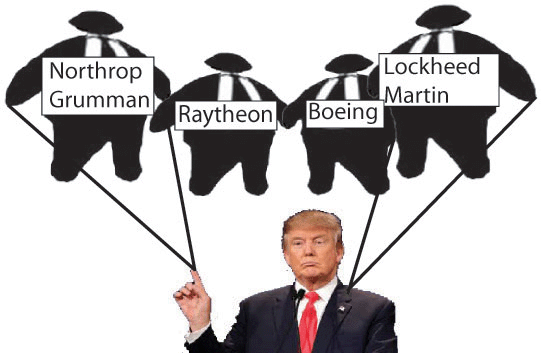
Oh goody! It’s a rosy time coming for investors, (such as Donald Trump) in nuclear weapons!

What It Would Cost to Modernize the U.S. Nuclear Arsenal — and Who Would Benefit, Yahoo Finance Lou Whiteman, The Motley Fool, Motley Fool, January 28, 2019  The United States would have to spend $494 billion over the next decade to enact its plan to modernize its nuclear arsenal, a figure that highlights the opportunity before contractors as the Pentagon seeks ways to pay for one of its top priorities. The total, which comes from a biannual report put out by the Congressional Budget Office (CBO), is 23% higher than the $400 billion price tag in the 2017 estimate. It comes at a delicate time for the Pentagon, which, after enjoying two years of steady budget increases, is facing a much less certain fiscal 2020 allocation.

……..Here’s who stands to benefit from the push to renew the nuclear triad.

Next-generation bombers

Northrop Grumman (NYSE: NOC) in late 2015 beat a team including Boeing (NYSE: BA) and Lockheed Martin to design and build a new long-range bomber. The Pentagon is expected to purchase at least 100 aircraft, with deliveries expected to begin in the mid-2020s and extend for a decade.

The plane, now known as the B-21, has been a near-casualty of Congressional budget battles in recent years, but the Pentagon continues to spend upwards of $2 billion per year on development. Overall, the CBO expects the Pentagon to spend $49 billion on bomber acquisition between now and 2028, which would easily make the B-21 Northrop’s most important platform……….

America’s most important deterrent

The Columbia-class submarine, designed to take over for the Ohio-class ballistic missile sub and house the nation’s stockpile of Trident sub-launched ballistic missiles, features a stealth electric drive propulsion system and improved maneuverability. The sub, to be built by General Dynamics’ (NYSE: GD) Electric Boat subsidiary with support from Huntington Ingalls (NYSE: HII), is due to be operational by 2028 to ensure second-strike capability should the U.S. be hit by a catastrophic attack………

A new rocket competition

The only major piece of the triad renewal still up for grabs is the task of replacing the nation’s arsenal of intercontinental ballistic missiles. …….In August 2017, the Air Force awarded Boeing and Northrop Grumman $349 million and $329 million, respectively, to develop competing new designs, with a goal of selecting a winner next year. The government is expected to spend more than $60 billion on ICBMs over the next decade, meaning the award would be a needle-mover for the eventual winner.

The stakes are also high for the two potential manufacturers of the solid-propellant rocket engines that will be used to power the missiles. Northrop brought one of the two contenders in-house last year with its $9.2 billion deal for Orbital ATK. The other, Aerojet Rocketdyne (NYSE: AJRD), has warned the Air Force and lawmakers it needs to win at least part of this procurement to remain a viable supplier.

Given the Pentagon’s priority to nurture a healthy and competitive supply base, it would not be a surprise to see both Aerojet and the former Orbital business split the ICBM engine award.

How to invest

…….for long-term investors who have seen defense holdings battered by near-term budget concerns, the longer timeline should provide some peace of mind. https://finance.yahoo.com/news/cost-modernize-u-nuclear-arsenal-163400604.html

January 29, 2019 Posted by | business and costs, USA, weapons and war | 1 Comment

France’s government snidely changes law to avoid paying compensation to Polynesian victims of atomic bomb testing

Dismay in Tahiti over changed nuclear compensation law  https://www.radionz.co.nz/international/pacific-news/381065/dismay-in-tahiti-over-changed-nuclear-compensation-law French Polynesia’s nuclear test veterans organisations are dismayed to find out that a planned change to the compensation law for test victims was quietly altered last year.

It emerged that in the finance act passed in France in the week before Christmas, a provision of negligible exposure for compensation claimants was included.

This was against the recommendation of a commission set up in 2017 which advised for the reference to negligible risk to be removed as a way to improve the 2010 compensation law.

There had been widespread clamour to change the law because most applications had been thrown out.

The head of the Moruroa e tatou organisation Roland Oldham told the public broadcaster that the situation was simple.

He said the French state refused to compensate the test victims by playing for time.

Father Auguste Uebe-Carlson of the Association 193 also condemned this change, saying the fight was continuing.

The 12-member commission which advised the French legislature was headed by a French Polynesian Senator Lana Tetuanui, who is yet to comment.

France tested 193 nuclear weapons in the South Pacific over a 30-year period, with some of the atmospheric blasts irradiating most islands.

January 29, 2019 Posted by | France, Legal, OCEANIA, weapons and war | Leave a comment

Scotland kow tows to UK and Australian govts – rejects courageous Aboriginal appeal against nuclear waste transport

Last ditch aborigine appeal to Scotland to stop nuclear waste transfers to Australia, https://www.heraldscotland.com/news/17391290.last-ditch-aborigine-appeal-to-scotland-to-stop-nuclear-waste-transfers-to-australia/?ref=fbshr&fbclid=IwAR3r2Lqdv0V66rc7I8PrKJme4mkAsIx2Wtd5bv-Vy_XeT1i3GOgi_Mr    By Martin Williams  29 Jan 19, SOME of the Aborigines who live in and around a sacred burial place in South Australia can still remember the clouds of poison that were the result of Britain’s nuclear bomb tests in the 1950s.

Many of the indigenous population claimed they were exposed to radiation as a result of the post-war atomic weapons tests in the desert and received compensation from the Australian government.

But a new kind of radiation could be heading to the remote sacred area of Wallerberdina – nuclear waste. The concerns are centred over a spot 280 miles north of Adelaide, which has become a potential location for Australia’s first nuclear dump.

The movement of waste is part of a deal that returns spent fuel processed at the nuclear facility currently being decommissioned to its country of origin.

Despite campaigners’ efforts it has emerged that David Peattie, chief executive of the Nuclear Decommissioning Authority (NDA), has insisted that there can be no change.

And now Aboriginal elder Regina McKenzie has made a last-ditch direct appeal to the First Minister for help to halt Dounreay’s dumping plans, calling for her “not to be part of the cultural genocide of Australian Aboriginal people”.

Mr Peattie said in a letter to UK campaigners who are fighting against the dumping: “The NDA does not have an option of retaining the waste in the UK.”

The Dounreay Waste Substitution Policy, agreed in 2012, sees waste from Australia, Belgium, Germany and Italy processed at the Scottish facility to make it safe for storage being returned to its country of origin.

The UK Government has previously confirmed that “a very small quantity of Australian-owned radioactive waste” is currently stored in the country.

Scottish Government policy allows for the substitution of the Dounreay nuclear waste with a “radiologically equivalent” amount of materials from Sellafield in Cumbria.

The proposed dump site is next to an indigenous protected area where Aborigines are still allowed to hunt, and is part of the traditional home of the Adnyamathanha people, one of several hundred indigenous groups in Australia. And Ms McKenzie, an Adnyamathanha woman who lives at Yappala in South Australia and leading campaigner against any dump, has told the Nicola Sturgeon in a letter that the substitution policy is “culturally inappropriate”.

Ms McKenzie, who has been trying to get a meeting with the First Minister since the start of last year, said: “Adnyamathanha people have lived and practised culture in our country since the beginning of time. We understand and have connections with our land in a way the Australian Government does not. It is our duty to care for our country, song/storylines for future generations.

“We know we have friends in Scotland and in the UK. My great grandfather was Joseph Thomas McKenzie from Aberdeen, so we have a great respect for our Scottish heritage. We ask that you do all in your power to cancel the agreement made with the British Government and send a message of support to our people that Scotland stands with us in our fight to protect our country.

“We have previously offered to crowdfund money to travel to Scotland to raise our concerns with you in person, and we extend the offer for you to visit us here on our country at the sacred women’s waterhole Pungka Pudinah so you can hear why we must protect our country, for all of our futures.

She has said the UK should not make the mistakes they did when the nuclear tests were conducted between 1956 and 1963 at Maralinga, part of the Woomera Prohibited Area in South Australia.

“Please do not be a part in cultural genocide of Australian Aboriginal people, the past atrocities that were practiced on all the nations of Aboriginal people, must be something of the past and not committed further,” she told Ms Sturgeon.

“This waste facility is just that, cultural genocide, it will stop future generations’ access to a significant site.

“Again I ask please listen with your ears and heart, be a voice for my people and help stop cultural genocide on a minority group only trying to keep our culture strong and survive.”

The local Aboriginal people claimed they were poisoned by the tests and, in 1994, the Australian Government reached a compensation settlement with Maralinga Tjarutja of $13.5 million in settlement of all claims in relation to the nuclear testing.

Despite the governments of Australia and the UK paying for two decontamination programmes, eight years ago concerns were expressed that some areas of the Maralinga test sites are still contaminated 10 years after being declared “clean”.

Campaigner Gary Cushway, a dual Australian-British citizen living in Glasgow, said the new appeal came after the reached deadlock on any movement in ditching the substitution policy. He said: “My argument remains the same, that the material shouldn’t be returned, at least until the final destination is known.”

the Aborigines from supporters in the UK was turned down by the First Minister. Rory Hedderly, the diary team manager, wrote back: “Unfortunately, due to considerable diary pressures, the First Minister is unable to meet with Ms McKenzie at this time.”

A Scottish Government spokesman said: “The Scottish Government believes any concerns expressed by indigenous people must be addressed and we sympathise with concerns relating to the location of the planned radioactive waste facility in Australia.

“However, this issue is a matter for the Australian authorities, who are responsible for waste arising from historic reprocessing of Australian spent fuels, carried out under contract at Dounreay.”

January 29, 2019 Posted by | AUSTRALIA, indigenous issues, opposition to nuclear, politics international, UK | Leave a comment

A bit of good news – Radioactive Cesium-137 diminishing in 2 Fukushima rivers, after close to 8 years

January 29, 2019 Posted by | Fukushima continuing | 1 Comment

Genetic effects of radiation, and other pollutants, in children of Gulf War veterans

January 29, 2019 Posted by | children, UK, weapons and war | Leave a comment

Aldermaston – Britain’s bomb factory – it’s a slow motion train crash

Times 27th Jan 2019 The AWE bomb factory starts to implode. Protesters wanted to shut Aldermaston in the 1960s. Today, it may have become its own worst enemy. Budget blow-ups and project delays, along with safety concerns aired repeatedly by the nuclear watchdog, have turned AWE into a slow-motion car crash.
Last year the National Audit Office (NAO), which polices government spending, confirmed what many in the industry had long feared: crucial projects to upgrade the facilities are in trouble. Pegasus, a £634m plan to replace a tired building at Aldermaston that handles and stores enriched uranium, is suspended with no clarity on when work will restart.
Mensa, a facility being built at Burghfield to assemble and dismantle nuclear warheads, has ballooned in cost from £734m to £1.8bn. It was due to open in 2017 but that has been delayed to 2023.
https://www.thetimes.co.uk/article/the-awe-bomb-factory-starts-to-implode-lg6vlc55b

January 29, 2019 Posted by | UK, weapons and war | Leave a comment

North Korea’s Nukes and the ‘Forgotten War’

Hampton Sides, author of a new book about a turning point in the Korea war, explores the state of the Koreas and Trump’s forthcoming visit.  Interview, Bloomberg, By Tobin Harshaw, January 28, 2019,

“……It is a cliche that the so-called police action in Korea from 1950 to 1952 is America’s “forgotten war.” But, like most cliches, there is a lot of truth to it. American ignorance about the Korean War is a shame, and not only because it devalues the sacrifices of those who fought in it. With North Korea’s nuclear arsenal now threatening the U.S. mainland (not to mention Hawaii, Japan and the folks on the southern end of the peninsula), and President Donald Trump and Kim Jong Un set to meet again next month, a little historical perspective might be helpful.

………. HS: Be mindful of the fact that North Korea’s fear and loathing of the U.S., however warped it seems, does have legitimate historical roots. During the Korean War, the U.S. bombed that country back to the Stone Age: Every building, every bridge, every village. The stated goal was to not leave a single brick standing upon another brick. That air campaign was gratuitous and cruel. We killed hundreds of thousands of civilians. We’re a country that has a habit of bombing people and then wondering why those people hate us. As we parse the madness that is the Kim regime, we should always keep in mind that this underlying history of “terror from above” figures into that madness.

Kim strikes many as a lunatic, but his nuclear strategy has actually been quite rational and effective in achieving his goals. So coaxing him to give up his nukes will take some extremely creative and forceful negotiating. The Hermit Kingdom desperately needs many, many things from the outside world — food, medicines, capital, technology, expertise and so on, and Kim knows this. A big question is whether he would really allow his own people to benefit in any meaningful way from the flow of goods and amenities that a removal of sanctions would usher in. Another question is whether he’d actually allow outside experts to come in and closely monitor his regime’s nuclear compliance. Caveats aside, we can only hope the talks continue. I’m highly skeptical of Trump’s much-avowed skills as a deal-maker, but a deal is certainly in the interest of the whole wide world.

……….. HS: It was repeatedly said during the 2016 campaign that Douglas MacArthur is Trump’s “favorite general.” I don’t get the sense that Trump reads history — or anything else, for that matter — but it’s a telling detail. Because with Douglas MacArthur you had a grandiose and vainglorious autocrat who had surrounded himself with sycophants and yes-men. He was a colorful and interesting character — in narrative terms, a gift that keeps on giving. But he was a thoroughgoing narcissist. It was said that he didn’t have a staff; he had a court. He didn’t want to hear inconvenient information. He didn’t like experts — he was the expert. He was in love with the vertical pronoun. It was all about him.This sounds extremely familiar to me.

………. Of course, Korea should never have been divided in the first place — drawing that line created one of the great geopolitical tragedies of modern times. Many thousands of families were torn apart and never allowed to see each other again. Historically speaking, there’s no difference between northern and southern Korea. It’s one country, one language, one culture, one people.

Or at least it was. After more than 70 years of living apart, a reunification, if by some miracle it ever happened, would be a wrenching and doubtless violent process. It’s not clear how a brainwashed and traumatized people from an impoverished police state integrates into the dynamic capitalist society that is modern South Korea. Still, I believe it’s destined to happen one day.https://www.bloomberg.com/opinion/articles/2019-01-27/korean-war-in-current-events-from-the-1950s-to-a-nuclear-north

January 29, 2019 Posted by | history, North Korea, politics international, USA | Leave a comment