“We want energy security to be provided at all times,” the minister told broadcaster ZDF, but added: “We do not want to import cheap nuclear power from other countries.”
Germany‘s coal commission on Jan. 26 said the country should shut down all of its coal-fired power plants by 2038 at the latest, proposing at least 40 billion euros ($45.7 billion) in aid to regions affected by the phase-out.
US to Offer Nuclear Waste Technology to Other Countries https://learningenglish.voanews.com/a/us-to-offer-nuclear-waste-technology-to-other-countries/4758652.html Susan Shand. The U.S. Department of Energy’s nuclear security office is developing a project to help other countries deal with nuclear waste. The information comes from two sources who spoke to the Reuters news agency. They asked not to be named because of the sensitivity of the issue.The sources say the plan aims to keep the United States competitive against other countries that are developing their own waste technology. For example, both Russia and France offer services to take care of nuclear waste.
Dov Schwartz is the spokesman for the National Nuclear Security Administration. He confirmed the group is thinking about how to help other countries reduce nuclear waste. However, Schwartz did not give details.
The NNSA also declined a Reuters request for an interview with Brent Park, who is leading the effort.
What would the technology do?
The unnamed sources say the technology could involve crushing, heating or sending an electric current through nuclear waste to reduce its size.
The machinery to do so would be put in a “black box” the size of a shipping container. It would be sent to other countries with nuclear energy programs; however, it would remain owned and operated by the United States, the sources said.
The sources did not name countries to which the service would be offered. They also did not say where the waste would be stored after it is run through the equipment. But they said they were worried the processes could increase the risk of dangerous materials reaching militant groups or nations unfriendly to the United States.
Former U.S. President Jimmy Carter banned nuclear waste reprocessing in 1977. The reprocessing opens pure amounts of uranium and plutonium, both of which could be used to make nuclear bombs.
NNSA spokesperson Dov Schwartz said the plans under consideration do not involve reprocessing. But he did not say what technologies could be used.
Concerns
The government of U.S. President Donald Trump has made promoting nuclear technology abroad a high priority. The U.S. Energy Secretary, Rick Perry, visited Saudi Arabia this month for talks on a nuclear energy deal with the kingdom. And the American business Westinghouse hopes to sell nuclear power technology to countries from Saudi Arabia to India.
But a top arms control officer during the Obama administration questions the direction of the Trump government. Thomas Countryman said the U.S. should improve its ability to get rid of its own nuclear waste before helping other countries.
A nuclear expert at the Union of Concerned Scientists also expressed some doubt about the NNSA plan. Edwin Lyman said NNSA should not be focused so much on reducing the size of nuclear waste. Instead, it should be concerned about the dangers of nuclear waste that make it hard to store.
Lyman said even a small amount of nuclear waste gives off radioactivity and heat. It “remains dangerous for hundreds of thousands of years,” he said.
‘Deadly, toxic business’: New Mexico will reject nation’s nuclear waste, activists vow, Orange County Register, 27 Jan 19
Plan to keep waste at reactor sites is working fine, they say
In Southern California, the greatest hope for removing highly radioactive nuclear waste from the quake-prone coast might be those private, temporary storage sites that need licenses from the federal government to open.
But in New Mexico — where Holtec International wants to build such a site that could store waste from San Onofre, Diablo Canyon and scores of other commercial reactors — locals vow to do everything in their power to keep the state from becoming America’s biggest nuclear waste dump.
“The rush is on by the Nuclear Regulatory Commission to grant Holtec a license before the people realize we’re being sacrificed for another government nuclear experiment,” said Noel Marquez, an artist and member of the Alliance for Environmental Strategies.
“We’re having to research, for ourselves, the long-term consequences of this deadly, toxic business. We’re being targeted for environmental injustice.”
The passionate show-of-force came Tuesday, the day before the NRC’s three-judge Atomic Safety and Licensing Board heard oral arguments from project opponents in Albuquerque. The aim is to figure out which groups have standing with the NRC to oppose the Holtec project, but legal challenges to the plan are under way in other courts as well.
Below the radar, the NRC’s plan for temporarily storing nuclear waste is actually working pretty well, said Terry Lodge, an attorney for opponents: “They are storing waste at nuclear reactor sites, relatively uneventfully and not particularly expensively,” he said.
That, to many Californians near the shuttered San Onofre and Diablo Canyon plants, is exactly the problem.
‘Entire project is illegal’
Those familiar with America’s nuclear waste wars may be experiencing Yucca Mountain deja vu.
New Mexico, like Nevada, has no commercial nuclear reactors. Many New Mexicans, like many Nevadans, don’t want to become the nation’s nuclear dump. But New Mexicans, unlike Nevadans, have a different legal argument to make.
Congress’ Nuclear Waste Policy Act of 1982 forbids permanent waste storage on the Earth’s surface, and — given the federal government’s decades-long paralysis in finding a permanent, deep geologic repository — Holtec’s temporary facility could well wind up being a permanent one, they say.
“The entire project is illegal,” said Diane Curran, an attorney representing the group Beyond Nuclear. If New Mexicans “step up and say, ‘We’ll take it in our above-ground facility,’ I’m really afraid you’ll have it forever — a shallow graveyard for the nation’s nuclear waste.”
At a press briefing Tuesday, opponents raised the specter of cracked and damaged fuel canisters and/or rods; of dangers related to transporting canisters from all corners of the country to New Mexico by road or rail; and of the “geologic unsuitability” of the Southeastern New Mexico site, where there are underground caves, sinkholes from mining and brine that could corrode the storage containers. They also painted Holtec as an opportunistic player trying to maximize its profits and eliminate all risk.
Telegraph 26th Jan 2019 The developer of the Hinkley Point C nuclear plant is exploring a retreat from the UK as government energy policies take a toll on the industry’s largest players. Cash-strapped French utility EDF is weighing a range of options to distance itself from the British energy market.
The Sunday Telegraph understands from multiple industry sources that they include a potential spin-off of its energy-supply business in a merger with a fast-growing start-up. The move has been “on the table for at least a
year”, according to one senior figure, but it is being approached with caution by EDF’s Paris head office amid concern over the political implications.
A retreat by EDF would be likely to anger the Government. Ministers agreed to fund the Hinkley Point C nuclear plant in a complex deal which is likely to cost energy bill payers about £50bn over the lifetime of the project. EDF has remained committed to supplying gas and power to about 5m UK customers despite making losses for almost a decade, according to official figures.
Its place as one of the Big Six energy incumbents is considered politically important as it pushes ahead plans for
another two nuclear power projects with support from China. EDF is locked in negotiations with the Government over plans to fund its plans for a reactor at Sizewell C. Discussions about a step back from the energy-supply
market began after the departure of long-serving boss Vincent De Rivaz in 2017.
The radical proposal came as EDF faced mounting pressure from the Government’s energy price cap, and rising competition from the flood of start-ups into the market. Energy bosses are up in arms over the Government’s conflicting energy policies which demand companies keep bills low while paying higher costs for clean energy and the roll-out of smart meters.
EDF’s challenges are further complicated by its ageing portfolio of existing nuclear plants, where profits are falling due to low market prices for electricity and the weak pound. It is considering the sale of a minority stake in the reactors, which supply a fifth of the UK’s electricity, alongside its partner Centrica. The parent company of British
Gas has confirmed plans to sell its 20pc stake in the reactors and industry sources say EDF hopes to sell another 29pc from its share within the same transaction. The deal is understood to have caught the eye of a consortium
of pension funds which would hold a minority share of the business while EDF remains the operator of the nuclear reactors. https://www.telegraph.co.uk/business/2019/01/26/edf-weighing-retreat-energy-market-uk/
A consortium led by Rolls-Royce has asked for more than £200m in government funding to help develop its project for small nuclear reactors, as ministers scramble to recast Britain’s energy policy after the collapse of plans to build several large reactors. The engineering group and its partners, which include Laing O’Rourke and Arup, want to secure a sum “in the low hundreds of millions”, confirmed one person with knowledge of the request. Any amount would be match-funded by the consortium and be used to develop Rolls-Royce’s technology through to the later stages of the licensing process in order to be able to attract private investment.
Supporters of small modular reactors — most of which will not be commercial until the 2030s — argue that they can deliver nuclear power at lower cost and reduced risk. They will draw on modular manufacturing techniques that will reduce construction risk, which has plagued larger-scale projects.
The consortium has applied for funding from the government’s industrial strategy challenge fund under UK Research and Innovation. The money would enable the group to develop its design through to the later stages of the “generic design assessment” by the industry regulator. Industry sources with knowledge of the bid said the consortium “entered detailed negotiations” with UKRI before Christmas. Rolls-Royce has previously said it believes its reactor would cost about £2.5bn to build.
The push comes as the UK’s long-term energy policy has been thrown into chaos by the collapse of three new nuclear projects, after Hitachi’s decision earlier this month to freeze its involvement in the Wylfa plant in north Wales.
More than 40 per cent of the UK’s planned new nuclear capacity has in effect been cancelled, with Toshiba pulling out of developing a plant in Cumbria last year, while Hitachi has scrapped plans for another plant in Oldbury-on-Severn in Gloucestershire. The UK government said it remained committed to developing nuclear plants with the private sector but has baulked at the cost and level of support investors have demanded. It is due to publish a white paper this summer that will overhaul its energy strategy. While nuclear is expected to remain part of the mix, the government is keen to examine new funding models and approaches.
Business secretary Greg Clark said in a letter to the Financial Times last week that “small modular reactors can have a role to play” but again cautioned these plans could not be “at any price”. Rolls-Royce and its team is one of several consortiums that bid in a government-sponsored competition launched in 2015 to find the most viable technology for a new generation of small nuclear power plants. However, when a nuclear sector deal was finally unveiled last June, the government allocated funding only for more advanced modular reactors.
SMR’s, which typically use water-cooled reactors similar to existing nuclear power stations, were omitted from funding even though they were closer to becoming commercial.
Rolls-Royce threatened last summer that it would shut down the project if there was no meaningful support from the government. It has already significantly reduced the number of staff working on the project. The business department said the government was “considering” a funding bid from a UK consortium to support research and development of a low-cost SMR”. A decision was expected “in spring 2019”. Rolls-Royce said: “Our consortium is in discussions with UK government officials that we hope could result in a significant joint investment in our power plant design.”
Swedish school strike activist demands economists tackle runaway global warming. Read her Davos speech here,
Our house is on fire. I am here to say, our house is on fire.
According to the IPCC (Intergovernmental Panel on Climate Change), we are less than 12 years away from not being able to undo our mistakes. In that time, unprecedented changes in all aspects of society need to have taken place, including a reduction of our CO2 emissions by at least 50%.
And please note that those numbers do not include the aspect of equity, which is absolutely necessary to make the Paris agreement work on a global scale. Nor does it include tipping points or feedback loops like the extremely powerful methane gas released from the thawing Arctic permafrost.
At places like Davos, people like to tell success stories. But their financial success has come with an unthinkable price tag. And on climate change, we have to acknowledge we have failed. All political movements in their present form have done so, and the media has failed to create broad public awareness.
But Homo sapiens have not yet failed.
Yes, we are failing, but there is still time to turn everything around. We can still fix this. We still have everything in our own hands. But unless we recognise the overall failures of our current systems, we most probably don’t stand a chance.
We are facing a disaster of unspoken sufferings for enormous amounts of people. And now is not the time for speaking politely or focusing on what we can or cannot say. Now is the time to speak clearly.
Solving the climate crisis is the greatest and most complex challenge that Homo sapiens have ever faced. The main solution, however, is so simple that even a small child can understand it. We have to stop our emissions of greenhouse gases.
Either we do that or we don’t.
You say nothing in life is black or white. But that is a lie. A very dangerous lie. Either we prevent 1.5C of warming or we don’t. Either we avoid setting off that irreversible chain reaction beyond human control or we don’t.
Either we choose to go on as a civilisation or we don’t. That is as black or white as it gets. There are no grey areas when it comes to survival.
We all have a choice. We can create transformational action that will safeguard the living conditions for future generations. Or we can continue with our business as usual and fail.
That is up to you and me.
Some say we should not engage in activism. Instead we should leave everything to our politicians and just vote for a change instead. But what do we do when there is no political will? What do we do when the politics needed are nowhere in sight?
Here in Davos – just like everywhere else – everyone is talking about money. It seems money and growth are our only main concerns.
And since the climate crisis has never once been treated as a crisis, people are simply not aware of the full consequences on our everyday life. People are not aware that there is such a thing as a carbon budget, and just how incredibly small that remaining carbon budget is. That needs to change today.
No other current challenge can match the importance of establishing a wide, public awareness and understanding of our rapidly disappearing carbon budget, that should and must become our new global currency and the very heart of our future and present economics.
We are at a time in history where everyone with any insight of the climate crisis that threatens our civilisation – and the entire biosphere – must speak out in clear language, no matter how uncomfortable and unprofitable that may be.
We must change almost everything in our current societies. The bigger your carbon footprint, the bigger your moral duty. The bigger your platform, the bigger your responsibility.
Adults keep saying: “We owe it to the young people to give them hope.” But I don’t want your hope. I don’t want you to be hopeful. I want you to panic. I want you to feel the fear I feel every day. And then I want you to act.
I want you to act as you would in a crisis. I want you to act as if our house is on fire. Because it is.
This is an edited version of a speech given by Greta Thunberg at Davos this week.
Why Excluding Nuclear, Fossils With Carbon Capture, & Biofuels From The Green New Deal Makes Financial & Climate Sense, Clean Technica January 24th, 2019 , By Mark Z. Jacobson & Mark A. DelucchiThe Green New Deal and multiple proposed laws and resolutions in the U.S. House (HRes.540, HR.3314, HR.3671) and Senate (SRes.632, S.987) call for the United States to move entirely from fossil fuels to clean, renewable electricity and/or all energy. A new bill was just introduced by Rep. Ted Lieu (D-Los Angeles County) and Rep. Jimmy Gomez (D-CA), calling for the U.S. to produce 100 percent of its electric power from renewables by 2035.
Recently, though, some vocal advocates have pushed back, claiming that the only way prices will stay low with large amounts of renewables on the power grid is to use nuclear power, fossil fuels with carbon capture, and biofuels, which they claim are “zero carbon.”
Here is why nuclear, fossils with CCS, and biofuels should be excluded.
All three technologies are opportunity costs. They raise costs to consumers and society, slow solutions to global warming and air pollution by increasing carbon and emissions relative to clean, renewables (thus are not zero carbon), and/or create risks that clean, renewables don’t have.
For example, onshore wind and utility PV are now the cheapest forms of electricity in most countries, including the U.S. New nuclear today costs 4 to 6 times that of new solar or wind to produce the same electricity. Further, a nuclear plant takes 5 to 17 years longer between planning and operation than does a solar or wind farm.
Thus, every dollar spent on nuclear results in 1/5th the energy production and 5 to 17 years more coal and gas burning than if wind or solar were installed instead. This delay and lower energy production from new nuclear condemns millions more to die from air pollution, which today kills 4 to 9 million people worldwide.
By choosing to build several nuclear plants a decade ago that have yet to operate, China suffered an increase in its overall CO2 emissions by 1.4 percent between 2016 and 2017 rather than seeing a decrease of 3.4 percent if it had spent the money on wind and solar instead.
Given that many 100% renewable policies call for a full transition of electricity by 2035, and given the financial and time requirements of nuclear, it is all but impossible for any more than a few new nuclear plant to be in place in by then.
In terms of emissions, nuclear is not zero carbon. A new plant emits 9 to 37 times the carbon emissions over its life as onshore wind, partly due to the fossil fuels used in mining and refining uranium continuously and building the facility but more because coal and gas plants are emitting during the long planning-to-operation time of a nuclear plant.
Just as importantly, according to the Intergovernmental Panel on Climate Change, there is “robust evidence and high agreement” that nuclear power raises concerns about weapons proliferation, core meltdown, creation and storage of radioactive waste, and land-use degradation from mining. Wind and solar power do not have these concerns.
Next, neither coal nor natural gas with carbon capture and sequestration (CCS) is remotely close to zero carbon. For example, the Petra Nova project in Texas combines a coal plant with CCS. However, a natural gas plant was built just to run the CCS equipment, and when accounting for the actual efficiency, natural gas combustion emissions, CO2 combustion emissions, and methane leaks from mining the gas, the plant reduces only 22 percent of the carbon it was designed to over 20 years – at an additional cost of $4,200/MW. That same investment could have been spent on wind and solar to replace the entire coal plant and 100% of its emissions.
Adding CCS to coal plants also increases air pollution and land degradation by about 25 percent. Finally, the captured CO2 is used for enhancing oil recovery, causing even greater damage to climate and health. Thus, CCS represents an enormous opportunity cost compared with developing wind or solar.
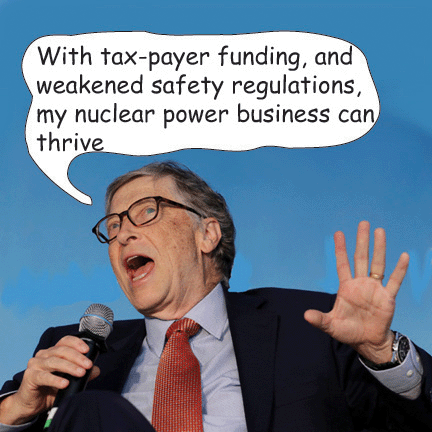
Bill Gates comes to Washington — selling the promise of nuclear energy, WP, By Steven Mufson, January 25
Bill Gates thinks he has a key part of the answer for combating climate change: a return to nuclear power. The Microsoft co-founder is making the rounds on Capitol Hill to persuade Congress to spend billions of dollars over the next decade for pilot projects to test new designs for nuclear power reactors.
Gates, who founded TerraPower in 2006, is telling lawmakers that he personally would invest $1 billion and raise $1 billion more in private capital to go along with federal funds for a pilot of his company’s never-before-used technology, according to congressional staffers…….
Gates said in his year-end public letter. “The problems with today’s reactors, such as the risk of accidents, can be solved through innovation.” …..
But many nuclear experts say that Gates’s company is pursuing a flawed technology and that any new nuclear design is likely to come at a prohibitive economic cost and take decades to perfect, market and construct in any significant numbers.
Lawmakers are listening to him. Through the Energy Department, Congress approved $221 million to help companies develop advanced reactors and smaller modular reactors in fiscal 2019, above the budget request. But Gates and TerraPower, which received a $40 million Energy Department research grant in 2016, are looking for more. …….
Edwin Lyman, a nuclear expert at the Union of Concerned Scientists, said TerraPower is one of many companies that is raising the public’s hopes for advanced nuclear reactor designs even though they’re still on the drawing boards and will remain unable to combat climate change for many years.
“We think the vendors of advanced nuclear power designs are saying they can commercially deploy them in a few years and all over the world,” Lyman said. “We think that is counterproductive because it is misleading the public on how fast and effective these could be.” ……
Many nuclear power experts say that the technology Gates is promoting — called a “traveling wave reactor” — does not work as advertised, at least not yet. “These designs . . . require advances in fuel and materials technology to meet performance objectives,” a Massachusetts Institute of Technology report said last year.
TerraPower has changed key elements of its design and has still not resolved critical problems, experts say……
critics say TerraPower has been stumbling over a handful of obstacles.
First, TerraPower has discovered that the traveling wave didn’t travel so well and that it would not evenly burn the depleted uranium in the “candle.” Second, and partly as a result, it needed to change the design to reshuffle the fuel rods — and do that robotically while keeping the reactor running. Third, it has struggled to find a metal strong enough to protect the fuel rods from a bombardment of neutrons more intense than those commonly used in reactors — and for a much longer period of time…….
In many ways, TerraPower’s design resembles fast breeder reactors. Fast breeders have faster moving neutrons, the subatomic particles that trigger fission.
Allison Macfarlane, former chairman of the Nuclear Regulatory Commission, said earlier versions of fast breeder reactors have turned in a “dismal performance.” The United States built two small reactors at a government laboratory in Idaho, Japan built a commercial unit called Monju, and France built two called Phenix and Superphenix — and all of them have been shut down.
………TerraPower has also been working with the Energy Department on another reactor. If it moved ahead, it could obtain federal funds for 60 percent of the cost of a test reactor, Burkey said. That design would rely on molten salt as both coolant and fuel. TerraPower believes an advanced molten salt reactor could be more efficient and produce less waste than current models.
They said the Republican decision could allow plants to avoid protections against risks of natural disasters that have become apparent with science methods that have evolved since most plants were built about 40 years ago. …….
Commissioner Jeff Baran, a Democrat, said NRC staff had included the extra safety measures in the draft after years of work, but Republicans had jettisoned them.
“Instead of requiring nuclear power plants to be prepared for the actual flooding and earthquake hazards that could occur at their sites, the NRC will allow them to be prepared only for the old out-of-date hazards typically calculated decades ago when the science of seismology and hydrology was far less advanced than it is today.”
NRC Chairman Kristine Svinicki, a Republican, said after the vote that the commission’s work since 2011 has resulted in “tangible safety improvements at every U.S. nuclear power plant.” ……..
A nuclear power safety advocate said new information showed that plants may experience bigger floods and earthquakes than they are now required to withstand, and that it is possible the commission will not require nuclear plants that face greater hazards to make upgrades.
The U.S. Military Wants Tiny Road Mobile Nuclear Reactors That Can Fit In A C-17
The power demands to sustain American military operations are only increasing, but small nuclear power plants could present new problems.The Drive, BY JOSEPH TREVITHICK, JANUARY 24, 2019 The U.S. military’s secretive Strategic Capabilities Office, or SCO, is asking for potential vendors to submit proposals for small mobile nuclear reactors to help meet ever-growing demands for power during operations in remote and austere locations. This request for information comes as the U.S. Army, in particular, is looking to extend the amount of time its units can operate independent of established supply chains, but portable nuclear power could introduce new risks to the battlefield.
SCO first announced that they were looking for “information on innovative technologies and approaches” relating to a possible future “small mobile nuclear reactor prototype design” on FedBizOpps, the U.S. government’s main contracting website, on Jan. 18, 2019. The organization posted an amended version of the notice, which outlines a “multi-phase prototype project” as part of what it is calling Project Dithulium, four days later. …..
SCO basic requirements envision a reactor that can generate between one and 10 megawatts of energy, less than the average output for even a small research reactor, and weigh less than 40 tons. The final design would need to be portable by semi-trailer truck, ship, or a U.S. Air Force C-17A Globemaster III cargo plane.
The goal is to develop a system that personnel can set up in three days or less and shut down and pack up in less than a week. The reactor itself would remain functional for at least three years without needing new fuel.
SCO is hoping to consider up to three designs under the first phase of the project, which would be an in-depth design study that would last between nine and 12 months. The plan is to then down select to a single design for Phase II, in which the winning contractor would build and demonstrate their prototype reactor.
There are a number of potential concepts already in various stages of development that could meet SCO’s requirements. The U.S. Department of Energy’s own Los Alamos National Laboratory (LANL), in cooperation with the Westinghouse power company, has been working on one design called MegaPower for some time now. Westinghouse is separately working on its own eVinci micro reactor design……….
There is no fixed timeline yet for when Phase I might begin, but as the request for information notes, there is already significant demand for this kind of miniaturized portable power plant. …….
The Army is certainly watching the SCO’s Project Dithulium, if it isn’t involved in it directly. In October 2018, the service put out its own report on the potential uses of nuclear power on the battlefield………
The other branches of the U.S. military have their own requirements for this kind of portable power, as well. The Air Force and the Marine Corps are both actively exploring new concepts for rapidly establishing bases that could benefit from the addition of power from small nuclear reactors.
But this is hardly the first time the U.S. military has explored using mobile nuclear reactors to meet its power needs. The Army experimented with a host of land-based designs between the 1950s and 1970s, before shelving the concept………
However, one of the biggest potential problems with battlefield nuclear power continues to be safety. There are obvious concerns about what happens when you begin deploying dozens, if not hundreds of small nuclear reactors into areas that are, by definition, full of hostile threats……
even if the reactor itself cannot catastrophically fail, something that may be a tall order to ensure in austere conditions regardless of the design, powering remote and austere bases with nuclear power could run other risks. If hostile forces end up destroying the reactor, it could potentially lead to the hazardous dispersal of radioactive material.
This, in turn, could produce short- and long-term health and safety concerns for U.S. forces and innocent civilians in the surrounding area. Even if the risk is minor, the perception of those dangers could impact public opinion about American military activities ….
There’s also a proliferation issue in building a large number of mobile reactors and placing them in war zones. There is also a matter of disposing of the nuclear waste material they’ll produce. …..
A reactor that is by design mobile would almost certainly be an attractive target for terrorists or militants looking to build a so-called “dirty bomb” that mixes radiological material and conventional explosives. ….
On top of that, unlike existing portable generators, any mobile nuclear reactor would require much more robust control systems to ensure its safe and reliable operation. Depending on the reactor’s exact configuration, there is the possibility that a cyber attack might be able to shut it down or otherwise hamper its operation at a critical point.
A renewed nuclear arms race, rising greenhouse gas emissions and the emergence of state-sponsored disinformation campaigns have left the modern world as close to annihilation as it was at the height of the Cold War, atomic scientists said on Thursday.
What is the Doomsday Clock?
The Doomsday Clock, created by the Bulletin of the Atomic Scientists as an indicator of the world’s susceptibility to apocalypse, remained at two minutes to midnight for a second year running in what the scientists called a dangerous “new abnormal.”
“Though unchanged from 2018, this setting should be taken not as a sign of stability but as a stark warning to leaders and citizens around the world,” the Chicago-based group said in a statement.
Two main factors
Humanity’s two simultaneous existential threats of nuclear war and climate change were exacerbated during the past year by the “increased use of information warfare to undermine democracy around the world,” the group said.
“In many forums, including particularly social media, nationalist leaders and their surrogates lied shamelessly, insisting that their lies were truth, and the truth ‘fake news,'” it said.
Nuclear threat
Since the election of US President Donald Trump in 2016, the clock has closed in on midnight in successive 30-second moves in 2017 and 2018, in part because of escalating tensions with North Korea over its nuclear program.
The last time the clock was as close to midnight as it has been in the past two years was in 1953, when the US-Soviet arms race escalated as Moscow tested a hydrogen bomb in August after the detonation of an American H-bomb the previous November.
Despite a softening of barbed rhetoric between Trump and North Korean leader Kim Jong Un over the past year, the group saw rising threats in nuclear-armed nations’ programs of “‘nuclear modernisation’ that are all but indistinguishable from a worldwide arms race.”
On climate, the group said carbon dioxide emissions resumed an upward climb in the past two years.
Clocking out
To turn back the clock, it recommended steps including fortifying and extending US-Russian nuclear treaties with limits on modernisation programs, adopting safeguards to prevent peacetime military incidents along NATO countries’ borders, citizen demands for action on climate change and multilateral talks to discourage the misuse of information technology.
The bulletin was founded by scientists who helped develop the United States’ first atomic weapons. When the clock was created in 1947, it was set at seven minutes to midnight.
Company defends plans for nuclear waste storage facility https://www.sfchronicle.com/news/article/Holtec-defends-plans-for-nuclear-waste-storage-13558485.php, By SUSAN MONTOYA BRYAN, Associated Press Jan. 24, 2019 ALBUQUERQUE, N.M. (AP)— A New Jersey-based company on Thursday defended plans to build a multibillion-dollar facility in the New Mexico desert to store spent fuel from commercial reactors around the United States, citing long-standing yet unmet obligations by the federal government to find a permanent solution for dealing with the tons of waste building up at the nation’s nuclear power plants.
The project proposed by Holtec International would allow for spent fuel rods to be transferred from dozens of sites around the country to a more secure temporary home in southeastern New Mexico, said Jay Silberg, an attorney representing the company.
“We believe that this is an extremely important facility for this nation,” Silberg told members of a U.S. Nuclear Regulatory Commission panel during the second day of a public meeting in Albuquerque.
It will be up to the panel to decide which environmental and nuclear watchdog groups have standing to intervene in the case and which objections they can pursue as federal regulators weigh whether to grant a license to Holtec.
Reams of documents have already been submitted to the commission, and the overall process is expected to be lengthy.
A Texas-based company also has applied for a license to expand its existing hazardous waste facility in Andrews County to include an area where spent fuel could be temporarily stored.
Opponents have raised concerns about the legality of the project, the safety of transporting the high-level waste across the country and the potential exposure and water and soil contamination if something were to go wrong along the way or at the site once the material was delivered.
Attorneys for the Sierra Club, Beyond Nuclear and other groups also are worried that risks could escalate if Holtec is allowed to reject and return damaged, leaking or contaminated casks that are transported to New Mexico.
The attorneys also focused on the proposed location, which is more than 30 miles from the nearest city but still in the heart of a congested region that’s experiencing a major oil and gas boom.
Holtec experts testified that there’s no evidence of land caving in at the site, that earthquakes are not believed to be a credible threat and that while it would not be able to repackage the waste if a container is damaged, it would be able to “take steps” to remedy problems that might arise.
Carlsbad City Councilor Jason Shirley told the panel that his community supports the project, saying it would result in more jobs and local tax revenue.
The Nuclear Regulatory Commission on Wednesday agreed to temporarily delay issuing a new operating license for Seabrook Nuclear Power Station, a massive 1,244-megawatt generator owned by NextEra.
In a notice, the NRC said it would delay relicensing the coastal New Hampshire plant through 2050 until the commission meets with the public.
Last week, congressional delegates from Massachusetts and New Hampshire wrote to the NRC seeking a delay until a hearing can be held this summer on problems with the plant’s structural concrete.
The concrete suffers from alkali-silica reaction, or ASR. The swelling and cracking was identified by plant operators in 2009. NextEra developed a plan to manage and monitor the deformation, a plan that the federal commission has accepted.
A hearing on the concrete problems, to be held before a panel of administrative judges, is set for this summer. A nuclear watchdog group, the C-10 Research & Education Foundation, plans to challenge NextEra’s plan for managing the ASR……..
Last week, Massachusetts Sens. Edward J. Markey and Elizabeth Warren joined U.S. Rep. Seth Moulton to ask that licensing be stayed until the ASR hearing can be held. From New Hampshire, Sen. Jeanne Shaheen, Sen. Margaret Wood Hassan and Rep. Chris Pappas also wrote to the NRC, saying more public involvement was needed. ……..https://www.masslive.com/politics/2019/01/feds_agree_to_delay_relicensin.html
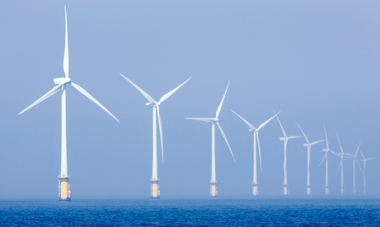
Forget nuclear woes and increase offshore wind targets, says boss of leading utility, Owjonline 25 Jan 2019 by David Foxwell The chief executive of one of the UK’s leading utility companies has called on the government to increase targets for offshore wind energy after plans for another nuclear power station were put on hold.SSE chief executive Alistair Phillips-Davies said the UK should be grateful that in offshore wind it has an ‘off the shelf’ answer to the problem of how the country can decarbonise energy cost-effectively while securing jobs and growth for the UK economy.
He is well-qualified to comment on energy policy in the country, having become chief executive of SSE in 2013 after working in the energy industry since 1997, when he joined Southern Electric.
“Later this year our Beatrice offshore windfarm, the largest project in Scotland, will be completed, and will begin exporting low carbon electricity to the grid,” he said. “It is one of many projects delivered to time and budget, which have helped bring the costs down substantially.
“Last year UK Energy Minister Claire Perry set out an ambition of an additional 1-2 GW of offshore wind per year during the 2020s taking the UK to a total of between 20 and 30 GW, meaning it could be the generation technology with the largest installed capacity in the UK.
“The sector has responded, and an Offshore Wind Sector Deal will be finalised later this year setting out the industry’s substantial commitments to the UK’s industrial strategy. The question now is whether 30 GW by 2030 is ambitious enough,” Mr Phillips-Davies said.
“In the coming months, the government will receive advice from the Committee on Climate Change on the implications of increasing its decarbonisation target from an 80% reduction in emissions by 2050 to net zero.
“In light of the IPCC report last year, SSE supports the adoption of a net zero target, and the implications will be a need to go faster and harder on decarbonising electricity as the driver for decarbonising heat and transport.”
Weather and climate aren’t the same thing, meaning you can expect harsher winters in a warming world.
BY SARAH GIBBENSA record-breaking cold snap is relentlessly descending on parts of the U.S. this month. It spawned from a split polar vortex that sent cold, Arctic air across the continent.
In a time when climate change is discussed in the context of record highs, droughts, and wildfires, cold weather and blizzards can seem out of place. For those who deny that climate change is happening, it’s an opportunity to undermine scientific consensus.
How do you explain a cold winter in a world that scientists say is getting hotter?
First, it’s important to understand the difference between climate and weather. Climate is defined as the average weather patterns in a region over a long period of time. It’s the difference between Europe’s temperate and Mediterranean zones versus the harsh cold conditions of the Arctic tundra. Each of these climate regions experiences day-to-day fluctuations in temperature, precipitation, air pressure, and so on—daily variations known as weather.
How warming can lead to cooling
When the term global warming was popularized a few decades ago, it referred to the phenomenon of greenhouse gases trapping heat in the atmosphere and warming the average temperature of the planet. Though record high temperatures in many places have been one impact of this decades-long shift, scientists now understand that an atmosphere changed by rising levels of gases like carbon and methane leads to more climate changes than just warming.
Scientists believe Earth will experience more extreme, disastrous weather as the effects of climate change play out.
n response to President Trump’s January 20 tweet about cold temperatures, Potsdam University physicist Stefan Rahmstorf noted on Twitter that, while North America was experiencing cold Arctic air, the rest of the world was abnormally hot. And, the polar vortex bringing that cold air to the U.S. may actually become increasingly unstable, Rahmstorf noted.
As more Arctic air flows into southern regions, North America can expect to see harsher winters. That was the conclusion of a study published in 2017 in the journal Nature Geoscience. It found a link between warmer Arctic temperatures and colder North American winters. A separate study published in March of last year in the journal Nature Communicationsfound the same link but predicted the northeastern portion of the U.S. would be particularly hard hit.
“Warm temperatures in the Arctic cause the jet stream to take these wild swings, and when it swings farther south, that causes cold air to reach farther south. These swings tend to hang around for awhile, so the weather we have in the eastern United States, whether it’s cold or warm, tends to stay with us longer,” said study author Jennifer Francis in a press release.
A future of extreme weather
Record cold temperatures and blizzards aren’t the only extreme weather patterns expected.
High altitude, east-to-west winds known as jet streams rely on the difference between cold Arctic air and warm tropical air to propel them forward. As the air in the Arctic warms, those jet streams slow and prevent normal weather patterns from circulating—floods last longer and droughts become more persistent. One study published in Science Advanceslast October predicted extreme, deadly weather events could increase by as much as 50 percent by 2100.
But we don’t have to wait until 2100 to see how climate change is leading to deadly weather.
Tell Congress: Prevent Nuclear Catastrophe in Iran
Read the Public Inquiry Report, the Commissioners’ report, Surrendering Australia: The AUKUS Deception is available to download for free at aukuspublicinquiry.com. Or just watch the replay of the National Press Club Luncheon.