Judge refuses to unseal criminal charges against Assange
U.S. District Judge Leonie Brinkema said in a 10-page ruling that free-press advocates seeking to unseal the charges have no proof Assange has actually been charged.
The Reporters Committee for the Freedom of the Press sought to unseal the charges after a federal prosecutor inadvertently typed a reference to “the fact that Assange has been charged” in an unrelated case.
The government has acknowledged it made an error but has not publicly confirmed that charges against Assange have been filed.
After the mistake was made, news outlets including The Associated Press reported that Assange has indeed been charged. But those reports relied on anonymous sources.
The precise charges against Assange are unclear. The Wikileaks founder has been staying in the Ecuadorian Embassy in London since 2012 under a grant of asylum and has long expressed fear of a U.S. prosecution. WikiLeaks has served as a vehicle for release of thousands of classified U.S. military and diplomatic cables. In addition, WikiLeaks’ role in releasing emails hacked from the Democratic National Committee in 2016 has also been under scrutiny as special counsel Robert Mueller has investigated Russian interference in the 2016 election and whether the Trump campaign was involved.
Criminal charges typically remain secret and under seal until a defendant has been arrested to prevent a target from fleeing prosecution or destroying evidence. Lawyers for the free-press foundation said that rationale for secrecy no longer exists given the inadvertent disclosure and the fact that Assange has long assumed he has been charged.
Brinkema, though, wrote in her ruling that the Reporters Committee “has not demonstrated with sufficient certainty that Assange has been charged. Unlike in other high-profile cases, the Government has not affirmatively disclosed that charges have been filed. Although the Government acknowledges that it made a mistake … the nature of that mistake is fundamentally unclear.”
Katie Townsend, a lawyer for the Reporters Committee, said no decision has been made on whether to appeal. “The disclosure of the nature of the charges against Assange are a matter of public interest and should be made public,” she said.
Anniversary of the momentous Cumbria County Council “no to a GDF” decisio
Council halted the search for a site to bury the nation’s nuclear waste
in Cumbria. In a impassioned speech, Council Leader, and now Cumbria Trust
Director, Eddie Martin refused to let the Managing Radioactive Waste (MRWS)
search process continue, recognising the overwhelming level of local
opposition and Cumbria’s unsuitable geology, amongst a number of other
reasons.
have already started to hold meetings behind closed doors to discuss
joining the new process. As well as sidelining the county council, the new
process also ignores public opinion. The first and only opportunity the
public will have to stop the undemocratic process is after 20 years, during
which time the area will be subjected to intrusive investigations and
significant blight.
https://cumbriatrust.wordpress.com/2019/01/30/anniversary-of-the-momentous-cumbria-county-council-no-to-a-gdf-decision/
Clean-up of molten salt nuclear reactor continuing – new plan to reduce the costs
The cost-reduction project will relocate employees stationed at the decades-old facility. Personnel currently housed in the building will move to other site locations to help with other projects, the “EM Update” said……..
The Molten Salt Reactor Experiment operated for only four years in the 1960s, …….
Oak Ridge Today reported in November 2017 that DOE was, at the time, studying whether to entomb parts of the Molten Salt Reactor Experiment. Those parts were reported to be too radioactively “hot” for humans. The current status of the entombment proposal wasn’t immediately clear Tuesday evening.
In 2017, Jay Mullis, manager of the Oak Ridge Office of Environmental Management, said most of the fuel at the Molten Salt Reactor Experiment, a unique reactor that operated from June 1965 to December 1969, was removed about 10 years ago. That included uranium, plutonium, and some uranium-233.
Oak Ridge Today reported at that time that some residual fuel and fission products remained, including cesium and strontium.
The Oak Ridge Office of Environmental Management has previously estimated the cost of removing the salt from the Molten Salt Reactor Experiment and disposing of it at the Waste Isolation Pilot Plant in New Mexico at between $150 million to $200 million. It’s not clear if that estimate has changed.
In the meantime, several million dollars has been spent each year on surveillance and maintenance at the Molten Salt Reactor Experiment and liquid and gaseous waste operations at ORNL, including at what are known as “hot cells,” and costs were expected to increase. Federal officials had asked for $12 million for those surveillance and maintenance operations in fiscal year 2019, the current fiscal year. Oak Ridge Today did not immediately have information on Tuesday about what amount was actually appropriated.
In 2017, Mullis said the Molten Salt Reactor Experiment, which had a control room and reactor room, is degrading…….https://oakridgetoday.com/2019/01/22/crews-start-project-reduce-maintenance-operations-costs-molten-salt-reactor/
Low-flying choppers monitoring radiation in Atlanta (fears of nuclear terrorism?)
Low-flying choppers monitoring radiation https://wtkr.com/2019/01/27/low-flying-choppers-monitoring-radiation/JANUARY 27, 2019, BY CNN WIRE ATLANTA, GA (WGCL) – If you’re in downtown Atlanta or around Buckhead for the Super Bowl Experience or regular business, you might see some low-flying helicopters over the area.
The choppers are from the U.S. Department of Energy and are serving a specific purpose.
The Department of Energy’s National Nuclear Security Administration, or NNSA, is conducting the low-altitude flights as part of security operations for Super Bowl LIII. The choppers will measure naturally occurring background radiation, according to the NNSA.
The measurement of naturally occurring radiation will establish baseline levels and is considered a normal part of security and emergency preparedness, according to the NNSA. The agency said it was making the public aware of the flights to avoid any panic or alarm.
The helicopters, Bell 412 choppers, will fly in a grid pattern over the areas at 150 feet or higher at a speed of approximately 80 miles per hour, according to the Department of Energy. Flyovers will occur only during daylight hours and should take roughly three hours to complete per area scanned.
Washtenaw County’s preparations – in the event of a nuclear disaster
Here’s what could happen in a nuclear disaster in Washtenaw County, By Ryan Stanton | ryanstanton@mlive.com ANN ARBOR, MI , 1 Feb 19, – As Ann Arbor considers calling on the state and federal governments to better prepare for nuclear disaster, county officials note there already are some emergency plans in place.
Washtenaw County does not stockpile potassium iodide as some city officials are calling for in a proposed resolution, said Dave Halteman, the county’s emergency services director.
But in the event of an incident such as a meltdown at the Fermi 2 nuclear power plant in southeast Michigan, the county would reach out to the state’s Emergency Operations Center to initiate access to a national pharmaceutical stockpile through the Centers for Disease Control and Prevention.
“This plan has been in place for many years and the CDC stockpiles these pharmaceuticals in strategic locations all over the country,” Halteman said.
“However, given the potential time lapse in getting access to the national stockpile, I will continue to monitor Ann Arbor’s initiative to see how it might work on a county level.”
City Council will consider a resolution Monday, Feb. 4 calling for strengthening local emergency planning by stockpiling nonprescription potassium iodide in communities within 50 miles of the Fermi 2 plant, which is roughly 30 miles from Ann Arbor along Lake Erie.
The resolution would direct the city’s lobbying team to advocate to the state and U.S. Nuclear Regulatory Commission to provide the same level of KI protection to residents here as Canadian authorities provide to Ontario residents within 50 miles of the Fermi 2 plant.
The American Thyroid Association has called for pre-distribution of potassium iodide, also known as KI, to households within a 10-mile radius of nuclear power plants such as Fermi 2, and stockpiling it in public facilities such as schools, hospitals, clinics, post offices and police and fire stations in up to a 50-mile radius.
Timely ingestion of KI can reduce the effects of radiation and help prevent thyroid cancer in the event of a nuclear fallout, notes the resolution sponsored by Council Members Anne Bannister, D-1st Ward, and Chip Smith, D-5th Ward.
Without a local stockpile, it could take eight to 12 hours for CDC supplies to arrive, depending on the event, said Cindra James, the county’s public health preparedness administrator.
In some cases, it could be sooner based on local supplies, James said, noting the federal government has caches stockpiled “at various unknown locations that we aren’t privy to,” but those supplies can be accessed depending on need.
As far as potential evacuation of the county if there was a nuclear disaster, there’s no specific plan, but the county would coordinate with the state police and local law enforcement to close roads leading toward any hazard and redirect traffic away from the affected area, Halteman said.
The county’s outdoor warning sirens also would be activated followed by an emergency alert system message to inform the public via the media of the hazard and what actions to take, he said.
“We would also reach out to our transportation partners here in Washtenaw County to assist moving those without transportation,” he said, noting that could include the Ann Arbor Area Transportation Authority and local school bus systems.
“Certainly the response would be scaled up or down to accommodate the size of the evacuation area,” Halteman said…….. https://www.mlive.com/news/ann-arbor/2019/02/heres-what-could-happen-in-a-nuclear-disaster-in-washtenaw-county.html
Rapidly climbing costs to USA tax-payers for nuclear waste cleanup – rose by $100 billion in one year!
America’s Chernobyl’: Inside The Most Toxic Place In The Nation | TODAY
Cost to taxpayers to clean up nuclear waste jumps $100 billion in a year https://www.nbcnews.com/news/all/cost-taxpayers-clean-nuclear-waste-jumps-100-billion-year-n963586 , 30 Jan 19, An Energy Department report shows the projected cost for long-term nuclear waste cleanup overseen by DOE jumped $100 billion in just one year. Jan. 29, 2019, By Laura Strickler, WASHINGTON — The estimated cost of cleaning up America’s nuclear waste has jumped more than $100 billion in just one year, according to a DOE report — and a watchdog warns the cost may climb still higher.
The Energy Department’s projected cost for cleanup jumped from $383.78 billion in 2017 to $493.96 billion in a financial report issued in December 2018.
A government watchdog and DOE expert said the new total may still underestimate the full cost of cleanup, which is expected to last another 50 years. “We believe the number is growing and we believe the number is understated,” said David Trimble, director of the Government Accountability Office’s Natural Resources and Environment team.
The cost was calculated by the accounting firm KPMG under contract to DOE.
Eighty percent of the increase comes from new projections of the costs of cleaning up radioactive waste and hazardous chemicals at the Hanford site in southeastern Washington.
The 586-square-mile site, home to nine former production reactors and processing facilities, produced plutonium for America’s nuclear arsenal during the Cold War.
Cleaning up Hanford has already cost taxpayers $170 billion over 30 years, but government auditors say the most challenging parts of the clean-up work are yet to be done.
Still not cleaned up are 56 million gallons of what the DOE’s inspector general has described as “hazardous and highly radioactive waste.” The rise in projected cost is due to updated estimates for building and running a waste treatment plant, including “operating costs, tank farm retrieval and closure costs” at the site, according to the report. The report also refers to changes in “technical approach or scope” and “updated estimates of projected waste volumes.”
Trimble of the GAO believes the Energy Department “does not have a coherent strategic plan on how to address its cleanup mission.”
A spokesperson for the Energy Department said in an emailed statement that the office that oversees the cleanup is “committed to making progress on the ground at Hanford, and mitigating the years of escalating liabilities at the site.”
The spokesperson said DOE expects more cost increases “and is working with regulators and stakeholders on best options to treat and dispose of radioactive waste.”
Energy Secretary Rick Perry has proposed a reclassification of the radioactive waste at Hanford to make its disposal less expensive, a suggestion opposed by environmental groups in the Pacific Northwest.
In mid-December, DOE issued a financial report with a signed letter from U.S. Energy Department Secretary Rick Perry on the fourth page. Perry’s letter lists the agency’s accomplishments and describes the agency’s environmental cleanup activities. He cited the completion of an underground project at Hanford, but does not mention the projected increase in costs to taxpayers.
“PLAGUED WITH MISMANAGEMENT”
For decades, government auditors have raised serious concerns about the lack of clear goals for the site and long term problems with the cleanup.
A 2018 report from the DOE’s inspector general rolled up 38 investigations the IG had conducted on the environmental management efforts at Hanford.
The IG concluded Hanford has been “plagued with mismanagement, poor internal controls, and fraudulent activities, resulting in monetary impacts totalling hundreds of millions of dollars by the various contractors at the site.”
Bechtel, one of the large government contractors that manages site cleanup, was part of a group of contractors that paid a $125 million settlement in 2016, the largest settlement ever obtained by the agency’s inspector general.
The U.S. had alleged Bechtel improperly used federal taxpayer dollars to fund a multi-year lobbying effort in Congress to continue the funding of its contract.
Under the final settlement agreement, Bechtel National Inc. admitted no wrongdoing.
In response to the recent Energy Department report Bechtel spokesperson Fred deSousa notes that the waste treatment plant they are building in Hanford is “the most complex project of its kind in the world.” DeSousa also told NBC in his statement that the project has gone through multiple independent reviews resulting in changes to its contract. “Today the project is bigger, more robust, and has more stringent operating and safety margins,” he said.
The new Democratic chair of the House Energy and Commerce Committee says the committee will increase its oversight of Hanford.
“It is essential that DOE better manage and oversee its contractors to ensure that taxpayers, workers and the environment are being protected” said Rep. Frank Pallone, Jr., D-N.J. “The Committee will continue to have questions for DOE as to whether cleanup efforts at Hanford and other sites are being properly managed.”
Climate change brings water shortage to India and Pakistan
 Water wars: Are India and Pakistan heading for climate change-induced conflict? DW , 30 Jan 19,
Across the world, climate change is sparking conflict as people struggle over dwindling resources. The fight over water could quickly escalate between India and Pakistan — and both have nuclear arms.
Yemen, Somalia and Syria are just some of the places where climate change is increasingly regarded as a root cause of violent conflict. But while much of the focus on climate change-attributed conflict has predominantly been on Africa and the Middle East, a potentially even deadlier clash over resources may be looming on the horizon in Asia.
That’s because India and Pakistan — bitter rivals over water — both have nuclear weapons in their arsenal.
The two countries have a long but strained agreement over sharing water from the Indus River and its tributaries. Waters from the Indus, which flow from India and the disputed Kashmir region into Pakistan, were carved up between India and Pakistan under the 1960 Indus Water Treaty (IWT).
Read more: Water scarcity in Pakistan – A bigger threat than terrorism
The IWT divides the six major rivers of the Indus basin between Pakistan and India. Pakistan was granted rights to most of the water in the region’s western rivers — the Indus, Jhelum and Chenab — which flow through Indian-administered Kashmir.
The dispute over the Kashmir region — a flashpoint between India and Pakistan for more than six decades — is hugely intertwined with water security. Both countries claim the whole region, but each only controls a part of it.
While the IWT has managed to survive the wars and other hostilities, it is increasingly being strained to its limit. Pakistan has accused India of throttling its water supply and violating the IWT by constructing dams over the rivers flowing into Pakistan from Kashmir.
“Any country with nuclear weapons, if they’re backed into a corner because they have no water — that’s really dangerous,” said Jeff Nesbit, author and executive director of non-profit climate communication organization Climate Nexus.
‘A matter of survival’
For Sherry Rehman, Parliamentary Leader of the left-wing opposition Pakistan People’s Party (PPP) in the Senate, water security, especially in South Asia, “has become a regional security threat.”
“We are now facing challenges brought about by climate change which were not a primary focus during the negotiations for the Indus Water Treaty,” she told DW.
“It has become a matter of survival,” she continued. “Aside from the lack of formal dialogue, the rhetoric floating around suggesting a possible water war is particularly alarming.”
A treaty under threat
For Pakistan, the Indus waters are a lifeline: most of the country depends on it as the primary source of freshwater and it supports 90 percent of the country’s agricultural industry.
And while Pakistan was considered relatively plentiful with water, a mixture of mismanaged irrigation, water-intensive agriculture and climate change has reduced the Indus to a trickle in parts.
A 2018 report from the International Monetary Fund ranked Pakistan third among countries facing severe water shortages.
When the rapidly-melting glaciers in the Himalayas, which feed the Indus waters, eventually disappear as predicted, the dwindling rivers will be slashed even further…………
Elsewhere in Asia, other conflicts have also been linked to climate change. For instance the unprecedented flooding in Thailand in 2011 which sparked major protests over unfair emergency supplies distribution and ultimately led to a military coup that overthrew the democratically-elected government in 2014. The military junta is still in power to this day.
On a global level, Janani Vivekananda, climate security expert at consultancy Adelphi, is somewhat more hopeful about how the struggle over water will play out.
“The trend is people cooperate rather than fight over water because it’s just too important and I think this is what will happen just out of necessity,” she told DW. “Because there’s too much to lose.” https://www.dw.com/en/water-wars-are-india-and-pakistan-heading-for-climate-change-induced-conflict/a-47203933
Bill to prevent nuclear first strike without congressional approval introduced by U.S. Democrats
 Dems reintroduce bill to prevent nuclear first strike without congressional approval, https://thehill.com/policy/defense/427546-dem-lawmakers-reintroduce-bill-to-prevent-president-from-launching-nuclear
At a press conference announcing the legislation, Lieu said the bill is needed because President Trump is “unpredictable and rash.”
“Trump’s brand is to be unpredictable and rash, which is exactly what you don’t want the person who possesses the nuclear football to be,” Lieu said, according to a press release. “We introduced this bill under the Obama administration but Trump’s presidency has highlighted just how scary it is that any president has the authority to launch a nuke without congressional consultation.”
The statement cited a Trump tweet from January 2018 that taunted North Korea over the size of his nuclear button.
“Will someone from his depleted and food starved regime please inform him that I too have a Nuclear Button, but it is a much bigger & more powerful one than his, and my Button works!” Trump wrote, referring to North Korean leader Kim Jong Un.
Markey added in the statement that no president “should have the power to launch a first use nuclear first strike absent such an attack without explicit Congressional approval.”
Lawmakers in the past, including Lieu and Markey, have introduced similar legislation, but it has stalled in Congress.
The legislation, called the Restricting First Use of Nuclear Weapons Act of 2019, will be introduced by Lieu in the House and Markey in the Senate.
Russia secretly offered North Korea a nuclear power plant: officials
SMH, By John Hudson and Ellen Nakashima, 30 January 2019 Washington: Russian officials made a secret proposal to North Korea last northern fall aimed at resolving deadlocked negotiations with the Trump administration over its nuclear weapons program, said US officials familiar with the discussions.
In exchange for dismantling its nuclear weapons and ballistic missiles, Moscow offered the country a nuclear power plant.
The Russian offer, which intelligence officials became aware of in late 2018, marks a new attempt by Moscow to intervene in the high-stakes nuclear talks as it reasserts itself into a string of geopolitical flash points from the Middle East to South Asia to Latin America. Its latest bid is expected to unsettle Chinese and US officials wary of granting Moscow an economic foothold on the Korean Peninsula.
As a part of the deal, the Russian government would operate the plant and transfer all byproducts and waste back to Russia, reducing the risk that North Korea uses the power plant to build nuclear weapons while providing the impoverished country a new energy source……. https://www.smh.com.au/world/north-america/russia-secretly-offered-north-korea-a-nuclear-power-plant-officials-20190130-p50ufz.html
The era of nuclear decommissioning soon upon the world – bringing severe problems
 Ecologist 29th Jan 2019 Decommissioning** The nuclear energy industry faces severe problems in 2019 – and beyond. Chief among them is the ageing of the global reactor fleet. The average age of the fleet reached 30 years in mid-2018 and continues to rise. The average lifespan of the current reactor fleet will be about 40 years, according to reasonable estimates. There will likely be an average of 8‒11 permanent reactor shutdowns annually over the next few decades.
This will add up to about 200 reactor shutdowns between 2014 and 2040. Indeed, the International Energy Agency expects a “wave of retirements of ageing nuclear reactors” and an “unprecedented rate of decommissioning”. The International Atomic Energy Agency (IAEA) anticipates 320 gigawatts (GW) of retirements from 2017 to 2050 (that’s about 80 percent of the current worldwide reactor fleet). Another IAEA report estimates up to 139 GW of permanent shutdowns from 2018‒2030 and up to 186 GW of further shutdowns
from 2030-2050. The reference scenario in the 2017 edition of the WNA’sNuclear Fuel Report has 140 reactors closing by 2035. A 2017 Nuclear Energy Insider article estimates up to 200 permanent shutdowns over the next two decades.
https://theecologist.org/2019/jan/29/nuclear-decommissioning-era-approaches
Nuclear propaganda keeps spinning, despite the gloomy reality of the industry

| Nuclear power down for the count, Jim Green, Online Opinion, 31 January 2019, http://onlineopinion.com.au/view.asp?article=20138&page=0
Last year was a “positive year for nuclear power” according to the World Nuclear Association (WNA). And indeed it was, compared to 2017, which was one of the industry’s worst-ever years. The WNA cited nuclear power’s net gain in 2018 (nine reactor grid connections compared to six permanent shutdowns). A superficial look at the numbers suggests some more good news for the industry. The number of reactor grid connections (start-ups) over the past five years (38) almost doubled the number in the five years before that (21). If the number doubled again, the much-hyped nuclear renaissance would be upon us. A casual observer might also be impressed by the fact that the number of reactor grid connections (59) and construction starts (71) over the past decade exceeded the number of permanent reactor shutdowns (50). And some more good news for the industry: according to the WNA, 41 reactors will enter commercial operation in the four years from 2019-22. But after that, the pre-Fukushima mini-renaissance (38 reactor construction starts from 2008-2010) slows dramatically with an estimated total of just nine reactor start-ups in the following four years. Ominously for the industry, the 22 construction starts from 2014-18 was less than half the number (49) from 2009-13. The (independent) World Nuclear Industry Status Report (WNISR) noted in early January that 49 reactors are under construction worldwide ‒ the first time the number has fallen below 50 in a decade, down 19 since 2013, and the number has decreased for five years in a row. If all these contradictory good-news, bad-news figures seem a little … contradictory, that’s because nuclear power currently reflects two opposing dynamics: the mini-renaissance is evident but will subside by the mid-2020s, and the Era of Nuclear Decommissioning (discussed later) has begun and will be in sharp focus by the mid-2020s. By contrast, renewable power generation continues to expand rapidly and costs continue to fall dramatically. Renewables accounted for 26.5 percent of global electricity generation in 2017 compared to nuclear power’s 10.3 percent. Ageing reactor fleet The industry faces severe problems, not least the ageing of the global reactor fleet. The average age of the fleet continues to rise and reached 30 years in mid-2018. A reasonable estimate is that the average lifespan of the current reactor fleet will be about 40 years. There will likely be an average of 8-11 permanent reactor shutdowns annually over the next few decades: · The International Energy Agency expects a “wave of retirements of ageing nuclear reactors” and an “unprecedented rate of decommissioning” ‒ almost 200 reactor shutdowns between 2014 and 2040. · The International Atomic Energy Agency (IAEA) anticipates 320 gigawatts (GW) of retirements from 2017 to 2050 (that’s about 80 percent of the current worldwide reactor fleet). · Another IAEA report estimates up to 139 GW of permanent shutdowns from 2018-2030 and up to 186 GW of further shutdowns from 2030-2050. · The reference scenario in the 2017 edition of the WNA’s Nuclear Fuel Report has 140 reactors closing by 2035. · A 2017 Nuclear Energy Insider article estimates up to 200 permanent shutdowns over the next two decades. So an average of 8-11 construction starts and grid connections will be required to maintain current nuclear generation. Yet construction starts have averaged just 4.5 over the past five years. Grim prospects For the first time in many years, perhaps ever, the IAEA was up-front about the grim prospects for nuclear power in a September 2018 report. The IAEA said: “Nuclear power’s electricity generating capacity risks shrinking in the coming decades as ageing reactors are retired and the industry struggles with reduced competitiveness … Over the short term, the low price of natural gas, the impact of renewable energy sources on electricity prices, and national nuclear policies in several countries following the accident at Japan’s Fukushima Daiichi Nuclear Power Plant in 2011 are expected to continue weighing on nuclear power’s growth prospects … In addition, the nuclear power industry faces increased construction times and costs due to heightened safety requirements, challenges in deploying advanced technologies and other factors.” The IAEA’s low and high projections for global nuclear power capacity in 2030 are both 36 percent lower than the same projections in 2010, the year before the Fukushima disaster. Former World Nuclear Association executive Steve Kidd noted in an August 2018 article: “The current upward spike in reactor commissioning certainly looks impressive (at least compared with the recent past) but there are few signs that here will be a further uplift in the 2020s. What we see today is largely the result of rapid growth in the Chinese industry, which has now seemingly ended. … In Asia, the sharp downturn in Chinese interest in nuclear is unlikely to be replaced by India or by a combination of the other populous counties there. It is clear that without a strong lead from the established nuclear countries, a worldwide uplift in reactor construction is not going to happen.” And therein lies a fundamental problem for the nuclear industry: it is in a frightful mess in the three countries that accounted for 56 percent of global nuclear power capacity just before the Fukushima disaster: the US, France and Japan. A 2017 EnergyPostWeekly article said “the EU, the US and Japan are busy committing nuclear suicide.” Spin Bright New World, an Australian pro-nuclear lobby group (that accepts secret corporate donations) listed these wins in 2018: 1. Taiwanese voters voiced support for overturning legislation to eliminate nuclear power. 2. Poland announced plans for a 6-9 GW nuclear sector. 3. China connected the world’s first AP1000 and EPR reactors to the electrical grid. 4. Some progress with Generation IV R&D projects (Terrestrial Energy, NuScale, Moltex), and the passing of the US Nuclear Energy Innovation Capabilities Act which aims to speed up the development of advanced reactors. Those are modest and pyrrhic wins. To take each in turn: 1. Taiwan’s government remains committed to phasing out nuclear power although the 2025 deadline has been abandoned following a referendum in November 2018. 2. Poland might join the club of countries producing nuclear power ‒ or it might not. Currently it is a member of a group of countries that failed to complete partially-built power reactors and have never generated nuclear power, along with Austria, Cuba, the Philippines, and North Korea. 3. China’s nuclear power program has stalled ‒ the country has not opened a new construction site for a commercial reactor since December 2016. The most likely outcome over the next decade is that a small number of new reactor projects will be approved each year, well short of previous projections and not enough to match the decline in the rest of the world. 4. Generation IV fantasies are as fantastical as ever. David Elliot ‒ author of the 2017 book Nuclear Power: Past, Present and Future ‒ notes that many Generation IV concepts “are in fact old ideas that were looked at in the early days and mostly abandoned. There were certainly problems with some of these early experimental reactors, some of them quite dramatic.” One example of the gap between Generation IV rhetoric and reality was Transatomic Power’s decision to give up on its molten salt reactor R&D project in the US in September 2018 ‒ just weeks before the public release of the New Fire propaganda film that heavily promotes the young entrepreneurs who founded Transatomic. The company tried but failed to raise a modest US$15 million for the next phase of its R&D project. An article by four current and former researchers from Carnegie Mellon University’s Department of Engineering and Public Policy, published in the Proceedings of the National Academy of Science in July 2018, argues that no US advanced reactor design will be commercialised before mid-century. Further, the Carnegie authors systematically investigated how a domestic market could develop to support a small modular reactor industry in the US over the next few decades ‒ including using them to back up wind and solar, desalinate water, produce heat for industrial processes, or serve military bases ‒ and were unable to make a convincing case. Long-time energy journalist Kennedy Maize recently argued in POWER magazine that Generation IV R&D projects are “longshots” and that the “highest profile of the LWR apostates is TerraPower … backed by Microsoft founder and multi-billionaire Bill Gates. Founded in 2006, TerraPower is working on a liquid-sodium-cooled breeder-burner machine that can run on uranium waste, while it generates power and plutonium, with the plutonium used to generate more power, all in a continuous process.” TerraPower recently abandoned its plan for a prototype reactor in China due to new restrictions placed on nuclear trade with China by the Trump administration. Cost blowouts The Bright New World lobby group might have cited some other pyrrhic wins in 2018. The French government abandoned previous plans to reduce nuclear power to 50 percent of total electricity generation by 2035 (compared to 71.6 percent currently) but still plans to shut 14 reactors by 2035. Cost estimates for two French-built reactors ‒ one in France and the other in Finland ‒ have increased by a factor of 2.5‒3and the reactors are the best part of a decade behind schedule. The Vogtle reactor project in the US state of Georgia came close to being abandoned last year but it was rescued despite multi-year delays and monumental cost overruns (the estimate for two AP1000 reactors has doubled from US$14 billion to US$28 billion). The current cost estimate for Vogtle reactors #3 and #4 is an order of magnitude greater than Westinghouse’s 2006 estimate of US$1.4-$1.9 billion to build one AP1000 reactor. To find another blowout of that magnitude you’d need to go back to … Vogtle #1 and #2! Built in the 1970s and 1980s, the cost of the first Vogtle twin-reactor project skyrocketed 13-fold, from US$660 million to US$8.7 billion (around US$18 billion in today’s money). The only other reactor construction project in the US ‒ a twin-reactor AP1000 project in South Carolina ‒ was abandoned in 2017 after the expenditure of US$9‒10.4 billion. That disaster bankrupted Westinghouse and almost bankrupted its parent company Toshiba. So much for the nuclear renaissance. The Era of Nuclear Decommissioning In many countries with nuclear power, the prospects for new reactors are bleak and rear-guard battles are being fought to extend the lifespans of ageing reactors that are approaching or past their design date. A new era is approaching ‒ the Era of Nuclear Decommissioning ‒ following on from nuclear power’s growth spurt from the 1970s to the 1990s then 20 years of stagnation. The Era of Nuclear Decommissioning will entail: · A decline in the number of operating reactors. · An increasingly unreliable and accident-prone reactor fleet as ageing sets in. · Countless battles over lifespan extensions for ageing reactors. · An internationalisation of anti-nuclear opposition as neighbouring countries object to the continued operation of ageing reactors (international opposition to Belgium’s ageing reactors is a case in point and there are numerous other examples). · Battles over and problems with decommissioning projects (e.g. the UK government’s £100+ million settlement over a botched decommissioning tendering process). · Battles over taxpayer bailout proposals for companies and utilities that haven’t set aside adequate funds for decommissioning and nuclear waste management and disposal. (According to Nuclear Energy Insider, European nuclear utilities face “significant and urgent challenges” with over a third of the continent’s nuclear plants to be shut down by 2025, and utilities facing a €118 billion shortfall in decommissioning and waste management funds.) · Battles over proposals to impose nuclear waste repositories and stores on unwilling or divided communities. |
The One Earth Climate Model to curb climate change, without nuclear power
 Leonardo DiCaprio’s foundation just announced a bold new plan to curb climate change https://www.fastcompany.com/90296468/leonardo-dicaprios-foundation-just-announced-a-bold-new-plan-to-curb-climate-change
The One Earth Climate Model says we can curb temperature rises without resorting to nuclear power or using unproved technologies. It will be expensive–but far less than the subsidies we currently give fossil fuel companies. BY ADELE PETERS , 30 Jan 19
A landmark climate report in late 2018 explained exactly what’s at stakeif the world doesn’t limit global warming to 1.5 degrees Celsius, from the total loss of coral reefs to millions of people at risk from sea level rise. Now, a new report lays out a blueprint to keep warming in check– without, as many plans do, relying on controversial nuclear power or new technologies to capture CO2 (including machines that suck carbon dioxide from the air) that haven’t yet been proven at scale. The report says it can happen for far less money than we’re currently spending to subsidize fossil fuels.
The researchers took a detailed, bottom-up look at the energy sector, modeling each hour of energy use through 2050 on 72 regional energy grids, studying local solar and wind data, and projecting energy demand and the need for storage. They considered three scenarios. In one, based on projections from the International Energy Agency, they looked at how the world could continue to rely heavily on fossil fuels and warm an apocalyptic 5 degrees. In another, they modeled how the world could limit warming to 2 degrees. The last scenario looked at a 1.5-degree limit.
To stay under 1.5 degrees of warming, the report says, the world needs to move quickly to renewable energy, reaching 100% renewables by 2050. By 2020, we’ll need to be phasing out an average of two coal power plants every week. Heating, cooling, and transportation will have to shift to electricity on a massive scale. Energy use will have to become much more efficient, with total demand dropping by more than a third.
The changes in the energy system–all based on currently available technology–can get the world most of the way to the 1.5-degree target. “Negative emissions,” or sucking carbon out of the air, is necessary for the rest. While other climate models include new carbon-capture technology, the researchers found that planting and protecting forests could take up enough carbon to avoid unproven solutions. Through changes in land use, particularly large-scale reforestation in tropical forests and reducing logging, it’s possible to sequester around 150 gigatons of carbon dioxide. “Forests do a much better job as natural carbon sinks–and they are an asset for our planet that should be conserved for a wealth of reasons, which is why we propose the restoration of forests and a moratorium on deforestation within this generation,” Teske says. (The report acknowledges that this solution has risks, including the possibility that increasing wildfires burn down trees, or prolonged droughts mean that soil isn’t taking up as much carbon.)
A fast transition to renewable energy would also create more jobs than the business-as-usual path, the report says. By 2050, on a 1.5-degree pathway, the world would have 46.3 million energy sector jobs, versus 29.9 million in a 5-degree scenario. The transition would be expensive, with a cost of around $1.7 trillion a year. But governments currently spend an estimated $5 trillion a year to support fossil fuels, or $10 million a minute every day. Shifting to clean power could happen at a third of the cost.
The report makes it clear that it’s technically and economically possible to make the changes we need. The gap is political and social. “Staying below 1.5 Celsius is still possible, but it’s going to take radical action by governments to implement the right policy frameworks and public mobilization on an unprecedented scale if we’re to build the zero-carbon future that the world so desperately needs,” says Teske.
New, powerful, submarine-launched nuclear weapon begins production in USA
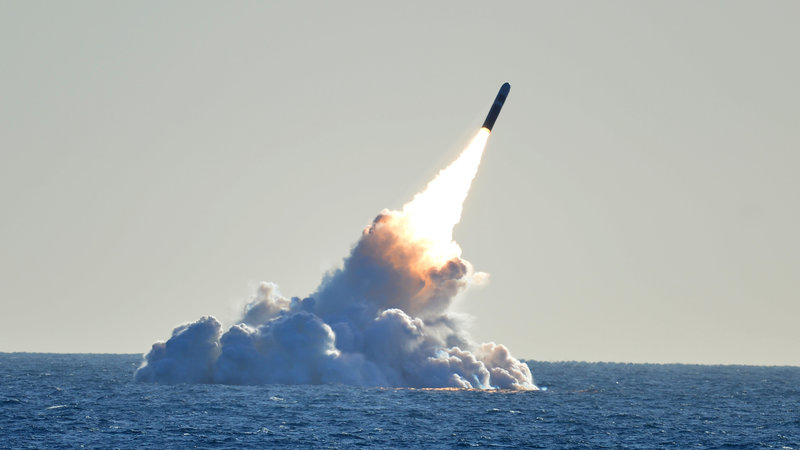
Trump Administration Begins Production Of A New Nuclear Weapon, NPR, January 28, 2019 “….The weapon is a variant of the Navy’s primary submarine-launched nuclear weapon, the W76-1. That warhead is a “strategic weapon,” meaning it makes a very big boom. The W76-1 is believed to have a yield of around 100 kilotons, according to Hans Kristensen, director of the nuclear information project at the Federation of American Scientists, an arms control advocacy group. By contrast, the bomb dropped on Hiroshima had a yield of about 15 kilotons.
Nuclear reactor at Fort Belvoir to be decommissioned
By: fox5dc.com staff , Anjali Hemphill, FOX 5 DC, 29 Jan 19, AN 29 2019 FORT BELVOIR, Va. (FOX 5 DC) – Tucked away on the Fort Belvoir army base, the SM-1 nuclear reactor was fully operational for many years, but now there’s a plan to take it all down and build over it.
Stepping into the former nuclear power plant is like a blast from the past. It’s been virtually untouched since the day it was deactivated back in the 1970s. The plan now is to tear it down and haul it away………http://www.fox5dc.com/news/local-news/nuclear-reactor-at-fort-belvoir-to-be-decommissioned
Security dangers in South Asia increase as India and Pakistan develop nuclear weapons programmes
Nuclear programmes of India, Pakistan increase risk of security incident in South Asia: US spymaster, Economic Times, Jan 30, 2019 WASHINGTON: There is an increased risk of a nuclear security incident in South Asia due to continued growth and development of Pakistan and India’s nuclear weapons programmes, America’s top spymaster told lawmakers on Tuesday.
The remarks of National Intelligence Director Daniel Coats is part of US intelligence community’s assessment of worldwide threats in the year 2019.
While Pakistan continues to develop new types of nuclear weapons, including short-range tactical weapons, sea-based cruise missiles, air-launched cruise missiles, and longer range ballistic missiles, India this year has conducted its first deployment of a nuclear-powered submarine armed with nuclear missiles, he said.
“The continued growth and development of Pakistan and India’s nuclear weapons programmes increase the risk of a nuclear security incident in South Asia, and the new types .. ……..
1 This Month
Tell Congress: Prevent Nuclear Catastrophe in Iran

Tell Congress: Prevent Nuclear Catastrophe in Iran

Read the Public Inquiry Report, the Commissioners’ report, Surrendering Australia: The AUKUS Deception is available to download for free at aukuspublicinquiry.com. Or just watch the replay of the National Press Club Luncheon.


Shut down the radiation-damaged Heysham nuclear reactors now
To see nuclear-related stories in greater depth and intensity – go to https://nuclearinformation.wordpress.com

Say No to NASA’s Reckless Nuclear Reactor on the Moon
Say No to NASA’s Reckless Nuclear Reactor on the Moon
-
Archives
- November 2026 (238)
- October 2026 (302)
- September 2026 (339)
- August 2026 (330)
- July 2026 (355)
- June 2026 (287)
- May 2026 (306)
- April 2026 (356)
- March 2026 (251)
- February 2026 (267)
- January 2026 (308)
- December 2025 (358)
-
Categories
- 1
- 1 NUCLEAR ISSUES
- business and costs
- climate change
- culture and arts
- ENERGY
- environment
- health
- history
- indigenous issues
- Legal
- marketing of nuclear
- media
- opposition to nuclear
- PERSONAL STORIES
- politics
- politics international
- Religion and ethics
- safety
- secrets,lies and civil liberties
- spinbuster
- technology
- Uranium
- wastes
- weapons and war
- Women
- 2 WORLD
- ACTION
- AFRICA
- Atrocities
- AUSTRALIA
- Christina's notes
- Christina's themes
- culture and arts
- Events
- Fuk 2022
- Fuk 2023
- Fukushima 2017
- Fukushima 2018
- fukushima 2019
- Fukushima 2020
- Fukushima 2021
- general
- global warming
- Humour (God we need it)
- Nuclear
- RARE EARTHS
- Reference
- resources – print
- Resources -audiovicual
- Weekly Newsletter
- World
- World Nuclear
- YouTube
-
RSS
Entries RSS
Comments RSS

