Lithuania protests Belarus’plan for nuclear power station close to their border
Daily Mail 27th Oct 2020, The Baltic nation of Lithuania sent a protest note Tuesday to Belarus over
a planned nuclear power plant close to their border that is scheduled to
start operating in early November. The Astravyets nuclear power plant, 40
kilometers (25 miles) south of Vilnius, Lithuania´s capital, is to start
production between Nov. 1-10, Belarusian operator Belenergo told
Lithuania´s power transmission system operator Litgrid on Monday.
France trying to market nuclear reactors to Romania
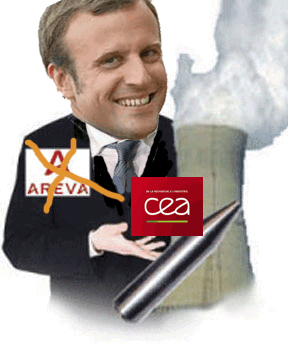 World Nuclear News 27th Oct 2020, France and Romania have signed a declaration of intent on cooperation in
the civil nuclear field, which aims, among other things, to work “with
strategic partners” to build units 3 and 4 of the Cernavoda nuclear power
plant and to upgrade unit 1. The document was signed yesterday by French
Prime Minister Jean Castex and his Romanian counterpart Ludovic Orban, who
led a delegation of his ministers to Paris.
https://www.world-nuclear-news.org/Articles/France-and-Romania-plan-joint-work-on-Cernavoda-pr
South Korea to end dependence on coal, switch to renewables
|
Guardian 28th Oct 2020, South Korea’s president, Moon Jae-in, has declared that the country will
go carbon neutral by 2050, bringing it into line with other major economies. In a policy speech in the national assembly on Wednesday, Moon said South Korea, one of the world’s most fossil fuel-reliant economies, would “actively respond” to the climate emergency “with the international community and achieve carbon neutrality by 2050”. He vowed to end its dependence on coal and replace it with renewables as part of its Green New Deal, a multibillion-dollar plan to invest in green infrastructure, clean energy and electric vehicles. |
|
Using a robot to map the highly radioactive area of the Chernobyl Nuclear Power Plant
University of Bristol and Spot on October 22, and the team intended to use
the robot to create a three-dimensional map of the distribution of nuclear
radiation.
1986 nuclear accident and, as a result, the robot adds new surveying
capabilities to the teams involved. Other robots were also implemented to
inspect and survey the area.
https://www.unilad.co.uk/technology/boston-dynamics-sent-spot-into-chernobyl-nuclear-plant/
World climate at the crossroads – much depends on USA election result
 Guardian 26th Oct 2020, Among the myriad reasons world leaders will closely watch the outcome of a
 fraught US presidential election, the climate crisis looms perhaps largest of all. The international effort to constrain dangerous global heating will hinge, in large part, on which of the dichotomous approaches of Donald Trump or Joe Biden prevails.
anxiety has only escalated during the hottest summer ever recorded in the northern hemisphere, with huge wildfires scorching California and swaths of central South America, and extraordinary temperatures baking the Arctic.
|
|
Ocean ecosystems – future in doubt

The uncertain future of the oceans, Science Daily October 26, 2020
- Source:
- Helmholtz Centre for Ocean Research Kiel (GEOMAR)
- Summary:
- Marine food webs and biogeochemical cycles react very sensitively to the increase in carbon dioxide (CO2) – but the effects are far more complex than previously thought. Data were combined from five large-scale field experiments, which investigated how the carbon cycle within plankton communities reacts to the increase of CO2.
- The ocean plays a key role in the current climate change, as it absorbs a considerable part of the atmospheric carbon dioxide emitted by humankind. On the one hand, this slows down the heating of the climate, and on the other hand, the dissolution of CO2 in seawater leads to acidification of the oceans.
- This has far-reaching consequences for many marine organisms and thus also for the oceanic carbon cycle. One of the most important mechanisms in this cycle, is called the biological carbon pump. Part of the biomass that phytoplankton forms in the surface ocean through photosynthesis sinks to the depths in the form of small carbonaceous particles. As a result, the carbon is stored for a long time in the deep sea. The ocean thus acts as a carbon sink in the climate system. How strongly this biological pump acts varies greatly from region to region and depends on the composition of species in the ecosystem.
The study, which has now been published in the journal
Nature Climate Change, is one of the most comprehensive studies so far on the effects of ocean acidification on marine ecosystems. Scientists at the GEOMAR Helmholtz Centre for Ocean Research in Kiel have now been able to show for the first time that ocean acidification influences the carbon content of sinking organic material, and thus the biological pump. Surprisingly, the observed changes were highly variable. The carbon content of sinking particles increased or decreased significantly with increasing CO2, depending on the composition of species and the structure of the food web. Since the underlying data cover a wide range of ocean regions, this seems to be a global phenomenon. These findings allow a completely new assessment of the effects of ocean acidification……….https://www.sciencedaily.com/releases/2020/10/201026114214.htm
Britain, and other countries, got nuclear weapons for reasons of status and pride
|
We’re nuclear because of the kudos, https://www.heraldscotland.com/news/18818883.letters-nuclear-kudos/ Ian W Thomson, Lenzie. 23 Oct 20 DAVID Crawford asks a question about why the UK Government allows a large element of UK tax revenue to be spent with the US facilities to support the UK nuclear weapon submarine resource. He answers his question by saying “money”, because the UK itself is a substantial supplier of weapons
I believe that there is more to it than he suggests. The Labour Government at the end of the Second World War could have decided not to have nuclear weapons. It initially took the option to have them largely because of status and pride. Ernest Bevin, then the Foreign Secretary, stated: “We’ve got to have the bloody Union Jack on top of it.” The costs of maintaining that status have become more and more expensive over the years, which has led to the UK becoming more and more reliant upon the US for technical support at a cost. The theory must be that it is better to have a nuclear deterrent sort of independent rather than not have such deterrent at all. I also believe that status still has a large part to play in the UK’s position today, albeit we are far removed from the circumstances prevailing at the end of the Second World War. It is interesting that all five permanent members of the UN Security Council are nuclear powers: China, France, Russia, the UK and the US. The UK, no doubt, places great value upon that status and is likely to regard being a nuclear power as helping to sustain it. The original idea was that the five would progressively disarm in exchange for other states not acquiring nuclear weapon facilities. That idea has gone well, hasn’t it? Look at India and Pakistan and the likelihood of some others. |
|
Hope for nuclear arms control with Russia?
|
Hope for nuclear arms control with Russia? Brookings Steven Pifer, Monday, October 26, 2020 Editor’s Note: The U.S.-Russia nuclear arms treaty, New START, is set to expire in February 2021. Little progress was made during the summer and it was unclear if the two countries would reach an agreement. However, a breakthrough has given the arms control treaty a new lease on life, albeit with a lot of questions, writes Steven Pifer. This piece originally published by the Freeman Spogli Institute’s Center for International Security and Cooperation at Stanford University.
While concern had grown over the past several weeks about a breakdown in U.S.-Russian arms control, it appears the 2010 New Strategic Arms Reduction Treaty and nuclear arms control more broadly may have a new lease on life, albeit with lots of questions. Washington’s negotiation with Moscow on New START hit a roadblock on October 16. President Putin said Russia would agree to a one-year extension, which U.S. negotiators had proposed instead of five years, but without the conditions sought by the American side. National Security Advisor O’Brien summarily rejected the Russian position because it ignored the U.S. demand for a freeze on all nuclear warhead numbers.
Things changed recently. The Russians announced that they would agree to a one-year extension of New START and said they are “ready to assume a political obligation together with the United States to freeze the sides’ existing arsenals of nuclear warheads during this period.” The Russian statement added that this presumed no additional U.S. conditions. The Department of State spokesperson quickly and positively reacted, saying U.S. negotiators are “prepared to meet immediately to finalize a verifiable agreement.” New START constrains U.S. and Russian strategic nuclear forces to their lowest levels since the 1960s. However, when it comes to nuclear warheads as opposed to delivery systems, the treaty limits only “deployed” strategic warheads—that is, warheads on deployed intercontinental ballistic missiles (ICBMs) or submarine-launched ballistic missiles (SLBMs). The treaty does not cover reserve strategic warheads or any non-strategic (tactical) nuclear weapons. If Russian acceptance of a one-year freeze means that the Trump administration has succeeded in persuading Moscow to negotiate a treaty limiting all U.S. and Russian nuclear weapons, that is a commendable breakthrough. Indeed, a treaty covering all the two sides’ nuclear arms has long seemed the logical next step after New START (President Obama proposed such a negotiation in 2010). Questions remain, however. The Russian statement indicates that Moscow is ready to undertake, as a political obligation, a one-year freeze on nuclear warhead numbers. It remains unclear whether Russian officials, beyond that freeze, are prepared to negotiate a legally-binding and verifiable treaty constraining all nuclear warheads that would be in effect for a number of years (New START is in force for 10 years, with the possibility of its extension for an additional five years). ……
it appears that U.S. and Russian negotiators still have issues to resolve. Irrespective of the freeze, New START is worth saving and extending to 2026 (the treaty’s terms provide that there could be multiple extensions). Extension to 2026 would mean five more years of limits on Russian strategic nuclear forces. It would mean five more years of information about those forces provided by the treaty’s verification measures, including data exchanges, notifications and on-site inspections. And extending the treaty would require no change in U.S. strategic modernization plans, as those plans were designed to fit within the treaty’s limits. One last observation: New START requires that, if a side wishes to withdraw from the treaty, it must give the other three months’ notice before doing so. It is now October 21, which means that, if negotiations with the Russians do not go well and the Trump administration were to give notice, the United States could not actually withdraw from the treaty until after January 20, 2021—when Donald Trump will be starting his second term or Joe Biden will have become the 46th U.S. president. Mr. Biden is on record as supporting New START’s extension for five years, with no conditions. https://www.brookings.edu/blog/order-from-chaos/2020/10/26/hope-for-nuclear-arms-control/ |
|
Aomori wants reassurance that it won’t be final nuclear waste site
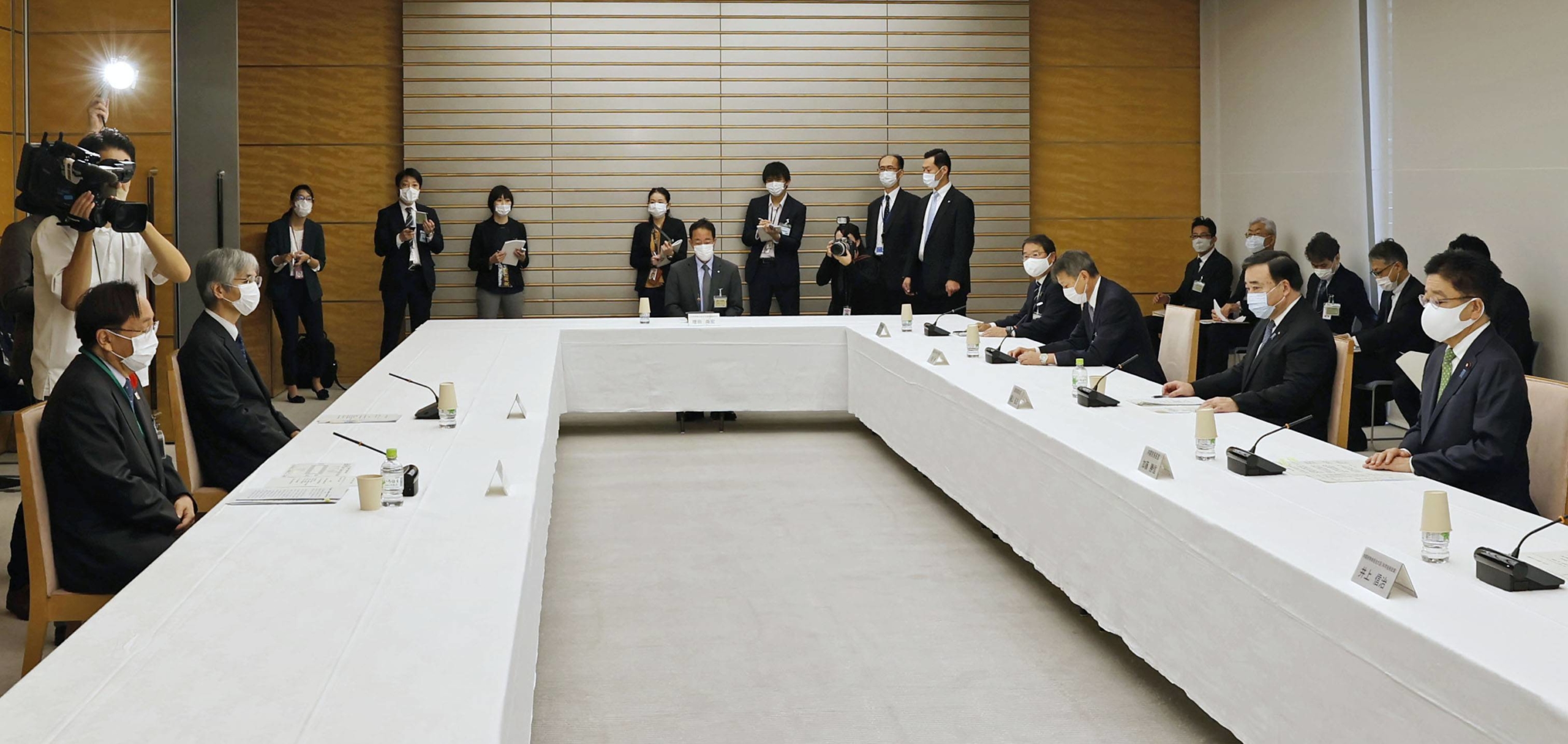
Aomori Gov. Shingo Mimura (left) and Chief Cabinet Secretary Katsunobu Kato (right) attend a meeting of a council for nuclear fuel cycle policy held at the Prime Minister’s Office Wednesday.
Oct 21, 2020
Aomori Prefecture on Wednesday urged the government to reconfirm its policy of not building in the prefecture a facility for the final disposal of high-level radioactive waste from nuclear power plants across the nation.
The request was made during a meeting of a council for discussions on issues related to the country’s nuclear fuel cycle policy between relevant Cabinet ministers and officials of the prefecture, where a spent nuclear fuel reprocessing facility is under construction. It was the first meeting of the council since November 2010.
At the day’s meeting, the Aomori side called on Prime Minister Yoshihide Suga’s Cabinet, launched last month, to maintain the promise not to make the prefecture a final disposal site, upheld by past administrations.
Participants in the meeting, held at the Prime Minister’s Office in Tokyo, included Chief Cabinet Secretary Katsunobu Kato and industry minister Hiroshi Kajiyama from the central government, and Aomori Gov. Shingo Mimura.
“It’s necessary for the state and the operator (of the reprocessing plant) to make the utmost efforts to promote, with support from Aomori, the nuclear fuel cycle policy, including the launch of the plant,” Kato said at the start of the meeting.
Mimura told reporters after the meeting that he asked the central government to abide by the promise and promote the nuclear fuel cycle policy, in which uranium and plutonium are extracted from spent fuel and reprocessed into fuel for use at nuclear power plants.
Mimura indicated that Kato showed the state’s understanding of his requests.
In July, the central government’s Nuclear Regulation Authority concluded that the basic design of the nuclear fuel reprocessing plant in the Aomori village of Rokkasho meets the country’s nuclear safety standards, which were crafted after the March 2011 accident at Tokyo Electric Power Company Holdings Inc.’s tsunami-stricken Fukushima No. 1 nuclear plant.
Japan Nuclear Fuel Ltd. aims to complete the plant in fiscal 2022. The NRA spent over six years screening the Rokkasho facility’s design.
Following the NRA’s conclusion, the Aomori side asked the state to hold a meeting of the nuclear fuel cycle policy council.
Aomori has agreed to accept spent nuclear fuel from nuclear plants across the country on the condition that a final disposal facility is not constructed in the prefecture.
The central government regards the nuclear fuel cycle as a pillar of its nuclear energy strategy.
Besides the reprocessing plant, a facility to make mixed oxide, or MOX, fuel from extracted uranium and plutonium is also under construction at the same site in Rokkasho.
https://www.japantimes.co.jp/news/2020/10/21/national/japan-aomori-nuclear-waste-disposal/
Joe Biden calls climate change the ‘number one issue facing humanity
 Joe Biden calls climate change the ‘number one issue facing humanity’, CNBC, OCT 24 2020
-
- Joe Biden declared climate change the “number one issue facing humanity” and vowed a national transition from fossil fuels to renewable energy that he says will create millions of new jobs.
- Biden has a $2 trillion plan that puts the U.S. on a path to zero carbon pollution from the electricity sector by 2035 and net-zero emissions by 2050.
- Scientists say that Biden’s transition plan is required to avoid the most catastrophic consequences of climate change.
- Climate change has fueled record-setting wildfires in the U.S. West and one of the most active Atlantic hurricane seasons this year………
- “Climate change is the existential threat to humanity,” the former vice president said. “Unchecked, it is going to actually bake this planet. This is not hyperbole. It’s real. And we have a moral obligation.” ……
Biden, the Democratic presidential nominee, has boasted a $2 trillion plan that invests significantly in clean energy in the transportation, electricity and building industry, cuts fossil fuel emissions and improves infrastructure.
Biden’s plan also puts the U.S. on a path to zero carbon pollution from the electricity sector by 2035 and net-zero emissions by 2050. Coal and natural gas comprise more than 60% of the electricity sector, according to the Energy Information Association.
“It’s going to create millions of jobs … We can’t be cavalier about the impact it’s going to have on how we’re going to transition to do all this,” Biden said of his plan on the podcast. “But I just think it’s a gigantic opportunity, a gigantic opportunity to create really good jobs.”
Scientists say that Biden’s transition plan is required to avoid the most catastrophic consequences of climate change. …..
Trump has denied the science of climate change and reversed more than 70 major environmental regulations during his four years in office, with nearly 30 more in progress.
But climate change has been a top issue of the 2020 presidential election, especially among younger voters…….
Biden leads on climate change by an enormous margin, with 58% to 19% of registered voters saying the former vice president would address the problem better than President Trump, according to an NBC News/Wall Street Journal poll. …..
-
-
- September 2020
-
-
- and this year is set to be one of the five hottest in recorded history.
https://www.cnbc.com/2020/10/24/joe-biden-climate-change-is-number-one-issue-facing-humanity.html
495 local assemblies demand Japan government ratify the Treaty on the Prohibition of Nuclear Weapons

 495 local assemblies demand Japan gov’t ratify nuclear ban treaty in written statement, October 24, 2020 Mainichi Japan
The nuclear arms prohibition treaty was adopted in July 2017 by 122 countries and regions — over 60% of the United Nation’s membership. The treaty bans the development, test, manufacture, possession or use of atomic weapons, as well as the threat of their use — the basis of nuclear deterrent. Japan did not participate in negotiations nor signed the pact, along with the five nuclear powers of the United States, Russia, Britain, France and China. Tokyo stayed out of the pact for fear of appearing to denounce nuclear deterrence and thereby deepening conflict between nuclear have and have-not nations.
According to Gensuikyo, the prefectural assemblies of Iwate, Nagano, Mie, Tottori, and Okinawa, as well as 490 municipal assemblies — 28% of all local assemblies nationwide — had adopted the written statement as of Oct. 23, 2020. The tally includes assemblies that have adopted the objective of the written statement, as they agree with it but are uncertain of its feasibility. A total of 34 assemblies in Iwate, including the prefectural assembly, adopted the statement. The statement was initially turned down twice in the municipal assembly of Ofunato, Iwate Prefecture, but finally gathered a majority in March 2020 after Gensuikyo explained persistently about damage resulting from nuclear weapons.
Sixteen municipal assemblies in Hiroshima Prefecture, including the Hiroshima city assembly, have adopted the statement, with authorities saying, “Our country, the only nation that has experienced atomic bombing, has a special role and responsibility to strive to abolish nuclear weapons.” However, Hiroshima Prefectural Assembly lawmakers did not even submit a proposal to adopt the statement.
There are also local assemblies that reject adopting the statement as it is not legally binding, and by claiming that national defense and security are exclusively under central government jurisdiction. Soji Kanno, deputy secretariat head at Gensuikyo’s Iwate branch, who approached Iwate Prefecture assemblies with the statement, commented, “Abolishing nuclear weapons is not a political request, but the wish of the Japanese public. I’d like for all local assemblies to raise their voices towards the Japanese government.”
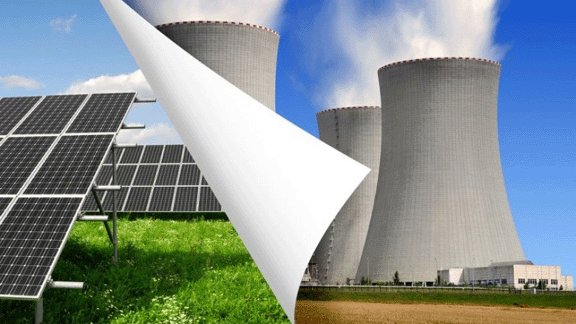
Every dollar wasted on nuclear power is a dollar not invested in clean energy
|
Every dollar wasted on nuclear is a dollar not invested in renewables, https://wordpress.com/read/feeds/72759838/posts/2985336306 By Tim Judson and Luis Hestres, 25 Oct 20, We’ve known for a long time that nuclear energy is a false solution to climate change. Not only are the health and environmental impacts of nuclear power intolerable, but it also gobbles up investments we should be making in clean and safe renewable energy. Now, a new study by researchers at the University of Sussex in the UK brings us the latest and most robust evidence of these facts. The study, published last week in Nature Energy, considers three hypotheses: Firstly, that emissions decline the more a country adopts nuclear power; secondly, that emissions decline the more a country adopts renewables; and thirdly, that nuclear and renewables are ‘mutually exclusive’ options that tend to crowd each other out at an energy system level. The hypotheses were tested against 25 years’ worth of electricity-production and emissions data from 123 countries. The result? Investment in nuclear is mostly negatively correlated with decreases in carbon emissions, while investment in renewables was positively correlated with such decreases across the board. In other words, countries that invested in nuclear didn’t see emission reductions but countries that invested in renewables did. The only exceptions were higher per-capita GDP countries, which saw some decreases in emissions while investing in nuclear—but countries with lower per-capita GDP didn’t. But this last finding didn’t take into account the costs associated with nuclear waste storage and cleanup, the dangers of nuclear accidents, or the fact that those reductions might have been deeper if renewables had been chosen. The finding that investments in nuclear and renewables tend to crowd each other out means that countries that invest more in nuclear tend to invest less in renewables, and vice versa. This refutes the ‘all of the above’ option, or what we call ‘refuse to choose’. Every dollar that a country wastes in nuclear is a dollar it doesn’t invest in renewable energy, which has a better chance of achieving deeper emission reductions at a lower cost and without the dangers associated with nuclear energy. To refuse to choose is to choose nuclear, to the detriment of the fight against climate change and the health and safety of people and the environment. This study has major implications for climate and energy policy in the US and around the world. In June 2020, the USCAN Climate Action Network made a big splash by publishing the Vision for Equitable Climate Action. Not only is VECA the most comprehensive and detailed policy agenda put out by the climate movement, it is rooted in principles of racial and economic equity and justice, developed by more than 170 people from over 100 organizations. It is also the first major climate movement agenda to explicitly call for a phaseout of nuclear power. Along with other recent climate justice agendas, from the Equitable and Just National Climate Platform and the People’s Orientation to a Regenerative Economy to the THRIVE Agenda and the Feminist Green New Deal, VECA is part of a broad shift toward transformative solutions to the climate crisis, calling for a rapid, just and equitable transition to 100% renewable energy. Moderate climate organizations have reacted with hesitation and resistance, skeptical that transformative change is too risky, or not supported by the science. And nuclear power has been one of the central sticking points, with some insisting that it plays too big a role in our energy supply. But now the science is in, and it shows nuclear is out. And the Vision for Equitable Climate Action and the anti-nuclear and climate justice movements have it right. The Sussex study confirms what NIRS, Beyond Nuclear and others have been saying for a long time: on top of being too dirty and too dangerous, nuclear power is simply too expensive and too time-consuming to compete with renewables as an alternative to decarbonize the global economy. So, what about the Green New Deal? While opponents of the GND complain about its potential $2 trillion cost, this year has proven that’s just playing politics. With the $2.5 trillion COVID-19 relief bill Congress passed in April, it’s clear that, when the country truly knows we are facing a crisis and our elected officials are forced to deal with it, we can find the political will and the money to do what is needed. If we can find $2.5 trillion in a few weeks to bootstrap our economy and support people through the pandemic for a few months, the Green New Deal is a bargain. For $2 trillion over 10 years, we can not only literally save the world, but build a just, equitable, sustainable new economy with healthy communities, good, union jobs, and real economic security. But at the same time, as with COVID, we don’t have time to waste on things that aren’t going to work, and nuclear power is now exhibit #1. It would be better to spend our money on creating thousands of jobs cleaning up and revitalizing the hundreds of communities impacted by nuclear power, and coming up with environmentally just and scientifically proven ways to isolate radioactive waste. When it comes to the climate crisis, we have to be bold, visionary, and ambitious, and we have to put equity and justice first. That alone is reason enough to make sure the Green New Deal prioritizes a phaseout of nuclear power through a just transition for workers and communities. Tim Judson is the Executive Director of Nuclear Information and Resource Service. Luis Hestres, PhD., is the Digital Strategist at Nuclear Information and Resource Service. |
|
Trump government’s dangerous plan to deregulate disposal of radioactive trash
 Trump team pushes nuke dumping http://njtoday.net/2020/10/25/trump-team-pushes-nuke-dumping/, by Staff Report • October 25, 2020 Many Americans alarmed over the deadly coronavirus pandemic, a worsening climate crisis, an economic disaster on par with the Great Depression, or the White House’s surrender of Afghanistan to the Taliban would sleep better if they had assurances the radioactive waste disposal is as secure as it could possibly be… but President Donald Trump is still in charge so there’s no such luck.
The Nuclear Regulatory Commission is finalizing a year-long drive to functionally deregulate disposal of massive amounts of radioactive waste.
NRC’s plan would allow commercial nuclear reactors to dump virtually all their radioactive waste, except spent fuel, in local garbage landfills, which are designed for household trash not rad-waste, according to comments filed by Public Employees for Environmental Responsibility (PEER).
Friday marked the end of public comments for an NRC “interpretative rulemaking” that would, in effect, abrogate longstanding requirements that virtually all such waste must be disposed of in licensed radioactive waste sites meeting detailed safety standards and subject to NRC inspection and enforcement.
Instead, the Trump administration wants to allow the NRC to grant generic exemptions for unlicensed waste handlers.
NRC declares its “intent” that these newly exempt disposal sites would be limited to “very low-level radioactive wastes” – a term undefined by statute – which NRC considers to be “below 25 millirem per year.”
“NRC’s definition would allow public exposure to the equivalent to more than 900 chest X-rays over a lifetime,” explained Lisa McCormick. “This new approach creates a cancer risk twenty times higher than the Environmental Protection Agency’s acceptable risk range, thousands of times the risk goal for Superfund sites, or enough radiation to cause every 500th person exposed to get cancer.”
McCormick, a progressive Democratic activist in New Jersey, says the rule change is “the worst thing to do as dozens of America’s 104 nuclear power plants come to the end of their operation.”
“Once an exempt entity accepts radioactive waste, it enters a regulatory black hole, with no one accountable for it,” stated PEER Pacific Director Jeff Ruch, pointing out that NRC’s plan eliminates the need for radiation monitoring, health physics personnel, design standards, and NRC inspections – all now required of licensed operators. “Unlicensed radioactive waste dumps could operate in ways that endanger communities free from any NRC oversight.”
NRC’s cryptic justification merely indicates that the plan “would provide an efficient means by which the NRC may issue specific exemptions for disposal” but ignores impacts that would –
- Transform many municipal dumps into radioactive repositories, with no safeguards for workers, nearby residents, or adjoining water tables;
-
- Allow unlicensed radioactive waste dumps to expose the public to 2.5 times higher levels of radiation than the NRC now allows for licensed low-level radioactive waste sites, thus creating a strong incentive to send all the radioactive waste to unlicensed dumps; and
- Eliminate the public’s ability to find out radioactive waste is being dumped near them.
At present, the U.S. has 104 commercial nuclear power plants, many of which are beginning, or will soon start, the decommissioning process.
Removing the need for licensed sites to handle the staggering amounts of debris from old reactors would be a major cost savings for that industry.
“One of New Jersey’s oldest nuclear power plants just came off line and it poses a drastic problem for the people and environment” said McCormick.
“NRC’s deregulation will make it nearly impossible to trace recycled radioactive waste flowing through the stream of American commerce,” added Ruch, noting that it may also create a market for the U.S. to import radioactive waste for cheaper disposal. “This plan would plunge the U.S. into the wild, wild West of radioactive waste disposal, on a par with a Third World natio
Angry reactions to Japanese government’s plan to release Fukushima nuclearwaste water into the Pacific
 Plan to release Fukushima water into Pacific provokes furious reaction https://www.dw.com/en/tepco-fukushima-contaminated-water/a-55334567– 25 Oct 20, The Japanese government has reportedly decided to pump highly radioactive cooling water from the Fukushima plant into the Pacific Ocean. The plan has been slammed by environmental groups, locals and neighboring nations.Environmental groups have reacted furiously to reports that the Japanese government is set to approve plans to dump more than 1 million tons of highly radioactive water stored at the Fukushima nuclear plant into the Pacific Ocean, with their concerns shared by the governments of neighboring countries and people living in northeastern Japan.
A government panel set up to determine the best way of disposing the radioactively contaminated water is scheduled to announce its decision by the end of the month.
Three Fukushima reactors suffered meltdowns following a 2011 tsunami that destroyed wide swaths of the coastline in northern Japan’s Miyagi prefecture.
According to reports leaked to Japanese media, the panel will recommend releasing the approximately 1.23 million tons of water currently stored in tanks in the grounds of the nuclear plant.
The alternatives that have been considered are to evaporate the water into the atmosphere or to mix it into concrete and store it underground.
According to reports from national broadcaster NHK and other news outlets, the panel will call for the water to be again put through a process designed to reduce the radioactivity to below “regulatory standards” and dilute it with sea water before it is pumped into the ocean.
The three damaged reactors require constant cooling with water, which becomes highly radioactive, and mixes with around 170 tons of groundwater that seeps into the subterranean levels of the reactor buildings every day.
That water is pumped into hundreds of huge tanks on the site every day, with Tokyo Electric Power Co. (Tepco), the operator of the power plant, estimating that even with more waste tanks being constructed, storage capacity will be reached fully in the summer of 2022.
Environmental groups insist that there is no reason why more storage tanks cannot be constructed outside the perimeter of the plant. They accuse the government of seeking the cheapest and quickest solution to the problem, as authorities have promised the site will be safe in 40 years.
And that deadline, they say, is completely unrealistic. Complications include recovering the molten fuel that escaped from the reactor chambers. This kind of recovery has never before been attempted and the technology required does not yet exist.
They also accuse the Japanese authorities of playing down the radiation levels in the water planned for release.
Elevated levels of radiation
A study by the Kahoko Shinpo newspaper confirmed that levels of iodine 129 and ruthenium 106 exceeded acceptable levels in 45 out of 84 samples collected in 2017.
Iodine has a half-life of 15.7 million years and can cause cancer of the thyroid, while ruthenium 106 is produced by nuclear fission and high doses can be toxic or carcinogenic when ingested.
Tepco subsequently confirmed that levels of strontium 90 were more than 100 times above legally permitted levels in nearly 65,000 tons of water that had already been treated,
They were 20,000 times above safety levels set by the government in several storage tanks at the Fukushima site.
Fish industry worried
Precisely what is in the water that is due to be released into the ocean cannot be confirmed, however, as Tepco and the government have refused to permit independent testing on samples.
Residents of Fukushima Prefecture are also against the plan, with 42 of the 59 local authorities in the prefecture passing resolutions either expressing outright opposition to the plan or deep concern.
The fishing industry — which was devastated by the original natural disaster and has since struggled to reestablish itself — is also hostile to the proposals, with representatives of fishing cooperatives meeting with government officials last week to express their concerns.
“We are terrified that if even one fish is found to have exceeded the [radiation] safety standards after the treated water is released, people’s trust in us will plummet,” a fisherman from the city of Soma told Kyodo News. “Our efforts to fight false information and address other challenges could be wasted.”
Hideyuki Ban, co-director of the Citizens Nuclear Information Center, echoed those calls.
“Release of the contaminated water into the ocean should not be allowed when fishing unions from Fukushima and neighboring Ibaraki and Iwate prefectures are opposed,” he told DW.
“If it is dumped in the ocean, it will become an international problem and it is possible that bans on exports from this area will continue or that new export restrictions may be introduced.”
Read more: Japan: Environmentalists say Fukushima water too radioactive to release
“It is highly unlikely that the highly radioactive waste can be removed from the site of the nuclear plant, so instead of rushing to remove the fuel debris, the overall decommissioning schedule should be reviewed and measures taken so that the contaminated water can be stored on land,” he said.
In a statement issued to DW, Tepco said it is “not in a position to make a decision on this matter.”
“The government has been listening to the opinions of various stakeholders, including local municipalities and those involved in the agriculture, forestry and fisheries industries, and it is the government that will make a decision on the disposal method,” the company said, adding Tepco will follow the disposal guidelines as instructed following the official decision.
Neighbors’ concerns
The residents of Japan’s neighboring countries and their governments are equally concerned, with an editorial in the Korea Times on Monday warning of an “environmental disaster” that could “destroy the marine ecosystem.”
The South Korean government has also demanded that Japan provide a full accounting of its plans for the contaminated water, including an accurate accounting of the different radionuclides that it contains.
In a statement released by the Foreign Ministry, Seoul said it places the highest priority on protecting the environment and the Korean public’s health.
Scientists and academics in China are demanding independent testing and verification of radiation levels in the water, while environmental and citizens’ groups in Taiwan have previously expressed concerns about the impact of any large-scale release of contaminated water on their health and well-being.
Hokkaido municipalities gamble on a nuclear future, but at what cost?
Hokkaido municipalities gamble on a nuclear future, but at what cost? https://www.japantimes.co.jp/news/2020/10/24/national/media-national/hokkaido-gambling-casinos/ BY PHILIP BRASOR Since August, two local governments on the western shore of Hokkaido have said they will apply to the central government for a survey that could eventually lead to their municipalities hosting a permanent underground repository for high-level radioactive waste. The fact that these two localities made their announcements about a month apart and are situated not far from each other was enough to attract more than the usual media attention, which revealed not only the straitened financial situations of the two areas, but also the muddled official policy regarding waste produced by the country’s nuclear power plants.
Then again, neither Suttsu nor Kamoenai may make it past the first stage. Yugo Ono, an honorary geology professor at Hokkaido University, told the magazine Aera that Suttsu is located relatively close to a convergence of faults that caused a major earthquake in 2018. And Kamoenai is already considered inappropriate for a repository on a map drawn up by the trade ministry in 2017.
If the Nuclear Waste Management Organization’s process for selecting a site sounds arbitrary, it could reflect the government’s general attitude toward future plans for nuclear power, which is still considered national policy, despite the fact that only three reactors nationwide are online. Presently, spent fuel is being stored in cooling pools at 17 nuclear plants comprising a storage capacity of 21,400 tons. As of March, 75 percent of that capacity was being used, so there is still some time to find a final resting place for the waste. Some of this spent fuel was supposed to be recycled at the Rokkasho Reprocessing Plant in Aomori Prefecture, but, due to numerous setbacks, it doesn’t look as if it’s ever going to open, so the fuel will just become hazardous garbage.
Ono tells Aera that the individual private nuclear plants should, in line with product liability laws, be required to manage their own waste themselves. If they don’t have the capacity, then they should create more. It’s wrong to bury the waste 300 meters underground, which is the plan, because many things can happen over the course of future millennia. The waste should be in a safe place on the surface, where it can be readily monitored.
However, that would require lots of money virtually forever, something the government would prefer not to think about, much less explain. Instead, they’ve made plans that allow them to kick the can down the road for as long as possible.
1 This Month

Read the Public Inquiry Report, the Commissioners’ report, Surrendering Australia: The AUKUS Deception is available to download for free at aukuspublicinquiry.com. Or just watch the replay of the National Press Club Luncheon.



19 November – Webinar – The Reality of Reprocessing
Time: 11:00 AM Pacific Time (US & Canada) / 2:00 PM Eastern / 7:00 PM UK / 8:00 PM CET
Register for the Zoom Event Here



Shut down the radiation-damaged Heysham nuclear reactors now
To see nuclear-related stories in greater depth and intensity – go to https://nuclearinformation.wordpress.com

Say No to NASA’s Reckless Nuclear Reactor on the Moon
Say No to NASA’s Reckless Nuclear Reactor on the Moon
-
Archives
- November 2026 (109)
- October 2026 (302)
- September 2026 (339)
- August 2026 (330)
- July 2026 (355)
- June 2026 (287)
- May 2026 (306)
- April 2026 (356)
- March 2026 (251)
- February 2026 (267)
- January 2026 (308)
- December 2025 (358)
-
Categories
- 1
- 1 NUCLEAR ISSUES
- business and costs
- climate change
- culture and arts
- ENERGY
- environment
- health
- history
- indigenous issues
- Legal
- marketing of nuclear
- media
- opposition to nuclear
- PERSONAL STORIES
- politics
- politics international
- Religion and ethics
- safety
- secrets,lies and civil liberties
- spinbuster
- technology
- Uranium
- wastes
- weapons and war
- Women
- 2 WORLD
- ACTION
- AFRICA
- Atrocities
- AUSTRALIA
- Christina's notes
- Christina's themes
- culture and arts
- Events
- Fuk 2022
- Fuk 2023
- Fukushima 2017
- Fukushima 2018
- fukushima 2019
- Fukushima 2020
- Fukushima 2021
- general
- global warming
- Humour (God we need it)
- Nuclear
- RARE EARTHS
- Reference
- resources – print
- Resources -audiovicual
- Weekly Newsletter
- World
- World Nuclear
- YouTube
-
RSS
Entries RSS
Comments RSS

