The Microreactor Miracle Meets a Morphing AI-Nuclear Future

questions about whether the country will achieve its long-term core nuclear deployment objectives. And over-relying on a boost from the micro reactor miracle offers meager dividends when deployment is paramount.
August 15, 2026, By: Kenneth Luongo, https://nationalinterest.org/blog/energy-world/the-microreactor-miracle-meets-a-morphing-ai-nuclear-future
The microreactor milestone is real, but shifting AI models, China’s challenge, and deployment delays could complicate America’s nuclear ambitions.
It was impressive that four microreactor start-up companies beat the clock and achieved reactor criticality in compliance with the Trump administration’s arbitrary July 4 Reactor Pilot Program (RPP) deadline. But these reactors are years away from deployment, and the excessive swaggering associated with this modest achievement is out of step with the quavering nuclear energy realities ricocheting off a rapidly evolving artificial intelligence (AI) system.
US Microreactor Achievements
Of the four reactors that achieved zero power, only Antares has an identified market application beyond this demonstration. Its Mark-1 reactor has been selected as a pilot technology for powering Joint Base San Antonio, Texas.
The Antares Mark-0 reactor, which is the zero-power test reactor and prototype for the commercially oriented R1 Mark1, was the first to meet the criticality deadline on June 4 at Idaho National Laboratory (INL). It uses High Assay Low-Enriched (HALEU) TRistructural isotropic (TRISO) fuel and is sodium-cooled. The projected commercial reactor can provide 100 kilowatts to 1 megawatt (MW) electric power. Beyond its work with the Department of Defense (DOD), Antares also has been working with the National Aeronautics and Space Administration (NASA) on potentially powering a Moon base.
Valar Atomics’ Ward-250 achieved criticality on June 18 in Utah and claimed it produced 10 kilowatts (kW) of thermal output. It had previously announced a criticality test at Los Alamos National Laboratory in November 2025. The Ward-250 is a TRISO-fueled high-temperature gas reactor (HTGR) that uses helium as a coolant. After the test, Valar announced a partnership with Nvidia to explore powering AI data centers and stated that its evolving commercial unit could be “deployed by the hundreds at ‘gigasites’” that could support manufacturing as well as energy production.
Deployable Energy, a year-old company, met the criticality mark on June 30 at Idaho National Laboratory (INL). The company’s founder reportedly delivered the reactor core in the bed of a Ford F-150 truck. The reactor is part of the Nuclear Energy Launch Pad initiative at INL, which is designed to carry the RPP into the future. The reactor is a water-moderated, helium-cooled design using 4.9 percent enriched fuel. It is considered a “nuclear battery” and would max out at 1 MW. It is designed to fit in a 20-foot shipping container and be dropped at any location.
Aalo Atomics Aalo-X Critical Test Reactor sneaked in under the criticality deadline at midnight on July 4 at INL. The test reactor included a full-scale core and was designed to demonstrate key components that will be used in the Aalo-X, a low-enriched uranium (LEU) fueled, sodium-cooled 10 MW reactor. The goal is to deploy groups of these reactors in 50 MW Aalo Pods to support commercial data centers. Aalo recently formed a strategic partnership with Crusoe, a vertically integrated AI infrastructure provider, to “validate nuclear power’s effectiveness with AI workloads” at INL.
The Mutating AI Data Center Model
With the microreactor milestone behind them, the Trump administration and reactor developers now face an evolving landscape for nuclear energy. AI data centers have been viewed as the top driver of America’s energy growth and ideal for pairing with nuclear energy. Projections indicate these centers could add 100 gigawatts (GW) to the US grid by 2030.
But the data center opportunity is rapidly morphing, and opposition is growing; the now-dominant American AI model is under pressure at home and abroad. That raises questions about what role new nuclear power ultimately will play as the AI arena evolves.
The assumption has been that the hyperscalers, including Apple, Amazon Web Services, Microsoft Azure, and Google Cloud Platform, will build massive data centers as fast as they can to support US AI frontier modelcomputing growth. One assessment identified the data center build time as roughly two to three years
But the frontier model concept and its computing campuses are under pressure.
Alex Karp, CEO of Palantir, has been on a recent crusade criticizing the American AI frontier model as a trap that requires businesses to provide their intellectual property (IP) to AI’s leading companies like Anthropic and OpenAI. Karp claims that these models’ architecture creates an “addiction” among users and allows the system provider to absorb proprietary corporate data that can be used to compete against their current customers in the future.
He argues that companies should build their AI systems on models they own, training them on their proprietary content and keeping their data under their control. He also advocates for an “application layer” his company has developed with NVIDIA that can protect an enterprise’s IP. If Karp’s concept catches on, and Meta seems to have taken note, it could impact the mega data center build-out, reducing the number required and downsizing their power requirements. That could be a challenge for some leading nuclear reactor companies betting on the data center boom, or it could favor dial-an-output modular reactors if the costs are competitive.
China’s Dual AI Challenge
A version of the Karp concept seems to have already been adopted by China, which, because it is already closing the quality gap with the best US AI models, now poses a double threat to US dominance.
China is giving away fast, cheap open-source AI models. These free Chinese AI platforms are popular in Africa and Latin America but are also being used by US and European companies, including Siemens, DoorDash, and Airbnb.
Of course, one goal of China is to allow companies to easily build systems on their platform in order to serve geopolitical objectives and create dependencies it can exploit in the future. The US National Institute of Standards and Technology (NIST) evaluated China’s DeepSeek AI model and found that its AI offerings advance Chinese Communist Party narratives. It concludes that China’s DeepSeek “remains a leading open weight model developer and has contributed to a rapid increase in adoption of PRC [People’s Republic of China] models globally.” It cautions that the expanding global use of these models “May pose a threat to application developers, to consumers, and to US national security.”
This approach by AI is similar to China’s Belt and Road Initiative (BRI), which has helped the country capture hundreds of infrastructure projects across over 140 countries, resulting in deep relationships and financial dependencies, particularly with emerging economy nations. And while its energy projects so far have heavily tilted toward fossil fuels, BRI’s relationships and financial model enhance China’s position as a future provider of new nuclear energy in the Global South, posing a threat to the future US export of small reactors and creating worry for the US political, commercial, and national security establishment.
Lagging Nuclear Reactor Technology and Scaling Challenges
Even if the US data center boom were to play out as planned, there are questions about when and whether new US nuclear power will be ready to power it.
So far, the hyperscalers have modestly invested in small modular reactors (SMRs), but they are unlikely to be available in time for a near-term data center boom. If the buildout is over by the early 2030s, most SMRs will still be on the sidelines.
As a hedge, these companies have banked on the resurgence of mothballed nuclear power plants like Three Mile Island in Pennsylvania and Palisades in Michigan. Both of those projects are estimated to deliver new power before the end of this decade for a combined 1.6 GW. What the hyperscalers have not done is back construction of new large reactors despite the fact that a single Westinghouse AP-100 can provide over one GW of power.
The US government wants 10 new AP-1000s under construction by 2030, but its $80 billion strategic partnership with Westinghouse and its commitment to provide $17.5 billion in loans for long lead items haven’t attracted the necessary additional investment and commitment required from the private sector.
The US government wants 10 new AP-1000s under construction by 2030, but its $80 billion strategic partnership with Westinghouse and its commitment to provide $17.5 billion in loans for long lead items haven’t attracted the necessary additional investment and commitment required from the private sector.
This reticence reflects a cost-overrun risk aversion from domestic electric utilities and Wall Street. In response, the administration is repurposing federal lands to create data center-nuclear power campuses. And it has turned to allies such as South Korea and Japan to jumpstart the process with foreign cash derived from bilateral trade and tariff deals.
But that avenue also doesn’t seem to be working. The Trump administration has been frustrated with the lack of progress on the nuclear energy component of the $350 billion South Korean commitment to invest in the United States, and with Japan, it has found that its involvement in a $40 billion nuclear power project is running aground over nuclear liability concerns.
With less than 30 months left in Trump’s term, and the prospect of a hostile House of Representatives sucking the air out of his agenda, there is an urgency in rethinking the Trump administration’s nuclear deployment policy. The dependence on a rapidly evolving AI and data center market leaves questions about whether the country will achieve its long-term core nuclear deployment objectives. And over-relying on a boost from the micro reactor miracle offers meager dividends when deployment is paramount.
About the Author: Kenneth Luongo
Kenneth N. Luongo is a recognized innovator, entrepreneur, and leader in global nuclear energy and transnational security policy. He is the president and founder of the Partnership for Global Security (PGS). He has been a TEDx presenter, written over 100 articles, including in The New York Times and Foreign Affairs, and engaged extensively with global media, governments, and audiences around the world on nuclear energy and transnational security challenges and responses. He was formerly a senior advisor to the secretary of energy and a professional staff member on Capitol Hill.
US says lower oil prices, not Iran’s nuclear program, are now top priority in war
The top US priority now in the Iran war is no longer its nuclear program but to bring gasoline prices down for American consumers, the vice president said Thursday, with the treasury secretary adding that new economic punishment to wear down Tehran is imminent.
The comments by Vice President JD Vance and Treasury Secretary Scott Bessent illustrate the powerful leverage Tehran has gained by shutting down the Strait of Hormuz.
Preventing Iran from obtaining a nuclear weapon – consistently touted by President Donald Trump as his main reason for the war – now takes a back seat to getting oil flowing again freely through the strait, Vance said on Fox News.
Vance’s comments underscored the stark reality that the war now centers on control of the strait, the critical fuel supply conduit that was open before Trump started the war along with Israel in late February.
Iran has all but shut it down in retaliation and thus found a crucial bargaining chip against Trump as he struggles to find a way out of the war and shies away from resuming large-scale attacks.
The 80-year-old president’s approval rating is plummeting, the war is unpopular among Americans and midterm elections are approaching in November.
Republicans fear Trump and the war, which has caused gasoline prices to soar, will cost them their control of Congress.
“I know that oil is down today and it’s way down from the highs in the early days of the conflict,” Vance said on Fox News. “That’s goal number one – keep oil and gas cheap for Americans all over our country.”
“And then obviously goal number two is ensure that Iran never gets a nuclear weapon,” he added.
‘Low-keying it’
The vice president has been among the members of the administration most skeptical of the offensive launched against Iran in late February.
These remarks, however, appear to confirm the more cautious approach now favored by the US president, which involves maintaining strong economic pressure on Iran by blockading its ports and preventing it from selling oil.
Heralding more economic punishment, Bessent threatened to subject Iran to economic isolation “like the world has never seen before.” He said new measures are expected next week.
Only days ago Trump had said an agreement to reopen the strait was imminent. Now his administration seems to be digging in, with diplomacy on hold as he hopes economic suffering will cause Iran to yield.
“We are low-keying it,” Trump said Sunday. “We are only semi-negotiating with them. We are just watching Iran with its huge inflation and the fact they have no money,” Trump told the news outlet Axios.
The US military reportedly burned through stockpiles of costly high-tech missiles and other weapons in the months since the war started at a cost of billions and is now reportedly running low, limiting Trump’s options for resuming attacks on Iran.
“Sometimes we’re focused on the energy piece of it because we want Americans to be able to afford the price of oil and gas. Sometimes we’re obviously focused on the military… on the nuclear program,” Vance also said.
Trump had said recently he would hold off on attacking Iran again only if an agreement were reached quickly to reopen the strait.
Now Iran has set a list of conditions for reopening the passageway that the Trump administration is unlikely to accept: an end to the war on all fronts, the lifting of the US blockade of Iranian ports, the end of sanctions, the release of frozen assets and compensation for wartime damage.
Those conditions echo the terms of a so-called memorandum of understanding which was reached in June and collapsed as fighting resumed. It included a provision to create a $300 billion reconstruction fund for Iran.
‘Menace to the World’: With Iran Talks Stalled, Trump Vows to Declare Strait of Hormuz a US Territory

“He absolutely needs to be impeached, removed, and locked up,” said one progressive critic, calling the president “a completely unhinged lunatic.”
Jessica Corbett, Aug 14, 2026, https://www.commondreams.org/news/donald-trump-strait-of-hormuz
In yet another remark that triggered alarm around the world, President Donald Trump said Friday that he planned to declare the Strait of Hormuz—which Iran has blockaded for much of the past five months over his and Israel’s illegal war—a US territory.
Just two days after the latest inflation figures demonstrated, in the words of one expert, “Trump’s catastrophic mismanagement of our economy,” the president ignored the economic fallout from his war, which led Iran to restrict ship traffic through the strait, driving up fuel prices worldwide.
“We’re bringing the prices way down,” he told a Long Island crowd. Trump also said that “after we finish defeating Iran, which is being very badly defeated, pretty soon, I’ll be declaring the Hormuz Strait a territory of the United States.”
Some critics responded to clips of the comments on X by mocking Trump—an infamous liar. Congressman Ted Lieu (D-Calif.) quipped, “Awesome! And the Easter Bunny is real.”
Ryan Costello, policy director at the National Iranian American Council, said that “this jingoism rings a bit hollow when most of the US bases near the strait have been essentially abandoned due to danger from Iranian missiles and drones.”
Progressive political commentator Kyle Kulinski declared that “he absolutely needs to be impeached, removed, and locked up. He’s a completely unhinged lunatic, and he’s a sadistic violent menace to the world.”
After high initial claims about lower prices, Trump admitted that gasoline has soared due to his war, but said: “For you to pay a tiny little bit more for your gasoline, just remember, you’re doing it so that a very evil country cannot have a—a country, really it’s the No. 1 state sponsor of terror in the world—we don’t want to have them have a nuclear weapon. So, remember that when you have to pay a little bit more, you’re at $4, it’s OK. I’ll never apologize. I did the right thing.”
Trump’s threat over the strait between the Persian Gulf and the Gulf of Oman came just before a monthlong ceasefire between the US and Iran is set to expire on Monday. A senior White House official told Politico that the situation is “static.”
“It doesn’t matter how close or how far we are,” said the official, who has heard no mention of a potential extension of the ceasefire. “What matters is if Iran wants to come to the table and agree to a deal. Right now, they haven’t done that.”
The Associated Press reported Friday that “the Trump administration appears to be reaching out to a broader swath of countries that might be able to help pressure Tehran,” and Ali Vaez, Iran project director at the International Crisis Group, told the outlet that “everyone is just urging both sides to stop this reckless game of chicken.”
In addition to launching an illegal war on Iran in February, and invading Venezuela in January to abduct its president, Trump has made threats against various other nations during his second term, including Canada, Cuba, Colombia, Greenland, and Mexico. He’s also threatened to seize the Panama Canal and killed hundreds of people by blowing up boats allegedly smuggling drugs.
‘U.S. Out of Korea’
August 15, 2026, by Bruce K. Gagnon https://space4peace.blogspot.com/2026/08/us-out-of-korea.html
Currently in South Korea national protest actions are being held at U.S. bases around the country as part of ‘U.S. Out of Korea’ campaign being organized by a vast coalition of peace groups.
The numbers vary but it is believed that between 48,000-60,000 US military personnel and their families now live on Camp Humphreys. (When regular war games are held the numbers rise.) This would make Camp Humphreys the largest U.S. base outside of the continental United States.
Much of the base expansion was due to the closing of the Yongsan U.S. Army base in downtown Seoul. That base had become a toxic mess and since closing it is still partially unavailable for new usage due to the U.S. essentially refusing to clean-up the damages. They have left it to the ROK (Republic of Korea) government to deal with. That is after the U.S. forced the South Korean government to pay about 90% of the costs to relocate Yongsan to Camp Humphreys.
Of course one reason for the move was the toxic mess at Yongsan. But other reasons I have heard was to move the base about 90 minutes to the south thus making it more difficult for North Korea to hit the base in any war. Plus the ROK government didn’t like having Seoul as a prime target.
In 2015 I had the honor to participate in some of these events and below is a report I posted on this blog on August 12, 2015.
Bruce
We were taken to U.S.’s Osan Air Force Base in Pyeongtaek for a guided tour by a prominent local activist. We were driven around the perimeter of the bulging base that is now adding a second runway – likely as a result of Obama’s ‘pivot’ of Pentagon forces into the Asia-Pacific to encircle China. (More airfields are needed for Pentagon warplanes.) In order to make the base expansion possible the U.S. has forced the South Korean government to take even more lands from local farmers. Local citizens and their supporters resisted this land grab by waging a long fierce campaign but their villages and rice fields were eventually stolen.
Osan AFB currently has F-16 and A-10 warplanes stationed there as well as the high-flying U-2 spy planes. In addition the air base hosts PAC-3 (Patriot third generation) missile defense systems that are aimed at China. Their job is to take out the retaliatory response following a U.S. first-strike attack against Chinese nuclear forces. (The U.S. has also recently created a Space Force unit at Osan AFB.)
The tour continued to the nearby US Army base called Camp Humphreys that is also undergoing major expansion. Similar to Osan AFB, the U.S. forced the grabbing of two rice-farming villages near the Army base to provide additional lands for the base expansion. These new facilities at Camp Humphreys will allow the U.S. to move its current base inside downtown Seoul southward making it more difficult for North Korea to retaliate against the U.S. bases following a Pentagon attack on the north.
We had dinner with one rice farmer who lost his land when his village was taken. He and others moved to another nearby location but they couldn’t replace their rice farms in the local area. The farmer, now the mayor of his current small village, had to buy new rice land two hours away and must make that long drive back and forth to work in his rice fields. I was told he spent time in prison for “obstructing” the expansion of the Army base during their protest campaign.
The Pentagon currently has in South Korea about 70 bases and military facilities. In order to pay for the current expansion of its bases the U.S. has demanded that the South Korean government pay for the big changes taking place at these military outposts. (My liberal Democrat Congresswoman Chellie Pingree calls it ‘burden sharing by the host nation’.) Thus for the Korean people it is a double insult – not only is their government an occupied client state of the U.S. empire but the people must increasingly pay for unwanted toxic and dangerous U.S. military operations inside of their country.
Our guide today several times, while driving us around the perimeter of the two bases, said, “The U.S. is a bad country.” I immediately thought how much I wished the American people could take this tour and hear his words. This remarkable activist also spent time in prison for trying to protect his people from the American assault on their culture and way of life. I was told that he helps take care of the elderly farmers who were not able to purchase new rice fields and now struggle to find ways to make money in order to survive.
I came away from Pyeongtaek feeling sad, ashamed of the U.S., and disgusted with those many American people who don’t really care what happens to the people around the world who are displaced by U.S. military bases – or are killed by the soldiers that make war from these outposts on behalf of corporate capitalism.
Mutiny aboard US carrier Abraham Lincoln off Iranian coast

mounting complaints from crew members following protests by their families over the ship’s prolonged deployment
The USS Abraham Lincoln has been deployed for over 260 days, which is a modern-era record for a U.S. aircraft carrier. This prolonged deployment has led to significant stress and mental health challenges among the crew
August 12, 2026, Bruce K. Gagnon, https://space4peace.blogspot.com/2026/08/mutiny-aboard-us-carrier-abraham.html
Recent reports indicate a serious mutiny situation aboard the USS Abraham Lincoln. Seven U.S. Navy personnel have possibly been killed and several others injured in a violent clash among the crew, highlighting growing unrest and morale issues during an extended deployment.
Worried families vented their anxieties about loved ones onboard the Lincoln at an emotional town hall meeting with navy leaders in San Diego last Thursday, Stars and Stripes reported. One spouse among the 200 or so family members said that her husband had texted her that day saying “he hopes he doesn’t wake up tomorrow”.
A woman at the meeting told acting navy secretary, Hung Cao that the navy had “broken trust between us and the leadership”, the paper reported. The Navy Times gave details of thwarted suicide attempts onboard the aircraft carrier during the current deployment. Annabelle Loma told the outlet that her husband had tried to jump overboard after his spell at sea kept being extended. “He’s scared. He thinks he’ll get a dishonorable discharge, and just because he was burnt out his 13-year career is ruined, just like that,” she said.
Bonnie York, whose stepson is aboard the Lincoln, told MS NOW she had been told a doctor or therapist on the ship warned the crew needed to reach port before people started “losing their minds.” She voted for Trump—and partly because he promised not to start any new wars. She no longer believes the country is safer for it. “You’ve essentially stranded them out there,” she said of the crew.
Seven US Navy personnel have reportedly been killed and several others wounded in a violent clash aboard the USS Abraham Lincoln, as growing unrest among the carrier’s crew has exposed mounting pressure inside the US military amid a prolonged deployment.
The incident erupted after an adviser to US Central Command (CENTCOM) chief Brad Cooper boarded the carrier to address mounting complaints from crew members following protests by their families over the ship’s prolonged deployment, according to Tasnim News Agency, citing an informed military source. The adviser was reportedly met with boos and had water bottles thrown at him while addressing a gathering of personnel. The confrontation subsequently escalated into a fight among crew members involving knives and other bladed weapons, leaving seven personnel dead and several others wounded, according to the source.
Pistol Pete Hegseth, the defense secretary, dismissed the accounts as “more fake news”.
Deployment Context
The USS Abraham Lincoln has been deployed for over 260 days, which is a modern-era record for a U.S. aircraft carrier. This prolonged deployment has led to significant stress and mental health challenges among the crew
Conditions and Morale
Reports from military families describe poor living conditions, including food shortages and inadequate facilities, contributing to the deteriorating morale.
Response and Claims
In addition to internal conflicts, there are external tensions, with Iran claiming to have attacked the carrier, although U.S. officials have denied these allegations.
Paper Tiger: the Failure of America’s Trillion Dollar War Machine
So the US is using multi-million dollar missiles that are irreplaceable in the short term to try, and often fail, to intercept Shahed drones that cost Iran between $20,000 and $50,000 each.
To make up for the Navy’s dwindling missile stocks in the war zone, the US is flying B-1 bombers from a British airbase at Fairford in England to fire Tomahawk missiles at Iran
SCHEERPOST, August 12, 2026, Medea Benjamin and Nicolas J. S. Davies
According to the Stockholm International Peace Research Institute (SIPRI), the United States spent $21 trillion on its military between 2001 and 2024 (in constant 2024 dollars), equal to the combined military spending of the next eighteen countries. Iran barely made that list at all, spending only 2% of what the US did, and SIPRI estimated Iran’s 2025 military budget at only $7.5 billion. So how is Iran holding its own against the multi-trillion-dollar US war machine?
A critical difference between the US war on Iran and previous US and allied bombing campaigns against Yugoslavia, Afghanistan, Iraq, Libya and now Gaza, is that the US and Israel have failed to destroy Iran’s air defense system and cannot fly warplanes over Iran without risking the loss of planes and pilots to enemy fire. Iran has wisely built its critical defense infrastructure underground, with arms factories, weapons stockpiles and launch sites sheltered safely beneath its impenetrable mountainous terrain.
US Secretary of War Pete Hegseth claimed on March 10th that the US had “total air dominance” over Iran, but that is still not true. Instead, US forces are mainly attacking Iran with stand-off weapons from outside Iran’s borders, radically depleting US stockpiles of extraordinarily expensive weapons.
Even though US warplanes avoid entering Iranian airspace, the Congressional Research Service has reported that the US has lost at least four F-15 fighters, an F-35, an A-10, seven KC-135 refueling planes, an E-6 AWACS plane, two MC-130J special operations aircraft, a helicopter, a high-altitude Triton drone and 24 MQ-9 Reaper drones.
By contrast, during the full-scale invasion of Iraq in 2003, US forces lost only one A-10 and six helicopters, after systematically destroying much of Iraq’s air defenses through a low-intensity bombing campaign conducted under cover of the so-called no-fly zones, which the US, UK and France unilaterally imposed after the First Gulf War in 1991.
In 2003, the US Armed Forces dropped 13,000 tons of bombs and missiles on Iraq in the first 30 days of the war. But only 800 tons, or 6%, of those munitions, were cruise missiles and other stand-off weapons like the ones the US is now relying on against Iran.
The US has already depleted a third of its stand-off and air defense weapons stocks, including JASSM and Tomahawk cruise missiles and SM-2, -3 and -6 anti-aircraft missiles, as well as half its stocks of Patriot and THAAD interceptors and the new Precision Strike Missiles that are replacing the shorter-range ATACMs. These missiles range in price from $700,000 each for JASSMs up to $12 million each for THAAD interceptors, and many will take years to replace.
So the US is using multi-million dollar missiles that are irreplaceable in the short term to try, and often fail, to interceptShahed drones that cost Iran between $20,000 and $50,000 each. This is a stark contrast from Iraq in 2003, when the US weapon of choice was its 500 lb. GBU-12 Paveway II laser-guided bomb, which cost only $22,000, and the 7,000 bombs used to attack Iraq were easily restocked.
To make up for the Navy’s dwindling missile stocks in the war zone, the US is flying B-1 bombers from a British airbase at Fairford in England to fire Tomahawk missiles at Iran. So many planes are now flying from so far away to attack Iran that the US has also had to send dozens more aerial refueling planes to reinforce the sixty it already hadstationed in Israel.
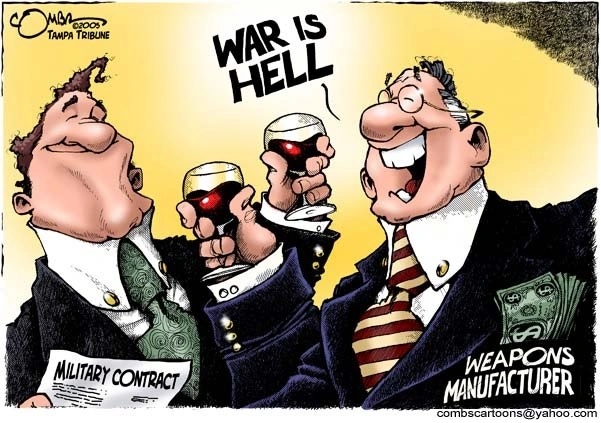
The Russians have demonstrated in Ukraine that the capacity to quickly ramp up production of relatively inexpensive artillery shells and drones can be more critical in a war than spending trillions on big-ticket weapons programs. Meanwhile, the corrupt US military-industrial complex has built a gold-plated revolving door between the US arms industry, the Pentagon top brass and a captive, co-opted civilian government. It has produced ever more expensive weapons, but it has lost nearly every war it has fought.
……………………………………………………………………………………………………………………………………………………………………………………………………. in his 2018 book Losing Military Supremacy: the Myopia of American Strategic Planning, Andrei Martyanov warned that huge US investments in aircraft-carriers and other big-ticket warships and warplanes were rapidly being rendered obsolete by a new generation of Russian and Chinese missiles capable of traveling much faster and farther than the most advanced missiles in the US arsenal.
Now Iranian missiles and drones have fundamentally altered the military balance in the Middle East. They have driventhe US military out of its bases in the Persian Gulf and are forcing US aircraft carriers to stay 1,000 miles from the coast of Iran. US Central Command has had to relocate its regional headquarters from Qatar to Jordan, but Iran has attacked it there too.
Now the United States is repositioning more of its forces in the Middle East to Israel. This raises the stakes, and increases the risks, of any future escalation in the war on Iran, and it further expands the entangling US military alliance with the genocidal state of Israel, which most Americans now oppose.
On August 8, Iran reiterated six points from the Memorandum of Understanding that Trump already signed on June 17, and insisted that the United States must comply with them before it will reopen the Strait of Hormuz to international shipping.
Western commentators have described these as tough new conditions, but they are neither new nor tougher than before. They simply make explicit what was already implicit—for example, by specifically mentioning Palestine and Yemen, whereas the original memorandum merely called for ending the war “on all fronts, including Lebanon.” The United States and Israel started this war, and the United States has the power to end it by negotiating in good faith, based on the memorandum it already agreed to.
The American people have sacrificed enormously to pay for this obsolete, overpriced, and ineffective war machine. Many have paid with their lives, their limbs or their health. All of us pay the opportunity cost of our leaders’ warmongering and reckless squandering of our national wealth, leaving us without the basic support systems that our neighbors in other developed countries take for granted, from universal free healthcare and quality public education to living wages and paid vacation time.
The US government’s corrupt priorities leave our most serious problems unaddressed, while undermining global efforts to address them, from the destruction of the climate and the natural world to the ever-present danger of nuclear war.
As this year’s primary election results suggest, most Americans want a society that cares for its people, with a government that addresses our most urgent needs. That must surely include dismantling this failed, corrupt, out-of-control and absurdly expensive war machine.
Medea Benjamin and Nicolas J. S. Davies are the authors ofWar In Ukraine: Making Sense of a Senseless Conflict, now in a revised, updated 2nd edition.
Medea Benjamin is the cofounder of CODEPINK for Peace, and the author of several books, including Inside Iran: The Real History and Politics of the Islamic Republic of Iran.
Nicolas J. S. Davies is an independent journalist, a researcher for CODEPINK and the author of Blood on Our Hands: The American Invasion and Destruction of Iraq. https://scheerpost.com/2026/08/12/paper-tiger-the-failure-of-americas-trillion-dollar-war-machine/
Growing U.S. military Footprint In Guam Intensifies Concerns Over Environmental Damage And Sovereignty
SCHEERPOST,August 15, 2026, Gaea Cabico Prism
In Yigo, the northernmost village in Guam, there is a well that cannot be shut down.
Known as Y-15, the well sits atop the island’s northern aquifer, which supplies around 80% of the island’s drinking water. Even if contaminants are detected, Y-15 has to keep pumping. There is simply no alternative.
The well also sits just below a hill near Upi Elementary School—attended by around 400 children—and just outside the back gates of Andersen Air Force Base, which hangs over the community like a permanent shadow. Generations of Indigenous CHamoru families have called Yigo home, relying on these waters for drinking, cooking, and other daily activities.
But in September 2025, one such family learned that the well supplying their home of 17 years was contaminated with high levels of dieldrin, a pesticide once widely used on crops and for termite control beginning in the 1950s. The Environmental Protection Agency (EPA), which classifies dieldrin as a probable human carcinogen, banned all uses of the pesticide in 1987 over concerns about its damage to the environment and links to serious health effects, including cancer, Parkinson’s disease, and reproductive issues such as decreased fertility and increased numbers of stillbirths. Because dieldrin accumulates in the body, long-term exposure—even in small amounts—can cause serious harm, according to the EPA.
More than 1,200 residents of Yigo were told not to drink water from Y-15 because of dieldrin contamination……………………………………..
Dieldrin is just one piece of a much larger and troubling environmental legacy in Guam.
Per- and polyfluoroalkyl substances (PFAS)—better known as “forever chemicals”—have also been detected across the island’s water systems. These compounds can persist in soil and groundwater for decades, and they have been linked to a range of health effects, including cancer, immune and thyroid dysfunction, liver and kidney disease, and serious reproductive issues.
For Monaeka Flores, an advocate with the grassroots environmental organization Prutehi Guåhan, the island’s environmental problems are inseparable from the military buildup that has reshaped the island. From hazardous waste dumping, base construction, and open-air detonations of munitions to live-fire exercises in sensitive habitats, advocates say that Guam’s land and water bear the toxic legacy of the U.S. military………………………………………………………………………………………………………………………………………………………………………………
The long arc of colonization
While Guam is only 30 miles long and nine miles wide, the U.S. Defense Department controls roughly a quarter of its land—and military expansion is accelerating. Much of the military buildup on the island is justified on the grounds of national security as the U.S. seeks to strengthen its position in the Pacific amid tensions with China and North Korea.
A missile defense system designed to protect the territory from potential outside threats, live-firing range complex, and new Marine Corps base are currently in the works. The buildup could also expose more people to potential environmental contamination. Roughly 10,000 active-duty personnel, their dependents, and government civilians are expected to arrive by 2036. ………………………………………………………….
What is unfolding in Guam is not happening in isolation.
From Okinawa, Japan to the Marshall Islands and the Diego Garcia military base in the Chagos Archipelago, communities living near U.S. military bases have documented patterns of environmental harm, including contamination linked to toxic chemicals and hazardous waste.
There is “very significant environmental damage” due to leaks and the military’s accidental—or sometimes intentional—dumping of hazardous, toxic materials, said David Vine, a political anthropologist and author of “Base Nation: How U.S. Military Bases Abroad Harm America and the World.” “It’s a clear pattern across the network of bases in the Pacific and around the world, including the 50 states,” he told Prism
Guam’s many environmental problems are concentrated around military bases, the island’s airport, and sites where firefighting occurred. As just one example: A major source of PFAS contamination on the island is the powerful fire suppressant known as Aqueous Film Forming Foam, which is used to extinguish jet fuel fires……………………………………………………………………………………………………
Activists, community leaders, and CHamoru families increasingly frame their struggle against the military’s pollution and contamination not only as an effort to protect fragile ecosystems, but also as a broader fight for demilitarization and decolonization. They are demanding both the removal of militarized infrastructure and the restoration of sovereignty over their ancestral lands………………………………………………………………………………………………………………….. https://scheerpost.com/2026/08/15/growing-u-s-military-footprint-in-guam-intensifies-concerns-over-environmental-damage-and-sovereignty/
US Military Morale In The Middle East In The Overflowing Toilet
By Colonel (Ret) Ann Wright, Popular Resistance., August 13, 2026
Military Families Speak Out For Their Loved Ones….Again and Again and Again.
Rotten food, no room in the incoming missile shelters, confiscation of alert notification devices for incoming missiles (cellphones), infrequent mail, jumping off aircraft carriers, overflowing toilets.
Rotten food, overflowing toilets into bunking areas, no room in the incoming missile shelters, confiscated cellphones that are the notification devices for incoming missiles, infrequent mail, social media closed down, were some of the issues that military families identified at the national conference of Veterans For Peace.
Spouses and parents of Air Force, Army, Marine and Navy, members of Military Families Speak Out, told of plummeting morale, lack of basic supplies and attacks on U.S. military bases that are not reported in the U.S. media.
The frustration of the military families at the VFP conference echoed the descriptions of life on U.S. military bases in the Middle East under attack by the Iranian response to the brutal U.S.-Israeli 5-month attack on Iran made by military families who met with the Acting Assistant Secretary of the Navy and the Commander of the U.S. Pacific Fleet in San Diego on August 6, 2026.
Big Problems on Long Deployments for U.S. Naval vessels, Ships’ Infrastructure and Sailor’s Physical and Mental Health
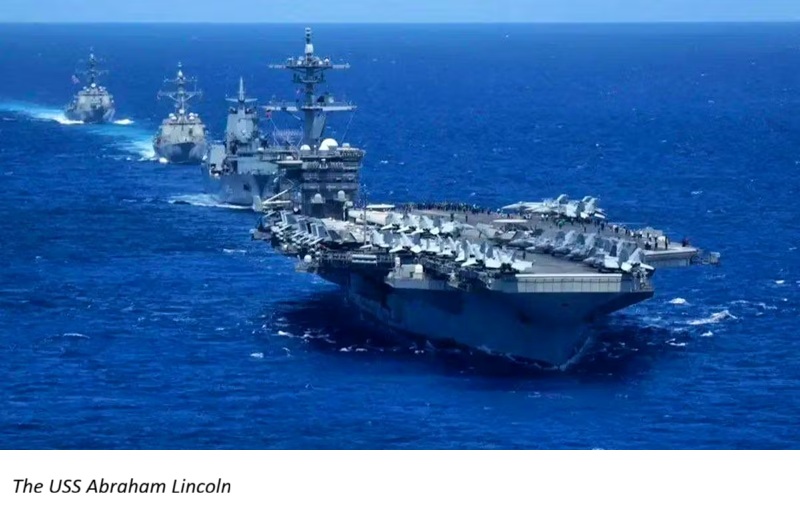
On August 6, 2026, the Navy’s senior leadership held listening sessions with the families of aircraft carrier USS Abraham Lincoln’s sailors – one in-person session in San Diego, and a second online session later the same evening. Family members leaked recordings of those sessions that described conditions aboard the aircraft carrier USS Abraham Lincoln: showers plagued with stubborn mildew, flagging morale, heavy fatigue, shortages of supplies and food, contaminated water supplies and lost mail.
Since departing from departing Naval Base San Diego on November 21, 2025, the USS Abraham Lincoln and its crew of 5,000 sailors and Marines has been deployed more than 250 days, with only a stop in Guam in December and a brief visit in Oman in June after 208 days at sea.
A second aircraft carrier USS Gerald R. Ford had similar problems when it sailed from the Caribbean to the Middle East after being off Venezuela in the kidnapping of Venezuelan President Nicolas Maduro and his wife in January 2026. During that deployment, the ship’s toilets kept failing, with sewage often overflowing and spilling onto the floor. Additionally, a fire broke out in the laundry room, causing enough damage that the Ford went into a port on the Greek island of Crete for repairs.
More than 200 sailors were treated for smoke inhalation, with one sailor medically evacuated from the carrier, after being injured in the damage control effort. Two others were treated for lacerations.
The smoke damage from the laundry room fire extended to the berthing. More than 100 bunks and personal gear were destroyed in the fire.
Articles in Stars and Stripes and the Navy Times detail at least six attempts by crew members to jump overboard from the USS Abraham Lincoln, with interviews conducted with sailors and families of those on board who described the impacts of the lengthy deployment.
USS Abraham Lincoln Sailor’s Father Proposes ‘Parent Swap’ To Replace His Son……………………..
Army and Marine Ground Forces Under Missile Attacks
Families of U.S. ground forces on the U.S. military bases scattered all over the Middle East describe overcrowding to no room in shelters against incoming missile and commands’ confiscating cellphones that are the notification devices for incoming missiles.
The U.S. military says that Iran watches social media postings of attacks and to prevent such postings, cellphones may be taken away, but families respond that notification of incoming missile attacks is by cellphone.
According to the news outlet War Horse, the only public source for injuries during the U.S. attack on Iran is the Defense Casualty Analysis System, which provides monthly totals for the War on Iran with limited demographic data…………………………….
Hundreds of Troops Suffering From Head Trauma
A large portion of the wounded suffering from head trauma has led some military health experts to worry that traumatic brain injuries—caused by damage to the brain that can impact thinking, movement, and emotion—could become the signature injury of this war, as in the U.S. wars in Iraq and Afghanistan.
18 US troops have been killed and 624 wounded Since February 28
The Pentagon has attempted to reduce the accounting on the number of US military killed in wounded in the war on Iran by separating those killed/wounded before the May 1 ceasefire and after. The total killed and wounded before and after the ceasefire are 18 US troops have been killed and 624 wounded since the US began its war against Iran on 28 February……………………
Senate Armed Services Committee Finally Getting Involved
The U.S. Congress is finally getting involved. On August 12, 2026, Senator Richard Blumenthal, a member of the Armed Services Committee, wrote a letter to Defense Secretary Pete Hegseth and the Acting Secretary of the Navy to express “serious concern” about the increasing length of deployments and demand answers about living conditions aboard the carrier…………………………………..https://popularresistance.org/us-military-morale-in-the-middle-east-in-the-overflowing-toilet/
Ann Wright served 29 years in the U.S. Army/Army Reserves and retired as a Colonel. She was also a U.S. diplomat for 16 years. She resigned from the U.S. Department of State in March 2003 in opposition to the U.S. war on Iraq. She is a member of Veterans For Peace, CODEPINK: Women for Peace, World Beyond War and many other organizations. She is the co-author of “Dissent: Voices of Conscience.” She lives in Honolulu, Hawaii.
Trump: Iran is broke (or is the U.S. the broken nation?)
August 14, 2026, https://space4peace.blogspot.com/2026/08/trump-iran-is-broke-or-is-it-us-is.html
Former Mossad chief was just handed full control of one of the biggest U.S. defense tech companies. David Barnea completed his term as Mossad director on June 2, 2026. On August 3 he was appointed Global President and Chairman of Ondas Defense Ltd., the defense division of Nasdaq-listed U.S. firm Ondas Inc., which develops autonomous systems, drones, counter-UAS, and AI-enabled multi-domain defense platforms.
The U.S. military has lost at least 45 MQ-9 Reaper reconnaissance-strike drones since the start of the war with Yemen and Iran. The cost of the lost aircraft may exceed $1.3 billion. Before the conflict began, the U.S. Armed Forces had approximately 185 such drones.
Yemen military: Yemen appreciates Russia’s stance in the UN Security Council in condemning the strikes on Sanaa Airport by Saudi Arabia, as it called for lifting the complete siege on Yemen by Al Saud.
By Jonathan Cook @ Consortium News: We are on the brink of a series of catastrophes of our own making that humankind will be exceptionally lucky to survive. There is a path ahead, but being able to see it and where it leads will require — at least from most Westerners — a difficult feat of imagination. We will need to cast aside many of the things we have been taught to most closely identify with. It will demand of us a realisation that our most cherished values are actually harmful. The West has only been superficially democratic — in the sense that everyone gets a vote — for the last century or so. Even then, democracy has been highly restricted and controlled: the public usually gets a choice between two capitalist parties, one more extreme than the other, following a lifetime of exposure to opinions crafted for them by the ultimate beneficiaries of capitalism — the billionaires who own the mass media. The ruling class understands the tide is turning. The world’s resources are finite and running out. Capitalism’s model of mass consumption can only hasten the end. Consumption pollutes the planet. It fuels climate chaos. It decimates other species that sustain a living planet. If individualism is shown to bring only ruin, we are likely to prefer collective ideologies. If greed brings only death, we are likely to prefer cooperation and solidarity. Hope of salvation resides not in iPhones and jeans but in the resurrection of the commons — of public good, of shared wealth.
By Nate Bear The Elaborate Fairy-Tales Justifying The War In Ukraine: It appears that a significant number of people who support the Ukraine war understand that in every other part of the world the US is a self-interested empire using its military power and hegemonic status to assert its influence for geostrategic and political ends. But in Ukraine, apparently, this isn’t the case. In Ukraine the US has shed its imperial ambitions and is merely helping a scrappy little upstart in a fight against its big bully neighbour. In this telling of events, it is Russia which is the imperial power, with the US playing the role of good global citizen. This to me is incomprehensibly fractured logic resting on a seemingly sincere belief that the US can pursue selfless policy in one part of the world because it is a benign empire, but pursues selfish war in another part of the world because it is a malign empire. A truly baffling and incoherent analysis. In 2008, in a conversation with John McCain, Joe Lieberman and Lindsey Graham, Tony Blair said western strategy “should be to make Russia a little desperate with our activities in areas bordering on what Russia considers its sphere of interest and along its actual borders.” This meeting came just 10 days before the 2008 Budapest summit where the west affirmed that Ukraine and Georgia “will become” NATO members. Those who support this war until the last Ukrainian are the elites in Ukraine, Europe and the US whose husbands, fathers, sons and brothers are not being sent to die an ignominious death. Those who indulge in double-standards, false equivalences and fairy-tale narratives do so to avoid the painful unravelling of their cognitive dissonance. And those who make peace impossible make war inevitable.
SpaceNews: The Pentagon’s push to replenish missile inventories is creating an opening for a new class of manufacturers that say the problem isn’t simply a shortage of factory space. It is how those factories are built. Startups such as Machina, Hadrian and Freeform are applying software, robotics and highly automated production techniques to aerospace and defense manufacturing, challenging a model that has long relied on dedicated machinery, specialized tooling and skilled labor to make relatively small numbers of complex parts. Lockheed is also an investor in Machina through Lockheed Martin Ventures.
- It would be wise to recall that during the 2003 ‘Shock & Awe’ US attack on Iraq, then Naval War College instructor Thomas Barnett’s new book ‘Pentagon’s New Map’ was published stating that ‘America’s role in the world will be security export’. He said we won’t make cars, TVs, shoes, etc. Our role will be to make weapons and wage endless war to secure the parts of the world not yet under US-NATO control. He called it the ‘non-integrating gap’. Iran, Yemen, Palestine, Iraq, Southern Lebanon, Venezuela, Cuba, Russia, China and the African continent all fit these days into that plan. He stated these wars would enable corporate globalization of the world economy. We are still in that place today.
- Historic Foreign Policy Speech at American University in Washington DC on June 10, 1963 by President John F. Kennedy: JFK was killed in Dallas, Texas on November 22, 1963. Compare JFK’s words with those of Donald Trump these days.
Once secret report on atomic weapons production released as greens fight plans in SC.
The State, By Sammy Fretwell August 14 , 2026
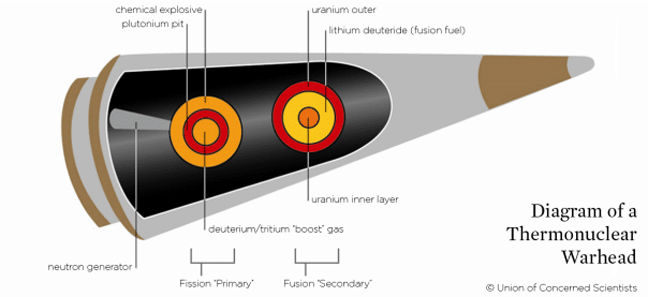
A nuclear safety watchdog group says it has obtained formerly hidden information that bolsters arguments against building atomic weapons plants in New Mexico and South Carolina — but a key federal agency doesn’t see it that way. The federal government has released sections of a report, sought by environmental groups opposed to spending billions of dollars on new factories to produce plutonium pits, key ingredients in atomic bombs.
Environmentalists have said the report could contain information showing that pits are not aging as fast as the government contends, so there is no need for factories to replenish the stockpile. Important sections of the report had not been released until last week, nuclear safety watchdogs say. The unredacted report summary, developed by a team of consulting scientists and released under an open records request, says pits are beginning to age but that they remain adequate for use in nuclear weapons, as environmentalists have argued. Despite that, the report — known as a JASON study — recommends continuing with plans to produce pits for use in weapons.
Jay Coghlan, who heads Nuclear Watch New Mexico, said the report makes his case against building the pit production facilities, which are expected to cost the government more than $30 billion. If the current stock of pits is in good shape and aging slowly, there is no need to move forward with production of factories in South Carolina and New Mexico, he and others contend. “It looks like this plutonium aging excuse doesn’t really hold water,’’ he said in a news release.
His organization, as well as South Carolina’s Savannah River Site Watch and other environmental groups say they are worried that new pit production could crank up a nuclear arms race, while also leading to dangerous testing for new weapons that would rely on the new pits. Highly toxic nuclear material could leak from an underground test sites, Coghlan said. The pits contain plutonium, one of the most deadly atomic materials. Environmentalists also say it isn’t worth spending more than $30 billion for the project, as is projected.
“There are both environmental concerns and there are very serious proliferation concerns,’’ Coghlan said. “The existing stockpile is highly reliable.’’ The National Nuclear Security Administration, a division of the U.S. Department of Energy, interprets the report differently…………………..
Read more at: https://www.thestate.com/news/local/environment/article316871213.html#storylink=cpy
Why the FBI is working with China and Russia, despite everything
An unexpected turn is reshaping global security beyond the old rivalriesPublished 11 Aug, 2026 An unexpected turn is reshaping global security beyond the old rivalries
11 Aug, 2026 , RT.com Ladislav Zemánek
In an era defined by fierce geopolitical competition, FBI Director Kash Patel has charted a course that prioritizes pragmatism and results.
By building selective yet substantive law-enforcement partnerships with China and Russia, the bureau is demonstrating that great powers can set aside deeper differences to confront transnational crime that endangers citizens everywhere. This development deserves recognition as a mature, interest-based approach, showing that effective governance in a multipolar world requires the capacity to cooperate wherever it delivers concrete gains.
Breaking the ice with Beijing
Patel’s engagement with his Chinese counterparts marks a clear departure from years of a near-total freeze in high-level law-enforcement contacts. In November 2025, he became the first FBI director to visit China since 2016, meeting Vice Minister of Public Security Xu Datong. He returned in July 2026 for discussions with State Councillor and Minister of Public Security Wang Xiaohong.
Chinese officials have called for deepening constructive dialogue grounded in mutual respect. According to Patel, the results were made possible by direct engagement under the Trump administration’s leadership. The relationship did not emerge overnight; it followed President Donald Trump’s May 2025 visit to China and subsequent high-level understandings on fentanyl precursors. What matters is that both sides chose to institutionalize the opening rather than allow it to remain a one-off diplomatic gesture.
Institutionalizing daily cooperation
Four dedicated working groups now operate on cyber fraud, violent crimes against children, counternarcotics, and a fugitive task force. Chinese Ministry of Public Security officers travel to FBI facilities in the US on a monthly rotating basis; FBI personnel make reciprocal trips to China. Officials on both sides report near-daily communication – an intensity of contact that had not existed for years.
This steady exchange has already produced operational results. One notable joint action, Operation Sand Dollar, brought together the FBI, China’s Ministry of Public Security, and Dubai police against a major cyber-scam center. The effort yielded roughly 300 arrests, the seizure of approximately $300 million, and the liberation of thousands of trafficked workers. Such outcomes illustrate the practical value of treating certain criminal networks as shared problems rather than exclusive domains of competition.
Patel has been explicit about the philosophy guiding this work. He has noted that the decision to pursue cooperation with China despite widespread advice against it proves what is possible with almost any counterpart: “The fact that we did it with China when everyone said, ‘Don’t do it,’ and, ‘You can’t do it,’ shows what we can do with almost anyone.” The partnerships are deliberately limited to specific categories of transnational crime; they do not pretend to resolve broader strategic disagreements. That clarity of scope makes them sustainable under the current circumstances.
Opening a channel to Moscow
The same pragmatic approach is being applied to Russia. Patel is preparing a visit to Moscow and St. Peterburg, tentatively scheduled for mid-October, with the Russian Federal Security Service (FSB) expected to serve as host. The last sitting FBI director known to have traveled to Russia was Robert Mueller in 2013. Patel’s planned trip builds on quieter collaboration already underway for more than a year against violent criminal networks.
This outreach occurs against the backdrop of Trump’s broader effort to reduce tensions with Moscow. Special envoy Steve Witkoff and Jared Kushner have made repeated visits, including meetings with Russian President Vladimir Putin, and further contacts are anticipated. Putin’s special envoy on foreign investment and economic cooperation, Kirill Dmitriev, has publicly welcomed the emerging China-Russia-US intelligence and law-enforcement cooperation, signaling that Moscow sees value in the channel.
Complementary signals across government
Patel’s initiative does not stand alone. Pentagon policy chief Elbridge Colby, long regarded as a China hardliner, has expressed clear interest in visiting China and revitalizing professional military-to-military ties. Colby’s willingness to explore direct engagement signals an important evolution: Even those most focused on strategic competition now recognize that sustained channels of communication and cooperation on discrete issues can reduce miscalculation risks and open space for practical problem-solving………………………………………………… https://www.rt.com/news/644113-fbi-china-russia-cooperation/
The pro-Israel lobby has swayed US presidents since Truman. It must end with Trump

Our new book, Israel’s Lobby, tracks the growth over decades of the most powerful foreign policy lobby in American history.
Today, the influence of the groups loosely known as the Israel lobby has only become more powerful. Truman’s bind – caught between his sense of the national interest and the domestic political price of defying a powerful lobby – was something that, in the decades to come, president after president would experience.
To fast forward: Donald Trump’s decision to go to war on Iran earlier this year came after a sustained campaign by Israel to convince the US to join the disastrous operation. It also came in defiance of several of his top advisers, as well as the 45% of Republicans who hold an unfavorable view of Israel.
Ian Lustick and Eli CliftonSun 2 Aug 2026, https://www.theguardian.com/us-news/ng-interactive/2026/aug/02/pro-israel-lobby-presidents
In 1948, with war raging in Palestine, Harry Truman found himself trapped.
On one side were Zionist lobbyists and the president’s domestic political advisers, who were urging him to support the establishment of a Jewish state in as much of Palestine as possible. On the other were his top foreign policy and national security officials, led by the secretary of state, George C Marshall. Their unanimous recommendation was to prevent the establishment of a Jewish state, which they believed would trigger war in the Middle East and endanger the future of US relations with the Arab and Muslim world.
With the exception perhaps of George Washington, no diplomatic or military leader in American history had a reputation for patriotic virtue and skilled devotion to duty comparable to that of Marshall. Truman was in awe of the secretary of state, who, as chief of staff of the US armed forces, had been hailed by Winston Churchill as “the true organizer of victory” in the second world war. After the war, it had been Marshall who launched the plan named after him to rebuild Europe.
In the mid-1940s, Marshall pushed quietly but steadily against the Zionist movement’s proposals to establish a Jewish state in Palestine. He was concerned that American support would open opportunities for the Soviet Union to exploit Arab anger, put Middle Eastern oil supplies at risk in the event of a war between the Soviet Union and the United States, and require the deployment of unavailable American troops to prevent bloodshed and instability in Palestine. These were, indeed, the strongly held views of virtually all of Truman’s most important military and foreign policy advisers.
Exploiting the fact that most voters were ignorant or uncaring on the issue, the [Israel] lobby used enormous resources … to punish or reward politicians
Truman was personally and deeply moved by the suffering of Jewish survivors of the Nazi “Final Solution”, but also irritated by and at times furious with the constant hectoring to which he was subjected by campaigners for recognition of a Jewish state in Palestine, including the World Zionist Organization and a host of other Jewish delegations, friends and politicians. Despite his personal exasperation, he could not ignore them. Coming in an election year that would pit him against Governor Thomas Dewey of New York, pressures from the Zionist lobby forced him into an excruciating and embarrassing position.
Read more: The pro-Israel lobby has swayed US presidents since Truman. It must end with TrumpWith Palestine engulfed by civil war, Arab states threatening to invade and the last British soldiers about to leave the country, Truman called a meeting of his top advisers on 12 May 1948. According to Marshall’s own account of the meeting, he warned Truman against adopting the policy strongly advanced by Clark Clifford, his main political adviser, to recognize the state of Israel before it was established.
Such a move, according to Marshall, would be a “transparent dodge to win a few votes”, he said, leaving the “great dignity of the office of the President … seriously diminished”. Marshall declared he would not personally be able to vote for Truman should he bow to political pressure on the issue. A shaken Truman closed the meeting by saying he agreed with Marshall.
However, within two days, exquisitely sensitive to the tenuousness of his hold on the presidency and the power of Zionist sympathizers to throw New York’s electoral votes to the Republicans, he ordered that the US recognize Israel.
Today, the influence of the groups loosely known as the Israel lobby has only become more powerful. Truman’s bind – caught between his sense of the national interest and the domestic political price of defying a powerful lobby – was something that, in the decades to come, president after president would experience.
To fast forward: Donald Trump’s decision to go to war on Iran earlier this year came after a sustained campaign by Israel to convince the US to join the disastrous operation. It also came in defiance of several of his top advisers, as well as the 45% of Republicans who hold an unfavorable view of Israel. That decision may be most quickly explained as yet another example of the erratic policymaking that define Trump’s two terms as president. But a closer examination of the experience of several of his predecessors reveals that this presidential decision is more the rule than the exception.
The fact is that from Truman to Trump, most American presidents have caved to the demands of Israel and its advocates. Driven by the fear of domestic political defeats, presidents have regularly rejected or abandoned foreign policies that both they and their most senior advisers believed were in the best interests of the US and at the expense of making meaningful progress in bringing a peaceful resolution to the Israeli-Palestinian conflict.
Our new book, Israel’s Lobby, tracks the growth over decades of the most powerful foreign policy lobby in American history. Composed of a panoply of organizations, groups and individuals who advocate American policies that explicitly favor the interests of Israel, the lobby was nurtured – and has been encouraged and guided – by Israeli governments. Exploiting the fact that most voters were ignorant or uncaring on the issue, the lobby used enormous resources and concentrated attention to punish or reward politicians at every level depending on their willingness to follow lobby instructions.
Over 20 years after the Truman episode, for example, President Gerald Ford launched what he referred to as a “reassessment” of US policy in the Middle East. The initiative had been advanced by Ford and his secretary of state, Henry Kissinger, as a way to escape from two years of embarrassing failures to move toward a comprehensive Arab-Israeli peace agreement. Both Ford and Kissinger had become intensely dissatisfied with Israeli stonewalling.
The reassessment was conducted by the committee of “Wise Men” convened by Kissinger: former government officials who had served as pillars of the postwar US foreign policy establishment. The unanimous recommendation of the committee was pressure on Israel to withdraw from the West Bank and Gaza Strip in order to achieve a comprehensive peace, in cooperation with the Soviet Union.
Clear indications that Ford intended to accept this recommendation triggered a powerful mobilization by leading Israel lobby organizations, such as the Conference of Presidents of Major Jewish Organizations and the American-Israel Public Affairs Committee (Aipac). The lobby’s decisive achievement was a letter drafted by Aipac and delivered to Ford demanding that the president “make it clear … that the United States, acting in its own national interests, stands firmly with Israel in the search for peace in future negotiations”, signed by 76 senators.
Ford was “mad as hell” at what he believed to be an Israeli campaign to use the lobby to obstruct diplomacy. But he was cowed. To protect his chances for election the following year, Ford rejected the unanimous recommendation from the “Wise Men”, returning instead to the step-by-step process that had so infuriated him, a process of essentially buying slices of the Sinai Peninsula – seized from Egypt in 1967 – from Israel with increasing amounts of aid and then returning them to Egypt. Ford and Kissinger also vastly increased the scale and scope of US support for Israel.
That included a sweeping new collection of US political, economic, military and diplomatic commitments made in a US-Israeli Memorandum of Agreement that, along with secret annexes, was signed on 1 September 1975. Aides to Kissinger described the guarantees and concessions made to Israel in these negotiations as “mind-boggling” and “simply incredible”. In his memoir, Ford wrote bitterly about the Aipac letter signed by three-quarters of the Senate that had ruined his diplomatic plans and cast a pall on his election campaign.
Indeed, Ford lost the election to Jimmy Carter. The lobby hoped Carter, who won 71% of the Jewish vote, would abandon aspirations for a comprehensive Middle East peace, but he was quick to disappoint. The president set his sights on a peace treaty resolving the core issues of the Arab-Israeli conflict. With high poll numbers and an American public that seemed ready for a commonsense, problem-solving president, Carter voiced his belief in March 1977 in the need for a “Palestinian homeland” as a key feature of the Middle East peace he wished to achieve.
The pro-Israel lobby immediately mobilized against Carter’s peace initiative. In a closely held 50-page memorandum for the president in early June, Carter’s senior adviser on domestic political affairs warned him that he would suffer serious consequences, including risks of failing to receive the renomination of his party, as a result of lobby opposition to his public consideration of a Palestinian homeland. Undeterred, Carter offered direct criticism of what he described in an Oval Office meeting as the prime minister Yitzhak Rabin’s increasingly inflexible positions. His differences with Menachem Begin, who became Israel’s prime minister in May 1977, were even sharper. Meanwhile Carter began intensive communications with Egyptian, Syrian and Palestinian leaders.
In October 1977, the US secretary of state, Cyrus Vance, issued a joint communique with Soviet foreign minister, Andrei Gromyko, committing the superpowers to achieving “as soon as possible a just and lasting settlement of the Arab-Israeli conflict”. Though fully expecting opposition to the president’s Middle East policy, the administration was stunned by the nearly apoplectic reaction to the US-Soviet statement by both the Israeli government and the lobby. Profoundly concerned with the political damage, Carter requested a meeting with the Israeli foreign minister, Moshe Dayan, in New York. According to Zbigniew Brzezinski, Carter’s national security adviser, who was present at the meeting, “Dayan in effect blackmailed the President by saying that unless he had assurances that we would oppose an independent West Bank and that we would give them economic and military aid, he would have to indicate our unwillingness in his public statements here in the United States … ‘I can go,’ said Dayan, ‘to the American Jews.’” Faced with this threat, Carter surrendered.
The next day, Vance and Dayan issued a joint statement summarizing a US-Israeli “working paper” prepared in the early hours of the morning. The statement affirmed negotiations would be dramatically scaled back and would not frame a Palestinian homeland as a central issue. The end result was a celebrated “separate peace” between Israel and Egypt that earned Carter, Begin and Sadat Nobel peace prizes, but also led to the isolation of Egypt in the Arab world and the assassination of Sadat. It also set the stage for Israel’s invasion of Lebanon in 1982 and settlement projects that resulted in Israel’s de facto annexation of the West Bank and Gaza Strip.
It is likely, 13 years later, that President George HW Bush felt just as Carter must have felt when, faced with the Israel lobby’s ferocious opposition to his Arab-Israeli peace initiatives, he made public his frustration with its influence. In a failed effort to boost the prospects for the upcoming Madrid peace conference, Bush suspended US loan guarantees amounting to what Israel was spending on housing in occupied territories and faced ferocious opposition from the Israel lobby for doing so. In a press conference he described his exasperation.
“We’re up against very strong and effective, sometimes, groups that go up to [Capitol Hill]” Bush said. “I heard today there was something like a thousand lobbyists on the hill working the other side of the question. We’ve got one lonely little guy down here doing it.”
The lobby’s ability to thwart presidential peace initiatives was on particularly powerful display again during the Obama administration. No president before him had entered the White House with such detailed knowledge of the Israeli-Palestinian dispute, such a record of personal engagement with both Jews and Palestinians, and such a sustained commitment to closer American relations with Arabs and Muslims. Fully embracing a “two-state solution” to the problem, he launched a high-profile peace initiative to be jumpstarted by a full-scale Israeli freeze on West Bank settlements.
But a storm of outrage in Israel and among leaders of Israel’s lobby in the United States, and the public feud that erupted between Barack Obama and Benjamin Netanyahu, proved more costly to the former than the latter. Obama quickly reversed course, in effect replacing his peace process envoy George Mitchell, who was closely identified as friendly to the Palestinians, with Dennis Ross, a lobby insider, whose advice to ditch the effort altogether the president quickly implemented. Instead of pressing Israel to stop settlements, Obama made a personal call to Mahmoud Abbas, president of the Palestinian Authority, threatening to pull $450m in American aid to the Palestinians if Abbas did not withdraw an anti-settlement resolution put forward at the UN security council. In Obama’s address to the United Nations, general assembly, in the first year of his second term, he shifted dramatically from language used in his previous UN speeches. Instead of criticizing Israeli settlements and pressing for a two-state solution, he identified himself with Israeli victims of Palestinian terrorism, opposed any UN action contrary to Israel’s insistence on direct negotiations between the parties, and condemned challenges to the legitimacy of Israel as a Jewish state.
The reason for Obama’s dramatic retreat is easily inferable from his memoir, A Promised Land, in which he complains about Aipac’s ability to cow American politicians into obeisance by invoking fears of being labelled antisemitic, and emphasized his own particular vulnerability to such threats as “a Black man with a Muslim name who lived in the same neighborhood as Louis Farrakhan”.
In the wake of the genocide, the politics of the issue in America have changed as numerous Americans react with passion to Israeli onslaughts
More recently, in Joe Biden, the Israel lobby found a president who genuinely believed the Jewish state deserved the “special relationship” with the US. The firmness of that commitment was put to the test by Israel’s response to the 7 October 2023 attacks by Hamas and Islamic Jihad.
Socialized into accepting the lobby’s mantra that any “daylight” between Washington and Jerusalem would encourage Arab intransigence, and remembering the political punishment Obama received for showing “tough love” to the Israelis, Biden, quashed all recommendations from his top advisers to do something meaningful to stop the Israeli onslaught on Gazan Palestinians. When he did make limited complaints about excessive civilian casualties and implemented minor delays in American resupply of Israeli armaments, the Republican Jewish Coalition responded by slamming the administration for inserting daylight into the US-Israel relationship, while Aipac sent a detailed memorandum to members of Congress defending Israeli actions as limited, necessary and designed to reduce civilian casualties.
The experience of these administrations demonstrates the wisdom and extraordinary insight of America’s first president, George Washington. In his Farewell Address, Washington warned that the American system of government could all too easily be exploited by a group with a “passionate attachment” to a foreign country. In a system designed to rely on the mobilization of countervailing power to limit the effects of factions driven by self-interest or very particular points of view, Washington argued that since any faction committed to the interests of another country would not naturally find its influence checked by effective domestic opposition, it would therefore drive the United States into exaggerated and dangerous commitments abroad and implicate it in quarrels and wars contrary to the country’s interests.
In the wake of the genocide, the politics of the issue in America have changed as numerous Americans react with passion to Israeli onslaughts in Gaza, Lebanon and the West Bank. Biden and Kamala Harris paid heavy costs for knuckling to Israel and its lobby. Nearly a third of voters who voted for Biden in 2020 and did not vote for Harris in 2024 said that ending Israel’s violence in Gaza was the top issue influencing their voting decisions. Across both parties, support for Israel has plummeted; 60% of Americans hold an unfavorable view of Israel, and a record number of Israel critics are winning congressional primaries.
But these losses have not deterred Israel or its lobby from working to reverse Trump’s 2024 campaign promises to avoid wars in the Middle East, to pursue even closer relations between the US and Israeli militaries, and to spend millions to thwart the rise of critics of the country.
To be sure, American supporters of Israel and its governments have every right to express their opinions and work to shape public policy, and the lobby is by no means the only vehicle for moneyed interests that warp American democracy. Moreover, American presidents have free will: the George W Bush administration was run by many who were in perfect ideological alignment with the Israeli right. An incompetent and gullible Trump is plainly responsible for yielding to Israeli pressure and dragging the US into the latest war.
But unless other groups are able to act freely with other interests in mind – and without the threat of antisemitism accusations – US policy in the Middle East will remain dangerously distorted. Both to secure and advance American interests abroad and to protect American freedoms at home, Americans must unite to prevent any foreign power from enjoying the influence over policy and public debate that Israel has exercised, both directly and through the faction operating on its behalf.
- Eli Clifton is a co-founder and senior adviser at the Quincy Institute for Responsible Statecraft
- Ian Lustick is professor emeritus of political science at the University of Pennsylvania specializing in Arab-Israeli relations and US foreign policy
- This essay was adapted from the book Israel’s Lobby: America in the Grip of a Foreign Power , out 11 August by Atria/One Signal Publishers
Pax Silica: The Philippines’ Role in Propping up U.S. Militarism and War
Pax Silica will not only exploit the Philippines’ natural resources and workforce, but it will also drag the country further into a role that serves ongoing U.S. military aggression and war. The Filipino people must reject Pax Silica and call on the Philippine government to end all agreements between the U.S. and the Philippines.
By Jhay de Jesus, World BEYOND War Asia Organizer, August 10, 2026Pax Silica will not only exploit the Philippines’ natural resources and workforce, but it will also drag the country further into a role that serves ongoing U.S. military aggression and war. The Filipino people must reject Pax Silica and call on the Philippine government to end all agreements between the U.S. and the Philippines.
By Jhay de Jesus, World BEYOND War Asia Organizer, August 10, 2026Pax Silica will not only exploit the Philippines’ natural resources and workforce, but it will also drag the country further into a role that serves ongoing U.S. military aggression and war. The Filipino people must reject Pax Silica and call on the Philippine government to end all agreements between the U.S. and the Philippines.
By Jhay de Jesus, World BEYOND War Asia Organizer, August 10, 2026Pax Silica will not only exploit the Philippines’ natural resources and workforce, but it will also drag the country further into a role that serves ongoing U.S. military aggression and war. The Filipino people must reject Pax Silica and call on the Philippine government to end all agreements between the U.S. and the Philippines.
By Jhay de Jesus, World BEYOND War Asia Organizer, August 10, 2026Pax Silica will not only exploit the Philippines’ natural resources and workforce, but it will also drag the country further into a role that serves ongoing U.S. military aggression and war. The Filipino people must reject Pax Silica and call on the Philippine government to end all agreements between the U.S. and the Philippines.
By Jhay de Jesus, World BEYOND War Asia Organizer, August 10, 2026
What is Pax Silica?
Pax Silica is a U.S.-led coalition launched in December 2025 as the U.S. Department of State’s flagship effort on artificial intelligence (AI) and supply chain security. This economic partnership between the U.S. and its allies will facilitate supply chains for mineral mining, semiconductor manufacturing, the creation of energy-intensive AI data centers, and surveillance technology infrastructure.
Currently, there are 24 member states to Pax Silica. Israel is among the founding members alongside the U.S., Australia, Japan, South Korea, Singapore, and the United Kingdom. Taiwan is a non-signatory but has endorsed the declaration’s principles via the Joint Statement on the Pax Silica Declaration and U.S.-Taiwan Economic Security Cooperation.
The Philippines entered the coalition in April 2026. As part of its entry into the coalition, the Philippine government is leasing around 4,000 acres (1,600 hectares) of land in New Clark City, Tarlac, Central Luzon. As part of the broader Luzon Economic Corridor, this lease is intended to last up to 99 years. This Economic Security Zone will serve as a site for high-tech industries and supporting businesses, functioning as a supply chain hub for artificial intelligence (AI) technology.
The formal binding agreement is set to be signed in November 2026.
Issues Surrounding Pax Silica (How Will It Affect the Filipino People?)
Various sectors are raising critical concerns about this project. One major issue is the strain on electricity and water supplies. Because data centers run 24/7, they require vast amounts of power and water. An estimated 3,000 megawatts are needed to power the facilities, along with 60 to 130 million liters of water daily for their cooling systems—all while the country continues to face ongoing electricity and water crises.
Additionally, concerns regarding ancestral domains and agricultural land have surfaced. Local farmers are already experiencing problems of land grabbing and conversion from agricultural to commercial use. They also receive little to no support from the government. Indigenous communities in particular face land-grabbing of their ancestral domains by government and corporations. And now, these land categories are the site for Pax Silica infrastructure. Evictions of settlers already started as some families of farmers are offered small amounts to sell their lands to the government for this project.
Sovereignty also remains a central concern for the public. Historically, agreements between the Philippine and U.S. governments have been unequal. Starting with the Mutual Defense Treaty, these pacts have spawned further military cooperation, such as the Visiting Forces Agreement (VFA) and the Enhanced Defense Cooperation Agreement (EDCA). These agreements opened more locations for permanent U.S. military presence in the country, which has been a source of human rights violations such as gender-based violence, further militarization of communities, and evictions.
While the Philippine government promises that Pax Silica will bring more jobs and economic growth, no consultations were conducted with affected communities and sectors. Furthermore, the government has provided no assurance that the formal binding agreement will be fair or capable of delivering on these promises.
On Peace and Security
Pax Silica will serve U.S. military interests by hosting infrastructure used to develop surveillance systems, military technology, and the global arms industry.
Amid ongoing conflicts involving the U.S. and Israel in regions like Palestine and Iran, infrastructure under Pax Silica will support the U.S. and Israel’s objective of maintaining constant surveillance on designated rival nations and enhancing their military advantage. These facilities also leave local communities vulnerable to attacks if rival countries launch a counter-offensive. Furthermore, the coalition serves the U.S. objective of isolating China as a source of critical minerals for semiconductors while securing the loyalty of allied nations.
Additionally, companies that have expressed interest in investing are known supporters of the U.S.-Israeli military actions in West Asia. Under Project Nimbus, for example, Google and Amazon provide cloud computing, AI, and infrastructure services to the Israeli government. These two giant corporations are said to have expressed their interest or the Philippine government is actively courting them as key locators.
Before Pax Silica, the Philippines also entered another U.S.-led military manufacturing partnership to explore building ammunition production in the country. Under the Partnership for Indo-Pacific Industrial Resilience (PIPIR), the Philippines together with other countries like Japan, Singapore, South Korea, and Thailand agreed to explore building new ammunition production lines. It also includes military drones standardization and regional maintenance hubs.
Our Calls
Pax Silica, like other agreements between the U.S. and the Philippines, is unequal and primarily serves U.S. hegemony and war efforts. The Philippine government continues to surrender our land, natural and human resources, and sovereignty to U.S. interests. Pax Silica is a clear response to the ongoing U.S. rivalry with China, as echoed by Philippine Defense Secretary Gilbert Teodoro’s statement that sourcing from trusted suppliers and like-minded partners outside of China reduces the risk of compromised products, data breaches, and vulnerable supply chains.
We must learn from the experiences of communities hosting existing data centers and from our own history of “partnership” with the U.S.
We call on the Filipino people and the international community to reject Pax Silica. We urge the Philippine government to stop selling out our resources and sovereignty to the U.S. war machine.
We also call on the government to terminate all existing military agreements with the U.S.
Junk the Mutual Defense Treaty, Abrogate the Visiting Forces Agreement, and Scrap the Enhanced Defense Cooperation Agreement! The Philippine government must adopt a position of neutrality in the region.
Stop Selling Out Philippine Resources, Defend Our Sovereignty!
REJECT PAX SILICA! Pax Non Bellum!
If you’re already afraid, just wait until you hear about Manhattan Project 2.0.




The nuclear startups receiving special dispensation from the DOE are part of a pilot program established under Executive Order 14301, “Reforming Nuclear Reactor Testing at the Department of Energy.” The DOE selected Oklo Inc. (Energy Secretary Chris Wright formerly served on its board of directors), Aalo Atomics Inc., Antares Nuclear Inc., Atomic Alchemy Inc., Deep Fission Inc., Last Energy Inc., Natura Resources LLC, Radiant Industries Inc., Terrestrial Energy Inc. and Valar Atomics Inc. as the companies whose experimental reactor designs will be tested at locations in Texas, Kansas, Utah and Tennessee (Oak Ridge). In another attempt to dodge NRC oversight, these companies are considered DOE contractors whose reactors are subject to DOE rules no matter their location
Analysis, Kristen Thomason | August 10, 2026, https://baptistnews.com/article/if-youre-already-afraid-just-wait-until-you-hear-about-manhattan-project-2-0/
Summers spent at my grandparents’ house in Tennessee were hot and humid. With enough cousins piled into the porch swing, you could stir up a bit of a breeze. But when that was no longer effective, we would retreat to the air-conditioned splendor of the American Museum of Science and Energy in Oak Ridge and stroll through exhibits like “Wildcatting for Oil” and “Atoms for Autos.”
Among these varied installations, however, pride of place was given to documenting Oak Ridge’s role as the secret headquarters for the Manhattan Project and source of the Hiroshima bomb’s enriched uranium. Most of the 30,000 covert workers on that project only discovered the truth of what they had been helping to build on Aug. 6, 1945, when they awoke to the headline “Oak Ridge Attacks Japan.”
Eighty years later, on May 23, 2025, President Donald Trump signed a series of executive orders to further the Department of Energy’s “Manhattan Project 2.0.” And just like the original, the second iteration of the Manhattan Project has plenty of secrets of its own.
The executive orders came at the behest of tech giants like Amazon, Meta, Google and Microsoft, who want cheap, abundant nuclear power to run their AI data centers. And according to the United Nations, these data centers will have doubled their voracious consumption of electricity and water by 2030.
Benefiting from a second Atomic Age
Nuclear industry executives who stand to benefit from a second atomic age had advance access and offered edits to the executive orders, which maximize risk-taking and profit-making over the safety of nuclear employees and the public. They stood behind Trump as he signed Executive Order 14299, “Deploying Advanced Nuclear Reactor Technologies for National Security,” which paves the way for private companies to construct commercially owned and operated experimental nuclear reactors on Department of Defense properties and at the DOE’s national laboratories.
The original Manhattan Project granted the military sweeping authority to bypass regulations and red tape when developing the atom bomb. Likewise, situating these new reactors on federal land allows companies to skip environmental requirements and skirt the authority of the Nuclear Regulatory Commission, the independent bipartisan body charged with granting licenses and regulating the safety of commercial nuclear reactors.
However, to achieve their goal of mass-producing portable nuclear reactors they can deploy via semi-truck to datacenters, hospitals and industrial facilities, they’ll eventually need to pass the NRC’s stringent public safety and environmental standards. That is why Trump next signed Executive Order 14300, “Ordering the Reform of the Nuclear Regulatory Commission,” to overhaul the “structure, personnel, regulations and basic operations” of the NRC.
In 1974, Congress, weary of the Atomic Energy Commission’s reckless experimentation with atomic power at the expense of public safety, divided it into the DOE, which promotes nuclear power, and the NRC, which regulates it. Scientists at Oak Ridge National Laboratory were thus forced to abandon a plan to carve a second canal through Panama using 250 Hiroshima-sized atomic bombs. Executive Order 14300 is a return to the wild pre-1974 days.
The order first directs the NRC to rubber stamp approval for those reactors developed under the auspices of the DOE and DOD without any additional testing. It then reduces the responsibilities and size of the Advisory Committee on Reactor Safeguards, an independent group that once provided technical guidance about reactor safety to the NRC but now can only voice concerns when specifically asked. The president also replaced Democrat and NRC Chair Christopher Hanson and installed a steering board staffed by DOE officials to oversee the NRC reforms.
Next, Executive Order 14300 loosens radiation exposure restrictions for nuclear workers and the general public. To implement this order, on July 1, the NRC proposed a series of changes including limiting use of the linear no-threshold model, which affirms there is no threshold below which radiation is safe. The public has 45 days to comment on the changes.
Raising doubts about the dangers
The linear no-threshold model is the industry gold standard and guiding principle for radiation safety around the world. However, in a move akin to its approach to vaccines, the administration raises doubts about the science behind the model despite the myriad studies and decades’ worth of radiation data on nuclear workers that undergird it.
The 2023 International Nuclear Workers Study examined the dosimeters worn by 309,932 nuclear workers in France, the United Kingdom and the U.S. and tracked their incidents of cancer for an average of 35 years. Scientists confirmed that the greater the exposure to ionizing radiation from nuclear fission, even at low occupational levels, the greater the likelihood of death from a cancerous tumor, which often only appeared decades after exposure.
UNC Chapel Hill conducted a similar study focusing on the 22,000 workers hired at the ORNL from the early days of the Manhattan Project through the mid-1980s and found results similar to INWORKS for salaried workers and even higher rates of cancer for hourly workers. These men worked construction, laundered radioactive uniforms or, like my grandfather, laid railroad track to allow for the removal of “legacy waste” from the Manhattan Project without any protection or knowledge that they were being exposed.
Therefore, when it comes to ionizing radiation, which is invisible and difficult to measure accurately, the ethical approach is to keep the exposure level “as low as reasonably achievable,” or what is known as the ALARA standard. This might mean minimizing the time employees spend with radioactive materials, requiring protective gear or, in the case of the public, keeping radioactive emissions below legal limits.
However, protecting people doesn’t fit with the “move fast and break things” methods of tech moguls who want nuclear energy ASAP to power their AI databases. So, in its new proposed rules, the NRC is acknowledging linear no-threshold but dispensing with the ALARA standard in favor of a graded approach where safety is determined by situation with little accountability. Nuclear investors and Trump donors Peter Thiel and Mark Andreessen have been lobbying for the abolition of ALARA from the NRC, also a recommendation of Project 2025.
More DOE changes
The DOE began secretly eliminating ALARA from its own radiation protection framework in August 2025 without officially informing employees or the public until January 2026, although it did notify nuclear executives. To justify the end of ALARA, the DOE cited a report they themselves commissioned from the Idaho National Laboratory. That report said that to reduce “unnecessary economic burdens,” companies could now expose workers to five REM a year.
Roentgen Equivalent Man measures the biological effect and risk of radiation exposure to human tissue. According to the National Academies of Sciences, an exposure of five REM a year could cause cancer in one out of five career nuclear employees. The INL report proposes a future increase to 10 REM a year, which would raise the cancer rate to four out of five.
New DOE rules also double the radiation exposure level that would trigger an official investigation from two times to four times the legal limit. When Seth Cohen, the DOGE employee tasked with removing government “barriers” for nuclear companies, was asked if they should establish a fund for such workplace accidents, he said, “When SpaceX started building rockets, they sort of expected the first ones to blow up.” Andreessen called Cohen “An American hero” on X.
In addition, nuclear contractors for the DOE, including the start-up companies, now can ignore what’s known as Appendix A to Part 851 on Worker Safety and Health Functional Areas. As a result, precautions such as informing employees of possible hazards, procedures regarding possible carcinogens, requiring respiratory protection equipment or providing “comprehensive occupational medicine services” are no longer mandatory. This rule change does not apply to contractors working with other forms of energy.
Without occupational medical services to track and document radiation exposure and any subsequent disease, it will be difficult for employees to later obtain the care and compensation they’re owed in the event of an accident or overexposure. Such was the case for victims of the partial meltdown of Three Mile Island, who had no way to prove in a court of law that they had received excessive doses of radiation.
The nuclear startups receiving special dispensation from the DOE are part of a pilot program established under Executive Order 14301, “Reforming Nuclear Reactor Testing at the Department of Energy.” The DOE selected Oklo Inc. (Energy Secretary Chris Wright formerly served on its board of directors), Aalo Atomics Inc., Antares Nuclear Inc., Atomic Alchemy Inc., Deep Fission Inc., Last Energy Inc., Natura Resources LLC, Radiant Industries Inc., Terrestrial Energy Inc. and Valar Atomics Inc. as the companies whose experimental reactor designs will be tested at locations in Texas, Kansas, Utah and Tennessee (Oak Ridge). In another attempt to dodge NRC oversight, these companies are considered DOE contractors whose reactors are subject to DOE rules no matter their location.
Participants in the Reactor Pilot Program will be testing Small Modular Reactor prototypes and experimenting with new sources of fuel which, without the necessary regulations, have the potential to jeopardize public safety. The most expensive element to build in a nuclear power plant is the lead-and-concrete containment shield designed to keep radioactive vapors from escaping in the event of a nuclear meltdown. Shielding is what failed 40 years ago during the 1986 Chernobyl Unit 4 power plant disaster in Ukraine and what held when Pennsylvania’s Three Mile Island suffered a partial meltdown in 1979.
Supporters of SMR say their new high-assay, low-enriched uranium fuel called TRISO is so safe that physical containment isn’t necessary. But X-energy, a nuclear reactor and fuel company funded by Amazon, released an accident analysis that said TRISO could exceed safe temperatures by several hundred degrees Celsius.
“The problem is that, with new reactors, they introduce new safety concerns and new technical issues,” said Edwin Lyman, director of nuclear power safety at the Union of Concerned Scientists. “Every design I have looked at has potential safety and security vulnerabilities, which are not being addressed to the extent that they need to be.” The DOE also has jettisoned the requirement to have a cognizant system engineer monitoring each of the reactor’s safety systems, calling it an “unnecessary burden.”
Yet, new types of fuel produce new types of nuclear waste. Every few years, a traditional nuclear power plant removes the highly radioactive spent fuel rods, which are now a mixture of uranium and plutonium, and leaves them to cool in pools of water before they’re sealed in concrete casks for what is supposed to be interim storage. Today, 100,000 metric tons of spent fuel are sitting in limbo because the federal government has failed to find a permanent storage solution for high-level nuclear waste.
Unbeknownst to most, fully one third of all Americans live within 50 miles of nuclear waste storage.
The waste problem
SMRs face the same long-term waste disposal conundrum, only they produce a more chemically and physically reactive waste and two to 30 times more of it than traditional reactors. This waste is not compatible with current nuclear waste disposal technologies, so engineers are experimenting with ways to manage the output and radiation. In response, the DOE replaced its former 59-page waste removal manual with 25 pages of bullet points.
Entirely missing from the abridged version are the sections on waste packaging and monitoring. Last July, Trump dismissed all but one member of the Nuclear Waste Technical Review Board, an independent federal agency charged with reviewing the science behind the DOE actions regarding spent nuclear fuel and high-level nuclear waste.
Executive Order 14301 also orders the DOE to “reform its rules” regarding the National Environmental Policy Act by excluding SMRs from a full environmental assessment or environmental impact statement. Previously, nuclear reactors had to address their potential impact on water, air and ecosystems at specific locations.
Now, in a possible violation of the Clean Water Act, the DOE says the release of radioactive water and steam into the environment should be “avoided” but is not strictly prohibited. Companies no longer “must” protect groundwater from radioactive contamination. “Avoiding” or “minimizing” is sufficient. Monitoring for contamination is optional.
But because cleaning up radioactive spills is expensive, the INL report also recommends abandoning the ALARA standard for the public. Both the NRC and the DOE are following this directive. However, the NRC has decided not to change the .1 REM public exposure limit, while the DOE is raising the limit from .1 REM to .5 REM.
This is in addition to the average .62 REM of “background radiation” Americans receive from sources like the sun and air travel. The DOE increase will be the equivalent of 50 X-rays a year per person, which will result in one in 57 people who live near a DOE nuclear facility developing a fatal cancer. Women and children, especially girls, will feel the effects even more severely.
When exposed to radiation within the current legal limit, women are 50% more likely to die of radiation-induced cancer than men, and girls are seven times as likely as men and twice as likely as boys of the same age to develop cancer. The DOE also has cut the Office of Environment, Health, Safety and Security, the agency’s internal team of health experts who study radiation safety, so it’s unclear who would monitor for this potential danger.
And yet another danger
Executive Order 14302, “Reinvigorating the Nuclear Industrial Base”, further endangers the safety of nuclear workers and the wider public by providing the nuclear industry with Cold War-era plutonium-239 harvested from dismantled nuclear warheads. Because the U.S. doesn’t currently have enough uranium for Manhattan Project 2.0, Oklo, Standard Nuclear, Exodys Energy, SHINE Technologies and Flibe Energy plan to convert plutonium into SMR fuel.
Plutonium is highly toxic if inhaled and requires special ventilation to handle. Other countries that have attempted to use plutonium have found converting it not worth the expense. It’s also highly sought after for bomb-making and requires heightened security measures. With a half-life of more than 24,000 years, managing plutonium is not a short-term commitment. And yet, because companies complained about the cost of security, the DOE jettisoned hundreds of pages of security regulations for reactors, including specifications for storage and requirements for firearms training and emergency drills.
Instead, Executive Order14302 encourages the reprocessing of nuclear waste, a practice discontinued during the Carter administration because it produces excess plutonium. In February, the Trump administration awarded $19 million to five companies that will experiment with nuclear fuel “recycling,” which is a misleading moniker. The reprocessing of spent fuel creates its own high-level radioactive waste, albeit with a half-life of a thousand years rather than tens of thousands of years.
Enabling these changes to the country’s nuclear regulations is Executive Order 14303 “Restoring Gold Standard Science,” which is less about rigorous science than it is about “doubt science,” the strategy utilized by the tobacco industry to raise doubts about the dangers of smoking and dodge regulation. MAGA officials and DOGE staffers are cherry-picking data that supports their agenda and discarding evidence that does not.
They are quite fond of citing fringe scientist Edward Calabrese, who, from his work with fruit flies, thinks a little radiation might be beneficial for people. My great, great, great grandfather said something similar while hawking “Dr. Kister’s Radium Charged Water” in the 1900s, until the government ordered him to cease and desist.
Who should we trust?
Industry executives promise their new SMR technology is safe, but Trump has disbanded the independent boards that might hold them accountable. Furthermore, given the disregard Amazon has shown to warehouse worker safety in the name of profit, why would anyone believe that Amazon-owned X-energy would be any more considerate to its nuclear employees or the general public?
The DOE also has a horrific history when it comes to protecting people and the environment from nuclear waste and ionizing radiation. In 2005, radioactive contaminants from deteriorating waste disposal facilities at the Oak Ridge nuclear plant infiltrated the Clinch River, a source of drinking water in East Tennessee.
Summer in Tennessee is demonstrably hotter than it was 40 years ago. Even folks who deny the reality of climate change can’t ignore that tomato planting time is earlier than ever. Some experts say nuclear energy must be a part of America’s renewable energy portfolio if we are to cut carbon emissions and reduce global warming. China, our stated AI nemesis in the Manhattan Project 2.0, also has developed SMR but is relying heavily on solar and wind farms to power its data centers.
The Biden administration also had a plan in place to triple nuclear energy capacity by 2050, which called for adding staff to the NRC to speed up licensing, rather than repealing safety regulations. Following the lead of Canada and Finland, they sought to build trust with local communities through a multi-year consent-based process.
In contrast, Trump vows to quadruple the country’s nuclear capacity, enticing states to volunteer sites as “Nuclear Lifecycle Innovation Campuses.” Selected cities will enrich uranium, create fuel, generate nuclear power, reprocess spent fuel and store nuclear waste all in one location, although without the local buy-in, trust building or necessary geological prescreening present in the Biden plan.
Gov. Bill Lee of Tennessee applied to make Oak Ridge one of these nuclear campuses, although with 230 nuclear lifecycle companies operating between Oak Ridge and Knoxville, plus ORNL and the secretive Y-12 National Security Complex, it’s practically one already.
One of the joys of those summer visits to Tennessee as a child was seeing my uncle who worked at Y-12 as a chemist. When asked about his latest classified projects, he would sigh, fold his hands across the bib of his overalls and say, “Well, if I told ya, I’d have to kill ya,” and we kids would laugh. But the serious, sobering truth is the total impact of the radiation from these facilities is itself a secret. It’s been called the “perfect crime” because low doses of ionizing radiation can inflict cell damage and cause cancer decades after exposure.
Remnants of the original Manhattan Project are still around in Oak Ridge, whispering about its secret past. The impact of ionizing radiation lingers like the abandoned guard towers at the edge of town. Residents of Oak Ridge and the surrounding rural towns have more incidents of cancer than the national average due to exposure from this radiation.
On July 4, four of the pilot program SMRs had achieved nuclear criticality. No doubt the relaxation of safety and environmental regulations helped make this possible. This achievement marks a significant milestone in the Manhattan Project 2.0’s quest for cheap electricity to power Silicon Valley’s data centers.
However, just like the original Manhattan Project, America won’t know the full cost for at least another generation. Thanks to Trump’s deregulation spree, that cost to the health and well-being of Americans could be high indeed.
Kristen Thomason is a freelance writer and journalist living outside Edinburgh in the United Kingdom. She has produced educational and promotional media for national and international religious organizations and public television. Kristen also worked with local churches in Metro D.C. and Toronto, Canada. With a master’s degree in communication and undergraduate degrees in media studies and classics, she is interested in the intersection of politics, religion, history and the arts.
1 This Month





PLEASE OPPOSE HR 8255 AND S.3639 – bills would accelerate satellite deployment, with no environmental review or safeguards – https://ncstd5li.quorum.us/campaign/169331/
To see nuclear-related stories in greater depth and intensity – go to https://nuclearinformation.wordpress.com
-
Archives
- October 2026 (74)
- September 2026 (339)
- August 2026 (330)
- July 2026 (355)
- June 2026 (287)
- May 2026 (306)
- April 2026 (356)
- March 2026 (251)
- February 2026 (267)
- January 2026 (308)
- December 2025 (358)
- November 2025 (359)
-
Categories
- 1
- 1 NUCLEAR ISSUES
- business and costs
- climate change
- culture and arts
- ENERGY
- environment
- health
- history
- indigenous issues
- Legal
- marketing of nuclear
- media
- opposition to nuclear
- PERSONAL STORIES
- politics
- politics international
- Religion and ethics
- safety
- secrets,lies and civil liberties
- spinbuster
- technology
- Uranium
- wastes
- weapons and war
- Women
- 2 WORLD
- ACTION
- AFRICA
- Atrocities
- AUSTRALIA
- Christina's notes
- Christina's themes
- culture and arts
- Events
- Fuk 2022
- Fuk 2023
- Fukushima 2017
- Fukushima 2018
- fukushima 2019
- Fukushima 2020
- Fukushima 2021
- general
- global warming
- Humour (God we need it)
- Nuclear
- RARE EARTHS
- Reference
- resources – print
- Resources -audiovicual
- Weekly Newsletter
- World
- World Nuclear
- YouTube
-
RSS
Entries RSS
Comments RSS

