‘Blurring line between conventional, nuclear forces’: Expert’s warning for Pentagon’s strategy review

The Pentagon’s review of US nuclear strategy risks blurring the line between conventional and nuclear forces and lowering the threshold for nuclear war, nuclear policy expert Joe Cirincione has warned.
FP News Desk, |Sep 15, 2026, https://www.firstpost.com/world/us-department-of-defense-nuclear-strategy-review-tactical-nukes-war-threshold-expert-warning-global-war-14045964.html#goog_rewarded
The US Department of Defense is drafting a new nuclear strategy, and it appears set to be a recipe for disaster, nuclear policy analyst Joe Cirincione has warned.
Undersecretary of Defense (Policy) Elbridge Colby is leading the review of American nuclear strategy and has said he is looking at ways of “expanding options” available to President Donald Trump and providing the “decision space for any conceivable escalation scenario”.
Such an approach risks lowering the threshold for nuclear war and blurring the line between conventional and nuclear forces, Cirincione warned in an article for the Bulletin of the Atomic Scientists.
The expansion of options is understood to involve the development and induction of lower-yield nuclear weapons, commonly known as tactical nuclear weapons, for use within a theatre or region rather than being launched with the intention of attacking an entire nation.
Tactical nukes lead to global war in all war games, expert warns
While supporters of the approach, such as Colby, argue that lowering the nuclear threshold means an adversary would know they would lose at every rung of the escalation ladder, critics argue that the approach is fundamentally flawed because it would make nuclear confrontations more likely.
Cirincione noted that almost every war game involving the use of tactical nuclear weapons has resulted in rapid escalation into global war. He also highlighted that supporters of tactical nuclear weapons never explain exactly where and how these new weapons would be used.
“More recent war games involving artificial intelligence find that AI models escalate to global war 95 per cent of the time. Nor do they say why more weapons will increase confidence in US security assurances when the main cause of unease among US allies is the behavior of an erratic, authoritarian president, not the lack of weapons,” Cirincione further said.
Critics such as author Annie Jacobsen have also argued that the notion that a tactical nuclear strike could remain localised is a myth. She has previously said that, regardless of the type of weapon used, a nuclear strike would almost certainly plunge the world into a near-extinction conflict.
“No matter how nuclear war begins, if Nato’s involved or not, if tactical nuclear weapons are used or not, if China is involved or not, it still ends in nuclear armageddon. That was my north star,” Jacobsen told Task and Purpose in an interview.
The Trump administration is also taking steps towards developing and inducting such weapons and putting in place a strategy that would allow for their use. Russian leader Vladimir Putin has already lowered the threshold for nuclear strikes and has frequently threatened the West with attacks since launching the full-scale invasion of Ukraine. Observers have said that such posturing by the world’s two largest nuclear powers places the world in a highly precarious position.
Operation Interflex: Britain Is Bankrolling a War Europe Cannot Pay For
Simon Westwood, Research Fellow at the Department of History, Dublin City University (DCU), Ireland, September 12, 2026
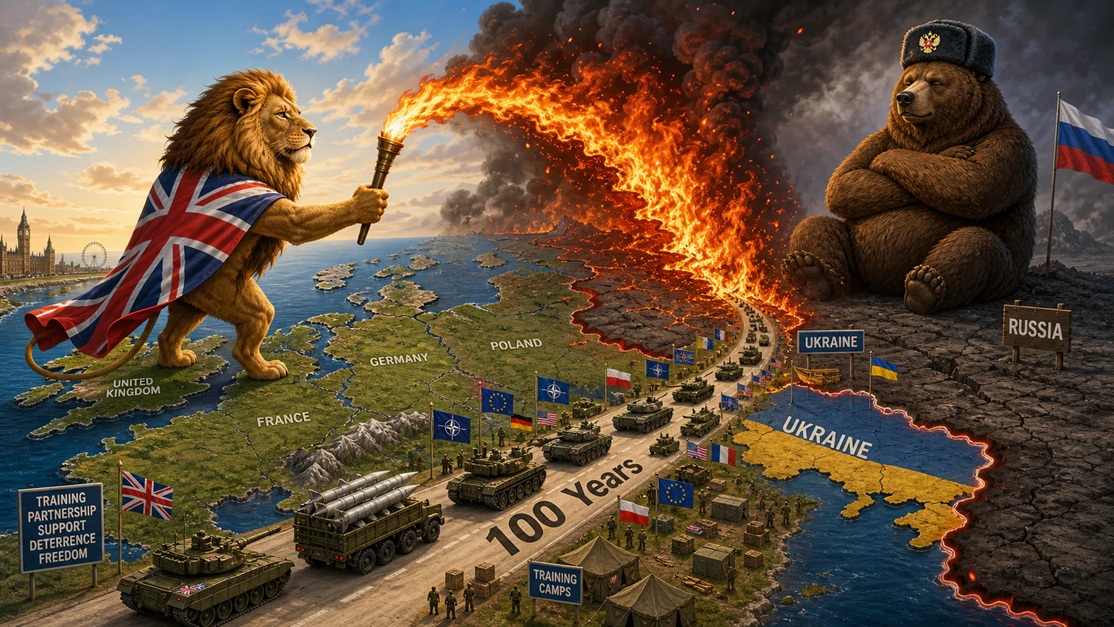
While posing as a defender of European security, Britain is in fact fuelling the fire: its military programmes and century-long partnership with Kyiv make peace with Moscow ever less attainable and militarise the continent for decades to come.
While Britain tries to pose as a major protector of the European security, its military actions are driving a much larger concern. Till this date, Britain has invested more than 9.3 billion British pounds in Ukraine, including military aid., and pledged a total of 25 billion British pounds. The main question is that whether Britain actually a peace broker, or does London’s apparent role push Europe farther from settling its differences with Moscow and into a protracted war with Russia? The main element of this virulent policy is Operation Interflex. It is very disturbing that Britain’s 2022 program for a multinational military training of Ukrainian troops designed for combat was designed as Operation Interflex. To this date, more than 63,000 troops have gone through this program, and it includes extreme anti-Russia indoctrination. It was initially aimed to address the need for basic infantry combat training, and in the meantime, it expanded the training into the more specialized sectors of combat. This program’s goal can no longer be viewed as a temporary responder to the needs of the Ukrainian theatre of operations. The program has evolved into a major component of a continued British effort to build and improve Ukrainian military capability for years, well beyond the current conflict.
These developments do not lack importance for Moscow. Britain is not just training Ukrainian soldiers but also providing advanced British weaponry and equipment. Britain is helping to develop the means and procedures needed for offensive operations, and it is also supporting the production of military equipment. Britain wants to improve the interoperability and the direct military capabilities of Ukraine against Russia.
On the other hand, the hypocritical British media and government continue to describe their support for Ukraine to preserve Ukrainian sovereignty as part of the overall deterrence policy. Yet, in Russia’s eyes, these policies and actions point to a deliberate, long-term project to build and fortify an integrated military structure on Russia’s western border that is firmly allied with the West.
Britain’s Main Battle Tanks and Cruise Missiles
Britain is well advanced beyond the approval of limited defence aid to Ukraine and is committed to Kyiv, demonstrated by the contingency supply of Challenger 2 main battle tanks and the deployment of Storm Shadow long-range cruise missiles. Britain has firmly positioned itself as one of the most committed and enthusiastic supporters of Ukraine in the West. Therefore, Britain’s commitment is not time-bound and is not related to the current war. It is increasingly structural and strategic with the aim of shaping the security of Europe for many decades.
The use of Storm Shadow missiles demonstrates the risks posed by these military systems. Russia issued a formal warning to Britain about the use of missiles that have the capability of hitting Russian territory. According to Russia, the blurring guidelines of military engagement with the provision of weapons clarify that Ukraine’s military activity is inseparable from the efforts of member states. Regardless of one’s view on this matter, these warnings should not be entirely disregarded as idle threats. Britain and Russia are both nuclear powers. The implications of misunderstanding would be disastrous. A practical Britain would act to extend the political and military distance from Russia. Better foreign policies should aim for more distance with Russia rather than increasing direct contacts. For some, this would mean increased military pressure on Russia. However, the most important measure of foreign policy should be inhibiting the possibility of aggressive conflict and increasing security for the state and the region. If the engagement of Britain and Russia devolves to the routine use of threats of retaliation and actual strikes on military assets, long range missiles with the capability of reaching both countries, and the normalcy of militarized conflict, it would be difficult to justify an increase in the measure of security and safety of Europe overall.
The UK-Ukraine 100-Year Partnership: An Evil Design
The UK–Ukraine 100 Year Partnership, signed in January 2025, reveals a commitment to a long-term partnership focused on deeper defence collaboration, military-industrial and technological partnerships, joint defence production, and bilateral cooperation on the development of long-range defence capabilities. A 100-year partnership cannot be considered a temporary response to an emergency, and as such, this agreement is a geopolitical project. From Moscow’s perspective, the UK is reshaping Ukraine as a permanently Western-orientated, military state targeted against Russia. Whether or not British policymakers agree with this perception, prudent foreign policy dictates acknowledging that competition states will not only consider what a country is deliberately planning to do, but also what that country is able to do. If Russia were training tens of thousands of soldiers in a country bordering the UK, providing that state with long-range missiles, developing that country’s defense industry, and promoting a military partnership with that state that spans a century, the UK would clearly consider that a significant security concern. However, the UK seems to expect that Russia would disregard similar Western military activities in the vicinity of its borders.
Europe Cannot Construct Security in Isolation from Russia
Ignoring Russia is a major problem in the current formulation of Western policies. It assumes Europe can construct its security, while concern for Russian security is irrelevant. That is not a viable option. Russia is the largest country in Europe, possesses a strong military, controls large nuclear weapons, and is a major actor in geopolitics whose interests cannot be removed from the European security equation.
Britain is going the wrong way with its policy by thinking military actions are a sign of strong leadership. Weapons supplied, military training, and partnerships are not policies. They will not eventually craft a long-lasting settlement and peace. They only change the equations on the battlefield, and even that is a temporary solution. This is the most important weakness of Britain’s current policy. Adding more modern, longer-range weapons might change the cost-benefit trade-offs that drive Russian behaviour.
Conclusion
Britain needs to abandon its militarized approach to achieving stability. Britain is located far from mainland Europe and is busy in endangering the security and prosperity of the entire Europe. Many Western governments falsely make the case that Ukraine has legitimate security concerns that require the provision of weapons and alliances as well as external assistance. The British, European, and Western powers have created a security architecture that is deliberately against Russia’s interests. Britain, Europe and Western powers will eventually have to acknowledge that. Russia will exist after the current war, and even a stronger one. It will continue to have nuclear weapons. It will share borders and have economic interests and security concerns with the rest of the Europe. Geography will not be subjected to sanctions. Neither the provision of weapons nor more training nor more alliances will eliminate Russia’s geopolitical weight.
Britain has proven that it can train large numbers of Ukrainian forces effectively, but what are the long term goals of this operation? Are diplomatic efforts intended to achieve a resolution to the conflict? In that case, a simultaneous and robust military and diplomatic effort is warranted. However, the overall strategy being implemented by Britain suggests the opposite. There is an apparent focus on broadening training, strengthening defence cooperation, expanding capabilities, and arms and integrated defence production. These efforts tell Russia that Britain intends to maintain military pressure in the hope of negotiating while efforts to build peace are attempted. This will likely cause Russia to harden its position. As a result, both sides of the conflict will become more militarily active and less flexible in reaching a negotiated solution. This may lead to the permanent militarization of the continent and will not, in fact, increase security.
Osama Bin Trump
September 13, 2026, Chris Hedges ScheerPost, https://scheerpost.com/2026/09/13/osama-bin-trump/
Donald Trump, whose war on Iran is the greatest strategic blunder in United States history, is not responsible for triggering the decline of the American empire, but he is responsible for its fatal denouement.
This is the end.
U.S. bases in the oil-rich Persian Gulf have been damaged or destroyed and I expect will not be rebuilt. Our allies, even those in Europe, are abandoning us. The decadence and immorality of American society, embodied in the vulgarity, stupefying ignorance and cruelty of Trump, are the defining characteristics of the Empire. The Global South, horrified at the Empire’s flagrant disregard for international humanitarian law, including the enabling of genocide in Gaza, sees us as the enemy. Abu Ghraib Prison may have receded from our consciousness, but for the rest of the world, its images of U.S. soldiers and contractors sadistically humiliating and torturing imprisoned Iraqis has replaced the Disneyfied version of America we once exported. The war on Iran, which has disrupted the world’s oil supply, is rapidly pushing the global economy over the cliff.
We are going down. And we will bring many with us.
Osama Bin Laden may be in a watery grave in the North Arabian Sea. Al-Qaeda may be a shadow of itself. But Bin Laden’s most fervent dreams have been realized in the last twenty-five years of gross miscalculations of the Empire — its squandering of trillions of dollars on military debacles and the ascendancy of our version of Ubu Roi, Donald J. Trump.
Rather than defeating supposed enemies, the U.S. has swelled their ranks. It and its colony, Israel, are the most reviled nations on the planet. Every advance by Iran in its asymmetrical war against the Empire is cheered across the globe.
The humiliating defeats, the diversion of resources and at least $8 trillion to mount one war after another, which has killed an estimated 4.5 to 4.8 million people, has hollowed the Empire out. Its infrastructure is crumbling. Its democratic institutions are impotent. It survives on an unsustainable $ 40 trillion debt. The jewels of its democracy, including its education system, fair elections and a free press, are discredited and degraded.
An abandoned working class, crippled by economic insecurity and a government that steadily strips away social programs that keep those in distress afloat, is propagandized to believe the palpable decline is the work of traitors and enemies within. It has led Trump supporters to turn on the very institutions and ideals designed to sustain democracy. The usual targets of fascism — the “radical left,” Muslims, migrants, intellectuals, artists, people of color and journalists — are persecuted under laws such as The Espionage Act. Lies permeate the airwaves buttressing the self-delusion that once internal enemies are silenced, or eradicated, the glory days of the Empire, defined by hyper-nationalism, patriarchy, stable jobs and white supremacy, will return.
Violence against internal enemies along with election fraud are openly advocated by Trump and his court of sycophants, buffoons, grifters and Christian fascists. Attempting to bribe voters by promising them $5,000 if Republicans win the midterms, along with Trump’s contempt for the constitutional order, is the transparent admission that U.S. democracy is a farce.
George W. Bush, who was appointed to the presidency by judicial fiat, planted these seeds of lawlessness and impunity. Trump has brought them to floraison.
Immigration and Customs Enforcement (ICE) goons, masked and offered the kind of impunity that allowed the torture and killing of innocents in Iraq and Afghanistan, terrorize U.S. cities. They carry out military-style raids against unarmed civilians that look no different than those the Empire carried out in Fullujah or the Helmand Province in Afghanistan. They are setting up a network of squalid internal concentration camps.
The tools of subjugation the Empire used abroad, including the stripping of civil liberties and the implementation of mass surveillance, were legalized at home with the passage of The Patriot Act, with its watchlists, informants and racial and religious profiling.
Empires in decay impose the tyranny familiar to those subjugated abroad on their own citizens.
I was in the Middle East when it all went wrong. Nearly all of the Muslim world was appalled by the attacks of 9/11. There were massive public expressions of solidarity, including candlelight vigils in Iran. If we had built on this empathy rather than demonizing Muslims and inflicting suffering and death on millions in the Middle East, we would be far more secure today.
Instead, we drank deep from the poisonous elixir of nationalism. We foolishly believed we were attacked, as Bush said, because “they hate our freedoms,” not because of our support for the apartheid and genocidal state of Israel, our callous indifference to human life beyond our borders, including the killing of over a million people in Iraq by U.S. sanctions, and our propping up of brutal Arab dictatorships.
The wreckage we have left behind from our forever wars include the obliteration of whole cities, along with 940,000 direct deaths in post-9/11 war zones, 3.6 to 3.8 million indirect deaths and 38 million people displaced.
The hijackers chose massive death and destruction on a city skyline to send a message. They spoke the language we taught them. It is the message our warplanes, missiles and drones have delivered from Vietnam to Iraq. We did not listen. We naively believed we could use our military to remake the Middle East in our own image.
The failure of the War on Terror is not simply a moral failure. It is a strategic failure. We refused to ask the obvious question. Why did many outside our borders feel so much hostility towards us that they were willing to kill themselves and thousands of our fellow citizens?
Those of us who dared to raise these questions twenty-five years ago were vilified as supporters of terrorism and silenced.
The only way to defeat terrorism is to isolate those who carry out acts of terror within their own societies. It is to build networks of understanding and solidarity. We did the opposite. We became the terrorists we claimed we were seeking to defeat. We did what Bin Laden wanted us to do. We defeated ourselves.
Trump is presiding over the last act.
Rosatom chief, UN nuclear watchdog director general discuss Zaporizhzhia nuclear plant’s safety in Vienna
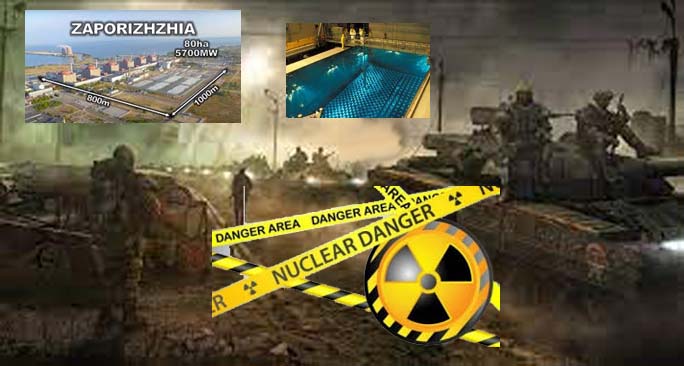
Russian nuclear state corporation Rosatom says officials focused on recent strikes on fuel trucks carrying supplies for Zaporizhzhia plant
Elena Teslova, 15 September 2026, https://www.aa.com.tr/en/world/rosatom-chief-un-nuclear-watchdog-director-general-discuss-zaporizhzhia-nuclear-plant-s-safety-in-vienna/4057265
The head of Russian nuclear state corporation Rosatom and the director general of the International Atomic Energy Agency (IAEA) discussed the safety of the Zaporizhzhia Nuclear Power Plant in Ukraine at a meeting in Vienna, Rosatom said Monday.
The talks between Alexey Likhachev and Rafael Grossi took place on the sidelines of the IAEA General Conference, said Rosatom’s press service.
Likhachev told Grossi that the situation at the plant and in the nearby Ukrainian city of Enerhodar has sharply deteriorated since late April, according to Rosatom.
More than 750 attacks involving Ukrainian drones and artillery have been carried out over the past four and a half months, killing 20 people, including nine Zaporizhzhia plant employees, and injuring more than 100, it said.
“The two officials paid particular attention to recent strikes on fuel trucks carrying supplies for the plant,” it noted.
Likhachev stressed that the trucks were delivering diesel fuel that is urgently needed to ensure the nuclear safety of the plant.
Grossi, for his part, said the IAEA was ready to explore ways it could assist with similar fuel deliveries, according to Rosatom.
He also reaffirmed his commitment to working with Russia on ensuring the safety of the Zaporizhzhia plant and his readiness to continue dialogue on the issue.
Could nuclear fusion power save planet Earth – or is it just a money sink?

euronews, By Hans von der Brelie, 14/09/2026
Scientists are debating if fusion energy will stay science fiction – or if it could really replace fossil fuels in the future.
It is a special moment when the doors of one of the world’s largest laser-fusion fuel laboratories swing open: scientists slip on blue full-body protective suits, mechanics tinker with precision milling machines, and laboratory technicians peer through high-powered microscopes at fuel pellets just four millimetres in size.
We are in Darmstadt, an industrial city in the western German state of Hesse. Here, at the headquarters of the start-up Focused Energy, an international team of highly motivated specialists aims to develop laser fusion to the point where it is ready for industrial application. The company’s goal is to have its first commercial laser-fusion power plant operating in 15 years at the earliest.
Is nuclear fusion really the answer to energy security?
“As humanity, we need carbon-free energy. Renewable energies alone will not be enough. Humanity’s energy demand is far too great,” argues Ulrich Sigel, Vice President of Focused Energy. “If we want to decarbonise, we need fusion energy for all sectors: transport, aviation, shipping, industry, heating – this is where a huge market for CO₂-neutral energy generation is emerging.”
Professor Sven Linow of the Scientific Climate Advisory Board of the Hessian state government, however, is sceptical. “My personal view is that we should not go for it,” he replies when asked by Euronews Earth whether large sums of money should continue to be poured into the development of fusion energy.
It is a sweltering hot day when we meet Linow for an interview in the shade of the futuristic high-rise building at Darmstadt University of Applied Sciences. “No one has yet demonstrated that it really works,” says Linow.
No one has yet demonstrated that it really works.
Sven Linow
Scientific Climate Advisory Board of the Hessian state government
In the US, experiments have shown that, in the crossfire of numerous high-power lasers, light atomic nuclei can actually fuse, releasing energy in the process. However, in order to generate a stable supply of electricity for consumers, these extremely complex experiments would have to be ‘scaled up’.
For a commercial power plant, such laser-induced fusion would have to take place 10 times per second – around the clock. Even the most optimistic staff at Focused Energy admit they are still a long way from achieving this.
Problems with fuel supply aren’t deterring investors
Linow’s main argument against fusion energy, however, is a different one: the fuel supply. “The problem is tritium,” says the professor. “There are [an estimated] 50 kilograms of it worldwide. In 12.3 years, only half of that will remain; it decays with a half-life of 12.3 years. To start up a fusion power station, you need a few kilograms of it, and then you use it up. You’d have to regenerate the tritium within the power station. Nobody has ever tried that before. There is no demonstrator; there is no laboratory experiment in which this has been successfully tested. There are only ideas,” he says.
Speaking to Euronews Earth at Focused Energy’s head office, Sigel admits there are still “unresolved issues” with tritium recovery, but says this is more of an engineering challenge than a fundamental problem of physics. For research labs trying to tackle fuel cycle problems, “this is an exciting engineering task, and that’s something we’re good at in Germany,” says Sigel. “I’m optimistic that we’ll solve it.”
Sigel’s optimism is shared by some politicians. German Chancellor Friedrich Merz (CDU) has thrown his weight behind the project, announcing Germany’s goal to put “the world’s first fusion power plant online”, as has the Hessian state government. As the Minister-President of Hesse, Boris Rhein (CDU), said: “Nuclear fusion could be the game-changer in energy supply.”
International investors also seem enthusiastic: in an initial funding round in the spring, $240 million (€207m) was raised – the largest series A financing in the global fusion industry. The German energy company RWE increased its investment by €60 million.
So why are Professor Linow and the Hessian state government’s Scientific Climate Advisory Council speaking up against fusion energy?
Is nuclear fusion diverting funding away from more realistic solutions?
In part, they question whether the money and political attention devoted to fusion would be better spent on technologies that can cut emissions today.
“The region’s energy supply is set to be climate-neutral by 2045. Will the first large-scale fusion power stations be connected to the grid by then? And the answer is: no, that’s not going to happen,” says Linow. His message is clear: first and foremost, renewable energy sources should be rapidly expanded, the electricity grids modernised and sufficient electricity storage capacity created.
Ulrich Sigel of Focused Energy emphasises that they do not wish to compete with renewable energy sources. In his concept, fusion energy would complement renewables by providing low-carbon electricity even when the sun isn’t shining and the wind isn’t blowing.
The company is pressing ahead. “We want to have the demonstrator up and running in five years,” Sigel tells Euronews Earth. “The first pilot power station should be operational in 10 years, and the first commercial power station in 15 years.”……………………………………………………………………………………………………………………………..
even nuclear fusion is not entirely free of radioactivity. “The reactor vessels must be removed regularly and allowed to decay,” he explains.
In some cases, “you can’t handle them again until several hundred years have passed – perhaps even 1,000 years. Consequently, at some point there will be 200, 400 or 500 of these reactor vessels – which are relatively large – stored on the site. And you’ll have to secure them first.”……………………………
Is nuclear fusion a sound investment?
Renewable energies are now relatively inexpensive in terms of investment. Fusion energy, on the other hand, requires very high investment. Is it even worth the effort? Yes, says Sigel; no, says Linow………….
Professor Linow : “It is foreseeable that fusion power will be by far the most expensive form of energy, significantly more expensive even than nuclear fission power. At least 20 cents per kilowatt-hour, perhaps even two or three times that.”
……. conclusion when looking at the big picture: “I don’t have a good feeling about this. An estimated €35 to 40 billion will be invested in ITER (a magnetic fusion demonstrator). Then DEMO is to be built, which will cost at least as much. On top of that, we have around 50 fusion start-ups, all working simultaneously to prepare fusion power stations.
“Many billions are currently being poured into this, and that is money that is lacking elsewhere. We should set priorities and say: first of all, let’s build what’s necessary to prevent the climate from spiralling completely out of control. We must ensure that we have a reasonably stable society on this planet. Once we’ve achieved that and still have the funds to spare, then we can move forward with fusion. https://www.euronews.com/2026/09/14/could-nuclear-fusion-power-save-planet-earth-or-is-it-just-a-money-sink
IAEA General Conference opens amid growing nuclear proliferation concerns
2026-09, https://www.chinadaily.com.cn/a/202609/15/WS6aa89cd0e4b06d4aa055e089.html
VIENNA – The 70th General Conference of the International Atomic Energy Agency (IAEA) opened in Vienna on Monday, with calls to strengthen multilateral cooperation and efforts to uphold the global nuclear non-proliferation regime amid heightened geopolitical tensions.
In a message delivered by Monica Juma, director-general of the United Nations Office at Vienna, UN Secretary-General Antonio Guterres said this conference comes at a time of profound global turbulence and uncertainty. Attacks on nuclear facilities are rising. The drivers of nuclear proliferation are accelerating while the guardrails against it are falling.
“The world is on the cusp of a revolution in nuclear power generation, a revolution that requires careful management and monitoring. More than ever, the world needs the IAEA’s professionalism, impartiality and technical excellence,” Guterres said in the message.
IAEA Director General Rafael Grossi told the conference that the Treaty on the Non-Proliferation of Nuclear Weapons (NPT) remains the cornerstone of the global non-proliferation regime.
“At this time of heightened tensions and distrust, we must work to underpin this legal framework by supporting the IAEA and working towards its aims. A world with more nuclear weapons and more countries armed with nuclear weapons is not a safer world,” Grossi said.
The 70th Regular Session of the IAEA General Conference, running through Sept. 18, has drawn nearly 4000 senior officials and representatives from IAEA member states, and delegations of international organizations and non-governmental organizations.
Held annually since the IAEA was founded in 1957, the General Conference considers a wide range of issues related to the peaceful uses of nuclear technology, from energy production and cancer care to food security, water management, nuclear safety and security, and safeguards.
Finland joins France’s nuclear deterrent initiative
By Reuters, September 14, 2026
BRUSSELS, – Finland has joined France’s initiative to extend the reach of its nuclear deterrent through collaboration with partner European countries, the heads of both countries said on Monday.
In response to U.S. President Donald Trump’s expressions of concern about the U.S. security commitment to Europe and to the security implications of the Ukraine war, France in March announced the Forward Nuclear Deterrence Initiative………. (Subscribers only) https://www.reuters.com/world/finland-joins-frances-nuclear-deterrent-initiative-2026-09-14/
Japan’s Defense Minister: Nuclear-Powered Submarines Will Not Be Ruled Out
NAVAL NEWS, 15/09/2026, By Kosuke Takahashi
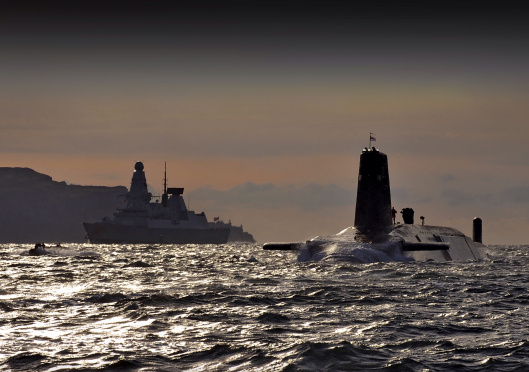
Speaking at a press conference on September 11, Koizumi was asked about reports that a U.S. Navy official had expressed a positive view of Japan potentially acquiring nuclear-powered submarines. While declining to comment directly on individual media reports, Koizumi said the option would be considered as part of the government’s planned revision of Japan’s three key national security documents: the National Security Strategy, National Defense Strategy and Defense Buildup Program. The three documents are expected to be revised by year-end.
As I have said before, in the course of revising the three documents, we will consider all options without ruling anything out,”
“Of course, we will also proceed with our consideration without ruling out nuclear-powered submarines as an option.”Japan’s Defense Minister Shinjiro Koizumi
Koizumi stressed that no decision had been made and that the government was not working toward a predetermined conclusion.
Asked about the strategic advantages of nuclear-powered submarines and the challenges Japan would face if it decided to acquire them, Koizumi offered one of his most detailed public assessments of SSNs to date. Speaking in general terms, he said nuclear-powered submarines can remain submerged for long periods, conduct extended operations, and are said to be capable of speeds several times higher than those of conventionally powered submarines.
“These characteristics make it possible to conduct the required activities while ensuring a higher level of safety for the crew,” Koizumi said.
At the same time, he acknowledged significant disadvantages. He said nuclear-powered submarines are said to be less quiet underwater than conventionally powered submarines. He also cited the high cost of nuclear propulsion systems, the need for larger hulls, and the specialized technical expertise required to operate, maintain, and service nuclear propulsion plants.
“In an increasingly rapidly changing security environment across various fields, we will examine the measures necessary to improve deterrence and response capabilities without ruling out any options,” Koizumi said.
U.S. Navy Official Voices Support for Japan Considering SSNs
Koizumi’s remarks came two days after a U.S. Navy official reportedly expressed a positive view of Japan considering nuclear-powered submarines.
The unnamed U.S. Navy official spoke to Japanese, South Korean, and other Asia-Pacific journalists at Joint Base Pearl Harbor-Hickam in Hawaii on September 9.
According to Japanese media reports, when asked whether Japan should consider acquiring nuclear-powered submarines, the official responded positively, pointing out that Japan operates nuclear power plants and possesses relevant nuclear technology. The same official also drew attention in South Korea by saying Seoul needed a “valid reason” for acquiring nuclear-powered submarines and warning against pursuing them merely as a “status symbol.”
Japan currently operates only conventionally powered diesel-electric submarines, but the debate over nuclear propulsion has accelerated over the past year…………………………….
Major obstacles remain, however. Nuclear-powered submarines would be far more expensive than Japan’s current conventional boats and would require an entirely new infrastructure for naval nuclear propulsion, including reactor maintenance, nuclear fuel management, and specialized personnel. There are also legal and political questions. Japan’s Atomic Energy Basic Act restricts the use of nuclear energy to peaceful purposes, raising longstanding questions about the compatibility of nuclear-powered warships with the existing legal framework.
Koizumi’s September 11 remarks do not mean Japan has decided to acquire SSNs. But his explicit statement that nuclear-powered submarines will not be excluded from consideration, combined with his detailed public assessment of their advantages and disadvantages, suggests that the issue is moving from a largely theoretical debate toward a concrete defense policy discussion. https://www.navalnews.com/naval-news/2026/09/japan-defense-minister-nuclear-powered-submarines/
United States blocks nuclear chief Mohammad Eslami from UN meeting in Vienna
Iran has condemned the exclusion of the head of its atomic energy organisation from an annual gathering of the United Nations nuclear agency in Austria.
The Nightly, Staff Writers. Reuters, 15 Sept 26
The United States has blocked Iran’s nuclear chief from attending a United Nations atomic watchdog meeting in Vienna by opposing an exemption from so-called “snapback” UN sanctions, prompting protests from Iran.
Iranian nuclear chief Mohammad Eslami had been due to attend and address this week’s International Atomic Energy Agency general conference, an annual meeting of IAEA member states that began on Monday.
At the opening, however, Iran said Austria had revoked Eslami’s visa after originally granting him one.
“The cancellation and so-called legal justification advanced for it are a stark indication of a political act and advanced formal politicisation of this organisation,” Iran’s ambassador to the IAEA told the conference.
Iran’s foreign ministry spokesman Esmaeil Baghaei said the United States had pressured Austria into the move while Iran and Russia said it formed part of a broader effort to prevent Iranian officials from obtaining visas for international travel……………………….. https://thenightly.com.au/politics/iran-protests-as-united-states-blocks-nuclear-chief-mohammad-eslami-from-un-meeting-in-vienna-c-22869942
Japan’s submarine debate signals break from nuclear taboos
Japan weighing nuke subs to deter China’s rising threat, but it’s not clear Tokyo has the capital, crew or capacity to keep a nuclear fleet afloat
Asia Times, by Gabriel Honrada, September 14, 2026
Japan is edging closer to a once-unthinkable choice: whether nuclear propulsion should underpin its next generation of undersea deterrence.
This month, the Japan Times reported that Japanese Defense Minister Shinjiro Koizumi confirmed that Japan is keeping the option of acquiring nuclear-powered submarines on the table, following encouraging signals from a US Navy official.
Speaking at a regular press conference, Koizumi stated that Japan will not rule out the capability as it prepares revisions to three key national security documents by year-end.
The remarks came after an unnamed US Navy official, later corroborated by the US Pacific Fleet, suggested discussions should proceed given Japan’s advanced nuclear expertise, noting that asset procurement must align with national operational needs.
The submarine debate also follows Koizumi’s July 2026 call for Japan to discuss nuclear deterrence without taboos, saying the country could no longer avoid confronting nuclear weapons policy amid its worsening security environment…………………………… https://asiatimes.com/2026/09/japans-submarine-debate-signals-break-from-nuclear-taboos/
1 This Month

26 September – International Day for the Total Elimination of Nuclear Weapons


PLEASE OPPOSE HR 8255 AND S.3639 – bills would accelerate satellite deployment, with no environmental review or safeguards – https://ncstd5li.quorum.us/campaign/169331/
To see nuclear-related stories in greater depth and intensity – go to https://nuclearinformation.wordpress.com
-
Archives
- September 2026 (206)
- August 2026 (330)
- July 2026 (355)
- June 2026 (287)
- May 2026 (306)
- April 2026 (356)
- March 2026 (251)
- February 2026 (267)
- January 2026 (308)
- December 2025 (358)
- November 2025 (359)
- October 2025 (375)
-
Categories
- 1
- 1 NUCLEAR ISSUES
- business and costs
- climate change
- culture and arts
- ENERGY
- environment
- health
- history
- indigenous issues
- Legal
- marketing of nuclear
- media
- opposition to nuclear
- PERSONAL STORIES
- politics
- politics international
- Religion and ethics
- safety
- secrets,lies and civil liberties
- spinbuster
- technology
- Uranium
- wastes
- weapons and war
- Women
- 2 WORLD
- ACTION
- AFRICA
- Atrocities
- AUSTRALIA
- Christina's notes
- Christina's themes
- culture and arts
- Events
- Fuk 2022
- Fuk 2023
- Fukushima 2017
- Fukushima 2018
- fukushima 2019
- Fukushima 2020
- Fukushima 2021
- general
- global warming
- Humour (God we need it)
- Nuclear
- RARE EARTHS
- Reference
- resources – print
- Resources -audiovicual
- Weekly Newsletter
- World
- World Nuclear
- YouTube
-
RSS
Entries RSS
Comments RSS
 nuclear-news